

ISO 8600-3:2019
(Main)Endoscopes — Medical endoscopes and endotherapy devices — Part 3: Determination of field of view and direction of view of endoscopes with optics
General Information
- Abstract
This document applies to endoscopes designed for use in the practice of medicine. It specifies measurement requirements and describes two test methods for measuring the field of view and direction of view of endoscopes. Method A uses the distance from the distal window to calculate the field of view. Method B uses the distance from the entrance pupil. Other test methods can be used if they obtain equivalent results.
- Status
- Published
- Publication Date
- 28-Jul-2019
- Technical Committee
- ISO/TC 172/SC 5 - Microscopes and endoscopes
- Drafting Committee
- ISO/TC 172/SC 5/WG 6 - Endoscopes
- Current Stage
- 9092 - International Standard to be revised
- Start Date
- 05-Feb-2025
- Completion Date
- 29-Aug-2026
Buy Documents

ISO 8600-3:2019 - Endoscopes -- Medical endoscopes and endotherapy devices

ISO 8600-3:2019 - Endoscopes — Medical endoscopes and endotherapy devices — Part 3: Determination of field of view and direction of view of endoscopes with optics/29/2019
Overview
ISO 8600-3:2019 - "Endoscopes - Medical endoscopes and endotherapy devices - Part 3" defines standardized measurement methods for the field of view (FOV) and direction of view of medical endoscopes with optics. The standard applies to endoscopes used in clinical practice and specifies two principal test methods (Method A and Method B), measurement accuracy requirements (per ISO 8600-1), apparatus, test procedures and required test report content.
Key topics and requirements
- Two test methods
- Method A (distal window reference): Calculates FOV using the distance from the distal window (typical for many rigid and flexible endoscopes). Applicable when the measuring distance is at least 30× the distance between the distal end and the entrance pupil to avoid systematic error.
- Method B (entrance pupil reference): Uses the entrance pupil as the distance reference and can be used at any test distance - recommended for capsule endoscopes, close-focus designs, and where Method A’s assumptions fail.
- Apparatus and targets
- Optical bench or equivalent with centring and distance adjustment (0–50 mm ±0.2 mm for Method A; capability to position concentric target circles for Method B).
- Targets: Method A uses circular targets scaled for 50 mm (major marks every 10°); Method B uses two concentric circles (recommended radii 18 mm and 9 mm) with crosshair.
- Illumination: White light target illumination sufficient to identify target details; can be delivered via endoscope lighting or external source.
- Measurement tolerances and accuracy
- Follow measurement accuracy requirements of ISO 8600-1.
- Specific tolerances in procedures: 50 mm ±0.2 mm placement, distal window within 0.5 mm for Method B steps, and manufacturer-specified measuring distances ±1% if relevant.
- Test report essentials
- Standard reference, endoscope type/manufacturer/model/serial, method used, measuring distances, measured FOV and direction of view with 95% confidence uncertainties, lab and engineer details, date/place, and any deviations.
Applications and users
- Who uses it: endoscope manufacturers, optical and medical device test laboratories, R&D teams, quality assurance engineers, notified bodies and regulators assessing device performance, and procurement/specification teams.
- Practical use cases: verifying product specifications, design validation, comparative performance testing (FOV and viewing angle), regulatory submissions, and supplier quality agreements for medical endoscopes and endotherapy devices.
Related standards
- ISO 8600-1 - General requirements for medical endoscopes (measurement accuracy reference).
- ISO 8600-6 - Vocabulary for endoscopes and endotherapy devices.
Keywords: ISO 8600-3:2019, endoscopes, field of view, direction of view, entrance pupil, distal window, Method A, Method B, medical endoscopes, test methods, endotherapy devices.
Relations
- Effective Date
- 05-Oct-2013
- Effective Date
- 05-Oct-2013
Buy Documents
ISO 8600-3:2019 - Endoscopes -- Medical endoscopes and endotherapy devices
ISO 8600-3:2019 - Endoscopes — Medical endoscopes and endotherapy devices — Part 3: Determination of field of view and direction of view of endoscopes with optics/29/2019
Get Certified
Connect with accredited certification bodies for this standard

BSI Group
BSI (British Standards Institution) is the business standards company that helps organizations make excellence a habit.

TÜV Rheinland
TÜV Rheinland is a leading international provider of technical services.

TÜV SÜD
TÜV SÜD is a trusted partner of choice for safety, security and sustainability solutions.
Sponsored listings
Frequently Asked Questions
ISO 8600-3:2019 is a standard published by the International Organization for Standardization (ISO). Its full title is "Endoscopes — Medical endoscopes and endotherapy devices — Part 3: Determination of field of view and direction of view of endoscopes with optics". This standard covers: This document applies to endoscopes designed for use in the practice of medicine. It specifies measurement requirements and describes two test methods for measuring the field of view and direction of view of endoscopes. Method A uses the distance from the distal window to calculate the field of view. Method B uses the distance from the entrance pupil. Other test methods can be used if they obtain equivalent results.
This document applies to endoscopes designed for use in the practice of medicine. It specifies measurement requirements and describes two test methods for measuring the field of view and direction of view of endoscopes. Method A uses the distance from the distal window to calculate the field of view. Method B uses the distance from the entrance pupil. Other test methods can be used if they obtain equivalent results.
ISO 8600-3:2019 is classified under the following ICS (International Classification for Standards) categories: 11.040.55 - Diagnostic equipment. The ICS classification helps identify the subject area and facilitates finding related standards.
ISO 8600-3:2019 has the following relationships with other standards: It is inter standard links to ISO 8600-3:1997/Amd 1:2003, ISO 8600-3:1997. Understanding these relationships helps ensure you are using the most current and applicable version of the standard.
ISO 8600-3:2019 is available in PDF format for immediate download after purchase. The document can be added to your cart and obtained through the secure checkout process. Digital delivery ensures instant access to the complete standard document.
Standards Content (Sample)
INTERNATIONAL ISO
STANDARD 8600-3
Second edition
2019-08
Endoscopes — Medical endoscopes
and endotherapy devices —
Part 3:
Determination of field of view and
direction of view of endoscopes with
optics
Endoscopes — Endoscopes médicaux et dispositifs d'endothérapie —
Partie 3: Détermination du champ d'observation et de la direction
d'observation des endoscopes optiques
Reference number
©
ISO 2019
© ISO 2019
All rights reserved. Unless otherwise specified, or required in the context of its implementation, no part of this publication may
be reproduced or utilized otherwise in any form or by any means, electronic or mechanical, including photocopying, or posting
on the internet or an intranet, without prior written permission. Permission can be requested from either ISO at the address
below or ISO’s member body in the country of the requester.
ISO copyright office
CP 401 • Ch. de Blandonnet 8
CH-1214 Vernier, Geneva
Phone: +41 22 749 01 11
Fax: +41 22 749 09 47
Email: copyright@iso.org
Website: www.iso.org
Published in Switzerland
ii © ISO 2019 – All rights reserved
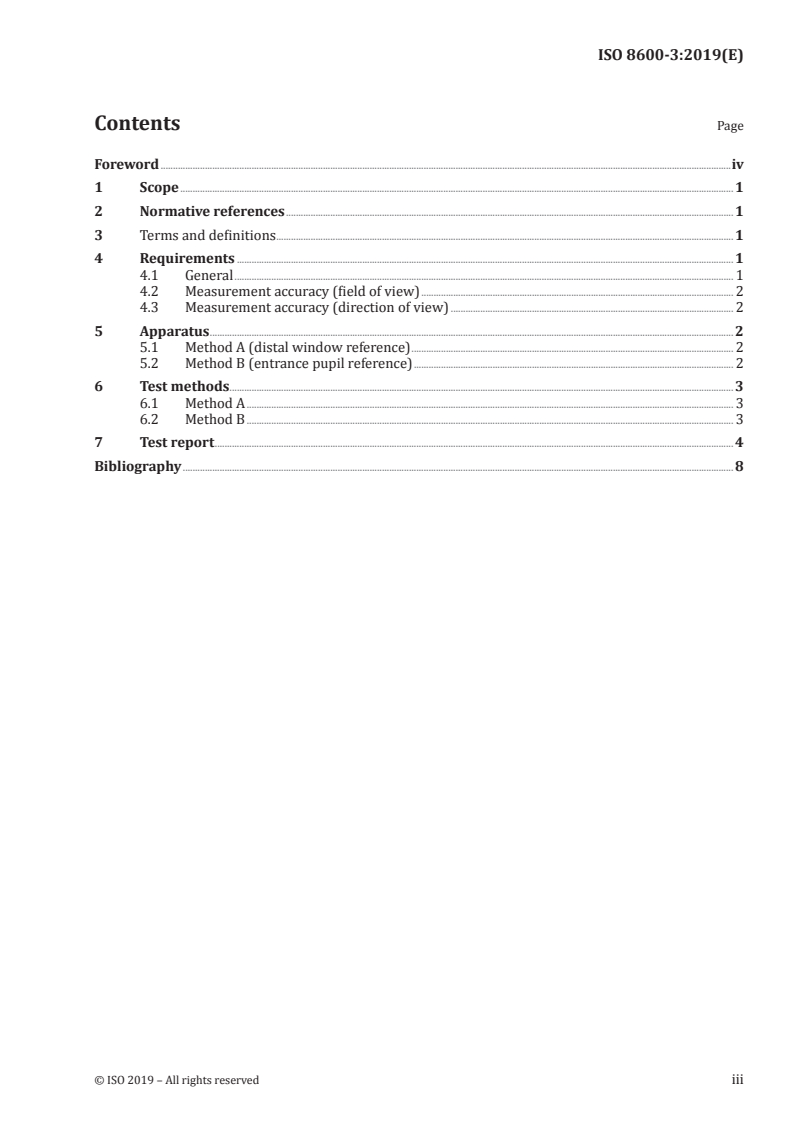
Contents Page
Foreword .iv
1 Scope . 1
2 Normative references . 1
3 Terms and definitions . 1
4 Requirements . 1
4.1 General . 1
4.2 Measurement accuracy (field of view) . 2
4.3 Measurement accuracy (direction of view) . 2
5 Apparatus . 2
5.1 Method A (distal window reference) . 2
5.2 Method B (entrance pupil reference) . 2
6 Test methods . 3
6.1 Method A . 3
6.2 Method B . 3
7 Test report . 4
Bibliography . 8
Foreword
ISO (the International Organization for Standardization) is a worldwide federation of national standards
bodies (ISO member bodies). The work of preparing International Standards is normally carried out
through ISO technical committees. Each member body interested in a subject for which a technical
committee has been established has the right to be represented on that committee. International
organizations, governmental and non-governmental, in liaison with ISO, also take part in the work.
ISO collaborates closely with the International Electrotechnical Commission (IEC) on all matters of
electrotechnical standardization.
The procedures used to develop this document and those intended for its further maintenance are
described in the ISO/IEC Directives, Part 1. In particular the different approval criteria needed for the
different types of ISO documents should be noted. This document was drafted in accordance with the
editorial rules of the ISO/IEC Directives, Part 2 (see www .iso .org/directives).
Attention is drawn to the possibility that some of the elements of this document may be the subject of
patent rights. ISO shall not be held responsible for identifying any or all such patent rights. Details of
any patent rights identified during the development of the document will be in the Introduction and/or
on the ISO list of patent declarations received (see www .iso .org/patents).
Any trade name used in this document is information given for the convenience of users and does not
constitute an endorsement.
For an explanation on the voluntary nature of standards, the meaning of ISO specific terms and
expressions related to conformity assessment, as well as information about ISO's adherence to the
World Trade Organization (WTO) principles in the Technical Barriers to Trade (TBT) see the following
URL: www .iso .org/iso/foreword .html.
The committee responsible for this document is ISO/TC 172, Optics and photonics, Subcommittee SC 5,
Microscopes and endoscopes.
This second edition cancels and replaces the first edition (ISO 8600-3:1997). It also incorporates the
Amendment ISO 8600-3:1997/Amd 1:2003.
A list of all parts in the ISO 8600 series can be found on the ISO website.
Any feedback or questions on this document should be directed to the user’s national standards body. A
complete listing of these bodies can be found at www .iso .org/members .html.
iv © ISO 2019 – All rights reserved
INTERNATIONAL STANDARD ISO 8600-3:2019(E)
Endoscopes — Medical endoscopes and endotherapy
devices —
Part 3:
Determination of field of view and direction of view of
endoscopes with optics
1 Scope
This document applies to endoscopes designed for use in the practice of medicine. It specifies
measurement requirements and describes two test methods for measuring the field of view and
direction of view of endoscopes. Method A uses the distance from the distal window to calculate the
field of view. Method B uses the distance from the entrance pupil. Other test methods can be used if
they obtain equivalent results.
2 Normative references
The following documents are referred to in the text in such a way that some or all of their content
constitutes requirements of this document. For dated references, only the edition cited applies. For
undated references, the latest edition of the referenced document (including any amendments) applies.
ISO 8600-1, Endoscopes — Medical endoscopes and endotherapy devices — Part 1: General requirements
ISO 8600-6, Optics and photonics — Medical endoscopes and endotherapy devices — Part 6: Vocabulary
3 Terms and definitions
For the purposes of this document, the terms and definitions given in ISO 8600-1 and ISO 8600-6 apply.
ISO and IEC maintain terminological databases for use in standardization at the following addresses:
— ISO Online browsing platform: available at http: //www .iso .org/obp
— IEC Electropedia: available at http: //www .electropedia .org/
4 Requirements
4.1 General
Method A applies only if the measuring distance is at least 30 times larger than the distance between the
[1]
distal end and the entrance pupil and the accuracy requirement in ISO 8600-1 is satisfied. Otherwise,
the error caused by the distance between the distal end and the entrance pupil in Method A will lead to
a systematic measurement error.
Method B may be used at any distance. In general, any method is allowed which has the entrance pupil
as reference. Details about test Method A and Method B for measuring endoscope field of view and
direction of view, inc
...
INTERNATIONAL ISO
STANDARD 8600-3
Second edition
2019-08
Endoscopes — Medical endoscopes
and endotherapy devices —
Part 3:
Determination of field of view and
direction of view of endoscopes with
optics
Endoscopes — Endoscopes médicaux et dispositifs d'endothérapie —
Partie 3: Détermination du champ d'observation et de la direction
d'observation des endoscopes optiques
Reference number
©
ISO 2019
© ISO 2019
All rights reserved. Unless otherwise specified, or required in the context of its implementation, no part of this publication may
be reproduced or utilized otherwise in any form or by any means, electronic or mechanical, including photocopying, or posting
on the internet or an intranet, without prior written permission. Permission can be requested from either ISO at the address
below or ISO’s member body in the country of the requester.
ISO copyright office
CP 401 • Ch. de Blandonnet 8
CH-1214 Vernier, Geneva
Phone: +41 22 749 01 11
Fax: +41 22 749 09 47
Email: copyright@iso.org
Website: www.iso.org
Published in Switzerland
ii © ISO 2019 – All rights reserved
Contents Page
Foreword .iv
1 Scope . 1
2 Normative references . 1
3 Terms and definitions . 1
4 Requirements . 1
4.1 General . 1
4.2 Measurement accuracy (field of view) . 2
4.3 Measurement accuracy (direction of view) . 2
5 Apparatus . 2
5.1 Method A (distal window reference) . 2
5.2 Method B (entrance pupil reference) . 2
6 Test methods . 3
6.1 Method A . 3
6.2 Method B . 3
7 Test report . 4
Bibliography . 8
Foreword
ISO (the International Organization for Standardization) is a worldwide federation of national standards
bodies (ISO member bodies). The work of preparing International Standards is normally carried out
through ISO technical committees. Each member body interested in a subject for which a technical
committee has been established has the right to be represented on that committee. International
organizations, governmental and non-governmental, in liaison with ISO, also take part in the work.
ISO collaborates closely with the International Electrotechnical Commission (IEC) on all matters of
electrotechnical standardization.
The procedures used to develop this document and those intended for its further maintenance are
described in the ISO/IEC Directives, Part 1. In particular the different approval criteria needed for the
different types of ISO documents should be noted. This document was drafted in accordance with the
editorial rules of the ISO/IEC Directives, Part 2 (see www .iso .org/directives).
Attention is drawn to the possibility that some of the elements of this document may be the subject of
patent rights. ISO shall not be held responsible for identifying any or all such patent rights. Details of
any patent rights identified during the development of the document will be in the Introduction and/or
on the ISO list of patent declarations received (see www .iso .org/patents).
Any trade name used in this document is information given for the convenience of users and does not
constitute an endorsement.
For an explanation on the voluntary nature of standards, the meaning of ISO specific terms and
expressions related to conformity assessment, as well as information about ISO's adherence to the
World Trade Organization (WTO) principles in the Technical Barriers to Trade (TBT) see the following
URL: www .iso .org/iso/foreword .html.
The committee responsible for this document is ISO/TC 172, Optics and photonics, Subcommittee SC 5,
Microscopes and endoscopes.
This second edition cancels and replaces the first edition (ISO 8600-3:1997). It also incorporates the
Amendment ISO 8600-3:1997/Amd 1:2003.
A list of all parts in the ISO 8600 series can be found on the ISO website.
Any feedback or questions on this document should be directed to the user’s national standards body. A
complete listing of these bodies can be found at www .iso .org/members .html.
iv © ISO 2019 – All rights reserved
INTERNATIONAL STANDARD ISO 8600-3:2019(E)
Endoscopes — Medical endoscopes and endotherapy
devices —
Part 3:
Determination of field of view and direction of view of
endoscopes with optics
1 Scope
This document applies to endoscopes designed for use in the practice of medicine. It specifies
measurement requirements and describes two test methods for measuring the field of view and
direction of view of endoscopes. Method A uses the distance from the distal window to calculate the
field of view. Method B uses the distance from the entrance pupil. Other test methods can be used if
they obtain equivalent results.
2 Normative references
The following documents are referred to in the text in such a way that some or all of their content
constitutes requirements of this document. For dated references, only the edition cited applies. For
undated references, the latest edition of the referenced document (including any amendments) applies.
ISO 8600-1, Endoscopes — Medical endoscopes and endotherapy devices — Part 1: General requirements
ISO 8600-6, Optics and photonics — Medical endoscopes and endotherapy devices — Part 6: Vocabulary
3 Terms and definitions
For the purposes of this document, the terms and definitions given in ISO 8600-1 and ISO 8600-6 apply.
ISO and IEC maintain terminological databases for use in standardization at the following addresses:
— ISO Online browsing platform: available at http: //www .iso .org/obp
— IEC Electropedia: available at http: //www .electropedia .org/
4 Requirements
4.1 General
Method A applies only if the measuring distance is at least 30 times larger than the distance between the
[1]
distal end and the entrance pupil and the accuracy requirement in ISO 8600-1 is satisfied. Otherwise,
the error caused by the distance between the distal end and the entrance pupil in Method A will lead to
a systematic measurement error.
Method B may be used at any distance. In general, any method is allowed which has the entrance pupil
as reference. Details about test Method A and Method B for measuring endoscope field of view and
direction of view, inc
...