

ISO 8600-7:2012
(Main)Endoscopes — Medical endoscopes and endotherapy devices — Part 7: Basic requirements for medical endoscopes of water-resistant type
General Information
- Abstract
ISO 8600-7:2012 specifies requirements for medical endoscopes, either flexible or rigid with a bending section, of water-resistant type.
- Status
- Published
- Publication Date
- 05-Jul-2012
- Technical Committee
- ISO/TC 172/SC 5 - Microscopes and endoscopes
- Drafting Committee
- ISO/TC 172/SC 5/WG 6 - Endoscopes
- Current Stage
- 9092 - International Standard to be revised
- Start Date
- 05-Feb-2025
- Completion Date
- 29-Aug-2026

Overview
ISO 8600-7:2012 is an international standard specifying the basic requirements for medical endoscopes designed to be water-resistant. This standard applies to both flexible and rigid medical endoscopes with a bending section. Water resistance is critical to ensure these endoscopes maintain functionality and patient safety during medical procedures, especially when subjected to sterilization processes involving liquids.
Established by the International Organization for Standardization (ISO), this standard is part seven within the broader ISO 8600 series, which covers general and specific requirements for medical endoscopes and endotherapy devices. ISO 8600-7 focuses specifically on verifying the structural integrity of water-resistant endoscopes by setting testing protocols to prevent internal air leakage when submerged.
Key Topics
Water Resistance Requirements
Medical endoscopes classified as water-resistant must withstand internal positive pressure of at least 20 kPa without leaking air. This ensures the enclosure integrity during sterilization and clinical use.Testing Procedure
The standard mandates that endoscopes be fully submerged in water with sustained positive pressure applied inside the enclosure for no less than one minute. Observers check for continuous air bubbles escaping, which would indicate leakage.Test Conditions
- Temperature range: 10 °C to 40 °C
- Minimum positive pressure: 20 kPa
- Complete immersion depth adequate to submerge the endoscope
- Duration of pressure application: at least 1 minute
Special Considerations for Electric Components
For video and ultrasonic endoscopes with electrical connectors, water-resistant caps or similar protective measures should be used during testing to validate water resistance reliably.Detection Criteria
Surface-attached or trapped internal bubbles are disregarded; only persistent air leakage from a single point is a failure indicator.
Applications
ISO 8600-7:2012 is essential for manufacturers of medical endoscopes to design and validate products capable of withstanding water exposure during use and cleaning cycles. Clinics and hospitals benefit from this standard by purchasing endoscopes meeting stringent waterproofing criteria, reducing risks of device contamination and electrical hazards.
Device Manufacturing
Provides clear specifications for designing endoscopes that resist water ingress, critical for product certification and market acceptance.Quality Assurance and Compliance
Assists regulatory bodies and healthcare providers in verifying the safety and reliability of water-resistant medical endoscopes through standardized testing methods.Clinical Safety
Ensures the integrity of endoscopes used in minimally invasive procedures, supporting effective sterilization without compromising performance.
Related Standards
ISO 8600-7:2012 is part of the comprehensive ISO 8600 series addressing medical endoscope technologies:
- ISO 8600-1: General requirements for medical endoscopes and endotherapy devices
- ISO 8600-2: Requirements for rigid bronchoscopes
- ISO 8600-3: Field of view and direction of view determination for optics-equipped endoscopes
- ISO 8600-4: Maximum width of insertion portion determination
- ISO 8600-5: Optical resolution determination for rigid endoscopes
- ISO 8600-6: Vocabulary related to medical endoscopes
Together, these standards provide a unified framework for the design, testing, and classification of medical endoscopes, ensuring safety, reliability, and performance.
By adhering to ISO 8600-7:2012, manufacturers and healthcare facilities ensure that water-resistant medical endoscopes meet rigorous international guidelines, enhancing safety and durability in various medical applications. This standard is vital for improving patient outcomes and supporting effective endoscope maintenance protocols worldwide.
Get Certified
Connect with accredited certification bodies for this standard

BSI Group
BSI (British Standards Institution) is the business standards company that helps organizations make excellence a habit.

TÜV Rheinland
TÜV Rheinland is a leading international provider of technical services.

TÜV SÜD
TÜV SÜD is a trusted partner of choice for safety, security and sustainability solutions.
Sponsored listings
Frequently Asked Questions
ISO 8600-7:2012 is a standard published by the International Organization for Standardization (ISO). Its full title is "Endoscopes — Medical endoscopes and endotherapy devices — Part 7: Basic requirements for medical endoscopes of water-resistant type". This standard covers: ISO 8600-7:2012 specifies requirements for medical endoscopes, either flexible or rigid with a bending section, of water-resistant type.
ISO 8600-7:2012 specifies requirements for medical endoscopes, either flexible or rigid with a bending section, of water-resistant type.
ISO 8600-7:2012 is classified under the following ICS (International Classification for Standards) categories: 11.040.55 - Diagnostic equipment. The ICS classification helps identify the subject area and facilitates finding related standards.
ISO 8600-7:2012 is available in PDF format for immediate download after purchase. The document can be added to your cart and obtained through the secure checkout process. Digital delivery ensures instant access to the complete standard document.
Standards Content (Sample)
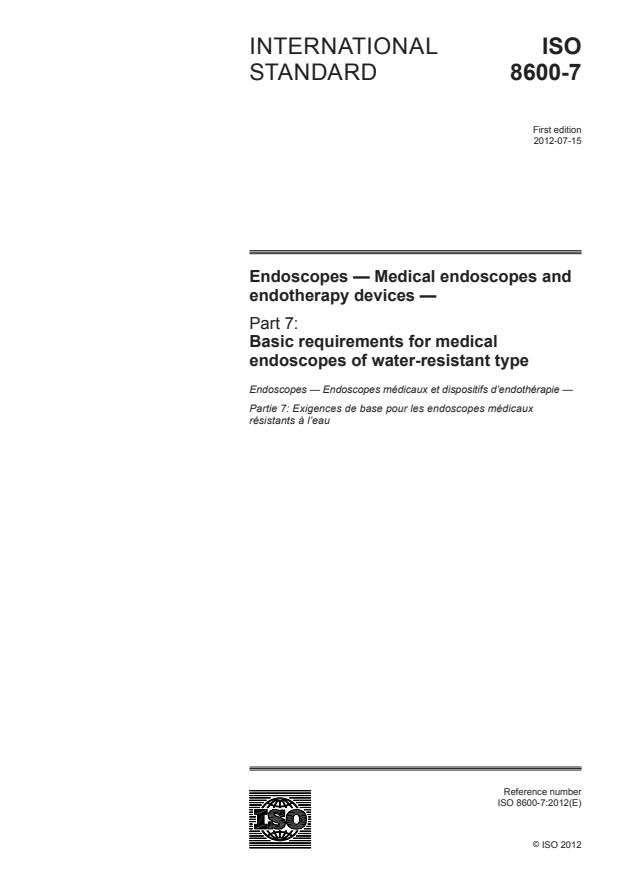
INTERNATIONAL ISO
STANDARD 8600-7
First edition
2012-07-15
Endoscopes — Medical endoscopes and
endotherapy devices —
Part 7:
Basic requirements for medical
endoscopes of water-resistant type
Endoscopes — Endoscopes médicaux et dispositifs d’endothérapie —
Partie 7: Exigences de base pour les endoscopes médicaux
résistants à l’eau
Reference number
©
ISO 2012
All rights reserved. Unless otherwise specified, no part of this publication may be reproduced or utilized in any form or by any means,
electronic or mechanical, including photocopying and microfilm, without permission in writing from either ISO at the address below or ISO’s
member body in the country of the requester.
ISO copyright office
Case postale 56 • CH-1211 Geneva 20
Tel. + 41 22 749 01 11
Fax + 41 22 749 09 47
E-mail copyright@iso.org
Web www.iso.org
Published in Switzerland
ii © ISO 2012 – All rights reserved
Foreword
ISO (the International Organization for Standardization) is a worldwide federation of national standards bodies
(ISO member bodies). The work of preparing International Standards is normally carried out through ISO
technical committees. Each member body interested in a subject for which a technical committee has been
established has the right to be represented on that committee. International organizations, governmental and
non-governmental, in liaison with ISO, also take part in the work. ISO collaborates closely with the International
Electrotechnical Commission (IEC) on all matters of electrotechnical standardization.
International Standards are drafted in accordance with the rules given in the ISO/IEC Directives, Part 2.
The main task of technical committees is to prepare International Standards. Draft International Standards
adopted by the technical committees are circulated to the member bodies for voting. Publication as an
International Standard requires approval by at least 75 % of the member bodies casting a vote.
Attention is drawn to the possibility that some of the elements of this document may be the subject of patent
rights. ISO shall not be held responsible for identifying any or all such patent rights.
ISO 8600-7 was prepared by Technical Committee ISO/TC 172, Optics and photonics, Subcommittee SC 5,
Microscopes and endoscopes.
ISO 8600 consists of the following parts, under the general title Endoscopes — Medical endoscopes and
1)
endotherapy devices :
— Part 1: General requirements
— Part 2: Particular requirements for rigid bronchoscopes
— Part 3: Determination of field of view and direction of view of endoscopes with optics
— Part 4: Determination of maximum width of insertion portion
— Part 5: Determination of optical resolution of rigid endoscopes with optics
— Part 6: Vocabulary
— Par
...