

ISO 13632:2012
(Main)Binders for paints and varnishes — Rosin — Sampling and sample preparation for colour measurement
General Information
- Abstract
This International Standard specifies a procedure for sampling of rosin and rosin derivatives from — drums, — the molten/liquid form, — flakes, pellets or pastilles and preparation of the samples for colour measurement. The method to be used for the colour measurement is specified in other standards. The colour of the rosin can be measured with neat rosin or rosin in solution. The two most commonly used colour-measurement methods are those based on the USDA1) scale and the Gardner colour scale. Annex A provides information on the correlation between these two scales.
- Status
- Published
- Publication Date
- 28-Jun-2012
- Technical Committee
- ISO/TC 35 - Paints and varnishes
- Drafting Committee
- ISO/TC 35 - Paints and varnishes
- Current Stage
- 9093 - International Standard confirmed
- Start Date
- 17-Feb-2024
- Completion Date
- 29-Aug-2026
Buy Documents
ISO 13632:2012 - Binders for paints and varnishes — Rosin — Sampling and sample preparation for colour measurement Released:6/29/2012
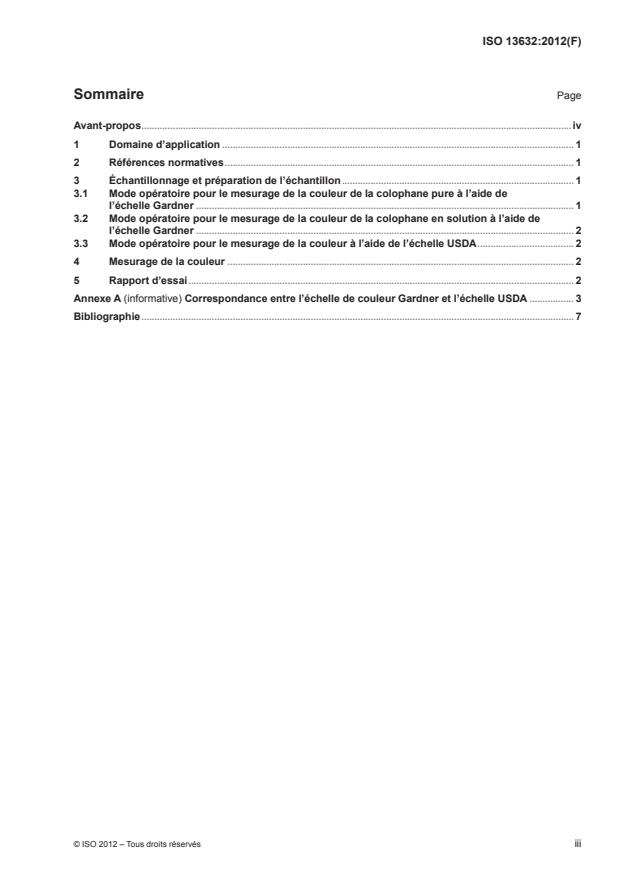
ISO 13632:2012 - Liants pour peintures et vernis — Colophane — Échantillonnage et préparation des échantillons pour le mesurage de la couleur Released:6/29/2012
Overview - ISO 13632:2012 (Rosin sampling and colour measurement)
ISO 13632:2012 specifies standardized procedures for sampling and sample preparation of rosin and rosin derivatives to ensure reliable colour measurement for use in paints and varnishes. The standard covers sampling from drums, molten/liquid rosin, and solid forms (flakes, pellets, pastilles) and describes how to prepare samples for measurement either as neat rosin or as rosin in solution. The actual colour measurement methods are referenced to other standards (e.g., ISO 4630 and ASTM D509). Annex A provides a correlation between the Gardner and USDA colour scales.
Key topics and technical requirements
- Sample form and cleanliness: Use freshly broken lumps free of dust and fine particles.
- Melting and handling:
- Melt in a clean container (oven, hotplate, heat gun, sand or oil bath) in an inert-gas atmosphere.
- Avoid overheating and avoid bubble formation by stirring slowly.
- Time from start of heating to pouring must not exceed 15 minutes.
- Neat rosin measurement (Gardner):
- Pour molten rosin into a test tube or cuvette while molten and measure immediately using ISO 4630-1 or ISO 4630-2 procedures.
- Rosin in solution (Gardner):
- Prepare a 50.0:50.0 (by mass) solution in analytical-grade toluene, dissolve at room temperature, then measure.
- USDA method:
- Pour molten rosin into a mould giving a 22.2 mm viewing path (cube) before measurement per ASTM D509.
- Reporting: Test reports must state the method of sample preparation in addition to measurement results.
- Scale correlation: Annex A details how to correlate USDA and Gardner scales (includes CIE x,y,Y data, use of Beer’s law for path-length correction and ΔE comparisons).
Practical applications and users
ISO 13632 is intended for:
- Quality control laboratories in rosin production and resin processing
- Manufacturers and formulators of paints, varnishes, adhesives, inks and related binders
- Third-party test labs and QA teams evaluating incoming raw materials
- Procurement and specification writers who require traceable, comparable colour data for rosin grades
Benefits include consistent sampling practice, repeatable colour measurement, and reliable comparisons between Gardner and USDA colour values.
Related standards (key references)
- ISO 4630-1: Gardner colour scale - visual method
- ISO 4630-2: Gardner colour scale - spectrophotometric method
- ASTM D509: Colour and sampling procedures for rosin (USDA scale)
Keywords: rosin sampling, colour measurement, Gardner scale, USDA scale, paint binders, rosin in solution, toluene, ISO 13632.
Relations
- Referred By
EN ISO 4630:2015 - Clear liquids - Estimation of colour by the Gardner colour scale (ISO 4630:2015) - Effective Date
- 11-Feb-2026
- Effective Date
- 12-Feb-2026
- Effective Date
- 06-Jun-2022
Buy Documents
ISO 13632:2012 - Binders for paints and varnishes — Rosin — Sampling and sample preparation for colour measurement Released:6/29/2012
ISO 13632:2012 - Liants pour peintures et vernis — Colophane — Échantillonnage et préparation des échantillons pour le mesurage de la couleur Released:6/29/2012
Frequently Asked Questions
ISO 13632:2012 is a standard published by the International Organization for Standardization (ISO). Its full title is "Binders for paints and varnishes — Rosin — Sampling and sample preparation for colour measurement". This standard covers: This International Standard specifies a procedure for sampling of rosin and rosin derivatives from — drums, — the molten/liquid form, — flakes, pellets or pastilles and preparation of the samples for colour measurement. The method to be used for the colour measurement is specified in other standards. The colour of the rosin can be measured with neat rosin or rosin in solution. The two most commonly used colour-measurement methods are those based on the USDA1) scale and the Gardner colour scale. Annex A provides information on the correlation between these two scales.
This International Standard specifies a procedure for sampling of rosin and rosin derivatives from — drums, — the molten/liquid form, — flakes, pellets or pastilles and preparation of the samples for colour measurement. The method to be used for the colour measurement is specified in other standards. The colour of the rosin can be measured with neat rosin or rosin in solution. The two most commonly used colour-measurement methods are those based on the USDA1) scale and the Gardner colour scale. Annex A provides information on the correlation between these two scales.
ISO 13632:2012 is classified under the following ICS (International Classification for Standards) categories: 87.060.20 - Binders. The ICS classification helps identify the subject area and facilitates finding related standards.
ISO 13632:2012 has the following relationships with other standards: It is inter standard links to EN ISO 4630:2015, EN ISO 13632:2012, ISO 11334-1:2007. Understanding these relationships helps ensure you are using the most current and applicable version of the standard.
ISO 13632:2012 is available in PDF format for immediate download after purchase. The document can be added to your cart and obtained through the secure checkout process. Digital delivery ensures instant access to the complete standard document.
Standards Content (Sample)
INTERNATIONAL ISO
STANDARD 13632
First edition
2012-07-01
Binders for paints and varnishes —
Rosin — Sampling and sample
preparation for colour measurement
Liants pour peintures et vernis — Colophane — Échantillonnage et
préparation des échantillons pour le mesurage de la couleur
Reference number
©
ISO 2012
All rights reserved. Unless otherwise specified, no part of this publication may be reproduced or utilized in any form or by any means,
electronic or mechanical, including photocopying and microfilm, without permission in writing from either ISO at the address below or ISO’s
member body in the country of the requester.
ISO copyright office
Case postale 56 • CH-1211 Geneva 20
Tel. + 41 22 749 01 11
Fax + 41 22 749 09 47
E-mail copyright@iso.org
Web www.iso.org
Published in Switzerland
ii © ISO 2012 – All rights reserved
Contents Page
Foreword .iv
1 Scope . 1
2 Normative references . 1
3 Sampling and sample preparation . 1
3.1 Procedure for Gardner colour measurement of neat rosin . 1
3.2 Procedure for Gardner colour measurement of rosin in solution . 1
3.3 Procedure for USDA colour . 2
4 Colour measurement . 2
5 Test report . 2
Annex A (informative) Correlation between Gardner colour scale and USDA scale . 3
Bibliography . 7
Foreword
ISO (the International Organization for Standardization) is a worldwide federation of national standards bodies
(ISO member bodies). The work of preparing International Standards is normally carried out through ISO
technical committees. Each member body interested in a subject for which a technical committee has been
established has the right to be represented on that committee. International organizations, governmental and
non-governmental, in liaison with ISO, also take part in the work. ISO collaborates closely with the International
Electrotechnical Commission (IEC) on all matters of electrotechnical standardization.
International Standards are drafted in accordance with the rules given in the ISO/IEC Directives, Part 2.
The main task of technical committees is to prepare International Standards. Draft International Standards
adopted by the technical committees are circulated to the member bodies for voting. Publication as an
International Standard requires approval by at least 75 % of the member bodies casting a vote.
Attention is drawn to the possibility that some of the elements of this document may be the subject of patent
rights. ISO shall not be held responsible for identifying any or all such patent rights.
ISO 13632 was prepared by Technical Committee ISO/TC 35, Paints and varnishes, Subcommittee SC 10,
Test methods for binders for paints and varnishes.
iv © ISO 2012 – All rights reserved
INTERNATIONAL STANDARD ISO 13632:2012(E)
Binders for paints and varnishes — Rosin — Sampling and
sample preparation for colour measurement
1 Scope
This International Standard specifies a procedure for sampling of rosin and rosin derivatives from
— drums,
— the molten/liquid form,
— flakes, pellets or pastilles
and preparation of the samples for colour measurement. The method to be used for the colour measurement
is specified in other standards. The colour of the rosin can be measured with neat rosin or rosin in solution.
1)
The two most commonly used colour-measurement methods are those based on the USDA scale and the
Gardner colour scale. Annex A provides information on the correlation between these two scales.
2 Normative references
The following referenced documents are indispensable for the application of this document. For dated
references, only the edition cited applies. For undated references, the latest edition of the referenced document
(including any amendments) applies.
ISO 4630-1, Clear liquids — Estimation of colour by the Gardner colour scale — Part 1: Visual method
ISO 4630-2, Clear liquids — Estimation of colour by the Gardner colour scale — Part 2: Spectrophotometric method
ASTM D509, Standard Test Methods of Sampling and Grading Rosin
3 Sampling and sample preparation
3.1 Procedure for Gardner colour measurement of neat rosin
The sample to be tested shall consist of freshly broken lumps and shall be free of dust and finely divided material.
Melt a sufficient amount of material in a clean container using an oven, hotplate, heat gun, sand bath or oil bath
in an inert-gas atmosphere, taking care to avoid overheating. Stir slowly, avoiding the formation of bubbles.
Melt the sample completely, but do not heat it above the temperature necessary for the sample to pour readily.
The time from the beginning of heating to pouring the sample shall not exceed 15 min.
Pour the molten sample into a test tube or cuvette and, while the sample is still molten, insert the tube or
cuvette into the measurement instrument and measure the colour.
3.2 Procedure for Gardner colour measurement of rosin in solution
The sample to be tested shall consist of freshly broken lumps and shall be free of dust and finely divided material.
Prepare a 50,0:50,0 (by mass) solution of the test material in analytical-grade toluene in a clean beaker or flask.
Stir or shake gently at room temperature until the rosin is dissolved and pour the solution into a test tube or cuvette.
1) USDA — United States Department of Agriculture.
Inser
...
NORME ISO
INTERNATIONALE 13632
Première édition
2012-07-01
Liants pour peintures et vernis —
Colophane — Échantillonnage et
préparation des échantillons pour le
mesurage de la couleur
Binders for paints and varnishes — Rosin — Sampling and sample
preparation for colour measurement
Numéro de référence
©
ISO 2012
DOCUMENT PROTÉGÉ PAR COPYRIGHT
Droits de reproduction réservés. Sauf prescription différente, aucune partie de cette publication ne peut être reproduite ni utilisée sous
quelque forme que ce soit et par aucun procédé, électronique ou mécanique, y compris la photocopie et les microfilms, sans l’accord écrit
de l’ISO à l’adresse ci-après ou du comité membre de l’ISO dans le pays du demandeur.
ISO copyright office
Case postale 56 • CH-1211 Geneva 20
Tel. + 41 22 749 01 11
Fax + 41 22 749 09 47
E-mail copyright@iso.org
Web www.iso.org
Publié en Suisse
ii © ISO 2012 – Tous droits réservés
Sommaire Page
Avant-propos .iv
1 Domaine d’application . 1
2 Références normatives . 1
3 Échantillonnage et préparation de l’échantillon . 1
3.1 Mode opératoire pour le mesurage de la couleur de la colophane pure à l’aide de
l’échelle Gardner . 1
3.2 Mode opératoire pour le mesurage de la couleur de la colophane en solution à l’aide de
l’échelle Gardner . 2
3.3 Mode opératoire pour le mesurage de la couleur à l’aide de l’échelle USDA . 2
4 Mesurage de la couleur . 2
5 Rapport d’essai . 2
Annexe A (informative) Correspondance entre l’échelle de couleur Gardner et l’échelle USDA . 3
Bibliographie . 7
Avant-propos
L’ISO (Organisation internationale de normalisation) est une fédération mondiale d’organismes nationaux de
normalisation (comités membres de l’ISO). L’élaboration des Normes internationales est en général confiée aux
comités techniques de l’ISO. Chaque comité membre intéressé par une étude a le droit de faire partie du comité
technique créé à cet effet. Les organisations internationales, gouvernementales et non gouvernementales,
en liaison avec l’ISO participent également aux travaux. L’ISO collabore étroitement avec la Commission
électrotechnique internationale (CEI) en ce qui concerne la normalisation électrotechnique.
Les Normes internationales sont rédigées conformément aux règles données dans les Directives ISO/CEI, Partie 2.
La tâche principale des comités techniques est d’élaborer les Normes internationales. Les projets de Normes
internationales adoptés par les comités techniques sont soumis aux comités membres pour vote. Leur publication
comme Normes internationales requiert l’approbation de 75 % au moins des comités membres votants.
L’attention est appelée sur le fait que certains des éléments du présent document peuvent faire l’objet de droits
de propriété intellectuelle ou de droits analogues. L’ISO ne saurait être tenue pour responsable de ne pas avoir
identifié de tels droits de propriété et averti de leur existence.
L’ISO 13632 a été élaborée par le comité technique ISO/TC 35, Peintures et vernis, sous-comité SC 10,
Méthodes d’essai des liants pour peintures et vernis.
iv © ISO 2012 – Tous droits réservés
NORME INTERNATIONALE ISO 13632:2012(F)
Liants pour peintures et vernis — Colophane —
Échantillonnage et préparation des échantillons pour le
mesurage de la couleur
1 Domaine d’application
La présente Norme internationale spécifie un mode opératoire d’échantillonnage de la colophane et des dérivés
de colophane prélevés à partir de
— fûts,
— matériaux liquides/fondus,
— copeaux, granulés ou pastilles
et de préparation des échantillons pour le mesurage de la couleur. La méthode à utiliser pour le mesurage de la
couleur est spécifiée dans d’autres normes. La couleur de la colophane peut être mesurée sur de la colophane
pure ou sur de la colophane en solution.
Les deux méthodes de mesurage de la couleur les plus couramment utilisées sont celles qui reposent sur
1)
l’échelle USDA et l’échelle de couleur Gardner. L’Annexe A fournit des informations sur la correspondance
entre ces deux échelles.
2 Références normatives
Les documents de référence suivants sont indispensables pour l’application du présent document. Pour les
références datées, seule l’édition citée s’applique. Pour les références non datées, la dernière édition du
document de référence s’applique (y compris les éventuels amendements).
ISO 4630-1, Liquides clairs — Évaluation de la couleur au moyen de l’échelle Gardner — Partie 1: Méthode visuelle
ISO 4630-2, Liquides clairs — Évaluation de la couleur au moyen de l’échelle Gardner — Partie 2: Méthode
spectrophotométrique
ASTM D509, Standard Test Methods of Sampling and Grading Rosin
3 Échantillonnage et préparation de l’échantillon
3.1 Mode opératoire pour le mesurage de la couleur de la colophane pure à l’aide de
l’échelle Gardner
L’échantillon soumis à essai doit être constitué de morceaux récemment prélevés et dépourvus de toute
poussière ou matériau finement divisé.
Faire fondre une quantité suffisante de matériau dans un récipient propre en utilisant un four, une plaque
chauffante, un pistolet thermique, un bain de sable ou un bain d’huile sous atmosphère de gaz inerte, en veillant
à ne pas surchauffer l’échantillon. Agiter lentement, en évitant la formation de bulles. Faire fondre l’échantillon
entièrement, en évitant de le porter à une température supérieure à la température nécessaire pour le fluidifier.
L’intervalle de temps entre le début du chauffage et le coulage de l’échantillon ne doit pas dépasser 15 min.
Verser l’échantillon fondu dans un tube à essai ou une cuve et, avant que l’échantillon ne durcisse, insérer le
tube ou la cuve dans l’appareil de mesurage et mesurer la couleur.
1) USDA — Département de l’agriculture des États-Unis.
3.2 Mode opératoire pour le mesurage de la couleur de la colophane en solution à l’aide de
l’échelle Gardner
L’échantillon soumis à essai doit être constitué de morceaux récemment prélevés et dépourvus de toute
poussière ou matériau finement divisé.
Préparer une solution à 50,0:50,0 (en masse) du matériau soumis à essai dans du toluène de qualité analytique,
dans une fiole ou un bécher propres. Agiter ou remuer doucement à température ambiante jusqu’à ce que la
colophane se dissolve et verser la solution dans un tube à essai ou une cuve.
Insérer le tube à essai ou la cuve dans l’appareil de mesurage et mesurer la couleu
...