

ISO/IEC 18013-3:2017
(Main)Information technology — Personal identification — ISO-compliant driving licence — Part 3: Access control, authentication and integrity validation
General Information
- Abstract
ISO/IEC 18013 establishes guidelines for the design format and data content of an ISO-compliant driving licence (IDL) with regard to human-readable features (ISO/IEC 18013‑1), machine-readable technologies (ISO/IEC 18013‑2), and access control, authentication and integrity validation (ISO/IEC 18013‑3). It creates a common basis for international use and mutual recognition of the IDL without impeding individual countries/states to apply their privacy rules and national/community/regional motor vehicle authorities in taking care of their specific needs. ISO 18013-3:2017 - is based on the machine-readable data content specified in ISO/IEC 18013‑2; - specifies mechanisms and rules available to issuing authorities (IAs) for: - access control (i.e. limiting access to the machine-readable data recorded on the IDL), - document authentication (i.e. confirming that the document was issued by the claimed IA), and - data integrity validation (i.e. confirming that the data has not been changed since issuing). ISO 1813-3:2017 does not address issues related to the subsequent use of data obtained from the IDL, e.g. privacy issues.
- Status
- Published
- Publication Date
- 03-Apr-2017
- Technical Committee
- ISO/IEC JTC 1/SC 17 - Cards and security devices for personal identification
- Current Stage
- 9092 - International Standard to be revised
- Start Date
- 16-Jun-2023
- Completion Date
- 29-Aug-2026
Buy Documents

ISO/IEC 18013-3:2017 - Information technology -- Personal identification -- ISO-compliant driving licence

ISO/IEC 18013-3:2017 - Information technology — Personal identification — ISO-compliant driving licence — Part 3: Access control, authentication and integrity validation/4/2017
Overview
ISO/IEC 18013-3:2017 defines access control, authentication and integrity validation mechanisms for an ISO‑compliant driving licence (IDL). Building on the machine‑readable data model in ISO/IEC 18013‑2, this part gives issuing authorities (IAs) interoperable technical options to: limit access to on‑card data, verify that a driving licence was issued by the claimed authority, and confirm that on‑card data have not been altered since issuance. The standard supports international use and mutual recognition of IDLs while allowing jurisdictions to apply their own privacy and policy rules. Note: ISO/IEC 18013‑3:2017 does not address downstream privacy or data‑use policy.
Key topics and requirements
- Access control - Mechanisms to prevent unauthorized/remote reading of machine‑readable data (e.g., Basic Access Protection (BAP), PACE).
- Document authentication - Techniques to confirm the document origin (e.g., Passive Authentication, Active Authentication, EACv1).
- Data integrity validation - Methods to ensure recorded data have not been changed since issuance (e.g., digital signatures and the Document Security Object EF.SOD).
- Mechanisms covered (from normative clauses and annexes): Passive Authentication; Active Authentication; Basic Access Protection; PACE (Password Authenticated Key Exchange based on Diffie‑Hellman, restricted to ECDH generic mapping for IDL); Extended Access Control v1 (EACv1); scanning area identifiers; non‑match alerts.
- Security file structure - Logical data files and tags such as EF.SOD, EF.DG13 (Active Authentication), EF.DG14 (EACv1) and EF.CardAccess (PACE) are specified for interoperable implementations.
- PKI and conformance - Public Key Infrastructure considerations (Annex A) and conformance rules guide issuer trust models and verification workflows.
- Standard updates - The 2017 edition simplified authentication protocols for better interoperability: harmonized Active Authentication, removal of certain BAP/EAP configurations, and optional EACv1 and PACE support.
Applications and who uses it
ISO/IEC 18013‑3:2017 is aimed at:
- Issuing authorities (motor vehicle agencies) designing secure IDLs.
- Smartcard/secure element manufacturers implementing IDL integrated circuits and file systems.
- Border control, law enforcement and inspection terminals that read and authenticate driving licences.
- System integrators and software developers building verification apps and PKI solutions.
- Standards bodies and policymakers aligning national IDL programs for mutual recognition.
Practical benefits include improved cross‑border interoperability, standardized anti‑skimming/access controls, and robust document and data integrity checks.
Related standards
- ISO/IEC 18013‑1 (human‑readable features)
- ISO/IEC 18013‑2 (machine‑readable data content) - ISO/IEC 18013‑3 is explicitly based on this part.
Keywords: ISO/IEC 18013-3:2017, ISO-compliant driving licence, IDL, access control, authentication, data integrity, PACE, EACv1, Basic Access Protection, Passive Authentication, Active Authentication.
Relations
- Effective Date
- 06-Jun-2022
- Effective Date
- 09-May-2020
- Effective Date
- 06-Jun-2022
- Effective Date
- 06-Jun-2022
- Effective Date
- 06-Jun-2022
Buy Documents
ISO/IEC 18013-3:2017 - Information technology -- Personal identification -- ISO-compliant driving licence
ISO/IEC 18013-3:2017 - Information technology — Personal identification — ISO-compliant driving licence — Part 3: Access control, authentication and integrity validation/4/2017
Get Certified
Connect with accredited certification bodies for this standard

BSI Group
BSI (British Standards Institution) is the business standards company that helps organizations make excellence a habit.

NYCE
Mexican standards and certification body.
Sponsored listings
Frequently Asked Questions
ISO/IEC 18013-3:2017 is a standard published by the International Organization for Standardization (ISO). Its full title is "Information technology — Personal identification — ISO-compliant driving licence — Part 3: Access control, authentication and integrity validation". This standard covers: ISO/IEC 18013 establishes guidelines for the design format and data content of an ISO-compliant driving licence (IDL) with regard to human-readable features (ISO/IEC 18013‑1), machine-readable technologies (ISO/IEC 18013‑2), and access control, authentication and integrity validation (ISO/IEC 18013‑3). It creates a common basis for international use and mutual recognition of the IDL without impeding individual countries/states to apply their privacy rules and national/community/regional motor vehicle authorities in taking care of their specific needs. ISO 18013-3:2017 - is based on the machine-readable data content specified in ISO/IEC 18013‑2; - specifies mechanisms and rules available to issuing authorities (IAs) for: - access control (i.e. limiting access to the machine-readable data recorded on the IDL), - document authentication (i.e. confirming that the document was issued by the claimed IA), and - data integrity validation (i.e. confirming that the data has not been changed since issuing). ISO 1813-3:2017 does not address issues related to the subsequent use of data obtained from the IDL, e.g. privacy issues.
ISO/IEC 18013 establishes guidelines for the design format and data content of an ISO-compliant driving licence (IDL) with regard to human-readable features (ISO/IEC 18013‑1), machine-readable technologies (ISO/IEC 18013‑2), and access control, authentication and integrity validation (ISO/IEC 18013‑3). It creates a common basis for international use and mutual recognition of the IDL without impeding individual countries/states to apply their privacy rules and national/community/regional motor vehicle authorities in taking care of their specific needs. ISO 18013-3:2017 - is based on the machine-readable data content specified in ISO/IEC 18013‑2; - specifies mechanisms and rules available to issuing authorities (IAs) for: - access control (i.e. limiting access to the machine-readable data recorded on the IDL), - document authentication (i.e. confirming that the document was issued by the claimed IA), and - data integrity validation (i.e. confirming that the data has not been changed since issuing). ISO 1813-3:2017 does not address issues related to the subsequent use of data obtained from the IDL, e.g. privacy issues.
ISO/IEC 18013-3:2017 is classified under the following ICS (International Classification for Standards) categories: 35.240.15 - Identification cards. Chip cards. Biometrics. The ICS classification helps identify the subject area and facilitates finding related standards.
ISO/IEC 18013-3:2017 has the following relationships with other standards: It is inter standard links to ISO/IEC 18013-3:2017/Amd 2:2023, ISO/IEC 18013-3:2017/Amd 1:2022, ISO/IEC 18013-3:2009/Amd 1:2012, ISO/IEC 18013-3:2009, ISO/IEC 18013-3:2009/Amd 2:2014. Understanding these relationships helps ensure you are using the most current and applicable version of the standard.
ISO/IEC 18013-3:2017 is available in PDF format for immediate download after purchase. The document can be added to your cart and obtained through the secure checkout process. Digital delivery ensures instant access to the complete standard document.
Standards Content (Sample)
INTERNATIONAL ISO/IEC
STANDARD 18013-3
Second edition
2017-04
Information technology — Personal
identification — ISO-compliant driving
licence —
Part 3:
Access control, authentication and
integrity validation
Technologies de l’information — Identification des personnes —
Permis de conduire conforme à l’ISO —
Partie 3: Contrôle d’accès, authentification et validation d’intégrité
Reference number
©
ISO/IEC 2017
© ISO/IEC 2017, Published in Switzerland
All rights reserved. Unless otherwise specified, no part of this publication may be reproduced or utilized otherwise in any form
or by any means, electronic or mechanical, including photocopying, or posting on the internet or an intranet, without prior
written permission. Permission can be requested from either ISO at the address below or ISO’s member body in the country of
the requester.
ISO copyright office
Ch. de Blandonnet 8 • CP 401
CH-1214 Vernier, Geneva, Switzerland
Tel. +41 22 749 01 11
Fax +41 22 749 09 47
copyright@iso.org
www.iso.org
ii © ISO/IEC 2017 – All rights reserved
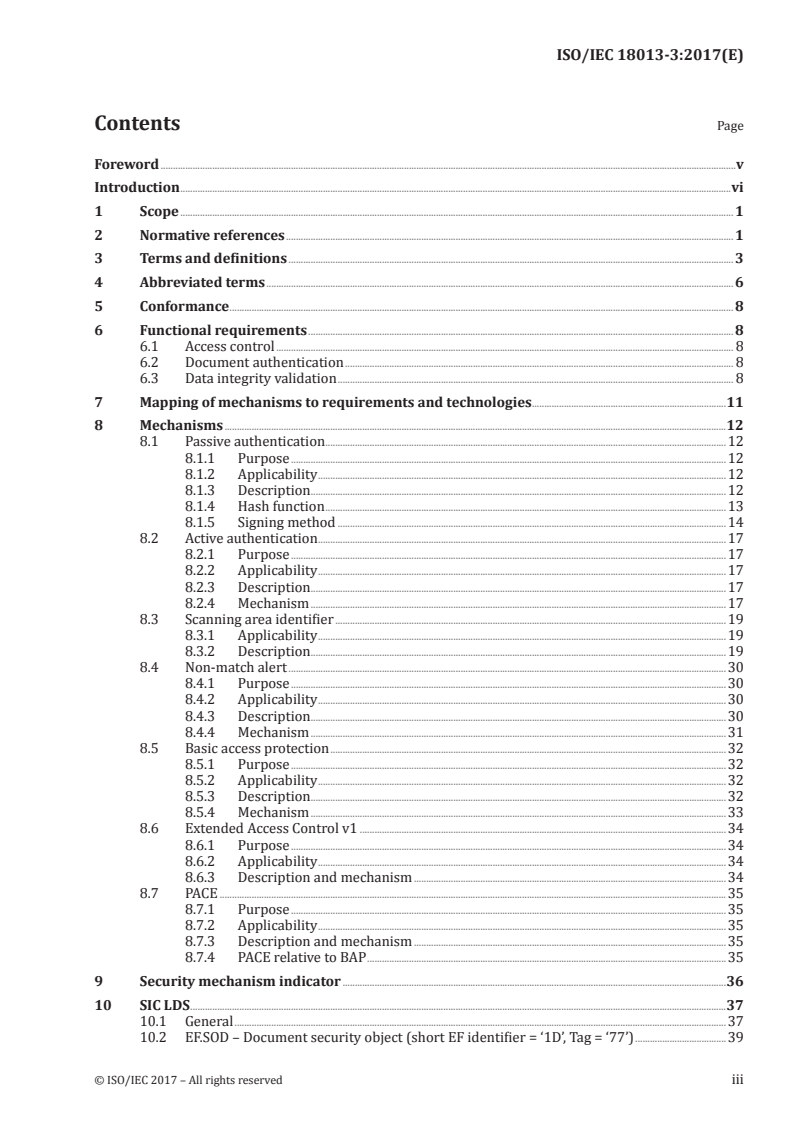
Contents Page
Foreword .v
Introduction .vi
1 Scope . 1
2 Normative references . 1
3 Terms and definitions . 3
4 Abbreviated terms . 6
5 Conformance . 8
6 Functional requirements . 8
6.1 Access control . 8
6.2 Document authentication . 8
6.3 Data integrity validation . 8
7 Mapping of mechanisms to requirements and technologies .11
8 Mechanisms .12
8.1 Passive authentication .12
8.1.1 Purpose .12
8.1.2 Applicability .12
8.1.3 Description . . .12
8.1.4 Hash function .13
8.1.5 Signing method .14
8.2 Active authentication .17
8.2.1 Purpose .17
8.2.2 Applicability .17
8.2.3 Description . . .17
8.2.4 Mechanism .17
8.3 Scanning area identifier .19
8.3.1 Applicability .19
8.3.2 Description . . .19
8.4 Non-match alert .30
8.4.1 Purpose .30
8.4.2 Applicability .30
8.4.3 Description . . .30
8.4.4 Mechanism .31
8.5 Basic access protection .32
8.5.1 Purpose .32
8.5.2 Applicability .32
8.5.3 Description . . .32
8.5.4 Mechanism .33
8.6 Extended Access Control v1 .34
8.6.1 Purpose .34
8.6.2 Applicability .34
8.6.3 Description and mechanism .34
8.7 PACE .35
8.7.1 Purpose .35
8.7.2 Applicability .35
8.7.3 Description and mechanism .35
8.7.4 PACE relative to BAP .35
9 Security mechanism indicator .36
10 SIC LDS .37
10.1 General .37
10.2 EF.SOD – Document security object (short EF identifier = ‘1D’, Tag = ‘77’) .39
© ISO/IEC 2017 – All rights reserved iii
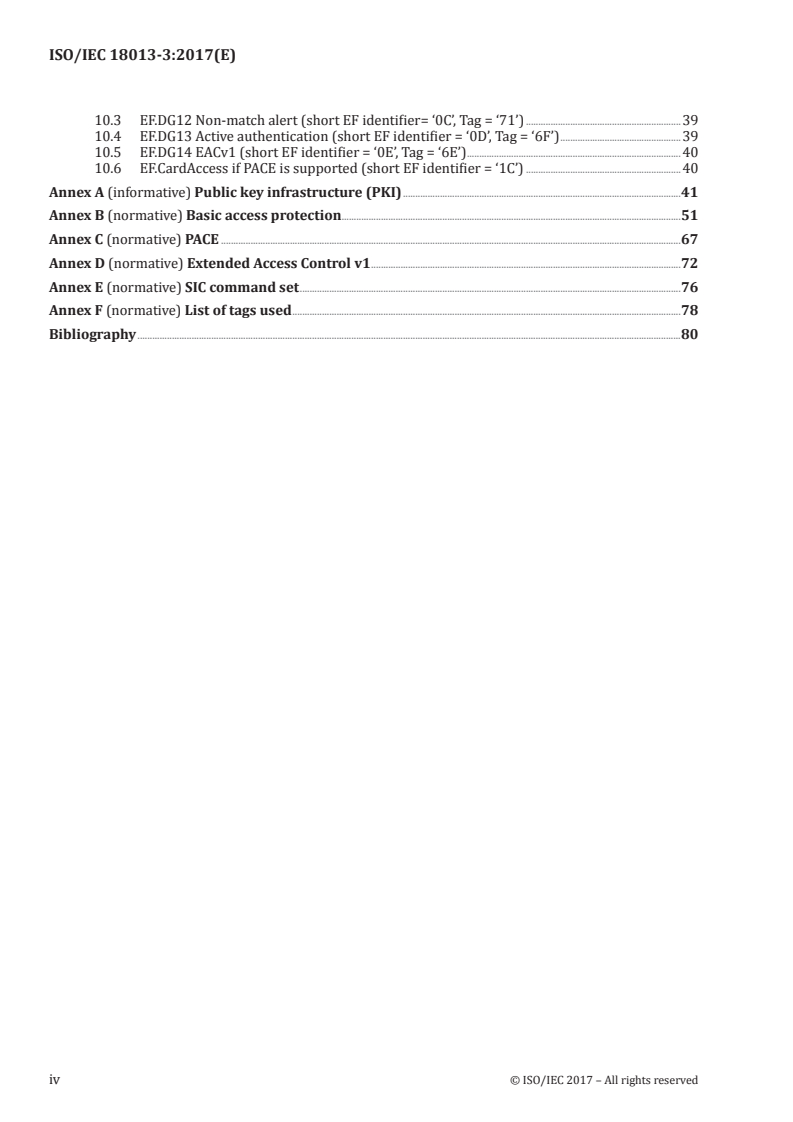
10.3 EF.DG12 Non-match alert (short EF identifier= ‘0C’, Tag = ‘71’) .39
10.4 EF.DG13 Active authentication (short EF identifier = ‘0D’, Tag = ‘6F’) .39
10.5 EF.DG14 EACv1 (short EF identifier = ‘0E’, Tag = ‘6E’) .40
10.6 EF.CardAccess if PACE is supported (short EF identifier = ‘1C’) .40
Annex A (informative) Public key infrastructure (PKI) .41
Annex B (normative) Basic access protection .51
Annex C (normative) PACE .67
Annex D (normative) Extended Access Control v1 .72
Annex E (normative) SIC command set .76
Annex F (normative) List of tags used .78
Bibliography .80
iv © ISO/IEC 2017 – All rights reserved
Foreword
ISO (the International Organization for Standardization) and IEC (the International Electrotechnical
Commission) form the specialized system for worldwide standardization. National bodies that are
members of ISO or IEC participate in the development of International Standards through technical
committees established by the respective organization to deal with particular fields of technical
activity. ISO and IEC technical committees collaborate in fields of mutual interest. Other international
organizations, governmental and non-governmental, in liaison with ISO and IEC, also take part in the
work. In the field of information technology, ISO and IEC have established a joint technical committee,
ISO/IEC JTC 1.
The procedures used to develop this document and those intended for its further maintenance are
described in the ISO/IEC Directives, Part 1. In particular the different approval criteria needed for
the different types of document should be noted. This document was drafted in accordance with the
editorial rules of the ISO/IEC Directives, Part 2 (see www .iso .org/ directives).
Attention is drawn to the possibility that some of the elements of this document may be the subject
of patent rights. ISO and IEC shall not be held responsible for identifying any or all such patent
rights. Details of any patent rights identified during the development of the document will be in the
Introduction and/or on the ISO list of patent declarations received (see www .iso .org/ patents).
Any trade name used in this document is information given for the convenience of users and does not
constitute an endorsement.
For an explanation on the meaning of ISO specific terms and expressions related to conformity assessment,
as well as information about ISO’s adherence to the World Trade Organization (WTO) principles in the
Technical Barriers to Trade (TBT) see the following URL: www . i so .org/ iso/ foreword .html.
The committee responsible for this document is ISO/IEC JTC 1, Information technology, SC 17, Cards and
personal identification.
This second edition cancels and replaces the first edition (ISO/IEC 18013-3:2009), which has been
technically revised. It also incorporates the Amendments ISO/IEC 18013-3:2009/Amd 1:2012 and
ISO/IEC 18013-3:2009/Amd 2:2014, and the Technical Corrigenda ISO/IEC 18013-3:2009/Cor 1:2011
and ISO/IEC 18013-3:2009/Cor 2:2013.
The most significant changes are the following:
— In the interest of interoperability of cards used for personal identification, the authentication
protocols for the IDL are simplified. Active Authentication is harmonised with other ISO standards
and thus BAP configurations 2, 3 and 4, as well as EAP are no longer supported by this document.
— Replacing EAP, the optional EACv1 protocol is defined for the IDL, enabling access control to sensitive
biometric data stored on an integrated circuit. EACv1 may be used in conjunction with either BAP
configuration 1 or PACE.
— The optional PACE protocol enables access control to the data stored on an integrated circuit. The
PACE protocol is a password authenticated Diffie Hellman key agreement protocol based on a (short)
input string that provides secure communication between a secure integrated circuit on an IDL
and a terminal and allows various implementation options (mappings, input strings, algorithms).
The PACE protocol implementation for the IDL is restricted to Elliptic Curve Diffie Hellman (ECDH)
generic mapping and can be used as a stand-alone protocol or in combination with the EACv1
protocol.
A list of all the parts in the ISO/IEC 18013 series can be found on the ISO website.
© ISO/IEC 2017 – All rights reserved v
Introduction
This document prescribes requirements for the implementation of mechanisms to control access to
data recorded in the machine-readable technology on an ISO-compliant driving licence (IDL), verifying
the origin of an IDL, and confirming data integrity.
One of the functions of an IDL is to facilitate international interchange. While storing data in machine-
readable form on the IDL supports this function by speeding up data input and eliminating transcription
errors, certain machine-readable technologies are vulnerable to being read without the knowledge of
the card holder and to other means of unauthorized access by unintended persons that is other than
driving licence or law enforcement authorities. Controlling access to IDL data stored in machine-
readable form protects the data on the card from being read remotely by electronic means without the
knowledge of the card holder.
Identifying falsified driving licences or an alteration to the human-readable data on authentic driving
licences present a major problem for driving licence and law enforcement authorities, both domestically
and in the context of international interchange. Verifying the authenticity of an IDL and confirming
the integrity of the data recorded on an IDL provide driving licence and law enforcement authorities
with a means to identify an authentic IDL from a falsified or altered one in the interests of traffic law
enforcement and other traffic safety processes.
vi © ISO/IEC 2017 – All rights reserved
INTERNATIONAL STANDARD ISO/IEC 18013-3:2017(E)
Information technology — Personal identification — ISO-
compliant driving licence —
Part 3:
Access control, authentication and integrity validation
1 Scope
ISO/IEC 18013 establishes guidelines for the design format and data content of an ISO-compliant
driving licence (IDL) with regard to human-readable features (ISO/IEC 18013-1), machine-readable
technologies (ISO/IEC 18013-2), and access control, authentication and integrity validation
(ISO/IEC 18013-3). It creates a common basis for international use and mutual recognition of the IDL
without impeding individual countries/states to apply their privacy rules and national/community/
regional motor vehicle authorities in taking care of their specific needs.
This document
— is based on the machine-readable data content specified in ISO/IEC 18013-2;
— specifies mechanisms and rules available to issuing authorities (IAs) for:
— access control (i.e. limiting access to the machine-readable data recorded on the IDL),
— document authentication (i.e. confirming that the document was issued by the claimed IA), and
— data integrity validation (i.e. confirming that the data has not been changed since issuing).
This document does not address issues related to the subsequent use of data obtained from the IDL, e.g.
privacy issues.
2 Normative references
The following documents are referred to in the text in such a way that some or all of their content
constitutes requirements of this document. For dated references, only the edition cited applies. For
undated references, the latest edition of the referenced document (including any amendments) applies.
ISO 1831:1980, Printing specifications for optical character recognition
ISO/IEC 7816-4:2013, Identification cards — Integrated circuit cards — Part 4: Organization, security and
commands for interchange
ISO/IEC 8859-1:1998, Information technology — 8-bit single-byte coded graphic character sets — Part 1:
Latin alphabet No. 1
ISO 9796-2, Information technology — Security techniques — Digital signature schemes giving message
recovery — Part 2: Integer factorization based mechanisms
1)
ISO/IEC 9797-1:1999 , Information technology — Security techniques — Message Authentication Codes
(MACs) — Part 1: Mechanisms using a block cipher
ISO/IEC 10118-3:2004, Information technology — Security techniques — Hash-functions — Part 3:
Dedicated hash-functions
1) ISO/IEC 9797-1:1999 is withdrawn and replaced by the 2011 version.
© ISO/IEC 2017 – All rights reserved 1
2)
ISO/IEC 11770-2:1996 , Information technology — Security techniques — Key management — Part 2:
Mechanisms using symmetric techniques
ISO/IEC 11770-2:1996/Cor.1:2005, Information technology — Security techniques — Key management —
Part 2: Mechanisms using symmetric techniques — Technical Corrigendum 1
ISO/IEC 18013-1, Information technology — Personal identification — ISO-compliant driving licence —
Part 1: Physical characteristics and basic data set
ISO/IEC 18013-2, Information technology — Personal identification — ISO-compliant driving licence —
Part 2: Machine-readable technologies
3)
ISO/IEC 18033-3:2005 , Information technology — Security techniques — Encryption algorithms —
Part 3: Block ciphers
I S O/ I EC 18 033-3:20 05/C or1: 20 06 , Information technology — Security techniques — Encryption
algorithms — Part 3: Block ciphers — Technical Corrigendum 1
I S O/ I EC 18 033-3:20 05/C or2: 20 07, Information technology — Security techniques — Encryption
algorithms — Part 3: Block ciphers — Technical Corrigendum 2
ANSI X9.62:2005, Public Key Cryptography for the Financial Services Industry: The Elliptic Curve Digital
Signature Algorithm (ECDSA)
BSI Technical Guideline TR-03110-1: Advanced Security Mechanisms for Machine Readable Travel
Documents — Part 1 — eMRTDs with BAC/PACEv2 and EACv1 — Version 2.10 — 2012-03-20
BSI Technical Guideline TR-03110-3: Advanced Security Mechanisms for Machine Readable Travel
Documents — Part 3 — Common Specifications — Version 2.10 — 2012-03-20
FIPS 186-2 (including Change Notice), Digital Signature Standard (DSS), Federal Information Processing
Standards Publication, National Institute of Standards and Technology, 27 January 2000
ICAO Technical Report – Supplemental Access Control for Machine Readable Travel Documents, v1.01, 2010
[TR-PACE]
NIST/SP 800-38B, Recommendation for Block Cipher Modes of Operation: The CMAC Mode for
Authentication, May 2005
4)
RFC 2631, E. Rescorla, Diffie-Hellman Key Agreement Method, June 1999
RFC 3279, W. Polk et al., Algorithms and Identifiers for the Internet X.509 Public Key Infrastructure
Certificate and Certificate Revocation List (CRL) Profile, April 2002
RFC 3280, R. Housley et al., Internet X.509 Public Key Infrastructure Certificate and Certificate Revocation
List (CRL) Profile, April 2002
RFC 3369, R. Housley, Cryptographic Message Syntax, August 2002
RFC 4055, J. Schaad, B. Kaliski, R. Housley, Additional Algorithms and Identifiers for RSA Cryptography for
use in the Internet X.509 Public Key Infrastructure Certificate and Certificate Revocation List (CRL) Profile,
June 2005
RFC 5639, M. Lochter, J. Merkle, Elliptic Curve Cryptography (ECC) Brainpool Standard Curves and Curve
Generation, March 2010
2) ISO/IEC 11770-2:1996 is withdrawn and replaced by the 2008 version.
3) ISO/IEC 18033-3:2005 is withdrawn and replaced by the 2010 version.
4) http:// www .ietf .org/ rfc .html
2 © ISO/IEC 2017 – All rights reserved
3 Terms and definitions
For the purposes of this document, the terms and definitions given in ISO/IEC 18013-1, ISO/IEC 18013-
2 and the following apply.
ISO and IEC maintain terminological databases for use in standardization at the following addresses:
— IEC Electropedia: available at http:// www .electropedia .org/
— ISO Online browsing platform: available at http:// www .iso .org/ obp
3.1
active authentication
mechanism that uses information stored in a secure area of a secure integrated circuit (SIC) (3.17) to
confirm that the SIC and the other machine-readable data were issued together
Note 1 to entry: See 8.2.
3.2
basic access protection
BAP
mechanism to confirm that an inspection system (IS) has physical access to a proximity integrated
circuit card (PICC) before the IS is allowed access to the data stored on the PICC and to ensure that
communication between the IS and the PICC (once access is authorized) is protected
Note 1 to entry: See 8.5 and Annex B.
3.3
chip authentication
ephemeral-static key agreement protocol that provides authentication of the secure integrated circuit
(3.17) and strong secure messaging
Note 1 to entry: See 8.6.
3.4
clone
unauthorized exact copy of a document that has the same security characteristics as the original
document and that cannot be distinguished from the legitimate one
3.5
eavesdropping
unauthorized interception and interpretation of information-bearing emanations
[SOURCE: ISO/IEC 2382-8:2015, 08.05.25, modified]
3.6
extended access control v1
EACv1
protocol used to limit access to optional signature and biometric data groups
Note 1 to entry: See 8.6 and Annex D.
3.7
input string
string of characters printed on an ISO-compliant driving licence [as human-readable text, optionally (or
by specification) accompanied by or consisting of a machine-readable rendering thereof] used as input
(either manually or automatically through the use of suitable equipment) for the non-match alert and
BAP (3.2) or PACE (3.10) mechanisms
© ISO/IEC 2017 – All rights reserved 3
3.8
issuing authority
IA
licensing authority (or issuing country if separate licensing authorities have not been authorized) which
applies a digital signature to an ISO-compliant driving licence and is responsible for the associated key
management
[SOURCE: ISO/IEC 18013-1]
3.9
non-match alert
mechanism to detect any differences between the machine-readable information and (some of) the
human-readable information on an ISO-compliant driving licence
Note 1 to entry: See 8.4.
3.10
PACE
alternative mechanism to BAP to confirm that an inspection system (IS) has physical access to a secure
integrated circuit (SIC) (3.17) on a driving licence card before the IS is allowed to access to the data
stored on the SIC and to establish a secure communication channel between the IS and SIC once access
is authorised
Note 1 to entry: As stated in TR-PACE, PACE refers to PACE v2.
Note 2 to entry: See 8.7 and Annex C.
3.11
passive authentication
mechanism to confirm that machine-readable data on an ISO-compliant driving licence (IDL) has not
been changed since the IDL was issued
Note 1 to entry: See 8.1.
3.12
pseudo issuing authority
PIA
authority that does not issue ISO-compliant driving licences [but that is similar to an issuing
authority (IA) (3.8) in all other respects] and which does not issue document keys, but which does have
a root key pair with which it can sign documents of other IAs or PIAs that it trusts
3.13
public key infrastructure
PKI
technologies and products using public key (asymmetric) cryptography
Note 1 to entry: Both passive authentication (3.11) and extended access protection use this technology.
3.14
reading authority
RA
authorized entity reading the machine-readable data on an ISO-compliant driving licence (IDL)
Note 1 to entry: Driving licence authorities other than the authority that issued the IDL and law enforcement
authorities are examples of reading authorities.
3.15
reference string
string of characters used as a reference against which to compare the input string (3.7) when using the
non-match alert (3.9) mechanism, and used for session key calculation purposes by the secure integrated
circuit (3.17) during execution of the basic access protection (3.2) mechanism
4 © ISO/IEC 2017 – All rights reserved
3.16
scanning area identifier
SAI
one or more graphical elements that demarcate an input string (3.7)
3.17
secure integrated circuit
SIC
integrated circuit that includes both a security feature (or security features), and memory and/or a
central processing unit
Note 1 to entry: An integrated circuit card with contacts and a proximity integrated circuit card (PICC) are
examples of a SIC.
Note 2 to entry: A SIC can be embedded in different solutions, for example in ID-1 sized cards (as used for the ISO-
compliant driving licence) and in a booklet (as found in passports).
3.18
secure memory
integrated circuit (IC) memory of which the content [once populated by an issuing authority (3.8) during
the personalization process] is accessible only by the IC operating system for internal use, and cannot
be made available by the operating system to any reading device
3.19
skimming
reading data from a proximity integrated circuit card (PICC) without the card holder’s awareness
3.20
trust chain
sequential set of trust points (3.23) that a verifying authority (3.26) references to verify a specific issuing
authority’s (3.8) public root key
3.21
trust model
description of the functional and logical aspects of a traditional public key infrastructure (3.13),
specifically excluding technical implementation details
3.22
trust network
component of a trust model (3.21) that describes the trust relationships and chains between issuing
authorities
3.23
trust point
issuing authority (3.8) or pseudo issuing authority (3.12) that publishes a trust list (and the related public
root keys) that verifying entities can reference
3.24
twinning
copying the data and/or integrated circuit of a physically and/or biometrically similar driver to the
attacker’s integrated circuit or ISO-compliant driving licence
3.25
unpacked BCD
binary coding of a sequence of integers using 4 bits for each integer (where the bit weights are 8421)
and encoding one integer in the least significant bits of each byte
Note 1 to entry: Only unsigned BCD is used in this document.
© ISO/IEC 2017 – All rights reserved 5
3.26
verifying authority
VA
verifying entity (3.27) that is part of a trust network (3.22), i.e. that also is an issuing authority (3.8) or a
pseudo issuing authority (3.12)
Note 1 to entry: Not all verifying entities are VAs. A car rental company can be a verifying entity, but is not a VA as
it is not part of the trust network.
Note 2 to entry: VAs can be divided into immediate VAs (3.26.1) and non-immediate VAs (3.26.2).
3.26.1
immediate VA
VA (3.26) that acquired the public root key of the issuing authority (3.8) via out-of-band means
3.26.2
non-immediate VA
VA (3.26) that acquired the public root key of the issuing authority (3.8) from another VA
3.27
verifying entity
entity that tries to determine if a digital signature is valid (i.e. if the data to which a certificate has
been applied has not been changed, and if the signature was generated by the issuing authority (3.8) the
verifying entity expects)
4 Abbreviated terms
APDU application protocol data unit
BAC basic access control
BAP basic access protection
BCD binary coded decimal
a
BER-TLV basic encoding rules – tag-length-value (see ISO/IEC 8825-1:2002 )
CA certification authority
CBC cipher block chaining
DER distinguished encoding rules (see ISO/IEC 8825-1:2002)
DF dedicated file
DG data group
DO data object
DST control reference template for digital signature (see ISO/IEC 7816-4:2013)
EACv1 extended access control v1
EAP extended access protection
EF elementary file
IA issuing authority
IC integrated circuit
6 © ISO/IEC 2017 – All rights reserved
ICC integrated circuit card
IDL ISO-compliant driving licence
IFD interface device
IS inspection system
IV initialization vector
KAT control reference template for key agreement (see ISO/IEC 7816-4:2013)
LDS logical data structure
MAC message authentication code
MF master file
MRTD machine readable travel document
MRZ machine readable zone
MSE manage security environment (see ISO/IEC 7816-4:2013)
OCR optical character recognition
OID object identifier
PACE password authenticated connection establishment
PIA pseudo issuing authority
PIC proximity integrated circuit
PICC proximity integrated circuit card
PKI public key infrastructure
PSO perform security operation (see ISO/IEC 7816-4:2013)
RA reading authority
RFU reserved for future use
SAI scanning area identifier
SIC secure integrated circuit
SM secure messaging
SOD document security object
SSC send sequence counter
TRCA trust root certificate authority
UTC coordinated universal time
© ISO/IEC 2017 – All rights reserved 7
VA verifying authority
2D two-dimensional
a
ISO/IEC 8825-1:2002 is withdrawn and replaced by the 2015 version.
5 Conformance
A driving licence is in conformance with this document if it meets all mandatory requirements specified
directly or by reference herein. Compliance with ISO/IEC 18013-2 is required for compliance with this
document.
Compliance with ISO/IEC 18013-1 is not required for compliance with this document. Conversely, the
incorporation of a machine-readable technology which is not compliant with this document does not
render the IDL non-compliant with ISO/IEC 18013-1.
6 Functional requirements
6.1 Access control
Access control can be broken down into the following functional requirements:
a) prevent skimming of machine-readable data on a PICC by ensuring that physical access to the IDL is
acquired prior to reading;
b) prevent unnoticed alteration of communication between a reader and a SIC;
c) prevent eavesdropping between a reader and a SIC;
d) selectively restrict access to specific optional machine-readable data groups for specific reading
authorities.
6.2 Document authentication
Document authentication can functionally be established by allowing for verification of the origin
of an IDL.
6.3 Data integrity validation
Data integrity validation can be broken down into the following functional requirements:
a) Verify that the IDL (including the machine-readable data) is not a clone of another IDL. A cloning
attempt can schematically be illustrated as shown in Figure 1.
8 © ISO/IEC 2017 – All rights reserved
A
B
Legend
C
D Physical IDL (before personalization)
Human-readable data
B
Data carrier
Machine-
D
readable
data
blank (no data)
blank
(no data)
Figure 1 — Data integrity validation: IDL cloning
b) Protect against the exchange of machine-readable data carriers between otherwise authentic IDLs.
This type of attack can schematically be illustrated as shown in Figure 2.
NOTE This guards (among others) against an IC “twinning” attack. This type of attack is of particular
concern in inspection environments where machine-readable data and human-readable data is not compared
(or only cursorily compared by an operator using, for example, a portrait image). Finding a biometrically
similar driver is possible by skimming the data of a few thousand IDL PICs.
A
B
Legend
C
D Physical IDL (before personalization)
A
Human-readable data
B
Data carrier
Machine-
readable
data
Figure 2 — Data integrity validation: Data carrier exchange or twinning
c) Verify that the physical IDL and the machine-readable data thereon were issued (belong) together.
This type of attack can schematically be illustrated as shown in Figure 3.
© ISO/IEC 2017 – All rights reserved 9
A
B
Legend
C
D Physical IDL (before personalization)
A
Human-readable data
B
Data carrier
C
Machine-
readable
data
Figure 3 — Data integrity validation: Machine-readable data exchange
d) Validate the integrity of the human readable data (i.e. confirm that the human-readable data has not
changed since issuing). This type of attack can schematically be illustrated as shown in Figure 4.
Legend
Physical IDL (before personalization)
A A
Human-readable data
B’
B
Data carrier
C
C
Machine-
D D
readable
data
Figure 4 — Data integrity validation: Human-readable data alteration
e) Validate the integrity of the machine-readable data (i.e. confirm that the machine-readable data
has not changed since issuing). This can schematically be illustrated as shown in Figure 5.
Legend
Physical IDL (before personalization)
A A
Human-readable data
B
B
Data carrier
C
C
Machine-
D D’
readable
data
Figure 5 — Data integrity validation: Machine-readable data alteration
10 © ISO/IEC 2017 – All rights reserved
7 Mapping of mechanisms to requirements and technologies
Mechanisms that, when used individually, can address specific functional requirements are specified in
Clause 8. Mechanisms can also be used together to address a broader range of functional requirements.
Not all machine-readable technologies have the same functional requirements, and some mechanisms
are applicable only to specific machine-readable technologies. Table 1 specifies the relationships
between the mechanisms, machine-readable technologies, and functional requirements.
Table 1 — Applicable mechanisms
Mechanisms
Functional
2D bar code ICC with contacts PICC
requirement
Prevent skim- Physical access to the IDL is required Physical access to the IDL is required BAP or PACE
ming to read the machine-readable data to read the machine-readable data
Prevent unno- N/A Chip authentication (EACv1) in BAP or PACE
ticed alteration combination with BAP or PACE secure
Chip authentication (EACv1) in
of communica- messaging
combination with BAP or PACE secure
tion between a
messaging
reader and an
IDL
a
Prevent eaves- N/A Chip authentication (EACv1) in BAP or PACE
dropping combination with BAP or PACE secure
Chip authentication (EACv1) in
messaging
combination with BAP or PACE secure
messaging
Selectively N/A Terminal authentication (EACv1) Terminal authentication (EACv1)
restrict access
to specific
optional ma-
chine-readable
data groups for
specific reading
authorities
Allow for veri- Step 1: Verify trustworthiness of/ob- Step 1: Verify trustworthiness of/ob- Step 1: Verify trustworthiness of/ob-
fication of the tain a trustworthy asymmetric/public tain a trustworthy asymmetric/public tain a trustworthy asymmetric/public
origin of an IDL key (via a PKI and a protected distri- key (via a PKI and a protected distri- key (via a PKI and a protected distri-
bution communication channel, or via bution communication channel, or via bution communication channel, or via
alternative trust building methods) alternative trust building methods) alternative trust building methods)
Step 2: Use trusted key to perform Step 2: Use trusted key to perform Step 2: Use trusted key to perform
passive authentication, followed by passive authentication; if the passive passive authentication; if the passive
use of the non-match alert mechanism, authentication was preceded by BAP authentication was preceded by BAP
or followed by visual comparison of or PACE, the IDL is authentic while if or PACE, the IDL is authentic while if
the human-readable data printed on BAP or PACE is not implemented, pas- BAP or PACE is not implemented, pas-
the document with the authenticated sive authentication can be followed by sive authentication can be followed by
machine-readable data use of the non-match alert mechanism, use of the non-match alert mechanism,
or followed by visual comparison of or followed by visual comparison of
the human-readable data printed on the human-readable data printed on
the document with the authenticated the document with the authenticated
machine-readable data machine-readable data
Verify that the 2D bar code: Cannot be verified Active authentication via challenge Active authentication via challenge
IDL (including through available international response response
the ma- standards
Chip authentication (EACv1) Chip authentication (EACv1)
chine-readable
data) is not a
clone of another
IDL
Protect against Non-match alert Non-match alert Non-match alert
the exchange of
Passive authentication followed by a BAP or PACE BAP or PACE
machine read-
visual comparison of the human-read-
able data car-
Passive authentication followed by a Passive authentication followed by a
able data printed on the document
riers between
visual comparison of the human-read- visual comparison of the human-read-
with the authenticated machine-read-
otherwise
able data printed on the document able data printed on the document
able data
authentic IDLs
with the authenticated machine-read- with the authenticated machine-read-
able data able data
© ISO/IEC 2017 – All rights reserved 11
Table 1 (continued)
Mechanisms
Functional
2D bar code ICC with contacts PICC
requirement
Verify that the Non-match alert Non-match alert Non-match alert
physical IDL
Passive authentication followed by a BAP or PACE BAP or PACE
and the ma-
visual comparison of the human-read-
chine-readable
Passive authentication followed by a Passive authentication followed by a
able data printed on the document
data thereon
visual comparison of the human-read- visual comparison of the human-read-
with the authenticated machine-read-
were issued (be-
able data printed on the document able data printed on the document
able data
long) together
with the authenticated machine-read- with the authenticated machine-read-
(i.e. that the
able data able data
machine-read-
Active authentication via challenge Active authentication via challenge
able data has
a a
not been copied response response
from another
IDL)
Validate the Non-match alert Non-match alert Non-match alert
integrity of
Passive authentication followed by a BAP or PACE BAP or PACE
the human read-
visual comparison of the human-read-
able data (i.e.
Passive authentication followed by a Passive authentication followed by a
able data printed on the document
confirm that the
visual comparison of the human-read- visual comparison of the human-read-
with the authenticated machine-read-
human-readable
able data printed on the document able data printed on the document
able data
data has not
with the authenticated machine-read- with the authenticated machine-read-
changed since
Visual inspection of the security fea- able data able data
issuing)
tures incorporated into the IDL (see
Visual inspection of the security fea- Visual inspection of the security fea-
ISO/IEC 18013-1)
tures incorporated into the IDL (see tures incorporated into the IDL (see
ISO/IEC 18013-1) ISO/IEC 18013-1)
Validate the Passive authentication Passive authentication Passive authentication
integrity of the
machine-read-
able data (i.e.
confirm that the
machine-reada-
ble data has not
changed since
issuing)
NOTE Visual comparison of human-readable information printed on an IDL with machine-readable information obtained from the
same IDL is not formally specified as a mechanism in this document; it is assumed that such comparison can be implemented by any RA in
a manner that meets local needs.
a
The entropy of the reference string used has to be commensurate with the IA’s assessment of the threat.
IA’s may selectively implement the mechanisms identified above, subject to any dependencies noted in
Clause 8.
8 Mechanisms
8.1 Passive authentication
8.1.1 Purpose
The purpose of passive authentication is to confirm that machine-readable data has not been changed
since the IDL was issued.
8.1.2 Applicability
Passive authentication is applicable to all machine-readable technologies.
8.1.3 Description
Passive authentication is implemented by way of a digital signature over specified machine-readable
data on the IDL, using a public-private (asymmetric) key pair.
12 © ISO/IEC 2017 – All rights reserved
In the case of s
...
INTERNATIONAL ISO/IEC
STANDARD 18013-3
Second edition
2017-04
Information technology — Personal
identification — ISO-compliant driving
licence —
Part 3:
Access control, authentication and
integrity validation
Technologies de l’information — Identification des personnes —
Permis de conduire conforme à l’ISO —
Partie 3: Contrôle d’accès, authentification et validation d’intégrité
Reference number
©
ISO/IEC 2017
© ISO/IEC 2017, Published in Switzerland
All rights reserved. Unless otherwise specified, no part of this publication may be reproduced or utilized otherwise in any form
or by any means, electronic or mechanical, including photocopying, or posting on the internet or an intranet, without prior
written permission. Permission can be requested from either ISO at the address below or ISO’s member body in the country of
the requester.
ISO copyright office
Ch. de Blandonnet 8 • CP 401
CH-1214 Vernier, Geneva, Switzerland
Tel. +41 22 749 01 11
Fax +41 22 749 09 47
copyright@iso.org
www.iso.org
ii © ISO/IEC 2017 – All rights reserved
Contents Page
Foreword .v
Introduction .vi
1 Scope . 1
2 Normative references . 1
3 Terms and definitions . 3
4 Abbreviated terms . 6
5 Conformance . 8
6 Functional requirements . 8
6.1 Access control . 8
6.2 Document authentication . 8
6.3 Data integrity validation . 8
7 Mapping of mechanisms to requirements and technologies .11
8 Mechanisms .12
8.1 Passive authentication .12
8.1.1 Purpose .12
8.1.2 Applicability .12
8.1.3 Description . . .12
8.1.4 Hash function .13
8.1.5 Signing method .14
8.2 Active authentication .17
8.2.1 Purpose .17
8.2.2 Applicability .17
8.2.3 Description . . .17
8.2.4 Mechanism .17
8.3 Scanning area identifier .19
8.3.1 Applicability .19
8.3.2 Description . . .19
8.4 Non-match alert .30
8.4.1 Purpose .30
8.4.2 Applicability .30
8.4.3 Description . . .30
8.4.4 Mechanism .31
8.5 Basic access protection .32
8.5.1 Purpose .32
8.5.2 Applicability .32
8.5.3 Description . . .32
8.5.4 Mechanism .33
8.6 Extended Access Control v1 .34
8.6.1 Purpose .34
8.6.2 Applicability .34
8.6.3 Description and mechanism .34
8.7 PACE .35
8.7.1 Purpose .35
8.7.2 Applicability .35
8.7.3 Description and mechanism .35
8.7.4 PACE relative to BAP .35
9 Security mechanism indicator .36
10 SIC LDS .37
10.1 General .37
10.2 EF.SOD – Document security object (short EF identifier = ‘1D’, Tag = ‘77’) .39
© ISO/IEC 2017 – All rights reserved iii
10.3 EF.DG12 Non-match alert (short EF identifier= ‘0C’, Tag = ‘71’) .39
10.4 EF.DG13 Active authentication (short EF identifier = ‘0D’, Tag = ‘6F’) .39
10.5 EF.DG14 EACv1 (short EF identifier = ‘0E’, Tag = ‘6E’) .40
10.6 EF.CardAccess if PACE is supported (short EF identifier = ‘1C’) .40
Annex A (informative) Public key infrastructure (PKI) .41
Annex B (normative) Basic access protection .51
Annex C (normative) PACE .67
Annex D (normative) Extended Access Control v1 .72
Annex E (normative) SIC command set .76
Annex F (normative) List of tags used .78
Bibliography .80
iv © ISO/IEC 2017 – All rights reserved
Foreword
ISO (the International Organization for Standardization) and IEC (the International Electrotechnical
Commission) form the specialized system for worldwide standardization. National bodies that are
members of ISO or IEC participate in the development of International Standards through technical
committees established by the respective organization to deal with particular fields of technical
activity. ISO and IEC technical committees collaborate in fields of mutual interest. Other international
organizations, governmental and non-governmental, in liaison with ISO and IEC, also take part in the
work. In the field of information technology, ISO and IEC have established a joint technical committee,
ISO/IEC JTC 1.
The procedures used to develop this document and those intended for its further maintenance are
described in the ISO/IEC Directives, Part 1. In particular the different approval criteria needed for
the different types of document should be noted. This document was drafted in accordance with the
editorial rules of the ISO/IEC Directives, Part 2 (see www .iso .org/ directives).
Attention is drawn to the possibility that some of the elements of this document may be the subject
of patent rights. ISO and IEC shall not be held responsible for identifying any or all such patent
rights. Details of any patent rights identified during the development of the document will be in the
Introduction and/or on the ISO list of patent declarations received (see www .iso .org/ patents).
Any trade name used in this document is information given for the convenience of users and does not
constitute an endorsement.
For an explanation on the meaning of ISO specific terms and expressions related to conformity assessment,
as well as information about ISO’s adherence to the World Trade Organization (WTO) principles in the
Technical Barriers to Trade (TBT) see the following URL: www . i so .org/ iso/ foreword .html.
The committee responsible for this document is ISO/IEC JTC 1, Information technology, SC 17, Cards and
personal identification.
This second edition cancels and replaces the first edition (ISO/IEC 18013-3:2009), which has been
technically revised. It also incorporates the Amendments ISO/IEC 18013-3:2009/Amd 1:2012 and
ISO/IEC 18013-3:2009/Amd 2:2014, and the Technical Corrigenda ISO/IEC 18013-3:2009/Cor 1:2011
and ISO/IEC 18013-3:2009/Cor 2:2013.
The most significant changes are the following:
— In the interest of interoperability of cards used for personal identification, the authentication
protocols for the IDL are simplified. Active Authentication is harmonised with other ISO standards
and thus BAP configurations 2, 3 and 4, as well as EAP are no longer supported by this document.
— Replacing EAP, the optional EACv1 protocol is defined for the IDL, enabling access control to sensitive
biometric data stored on an integrated circuit. EACv1 may be used in conjunction with either BAP
configuration 1 or PACE.
— The optional PACE protocol enables access control to the data stored on an integrated circuit. The
PACE protocol is a password authenticated Diffie Hellman key agreement protocol based on a (short)
input string that provides secure communication between a secure integrated circuit on an IDL
and a terminal and allows various implementation options (mappings, input strings, algorithms).
The PACE protocol implementation for the IDL is restricted to Elliptic Curve Diffie Hellman (ECDH)
generic mapping and can be used as a stand-alone protocol or in combination with the EACv1
protocol.
A list of all the parts in the ISO/IEC 18013 series can be found on the ISO website.
© ISO/IEC 2017 – All rights reserved v
Introduction
This document prescribes requirements for the implementation of mechanisms to control access to
data recorded in the machine-readable technology on an ISO-compliant driving licence (IDL), verifying
the origin of an IDL, and confirming data integrity.
One of the functions of an IDL is to facilitate international interchange. While storing data in machine-
readable form on the IDL supports this function by speeding up data input and eliminating transcription
errors, certain machine-readable technologies are vulnerable to being read without the knowledge of
the card holder and to other means of unauthorized access by unintended persons that is other than
driving licence or law enforcement authorities. Controlling access to IDL data stored in machine-
readable form protects the data on the card from being read remotely by electronic means without the
knowledge of the card holder.
Identifying falsified driving licences or an alteration to the human-readable data on authentic driving
licences present a major problem for driving licence and law enforcement authorities, both domestically
and in the context of international interchange. Verifying the authenticity of an IDL and confirming
the integrity of the data recorded on an IDL provide driving licence and law enforcement authorities
with a means to identify an authentic IDL from a falsified or altered one in the interests of traffic law
enforcement and other traffic safety processes.
vi © ISO/IEC 2017 – All rights reserved
INTERNATIONAL STANDARD ISO/IEC 18013-3:2017(E)
Information technology — Personal identification — ISO-
compliant driving licence —
Part 3:
Access control, authentication and integrity validation
1 Scope
ISO/IEC 18013 establishes guidelines for the design format and data content of an ISO-compliant
driving licence (IDL) with regard to human-readable features (ISO/IEC 18013-1), machine-readable
technologies (ISO/IEC 18013-2), and access control, authentication and integrity validation
(ISO/IEC 18013-3). It creates a common basis for international use and mutual recognition of the IDL
without impeding individual countries/states to apply their privacy rules and national/community/
regional motor vehicle authorities in taking care of their specific needs.
This document
— is based on the machine-readable data content specified in ISO/IEC 18013-2;
— specifies mechanisms and rules available to issuing authorities (IAs) for:
— access control (i.e. limiting access to the machine-readable data recorded on the IDL),
— document authentication (i.e. confirming that the document was issued by the claimed IA), and
— data integrity validation (i.e. confirming that the data has not been changed since issuing).
This document does not address issues related to the subsequent use of data obtained from the IDL, e.g.
privacy issues.
2 Normative references
The following documents are referred to in the text in such a way that some or all of their content
constitutes requirements of this document. For dated references, only the edition cited applies. For
undated references, the latest edition of the referenced document (including any amendments) applies.
ISO 1831:1980, Printing specifications for optical character recognition
ISO/IEC 7816-4:2013, Identification cards — Integrated circuit cards — Part 4: Organization, security and
commands for interchange
ISO/IEC 8859-1:1998, Information technology — 8-bit single-byte coded graphic character sets — Part 1:
Latin alphabet No. 1
ISO 9796-2, Information technology — Security techniques — Digital signature schemes giving message
recovery — Part 2: Integer factorization based mechanisms
1)
ISO/IEC 9797-1:1999 , Information technology — Security techniques — Message Authentication Codes
(MACs) — Part 1: Mechanisms using a block cipher
ISO/IEC 10118-3:2004, Information technology — Security techniques — Hash-functions — Part 3:
Dedicated hash-functions
1) ISO/IEC 9797-1:1999 is withdrawn and replaced by the 2011 version.
© ISO/IEC 2017 – All rights reserved 1
2)
ISO/IEC 11770-2:1996 , Information technology — Security techniques — Key management — Part 2:
Mechanisms using symmetric techniques
ISO/IEC 11770-2:1996/Cor.1:2005, Information technology — Security techniques — Key management —
Part 2: Mechanisms using symmetric techniques — Technical Corrigendum 1
ISO/IEC 18013-1, Information technology — Personal identification — ISO-compliant driving licence —
Part 1: Physical characteristics and basic data set
ISO/IEC 18013-2, Information technology — Personal identification — ISO-compliant driving licence —
Part 2: Machine-readable technologies
3)
ISO/IEC 18033-3:2005 , Information technology — Security techniques — Encryption algorithms —
Part 3: Block ciphers
I S O/ I EC 18 033-3:20 05/C or1: 20 06 , Information technology — Security techniques — Encryption
algorithms — Part 3: Block ciphers — Technical Corrigendum 1
I S O/ I EC 18 033-3:20 05/C or2: 20 07, Information technology — Security techniques — Encryption
algorithms — Part 3: Block ciphers — Technical Corrigendum 2
ANSI X9.62:2005, Public Key Cryptography for the Financial Services Industry: The Elliptic Curve Digital
Signature Algorithm (ECDSA)
BSI Technical Guideline TR-03110-1: Advanced Security Mechanisms for Machine Readable Travel
Documents — Part 1 — eMRTDs with BAC/PACEv2 and EACv1 — Version 2.10 — 2012-03-20
BSI Technical Guideline TR-03110-3: Advanced Security Mechanisms for Machine Readable Travel
Documents — Part 3 — Common Specifications — Version 2.10 — 2012-03-20
FIPS 186-2 (including Change Notice), Digital Signature Standard (DSS), Federal Information Processing
Standards Publication, National Institute of Standards and Technology, 27 January 2000
ICAO Technical Report – Supplemental Access Control for Machine Readable Travel Documents, v1.01, 2010
[TR-PACE]
NIST/SP 800-38B, Recommendation for Block Cipher Modes of Operation: The CMAC Mode for
Authentication, May 2005
4)
RFC 2631, E. Rescorla, Diffie-Hellman Key Agreement Method, June 1999
RFC 3279, W. Polk et al., Algorithms and Identifiers for the Internet X.509 Public Key Infrastructure
Certificate and Certificate Revocation List (CRL) Profile, April 2002
RFC 3280, R. Housley et al., Internet X.509 Public Key Infrastructure Certificate and Certificate Revocation
List (CRL) Profile, April 2002
RFC 3369, R. Housley, Cryptographic Message Syntax, August 2002
RFC 4055, J. Schaad, B. Kaliski, R. Housley, Additional Algorithms and Identifiers for RSA Cryptography for
use in the Internet X.509 Public Key Infrastructure Certificate and Certificate Revocation List (CRL) Profile,
June 2005
RFC 5639, M. Lochter, J. Merkle, Elliptic Curve Cryptography (ECC) Brainpool Standard Curves and Curve
Generation, March 2010
2) ISO/IEC 11770-2:1996 is withdrawn and replaced by the 2008 version.
3) ISO/IEC 18033-3:2005 is withdrawn and replaced by the 2010 version.
4) http:// www .ietf .org/ rfc .html
2 © ISO/IEC 2017 – All rights reserved
3 Terms and definitions
For the purposes of this document, the terms and definitions given in ISO/IEC 18013-1, ISO/IEC 18013-
2 and the following apply.
ISO and IEC maintain terminological databases for use in standardization at the following addresses:
— IEC Electropedia: available at http:// www .electropedia .org/
— ISO Online browsing platform: available at http:// www .iso .org/ obp
3.1
active authentication
mechanism that uses information stored in a secure area of a secure integrated circuit (SIC) (3.17) to
confirm that the SIC and the other machine-readable data were issued together
Note 1 to entry: See 8.2.
3.2
basic access protection
BAP
mechanism to confirm that an inspection system (IS) has physical access to a proximity integrated
circuit card (PICC) before the IS is allowed access to the data stored on the PICC and to ensure that
communication between the IS and the PICC (once access is authorized) is protected
Note 1 to entry: See 8.5 and Annex B.
3.3
chip authentication
ephemeral-static key agreement protocol that provides authentication of the secure integrated circuit
(3.17) and strong secure messaging
Note 1 to entry: See 8.6.
3.4
clone
unauthorized exact copy of a document that has the same security characteristics as the original
document and that cannot be distinguished from the legitimate one
3.5
eavesdropping
unauthorized interception and interpretation of information-bearing emanations
[SOURCE: ISO/IEC 2382-8:2015, 08.05.25, modified]
3.6
extended access control v1
EACv1
protocol used to limit access to optional signature and biometric data groups
Note 1 to entry: See 8.6 and Annex D.
3.7
input string
string of characters printed on an ISO-compliant driving licence [as human-readable text, optionally (or
by specification) accompanied by or consisting of a machine-readable rendering thereof] used as input
(either manually or automatically through the use of suitable equipment) for the non-match alert and
BAP (3.2) or PACE (3.10) mechanisms
© ISO/IEC 2017 – All rights reserved 3
3.8
issuing authority
IA
licensing authority (or issuing country if separate licensing authorities have not been authorized) which
applies a digital signature to an ISO-compliant driving licence and is responsible for the associated key
management
[SOURCE: ISO/IEC 18013-1]
3.9
non-match alert
mechanism to detect any differences between the machine-readable information and (some of) the
human-readable information on an ISO-compliant driving licence
Note 1 to entry: See 8.4.
3.10
PACE
alternative mechanism to BAP to confirm that an inspection system (IS) has physical access to a secure
integrated circuit (SIC) (3.17) on a driving licence card before the IS is allowed to access to the data
stored on the SIC and to establish a secure communication channel between the IS and SIC once access
is authorised
Note 1 to entry: As stated in TR-PACE, PACE refers to PACE v2.
Note 2 to entry: See 8.7 and Annex C.
3.11
passive authentication
mechanism to confirm that machine-readable data on an ISO-compliant driving licence (IDL) has not
been changed since the IDL was issued
Note 1 to entry: See 8.1.
3.12
pseudo issuing authority
PIA
authority that does not issue ISO-compliant driving licences [but that is similar to an issuing
authority (IA) (3.8) in all other respects] and which does not issue document keys, but which does have
a root key pair with which it can sign documents of other IAs or PIAs that it trusts
3.13
public key infrastructure
PKI
technologies and products using public key (asymmetric) cryptography
Note 1 to entry: Both passive authentication (3.11) and extended access protection use this technology.
3.14
reading authority
RA
authorized entity reading the machine-readable data on an ISO-compliant driving licence (IDL)
Note 1 to entry: Driving licence authorities other than the authority that issued the IDL and law enforcement
authorities are examples of reading authorities.
3.15
reference string
string of characters used as a reference against which to compare the input string (3.7) when using the
non-match alert (3.9) mechanism, and used for session key calculation purposes by the secure integrated
circuit (3.17) during execution of the basic access protection (3.2) mechanism
4 © ISO/IEC 2017 – All rights reserved
3.16
scanning area identifier
SAI
one or more graphical elements that demarcate an input string (3.7)
3.17
secure integrated circuit
SIC
integrated circuit that includes both a security feature (or security features), and memory and/or a
central processing unit
Note 1 to entry: An integrated circuit card with contacts and a proximity integrated circuit card (PICC) are
examples of a SIC.
Note 2 to entry: A SIC can be embedded in different solutions, for example in ID-1 sized cards (as used for the ISO-
compliant driving licence) and in a booklet (as found in passports).
3.18
secure memory
integrated circuit (IC) memory of which the content [once populated by an issuing authority (3.8) during
the personalization process] is accessible only by the IC operating system for internal use, and cannot
be made available by the operating system to any reading device
3.19
skimming
reading data from a proximity integrated circuit card (PICC) without the card holder’s awareness
3.20
trust chain
sequential set of trust points (3.23) that a verifying authority (3.26) references to verify a specific issuing
authority’s (3.8) public root key
3.21
trust model
description of the functional and logical aspects of a traditional public key infrastructure (3.13),
specifically excluding technical implementation details
3.22
trust network
component of a trust model (3.21) that describes the trust relationships and chains between issuing
authorities
3.23
trust point
issuing authority (3.8) or pseudo issuing authority (3.12) that publishes a trust list (and the related public
root keys) that verifying entities can reference
3.24
twinning
copying the data and/or integrated circuit of a physically and/or biometrically similar driver to the
attacker’s integrated circuit or ISO-compliant driving licence
3.25
unpacked BCD
binary coding of a sequence of integers using 4 bits for each integer (where the bit weights are 8421)
and encoding one integer in the least significant bits of each byte
Note 1 to entry: Only unsigned BCD is used in this document.
© ISO/IEC 2017 – All rights reserved 5
3.26
verifying authority
VA
verifying entity (3.27) that is part of a trust network (3.22), i.e. that also is an issuing authority (3.8) or a
pseudo issuing authority (3.12)
Note 1 to entry: Not all verifying entities are VAs. A car rental company can be a verifying entity, but is not a VA as
it is not part of the trust network.
Note 2 to entry: VAs can be divided into immediate VAs (3.26.1) and non-immediate VAs (3.26.2).
3.26.1
immediate VA
VA (3.26) that acquired the public root key of the issuing authority (3.8) via out-of-band means
3.26.2
non-immediate VA
VA (3.26) that acquired the public root key of the issuing authority (3.8) from another VA
3.27
verifying entity
entity that tries to determine if a digital signature is valid (i.e. if the data to which a certificate has
been applied has not been changed, and if the signature was generated by the issuing authority (3.8) the
verifying entity expects)
4 Abbreviated terms
APDU application protocol data unit
BAC basic access control
BAP basic access protection
BCD binary coded decimal
a
BER-TLV basic encoding rules – tag-length-value (see ISO/IEC 8825-1:2002 )
CA certification authority
CBC cipher block chaining
DER distinguished encoding rules (see ISO/IEC 8825-1:2002)
DF dedicated file
DG data group
DO data object
DST control reference template for digital signature (see ISO/IEC 7816-4:2013)
EACv1 extended access control v1
EAP extended access protection
EF elementary file
IA issuing authority
IC integrated circuit
6 © ISO/IEC 2017 – All rights reserved
ICC integrated circuit card
IDL ISO-compliant driving licence
IFD interface device
IS inspection system
IV initialization vector
KAT control reference template for key agreement (see ISO/IEC 7816-4:2013)
LDS logical data structure
MAC message authentication code
MF master file
MRTD machine readable travel document
MRZ machine readable zone
MSE manage security environment (see ISO/IEC 7816-4:2013)
OCR optical character recognition
OID object identifier
PACE password authenticated connection establishment
PIA pseudo issuing authority
PIC proximity integrated circuit
PICC proximity integrated circuit card
PKI public key infrastructure
PSO perform security operation (see ISO/IEC 7816-4:2013)
RA reading authority
RFU reserved for future use
SAI scanning area identifier
SIC secure integrated circuit
SM secure messaging
SOD document security object
SSC send sequence counter
TRCA trust root certificate authority
UTC coordinated universal time
© ISO/IEC 2017 – All rights reserved 7
VA verifying authority
2D two-dimensional
a
ISO/IEC 8825-1:2002 is withdrawn and replaced by the 2015 version.
5 Conformance
A driving licence is in conformance with this document if it meets all mandatory requirements specified
directly or by reference herein. Compliance with ISO/IEC 18013-2 is required for compliance with this
document.
Compliance with ISO/IEC 18013-1 is not required for compliance with this document. Conversely, the
incorporation of a machine-readable technology which is not compliant with this document does not
render the IDL non-compliant with ISO/IEC 18013-1.
6 Functional requirements
6.1 Access control
Access control can be broken down into the following functional requirements:
a) prevent skimming of machine-readable data on a PICC by ensuring that physical access to the IDL is
acquired prior to reading;
b) prevent unnoticed alteration of communication between a reader and a SIC;
c) prevent eavesdropping between a reader and a SIC;
d) selectively restrict access to specific optional machine-readable data groups for specific reading
authorities.
6.2 Document authentication
Document authentication can functionally be established by allowing for verification of the origin
of an IDL.
6.3 Data integrity validation
Data integrity validation can be broken down into the following functional requirements:
a) Verify that the IDL (including the machine-readable data) is not a clone of another IDL. A cloning
attempt can schematically be illustrated as shown in Figure 1.
8 © ISO/IEC 2017 – All rights reserved
A
B
Legend
C
D Physical IDL (before personalization)
Human-readable data
B
Data carrier
Machine-
D
readable
data
blank (no data)
blank
(no data)
Figure 1 — Data integrity validation: IDL cloning
b) Protect against the exchange of machine-readable data carriers between otherwise authentic IDLs.
This type of attack can schematically be illustrated as shown in Figure 2.
NOTE This guards (among others) against an IC “twinning” attack. This type of attack is of particular
concern in inspection environments where machine-readable data and human-readable data is not compared
(or only cursorily compared by an operator using, for example, a portrait image). Finding a biometrically
similar driver is possible by skimming the data of a few thousand IDL PICs.
A
B
Legend
C
D Physical IDL (before personalization)
A
Human-readable data
B
Data carrier
Machine-
readable
data
Figure 2 — Data integrity validation: Data carrier exchange or twinning
c) Verify that the physical IDL and the machine-readable data thereon were issued (belong) together.
This type of attack can schematically be illustrated as shown in Figure 3.
© ISO/IEC 2017 – All rights reserved 9
A
B
Legend
C
D Physical IDL (before personalization)
A
Human-readable data
B
Data carrier
C
Machine-
readable
data
Figure 3 — Data integrity validation: Machine-readable data exchange
d) Validate the integrity of the human readable data (i.e. confirm that the human-readable data has not
changed since issuing). This type of attack can schematically be illustrated as shown in Figure 4.
Legend
Physical IDL (before personalization)
A A
Human-readable data
B’
B
Data carrier
C
C
Machine-
D D
readable
data
Figure 4 — Data integrity validation: Human-readable data alteration
e) Validate the integrity of the machine-readable data (i.e. confirm that the machine-readable data
has not changed since issuing). This can schematically be illustrated as shown in Figure 5.
Legend
Physical IDL (before personalization)
A A
Human-readable data
B
B
Data carrier
C
C
Machine-
D D’
readable
data
Figure 5 — Data integrity validation: Machine-readable data alteration
10 © ISO/IEC 2017 – All rights reserved
7 Mapping of mechanisms to requirements and technologies
Mechanisms that, when used individually, can address specific functional requirements are specified in
Clause 8. Mechanisms can also be used together to address a broader range of functional requirements.
Not all machine-readable technologies have the same functional requirements, and some mechanisms
are applicable only to specific machine-readable technologies. Table 1 specifies the relationships
between the mechanisms, machine-readable technologies, and functional requirements.
Table 1 — Applicable mechanisms
Mechanisms
Functional
2D bar code ICC with contacts PICC
requirement
Prevent skim- Physical access to the IDL is required Physical access to the IDL is required BAP or PACE
ming to read the machine-readable data to read the machine-readable data
Prevent unno- N/A Chip authentication (EACv1) in BAP or PACE
ticed alteration combination with BAP or PACE secure
Chip authentication (EACv1) in
of communica- messaging
combination with BAP or PACE secure
tion between a
messaging
reader and an
IDL
a
Prevent eaves- N/A Chip authentication (EACv1) in BAP or PACE
dropping combination with BAP or PACE secure
Chip authentication (EACv1) in
messaging
combination with BAP or PACE secure
messaging
Selectively N/A Terminal authentication (EACv1) Terminal authentication (EACv1)
restrict access
to specific
optional ma-
chine-readable
data groups for
specific reading
authorities
Allow for veri- Step 1: Verify trustworthiness of/ob- Step 1: Verify trustworthiness of/ob- Step 1: Verify trustworthiness of/ob-
fication of the tain a trustworthy asymmetric/public tain a trustworthy asymmetric/public tain a trustworthy asymmetric/public
origin of an IDL key (via a PKI and a protected distri- key (via a PKI and a protected distri- key (via a PKI and a protected distri-
bution communication channel, or via bution communication channel, or via bution communication channel, or via
alternative trust building methods) alternative trust building methods) alternative trust building methods)
Step 2: Use trusted key to perform Step 2: Use trusted key to perform Step 2: Use trusted key to perform
passive authentication, followed by passive authentication; if the passive passive authentication; if the passive
use of the non-match alert mechanism, authentication was preceded by BAP authentication was preceded by BAP
or followed by visual comparison of or PACE, the IDL is authentic while if or PACE, the IDL is authentic while if
the human-readable data printed on BAP or PACE is not implemented, pas- BAP or PACE is not implemented, pas-
the document with the authenticated sive authentication can be followed by sive authentication can be followed by
machine-readable data use of the non-match alert mechanism, use of the non-match alert mechanism,
or followed by visual comparison of or followed by visual comparison of
the human-readable data printed on the human-readable data printed on
the document with the authenticated the document with the authenticated
machine-readable data machine-readable data
Verify that the 2D bar code: Cannot be verified Active authentication via challenge Active authentication via challenge
IDL (including through available international response response
the ma- standards
Chip authentication (EACv1) Chip authentication (EACv1)
chine-readable
data) is not a
clone of another
IDL
Protect against Non-match alert Non-match alert Non-match alert
the exchange of
Passive authentication followed by a BAP or PACE BAP or PACE
machine read-
visual comparison of the human-read-
able data car-
Passive authentication followed by a Passive authentication followed by a
able data printed on the document
riers between
visual comparison of the human-read- visual comparison of the human-read-
with the authenticated machine-read-
otherwise
able data printed on the document able data printed on the document
able data
authentic IDLs
with the authenticated machine-read- with the authenticated machine-read-
able data able data
© ISO/IEC 2017 – All rights reserved 11
Table 1 (continued)
Mechanisms
Functional
2D bar code ICC with contacts PICC
requirement
Verify that the Non-match alert Non-match alert Non-match alert
physical IDL
Passive authentication followed by a BAP or PACE BAP or PACE
and the ma-
visual comparison of the human-read-
chine-readable
Passive authentication followed by a Passive authentication followed by a
able data printed on the document
data thereon
visual comparison of the human-read- visual comparison of the human-read-
with the authenticated machine-read-
were issued (be-
able data printed on the document able data printed on the document
able data
long) together
with the authenticated machine-read- with the authenticated machine-read-
(i.e. that the
able data able data
machine-read-
Active authentication via challenge Active authentication via challenge
able data has
a a
not been copied response response
from another
IDL)
Validate the Non-match alert Non-match alert Non-match alert
integrity of
Passive authentication followed by a BAP or PACE BAP or PACE
the human read-
visual comparison of the human-read-
able data (i.e.
Passive authentication followed by a Passive authentication followed by a
able data printed on the document
confirm that the
visual comparison of the human-read- visual comparison of the human-read-
with the authenticated machine-read-
human-readable
able data printed on the document able data printed on the document
able data
data has not
with the authenticated machine-read- with the authenticated machine-read-
changed since
Visual inspection of the security fea- able data able data
issuing)
tures incorporated into the IDL (see
Visual inspection of the security fea- Visual inspection of the security fea-
ISO/IEC 18013-1)
tures incorporated into the IDL (see tures incorporated into the IDL (see
ISO/IEC 18013-1) ISO/IEC 18013-1)
Validate the Passive authentication Passive authentication Passive authentication
integrity of the
machine-read-
able data (i.e.
confirm that the
machine-reada-
ble data has not
changed since
issuing)
NOTE Visual comparison of human-readable information printed on an IDL with machine-readable information obtained from the
same IDL is not formally specified as a mechanism in this document; it is assumed that such comparison can be implemented by any RA in
a manner that meets local needs.
a
The entropy of the reference string used has to be commensurate with the IA’s assessment of the threat.
IA’s may selectively implement the mechanisms identified above, subject to any dependencies noted in
Clause 8.
8 Mechanisms
8.1 Passive authentication
8.1.1 Purpose
The purpose of passive authentication is to confirm that machine-readable data has not been changed
since the IDL was issued.
8.1.2 Applicability
Passive authentication is applicable to all machine-readable technologies.
8.1.3 Description
Passive authentication is implemented by way of a digital signature over specified machine-readable
data on the IDL, using a public-private (asymmetric) key pair.
12 © ISO/IEC 2017 – All rights reserved
In the case of s
...