

ISO 6518-2:2024
(Main)Road vehicles — Ignition systems — Part 2: Electrical performance and function test methods
General Information
- Abstract
This document specifies the design and/or evaluation with the specific equipment, conditions and methods for distributorless battery ignition systems intended for use in various internal combustion engines including automotive, marine, motorcycle and utility engine applications. The test procedures listed in this document are limited to measurements performed on a test bench only and do not include measurements made directly on engines or vehicles. This document is not intended to supply information for battery ignition systems used in aircraft applications of any type.
- Status
- Published
- Publication Date
- 04-Aug-2024
- Current Stage
- 6060 - International Standard published
- Start Date
- 05-Aug-2024
- Due Date
- 14-Jun-2024
- Completion Date
- 05-Aug-2024

Overview
ISO 6518-2:2024 - Road vehicles - Ignition systems - Part 2: Electrical performance and function test methods - is the third edition (2024) International Standard that specifies test equipment, conditions and bench test methods for distributorless battery ignition systems used in internal combustion engines (automotive, marine, motorcycle and utility engines). The document focuses on electrical performance and function test methods performed on a test bench only (it does not cover in‑vehicle or in‑engine measurements and is not applicable to aircraft ignition systems).
Key topics and technical requirements
The standard defines how to measure and evaluate ignition system electrical parameters and the required test setup. Important technical topics include:
- Scope and system types: single‑ended coil‑on‑plug (COP) and coil‑near‑plug (CNP) configurations; conventional induction or transformer coils; modern switching devices (typically IGBT).
- System load modelling: specified capacitive and resistive loads and a Zener diode string to simulate spark plug, cable and fouling conditions (typical reference: 20 pF capacitance for COP simulation; 1 MΩ ±1%, 10 W non‑inductive resistor to simulate fouling; low voltage coefficient ≤0.0005 %/V).
- Key ignition parameters (Clause 6) - standardized measurement procedures for:
- Available secondary (spark) voltage
- Secondary output (open‑circuit) voltage
- Minimum available (loaded) secondary voltage
- Secondary feed‑forward voltage at primary switch‑on
- Zener discharge current (peak spark current), duration, voltage and energy
- Primary current (peak coil current) and average input current
- Primary and secondary energy, coil secondary risetime, peak coil primary voltage
- Spark timing delay, dwell time/dwell angle
- Test equipment (Clause 7): voltage probes (HV voltage dividers), oscilloscopes, current probes, DC sources, signal generators, secondary loading hardware and recommended test bench setups.
- Test procedures (Clause 8): detailed bench measurement techniques for secondary voltage, spark energy and miscellaneous diagnostics; guidance on documenting deviations from the standard test conditions.
Applications and users
ISO 6518-2 is intended for professionals and organizations involved in ignition system development, validation and quality testing:
- Automotive, motorcycle and marine ignition system designers and test engineers
- OEMs and Tier‑1 suppliers validating distributorless battery ignition performance
- Test laboratories performing bench certification and R&D qualification
- Component manufacturers (coils, IGBT drivers, high‑voltage cables, spark plugs)
Using ISO 6518-2 helps ensure consistent, repeatable electrical performance characterization of ignition systems and assists in comparing designs, diagnosing failures and meeting customer or regulatory test requirements.
Related standards
- ISO 6518-1 - Road vehicles - Ignition systems - Part 1: Vocabulary (terminology referenced by ISO 6518-2)
- Other parts of the ISO 6518 series (see ISO catalogue for the full series)
Keywords: ISO 6518-2, ignition systems, distributorless battery ignition, coil‑on‑plug, coil‑near‑plug, electrical performance, test methods, secondary voltage, bench testing.
Relations
- Effective Date
- 06-Jun-2022
Get Certified
Connect with accredited certification bodies for this standard

TÜV Rheinland
TÜV Rheinland is a leading international provider of technical services.

TÜV SÜD
TÜV SÜD is a trusted partner of choice for safety, security and sustainability solutions.

DEKRA Certification Inc.
DEKRA US certification services.
Sponsored listings
Frequently Asked Questions
ISO 6518-2:2024 is a standard published by the International Organization for Standardization (ISO). Its full title is "Road vehicles — Ignition systems — Part 2: Electrical performance and function test methods". This standard covers: This document specifies the design and/or evaluation with the specific equipment, conditions and methods for distributorless battery ignition systems intended for use in various internal combustion engines including automotive, marine, motorcycle and utility engine applications. The test procedures listed in this document are limited to measurements performed on a test bench only and do not include measurements made directly on engines or vehicles. This document is not intended to supply information for battery ignition systems used in aircraft applications of any type.
This document specifies the design and/or evaluation with the specific equipment, conditions and methods for distributorless battery ignition systems intended for use in various internal combustion engines including automotive, marine, motorcycle and utility engine applications. The test procedures listed in this document are limited to measurements performed on a test bench only and do not include measurements made directly on engines or vehicles. This document is not intended to supply information for battery ignition systems used in aircraft applications of any type.
ISO 6518-2:2024 is classified under the following ICS (International Classification for Standards) categories: 43.060.50 - Electrical and electronic equipment. Control systems. The ICS classification helps identify the subject area and facilitates finding related standards.
ISO 6518-2:2024 has the following relationships with other standards: It is inter standard links to ISO 6518-2:1995. Understanding these relationships helps ensure you are using the most current and applicable version of the standard.
ISO 6518-2:2024 is available in PDF format for immediate download after purchase. The document can be added to your cart and obtained through the secure checkout process. Digital delivery ensures instant access to the complete standard document.
Standards Content (Sample)
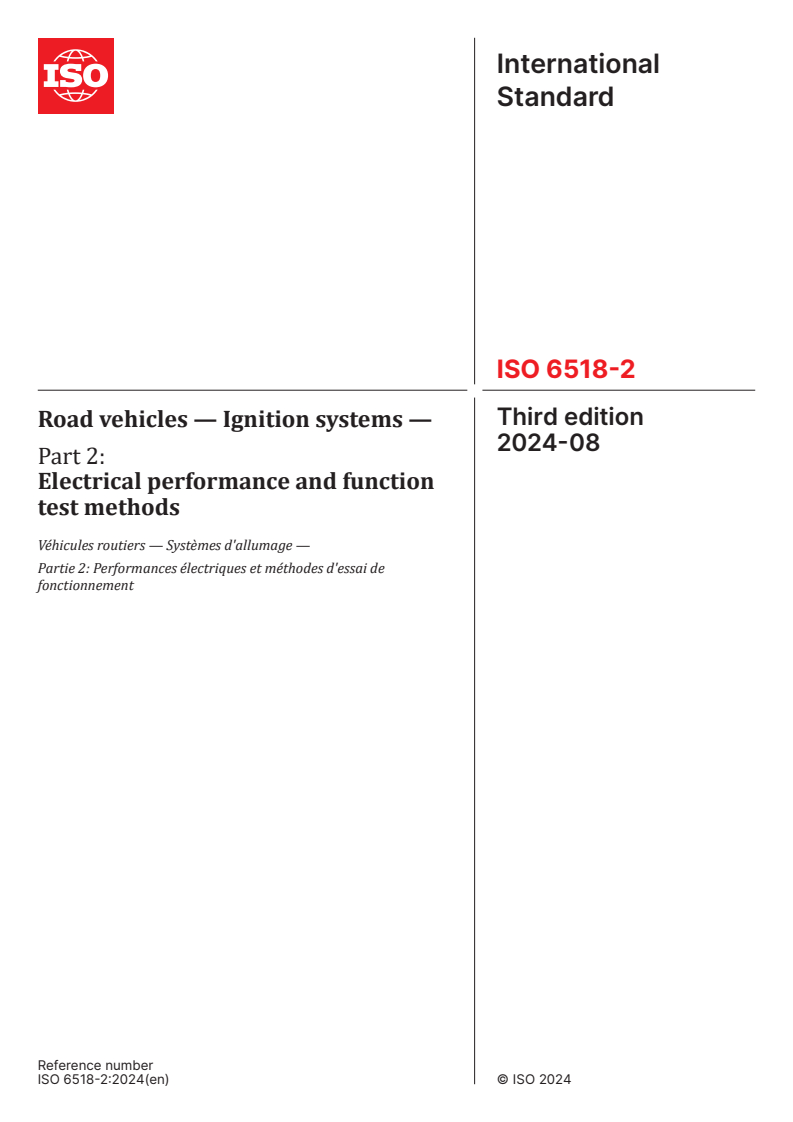
International
Standard
ISO 6518-2
Third edition
Road vehicles — Ignition systems —
2024-08
Part 2:
Electrical performance and function
test methods
Véhicules routiers — Systèmes d'allumage —
Partie 2: Performances électriques et méthodes d'essai de
fonctionnement
Reference number
© ISO 2024
All rights reserved. Unless otherwise specified, or required in the context of its implementation, no part of this publication may
be reproduced or utilized otherwise in any form or by any means, electronic or mechanical, including photocopying, or posting on
the internet or an intranet, without prior written permission. Permission can be requested from either ISO at the address below
or ISO’s member body in the country of the requester.
ISO copyright office
CP 401 • Ch. de Blandonnet 8
CH-1214 Vernier, Geneva
Phone: +41 22 749 01 11
Email: copyright@iso.org
Website: www.iso.org
Published in Switzerland
ii
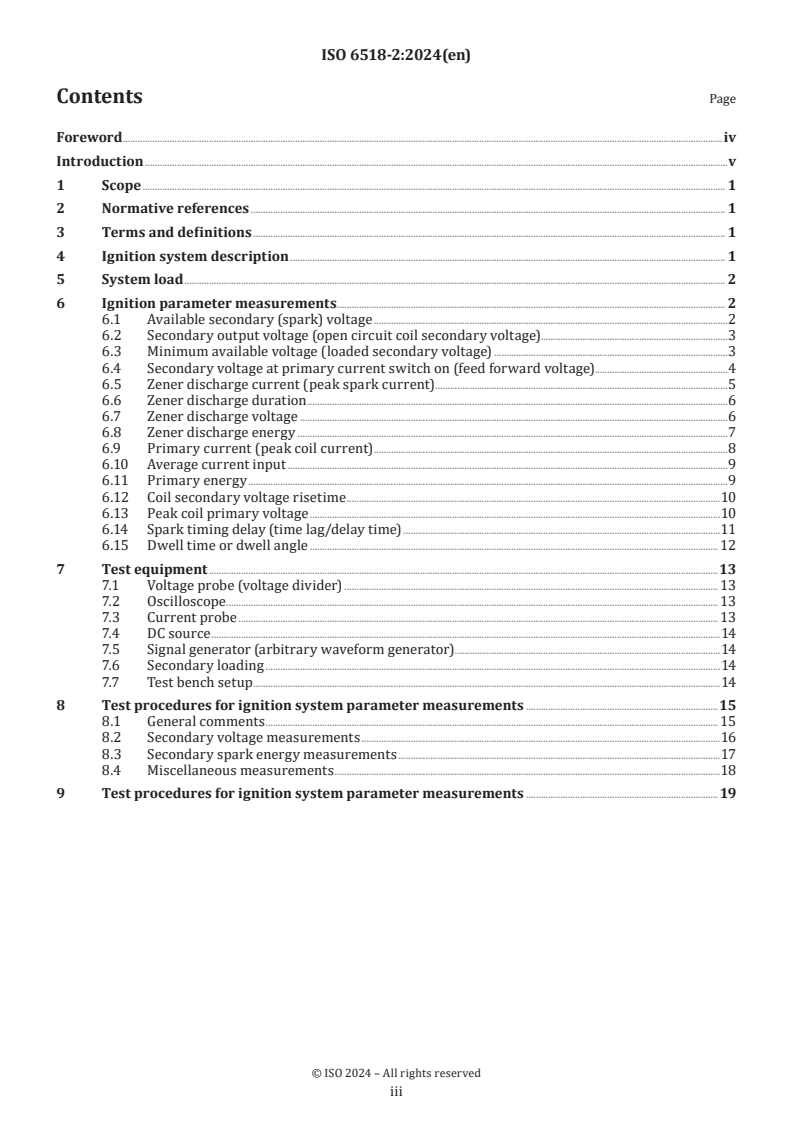
Contents Page
Foreword .iv
Introduction .v
1 Scope . 1
2 Normative references . 1
3 Terms and definitions . 1
4 Ignition system description . 1
5 System load . 2
6 Ignition parameter measurements . . 2
6.1 Available secondary (spark) voltage .2
6.2 Secondary output voltage (open circuit coil secondary voltage).3
6.3 Minimum available voltage (loaded secondary voltage) .3
6.4 Secondary voltage at primary current switch on (feed forward voltage).4
6.5 Zener discharge current (peak spark current) .5
6.6 Zener discharge duration .6
6.7 Zener discharge voltage .6
6.8 Zener discharge energy .7
6.9 Primary current (peak coil current) .8
6.10 Average current input .9
6.11 Primary energy .9
6.12 Coil secondary voltage risetime .10
6.13 Peak coil primary voltage .10
6.14 Spark timing delay (time lag/delay time) .11
6.15 Dwell time or dwell angle . 12
7 Test equipment .13
7.1 Voltage probe (voltage divider) . 13
7.2 Oscilloscope . 13
7.3 Current probe . 13
7.4 DC source .14
7.5 Signal generator (arbitrary waveform generator) .14
7.6 Secondary loading .14
7.7 Test bench setup .14
8 Test procedures for ignition system parameter measurements .15
8.1 General comments . 15
8.2 Secondary voltage measurements .16
8.3 Secondary spark energy measurements .17
8.4 Miscellaneous measurements .18
9 Test procedures for ignition system parameter measurements . 19
iii
Foreword
ISO (the International Organization for Standardization) is a worldwide federation of national standards
bodies (ISO member bodies). The work of preparing International Standards is normally carried out through
ISO technical committees. Each member body interested in a subject for which a technical committee
has been established has the right to be represented on that committee. International organizations,
governmental and non-governmental, in liaison with ISO, also take part in the work. ISO collaborates closely
with the International Electrotechnical Commission (IEC) on all matters of electrotechnical standardization.
The procedures used to develop this document and those intended for its further maintenance are described
in the ISO/IEC Directives, Part 1. In particular, the different approval criteria needed for the different types
of ISO document should be noted. This document was drafted in accordance with the editorial rules of the
ISO/IEC Directives, Part 2 (see www.iso.org/directives).
ISO draws attention to the possibility that the implementation of this document may involve the use of (a)
patent(s). ISO takes no position concerning the evidence, validity or applicability of any claimed patent
rights in respect thereof. As of the date of publication of this document, ISO had not received notice of (a)
patent(s) which may be required to implement this document. However, implementers are cautioned that
this may not represent the latest information, which may be obtained from the patent database available at
www.iso.org/patents. ISO shall not be held responsible for identifying any or all such patent rights.
Any trade name used in this document is information given for the convenience of users and does not
constitute an endorsement.
For an explanation of the voluntary nature of standards, the meaning of ISO specific terms and expressions
related to conformity assessment, as well as information about ISO's adherence to the World Trade
Organization (WTO) principles in the Technical Barriers to Trade (TBT), see www.iso.org/iso/foreword.html.
This document was prepared by Technical Committee ISO/TC 22, Road vehicles, Subcommittee SC 32,
Electrical and electronic components and general system aspects.
This third edition cancels and replaces the second edition (ISO 6518-2:1995), which has been technically
revised. It also incorporates the Technical Corrigendum ISO 6518-2:1995/Cor. 1:1997.
The main changes compared are as follows:
— test description amended to reflect the state of the art in digital technology.
A list of all parts in the ISO 6518 series can be found on the ISO website.
Any feedback or questions on this document should be directed to the user’s national standards body. A
complete listing of these bodies can be found at www.iso.org/members.html.
iv
Introduction
The purpose of this document is to provide a compact and concise specification on ignition parameter
measurements, the test equipment and the corresponding measurement procedures.
It is intended to specify equipment, conditions and methods to evaluate ignition systems for internal
combustion engines.
ISO 6518-1 specifies the definitions.
v
International Standard ISO 6518-2:2024(en)
Road vehicles — Ignition systems —
Part 2:
Electrical performance and function test methods
1 Scope
This document specifies the design and/or evaluation with the specific equipment, conditions and methods
for distributorless battery ignition systems intended for use in various internal combustion engines
including automotive, marine, motorcycle and utility engine applications. The test procedures listed in this
document are limited to measurements performed on a test bench only and do not include measurements
made directly on engines or vehicles. This document is not intended to supply information for battery
ignition systems used in aircraft applications of any type.
2 Normative references
The following documents are referred to in the text in such a way that some or all of their content constitutes
requirements of this document. For dated references, only the edition cited applies. For undated references,
the latest edition of the referenced document (including any amendments) applies.
ISO 6518-1, Road vehicles — Ignition systems — Part 1: Vocabulary
3 Terms and definitions
For the purposes of this document, the terms and definitions given in ISO 6518-1 apply.
ISO and IEC maintain terminology databases for use in standardization at the following addresses:
— ISO Online browsing platform: available at https:// www .iso .org/ obp
— IEC Electropedia: available at https:// www .electropedia .org/
4 Ignition system description
This document applies to single ended coil on plug (COP) and coil near plug (CNP). This document does not
propose methods to measure any advanced ignition technologies. Those advanced technologies may require
advanced methodologies for collection of performance characteristics.
The ignition system as defined for the tests tabulated in this document shall consist of:
a) A coil. This can be the conventional induction coil or an air or magnetic core transformer.
b) High voltage, metal conductor ignition cables which are specified to eliminate the varying effects of the
different kinds of cable with high impedance conductors. Resistance per foot, as well as inductance of
spark plug cables built to suppress radiation, can be quite different from manufacturer to manufacturer.
NOTE It is possible that some ignition systems do not function properly with metallic secondary cables due
to EMI and can require low resistance inductance cables.
c) The standard switching device used in modern systems is the insulated gate bipolar transistor (IGBT).
Other transistorized switches can be utilized too.
The preceding devices shall be interconnected as the manufacturer recommends or similar to the
conventional system see Figure 15 in 7.7.
5 System load
For the purposes of this document, the assumed loads for the ignition coil are capacitance, resistance and
a Zener diode string shown in Figure 1. For certain tests, as designated in Clause 6, the capacitive and
resistive loads will be directly connected to the coil high voltage tower with the coil not firing. A high
voltage load of 20 Picofarad (pF) or other as specified by OEM for coil-on-plug ignition system (this can
be a section of shielded ignition cable) are used to simulate the capacitance of the cables and spark plugs
as normally encountered on a vehicle. At suitable times, a low voltage coefficient (0,000 5 %/V max), non-
inductive 1,0 MW resistor, with a power rating of approximately 10 W, should be used to represent the
fouling accumulated onto the spark plug. The resistor simulates spark plug fouling due to carbon or other
fuel additives. This is a standard condition, but if the user deviates from this, then it is to be documented in
the test procedure. Load may vary according to customer requirements.
Key
1 secondary output voltage
2 HV measurement point
3 800 V/1 000 V switch
4 5 kΩ bypass switch
Figure 1 — Representation of Zener diode string
6 Ignition parameter measurements
6.1 Available secondary (spark) voltage
The available secondary voltage is the minimum voltage at the spark plug terminal with the terminal
connected to a load referenced to ground under specified conditions. This condition is usually a capacitive
load representative of the engine environment around the coil and spark plug. This measurement is
fundamental to spark ignition systems. Comparing available secondary voltage to the voltage that must
be exceeded to fire spark plugs (in a given engine) determines the adequacy of the ignition system (see
Figure 2).
Key
1 ignition coil t time [µs (typ.)]
I (reference) primary current [A (typ.)] C capacitive load
p L
U available voltage R resistance load
av L
U secondary voltage [kV (typ.)]
s
Figure 2 — Example of secondary voltage waveform
6.2 Secondary output voltage (open circuit coil secondary voltage)
The secondary output voltage is the voltage measured at the coil output terminal without loading (see
Figure 3). The coil is likely to be considered not installed or away from the installed capacitance due to the
valve cover, the environment around the boot and the spark plug. A specified capacitance may also be placed
from the high voltage terminal to ground to represent the installed system. This presents maximum voltage
to the ignition coil and possible stress to IGBT clamping. This is due to the stress put upon the insulation
around the windings and the stress to the driving element (IGBT) experiencing the reflected voltage from
this event upon the collector. Typically, this voltage is measured with a very low capacitance HV probe.
Key
1 ignition coil t time [µs (typ.)]
2 high voltage probe U secondary voltage [kV (typ.)]
s
I primary current [A (typ.)]
p
Figure 3 — Example of secondary voltage waveform
6.3 Minimum available voltage (loaded secondary voltage)
The minimum available voltage is the voltage measured at the spark plug terminal with a non-inductive
(1 MΩ +/- 1 %, 10 W 0,000 5 %/V maximum voltage coefficient, dielectric strength that exceeds the system
voltage) load resistor connected to the cable spark plug terminal. This may also have a specified capacitance
in parallel with the resistor. This is representative of available voltage when there is a severe plug fouling
condition represented by Figure 4. This may also be called minimum available voltage requirement.
Key
1 ignition coil t time [µs (typ.)]
I primary current [A (typ.)] C capacitive load
p L
U minimum available voltage R resistance load
avm L
U secondary voltage [kV (typ.)]
s
Figure 4 — Example of secondary voltage waveform for a fouled spark plug with a low shunt
resistance
6.4 Secondary voltage at primary current switch on (feed forward voltage)
This is the voltage induced in a secondary winding due to rate of change of the primary current at switch on
(transformer effect) as shown in Figure 5. This measurement occurs at the beginning of the current ramp
of the primary coil. It is the voltage that appears on the secondary output as the current changes over time
on the primary coil. This is most pronounced during the moment of turning on the ignitor. This turn on can
produce a peak voltage that could produce a spark before it is expected. This is measured at a specified load
and battery voltage condition.
Key
1 ignition coil U secondary voltage [V (typ.)]
s
U feed forward voltage C capacitive load
so L
t time [µs (typ.)] R resistance load
L
I primary current [A (typ.)]
p
Figure 5 — Example of close-up of secondary voltage waveform illustrating voltage
induced during turn on of primary current of ignition coil
6.5 Zener discharge current (peak spark current)
The Zener discharge current is the instantaneous current observed in the secondary circuit during
discharge of the ignition coil passing through the spark gap electrodes during arcing (see Figure 6). This
measurement describes the current flow through the electrode gap during the discharge. For an inductive
ignition coil, this occurs at the beginning of discharge. The critical parameter is the peak inductive current
(peak spark current) value. However, the instantaneous values over the duration of the spark event are
useful in determining spark energy. This can also refer to the secondary current across a load R .
L
Key
1 ignition coil I spark current [mA (typ.)]
sp
I primary current [A (typ.)] R spark plug resistor
p sp
I peak spark current R resistance load
zdm L
t time [ms (typ.)] U Zener discharge voltage
zd
Figure 6 — Example of secondary current waveform with a 1 000 V Zener load showing peak
inductive secondary current
6.6 Zener discharge duration
The Zener discharge duration is the length of time the current is flowing in the secondary circuit during the
coil discharge event under specified conditions. This measurement is indicative of the length of time when
an arc is present in the electrode gap and the secondary current is non-zero (see Figure 7).
Key
1 ignition coil t time [ms (typ.)]
I primary current [A (typ.)] R spark plug resistor
p sp
t Zener discharge duration time R resistance load
fzd L
I spark current [mA (typ.)] U Zener discharge voltage
sp zd
Figure 7 — Example of secondary current waveform with a 1 000 V Zener load showing duration of
secondary current
6.7 Zener discharge voltage
This measurement is the potential difference between the HV secondary terminal and ground during coil
discharge across the electrode gap during the coil discharge (see Figure 8). This value can be either positive
or negative depending on the system polarity. The critical parameter of value is the peak voltage during
the breakdown phase. The instantaneous values over the duration of the discharge event are useful in
determining the output energy of the coil.
Key
1 ignition coil I primary current [A (typ.)]
p
t time of 50 % spark duration R spark plug resistor
fsp sp
U Zener discharge voltage R resistance load
zd L
U spark voltage [V (typ.)]
sp
t time [ms (typ.)]
NOTE The voltage of the Zener voltage is measured at the 50 % spark duration mark.
Figure 8 — Example of secondary current waveform with a 1 000 V Zener load showing Zener
voltage measurement
6.8 Zener discharge energy
This represents the measure of energy released from the coil during the discharge event (see Figure 9). The
typical spark discharge is made of two c
...