

ISO/FDIS 9308-4
(Main)Water quality — Enumeration of Escherichia coli and coliform bacteria — Part 4: Membrane filtration method for Escherichia coli in water with high levels of background bacteria
- Abstract
This document describes a highly specific method for the enumeration of Escherichia coli (E. coli) in water. The method is based on membrane filtration, subsequent culture at 44 °C on a chromogenic agar medium containing a chromogenic ingredient for the detection of the enzyme ß-glucuronidase, and calculation of the number of target organisms in the sample. Because of the high specificity of the method, this document is suitable for waters with high levels of background bacteria, such as surface waters including bathing water and wastewater. E. coli strains which do not grow at 44 °C and those that are β-glucuronidase negative, such as E. coli O157, will not be detected as E. coli by this method.
- Status
- Not Published
- Technical Committee
- ISO/TC 147/SC 4 - Microbiological methods
- Drafting Committee
- ISO/TC 147/SC 4/WG 30 - E. coli by membrane filtration
- Current Stage
- 5020 - Proof sent to secretariat or FDIS ballot initiated: 8 weeks - 50 Approval
- Start Date
- 13-Oct-2026
- Due Date
- 13-Oct-2026
- Completion Date
- 13-Oct-2026
Buy Documents
ISO/FDIS 9308-4 - Water quality — Enumeration of Escherichia coli and coliform bacteria — Part 4: Membrane filtration method for Escherichia coli in water with high levels of background bacteria
REDLINE ISO/FDIS 9308-4 - Water quality — Enumeration of Escherichia coli and coliform bacteria — Part 4: Membrane filtration method for Escherichia coli in water with high levels of background bacteria
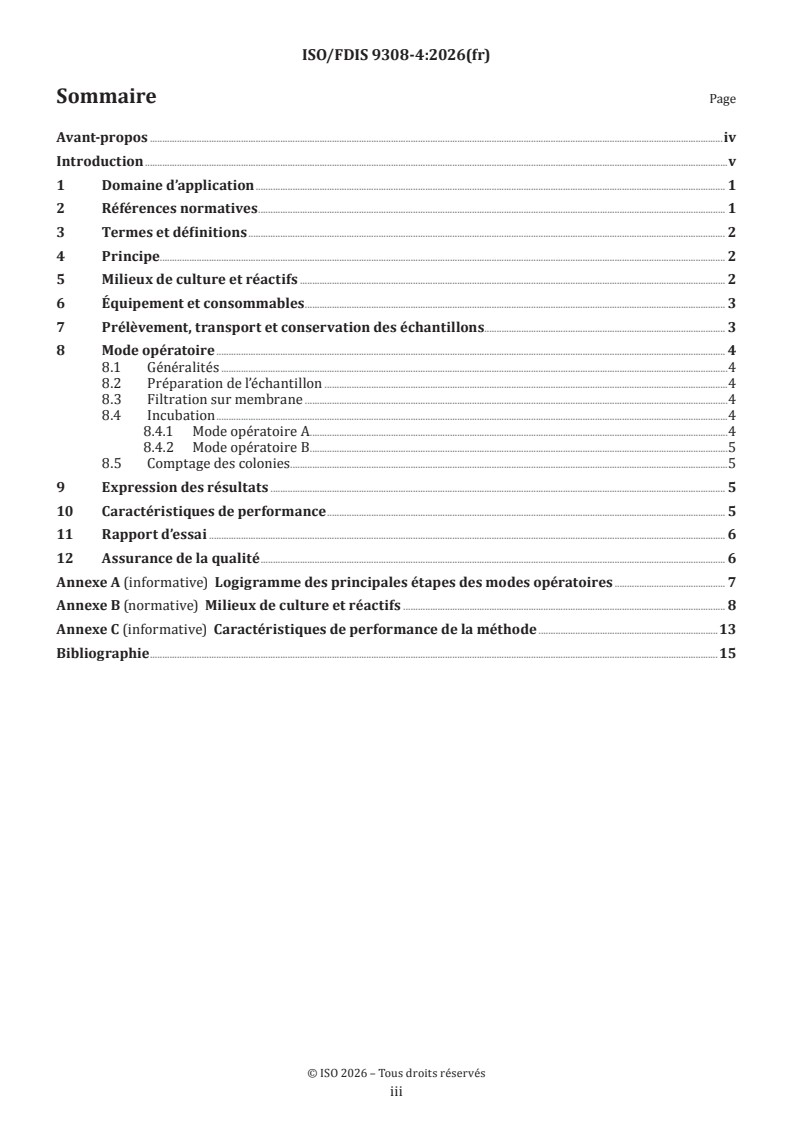
ISO/FDIS 9308-4 - Qualité de l'eau — Dénombrement des Escherichia coli et des bactéries coliformes — Partie 4: Méthode par filtration sur membrane pour Escherichia coli pour les eaux à teneurs élevées en bactéries
ISO/FDIS 9308-4 is an ISO document for enumerating Escherichia coli (E. coli) in water by membrane filtration. It specifies a selective culture method for waters with high levels of background bacteria, including surface water, bathing water and wastewater, and it is written for laboratories that monitor water quality and faecal pollution.
What does ISO/FDIS 9308-4 specify?
ISO/FDIS 9308-4 specifies a membrane filtration method for counting E. coli in water, followed by culture at 44 °C on a chromogenic agar medium that detects β-glucuronidase activity. The document is organized into clauses for the principle, media and reagents, equipment, sampling, procedure, expression of results, performance characteristics, test report and quality assurance.
The method is aimed at waters with high levels of background bacteria, provided the water has little particulate or colloidal matter relative to the E. coli concentration. It covers two procedures - one for fresh water and one for marine water and brackish water.
| Annex | What it covers |
|---|---|
| Annex A | Flow diagram of the main steps of Procedure A and Procedure B |
| Annex B | Culture media and reagents, plus performance testing of the media and membrane filters |
| Annex C | Performance characteristics of the method |
What are the key requirements of ISO/FDIS 9308-4?
ISO/FDIS 9308-4 is built around three practical decisions: choose the right procedure for the water type, use the right filtration and incubation sequence, and report counts in a way that matches the method limits. In practice, these choices affect whether damaged cells recover, whether target colonies are visible, and whether the result is suitable for comparison with other samples.
Sample handling and method choice
- Clause 7 requires sampling, transport and storage in line with ISO 19458, with analysis as soon as possible and within 24 h, keeping samples at (5 ± 3) °C if stored. This matters because E. coli counts can change quickly after sampling.
- For brackish water, Clause 8.1 requires Procedure B or a comparison of Procedure A and Procedure B in accordance with ISO 17994 before using Procedure A. This matters because salinity can affect recovery.
- Clause 1 says the method is not for coliform bacteria other than E. coli. This matters if a laboratory needs a broader coliform result.
Filtration and incubation
- Clause 8.3 requires membrane filtration of test portions or dilutions using membrane filters, with a target range of at least 10 and at most 150 specific colonies expected per filter. This matters because counts outside that range reduce confidence in the result.
- Clause 8.3 recommends fourfold dilutions when the water content is unknown, and it allows multiple filters or duplicate plates to improve precision. This matters when the background load or contamination level is uncertain.
- Procedure A in Clause 8.4.1 is for fresh water: place the membrane on TBX agar, pre-incubate at 36 °C, then incubate at 44 °C. Procedure B in Clause 8.4.2 is for marine and brackish water: pre-incubate on MMGA, transfer to TBX agar, then incubate at 44 °C. This matters because the two procedures are tuned to different water matrices.
- Clause 8.5 counts colonies with a positive β-D-glucuronidase reaction, generally blue or blue-green, as E. coli. Strains that do not grow at 44 °C or are β-glucuronidase negative, such as E. coli O157, are not detected as E. coli by this method.
Reporting, performance and quality assurance
- Clause 9 requires results to be expressed as cfu per chosen reference volume, using the counts from filters that stay within the method limit. This matters because the same sample may be reported per ml, 100 ml or l depending on the water type and local practice.
- Clause 10 ties the method to validation data and single-laboratory verification. When not all colonies are confirmed, the clause gives a calculation approach based on false negative and false positive rates. This matters when only part of the growth can be confirmed in routine work.
- Clause 12 requires a laboratory quality control system, with performance testing of culture media, reagents and membranes. Positive controls, negative controls and blanks are part of the method. This matters because the media and filter system can change the result if they are not functioning correctly.
- Clause 11 requires the test report to identify the method and procedure used, the sample, the volume tested, the calculated result, deviations and the test date. This matters for traceability and for comparing results across laboratories.
What terms does ISO/FDIS 9308-4 define?
- Escherichia coli (E. coli) - A member of the Enterobacteriaceae that expresses β-D-glucuronidase and can grow at 44 °C in the presence of bile salts.
- TBX agar - Tryptone bile X-glucuronide agar, used to support growth and reveal β-D-glucuronidase-positive colonies by colour.
- MMGA - Minerals-modified glutamate agar, used in Procedure B to help damaged cells recover before transfer to TBX agar.
- cfu - Colony-forming units, the expression used for the calculated concentration in the sample.
- β-D-glucuronidase - The enzyme detected by the chromogenic ingredient; colonies showing this reaction are counted as E. coli.
- Productivity - The ability of the media and membrane filter system to recover E. coli in performance testing.
- Selectivity - The ability of the medium to suppress non-target organisms under the test conditions.
- Specificity - The ability of the method to react as intended with target and non-target organisms in the validation checks.
Who uses ISO/FDIS 9308-4?
ISO/FDIS 9308-4 is used by water testing laboratories, environmental microbiology laboratories, and public-health or regulatory bodies that monitor faecal pollution. It is relevant for fresh water, marine water, brackish water, bathing water and wastewater.
Quality managers use it to define the laboratory workflow, media control and reporting format. Buyers and technical evaluators use it to choose a method when high background bacterial growth makes less selective methods harder to read. Laboratory staff use it for routine enumeration, confirmation, quality control and result interpretation.
Which standards are used with ISO/FDIS 9308-4?
The document relies on these normative references and related companion standards:
- ISO 7704 - Sets requirements for performance testing of membrane filters used for direct enumeration by culture methods.
- ISO 8199:2018 - Gives general requirements and guidance for microbiological examinations by culture, including sampling support, diluents and result expression.
- ISO 11133 - Covers preparation, storage and performance testing of culture media and reagents.
- ISO 19458 - Specifies sampling for microbiological analysis.
- ISO 9308-2 - Provides the most probable number method for E. coli and coliform bacteria.
- ISO 9308-3 - Provides a miniaturized most probable number method for E. coli in surface water and wastewater.
- ISO 13843:2017 - Is used for performance characteristics, verification and related statistical treatment.
- ISO 17994 - Is used when comparing the relative recovery of two quantitative methods.
- ISO 16269-4 - Supports outlier treatment in the interlaboratory statistics described in the bibliography.
What does the ISO/FDIS 9308-4 document contain?
ISO/FDIS 9308-4 contains a flow diagram of the main analytical steps in Annex A, which helps users follow the sequence from filtration to counting. Annex B provides the culture media and reagents for TBX agar, MMGA and peptone saline solution, together with preparation details and the performance tests for media and membrane filters.
The document also contains performance-testing tables in Annex B that link the media to productivity, selectivity and specificity checks using reference organisms. Clause 10 includes formulas for handling performance-characteristic calculations when only part of the colonies are confirmed. Annex C summarizes interlaboratory performance data, including sensitivity, specificity, false positive rate, false negative rate, selectivity and efficiency, plus repeatability, reproducibility, robustness and the upper limit used for the method.
Relations
- Effective Date
- 12-Feb-2026
Buy Documents
ISO/FDIS 9308-4 - Water quality — Enumeration of Escherichia coli and coliform bacteria — Part 4: Membrane filtration method for Escherichia coli in water with high levels of background bacteria
REDLINE ISO/FDIS 9308-4 - Water quality — Enumeration of Escherichia coli and coliform bacteria — Part 4: Membrane filtration method for Escherichia coli in water with high levels of background bacteria
ISO/FDIS 9308-4 - Qualité de l'eau — Dénombrement des Escherichia coli et des bactéries coliformes — Partie 4: Méthode par filtration sur membrane pour Escherichia coli pour les eaux à teneurs élevées en bactéries
Frequently Asked Questions
ISO/FDIS 9308-4 is a draft published by the International Organization for Standardization (ISO). Its full title is "Water quality — Enumeration of Escherichia coli and coliform bacteria — Part 4: Membrane filtration method for Escherichia coli in water with high levels of background bacteria". This standard covers: This document describes a highly specific method for the enumeration of Escherichia coli (E. coli) in water. The method is based on membrane filtration, subsequent culture at 44 °C on a chromogenic agar medium containing a chromogenic ingredient for the detection of the enzyme ß-glucuronidase, and calculation of the number of target organisms in the sample. Because of the high specificity of the method, this document is suitable for waters with high levels of background bacteria, such as surface waters including bathing water and wastewater. E. coli strains which do not grow at 44 °C and those that are β-glucuronidase negative, such as E. coli O157, will not be detected as E. coli by this method.
This document describes a highly specific method for the enumeration of Escherichia coli (E. coli) in water. The method is based on membrane filtration, subsequent culture at 44 °C on a chromogenic agar medium containing a chromogenic ingredient for the detection of the enzyme ß-glucuronidase, and calculation of the number of target organisms in the sample. Because of the high specificity of the method, this document is suitable for waters with high levels of background bacteria, such as surface waters including bathing water and wastewater. E. coli strains which do not grow at 44 °C and those that are β-glucuronidase negative, such as E. coli O157, will not be detected as E. coli by this method.
ISO/FDIS 9308-4 is classified under the following ICS (International Classification for Standards) categories: 07.100.20 - Microbiology of water. The ICS classification helps identify the subject area and facilitates finding related standards.
ISO/FDIS 9308-4 has the following relationships with other standards: It is inter standard links to FprEN ISO 9308-4. Understanding these relationships helps ensure you are using the most current and applicable version of the standard.
ISO/FDIS 9308-4 is available in PDF format for immediate download after purchase. The document can be added to your cart and obtained through the secure checkout process. Digital delivery ensures instant access to the complete standard document.
Standards Content (Sample)
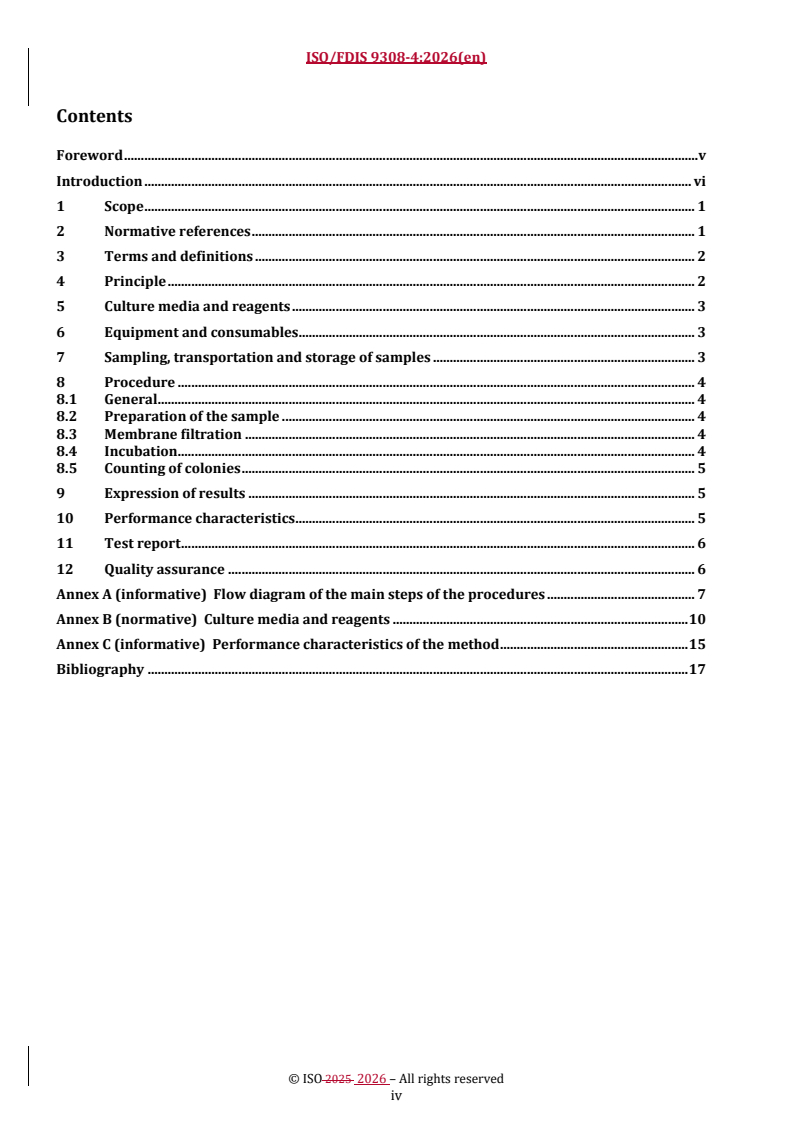
Contents
- Introduction
- 1 Scope
- 2 Normative references
- 3 Terms and definitions
- 3.1 Escherichia coli
- 4 Principle
- 5 Culture media and reagents
- 6 Equipment and consumables
- 7 Sampling, transportation and storage of samples
- 8 Procedure
- 8.1 General
- 8.2 Preparation of the sample
- 8.3 Membrane filtration
- 8.4 Incubation
- 8.5 Counting of colonies
- 9 Expression of results
- 10 Performance characteristics
- 11 Test report
- 12 Quality assurance
- Annex A
- Annex B
- Annex C
- Bibliography
Introduction
The presence and extent of faecal pollution is an important factor in assessing the quality of water and the risk to human health from infection. Examination of water samples for the presence of Escherichia coli (E. coli), which normally inhabits the bowel of man and other warm-blooded animals, provides an indication of such pollution.
EXAMPLE 1 Directive 2006/7/EC of the European Parliament and of the Council of 15 February 2006 concerning the management of bathing water quality sets standards for the monitoring of levels of E. coli in official bathing waters. [9] EXAMPLE 2 According to the United States Environmental Protection Agency, states can require the measurement of E. coli to determine whether water quality criteria have been met for fresh water that is designated for primary [10] contact recreation, including swimming and bathing.
As surface waters often contain other bacteria than E. coli, either of environmental origin or through contamination with faeces from animal or human origin, a method with high specificity is essential for the enumeration of E. coli in surface water. This method makes use of two features that E. coli generally possesses: thermotolerance and expression of β-glucuronidase, to ensure such a high specificity.
FINAL DRAFT International Standard ISO/FDIS 9308-4:2026(en) Water quality — Enumeration of Escherichia coli and coliform bacteria — Part 4:
Membrane filtration method for Escherichia coli in water with high levels of background bacteria WARNING — Persons using this document should be familiar with good laboratory practice. This document does not purport to address all of the safety aspects, if any, associated with its use. It is the responsibility of the user to establish appropriate safety and health practices. IMPORTANT — Tests conducted in accordance with this document shall be carried out by suitably qualified staff.
1 Scope
This document specifies a highly specific method for the enumeration of Escherichia coli (E. coli) in water, based on membrane filtration followed by culture at 44 °C on chromogenic agar medium containing an [5],[6],[13] ingredient for the detection of the enzyme β-glucuronidase.
This document is applicable to waters with high levels of background bacteria (e.g. surface waters including bathing water and wastewater) provided that these waters contain little particulate or colloidal matter relative to the E. coli concentration. This document consists of two procedures one for fresh water and one for marine water.
E. coli strains that do not grow at 44 °C and those that are β-glucuronidase negative (e.g. E. coli O157) are not detected as E. coli by this method.
The method specified in this document does not apply to the enumeration of coliform bacteria other than E. coli.
2 Normative references
The following documents are referred to in the text in such a way that some or all of their content constitutes requirements of this document. For dated references, only the edition cited applies. For undated references, the latest edition of the referenced document (including any amendments) applies. ISO 7704, Water quality — Requirements for the performance testing of membrane filters used for direct enumeration of microorganisms by culture methods ISO 8199:2018, Water quality — General requirements and guidance for microbiological examinations by culture ISO 11133, Microbiology of the food chain and water — Preparation, production, storage and performance testing of culture media and reagents ISO 19458, Water quality — Sampling for microbiological analysis
3 Terms and definitions
For the purposes of this document, the following terms and definitions apply.
ISO/FDIS 9308-4:2026(en) ISO and IEC maintain terminology databases for use in standardization at the following addresses:
- ISO Online browsing platform: available at https:// www .iso .org/ obp
- IEC Electropedia: available at https:// www .electropedia .org/
3.1 Escherichia coli
E. coli member of the Enterobacteriaceae that expresses β-d-glucuronidase and that is capable of growing at 44 °C in the presence of bile salts
4 Principle
The enumeration of E. coli consists of the following steps:
- filtering test portion(s) or dilutions of the sample, through a membrane filter, which retains the organisms;
- depending on the type of sample, two different procedures for the enumeration of E. coli are used:
- procedure A: enumerating E. coli in fresh water by placement of the membrane filter on tryptone bile-X-glucuronide (TBX) agar, placing the TBX agar at 36 °C for 4 h to 5 h to resuscitate stressed cells, followed by incubation at 44 °C for 21 h;
- procedure B: enumerating E. coli in marine water and brackish water by placement of the membrane filter on minerals-modified glutamate agar (MMGA), placing the MMGA at 36 °C for 4 h to 5 h to resuscitate stressed cells, followed by incubation on TBX agar at 44 °C for 21 h;
- counting β-d-glucuronidase positive colonies (blue or blue green) as E. coli; as the shade of β-d- glucuronidase positive colonies can vary between different manufacturers, follow the manufacturer’s instructions for the specific colour of β-d-glucuronidase positive colonies;
- calculating the colony forming units (cfu) per required volume of the sample from the number of colonies counted.
Figure A.1 gives the main steps of both procedures.
NOTE 1 Recovery of E. coli from marine water appears to be suboptimal on TBX agar while limited data are available for brackish water (see “Supportive data for the use of MMGA during pre-incubation for the analysis of marine water” provided in a machine-readable file at: https:// standards .iso .org/ iso/ 9308/ -4/ ed -1/ en). Pre-incubation on MMGA [11],[12] enhances resuscitation of damaged cells and optimizes recovery . NOTE 2 Examples of colour variation of β-d-glucuronidase positive colonies on TBX agar from different manufacturers are shown in “Variation in target colony colour on TBX agar” provided in a machine-readable file at:
https:// standards .iso .org/ iso/ 9308/ -4/ ed -1/ en.
5 Culture media and reagents
Follow good laboratory practices in accordance with ISO 8199. Use peptone saline solution for dilutions or, alternatively, one of the other diluents presented in ISO 8199. The composition of the culture media (TBX agar and MMGA) and reagents and their preparation are specified in Annex B. For performance testing of the culture media and reagents, follow the procedures in accordance with Annex B and ISO 11133.
6 Equipment and consumables
Disposable equipment is an acceptable alternative to reusable items if these have the suitable specifications. The usual microbiological laboratory equipment (see ISO 8199) and, in particular, the following shall be used.
ISO/FDIS 9308-4:2026(en) 6.1 Apparatus for sterilization by steam (autoclave) capable of operating at (121 ± 3) °C, as specified in ISO 8199. In case the procedure for pre-incubation on MMGA (Procedure B) is used, the autoclave shall also be capable of operating at (115 ± 3) °C.
6.2 Disinfected or sterilized forceps, for handling of membrane filters (6.5). 6.3 Equipment for membrane filtration, with funnels that can be disinfected or sterilized. 6.4 Incubators, one capable of operating at (36 ± 2) °C and one capable of operating at (44 ± 0,5) °C or alternatively a cycling temperature incubator programmed to switch from (36 ± 2) °C to (44 ± 0,5) °C. 6.5 Membrane filters, composed of cellulose esters or other suitable material, usually 47 mm or 50 mm in diameter, with filtration characteristics equivalent to a rated nominal pore diameter of 0,45 μm and, preferentially, with grid lines.
6.6 pH meter, with an accuracy of ±0,1 at 20 °C to 25 °C.
6.7 Refrigerator (e.g. for storage of samples or media), capable of operating at (5 ± 3) °C. 6.8 Sterile Petri dishes with vents, with an appropriate diameter. 6.9 Sterile pipettes and micropipettes with sterile tips.
6.10 Water bath (optional), capable of operating at 47 °C to 50 °C (if culture medium is prepared from dehydrated media).
7 Sampling, transportation and storage of samples
Take the samples and deliver them to the laboratory in accordance with ISO 19458. Keep the time between sampling and analysis as short as possible in accordance with ISO 19458 and maximally for 24 h. Samples can be kept at (5 ± 3) °C in a refrigerator (6.7) up to 24 h prior to analysis. NOTE The maximum sample storage time of 24 h is above the acceptable maximum sample storage time for E. coli as given in ISO 19458 (which is 18 h). The deviation from ISO 19458 is based on experimental data (see “Supportive data for increasing the maximum sample storage time to 24 hours” provided in a machine-readable file at: https:// standards .iso .org/ iso/ 9308/ -4/ ed -1/ en).
8 Procedure
8.1 General
Depending on the type of sample, two different procedures for the enumeration of E. coli are used:
- procedure A: enumeration of E. coli in fresh water;
- procedure B: enumeration of E. coli in marine water and brackish water. For brackish water with salinity of maximal 6 parts per thousand, data indicated an equally efficient recovery on TBX agar as fresh water. The amount of data on brackish water is very limited however, and the level of salinity at which recovery becomes significantly inhibited is unknown. For brackish water, it is, therefore, required to use procedure B or test the relative recovery with procedure A versus procedure B (following the method described in ISO 17994) to determine the suitability of procedure A for brackish water prior to implementation of the method.
ISO/FDIS 9308-4:2026(en)
8.2 Preparation of the sample
For preparation and diluting of the sample, follow the instructions given in ISO 8199:2018, 6.3 and 8.2.1, using sterile pipettes and micropipettes with sterile tips (6.9).
8.3 Membrane filtration
Filter appropriate test portions using membrane filters (6.5) in accordance with the instructions in ISO 8199:2018, 9.1.4. Appropriate test portions are volumes or dilutions where growth of at least 10 specific colonies and a maximum of 150 target colonies are expected. If the content of the water is unknown, a range of fourfold dilutions is recommended.
NOTE 1 The test-volumes or levels of dilution depend on the presumed level of faecal contamination of the water to 2 5 be tested: as a guidance, E. coli concentrations generally range between 10 cfu/l and 10 cfu/l in surface water and 6 10 [8] 10 cfu/l to 10 cfu/l in untreated wastewater, but data varies between locations. NOTE 2 The maximum volume that can be filtered depends on the particulate matter of the sample. Turbid samples have lower maximum volumes or need diluting, which will influence the detection level. If samples are too turbid to efficiently reach the desired detection level, the required volume can be filtered over multiple filters. Alternatively, a most probable number method can be used (see ISO 9308-2 and ISO 9308-3). NOTE 3 The use of duplicate plates per volume or dilution can increase the precision of the method. In the case of multiple dilutions, proceed from the most to the least diluted test portion and in the case of multiple volumes from the smallest to the largest volume.
Disinfect the filtration funnels (6.3) prior to the first sample and in between two different samples. Directly prior to filtration, mix the sample well to ensure a uniform distribution of the microorganisms in the sample.
8.4 Incubation
8.4.1 Procedure A
Place the membrane filters on the TBX agar (see Clause B.2) using sterile forceps (6.2), ensuring that no air is trapped underneath. Invert the plates, then pre-incubate at (36 ± 2) °C for (4,5 ± 0,5) h and follow with incubation at (44 ± 0,5) °C for (21 ± 3) h (6.4).
...
Contents
- Introduction
- 1 Scope
- 2 Normative references
- 3 Terms and definitions
- 4 Principle
- 5 Culture media and reagents
- 6 Equipment and consumables
- 7 Sampling, transportation and storage of samples
- 8 Procedure
- 8.1 General
- 8.2 Preparation of the sample
- 8.3 Membrane filtration
- 8.4 Incubation
- 8.5 Counting of colonies
- 9 Expression of results
- 10 Performance characteristics
- 11 Test report
- 12 Quality assurance
- Annex A
- Annex B
- Annex C
- Bibliography
Introduction
The presence and extent of faecal pollution is an important factor in assessing the quality of water and the risk to human health from infection. Examination of water samples for the presence of Escherichia coli (E. coli), which normally inhabits the bowel of man and other warm-blooded animals, provides an indication of such pollution.
EXAMPLE 1 In European Union Member States the monitoring of levels of E. coli is mandatory for official bathing waters, as indicated by the 1 Directive 2006/7/EC of the European Parliament and of the Council of 15 February [9] 2006 concerning the management of bathing water quality . sets standards for the monitoring of levels of E. coli in [9] official bathing waters.
EXAMPLE 2 According to the United States Environmental Protection Agency, states can require the measurement of E. coli to determine whether water quality criteria have been met for fresh water that is designated for primary contact [10] [10] recreation, including swimming and bathing ..
As surface waters often contain other bacteria than E. coli, either of environmental origin or through contamination with faeces from animal or human origin, a method with high specificity is essential for the enumeration of E. coli in surface water. This method makes use of two features that E. coli generally possesses:
thermotolerance and expression of β-glucuronidase, to ensure such a high specificity.
nd Final Draft International Standard (2 draft) ISO/FDIS 9308-4
Water quality — Enumeration of Escherichia coli and coliform bacteria
Part 4:
Membrane filtration method for Escherichia coli in water with high levels of background bacteria WARNING — Persons using this document should be familiar with good laboratory practice. This document does not purport to address all of the safety aspects, if any, associated with its use. It is the responsibility of the user to establish appropriate safety and health practices. IMPORTANT — It is absolutely essential that testsTests conducted in accordance with this document shall be carried out by suitably qualified staff.
1 Scope
This document specifies a highly specific method for the enumeration of Escherichia coli (E. coli) in water. The method is, based on membrane filtration followed by culture at 44 °C on chromogenic agar medium containing [5]],[ [6] [5,6,13] ],[ [13] an ingredient for the detection of the enzyme β-glucuronidase. . This document is applicable to waters with high levels of background bacteria (e.g. surface waters including bathing water and wastewater) provided that these waters contain little particulate or colloidal matter relative to the E. coli concentration. This document consists of two procedures one for fresh water and one for marine water.
E. coli strains that do not grow at 44 °C and those that are β-glucuronidase negative (e.g. E. coli O157) willare not be detected as E. coli by this method.
The method specified in this document isdoes not appropriate forapply to the enumeration of coliform bacteria other than E. coli.
2 Normative references
The following documents are referred to in the text in such a way that some or all of their content constitutes requirements of this document. For dated references, only the edition cited applies. For undated references, the latest edition of the referenced document (including any amendments) applies. ISO 7704, Water quality — Requirements for the performance testing of membrane filters used for direct enumeration of microorganisms by culture methods ISO 8199:2018, Water quality — General requirements and guidance for microbiological examinations by culture ISO 11133, Microbiology of the food chain and water — Preparation, production, storage and performance testing of culture media and reagents
ISO/FDIS 9308-4:2026(en) ISO 19458, Water quality — Sampling for microbiological analysis
3 Terms and definitions
For the purposes of this document, the following terms and definitions apply. ISO and IEC maintain terminology databases for use in standardization at the following addresses:
- — ISO Online browsing platform: available at https://www.iso.org/obp
- — IEC Electropedia: available at https://www.electropedia.org/ 3.1 3.1 Escherichia coli E. coli member of the Enterobacteriaceae that expresses β-D-glucuronidase and that is capable of growing at 44 °C in the presence of bile salts
4 Principle
The enumeration of E. coli consists of the following steps:
- — Filtration offiltering test portion(s) or dilutions of the sample, through a membrane filter, which retains the organisms.;
- — Dependingdepending on the type of sample, two different procedures for the enumeration of E. coli are used:
- — Procedureprocedure A: enumeration ofenumerating E. coli in fresh water by placement of the membrane filter on tryptone bile-X-glucuronide (TBX) agar, placing the TBX agar at 36 °C for 4 h to 5 h to resuscitate stressed cells, followed by incubation at 44 °C for 21 h.;
- — Procedureprocedure B: enumeration ofenumerating E. coli in marine water and brackish water by placement of the membrane filter on minerals-modified glutamate agar (MMGA), placing the MMGA at 36 °C for 4 h to 5 h to resuscitate stressed cells, followed by incubation on TBX agar at 44 °C for 21 h.;
- — Countingcounting β-D-glucuronidase positive colonies (blue or blue green) as E. coli; as the shade of β- D-glucuronidase positive colonies (blue or blue green) as E. coli.
- — Calculationcan vary between different manufacturers, follow the manufacturer’s instructions for the specific colour of β-D-glucuronidase positive colonies;
- calculating the colony forming units (cfu) per required volume of the sample from the number of colonies counted.
Figure A.1Figure A.1 gives the main steps of both procedures.
NOTE 1 Recovery of E. coli from marine water appears to be suboptimal on TBX agar while limited data isare available for brackish water (see document “Supportive data for the use of MMGA during pre-incubation for the analysis of marine water” onprovided in a machine-readable file at: https://standards.iso.org/iso/9308/-4/ed-1/en). Pre-incubation on [11]],[ [12][11],[12] MMGA enhances resuscitation of damaged cells and optimizes recovery .. NOTE 2 The Examples of colour variation of β-D-glucuronidase positive colonies can vary on TBX agar from different manufacturers (see documentare shown in “Variation in target colony colour on TBX agar” onprovided in a machine-
nd (2 draft) ISO/FDIS 9308-4:2026(en) readable file at: https://standards.iso.org/iso/9308/-4/ed-1/en): follow the manufacturer’s instructions for the specific colour of β-D-glucuronidase positive colonies..
5 Culture media and reagents
Follow good laboratory practices in accordance with ISO 8199. Use peptone saline solution for dilutions or, alternatively, one of the other diluents presented in ISO 8199. The composition of the culture media (TBX agar and MMGA) and reagents and their preparation are specified in Annex BAnnex B.. For performance testing of the culture media and reagents, follow the procedures in accordance with Annex BAnnex B and ISO 11133.
6 Equipment and consumables
Disposable equipment is an acceptable alternative to reusable items if these have the suitable specifications. The usual microbiological laboratory equipment (see ISO 8199) and, in particular, the following shall be used. 6.1 6.1 Apparatus for sterilization by steam (autoclave) capable of operating at (121 ± 3) °C, as specified in ISO 8199. In case the procedure for pre-incubation on MMGA (Procedure B) is used, the autoclave shall also be capable of operating at (115 ± 3) °C.
6.2 6.2 Disinfected or sterilized forceps, for handling of membrane filters (6.5(6.5).). 6.3 6.3 Equipment for membrane filtration, with funnels that can be disinfected or sterilized. 6.4 6.4 Incubators, one capable of operating at (36 ± 2) °C and one capable of operating at (44 ± 0,5) °C or alternatively a cycling temperature incubator programmed to switch from (36 ± 2) °C to (44 ± 0,5) °C.
6.5 6.5 Membrane filters, composed of cellulose esters or other suitable material, usually 47 mm or 50 mm in diameter, with filtration characteristics equivalent to a rated nominal pore diameter of 0,45 μm and, preferentially, with grid lines.
6.6 6.6 pH meter, with an accuracy of ±0,1 at 20 °C to 25 °C.
6.7 6.7 Refrigerator (e.g. for storage of samples or media), capable of operating at (5 ± 3) °C. 6.8 6.8 Sterile Petri dishes with vents, with an appropriate diameter. 6.9 6.9 Sterile pipettes and micropipettes with sterile tips.
6.10 6.10 Water bath (optional), capable of operating at 47 °C to 50 °C (if culture medium is prepared from dehydrated media).
7 Sampling, transportation and storage of samples
Take the samples and deliver them to the laboratory in accordance with ISO 19458. Keep the time between sampling and analysis as short as possible in accordance with ISO 19458 and maximally for 24 h. Samples can be kept at (5 ± 3) °C in a refrigerator (6.7(6.7)) up to 24 h prior to analysis. NOTE The maximum sample storage time of 24 h is above the acceptable maximum sample storage time for E. coli as given in ISO 19458 (which is 18 h). The deviation from ISO 19458 is based on experimental data (see document “Supportive data for increasing the maximum sample storage time to 24 hours” onprovided in a machine-readable file at: https://standards.iso.org/iso/9308/-4/ed-1/en).
ISO/FDIS 9308-4:2026(en)
8 Procedure
8.1 General
Depending on the type of sample, two different procedures for the enumeration of E. coli are used:
- — Procedureprocedure A: enumeration of E. coli in fresh water.;
- — Procedureprocedure B: enumeration of E. coli in marine water and brackish water. For brackish water with salinity of maximal 6 parts per thousand, data indicated an equally efficient recovery on TBX agar as fresh water. The amount of data on brackish water is very limited however, and the level of salinity at which recovery becomes significantly inhibited is unknown. For brackish water, it is, therefore, required to use Procedureprocedure B or test the relative recovery with Procedureprocedure A versus Procedureprocedure B (following the method described in ISO 17994) to determine the suitability of Procedureprocedure A for brackish water prior to implementation of the method.
8.2 Preparation of the sample
For preparation and diluting of the sample, follow the instructions given in ISO 8199:2018, 6.3 and 8.2.1, using sterile pipettes and micropipettes with sterile tips (6.9(6.9).).
8.3 Membrane filtration
Filter appropriate test portions using membrane filters (6.5(6.5)) in accordance with the instructions in ISO 8199:2018, 9.1.4. Appropriate test portions are volumes or dilutions where growth of at least 10 specific colonies and a maximum of 150 target colonies are expected. If the content of the water is unknown, a range of four-foldfourfold dilutions is recommended.
NOTE 1 The test-volumes or levels of dilution depend on the presumed level of faecal contamination of the water to 2 5 be tested: “as a guidance, E. coli concentrations generally range between 10 cfu/l and 10 cfu/l in surface water and 6 10 [8] [8] 10 cfu/l to 10 cfu/l in untreated wastewater, but data varies between locations”. . NOTE 2 The maximum volume that can be filtered depends on the particulate matter of the sample. Turbid samples will have lower maximum volumes or will need diluting, which will influence the detection level. If samples are too turbid to efficiently reach the desired detection level, the required volume can be filtered over multiple filters. Alternatively, a most probable number method can be used (see ISO 9308-2 and ISO 9308-3). NOTE 3 The use of duplicate plates per volume or dilution can increase the precision of the method. In the case of multiple dilutions, proceed from the most to the least diluted test portion and in the case of multiple volumes from the smallest to the largest volume.
Disinfect the filtration funnels (6.3(6.3)) prior to the first sample and in between two different samples. Directly prior to filtration, mix the sample well to ensure a uniform distribution of the microorganisms in the sample.
8.4 Incubation
8.4.1 Procedure A
Place the membrane filters on the TBX agar (see Clause B.2Clause B.2)) using sterile forceps (6.2(6.2),), ensuring that no air is trapped underneath. Invert the plates, then pre-incubate at (36 ± 2) °C for (4,5 ± 0,5) h and follow with incubation at (44 ± 0,5) °C for (21 ± 3) h (6.4(6.4).).
nd (2 draft) ISO/FDIS 9308-4:2026(en)
8.4.2 Procedure B
Place the membrane filters on the MMGA (see Clause B.3Clause B.3)) using sterile forceps (6.2(6.2),), ensuring that no air is trapped between the filter and agar, invert the plates, and pre-incubate at (36 ± 2) °C for (4,5 ± 0,5) h (6.4(6.4).). Transfer the filters to TBX agar using sterile forceps and incubate at (44 ± 0,5) °C for (21 ± 3) h (6.4(6.4).).
...
Contents
- Introduction
- 1 Domaine d’application
- 2 Références normatives
- 3 Termes et définitions
- 3.1 Escherichia coli
- 4 Principe
- 5 Milieux de culture et réactifs
- 6 Équipement et consommables
- 7 Prélèvement, transport et conservation des échantillons
- 8 Mode opératoire
- 8.1 Généralités
- 8.2 Préparation de l’échantillon
- 8.3 Filtration sur membrane
- 8.4 Incubation
- 8.5 Comptage des colonies
- 9 Expression des résultats
- 10 Caractéristiques de performance
- 11 Rapport d’essai
- 12 Assurance de la qualité
- Annexe A
- Annexe B
- Annexe C
- Bibliographie
Introduction
La présence et l’étendue de la pollution fécale sont des facteurs importants dans l’évaluation de la qualité de l’eau ainsi que du risque infectieux représenté pour la santé humaine. L’examen d’échantillons d’eau pour y rechercher des Escherichia coli (E. coli), normalement présents dans les intestins de l’homme et des animaux homéothermes, fournit une indication sur ce type de pollution. EXEMPLE 1 La Directive 2006/7/CE du Parlement européen et du Conseil du 15 février 2006 concernant la gestion de la qualité des eaux de baignade spécifie les normes concernant la surveillance des teneurs en E. coli pour les eaux de [9] baignade officielles .
EXEMPLE 2 Selon l’Agence de protection de l’environnement des États-Unis, les états peuvent exiger de mesurer la teneur en E. coli pour vérifier que les critères de qualité de l’eau sont satisfaits pour l’eau douce destinée à des activités [10] de loisirs en contact direct avec l’eau, comme la nage et la baignade par exemple . Étant donné que les eaux de surface contiennent souvent des bactéries autres qu’E. coli, d’origine environnementale ou à la suite d’une contamination par les excréments animaux ou humains, une méthode offrant une haute spécificité est essentielle pour le dénombrement des E. coli dans les eaux de surface. La présente méthode utilise deux caractéristiques que E. coli possède généralement: la thermotolérance et l’expression de la β-glucuronidase, pour assurer cette haute spécificité.
PROJET FINAL Norme internationale ISO/FDIS 9308-4:2026(fr) Qualité de l'eau — Dénombrement des Escherichia coli et des bactéries coliformes — Partie 4:
Méthode par filtration sur membrane pour Escherichia coli pour les eaux à teneurs élevées en bactéries AVERTISSEMENT — Il convient que les utilisateurs du présent document maîtrisent les bonnes pratiques de laboratoire. Le présent document ne prétend pas couvrir tous les aspects de sécurité qui sont, le cas échéant, liés à son utilisation. Il incombe à l’utilisateur de mettre en place des pratiques appropriées en matière d’hygiène et de sécurité.
IMPORTANT — Les essais réalisés conformément au présent document doivent être effectués par du personnel ayant une qualification appropriée.
1 Domaine d’application
Le présent document spécifie une méthode hautement spécifique de dénombrement des Escherichia coli (E. coli) dans l’eau qui repose sur une filtration sur membrane, suivie d’une mise en culture à 44 °C dans un milieu [5],[6],[13] gélosé chromogène contenant un ingrédient permettant de détecter l’enzyme β-glucuronidase . Le présent document est applicable aux eaux à teneurs élevées en bactéries (par exemple, les eaux de surface, notamment les eaux de baignade et les eaux usées) sous réserve que ces eaux contiennent une faible teneur en matière particulaire ou colloïdale par rapport à la concentration en E. coli. Le présent document comprend deux modes opératoires, l’un pour l’eau douce et l’autre pour l’eau de mer. Les souches d’E. coli qui ne se développent pas à 44 °C et celles qui sont négatives à la β-glucuronidase (par exemple, E. coli O157), ne sont pas détectées en tant qu’E. coli par cette méthode. La méthode spécifiée dans le présent document ne s’applique pas au dénombrement des bactéries coliformes autres qu’E. coli.
2 Références normatives
Les documents suivants sont cités dans le texte de sorte qu’ils constituent, pour tout ou partie de leur contenu, des exigences du présent document. Pour les références datées, seule l’édition citée s’applique. Pour les références non datées, la dernière édition du document de référence s’applique (y compris les éventuels amendements).
ISO 7704, Qualité de l'eau — Exigences relatives aux essais de performance des membranes filtrantes utilisées pour le dénombrement direct des micro-organismes par des méthodes de culture ISO 8199:2018, Qualité de l’eau — Exigences et lignes directrices générales pour les examens microbiologiques sur milieu de culture ISO 11133, Microbiologie des aliments, des aliments pour animaux et de l’eau — Préparation, production, stockage et essais de performance des milieux de culture ISO 19458, Qualité de l'eau — Échantillonnage pour analyse microbiologique
ISO/FDIS 9308-4:2026(fr)
3 Termes et définitions
Pour les besoins du présent document, les termes et définitions suivants s’appliquent. L’ISO et l’IEC tiennent à jour des bases de données terminologiques destinées à être utilisées en normalisation, consultables aux adresses suivantes:
- ISO Online browsing platform: disponible à l’adresse https:// www .iso .org/ obp
- IEC Electropedia: disponible à l’adresse https:// www .electropedia .org/
3.1 Escherichia coli
E. coli membre de la famille des entérobactéries qui exprime la β-d-galactosidase et qui est en mesure de se développer à 44 °C en présence de sels biliaires
4 Principe
Le dénombrement d’E. coli se composent des étapes suivantes:
- filtration de la ou des prises d’essai ou des dilutions de l’échantillon à travers une membrane filtrante qui retient les organismes;
- selon le type d’échantillon, deux modes opératoires différents sont suivis pour le dénombrement d’E. coli:
- mode opératoire A: dénombrement d’E. coli dans l’eau douce par positionnement de la membrane filtrante sur gélose tryptone-bile-X-glucuronide (gélose TBX), incubation de la gélose TBX à 36 °C pendant 4 h à 5 h pour revivifier les cellules en état de stress, suivie d’une incubation à 44 °C pendant 21 h;
- mode opératoire B: dénombrement d’E. coli dans l’eau de mer et l’eau saumâtre par positionnement de la membrane filtrante sur gélose au glutamate modifiée (MMGA), incubation de la MMGA à 36 °C pendant 4 h à 5 h pour revivifier les cellules en état de stress, suivie d’une incubation sur gélose TBX à 44 °C pendant 21 h;
- dénombrement des colonies positives à la β-d-glucuronidase (de couleur bleue ou bleu-vert) en tant qu’E. coli; comme la teinte des colonies positives à la β-d-glucuronidase peut varier d’un fabricant à l’autre, suivre les instructions du fabricant en ce qui concerne la couleur spécifique des colonies positives à la β-d-glucuronidase;
- calcul des unités formant colonie (UFC) par volume requis de l’échantillon à partir du nombre de colonies dénombrées.
La Figure A.1 présente les principales étapes des deux modes opératoires. NOTE 1 La récupération d’E. coli dans l’eau de mer semble sous-optimale sur gélose TBX. Quant à la récupération d’E. coli dans l’eau saumâtre, les données disponibles sont limitées (voir fichier informatique “Supportive data for the use of MMGA during pre-incubation for the analysis of marine water” (données complémentaires pour l’utilisation de MMGA pendant la pré-incubation pour l’analyse de l’eau de mer) consultable à l’adresse: https:// standards .iso .org/ iso/ 9308/ -4/ ed -1/ en). La pré-incubation sur MMGA améliore la revivification des cellules endommagées et optimise la [11],[12] récupération[ .
NOTE 2 Des exemples de variation de couleur de colonies positives à la β-d-glucuronidase sur gélose TBX selon les fabricants sont présentés dans le fichier informatique “Variation in target colony colour on TBX” (variation de couleur des colonies cibles sur gélose TBX) consultable à l’adresse: https:// standards .iso .org/ iso/ 9308/ -4/ ed -1/ en.
5 Milieux de culture et réactifs
Suivre les bonnes pratiques de laboratoire conformément à l’ISO 8199. Utiliser une solution peptonée saline pour les dilutions ou, en variante, l’un des autres diluants présentés dans l’ISO 8199.
ISO/FDIS 9308-4:2026(fr) La composition des milieux de culture (gélose TBX et MMGA) et des réactifs et leur préparation sont spécifiées à l’Annexe B. Pour les essais de performance des milieux de culture et des réactifs, suivre les modes opératoires conformément à l’Annexe B et à l’ISO 11133.
6 Équipement et consommables
Le matériel à usage unique est acceptable au même titre que les éléments réutilisables, à condition que ses spécifications soient convenables. Le matériel courant de laboratoire de microbiologie (voir ISO 8199) et, en particulier, ce qui suit doit être utilisé.
6.1 Appareil de stérilisation à la vapeur (autoclave) pouvant fonctionner à (121 ± 3) °C, tel que spécifié dans l’ISO 8199. Si le mode opératoire de pré-incubation sur MMGA (mode opératoire B) est utilisé, l’autoclave doit également pouvoir fonctionner à (115 ± 3) °C.
6.2 Pinces désinfectées ou stérilisées, pour la manipulation des membranes filtrantes (6.5). 6.3 Équipement de filtration sur membrane, avec entonnoirs pouvant être désinfectés ou stérilisés. 6.4 Incubateurs, l’un pouvant fonctionner à (36 ± 2) °C et l’autre à (44 ± 0,5) °C ou, en variante, un incubateur à température programmable permettant de passer de (36 ± 2) °C à (44 ± 0,5) °C. 6.5 Membranes filtrantes, composées d’esters de cellulose ou d’autres matériaux appropriés, généralement de 47 mm ou 50 mm de diamètre, présentant des caractéristiques de filtration équivalentes à une porosité nominale de 0,45 μm, munies, de préférence, d’un quadrillage. 6.6 pH-mètre, d’une exactitude de ± 0,1 unité entre 20 °C et 25 °C. 6.7 Réfrigérateur (par exemple pour le stockage des échantillons ou des milieux), pouvant fonctionner à (5 ± 3) °C.
6.8 Boîtes de Petri stériles avec ergots de ventilation, d’un diamètre approprié. 6.9 Pipettes stériles et micropipettes avec embouts stériles.
6.10 Bain d’eau thermostaté (facultatif), pouvant fonctionner entre 47 °C et 50 °C (si le milieu de culture est préparé à partir de milieux déshydratés).
7 Prélèvement, transport et conservation des échantillons
Prélever les échantillons et les remettre au laboratoire conformément à l’ISO 19458. Veiller à ce que le délai entre le prélèvement et l’analyse soit le plus bref possible conformément à l’ISO 19458 et ne dépasse pas 24 h. Les échantillons peuvent être conservés à (5 ± 3) °C au réfrigérateur (6.7) pendant 24 h au maximum avant l’analyse.
NOTE La durée maximale de conservation des échantillons de 24 h est supérieure à la durée maximale acceptable de conservation des échantillons fixée pour E. coli dans l’ISO 19458 (qui est de 18 h). L’écart par rapport à l’ISO 19458 repose sur des données expérimentales (voir fichier informatique “Supportive data for increasing the maximum sample storage time to 24 hours” (Données complémentaires concernant l’augmentation de la durée maximale de conservation des échantillons à 24 h) consultable à l’adresse suivante: https:// standards .iso .org/ iso/ 9308/ -4/ ed -1/ en).
ISO/FDIS 9308-4:2026(fr)
8 Mode opératoire
8.1 Généralités
Selon le type d’échantillon, deux modes opératoires différents sont suivis pour le dénombrement d’E. coli:
- mode opératoire A: dénombrement d’E. coli dans l’eau douce;
- mode opératoire B: dénombrement d’E. coli dans l’eau de mer et l’eau saumâtre. Pour les eaux saumâtres ayant une salinité maximale de 6 parties par millier, les données indiquent une récupération tout aussi efficace sur gélose TBX que pour l’eau douce. Cependant, les données concernant l’eau saumâtre sont très peu nombreuses et le niveau de salinité auquel la récupération devient significativement inhibée n’est pas connu. Pour les eaux saumâtres, il est donc nécessaire d’utiliser le mode opératoire B ou de déterminer par essai le rendement relatif en comparant le mode opératoire A au mode opératoire B (en suivant la méthode décrite dans l’ISO 17994) pour statuer sur l’adéquation du mode opératoire A pour les eaux saumâtres avant la mise en œuvre de la méthode.
8.2 Préparation de l’échantillon
Pour la préparation et la dilution de l’échantillon, suivre les instructions données dans l’ISO 8199:2018, 6.3 et 8.2.1, en utilisant des pipettes stériles et des micropipettes avec embouts stériles (6.9).
8.3 Filtration sur membrane
Filtrer les prises d’essai appropriées au moyen de membranes filtrantes (6.5) conformément aux instructions de l’ISO 8199:2018, 9.1.4. Les prises d’essai appropriées sont des volumes ou des dilutions pour lesquels une croissance d’au moins 10 colonies spécifiques et d’un maximum de 150 colonies cibles est attendue. Si la teneur en microorganismes de l’eau n’est pas connue, une série de dilutions au quart est recommandée. NOTE 1 Les volumes d’essai ou les niveaux de dilution dépendent du niveau présumé de contamination d’origine fécale de l’eau à soumettre à essai: à titre indicatif, les concentrations en E. coli sont généralement comprises 2 5 6 10 entre 10 UFC/l et 10 UFC/l dans les eaux de surface et entre 10 UFC/l et 10 UFC/l dans les eaux usées non traitées, [8] mais les données varient d’un site à l’autre .
NOTE 2 Le volume maximal pouvant être filtré dépend de la quantité de matière particulaire de l’échantillon. Les échantillons troubles ont des volumes maximaux plus faibles ou doivent être dilués, ce qui a une influence sur le niveau de détection. Si les échantillons sont trop troubles pour atteindre efficacement le niveau de détection souhaité, le volume requis peut être filtré sur plusieurs filtres. Une méthode du nombre le plus probable peut également être utilisée (voir ISO 9308-2 et ISO 9308-3).
NOTE 3 L’utilisation de boîtes en doublon par volume ou dilution peut augmenter la fidélité de la méthode. Dans le cas de multiples dilutions, commencer par la prise d’essai la plus diluée pour finir par la prise d’essai la moins diluée et, dans le cas de multiples volumes, commencer par le plus petit volume pour finir par le plus grand volume.
Désinfecter les entonnoirs de filtration (6.3) avant le premier échantillon et entre deux échantillons différents.
Juste avant la filtration, bien mélanger l’échantillon pour assurer une répartition uniforme des microorganismes dans l’échantillon.
8.4 Incubation
8.4.1 Mode opératoire A
Placer les membranes filtrantes sur la gélose TBX (voir Article B.2) à l’aide de pinces stériles (6.2), en veillant à ne pas emprisonner d’air entre la membrane filtrante et la gélose. Retourner les boîtes, puis pré-incuber à (36 ± 2) °C pendant (4,5 ± 0,5) h et incuber à (44 ± 0,5) °C pendant (21 ± 3) h (6.4).
ISO/FDIS 9308-4:2026(fr)
...