

ISO 13647:2026
(Main)Water quality — Enumeration of culturable microorganisms — Colony count by spread plate inoculation on R2A medium
- Abstract
This document specifies a method for the enumeration of culturable microorganisms in water by counting colonies on a low-nutrient agar culture medium by spread plate inoculation after incubation at 22 °C for 7 d. This document is applicable to: water from the treatment process of public drinking water supplies (e.g. process water in the waterworks); chlorinated and non-chlorinated tap water in distribution systems and containers; bottled water; well water intended for human consumption. For detailed information on the performance characteristics, see Annex B. This document can be applied to other water matrices if the appropriate validation of performance of this method has been undertaken by the laboratory prior to use.
- Status
- Published
- Publication Date
- 10-Aug-2026
- Technical Committee
- ISO/TC 147/SC 4 - Microbiological methods
- Drafting Committee
- ISO/TC 147/SC 4/WG 27 - Culturable microorganisms
- Current Stage
- 6060 - International Standard published - 60 Publication
- Start Date
- 11-Aug-2026
- Due Date
- 31-Mar-2026
- Completion Date
- 31-Mar-2026
Buy Documents
ISO 13647:2026 - Water quality — Enumeration of culturable microorganisms — Colony count by spread plate inoculation on R2A medium
ISO 13647:2026 - Qualité de l'eau — Dénombrement des micro-organismes revivifiables — Comptage des colonies par ensemencement par étalement sur un milieu gélosé R2A
ISO 13647:2026 is an International Standard published by ISO for water microbiology laboratories. It specifies a spread plate method on R2A medium for counting culturable microorganisms in water after incubation at 22 °C for 7 d, mainly for treated drinking water, tap water, bottled water and well water intended for human consumption.
What does ISO 13647:2026 specify?
ISO 13647:2026 specifies how to enumerate culturable microorganisms in water by counting colonies on a low-nutrient agar medium after spread plate inoculation and incubation. It is written for routine microbiological examination of drinking-water related samples, and it also allows use on other water matrices if the laboratory has validated the method for that matrix.
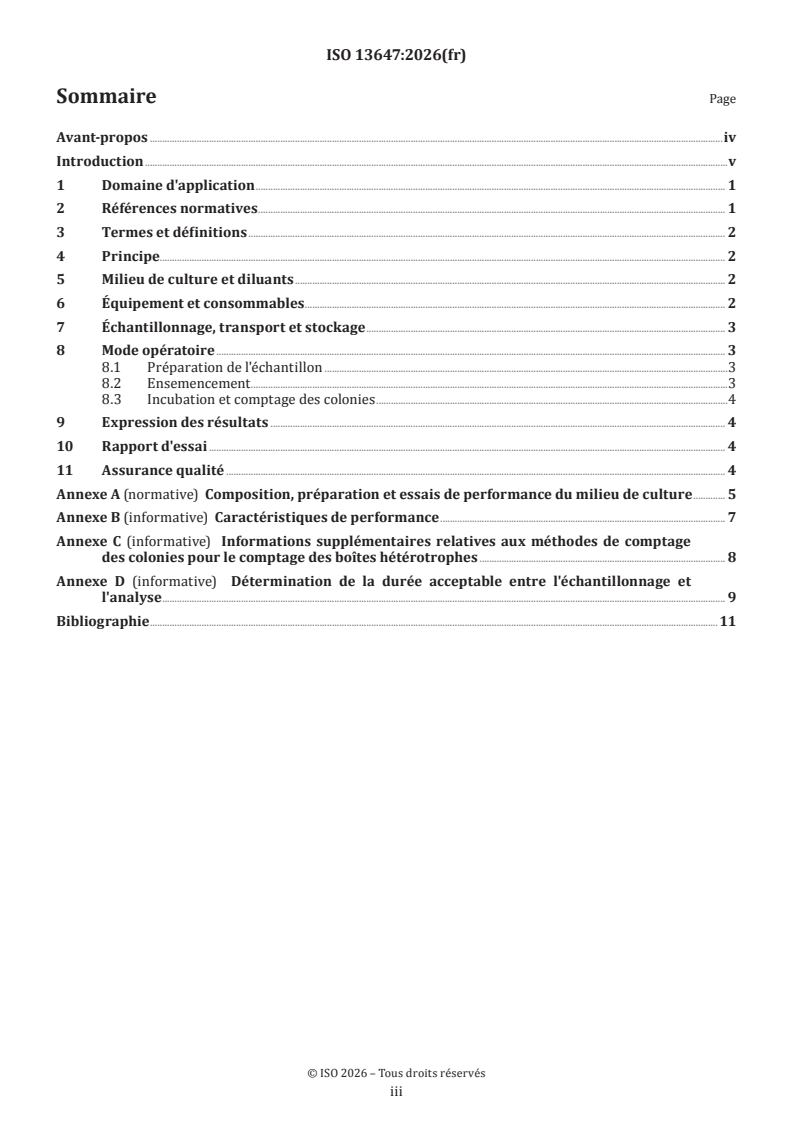
For performance information, the standard points readers to Annex B. The document is organized into scope, normative references, terms and definitions, principle, medium and diluents, equipment, sampling and storage, procedure, result expression, test report, quality assurance, and four annexes.
| Annex | What it covers |
|---|---|
| Annex A | Composition, preparation and performance testing of the culture medium |
| Annex B | Performance characteristics |
| Annex C | Additional information about colony counting methods for heterotrophic plate counting |
| Annex D | Determination of acceptable time between sampling and analysis |
What are the key requirements of ISO 13647:2026?
ISO 13647:2026 sets out a complete workflow, from sampling to reporting, so laboratories can produce comparable colony counts. The main points are below.
Use the specified principle in Clause 4. A test portion or dilution is spread on the surface of the specified culture medium and incubated at 22 °C for 7 d. In practice, this means the method is aimed at organisms that form colonies under these low-nutrient, longer-incubation conditions.
Prepare and control the medium and diluents as required in Clause 5 and Annex A. The standard relies on R2A medium, with preparation and performance testing aligned with ISO 11133 and ISO 8199. For users, this means medium quality matters as much as the counting step.
Use suitable laboratory equipment under Clause 6. The standard calls for sterilization by steam, an incubator at 22 °C, a pH meter, magnifying equipment for colony counting, and refrigeration for sample handling. This is what keeps the method controlled and repeatable.
Handle samples carefully in Clause 7. Sampling, transport and storage follow ISO 19458 and ISO 5667-5, with storage at 5 °C and analysis as soon as possible. Practically, this limits growth or decline before testing.
Follow the spread plate procedure in Clause 8. The method uses 0.1 ml on 90 mm Petri dishes, with the plates dried, inoculated, absorbed, inverted and incubated. The clause also notes that duplicate plates and serial dilutions can improve precision.
Count colonies and report results in Clauses 8 and 9. Visible colonies are counted and converted to cfu/ml; if 0.1 ml is used, the detection limit is 10 cfu/ml. When dilutions are used, the result is calculated as a weighted mean, and measurement uncertainty is linked to ISO 29201.
Keep records and quality control in Clauses 10 and 11. The test report must identify the sample, the method, the result, any deviations, notable occurrences and the test date. The laboratory also needs a quality control system, including control strains and blanks.
What terms does ISO 13647:2026 define?
- Culturable microorganism - an aerobic bacterium, yeast or mould capable of forming colonies on a culture medium.
- Colony forming unit (cfu) - the reporting unit used for the counted colonies, expressed per millilitre of sample.
- Reasoner’s 2 Agar (R2A) - the low-nutrient medium used in this method to reveal colonies that may grow slowly on richer media.
- Spread plate technique - the inoculation method where a measured volume is spread over the agar surface before incubation.
- Productivity ratio (P_R) - the Annex A performance measure used to check whether a batch of medium supports growth adequately.
- World Data Centre for Microorganisms (WDCM) - the reference catalogue used to identify the control strains named for medium performance testing.
Who uses ISO 13647:2026?
ISO 13647:2026 is used by water microbiology laboratories, drinking-water operators, bottled-water producers, and public health or contract testing laboratories. Quality managers and buyers use it when they need routine monitoring of treatment efficiency, distribution system condition, or water intended for human consumption.
It is also relevant when a laboratory wants to validate the method for another water matrix. In practice, that means the method supports both routine surveillance and controlled method extension.
Which standards are used with ISO 13647:2026?
- ISO 5667-5 - gives guidance on sampling drinking water from treatment works and piped distribution systems.
- ISO 8199:2018 - supplies general requirements for microbiological examinations by culture, including diluents, spread plate handling, storage of plates and result calculation.
- ISO 11133 - provides the rules for preparation, storage and performance testing of culture media.
- ISO 19458 - covers sampling for microbiological analysis.
- ISO 29201 - is used for estimating measurement uncertainty.
- ISO 13843:2017 - underpins the performance-characteristics approach used in Annex B.
- ISO 17994:2014 - is used in Annex D to compare relative recovery between storage times.
- ISO 6222 - is cited for comparison with a nutrient-rich colony count method and for alternative inoculation approaches discussed in Annex C.
What does the ISO 13647:2026 document contain?
ISO 13647:2026 contains the method principle, the required medium, equipment, sampling and storage instructions, the step-by-step inoculation and incubation procedure, result expression, reporting rules and quality assurance requirements. Annex A gives the medium composition, preparation and quality control conditions, including a performance-testing table.
Annex B summarizes performance characteristics such as quantitative range, recovery, counting uncertainty, repeatability, reproducibility and robustness. Annex C explains how this spread plate method relates to other heterotrophic plate counting approaches, and Annex D describes the storage-time study used to support the sampling-to-analysis interval.
Relations
- Effective Date
- 12-Feb-2026
- Effective Date
- 06-May-2023
Buy Documents
ISO 13647:2026 - Water quality — Enumeration of culturable microorganisms — Colony count by spread plate inoculation on R2A medium
ISO 13647:2026 - Qualité de l'eau — Dénombrement des micro-organismes revivifiables — Comptage des colonies par ensemencement par étalement sur un milieu gélosé R2A
Frequently Asked Questions
ISO 13647:2026 is a standard published by the International Organization for Standardization (ISO). Its full title is "Water quality — Enumeration of culturable microorganisms — Colony count by spread plate inoculation on R2A medium". This standard covers: This document specifies a method for the enumeration of culturable microorganisms in water by counting colonies on a low-nutrient agar culture medium by spread plate inoculation after incubation at 22 °C for 7 d. This document is applicable to: water from the treatment process of public drinking water supplies (e.g. process water in the waterworks); chlorinated and non-chlorinated tap water in distribution systems and containers; bottled water; well water intended for human consumption. For detailed information on the performance characteristics, see Annex B. This document can be applied to other water matrices if the appropriate validation of performance of this method has been undertaken by the laboratory prior to use.
This document specifies a method for the enumeration of culturable microorganisms in water by counting colonies on a low-nutrient agar culture medium by spread plate inoculation after incubation at 22 °C for 7 d. This document is applicable to: water from the treatment process of public drinking water supplies (e.g. process water in the waterworks); chlorinated and non-chlorinated tap water in distribution systems and containers; bottled water; well water intended for human consumption. For detailed information on the performance characteristics, see Annex B. This document can be applied to other water matrices if the appropriate validation of performance of this method has been undertaken by the laboratory prior to use.
ISO 13647:2026 is classified under the following ICS (International Classification for Standards) categories: 07.100.20 - Microbiology of water. The ICS classification helps identify the subject area and facilitates finding related standards.
ISO 13647:2026 has the following relationships with other standards: It is inter standard links to EN ISO 13647:2026, ISO/IEC 18033-4:2011/Amd 1:2020. Understanding these relationships helps ensure you are using the most current and applicable version of the standard.
ISO 13647:2026 is available in PDF format for immediate download after purchase. The document can be added to your cart and obtained through the secure checkout process. Digital delivery ensures instant access to the complete standard document.
Standards Content (Sample)
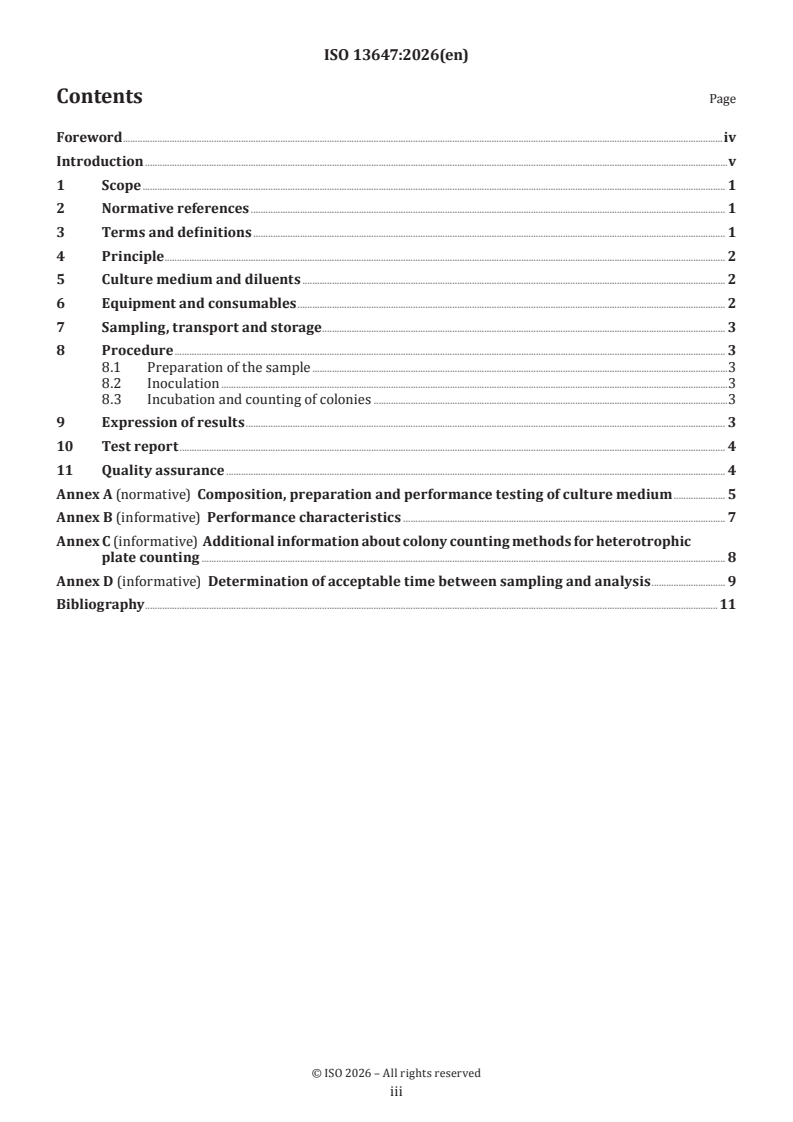
Contents
- Introduction
- 1 Scope
- 2 Normative references
- 3 Terms and definitions
- 3.1 culturable microorganism
- 4 Principle
- 5 Culture medium and diluents
- 6 Equipment and consumables
- 7 Sampling, transport and storage
- 8 Procedure
- 8.1 Preparation of the sample
- 8.2 Inoculation
- 8.3 Incubation and counting of colonies
- 9 Expression of results
- 10 Test report
- 11 Quality assurance
- Annex A
- Annex B
- Annex C
- Annex D
- Bibliography
Introduction
Treated drinking water contains a variety of microorganisms derived from various sources, such as raw water resource, different treatment steps within drinking water production and drinking water distribution networks.
Enumeration of the overall colony count of culturable microorganisms provides useful information for the assessment and surveillance of water quality. Colony counts are useful for assessing the raw water quality and efficiency of water treatment processes and provide an indication of the cleanliness and integrity of the drinking water distribution systems.
However, the main value of colony counts lies in the detection of changes from the expected values, based on representative monitoring. The change in colony counts can be caused for various reasons like biofilm formation, increase in water temperature, presence of microbially available nutrients or decrease in chlorine concentration. Any substantial increase in count can also be either a warning of potential treatment failure or contamination.
Nutrient rich tryptone yeast extract agar medium has been used for long time in water microbiology. ISO 6222 provides a monitoring method for heterotrophic plate counts in tap water quality verification. However, ISO 6222 only applies to the detection of microorganisms in nutrient rich conditions at 22 °C in 3 d or at 36 °C in 2 d.
Reasoner’s 2 agar (R2A) medium, which has a low-nutrient composition and long incubation time (7 d at 22 °C), enables the determination of micro-organisms forming colonies after a longer incubation time. Furthermore, the low level of nutrients in the medium minimizes the colony size and overgrowth. Therefore, the R2A method is especially suitable for providing more information on the enumeration of heterotrophic colony counts in water with low colony counts.
The method is well suited for monitoring water for human consumption which is low in nutrients and is distributed in temperatures below 20 °C (see Reference [1]), for example, to measure the operational efficiency of the treatment process of public drinking water supplies. The low-nutrient agar specified in this document for enumeration of culturable microorganisms usually gives higher colony counts from water samples than typically used nutrient-rich formulations of culture media (see References [2], [3] and [4]).
International Standard ISO 13647:2026(en) Water quality — Enumeration of culturable microorganisms - Colony count by spread plate inoculation on R2A medium WARNING — Persons using this document should be familiar with normal laboratory practice. This document does not purport to address all of the safety concerns, if any, associated with its use. It is the responsibility of the user to establish appropriate safety and health practices. IMPORTANT — The tests in this document shall be carried out by suitably qualified staff.
1 Scope
This document specifies a method for the enumeration of culturable microorganisms in water by counting colonies on a low-nutrient agar culture medium by spread plate inoculation after incubation at 22 °C for 7 d. This document is applicable to:
- water from the treatment process of public drinking water supplies (e.g. process water in the waterworks);
- chlorinated and non-chlorinated tap water in distribution systems and containers;
- bottled water;
- well water intended for human consumption.
For detailed information on the performance characteristics, see Annex B. This document can be applied to other water matrices if the appropriate validation of performance of this method has been undertaken by the laboratory prior to use.
2 Normative references
The following documents are referred to in the text in such a way that some or all of their content constitutes requirements of this document. For dated references, only the edition cited applies. For undated references, the latest edition of the referenced document (including any amendments) applies. ISO 5667-5, Water quality — Sampling — Part 5: Guidance on sampling of drinking water from treatment works and piped distribution systems ISO 8199:2018, Water quality — General requirements and guidance for microbiological examinations by culture ISO 11133, Microbiology of food, animal feed and water — Preparation, production, storage and performance testing of culture media ISO 19458, Water quality — Sampling for microbiological analysis
3 Terms and definitions
For the purposes of this document, the following terms and definitions apply. ISO and IEC maintain terminology databases for use in standardization at the following addresses:
- ISO Online browsing platform: available at https:// www .iso .org/ obp
- IEC Electropedia: available at https:// www .electropedia .org/
ISO 13647:2026(en)
3.1 culturable microorganism
aerobic bacteria, yeast or mould capable of forming colonies on a culture medium
4 Principle
A test portion of the sample or dilutions of the sample are inoculated on the surface of a specified culture medium (see Annex A) in Petri dishes by spread plate technique. Plates are incubated at (22 ± 2) °C for (164 ± 4) h.
All visible colonies are counted using a magnifying equipment as culturable microorganisms. The colony forming unit (cfu) per millilitre (ml) of the sample is calculated from the number of colonies counted. NOTE 1 The spread plate technique causes no heat shock and all colonies are on top of the agar surface where they can be distinguished readily from particles and bubbles.
NOTE 2 The low-nutrient agar in use in this document prevents the plates from becoming overgrown by faster growing microorganisms and allows the slower growing microorganisms to become apparent due to the longer incubation time.
NOTE 3 For certain purposes such as for waters with very low nutrient content such as de-ionised, distilled or reverse osmosis waters (see References [5], [6] and [7]), colony counting can be done with the pour plate technique or membrane filtration instead of the spread plate technique. For more information, see Annex C and ISO 8199.
5 Culture medium and diluents
Follow good laboratory practices in accordance with ISO 8199. Use ingredients of uniform quality and chemicals of analytical grade. For composition, preparation and performance testing of culture medium, follow the instructions given in Annex A and ISO 11133. Alternatively, use commercially available medium which conforms with the composition given in Annex A and strictly follow the manufacturer’s instructions. NOTE This document describes the use of R2A medium (see Reference [8]). There are other formulations available, e.g. R3A medium that can be suitable for certain applications. Laboratories can use other formulations by undertaking appropriate performance validation of the adapted formulation prior to use but the performance validations of such media are not covered in this document.
Use diluents presented in ISO 8199:2018, 6.3 for dilutions and follow the formulation, preparation, storage and performance testing instructions given in ISO 8199:2018, Annex D.
6 Equipment and consumables
Disposable equipment is an acceptable alternative to reusable items if these have the suitable specifications. The usual microbiological laboratory equipment (see ISO 8199) and, in particular, the following shall be used.
6.1 Apparatus for sterilization by steam (autoclave), thermostatically controlled at (121 ± 3) °C. Apparatus and glassware that are not supplied sterile shall be sterilized in accordance with ISO 8199. 6.2 Incubator, thermostatically controlled at (22 ± 2) °C.
6.3 pH meter, with an accuracy of ±0,1 at 20 °C to 25 °C.
6.4 Magnifying equipment, for colony counting with magnitude of at least 2 to 3 times and light above or under the plate against dark background.
ISO 13647:2026(en) NOTE The use of higher magnification than 2 to 3 times can lower the operational variability of the colony counting (see Clause 9). In some laboratories, the use of magnifying equipment with magnitude of 6 to 8 times has been successfully used.
6.5 Laminar flow cabinet (optional).
6.6 Refrigerator, thermostatically controlled at (5 ± 3) °C.
7 Sampling, transport and storage
Take the samples and deliver them to the laboratory in accordance with ISO 19458 and ISO 5667-5. Samples shall be transported and stored at 5 °C in accordance with 6.6 and ISO 19458. The samples can be kept at 5 °C for up to 24 h after the sampling prior to examination (see Reference [9]). The data of determination of acceptable time between sampling and analysis is described in Annex D. Samples should be analysed as soon as possible.
8 Procedure
8.1 Preparation of the sample
For preparation and dilution of the sample and inoculation on the culture medium, follow the instructions given in ISO 8199:2018, 8.2.1 and 9.1.3. As R2A is prone to cross-contamination, precautions should be taken to prevent it. The use of laminar flow cabinets or hoods can decrease the cross-contamination of R2A plates.
...
Contents
- Introduction
- 1 Domaine d'application
- 2 Références normatives
- 3 Termes et définitions
- 3.1 micro-organisme revivifiable
- 4 Principe
- 5 Milieu de culture et diluants
- 6 Équipement et consommables
- 7 Échantillonnage, transport et stockage
- 8 Mode opératoire
- 8.1 Préparation de l'échantillon
- 8.2 Ensemencement
- 8.3 Incubation et comptage des colonies
- 9 Expression des résultats
- 10 Rapport d'essai
- 11 Assurance qualité
- Annexe A
- Annexe B
- Annexe C
- Annexe D
- Bibliographie
Introduction
L'eau potable traitée contient une multitude de micro-organismes provenant de sources diverses, telles que les ressources en eau brute, les différentes étapes de traitement au sein des réseaux de production et de distribution d'eau potable.
Le dénombrement du comptage global des colonies de micro-organismes revivifiables fournit des informations utiles pour l'évaluation et la surveillance de la qualité de l'eau. Les comptages de colonies sont utiles pour l'évaluation de la qualité de l'eau brute et de l'efficacité des procédés de traitement de l'eau, et fournissent une indication sur la propreté et l'intégrité des systèmes de distribution d'eau potable. Cependant, le principal intérêt du comptage de colonies réside dans la possibilité de détecter les variations par rapport aux valeurs attendues grâce à une surveillance représentative. La variation du comptage de colonies peut être causée par diverses raisons telles que la formation de biofilm, l'augmentation de la température de l'eau, la présence de nutriments microbiens disponibles ou la diminution de la concentration en chlore. Toute augmentation substantielle du nombre obtenu peut également constituer un avertissement d'une défaillance potentielle du traitement ou d'une contamination. Le milieu gélosé à l'extrait de levure et au tryptone riche en nutriments est utilisé depuis longtemps dans la microbiologie de l'eau. L'ISO 6222 fournit une méthode de surveillance de la conformité pour le comptage des micro-organismes revivifiables dans le cadre de la vérification de la qualité de l'eau du robinet. Cependant, l'ISO 6222 s'applique seulement à la détection de micro-organismes dans des conditions riches en nutriments à 22 °C en 3 j ou à 36 °C en 2 j.
Un milieu gélosé Reasoner's 2 Agar (R2A), d'une composition faible en nutriments et avec un long temps d'incubation (7 j à 22 °C), permet la détermination des micro-organismes formant des colonies après un temps d'incubation plus long. De plus, le faible niveau de nutriments dans le milieu gélosé réduit le plus possible la taille et la prolifération de la colonie. Par conséquent, la méthode R2A est particulièrement adaptée pour fournir plus d'informations sur les comptages de colonies de micro-organismes revivifiables dans l'eau à faibles taux de colonies.
La méthode est bien adaptée pour surveiller l'eau destinée à la consommation humaine, qui est faible en nutriments et distribuée à des températures inférieures à 20 °C (voir Référence [1]), par exemple, pour mesurer l'efficacité de fonctionnement du procédé de traitement des ressources publiques en eau potable. La gélose à faible teneur en nutriments spécifiée dans le présent document pour le dénombrement de microorganismes revivifiables donne généralement des comptages de colonies plus élevés, à partir d'échantillons d'eau, que les milieux de culture ayant des formulations riches en nutriments généralement utilisées (voir Références [2], [3] et [4]).
Norme internationale ISO 13647:2026(fr) Qualité de l'eau — Dénombrement des micro-organismes revivifiables — Comptage des colonies par ensemencement par étalement sur un milieu gélosé R2A AVERTISSEMENT — Il convient que l'utilisateur du présent document connaisse bien les pratiques courantes de laboratoire. Le présent document ne prétend pas aborder tous les éventuels problèmes de sécurité liés à son utilisation. Il est de la responsabilité de l'utilisateur de mettre en place des mesures de sécurité et d'hygiène appropriées.
IMPORTANT — Les essais du présent document doivent être réalisés par un personnel suffisamment qualifié.
1 Domaine d'application
Le présent document spécifie une méthode de dénombrement des micro-organismes revivifiables présents dans l'eau, par comptage de colonies sur un milieu de culture gélosé à faible teneur en nutriments, par ensemencement par étalement après incubation à 22 °C pendant 7 j. Le présent document s'applique à:
- l'eau provenant du procédé de traitement de ressources publiques en eau potable (par exemple, eau traitée dans les systèmes d'adduction d'eau);
- l'eau du robinet chlorée et non chlorée dans les systèmes de distribution et les réservoirs;
- l'eau embouteillée;
- l'eau de puits destinée à la consommation humaine.
- Pour des informations détaillées sur les caractéristiques de performance, voir Annexe B. Le présent document peut être appliqué à d'autres matrices d'eau si la validation appropriée des performances de cette méthode a été entreprise par le laboratoire avant utilisation.
2 Références normatives
Les documents suivants sont cités dans le texte de sorte qu'ils constituent, pour tout ou partie de leur contenu, des exigences du présent document. Pour les références datées, seule l'édition citée s'applique. Pour les références non datées, la dernière édition du document de référence s'applique (y compris les éventuels amendements).
ISO 5667-5, Qualité de l'eau — Échantillonnage — Partie 5: Lignes directrices pour l'échantillonnage de l'eau potable des usines de traitement et du réseau de distribution ISO 8199:2018, Qualité de l’eau — Exigences et lignes directrices générales pour les examens microbiologiques sur milieu de culture ISO 11133, Microbiologie des aliments, des aliments pour animaux et de l’eau — Préparation, production, stockage et essais de performance des milieux de culture ISO 19458, Qualité de l'eau — Échantillonnage pour analyse microbiologique
ISO 13647:2026(fr)
3 Termes et définitions
Pour les besoins du présent document, les termes et définitions suivants s'appliquent. L'ISO et l'IEC tiennent à jour des bases de données terminologiques destinées à être utilisées en normalisation, consultables aux adresses suivantes:
- ISO Online browsing platform: disponible à l'adresse https:// www .iso .org/ obp
- IEC Electropedia: disponible à l'adresse https:// www .electropedia .org/
3.1 micro-organisme revivifiable
bactérie aérobie, levure ou moisissure, capable de former des colonies sur un milieu de culture
4 Principe
Une prise d'essai de l'échantillon, ou des dilutions de l'échantillon, sont ensemencées sur la surface d'un milieu de culture spécifié (voir Annexe A) dans des boîtes de Pétri par technique par étalement. Les boîtes sont incubées à (22 ± 2) °C pendant (164 ± 4) h.
Toutes les colonies visibles sont comptées à l'aide d'un équipement grossissant en tant que micro-organismes revivifiables. L'unité formant colonie (UFC) par millilitre (ml) d'échantillon est calculée à partir du nombre de colonies comptées.
NOTE 1 La technique par étalement n'entraîne aucun choc thermique et toutes les colonies sont situées au-dessus de la surface gélosée, où elles peuvent être facilement différenciées des particules et des bulles. NOTE 2 La gélose à faible teneur en nutriments utilisée dans le présent document empêche les boîtes d'être envahies par des micro-organismes à croissance plus rapide et permet aux micro-organismes à croissance plus lente d'être observables en raison du temps d'incubation plus long.
NOTE 3 Pour certains usages, tels que pour les eaux présentant de très faibles teneurs en nutriments, comme les eaux déionisées, distillées ou d'osmose inverse (voir Références [5], [6] et [7]), il est possible de privilégier la technique de comptage des boîtes par incorporation ou par filtration sur membrane à la technique par étalement. Pour plus d'informations, voir Annexe C et l'ISO 8199.
5 Milieu de culture et diluants
Suivre les bonnes pratiques de laboratoire conformément à l'ISO 8199. Utiliser des composants de qualité uniforme et des produits chimiques de qualité analytique. Pour la composition, la préparation et les essais de performance du milieu de culture, suivre les instructions données à l'Annexe A et dans l'ISO 11133. Il est également possible d'utiliser un milieu disponible dans le commerce qui est conforme à la composition indiquée à l'Annexe A et de suivre strictement les instructions du fabricant. NOTE Le présent document décrit l'utilisation du milieu gélosé R2A (voir Référence [8]). D'autres formulations, telles que le milieu R3A, peuvent être adaptées à certaines applications. Les laboratoires peuvent utiliser d'autres formulations en procédant avant son utilisation à une validation des performances appropriée de la formulation adaptée, mais les validations de performances de ces milieux ne sont pas couvertes dans le présent document. Utiliser les diluants présentés dans l'ISO 8199:2018, 6.3 pour les dilutions et suivre les instructions de formulation, de préparation, de stockage et d'essai de performance données dans l'ISO 8199:2018, Annexe D.
6 Équipement et consommables
Le matériel jetable constitue une alternative acceptable aux articles réutilisables s'il répond à des spécifications adaptées. Utiliser un matériel microbiologique de laboratoire (voir l'ISO 8199); en particulier, il doit être utilisé ce qui suit.
ISO 13647:2026(fr) 6.1 Appareillage pour la stérilisation en chaleur humide (autoclave), thermorégulé à (121 ± 3) °C. Les appareils et la verrerie qui ne sont pas fournis stériles doivent être stérilisés conformément à l'ISO 8199. 6.2 Incubateur, thermorégulé à (22 ± 2) °C.
6.3 pH-mètre, d'une précision de ±0,1 entre 20 °C et 25 °C.
6.4 Équipement grossissant, pour le comptage de colonies avec une amplitude d'au moins 2 à 3 fois et avec une lumière au-dessus ou sous la boîte sur fond sombre.
NOTE L'utilisation d'un grossissement supérieur à 2 à 3 fois peut réduire la variabilité opérationnelle du comptage des colonies (voir l’Article 9). Dans certains laboratoires, un équipement de grossissement d'une amplitude de 6 à 8 fois a été utilisé avec succès.
6.5 Armoire à flux laminaire (optionnel).
6.6 Réfrigérateur, thermorégulé à (5 ± 3) °C.
7 Échantillonnage, transport et stockage
Prélever les échantillons et les livrer au laboratoire conformément à l'ISO 19458 et à l'ISO 5667-5. Les échantillons doivent être transportés et conservés à 5 °C conformément à 6.6 et à l'ISO 19458. Les échantillons avant l'examen peuvent être conservés à 5 °C jusqu'à 24 h après l'échantillonnage (voir Référence [9]). Les données de détermination de la durée acceptable entre l'échantillonnage et l'analyse sont décrites à l'Annexe D. Il convient que les échantillons soient analysés dès que possible.
...