


ISO 20673:2022
(Main)Ships and marine technology - Electric rudder angle indicators
Ships and marine technology - Electric rudder angle indicators
This document specifies the construction, performance requirements, methods of testing and required test results for electric rudder angle indicators required to comply with Clause 2.5.4, Regulation 19, chapter V, SOLAS 1974 (as amended, 2000). This document is associated with IMO Resolution A.694 (17) and IEC 60945. Where a requirement in this document is different from IEC 60945, the requirement in this document takes precedence.
Navires et technologie maritime — Indicateurs de direction des gouvernails électriques
General Information
- Status
- Published
- Publication Date
- 27-Feb-2022
- Technical Committee
- ISO/TC 8/SC 6 - Navigation and ship operations
- Drafting Committee
- ISO/TC 8/SC 6/WG 9 - Indicators
- Current Stage
- 6060 - International Standard published
- Start Date
- 28-Feb-2022
- Due Date
- 13-Feb-2023
- Completion Date
- 28-Feb-2022
Relations
- Consolidated By
ISO 16212:2017/Amd 1:2022 - Cosmetics - Microbiology - Enumeration of yeast and mould - Amendment 1 - Effective Date
- 06-Jun-2022
- Effective Date
- 21-Oct-2017
Overview
ISO 20673:2022 - "Ships and marine technology - Electric rudder angle indicators" - defines construction, performance requirements, testing methods and required test results for electric rudder angle indicators used to meet Clause 2.5.4, Regulation 19, Chapter V of SOLAS 1974. This second edition (2022) updates the 2007 version and aligns the indicator requirements with relevant IMO resolutions and IEC guidance. Where ISO 20673 differs from IEC 60945, ISO 20673 takes precedence.
Key topics and technical requirements
- System scope: Covers the complete indicator system (transmitter and receiver/indicator), including earthing, robustness and maintenance access.
- Indicator types: Requires an analogue-type indicator; a digital display may be fitted in addition. Display presentation must comply with IEC 62288 where applicable.
- Mechanical/transmitter design: Transmitters must be driven from the rudder head (lever, belt or similar), adjustable and resistant to vibration at pivot points.
- Scale and graduation: Maximum indicated angle must be equal port/starboard and not less than 40°. Graduations generally ≥ 1°; wide-angle indicators (≥ 70°) may use 2° graduations with longer marks every 10°.
- Calibration accuracy: Difference between transmitter shaft angle and indicator reading must be within 1.5% of full scale; conversion resolution minimum 0.1°.
- Damping efficiency: Indicator pointer must reset to the correct position within 5 s when power is applied from an offset position.
- Power supply resilience: Must maintain performance under specified voltage/frequency fluctuations (settled and transient conditions) and repeated power makings/breakings.
- Alerts and interfaces: If alerting is provided, compliance with IMO/IEC alert standards (IEC 62923-1/2, MSC.302(87)) is required; digital interfaces must meet IEC 61162 series as applicable.
- Testing & environment: Environmental tests per IEC 60945; insulation/high-voltage testing may apply IEC 60092-504.
- Marking & documentation: Manufacturer ID, model/type, serial number and compass safe distance marking required; user documentation must support operation and maintenance.
Applications and users
ISO 20673:2022 is used by:
- Marine equipment manufacturers for product design, type testing and certification.
- Shipyards and system integrators during installation and bridge equipment integration.
- Ship operators, marine surveyors and classification societies for compliance checks with SOLAS and IMO resolutions.
- Test laboratories executing calibration, damping, environmental and power fluctuation tests. Use cases include newbuild bridge outfitting, retrofit of rudder indicators, procurement specifications and conformity assessment.
Related standards
- IEC 60945 (general marine equipment testing) - note ISO 20673 precedence where different
- IEC 62288 (display presentation)
- IEC 61162-1 / -2 / -450 (digital interfaces)
- IEC 62923-1 / -2 (bridge alerts)
- IEC 60092-504 (insulation/high voltage guidance)
- IMO Resolution A.694(17), MSC.302(87), SOLAS Reg. 19 (Chapter V)
Frequently Asked Questions
ISO 20673:2022 is a standard published by the International Organization for Standardization (ISO). Its full title is "Ships and marine technology - Electric rudder angle indicators". This standard covers: This document specifies the construction, performance requirements, methods of testing and required test results for electric rudder angle indicators required to comply with Clause 2.5.4, Regulation 19, chapter V, SOLAS 1974 (as amended, 2000). This document is associated with IMO Resolution A.694 (17) and IEC 60945. Where a requirement in this document is different from IEC 60945, the requirement in this document takes precedence.
This document specifies the construction, performance requirements, methods of testing and required test results for electric rudder angle indicators required to comply with Clause 2.5.4, Regulation 19, chapter V, SOLAS 1974 (as amended, 2000). This document is associated with IMO Resolution A.694 (17) and IEC 60945. Where a requirement in this document is different from IEC 60945, the requirement in this document takes precedence.
ISO 20673:2022 is classified under the following ICS (International Classification for Standards) categories: 47.020.70 - Navigation and control equipment. The ICS classification helps identify the subject area and facilitates finding related standards.
ISO 20673:2022 has the following relationships with other standards: It is inter standard links to ISO 16212:2017/Amd 1:2022, ISO 20673:2007. Understanding these relationships helps ensure you are using the most current and applicable version of the standard.
You can purchase ISO 20673:2022 directly from iTeh Standards. The document is available in PDF format and is delivered instantly after payment. Add the standard to your cart and complete the secure checkout process. iTeh Standards is an authorized distributor of ISO standards.
Standards Content (Sample)
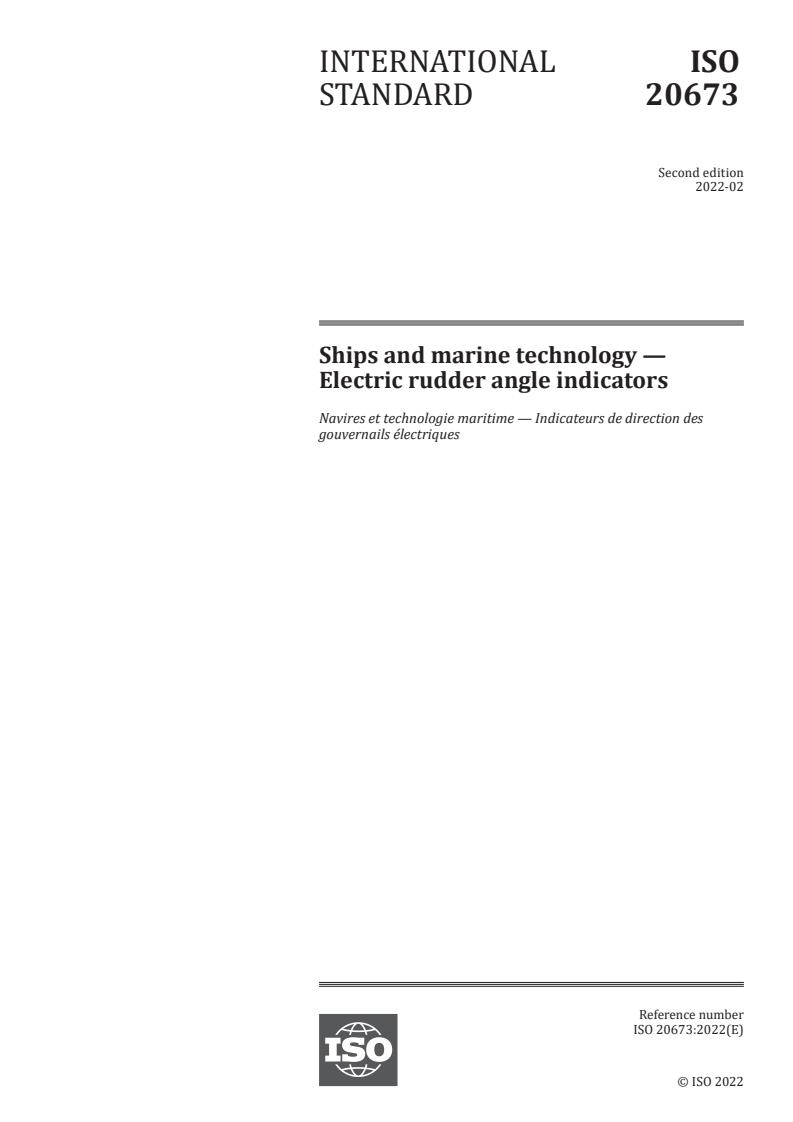
INTERNATIONAL ISO
STANDARD 20673
Second edition
2022-02
Ships and marine technology —
Electric rudder angle indicators
Navires et technologie maritime — Indicateurs de direction des
gouvernails électriques
Reference number
© ISO 2022
All rights reserved. Unless otherwise specified, or required in the context of its implementation, no part of this publication may
be reproduced or utilized otherwise in any form or by any means, electronic or mechanical, including photocopying, or posting on
the internet or an intranet, without prior written permission. Permission can be requested from either ISO at the address below
or ISO’s member body in the country of the requester.
ISO copyright office
CP 401 • Ch. de Blandonnet 8
CH-1214 Vernier, Geneva
Phone: +41 22 749 01 11
Email: copyright@iso.org
Website: www.iso.org
Published in Switzerland
ii
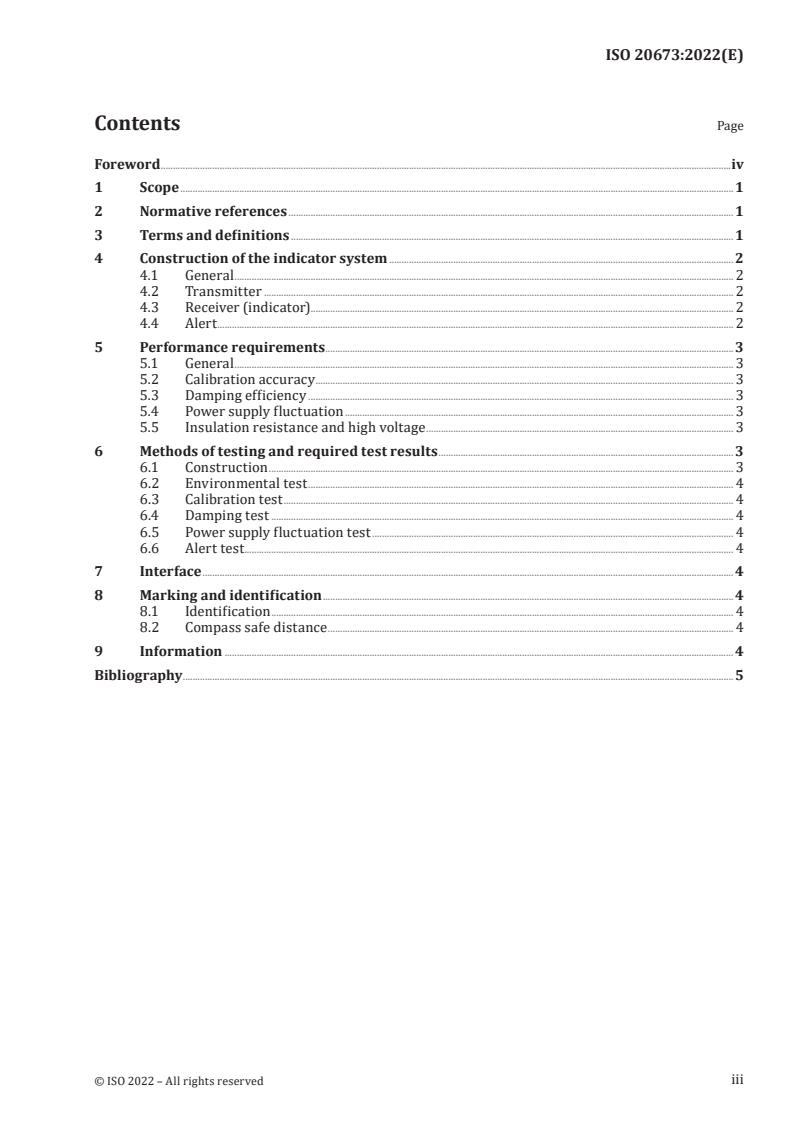
Contents Page
Foreword .iv
1 Scope . 1
2 Normative references . 1
3 Terms and definitions . 1
4 Construction of the indicator system . 2
4.1 General . 2
4.2 Transmitter . 2
4.3 Receiver (indicator) . . 2
4.4 Alert . . 2
5 Performance requirements . .3
5.1 General . 3
5.2 Calibration accuracy . 3
5.3 Damping efficiency . 3
5.4 Power supply fluctuation . 3
5.5 Insulation resistance and high voltage . 3
6 Methods of testing and required test results . 3
6.1 Construction . 3
6.2 Environmental test . 4
6.3 Calibration test . 4
6.4 Damping test . 4
6.5 Power supply fluctuation test . 4
6.6 Alert test . . . 4
7 Interface . 4
8 Marking and identification .4
8.1 Identification . 4
8.2 Compass safe distance . 4
9 Information . 4
Bibliography . 5
iii
Foreword
ISO (the International Organization for Standardization) is a worldwide federation of national standards
bodies (ISO member bodies). The work of preparing International Standards is normally carried out
through ISO technical committees. Each member body interested in a subject for which a technical
committee has been established has the right to be represented on that committee. International
organizations, governmental and non-governmental, in liaison with ISO, also take part in the work.
ISO collaborates closely with the International Electrotechnical Commission (IEC) on all matters of
electrotechnical standardization.
The procedures used to develop this document and those intended for its further maintenance are
described in the ISO/IEC Directives, Part 1. In particular, the different approval criteria needed for the
different types of ISO documents should be noted. This document was drafted in accordance with the
editorial rules of the ISO/IEC Directives, Part 2 (see www.iso.org/directives).
Attention is drawn to the possibility that some of the elements of this document may be the subject of
patent rights. ISO shall not be held responsible for identifying any or all such patent rights. Details of
any patent rights identified during the development of the document will be in the Introduction and/or
on the ISO list of patent declarations received (see www.iso.org/patents).
Any trade name used in this document is information given for the convenience of users and does not
constitute an endorsement.
For an explanation of the voluntary nature of standards, the meaning of ISO specific terms and
expressions related to conformity assessment, as well as information about ISO's adherence to
the World Trade Organization (WTO) principles in the Technical Barriers to Trade (TBT), see
www.iso.org/iso/foreword.html.
This document was prepared by Technical Committee ISO/TC 8, Ships and marine technology,
Subcommittee SC 6, Navigation and ship operations.
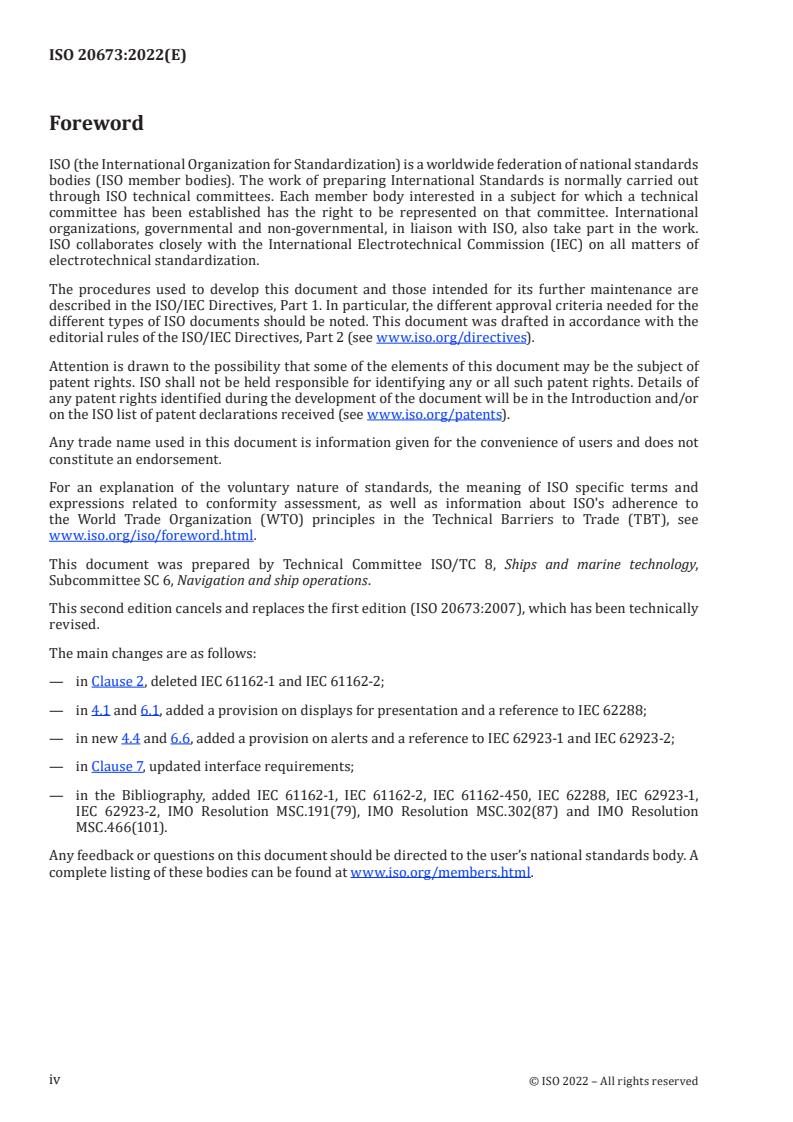
This second edition cancels and replaces the first edition (ISO 20673:2007), which has been technically
revised.
The main changes are as follows:
— in Clause 2, deleted IEC 61162-1 and IEC 61162-2;
— in 4.1 and 6.1, added a provision on displays for presentation and a reference to IEC 62288;
— in new 4.4 and 6.6, added a provision on alerts and a reference to IEC 62923-1 and IEC 62923-2;
— in Clause 7, updated interface requirements;
— in the Bibliography, added IEC 61162-1, IEC 61162-2, IEC 61162-450, IEC 62288, IEC 62923-1,
IEC 62923-2, IMO Resolution MSC.191(79), IMO Resolution MSC.302(87) and IMO Resolution
MSC.466(101).
Any feedback or questions on this document should be directed to the user’s national standards body. A
complete listing of these bodies can be found at www.iso.org/members.html.
iv
INTERNATIONAL STANDARD ISO 20673:2022(E)
Ships and marine technology — Electric rudder angle
indicators
1 Scope
This document specifies the construction, performance requirements, methods of testing and required
test results for electric rudder angle indicators required to comply with Clause 2.5.4, Regulation 19,
chapter V, SOLAS 1974 (as amended, 2000).
This document is associated with IMO Resolution A.694 (17) and IEC 60945.
Where a requirement in this document is different from IEC 60945, the requirement in this document
takes precedence.
2 Normative references
The following documents are referred to in the text in such a way that some or all of their
...
Questions, Comments and Discussion
Ask us and Technical Secretary will try to provide an answer. You can facilitate discussion about the standard in here.
Loading comments...