


ISO/IEC 23090-5:2025
(Main)Information technology — Coded representation of immersive media — Part 5: Visual volumetric video-based coding (V3C) and video-based point cloud compression (V-PCC)
Information technology — Coded representation of immersive media — Part 5: Visual volumetric video-based coding (V3C) and video-based point cloud compression (V-PCC)
This document specifies the syntax, semantics, and decoding for visual volumetric media using video‑based coding methods. Furthermore, this document specifies processes that may be needed for reconstruction of visual volumetric media, and may also include additional processes such as post‑decoding, pre-reconstruction, post‑reconstruction, and adaptation.
Technologie de l'information — Représentation codée de média immersifs — Partie 5: Codage basé sur la vidéo volumétrique (V3C) et compression de nuage de points basée sur la vidéo (V-PCC)
General Information
- Status
- Withdrawn
- Publication Date
- 02-Mar-2025
- Technical Committee
- ISO/IEC JTC 1/SC 29 - Coding of audio, picture, multimedia and hypermedia information
- Drafting Committee
- ISO/IEC JTC 1/SC 29/WG 7 - MPEG 3D Graphics coding
- Current Stage
- 9599 - Withdrawal of International Standard
- Start Date
- 26-Jun-2026
- Completion Date
- 27-Jun-2026

Relations
- Effective Date
- 08-Mar-2025
- Effective Date
- 17-Feb-2024
Overview
ISO/IEC 23090-5:2025 - third edition - is an international standard for the coded representation of immersive visual volumetric media. Commonly referenced by its keywords V3C (Visual Volumetric Video-based Coding) and V‑PCC (Video‑based Point Cloud Compression), the document specifies the syntax, semantics, and decoding procedures for visual volumetric media encoded with video‑based methods. It also defines processes that support reconstruction of volumetric content, including post‑decoding, pre‑reconstruction, post‑reconstruction, and adaptation steps.
Key Topics and Technical Requirements
- Bitstream format and partitioning: Defines V3C bitstream layouts, NAL (Network Abstraction Layer) unit formats, atlas frame partitioning into tiles, and sub‑bitstream extraction processes.
- Syntax and semantics: Tabular syntax specification for V3C units, parameter sets, NAL units, atlas tile data, and supplemental enhancement information, with corresponding semantic descriptions.
- Decoding and reconstruction: Detailed decoding pipeline for atlas data, occupancy, geometry, attribute, and packed video planes; processes for patch handling, block-to-patch mapping, and tile/header decoding.
- Supporting processes: Specification of pre‑reconstruction, post‑decoding conversion to nominal video formats, adaptation, and parsing behaviors (e.g., Exp‑Golomb code parsing).
- Profiles, tiers, and levels: Normative profiles and level definitions to ensure interoperability across devices and applications (Annex A).
- Video-based Point Cloud Compression (V‑PCC): Normative annex (Annex H) covers V‑PCC specifics for compressing point cloud data using video approaches.
- Reference tools and examples: Annexes include sample stream formats, hypothetical reference decoders, and supplemental enhancement information to guide implementers.
Practical Applications and Who Uses It
ISO/IEC 23090-5:2025 is intended for organizations working with immersive 3D content, including:
- Codec and encoder/decoder developers implementing V3C and V‑PCC compliant codecs.
- Device manufacturers (VR/AR headsets, mixed‑reality displays, mobile devices) ensuring playback interoperability.
- Streaming platforms and CDN providers delivering volumetric video for real‑time or on‑demand experiences.
- Game studios, telepresence and conferencing vendors, 3D capture and scanning companies using volumetric media for performance capture, digital twins, and interactive content.
- Archivists and media production houses preserving and distributing 3D scene data efficiently.
Related Standards (if applicable)
- ISO/IEC 23090 series - other parts cover different aspects of immersive media representation and system-level integration.
- Standards and profiles referenced within the document (normative references) provide interoperability and implementation context.
Keywords: ISO/IEC 23090-5:2025, V3C, V‑PCC, volumetric video, video-based point cloud compression, visual volumetric media, atlas, NAL, decoding, reconstruction, immersive media.
Get Certified
Connect with accredited certification bodies for this standard

BSI Group
BSI (British Standards Institution) is the business standards company that helps organizations make excellence a habit.

NYCE
Mexican standards and certification body.
Sponsored listings
Frequently Asked Questions
ISO/IEC 23090-5:2025 is a standard published by the International Organization for Standardization (ISO). Its full title is "Information technology — Coded representation of immersive media — Part 5: Visual volumetric video-based coding (V3C) and video-based point cloud compression (V-PCC)". This standard covers: This document specifies the syntax, semantics, and decoding for visual volumetric media using video‑based coding methods. Furthermore, this document specifies processes that may be needed for reconstruction of visual volumetric media, and may also include additional processes such as post‑decoding, pre-reconstruction, post‑reconstruction, and adaptation.
This document specifies the syntax, semantics, and decoding for visual volumetric media using video‑based coding methods. Furthermore, this document specifies processes that may be needed for reconstruction of visual volumetric media, and may also include additional processes such as post‑decoding, pre-reconstruction, post‑reconstruction, and adaptation.
ISO/IEC 23090-5:2025 is classified under the following ICS (International Classification for Standards) categories: 35.040.40 - Coding of audio, video, multimedia and hypermedia information. The ICS classification helps identify the subject area and facilitates finding related standards.
ISO/IEC 23090-5:2025 has the following relationships with other standards: It is inter standard links to ISO/IEC 23090-5:2026, ISO/IEC 23090-5:2023. Understanding these relationships helps ensure you are using the most current and applicable version of the standard.
ISO/IEC 23090-5:2025 is available in PDF format for immediate download after purchase. The document can be added to your cart and obtained through the secure checkout process. Digital delivery ensures instant access to the complete standard document.
Standards Content (Sample)
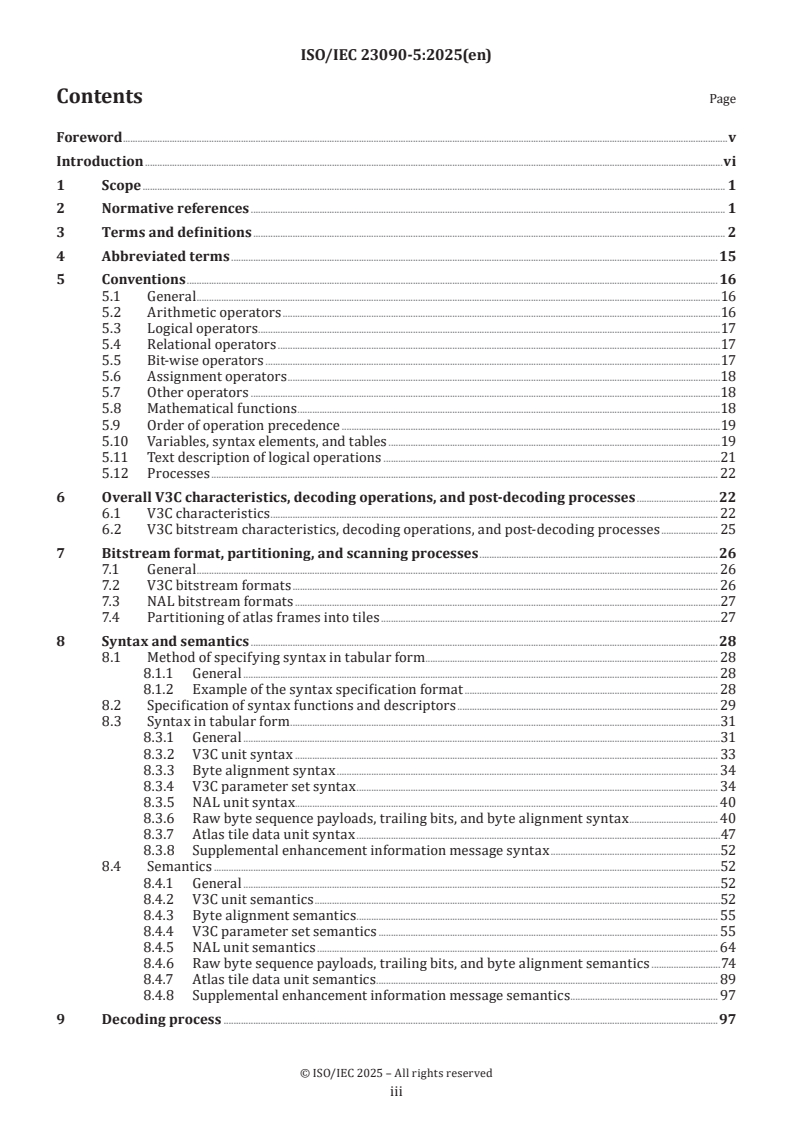
International
Standard
ISO/IEC 23090-5
Third edition
Information technology — Coded
2025-03
representation of immersive media —
Part 5:
Visual volumetric video-based
coding (V3C) and video-based point
cloud compression (V-PCC)
Technologie de l'information — Représentation codée de média
immersifs —
Partie 5: Codage basé sur la vidéo volumétrique (V3C) et
compression de nuage de points basée sur la vidéo (V-PCC)
Reference number
© ISO/IEC 2025
All rights reserved. Unless otherwise specified, or required in the context of its implementation, no part of this publication may
be reproduced or utilized otherwise in any form or by any means, electronic or mechanical, including photocopying, or posting on
the internet or an intranet, without prior written permission. Permission can be requested from either ISO at the address below
or ISO’s member body in the country of the requester.
ISO copyright office
CP 401 • Ch. de Blandonnet 8
CH-1214 Vernier, Geneva
Phone: +41 22 749 01 11
Email: copyright@iso.org
Website: www.iso.org
Published in Switzerland
© ISO/IEC 2025 – All rights reserved
ii
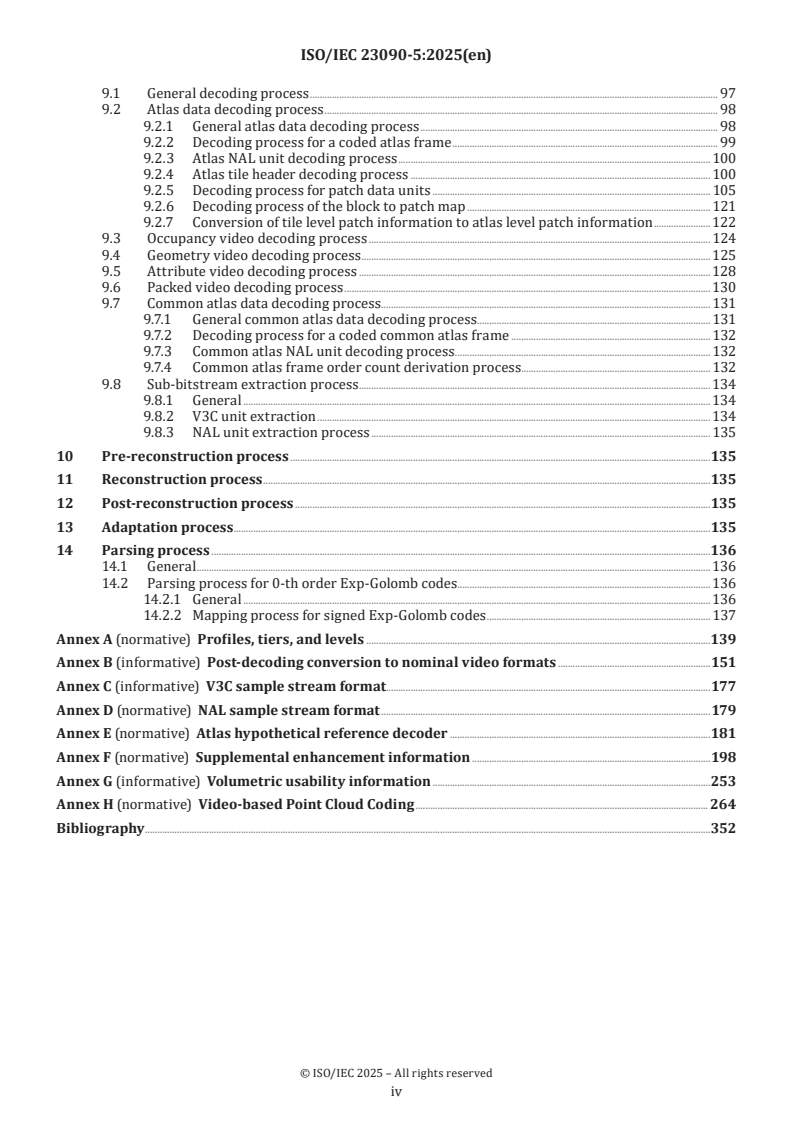
Contents Page
Foreword .v
Introduction .vi
1 Scope . 1
2 Normative references . 1
3 Terms and definitions . 2
4 Abbreviated terms .15
5 Conventions . 16
5.1 General .16
5.2 Arithmetic operators .16
5.3 Logical operators .17
5.4 Relational operators .17
5.5 Bit-wise operators .17
5.6 Assignment operators .18
5.7 Other operators .18
5.8 Mathematical functions .18
5.9 Order of operation precedence .19
5.10 Variables, syntax elements, and tables .19
5.11 Text description of logical operations .21
5.12 Processes . 22
6 Overall V3C characteristics, decoding operations, and post-decoding processes .22
6.1 V3C characteristics . 22
6.2 V3C bitstream characteristics, decoding operations, and post-decoding processes . 25
7 Bitstream format, partitioning, and scanning processes .26
7.1 General . 26
7.2 V3C bitstream formats . 26
7.3 NAL bitstream formats .27
7.4 Partitioning of atlas frames into tiles .27
8 Syntax and semantics .28
8.1 Method of specifying syntax in tabular form . . 28
8.1.1 General . 28
8.1.2 Example of the syntax specification format . 28
8.2 Specification of syntax functions and descriptors . 29
8.3 Syntax in tabular form .31
8.3.1 General .31
8.3.2 V3C unit syntax . 33
8.3.3 Byte alignment syntax . 34
8.3.4 V3C parameter set syntax . 34
8.3.5 NAL unit syntax . . 40
8.3.6 Raw byte sequence payloads, trailing bits, and byte alignment syntax . 40
8.3.7 Atlas tile data unit syntax .47
8.3.8 Supplemental enhancement information message syntax .52
8.4 Semantics .52
8.4.1 General .52
8.4.2 V3C unit semantics .52
8.4.3 Byte alignment semantics . 55
8.4.4 V3C parameter set semantics . 55
8.4.5 NAL unit semantics . 64
8.4.6 Raw byte sequence payloads, trailing bits, and byte alignment semantics .74
8.4.7 Atlas tile data unit semantics . 89
8.4.8 Supplemental enhancement information message semantics . 97
9 Decoding process .97
© ISO/IEC 2025 – All rights reserved
iii
9.1 General decoding process . 97
9.2 Atlas data decoding process . 98
9.2.1 General atlas data decoding process . 98
9.2.2 Decoding process for a coded atlas frame . 99
9.2.3 Atlas NAL unit decoding process . 100
9.2.4 Atlas tile header decoding process . 100
9.2.5 Decoding process for patch data units . 105
9.2.6 Decoding process of the block to patch map . 121
9.2.7 Conversion of tile level patch information to atlas level patch information . 122
9.3 Occupancy video decoding process . 124
9.4 Geometry video decoding process . 125
9.5 Attribute video decoding process .128
9.6 Packed video decoding process . 130
9.7 Common atlas data decoding process. 131
9.7.1 General common atlas data decoding process. 131
9.7.2 Decoding process for a coded common atlas frame . 132
9.7.3 Common atlas NAL unit decoding process . . 132
9.7.4 Common atlas frame order count derivation process . . 132
9.8 Sub-bitstream extraction process .134
9.8.1 General .134
9.8.2 V3C unit extraction .134
9.8.3 NAL unit extraction process . 135
10 Pre-reconstruction process .135
11 Reconstruction process .135
12 Post-reconstruction process .135
13 Adaptation process .135
14 Parsing process .136
14.1 General . 136
14.2 Parsing process for 0-th order Exp-Golomb codes. 136
14.2.1 General . 136
14.2.2 Mapping process for signed Exp-Golomb codes . 137
Annex A (normative) Profiles, tiers, and levels .139
Annex B (informative) Post-decoding conversion to nominal video formats .151
Annex C (informative) V3C sample stream format.177
Annex D (normative) NAL sample stream format .179
Annex E (normative) Atlas hypothetical reference decoder .181
Annex F (normative) Supplemental enhancement information .198
Annex G (informative) Volumetric usability information .253
Annex H (normative) Video-based Point Cloud Coding . 264
Bibliography .352
© ISO/IEC 2025 – All rights reserved
iv
Foreword
ISO (the International Organization for Standardization) and IEC (the International Electrotechnical
Commission) form the specialized system for worldwide standardization. National bodies that are
members of ISO or IEC participate in the development of International Standards through technical
committees established by the respective organization to deal with particular fields of technical activity.
ISO and IEC technical committees collaborate in fields of mutual interest. Other international organizations,
governmental and non-governmental, in liaison with ISO and IEC, also take part in the work.
The procedures used to develop this document and those intended for its further maintenance are described
in the ISO/IEC Directives, Part 1. In particular, the different approval criteria needed for the different types
of document should be noted. This document was drafted in accordance with the editorial rules of the ISO/
IEC Directives, Part 2 (see www.iso.org/directives or www.iec.ch/members_experts/refdocs).
ISO and IEC draw attention to the possibility that the implementation of this document may involve the
use of (a) patent(s). ISO and IEC take no position concerning the evidence, validity or applicability of any
claimed patent rights in respect thereof. As of the date of publication of this document, ISO and IEC had
received notice of (a) patent(s) which may be required to implement this document. However, implementers
are cautioned that this may not represent the latest information, which may be obtained from the patent
database available at www.iso.org/patents and https://patents.iec.ch. ISO and IEC shall not be held
responsible for identifying any or all such patent rights.
Any trade name used in this document is information given for the convenience of users and does not
constitute an endorsement.
For an explanation of the voluntary nature of standards, the meaning of ISO specific terms and expressions
related to conformity assessment, as well as information about ISO's adherence to the World Trade
Organization (WTO) principles in the Technical Barriers to Trade (TBT) see www.iso.org/iso/foreword.html.
In the IEC, see www.iec.ch/understanding-standards.
This document was prepared by Joint Technical Committee ISO/IEC JTC 1, Information technology,
Subcommittee SC 29, Coding of audio, picture, multimedia and hypermedia information.
This third edition cancels and replaces the second edition (ISO/IEC 23090-5:2023), which has been
technically revised.
The main changes are as follows:
1)
— Additions needed for ISO/IEC 23090-12:— .
A list of all parts in the ISO/IEC 23090 series can be found on the ISO and IEC websites.
Any feedback or questions on this document should be directed to the user’s national standards
body. A complete listing of these bodies can be found at www.iso.org/members.html and
www.iec.ch/national-committees.
1) Under preparation. Stage at the time of publication: ISO/IEC DIS 23090-12:2025.
© ISO/IEC 2025 – All rights reserved
v
Introduction
Advances in 3D capturing and rendering technologies have unleashed a new wave of innovation in Virtual/
Augmented/Mixed reality (VR/AR/MR) content creation and communication, of which visual volumetric
video is an integral part.
Visual volumetric video, a sequence of visual volumetric frames, if uncompressed, may be represented by a
large amount of data, which can be costly in terms of storage and transmission. This has led to the need for a
high coding efficiency standard for the compression of visual volumetric data.
Visual volumetric frames can be coded by converting the 3D volumetric information into a collection of 2D
images and associated data. The converted 2D images can be coded using widely available video and image
coding specifications, such as ISO/IEC 14496-10 and ISO/IEC 23008-2 and the associated data can be coded
with mechanisms specified in this document. The coded images and the associated data can then be decoded
and used to reconstruct the 3D volumetric information. This document specifies a generic mechanism for
visual volumetric video coding, i.e. visual volumetric video-based coding. The generic mechanism may be
used by applications targeting volumetric content, such as point clouds, immersive video with depth, mesh
representations of visual volumetric frames, etc.
In addition to the generic mechanism of coding volumetric content, this document specifies one of the
applications of visual volumetric video-based coding targeting point cloud representations of visual
volumetric frames. In a point cloud sequence, each point cloud frame contains a collection of points. Each
point has a 3D position, i.e., geometry information, and each point may also be associated with a number of
attributes, such as colour, reflectance, surface normal, etc.
© ISO/IEC 2025 – All rights reserved
vi
International Standard ISO/IEC 23090-5:2025(en)
Information technology — Coded representation of
immersive media —
Part 5:
Visual volumetric video-based coding (V3C) and video-based
point cloud compression (V-PCC)
1 Scope
This document specifies the syntax, semantics, and decoding for visual volumetric media using video-based
coding methods. Furthermore, this document specifies processes that may be needed for reconstruction
of visual volumetric media, and may also include additional processes such as post-decoding, pre-
reconstruction, post-reconstruction, and adaptation.
2 Normative references
The following documents are referred to in the text in such a way that some or all of their content constitute
requirements of this document. For dated references, only the edition cited applies. For undated references,
the latest edition of the referenced document (including any amendments) applies.
ISO/IEC 10646, Information technology — Universal coded character set (UCS)
ISO/IEC 14496-10, Information technology — Coding of audio-visual objects — Part 10: Advanced video coding
ISO/IEC 14496-12, Information technology — Coding of audio-visual objects — Part 12: ISO base media file format
ISO/IEC 14496-15, Information technology — Coding of audio-visual objects — Part 15: Carriage of network
abstraction layer (NAL) unit structured video in the ISO base media file format
ISO/IEC 23002-7, Information technology — MPEG video technologies — Part 7: Versatile supplemental
enhancement information messages for coded video bitstreams
ISO/IEC 23008-2, Information technology — High efficiency coding and media delivery in heterogeneous
environments — Part 2: High efficiency video coding
ISO/IEC 23090-3, Information technology — Coded representation of immersive media — Part 3: Versatile
video coding
ISO/IEC 23091-2, Coding-independent code points for video signal type identification
ISO/IEC 60559:2020, Information technology — Microprocessor Systems — Floating-Point arithmetic
Rec. ITU-T T.35, Procedure for the allocation of ITU-T defined codes for non standard facilities
Rec. ITU-T H.271, Video back-channel messages for conveyance of status information and requests from a video
receiver to a video sender
IETF RFC 1321, The MD5 Message-Digest Algorithm
IETF RFC 5646, Tags for Identifying Languages
© ISO/IEC 2025 – All rights reserved
3 Terms and definitions
For the purposes of this document, the following terms and definitions apply.
ISO and IEC maintain terminology databases for use in standardization at the following addresses:
— ISO Online browsing platform: available at https:// www .iso .org/ obp
— IEC Electropedia: available at https:// www .electropedia .org/
3.1
3D bounding box
volume defined as a cuboid solid having six rectangular faces placed at right angles
3.2
associated non-ACL NAL unit
non-ACL NAL unit (3.81) that is associated with an ACL NAL unit (3.5) for the purpose of decoding or other
operations specified by this document
3.3
atlas
collection of 2D bounding boxes and their associated information placed onto a rectangular frame and
corresponding to a volume in 3D space on which volumetric data is rendered
3.4
atlas bitstream
sequence of bits that forms the representation of atlas frames (3.7) and associated data forming one or more
CASs (3.35)
3.5
atlas coding layer NAL unit
ACL NAL unit
collective term for coded atlas tile layer NAL units (3.79) and the subset of NAL units (3.79) that have reserved
values of nal_unit_type that are classified as being of type class equal to ACL in this document
3.6
atlas coordinates
two scalars (x, y) with finite precision and dynamic range that indicate the location of an atlas sample
relative to the top left corner of an atlas frame, with x and y indicating the horizontal and vertical direction,
respectively
3.7
atlas frame
2D rectangular array of atlas samples onto which patches (3.88) are projected and additional information
related to the patches (3.88), corresponding to a volumetric frame (3.140)
3.8
atlas frame parameter set
AFPS
syntax structure (3.122) containing syntax elements (3.121) that apply to zero or more entire coded atlas
frames (3.7) as determined by the content of a syntax element (3.121) found in each tile header
3.9
atlas sample
position on the rectangular frame onto which patches (3.88) that are associated with an atlas (3.3) are
projected
3.10
atlas sequence
collection of atlas frames (3.7)
© ISO/IEC 2025 – All rights reserved
3.11
atlas sequence parameter set
ASPS
syntax structure (3.122) containing syntax elements (3.121) that apply to zero or more entire coded atlas
sequences (3.34) as determined by the content of a syntax element (3.121) found in the AFPS referred to by a
syntax element found in each tile header
3.12
atlas sub-bitstream
extracted sub-bitstream (3.110) from the V3C bitstream (3.130) containing a part of an atlas NAL bitstream
3.13
atlas unit
set of NAL units (3.79) that contain all ACL NAL units (3.5) of a coded atlas (3.33) and their associated non-ACL
NAL units (3.2)
3.14
attribute
scalar or vector property optionally associated with each point in a volumetric frame (3.140) such as colour,
reflectance, surface normal, transparency, material ID, etc.
3.15
attribute access unit
collection of attribute maps (3.17) and auxiliary attribute frames, if available, for a specific attribute (3.14)
that correspond to the same time instance
3.16
attribute frame
2D rectangular array created through the aggregation of patches (3.88) containing values of a specific
attribute (3.14)
3.17
attribute map
attribute frame (3.16) containing attribute patch (3.88) information projected at a particular depth indicated
by the corresponding geometry map (3.64)
3.18
auxiliary attribute frame
2D rectangular array that is associated with RAW patches (3.105) and EOM patches (3.56), and contains
values of a specific attribute (3.14)
3.19
auxiliary geometry frame
2D rectangular array that is associated with RAW patches (3.105) and contains geometry (3.61) values
3.20
auxiliary video component
video component (3.127) indicated as being of auxiliary type through an appropriate flag in the VPS (3.136)
and containing data only associated with RAW patches (3.105) and/or EOM patches (3.56)
3.21
auxiliary video sub-bitstream
video sub-bitstream (3.129) indicated as being of auxiliary type through an appropriate flag in the VPS
(3.136) and containing data only associated with RAW patches (3.105) and/or EOM patches (3.56)
3.22
bitstream
ordered series of bits that forms the coded representation of the data
© ISO/IEC 2025 – All rights reserved
3.23
byte
sequence of 8 bits, within which, when written or read as a sequence of bit values, the left-most and right-
most bits represent the most and least significant bits, respectively
3.24
broken link access access unit
BLA access unit
access unit in which the coded atlas (3.33) with nal_layer_id equal to 0 is a BLA coded atlas (3.25)
3.25
broken link access coded atlas frame
BLA coded atlas
BLA atlas frame
IRAP coded atlas (3.75) frame for which each ACL NAL unit (3.5) has nal_unit_type equal to NAL_BLA_W_LP,
NAL_GBLA_W_LP, NAL_BLA_W_RADL NAL_GBLA_W_RADL, NAL_BLA_N_LP or NAL_GBLA_N_LP
Note 1 to entry: A BLA coded atlas does not use inter prediction in its decoding process, and could be the first coded
atlas in the bitstream in decoding order, or could appear later in the bitstream. Each BLA coded atlas begins a new CAS,
and has the same effect on the decoding process as an instantaneous decoding refresh (IDR) coded atlas. However, a
BLA coded atlas contains syntax elements that specify a non-empty DAB. When a BLA coded atlas frame for which
each ACL NAL unit has nal_unit_type equal to NAL_BLA_W_LP or NAL_GBLA_W_LP, it may have associated random
access skipped leading (RASL) coded atlas frames, which are not output by the decoder and may not be decodable, as
they may contain references to atlas frames that are not present in the bitstream. When a BLA coded atlas frame for
which each ACL NAL unit has nal_unit_type equal to NAL_BLA_W_LP or NAL_GBLA_W_LP, it may also have associated
RADL coded atlas frames, which are specified to be decoded. When a BLA coded atlas frame for which each ACL NAL
unit has nal_unit_type equal to NAL_BLA_W_RADL or NAL_GBLA_W_RADL, it does not have associated RASL coded
atlas frames but may have associated random access decodable leading (RADL) coded atlas frames. When a BLA coded
atlas frame for which each ACL NAL unit has nal_unit_type equal to NAL_BLA_N_LP or NAL_GBLA_N_LP, it does not
have any associated leading coded atlas frames.
3.26
byte-aligned
positioned as an integer multiple of 8 bits from the position of the first bit in the bitstream (3.22)
3.27
byte-aligned position
position in a bitstream (3.22) that is byte-aligned (3.26)
3.28
byte-aligned byte
byte (3.23) that appears in a position in a bitstream (3.22) that is byte-aligned (3.26)
3.29
Cartesian coordinates
three scalars (x, y, z) with finite precision and dynamic range that indicate the location of a point relative to
a fixed reference point (the origin)
3.30
clean random access access unit
CRA access unit
access unit in which the coded atlas (3.33) with nal_layer_id equal to 0 is a CRA coded atlas (3.31)
© ISO/IEC 2025 – All rights reserved
3.31
clean random access coded atlas frame
CRA coded atlas
CRA atlas frame
IRAP coded atlas (3.75) for which each ACL NAL unit (3.5) has nal_unit_type equal to NAL_CRA or NAL_GCRA
Note 1 to entry: A CRA coded atlas does not use inter prediction in its decoding process, and could be the first
coded atlas in the bitstream in decoding order, or could appear later in the bitstream. A CRA coded atlas could have
associated RADL or RASL coded atlas frames. When a CRA coded atlas has NoOutputBeforeRecoveryFlag equal to 1,
the associated RASL coded atlas frames are not output by the decoder, because they might not be decodable, as they
could contain references to coded atlas frames that are not present in the bitstream.
3.32
codec
specification, device, or system that specifies or uses well defined instructions for encoding or decoding a
digital data, i.e. image or video, stream or signal
3.33
coded atlas
coded atlas frame
coded representation of an atlas (3.3)
3.34
coded atlas access unit
set of atlas NAL units (3.79) that are associated with each other according to a specified classification rule, are
consecutive in decoding order, and contain all atlas NAL units (3.79) pertaining to one particular output time
3.35
coded atlas sequence
CAS
sequence of coded atlas access units (3.34), in decoding order, of an IRAP coded atlas access unit (3.74) with
NoOutputBeforeRecoveryFlag equal to 1, followed by zero or more coded atlas access units (3.34) that are not
IRAP coded atlas access units (3.74) with NoOutputBeforeRecoveryFlag equal to 1, including all subsequent
access units (3.34) up to but not including any subsequent coded atlas access unit (3.34) that is an IRAP coded
atlas access unit (3.74) with NoOutputBeforeRecoveryFlag equal to 1
Note 1 to entry: An IRAP coded atlas access unit may be an IDR coded atlas access unit, a BLA coded atlas access unit,
or a CRA coded atlas access unit. The value of NoOutputBeforeRecoveryFlag is equal to 1 for each IDR coded atlas
access unit, each BLA coded atlas access unit, and each CRA coded atlas access unit that is the first coded atlas access
unit in the atlas bitstream in decoding order, is the first coded atlas access unit that follows an end of sequence NAL
unit in decoding order, or has HandleCraAsBlaFlag equal to 1.
3.36
coded common atlas access unit
set of common atlas non-ACL NAL units (3.81) that are associated with each other according to a specified
classification rule, are consecutive in decoding order, and contain all common atlas NAL units (3.79)
pertaining to one particular output time
3.37
coded common atlas frame
coded representation of a common atlas frame (3.44)
3.38
coded common atlas sequence
CCAS
sequence of coded common atlas access units (3.36), in decoding order, of an IRAP coded common atlas access
unit (3.77), followed by zero or more coded common atlas access units (3.36) that are not IRAP coded common
atlas access units (3.77), including all subsequent access units (3.36) up to but not including any subsequent
coded common atlas access unit (3.36) that is an IRAP coded common atlas access unit (3.77)
© ISO/IEC 2025 – All rights reserved
3.39
coded volumetric frame
collection of coded representations of an atlas (3.3), occupancy (3.86), geometry access unit (3.62), and, for
each available attribute (3.14), attribute access unit (3.15), pertaining to one particular time instance
3.40
coded V3C sequence
CVS
sequence of V3C sub-bitstreams (3.135) identified and separated by appropriate delimiters, required to
start with a VPS (3.136), included in at least one V3C unit (3.137) or provided through external means, and
contains one or more V3C units that can be factored into V3C composition units (3.133), where the first V3C
composition unit is a V3C IRAP composition unit (3.134)
3.41
coded representation
data element as represented in its coded form
3.42
coded sub-bitstream sequence
sub-bitstream IRAP composition unit (3.112) followed by zero or more sub-bitstream composition units (3.111)
3.43
coded V3C component
coded representation of a V3C component (3.131)
3.44
common atlas frame
CAF
common information (e.g. projection parameters) that applies to all atlas frames (3.7) in a volumetric
frame (3.140)
3.45
common atlas sequence
collection of common atlas frames (3.44)
3.46
common atlas sub-bitstream
extracted sub-bitstream (3.110) from the V3C bitstream (3.130) containing a part of a common atlas NAL
bitstream
3.47
component bitstream
bitstream (3.22) representing a V3C component (3.131)
3.48
component sub-bitstream
portion of component bitstream (3.44)
3.49
composition time
time or time period at which a frame needs to be composed, used for reconstruction, or presented
3.50
composition time index
index to an ordered list of composition times (3.49)
3.51
composition unit
partition of a bitstream (3.22) that has a certain composition time (3.49)
© ISO/IEC 2025 – All rights reserved
3.52
decoder under test
DUT
decoder that is tested for conformance to this document by operating the hypothetical stream scheduler
to deliver a conforming bitstream (3.22) to the decoder and to the hypothetical reference decoder and
comparing the values and timing or order of the output of the two decoders
3.53
decoding unit
sub-set of a coded atlas access unit (3.34) consisting of one or more ACL NAL units in a coded atlas access unit
(3.34) and the associated non-ACL NAL units (3.2)
3.54
enhanced occupancy mode
EOM
patch coding mode where a patch (3.88) is associated with enhanced occupancy information
3.55
EOM coded points
coded representation of 3D points located at intermediate depth positions for which geometry (3.61) values
are stored as codewords in the occupancy frame (3.87) and their corresponding attributes values are stored
in additional patches, referred to as EOM patches (3.56), in the attribute frames (3.16)
3.56
EOM patch
patch (3.88) with patch mode (3.90) equal to I_EOM, P_EOM, or P_SKIP
3.57
EOM patch type
patch type (3.91) indicating an EOM patch (3.56)
3.58
essential supplemental enhancement information
ESEI
SEI (3.119) that is deemed as essential by the decoding process and should not be ignored or discarded
3.59
essential supplemental enhancement information NAL unit
ESEI NAL unit
NAL unit (3.79) corresponding to an ESEI (3.58) and has nal_unit_type equal to NAL_PREFIX_ESEI or NAL_
SUFFIX_ESEI
3.60
flag
variable or single-bit syntax element that can take one of the two possible values: 0 and 1
3.61
geometry
set of Cartesian coordinates (3.29) associated with a volumetric frame (3.140)
3.62
geometry access unit
collection of geometry maps (3.64) and auxiliary geometry frames, if present, corresponding to the same
time instance
3.63
geometry frame
2D array created through the aggregation of the geometry (3.61) information associated with each patch (3.88)
© ISO/IEC 2025 – All rights reserved
3.64
geometry map
geometry frame (3.63) containing geometry patch (3.88) information projected at a particular depth
3.65
global broken link access coded atlas frame
GBLA atlas frame
IRAP coded atlas (3.75) frame for which each ACL NAL unit (3.5) has nal_unit_type equal to NAL_GBLA_W_LP,
NAL_GBLA_W_RADL, or NAL_GBLA_N_LP respectively
3.66
global clean random access coded atlas frame
GCRA atlas frame
IRAP coded atlas (3.75) frame for which each ACL NAL unit (3.5) has nal_unit_type equal to NAL_GCRA
3.67
global instantaneous decoding refresh coded atlas frame
GIDR atlas frame
coded atlas (3.33) for which each ACL NAL unit (3.5) has nal_unit_type equal to NAL_GIDR_W_RADL, NAL_
GBLA_N_LP, or NAL_GCRA, or in the range of NAL_GBLA_W_LP to NAL_GBLA_N_LP, inclusive, and specify a
random access association between the current coded atlas and its corresponding coded video frames at the
same composition time
3.68
hypothetical reference decoder
HRD
hypothetical decoder model that specifies constraints on the variability of conforming atlas NAL unit (3.79)
streams or conforming coded atlas (3.33) sample streams that an encoding process may produce
3.69
hypothetical stream scheduler
HSS
hypothetical delivery mechanism used for checking the conformance of an atlas sub-bitstream (3.12) or
a decoder with regards to the timing and data flow of the input of an atlas sub-bitstream (3.12) into the
hypothetical reference decoder (3.68)
3.70
instantaneous decoding refresh coded atlas access unit
IDR coded atlas access unit
access unit in which the coded atlas (3.33) with nal_layer_id equal to 0 is an IDR coded atlas (3.71)
3.71
instantaneous decoding refresh coded atlas frame
IDR coded atlas
IDR atlas frame
IRAP coded atlas (3.75) for which each ACL NAL unit (3.5) has nal_unit_type equal to NAL_IDR_W_RADL, or
NAL_IDR_N_LP, NAL_GIDR_W_RADL, or NAL_GIDR_N_LP
Note 1 to entry: An IDR coded atlas does not refer to any atlases other than itself for inter prediction in its decoding
process, and may be the first atlas in the bitstream in decoding order, or may appear later in the bitstream. Each IDR
coded atlas is the first atlas of a CAS in decoding order. When an IDR coded atlas for which each ACL NAL unit has
nal_unit_type equal to NAL_IDR_W_RADL or NAL_GIDR_W_RADL, it may have associated RADL coded atlases. When
an IDR coded atlas for which each ACL NAL unit has nal_unit_type equal to NAL_IDR_N_LP or NAL_GIDR_N_LP, it does
not have any associated leading coded atlases. An IDR coded atlas does not have associated RASL coded atlases.
3.72
inter atlas tile
atlas tile that may be decoded using both intra or inter prediction methods
© ISO/IEC 2025 – All rights reserved
3.73
intra atlas tile
atlas tile that is decoded using only intra prediction methods
3.74
intra random access point coded atlas access unit
IRAP coded atlas access unit
access unit in which the coded atlas (3.33) with nal_layer_id equal to 0 is an IRAP coded atlas (3.75)
3.75
intra random access point coded atlas frame
IRAP coded atlas
IRAP coded atlas frame
coded atlas (3.33) for which each ACL NAL unit (3.5) has nal_unit_type in the range of NAL_BLA_W_LP to
NAL_RSV_IRAP_ACL_29, inclusive
Note 1 to entry: An IRAP coded atlas does not refer to any coded atlases other than itself for prediction in its decoding
process, and may be a BLA coded atlas, a CRA coded atlas, or an IDR coded atlas. Provided the necessary parameter
sets are available when they need to be activated, the IRAP coded atlas and all subsequent non-RASL coded atlas in
decoding order can be correctly decoded without performing the decoding process of any coded atlases that precede
the IRAP coded atlas in decoding order.
3.76
intra random access point coded common atlas
IRAP coded common atlas
coded common atlas frame (3.37) for which at least one non-ACL NAL unit (3.81) has nal_unit_type equal to
NAL_CAF_IDR
3.77
intra random access point coded common atlas access unit
IRAP coded common atlas access unit
coded common access unit (3.36) in which the coded common atlas frame (3.37) has nal_layer_id equal to 0 is
and and nal_unit_type equal to NAL_CAF_IDR
3.78
multi-component collection of V3C sub-bitstreams
V3C sub-bitstreams (3.135) of multiple V3C components (3.131) that, when decoded, enable the reconstruction
of volumetric content
3.79
network abstraction lay
...