


ISO/IEC FDIS 17067
(Main)Conformity assessment — Fundamentals of and guidelines for conformity assessment schemes
General Information
- Abstract
ISO/IEC 17067 describes the fundamentals of product certification and provides guidelines for understanding, developing, operating or maintaining certification schemes for products, processes and services. ISO/IEC 17067 is intended for use by all with an interest in product certification, and especially by certification scheme owners.
- Status
- Not Published
- Technical Committee
- ISO/CASCO - Committee on conformity assessment
- Drafting Committee
- ISO/CASCO - Committee on conformity assessment
- Current Stage
- 5020 - FDIS ballot initiated: 2 months. Proof sent to secretariat
- Start Date
- 25-Jun-2026
- Completion Date
- 25-Jun-2026
Buy Documents
ISO/IEC FDIS 17067 - Conformity assessment — Fundamentals of and guidelines for conformity assessment schemes

REDLINE ISO/IEC FDIS 17067 - Conformity assessment — Fundamentals of and guidelines for conformity assessment schemes
ISO/IEC FDIS 17067 - Évaluation de la conformité — Éléments fondamentaux et lignes directrices pour les systèmes particuliers d’évaluation de la conformité
Overview
ISO/IEC FDIS 17067:2026 is a foundational standard developed by ISO and IEC that sets out the key principles and guidelines for conformity assessment schemes. Conformity assessment involves demonstrating whether products, processes, or services meet specified requirements, and schemes are essential frameworks for structuring these assessments. The standard is relevant for a diverse audience including scheme owners, regulatory authorities, industry stakeholders, conformity assessment bodies, and purchaser organizations. Its guidance aims to facilitate a unified approach to product certification and similar evaluations, supporting transparency, consistency, and confidence in the global marketplace.
By providing a systematic methodology and outlining the distinct types of conformity assessment schemes, ISO/IEC 17067 ensures effective scheme development, operation, and maintenance. This document is part of the "CASCO toolbox," a suite of global conformity assessment standards that help reduce technical barriers to trade and enhance product and service quality worldwide.
Key Topics
Fundamentals of Conformity Assessment Schemes:
Clarifies core terms, principles, and functions, including scheme ownership, operation, and lifecycle management.Objects of Conformity Assessment:
Defines what can be assessed, from products and processes to services, systems, designs, and even individuals.Specified Requirements:
Discusses how requirements should be clear, measurable, and derived from normative documents such as standards, technical specifications, or regulations.Functional Approach:
Presents conformity assessment as a sequence of stages, including selection, determination, review, decision, attestation, and surveillance.Scheme Content and Methodology:
Details how to construct a scheme, including rules for assessment, reporting, handling complaints and appeals, and maintaining scheme integrity.Responsibilities of Scheme Owners:
Emphasizes the distinct roles of scheme developers and operators, outlining responsibilities across scheme development, management, and revision.Categorization and Types of Schemes:
The standard provides annexes covering different types of schemes, such as product, process, service, management system, personnel certification, and others.
Applications
ISO/IEC 17067 serves as an essential resource for developing and evaluating effective conformity assessment schemes in a variety of sectors. Practical uses include:
Product Certification:
Establishes credible certification processes that ensure products meet requirements for safety, quality, and performance.Process and Service Schemes:
Structures assessment of operational processes or services, with benefits for both providers and users.Management System Certification:
Supports schemes that verify organizational or management system compliance (e.g., environmental or quality management).Regulatory Compliance:
Provides guidance for government agencies and regulators designing schemes to enforce technical regulations or safety standards.Market Access:
Facilitates mutual recognition and acceptance of assessment results across regions, reducing duplication and market entry barriers.Accreditation and Inspection:
Offers a common reference for accreditation schemes and specialized inspections, strengthening consistency and recognition globally.
Related Standards
- ISO/IEC 17000: Conformity assessment – Vocabulary and general principles
- ISO/IEC 17007: Guidelines for drafting normative documents suitable for use for conformity assessment
- ISO/IEC 17011: Requirements for accreditation bodies accrediting conformity assessment bodies
- ISO/IEC 17065: Requirements for bodies certifying products, processes, and services
- ISO/IEC 17021: Conformity assessment for management system certification
- ISO/IEC 17025: General requirements for the competence of testing and calibration laboratories
ISO/IEC FDIS 17067 streamlines the development and operation of conformity assessment schemes, empowering organizations to create reliable, recognized frameworks that build trust, facilitate trade, and drive continual improvement on a global scale. Adopting this standard lays the groundwork for robust certification processes and supports international harmonization in conformity assessment practices.
Relations
- Effective Date
- 12-Feb-2026
- Effective Date
- 28-Oct-2023
- Effective Date
- 12-Aug-2023
Buy Documents
ISO/IEC FDIS 17067 - Conformity assessment — Fundamentals of and guidelines for conformity assessment schemes
REDLINE ISO/IEC FDIS 17067 - Conformity assessment — Fundamentals of and guidelines for conformity assessment schemes
ISO/IEC FDIS 17067 - Évaluation de la conformité — Éléments fondamentaux et lignes directrices pour les systèmes particuliers d’évaluation de la conformité
Get Certified
Connect with accredited certification bodies for this standard

BSI Group
BSI (British Standards Institution) is the business standards company that helps organizations make excellence a habit.

Bureau Veritas
Bureau Veritas is a world leader in laboratory testing, inspection and certification services.

DNV
DNV is an independent assurance and risk management provider.
Sponsored listings
Frequently Asked Questions
ISO/IEC FDIS 17067 is a draft published by the International Organization for Standardization (ISO). Its full title is "Conformity assessment — Fundamentals of and guidelines for conformity assessment schemes". This standard covers: ISO/IEC 17067 describes the fundamentals of product certification and provides guidelines for understanding, developing, operating or maintaining certification schemes for products, processes and services. ISO/IEC 17067 is intended for use by all with an interest in product certification, and especially by certification scheme owners.
ISO/IEC 17067 describes the fundamentals of product certification and provides guidelines for understanding, developing, operating or maintaining certification schemes for products, processes and services. ISO/IEC 17067 is intended for use by all with an interest in product certification, and especially by certification scheme owners.
ISO/IEC FDIS 17067 is classified under the following ICS (International Classification for Standards) categories: 03.120.20 - Product and company certification. Conformity assessment. The ICS classification helps identify the subject area and facilitates finding related standards.
ISO/IEC FDIS 17067 has the following relationships with other standards: It is inter standard links to FprEN ISO/IEC 17067, ISO/IEC TR 24372:2021, ISO/IEC 17067:2013. Understanding these relationships helps ensure you are using the most current and applicable version of the standard.
ISO/IEC FDIS 17067 is available in PDF format for immediate download after purchase. The document can be added to your cart and obtained through the secure checkout process. Digital delivery ensures instant access to the complete standard document.
Standards Content (Sample)
FINAL DRAFT
International
Standard
ISO/CASCO
Conformity assessment —
Secretariat: ISO
Fundamentals of and guidelines for
Voting begins on:
conformity assessment schemes
2026-06-25
Évaluation de la conformité — Éléments fondamentaux et lignes
Voting terminates on:
directrices pour les systèmes particuliers d’évaluation de la
2026-08-20
conformité
RECIPIENTS OF THIS DRAFT ARE INVITED TO SUBMIT,
This draft is submitted to a parallel vote in ISO and in IEC.
WITH THEIR COMMENTS, NOTIFICATION OF ANY
RELEVANT PATENT RIGHTS OF WHICH THEY ARE AWARE
AND TO PROVIDE SUPPOR TING DOCUMENTATION.
IN ADDITION TO THEIR EVALUATION AS
BEING ACCEPTABLE FOR INDUSTRIAL, TECHNO
ISO/CEN PARALLEL PROCESSING LOGICAL, COMMERCIAL AND USER PURPOSES, DRAFT
INTERNATIONAL STANDARDS MAY ON OCCASION HAVE
TO BE CONSIDERED IN THE LIGHT OF THEIR POTENTIAL
TO BECOME STAN DARDS TO WHICH REFERENCE MAY BE
MADE IN NATIONAL REGULATIONS.
Reference number
FINAL DRAFT
International
Standard
ISO/CASCO
Conformity assessment —
Secretariat: ISO
Fundamentals of and guidelines for
Voting begins on:
conformity assessment schemes
Évaluation de la conformité — Éléments fondamentaux et lignes
Voting terminates on:
directrices pour les systèmes particuliers d’évaluation de la
conformité
RECIPIENTS OF THIS DRAFT ARE INVITED TO SUBMIT,
This draft is submitted to a parallel vote in ISO and in IEC.
WITH THEIR COMMENTS, NOTIFICATION OF ANY
RELEVANT PATENT RIGHTS OF WHICH THEY ARE AWARE
AND TO PROVIDE SUPPOR TING DOCUMENTATION.
© ISO/IEC 2026
IN ADDITION TO THEIR EVALUATION AS
All rights reserved. Unless otherwise specified, or required in the context of its implementation, no part of this publication may
BEING ACCEPTABLE FOR INDUSTRIAL, TECHNO
ISO/CEN PARALLEL PROCESSING
LOGICAL, COMMERCIAL AND USER PURPOSES, DRAFT
be reproduced or utilized otherwise in any form or by any means, electronic or mechanical, including photocopying, or posting on
INTERNATIONAL STANDARDS MAY ON OCCASION HAVE
the internet or an intranet, without prior written permission. Permission can be requested from either ISO at the address below
TO BE CONSIDERED IN THE LIGHT OF THEIR POTENTIAL
or ISO’s member body in the country of the requester.
TO BECOME STAN DARDS TO WHICH REFERENCE MAY BE
MADE IN NATIONAL REGULATIONS.
ISO copyright office
CP 401 • Ch. de Blandonnet 8
CH-1214 Vernier, Geneva
Phone: +41 22 749 01 11
Email: copyright@iso.org
Website: www.iso.org
Published in Switzerland Reference number
© ISO/IEC 2026 – All rights reserved
ii
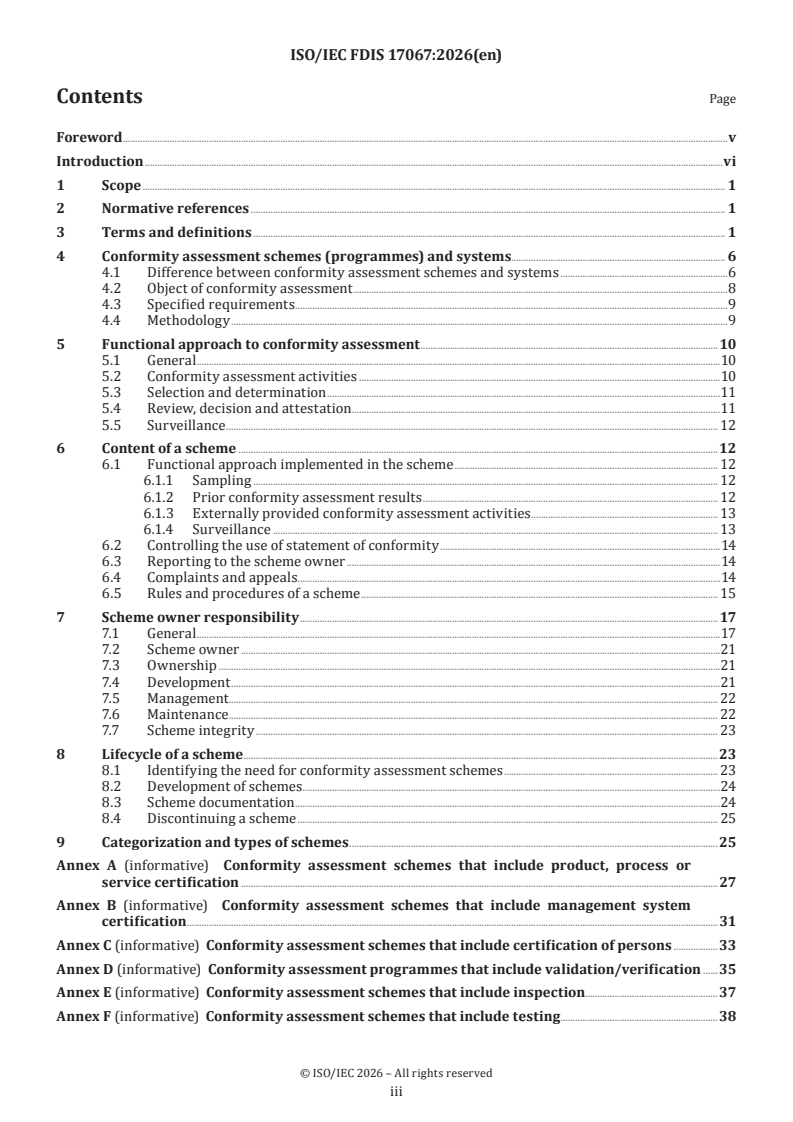
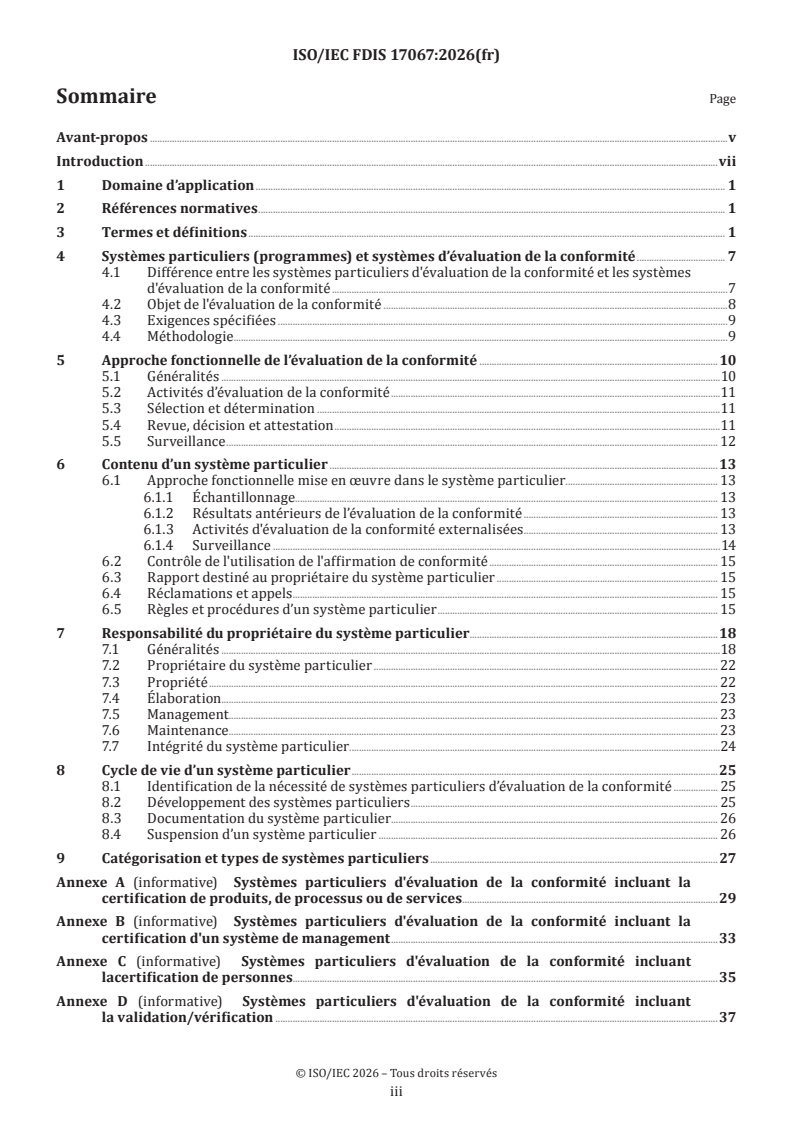
Contents Page
Foreword .v
Introduction .vi
1 Scope . 1
2 Normative references . 1
3 Terms and definitions . 1
4 Conformity assessment schemes (programmes) and systems. 6
4.1 Difference between conformity assessment schemes and systems .6
4.2 Object of conformity assessment .8
4.3 Specified requirements .9
4.4 Methodology .9
5 Functional approach to conformity assessment . 10
5.1 General .10
5.2 Conformity assessment activities .10
5.3 Selection and determination .11
5.4 Review, decision and attestation.11
5.5 Surveillance . 12
6 Content of a scheme .12
6.1 Functional approach implemented in the scheme . 12
6.1.1 Sampling . 12
6.1.2 Prior conformity assessment results . 12
6.1.3 Externally provided conformity assessment activities . 13
6.1.4 Surveillance . 13
6.2 Controlling the use of statement of conformity .14
6.3 Reporting to the scheme owner .14
6.4 Complaints and appeals.14
6.5 Rules and procedures of a scheme . 15
7 Scheme owner responsibility . 17
7.1 General .17
7.2 Scheme owner .21
7.3 Ownership .21
7.4 Development .21
7.5 Management . . . 22
7.6 Maintenance . 22
7.7 Scheme integrity . 23
8 Lifecycle of a scheme . .23
8.1 Identifying the need for conformity assessment schemes . 23
8.2 Development of schemes . .24
8.3 Scheme documentation .24
8.4 Discontinuing a scheme . 25
9 Categorization and types of schemes .25
Annex A (informative) Conformity assessment schemes that include product, process or
service certification .27
Annex B (informative) Conformity assessment schemes that include management system
certification .31
Annex C (informative) Conformity assessment schemes that include certification of persons .33
Annex D (informative) Conformity assessment programmes that include validation/verification .35
Annex E (informative) Conformity assessment schemes that include inspection.37
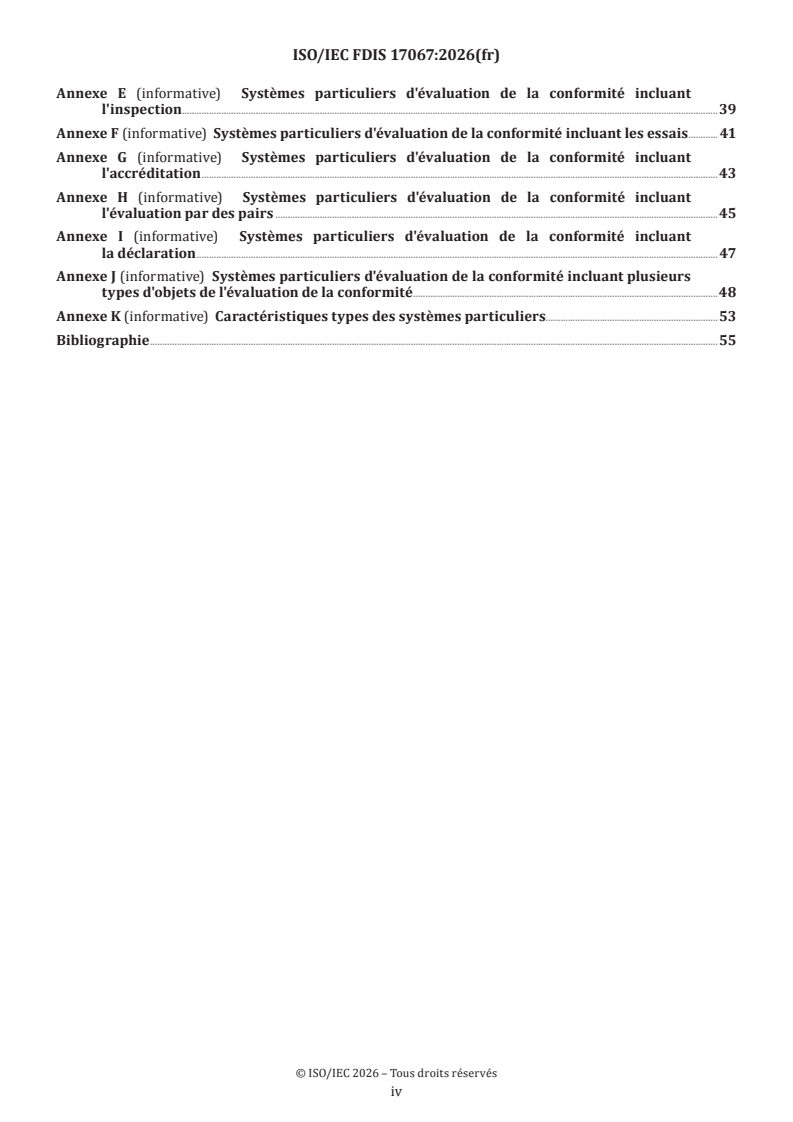
Annex F (informative) Conformity assessment schemes that include testing .38
© ISO/IEC 2026 – All rights reserved
iii
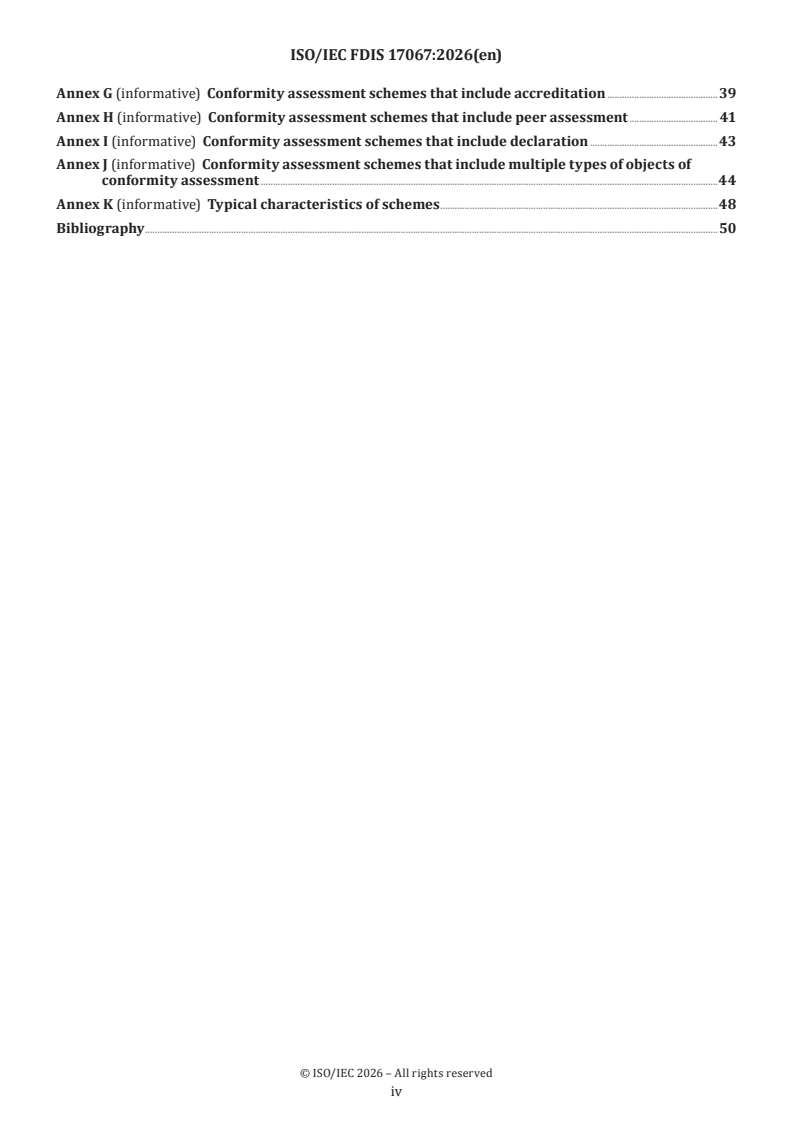
Annex G (informative) Conformity assessment schemes that include accreditation .39
Annex H (informative) Conformity assessment schemes that include peer assessment . 41
Annex I (informative) Conformity assessment schemes that include declaration .43
Annex J (informative) Conformity assessment schemes that include multiple types of objects of
conformity assessment .44
Annex K (informative) Typical characteristics of schemes .48
Bibliography .50
© ISO/IEC 2026 – All rights reserved
iv
Foreword
ISO (the International Organization for Standardization) and IEC (the International Electrotechnical
Commission) form the specialized system for worldwide standardization. National bodies that are
members of ISO or IEC participate in the development of International Standards through technical
committees established by the respective organization to deal with particular fields of technical activity.
ISO and IEC technical committees collaborate in fields of mutual interest. Other international organizations,
governmental and non-governmental, in liaison with ISO and IEC, also take part in the work.
The procedures used to develop this document and those intended for its further maintenance are described
in the ISO/IEC Directives, Part 1. In particular, the different approval criteria needed for the different types
of document should be noted. This document was drafted in accordance with the editorial rules of the ISO/
IEC Directives, Part 2 (see www.iso.org/directives or www.iec.ch/members_experts/refdocs).
ISO and IEC draw attention to the possibility that the implementation of this document may involve the
use of (a) patent(s). ISO and IEC take no position concerning the evidence, validity or applicability of any
claimed patent rights in respect thereof. As of the date of publication of this document, ISO and IEC had not
received notice of (a) patent(s) which may be required to implement this document. However, implementers
are cautioned that this may not represent the latest information, which may be obtained from the patent
database available at www.iso.org/patents and https://patents.iec.ch. ISO and IEC shall not be held
responsible for identifying any or all such patent rights.
Any trade name used in this document is information given for the convenience of users and does not
constitute an endorsement.
For an explanation of the voluntary nature of standards, the meaning of ISO specific terms and expressions
related to conformity assessment, as well as information about ISO's adherence to the World Trade
Organization (WTO) principles in the Technical Barriers to Trade (TBT) see www.iso.org/iso/foreword.html.
In the IEC, see www.iec.ch/understanding-standards.
This document was prepared by the ISO Committee on Conformity Assessment (CASCO), in collaboration
with the European Committee for Standardization (CEN) Technical Committee CEN/CLC/JTC 1, Criteria for
conformity assessment bodies, in accordance with the Agreement on technical cooperation between ISO and
CEN (Vienna Agreement).
This second edition cancels and replaces the first edition (ISO/IEC 17067:2013), which has been technically
revised.
The main changes are as follows:
— the scope has been expanded to apply to conformity assessment schemes in general;
— the title has been updated to reflect the extended scope;
— individual clauses have been rephrased to apply to conformity assessment schemes in general;
— clauses have been added to provide specifics (e.g. on product certification schemes) where necessary;
— guidelines for product certification schemes are maintained and moved to Annex A;
— annexes have been added to provide guidelines for other schemes (e.g. schemes including inspection,
management system certification, peer assessment, accreditation).
Any feedback or questions on this document should be directed to the user’s national standards
body. A complete listing of these bodies can be found at www.iso.org/members.html and
www.iec.ch/national-committees.
© ISO/IEC 2026 – All rights reserved
v
Introduction
This document provides fundamental concepts, principles and guidelines for conformity assessment
schemes (which are sometimes referred to as “conformity assessment programmes”).
Conformity assessment performed in accordance with a conformity assessment scheme can provide
assurance to interested parties via demonstration that specified requirements are fulfilled. Conformity
assessment can thus provide assurance to interested parties in various areas, including but not limited
to, legal compliance, health and safety, suitability for intended use, performance, durability, compatibility,
environmental impacts, governance and social impacts, resource use efficiency and resource circularity,
management and use of information technology, climate change and sustainability matters.
This document is intended for those who have an interest in conformity assessment schemes, particularly
those who own or operate schemes, or are considering development of a scheme. These people and their
organizations can include:
a) governments and regulatory authorities;
b) industry, trade associations and organizations (e.g. retailers) within value chains;
c) procurement and purchasing agencies;
d) non-governmental organizations (NGOs);
e) consumer organizations;
f) bodies undertaking conformity assessment activities.
A conformity assessment scheme can be operated at an international, regional, national, sub-national level,
or for a specific industry sector or value chain. A scheme can be documented or only orally created.
A conformity assessment scheme is defined as a set of rules and procedures that:
a) describes objects of conformity assessment;
b) identifies the specified requirements; and
c) provides the methodology for performing conformity assessment.
This document is one of the ISO/IEC and ISO documents on conformity assessment that are developed and
maintained by the ISO Committee on Conformity Assessment (CASCO). These ISO/IEC and ISO documents
are colloquially known as the “CASCO toolbox” and contribute to the development of “conformity assessment
procedures” as referenced in the World Trade Organization Agreement on Technical Barriers to Trade (WTO/
TBT). These documents are applied and used by ISO and its members, IEC and its national committees, and
organizations outside of ISO and IEC (e.g. regulatory authorities, NGOs, accreditation bodies and agreement
groups) for globally accepted conformity assessment practice.
Where the context is unambiguous, "scheme" is used in short for the full terms "conformity assessment
scheme" and “conformity assessment programme”. For ease of comprehension of this document, the terms
"conformity assessment scheme" and “conformity assessment programme” are considered synonyms,
unless explicitly stated otherwise.
Where the context is unambiguous, "system" is used in short for the full term "conformity assessment
system".
Where the context is unambiguous, "object" is used in short for the full term "object of conformity
assessment".
© ISO/IEC 2026 – All rights reserved
vi
FINAL DRAFT International Standard ISO/IEC FDIS 17067:2026(en)
Conformity assessment — Fundamentals of and guidelines for
conformity assessment schemes
1 Scope
This document specifies the fundamental principles and concepts of conformity assessment schemes
(programmes) and provides guidelines for understanding, developing, operating or maintaining them.
2 Normative references
The following documents are referred to in the text in such a way that some or all of their content constitutes
requirements of this document. For dated references, only the edition cited applies. For undated references,
the latest edition of the referenced document (including any amendments) applies.
ISO/IEC 17000, Conformity assessment — Vocabulary and general principles
3 Terms and definitions
For the purposes of this document, the terms and definitions given in ISO/IEC 17000 and the following apply.
ISO and IEC maintain terminology databases for use in standardization at the following addresses:
— ISO Online browsing platform: available at https:// www .iso .org/ obp
— IEC Electropedia: available at https:// www .electropedia .org/
3.1
conformity assessment
demonstration that specified requirements (3.3) are fulfilled
Note 1 to entry: The process of conformity assessment as described in the functional approach in ISO/IEC 17000:2020,
Annex A can have a negative outcome, i.e. demonstrating that the specified requirements are not fulfilled.
Note 2 to entry: Conformity assessment includes activities, such as but not limited to testing, inspection, validation,
verification, certification (3.17), and accreditation (3.18).
Note 3 to entry: Conformity assessment is explained in ISO/IEC 17000:2020, Annex A as a series of functions. Activities
contributing to any of these functions can be described as conformity assessment activities.
Note 4 to entry: This document does not include a definition of “conformity”. “Conformity” does not feature in the
definition of “conformity assessment”. Nor does this document address the concept of compliance.
[SOURCE: ISO/IEC 17000:2020, 4.1]
3.2
object of conformity assessment
object
entity to which specified requirements (3.3) apply
EXAMPLE Product, process, service, system, installation, project, data, design, material, claim, person, body or
organization, or any combination thereof.
© ISO/IEC 2026 – All rights reserved
Note 1 to entry: The term “body” is used in this document to refer to the conformity assessment body (3.19) and
accreditation body (3.20). The term “organization” is used in its general meaning and may include bodies according
to the context. The more specific ISO/IEC Guide 2 definition of an organization as a body based on membership is not
applicable to the field of conformity assessment (3.1).
[SOURCE: ISO/IEC 17000:2020, 4.2]
3.3
specified requirement
need or expectation that is stated
Note 1 to entry: Specified requirements can be stated in normative documents such as regulations, standards and
technical specifications.
Note 2 to entry: Specified requirements can be detailed or general.
[SOURCE: ISO/IEC 17000:2020, 5.1]
3.4
conformity assessment scheme
conformity assessment programme
set of rules and procedures (3.21) that describes the objects of conformity assessment (3.2), identifies the
specified requirements (3.3) and provides the methodology (3.22) for performing conformity assessment (3.1)
Note 1 to entry: A conformity assessment scheme can be managed within a conformity assessment system (3.5).
Note 2 to entry: A conformity assessment scheme can be operated at an international, regional, national, sub-national,
or industry sector level.
Note 3 to entry: A scheme can cover all or part of the conformity assessment functions explained in ISO/IEC 17000:2020,
Annex A.
[SOURCE: ISO/IEC 17000:2020, 4.9]
3.5
conformity assessment system
set of rules and procedures (3.21) for the management of similar or related conformity assessment schemes
(3.4)
Note 1 to entry: A conformity assessment system can be operated at an international, regional, national, sub-national,
or industry sector level.
[SOURCE: ISO/IEC 17000:2020, 4.8]
3.6
owner
owner of a system
owner of a scheme
system owner
scheme owner
person or organization responsible for the development and maintenance of a conformity assessment system
(3.5) or conformity assessment scheme (3.4)
Note 1 to entry: A scheme owner does not necessarily operate the scheme (3.4).
Note 2 to entry: A system owner or a scheme owner can be a conformity assessment body (3.19) itself, a governmental
authority, a trade association, a group of conformity assessment bodies or others.
[SOURCE: ISO/IEC 17000:2020, 4.13]
© ISO/IEC 2026 – All rights reserved
3.7
participant
participant in a system
participant in a scheme
person or organization that implements or operates under the rules and procedures (3.21) of a conformity
assessment system (3.5) or scheme (3.4) without being involved in their development, revision or approval
[SOURCE: ISO/IEC 17000:2020, 4.11]
3.8
member
member of a system
member of a scheme
person or organization that is involved in the development, revision or approval of the rules and procedures
(3.21) of a conformity assessment system (3.5) or scheme (3.4)
[SOURCE: ISO/IEC 17000:2020, 4.12]
3.9
first-party conformity assessment activity
conformity assessment (3.1) activity that is performed by the person or organization that provides or that is
the object of conformity assessment (3.2)
Note 1 to entry: The first-, second- and third-party descriptors used to characterize conformity assessment activities
in relation to a given object are not to be confused with the legal identification of the relevant parties to a contract.
EXAMPLE Activities performed by providers, designers or owners of the object, investors in the object, and
advertisers or promoters of the object.
Note 2 to entry: If an activity is performed by an external body acting on behalf of and controlled by a person or
organization that provides or is the object, the activity is still called a first-party conformity assessment activity (e.g.
internal audits performed by a consultant who is not part of the organization).
[SOURCE: ISO/IEC 17000:2020, 4.3]
3.10
second-party conformity assessment activity
conformity assessment (3.1) activity that is performed by a person or organization that has a user interest in
the object of conformity assessment (3.2)
Note 1 to entry: The first-, second- and third-party descriptors used to characterize conformity assessment activities
in relation to a given object are not to be confused with the legal identification of the relevant parties to a contract.
EXAMPLE Persons or organizations performing second-party conformity assessment activities include, for
example, purchasers or users of products, or potential customers seeking to rely on a supplier's management system,
or organizations representing those interests. Examples of organizations representing user interest include consumer
advocacy organizations, regulators implementing legislation governing products and services for the protection of
consumer and public interests, centralized government procurement organizations and private sector purchasing
agents.
Note 2 to entry: If an activity is performed by an external body acting on behalf of and controlled by a person or
organization with a user interest, the activity is still called a second-party conformity assessment activity (e.g. supply
chain audits conducted by an external body on behalf of the purchaser).
[SOURCE: ISO/IEC 17000:2020, 4.4]
3.11
third-party conformity assessment activity
conformity assessment (3.1) activity that is performed by a person or organization that is independent of the
provider of the object of conformity assessment (3.2) and has no user interest in the object
Note 1 to entry: The first-, second- and third-party descriptors used to characterize conformity assessment activities
in relation to a given object are not to be confused with the legal identification of the relevant parties to a contract.
© ISO/IEC 2026 – All rights reserved
[SOURCE: ISO/IEC 17000:2020, 4.5]
3.12
review
consideration of the suitability, adequacy and effectiveness of selection and determination activities, and the
results of these activities, with regard to fulfilment of specified requirements (3.3) by an object of conformity
assessment (3.2)
Note 1 to entry: A description of “selection and determination activities” is included in 5.1, 5.3 and ISO/IEC 17000:2020,
A.2 and A.3.
[SOURCE: ISO/IEC 17000:2020, 7.1, modified – Note to entry 1 added.]
3.13
decision
conclusion, based on the results of review (3.12), that fulfilment of specified requirements (3.3) has or has not
been demonstrated
[SOURCE: ISO/IEC 17000:2020, 7.2]
3.14
attestation
issue of a statement, based on a decision (3.13), that fulfilment of specified requirements (3.3) has been
demonstrated
Note 1 to entry: The resulting statement, referred to in this document as a “statement of conformity”, is intended to
convey the assurance that the specified requirements have been fulfilled. Such an assurance does not, of itself, provide
contractual or other legal guarantees.
Note 2 to entry: First-party attestation and third-party attestation are distinguished by the terms declaration (3.16),
certification (3.17) and accreditation (3.18), but there is no corresponding term applicable to second-party attestation.
[SOURCE: ISO/IEC 17000:2020, 7.3]
3.15
surveillance
systematic iteration of conformity assessment (3.1) activities as a basis for maintaining the validity of the
statement of conformity
[SOURCE: ISO/IEC 17000:2020, 8.1]
3.16
declaration
first-party attestation (3.14)
[SOURCE: ISO/IEC 17000:2020, 7.5]
3.17
certification
third-party attestation (3.14) related to an object of conformity assessment (3.2), with the exception of
accreditation (3.18)
[SOURCE: ISO/IEC 17000:2020, 7.6]
3.18
accreditation
third-party attestation (3.14) related to a conformity assessment body (3.19), conveying formal demonstration
of its competence, impartiality and consistent operation in performing specific conformity assessment
activities
[SOURCE: ISO/IEC 17000:2020, 7.7]
© ISO/IEC 2026 – All rights reserved
3.19
conformity assessment body
body that performs conformity assessment activities, excluding accreditation (3.18)
[SOURCE: ISO/IEC 17000:2020, 4.6]
3.20
accreditation body
authoritative body that performs accreditation (3.18)
Note 1 to entry: The authority of an accreditation body can be derived from government, public authorities, contracts,
market acceptance or scheme owners.
[SOURCE: ISO/IEC 17000:2020, 4.7]
3.21
procedure
specified way to carry out an activity or a process
Note 1 to entry: In this context, a process is defined as a set of interrelated or interacting activities that use inputs to
deliver an intended result.
[SOURCE: ISO/IEC 17000:2020, 5.2]
3.22
methodology
systematic collection of methods
Note 1 to entry: In conformity assessment (3.1), a systematic approach, or collection of methods, for performing
activities contributing to the functions described in ISO/IEC 17000:2020, Annex A, (the functional approach) is one
part of a conformity assessment scheme (3.9). Individual demonstrations performed in accordance with the same
conformity assessment scheme follow the same methodology.
Note 2 to entry: A method or procedure for a specific individual conformity assessment activity (3.5) within the
functional approach (e.g. a sampling protocol, test method, calibration method, inspection procedure, a general plan
for an audit of a management system, a general plan for validation or verification of a type of claim, the formatting of
a statement of conformity) can be included or referenced in the methodology provided in a conformity assessment
scheme. However, a method or procedure for a specific individual conformity assessment activity is not by itself a
methodology for demonstrating the fulfilment of specified requirements (3.1).
[SOURCE: ISO/IEC 17007:2026, 3.10]
3.23
complaint
expression of dissatisfaction, other than appeal (3.24), by any person or organization to a conformity
assessment body (3.19) or an accreditation body (3.20), relating to the activities of that body, where a response
is expected
[SOURCE: ISO/IEC 17000:2020, 8.7]
3.24
appeal
request by the person or organization that provides, or that is, the object of conformity assessment (3.2) to
a conformity assessment body (3.19) or an accreditation body (3.20) for reconsideration by that body of a
decision (3.13) it has made relating to that object
[SOURCE: ISO/IEC 17000:2020, 8.6]
3.25
testing
testing determination of one or more characteristics of an object of conformity assessment (4.2), according
to a procedure (5.2)
[SOURCE: ISO/IEC 17000:2020, 6.2]
© ISO/IEC 2026 – All rights reserved
3.26
inspection
inspection examination of an object of conformity assessment (4.2) and determination of its conformity
with detailed requirements or, on the basis of professional judgement, with general requirements.
[SOURCE: ISO/IEC 17000:2020, 6.3]
3.27
validation
validation confirmation of plausibility for a specific intended use or application through the provision of
objective evidence that specified requirements (5.1) have been fulfilled.
[SOURCE: ISO/IEC 17000:2020, 6.5]
3.28
verification
verification confirmation of truthfulness through the provision of objective evidence that specified
requirements (5.1) have been fulfilled
[SOURCE: ISO/IEC 17000:2020, 6.6]
3.29
agreement group
bodies that are signatories to the agreement on which an arrangement is based
[SOURCE: ISO/IEC 17000:2020, 9.10]
3.30
recognition
recognition of a conformity assessment result
acknowledgement of the validity of a conformity assessment result provided by another person or
organization
Note 1 to entry: The expression “conformity assessment result” signifies the output of any conformity assessment
activity (e.g. a report or certificate) and can include a finding of nonconformity.
[SOURCE: ISO/IEC 17000:2020, 9.5]
3.31
acceptance
acceptance of a conformity assessment result
use of a conformity assessment result provided by another person or organization
Note 1 to entry: The expression “conformity assessment result” signifies the output of any conformity assessment
activity (e.g. a report or certificate) and can include a finding of nonconformity.
[SOURCE: ISO/IEC 17000:2020, 9.6]
4 Conformity assessment schemes (programmes) and systems
4.1 Difference between conformity assessment schemes and systems
4.1.1 The set of rules and procedures defined as a “conformity assessment scheme” or “conformity
assessment programme” relates to:
a) a description of the object of conformity assessment (see 4.2);
b) identification of the specified requirements (see 4.3);
© ISO/IEC 2026 – All rights reserved
c) provision of the methodology (see 4.4 and Clause 5) for performing conformity assessment (e.g. rules
for persons and organizations involved in conformity assessment, procedures for individual activities,
rules and procedures for issuing statements of conformity).
4.1.2 Rules and procedures can be unique to a conformity assessment scheme or shared by multiple
schemes. The rules and procedures shared by multiple schemes can be described and documented separately
from the content of the individual schemes. Such common rules and procedures can relate to concepts (e.g.
specific to a sector or an application), structure, methodology, requirements, or other content shared by the
schemes. Documents providing such general contents for multiple schemes are different from documents
containing an individual conformity assessment scheme. Sometimes these documents are referred to as
“frameworks”.
4.1.3 Depending on the object of conformity assessment and the needs of users of conformity assessment,
a scheme can be used only once or repeatedly.
4.1.4 The rules and procedures in a scheme can be provided in a single document or in multiple documents
linked by reference. Documented schemes can be intended for repeated use over a long period of time.
4.1.5 A conformity assessment system is also a set of rules and procedures. However, these rules and
procedures are to manage several conformity assessment schemes that are similar or related. An example for
a conformity assessment system is the IEC CA System to manage the IECEE, IECQ, IECRE, IECEx certification
schemes. Whenever conformity assessment is performed, a scheme always exists, but a system for managing
schemes is optional.
Figure 1 illustrates the relationship between a scheme and a system.
© ISO/IEC 2026 – All rights reserved
Figure 1 — Relationship between conformity assessment scheme and conformity assessment
system
4.2 Object of conformity assessment
4.2.1 An object of conformity assessment can be, for example, a product, process, service, management
system, system, design, project, data, information, software, material, installation, claim, person, body or
organization, or any combination thereof (e.g. a product and its production process, an installation and its
maintenance service). The conformity assessment scheme should clearly describe the object of conformity
assessment to which the specified requirements within the scheme will apply.
4.2.2 The object can be a single item or a group of items based on common characteristics (e.g. any area
of land used for a specific purpose, any person with a specific ability, any management system for a specific
discipline, or any person performing a specific type of activity).
© ISO/IEC 2026 – All rights reserved
4.2.3 Schemes that describe multiple objects can identify unique specified requirements to be used for
each object. Specified requirements are identified for each object in the scheme.
4.3 Specified requirements
4.3.1 Specified requirements applicable to the object of conformity assessment are stated needs or
expectations. The content of specified requirements should indicate the type of object of conformity
assessment to which they apply.
4.3.2 Specified requirements are chosen for the scheme so that, when fulfilled, needs and concerns for
assurance are resolved.
4.3.3 Specified requirements are often in the form of provisions in normative documents such as
standards, technical specifications, codes of practice and regulations.
4.3.4 Specified requirements can be detailed (e.g. specific expression of measurements or data) or general
(e.g. properties and qualities, such as “safe to use” or “fit for intended purpose” or “fit for intended use”).
4.3.5 Where applicable, the specified requirements should be written in terms of results or outcomes,
together with limiting values and tolerances. The specified requirements should be stated unambiguously
using wording that is objective, logical, valid, specific and should enable consistent application by
organizations as well as consistent evaluation across conformity assessment bodies.
4.3.6 Identification of the specified requirements for the conformity assessment scheme can be made
by reference (e.g. to the applicable standards, technical specifications, regulation, or other normative
documents) or by documentation as content element of the scheme itself.
4.3.7 Further guidance for drafting normative documents suitable for use for conformity assessment,
including documents which provide specified requirements, can also be found in ISO/IEC 17007.
4.4 Methodology
4.4.1 The rules and procedures for methodology are one element of a conformity assessment scheme.
They include methods and procedures for performing conformity assessment activities in the functions
described in ISO/IEC 17000:2020, Annex A (the functional approach). Individual demonstrations performed
in accordance with the same scheme follow the same methodology provided by the scheme.
4.4.2 A method or procedure for a specific individual activity within the functional approach (e.g. a
sampling protocol, test method, calibration method, inspection procedure, a general plan for an audit of
a management system, a general plan for validation or verification of a type of claim, the formatting of a
statement of conformity) can be included or referenced in the methodology provided in a scheme.
4.4.3 Methodology for performing conformity assessment can include rules and procedures for:
a) conformity assessment activities including methods for individual activities such as assessment,
auditing, design review, evaluation, examination, inspection, testing, calibration, validation, verification,
review, decision and attestation;
b) conformity assessment activities during surveillance;
c) a certificate, mark, label, listing in databases or on websites, approval, consent, permission, licence,
report, letter, or other statement of conformity issued to communicate that a successful demonstration
of fulfilment of specified requirement by a specific object of conformity assessment exists.
© ISO/IEC 2026 – All rights reserved
5 Functional approach to conformity assessment
5.1 General
5.1.1 Conformity assessment is a series of functions that satisfy the need or demand for demonstration
that specified requirements are fulfilled.
NOTE See ISO/IEC 17000:2020, Annex A.
The functions are:
— selection, which involves planning and preparation activities in order to collect or produce all the
information and input needed for the subsequent determination function (see 5.3.1);
— determination, which relates to activities that are undertaken to develop or to gather complete
information regarding fulfilment of the specified requirements by the object of conformity assessment
or its sample (see 5.3.2);
— review, decision and attestation, which includes review as the final stage of checking before taking
the important decision as to whether or not the object of conformity assessment has been reliably
demonstrated to fulfil the specified requirements (see 5.4.1) and attestation, which results in a statement
of conformity communicating that fulfilment of specified requirements has been demonstrated (see
5.4.2).
5.1.2 The functional approach is the general structure for the methodology provided by conformity
assessment schemes.
5.1.3 The aspects of the functional approach addressed by the scheme’s rules and procedures for
methodology and the level of detail in those rules and procedures are decided when the scheme is developed
and can be altered as the scheme is maintained.
5.1.4 When the rules and procedures for methodology are general, the scheme can be flexible and used
broadly. However, leaving the choice of specific activities and details to bodies performing conformity
assessment can result in significant differences in individual demonstrations performed in accordance with
the scheme which can negatively impact the consistency of the assurance among these demonstrations.
Very detailed rules and procedures, on the other hand, result in highly consistent assurance among different
demonstrations performed in accordance with the scheme. However, very detailed rules and procedures
can result in the applicability of the scheme being very narrow or delay improvement or innovation in the
scheme.
Implementing the appropriate balance between flexibility and consistency should be considered in
developing and maintaining a scheme.
5.2 Conformity assessment activities
5.2.1 Activities contributing to any of the functions are described as “conformity assessment activities”.
5.2.2 The rules and procedures for methodology can specify, for example:
a) what activities are to be performed;
b) who performs activities;
c) when activities are performed and their sequence;
d) where activities are performed;
e) how often activities are performed;
© ISO/IEC 2026 – All rights reserved
f) the method, plan, procedure, or instructions for individua
...
Secretariat: ISO/CASCOISO/IEC FDIS 17067:2026(en)
ISO/CASCO
Secretariat: ISO/CASCO
Date: 2026-XX-XX06-10
Conformity assessment — Fundamentals of and guidelines for
conformity assessment schemes
Évaluation de la conformité — Éléments fondamentaux de l’évaluation de la conformité et lignes directrices
pour les programmes de l’évaluationsystèmes particuliers d’évaluation de la conformité
FDIS stage
TThhiiss d drraftaft i iss s suubbmmiitttteded t too a pa pararallel vallel vootte e iinn I ISSOO,, I IECEC && C CENEN.
© ISO/IEC 2026
All rights reserved. Unless otherwise specified, or required in the context of its implementation, no part of this publication
may be reproduced or utilized otherwise in any form or by any means, electronic or mechanical, including photocopying,
or posting on the internet or an intranet, without prior written permission. Permission can be requested from either ISO
at the address below or ISO'sISO’s member body in the country of the requester.
ISO Copyright Officecopyright office
CP 401 • Ch. de Blandonnet 8
CH-1214 Vernier, Geneva
Phone: + 41 22 749 01 11
Email: E-mail: copyright@iso.org
Website: www.iso.org
Published in Switzerland.
© ISO/IEC 2026 – All rights reserved
ii
Table of
© ISO/IEC 2026 – All rights reserved
iii
Contents
Foreword . vi
Introduction . viii
1 Scope . 1
2 Normative references . 1
3 Terms and definitions . 1
4 Conformity assessment schemes (programmes) and systems . 7
4.1 Difference between conformity assessment schemes and systems . 7
4.2 Object of conformity assessment . 10
4.3 Specified requirements . 11
4.4 Methodology . 11
5 Functional approach to conformity assessment. 11
5.1 General. 11
5.2 Conformity assessment activities . 12
5.3 Selection and determination . 13
5.4 Review, decision and attestation . 13
5.5 Surveillance . 14
6 Content of a scheme . 14
6.1 Functional approach implemented in the scheme . 14
6.2 Controlling the use of statement of conformity . 16
6.3 Reporting to the scheme owner . 16
6.4 Complaints and appeals. 17
6.5 Rules and procedures of a scheme . 17
7 Scheme owner responsibility . 19
7.1 General. 19
7.2 Scheme owner . 23
7.3 Ownership . 23
7.4 Development . 23
7.5 Management . 24
7.6 Maintenance . 24
7.7 Scheme integrity . 25
8 Lifecycle of a scheme . 25
8.1 Identifying the need for conformity assessment schemes . 25
8.2 Development of schemes . 26
8.3 Scheme documentation . 26
8.4 Discontinuing a scheme . 27
9 Categorization and types of schemes . 27
Annex A (informative) Conformity assessment schemes that include product, process or service
certification . 29
Annex B (informative) Conformity assessment schemes that include management system
certification . 33
Annex C (informative) Conformity assessment schemes that include certification of persons . 35
Annex D (informative) Conformity assessment programmes that include validation/verification37
Annex E (informative) Conformity assessment schemes that include inspection . 39
Annex F (informative) Conformity assessment schemes that include testing . 41
© ISO/IEC 2026 – All rights reserved
iv
Annex G (informative) Conformity assessment schemes that include accreditation . 43
Annex H (informative) Conformity assessment schemes that include peer assessment . 45
Annex I (informative) Conformity assessment schemes that include declaration . 47
Annex J (informative) Conformity assessment schemes that include multiple types of objects of
conformity assessment . 48
Annex K (informative) Typical characteristics of schemes . 52
Bibliography . 55
© ISO/IEC 2026 – All rights reserved
v
Foreword
ISO (the International Organization for Standardization) and IEC (the International Electrotechnical
Commission) form the specialized system for worldwide standardization. National bodies that are members
of ISO or IEC participate in the development of International Standards through technical committees
established by the respective organization to deal with particular fields of technical activity. ISO and IEC
technical committees collaborate in fields of mutual interest. Other international organizations, governmental
and non-governmental, in liaison with ISO and IEC, also take part in the work.
The procedures used to develop this document and those intended for its further maintenance are described
in the ISO/IEC Directives, Part 1. In particular, the different approval criteria needed for the different types of
document should be noted. This document was drafted in accordance with the editorial rules of the ISO/IEC
Directives, Part 2 (see www.iso.org/directives or www.iec.ch/members_experts/refdocs).
ISO and IEC draw attention to the possibility that the implementation of this document may involve the use of
(a) patent(s). ISO and IEC take no position concerning the evidence, validity or applicability of any claimed
patent rights in respect thereof. As of the date of publication of this document, ISO and IEC had not received
notice of (a) patent(s) which may be required to implement this document. However, implementers are
cautioned that this may not represent the latest information, which may be obtained from the patent database
available at www.iso.org/patents and https://patents.iec.ch. ISO and IEC shall not be held responsible for
identifying any or all such patent rights.
Any trade name used in this document is information given for the convenience of users and does not
constitute an endorsement.
For an explanation of the voluntary nature of standards, the meaning of ISO specific terms and expressions
related to conformity assessment, as well as information about ISO's adherence to the World Trade
Organization (WTO) principles in the Technical Barriers to Trade (TBT) see www.iso.org/iso/foreword.html.
In the IEC, see www.iec.ch/understanding-standards.
This document was prepared by the ISO Committee on Conformity Assessment (CASCO), in collaboration with
the European Committee for Standardization (CEN) Technical Committee CEN/CLC/JTC 1, Criteria for
conformity assessment bodies, in accordance with the Agreement on technical cooperation between ISO and
CEN (Vienna Agreement).
This second edition cancels and replaces the first edition (ISO/IEC 17067:2013), which has been technically
revised.
The main changes are as follows:
— — the scope has been expanded to apply to conformity assessment schemes in general;
— — the title has been updated to reflect the extended scope;
— — individual clauses have been rephrased to apply to conformity assessment schemes in general;
— — clauses have been added to provide specifics (e.g. on product certification schemes) where necessary;
— — guidelines for product certification schemes are maintained and moved to an Annex A;
— — Annexesannexes have been added to provide guidelines for other schemes (e.g. schemes including
inspection, management system certification, peer assessment, accreditation).
© ISO/IEC 2026 – All rights reserved
vi
Any feedback or questions on this document should be directed to the user’s national standards body. A
complete listing of these bodies can be found at www.iso.org/members.html and www.iec.ch/national-
committees.
© ISO/IEC 2026 – All rights reserved
vii
Introduction
This document provides fundamental concepts, principles and guidelines for conformity assessment schemes
(which are sometimes referred to as “conformity assessment programmes”).
Conformity assessment performed in accordance with a conformity assessment scheme can provide
assurance to interested parties via demonstration that specified requirements are fulfilled. Conformity
assessment can thus provide assurance to interested parties in various areas, including but not limited to,
legal compliance, health and safety, suitability for intended use, performance, durability, compatibility,
environmental impacts, governance and social impacts, resource use efficiency and resource circularity,
management and use of information technology, climate change and sustainability matters.
This document is intended for those who have an interest in conformity assessment schemes, particularly
those who own or operate schemes, or are considering development of a scheme. These people and their
organizations can include:
a) a) governments and regulatory authorities;
b) b) industry, trade associations and organizations (e.g. retailers) within value chains;
c) c) procurement and purchasing agencies;
d) d) non-governmental organizations (NGOs);
e) e) consumer organizations;
f) f) bodies undertaking conformity assessment activities.
A conformity assessment scheme can be operated at an international, regional, national, sub-national level, or
for a specific industry sector or value chain. A scheme can be documented or only orally created.
A conformity assessment scheme is defined as a set of rules and procedures that:
g) a) describes objects of conformity assessment;
h) b) identifies the specified requirements; and
i) c) provides the methodology for performing conformity assessment.
This document is one of the ISO/IEC and ISO documents on conformity assessment that are developed and
maintained by the ISO Committee on Conformity Assessment (CASCO). These ISO/IEC and ISO documents are
colloquially known as the “CASCO toolbox” and contribute to the development of “conformity assessment
procedures” as referenced in the World Trade Organization Agreement on Technical Barriers to Trade
(WTO/TBT). These documents are applied and used by ISO and its members, IEC and its national committees,
and organizations outside of ISO and IEC (e.g. regulatory authorities, NGOs, accreditation bodies and
agreement groups) for globally accepted conformity assessment practice.
Unless explicitly stated otherwise, for ease of comprehension of this document, the terms "conformity
assessment scheme" and "conformity assessment programme" are considered synonyms, and referred to in
this document by the short term "scheme".
Where the context is unambiguous, "scheme" and "system" areis used in short for the full terms "conformity
assessment scheme" and "“conformity assessment programme”. For ease of comprehension of this document,
the terms "conformity assessment scheme" and “conformity assessment programme” are considered
synonyms, unless explicitly stated otherwise.
© ISO/IEC 2026 – All rights reserved
viii
Where the context is unambiguous, "system" is used in short for the full term "conformity assessment system",
respectively.".
Where the context is unambiguous, "object" is used in short for the full term "object of conformity assessment".
© ISO/IEC 2026 – All rights reserved
ix
Conformity assessment — Fundamentals of and guidelines for
conformity assessment schemes
1 Scope
This document specifies the fundamental principles and concepts of conformity assessment schemes
(programmes) and provides guidelines for understanding, developing, operating or maintaining them.
2 Normative references
The following documents are referred to in the text in such a way that some or all of their content constitutes
requirements of this document. For dated references, only the edition cited applies. For undated references,
the latest edition of the referenced document (including any amendments) applies.
ISO/IEC 17000:2020, Conformity assessment — Vocabulary and general principles
3 Terms and definitions
For the purposes of this document, the terms and definitions given in ISO/IEC 17000 and the following apply.
ISO and IEC maintain terminology databases for use in standardization at the following addresses:
— — ISO Online browsing platform: available at https://www.iso.org/obp
— — IEC Electropedia: available at https://www.electropedia.org/
3.1 3.1
conformity assessment
demonstration that specified requirements (3.3(3.3)) are fulfilled
Note 1 to entry: The process of conformity assessment as described in the functional approach in ISO/IEC 17000:2020,
Annex A can have a negative outcome, i.e. demonstrating that the specified requirements are not fulfilled.
Note 2 to entry: Conformity assessment includes activities, such as but not limited to testing, inspection, validation,
verification, certification (3.17(3.17),), and accreditation (3.18(3.18).).
Note 3 to entry: Conformity assessment is explained in ISO/IEC 17000:2020, Annex A as a series of functions. Activities
contributing to any of these functions can be described as conformity assessment activities.
Note 4 to entry: This document does not include a definition of “conformity”. “Conformity” does not feature in the
definition of “conformity assessment”. Nor does this document address the concept of compliance.
[SOURCE: ISO/IEC 17000:2020, 4.1, modified — In notes to entry 1 and 3, "ISO/IEC 17000:2020" has been
added.]]
3.2 3.2
object of conformity assessment
object
entity to which specified requirements (3.3(3.3)) apply
EXAMPLE Product, process, service, system, installation, project, data, design, material, claim, person, body or
organization, or any combination thereof.
Note 1 to entry: The term “body” is used in this document to refer to the conformity assessment body (3.19(3.19)) and
accreditation body (3.20(3.20).). The term “organization” is used in its general meaning and may include bodies according
© ISO/IEC 2026 – All rights reserved
to the context. The more specific ISO/IEC Guide 2 definition of an organization as a body based on membership is not
applicable to the field of conformity assessment (3.1(3.1).).
[SOURCE: ISO/IEC 17000:2020, 4.2]
3.3 3.3
specified requirement
need or expectation that is stated
Note 1 to entry: Specified requirements can be stated in normative documents such as regulations, standards and
technical specifications.
Note 2 to entry: Specified requirements can be detailed or general.
[SOURCE: ISO/IEC 17000:2020, 5.1]
3.4 3.4
conformity assessment scheme
conformity assessment programme
set of rules and procedures (3.21(3.21)) that describes the objects of conformity assessment (3.2(3.2),),
identifies the specified requirements (3.3(3.3)) and provides the methodology (3.22(3.22)) for performing
conformity assessment (3.1(3.1))
Note 1 to entry: A conformity assessment scheme can be managed within a conformity assessment system (3.5(3.5).).
Note 2 to entry: A conformity assessment scheme can be operated at an international, regional, national, sub-national, or
industry sector level.
Note 3 to entry: A scheme can cover all or part of the conformity assessment functions explained in ISO/IEC 17000:2020,
Annex A.
[SOURCE: ISO/IEC 17000:2020, 4.9, modified — In note 3 to entry, "ISO/IEC 17000:2020" has been added.]]
3.5 3.5
conformity assessment system
set of rules and procedures (3.21(3.21)) for the management of similar or related conformity assessment
schemes (3.4(3.4))
Note 1 to entry: A conformity assessment system can be operated at an international, regional, national, sub-national, or
industry sector level.
[SOURCE: ISO/IEC 17000:2020, 4.8]
3.6 3.6
owner
owner of a system
owner of a scheme
system owner
scheme owner
person or organization responsible for the development and maintenance of a conformity assessment system
(3.5(3.5)) or conformity assessment scheme (3.4(3.4))
Note 1 to entry: A scheme owner does not necessarily operate the scheme (3.4(3.4).).
Note 2 to entry: A system owner or a scheme owner can be a conformity assessment body (3.19(3.19)) itself, a
governmental authority, a trade association, a group of conformity assessment bodies or others.
© ISO/IEC 2026 – All rights reserved
[SOURCE: ISO/IEC 17000:2020, 4.13]
3.7 3.7
participant
participant in a system
participant in a scheme
person or organization that implements or operates under the rules and procedures (3.21(3.21)) of a
conformity assessment system (3.5(3.5)) or scheme (3.4(3.4)) without being involved in their development,
revision or approval
[SOURCE: ISO/IEC 17000:2020, 4.11]
3.8 3.8
member
member of a system
member of a scheme
person or organization that is involved in the development, revision or approval of the rules and procedures
(3.21(3.21)) of a conformity assessment system (3.5(3.5)) or scheme (3.4(3.4))
[SOURCE: ISO/IEC 17000:2020, 4.12]
3.9 3.9
first-party conformity assessment activity
conformity assessment (3.1(3.1)) activity that is performed by the person or organization that provides or that
is the object of conformity assessment (3.2(3.2))
Note 1 to entry: The first-, second- and third-party descriptors used to characterize conformity assessment activities in
relation to a given object are not to be confused with the legal identification of the relevant parties to a contract.
EXAMPLE Activities performed by providers, designers or owners of the object, investors in the object, and
advertisers or promoters of the object.
Note 2 to entry: If an activity is performed by an external body acting on behalf of and controlled by a person or
organization that provides or is the object, the activity is still called a first-party conformity assessment activity (e.g.
internal audits performed by a consultant who is not part of the organization).
[SOURCE: ISO/IEC 17000:2020, 4.3]
3.10 3.10
second-party conformity assessment activity
conformity assessment (3.1(3.1)) activity that is performed by a person or organization that has a user interest
in the object of conformity assessment (3.2(3.2))
Note 1 to entry: The first-, second- and third-party descriptors used to characterize conformity assessment activities in
relation to a given object are not to be confused with the legal identification of the relevant parties to a contract.
EXAMPLE Persons or organizations performing second-party conformity assessment activities include, for
example, purchasers or users of products, or potential customers seeking to rely on a supplier's management system, or
organizations representing those interests. Examples of organizations representing user interest include consumer
advocacy organizations, regulators implementing legislation governing products and services for the protection of
consumer and public interests, centralized government procurement organizations and private sector purchasing agents.
Note 2 to entry: If an activity is performed by an external body acting on behalf of and controlled by a person or
organization with a user interest, the activity is still called a second-party conformity assessment activity (e.g. supply
chain audits conducted by an external body on behalf of the purchaser).
[SOURCE: ISO/IEC 17000:2020, 4.4]
© ISO/IEC 2026 – All rights reserved
3.11 3.11
third-party conformity assessment activity
conformity assessment (3.1(3.1)) activity that is performed by a person or organization that is independent of
the provider of the object of conformity assessment (3.2(3.2)) and has no user interest in the object
Note 1 to entry: The first-, second- and third-party descriptors used to characterize conformity assessment activities in
relation to a given object are not to be confused with the legal identification of the relevant parties to a contract.
[SOURCE: ISO/IEC 17000:2020, 4.5]
3.12 3.12
review
consideration of the suitability, adequacy and effectiveness of selection and determination activities, and the
results of these activities, with regard to fulfilment of specified requirements (3.3(3.3)) by an object of
conformity assessment (3.2(3.2))
Note 1 to entry: A description of “selection and determination activities” is included in 5.15.1, 5.3, 5.3 and ISO/IEC
17000:2020, A.2 and A.3.
[SOURCE: ISO/IEC 17000:2020, 7.1, modified – Note to entry 1 added.]
3.13 3.13
decision
conclusion, based on the results of review (3.12(3.12),), that fulfilment of specified requirements (3.3(3.3)) has
or has not been demonstrated
[SOURCE: ISO/IEC 17000:2020, 7.2]
3.14 3.14
attestation
issue of a statement, based on a decision (3.13(3.13),), that fulfilment of specified requirements (3.3(3.3)) has
been demonstrated
Note 1 to entry: The resulting statement, referred to in this document as a “statement of conformity”, is intended to
convey the assurance that the specified requirements have been fulfilled. Such an assurance does not, of itself, provide
contractual or other legal guarantees.
Note 2 to entry: First-party attestation and third-party attestation are distinguished by the terms declaration
(3.16(3.16),), certification (3.17(3.17)) and accreditation (3.18(3.18),), but there is no corresponding term applicable to
second-party attestation.
[SOURCE: ISO/IEC 17000:2020, 7.3]
3.15 3.15
surveillance
systematic iteration of conformity assessment (3.1(3.1)) activities as a basis for maintaining the validity of the
statement of conformity
[SOURCE: ISO/IEC 17000:2020, 8.1]
3.16 3.16
declaration
first-party attestation (3.14(3.14))
[SOURCE: ISO/IEC 17000:2020, 7.5]
© ISO/IEC 2026 – All rights reserved
3.17 3.17
certification
third-party attestation (3.14(3.14)) related to an object of conformity assessment (3.2(3.2),), with the exception
of accreditation (3.18(3.18))
[SOURCE: ISO/IEC 17000:2020, 7.6]
3.18 3.18
accreditation
third-party attestation (3.14(3.14)) related to a conformity assessment body (3.19(3.19),), conveying formal
demonstration of its competence, impartiality and consistent operation in performing specific conformity
assessment activities
[SOURCE: ISO/IEC 17000:2020, 7.7]
3.19 3.19
conformity assessment body
body that performs conformity assessment activities, excluding accreditation (3.18(3.18))
[SOURCE: ISO/IEC 17000:2020, 4.6]
3.20 3.20
accreditation body
authoritative body that performs accreditation (3.18(3.18))
Note 1 to entry: The authority of an accreditation body can be derived from government, public authorities, contracts,
market acceptance or scheme owners.
[SOURCE: ISO/IEC 17000:2020, 4.7]
3.21 3.21
procedure
specified way to carry out an activity or a process
Note 1 to entry: In this context, a process is defined as a set of interrelated or interacting activities that use inputs to
deliver an intended result.
[SOURCE: ISO/IEC 17000:2020, 5.2]
3.22 3.22
methodology
systematic collection of methods
Note 1 to entry: In conformity assessment (3.1(3.1),), a systematic approach, or collection of methods, for performing
activities contributing to the functions described in ISO/IEC 17000:2020, Annex A, (the functional approach) is one part
of a conformity assessment scheme (3.9().). Individual demonstrations performed in accordance with the same conformity
assessment scheme follow the same methodology.
Note 2 to entry: A method or procedure for a specific individual conformity assessment activity (3.5()) within the
functional approach (e.g. a sampling protocol, test method, calibration method, inspection procedure, a general plan for
an audit of a management system, a general plan for validation or verification of a type of claim, the formatting of a
statement of conformity) can be included or referenced in the methodology provided in a conformity assessment scheme.
However, a method or procedure for a specific individual conformity assessment activity is not by itself a methodology
for demonstrating the fulfilment of specified requirements (3.1().).
[SOURCE: ISO/IEC 17007:2026, 3.10]
© ISO/IEC 2026 – All rights reserved
3.23 3.23
complaint
expression of dissatisfaction, other than appeal (3.24(3.24),), by any person or organization to a conformity
assessment body (3.19(3.19)) or an accreditation body (3.20(3.20),), relating to the activities of that body,
where a response is expected
[SOURCE: ISO/IEC 17000:2020, 8.7]
3.24 3.24
appeal
request by the person or organization that provides, or that is, the object of conformity assessment (3.2(3.2))
to a conformity assessment body (3.19(3.19)) or an accreditation body (3.20(3.20)) for reconsideration by that
body of a decision (3.13(3.13)) it has made relating to that object
[SOURCE: ISO/IEC 17000:2020, 8.6]
3.25 3.25
testing
testing determination of one or more characteristics of an object of conformity assessment (4.2(4.2),),
according to a procedure (5.2(5.2))
[SOURCE: ISO/IEC 17000:2020, 6.2]
3.26
3.26
inspection
inspection examination of an object of conformity assessment (4.2(4.2)) and determination of its conformity
with detailed requirements or, on the basis of professional judgement, with general requirements.
[SOURCE: ISO/IEC 17000:2020, 6.3]
3.27
3.27
validation
validation confirmation of plausibility for a specific intended use or application through the provision of
objective evidence that specified requirements (5.1(5.1)) have been fulfilled.
[SOURCE: ISO/IEC 17000:2020, 6.5]
3.28
3.28
verification
verification confirmation of truthfulness through the provision of objective evidence that specified
requirements (5.1(5.1)) have been fulfilled.
[SOURCE: ISO/IEC 17000:2020, 6.6]
3.29 3.29
agreement group
bodies that are signatories to the agreement on which an arrangement is based
[SOURCE: ISO/IEC 17000:2020, 9.10]
© ISO/IEC 2026 – All rights reserved
3.30 3.30
recognition
recognition of a conformity assessment result
acknowledgement of the validity of a conformity assessment result provided by another person or
organization
Note 1 to entry: The expression “conformity assessment result” signifies the output of any conformity assessment
activity (e.g. a report or certificate) and can include a finding of nonconformity.
[SOURCE: ISO/IEC 17000:2020, 9.5]
3.31
3.31
acceptance
acceptance of a conformity assessment result
use of a conformity assessment result provided by another person or organization
Note 1 to entry: The expression “conformity assessment result” signifies the output of any conformity assessment
activity (e.g. a report or certificate) and can include a finding of nonconformity.
[SOURCE: ISO/IEC 17000:2020, 9.6]
4 Conformity assessment schemes (programmes) and systems
4.1 Difference between conformity assessment schemes and systems
4.1.1 4.1.1 The set of rules and procedures defined as a “conformity assessment scheme” or “conformity
assessment programme” relates to:
a) a) a description of the object of conformity assessment (see 4.24.2););
b) b) identification of the specified requirements (see 4.34.3););
c) c) provision of the methodology (see 4.44.4 and Clause 5Clause 5)) for performing conformity
assessment (e.g. rules for persons and organizations involved in conformity assessment, procedures for
individual activities, rules and procedures for issuing statements of conformity).
4.1.2 4.1.2 Rules and procedures can be unique to a conformity assessment scheme or shared by multiple
schemes. The rules and procedures shared by multiple schemes can be described and documented separately
from the content of the individual schemes. Such common rules and procedures can relate to concepts (e.g.
specific to a sector or an application), structure, methodology, requirements, or other content shared by the
schemes. Documents providing such general contents for multiple schemes are different from documents
containing an individual conformity assessment scheme. Sometimes these documents are referred to as
“frameworks”.
4.1.3 4.1.3 Depending on the object of conformity assessment and the needs of users of conformity
assessment, a scheme can be used only once or repeatedly.
4.1.4 4.1.4 The rules and procedures in a scheme can be provided in a single document or in multiple
documents linked by reference. Documented schemes can be intended for repeated use over a long period of
time.
4.1.5 4.1.5 A conformity assessment system is also a set of rules and procedures. However, these rules and
procedures are to manage several conformity assessment schemes that are similar or related. An example for
a conformity assessment system is the IEC CA System to manage the IECEE, IECQ, IECRE, IECEx certification
schemes. Whenever conformity assessment is performed, a scheme always exists, but a system for managing
schemes is optional.
© ISO/IEC 2026 – All rights reserved
Figure 1Figure 1 illustrates the relationship between a scheme and a system.
© ISO/IEC 2026 – All rights reserved
© ISO/IEC 2026 – All rights reserved
Figure 1 — Relationship between conformity assessment scheme and conformity assessment system
4.2 Object of conformity assessment
4.2.1 4.2.1 An object of conformity assessment can be, for example, a product, process, service,
management system, system, design, project, data, information, software, material, installation, claim, person,
body or organization, or any combination thereof (e.g. a product and its production process, an installation
and its maintenance service). The conformity assessment scheme should clearly describe the object of
conformity assessment to which the specified requirements within the scheme will apply.
4.2.2 4.2.2 The object can be a single item or a group of items based on common characteristics (e.g. any
area of land used for a specific purpose, any person with a specific ability, any management system for a
specific discipline, or any person performing a specific type of activity).
4.2.3 4.2.3 Schemes that describe multiple objects can identify unique specified requirements to be used
for each object. Specified requirements are identified for each object in the scheme.
© ISO/IEC 2026 – All rights reserved
4.3 Specified requirements
4.3.1 4.3.1 Specified requirements applicable to the object of conformity assessment are stated needs or
expectations. The content of specified requirements should indicate the type of object of conformity
assessment to which they apply.
4.3.2 4.3.2 Specified requirements are chosen for the scheme so that, when fulfilled, needs and concerns
for assurance are resolved.
4.3.3 4.3.3 Specified requirements are often in the form of provisions in normative documents such as
standards, technical specifications, codes of practice and regulations.
4.3.4 4.3.4 Specified requirements can be detailed (e.g. specific expression of measurements or data) or
general (e.g. properties and qualities, such as “safe to use” or “fit for intended purpose” or “fit for intended
use”).
4.3.5 4.3.5 Where applicable, the specified requirements should be written in terms of results or
outcomes, together with limiting values and tolerances. The specified requirements should be stated
unambiguously using wording that is objective, logical, valid, specific and should enable consistent application
by organizations as well as consistent evaluation across conformity assessment bodies.
4.3.6 4.3.6 Identification of the specified requirements for the conformity assessment scheme can be
made by reference (e.g. to the applicable standards, technical specifications, regulation, or other normative
documents) or by documentation as content element of the scheme itself.
4.3.7 4.3.7 Further guidance for drafting normative documents suitable for use for conformity
assessment, including documents which provide specified requirements, can also be found in ISO/IEC 17007.
4.4 Methodology
4.4.1 4.4.1 The rules and procedures for methodology are one element of a conformity assessment
scheme. They include methods and procedures for performing conformity assessment activities in the
functions described in ISO/IEC 17000:2020, Annex A (the functional approach). Individual demonstrations
performed in accordance with the same scheme follow the same methodology provided by the scheme.
4.4.2 4.4.2 A method or procedure for a specific individual activity within the functional approach (e.g. a
sampling protocol, test method, calibration method, inspection procedure, a general plan for an audit of a
management system, a general plan for validation or verification of a type of claim, the formatting of a
statement of conformity) can be included or referenced in the methodology provided in a scheme.
4.4.3 4.4.3 Methodology for performing conformity assessment can include rules and procedures for:
a) a) conformity assessment activities including methods for individual activities such as
assessment, auditing, design review, evaluation, examination, inspection, testing, calibration, validation,
verification, review, decision and attestation;
b) b) conformity assessment activities during surveillance;
c) c) a certificate, mark, label, listing in databases or on websites, approval, consent, permission,
licence, report, letter, or other statement of conformity issued to communicate that a successful
demonstration of fulfilment of specified requirement by a specific object of conformity assessment exists.
5 Functional approach to conformity assessment
5.1 General
5.1.1 5.1.1 Conformity assessment is a series of functions that satisfy the need or demand for
demonstration that specified requirements are fulfilled.
© ISO/IEC 2026 – All rights reserved
NOTE See ISO/IEC 17000:2020, Annex A.
The functions are:
— — selection, which involves planning and preparation activities in order to collect or produce all the
information and input needed for the subsequent determination function (see 5.3.15.3.1););
— — determination, which relates to activities that are undertaken to develop or to gather complete
information regarding fulfilment of the specified requirements by the object of conformity assessment or
its sample (see 5.3.25.3.2););
— — review, decision and attestation, which includes review as the final stage of checking before taking the
important decision as to whether or not the object of conformity assessment has been reliably
demonstrated to fulfil the specified requirements (see 5.4.15.4.1)) and attestation, which results in a
statement of conformity communicating that fulfilment of specified requirements has been demonstrated
(see 5.4.25.4.2).).
5.1.2 5.1.2 The functional approach is the general structure for the methodology provided by conformity
assessment schemes.
5.1.3 5.1.3 The aspects of the functional approach addressed by the scheme’s rules and procedures for
methodology and the level of detail in those rules and procedures are decided when the scheme is developed
and can be altered as the scheme is maintained.
5.1.4 5.1.4 When the rules and procedures for methodology are general, the scheme can be flexible and
used broadly. However, leaving the choice of specific activities and details to bodies performing conformity
assessment can result in significant differences in individual demonstrations performed in accordance with
the scheme which can negatively impact the consistency of the assurance among these demonstrations.
Very detailed rules and procedures, on the other hand, result in highly consistent assurance among different
demonstrations performed in accordance with the scheme. However, very detailed rules and procedures can
result in the applicability of the scheme being very narrow or delay improvement or innovation in the scheme.
Implementing the appropriate balance between flexibility and consistency should be considered in developing
and maintaining a scheme.
5.2 Conformity assessment activities
5.2.1 5.2.1 Activities contributing to any of the functions are described as “conformity assessment
activities”.
5.2.2 5.2.2 The rules and procedures for methodology can specify, for example:
a) a) what activities are to be performed;
b) b) who performs activities;
c) c) when activities are performed and their sequence;
d) d) where activities are performed;
e) e) how often activities are performed;
f) f) the method, plan, procedure, or instructions for individual activities.
5.2.3 5.2.3 Conformity assessment activities are performed in accordance with the rules and procedures
of the scheme by conformity assessment bodies, accreditation bodies (collectively “bodies”) or agreement
© ISO/IEC 2026 – All rights reserved
groups. Any activities or details needed for demonstrating fulfilment of specified requirements but not
addressed by the rules and procedures of the scheme are left for the bodies to decide when performing
activities in accordance with the scheme.
5.3 Selection and determination
5.3.1 5.3.1 Conformity assessment activities contributing to the selection function include, but are not
limited to, planning, sampling and sample preparation.
5.3.2 5.3.2 Conformity assessment activities contributing to the determination function include, but are
not limited to, assessment, auditing, design review, evaluation, examination, inspection, peer assessment,
testing, calibration, validation and verification.
5.3.3 5.3.3 Rules and procedures for testing and inspection can include decision rules as a basis for stating
whether the tested or inspected items fulfil specified requirements. Such statements are part of the reported
results of testing or inspection, pertain only to the tested or inspected items, and are different from the
statement of conformity issued during attestation (see 5.4.25.4.2).).
Rules and procedures for testing and inspection can specify that results are reported with no indication of
whether items tested or inspected fulfil specified requirements.
5.3.4 5.3.4 Likewise, rules and procedures for validation and verification can specify that reports include
a conclusion regarding fulfilment of specified requirements. Such conclusions are part of the reported results
of validation and verification, pertain only to the evidence reviewed, and are different from the statement of
conformity issued during attestation (see 5.4.25.4.2).).
Rules and procedures for validation and verification can specify reports with no indication of whether the
declared information (claim) fulfils specified requirements.
5.4 Review, decision and attestation
5.4.1 5.4.1 The decision i
...
PROJET FINAL
Norme
internationale
ISO/CASCO
Évaluation de la conformité —
Secrétariat: ISO
Éléments fondamentaux et lignes
Début de vote:
directrices pour les systèmes
2026-06-25
particuliers d’évaluation de la
Vote clos le:
conformité
2026-08-20
Conformity assessment — Fundamentals of and guidelines for
conformity assessment schemes
LES DESTINATAIRES DU PRÉSENT PROJET SONT
INVITÉS À PRÉSENTER, AVEC LEURS OBSERVATIONS,
NOTIFICATION DES DROITS DE PROPRIÉTÉ DONT ILS
AURAIENT ÉVENTUELLEMENT CONNAISSANCE ET À
FOURNIR UNE DOCUMENTATION EXPLICATIVE.
Ce projet est soumis à un vote parallèle à ISO et à IEC.
OUTRE LE FAIT D’ÊTRE EXAMINÉS POUR
ÉTABLIR S’ILS SONT ACCEPTABLES À DES FINS
INDUSTRIELLES, TECHNOLOGIQUES ET COM-MERCIALES,
AINSI QUE DU POINT DE VUE DES UTILISATEURS, LES
PROJETS DE NORMES
TRAITEMENT PARALLÈLE ISO/CEN
INTERNATIONALES DOIVENT PARFOIS ÊTRE CONSIDÉRÉS
DU POINT DE VUE DE LEUR POSSI BILITÉ DE DEVENIR DES
NORMES POUVANT
SERVIR DE RÉFÉRENCE DANS LA RÉGLEMENTATION
NATIONALE.
Numéro de référence
PROJET FINAL
Norme
internationale
ISO/CASCO
Évaluation de la conformité —
Secrétariat: ISO
Éléments fondamentaux et lignes
Début de vote:
directrices pour les systèmes
2026-06-25
particuliers d’évaluation de la
Vote clos le:
conformité
2026-08-20
Conformity assessment — Fundamentals of and guidelines for
conformity assessment schemes
LES DESTINATAIRES DU PRÉSENT PROJET SONT
INVITÉS À PRÉSENTER, AVEC LEURS OBSERVATIONS,
NOTIFICATION DES DROITS DE PROPRIÉTÉ DONT ILS
AURAIENT ÉVENTUELLEMENT CONNAISSANCE ET À
FOURNIR UNE DOCUMENTATION EXPLICATIVE.
Ce projet est soumis à un vote parallèle à ISO et à IEC.
DOCUMENT PROTÉGÉ PAR COPYRIGHT
OUTRE LE FAIT D’ÊTRE EXAMINÉS POUR
ÉTABLIR S’ILS SONT ACCEPTABLES À DES FINS
© ISO/IEC 2026
INDUSTRIELLES, TECHNOLOGIQUES ET COM-MERCIALES,
AINSI QUE DU POINT DE VUE DES UTILISATEURS, LES
Tous droits réservés. Sauf prescription différente ou nécessité dans le contexte de sa mise en œuvre, aucune partie de cette
PROJETS DE NORMES
publication ne peut être reproduite ni utilisée sous quelque forme que ce soit et par aucun procédé, électronique ou mécanique, TRAITEMENT PARALLÈLE ISO/CEN
INTERNATIONALES DOIVENT PARFOIS ÊTRE CONSIDÉRÉS
y compris la photocopie, ou la diffusion sur l’internet ou sur un intranet, sans autorisation écrite préalable. Une autorisation peut DU POINT DE VUE DE LEUR POSSI BILITÉ DE DEVENIR DES
NORMES POUVANT
être demandée à l’ISO à l’adresse ci-après ou au comité membre de l’ISO dans le pays du demandeur.
SERVIR DE RÉFÉRENCE DANS LA RÉGLEMENTATION
NATIONALE.
ISO copyright office
Case postale 401 • Ch. de Blandonnet 8
CH-1214 Vernier, Genève
Tél.: +41 22 749 01 11
E-mail: copyright@iso.org
Web: www.iso.org
Publié en Suisse
Numéro de référence
© ISO/IEC 2026 – Tous droits réservés
ii
Sommaire Page
Avant-propos .v
Introduction .vii
1 Domaine d’application . 1
2 Références normatives . 1
3 Termes et définitions . 1
4 Systèmes particuliers (programmes) et systèmes d’évaluation de la conformité . 7
4.1 Différence entre les systèmes particuliers d'évaluation de la conformité et les systèmes
d'évaluation de la conformité .7
4.2 Objet de l'évaluation de la conformité .8
4.3 Exigences spécifiées .9
4.4 Méthodologie . .9
5 Approche fonctionnelle de l’évaluation de la conformité .10
5.1 Généralités .10
5.2 Activités d’évaluation de la conformité .11
5.3 Sélection et détermination .11
5.4 Revue, décision et attestation .11
5.5 Surveillance . 12
6 Contenu d’un système particulier .13
6.1 Approche fonctionnelle mise en œuvre dans le système particulier . 13
6.1.1 Échantillonnage. 13
6.1.2 Résultats antérieurs de l’évaluation de la conformité . 13
6.1.3 Activités d'évaluation de la conformité externalisées . 13
6.1.4 Surveillance .14
6.2 Contrôle de l'utilisation de l'affirmation de conformité . 15
6.3 Rapport destiné au propriétaire du système particulier . 15
6.4 Réclamations et appels . 15
6.5 Règles et procédures d’un système particulier . 15
7 Responsabilité du propriétaire du système particulier .18
7.1 Généralités .18
7.2 Propriétaire du système particulier . 22
7.3 Propriété . 22
7.4 Élaboration. 23
7.5 Management . . . 23
7.6 Maintenance . 23
7.7 Intégrité du système particulier .24
8 Cycle de vie d’un système particulier .25
8.1 Identification de la nécessité de systèmes particuliers d’évaluation de la conformité . 25
8.2 Développement des systèmes particuliers . 25
8.3 Documentation du système particulier. 26
8.4 Suspension d’un système particulier . 26
9 Catégorisation et types de systèmes particuliers .27
Annexe A (informative) Systèmes particuliers d'évaluation de la conformité incluant la
certification de produits, de processus ou de services .29
Annexe B (informative) Systèmes particuliers d'évaluation de la conformité incluant la
certification d'un système de management .33
Annexe C (informative) Systèmes particuliers d'évaluation de la conformité incluant
lacertification de personnes.35
Annexe D (informative) Systèmes particuliers d'évaluation de la conformité incluant
la validation/vérification .37
© ISO/IEC 2026 – Tous droits réservés
iii
Annexe E (informative) Systèmes particuliers d'évaluation de la conformité incluant
l'inspection.39
Annexe F (informative) Systèmes particuliers d'évaluation de la conformité incluant les essais . 41
Annexe G (informative) Systèmes particuliers d'évaluation de la conformité incluant
l'accréditation .43
Annexe H (informative) Systèmes particuliers d'évaluation de la conformité incluant
l'évaluation par des pairs .45
Annexe I (informative) Systèmes particuliers d'évaluation de la conformité incluant
la déclaration . 47
Annexe J (informative) Systèmes particuliers d'évaluation de la conformité incluant plusieurs
types d'objets de l'évaluation de la conformité .48
Annexe K (informative) Caractéristiques types des systèmes particuliers .53
Bibliographie .55
© ISO/IEC 2026 – Tous droits réservés
iv
Avant-propos
L’ISO (Organisation internationale de normalisation) et l’IEC (Commission électrotechnique internationale)
forment le système spécialisé de la normalisation mondiale. Les organismes nationaux membres de l’ISO
ou de l’IEC participent au développement de Normes internationales par l’intermédiaire des comités
techniques créés par l’organisation concernée afin de s’occuper des domaines particuliers de l’activité
technique. Les comités techniques de l’ISO et de l’IEC collaborent dans des domaines d’intérêt commun.
D’autres organisations internationales, gouvernementales et non gouvernementales, en liaison avec l’ISO et
l’IEC, participent également aux travaux.
Les procédures utilisées pour élaborer le présent document et celles destinées à sa mise à jour sont décrites
dans les Directives ISO/IEC, Partie 1. Il convient, en particulier, de prendre note des différents critères
d’approbation requis pour les différents types de documents. Le présent document a été rédigé conformément
aux règles de rédaction données dans les Directives ISO/IEC, Partie 2 (voir www.iso.org/directives ou
www.iec.ch/members_experts/refdocs).
L'ISO et l'IEC attirent l'attention sur le fait que la mise en application du présent document peut entraîner
l'utilisation d'un ou de plusieurs brevets. L'ISO et L'IEC ne prennent pas position quant à la preuve, à la
validité et à l'applicabilité de tout droit de propriété revendiqué à cet égard. À la date de publication du
présent document, l'ISO et l'IEC n'avaient pas reçu notification qu'un ou plusieurs brevets pouvaient être
nécessaires à sa mise en application. Toutefois, il y a lieu d'avertir les responsables de la mise en application
du présent document que des informations plus récentes sont susceptibles de figurer dans la base de données
de brevets, disponible à l'adresse www.iso.org/brevets et https://patents.iec.ch. L’ISO et l’IEC ne sauraient
être tenues pour responsables de ne pas avoir identifié tout ou partie de tels droits de propriété.
Les appellations commerciales éventuellement mentionnées dans le présent document sont données pour
information, par souci de commodité, à l’intention des utilisateurs et ne sauraient constituer un engagement.
Pour une explication de la nature volontaire des normes, la signification des termes et expressions
spécifiques de l'ISO liés à l'évaluation de la conformité, ou pour toute information au sujet de l'adhésion de
l'ISO aux principes de l'Organisation mondiale du commerce (OMC) concernant les obstacles techniques au
commerce (OTC), voir www.iso.org/avant-propos. Pour l'IEC, voir www.iec.ch/understanding-standards.
Le présent document a été élaboré par le comité ISO pour l'évaluation de la conformité (CASCO), en
collaboration avec le comité technique CEN/CLC/JTC 1, Critères applicables aux organismes d'évaluation de la
conformité, du Comité européen de normalisation (CEN), conformément à l'Accord de coopération technique
entre l'ISO et le CEN (Accord de Vienne).
Cette deuxième édition annule et remplace la première édition (ISO/IEC 17067:2013), qui a fait l'objet d'une
révision technique.
Les principales modifications sont les suivantes:
— le domaine d'application a été étendu pour s'appliquer aux systèmes particuliers d'évaluation de la
conformité en général;
— le titre a été mis à jour pour refléter l'extension du domaine d'application;
— des articles individuels ont été reformulés pour s'appliquer aux systèmes particuliers d'évaluation de
la conformité en général;
— des articles ont été ajoutés pour fournir des détails (par exemple sur les systèmes particuliers de
certification de produits) le cas échéant;
— les lignes directrices relatives pour les systèmes particuliers de certification de produits sont conservées
et transférées à l'Annexe A;
— des annexes ont été ajoutées pour fournir des lignes directrices pour d'autres systèmes particuliers (par
exemple, systèmes particuliers comprenant l'inspection, la certification d'un système de management,
l'évaluation par des pairs, l'accréditation).
© ISO/IEC 2026 – Tous droits réservés
v
Il convient que l'utilisateur adresse tout retour d'information ou toute question concernant le présent
document à l'organisme national de normalisation de son pays. Une liste exhaustive desdits organismes se
trouve aux adresses www.iso.org/fr/members.html et www.iec.ch/national-committees.
© ISO/IEC 2026 – Tous droits réservés
vi
Introduction
Le présent document fournit les concepts fondamentaux, les principes et les lignes directrices pour
les systèmes particuliers d'évaluation de la conformité (auxquels il est parfois fait référence sous l'appellation
“programmes d'évaluation de la conformité”).
L'évaluation de la conformité réalisée conformément à un système particulier d'évaluation de la conformité
peut fournir une assurance aux parties intéressées en démontrant que les exigences spécifiées sont
satisfaites. L'évaluation de la conformité peut par conséquent fournir une assurance aux parties intéressées
dans divers domaines tels que, sans pour autant s'y limiter, la conformité juridique, la santé et la sécurité,
l'adéquation à l'usage prévu, la performance, la durabilité, la compatibilité, les impacts environnementaux, la
gouvernance et les impacts sociaux, l'efficacité de l'utilisation des ressources et la circularité des ressources,
le management et l'utilisation de technologies de l'information, le changement climatique et les enjeux
relatifs au développement durable.
Le présent document est destiné aux personnes qui ont un intérêt dans les systèmes particuliers d'évaluation
de la conformité, en particulier celles qui détiennent ou qui mettent en œuvre des systèmes particuliers, ou
qui envisagent l'élaboration d'un système particulier. Ces personnes et leurs organismes peuvent inclure:
a) des autorités de réglementation ou gouvernementales;
b) des associations et organisations sectorielles et commerciales (par exemple détaillants) au sein de leur
chaîne de valeur;
c) des centrales ou groupements d'achat;
d) des organisations non gouvernementales (ONG);
e) des organisations de consommateurs;
f) des organismes opérant des activités d'évaluation de la conformité.
Un système particulier d'évaluation de la conformité peut être mis en œuvre à un niveau international,
régional, national ou infranational, ou pour un secteur ou une chaîne de valeur spécifique. Un système
particulier peut être documenté ou créé à l’oral uniquement.
Un système particulier d'évaluation de la conformité est défini comme étant un ensemble de règles
et procédures qui:
g) décrit les objets de l'évaluation de la conformité;
h) identifie les exigences spécifiées; et
i) fournit la méthodologie pour la mise en œuvre de l'évaluation de la conformité.
Le présent document est l'un des documents ISO/IEC et ISO sur l'évaluation de la conformité qui sont
élaborés et tenus à jour par le comité ISO pour l'évaluation de la conformité (CASCO). Ces documents ISO/
IEC et ISO sont communément connus sous le nom de “boîte à outils CASCO” et contribuent à l'élaboration de
“procédures d'évaluation de la conformité” telles que mentionnées dans l'Accord sur les obstacles techniques
au commerce de l'Organisation mondiale du commerce (OTC/OMC). Ces documents sont appliqués et utilisés
par l'ISO et ses membres, l'IEC et ses comités nationaux ainsi que les organismes en dehors de l'ISO et de l'IEC
(par exemple, autorités de réglementation, ONG, organismes d'accréditation et groupes d'accord) pour des
pratiques d'évaluation de la conformité reconnues à l'échelle mondiale.
Lorsque le contexte n'est pas ambigu, le terme “système particulier” est utilisé pour désigner les termes
“système particulier d'évaluation de la conformité” et “programmes d'évaluation de la conformité”. Pour
faciliter la compréhension du présent document, les termes “systèmes particuliers d'évaluation de la
conformité” et “programme d'évaluation de la conformité” sont considérés comme des synonymes, sauf
indication contraire explicite.
Lorsque le contexte n'est pas ambigu, le terme” système” est utilisé pour désigner un “système d'évaluation
de la conformité”.
© ISO/IEC 2026 – Tous droits réservés
vii
Lorsque le contexte n'est pas ambigu, le terme “objet” est utilisé pour désigner un objet de l'évaluation de
la conformité.
© ISO/IEC 2026 – Tous droits réservés
viii
PROJET FINAL Norme internationale ISO/IEC FDIS 17067:2026(fr)
Évaluation de la conformité — Éléments fondamentaux et
lignes directrices pour les systèmes particuliers d’évaluation
de la conformité
1 Domaine d’application
Le présent document spécifie les principes et les concepts fondamentaux des systèmes particuliers
d'évaluation de la conformité (programmes), et fournit des lignes directrices pour leur compréhension, leur
élaboration, leur mise en œuvre ou leur maintien.
2 Références normatives
Les documents suivants sont cités dans le texte de sorte qu’ils constituent, pour tout ou partie de leur
contenu, des exigences du présent document. Pour les références datées, seule l’édition citée s’applique. Pour
les références non datées, la dernière édition du document de référence s’applique (y compris les éventuels
amendements).
ISO/IEC 17000, Évaluation de la conformité — Vocabulaire et principes généraux
3 Termes et définitions
Pour les besoins du présent document, les termes et les définitions de l'ISO/IEC 17000 ainsi que les suivants
s'appliquent.
L'ISO et l'IEC tiennent à jour des bases de données terminologiques destinées à être utilisées en normalisation,
consultables aux adresses suivantes:
— ISO Online browsing platform: disponible à l'adresse https:// www .iso .org/ obp
— IEC Electropedia: disponible à l'adresse https:// www .electropedia .org/
3.1
évaluation de la conformité
démonstration que les exigences spécifiées (3.3) sont respectées
Note 1 à l'article: Le processus d'évaluation de la conformité tel que décrit dans l'approche fonctionnelle de l'Annexe A
de l'ISO/IEC 17000:2020 peut aboutir à un résultat négatif, c'est-à-dire en démontrant que les exigences spécifiées ne
sont pas respectées.
Note 2 à l'article: L'évaluation de la conformité inclut des activités telles que, sans pour autant s'y limiter
essai, inspection, validation, vérification, certification (3.17) et accréditation (3.18).
Note 2 à l'article: L'évaluation de la conformité est expliquée à l'Annexe A de l'ISO/IEC 17000:2020 par une suite
de fonctions. Les activités contribuant à l’une de ces fonctions peuvent être décrites comme étant des activités
d’évaluation de la conformité.
Note 3 à l'article: Le présent document n’inclut pas de définition pour le terme” conformité “. Le terme ” conformité”
ne figure pas dans la définition du terme” évaluation de la conformité “. Le présent document n’aborde pas non plus
le concept de ” compliance “.
[SOURCE: ISO/IEC 17000:2020, 4.1]
© ISO/IEC 2026 – Tous droits réservés
3.2
objet de l’évaluation de la conformité
objet
entité à laquelle les exigences spécifiées (3.3) s'appliquent
EXEMPLE Produit, processus, service, système, installation, projet, données, conception, matériau, allégation,
personne, organisme ou organisation, ou toute combinaison de ces derniers.
Note 1 à l'article: Le terme” organisme” est employé dans le présent document en référence à des organismes
d'évaluation de la conformité (3.19) et des organismes d'accréditation (3.20). Le terme” organisation” est employé
avec son sens générique et peut inclure les organismes ci-dessus, selon le contexte. La définition plus spécifique de
le Guide ISO/IEC 2 d'une organisation en tant qu'organisme basé sur l'adhésion de membres ne s'applique pas dans le
domaine de l'évaluation de la conformité (3.1).
[SOURCE: ISO/IEC 17000:2020, 4.2]
3.3
exigence spécifiée
besoin ou attente formulé(e)
Note 1 à l'article: Les exigences spécifiées peuvent être formulées dans des documents normatifs tels que les
règlements, les normes et les spécifications techniques.
Note 2 à l'article: Les exigences spécifiées peuvent être détaillées ou générales.
[SOURCE: ISO/IEC 17000:2020, 5.1]
3.4
système particulier d’évaluation de la conformité
programme d’évaluation de la conformité
ensemble de règles et procédures (3.21) qui décrit les objets de l'évaluation de la conformité (3.2), identifie les
exigences spécifiées (3.3) et fournit la méthodologie (3.22) pour la réalisation de l'évaluation de la conformité
(3.1)
Note 1 à l'article: Un système particulier d'évaluation de la conformité peut être géré au sein d'un système d'évaluation
de la conformité (3.5).
Note 2 à l'article: Un système particulier d’évaluation de la conformité peut être mis en œuvre à un niveau international,
régional, national, infranational ou sectoriel.
Note 3 à l'article: Un système particulier peut couvrir tout ou partie des fonctions d'évaluation de la conformité
expliquées à l'Annexe A de l'ISO/IEC 17000:2020.
[SOURCE: ISO/IEC 17000:2020, 4.9]
3.5
système d’évaluation de la conformité
ensemble de règles et procédures (3.21) pour le management de systèmes particuliers d'évaluation de
la conformité (3.4) similaires ou connexes
Note 1 à l'article: Un système d’évaluation de la conformité peut être mis en œuvre à un niveau international, régional,
national, infranational ou sectoriel.
[SOURCE: ISO/IEC 17000:2020, 4.8]
3.6
propriétaire
propriétaire d'un système
propriétaire d'un système particulier
personne ou organisation responsable de l'élaboration, de la mise en œuvre et de la tenue à jour d'un
système d'évaluation de la conformité (3.5) ou d'un système particulier d'évaluation de la conformité (3.4)
Note 1 à l'article: Le propriétaire du système particulier ne met pas nécessairement en œuvre le système particulier
(3.4).
© ISO/IEC 2026 – Tous droits réservés
Note 2 à l'article: Le propriétaire du système ou du système particulier peut lui-même être un organisme d'évaluation
de la conformité (3.19), une autorité gouvernementale, une association professionnelle, un groupe d'organismes
d'évaluation de la conformité ou autre.
[SOURCE: ISO/IEC 17000:2020, 4.13]
3.7
participant
participant à un système
participant à un système particulier
personne ou organisation qui met en œuvre les règles et procédures (3.21) d'un système d'évaluation de
la conformité (3.5) ou d'un système particulier d'évaluation de la conformité (3.4), ou s'y conforme, sans être
impliquée dans son développement, sa révision ou son homologation
[SOURCE: ISO/IEC 17000:2020, 4.11]
3.8
membre
membre d’un système
membre d’un système particulier
personne ou organisation qui est impliquée dans l'élaboration, la révision ou l'homologation des règles et
procédures (3.21) d'un système d'évaluation de la conformité (3.5) ou d'un système particulier d'évaluation
de la conformité (3.4)
[SOURCE: ISO/IEC 17000:2020, 4.12]
3.9
activité d’évaluation de la conformité par première partie
activité d'évaluation de la conformité (3.1) réalisée par la personne ou l'organisation qui fournit ou qui est
l'objet de l'évaluation de la conformité (3.2)
Note 1 à l'article: Les désignations de première, seconde et tierce partie utilisées pour caractériser les activités
d'évaluation de la conformité relative à un objet donné ne doivent pas être confondues avec la désignation juridique de
parties prenantes à un contrat.
EXEMPLE Activités réalisées par des fournisseurs, concepteurs ou propriétaires de l'objet, investisseurs dans
l'objet et publicitaires ou promoteurs de l'objet.
Note 2 à l'article: Si une activité est réalisée par un organisme externe qui agit pour le compte et sous la supervision
d’une personne ou d’une organisation qui fournit ou est l’objet, l’activité continue de porter le nom d’activité
d’évaluation de la conformité par première partie (par exemple, les audits internes réalisés par un consultant qui ne
fait pas partie de l’organisation).
[SOURCE: ISO/IEC 17000:2020, 4.3]
3.10
activité d’évaluation de la conformité par seconde partie
activité d'évaluation de la conformité (3.1) réalisée par une personne ou une organisation qui a un intérêt
dans l'utilisation de l'objet de l'évaluation de la conformité (3.2)
Note 1 à l'article: Les désignations de première, seconde et tierce partie utilisées pour caractériser les activités
d'évaluation de la conformité relative à un objet donné ne doivent pas être confondues avec la désignation juridique de
parties prenantes à un contrat.
EXEMPLE Parmi les personnes ou les organisations qui réalisent des activités d'évaluation de la conformité
par seconde partie figurent, par exemple, les acheteurs ou utilisateurs de produits, ou les clients potentiels qui
cherchent à s'appuyer sur un système de management d'un fournisseur ou des organisations représentant ces
intérêts. Les organisations de défense des consommateurs, les régulateurs qui mettent en œuvre des législations
encadrant les produits et services destinées à la protection des consommateurs et des intérêts publics, les centrales
d'achat gouvernementales et les acheteurs du secteur privé sont des exemples d'organisations ayant un intérêt dans
l'utilisation de l'objet.
© ISO/IEC 2026 – Tous droits réservés
Note 2 à l'article: Si une activité est réalisée par un organisme externe qui agit pour le compte et sous la supervision
d’une personne ou d’une organisation de défense des consommateurs, l’activité continue de porter le nom d’activité
d’évaluation de la conformité par seconde partie (par exemple, les audits portant sur la chaîne d’approvisionnement
réalisés par un organisme externe pour le compte de l’acheteur).
[SOURCE: ISO/IEC 17000:2020, 4.4]
3.11
activité d’évaluation de la conformité par tierce partie
activité d'évaluation de la conformité (3.1) réalisée par une personne ou une organisation qui est indépendante
du fournisseur de l'objet de l'évaluation de la conformité (3.2) et qui n'a pas d'intérêt dans l'utilisation de
l'objet
Note 1 à l'article: Les désignations de première, seconde et tierce partie utilisées pour caractériser les activités
d'évaluation de la conformité relative à un objet donné ne doivent pas être confondues avec la désignation juridique de
parties prenantes à un contrat.
[SOURCE: ISO/IEC 17000:2020, 4.5]
3.12
revue
prise en compte de la pertinence, de l'adéquation et de l'efficacité des activités de sélection et de
détermination, et de leurs résultats, en ce qui concerne le respect, par un objet de l'évaluation de la conformité
(3.2), d'exigences spécifiées (3.3)
Note 1 à l'article: Une description des” activités de sélection et de détermination” est incluse dans 5.1, 5.3 et dans
l'ISO/IEC 17000:2020, A.2 et A.3.
[SOURCE: ISO/IEC 17000:2020, 7.1, modifiée – La Note 1 à l'article a été ajoutée.]
3.13
décision
conclusion basée sur les résultats de la revue (3.12), que le respect des exigences spécifiées (3.3) a été ou
n'a pas été démontré
[SOURCE: ISO/IEC 17000:2020, 7.2]
3.14
attestation
délivrance d'une affirmation basée sur une décision (3.13) indiquant que le respect des exigences spécifiées
(3.3) a été démontré
Note 1 à l'article: L’affirmation qui en résulte, désignée dans le présent document sous le nom de” affirmation de
conformité “, est destinée à donner l’assurance que les exigences spécifiées ont été respectées. Une telle assurance
ne constitue pas en soi une garantie contractuelle ou autre garantie légale.
Note 2 à l'article: L'attestation par première partie et l'attestation par tierce partie se distinguent par les termes
déclaration (3.16), certification (3.17) et accréditation (3.18), mais aucun terme correspondant n'est applicable à
l'attestation par seconde partie.
[SOURCE: ISO/IEC 17000:2020, 7.3]
3.15
surveillance
itération systématique d'activités d'évaluation de la conformité (3.1) comme base du maintien de la validité
de l'affirmation de conformité
[SOURCE: ISO/IEC 17000:2020, 8.1]
3.16
déclaration
attestation (3.14) par première partie
[SOURCE: ISO/IEC 17000:2020, 7.5]
© ISO/IEC 2026 – Tous droits réservés
3.17
certification
attestation (3.14) par tierce partie portant sur un objet de l'évaluation de la conformité (3.2), à l'exception
de l'accréditation (3.18)
[SOURCE: ISO/IEC 17000:2020, 7.6]
3.18
accréditation
attestation (3.14) par tierce partie, portant sur un organisme d'évaluation de la conformité (3.19) constituant
une reconnaissance formelle de la compétence, de l'impartialité et de la cohérence de la réalisation d'activités
spécifiques d'évaluation de la conformité
[SOURCE: ISO/IEC 17000:2020, 7.7]
3.19
organisme d’évaluation de la conformité
organisme qui réalise des activités d'évaluation de la conformité, à l'exclusion de l'accréditation (3.18)
[SOURCE: ISO/IEC 17000:2020, 4.6]
3.20
organisme d’accréditation
organisme faisant autorité qui procède à l'accréditation (3.18)
Note 1 à l'article: L’autorité d’un organisme d’accréditation peut être conférée par un gouvernement, des autorités
publiques, des contrats, l’acceptation du marché ou les propriétaires d’un système particulier.
[SOURCE: ISO/IEC 17000:2020, 4.7]
3.21
procédure
manière spécifiée de réaliser une activité ou un processus
Note 1 à l'article: Dans ce contexte, un processus est défini comme étant un ensemble d’activités corrélées ou en
interaction qui utilise des éléments d’entrée pour produire un résultat escompté.
[SOURCE: ISO/IEC 17000:2020, 5.2]
3.22
méthodologie
collection systématique de méthodes
Note 1 à l'article: Dans l'évaluation de la conformité (3.1), une approche systématique, ou collection de méthodes, pour
réaliser les activités contribuant aux fonctions décrites dans l'ISO/IEC 17000:2020, Annexe A (Approche fonctionnelle)
est une partie d'un système particulier d'évaluation de la conformité (3.9). Des démonstrations individuelles réalisées
conformément au même système particulier d'évaluation de la conformité suivent la même méthodologie.
Note 2 à l'article: Une méthode ou procédure propre à une activité individuelle spécifique d'évaluation de la conformité
(3.5) au sein de l'approche fonctionnelle (par exemple, un protocole d'échantillonnage, une méthode d'essai, une
méthode d'étalonnage, une procédure d'inspection, un plan général d'audit d'un système de management, un plan
général de validation ou de vérification d'un type d'allégation, la mise en forme d'une affirmation de conformité) peut
être incluse ou référencée dans la méthodologie fournie dans un système particulier d'évaluation de la conformité.
Cependant, une méthode ou une procédure pour une activité individuelle spécifique d'évaluation de la conformité
n'est pas en soi une méthodologie permettant de démontrer la satisfaction des exigences spécifiées (3.1).
[SOURCE: ISO/IEC 17007:2026, 3.10]
© ISO/IEC 2026 – Tous droits réservés
3.23
réclamation
expression d'insatisfaction, autre qu'un appel (3.24), émise par toute personne ou organisation auprès
d'un organisme d'évaluation de la conformité (3.19) ou d'un organisme d'accréditation (3.20) relative aux
activités de cet organisme, à laquelle une réponse est attendue
[SOURCE: ISO/IEC 17000:2020, 8.7]
3.24
appel
demande adressée par la personne ou l'organisation qui fournit ou qui est l'objet de l'évaluation de
la conformité (3.2) à un organisme de l'évaluation (3.19) de la conformité ou à un organisme d'accréditation
(3.20) pour que cet organisme reconsidère une décision (3.13) déjà prise relative à cet objet
[SOURCE: ISO/IEC 17000:2020, 8.6]
3.25
tests
détermination d'une ou de plusieurs caractéristiques d'un objet de l'évaluation de la conformité (4.2),
conformément à une procédure (5.2)
[SOURCE: ISO/IEC 17000:2020, 6.2]
3.26
inspection
examen d'un objet de l'évaluation de la conformité (4.2) et détermination de sa conformité à des exigences
détaillées ou, sur la base d'un jugement professionnel, à des exigences générales
[SOURCE: ISO/IEC 17000:2020, 6.3]
3.27
validation
confirmation, par la fourniture de preuves objectives, de la plausibilité, pour un usage ou une application
spécifique prévu(e), du respect des exigences spécifiées (5.1)
[SOURCE: ISO/IEC 17000:2020, 6.5]
3.28
vérification
confirmation de la véracité, par la fourniture de preuves objectives, que les exigences spécifiées (5.1) ont été
respectées
[SOURCE: ISO/IEC 17000:2020, 6.6]
3.29
groupe d'accord
instances qui sont signataires de l'accord sur lequel l'arrangement est fondé
[SOURCE: ISO/IEC 17000:2020, 9.10]
3.30
reconnaissance
reconnaissance d'un résultat d'évaluation de la conformité
reconnaissance de la validité d'un résultat d'évaluation de la conformité fourni par une autre personne ou
organisation
Note 1 à l'article: L'expression” résultat d'évaluation de la conformité” désigne le produit d'une activité d'évaluation de
la conformité (par exemple, un rapport ou un certificat) et peut comprendre un constat de non-conformité.
[SOURCE: ISO/IEC 17000:2020, 9.5]
© ISO/IEC 2026 – Tous droits réservés
3.31
acceptation
acceptation d'un résultat d'évaluation de la conformité
utilisation d'un résultat d'évaluation de la conformité fourni par une autre personne ou organisation
Note 1 à l'article: L'expression” résultat d'évaluation de la conformité” désigne le produit d'une activité d'évaluation de
la conformité (par exemple, un rapport ou un certificat) et peut comprendre un constat de non-conformité.
[SOURCE: ISO/IEC 17000:2020, 9.6]
4 Systèmes particuliers (programmes) et systèmes d’évaluation de la conformité
4.1 Différence entre les systèmes particuliers d'évaluation de la conformité et les systèmes
d'évaluation de la conformité
4.1.1 L'ensemble des règles et procédures définies en tant que” système particulier d'évaluation de
la conformité” ou “programme d'évaluation de la conformité ” correspond à:
a) une description de l'objet de l'évaluation de la conformité (voir 4.2);
b) l'identification des exigences spécifiées (voir 4.3);
c) la fourniture de la méthodologie (voir 4.4 et 5) pour la réalisation de l'évaluation de la conformité
(par exemple, règles pour les personnes et les organisations impliquées dans l'évaluation de la
conformité, procédures pour les activités individuelles, règles et procédures pour la délivrance
d'attestations de conformité).
4.1.2 Les règles et procédures peuvent être uniques à un système particulier d'évaluation de la conformité
ou partagées par plusieurs systèmes particuliers. Les règles et procédures partagées par plusieurs systèmes
particuliers peuvent être décrites et documentées séparément du contenu des systèmes particuliers
individuels. Ces règles et procédures communes peuvent concerner des concepts (par exemple spécifiques
à un secteur ou à une application), une structure, une méthodologie, des exigences ou d’autres contenus
partagés par les systèmes particuliers. Les documents fournissant ce contenu général pour plusieurs
systèmes particuliers sont différents des documents contenant un système particulier d'évaluation de la
conformité individuel. Ces documents sont parfois appelés” cadres “.
4.1.3 Selon l'objet de l'évaluation de la conformité et les besoins des utilisateurs de l'évaluation de
la conformité, un système particulier ne peut être utilisé qu'une seule fois ou de manière répétée.
4.1.4 Les règles et procédures d'un système particulier peuvent être fournies dans un seul document ou
dans plusieurs documents liés par référence. Les systèmes particuliers documentés peuvent être destinés à
être utilisés à plusieurs reprises sur une longue période de temps.
4.1.5 Un système d'évaluation de la conformité est également un ensemble de règles et de procédures.
Cependant, ces règles et procédures sont destinées à la gestion de plusieurs systèmes particuliers
d'évaluation de la conformité similaires ou liés. Le système CA de l'IEC pour gérer les systèmes particuliers
de certification IECEE, IECQ, IECRE, IECEx constitue un exemple de système d'évaluation de la conformité.
Chaque fois que l'évaluation de la conformité est réalisée, un système particulier existe toujours, mais un
système de management des systèmes particuliers est facultatif.
La Figure 1 illustre la relation entre un système particulier et un système.
© ISO/IEC 2026 – Tous droits réservés
Figure 1 — Relation entre système particulier d'évaluation de la conformité
et système d'évaluation de la conformité
4.2 Objet de l'évaluation de la conformité
4.2.1 Un objet de l'évaluation de la conformité peut être, par exemple, un produit, un processus, un service,
un système de management, un système, une conception, un projet, des données, des informations, un
logiciel, un matériau, une installation, une déclaration, une personne, un organisme ou une organisation, ou
toute combinaison de ces derniers (par exemple un produit et son processus de production, une installation
et son service de maintenance). Il convient que le système particulier d'évaluation de la conformité décrive
clairement l'objet de l'évaluation de la conformité auquel les exigences spécifiées s'appliqueront au sein du
système particulier.
4.2.2 L'objet peut être un seul élément ou un groupe d'éléments basés sur des caractéristiques communes
(par exemple, toute zone géographique utilisée pour un usage spécifique, toute personne ayant une capacité
© ISO/IEC 2026 – Tous droits réservés
spécifique, tout système de management pour une discipline spécifique ou toute personne réalisant un type
d'activité spécifique).
4.2.3 Les systèmes particuliers qui décrivent plusieurs objets peuvent identifier des exigences spécifiées
uniques à utiliser pour chaque objet. Les exigences spécifiées sont identifiées pour chaque objet du système
particulier.
4.3 Exigences spécifiées
4.3.1 Les exigences spécifiées applicables à l'objet de l'évaluation de la conf
...