

ISO 8587:2006/Amd 1:2013
(Amendment)Sensory analysis — Methodology — Ranking — Amendment 1
General Information
- Abstract
- Status
- Published
- Publication Date
- 04-Feb-2013
- Technical Committee
- ISO/TC 34/SC 12 - Sensory analysis
- Drafting Committee
- ISO/TC 34/SC 12 - Sensory analysis
- Current Stage
- 6060 - International Standard published
- Start Date
- 05-Feb-2013
- Due Date
- 19-Apr-2015
- Completion Date
- 19-Apr-2015
Buy Documents


ISO 8587:2006/Amd 1:2013 - Sensory analysis — Methodology — Ranking — Amendment 1 Released:2/5/2013
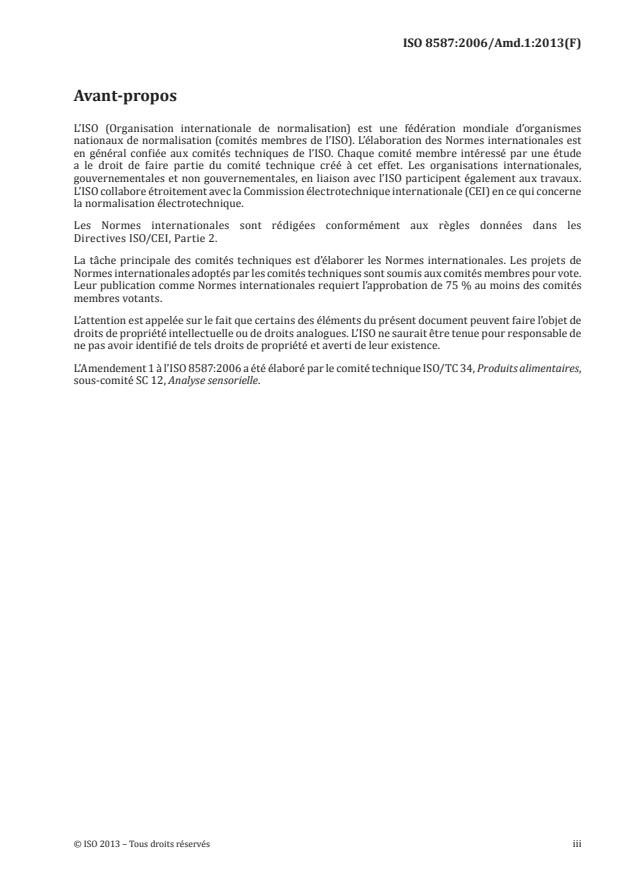

ISO 8587:2006/Amd 1:2013 - Analyse sensorielle — Méthodologie — Classement par rangs — Amendement 1 Released:2/5/2013
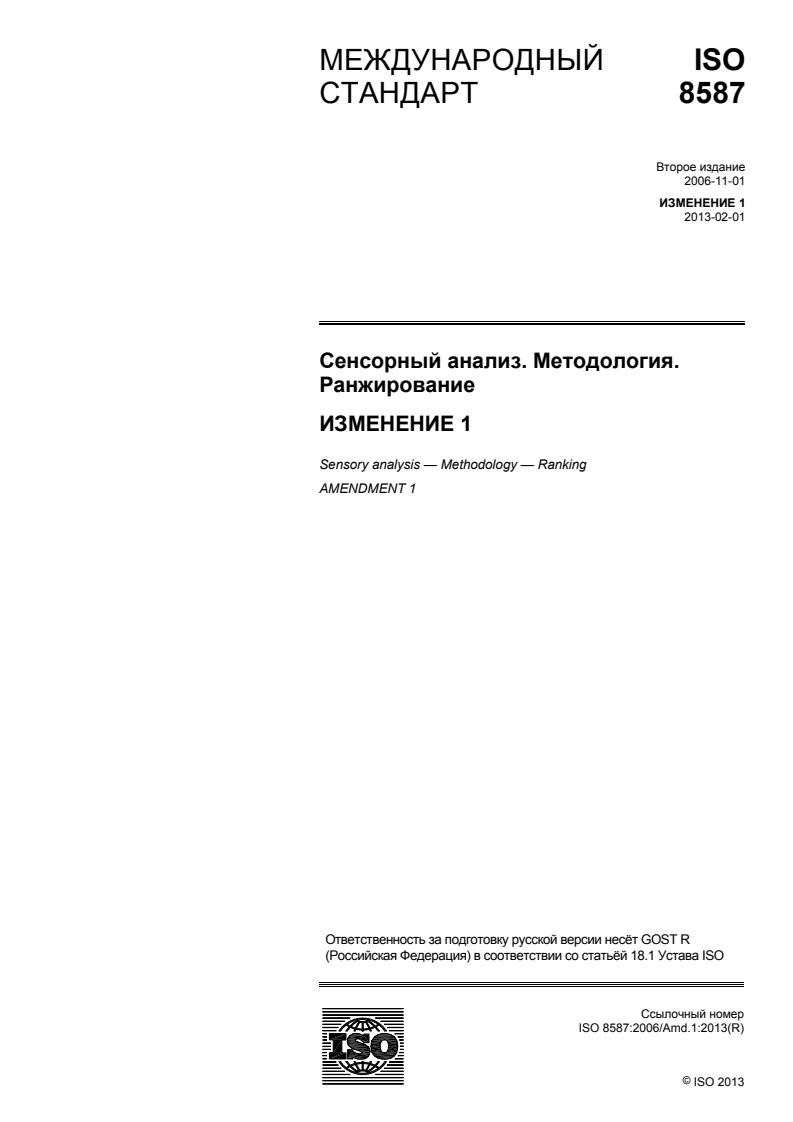
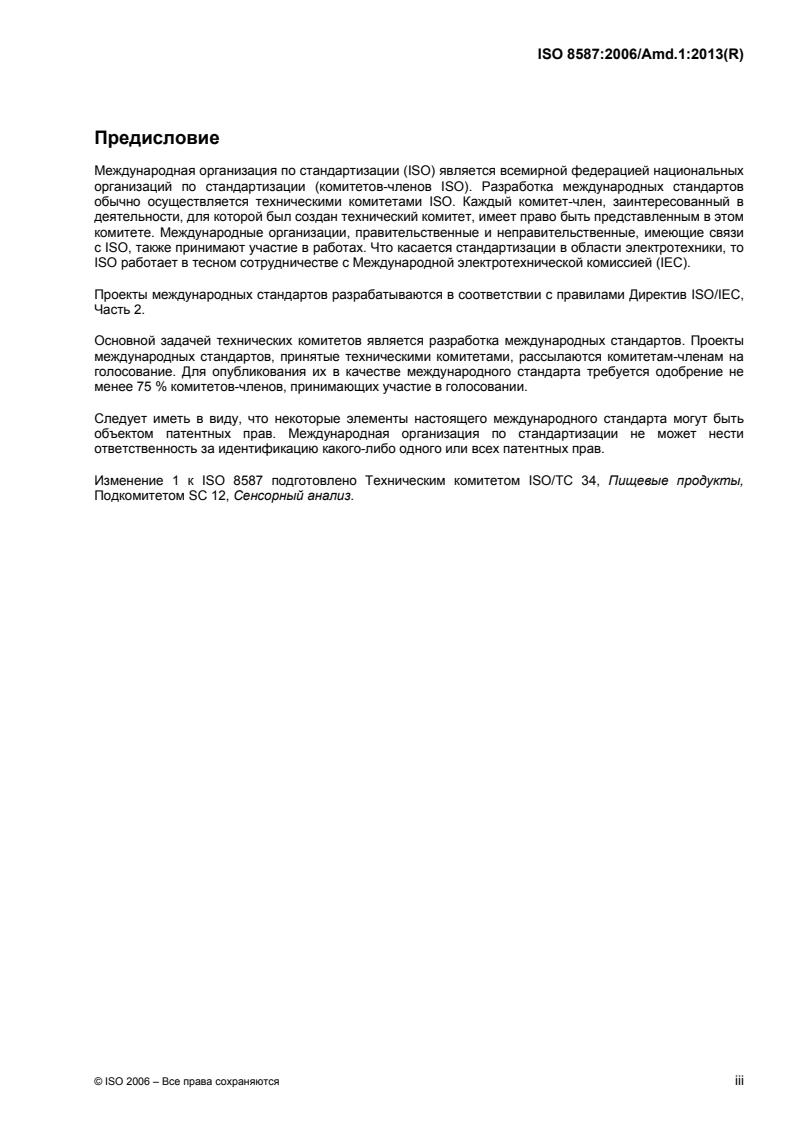

ISO 8587:2006/Amd 1:2013 - Sensory analysis — Methodology — Ranking — Amendment 1 Released:9/17/2015
Overview
ISO 8587:2006/Amd 1:2013 is an official amendment to the international standard ISO 8587:2006, which focuses on sensory analysis methodologies - specifically, the ranking method. Published by the International Organization for Standardization (ISO), this amendment refines and updates the procedures for conducting ranking tests, a common sensory evaluation technique used to compare multiple products or samples based on their sensory attributes. The changes primarily involve clarifying statistical hypotheses related to ranking outcomes to enhance the robustness and consistency of sensory data interpretation.
Key Topics
Sensory Analysis Methodology
The standard pertains to ranking as a sensory evaluation method. Ranking involves ordering a series of products or samples according to a specific attribute, such as flavor intensity or texture preference.Statistical Hypotheses in Ranking
Amendment 1 updates the definitions of the null and alternative hypotheses:- Null hypothesis (H0): The theoretical number of times products (A and B) are ranked first are equal across the population.
- Alternative hypothesis (H1): The theoretical number of times products are ranked first differ across the population.
Improved Data Interpretation
By refining these hypotheses, the amendment ensures greater statistical rigor in analyzing ranking tests, which supports better decision-making in product development and quality control.ISO Technical Committee
Developed by ISO/TC 34, Food Products, Subcommittee SC 12 on Sensory Analysis, this amendment reflects expert consensus from global technical experts in the field.
Applications
ISO 8587:2006/Amd 1:2013 is highly valuable for professionals conducting sensory tests who need an internationally recognized framework with clear methodologies and statistical interpretation principles. It benefits areas such as:
Food and Beverage Industry
Sensory ranking is frequently used to compare flavors, aromas, textures, and overall acceptability among various formulations or brands.Product Development and Innovation
Researchers use ranking methods to screen prototypes quickly for consumer sensory preferences and to guide iterative product improvements.Quality Control
Consistent sensory evaluation ensures ongoing product consistency and can detect changes in sensory characteristics that might affect consumer satisfaction.Consumer Research and Marketing
Sensory data generated through established ranking methods helps validate marketing claims and benchmark products against competitors.
Related Standards
For a comprehensive sensory analysis toolkit, the following ISO standards are relevant in conjunction with ISO 8587:2006 and its amendments:
ISO 13299 - Sensory Analysis - Methodology - General Guidance for Establishing a Sensory Profile
Provides guidelines for producing detailed sensory profiles beyond ranking.ISO 8586 - Sensory Analysis - General Guidelines for the Selection, Training, and Monitoring of Assessors
Addresses assessor competence, which is crucial for reliable ranking experiments.ISO 5492 - Sensory Analysis - Vocabulary
Defines terminology to ensure consistent communication and understanding within sensory science.ISO 11136 - Sensory Analysis - Methodology - Method of Measuring Thresholds
Complements ranking by offering methodologies to identify sensory detection thresholds.
Adopting ISO 8587:2006/Amd 1:2013 ensures standardized, statistically sound ranking procedures in sensory evaluation, promoting reliability and international comparability of results across food and related industries. This contributes directly to better product quality, consumer satisfaction, and innovation-driven market success.
Relations
- Consolidated By
ISO 10318-2:2015/Amd 1:2018 - Geosynthetics — Part 2: Symbols and pictograms — Amendment 1 - Effective Date
- 06-Jun-2022
- Effective Date
- 14-Oct-2020
Buy Documents
ISO 8587:2006/Amd 1:2013 - Sensory analysis — Methodology — Ranking — Amendment 1 Released:2/5/2013
ISO 8587:2006/Amd 1:2013 - Analyse sensorielle — Méthodologie — Classement par rangs — Amendement 1 Released:2/5/2013
ISO 8587:2006/Amd 1:2013 - Sensory analysis — Methodology — Ranking — Amendment 1 Released:9/17/2015
Get Certified
Connect with accredited certification bodies for this standard

BSI Group
BSI (British Standards Institution) is the business standards company that helps organizations make excellence a habit.

Bureau Veritas
Bureau Veritas is a world leader in laboratory testing, inspection and certification services.

DNV
DNV is an independent assurance and risk management provider.
Sponsored listings
Frequently Asked Questions
ISO 8587:2006/Amd 1:2013 is a standard published by the International Organization for Standardization (ISO). Its full title is "Sensory analysis — Methodology — Ranking — Amendment 1". This standard covers: Sensory analysis — Methodology — Ranking — Amendment 1
Sensory analysis — Methodology — Ranking — Amendment 1
ISO 8587:2006/Amd 1:2013 is classified under the following ICS (International Classification for Standards) categories: 67.240 - Sensory analysis. The ICS classification helps identify the subject area and facilitates finding related standards.
ISO 8587:2006/Amd 1:2013 has the following relationships with other standards: It is inter standard links to ISO 10318-2:2015/Amd 1:2018, ISO 8587:2006. Understanding these relationships helps ensure you are using the most current and applicable version of the standard.
ISO 8587:2006/Amd 1:2013 is available in PDF format for immediate download after purchase. The document can be added to your cart and obtained through the secure checkout process. Digital delivery ensures instant access to the complete standard document.
Standards Content (Sample)
INTERNATIONAL ISO
STANDARD 8587
Second edition
2006-11-01
AMENDMENT 1
2013-02-01
Sensory analysis — Methodology —
Ranking
AMENDMENT 1
Analyse sensorielle — Méthodologie — Classement par rangs
AMENDEMENT 1
Reference number
ISO 8587:2006/Amd.1:2013(E)
©
ISO 2013
ISO 8587:2006/Amd.1:2013(E)
© ISO 2013
All rights reserved. Unless otherwise specified, no part of this publication may be reproduced or utilized otherwise in any form
or by any means, electronic or mechanical, including photocopying, or posting on the internet or an intranet, without prior
written permission. Permission can be requested from either ISO at the address below or ISO’s member body in the country of
the requester.
ISO copyright office
Case postale 56 • CH-1211 Geneva 20
Tel. + 41 22 749 01 11
Fax + 41 22 749 09 47
E-mail copyright@iso.org
Web www.iso.org
Published in Switzerland
ii © ISO 2013 – All rights reserved
ISO 8587:2006/Amd.1:2013(E)
Foreword
ISO (the International Organization for Standardization) is a worldwide federation of national standards
bodies (ISO member bodies). The work of preparing International Standards is normally carried out
through ISO technical committees. Each member body interested in a subject for which a technical
committee has been established has the right to be represented on that committee. International
organizations, governmental and non-governmental, in liaison with ISO, also take part in the work.
ISO collaborates closely with the International Electrotechnical Commission (IEC) on all matters of
el
...
NORME ISO
INTERNATIONALE 8587
Deuxième édition
2006-11-01
AMENDEMENT 1
2013-02-01
Analyse sensorielle —
Méthodologie — Classement par rangs
AMENDEMENT 1
Sensory analysis — Methodology — Ranking
AMENDMENT 1
Numéro de référence
ISO 8587:2006/Amd.1:2013(F)
©
ISO 2013
ISO 8587:2006/Amd.1:2013(F)
DOCUMENT PROTÉGÉ PAR COPYRIGHT
© ISO 2013
Droits de reproduction réservés. Sauf indication contraire, aucune partie de cette publication ne peut être reproduite ni utilisée
sous quelque forme que ce soit et par aucun procédé, électronique ou mécanique, y compris la photocopie, l’affichage sur
l’internet ou sur un Intranet, sans autorisation écrite préalable. Les demandes d’autorisation peuvent être adressées à l’ISO à
l’adresse ci-après ou au comité membre de l’ISO dans le pays du demandeur.
ISO copyright office
Case postale 56 • CH-1211 Geneva 20
Tel. + 41 22 749 01 11
Fax + 41 22 749 09 47
E-mail copyright@iso.org
Web www.iso.org
Publié en Suisse
ii © ISO 2013 – Tous droits réservés
ISO 8587:2006/Amd.1:2013(F)
Avant-propos
L’ISO (Organisation internationale de normalisation) est une fédération mondiale d’organismes
nationaux de normalisation (comités membres de l’ISO). L’élaboration des Normes internationales est
en général confiée aux comités techniques de l’ISO. Chaque comité membre intéressé par une étude
a le droit de faire partie du comité technique créé à cet effet. Les organisations internationales,
gouvernementales et non gouvernementales, en liaison avec l’ISO participent également aux travaux.
L’ISO collabore étroitement avec la Commission électrotechnique internationale (CEI) en ce qui concerne
la normalisation électrotechnique.
Les Normes inte
...
МЕЖДУНАРОДНЫЙ ISO
СТАНДАРТ 8587
Второе издание
2006-11-01
ИЗМЕНЕНИЕ 1
2013-02-01
Сенсорный анализ. Методология.
Ранжирование
ИЗМЕНЕНИЕ 1
Sensory analysis — Methodology — Ranking
AMENDMENT 1
Ответственность за подготовку русской версии несёт GOST R
(Российская Федерация) в соответствии со статьёй 18.1 Устава ISO
Ссылочный номер
ISO 8587:2006/Amd.1:2013(R)
©
ISO 2013
ISO 8587:2006/Amd.1:2013(R)
ДОКУМЕНТ ЗАЩИЩЕН АВТОРСКИМ ПРАВОМ
© ISO 2006
Все права сохраняются. Если не указано иное, никакую часть настоящей публикации нельзя копировать или использовать в
какой-либо форме или каким-либо электронным или механическим способом, включая фотокопии и микрофильмы, без
предварительного письменного согласия ISO по адресу ниже или членов ISO в стране регистрации пребывания.
ISO copyright office
Case postale 56 • CH-1211 Geneva 20
Tel. + 41 22 749 01 11
Fax + 41 22 749 09 47
E-mail copyright@iso.org
Web www.iso.org
Опубликовано в Швейцарии
ii © ISO 2013 – Все права сохраняются
ISO 8587:2006/Amd.1:2013(R)
Предисловие
Международная организация по стандартизации (ISO) является всемирной федерацией национальных
организаций по стандартизации (комитетов-членов ISO). Разработка международных стандартов
обычно осуществляется техническими комитетами ISO. Каждый комитет-член, заинтересованный в
деятельности, для которой был создан технический комитет, имеет право быть представленным в этом
комитете. Международные организации, правительственные и неправительственные, имеющие связи
с ISO, также принимают участие в работах. Что касается стандартизации в области электротехники, то
ISO работает в тесном сотрудничестве с Международной электротехнической комиссией (IEC).
Проекты меж
...