

ISO 23519:2010
(Main)Sintered metal materials, excluding hardmetals — Measurement of surface roughness
General Information
- Abstract
ISO 23519:2010 specifies a method to determine the surface roughness of sintered parts of metal materials. It also establishes principles for the use of the suitable parameters for measurement.
- Status
- Published
- Publication Date
- 30-May-2010
- Current Stage
- 9093 - International Standard confirmed
- Start Date
- 10-Dec-2025
- Completion Date
- 29-Aug-2026
Buy Documents
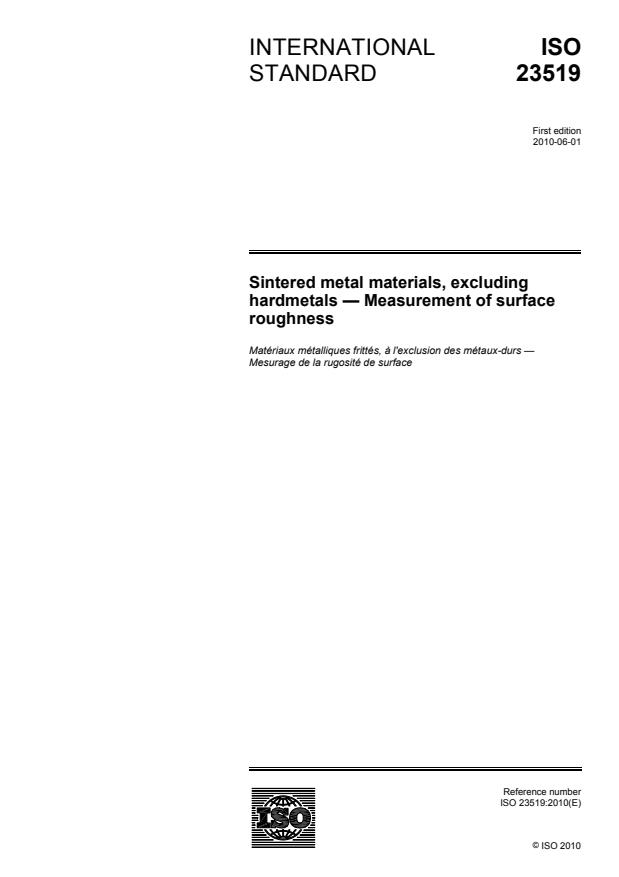
ISO 23519:2010 - Sintered metal materials, excluding hardmetals — Measurement of surface roughness Released:5/31/2010
ISO 23519:2010 - Sintered metal materials, excluding hardmetals — Measurement of surface roughness Released:3/6/2018
Overview
ISO 23519:2010 - "Sintered metal materials, excluding hardmetals - Measurement of surface roughness" defines a standardized method to measure and report surface roughness of sintered metal parts. The standard addresses the effect of porosity and surface texture unique to powder metallurgy and prescribes measurement parameters and reporting conventions to ensure meaningful, comparable roughness data for sintered components.
Key topics and requirements
- Scope: Measurement method and principles for selecting suitable surface roughness parameters for sintered materials (excluding hardmetals).
- Filtered profile: Always use a filtered (roughness) profile with the standard Gaussian filter.
- Cut-off and evaluation length: Default cut-off = 0.8 mm and total evaluation length = 4 mm (5 × cut-off).
- If Ra > 4.0 µm, increase cut-off to 2.5 mm and evaluation length to 12.5 mm.
- Stylus probe: Use a probe with a 2 µm radius to resolve surface irregularities on sintered parts.
- Depth exclusion:Do not consider the first 5% of depth in measurements (to avoid artefacts from edge effects or initial pore influence).
- Recommended parameters: Report results primarily in Rk (core roughness depth) and Rpk (reduced peak height) - these better characterise stratified surfaces with open porosity.
- Parameters to avoid: Metrics that are strongly affected by porosity and pore depth - Rp, Rv, Rz, Rt, Ra, Rq, Rs, RSm - are not recommended for sintered materials because they conflate surface topography with open-porosity effects.
- Reporting precision: Results should be reported in Rpk (and Rk) to the nearest 0.1 µm.
Applications and users
ISO 23519:2010 is targeted at professionals involved in quality control, metrology and product development for powder metallurgy and sintered components. Typical users include:
- Quality engineers and inspection labs performing profilometer-based roughness measurements
- Production engineers optimizing sintering, sizing and surface finishing processes
- Materials and process engineers assessing functional surface properties (wear, lubrication retention, sealing)
- OEMs and suppliers of sintered parts in automotive, industrial machinery, bearings and filtration industries
Practical benefits include consistent roughness data for acceptance testing, improved correlation between surface finish and functional performance, and reduced measurement variability caused by porosity.
Related standards
- ISO 4287 - Surface texture: Profile method - Terms and parameters
- ISO 13565-1, ISO 13565-2, ISO 13565-3 - Surface texture for stratified functional properties (filtering and height-characterization methods)
- Other GPS/profile standards referenced for instrument and filtering requirements (e.g., ISO 3274, ISO 4288)
Keywords: ISO 23519:2010, sintered metal materials, surface roughness measurement, Rpk, Rk, powder metallurgy, profilometer, porosity, ISO 13565, ISO 4287.
Buy Documents
ISO 23519:2010 - Sintered metal materials, excluding hardmetals — Measurement of surface roughness Released:5/31/2010
ISO 23519:2010 - Sintered metal materials, excluding hardmetals — Measurement of surface roughness Released:3/6/2018
Get Certified
Connect with accredited certification bodies for this standard

Element Materials Technology
Materials testing and product certification.

Inštitut za kovinske materiale in tehnologije
Institute of Metals and Technology. Materials testing, metallurgical analysis, NDT.
Sponsored listings
Frequently Asked Questions
ISO 23519:2010 is a standard published by the International Organization for Standardization (ISO). Its full title is "Sintered metal materials, excluding hardmetals — Measurement of surface roughness". This standard covers: ISO 23519:2010 specifies a method to determine the surface roughness of sintered parts of metal materials. It also establishes principles for the use of the suitable parameters for measurement.
ISO 23519:2010 specifies a method to determine the surface roughness of sintered parts of metal materials. It also establishes principles for the use of the suitable parameters for measurement.
ISO 23519:2010 is classified under the following ICS (International Classification for Standards) categories: 77.160 - Powder metallurgy. The ICS classification helps identify the subject area and facilitates finding related standards.
ISO 23519:2010 is available in PDF format for immediate download after purchase. The document can be added to your cart and obtained through the secure checkout process. Digital delivery ensures instant access to the complete standard document.
Standards Content (Sample)
INTERNATIONAL ISO
STANDARD 23519
First edition
2010-06-01
Sintered metal materials, excluding
hardmetals — Measurement of surface
roughness
Matériaux métalliques frittés, à l'exclusion des métaux-durs —
Mesurage de la rugosité de surface
Reference number
©
ISO 2010
PDF disclaimer
This PDF file may contain embedded typefaces. In accordance with Adobe's licensing policy, this file may be printed or viewed but
shall not be edited unless the typefaces which are embedded are licensed to and installed on the computer performing the editing. In
downloading this file, parties accept therein the responsibility of not infringing Adobe's licensing policy. The ISO Central Secretariat
accepts no liability in this area.
Adobe is a trademark of Adobe Systems Incorporated.
Details of the software products used to create this PDF file can be found in the General Info relative to the file; the PDF-creation
parameters were optimized for printing. Every care has been taken to ensure that the file is suitable for use by ISO member bodies. In
the unlikely event that a problem relating to it is found, please inform the Central Secretariat at the address given below.
© ISO 2010
All rights reserved. Unless otherwise specified, no part of this publication may be reproduced or utilized in any form or by any means,
electronic or mechanical, including photocopying and microfilm, without permission in writing from either ISO at the address below or
ISO's member body in the country of the requester.
ISO copyright office
Case postale 56 • CH-1211 Geneva 20
Tel. + 41 22 749 01 11
Fax + 41 22 749 09 47
E-mail copyright@iso.org
Web www.iso.org
Published in Switzerland
ii © ISO 2010 – All rights reserved
Contents Page
Foreword .iv
1 Scope.1
2 Normative references.1
3 Terms and definitions .1
4 Symbols and units.2
5 Principle.2
6 Procedure.3
7 Expression of results.4
Bibliography.5
Foreword
ISO (the International Organization for Standardization) is a worldwide federation of national standards bodies
(ISO member bodies). The work of preparing International Standards is normally carried out through ISO
technical committees. Each member body interested in a subject for which a technical committee has been
established has the right to be represented on that committee. International organizations, governmental and
non-governmental, in liaison with ISO, also take part in the work. ISO collaborates closely with the
International Electrotechnical Commission (IEC) on all matters of electrotechnical standardization.
International Standards are drafted in accordance with the rules given in the ISO/IEC Directives, Part 2.
The main task of technical committees is to prepare International Standards. Draft International Standards
adopted by the technical committees are circulated to the member bodies for voting. Publication as an
International Standard requires approval by at least 75 % of the member bodies casting a vote.
Attention is drawn to the possibility that some of the elements of this document may be the subject of patent
rights. ISO shall not be held responsible for identifying any or all such patent rights.
ISO 23519 was prepared by Technical Committee ISO/TC 119, Powder metallurgy, Subcommittee SC 3,
Sampling and testing methods for sintered metal materials (excluding hardmetals).
iv © ISO 2010 – All rights reserved
INTERNATIONAL STANDARD ISO 23519:2010(E)
Sintered metal materials, excluding hardmetals — Measurement
of surface roughness
1 Scope
This International Standard specifies a method to determine the surface roughness of sintered parts of metal
materials. It also establishes principles for the use of the suitable parameters for measurement.
2 Normative references
The following referenced documents are indispensable for the application of this document. For dated
references, only the edition cited applies. For undated references, the latest edition of the referenced
document (including any amendments) applies.
ISO 4287, Geometrical Product
...
МЕЖДУНАРОДНЫЙ ISO
СТАНДАРТ 23519
Первое издание
2010-06-01
Материалы металлические спеченные,
исключая твердые сплавы. Измерение
шероховатости поверхности
Sintered metal materials, excluding hard metals. Measurement of
surface roughness
Ответственность за подготовку русской версии несѐт GOST R
(Российская Федерация) в соответствии со статьѐй 18.1 Устава ISO
Ссылочный номер
©
ISO 2010
Отказ от ответственности при работе в PDF
Настоящий файл PDF может содержать интегрированные шрифты. В соответствии с условиями лицензирования, принятыми
фирмой Adobe, этот файл можно распечатать или смотреть на экране, но его нельзя изменить, пока не будет получена
лицензия на установку интегрированных шрифтов в компьютере, на котором ведется редактирование. В случае загрузки
настоящего файла заинтересованные стороны принимают на себя ответственность за соблюдение лицензионных условий
фирмы Adobe. Центральный секретариат ISO не несет никакой ответственности в этом отношении.
Adobe - торговый знак Adobe Systems Incorporated.
Подробности, относящиеся к программным продуктам, использованным для создания настоящего файла PDF, можно найти в
рубрике General Info файла; параметры создания PDF оптимизированы для печати. Были приняты во внимание все меры
предосторожности с тем, чтобы обеспечить пригодность настоящего файла для использования комитетами – членами ISO. В
редких случаях возникновения проблемы, связанной со сказанным выше, просим информировать Центральный секретариат по
адресу, приведенному ниже.
ДОКУМЕНТ ЗАЩИЩЕН АВТОРСКИМ ПРАВОМ
© ISO 2010
Все права сохраняются. Если не задано иначе, никакую часть настоящей публикации нельзя копировать или использовать в
какой-либо форме или каким-либо электронным или механическим способом, включая фотокопии и микрофильмы, без
предварительного письменного согласия офиса ISO по адресу, указанному ниже, или членов ISO в стране регистрации
пребывания.
ISO copyright office
Case postale 56 CH-1211 Geneva 20
Tel. + 41 22 749 01 11
Fax + 41 22 749 09 47
E-mail copyright@iso.org
Web www.iso.org
Опубликовано в Швейцарии
ii © ISO 2010 – Все права сохраняются
Содержание Страница
Предисловие. iv
1 Область применения . 1
2 Нормативные ссылки . 1
3 Термины и определения . 1
4 Символы и единицы измерения . 2
5 Принцип . 2
6 Методика . 3
7 Выражение результатов . 4
Библиография . 5
Предисловие
Международная организация по стандартизации (ISO) является всемирной федерацией национальных
организаций по стандартизации (комитетов-членов ISO). Разработка международных стандартов
обычно осуществляется техническими комитетами ISO. Каждый комитет-член, заинтересованный в
деятельности, для которой был создан технический комитет, имеет право быть представленным в этом
комитете. Международные правительственные и неправительственные организации, имеющие связи с
ISO, также принимают участие в работах. Что касается стандартизации в области электротехники, то
ISO работает в тесном сотрудничестве с Международной электротехнической комиссией (IEC).
Проекты международных стандартов разрабатываются в соответствии с правилами Директив ISO/IEC,
Часть 2.
Основной задачей технических комитетов является подготовка международных стандартов. Проекты
международных стандартов, принятые техническими комитетами, рассылаются комитетам-членам на
голосование. Их опубликование в качестве международных стандартов требует одобрения не менее
75 % комитетов-членов, принимающих участие в голосовании.
Следует иметь в виду, что некоторые элементы настоящего международного стандарта могут быть
объектом патентных прав. Международная организация по стандартизации не может нести
ответственность за идентификацию какого-либо одного или всех патентных прав.
ISO 23519 подготовил Технический комитет ISO/TC 119, Порошковая металлургия, Подкомитет SC 3,
Отбор образцов и методы испытаний спеченных металлических материалов (исключая твердые
сплавы).
iv © ISO 2010 – Все права сохраняются
МЕЖДУНАРОДНЫЙ СТАНДАРТ ISO 23519:2010(R)
Материалы металлические спеченные, исключая твердые
сплавы. Измерение шероховатости поверхности
1 Область применения
Настоящий международный стандарт задает метод определения шероховатости на поверхности
спеченных частей металлических материалов. Он также устанавливает принципы использования
подходящих параметров для измерения.
2 Нормативные ссылки
Следующие ссылочные документы являются обязательными для применения настоящего документа.
Для устаревших ссылок применяется только цитируемое издание. Для недатированных ссылок
применяется самое последнее издание ссылочного документа (включая поправки).
ISO 4287, Геометрические характеристики изделий (GPS). Структура поверхности: Профильный
метод. Термины, определения и параметры структура поверхности
ISO 13565-1, Геометрические характеристики изделий (GPS). Структура поверхности:
Профильный метод. Поверхности с послойным распределением функциональных свойств. Часть 1.
Фильтрация и общие условия измерений
ISO 13565-2, Геометрические характеристики изделий (GPS). Структура поверхности:
Профильный метод. Поверхности с послойным распределением функциональных свойств. Часть 2.
Характеристика слоев методом выделения линейного участка на
...