

ISO/TS 23030:2020
(Main)Traditional Chinese medicine — Clinical document specification for prescription of traditional Chinese medicine decoction pieces
General Information
- Abstract
This document provides a referenced entry-level implementation template for traditional Chinese medicine decoction piece prescriptions based on HL7 CDA® Release 2.0 to support the data collection, transmission, storage and exchange of decoction piece prescriptions for electronic records. This document focuses on the description of core data of traditional Chinese medicine decoction piece prescriptions which constitute the 'medication administration' section of the clinical document body. This document does not specify the detailed content of the clinical document header or other sections and entries of the clinical document body.
- Status
- Published
- Publication Date
- 15-Dec-2020
- Technical Committee
- ISO/TC 249 - Traditional Chinese medicine
- Drafting Committee
- ISO/TC 249/JWG 1 - Joint ISO/TC 249 - ISO/TC 215 WG: Informatics
- Parallel Committee
- ISO/TC 215 - Health informatics
- Current Stage
- 9093 - International Standard confirmed
- Start Date
- 20-Dec-2024
- Completion Date
- 29-Aug-2026
Buy Documents
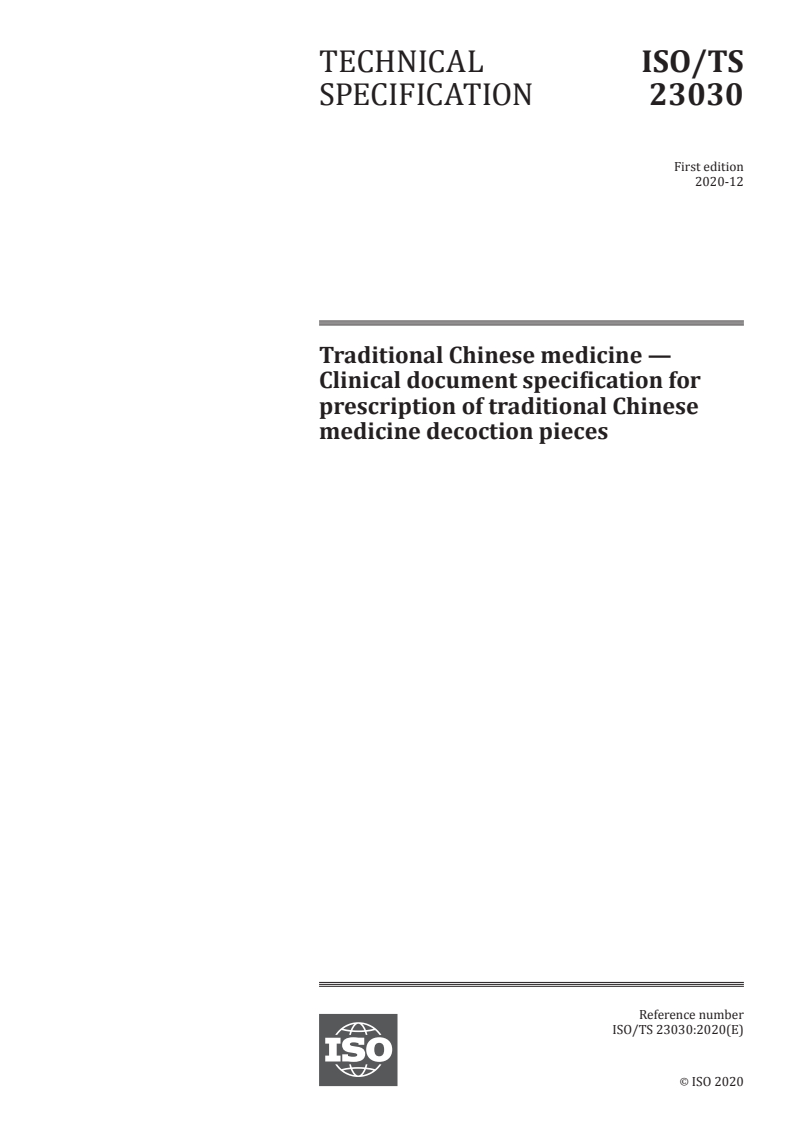
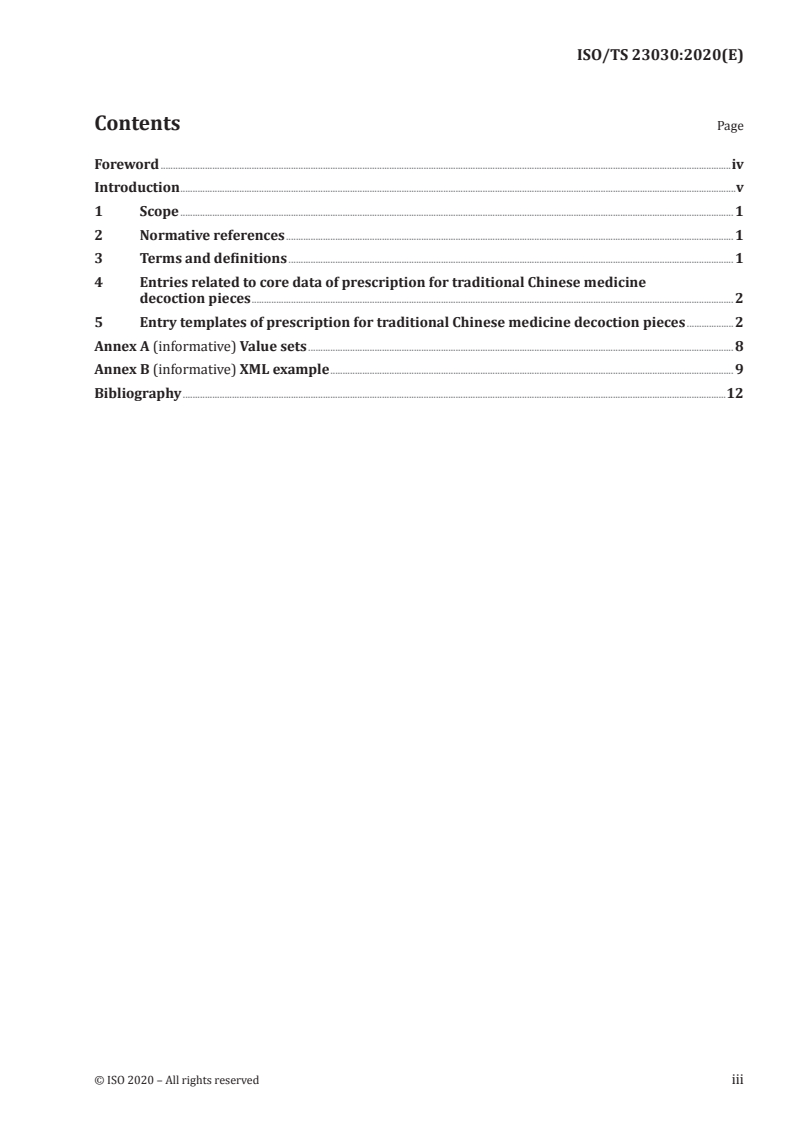
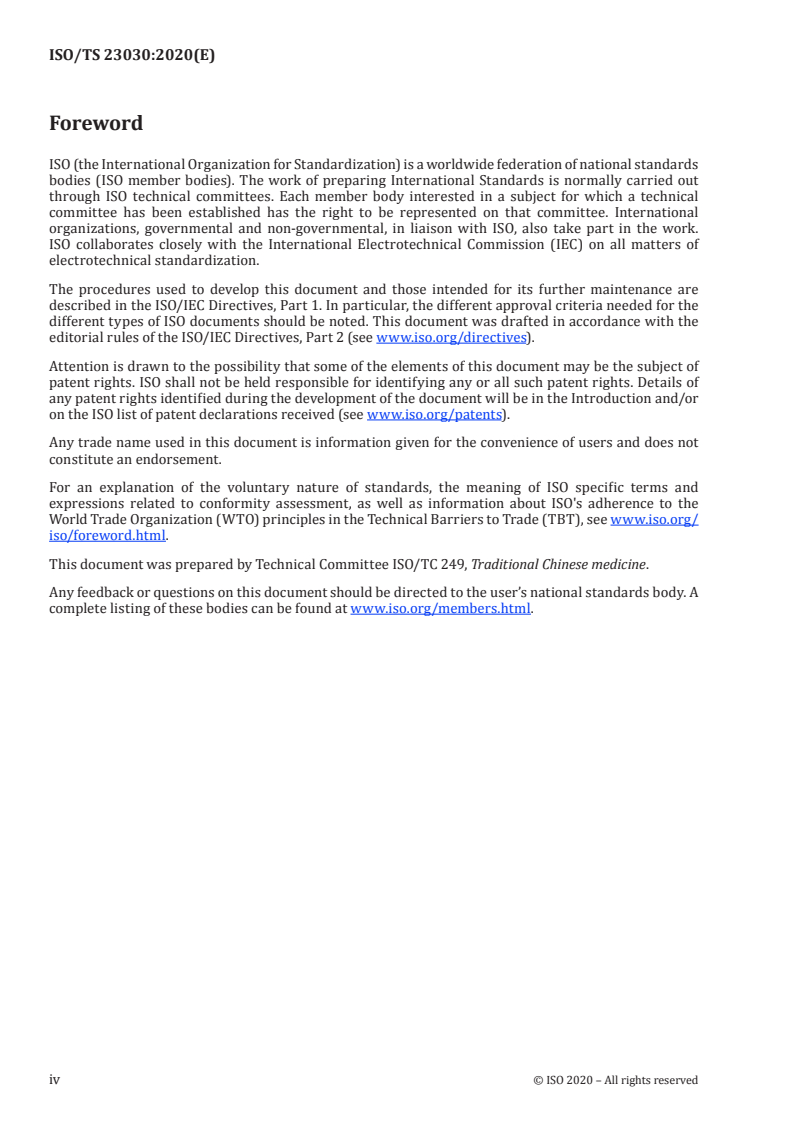
ISO/TS 23030:2020 - Traditional Chinese medicine — Clinical document specification for prescription of traditional Chinese medicine decoction pieces Released:12/16/2020
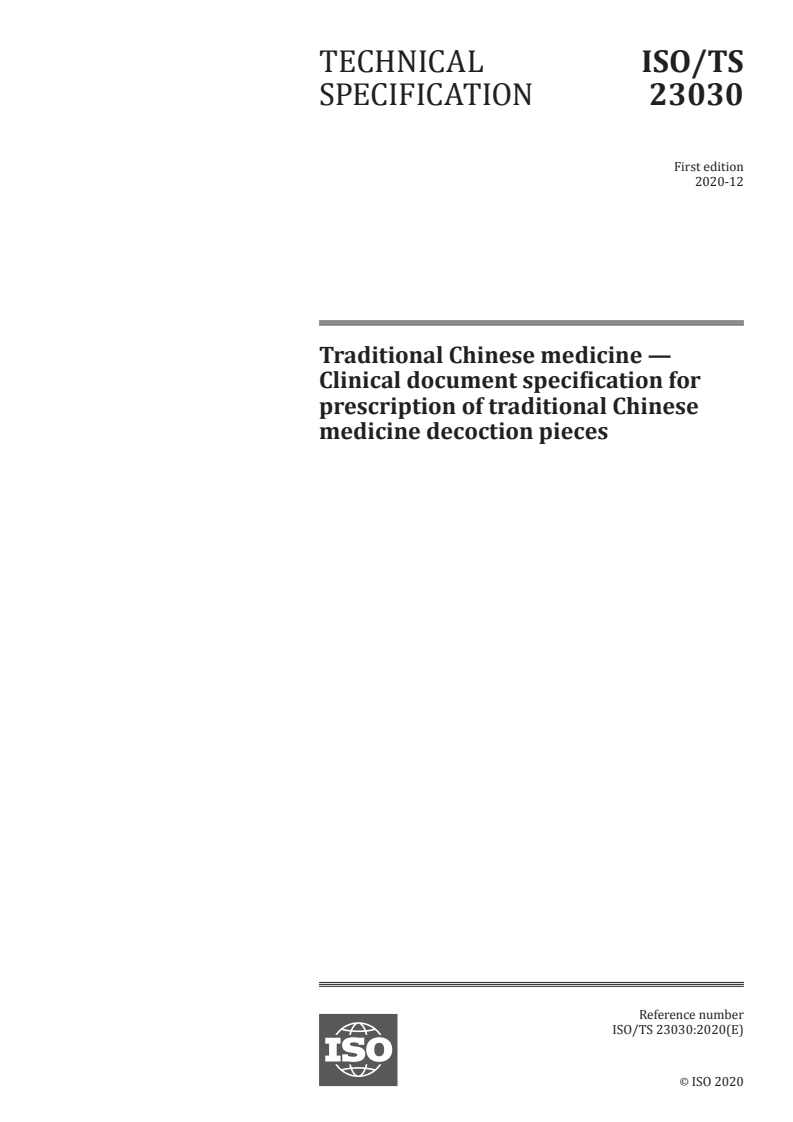
ISO/TS 23030:2020 - Traditional Chinese medicine — Clinical document specification for prescription of traditional Chinese medicine decoction pieces/16/2020
Overview
ISO/TS 23030:2020 - Traditional Chinese medicine - Clinical document specification for prescription of traditional Chinese medicine decoction pieces - provides an entry-level implementation template for encoding prescriptions of TCM decoction pieces using HL7 CDA® Release 2.0 (ISO/HL7 27932). The technical specification focuses on the core medication-administration data for decoction-piece prescriptions to support consistent data collection, transmission, storage and exchange in electronic health records (EHRs). It does not prescribe detailed clinical document headers or unrelated body sections.
Key topics and technical requirements
- CDA-based entry templates: The specification reuses HL7 CDA Release 2.0’s substanceAdministration template as the basis for the medication-administration section.
- Defined elements and cardinality: Detailed elements (e.g., effectiveTime, routeCode, doseQuantity, consumable/manufacturedProduct) and cardinality constraints are specified, with CONF-nnnn conformance statements (CONF-0001 … CONF-0028) that implementers must follow.
- Template identifiers and OIDs: Required templateId roots are specified (for example, 2.16.840.1.113883.2.23.11.5.1.1 and 2.16.840.1.113883.2.23.11.5.1.2) to ensure consistent document recognition.
- Terminology and code systems:
- Route and site codes may use SNOMED-CT (code system OID 2.16.840.1.113883.6.96).
- Decoction method and decoction service use dedicated code system OIDs referenced in the spec (e.g., 2.16.840.1.113883.2.23.11.5.2.1 and …5.2.2).
- Structured decoction data: Templates cover decoction-piece names, dose instructions, special decoction methods, frequency (PIVL_TS), execution interval (IVL_TS), and package counts.
- Annexes: Annex A contains value sets; Annex B provides an XML example demonstrating the template in CDA XML.
Applications and who should use it
This TS is practical for:
- EHR and clinical systems vendors implementing TCM prescription modules.
- Health IT architects and integration engineers building CDA-based interoperability for TCM.
- Hospitals, TCM clinics and pharmacies exchanging electronic decoction-piece prescriptions.
- National/regional health authorities and standards committees integrating TCM prescribing into health information exchanges.
- Clinical informaticians who need consistent semantics for medication administration, CDS, reimbursement, audit and reporting.
Practical benefits include improved interoperability, reduced transcription errors, standardized data for analytics and decision support, and consistent encoding of decoction methods and services.
Related standards
- ISO/HL7 27932 (HL7 CDA Release 2.0) - structural foundation for clinical documents.
- SNOMED CT - recommended terminology for route and site coding.
- ISO/TC 249 - technical committee responsible for the TCM standardization work.
Keywords: ISO/TS 23030:2020, traditional Chinese medicine, decoction pieces, HL7 CDA Release 2.0, clinical document specification, medication administration, interoperability, EHR, SNOMED-CT, XML example, value sets.
Relations
- Consolidated By
ISO 16122-2:2024 - Agricultural and forestry machinery — Inspection of sprayers in use — Part 2: Horizontal boom sprayers - Effective Date
- 06-Jun-2022
Buy Documents
ISO/TS 23030:2020 - Traditional Chinese medicine — Clinical document specification for prescription of traditional Chinese medicine decoction pieces Released:12/16/2020
ISO/TS 23030:2020 - Traditional Chinese medicine — Clinical document specification for prescription of traditional Chinese medicine decoction pieces/16/2020
Get Certified
Connect with accredited certification bodies for this standard

BSI Group
BSI (British Standards Institution) is the business standards company that helps organizations make excellence a habit.

TÜV Rheinland
TÜV Rheinland is a leading international provider of technical services.

TÜV SÜD
TÜV SÜD is a trusted partner of choice for safety, security and sustainability solutions.
Sponsored listings
Frequently Asked Questions
ISO/TS 23030:2020 is a technical specification published by the International Organization for Standardization (ISO). Its full title is "Traditional Chinese medicine — Clinical document specification for prescription of traditional Chinese medicine decoction pieces". This standard covers: This document provides a referenced entry-level implementation template for traditional Chinese medicine decoction piece prescriptions based on HL7 CDA® Release 2.0 to support the data collection, transmission, storage and exchange of decoction piece prescriptions for electronic records. This document focuses on the description of core data of traditional Chinese medicine decoction piece prescriptions which constitute the 'medication administration' section of the clinical document body. This document does not specify the detailed content of the clinical document header or other sections and entries of the clinical document body.
This document provides a referenced entry-level implementation template for traditional Chinese medicine decoction piece prescriptions based on HL7 CDA® Release 2.0 to support the data collection, transmission, storage and exchange of decoction piece prescriptions for electronic records. This document focuses on the description of core data of traditional Chinese medicine decoction piece prescriptions which constitute the 'medication administration' section of the clinical document body. This document does not specify the detailed content of the clinical document header or other sections and entries of the clinical document body.
ISO/TS 23030:2020 is classified under the following ICS (International Classification for Standards) categories: 11.120.10 - Medicaments. The ICS classification helps identify the subject area and facilitates finding related standards.
ISO/TS 23030:2020 has the following relationships with other standards: It is inter standard links to ISO 16122-2:2024. Understanding these relationships helps ensure you are using the most current and applicable version of the standard.
ISO/TS 23030:2020 is available in PDF format for immediate download after purchase. The document can be added to your cart and obtained through the secure checkout process. Digital delivery ensures instant access to the complete standard document.
Standards Content (Sample)
TECHNICAL ISO/TS
SPECIFICATION 23030
First edition
2020-12
Traditional Chinese medicine —
Clinical document specification for
prescription of traditional Chinese
medicine decoction pieces
Reference number
©
ISO 2020
© ISO 2020
All rights reserved. Unless otherwise specified, or required in the context of its implementation, no part of this publication may
be reproduced or utilized otherwise in any form or by any means, electronic or mechanical, including photocopying, or posting
on the internet or an intranet, without prior written permission. Permission can be requested from either ISO at the address
below or ISO’s member body in the country of the requester.
ISO copyright office
CP 401 • Ch. de Blandonnet 8
CH-1214 Vernier, Geneva
Phone: +41 22 749 01 11
Email: copyright@iso.org
Website: www.iso.org
Published in Switzerland
ii © ISO 2020 – All rights reserved
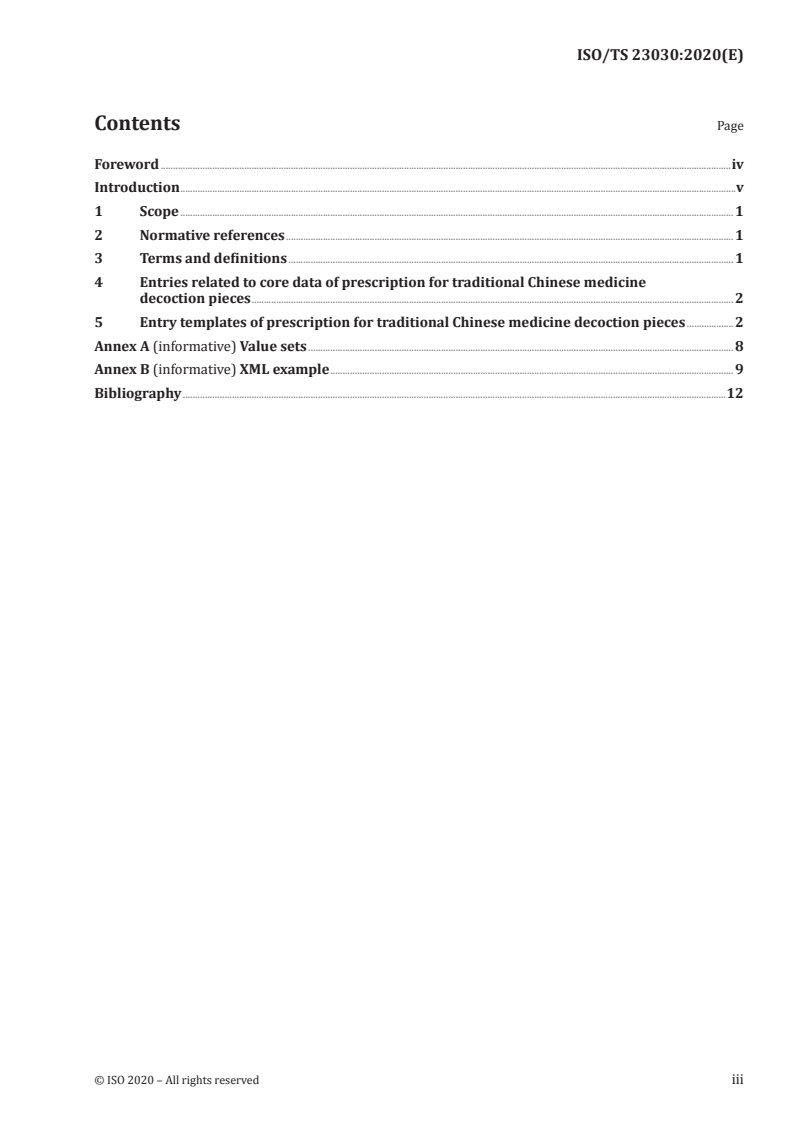
Contents Page
Foreword .iv
Introduction .v
1 Scope . 1
2 Normative references . 1
3 Terms and definitions . 1
4 Entries related to core data of prescription for traditional Chinese medicine
decoction pieces . 2
5 Entry templates of prescription for traditional Chinese medicine decoction pieces .2
Annex A (informative) Value sets . 8
Annex B (informative) XML example . 9
Bibliography .12
Foreword
ISO (the International Organization for Standardization) is a worldwide federation of national standards
bodies (ISO member bodies). The work of preparing International Standards is normally carried out
through ISO technical committees. Each member body interested in a subject for which a technical
committee has been established has the right to be represented on that committee. International
organizations, governmental and non-governmental, in liaison with ISO, also take part in the work.
ISO collaborates closely with the International Electrotechnical Commission (IEC) on all matters of
electrotechnical standardization.
The procedures used to develop this document and those intended for its further maintenance are
described in the ISO/IEC Directives, Part 1. In particular, the different approval criteria needed for the
different types of ISO documents should be noted. This document was drafted in accordance with the
editorial rules of the ISO/IEC Directives, Part 2 (see www .iso .org/ directives).
Attention is drawn to the possibility that some of the elements of this document may be the subject of
patent rights. ISO shall not be held responsible for identifying any or all such patent rights. Details of
any patent rights identified during the development of the document will be in the Introduction and/or
on the ISO list of patent declarations received (see www .iso .org/ patents).
Any trade name used in this document is information given for the convenience of users and does not
constitute an endorsement.
For an explanation of the voluntary nature of standards, the meaning of ISO specific terms and
expressions related to conformity assessment, as well as information about ISO's adherence to the
World Trade Organization (WTO) principles in the Technical Barriers to Trade (TBT), see www .iso .org/
iso/ foreword .html.
This document was prepared by Technical Committee ISO/TC 249, Traditional Chinese medicine.
Any feedback or questions on this document should be directed to the user’s national standards body. A
complete listing of these bodies can be found at www .iso .org/ members .html.
iv © ISO 2020 – All rights reserved
Introduction
® 1)
HL7 CDA Release 2.0 , which has been adopted as ISO/HL7 27932, is a document mark-up standard
that specifies the structure and semantics of clinical documents for the purpose of exchange between
healthcare providers and patients. It is necessary to establish a clinical document specification for
prescription of traditional Chinese medicine decoction pieces to support the implementation of
ISO/HL7 27932 in the context of the traditional Chinese medicine community. For implementers of HL7 ®
CDA Release 2.0, the prescription of traditional Chinese medicine decoction pieces can be provided as
a use case to maximize the use of shared semantics.
A clinical document consists of a clinical document header and a clinical document body. A clinical
document header consists of many sections, including identification and classification, participant
author and custodian. A clinical document body consists of many sections, including diagnosis,
medication administration, cost and medication plan. Usually, the core data of the prescription of
traditional Chinese medicine decoction pieces includes information about the names and amounts of
the decoction pieces, the form of processing, the dose, preparation and decoction methods, the route of
administration, frequency, the timing of consumption and the number of packages.
This document can be applied in medical institutions that need to share their prescriptions of decoction
pieces to ensure that both or multiple parties exchange documents following the specification
with consistent syntax and semantics. This document can be used to support the data collection,
transmission, storage and exchange of decoction piece prescriptions for electronic records.
In this document, the following verbal forms are used:
— “shall” indicates a requirement;
— “should” indicates a recommendation;
— “can” indicates a possibility or a capability;
— “may” indicates a permission.
1) HL7 and CDA are registered trademarks of Health Level Seven International and their use does not constitute
an endorsement by HL7.
TECHNICAL SPECIFICATION ISO/TS 23030:2020(E)
Traditional Chinese medicine — Clinical document
specification for prescription of traditional Chinese
medicine decoction pieces
1 Scope
This document provides a referenced entry-level implementation template for traditional Chinese ®
medicine decoction piece prescriptions based on HL7 CDA Release 2.0 to support the data collection,
transmission, storage and exchange of decoction piece prescriptions for electronic records. This
document focuses on the description of core data of traditional Chinese medicine decoction piece
prescriptions which constitute the 'medication administration' section of the clinical document body.
This document does not specify the detailed content of the clinical document header or other sections
and entries of the clinical document body.
2 Normative references
There are no normative references in this document.
3 Terms and definitions
For the purposes of this document, the following terms and definitions apply.
ISO and IEC maintain terminological databases for use in standardization at the following addresses:
— ISO Online browsing platform: available at https:// www .iso .org/ obp
— IEC Electropedia: available at http:// www .electropedia .org/
3.1
cardinality
number of times that a data element can repeat within an individual occurrence or object view
Note 1 to entry: In the XML documents specified by this document, the cardinality of an element defines the
number of times the element can repeatedly appear at a specified position, which is used to specify the number
of allowed values for data attributes expressed by the name of the element. It is denoted by ‘m.n’: ‘m’ means the
minimum number of occurrences and ‘n’ means the maximum allowed number of times.
[SOURCE: ISO/TR 12300:2014, 2.1.5, modified]
3.2
CONF
conformance requirement
precise text definition of a characteristic required to be present in a conforming implementation
Note 1 to entry: In CONF-nnnn, nnnn is a four-digit integer. The document is based on the CDA POCD_HD000040
and XML schema document (XSD). For XML elements, cardinality, terminology and data type in CDA XSD, no
specific explanation is given in this document
[SOURCE: ISO 13584-25:2004, 3.6, modified]
3.3
prescription
direction created by an authorized healthcare professional to instruct a dispensing agent regarding the
preparation and use of a medicinal product or medicinal appliance to be taken or used by a subject of care
[SOURCE: ISO 21549-7:2016, 3.22]
3.4
dose instructions
instructions pertaining to the medication, which describe the amount of administration, the frequency
or interval of dose, associated instructions for dosing or skipped doses, and other associated parameters
necessary for appropriate administration of the medication
[SOURCE: ISO/TS 17251:2016, 2.1]
4 Entries related to core data of prescription for traditional Chinese medicine
decoction pieces
The entries related to core data of prescription for traditional Chinese medicine decoction pieces
are described in Table 1, including entry of traditional Chinese medicine Medication Administration
and entry of Decoction Pieces Administration. The implementation entry template is based on ®
'substanceAdministration' of HL7 CDA Release 2.0. Annex B is the xml example based on the template
of core data of prescription for traditional Chinese medicine decoction pieces.
Table 1 — Entries related to core data of prescription for traditional Chinese medicine
decoction pieces
Name of entry Explanation and description
Traditional Chinese medicine medi- The entry includes information about the route of admin-
cation administration istration, frequency of drug taking and total number of
packages.
Decoction pieces administration The entry includes information about the name, dose in-
struction and special decoction method of decoction pieces.
5 Entry templates of prescription for traditional Chinese medicine decoction
pieces
5.1 Entry template of traditional Chinese medicine medication administration
The entry template of traditional Chinese medicine medication administration is described in Table 2. ®
The entry conforms to entry-level template 'substanceAdministration' in CDA schema of HL7 CDA
Release 2.0.
Table 2 — Elements of traditional Chinese medicine medication administration entry
Name of element Cardinality Verb Explanation and description
substanceAdministration 1.1 SHALL @classCode="SBADM" @moodCode="RQO"
-templateId 1.1 SHALL @root="2.16.840.1.113883.2.23.11.5.1.1"
A detailed description of traditional Chinese
-text 0.1 MAY
medicine administration
Execution time, number of days of drug - tak-
-effectiveTime 1.1 SHALL
ing @xsi: type = "IVL _TS"
--low 1.1 SHALL Starting time of drug taking
--high 0.1 MAY Ending time of drug taking
2 © ISO 2020 – All rights reserved
Table 2 (continued)
Name of element Cardinality Verb Explanation and description
Frequency of drug taking
-effectiveTime 1.1 SHALL
@xsi: type = "PIVL _TS"
@value=" "
-- period 1.1 SHALL
@unit=" h"
-repeatNumber 1.1 SHALL The total packages
@code=" "
@codeSystem="2.16.840.1.113883.6.96"
-routeCode 1.1 SHALL
@codeSystemName=" SNOMED-CT"
@displayName=" "
@code
@codeSystem=" 2.16.840.1.113883.6.96"
-approachSiteCode 0.1 MAY
@codeSystemName=" SNOMED-CT"
@displayName=""
@value=" "
-doseQuantity 1.1 SHALL
@unit ="packages"
-consumable 1.1 SHALL
--man
...
TECHNICAL ISO/TS
SPECIFICATION 23030
First edition
2020-12
Traditional Chinese medicine —
Clinical document specification for
prescription of traditional Chinese
medicine decoction pieces
Reference number
©
ISO 2020
© ISO 2020
All rights reserved. Unless otherwise specified, or required in the context of its implementation, no part of this publication may
be reproduced or utilized otherwise in any form or by any means, electronic or mechanical, including photocopying, or posting
on the internet or an intranet, without prior written permission. Permission can be requested from either ISO at the address
below or ISO’s member body in the country of the requester.
ISO copyright office
CP 401 • Ch. de Blandonnet 8
CH-1214 Vernier, Geneva
Phone: +41 22 749 01 11
Email: copyright@iso.org
Website: www.iso.org
Published in Switzerland
ii © ISO 2020 – All rights reserved
Contents Page
Foreword .iv
Introduction .v
1 Scope . 1
2 Normative references . 1
3 Terms and definitions . 1
4 Entries related to core data of prescription for traditional Chinese medicine
decoction pieces . 2
5 Entry templates of prescription for traditional Chinese medicine decoction pieces .2
Annex A (informative) Value sets . 8
Annex B (informative) XML example . 9
Bibliography .12
Foreword
ISO (the International Organization for Standardization) is a worldwide federation of national standards
bodies (ISO member bodies). The work of preparing International Standards is normally carried out
through ISO technical committees. Each member body interested in a subject for which a technical
committee has been established has the right to be represented on that committee. International
organizations, governmental and non-governmental, in liaison with ISO, also take part in the work.
ISO collaborates closely with the International Electrotechnical Commission (IEC) on all matters of
electrotechnical standardization.
The procedures used to develop this document and those intended for its further maintenance are
described in the ISO/IEC Directives, Part 1. In particular, the different approval criteria needed for the
different types of ISO documents should be noted. This document was drafted in accordance with the
editorial rules of the ISO/IEC Directives, Part 2 (see www .iso .org/ directives).
Attention is drawn to the possibility that some of the elements of this document may be the subject of
patent rights. ISO shall not be held responsible for identifying any or all such patent rights. Details of
any patent rights identified during the development of the document will be in the Introduction and/or
on the ISO list of patent declarations received (see www .iso .org/ patents).
Any trade name used in this document is information given for the convenience of users and does not
constitute an endorsement.
For an explanation of the voluntary nature of standards, the meaning of ISO specific terms and
expressions related to conformity assessment, as well as information about ISO's adherence to the
World Trade Organization (WTO) principles in the Technical Barriers to Trade (TBT), see www .iso .org/
iso/ foreword .html.
This document was prepared by Technical Committee ISO/TC 249, Traditional Chinese medicine.
Any feedback or questions on this document should be directed to the user’s national standards body. A
complete listing of these bodies can be found at www .iso .org/ members .html.
iv © ISO 2020 – All rights reserved
Introduction
® 1)
HL7 CDA Release 2.0 , which has been adopted as ISO/HL7 27932, is a document mark-up standard
that specifies the structure and semantics of clinical documents for the purpose of exchange between
healthcare providers and patients. It is necessary to establish a clinical document specification for
prescription of traditional Chinese medicine decoction pieces to support the implementation of
ISO/HL7 27932 in the context of the traditional Chinese medicine community. For implementers of HL7 ®
CDA Release 2.0, the prescription of traditional Chinese medicine decoction pieces can be provided as
a use case to maximize the use of shared semantics.
A clinical document consists of a clinical document header and a clinical document body. A clinical
document header consists of many sections, including identification and classification, participant
author and custodian. A clinical document body consists of many sections, including diagnosis,
medication administration, cost and medication plan. Usually, the core data of the prescription of
traditional Chinese medicine decoction pieces includes information about the names and amounts of
the decoction pieces, the form of processing, the dose, preparation and decoction methods, the route of
administration, frequency, the timing of consumption and the number of packages.
This document can be applied in medical institutions that need to share their prescriptions of decoction
pieces to ensure that both or multiple parties exchange documents following the specification
with consistent syntax and semantics. This document can be used to support the data collection,
transmission, storage and exchange of decoction piece prescriptions for electronic records.
In this document, the following verbal forms are used:
— “shall” indicates a requirement;
— “should” indicates a recommendation;
— “can” indicates a possibility or a capability;
— “may” indicates a permission.
1) HL7 and CDA are registered trademarks of Health Level Seven International and their use does not constitute
an endorsement by HL7.
TECHNICAL SPECIFICATION ISO/TS 23030:2020(E)
Traditional Chinese medicine — Clinical document
specification for prescription of traditional Chinese
medicine decoction pieces
1 Scope
This document provides a referenced entry-level implementation template for traditional Chinese ®
medicine decoction piece prescriptions based on HL7 CDA Release 2.0 to support the data collection,
transmission, storage and exchange of decoction piece prescriptions for electronic records. This
document focuses on the description of core data of traditional Chinese medicine decoction piece
prescriptions which constitute the 'medication administration' section of the clinical document body.
This document does not specify the detailed content of the clinical document header or other sections
and entries of the clinical document body.
2 Normative references
There are no normative references in this document.
3 Terms and definitions
For the purposes of this document, the following terms and definitions apply.
ISO and IEC maintain terminological databases for use in standardization at the following addresses:
— ISO Online browsing platform: available at https:// www .iso .org/ obp
— IEC Electropedia: available at http:// www .electropedia .org/
3.1
cardinality
number of times that a data element can repeat within an individual occurrence or object view
Note 1 to entry: In the XML documents specified by this document, the cardinality of an element defines the
number of times the element can repeatedly appear at a specified position, which is used to specify the number
of allowed values for data attributes expressed by the name of the element. It is denoted by ‘m.n’: ‘m’ means the
minimum number of occurrences and ‘n’ means the maximum allowed number of times.
[SOURCE: ISO/TR 12300:2014, 2.1.5, modified]
3.2
CONF
conformance requirement
precise text definition of a characteristic required to be present in a conforming implementation
Note 1 to entry: In CONF-nnnn, nnnn is a four-digit integer. The document is based on the CDA POCD_HD000040
and XML schema document (XSD). For XML elements, cardinality, terminology and data type in CDA XSD, no
specific explanation is given in this document
[SOURCE: ISO 13584-25:2004, 3.6, modified]
3.3
prescription
direction created by an authorized healthcare professional to instruct a dispensing agent regarding the
preparation and use of a medicinal product or medicinal appliance to be taken or used by a subject of care
[SOURCE: ISO 21549-7:2016, 3.22]
3.4
dose instructions
instructions pertaining to the medication, which describe the amount of administration, the frequency
or interval of dose, associated instructions for dosing or skipped doses, and other associated parameters
necessary for appropriate administration of the medication
[SOURCE: ISO/TS 17251:2016, 2.1]
4 Entries related to core data of prescription for traditional Chinese medicine
decoction pieces
The entries related to core data of prescription for traditional Chinese medicine decoction pieces
are described in Table 1, including entry of traditional Chinese medicine Medication Administration
and entry of Decoction Pieces Administration. The implementation entry template is based on ®
'substanceAdministration' of HL7 CDA Release 2.0. Annex B is the xml example based on the template
of core data of prescription for traditional Chinese medicine decoction pieces.
Table 1 — Entries related to core data of prescription for traditional Chinese medicine
decoction pieces
Name of entry Explanation and description
Traditional Chinese medicine medi- The entry includes information about the route of admin-
cation administration istration, frequency of drug taking and total number of
packages.
Decoction pieces administration The entry includes information about the name, dose in-
struction and special decoction method of decoction pieces.
5 Entry templates of prescription for traditional Chinese medicine decoction
pieces
5.1 Entry template of traditional Chinese medicine medication administration
The entry template of traditional Chinese medicine medication administration is described in Table 2. ®
The entry conforms to entry-level template 'substanceAdministration' in CDA schema of HL7 CDA
Release 2.0.
Table 2 — Elements of traditional Chinese medicine medication administration entry
Name of element Cardinality Verb Explanation and description
substanceAdministration 1.1 SHALL @classCode="SBADM" @moodCode="RQO"
-templateId 1.1 SHALL @root="2.16.840.1.113883.2.23.11.5.1.1"
A detailed description of traditional Chinese
-text 0.1 MAY
medicine administration
Execution time, number of days of drug - tak-
-effectiveTime 1.1 SHALL
ing @xsi: type = "IVL _TS"
--low 1.1 SHALL Starting time of drug taking
--high 0.1 MAY Ending time of drug taking
2 © ISO 2020 – All rights reserved
Table 2 (continued)
Name of element Cardinality Verb Explanation and description
Frequency of drug taking
-effectiveTime 1.1 SHALL
@xsi: type = "PIVL _TS"
@value=" "
-- period 1.1 SHALL
@unit=" h"
-repeatNumber 1.1 SHALL The total packages
@code=" "
@codeSystem="2.16.840.1.113883.6.96"
-routeCode 1.1 SHALL
@codeSystemName=" SNOMED-CT"
@displayName=" "
@code
@codeSystem=" 2.16.840.1.113883.6.96"
-approachSiteCode 0.1 MAY
@codeSystemName=" SNOMED-CT"
@displayName=""
@value=" "
-doseQuantity 1.1 SHALL
@unit ="packages"
-consumable 1.1 SHALL
--man
...