


ISO/PAS 28004-2:2012
(Main)Security management systems for the supply chain — Guidelines for the implementation of ISO 28000 — Part 2: Guidelines for adopting ISO 28000 for use in medium and small seaport operations
Security management systems for the supply chain — Guidelines for the implementation of ISO 28000 — Part 2: Guidelines for adopting ISO 28000 for use in medium and small seaport operations
ISO/PAS 28004-2:2012 provide guidance to medium and small ports that wish to adopt ISO 28000. It identifies supply chain risk and threat scenarios, procedures for conducting risks/threat assessments, and evaluation criteria for measuring conformance and effectiveness of the documented security plans in accordance with ISO 28000 and ISO 28004 implementation guidelines.
Systèmes de management de la sûreté pour la chaîne d'approvisionnement — Lignes directrices pour la mise en application de l'ISO 28000 — Partie 2: Lignes directrices pour l'adoption de l'ISO 28000 lors de l'utilisation dans les opérations portuaires petites et moyennes
General Information
- Status
- Withdrawn
- Publication Date
- 12-Jul-2012
- Withdrawal Date
- 12-Jul-2012
- Technical Committee
- ISO/TC 8 - Ships and marine technology
- Drafting Committee
- ISO/TC 8 - Ships and marine technology
- Current Stage
- 9599 - Withdrawal of International Standard
- Start Date
- 03-Feb-2014
- Completion Date
- 12-Feb-2026
Relations
- Effective Date
- 12-Nov-2011
Get Certified
Connect with accredited certification bodies for this standard

DNV
DNV is an independent assurance and risk management provider.

Lloyd's Register
Lloyd's Register is a global professional services organisation specialising in engineering and technology.

BSI Group
BSI (British Standards Institution) is the business standards company that helps organizations make excellence a habit.
Sponsored listings
Frequently Asked Questions
ISO/PAS 28004-2:2012 is a technical specification published by the International Organization for Standardization (ISO). Its full title is "Security management systems for the supply chain — Guidelines for the implementation of ISO 28000 — Part 2: Guidelines for adopting ISO 28000 for use in medium and small seaport operations". This standard covers: ISO/PAS 28004-2:2012 provide guidance to medium and small ports that wish to adopt ISO 28000. It identifies supply chain risk and threat scenarios, procedures for conducting risks/threat assessments, and evaluation criteria for measuring conformance and effectiveness of the documented security plans in accordance with ISO 28000 and ISO 28004 implementation guidelines.
ISO/PAS 28004-2:2012 provide guidance to medium and small ports that wish to adopt ISO 28000. It identifies supply chain risk and threat scenarios, procedures for conducting risks/threat assessments, and evaluation criteria for measuring conformance and effectiveness of the documented security plans in accordance with ISO 28000 and ISO 28004 implementation guidelines.
ISO/PAS 28004-2:2012 is classified under the following ICS (International Classification for Standards) categories: 03.100.01 - Company organization and management in general; 03.100.70 - Management systems; 47.020.99 - Other standards related to shipbuilding and marine structures. The ICS classification helps identify the subject area and facilitates finding related standards.
ISO/PAS 28004-2:2012 has the following relationships with other standards: It is inter standard links to ISO 28004-2:2014. Understanding these relationships helps ensure you are using the most current and applicable version of the standard.
ISO/PAS 28004-2:2012 is available in PDF format for immediate download after purchase. The document can be added to your cart and obtained through the secure checkout process. Digital delivery ensures instant access to the complete standard document.
Standards Content (Sample)
PUBLICLY ISO/PAS
AVAILABLE 28004-2
SPECIFICATION
First edition
2012-07-15
Security management systems for the
supply chain — Guidelines for the
implementation of ISO 28000 —
Part 2:
Guidelines for adopting ISO 28000 for use
in medium and small seaport operations
Systèmes de management de la sûreté pour la chaîne
d'approvisionnement — Lignes directrices pour la mise en application
de l'ISO 28000 —
Partie 2: Lignes directrices pour l'adoption de l'ISO 28000 lors de
l'utilisation dans les opérations portuaires petites et moyennes
Reference number
©
ISO 2012
© ISO 2012
All rights reserved. Unless otherwise specified, no part of this publication may be reproduced or utilized in any form or by any means,
electronic or mechanical, including photocopying and microfilm, without permission in writing from either ISO at the address below or
ISO's member body in the country of the requester.
ISO copyright office
Case postale 56 CH-1211 Geneva 20
Tel. + 41 22 749 01 11
Fax + 41 22 749 09 47
E-mail copyright@iso.org
Web www.iso.org
Published in Switzerland
ii © ISO 2012 – All rights reserved
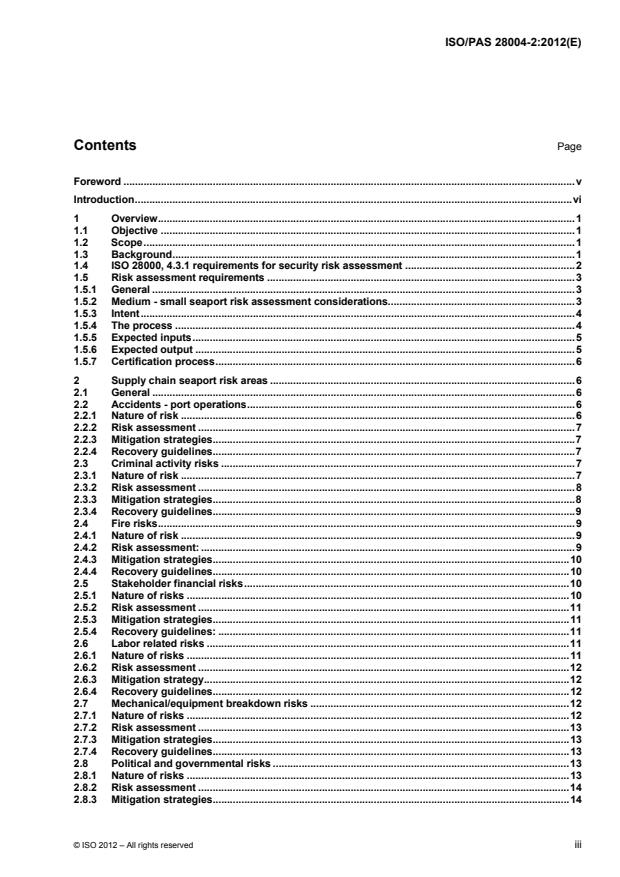
Contents Page
Foreword . v
Introduction . vi
1 Overview . 1
1.1 Objective . 1
1.2 Scope . 1
1.3 Background . 1
1.4 ISO 28000, 4.3.1 requirements for security risk assessment . 2
1.5 Risk assessment requirements . 3
1.5.1 General . 3
1.5.2 Medium - small seaport risk assessment considerations. 3
1.5.3 Intent . 4
1.5.4 The process . 4
1.5.5 Expected inputs . 5
1.5.6 Expected output . 5
1.5.7 Certification process . 6
2 Supply chain seaport risk areas . 6
2.1 General . 6
2.2 Accidents - port operations . 6
2.2.1 Nature of risk . 6
2.2.2 Risk assessment . 7
2.2.3 Mitigation strategies . 7
2.2.4 Recovery guidelines . 7
2.3 Criminal activity risks . 7
2.3.1 Nature of risk . 7
2.3.2 Risk assessment . 8
2.3.3 Mitigation strategies . 8
2.3.4 Recovery guidelines . 9
2.4 Fire risks . 9
2.4.1 Nature of risk . 9
2.4.2 Risk assessment: . 9
2.4.3 Mitigation strategies . 10
2.4.4 Recovery guidelines . 10
2.5 Stakeholder financial risks . 10
2.5.1 Nature of risks . 10
2.5.2 Risk assessment . 11
2.5.3 Mitigation strategies . 11
2.5.4 Recovery guidelines: . 11
2.6 Labor related risks . 11
2.6.1 Nature of risks . 11
2.6.2 Risk assessment . 12
2.6.3 Mitigation strategy . 12
2.6.4 Recovery guidelines . 12
2.7 Mechanical/equipment breakdown risks . 12
2.7.1 Nature of risks . 12
2.7.2 Risk assessment . 13
2.7.3 Mitigation strategies . 13
2.7.4 Recovery guidelines . 13
2.8 Political and governmental risks . 13
2.8.1 Nature of risks . 13
2.8.2 Risk assessment . 14
2.8.3 Mitigation strategies . 14
2.8.4 Recovery guidelines .14
2.9 Terrorist risks .15
2.9.1 Nature of risks .15
2.9.2 Risk assessment .15
2.9.3 Mitigation strategy .15
2.9.4 Recovery guidelines .16
2.10 Weather related risks .16
2.10.1 Nature of risks .16
2.10.2 Risk assessment .17
2.10.3 Mitigation strategies .17
2.10.4 Recovery guidelines .17
3 Seaport security plan evaluation criteria and rating process .18
3.1 General .18
3.2 Security plan evaluation process and procedures .18
3.3 Evaluation criteria for assessing conformance .18
3.4 Use of ISO 20858 security evaluation and assessment procedures .19
3.5 Security plan assessment rating system .20
iv © ISO 2012 – All rights reserved
Foreword
ISO (the International Organization for Standardization) is a worldwide federation of national standards bodies
(ISO member bodies). The work of preparing International Standards is normally carried out through ISO
technical committees. Each member body interested in a subject for which a technical committee has been
established has the right to be represented on that committee. International organizations, governmental and
non-governmental, in liaison with ISO, also take part in the work. ISO collaborates closely with the
International Electrotechnical Commission (IEC) on all matters of electrotechnical standardization.
International Standards are drafted in accordance with the rules given in the ISO/IEC Directives, Part 2.
The main task of technical committees is to prepare International Standards. Draft International Standards
adopted by the technical committees are circulated to the member bodies for voting. Publication as an
International Standard requires approval by at least 75 % of the member bodies casting a vote.
In other circumstances, particularly when there is an urgent market requirement for such documents, a
technical committee may decide to publish other types of document:
an ISO Publicly Available Specification (ISO/PAS) represents an agreement between technical experts in
an ISO working group and is accepted for publication if it is approved by more than 50 % of the members
of the parent committee casting a vote;
an ISO Technical Specification (ISO/TS) represents an agreement between the members of a technical
committee and is accepted for publication if it is approved by 2/3 of the members of the committee casting
a vote.
An ISO/PAS or ISO/TS is reviewed after three years in order to decide whether it will be confirmed for a
further three years, revised to become an International Standard, or withdrawn. If the ISO/PAS or ISO/TS is
confirmed, it is reviewed again after a further three years, at which time it must either be transformed into an
International Standard or be withdrawn.
Attention is drawn to the possibility that some of the elements of this document may be the subject of patent
rights. ISO shall not be held responsible for identifying any or all such patent rights.
ISO/PAS 28004-2 was prepared by Technical Committee ISO/TC 8, Ships and marine technology.
ISO/PAS 28004 consists of the following parts, under the general title Security management systems for the
supply chain ― Guidelines for the implementation of ISO 28000:
Part 2: Guidelines for adopting ISO 28000 for use in medium and small seaport operations
Part 3: Additional specific guidance for adopting ISO 28000 for use by medium and small businesses
(other than marine ports)
Part 4: Additional specific guidance on implementing ISO 28000 if compliance with ISO 28001 is a
management objective
Introduction
“ISO 28000:2007, Specification for security management systems for the supply chain”, and the
guidance contained in ISO 28004, have been developed in response to the need for a recognizable supply
chain management system evaluation criteria (validation process) against which their security management
systems can be assessed and certified for determining conformance with ISO 28000 and ISO 28004. The
guidance currently contained in ISO 28004 is designed to assist organizations adopting ISO 28000. Because
the types of organizations that can use ISO 28000 are vast, the guidance provided in ISO 28004 is general in
nature. As a result, some smaller organizations have had difficulty in defining the scope of measures needed
to address each of the requirements established in ISO 28000. Therefore, the purpose of this part of
ISO/PAS 28004 is to provide guidance and amplifying information that can be used by Medium and Small
seaports to assist them in defining the scope of validation and verification measures needed to comply with
the security provisions specified in ISO 28000 and ISO 28004.
ISO 28000 requires that stakeholder organizations evaluate the capabilities of their security protection
management plans and procedures through periodic reviews, testing, post-incident reports, and training
exercises to measure the effectiveness of their installed security protection systems and methods. It is critical
to the overall continued end-to-end safety of the supply chain that stakeholder organizations ensure the
transportation industry that they have sufficient safeguards in place to protect the integrity of the supply chain
while those goods are under their direct control. The failure by one of the stakeholder organizations to protect
the supply chain from any one of the global threats and operational risks can severely impact the integrity of
the system and erode the confidence of those who depend on the secure transportation of their valuable
goods.
The Medium and Small seaport stakeholder organizations are an integral part of the supply transportation
system and will be required to conduct these performance capabilities reviews and verify to the transportation
industry that they are in conformance with relevant legislation and regulations, industry best practices and
conformance with its own security policy and objectives based on the identified threats and risks to their
operations. The information contained in this part of ISO/PAS 28004 provides guidance and criteria for
evaluating the quality of the seaport security management plans developed in accordance with ISO 28000 to
protect the integrity of the supply chain. The amplifying information is designed to enhance, but not alter, the
general guidance currently specified in ISO 28004. No alterations to ISO 28004, other than the addition of
supplements, will be undertaken.
Relationship with ISO Relevant Technical Standards
There are several established and pending related ISO technical standards that when coupled with this part of
ISO/PAS 28004, provide additional guidance and instructions for the seaport operators for establishing their
security management plans and evaluating the capability of those plans to protect the integrity of the supply
chain cargo while under their direct control. These standards, ISO 20858, ISO 28001, ISO 28002, ISO 28003,
including ISO 28004 are referenced in thispart of ISO/PAS 28004 and in order to provide specific guidance
steps to Operators. The relevance of these standards to ISO 28000 is presented in the following Table.
vi © ISO 2012 – All rights reserved
ISO Technical Technical Description
Standard
ISO 28004-1 Provides guidance to certifying bodies on
assessing conformance of an organization with
the requirements of ISO 28000
ISO 20858 Provides a professional interpretation of the IMO
ISPS for port facility security and guidance for
evaluating the Port security management plans
and installed operational procedures.
ISO 28001 Provides security requirements addresses the
core security requirements of the World Customs
Organization (WCO) Authorized Economic
Operator Program
ISO 28002 Provides guidance on establishing a policy to
enhance the resilience of an organization’s supply
chain
ISO 28003 Provides guidance to certifying bodies on
assessing conformance of an organization with
the requirements of ISO 28000
Disclaimer
This part of ISO/PAS 28004 does not purport to include all necessary provisions of a contract between supply
chain operators, suppliers and stakeholders. Users are responsible for its correct application. Conformance
with this part of ISO/PAS 28004 does not of itself confer immunity from legal obligations.
PUBLICLY AVAILABLE SPECIFICATION ISO/PAS 28004-2:2012(E)
Security management systems for the supply chain —
Guidelines for the implementation of ISO 28000 —
Part 2:
Guidelines for adopting ISO 28000 for use in medium and small
seaport operations
1 Overview
1.1 Objective
The objective of this part of ISO/PAS 28004 is to provide guidance to medium and small ports that wish to
adopt ISO 28000. This guidance provides a self-evaluation criterion that could be used by these ports as they
rd
implement ISO 28000. While the self-certification criteria will not result in a 3 party certification, it can be
used to determine the capability of the seaport stakeholders’ security management plans for safeguarding the
integrity of supply chain in accordance with the security provisions and guidelines specified in ISO 28000 and
ISO 28004. The goal is to develop a risk assessment evaluation rating scale metric that can be used to
evaluate the capability of the port security management plans to provide uninterrupted security protection and
continuous operations for the supply chain cargo being received, stored, and transferred by the seaport. The
use of these self-evaluation criteria will enable the user to determine if the seaport has addressed each
requirement of ISO 28000 in adequate detail.
1.2 Scope
This part of ISO/PAS 28004 will identify supply chain risk and threat scenarios, procedures for conducting
risks/threat assessments, and evaluation criteria for measuring conformance and effectiveness of the
documented security plans in accordance with ISO 28000/28004 implementation guidelines. An output of this
effort will be a level of confidence rating system based on the quality of the security management plans and
procedures implemented by the seaport to safeguard the security and ensure continuity of operations of the
supply chain cargo being processed by the seaport. The rating system will be used as a means of identifying a
measurable level of confidence (on a scale of 1 to 5) that the seaport security operations are in conformance
with ISO 28000 for protecting the integrity of the supply chain.
1.3 Background
The International Ship and Port Facility Security (ISPS) Code requires that each maritime port facility develop
a comprehensive port facility security plan that includes the cargo under their direct control. The port security
plan should address those applications, security systems and operations measures designed to protect the
personnel, port facilities, ships at berth, cargo, and cargo transport units, including rail and ground within the
port facility physical boundaries from the risks of a security incident (ISO 20858 provides clear guidance on
meeting these requirements). The ISO 28000/28004 Standard has established guidelines for protecting the
Global Supply Chain at a very high level, but does not provide enough specific detail that would allow a
consistent level of implementation to cover all of the security provisions and applications for large, medium
and smaller seaports that are integral parts of the global supply chain security infrastructure. To ensure long
term and consistent security of the supply chain, there is a need for each of the stakeholders in this integrated
global network to be measured and held accountable for contributing to the safety and uninterrupted delivery
of goods.
The Medium and Small seaports are an integral part of the supply chain delivery infrastructure especially
considering that these ports are typically the first entry points for a majority of the goods being shipped and
distributed to local and international destinations. These smaller ports are the feeder ports for goods being
shipped to the larger mega ports for consolidating cargo for distribution to long haul shipment to other mega
ports and global destinations. Therefore, it is critical that these Medium and Small sized seaports implement
and maintain proven security provisions that can ensure the protection and continued safe passage of goods
being shipped through their port facilities.
While ISO 28000/28004 provides general overviews of the expected requirements to secure the Supply
Chain, there are limited instructions, measurable requirements and acceptance criteria that would allow an
entity to create and implement a security management plan that would ensure that the established standards
in ISO 28000 were met. Therefore, this part of ISO/PAS 28004 is designed to provide the methods,
procedures, guidelines and acceptance criteria that will be used for measuring the level of conformance with
ISO 28004 security provisions.
1.4 ISO 28000, 4.3.1 requirements for security risk assessment
In accordance with the ISPS Code requirement and the security risk assessment requirements specified in
4.3.1 of ISO 28000, the seaport stakeholders and governing organization shall establish and maintain
procedures for the ongoing identification and assessment of security threats, security management-related
threats and risks, and the identification and implementation of the necessary management control measures
to safeguard the supply chain. The security threats and risk identification, assessment and control methods
should, as a minimum, be appropriate to the nature and scale of the seaport operations. This assessment
shall consider the likelihood of an event and all of its consequences to the seaport stakeholders, threats to
continuity of operations, supply chain security, and disaster recovery. Specifically, the risk assessment should
address at a minimum, the following:
a) Operational threats and risks, including the control of the security, human factors and other activities,
which affect the organizations performance, condition or safety.
b) Natural environmental events (storms, floods, high winds, etc.), which may render security measures and
equipment ineffective.
c) Factors outside of the organization’s control, such as failures in externally supplied equipment and
services, changes in local and international security policies and regulations, and political changes
affecting seaport ownership and operations.
d) Stakeholder threats and risks such as failure to meet regulatory requirements, financial constraints, or
ownership changes that affect port operations and supply chain security.
e) Design, installation, validation and maintenance of security equipment including installation of new
systems and training of staff to operate, repair and maintain.
f) Failure of critical information, data management and communication systems used to manage and
safeguard the supply chain.
The seaport stakeholder organizations responsible for providing security protection for supply chain goods
shall ensure that the results of these assessments and the appropriate security controls are in place to
safeguard the integrity of the supply chain. The seaport Security Management Plan must provide provisions
and procedures for addressing the security system objectives, operational requirements, risk assessment and
mitigation, continuity of operations and disaster recovery steps. Specifically, the plan should address the
following:
a) The determination of requirements for the design, specification, installation, certification and operation of
security devices and systems;
b) Identification of security staffing resources, skill levels, and training needed to operate and maintain
security devices and systems (ISO 28000, 4.4.2);
2 © ISO 2012 – All rights reserved
c) Identification of the organization’s overall threat and risk assessment and management framework to
mitigate identified risks.
d) Continuity of operation provisions and disaster recovery steps that will be implemented to restore security
systems for protecting the supply chain and restore the seaport to full operational status.
The organization shall document and keep the above information up to date and have personnel trained in the
understanding and application of the security and operational plans and procedures specified in the plan. The
organization’s methodology for threat and risk identification, assessment and mitigation shall at a minimum do
the following:
a) Be clearly defined with respect to its scope, stakeholder roles and responsibilities, expected nature and
timing of risks and threats to ensure it is proactive rather than reactive.
b) Identify and the monitor the collection of information sources to document existing and determine future
supply chain related security threats and risks.
c) Provide for the classification of threats and risks and the identification of mitigation steps for those that
must be either avoided, eliminated or controlled.
d) Provide for the monitoring of actions to ensure effectiveness and the timeliness of their implementation
(ISO 28000/4.5.1) to ensure uninterrupted protection of the supply chain.
This should be a planned part of the continuous improvement procedures for keeping the seaport personnel
and systems current with identified threats, risks and operational security needs required to safeguard the
supply chain.
The security threat identification, risk assessment and risk management processes and their outputs should
be the basis for developing and implementing a comprehensive supply chain security system. It is important
that the links between the security threat identification, risk assessment and risk management processes and
the other elements of the security management system are clearly established, continually monitored and
updated to reflect any changes in the threats and risks assessments to port operations for safeguarding the
supply chain.
1.5 Risk assessment requirements
1.5.1 General
Security threat identification, risk assessment and risk mitigation processes are key tools in the management,
control and elimination of risks to the security and continuous operation of the supply chain. The seaport
security management plan must address each of these areas and provide specific roles and responsibilities
for each stakeholder involved in safeguarding the supply chain.
1.5.2 Medium - small seaport risk assessment considerations
The goal of the document is to create a process for assessing the risk to the Supply Chain and what steps are
in place to minimize and prevent major disruptions to the supply chain cargo being transported through the
mid and small sized seaports. These seaports are usually the initial entry point for a large segment of the
goods being shipped to the larger and mega international seaports. Cargo entering the ports from upstream
locations via rail, truck and transport vessels that either transfer or collect cargo stored at the port locations.
Therefore the goal is to determine and assess the ability of the port operations to safeguard the cargo and
maintain the expected delivery pace of the products as goods past through the seaport.
The inbound collection, processing, storage, loading/unloading of cargo and final outbound shipping
requirements and port operations plan and security plans that is designed to have a functional Continuity of
Operations Plan (COOP) designed around the identified and perceived risks associated with the amount, flow
and type of cargo being handled by the port. For each identified risk and/or threat to the flow of goods through
the port must have a plan in place to either avoid, prevent or minimize the impact of the risks with work a
rounds and formal disaster recover plans to provide COOP for the port and the flow of goods. These plans
that are developed and maintained by the port operations and associated stakeholders will be evaluated and
assigned a certification/level of confidence number that can be used to measure the level of conformance with
the ISO 2800/28004 guidelines for protection of the supply chain.
The major output of the document will be a set of guidelines to assess the conformance of the seaport security
management plans with the ISO 28004 Standards. The guidelines will cover the identification of risks and
threats to the seaport operations and the documented procedures and practices implemented by the seaport
stakeholders to prevent, detect, respond and restore the port to normal operational status to safeguard and
ensure the continuity of operations for the supply chain.
1.5.3 Intent
The intent is to create and document a set of procedures for measuring the capability of the Medium and
Small sized seaports to comply with the supply chain security requirements specified in ISO 28000 and
ISO 28004 for the identified threats and risks to their seaport operations. Security threat identification, risk
assessment and risk management processes are key tools in the management and reduction of security risks
to supply chain operations. Security threats and risks can vary greatly across the supply chain infrastructure
from minor incidents to full-scale breaches in cargo security. The goal is to (a), identify and characterize those
threats and risks that are specific to the smaller seaports; determine the possible impacts to port security
operations; (b), evaluate the seaport mitigation processes and prevention steps developed in response to
those threats/risks; (c), and then assess the capability of the seaport to maintain the integrity of the supply
chain for goods being transported through its facilities. The seaport security management plan will then be
evaluated to determine the capability of the seaport to protect the supply chain against the identified threats
and risks to their operations.
1.5.4 The process
Security threat identification, risk assessment and risk management processes are key tools in the
management of risk. Security threat identification, risk assessment and risk management processes vary
greatly across industries, ranging from simple assessments to complex quantitative analyses with extensive
documentation. Therefore, the seaport Stakeholder organizations and agencies must maintain a
comprehensive security management plan that addresses those threats and risks to their operations.
The seaport stakeholder organizations and agencies responsible for supply chain security, as well as port
operations, are required to create and maintain a security management plan that identifies all credible threats
and risks to port and security operations and creates mitigation strategies and recovery procedures for
safeguarding the integrity of the supply chain. Each seaport operation will be evaluated on quality and
capability of their implemented security plan to fully protect the supply chain against the identified threats and
risks that it either controls or has influence over. The performance indicators that would be used to measure
the capability of the seaport security protection provisions will include at a minimum the following to determine
if:
The ISO security policy and security objectives are being achieved.
All Identified threats and risks to supply chain security are being controlled and/or mitigated, as
appropriate and countermeasures have been implemented and are effective.
Security personnel are knowledgeable and trained in the security protection, detection, mitigation and
recovery procedures needed to safeguard the supply chain.
Incident recovery and continuity of operations plans (COOP) are well established with adequate
provisions for quickly restoring port security equipment and systems designed to protect the supply
chain.
Continuous improvement processes are in place to learn from any security management system
failures, including security incidents and near misses.
4 © ISO 2012 – All rights reserved
Regularity scheduled security training and exercises are being conducted to ensure that stakeholder
personnel are current and aware of their assigned roles and responsibilities for protecting and
responding to security incidents.
Performance measures for the management of threats and risks to the supply chain will consider the
probability of occurrence, vulnerability of the security systems, expected impact to port security operations and
recovery steps to ensure continuity of security protection. The performance assessment measures will reflect
the capability of the plan for eliminating or reducing to a practicable minimum security risk, either by reducing
the likelihood of occurrence or the potential severity of impacts from security related incidents.
1.5.5 Expected inputs
For the medium to small seaport operations, there are at least nine universal risk and threat category areas
that have the potential for major disruptions to the supply chain for cargo being transferred in, processed,
stored and transferred out by the seaport stakeholder organizations responsible for safeguarding the integrity
of the cargo while in port. These categories include the following:
Accidents that occur in the port facilities involving staff, equipment, cargo and fluid spills.
Criminal Activities such as theft, vandalism, and contra band smuggling.
Fire to building facilities, equipment, on board vessels and surrounding port areas.
Financial issues with port operations and transportation stakeholders.
Labor unrest including labor strikes, staff shortages and skills trainings
Mechanical/Equipment breakdowns that put major support items (Cranes, communications
equipment, cargo movement loaders) out of commission for extended periods of time.
Political unrest that includes government restrictions, new policies and regulations that impact port
operations.
Terrorist activities that physically attack/damage port operations and/or disrupt the flow of cargo due
to the discovery of contraband that forces the port to close until contraband can be removed and the
port cleared for resume normal operations.
Weather related issues such as natural environmental events (severe storms, wind, heat, cold, ice,
snow and floods) that can disrupt operations and render security measures and equipment ineffective
for several hours to several days/weeks.
Each of these nine areas represents a level of risk to continuous operations at the seaport that can affect the
security of the supply chain. Once the input parameters that describe the nature and level of risk to seaport
operations for each of these threat and risk areas are identified, then these inputs become the basis for
developing prevention and mitigations strategies to minimize their occurrence and formulate recovery plans
when they do occur. For each of the identified areas, a risk assessment, mitigation strategies, and disaster
recovery guidelines are discussed in the following clauses.
1.5.6 Expected output
The purpose of this guideline is to establish principles by which the organization can determine whether or not
given security threat identification, risk assessment and risk management processes are suitable and
sufficient to safeguard the integrity of the supply chain. The certification process will allow seaport operators
and supply chain stakeholders to assess the probability that their goods and operations will be secured and
processed in a timely matter in accordance with the required security protection policies and procedures and
delivery schedules agreed to by the transportation stakeholders and their end user recipient customers. The
seaport security management plan documenting the implemented security provisions will be evaluated and
assigned of a level of confidence number indicating the assessed quality and capability of the management
plan to safeguard the integrity of the supply chain.
1.5.7 Certification process
To ensure consistency and completion of a creditable evaluation process, the certification process should be
conducted by a qualified independent organization. The process itself will be comprised of a list of evaluation
points and criteria covering the supply chain security threats and risk areas identified in the seaport security
management plan. The goal is to have fully trained personnel and/or experienced independent organizations
with the required technical expertise, to assess and evaluate the established security plans. ISO 20858
provides specific guidance for specifying the competence and technical expertise required of personnel to
conduct a marine port facility security assessment in accordance with ISO 28000 requirements. In addition,
ISO 20858 provides specific documentation guidance and requirements for assessing and recording the
quality of the port security management plans. Evaluation and certification by an independent qualified third
party is envisioned to do the following:
Validate to the user community that the seaport meets the intended objectives and standards
specified in ISO 28000 and ISO 28004 for safeguarding the integrity of the supply chain.
Establishment of a repeatable process that can be used as a standardized basis for measuring and
comparing seaport security plans to an industry standard.
The evaluation will be based on their ability to meet the certification criteria in accordance with the identified
risks; mitigation procedures; and, recovery plans associated with the level of seaport operations, traffic flow,
cargo type, geographical location, and stakeholder security systems and operational structure for securing the
supply chain. An outcome of the evaluation process will be the assignment of assessment quality number that
identifies to what level of confidence (1 to 5, with 5 being the highest) that the seaport security management
plan will be able to safeguard the supply against the identified risks and threats to seaport operations.
2 Supply chain seaport risk areas
2.1 General
The nine maritime seaport risk areas are discussed in the following paragraphs, including the identification of
the types of related risk issues, their risk assessment considerations, mitigation steps to minimize the risks,
and recovery guidelines to restoring security protections systems and port operations to their normal operating
status. Depending on the operational tempo, stakeholder organizational structure, flow of goods through the
seaport, geographical location, government and political considerations, each seaport will have varying levels
of threats and risks to their seaport operations in providing security and uninterrupted transportation services
to the supply chain. Those that apply for each seaport should be addressed in their security management plan
and updated if new threats, risks and/or changes in the operational status of the seaport.
2.2 Accidents - port operations
2.2.1 Nature of risk
Accidents can be purely random in nature and/or can be categorized as accidents waiting to happen that
could have been prevented with better management oversight, staff training and operational procedures. The
security of the supply chain will rely on the constant surveillance and protection of cargo while in port by
security personnel and security protection systems and equipment. Any accident that disrupts the oversight
and protection of the cargo must be addressed with specific plans in place to minimize occurrences, prevent
were possible, and execute recovery steps to restore the security coverage to the supply chain. The heavy
machinery, loading cranes, cargo movement vehicles, rail and truck off loading devices all pose safety issues
for seaport personnel operating those systems and overseeing the security of the supply chain cargo while in
port. Industrial accidents involving personnel, equipment, cargo and/or fluid/chemical spills have the potential
of comprising the integrity of the supply chain if security provisions and seaport operations are disrupted for
any sufficient amount of time.
6 © ISO 2012 – All rights reserved
2.2.2 Risk assessment
The probability of occurrence and severity of the identified risks to operations will need to be assessed.
Depending on the nature of the accident, the probability of occurrence and expected impact on security and
continuity of operations will need to be determined. The assessment should address the specific impacts to
security (lost of key, monitoring and protection
...
Questions, Comments and Discussion
Ask us and Technical Secretary will try to provide an answer. You can facilitate discussion about the standard in here.
Loading comments...