

ISO 14621-1:2019
(Main)Space systems — Electrical, electronic and electromechanical (EEE) parts — Part 1: Parts management
General Information
- Abstract
This document addresses the key elements for an EEE parts management programme for space systems and is written in general terms as a baseline for developing, implementing, validating, and evaluating a space parts management programme. The family of EEE parts includes electro-optical parts.
- Status
- Published
- Publication Date
- 27-May-2019
- Technical Committee
- ISO/TC 20/SC 14 - Space systems and operations
- Drafting Committee
- ISO/TC 20/SC 14/WG 5 - Space System Program Management and Quality
- Current Stage
- 9092 - International Standard to be revised
- Start Date
- 25-Feb-2025
- Completion Date
- 29-Aug-2026
Buy Documents




ISO 14621-1:2019 - Space systems -- Electrical, electronic and electromechanical (EEE) parts


ISO 14621-1:2019 - Space systems — Electrical, electronic and electromechanical (EEE) parts — Part 1: Parts management/28/2019
Overview
ISO 14621-1:2019 - Space systems - Electrical, electronic and electromechanical (EEE) parts - Part 1: Parts management provides a baseline framework for establishing an EEE parts management programme for space systems. Written in general terms, it guides organizations in developing, implementing, validating, and evaluating policies and processes that manage electrical, electronic, electromechanical and electro‑optical parts across the programme life cycle. The standard supports a system‑level approach to risk management, parts selection, and long‑term sustainment.
Key topics
The standard addresses practical EEE parts management elements, including:
- EEE parts management process: design process, design margin, life‑cycle cost considerations, technical support, and systems‑engineering integration.
- Parts selection: guidance and a checklist (Annex B) to select parts appropriate to mission requirements and environments.
- Obsolescence management: early assessment of part availability risk and mitigation strategies to minimize programme disruption (DMSMS).
- Supplier management: requirements for vendor verification, management processes, information control and internal controls; includes a supplier/subcontractor checklist (Annex C).
- Technology insertion strategy: planning for new and emerging technologies to reduce obsolescence and manage risk across concept, production, and field support phases.
- Shared data and community alerts: mechanisms for peer‑to‑peer problem sharing and shared databases (Annex D) to improve industry situational awareness.
- Process control & validation: documenting, approving, and validating approaches for controlling EEE parts risks.
- Training and systems engineering: emphasis on integrating parts engineering into all life‑cycle phases and maintaining trained personnel.
- Informative annexes: Radiation effects (Annex A) and practical checklists support implementation.
Applications
ISO 14621-1:2019 is used to:
- Develop or tailor an EEE parts management programme for satellites, launch vehicles, payloads and ground support hardware.
- Inform procurement, risk assessments, and supplier evaluation for space‑flight hardware.
- Guide parts engineers, systems engineers and reliability teams in selecting parts and planning technology insertion.
- Set baseline contractual language for primes, subcontractors and suppliers concerning parts management expectations.
Who should use it
- Spacecraft manufacturers, prime contractors and subsystem suppliers
- Systems, reliability and parts engineers
- Procurement, quality assurance and supply‑chain managers
- Programme managers responsible for life‑cycle cost, sustainment and obsolescence risk
Related standards
- ISO 14621-2 - Part 2: Control Programme Requirements (companion document)
- ISO 17666 - Space systems - Risk management
- ISO/TS 18667 referenced for capability‑based SD&QA tailoring
Keywords: ISO 14621-1:2019, EEE parts management, space systems, parts obsolescence, supplier management, parts selection, technology insertion, electro-optical parts.
Relations
- Effective Date
- 18-Jun-2016
Buy Documents
ISO 14621-1:2019 - Space systems -- Electrical, electronic and electromechanical (EEE) parts
ISO 14621-1:2019 - Space systems — Electrical, electronic and electromechanical (EEE) parts — Part 1: Parts management/28/2019
Get Certified
Connect with accredited certification bodies for this standard

BUREAU VERITAS Certification Germany
Bureau Veritas certification in Germany.

Element Materials Technology
Materials testing and product certification.

AQMS Ltd.
AQMS provides ISO certification to SMEs across the UK.
Sponsored listings
Frequently Asked Questions
ISO 14621-1:2019 is a standard published by the International Organization for Standardization (ISO). Its full title is "Space systems — Electrical, electronic and electromechanical (EEE) parts — Part 1: Parts management". This standard covers: This document addresses the key elements for an EEE parts management programme for space systems and is written in general terms as a baseline for developing, implementing, validating, and evaluating a space parts management programme. The family of EEE parts includes electro-optical parts.
This document addresses the key elements for an EEE parts management programme for space systems and is written in general terms as a baseline for developing, implementing, validating, and evaluating a space parts management programme. The family of EEE parts includes electro-optical parts.
ISO 14621-1:2019 is classified under the following ICS (International Classification for Standards) categories: 49.140 - Space systems and operations. The ICS classification helps identify the subject area and facilitates finding related standards.
ISO 14621-1:2019 has the following relationships with other standards: It is inter standard links to ISO 14621-1:2003. Understanding these relationships helps ensure you are using the most current and applicable version of the standard.
ISO 14621-1:2019 is available in PDF format for immediate download after purchase. The document can be added to your cart and obtained through the secure checkout process. Digital delivery ensures instant access to the complete standard document.
Standards Content (Sample)
INTERNATIONAL ISO
STANDARD 14621-1
Second edition
2019-05
Space systems — Electrical, electronic
and electromechanical (EEE) parts —
Part 1:
Parts management
Systèmes spatiaux — Composants électriques, électroniques et
électromécaniques (EEE) —
Partie 1: Gestion des composants
Reference number
©
ISO 2019
© ISO 2019
All rights reserved. Unless otherwise specified, or required in the context of its implementation, no part of this publication may
be reproduced or utilized otherwise in any form or by any means, electronic or mechanical, including photocopying, or posting
on the internet or an intranet, without prior written permission. Permission can be requested from either ISO at the address
below or ISO’s member body in the country of the requester.
ISO copyright office
CP 401 • Ch. de Blandonnet 8
CH-1214 Vernier, Geneva
Phone: +41 22 749 01 11
Fax: +41 22 749 09 47
Email: copyright@iso.org
Website: www.iso.org
Published in Switzerland
ii © ISO 2019 – All rights reserved
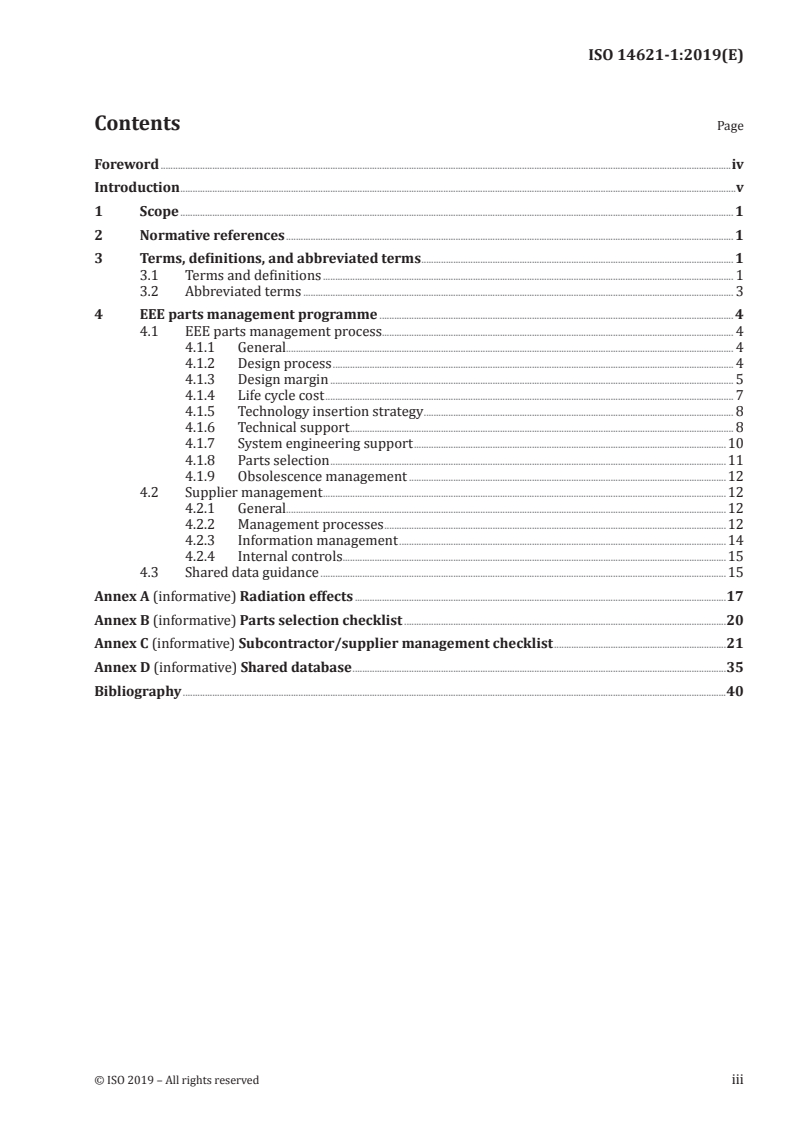
Contents Page
Foreword .iv
Introduction .v
1 Scope . 1
2 Normative references . 1
3 Terms, definitions, and abbreviated terms . 1
3.1 Terms and definitions . 1
3.2 Abbreviated terms . 3
4 EEE parts management programme . 4
4.1 EEE parts management process. 4
4.1.1 General. 4
4.1.2 Design process . 4
4.1.3 Design margin . 5
4.1.4 Life cycle cost . 7
4.1.5 Technology insertion strategy . 8
4.1.6 Technical support . 8
4.1.7 System engineering support .10
4.1.8 Parts selection .11
4.1.9 Obsolescence management .12
4.2 Supplier management .12
4.2.1 General.12
4.2.2 Management processes .12
4.2.3 Information management .14
4.2.4 Internal controls . .15
4.3 Shared data guidance .15
Annex A (informative) Radiation effects .17
Annex B (informative) Parts selection checklist .20
Annex C (informative) Subcontractor/supplier management checklist .21
Annex D (informative) Shared database .35
Bibliography .40
Foreword
ISO (the International Organization for Standardization) is a worldwide federation of national standards
bodies (ISO member bodies). The work of preparing International Standards is normally carried out
through ISO technical committees. Each member body interested in a subject for which a technical
committee has been established has the right to be represented on that committee. International
organizations, governmental and non-governmental, in liaison with ISO, also take part in the work.
ISO collaborates closely with the International Electrotechnical Commission (IEC) on all matters of
electrotechnical standardization.
The procedures used to develop this document and those intended for its further maintenance are
described in the ISO/IEC Directives, Part 1. In particular, the different approval criteria needed for the
different types of ISO documents should be noted. This document was drafted in accordance with the
editorial rules of the ISO/IEC Directives, Part 2 (see www .iso .org/directives).
Attention is drawn to the possibility that some of the elements of this document may be the subject of
patent rights. ISO shall not be held responsible for identifying any or all such patent rights. Details of
any patent rights identified during the development of the document will be in the Introduction and/or
on the ISO list of patent declarations received (see www .iso .org/patents).
Any trade name used in this document is information given for the convenience of users and does not
constitute an endorsement.
For an explanation of the voluntary nature of standards, the meaning of ISO specific terms and
expressions related to conformity assessment, as well as information about ISO's adherence to the
World Trade Organization (WTO) principles in the Technical Barriers to Trade (TBT) see www .iso
.org/iso/foreword .html.
This document was prepared by Technical Committee ISO/TC 20, Aircraft and space vehicles,
Subcommittee SC 14, Space systems and operations.
This edition cancels and replaces the first edition (ISO 14621-1:2003), which has been technically
revised. The main changes compared to the previous edition are as follows:
— Introduction and definitions have been revised,
— consistency has been checked with ISO 14621-2, and
— the document has been aligned with the ISO/IEC Directives Part 2, 2018 edition.
A list of all parts in the ISO 14621 series can be found on the ISO website.
Any feedback or questions on this document should be directed to the user’s national standards body. A
complete listing of these bodies can be found at www .iso .org/members .html.
iv © ISO 2019 – All rights reserved
Introduction
ISO 14621-1 and ISO 14621-2 are designed to jointly assist the user and supplier communities in
developing and executing an effective process for the design, selection and application of electrical,
electronic, and electromechanical (EEE) space parts throughout the life cycle of the programme.
NOTE In both ISO 14621-1 and ISO 14621-2, the family of EEE parts includes electro-optical parts.
The strategy represented in the ISO 14621 series is:
— for ISO 14621-1 a system approach to managing risk throughout the life cycle of the programme, by
developing, selecting and properly applying the right EEE part for its intended application;
— for ISO 14621-2 a framework for developing and documenting an EEE parts control programme
to assure that the parts used in space flight hardware have acceptable risk, i.e. possess adequate
functional, radiation and reliability characteristics to meet the system requirements.
Both ISO 14621-1 and ISO 14621-2 should be tailored to meet the specific needs of each individual
programme, i.e. to address the applicable system performance requirements, risk tolerance, budget,
mission duration, operating environment, and schedule. Tailoring should result in a set of planned
activities that are not only capable of achieving all contractual EEE parts related requirements, but
also commensurate with the space system’s unit-value/mission-criticality and life cycle technical data
product requirements.
NOTE This type of planning is sometimes referred to as capability-based Safety, Dependability, and Quality
Assurance (SD&QA) programme tailoring; and the guidance for performing it is provided in ISO/TS 18667.
ISO 14621-1 and ISO 14621-2 are relevant to all users and customers of space systems, and the suppliers
and vendors that furnish space flight hardware. However, to utilize these documents to their fullest
potential, it is necessary to understand the commercial space business environment which has unique
cost and schedule constraint challenges.
This document discusses the following key elements that support an effective EEE parts management
programme:
— Part obsolescence management — perform early assessment of part availability risk for the entire
space system, develop and implement risk mitigation activities that will prevent or minimize
programme disruption due to part shortages, and ensure long-term supportability throughout the
programme life cycle.
— Supplier management — plan and execute techniques for verifying that the practices and products
of suppliers and vendors comply with:
— contractual requirements;
— their documented internal business practices (also known as command media), which should
be consistent with the commercial consensus on technical best practices.
— Cost management — minimize the costs, including verifying parts suppliers and vendors can provide
the rationale why they set different costs for parts that are functionally identical, e.g. identify the
cost of special processing applied to parts that are designed for a specific space environment or
mission.
— Technology insertion — focus on creating a technology road map, which minimizes risk of
obsolescence and develops a strategy for technology insertion during the entire system life cycle.
— Space parts community alert exchange — have a forum focused on managing peer to peer
communication among space industry participants seeking to reduce or eliminate expenditures of
resources on common problems, by sharing EEE parts related problem information collected during
research, design, development, production, and operational phases of the programme.
— Process control — ensure the user’s and supplier’s approaches for controlling EEE parts risks, and
risks of other critical items and processes, are documented, formally approved, and validated.
— Systems engineering — encourage parts engineering participation in all phases of the product
life cycle.
— Training — provide effectively trained resources on the various processes required to develop,
select, and properly apply the right EEE part for the its intended application, as well as to establish
awareness of the parts management programme throughout all levels of the user and supplier
communities.
Those specific elements or opportunities are presented in descriptive terms and illustrated in graphic
flow charts. There is no intent to provide detailed descriptions of “how to” in this document. It may be
cited as a basic guideline within a statement of work and/or for assessing proposals and contractor
performance. All levels of contractual relationships (acquiring activities, primes, subcontractors and
suppliers) may use this document. It is the responsibility of the user community to establish, define,
and administer those tasks based on the programme goals and objectives and thus provide the “what”
elements envisioned and establish their appropriate criteria for their programme.
Although this document was written with the intent of covering EEE parts, the concept established
is a system approach for developing an EEE parts programme with reference to specific material and
mechanical processes that make up EEE parts.
vi © ISO 2019 – All rights reserved
INTERNATIONAL STANDARD ISO 14621-1:2019(E)
Space systems — Electrical, electronic and
electromechanical (EEE) parts —
Part 1:
Parts management
1 Scope
This document addresses the key elements for an EEE parts management programme for space systems
and is written in general terms as a baseline for developing, implementing, validating, and evaluating a
space parts management programme. The family of EEE parts includes electro-optical parts.
2 Normative references
The following documents are referred to in the text in such a way that some or all of their content
constitutes requirements of this document. For dated references, only the edition cited applies. For
undated references, the latest edition of the referenced document (including any amendments) applies.
ISO 14621-2, Space systems — Electrical, electronic and electromechanical (EEE) parts — Part 2: Control
Programme Requirements
ISO 17666, Space systems — Risk management
3 Terms, definitions, and abbreviated terms
3.1 Terms and definitions
For the purposes of this document, the following terms and definitions apply.
ISO and IEC maintain terminological databases for use in standardization at the following addresses:
— ISO Online browsing platform: available at https: //www .iso .org/obp
— IEC Electropedia: available at http: //www .electropedia .org/
3.1.1
best practice
documented process or product developed by the user community, consisting of suppliers and
customers, teaming for the purpose of establishing industry guidelines
3.1.2
electronic, electrical, or electromechanical part
EEE part
device that performs an electronic, electrical, or electromechanical (EEE) function, including electro-
optical devices, and consists of one or more elements so joined together that they cannot normally be
disassembled without destroying the functionality of the device
3.1.3
integrated product team
IPT
integrated product team consisting of members selected from the appropriate disciplines
EXAMPLE Engineering, manufacturing, quality, suppliers or customers, as appropriate.
3.1.4
manufacturer
company or organization that transfers raw material into a product
3.1.5
performance specification
document that defines what the customer desires as a product, its operational environments and all
required performance characteristics
3.1.6
product specification
document that defines the end item(s) the supplier intends to provide to satisfy all the performance
specification (3.1.5) requirements
3.1.7
reliability engineering
integral part of the system engineering requirements definition and analysis function
Note 1 to entry: The tasks are to conduct cost/benefit trade-offs and to analyse and determine alternative design
and procurement solutions.
3.1.8
systems engineering
interdisciplinary approach governing the total technical and managerial effort required to transform
a set of stakeholder needs, expectations, and constraints into a solution and to support that solution
throughout its life
[SOURCE: ISO/IEC/IEEE 24748-1:2018, 3.57]
3.1.9
technology insertion strategy
decision making process to assess current and future part availability and trends, which leads to a
decision regarding emerging or new technology insertion
Note 1 to entry: This process is used in the concept development phase, but also impacts the production and field
support phases.
3.1.10
validation
confirmation, through the provision of objective evidence, that the requirements for a specific intended
use or application have been fulfilled
[SOURCE: ISO 9000:2015, 3.8.13, modified — Notes 1, 2, and 3 to entry have been deleted.]
3.1.11
vendor
seller of parts, products, or commodities
Note 1 to entry: This term can be interchangeable with manufacturer (3.1.4), depending on the application
3.1.12
verification
confirmation, through the provision of objective evidence, that specified requirements have been
fulfilled
[SOURCE: ISO 9000:2015, 3.8.12, modified — Notes 1, 2, and 3 to entry have been deleted.]
2 © ISO 2019 – All rights reserved
3.2 Abbreviated terms
ARN anticipated reliability number
ASIC application specific integrated circuit
BOM bill of materials
CAM computer-aided manufacturing
Cpk process capability
DEMP discharge electromagnetic pulse
DIC digital integrated circuit
DM design margin
DMSMS diminishing manufacturing sources and material shortages
DoE design of experiments
DPA destructive physical analysis
EEE electronic, electrical and electromechanical
EMC electro-magnetic compatibility
EMP electromagnetic pulse
EPI epitaxial
ESD electrostatic discharge
FMECA failure modes and effects criticality analysis
F I form, fit, function interfaces
FRACAS failure reporting, analysis, and corrective action system
HAST highly accelerated stress test
HEMP high altitude electromagnetic pulse
IPD integrated product design
MPU micro processing unit
NDI non-developmental item
OEM original equipment manufacturer
PEM plastic encapsulated microcircuit
PWB printed wiring board
QML qualified manufacturers list
QPL qualified parts list
RH relative humidity
SEB single event burnout
SEE single event effects
SEGR single event gate rupture
SEL single event latchup
SEU single event upset
SGEMP system-generated electromagnetic pulse
SPC statistical process control
4 EEE parts management programme
4.1 EEE parts management process
4.1.1 General
The EEE parts management process defined in this document is designed to assist in dealing
more proactively with critical parts management issues and to provide guidance for developing
comprehensive strategies to manage EEE parts related performance, cost, and schedule risk via an
integrated product team (IPT) process (Figure 1). The main aspects of the EEE parts management
process are design process, supplier management, and shared data. The design process includes,
but is not limited to, design margins, life cycle cost, technology insertion, technical support, system
engineering support, parts selection, obsolescence management and validation/verification. The
emphasis should be on concurrent rather than sequential consideration of these factors in design.
Space systems users shall systematically select and proactively monitor their parts supplier base, while
information collected from the EEE parts manufacturing and supplier communities shall be organized
in a database and shared with IPT members.
Figure 1 — Parts management IPT overview
4.1.2 Design process
The flow diagram (Figure 2) illustrates the interrelationships of the critical key elements that shall be
addressed concurrently by engineering and supplier management (B) (see 4.2), to achieve the “best
4 © ISO 2019 – All rights reserved
practice” selection of EEE parts and documentation required for the initial design. The results obtained
from this analysis should be made available as shared data (A) (see 4.3). The following paragraphs
describe the principles embodying the ten key elements. Refer to the Introduction.
4.1.3 Design margin
The objective of developing a design margin is to assist integrated product teams with critical analyses
resulting in a robust design and minimized life cycle cost. The availability of computer-based analysis
and simulation tools presents the opportunity to validate in detail those aspects of design prior to
manufacturing/qualification commitment. Creating a design margin analysis based on actual conditions
will provide a comprehensive description of EEE part characteristics with simulation results, thereby
enhancing system performance. The design margin process (Figure 3) describes a minimum set of
design analyses needed to maximize design robustness and identifies control limits and corrective
action procedures. Metrics to validate the process include, but are not limited to, the following:
a) comparisons of actual design margins to established baselines;
b) quality of engineering design changes;
c) qualification test performance (failures);
d) prediction analysis yield;
e) manufacturing/production yields.
Associated elements are parts selection (4.1.8) and technical support (4.1.6).
Key
linked to shared data (see 4.3)
linked to supplier management (see 4.2)
Figure 2 — Systems engineering IPT product
6 © ISO 2019 – All rights reserved
Figure 3 — Design margin process
4.1.4 Life cycle cost
In establishing life cycle cost for EEE parts, the following methods should be employed: identify
technology assessment techniques and the mitigation of parts failure risk and utilize procedures
that minimize programme disruptions due to parts obsolescence, unavailability, and other unwanted
conditions. Life cycle cost analysis should include, as well as define, the EEE parts management
programme’s baseline and support a programmatic risk management methodology to control cost as
well as reduce schedule disruptions throughout the life cycle of the programme (Figure 4).
Standardization techniques are becoming increasingly dependent on the available supplier base and
market trends. A new and innovative process being implemented moves away from part number
standardization to commodity/technology/family standardization. This concept should provide a lower
cost/higher benefit approach as the demand for commercial EEE parts increases.
Factors to be considered include technology maturity, market base, material cost, ease of manufacture,
performance management, logistics costs, standardization, and form, fit, function interfaces (F I).
Initial nonrecurring costs should be de-emphasized and rationalized with long-term cost savings to
provide the best value to the customer.
Through the implementation of technology assessments, strategic supplier relationships, technology
leapfrogging, and creative risk mitigation techniques, programme continuity and integrity can be
maintained, and life cycle costs can be minimized.
Validation of the life cycle cost objectives can be accomplished through the use of the following methods:
a) design-to-cost trade studies documenting parts selected during the design phase including all
elements of cost;
b) periodic programme assessment of life cycle ratings, part technology, and part obsolescence;
c) periodic price trend analyses for “road map” technologies to validate that costs are declining as the
technologies move from introduction and growth to production maturity in the market;
d) associated elements are:
1) technology insertion strategy (4.1.5),
2) parts selection (4.1.8), and
3) obsolescence management (4.1.9).
4.1.5 Technology insertion strategy
The objective of the technology insertion strategy is to create a technology road map, which minimizes
the risk of obsolescence and develops a strategy for technology insertion during the entire life cycle
(Figure 5). The commercial industry is driving new technology development of EEE parts. The market
dynamics of the industry (availability, functionality, performance, characteristics, and packaging) affect
the way parts are used in the design. Technology road maps subdivide technologies into functions,
which provide the required visibility to resolve future obsolescence and standardization issues. Use of
technology road maps is the key element of the parts selection process. Technology road maps shall be
assessed over the life cycle of the programme to validate their effectiveness.
Associated elements are:
a) design margin (4.1.3),
b) life cycle costs (4.1.4),
c) parts selection (4.1.8), and
d) obsolescence management (4.1.9).
4.1.6 Technical support
Technical support is an all-encompassing activity established to provide a method of obtaining data
to facilitate reliability analysis, monitor applications, identify risk issues, and suggest mitigation
paths associated with the selected parts (Figure 6). Technical support requires a total commitment
by all disciplines and levels of management to ensure success. Specifically, the user shall define
his/her reliability requirements. The responsibility for reliability engineering activities shall be
established early in the programme in order to minimize the cost of unscheduled redesign, rework, or
remanufacture, as well as potential safety problems. Accomplishment of the performance objectives
will be enhanced through the application of user and field reliability information from shared data. The
shared data and supplier management information should be used in support of the IPT for evaluating
sourcing, performance, packaging, and availability. Associated elements of reliability models are
a) design margin (4.1.3),
b) parts selection (4.1.8), and
c) shared data (4.3).
8 © ISO 2019 – All rights reserved
Figure 4 — Life cycle cost process
Figure 5 — Technology insertion strategy (road map)
4.1.7 System engineering support
The major engineering disciplines involved in evaluating reliability processes are shown in Table 1.
Reliability engineering is just one of the many disciplines required to assess programme development
and implementation. Reliability concepts should be developed early in the programme in order to ensure
adequate verification techniques are defined. Qualification and verification testing are an integral part
of determining system performance characteristics. Failure analysis is a proactive tool for updating
reliability models and ensuring system lifetime performance. Reliability growth and pre-qualification
testing provide opportunities to reveal design and process deficiencies when they are the least costly to
fix or repair or to change the product. Verification testing is equally important in achieving programme
reliability goals as well as production processes. Materials and vendors are constantly changing;
therefore, the understanding of specific failure modes, fault tree analyses and field performance data
should provide a means to identify and correct most reliability problems. During design evaluation,
parts manufacturers should identify the use of simulation data [application specific integrated circuits
(ASIC’s)], interface data, mechanical/thermal robustness, and radiation sensitivity.
10 © ISO 2019 – All rights reserved
Figure 6 — Technical support
Table 1 — System engineering support functions
Major engineering disciplines
Ther-
Quality as-
Critical processes Config- mal, Test
System surance/ Compo- Manu- Process Log-
uration De- struc- engi- Safe-
engineer- reliability nent engi- factur- engi- isti-
manage- signer tural, neer- ty
ing engineer- neering ing neering cians
ment materi- ing
ing
als
Requirements identifica-
tion and analysis
System X X X
Subsystem/con- X X X X X X X X
figuration items
Design
Allocation X X X X
Prediction X X X X X
Failure analysis X X X X X X X X
Parameter design X X X X
analysis
Fault tree analysis X X X X X X X X
Design reviews X X X X X X X X X X X
Part derating X X X X X X
Process variability X X X X X X
Risk assessments X X X X X X X X X X
Verification
Test X X X X X X X X X
Inspection X X X X X X X X
Field data X X X X X X X
4.1.8 Parts selection
In selecting parts, the objective is to evaluate inputs from all key elements and then select the parts
that satisfy the product specification (Figure 7). The selection process is based on determining and
assessing the key characteristics of the parts that are under consideration. The process uses existing
industry and supplier databases, as established and, where necessary, performs characterization
testing.
Parts selected should be assessed for producibility and compatibility with the technology road map.
The selection should be made after assessing testability, reliability, radiation tolerance (see Annex A),
availability, cost and performance, as appropriate.
Validation of the selection objectives can be accomplished through the use of a checklist (see Annex B)
which ensures completeness of the selection data and results in a best practice product.
4.1.9 Obsolescence management
The primary discipline of obsolescence management is composed of all of the key elements that
comprise life cycle cost as shown in Figure 4.
Figure 7 — Parts selection process
4.2 Supplier management
4.2.1 General
Supplier management consists of a supplier selection and monitoring process in which a proactive
approach is used to determine the capability and performance of a supplier on a continuing basis
(Figure 8). The attributes of this process are described in 4.2.2, 4.2.3 and 4.2.4. This approach with
the suppliers will enable a partnership in the form of IPT's whereby each member will achieve his/her
respective business objectives.
4.2.2 Management processes
The objective is to ensure the supplier has documented management practices, which, as a minimum,
shall address the following elements.
a) Communications
The supplier shall have a process that facilitates the exchange of information on technical
requirements, change notices, contractual issues, and product performance throughout the
supply chain.
b) Cost management
The supplier shall have a cost management process that addresses financial resources, life cycle
costs, and recurring and nonrecurring costs. The management process should have a cost reduction
activity (i.e. a co-ordinated procurement leveraging).
c) Delivery performance
The supplier shall have a process which demonstrates the ability to manage his/her delivery
schedules based on history, current and projected resources, capacity and capability.
12 © ISO 2019 – All rights reserved
d) Risk management
The supplier shall have a risk management process, in accordance with ISO 17666, that includes, at a
minimum, the ability to identify, assess, mitigate, and track risks related to EEE parts at the mission/
system level through the lowest EEE parts level, as applicable. The supplier’s risk management
process shall be capable of describing the risk in terms of the standard IF-THAN statement,
identifying the root causes, and planning and tracking the mitigation/corrective action steps.
Examples of EEE parts risk are obsolescence, health and safety, diminishing sources, process
changes, and facility moves.
e) Subcontract management
The supplier shall maintain a process for the development, selection, and ongoing evaluation of
subcontract suppliers, consistent with the practices described herein. The selection methodology
should be based on evaluation of the subcontract supplier application of this document. The
evaluation should assess the subcontract capability to deliver on time, within cost, and in
accordance with the specified requirements.
f) Technical requirements management
The supplier shall maintain a process for the management of technical requirements. Examples
of technical requirements are part design, modelling, design controls, design rules, packaging
requirements and life cycle considerations.
g) Product assurance
The supplier shall have a documented parts management plan, to ensure that all parts related
requirements are achieved and verifiable throughout the programme life cycle. The product
assurance process should monitor progress and provide quality history and quality metrics
information.
Independent or self-assessments of the supplier’s parts management programme (see Figure 8) shall be
performed periodically throughout the programme life cycle. The type and frequency of assessments
shall be determined by the assessment results.
Recommended quality assurance steps include process verification and validation (as defined in 3.1.10
and 3.1.12), of the supplier’s quality management control system. Qualification or registration to a
recognized quality management standard, such as ISO 9001 or qualified manufacturers list (QML) or an
equivalent management system standard, should be considered as indicative of an acceptable quality
system. If deemed necessary, monitoring of suppliers can be accomplished through on-site evaluations
utilizing checklists or other appropriate monitoring systems. A checklist for this activity is provided in
Annex C.
Key
linked to shared data (see 4.3)
linked to supplier management (see 4.2)
Figure 8 — Supplier management
4.2.3 Information management
This process shall provide technical information for distribution to the industry and government
(Figure 8). Refer to 4.3. The supplier should have an information management process for distributing
and reporting technical and assurance information. The supplier should also provide support for
his/her commodities. Product information should contain such items as electrical and mechanical
characteristics, environmental capabilities, and unique characteristics such as electrostatic discharge
(ESD) susceptibility, radiation hardness (Annex A), reliability and quality data.
This information as a by-product of the design activity is not only shared with the industrial community
but also fed back to the supplier to enhance the design. The supplier should have a system for assembling
and maintaining technical information as well as a process for accessing the shared data (4.3).
14 © ISO 2019 – All rights reserved
4.2.4 Internal controls
The supplier shall have a documented methodology for establishing, maintaining, verifying, and
improving its processes (Figure 8). The application of internal controls and their sub-elements should
be based upon the design and product maturity as it varies within the life cycle.
a) Design process
The supplier shall have a systematic design methodology that is capable of meeting the performance,
reliability, and quality requirements as delineated in Figure 2 (systems engineering IPT). The
components of the methodology may include part design and modelling, design controls and
rules, performance requirements, F I, and new technology, as well as providing for new packaging
considerations, as appropriate.
b) Process controls
The supplier shall have process controls in place in accordance with ISO 14621-2, to ensure
consistency in performance, quality and reliability of the product. Specific process controls will
depend on the type of product. Examples of the process controls include, but are not limited to,
process maturity, change control, schedule control, unique and proprietary processes, documented
procedures, workmanship, equipment calibration, contamination, trained work force, effective
handling, statistical process control, and technology review board.
c) Validation and verification
The supplier shall have a methodology to verify and validate that the product meets the
requirements. These methods may include, but are not limited to, qualification testing, performance
data sheet, screens/components, radiation hardness assurance, technology control, quality
conformance inspection, first article inspection, process monitors, destructive physical analysis
(DPA) and receiving inspection. Special testing (radiation hardness assurance, Annex A) may also
be required.
d) Failure reporting, analysis, and corrective action system (FRACAS)
The supplier shall have a closed-loop FRACAS in place to identify the root cause as well as
implementing the corrective actions and disposition the resolutions, and to track/monitor the
results.
e) Training
The supplier shall have a continuous improvement process in place to provide effectively trained
resources on the various processes required to produce a quality product as well as a method to
verify the integrity of the product.
4.3 Shared data guidance
A key to improvements in the design, development, and operation of space systems is the ability to share
EEE parts information between the various IPTs at the prime contractor, subcontractor, supplier, and
customer/user. The sharing of this information will significantly enhance the ability of a programme
to manage its risks, in terms of technical performance, cost, and schedule impacts associated with the
implementation of this document.
The design and cost benefits of emerging technology and commercial parts can be fully realized only
if the data required for their potential use in all environments is developed, documented, and made
available for other users.
The establishment and utilization of a space industry-wide EEE parts community alert exchange that
focuses on managing peer to peer communication among space industry participants seeking to reduce
or eliminate common expenditures of resources, by sharing EEE parts related problem information
collected during research, design, development, production, and operational phases of the programme
life cycle, will reduce the life cycle cost associated with redundant testing and qualification and lead to
higher levels of EEE parts standardization, reliability, and safety over the life cycle of the programme.
16 © ISO 2019 – All rights reserved
Annex A
(informative)
Radiation effects
A.1 General
This annex provides radiation-hardening guidance to the design process IPT by addressing the concerns
and issues necessary to survive radiation environments (see Figure A.1). Some of these issues include,
but are not limited to, total ionizing dose, dose rate, neutrons, electrons, protons, heavy ions, etc.
A.2 System/analysis/environmental
Radiation effects are application-dependent. The precise level of each type of radiation environmental
effects typically flows down from the system performance specification. The flow-down may involve
some analysis. Definitions of the radiation environmental effects are presented below.
a) Displacement damage
Displacement damage is a semiconductor and material failure mechanism caused by neutron fluence
and/or proton fluence. The neutron fluence is usually a manmade radiation source generated by
nuclear weapons. The proton fluence is a naturally occurring phenomenon that is observed during
solar flares or in orbit through the Van Allen belt.
b) Dose rate
Dose rate is an ionization dose delivered as a function of time such as high-dose rate resulting from
a manmade nuclear event or low-dose rate resulting from a natural ionizing radiation environment.
The major contributors for high-dose rates are gamma rays and x-rays. The major contributors for
low-dose rates are protons and electrons.
c) Electromagnetic pulse (EMP)
EMP is the electromagnetic radiation generated by the interaction of gamma radiation produced by a
nuclear explosion with the atmosphere or conductive material in space. Some of the types of EMP are:
— system-generated electromagnetic pulse (SGEMP),
— discharge electromagnetic pulse (DEMP), and
— high-altitude electromagnetic pulse (HEMP).
d) Single event effects (SEE)
SEE are combinations of single event upset (SEU), single event latch up (SEL), single event burnout
(SEB), and single event gate rupture (SEGR). These effects result from a heavy ion or other charged
particle travelling through an active area of a semi-conducting device depositing sufficient charge
to cause one or more of the effects previously described to occur.
e) Spacecraft charging
Typically, spacecraft charging is a naturally occurring build-up of electrons between two types of
material or physical structure in space that may exhibit ESD.
f) Total dose (also called total ionizing dose)
Total dose is the cumulative ionizing radiation which the part experiences during its mission life.
Examples of contributing sources, from either natural causes or manmade events, are gamma rays,
x-rays, protons, electrons, neutrons, and heavy ions (cosmic rays).
Figure A.1 — Part selection and evaluation process for radiation hardened parts
A.3 Design margin
The design margin process often determines the robustness of the design. Technical support and design
information (e.g. critical design parameters, tolerances, and allocations) aid in this process. Some types
of analysis used to determine a design margin are:
— circuit analysis,
— shielding analysis,
— system analysis,
— part radiation data analysis, and
— SEU analysis.
Examples of design margin validation criteria are:
a) high design margin = acceptable, and
b) low design margin = hardness assurance.
A.4 Parts selection
The following are tools and methods to mitigate the risk of radiation effects. EEE parts and materials
can be selected for radiation hardness in the following ways:
— radiation hardened parts;
— design baselin
...
INTERNATIONAL ISO
STANDARD 14621-1
Second edition
2019-05
Space systems — Electrical, electronic
and electromechanical (EEE) parts —
Part 1:
Parts management
Systèmes spatiaux — Composants électriques, électroniques et
électromécaniques (EEE) —
Partie 1: Gestion des composants
Reference number
©
ISO 2019
© ISO 2019
All rights reserved. Unless otherwise specified, or required in the context of its implementation, no part of this publication may
be reproduced or utilized otherwise in any form or by any means, electronic or mechanical, including photocopying, or posting
on the internet or an intranet, without prior written permission. Permission can be requested from either ISO at the address
below or ISO’s member body in the country of the requester.
ISO copyright office
CP 401 • Ch. de Blandonnet 8
CH-1214 Vernier, Geneva
Phone: +41 22 749 01 11
Fax: +41 22 749 09 47
Email: copyright@iso.org
Website: www.iso.org
Published in Switzerland
ii © ISO 2019 – All rights reserved
Contents Page
Foreword .iv
Introduction .v
1 Scope . 1
2 Normative references . 1
3 Terms, definitions, and abbreviated terms . 1
3.1 Terms and definitions . 1
3.2 Abbreviated terms . 3
4 EEE parts management programme . 4
4.1 EEE parts management process. 4
4.1.1 General. 4
4.1.2 Design process . 4
4.1.3 Design margin . 5
4.1.4 Life cycle cost . 7
4.1.5 Technology insertion strategy . 8
4.1.6 Technical support . 8
4.1.7 System engineering support .10
4.1.8 Parts selection .11
4.1.9 Obsolescence management .12
4.2 Supplier management .12
4.2.1 General.12
4.2.2 Management processes .12
4.2.3 Information management .14
4.2.4 Internal controls . .15
4.3 Shared data guidance .15
Annex A (informative) Radiation effects .17
Annex B (informative) Parts selection checklist .20
Annex C (informative) Subcontractor/supplier management checklist .21
Annex D (informative) Shared database .35
Bibliography .40
Foreword
ISO (the International Organization for Standardization) is a worldwide federation of national standards
bodies (ISO member bodies). The work of preparing International Standards is normally carried out
through ISO technical committees. Each member body interested in a subject for which a technical
committee has been established has the right to be represented on that committee. International
organizations, governmental and non-governmental, in liaison with ISO, also take part in the work.
ISO collaborates closely with the International Electrotechnical Commission (IEC) on all matters of
electrotechnical standardization.
The procedures used to develop this document and those intended for its further maintenance are
described in the ISO/IEC Directives, Part 1. In particular, the different approval criteria needed for the
different types of ISO documents should be noted. This document was drafted in accordance with the
editorial rules of the ISO/IEC Directives, Part 2 (see www .iso .org/directives).
Attention is drawn to the possibility that some of the elements of this document may be the subject of
patent rights. ISO shall not be held responsible for identifying any or all such patent rights. Details of
any patent rights identified during the development of the document will be in the Introduction and/or
on the ISO list of patent declarations received (see www .iso .org/patents).
Any trade name used in this document is information given for the convenience of users and does not
constitute an endorsement.
For an explanation of the voluntary nature of standards, the meaning of ISO specific terms and
expressions related to conformity assessment, as well as information about ISO's adherence to the
World Trade Organization (WTO) principles in the Technical Barriers to Trade (TBT) see www .iso
.org/iso/foreword .html.
This document was prepared by Technical Committee ISO/TC 20, Aircraft and space vehicles,
Subcommittee SC 14, Space systems and operations.
This edition cancels and replaces the first edition (ISO 14621-1:2003), which has been technically
revised. The main changes compared to the previous edition are as follows:
— Introduction and definitions have been revised,
— consistency has been checked with ISO 14621-2, and
— the document has been aligned with the ISO/IEC Directives Part 2, 2018 edition.
A list of all parts in the ISO 14621 series can be found on the ISO website.
Any feedback or questions on this document should be directed to the user’s national standards body. A
complete listing of these bodies can be found at www .iso .org/members .html.
iv © ISO 2019 – All rights reserved
Introduction
ISO 14621-1 and ISO 14621-2 are designed to jointly assist the user and supplier communities in
developing and executing an effective process for the design, selection and application of electrical,
electronic, and electromechanical (EEE) space parts throughout the life cycle of the programme.
NOTE In both ISO 14621-1 and ISO 14621-2, the family of EEE parts includes electro-optical parts.
The strategy represented in the ISO 14621 series is:
— for ISO 14621-1 a system approach to managing risk throughout the life cycle of the programme, by
developing, selecting and properly applying the right EEE part for its intended application;
— for ISO 14621-2 a framework for developing and documenting an EEE parts control programme
to assure that the parts used in space flight hardware have acceptable risk, i.e. possess adequate
functional, radiation and reliability characteristics to meet the system requirements.
Both ISO 14621-1 and ISO 14621-2 should be tailored to meet the specific needs of each individual
programme, i.e. to address the applicable system performance requirements, risk tolerance, budget,
mission duration, operating environment, and schedule. Tailoring should result in a set of planned
activities that are not only capable of achieving all contractual EEE parts related requirements, but
also commensurate with the space system’s unit-value/mission-criticality and life cycle technical data
product requirements.
NOTE This type of planning is sometimes referred to as capability-based Safety, Dependability, and Quality
Assurance (SD&QA) programme tailoring; and the guidance for performing it is provided in ISO/TS 18667.
ISO 14621-1 and ISO 14621-2 are relevant to all users and customers of space systems, and the suppliers
and vendors that furnish space flight hardware. However, to utilize these documents to their fullest
potential, it is necessary to understand the commercial space business environment which has unique
cost and schedule constraint challenges.
This document discusses the following key elements that support an effective EEE parts management
programme:
— Part obsolescence management — perform early assessment of part availability risk for the entire
space system, develop and implement risk mitigation activities that will prevent or minimize
programme disruption due to part shortages, and ensure long-term supportability throughout the
programme life cycle.
— Supplier management — plan and execute techniques for verifying that the practices and products
of suppliers and vendors comply with:
— contractual requirements;
— their documented internal business practices (also known as command media), which should
be consistent with the commercial consensus on technical best practices.
— Cost management — minimize the costs, including verifying parts suppliers and vendors can provide
the rationale why they set different costs for parts that are functionally identical, e.g. identify the
cost of special processing applied to parts that are designed for a specific space environment or
mission.
— Technology insertion — focus on creating a technology road map, which minimizes risk of
obsolescence and develops a strategy for technology insertion during the entire system life cycle.
— Space parts community alert exchange — have a forum focused on managing peer to peer
communication among space industry participants seeking to reduce or eliminate expenditures of
resources on common problems, by sharing EEE parts related problem information collected during
research, design, development, production, and operational phases of the programme.
— Process control — ensure the user’s and supplier’s approaches for controlling EEE parts risks, and
risks of other critical items and processes, are documented, formally approved, and validated.
— Systems engineering — encourage parts engineering participation in all phases of the product
life cycle.
— Training — provide effectively trained resources on the various processes required to develop,
select, and properly apply the right EEE part for the its intended application, as well as to establish
awareness of the parts management programme throughout all levels of the user and supplier
communities.
Those specific elements or opportunities are presented in descriptive terms and illustrated in graphic
flow charts. There is no intent to provide detailed descriptions of “how to” in this document. It may be
cited as a basic guideline within a statement of work and/or for assessing proposals and contractor
performance. All levels of contractual relationships (acquiring activities, primes, subcontractors and
suppliers) may use this document. It is the responsibility of the user community to establish, define,
and administer those tasks based on the programme goals and objectives and thus provide the “what”
elements envisioned and establish their appropriate criteria for their programme.
Although this document was written with the intent of covering EEE parts, the concept established
is a system approach for developing an EEE parts programme with reference to specific material and
mechanical processes that make up EEE parts.
vi © ISO 2019 – All rights reserved
INTERNATIONAL STANDARD ISO 14621-1:2019(E)
Space systems — Electrical, electronic and
electromechanical (EEE) parts —
Part 1:
Parts management
1 Scope
This document addresses the key elements for an EEE parts management programme for space systems
and is written in general terms as a baseline for developing, implementing, validating, and evaluating a
space parts management programme. The family of EEE parts includes electro-optical parts.
2 Normative references
The following documents are referred to in the text in such a way that some or all of their content
constitutes requirements of this document. For dated references, only the edition cited applies. For
undated references, the latest edition of the referenced document (including any amendments) applies.
ISO 14621-2, Space systems — Electrical, electronic and electromechanical (EEE) parts — Part 2: Control
Programme Requirements
ISO 17666, Space systems — Risk management
3 Terms, definitions, and abbreviated terms
3.1 Terms and definitions
For the purposes of this document, the following terms and definitions apply.
ISO and IEC maintain terminological databases for use in standardization at the following addresses:
— ISO Online browsing platform: available at https: //www .iso .org/obp
— IEC Electropedia: available at http: //www .electropedia .org/
3.1.1
best practice
documented process or product developed by the user community, consisting of suppliers and
customers, teaming for the purpose of establishing industry guidelines
3.1.2
electronic, electrical, or electromechanical part
EEE part
device that performs an electronic, electrical, or electromechanical (EEE) function, including electro-
optical devices, and consists of one or more elements so joined together that they cannot normally be
disassembled without destroying the functionality of the device
3.1.3
integrated product team
IPT
integrated product team consisting of members selected from the appropriate disciplines
EXAMPLE Engineering, manufacturing, quality, suppliers or customers, as appropriate.
3.1.4
manufacturer
company or organization that transfers raw material into a product
3.1.5
performance specification
document that defines what the customer desires as a product, its operational environments and all
required performance characteristics
3.1.6
product specification
document that defines the end item(s) the supplier intends to provide to satisfy all the performance
specification (3.1.5) requirements
3.1.7
reliability engineering
integral part of the system engineering requirements definition and analysis function
Note 1 to entry: The tasks are to conduct cost/benefit trade-offs and to analyse and determine alternative design
and procurement solutions.
3.1.8
systems engineering
interdisciplinary approach governing the total technical and managerial effort required to transform
a set of stakeholder needs, expectations, and constraints into a solution and to support that solution
throughout its life
[SOURCE: ISO/IEC/IEEE 24748-1:2018, 3.57]
3.1.9
technology insertion strategy
decision making process to assess current and future part availability and trends, which leads to a
decision regarding emerging or new technology insertion
Note 1 to entry: This process is used in the concept development phase, but also impacts the production and field
support phases.
3.1.10
validation
confirmation, through the provision of objective evidence, that the requirements for a specific intended
use or application have been fulfilled
[SOURCE: ISO 9000:2015, 3.8.13, modified — Notes 1, 2, and 3 to entry have been deleted.]
3.1.11
vendor
seller of parts, products, or commodities
Note 1 to entry: This term can be interchangeable with manufacturer (3.1.4), depending on the application
3.1.12
verification
confirmation, through the provision of objective evidence, that specified requirements have been
fulfilled
[SOURCE: ISO 9000:2015, 3.8.12, modified — Notes 1, 2, and 3 to entry have been deleted.]
2 © ISO 2019 – All rights reserved
3.2 Abbreviated terms
ARN anticipated reliability number
ASIC application specific integrated circuit
BOM bill of materials
CAM computer-aided manufacturing
Cpk process capability
DEMP discharge electromagnetic pulse
DIC digital integrated circuit
DM design margin
DMSMS diminishing manufacturing sources and material shortages
DoE design of experiments
DPA destructive physical analysis
EEE electronic, electrical and electromechanical
EMC electro-magnetic compatibility
EMP electromagnetic pulse
EPI epitaxial
ESD electrostatic discharge
FMECA failure modes and effects criticality analysis
F I form, fit, function interfaces
FRACAS failure reporting, analysis, and corrective action system
HAST highly accelerated stress test
HEMP high altitude electromagnetic pulse
IPD integrated product design
MPU micro processing unit
NDI non-developmental item
OEM original equipment manufacturer
PEM plastic encapsulated microcircuit
PWB printed wiring board
QML qualified manufacturers list
QPL qualified parts list
RH relative humidity
SEB single event burnout
SEE single event effects
SEGR single event gate rupture
SEL single event latchup
SEU single event upset
SGEMP system-generated electromagnetic pulse
SPC statistical process control
4 EEE parts management programme
4.1 EEE parts management process
4.1.1 General
The EEE parts management process defined in this document is designed to assist in dealing
more proactively with critical parts management issues and to provide guidance for developing
comprehensive strategies to manage EEE parts related performance, cost, and schedule risk via an
integrated product team (IPT) process (Figure 1). The main aspects of the EEE parts management
process are design process, supplier management, and shared data. The design process includes,
but is not limited to, design margins, life cycle cost, technology insertion, technical support, system
engineering support, parts selection, obsolescence management and validation/verification. The
emphasis should be on concurrent rather than sequential consideration of these factors in design.
Space systems users shall systematically select and proactively monitor their parts supplier base, while
information collected from the EEE parts manufacturing and supplier communities shall be organized
in a database and shared with IPT members.
Figure 1 — Parts management IPT overview
4.1.2 Design process
The flow diagram (Figure 2) illustrates the interrelationships of the critical key elements that shall be
addressed concurrently by engineering and supplier management (B) (see 4.2), to achieve the “best
4 © ISO 2019 – All rights reserved
practice” selection of EEE parts and documentation required for the initial design. The results obtained
from this analysis should be made available as shared data (A) (see 4.3). The following paragraphs
describe the principles embodying the ten key elements. Refer to the Introduction.
4.1.3 Design margin
The objective of developing a design margin is to assist integrated product teams with critical analyses
resulting in a robust design and minimized life cycle cost. The availability of computer-based analysis
and simulation tools presents the opportunity to validate in detail those aspects of design prior to
manufacturing/qualification commitment. Creating a design margin analysis based on actual conditions
will provide a comprehensive description of EEE part characteristics with simulation results, thereby
enhancing system performance. The design margin process (Figure 3) describes a minimum set of
design analyses needed to maximize design robustness and identifies control limits and corrective
action procedures. Metrics to validate the process include, but are not limited to, the following:
a) comparisons of actual design margins to established baselines;
b) quality of engineering design changes;
c) qualification test performance (failures);
d) prediction analysis yield;
e) manufacturing/production yields.
Associated elements are parts selection (4.1.8) and technical support (4.1.6).
Key
linked to shared data (see 4.3)
linked to supplier management (see 4.2)
Figure 2 — Systems engineering IPT product
6 © ISO 2019 – All rights reserved
Figure 3 — Design margin process
4.1.4 Life cycle cost
In establishing life cycle cost for EEE parts, the following methods should be employed: identify
technology assessment techniques and the mitigation of parts failure risk and utilize procedures
that minimize programme disruptions due to parts obsolescence, unavailability, and other unwanted
conditions. Life cycle cost analysis should include, as well as define, the EEE parts management
programme’s baseline and support a programmatic risk management methodology to control cost as
well as reduce schedule disruptions throughout the life cycle of the programme (Figure 4).
Standardization techniques are becoming increasingly dependent on the available supplier base and
market trends. A new and innovative process being implemented moves away from part number
standardization to commodity/technology/family standardization. This concept should provide a lower
cost/higher benefit approach as the demand for commercial EEE parts increases.
Factors to be considered include technology maturity, market base, material cost, ease of manufacture,
performance management, logistics costs, standardization, and form, fit, function interfaces (F I).
Initial nonrecurring costs should be de-emphasized and rationalized with long-term cost savings to
provide the best value to the customer.
Through the implementation of technology assessments, strategic supplier relationships, technology
leapfrogging, and creative risk mitigation techniques, programme continuity and integrity can be
maintained, and life cycle costs can be minimized.
Validation of the life cycle cost objectives can be accomplished through the use of the following methods:
a) design-to-cost trade studies documenting parts selected during the design phase including all
elements of cost;
b) periodic programme assessment of life cycle ratings, part technology, and part obsolescence;
c) periodic price trend analyses for “road map” technologies to validate that costs are declining as the
technologies move from introduction and growth to production maturity in the market;
d) associated elements are:
1) technology insertion strategy (4.1.5),
2) parts selection (4.1.8), and
3) obsolescence management (4.1.9).
4.1.5 Technology insertion strategy
The objective of the technology insertion strategy is to create a technology road map, which minimizes
the risk of obsolescence and develops a strategy for technology insertion during the entire life cycle
(Figure 5). The commercial industry is driving new technology development of EEE parts. The market
dynamics of the industry (availability, functionality, performance, characteristics, and packaging) affect
the way parts are used in the design. Technology road maps subdivide technologies into functions,
which provide the required visibility to resolve future obsolescence and standardization issues. Use of
technology road maps is the key element of the parts selection process. Technology road maps shall be
assessed over the life cycle of the programme to validate their effectiveness.
Associated elements are:
a) design margin (4.1.3),
b) life cycle costs (4.1.4),
c) parts selection (4.1.8), and
d) obsolescence management (4.1.9).
4.1.6 Technical support
Technical support is an all-encompassing activity established to provide a method of obtaining data
to facilitate reliability analysis, monitor applications, identify risk issues, and suggest mitigation
paths associated with the selected parts (Figure 6). Technical support requires a total commitment
by all disciplines and levels of management to ensure success. Specifically, the user shall define
his/her reliability requirements. The responsibility for reliability engineering activities shall be
established early in the programme in order to minimize the cost of unscheduled redesign, rework, or
remanufacture, as well as potential safety problems. Accomplishment of the performance objectives
will be enhanced through the application of user and field reliability information from shared data. The
shared data and supplier management information should be used in support of the IPT for evaluating
sourcing, performance, packaging, and availability. Associated elements of reliability models are
a) design margin (4.1.3),
b) parts selection (4.1.8), and
c) shared data (4.3).
8 © ISO 2019 – All rights reserved
Figure 4 — Life cycle cost process
Figure 5 — Technology insertion strategy (road map)
4.1.7 System engineering support
The major engineering disciplines involved in evaluating reliability processes are shown in Table 1.
Reliability engineering is just one of the many disciplines required to assess programme development
and implementation. Reliability concepts should be developed early in the programme in order to ensure
adequate verification techniques are defined. Qualification and verification testing are an integral part
of determining system performance characteristics. Failure analysis is a proactive tool for updating
reliability models and ensuring system lifetime performance. Reliability growth and pre-qualification
testing provide opportunities to reveal design and process deficiencies when they are the least costly to
fix or repair or to change the product. Verification testing is equally important in achieving programme
reliability goals as well as production processes. Materials and vendors are constantly changing;
therefore, the understanding of specific failure modes, fault tree analyses and field performance data
should provide a means to identify and correct most reliability problems. During design evaluation,
parts manufacturers should identify the use of simulation data [application specific integrated circuits
(ASIC’s)], interface data, mechanical/thermal robustness, and radiation sensitivity.
10 © ISO 2019 – All rights reserved
Figure 6 — Technical support
Table 1 — System engineering support functions
Major engineering disciplines
Ther-
Quality as-
Critical processes Config- mal, Test
System surance/ Compo- Manu- Process Log-
uration De- struc- engi- Safe-
engineer- reliability nent engi- factur- engi- isti-
manage- signer tural, neer- ty
ing engineer- neering ing neering cians
ment materi- ing
ing
als
Requirements identifica-
tion and analysis
System X X X
Subsystem/con- X X X X X X X X
figuration items
Design
Allocation X X X X
Prediction X X X X X
Failure analysis X X X X X X X X
Parameter design X X X X
analysis
Fault tree analysis X X X X X X X X
Design reviews X X X X X X X X X X X
Part derating X X X X X X
Process variability X X X X X X
Risk assessments X X X X X X X X X X
Verification
Test X X X X X X X X X
Inspection X X X X X X X X
Field data X X X X X X X
4.1.8 Parts selection
In selecting parts, the objective is to evaluate inputs from all key elements and then select the parts
that satisfy the product specification (Figure 7). The selection process is based on determining and
assessing the key characteristics of the parts that are under consideration. The process uses existing
industry and supplier databases, as established and, where necessary, performs characterization
testing.
Parts selected should be assessed for producibility and compatibility with the technology road map.
The selection should be made after assessing testability, reliability, radiation tolerance (see Annex A),
availability, cost and performance, as appropriate.
Validation of the selection objectives can be accomplished through the use of a checklist (see Annex B)
which ensures completeness of the selection data and results in a best practice product.
4.1.9 Obsolescence management
The primary discipline of obsolescence management is composed of all of the key elements that
comprise life cycle cost as shown in Figure 4.
Figure 7 — Parts selection process
4.2 Supplier management
4.2.1 General
Supplier management consists of a supplier selection and monitoring process in which a proactive
approach is used to determine the capability and performance of a supplier on a continuing basis
(Figure 8). The attributes of this process are described in 4.2.2, 4.2.3 and 4.2.4. This approach with
the suppliers will enable a partnership in the form of IPT's whereby each member will achieve his/her
respective business objectives.
4.2.2 Management processes
The objective is to ensure the supplier has documented management practices, which, as a minimum,
shall address the following elements.
a) Communications
The supplier shall have a process that facilitates the exchange of information on technical
requirements, change notices, contractual issues, and product performance throughout the
supply chain.
b) Cost management
The supplier shall have a cost management process that addresses financial resources, life cycle
costs, and recurring and nonrecurring costs. The management process should have a cost reduction
activity (i.e. a co-ordinated procurement leveraging).
c) Delivery performance
The supplier shall have a process which demonstrates the ability to manage his/her delivery
schedules based on history, current and projected resources, capacity and capability.
12 © ISO 2019 – All rights reserved
d) Risk management
The supplier shall have a risk management process, in accordance with ISO 17666, that includes, at a
minimum, the ability to identify, assess, mitigate, and track risks related to EEE parts at the mission/
system level through the lowest EEE parts level, as applicable. The supplier’s risk management
process shall be capable of describing the risk in terms of the standard IF-THAN statement,
identifying the root causes, and planning and tracking the mitigation/corrective action steps.
Examples of EEE parts risk are obsolescence, health and safety, diminishing sources, process
changes, and facility moves.
e) Subcontract management
The supplier shall maintain a process for the development, selection, and ongoing evaluation of
subcontract suppliers, consistent with the practices described herein. The selection methodology
should be based on evaluation of the subcontract supplier application of this document. The
evaluation should assess the subcontract capability to deliver on time, within cost, and in
accordance with the specified requirements.
f) Technical requirements management
The supplier shall maintain a process for the management of technical requirements. Examples
of technical requirements are part design, modelling, design controls, design rules, packaging
requirements and life cycle considerations.
g) Product assurance
The supplier shall have a documented parts management plan, to ensure that all parts related
requirements are achieved and verifiable throughout the programme life cycle. The product
assurance process should monitor progress and provide quality history and quality metrics
information.
Independent or self-assessments of the supplier’s parts management programme (see Figure 8) shall be
performed periodically throughout the programme life cycle. The type and frequency of assessments
shall be determined by the assessment results.
Recommended quality assurance steps include process verification and validation (as defined in 3.1.10
and 3.1.12), of the supplier’s quality management control system. Qualification or registration to a
recognized quality management standard, such as ISO 9001 or qualified manufacturers list (QML) or an
equivalent management system standard, should be considered as indicative of an acceptable quality
system. If deemed necessary, monitoring of suppliers can be accomplished through on-site evaluations
utilizing checklists or other appropriate monitoring systems. A checklist for this activity is provided in
Annex C.
Key
linked to shared data (see 4.3)
linked to supplier management (see 4.2)
Figure 8 — Supplier management
4.2.3 Information management
This process shall provide technical information for distribution to the industry and government
(Figure 8). Refer to 4.3. The supplier should have an information management process for distributing
and reporting technical and assurance information. The supplier should also provide support for
his/her commodities. Product information should contain such items as electrical and mechanical
characteristics, environmental capabilities, and unique characteristics such as electrostatic discharge
(ESD) susceptibility, radiation hardness (Annex A), reliability and quality data.
This information as a by-product of the design activity is not only shared with the industrial community
but also fed back to the supplier to enhance the design. The supplier should have a system for assembling
and maintaining technical information as well as a process for accessing the shared data (4.3).
14 © ISO 2019 – All rights reserved
4.2.4 Internal controls
The supplier shall have a documented methodology for establishing, maintaining, verifying, and
improving its processes (Figure 8). The application of internal controls and their sub-elements should
be based upon the design and product maturity as it varies within the life cycle.
a) Design process
The supplier shall have a systematic design methodology that is capable of meeting the performance,
reliability, and quality requirements as delineated in Figure 2 (systems engineering IPT). The
components of the methodology may include part design and modelling, design controls and
rules, performance requirements, F I, and new technology, as well as providing for new packaging
considerations, as appropriate.
b) Process controls
The supplier shall have process controls in place in accordance with ISO 14621-2, to ensure
consistency in performance, quality and reliability of the product. Specific process controls will
depend on the type of product. Examples of the process controls include, but are not limited to,
process maturity, change control, schedule control, unique and proprietary processes, documented
procedures, workmanship, equipment calibration, contamination, trained work force, effective
handling, statistical process control, and technology review board.
c) Validation and verification
The supplier shall have a methodology to verify and validate that the product meets the
requirements. These methods may include, but are not limited to, qualification testing, performance
data sheet, screens/components, radiation hardness assurance, technology control, quality
conformance inspection, first article inspection, process monitors, destructive physical analysis
(DPA) and receiving inspection. Special testing (radiation hardness assurance, Annex A) may also
be required.
d) Failure reporting, analysis, and corrective action system (FRACAS)
The supplier shall have a closed-loop FRACAS in place to identify the root cause as well as
implementing the corrective actions and disposition the resolutions, and to track/monitor the
results.
e) Training
The supplier shall have a continuous improvement process in place to provide effectively trained
resources on the various processes required to produce a quality product as well as a method to
verify the integrity of the product.
4.3 Shared data guidance
A key to improvements in the design, development, and operation of space systems is the ability to share
EEE parts information between the various IPTs at the prime contractor, subcontractor, supplier, and
customer/user. The sharing of this information will significantly enhance the ability of a programme
to manage its risks, in terms of technical performance, cost, and schedule impacts associated with the
implementation of this document.
The design and cost benefits of emerging technology and commercial parts can be fully realized only
if the data required for their potential use in all environments is developed, documented, and made
available for other users.
The establishment and utilization of a space industry-wide EEE parts community alert exchange that
focuses on managing peer to peer communication among space industry participants seeking to reduce
or eliminate common expenditures of resources, by sharing EEE parts related problem information
collected during research, design, development, production, and operational phases of the programme
life cycle, will reduce the life cycle cost associated with redundant testing and qualification and lead to
higher levels of EEE parts standardization, reliability, and safety over the life cycle of the programme.
16 © ISO 2019 – All rights reserved
Annex A
(informative)
Radiation effects
A.1 General
This annex provides radiation-hardening guidance to the design process IPT by addressing the concerns
and issues necessary to survive radiation environments (see Figure A.1). Some of these issues include,
but are not limited to, total ionizing dose, dose rate, neutrons, electrons, protons, heavy ions, etc.
A.2 System/analysis/environmental
Radiation effects are application-dependent. The precise level of each type of radiation environmental
effects typically flows down from the system performance specification. The flow-down may involve
some analysis. Definitions of the radiation environmental effects are presented below.
a) Displacement damage
Displacement damage is a semiconductor and material failure mechanism caused by neutron fluence
and/or proton fluence. The neutron fluence is usually a manmade radiation source generated by
nuclear weapons. The proton fluence is a naturally occurring phenomenon that is observed during
solar flares or in orbit through the Van Allen belt.
b) Dose rate
Dose rate is an ionization dose delivered as a function of time such as high-dose rate resulting from
a manmade nuclear event or low-dose rate resulting from a natural ionizing radiation environment.
The major contributors for high-dose rates are gamma rays and x-rays. The major contributors for
low-dose rates are protons and electrons.
c) Electromagnetic pulse (EMP)
EMP is the electromagnetic radiation generated by the interaction of gamma radiation produced by a
nuclear explosion with the atmosphere or conductive material in space. Some of the types of EMP are:
— system-generated electromagnetic pulse (SGEMP),
— discharge electromagnetic pulse (DEMP), and
— high-altitude electromagnetic pulse (HEMP).
d) Single event effects (SEE)
SEE are combinations of single event upset (SEU), single event latch up (SEL), single event burnout
(SEB), and single event gate rupture (SEGR). These effects result from a heavy ion or other charged
particle travelling through an active area of a semi-conducting device depositing sufficient charge
to cause one or more of the effects previously described to occur.
e) Spacecraft charging
Typically, spacecraft charging is a naturally occurring build-up of electrons between two types of
material or physical structure in space that may exhibit ESD.
f) Total dose (also called total ionizing dose)
Total dose is the cumulative ionizing radiation which the part experiences during its mission life.
Examples of contributing sources, from either natural causes or manmade events, are gamma rays,
x-rays, protons, electrons, neutrons, and heavy ions (cosmic rays).
Figure A.1 — Part selection and evaluation process for radiation hardened parts
A.3 Design margin
The design margin process often determines the robustness of the design. Technical support and design
information (e.g. critical design parameters, tolerances, and allocations) aid in this process. Some types
of analysis used to determine a design margin are:
— circuit analysis,
— shielding analysis,
— system analysis,
— part radiation data analysis, and
— SEU analysis.
Examples of design margin validation criteria are:
a) high design margin = acceptable, and
b) low design margin = hardness assurance.
A.4 Parts selection
The following are tools and methods to mitigate the risk of radiation effects. EEE parts and materials
can be selected for radiation hardness in the following ways:
— radiation hardened parts;
— design baselin
...