


ISO/IEC 13156:2009
(Main)Information technology — Telecommunications and information exchange between systems — High rate 60 GHz PHY, MAC and HDMI PAL
Information technology — Telecommunications and information exchange between systems — High rate 60 GHz PHY, MAC and HDMI PAL
ISO/IEC 13156:2009 specifies a physical layer (PHY), distributed medium access control (MAC) sublayer, and an HDMI protocol adaptation layer (PAL) for 60 GHz wireless networks.
Technologies de l'information — Téléinformatique — PHY, MAC et HDMI PAL 60 GHz à haut débit
General Information
- Status
- Withdrawn
- Publication Date
- 23-Nov-2009
- Withdrawal Date
- 23-Nov-2009
- Current Stage
- 9599 - Withdrawal of International Standard
- Start Date
- 30-Sep-2011
- Completion Date
- 12-Feb-2026
Relations
- Effective Date
- 25-Dec-2010
Get Certified
Connect with accredited certification bodies for this standard

BSI Group
BSI (British Standards Institution) is the business standards company that helps organizations make excellence a habit.

NYCE
Mexican standards and certification body.
Sponsored listings
Frequently Asked Questions
ISO/IEC 13156:2009 is a standard published by the International Organization for Standardization (ISO). Its full title is "Information technology — Telecommunications and information exchange between systems — High rate 60 GHz PHY, MAC and HDMI PAL". This standard covers: ISO/IEC 13156:2009 specifies a physical layer (PHY), distributed medium access control (MAC) sublayer, and an HDMI protocol adaptation layer (PAL) for 60 GHz wireless networks.
ISO/IEC 13156:2009 specifies a physical layer (PHY), distributed medium access control (MAC) sublayer, and an HDMI protocol adaptation layer (PAL) for 60 GHz wireless networks.
ISO/IEC 13156:2009 is classified under the following ICS (International Classification for Standards) categories: 35.110 - Networking. The ICS classification helps identify the subject area and facilitates finding related standards.
ISO/IEC 13156:2009 has the following relationships with other standards: It is inter standard links to ISO/IEC 13156:2011. Understanding these relationships helps ensure you are using the most current and applicable version of the standard.
ISO/IEC 13156:2009 is available in PDF format for immediate download after purchase. The document can be added to your cart and obtained through the secure checkout process. Digital delivery ensures instant access to the complete standard document.
Standards Content (Sample)
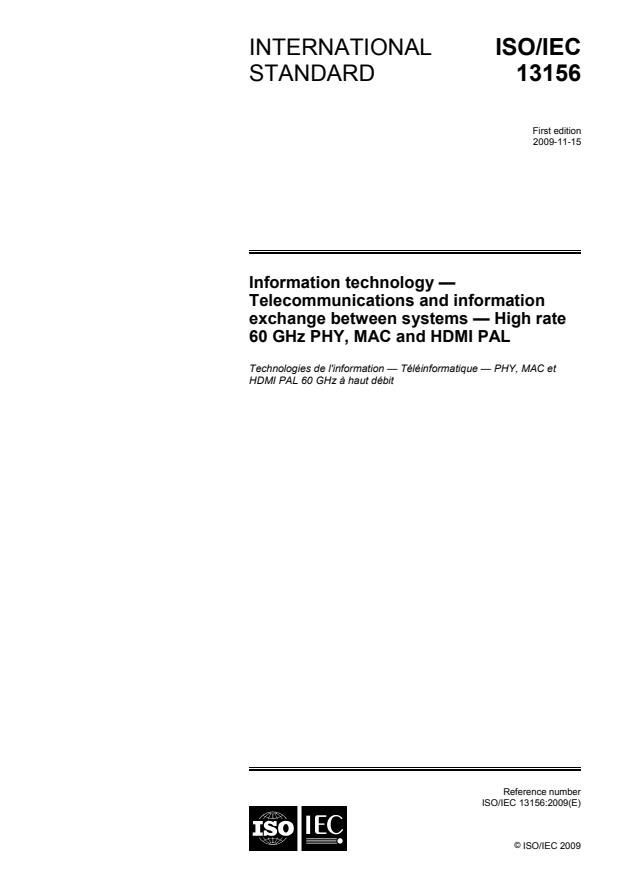
INTERNATIONAL ISO/IEC
STANDARD 13156
First edition
2009-11-15
Information technology —
Telecommunications and information
exchange between systems — High rate
60 GHz PHY, MAC and HDMI PAL
Technologies de l'information — Téléinformatique — PHY, MAC et
HDMI PAL 60 GHz à haut débit
Reference number
©
ISO/IEC 2009
PDF disclaimer
This PDF file may contain embedded typefaces. In accordance with Adobe's licensing policy, this file may be printed or viewed but
shall not be edited unless the typefaces which are embedded are licensed to and installed on the computer performing the editing. In
downloading this file, parties accept therein the responsibility of not infringing Adobe's licensing policy. The ISO Central Secretariat
accepts no liability in this area.
Adobe is a trademark of Adobe Systems Incorporated.
Details of the software products used to create this PDF file can be found in the General Info relative to the file; the PDF-creation
parameters were optimized for printing. Every care has been taken to ensure that the file is suitable for use by ISO member bodies. In
the unlikely event that a problem relating to it is found, please inform the Central Secretariat at the address given below.
© ISO/IEC 2009
All rights reserved. Unless otherwise specified, no part of this publication may be reproduced or utilized in any form or by any means,
electronic or mechanical, including photocopying and microfilm, without permission in writing from either ISO at the address below or
ISO's member body in the country of the requester.
ISO copyright office
Case postale 56 • CH-1211 Geneva 20
Tel. + 41 22 749 01 11
Fax + 41 22 749 09 47
E-mail copyright@iso.org
Web www.iso.org
Published in Switzerland
ii © ISO/IEC 2009 – All rights reserved
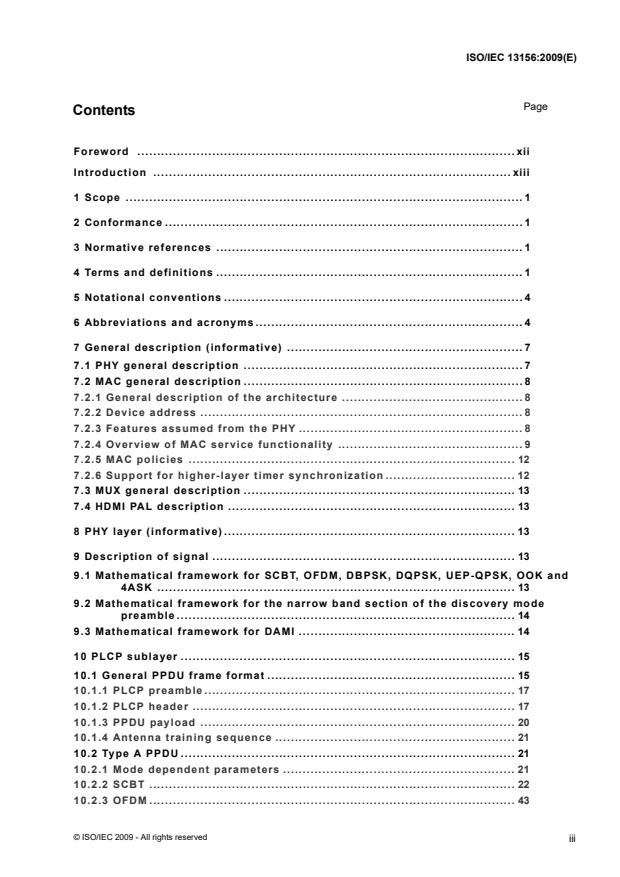
Page
Contents
Foreword .xii
Introduction .xiii
1 Scope . 1
2 Conformance . 1
3 Normative references . 1
4 Terms and definitions . 1
5 Notational conventions . 4
6 Abbreviations and acronyms . 4
7 General description (informative) . 7
7.1 PHY general description . 7
7.2 MAC general description . 8
7.2.1 General description of the architecture . 8
7.2.2 Device address . 8
7.2.3 Features assumed from the PHY . 8
7.2.4 Overview of MAC service functionality . 9
7.2.5 MAC policies . 12
7.2.6 Support for higher-layer timer synchronization . 12
7.3 MUX general description . 13
7.4 HDMI PAL description . 13
8 PHY layer (informative) . 13
9 Description of signal . 13
9.1 Mathematical framework for SCBT, OFDM, DBPSK, DQPSK, UEP-QPSK, OOK and
4ASK . 13
9.2 Mathematical framework for the narrow band section of the discovery mode
preamble . 14
9.3 Mathematical framework for DAMI . 14
10 PLCP sublayer . 15
10.1 General PPDU frame format . 15
10.1.1 PLCP preamble . 17
10.1.2 PLCP header . 17
10.1.3 PPDU payload . 20
10.1.4 Antenna training sequence . 21
10.2 Type A PPDU . 21
10.2.1 Mode dependent parameters . 21
10.2.2 SCBT . 22
10.2.3 OFDM . 43
© ISO/IEC 2009 - All rights reserved
iii
10.2.4 Constellation mapping . 61
10.2.5 Discovery mode . 70
10.3 Type B PPDU . 72
10.3.1 Mode dependent parameters . 72
10.3.2 Single carrier (DBPSK, DQPSK, UEP-QPSK) . 72
10.3.3 Dual alternate mark inversion (DAMI) . 80
10.3.4 Channel bonding . 83
10.3.5 Discovery mode . 83
10.4 Type C PPDU . 83
10.4.1 Mode dependent parameters . 84
10.4.2 Timing related parameters . 84
10.4.3 Frame related parameters . 84
10.4.4 PLCP preamble . 85
10.4.5 PLCP header . 86
10.4.6 PPDU payload . 87
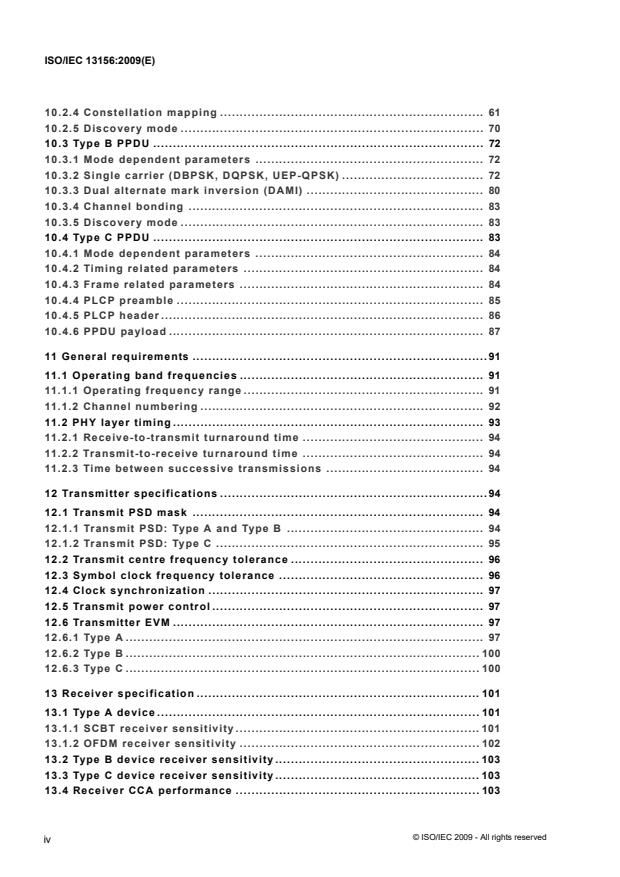
11 General requirements .91
11.1 Operating band frequencies . 91
11.1.1 Operating frequency range . 91
11.1.2 Channel numbering . 92
11.2 PHY layer timing . 93
11.2.1 Receive-to-transmit turnaround time . 94
11.2.2 Transmit-to-receive turnaround time . 94
11.2.3 Time between successive transmissions . 94
12 Transmitter specifications .94
12.1 Transmit PSD mask . 94
12.1.1 Transmit PSD: Type A and Type B . 94
12.1.2 Transmit PSD: Type C . 95
12.2 Transmit centre frequency tolerance . 96
12.3 Symbol clock frequency tolerance . 96
12.4 Clock synchronization . 97
12.5 Transmit power control . 97
12.6 Transmitter EVM . 97
12.6.1 Type A . 97
12.6.2 Type B . 100
12.6.3 Type C . 100
13 Receiver specification . 101
13.1 Type A device . 101
13.1.1 SCBT receiver sensitivity . 101
13.1.2 OFDM receiver sensitivity . 102
13.2 Type B device receiver sensitivity . 103
13.3 Type C device receiver sensitivity . 103
13.4 Receiver CCA performance . 103
© ISO/IEC 2009 - All rights reserved
iv
14 MAC frame formats . 103
14.1 Frame format conventions . 103
14.1.1 Figures . 103
14.1.2 Octet order . 104
14.1.3 Encoding . 104
14.2 General MAC frame format . 104
14.2.1 Unaggregated MAC frame . 104
14.2.2 Aggregated MAC frame . 105
14.2.3 Frame control . 106
14.2.4 DestAddr . 107
14.2.5 SrcAddr . 107
14.2.6 Sequence control . 107
14.2.7 Access information . 108
14.2.8 Frame payload . 108
14.2.9 FCS . 109
14.3 Beacon frames . 110
14.4 Control frames . 112
14.4.1 Immediate acknowledgement (Imm-ACK) . 113
14.4.2 Block acknowledgement (B-ACK) . 113
14.4.3 Application-specific . 114
14.4.4 B-Poll . 114
14.4.5 B-Poll response frame . 115
14.4.6 ATTP control frames . 115
14.5 Command frames . 116
14.5.1 DRP reservation request . 117
14.5.2 DRP reservation response . 117
14.5.3 Channel selection . 117
14.5.4 Link feedback . 119
14.5.5 Probe . 122
14.5.6 Pairwise temporal key (PTK) . 122
14.5.7 Group temporal key (GTK) . 123
14.5.8 Application-specific . 124
14.5.9 Relay . 124
14.5.10 Transmit switched diversity (TSD) request . 124
14.5.11 Transmit switched diversity (TSD) set response . 125
14.5.12 Transmit switched diversity (TSD) switch . 126
14.5.13 Fast uplink channel allocation (FUCA) . 126
14.6 Data frames . 126
14.7 Information elements . 126
14.7.1 Application-specific IE (ASIE) . 128
14.7.2 Application-specific probe IE . 129
14.7.3 ATTP IE . 129
14.7.4 Beacon period occupancy IE (BPOIE) . 131
14.7.5 Channel bonding IE (CBOIE) . 133
14.7.6 Channel change IE . 134
© ISO/IEC 2009 - All rights reserved
v
14.7.7 CTR description IE . 134
14.7.8 Distributed reservation protocol (DRP) IE . 135
14.7.9 DRP availability IE . 137
14.7.10 Hibernation anchor IE . 137
14.7.11 Hibernation mode IE . 138
14.7.12 Identification IE . 138
14.7.13 Link feedback IE . 139
14.7.14 MAC capabilities IE . 141
14.7.15 Master key identifier (MKID) IE . 142
14.7.16 MSP interval change IE . 142
14.7.17 MSP timing IE . 142
14.7.18 Multicast address binding (MAB) IE . 142
14.7.19 PHY capabilities IE . 143
14.7.20 Probe IE . 146
14.7.21 Relinquish request IE . 146
14.7.22 Relay IE . 147
14.7.23 Scan Countdown IE . 149
14.7.24 Scan Timing IE . 150
14.7.25 UEP information IE . 150
14.8 Master-slave operation command . 151
14.8.1 Type C poll . 152
14.8.2 Type C poll response . 153
14.8.3 Association request command . 153
14.8.4 Association response command . 154
14.8.5 MSPr services command . 154
14.8.6 Disassociation request command . 155
14.8.7 Channel time request command . 155
14.8.8 Channel time response command . 155
14.8.9 Channel time termination command . 156
14.8.10 Channel time modify request . 156
14.8.11 Channel time modification response command . 157
14.8.12 Remote scan request command . 157
14.8.13 Remote scan response command . 158
14.8.14 Channel release request command . 158
14.8.15 Application specific command . 159
15 MAC sublayer functional description . 159
15.1 Frame processing . 159
15.1.1 Frame addresses . 160
15.1.2 Frame reception . 160
15.1.3 Antenna training frame transaction . 160
15.1.4 Frame transfer . 161
15.1.5 Frame retry . 161
15.1.6 Inter-frame space (IFS) . 162
15.1.7 Duplicate detection . 162
© ISO/IEC 2009 - All rights reserved
vi
15.1.8 RTT/CTT use . 162
15.1.9 MAC header fields . 162
15.1.10 Information elements . 164
15.2 Distributed contention access (DCA) . 166
15.2.1 DCA medium availability . 167
15.2.2 NAV . 167
15.2.3 Medium status . 167
15.2.4 Obtaining a TXOP . 167
15.2.5 Using a TXOP . 168
15.2.6 Invoking a backoff procedure . 169
15.2.7 Decrementing a backoff counter . 169
15.3 Device discovery . 170
15.3.1 Type A . 170
15.3.2 Type B . 170
15.3.3 Type C . 171
15.4 Channel selection . 171
15.4.1 Explicit channel selection . 172
15.4.2 Implicit channel selection . 172
15.5 Transmission and reception of beacons and poll frames . 173
15.5.1 Transmission of beacons in the discovery channel . 173
15.5.2 Transmission and reception of mode-A0 beacon frames . 176
15.5.3 Transmission and reception of mode-B0 beacon frames . 177
15.5.4 Transmission and reception of TypeC poll frames . 177
15.5.5 Superframe . 178
15.6 Distributed reservation protocol (DRP) . 182
15.6.1 Reservation type . 183
15.6.2 Reservation waveform . 184
15.6.3 DRP availability IE . 184
15.6.4 DRP reservation negotiation . 184
15.6.5 DRP reservation announcements . 186
15.6.6 Resolution of DRP reservation conflicts . 186
15.6.7 BPST realignment and existing DRP reservations . 187
15.6.8 Modification and termination of existing DRP reservations . 187
15.6.9 Retransmit procedures in DRP reservations . 188
15.7 Coexistence and interoperability . 188
15.7.1 Coexistence . 188
15.7.2 Interoperability . 189
15.8 Synchronization of devices . 190
15.8.1 Clock accuracy . 190
15.8.2 Synchronization for devices in hibernation mode . 191
15.8.3 Guard times . 191
15.9 Fragmentation and reassembly . 192
15.10 Aggregation . 192
15.11 Channel bonding . 194
15.12 Acknowledgement policies . 195
© ISO/IEC 2009 - All rights reserved
vii
15.12.1 No-ACK . 195
15.12.2 Immediate ACK . 195
15.12.3 Block ACK . 195
15.13 Probe . 197
15.14 Multi-rate support . 198
15.15 Transmit power control (TPC) . 198
15.16 Power management mechanisms . 198
15.16.1 Power management modes . 198
15.16.2 Power state transitions at active mode . 199
15.16.3 Hibernation mode operation for Type A/B devices . 201
15.16.4 Hibernation mode operation for Type C device . 202
15.16.5 Hibernation anchor operation in Type A/B devices . 202
15.17 ASIE operation . 203
15.18 The antenna training and tracking protocol (ATTP) . 203
15.18.1 ATTP functional description . 204
15.18.2 Antenna training sequence transmission and frame type . 206
15.18.3 Antenna training feedback information . 206
15.18.4 Training matrix in closed loop mode . 207
15.18.5 Feedback method in closed loop mode . 208
15.18.6 No feedback in open loop mode . 212
15.18.7 Iterative antenna training . 212
15.18.8 Antenna tracking . 214
15.19 Master-slave operation . 214
15.19.1 Master-slave timing structure . 215
15.19.2 Master-slave operation between Type A, Type B and Type C devices 216
15.19.3 Channel scanning . 217
15.19.4 Starting a MSPr . 218
15.19.5 Terminating a MSPr . 218
15.19.6 Association and disassociation . 218
15.19.7 Channel access . 221
15.19.8 Synchronization . 225
15.19.9 Fragmentation and de-fragmentation . 227
15.19.10 Acknowledgment and retransmissions . 227
15.19.11 Link check . 227
15.19.12 Changing MSP parameters . 229
15.19.13 Channel release . 230
15.20 Transmit switched diversity (TSD) operation . 232
15.20.1 TSD initiating procedure . 232
15.20.2 Antenna switching . 232
15.21 MAC sublayer parameters . 233
16 Security . 235
16.1 Security mechanisms . 235
16.1.1 Security operation . 235
16.1.2 4-way handshake . 235
© ISO/IEC 2009 - All rights reserved
viii
16.1.3 Key transport . 236
16.1.4 Freshness protection . 236
16.1.5 Data encryption . 236
16.1.6 Frame integrity protection . 236
16.2 Security modes . 236
16.2.1 Security mode 0 . 238
16.2.2 Security mode 1 . 238
16.2.3 Security mode 2 . 238
16.3 Temporal keys . 238
16.3.1 Mutual authentication and PTK derivation . 239
16.3.2 GTK exchange . 240
16.3.3 Pseudo-random function (PRF) definition . 240
16.3.4 PTK and KCK derivation . 241
16.3.5 PTK MIC generation . 242
16.3.6 Random number generation . 242
16.4 Frame reception steps and replay prevention measures . 243
16.4.1 Frame reception . 243
16.4.2 Replay prevention . 243
16.4.3 Implications on GTKs . 244
16.5 AES-128 CCM inputs . 244
16.5.1 Overview . 244
16.5.2 Nonce . 244
16.5.3 CCM blocks . 245
16.6 Token authentication . 246
16.6.1 Token issuance . 246
16.6.2 Token revoke . 247
17 HDMI PAL . 247
17.1 Introduction . 247
17.2 HDMI transmission . 248
17.2.1 Identification of video vs. data . 248
17.2.2 TMDS removal . 248
17.2.3 Data type multiplexing . 248
17.3 HDMI reception . 251
17.3.1 TMDS encoding . 251
17.3.2 Packet demultiplexing . 251
17.4 PAL header format . 255
17.4.1 Sub-packet header . 256
17.5 PAL payload format . 257
17.6 Block retransmission request . 257
17.7 Type specific header fields . 258
17.7.1 S-UEP . 258
17.7.2 P-UEP . 261
17.8 Video/audio format adaptation . 262
17.8.1 Fast video format adaptation . 262
© ISO/IEC 2009 - All rights reserved
ix
17.8.2 Fast audio format adaptation . 265
17.8.3 Control messages to support fast format adaptation . 266
17.9 Fast uplink channel allocation (FUCA) . 267
17.9.1 FUCA operation . 268
17.9.2 The procedure of data exchange using FUCA . 271
18 Out-of-band control channel . 272
18.1 OOB operation . 273
18.1.1 Ad hoc mode . 273
18.1.2 Infrastructure mode . 275
18.1.3 Other OOB functions . 277
18.2 OOB frame format . 278
18.2.1 General frame format . 278
18.2.2 OOB-beacon . 278
18.2.3 OOB-60GHz capability request . 279
18.2.4 OOB-60GHz capability response . 279
18.2.5 OOB-interference detection request . 280
18.2.6 OOB-interference detection response . 280
18.2.7 OOB-channel loss notification . 280
18.2.8 OOB-block ACK . 281
18.2.9 OOB-probe request . 281
18.2.10 OOB-probe response . 281
18.3 Convergence MAC sublayer parameters . 282
19 Relay operation . 282
19.1 Relay path setup . 282
19.1.1 Identification of relay capabilites . 282
19.1.2 Association with a relay device . 282
19.1.3 Antenna training between the source and the destination . 282
19.1.4 Antenna training between the source and the relay . 282
19.1.5 Antenna training between the relay and the destination . 283
19.1.6 Transition to data channel . 283
19.2 Data transmission in relay operation . 285
19.2.1 DRP reservation for relay operation in data channel . 285
19.2.2 Usage of relay device . 285
19.2.3 Frame transfer in relay operation . 285
19.2.4 Frame reception in relay operation . 286
19.2.5 Data exchange using relay device . 286
19.2.6 Decision on path change . 287
19.2.7 Path Change . 287
19.2.8 Relay link feedback via relay device . 288
19.2.9 Scan of idle path . 289
19.2.10 Operation of relay device . 289
Annex A (normative) MUX sublayer . 291
Annex B (normative) MAC Policies . 293
© ISO/IEC 2009 - All rights reserved
x
Annex C (informative) Bibliography . 296
Annex D (informative) Higher Layer Synchronization Support . 297
© ISO/IEC 2009 - All rights reserved
xi
Foreword
ISO (the International Organization for Standardization) and IEC (the International Electrotechnical
Commission) form the specialized system for worldwide standardization. National bodies that are members
of ISO or IEC participate in the development of International Standards through technical committees
established by the respective organization to deal with particular fields of technical activity. ISO and IEC
technical committees collaborate in fields of mutual interest. Other international organizations, governmental
and non-governmental, in liaison with ISO and IEC, also take part in the work. In the field of information
technology, ISO and IEC have established a joint technical committee, ISO/IEC JTC 1.
International Standards are drafted in accordance with the rules given in the ISO/IEC Directives, Part 2.
The main task of the joint technical committee is to prepare International Standards. Draft International
Standards adopted by the joint technical committee are circulated to national bodies for voting. Publication
as an International Standard requires approval by at least 75 % of the national bodies casting a vote.
Attention is drawn to the possibility that some of the elements of this document may be the subject of patent
rights. ISO and IEC shall not be held responsible for identifying any or all such patent rights.
International Standard ISO/IEC 13156 was prepared by Ecma International (as ECMA-387) and was
adopted, under a special "fast-track procedure", by Joint Technical Committee ISO/IEC JTC 1, Information
technology, in parallel with its approval by national bodies of ISO and IEC.
© ISO/IEC 2009 - All rights reserved
xii
Introduction
This is a standard for a 60 GHz PHY, MAC and HDMI PAL for short range unlicensed communications
providing high rate wireless personal area network (including point-to-point) transport for both bulk data
transfer and multimedia streaming; addressing usages and applications such as high definition
(uncompressed / lightly compressed) AV streaming, access point, wireless docking station, and short range
sync-and-go.
The standard defines three device types. All device types coexist and interoperate with each other. None of
the types requires presence of another type for its operation.
• Device Type A offers video streaming and WPAN applications in 10 meter range LOS/NLOS multipath
environments. It uses high gain trainable antennas. This device type is considered as the 'high end -
high performance” device.
• Device Type B offers video and data applications over shorter range (1-3 meters) point to point LOS
links with non-trainable antennas. It is considered as the “economy” device and trades off range and
NLOS performance in favour of low cost implementation and low power consumption.
• Device Type C is positioned to support data only applications over point to point LOS links at less than
1 meter range with non-trainable antennas and no QoS guarantees. This type is considered a 'bottom
end' device providing simplest implementation, lowest cost and lowest power consumption.
Four frequency channels are defined and used by all the three device types. The frequency separation for
these channels is 2.160 GHz and the symbol rate on each channel is 1.728 Gsps. All device types follow the
same frequency plan defined in the major regulatory domains. The standard supports bonding of two or three
adjacent channels. The channel bonding allows achieving higher data rates, or the same data rates while
using smaller, more efficient constellations.
A single MAC layer protocol is defined within which Type B and Type C devices support limited functionality
supported by their respective PHY layers as illustrated in Figure 1. A multiplexing sublayer (MUX) is defined
to enable the coexistence of concurrently active higher layer protocols within a single device.
There is an HDMI PAL defined in the standard which places the 60 GHz wireless solution between the HDMI
source and HDMI sink. In the wireless HDMI transmitter, the HDMI TMDS coding is removed prior to wireless
transmission. The three HDMI data types (video, control and data) are multiplexed together with the video
flagged for unequal error protection (UEP) and data/control flagged for equal error protection (EEP). In the
wireless HDMI receiver, the three HDMI data types are demultiplexed prior to reapplying the TMDS coding
and sending on to the HDMI data sink.
1. HDMI is the registered trademark of the HDMI LLC.
© ISO/IEC 2009 - All rights reserved
xiii
DME
HDMI
…
PAL
n Device Management Entity
PAL
MUX
MAC
MLME
MAC
MAC Layer
Layer
Management Entity
Type C Type B Type A
PLCP PLCP PLCP
Type C Type B Type A
PLME
PHY PHY PHY
PHY Layer
Management Entity
Antenna
Front-
PHY
end
Layer
Antenna
Figure 1 - Protocol structure
NOTE The DME, MLME, PLME, and PALs (except the HDMI PAL) are outside the scope of this standard and
all references to these are informative.
© ISO/IEC 2009 - All rights reserved
xiv
INTERNATIONAL STANDARD
Information technology — Telecommunications and information
exchange between systems — High rate 60 GHz PHY, MAC and
HDMI PAL
1 Scope
This Standard specifies a physical layer (PHY), distributed medium access control (MAC) sublayer, and
an HDMI protocol adaptation layer (PAL) for 60 GHz wireless networks.
2 Conformance
Conforming devices of Type A, B or C shall implement the MAC sublayer and the PHY layer and may
implement the HDMI PAL as specified herein.
3 Normative references
The following referenced documents are indispensable for the application of this document. For dated
references, only the edition cited applies. For undated references, the latest edition of the referenced
document (including any amendments) applies.
ISO/IEC 8802-11:2005/Amd. 6, Information technology – Telecommunications and information
exchange between systems – Local and metropolitan area networks – Specific requirements – Part 11:
Wireless LAN Medium Access Control (MAC) and Physical Layer (PHY) specifications - Amendment 6:
Medium Access Control (MAC) Security Enhancements
ISO/IEC 10646:2003, Information technology – Universal Multiple-Octet Coded Character Set (UCS)
ISO/IEC 18033-3:2005, Information technology – Security techniques – Encryption algorithms –
Part 3: Block ciphers
4 Terms and definitions
For the purposes of this document, the following terms and definitions apply. For terms and definitions not
defined in this Clause, the term and definitions given in IEEE 100, The Authoritative Dictionary of IEEE
Standards Terms, Seventh Edition apply.
4.1
Beacon Group
BG
set of devices from which a device receives beacons that identify the same beacon period start time
(BPST) as the device
4.2
Beacon Period
BP
period of time declared by a device during which it sends or listens for beacons
© ISO/IEC 2009 - All rights reserved
4.3
Beacon Period Start Time
BPST
start of the beacon period
4.4
Channel
medium over which cooperating entities exchange information
4.5
Data integrity
assurance that the data has not been modified from its original form
4.6
Device
entity containing an implementation of this Standard
4.7
Distributed Reservation Protocol
DRP
protocol implemented in each device to support negotiation and maintenance of channel time
reservations binding on all neighbours of the reservation participants
4.8
Equivalent Isotropic Radiated Power
EIRP
amount of power that a theoretical isotropic antenna (t
...
Questions, Comments and Discussion
Ask us and Technical Secretary will try to provide an answer. You can facilitate discussion about the standard in here.
Loading comments...