

ISO/IEC TS 4213:2022
(Main)Information technology — Artificial intelligence — Assessment of machine learning classification performance
General Information
- Abstract
This document specifies methodologies for measuring classification performance of machine learning models, systems and algorithms.
- Status
- Published
- Publication Date
- 12-Oct-2022
- Technical Committee
- ISO/IEC JTC 1/SC 42 - Artificial intelligence
- Current Stage
- 9092 - International Standard to be revised
- Start Date
- 23-Oct-2025
- Completion Date
- 29-Aug-2026

Overview - ISO/IEC TS 4213:2022 (Machine learning classification performance)
ISO/IEC TS 4213:2022 is a Technical Specification from ISO/IEC JTC 1/SC 42 that defines standardized methodologies for measuring classification performance of machine learning models, systems and algorithms. It provides a consistent framework for assessing classification quality, reporting results, and comparing models against baselines - supporting reproducible evaluation in research, product development and compliance contexts.
Key topics and technical requirements
The specification organizes practical guidance and requirements around these topics:
- General principles and assessment process - a generalized workflow for classification performance assessment and the purpose of evaluation.
- Control criteria addressing evaluation setup, including:
- Data representativeness and bias, preprocessing, training/test/validation splits and cross-validation
- Limiting information leakage and channel effects
- Ground truth definition, algorithm/hyperparameter documentation, evaluation environment and baselines
- Statistical measures of performance - base elements and metrics such as:
- Confusion matrix, accuracy, precision, recall, specificity, F-score
- ROC curve / AUC, precision–recall curve, cumulative response and lift curves
- Kullback–Leibler divergence and distribution-distance metrics
- Multi-class (macro/micro/weighted averages) and multi-label metrics (Hamming loss, exact match ratio, Jaccard index)
- Computational complexity metrics - latency, throughput, efficiency and energy considerations for classification.
- Statistical significance testing - paired t-test, ANOVA, Kruskal–Wallis, chi-squared, Wilcoxon, Fisher’s exact, McNemar and approaches to multiple comparisons (Bonferroni, false discovery rate).
- Reporting requirements - recommended content for clear, reproducible evaluation and annexes with illustrative examples and benchmark summaries.
Practical applications and who uses it
ISO/IEC TS 4213:2022 is practical for:
- Data scientists and ML engineers designing reliable evaluation pipelines and selecting appropriate metrics (e.g., ROC AUC vs. precision–recall) for imbalanced data.
- ML researchers benchmarking novel classifiers against baselines using standardized tests and significance procedures.
- Product managers and QA teams validating model performance, latency and energy efficiency under controlled conditions.
- Regulators, auditors and procurement teams requiring transparent, reproducible performance evidence for AI systems.
- Academia and benchmarking labs producing comparable, documented results across datasets and tasks.
Example use case: demonstrating that a new classifier improves accuracy from 96.2% to 97.8% while also reporting statistical significance, computational cost and robustness to dataset bias.
Related standards and context
This Technical Specification complements ISO/IEC work on artificial intelligence by providing focused guidance for classification performance assessment as part of broader AI governance, testing and benchmarking efforts.
Get Certified
Connect with accredited certification bodies for this standard

BSI Group
BSI (British Standards Institution) is the business standards company that helps organizations make excellence a habit.

NYCE
Mexican standards and certification body.
Sponsored listings
Frequently Asked Questions
ISO/IEC TS 4213:2022 is a technical specification published by the International Organization for Standardization (ISO). Its full title is "Information technology — Artificial intelligence — Assessment of machine learning classification performance". This standard covers: This document specifies methodologies for measuring classification performance of machine learning models, systems and algorithms.
This document specifies methodologies for measuring classification performance of machine learning models, systems and algorithms.
ISO/IEC TS 4213:2022 is classified under the following ICS (International Classification for Standards) categories: 35.020 - Information technology (IT) in general. The ICS classification helps identify the subject area and facilitates finding related standards.
ISO/IEC TS 4213:2022 is available in PDF format for immediate download after purchase. The document can be added to your cart and obtained through the secure checkout process. Digital delivery ensures instant access to the complete standard document.
Standards Content (Sample)
TECHNICAL ISO/IEC TS
SPECIFICATION 4213
First edition
2022-10
Information technology — Artificial
intelligence — Assessment of machine
learning classification performance
Technologies de l'information — Intelligence artificielle — Evaluation
des performances de classification de l'apprentissage machine
Reference number
© ISO/IEC 2022
© ISO/IEC 2022
All rights reserved. Unless otherwise specified, or required in the context of its implementation, no part of this publication may
be reproduced or utilized otherwise in any form or by any means, electronic or mechanical, including photocopying, or posting on
the internet or an intranet, without prior written permission. Permission can be requested from either ISO at the address below
or ISO’s member body in the country of the requester.
ISO copyright office
CP 401 • Ch. de Blandonnet 8
CH-1214 Vernier, Geneva
Phone: +41 22 749 01 11
Email: copyright@iso.org
Website: www.iso.org
Published in Switzerland
ii
© ISO/IEC 2022 – All rights reserved
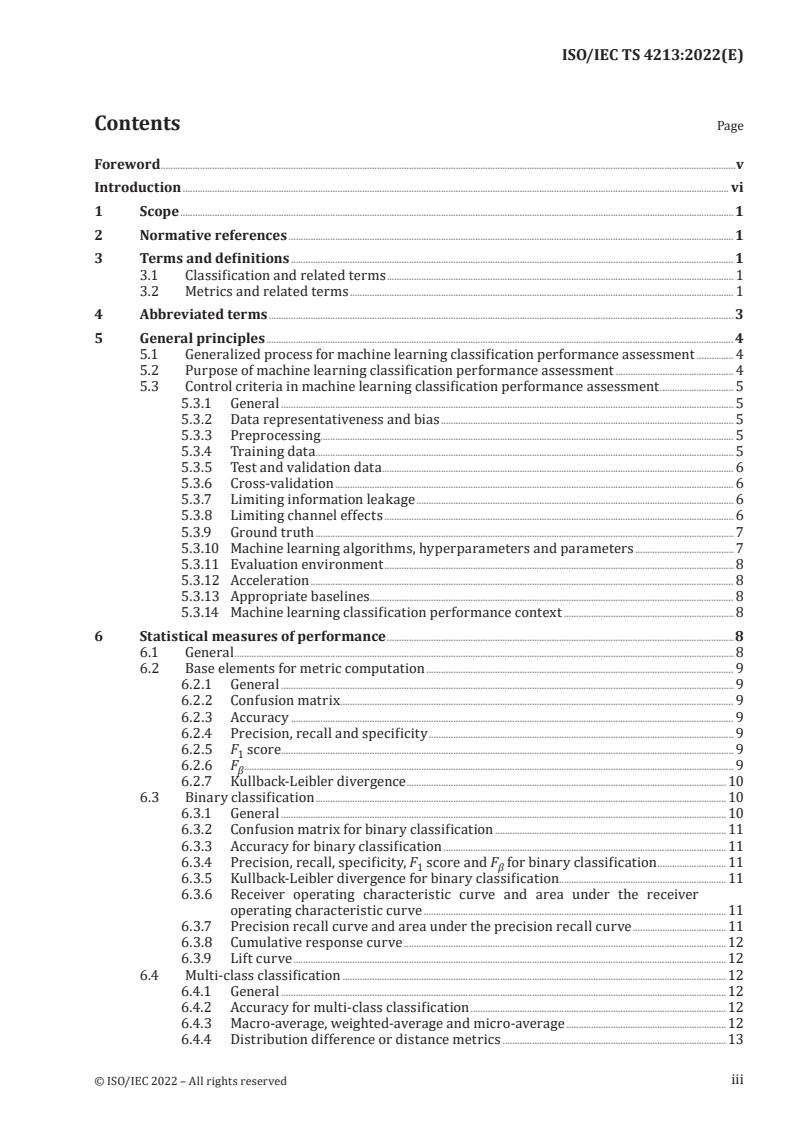
Contents Page
Foreword .v
Introduction . vi
1 Scope . 1
2 Normative references . 1
3 Terms and definitions . 1
3.1 Classification and related terms . 1
3.2 Metrics and related terms . 1
4 Abbreviated terms . 3
5 General principles . 4
5.1 Generalized process for machine learning classification performance assessment . 4
5.2 Purpose of machine learning classification performance assessment . 4
5.3 Control criteria in machine learning classification performance assessment . 5
5.3.1 General . 5
5.3.2 Data representativeness and bias . 5
5.3.3 Preprocessing. 5
5.3.4 Training data . . 5
5.3.5 Test and validation data . 6
5.3.6 Cross-validation . 6
5.3.7 Limiting information leakage . 6
5.3.8 Limiting channel effects . 6
5.3.9 Ground truth . 7
5.3.10 Machine learning algorithms, hyperparameters and parameters . 7
5.3.11 Evaluation environment . 8
5.3.12 Acceleration . 8
5.3.13 Appropriate baselines. 8
5.3.14 Machine learning classification performance context . 8
6 Statistical measures of performance .8
6.1 General . 8
6.2 Base elements for metric computation . 9
6.2.1 General . 9
6.2.2 Confusion matrix. 9
6.2.3 Accuracy . 9
6.2.4 Precision, recall and specificity . 9
6.2.5 F score . . 9
6.2.6 F . 9
β
6.2.7 Kullback-Leibler divergence . 10
6.3 Binary classification . 10
6.3.1 General . 10
6.3.2 Confusion matrix for binary classification . 11
6.3.3 Accuracy for binary classification . 11
6.3.4 Precision, recall, specificity, F score and F for binary classification . 11
1 β
6.3.5 Kullback-Leibler divergence for binary classification. 11
6.3.6 Receiver operating characteristic curve and area under the receiver
operating characteristic curve . 11
6.3.7 Precision recall curve and area under the precision recall curve . 11
6.3.8 Cumulative response curve .12
6.3.9 Lift curve . 12
6.4 Multi-class classification . 12
6.4.1 General .12
6.4.2 Accuracy for multi-class classification .12
6.4.3 Macro-average, weighted-average and micro-average .12
6.4.4 Distribution difference or distance metrics .13
iii
© ISO/IEC 2022 – All rights reserved
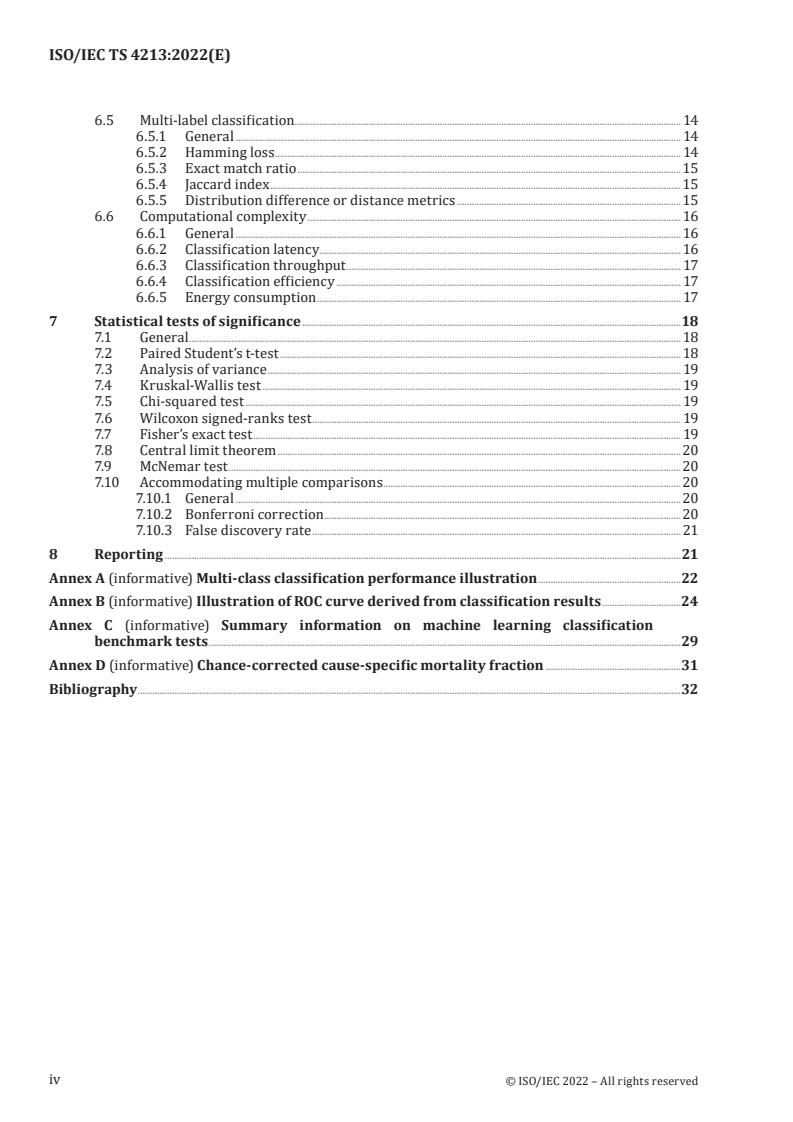
6.5 Multi-label classification . 14
6.5.1 General . 14
6.5.2 Hamming loss . 14
6.5.3 Exact match ratio .15
6.5.4 Jaccard index . 15
6.5.5 Distribution difference or distance metrics . 15
6.6 Computational complexity . 16
6.6.1 General . 16
6.6.2 Classification latency . 16
6.6.3 Classification throughput . 17
6.6.4 Classification efficiency . 17
6.6.5 Energy consumption . 17
7 Statistical tests of significance .18
7.1 General . 18
7.2 Paired Student’s t-test . 18
7.3 Analysis of variance . 19
7.4 Kruskal-Wallis test . 19
7.5 Chi-squared test . 19
7.6 Wilcoxon signed-ranks test . 19
7.7 Fisher’s exact test . 19
7.8 Central limit theorem .20
7.9 McNemar test . 20
7.10 Accommodating multiple comparisons . 20
7.10.1 General .20
7.10.2 Bonferroni correction . 20
7.10.3 False discovery rate . 21
8 Reporting .21
Annex A (informative) Multi-class classification performance illustration .22
Annex B (informative) Illustration of ROC curve derived from classification results .24
Annex C (informative) Summary information on machine learning classification
benchmark tests .29
Annex D (informative) Chance-corrected cause-specific mortality fraction .31
Bibliography .32
iv
© ISO/IEC 2022 – All rights reserved
Foreword
ISO (the International Organization for Standardization) and IEC (the International Electrotechnical
Commission) form the specialized system for worldwide standardization. National bodies that are
members of ISO or IEC participate in the development of International Standards through technical
committees established by the respective organization to deal with particular fields of technical
activity. ISO and IEC technical committees collaborate in fields of mutual interest. Other international
organizations, governmental and non-governmental, in liaison with ISO and IEC, also take part in the
work.
The procedures used to develop this document and those intended for its further maintenance
are described in the ISO/IEC Directives, Part 1. In particular, the different approval criteria
needed for the different types of document should be noted. This document was drafted in
accordance with the editorial rules of the ISO/IEC Directives, Part 2 (see www.iso.org/directives or
www.iec.ch/members_experts/refdocs).
Attention is drawn to the possibility that some of the elements of this document may be the subject
of patent rights. ISO and IEC shall not be held responsible for identifying any or all such patent
rights. Details of any patent rights identified during the development of the document will be in the
Introduction and/or on the ISO list of patent declarations received (see www.iso.org/patents) or the IEC
list of patent declarations received (see https://patents.iec.ch).
Any trade name used in this document is information given for the convenience of users and does not
constitute an endorsement.
For an explanation of the voluntary nature of standards, the meaning of ISO specific terms and
expressions related to conformity assessment, as well as information about ISO's adherence to
the World Trade Organization (WTO) principles in the Technical Barriers to Trade (TBT) see
www.iso.org/iso/foreword.html. In the IEC, see www.iec.ch/understanding-standards.
This document was prepared by Joint Technical Committee ISO/IEC JTC 1, Information technology,
Subcommittee SC 42, Artificial intelligence.
Any feedback or questions on this document should be directed to the user’s national standards
body. A complete listing of these bodies can be found at www.iso.org/members.html and
www.iec.ch/national-committees.
v
© ISO/IEC 2022 – All rights reserved
Introduction
As academic, commercial and governmental researchers continue to improve machine learning models,
consistent approaches and methods should be applied to machine learning classification performance
assessment.
Advances in machine learning are often reported in terms of improved performance relative to the
state of the art or a reasonable baseline. The choice of an appropriate metric to assess machine learning
model classification performance depends on the use case and domain constraints. Further, the
chosen metric can differ from the metric used during training. Machine learning model classification
performance can be represented through the following examples:
— A new model achieves 97,8 % classification accuracy on a dataset where the state-of-the-art model
achieves just 96,2 % accuracy.
— A new model achieves classification accuracy equivalent to the state of the art but requires much
less training data than state-of-the-art approaches.
— A new model generates inferences 100x faster than state-of-the-art models while maintaining
equivalent accuracy.
To determine whether these assertions are meaningful, aspects of machine learning classification
performance assessment including model implementation, dataset composition and results calculation
are taken into consideration. This document describes approaches and methods to ensure the relevance,
legitimacy and extensibility of machine learning classification performance assertions.
Various AI stakeholder roles as defined in ISO/IEC 22989:2022, 5.17 can take advantage of the
approaches and methods described in this document. For example, AI developers can use the approaches
and methods when evaluating ML models.
Methodological controls are put in place when assessing machine learning performance to ensure that
results are fair and representative. Examples of these controls include establishing computational
environments, selecting and preparing datasets, and limiting leakage that potentially leads to
misleading classification results. Clause 5 addresses this topic.
Merely reporting performance in terms of accuracy can be inappropriate depending on the
characteristics of training data and input data. If a classifier is susceptible to majority class classification,
grossly unbalanced training data can overstate accuracy by representing the prior probabilities of
the majority class. Additional measurements that reflect more subtle aspects of machine learning
classification performance, such as macro-averaged metrics, are at times more appropriate. Further,
different types of machine learning classification, such as binary, multi-class and multi-label, are
associated with specific performance metrics. In addition to these metrics, aspects of classification
performance such as computational complexity, latency, throughput and efficiency can be relevant.
Clause 6 addresses these topics.
Complications can arise as a result of the distribution of training data. Statistical tests of significance
are undertaken to establish the conditions under which machine learning classification performance
differs meaningfully. Specific training, validation and test methodologies are used in machine learning
model development to address the range of potential scenarios. Clause 7 addresses these topics.
Annex A illustrates calculation of multi-class classification performance, using examples of positive and
negative classifications. Annex B illustrates a receiver operating characteristic (ROC) curve derived
from example data in Annex A.
Annex C summarizes results from machine learning classification benchmark tests.
Annex D discusses a chance-corrected cause-specific mortality fraction, a machine learning
classification use case. Apart from these, this document does not address any issues related to
benchmarking, applications or use cases.
vi
© ISO/IEC 2022 – All rights reserved
TECHNICAL SPECIFICATION ISO/IEC TS 4213:2022(E)
Information technology — Artificial intelligence
— Assessment of machine learning classification
performance
1 Scope
This document specifies methodologies for measuring classification performance of machine learning
models, systems and algorithms.
2 Normative references
The following documents are referred to in the text in such a way that some or all of their content
constitutes requirements of this document. For dated references, only the edition cited applies. For
undated references, the latest edition of the referenced document (including any amendments) applies.
ISO/IEC 22989:2022, Information technology — Artificial intelligence — Artificial intelligence concepts
and terminology
ISO/IEC 23053:2022, Framework for Artificial Intelligence (AI) Systems Using Machine Learning (ML)
3 Terms and definitions
For the purposes of this document, the terms and definitions in ISO/IEC 22989:2022, ISO/IEC 23053:2022,
and the following apply.
ISO and IEC maintain terminology databases for use in standardization at the following addresses:
— ISO Online browsing platform: available at https:// www .iso .org/ obp
— IEC Electropedia: available at https:// www .electropedia .org/
3.1 Classification and related terms
3.1.1
classification
method of structuring a defined type of item (objects or documents) into classes and subclasses in
accordance with their characteristics
[SOURCE: ISO 7200:2004, 3.1]
3.1.2
classifier
trained model and its associated mechanism used to perform classification (3.1.1)
3.2 Metrics and related terms
3.2.1
evaluation
process of comparing the classification (3.1.1) predictions made by the model on data to the actual
labels in the data
© ISO/IEC 2022 – All rights reserved
3.2.2
false negative
miss
type II error
F
N
sample wrongly classified as negative
3.2.3
false positive
false alarm
type I error
F
P
sample wrongly classified as positive
3.2.4
true positive
T
P
sample correctly classified as positive
3.2.5
true negative
T
N
sample correctly classified as negative
3.2.6
accuracy
number of correctly classified samples divided by all classified samples
Note 1 to entry: It is calculated as aT=+TT/ ++FT +F .
() ()
PN PP NN
3.2.7
confusion matrix
matrix used to record the number of correct and incorrect classifications (3.1.1) of samples
3.2.8
F score
F-score
F-measure
F -measure
harmonic mean of precision (3.2.9) and recall (3.2.10)
Note 1 to entry: It is calculated as FT=+22/()TF +F .
1 P PPN
3.2.9
precision
positive predictive value
number of samples correctly classified as positive divided by all samples classified as positive
Note 1 to entry: It is calculated as pT=+/ TF .
()
PP P
3.2.10
recall
true positive rate
sensitivity
hit rate
number of samples correctly classified as positive divided by all positive samples
Note 1 to entry: It is calculated as rT=+/ TF .
()
PP N
© ISO/IEC 2022 – All rights reserved
3.2.11
specificity
selectivity
true negative rate
number of samples correctly classified as negative divided by all negative samples
Note 1 to entry: It is calculated as sT=+/()TF .
NN P
3.2.12
false positive rate
fall-out
number of samples incorrectly classified as positive divided by all negative samples
Note 1 to entry: It is calculated as FF=+ / FT .
()
P,RP PN
3.2.13
cumulative response curve
gain chart
graphical method of displaying true positive rates (3.2.10) and percentage of positive prediction in the
total data across multiple thresholds
3.2.14
lift curve
graphical method of displaying on the y-axis the ratio of true positive rate (3.2.10) between the model
and a random classifier, and on the x-axis the percentage of positive predictions in the total data across
multiple thresholds
3.2.15
precision recall curve
PRC
graphical method for displaying recall (3.2.10) and precision (3.2.9) across multiple thresholds
Note 1 to entry: A PRC is more suitable than a ROC (receiver operating characteristic) curve for showing
performance with imbalanced data.
3.2.16
receiver operating characteristic curve
ROC curve
graphical method for displaying true positive rate (3.2.10) and false positive rate (3.2.12) across multiple
thresholds
3.2.17
cross-validation
method to estimate the performance of a machine learning method using a single dataset
Note 1 to entry: Cross-validation is typically used for validating design choices before training the final model.
3.2.18
majority class
class with the most samples in a dataset
4 Abbreviated terms
AI artificial intelligence
ANOVA analysis of variance
AUPRC area under the precision recall curve
© ISO/IEC 2022 – All rights reserved
AUROC area under the receiver operating characteristic curve
CLT central limit theorem
CPU central processing unit
CRC cumulative response curve
FC fully connected
FDR false discovery rate
IoU intersection over union
GPU graphics processing unit
ROC receiver operating characteristic
5 General principles
5.1 Generalized process for machine learning classification performance assessment
A generalized process for machine learning classification performance assessment is shown in Figure 1.
Figure 1 — Generalized process for machine learning classification performance assessment
Step 1: Determine evaluation tasks
Determine the appropriate classification task or tasks for the evaluation.
Step 2: Specify metrics
Based on the classification task, specify the required metric or metrics.
Step 3: Conduct evaluation
Create the evaluation plan, implement the evaluation environment including software and hardware,
prepare datasets and process datasets.
Step 4: Collect and analyse data
According to the specified metrics, collect model outputs such as classification predictions for each
sample.
Step 5: Generate evaluation results
Generate evaluation results based on specified metrics and other relevant information.
5.2 Purpose of machine learning classification performance assessment
The purpose of the assessment and its baseline requirements can vary greatly depending on whether it
applies to the "design and development" or "verification and validation” stage.
The purpose of assessment during the “design and development” stage is to optimize hyperparameters
to achieve the best classification performance. The purpose of assessment during the "verification and
validation" stage is to estimate the trained model performance.
© ISO/IEC 2022 – All rights reserved
Performance assessment can be applied for several purposes, including:
— model assessment, to know how good the model is, how reliable the model’s predictions are, or the
expected frequency and size of errors;
— model comparison, to compare two or more models in order to choose between them;
— out-of-sample and out-of-time comparisons, to check that performance has not degraded with new
production data.
5.3 Control criteria in machine learning classification performance assessment
5.3.1 General
When assessing machine learning classification performance, consistent approaches and methods
should be applied to demonstrate relevance, legitimacy and extensibility. Special care should be taken
in comparative assessments of multiple machine learning classification models, algorithms or systems
to ensure that no approach is favoured over another.
5.3.2 Data representativeness and bias
Except when done for specific goal-relevant reasons, the training and test data should be as free of
sampling bias as possible. That is, the distribution of features and classes in the training data should be
matched to their distribution in the real world to the extent possible. The training data does not need
to match the eventual use case exactly. For example, in the case of self-driving cars, it can be acceptable
to assess the classification performance of machine learning models trained on closed-circuit tracks
rather than on open roads for prototype systems. The data used to test a machine learning model
should be representative of the intended use of the system.
Data can be skewed, incomplete, outdated, disproportionate or have embedded historical biases.
Such unwanted biases can propagate biases present in the training data and are detrimental to model
training. If the machine learning operating environment is complex and nuanced, limited training data
will not necessarily reflect the full range of input data. Moreover, training data for a particular task
is not necessarily extensible to different tasks. Extra care should be taken when splitting unbalanced
data into training and test to ensure that similar distributions are maintained between training data,
validation data and test data.
Data capture bias can be based on both the collection device and the collector’s preferences. Label
biases can occur if categories are poorly defined (e.g. similar images can be annotated with different
labels while, due to in-class variability, the same labels can be assigned to visually different images).
[1]
For more information on bias in AI systems, see ISO/IEC TR 24027 .
5.3.3 Preprocessing
Special care should be taken in preprocessing and its impact on performance assessment, especially
in the case of comparative assessment. Depending on the purpose of the evaluation, inconsistent
preprocessing can lead to biased interpretation of the results. In particular, when preprocessing favours
one model over another, their performance gap should not be attributed to the downstream algorithms.
Examples of preprocessing include removal of outliers, resolving incomplete data or filtering out noise.
5.3.4 Training data
Special care should be taken in the choice of training and validation data and how the choice impacts
performance assessment, especially in the case of comparative assessment. Depending on the purpose
of the evaluation, the use of different training data can lead to a biased interpretation of the results. In
particular, in such cases any performance gap should be attributed to the combination of the algorithm
and training data, rather than to just the algorithm.
© ISO/IEC 2022 – All rights reserved
In the context of model comparison, the training data used to build the respective models can differ.
One can take two models, trained on different training data, and evaluate them against each other on
the same test data.
5.3.5 Test and validation data
The data used to test a machine learning model shall be the same for all machine learning models being
compared. The test and validation data shall contain no samples that overlap with training data.
5.3.6 Cross-validation
Cross-validation is a method to estimate the performance of a machine learning method using a single
dataset.
The dataset is divided into k segments, where one segment is used for test while the rest is used for
training. This process is repeated k times, each time using another segment as the test set. When k is
equal to N, the size as the dataset, this is called leave-one-out cross-validation. When k is smaller than
N, this is called k-fold cross-validation.
It can be of interest to compare the performance of different cross-validation techniques when all
other variables are controlled. However, models whose performance is being compared should not
use different cross-validation techniques (e.g. it is not appropriate to compare Model A k-fold cross-
validation results against the mean of Model B single train-test split results).
The primary use of cross-validation is for validating design choices such as hyperparameter values,
by comparing their overall effect on various models. That is why it is typical to retrain a model on the
full dataset after that validation, using the hyperparameters that performed best on average. However,
cross-validation does not provide a performance assessment of that final model, and extrapolating
performance from the output of cross-validation is a rough approximation with no guarantee of
faithfulness.
Another use of cross-validation is for comparative evaluation of machine learning algorithms, without
subsequently training a final model. An algorithm is considered to outperform another if on average its
resulting models perform best.
5.3.7 Limiting information leakage
Information leakage occurs when a machine learning algorithm uses information not in the training
data to create a machine learning model.
Information leakage is often caused when training data includes information not available during
production. In an evaluation, information leakage can result in a machine learning model’s classification
accuracy being overstated. A model trained under these conditions will typically not generalize well.
Evaluations should be designed to prevent information leakage between training and test data.
EXAMPLE A machine learning model can be designed to classify between native and non-native Spanish
speakers, using multiple audio samples from each subject. Some observation features, such as vowel enunciation,
are potentially useful for this type of speaker classification. However, such features can also be used to identify
the specific speaker. The model can use identity-based information to accurately classify test data, even though
this information would not be available in production systems. The solution would be to not include the same
subject in both training and test data, even if the training and test samples differ.
5.3.8 Limiting channel effects
A channel effect is a characteristic of data that reflects how data were collected as opposed to what
data were collected. Channel effects can cause machine learning classification algorithms to learn
irrelevant characteristics from training data as opposed to relevant content, which in turn can lead to
poor machine learning classification performance.
© ISO/IEC 2022 – All rights reserved
Channel effects can be caused by the mechanism used to acquire data, preprocessing applied to data,
the identity of the individual obtaining data, and environmental conditions under which data were
acquired, among other factors.
The data should be as free of channel effects as possible. Controlling channel effects in training data
contributes to better performance. Controlling channel effects in test data enables higher-quality
assessments.
NOTE One method of reducing channel effects is to balance channel distributions for each class in the data.
Reporting should describe known channel effects introduced to the training data. Channel effects
should be accounted for during statistical significance testing (see Clause 7).
EXAMPLE A vision-based system can be designed to distinguish between images of cats and dogs. However,
if all “cat” images are high-resolution, and all “dog” images are low-resolution, a machine learning classifier can
learn to classify images based on resolution as opposed to content.
5.3.9 Ground truth
Ground truth is the value of the target variable for a particular item of labelled input data. Cleanliness
in ground truth can affect classification performance measurement. When assessing classification
performance, a strong generalizable ground truth should be established.
General agreement on an aggregated ground truth can be quantified using measurements of agreement
such as Cohen's kappa coefficient.
In some domains (e.g. medical), inter-annotator variation can be significant, especially in tasks where
team-based consensus is involved.
5.3.10 Machine learning algorithms, hyperparameters and parameters
Most machine learning algorithms have characteristics that affect their learning processes, known as
hyperparameters. Machine learning algorithms use hyperparameters and training data to establish
internal parameters. The manner in which these parameters are computed can vary. For example,
generative algorithms can optimize parameters such that the probability of the available training data
is maximized, whereas discriminative algorithms can optimize parameters to maximize classification
accuracy.
Hyperparameter types should be reported for all machine learning algorithms in an assessment, as
well as hyperparameter values for each machine learning model.
Hyperparameter selection bias should be taken into account when machine learning models are
compared. Different machine learning algorithms can have different numbers of hyperparameters
with different adjustment capabilities. The degree of overfitting in the training process can then differ
across machine learning algorithms.
This is especially pronounced in deep learning with its many combinations of architectures, activation
functions, learning rates and regularization parameters. No information from the test set shall be used
when adjusting hyperparameters, as this typically leads to over-optimistic performance estimation.
When label information is needed for such tuning, it is typically drawn from a separate set of data,
called the validation set, which is disjoint from the test set.
This challenge can be addressed through approaches such as nested cross-validation. In this
training process, an outer loop measures prediction performance while an inner loop adjusts the
hyperparameters of the individual models. In this fashion, methods can choose optimal settings for
building predictive models in the outer loop.
See Annex C for summary information on selected machine learning classification benchmark tests,
including model parameters and values associated with performance against various datasets.
© ISO/IEC 2022 – All rights reserved
5.3.11 Evaluation environment
Evaluation environmental requirements are as follows:
— the evaluation environment shall not be modified while the assessment is in progress;
— hardware and system software shall not be modified during the assessment;
— the same test environment should be considered for the machine learning models under assessment.
The evaluation environment should meet the minimum environmental requirements required by
the target machine learning model. This increases the utility of evaluation results for environment-
dependent performance dimensions such as processing time and processing cost. When it is infeasible
to implement the required minimum environmental requirements with the actual application, an
evaluation environment can be designed to simulate an actual application. In such cases, the potential
impact on environment-dependent evaluation results should be analysed. For example, results
for processing time and processing cost are not necessarily reflective of performance in an actual
application.
5.3.12 Acceleration
The same test environment should be used for all machine learning models under evaluation. Any use
of acceleration during training or testing shall be reported. Each machine learning method under test
should be optimized to utilize acceleration when available and appropriate.
Accelerators can be exposed as specialized hardware, graphics processing units (GPUs), application-
specific integrated circuits or a set of instructions built into central processing units (CPUs). Other
examples of acceleration include sparsity, pruning and other optimizations focused on improving
memory bandwidth. Accelerators can be applied to a simple function (e.g. general matrix multiplication)
or a complex function (e.g. a complete ResNET function).
5.3.13 Appropriate baselines
A baseline method can be necessary as a basis of comparison for machine learning classification
performance. Trivial baselines, such as those that always predict the majority class, are useful to
consider for the sake of calibrating metric interpretation, but they should not be the only point of
comparison.
5.3.14 Machine learning classification performance context
It is important to consider the overall system (including components and sub-systems) in which a
machine learning model will be deployed when assessing machine learning model performance.
Further, context such as environmental variables can guide machine learning model classification
performance trade-offs. It can be necessary to measure performance with multiple contextual datasets
to come to a final conclusion on machine learning model performance.
6 Statistical measures of performance
6.1 General
Machine learning classification can be categorized as binary, multi-class or multi-label. Performance
measurement for each category is described in this clause.
The classes are typically from a discrete and unordered set, such that the problem cannot be formalized
as a regression task. For example, a medical diagnosis of a set of symptoms can be {stroke, drug
overdose, seizure}, there is no order to the class values, and there is no continuous change from one
class to another.
© ISO/IEC 2022 – All rights reserved
6.2 Base elements for metric computation
6.2.1 General
Several classification metrics are derived from the following elements:
— true positive (T );
P
— true negative (T );
N
— false positive (F );
P
— false negative (F ).
N
6.2.2 Confusion matrix
A confusion matrix in general will have true classes in columns and predicted classes in rows. While
confusion matrices are used to generate several widely applicable classification performance metrics,
they can also be used to calculate metrics for specia
...