

ISO/TR 16158:2021
(Main)Space systems — Avoiding collisions among orbiting objects
General Information
- Abstract
This document is a guide for establishing essential collaborative enterprises to sustain the space environment and employ it effectively. This document describes some widely used techniques for perceiving close approaches, estimating collision probability, estimating the cumulative probability of survival, and manoeuvring to avoid collisions. NOTE Satellite operators accept that all conjunction and collision assessment techniques are statistical. All suffer false positives and/or missed detections. The degree of uncertainty in the estimated outcomes is not uniform across all satellite orbits or all assessment intervals. No comparison within a feasible number of test cases can reveal the set of techniques that is uniformly most appropriate for all.
- Status
- Published
- Publication Date
- 04-Oct-2021
- Technical Committee
- ISO/TC 20/SC 14 - Space systems and operations
- Drafting Committee
- ISO/TC 20/SC 14/WG 3 - Operations and support systems
- Current Stage
- 6060 - International Standard published
- Start Date
- 05-Oct-2021
- Due Date
- 01-Sep-2022
- Completion Date
- 05-Oct-2021
Buy Documents

ISO/TR 16158:2021 - Space systems — Avoiding collisions among orbiting objects Released:10/5/2021

ISO/TR 16158:2021 - Space systems — Avoiding collisions among orbiting objects/5/2021
Overview
ISO/TR 16158:2021 - "Space systems - Avoiding collisions among orbiting objects" - is a technical report that provides guidance for collision avoidance, conjunction assessment, and collaborative operations to sustain the space environment. The document outlines a practical workflow for perceiving close approaches, estimating collision probability, tracking cumulative survival risk, and planning manoeuvres to avoid collisions. It emphasizes that all conjunction assessment techniques are statistical, variable in uncertainty, and require high-quality orbit data and operator collaboration.
Key topics and technical requirements
- Collision avoidance workflow: End-to-end process from orbit data ingestion to decision-making and manoeuvre execution.
- Orbit data requirements: Metadata and trajectory inputs needed for credible conjunction assessment (epoch, coordinate frames, force models, estimation errors); aligns with ISO 26900 data expectations.
- Perceiving close approaches:
- Orbit propagation over intervals of interest
- Initial filtering approaches (including all‑against‑all screening)
- Elimination techniques (sieves, toroidal elimination, apogee–perigee filters)
- Conjunction screening methods:
- Symmetric keepout and bounding-volume approaches
- Probability‑based techniques and maximum-probability estimation
- Probability contour visualization and topology (informative annexes)
- Probability of survival and cumulative risk:
- Trending of collision risk over time
- Cumulative survival probability and Bayesian assessment approaches
- Operational considerations:
- Manoeuvre capability and spacecraft characteristics
- Quality indicators for orbit data and metadata needed for operational judgments
- Consequence and traffic impact assessment: Guidance on assessing population risk and broader traffic effects.
- Informative annexes: Nomograms and visual tools to relate object size, positional uncertainty, and collision probability.
Practical applications and users
ISO/TR 16158:2021 is intended for:
- Satellite operators and mission planners for conjunction screening, risk-informed manoeuvre decisions, and operational procedures.
- Space situational awareness (SSA) providers and sensor networks to standardize data products and filtering workflows.
- Risk analysts and safety engineers assessing cumulative survival probabilities and population-level impacts.
- Regulators, insurance underwriters, and collaborative frameworks establishing information exchanges and interface control documents (ICDs).
Practical benefits include improved decision support for manoeuvre planning, consistent interpretation of collision probability metadata, and enhanced interoperability among operators exchanging orbit and conjunction data.
Related standards
- ISO 26900 - referenced for essential orbit data content and metadata.
- Work prepared by ISO/TC 20/SC 14 (Space systems and operations).
Keywords: ISO/TR 16158:2021, collision avoidance, conjunction assessment, collision probability, orbit data, satellite operators, space situational awareness, manoeuvre planning, cumulative probability of survival.
Relations
- Effective Date
- 31-Jul-2021
Buy Documents
ISO/TR 16158:2021 - Space systems — Avoiding collisions among orbiting objects Released:10/5/2021
ISO/TR 16158:2021 - Space systems — Avoiding collisions among orbiting objects/5/2021
Get Certified
Connect with accredited certification bodies for this standard

BUREAU VERITAS Certification Germany
Bureau Veritas certification in Germany.

Element Materials Technology
Materials testing and product certification.

AQMS Ltd.
AQMS provides ISO certification to SMEs across the UK.
Sponsored listings
Frequently Asked Questions
ISO/TR 16158:2021 is a technical report published by the International Organization for Standardization (ISO). Its full title is "Space systems — Avoiding collisions among orbiting objects". This standard covers: This document is a guide for establishing essential collaborative enterprises to sustain the space environment and employ it effectively. This document describes some widely used techniques for perceiving close approaches, estimating collision probability, estimating the cumulative probability of survival, and manoeuvring to avoid collisions. NOTE Satellite operators accept that all conjunction and collision assessment techniques are statistical. All suffer false positives and/or missed detections. The degree of uncertainty in the estimated outcomes is not uniform across all satellite orbits or all assessment intervals. No comparison within a feasible number of test cases can reveal the set of techniques that is uniformly most appropriate for all.
This document is a guide for establishing essential collaborative enterprises to sustain the space environment and employ it effectively. This document describes some widely used techniques for perceiving close approaches, estimating collision probability, estimating the cumulative probability of survival, and manoeuvring to avoid collisions. NOTE Satellite operators accept that all conjunction and collision assessment techniques are statistical. All suffer false positives and/or missed detections. The degree of uncertainty in the estimated outcomes is not uniform across all satellite orbits or all assessment intervals. No comparison within a feasible number of test cases can reveal the set of techniques that is uniformly most appropriate for all.
ISO/TR 16158:2021 is classified under the following ICS (International Classification for Standards) categories: 49.140 - Space systems and operations. The ICS classification helps identify the subject area and facilitates finding related standards.
ISO/TR 16158:2021 has the following relationships with other standards: It is inter standard links to ISO/TR 16158:2013. Understanding these relationships helps ensure you are using the most current and applicable version of the standard.
ISO/TR 16158:2021 is available in PDF format for immediate download after purchase. The document can be added to your cart and obtained through the secure checkout process. Digital delivery ensures instant access to the complete standard document.
Standards Content (Sample)
TECHNICAL ISO/TR
REPORT 16158
Second edition
2021-10
Space systems — Avoiding collisions
among orbiting objects
Systèmes spatiaux — Évitement des collisions entre objets en orbite
Reference number
© ISO 2021
All rights reserved. Unless otherwise specified, or required in the context of its implementation, no part of this publication may
be reproduced or utilized otherwise in any form or by any means, electronic or mechanical, including photocopying, or posting on
the internet or an intranet, without prior written permission. Permission can be requested from either ISO at the address below
or ISO’s member body in the country of the requester.
ISO copyright office
CP 401 • Ch. de Blandonnet 8
CH-1214 Vernier, Geneva
Phone: +41 22 749 01 11
Email: copyright@iso.org
Website: www.iso.org
Published in Switzerland
ii
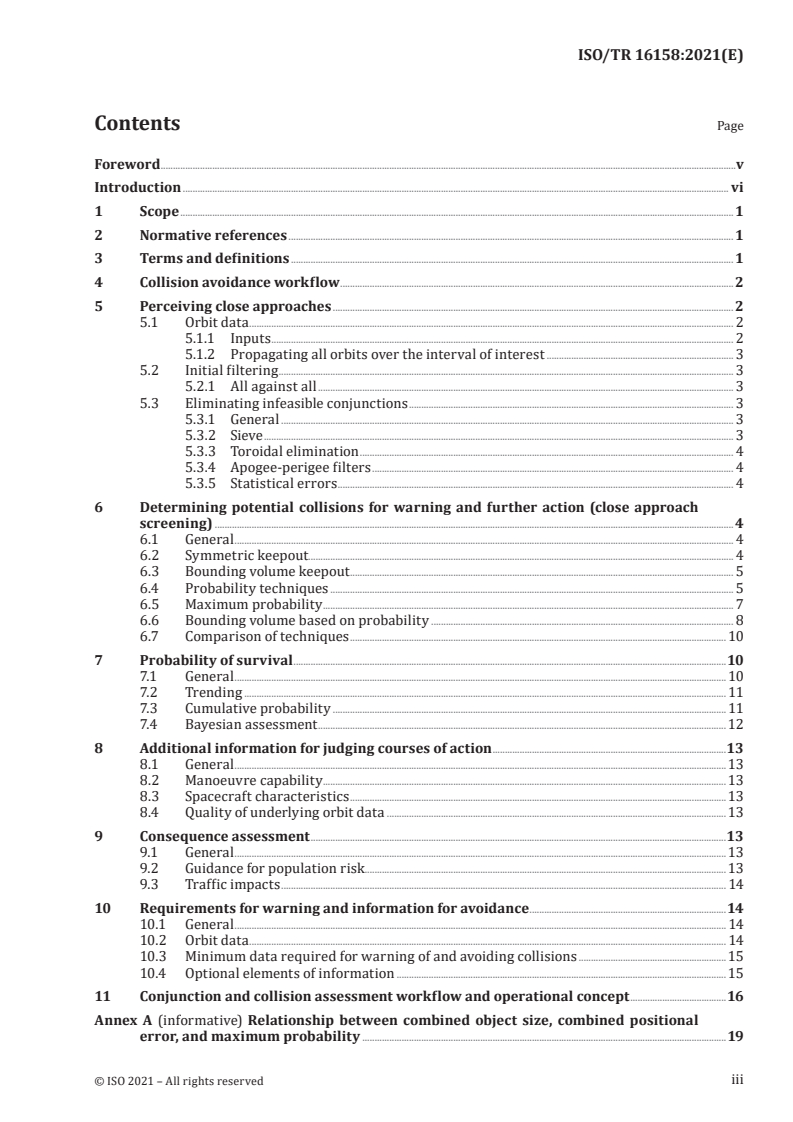
Contents Page
Foreword .v
Introduction . vi
1 Scope . 1
2 Normative references . 1
3 Terms and definitions . 1
4 Collision avoidance workflow .2
5 Perceiving close approaches . 2
5.1 Orbit data . 2
5.1.1 Inputs . 2
5.1.2 Propagating all orbits over the interval of interest . 3
5.2 Initial filtering . 3
5.2.1 All against all . 3
5.3 Eliminating infeasible conjunctions . 3
5.3.1 General . 3
5.3.2 Sieve . 3
5.3.3 Toroidal elimination . 4
5.3.4 Apogee-perigee filters . 4
5.3.5 Statistical errors . 4
6 Determining potential collisions for warning and further action (close approach
screening) . 4
6.1 General . 4
6.2 Symmetric keepout. 4
6.3 Bounding volume keepout . 5
6.4 Probability techniques . 5
6.5 Maximum probability . 7
6.6 Bounding volume based on probability . 8
6.7 Comparison of techniques . 10
7 Probability of survival .10
7.1 General . 10
7.2 Trending . 11
7.3 Cumulative probability . 11
7.4 Bayesian assessment . 12
8 Additional information for judging courses of action .13
8.1 General .13
8.2 Manoeuvre capability . 13
8.3 Spacecraft characteristics .13
8.4 Quality of underlying orbit data . 13
9 Consequence assessment .13
9.1 General .13
9.2 Guidance for population risk . . 13
9.3 Traffic impacts . 14
10 Requirements for warning and information for avoidance .14
10.1 General . 14
10.2 Orbit data . 14
10.3 Minimum data required for warning of and avoiding collisions . 15
10.4 Optional elements of information . 15
11 Conjunction and collision assessment workflow and operational concept .16
Annex A (informative) Relationship between combined object size, combined positional
error, and maximum probability .19
iii
Annex B (informative) Probability contour visualization .21
Bibliography .31
iv
Foreword
ISO (the International Organization for Standardization) is a worldwide federation of national standards
bodies (ISO member bodies). The work of preparing International Standards is normally carried out
through ISO technical committees. Each member body interested in a subject for which a technical
committee has been established has the right to be represented on that committee. International
organizations, governmental and non-governmental, in liaison with ISO, also take part in the work.
ISO collaborates closely with the International Electrotechnical Commission (IEC) on all matters of
electrotechnical standardization.
The procedures used to develop this document and those intended for its further maintenance are
described in the ISO/IEC Directives, Part 1. In particular, the different approval criteria needed for the
different types of ISO documents should be noted. This document was drafted in accordance with the
editorial rules of the ISO/IEC Directives, Part 2 (see www.iso.org/directives).
Attention is drawn to the possibility that some of the elements of this document may be the subject of
patent rights. ISO shall not be held responsible for identifying any or all such patent rights. Details of
any patent rights identified during the development of the document will be in the Introduction and/or
on the ISO list of patent declarations received (see www.iso.org/patents).
Any trade name used in this document is information given for the convenience of users and does not
constitute an endorsement.
For an explanation of the voluntary nature of standards, the meaning of ISO specific terms and
expressions related to conformity assessment, as well as information about ISO's adherence to
the World Trade Organization (WTO) principles in the Technical Barriers to Trade (TBT), see
www.iso.org/iso/foreword.html.
This document was prepared by Technical Committee ISO/TC 20, Aircraft and space vehicles,
Subcommittee SC 14, Space systems and operations.
This second edition cancels and replaces the first edition (ISO/TR 16158:2013), which has been
technically revised.
The main changes compared to the previous edition are as follows:
— improved figures for clarity;
— added plot of maximum probability;
— switched to “decimal comma” per ISO editorial rules;
— simplified operational concepts figures;
— added informative annexes containing collision probability relational nomograms;
— added collision probability topology in both graphical and tabular look-up formats;
— reordered the bibliography.
Any feedback or questions on this document should be directed to the user’s national standards body. A
complete listing of these bodies can be found at www.iso.org/members.html.
v
Introduction
This document describes the workflow for perceiving and avoiding collisions among orbiting objects,
data requirements for these tasks, techniques that can be used to estimate the probability of collision
and guidance for executing avoidance manoeuvres. Diligent collaboration is strongly encouraged
among all who operate satellites.
The process begins with the best possible trajectory data, provided by satellite operators or sensor
systems developed for this purpose. The orbits of satellites can be compared with each other to discern
physically feasible approaches that can result in collisions. The trajectories so revealed can then be
examined more closely to estimate the probability of collision. Where the possibility of a collision
has been identified within the criteria established by each satellite operator, the spectrum of feasible
manoeuvres is examined.
There are several different approaches to conjunction assessment. All have merits and deficiencies.
Most focus on how closely satellites approach each other. This is often very uncertain since satellite
orbits generally change more rapidly under the influence of non-conservative forces than observations
of satellites in orbit can be acquired and employed to improve orbit estimates. Spacecraft operators
require the fullness of orbit data to judge the credibility and quality of conjunction perception. This
information includes the moment of time of the last elaboration of orbit (the epoch) and the standard
time scale employed, state vector value or elements of orbit at this moment of time, the coordinate
system description that presents the orbital data, the forces model description that was used for orbital
plotting, and information about the estimation errors of the orbital parameters. Essential elements of
information for this purpose are specified in ISO 26900.
There are also diverse approaches to estimating the probability that a close approach can really result
in a collision. This is a statistical process very similar to weather forecasting. Meteorologists no longer
make definitive predictions. They provide the probability of precipitation, not whether it will rain. All
conjunction assessment approaches are in some way founded in probabilities. Probability of collision
is also a highly desirable element of data. It can be accompanied by metadata that allows operators to
interpret the information within their own operational procedures.
How near satellites can be to each other and the probability they can collide if they were that close
are only two discriminants of potentially catastrophic events. Since the objective is that the satellite
survives despite many potential close approaches, cumulative probability of survival is also important
information. Responding precipitously to the close approach nearest at hand can only delay the demise
of the satellite or even contribute to a subsequent more serious event. The evolution of close approaches
and the cumulative probability that a satellite can survive are also important.
Finally, the state of each of the conjunction partners, their ability to manoeuvre or otherwise avoid
contact, and the outcomes of past events that are similar guide courses of action.
vi
TECHNICAL REPORT ISO/TR 16158:2021(E)
Space systems — Avoiding collisions among orbiting
objects
1 Scope
This document is a guide for establishing essential collaborative enterprises to sustain the space
environment and employ it effectively.
This document describes some widely used techniques for perceiving close approaches, estimating
collision probability, estimating the cumulative probability of survival, and manoeuvring to avoid
collisions.
NOTE Satellite operators accept that all conjunction and collision assessment techniques are statistical.
All suffer false positives and/or missed detections. The degree of uncertainty in the estimated outcomes is not
uniform across all satellite orbits or all assessment intervals. No comparison within a feasible number of test
cases can reveal the set of techniques that is uniformly most appropriate for all.
2 Normative references
There are no normative references in this document.
3 Terms and definitions
For the purposes of this document, the following terms and definitions apply.
ISO and IEC maintain terminology databases for use in standardization at the following addresses:
— ISO Online browsing platform: available at https:// www .iso .org/ obp
— IEC Electropedia: available at https:// www .electropedia .org/
3.1
collision
act of colliding; instance of one object striking another
3.2
conjunction
apparent meeting or passing of two or more objects in space
3.3
covariance
measure of how much variables change together
Note 1 to entry: For multiple dependent variables, a square, symmetric, positive definite matrix of dimensionality
N × N, where N is the number of variables.
3.4
encounter plane
plane normal to the relative velocity at the time of closest approach
3.5
ephemeris
time-ordered set of position and velocity within which one interpolates to estimate the position and
velocity at intermediate times
3.6
false alarm
statistical Type I error, when a statistical test fails to reject a false null hypothesis
3.7
interface control document
ICD
specification that describes the characteristics that can be controlled at the boundaries between
systems, subsystems, and other elements
3.8
operational concept
roles, relationships, and information flows among tasks and stakeholders and the way systems and
processes will be used
3.9
orbital elements
parameters that describe the evolution of the trajectory and which can be used to estimate the
trajectory in the future
4 Collision avoidance workflow
The avoidance process begins with orbit data, the content of which is specified in ISO 26900. The data
can be provided by collaborating satellite operators and from observers who are capable of viewing
satellites. It is also important to know the nature of each object if possible. This information includes
size, mass, geometry, and the operational state (e.g. active or inactive). Finally, collision probability
estimates consider the inevitable imprecision associated with orbit determination and other hypotheses
and measurements. Figure 1 depicts this top-level workflow.
Figure 1 — Top-level collision avoidance workflow
5 Perceiving close approaches
5.1 Orbit data
5.1.1 Inputs
Inputs to conjunction assessment are principally data that specify the trajectories of the objects of
interest. These are one of three types of information: orbital elements, ephemerides, or observations
of satellites. Orbital elements in this context include parameters that describe the evolution of the
trajectory and which can be used to estimate the trajectory in the future. They are derived from past
observations of satellites. Ephemerides are time-ordered sets of position and velocity within which one
interpolates to estimate the position and velocity at intermediate times. Ephemerides need to span the
future time interval of interest, where the equations of motion having been propagated by the provider.
Observations are measurements of satellite position and velocity from one or more well-characterized
and registered instruments. The recipient can use those observations to estimate the evolution of the
trajectory either through direct numerical integration of governing equations or by developing orbital
elements for subsequent propagation. ISO/TR 11233 describes the way a provider's orbit determination
scheme is codified. There are normative formats for orbital elements and ephemerides (see ISO 26900).
See CCSDS 503.0-B-2 for normative formats for transmitting observations.
It is extremely important to realize that trajectory estimates are derived from measurements that
cannot be precise such as spheres. Therefore, they are called “estimates.” The input information can
include characterized uncertainties. Uncertainty in any of the independent variables or parameters
introduces imprecision in all the dependent variables that describe the evolution. The appropriate
expression of uncertainty is, therefore, a square matrix whose dimension is the number of elements of
the state, called a state vector. If uncertainties are not provided or are wrong, one cannot determine
properly the probability that two objects can collide.
5.1.2 Propagating all orbits over the interval of interest
All orbits being under consideration are best forecasted by the model in which they were created.
Since orbit determination and propagation are uncertain, the propagation scheme can be well suited
for this interval. ANSI/AIAA S-131-2010 is a normative reference for orbit propagation. Osculating
orbit estimates grow imprecise over time intervals long compared to the time span of underlying
observations. This imprecision is sufficient to make collision probabilities misleading. Therefore,
conjunction assessment in low Earth orbit is unreliable at the present state of the art for periods longer
than approximately one week beyond the latest orbit determination, depending on the orbit of interest.
Some particularly stable orbits can be estimated reliably for longer periods. Probability of collision
can be estimated over long periods using consistent statistical descriptions of satellite orbits and the
evolution of the debris environment. These techniques estimate whether a conjunction will occur or not
but cannot expose which specific objects can be involved.
5.2 Initial filtering
5.2.1 All against all
The most complete process would examine each object in orbit against all others over the designated
time span. Most techniques eliminate A-B duplication, defined as screening B against A in addition to A
against B. Therefore, the number of screenings necessary is not the factorial of the number of satellites.
It is impossible to know how many objects orbit the Earth. Many escape perception. The best a satellite
operator can do is to consider those that have been detected. One cannot screen against unknown
objects that one estimates can be present.
5.3 Eliminating infeasible conjunctions
5.3.1 General
Much of the population in orbit physically cannot encounter many other satellites during the period of
interest. For example, even if uncontrolled, geostationary satellites 180 degrees apart in longitude are
not threats to each other.
5.3.2 Sieve
Sieve techniques employ straightforward geometric and kinematic processes to narrow the spectrum
of feasible conjunctions based on the minimum separation between orbits. They are based variously
on orbit geometry, numerical relative distance functions, and actual orbit propagation. The concept is
to examine proximity of one satellite to another sequentially in parameter space beginning with the
parameter that most effectively discriminates separation distance. To account for approximations
in orbit analysis, a distance buffer (pad) can be added to the filter screening distance threshold. For
example, if in-track separation is likely to be the best indicator of separation, satellites that are far apart
in-track do not need to be screened further cross-track. They differ in computational efficiency and
the degree to which close approaches are all perceived. There is no normative approach since different
techniques are satisfactory for different satellites and operator judgements.
5.3.3 Toroidal elimination
Toroidal elimination eliminates objects by determining which mean orbits can touch a toroidal volume
defined by the orbit of the satellite of interest and a keepout volume cross-sectional area.
5.3.4 Apogee-perigee filters
This approach eliminates satellites whose apogees are lower than the perigee of the satellite of
interest and perigees are sufficiently greater than the apogee of the satellite of interest. The criterion
for sufficiency is based either on operator experience or risk tolerance. Risk can be quantified with
techniques of signal detection and receiver operating characteristics discussed subsequently.
Volumetric screening is of the same nature, eliminating satellites whose orbits are outside the volume
of space described by the orbit of the satellite of interest.
5.3.5 Statistical errors
Since each of these techniques relies on trajectory information that is imprecise, these filters will suffer
from Type I failure to identify real threats and Type II errors (including satellites that are not threats).
Filter parameter selection is based on the user's tolerance for both kinds of errors. Every filtering
scheme will include events that can have been discarded and discarded events that ought to have been
included.
6 Determining potential collisions for warning and further action (close
approach screening)
6.1 General
Initial filtering provides little information for mitigating collisions. The next task is judging whether
the actual states of the involved satellites are sufficiently threatening. The first step is determining
whether satellites come extremely close to each other. This is the judgement of each satellite operator. It
can be based on satellite sizes, the consequences of a collision, the confidence one has in orbit estimates
and propagation, and other subjective factors. As with initial filtering, even this more refined level of
discrimination will miss some threats. The possibility of false alarms and missed detections increases
the farther in the future one extrapolates.
6.2 Symmetric keepout
The most straightforward keepout volume is symmetric. These are easiest to implement but can
encompass considerably more than the vulnerable geometry of the satellite. These can be spheres,
cubes, or any other three-dimensional volumes of operator-judged size. The satellite of interest can be
enveloped symmetrically, and osculating orbits of other satellites tested for penetrating the volume.
Alternatively, the bounding volumes of both satellites can be screened for intersection. This is generally
the most conservative approach, identifying as potential collisions requiring action many events that
are extremely improbable.
6.3 Bounding volume keepout
This approach envelops the satellite of interest in a volume that is not symmetric. The volume can be
ellipsoidal, a rectangular parallelepiped, or a shape composed of surfaces nearly conformal with the
satellite. The geometry of the bounding volume can be based on operator experience. For example, one
can use consistent orbit uncertainties along track, radial from Earth Center, and normal to the plane
defined by both directions. The volume can also be determined from more exhaustive probabilistic
calculations that are too resource intensive to use frequently.
6.4 Probability techniques
The probability that two objects separated by a given distance at closest approach would actually
collide is assessed as the integral of the intersection of the objects' position probability densities as a
function of time.
All satellite orbits are imprecise. Approximations to physical processes (process noise) and imprecise
observations of satellite states of motion (measurement noise) lead to imprecise estimates of the future
states of satellites. The imprecision is represented by variances and covariances of the dependent
parameters among each other. These form a covariance matrix. It represents generally mean squared
deviations of estimated (expected) values of each dependent variable from those inferred from
measurements. A covariance matrix is symmetric and positive-definite if all of the variables are
independent.
When the duration of a conjunction is very short with respect to the time it takes for the satellites to
move through the covariance volume, the collision path can be assumed a straight line. Since satellite
position is the quantity of interest in that case, the covariance volume for estimating the location of
an object is the 3 × 3 position submatrix of the full covariance. These concepts are described in ANSI/
AIAA S-131-2010.
When the duration of the encounter is comparable to or greater than the distance satellites move in a
unit time, the collision path is not straight, the relative velocity cannot be assumed linear, and a more
complete position and velocity submatrix is required, at least 6 × 6.
Satellite orbits and covariances are propagated or interpolated over the future interval of interest,
depending on whether the orbit is state vector and covariance at the initiation time or whether the
orbit data are ephemerides and covariances already determined at time increments over the interval of
interest. The probability of collision is determined at each time increment.
The complex mathematical process of determining whether the covariance volumes of two objects
touch or intersect and the methods for determining the volume of the intersection are described in
normative and informative documents. The process reduces to combining the covariance volumes of
both objects in the direction of the relative velocity between the objects and determining the volume
contained within a cylinder whose cross section is the combined areas of both objects. Figure 2 depicts
the geometry of the problem.
Key
1 encounter plane
2 combined covariance ellipsoid shell
3 combined spherical object
4 relative path (collision tube)
5 relative velocity
Figure 2 — The collision estimation problem
The process depicted is valid when the rate at which the encounter occurs is small compared to the
relative velocity. The collision tube can be assumed linear. When the encounter occurs over a long time
compared to that in which the object would move a distance comparable to the longest dimension of the
covariance volume, the collision tube cannot be assumed to be straight. Bending can be accommodated
consistent with the change in relative orbit curvature of one of the objects relative to the other over the
encounter interval. This is the case for conjunctions among geostationary objects and conjunctions in
other orbital regimes having slow closing velocity with respect to orbital velocity.
The covariance ellipsoid can be reduced to a sphere by normalizing its dimensions by the variance
in each orthogonal axis. This is called Mahalanobis space. Since all cross sections are affine, scaled
transformations of a circle, the problem is reduced to determining an area in a two-dimensional space.
Informative references describe the formalism.
In the two-dimensional reduction, the collision probability is
P (1)
max
where
r
is the combined object radius;
d
lies along the minor axis;
A lies along the major axis;
r
P and P ′′ are the respective components of the projected miss distance;
k k
are the corresponding standard deviations.
xx− yy−
1
mm
− + dy dx
2 σσ
C Cx−
1 xy
HBR HBR
Pe= ⋅
∫ ∫
−C −−Cx
2⋅⋅π σσ⋅
HBR HBR
xy
and C
HBR
There are several numerical techniques for determining the volume whose value is the collision
probability. The mathematical statement is well documented in communication and signal detection
theory. The most widely used numerical approximations to this integral are due to Foster, Chan, Patera,
and Alfano. These have all been evaluated over wide ranges of governing parameters (miss distance,
variances, object sizes, covariance aspect ratios) to provide relationship plots (called “nomograms”) in
Annex A.
6.5 Maximum probability
A significant amount of information is required to estimate the probability that two satellites can
collide. This includes the external architecture of the satellite, its attitude, and specific characteristics
of both the osculating orbit and the uncertainty in that orbit. Much of this is not available realistically;
and it can be infeasible to seek it in a reasonable amount of time. There are two approaches to mitigate
this uncertainty while still developing meaningful and trustworthy measures of risk. The first is
maximum probability.
Trustworthy and realistic covariances are the essence of probability estimates. There are many reasons
for covariances not being trustworthy or realistic. For example, the observations from which orbits are
determined can be correlated because of tracking procedures. Much of the orbit uncertainty will be
suppressed artificially. Process models can be deficient or the essential matches among observation
frequency, mathematical sampling, physical approximations, and numerical procedures can be faulty.
It is well known that the joint probability that two objects occupy the same location in phase space has
a maximum as a function of covariance dimensions. Physically, if the two orbits have been estimated
precisely, it is extremely unlikely that the satellites would collide for separations greater than the
sum of both cross-section dimensions. Conversely, if the orbits are not very precise, the objects can be
anywhere within large volumes; and the probability that they were in the same place is small.
Figure 3 demonstrates maximum probability in a representative situation. There is a unique value
of combined covariance for which the probability is a maximum and a corresponding unique mean
separation between the satellites. Note that the actual probability decreases dramatically on either
side of the maximum. Therefore, the maximum probability is always very conservative. In the dilution
region, probabilities decrease because we are very uncertain as opposed to the small probabilities
before the maximum, which occur because we are certain where the satellites can be.
Key
X σ - 1 sigma combined positional deviation (KM)
x
Y probability
1 maximum probability
2 same probability value occurs twice
3 dilution region
Figure 3 — Maximum probability and associated dilution region
6.6 Bounding volume based on probability
An alternative to mitigating lack of information is the exhaustive and methodical development of a
straightforward bounding volume that encompasses as much of the high-probability collision events as
is reasonable. This technique can be applied to every satellite of interest and is most practical when an
operator is responsible for only a few satellites. However, once an interested and responsible operator
has determined the appropriate bounding volume for his satellites, that volume can be shared and
employed whenever other observers and providers consider that satellite.
Figure 4 demonstrates the bounding volume determined for the Jules Verne automated transfer vehicle
(ATV) based on extensive synthesis of collision circumstances. Table 1 demonstrates that a large,
conservative bounding volume has both a high rate of detection for high-probability collisions and
a correspondingly high rate of false alarms. Conversely, a smaller volume can have a low probability
of detection but also a low probability of false alarms. Generally, operators are well advised to be
conservative rather than risk missing potentially catastrophic events.
Key
1 conjunction partner’s spacecraft velocity
2 owner’s spacecraft velocity
3 relative velocity
4 encounter plane
5 exclusion zone designed to capture threatening conjunctions
Figure 4 — Automated transfer vehicle exclusion zone
Table 1 — Probabilities of detection and probabilities of false alarm for different bounding
volumes
USAF catalog number 11332 26847 26063
Probability Alerts Probability Alerts Probability Alerts
Exclusion zone
of detection per year of detection per year of detection per year
3 km sphere 0,44 0,2 0,24 0,3 0,08 0,7
10 km sphere 0,86 5,5 0,63 3,7 0,23 4,9
(10 × 25 × 10) km box 0,92 3,6 0,78 6,7 0,28 10,1
NASA “pizza box”
0,98 0,4 0,93 0,4 0,33 1,4
(0,75 × 25 × 25) km box
a
NASA “hockey puck” cylinder 0,99 3,6 0,94 5 0,37 7,5
b
ATV-CC sweeping rectangle 1 3,6 0,99 5 0,39 7,5
Box formerly used by
1 7,6 0,97 9,8 0,42 11,1
c
USSTRATCOM
a
NASA “hockey puck” radially aligned cylinder 10 km in height and 30 km in diameter.
b
ATV-CC rectangle that is 60 km long and 10 km wide.
c
USSTRATCOM box that is 38 km along radial direction and 40 km along intrack and crosstrack directions.
6.7 Comparison of techniques
Each assessment and collision probability technique will lead to a different outcome. Figure 5 illustrates
the possibilities for a real conjunction between AMC-11 and XM-3, 29 Jan 2011, 10:35 UTC.
a) NASA (0,75 × 5 × 5) km pizza box b) (5 × 5 × 25) km parallelepiped
c) intersecting covariance ellipsoids d) 3 km diameter sphere
Figure 5 — Comparison of different screening and assessment techniques
Each screening and analysis technique will perceive events differently. These include the so-called
NASA pizza box [(0,75 × 5 × 5) km parallelepiped], a (5 × 5 × 25) km parallelepiped, covariance ellipsoids
and a 3 km diameter sphere. The bounding value is centred on one of the satellites. Some perceive the
close approach of one satellite to other as a threat; some do not.
The differences in screening and assessment approaches make it necessary that those who receive
warnings also be informed of the screening and assessment techniques that led to the warning.
7 Probability of survival
7.1 General
The goal of the analysis to avoid collisions is that the satellite of interest survives the estimation time
interval. The highest probability collision or the one with the minimum separation distance over the
time interval generally are not the only conjunctions. Operators wish their satellites not to experience
any collisions; and there is a probability that each conjunction can lead to a collision. As orbit estimates
evolve with new observations, close approach geometry and epoch will change. The closer the estimated
epoch is to the estimated time of closest approach, the more accurate the estimate. Close approaches,
even those with notable probability of collision, estimated to occur weeks from the estimated epoch
hence almost never materialize.
7.2 Trending
Trending is following the progress of close approach between two satellites over the time interval of
interest. Figure 6 is an example of the evolution of such a conjunction based on relative range at the
time of closest approach (TCA). The trend that a close approach distance exhibits over the estimation
interval indicates decreasing separation; hence, reason for concern. Probability of collision can increase
or decrease over time. Increasing probability of collision and decreasing separation are causes for
concern and preventive action. It is very important to understand that a single discriminant is seldom
sufficient for a confident assessment.
Key
X # days to conjunction
Y1 range (km)
Y2 N sigma
Y3 probability
1 min. range
2 N sigma
3 true probability
Figure 6 — Trend of close approach between two satellites
A more effective and meaningful method for trending both miss distance and estimated collision
probability is provided in Annex B, where probability contours and tables of collision probability are
provided as a function of covariance scaling and miss distance.
In addition to the short-term trending of conjunction miss distance associated with a single conjunction
event, satellite operators can also minimize collision risk via monitoring and long-term trending of
multiple close approach events for all pairings of their operational satellites with each other and with
the rest of the orbital population. This is especially effective in the GEO regime or in constellations
having common altitude ranges, where recurring close approaches can signal a long-term collision
threat.
Conjunction assessment and collision avoidance require continuous vigilance for near-term events
that can require unanticipated manoeuvres and long-term monitoring for numerous close approaches
that can be mitigated by collaborative stationkeeping among those who occupy the same assigned
longitudinal slot.
7.3 Cumulative probability
The principle of cumulative probability accrues the probability that a single satellite will survive
the analysis time subject to all close approaches that it can experience in that interval. Each close
approach taken in the order that they occur has a probability that a collision will occur and its
complement, the probability that there will be no collision. If the satellite survives the first encounter,
there are corresponding probabilities of demise or survival for the next encounter, and so on. Figure 7
demonstrates this chain for a real satellite in the past.
Figure 7 — Cumulative probability hierarchy
The sum of possibilities after each successive encounter can be unity since the satellite will have
survived or not. The process at each stage reveals the probability that the satellite would have survived
one, two, or more of a sequence of encounters. These can be successive encounters with the same object
over time.
It is possible that the cumulative probability of demise over several successive encounters can exceed
the threshold of concern even though none of the individual encounters can have individual probability
of collision above threshold.
The current threat is not the only threat; and a threat far in the future is not as credible as a threat near
at hand.
7.4 Bayesian assessment
Bayesian assessment exploits the fundamental principles of conditional probability and multi-
discriminant signal detection. Bayesian concepts systematically assess the probability that a given
outcome is associated with a set of observables. The observables are called discriminants. The
discriminants can include physical observables such as minimum close approach separation between
two satellites, the largest probability of collisi
...
TECHNICAL ISO/TR
REPORT 16158
Second edition
2021-10
Space systems — Avoiding collisions
among orbiting objects
Systèmes spatiaux — Évitement des collisions entre objets en orbite
Reference number
© ISO 2021
All rights reserved. Unless otherwise specified, or required in the context of its implementation, no part of this publication may
be reproduced or utilized otherwise in any form or by any means, electronic or mechanical, including photocopying, or posting on
the internet or an intranet, without prior written permission. Permission can be requested from either ISO at the address below
or ISO’s member body in the country of the requester.
ISO copyright office
CP 401 • Ch. de Blandonnet 8
CH-1214 Vernier, Geneva
Phone: +41 22 749 01 11
Email: copyright@iso.org
Website: www.iso.org
Published in Switzerland
ii
Contents Page
Foreword .v
Introduction . vi
1 Scope . 1
2 Normative references . 1
3 Terms and definitions . 1
4 Collision avoidance workflow .2
5 Perceiving close approaches . 2
5.1 Orbit data . 2
5.1.1 Inputs . 2
5.1.2 Propagating all orbits over the interval of interest . 3
5.2 Initial filtering . 3
5.2.1 All against all . 3
5.3 Eliminating infeasible conjunctions . 3
5.3.1 General . 3
5.3.2 Sieve . 3
5.3.3 Toroidal elimination . 4
5.3.4 Apogee-perigee filters . 4
5.3.5 Statistical errors . 4
6 Determining potential collisions for warning and further action (close approach
screening) . 4
6.1 General . 4
6.2 Symmetric keepout. 4
6.3 Bounding volume keepout . 5
6.4 Probability techniques . 5
6.5 Maximum probability . 7
6.6 Bounding volume based on probability . 8
6.7 Comparison of techniques . 10
7 Probability of survival .10
7.1 General . 10
7.2 Trending . 11
7.3 Cumulative probability . 11
7.4 Bayesian assessment . 12
8 Additional information for judging courses of action .13
8.1 General .13
8.2 Manoeuvre capability . 13
8.3 Spacecraft characteristics .13
8.4 Quality of underlying orbit data . 13
9 Consequence assessment .13
9.1 General .13
9.2 Guidance for population risk . . 13
9.3 Traffic impacts . 14
10 Requirements for warning and information for avoidance .14
10.1 General . 14
10.2 Orbit data . 14
10.3 Minimum data required for warning of and avoiding collisions . 15
10.4 Optional elements of information . 15
11 Conjunction and collision assessment workflow and operational concept .16
Annex A (informative) Relationship between combined object size, combined positional
error, and maximum probability .19
iii
Annex B (informative) Probability contour visualization .21
Bibliography .31
iv
Foreword
ISO (the International Organization for Standardization) is a worldwide federation of national standards
bodies (ISO member bodies). The work of preparing International Standards is normally carried out
through ISO technical committees. Each member body interested in a subject for which a technical
committee has been established has the right to be represented on that committee. International
organizations, governmental and non-governmental, in liaison with ISO, also take part in the work.
ISO collaborates closely with the International Electrotechnical Commission (IEC) on all matters of
electrotechnical standardization.
The procedures used to develop this document and those intended for its further maintenance are
described in the ISO/IEC Directives, Part 1. In particular, the different approval criteria needed for the
different types of ISO documents should be noted. This document was drafted in accordance with the
editorial rules of the ISO/IEC Directives, Part 2 (see www.iso.org/directives).
Attention is drawn to the possibility that some of the elements of this document may be the subject of
patent rights. ISO shall not be held responsible for identifying any or all such patent rights. Details of
any patent rights identified during the development of the document will be in the Introduction and/or
on the ISO list of patent declarations received (see www.iso.org/patents).
Any trade name used in this document is information given for the convenience of users and does not
constitute an endorsement.
For an explanation of the voluntary nature of standards, the meaning of ISO specific terms and
expressions related to conformity assessment, as well as information about ISO's adherence to
the World Trade Organization (WTO) principles in the Technical Barriers to Trade (TBT), see
www.iso.org/iso/foreword.html.
This document was prepared by Technical Committee ISO/TC 20, Aircraft and space vehicles,
Subcommittee SC 14, Space systems and operations.
This second edition cancels and replaces the first edition (ISO/TR 16158:2013), which has been
technically revised.
The main changes compared to the previous edition are as follows:
— improved figures for clarity;
— added plot of maximum probability;
— switched to “decimal comma” per ISO editorial rules;
— simplified operational concepts figures;
— added informative annexes containing collision probability relational nomograms;
— added collision probability topology in both graphical and tabular look-up formats;
— reordered the bibliography.
Any feedback or questions on this document should be directed to the user’s national standards body. A
complete listing of these bodies can be found at www.iso.org/members.html.
v
Introduction
This document describes the workflow for perceiving and avoiding collisions among orbiting objects,
data requirements for these tasks, techniques that can be used to estimate the probability of collision
and guidance for executing avoidance manoeuvres. Diligent collaboration is strongly encouraged
among all who operate satellites.
The process begins with the best possible trajectory data, provided by satellite operators or sensor
systems developed for this purpose. The orbits of satellites can be compared with each other to discern
physically feasible approaches that can result in collisions. The trajectories so revealed can then be
examined more closely to estimate the probability of collision. Where the possibility of a collision
has been identified within the criteria established by each satellite operator, the spectrum of feasible
manoeuvres is examined.
There are several different approaches to conjunction assessment. All have merits and deficiencies.
Most focus on how closely satellites approach each other. This is often very uncertain since satellite
orbits generally change more rapidly under the influence of non-conservative forces than observations
of satellites in orbit can be acquired and employed to improve orbit estimates. Spacecraft operators
require the fullness of orbit data to judge the credibility and quality of conjunction perception. This
information includes the moment of time of the last elaboration of orbit (the epoch) and the standard
time scale employed, state vector value or elements of orbit at this moment of time, the coordinate
system description that presents the orbital data, the forces model description that was used for orbital
plotting, and information about the estimation errors of the orbital parameters. Essential elements of
information for this purpose are specified in ISO 26900.
There are also diverse approaches to estimating the probability that a close approach can really result
in a collision. This is a statistical process very similar to weather forecasting. Meteorologists no longer
make definitive predictions. They provide the probability of precipitation, not whether it will rain. All
conjunction assessment approaches are in some way founded in probabilities. Probability of collision
is also a highly desirable element of data. It can be accompanied by metadata that allows operators to
interpret the information within their own operational procedures.
How near satellites can be to each other and the probability they can collide if they were that close
are only two discriminants of potentially catastrophic events. Since the objective is that the satellite
survives despite many potential close approaches, cumulative probability of survival is also important
information. Responding precipitously to the close approach nearest at hand can only delay the demise
of the satellite or even contribute to a subsequent more serious event. The evolution of close approaches
and the cumulative probability that a satellite can survive are also important.
Finally, the state of each of the conjunction partners, their ability to manoeuvre or otherwise avoid
contact, and the outcomes of past events that are similar guide courses of action.
vi
TECHNICAL REPORT ISO/TR 16158:2021(E)
Space systems — Avoiding collisions among orbiting
objects
1 Scope
This document is a guide for establishing essential collaborative enterprises to sustain the space
environment and employ it effectively.
This document describes some widely used techniques for perceiving close approaches, estimating
collision probability, estimating the cumulative probability of survival, and manoeuvring to avoid
collisions.
NOTE Satellite operators accept that all conjunction and collision assessment techniques are statistical.
All suffer false positives and/or missed detections. The degree of uncertainty in the estimated outcomes is not
uniform across all satellite orbits or all assessment intervals. No comparison within a feasible number of test
cases can reveal the set of techniques that is uniformly most appropriate for all.
2 Normative references
There are no normative references in this document.
3 Terms and definitions
For the purposes of this document, the following terms and definitions apply.
ISO and IEC maintain terminology databases for use in standardization at the following addresses:
— ISO Online browsing platform: available at https:// www .iso .org/ obp
— IEC Electropedia: available at https:// www .electropedia .org/
3.1
collision
act of colliding; instance of one object striking another
3.2
conjunction
apparent meeting or passing of two or more objects in space
3.3
covariance
measure of how much variables change together
Note 1 to entry: For multiple dependent variables, a square, symmetric, positive definite matrix of dimensionality
N × N, where N is the number of variables.
3.4
encounter plane
plane normal to the relative velocity at the time of closest approach
3.5
ephemeris
time-ordered set of position and velocity within which one interpolates to estimate the position and
velocity at intermediate times
3.6
false alarm
statistical Type I error, when a statistical test fails to reject a false null hypothesis
3.7
interface control document
ICD
specification that describes the characteristics that can be controlled at the boundaries between
systems, subsystems, and other elements
3.8
operational concept
roles, relationships, and information flows among tasks and stakeholders and the way systems and
processes will be used
3.9
orbital elements
parameters that describe the evolution of the trajectory and which can be used to estimate the
trajectory in the future
4 Collision avoidance workflow
The avoidance process begins with orbit data, the content of which is specified in ISO 26900. The data
can be provided by collaborating satellite operators and from observers who are capable of viewing
satellites. It is also important to know the nature of each object if possible. This information includes
size, mass, geometry, and the operational state (e.g. active or inactive). Finally, collision probability
estimates consider the inevitable imprecision associated with orbit determination and other hypotheses
and measurements. Figure 1 depicts this top-level workflow.
Figure 1 — Top-level collision avoidance workflow
5 Perceiving close approaches
5.1 Orbit data
5.1.1 Inputs
Inputs to conjunction assessment are principally data that specify the trajectories of the objects of
interest. These are one of three types of information: orbital elements, ephemerides, or observations
of satellites. Orbital elements in this context include parameters that describe the evolution of the
trajectory and which can be used to estimate the trajectory in the future. They are derived from past
observations of satellites. Ephemerides are time-ordered sets of position and velocity within which one
interpolates to estimate the position and velocity at intermediate times. Ephemerides need to span the
future time interval of interest, where the equations of motion having been propagated by the provider.
Observations are measurements of satellite position and velocity from one or more well-characterized
and registered instruments. The recipient can use those observations to estimate the evolution of the
trajectory either through direct numerical integration of governing equations or by developing orbital
elements for subsequent propagation. ISO/TR 11233 describes the way a provider's orbit determination
scheme is codified. There are normative formats for orbital elements and ephemerides (see ISO 26900).
See CCSDS 503.0-B-2 for normative formats for transmitting observations.
It is extremely important to realize that trajectory estimates are derived from measurements that
cannot be precise such as spheres. Therefore, they are called “estimates.” The input information can
include characterized uncertainties. Uncertainty in any of the independent variables or parameters
introduces imprecision in all the dependent variables that describe the evolution. The appropriate
expression of uncertainty is, therefore, a square matrix whose dimension is the number of elements of
the state, called a state vector. If uncertainties are not provided or are wrong, one cannot determine
properly the probability that two objects can collide.
5.1.2 Propagating all orbits over the interval of interest
All orbits being under consideration are best forecasted by the model in which they were created.
Since orbit determination and propagation are uncertain, the propagation scheme can be well suited
for this interval. ANSI/AIAA S-131-2010 is a normative reference for orbit propagation. Osculating
orbit estimates grow imprecise over time intervals long compared to the time span of underlying
observations. This imprecision is sufficient to make collision probabilities misleading. Therefore,
conjunction assessment in low Earth orbit is unreliable at the present state of the art for periods longer
than approximately one week beyond the latest orbit determination, depending on the orbit of interest.
Some particularly stable orbits can be estimated reliably for longer periods. Probability of collision
can be estimated over long periods using consistent statistical descriptions of satellite orbits and the
evolution of the debris environment. These techniques estimate whether a conjunction will occur or not
but cannot expose which specific objects can be involved.
5.2 Initial filtering
5.2.1 All against all
The most complete process would examine each object in orbit against all others over the designated
time span. Most techniques eliminate A-B duplication, defined as screening B against A in addition to A
against B. Therefore, the number of screenings necessary is not the factorial of the number of satellites.
It is impossible to know how many objects orbit the Earth. Many escape perception. The best a satellite
operator can do is to consider those that have been detected. One cannot screen against unknown
objects that one estimates can be present.
5.3 Eliminating infeasible conjunctions
5.3.1 General
Much of the population in orbit physically cannot encounter many other satellites during the period of
interest. For example, even if uncontrolled, geostationary satellites 180 degrees apart in longitude are
not threats to each other.
5.3.2 Sieve
Sieve techniques employ straightforward geometric and kinematic processes to narrow the spectrum
of feasible conjunctions based on the minimum separation between orbits. They are based variously
on orbit geometry, numerical relative distance functions, and actual orbit propagation. The concept is
to examine proximity of one satellite to another sequentially in parameter space beginning with the
parameter that most effectively discriminates separation distance. To account for approximations
in orbit analysis, a distance buffer (pad) can be added to the filter screening distance threshold. For
example, if in-track separation is likely to be the best indicator of separation, satellites that are far apart
in-track do not need to be screened further cross-track. They differ in computational efficiency and
the degree to which close approaches are all perceived. There is no normative approach since different
techniques are satisfactory for different satellites and operator judgements.
5.3.3 Toroidal elimination
Toroidal elimination eliminates objects by determining which mean orbits can touch a toroidal volume
defined by the orbit of the satellite of interest and a keepout volume cross-sectional area.
5.3.4 Apogee-perigee filters
This approach eliminates satellites whose apogees are lower than the perigee of the satellite of
interest and perigees are sufficiently greater than the apogee of the satellite of interest. The criterion
for sufficiency is based either on operator experience or risk tolerance. Risk can be quantified with
techniques of signal detection and receiver operating characteristics discussed subsequently.
Volumetric screening is of the same nature, eliminating satellites whose orbits are outside the volume
of space described by the orbit of the satellite of interest.
5.3.5 Statistical errors
Since each of these techniques relies on trajectory information that is imprecise, these filters will suffer
from Type I failure to identify real threats and Type II errors (including satellites that are not threats).
Filter parameter selection is based on the user's tolerance for both kinds of errors. Every filtering
scheme will include events that can have been discarded and discarded events that ought to have been
included.
6 Determining potential collisions for warning and further action (close
approach screening)
6.1 General
Initial filtering provides little information for mitigating collisions. The next task is judging whether
the actual states of the involved satellites are sufficiently threatening. The first step is determining
whether satellites come extremely close to each other. This is the judgement of each satellite operator. It
can be based on satellite sizes, the consequences of a collision, the confidence one has in orbit estimates
and propagation, and other subjective factors. As with initial filtering, even this more refined level of
discrimination will miss some threats. The possibility of false alarms and missed detections increases
the farther in the future one extrapolates.
6.2 Symmetric keepout
The most straightforward keepout volume is symmetric. These are easiest to implement but can
encompass considerably more than the vulnerable geometry of the satellite. These can be spheres,
cubes, or any other three-dimensional volumes of operator-judged size. The satellite of interest can be
enveloped symmetrically, and osculating orbits of other satellites tested for penetrating the volume.
Alternatively, the bounding volumes of both satellites can be screened for intersection. This is generally
the most conservative approach, identifying as potential collisions requiring action many events that
are extremely improbable.
6.3 Bounding volume keepout
This approach envelops the satellite of interest in a volume that is not symmetric. The volume can be
ellipsoidal, a rectangular parallelepiped, or a shape composed of surfaces nearly conformal with the
satellite. The geometry of the bounding volume can be based on operator experience. For example, one
can use consistent orbit uncertainties along track, radial from Earth Center, and normal to the plane
defined by both directions. The volume can also be determined from more exhaustive probabilistic
calculations that are too resource intensive to use frequently.
6.4 Probability techniques
The probability that two objects separated by a given distance at closest approach would actually
collide is assessed as the integral of the intersection of the objects' position probability densities as a
function of time.
All satellite orbits are imprecise. Approximations to physical processes (process noise) and imprecise
observations of satellite states of motion (measurement noise) lead to imprecise estimates of the future
states of satellites. The imprecision is represented by variances and covariances of the dependent
parameters among each other. These form a covariance matrix. It represents generally mean squared
deviations of estimated (expected) values of each dependent variable from those inferred from
measurements. A covariance matrix is symmetric and positive-definite if all of the variables are
independent.
When the duration of a conjunction is very short with respect to the time it takes for the satellites to
move through the covariance volume, the collision path can be assumed a straight line. Since satellite
position is the quantity of interest in that case, the covariance volume for estimating the location of
an object is the 3 × 3 position submatrix of the full covariance. These concepts are described in ANSI/
AIAA S-131-2010.
When the duration of the encounter is comparable to or greater than the distance satellites move in a
unit time, the collision path is not straight, the relative velocity cannot be assumed linear, and a more
complete position and velocity submatrix is required, at least 6 × 6.
Satellite orbits and covariances are propagated or interpolated over the future interval of interest,
depending on whether the orbit is state vector and covariance at the initiation time or whether the
orbit data are ephemerides and covariances already determined at time increments over the interval of
interest. The probability of collision is determined at each time increment.
The complex mathematical process of determining whether the covariance volumes of two objects
touch or intersect and the methods for determining the volume of the intersection are described in
normative and informative documents. The process reduces to combining the covariance volumes of
both objects in the direction of the relative velocity between the objects and determining the volume
contained within a cylinder whose cross section is the combined areas of both objects. Figure 2 depicts
the geometry of the problem.
Key
1 encounter plane
2 combined covariance ellipsoid shell
3 combined spherical object
4 relative path (collision tube)
5 relative velocity
Figure 2 — The collision estimation problem
The process depicted is valid when the rate at which the encounter occurs is small compared to the
relative velocity. The collision tube can be assumed linear. When the encounter occurs over a long time
compared to that in which the object would move a distance comparable to the longest dimension of the
covariance volume, the collision tube cannot be assumed to be straight. Bending can be accommodated
consistent with the change in relative orbit curvature of one of the objects relative to the other over the
encounter interval. This is the case for conjunctions among geostationary objects and conjunctions in
other orbital regimes having slow closing velocity with respect to orbital velocity.
The covariance ellipsoid can be reduced to a sphere by normalizing its dimensions by the variance
in each orthogonal axis. This is called Mahalanobis space. Since all cross sections are affine, scaled
transformations of a circle, the problem is reduced to determining an area in a two-dimensional space.
Informative references describe the formalism.
In the two-dimensional reduction, the collision probability is
P (1)
max
where
r
is the combined object radius;
d
lies along the minor axis;
A lies along the major axis;
r
P and P ′′ are the respective components of the projected miss distance;
k k
are the corresponding standard deviations.
xx− yy−
1
mm
− + dy dx
2 σσ
C Cx−
1 xy
HBR HBR
Pe= ⋅
∫ ∫
−C −−Cx
2⋅⋅π σσ⋅
HBR HBR
xy
and C
HBR
There are several numerical techniques for determining the volume whose value is the collision
probability. The mathematical statement is well documented in communication and signal detection
theory. The most widely used numerical approximations to this integral are due to Foster, Chan, Patera,
and Alfano. These have all been evaluated over wide ranges of governing parameters (miss distance,
variances, object sizes, covariance aspect ratios) to provide relationship plots (called “nomograms”) in
Annex A.
6.5 Maximum probability
A significant amount of information is required to estimate the probability that two satellites can
collide. This includes the external architecture of the satellite, its attitude, and specific characteristics
of both the osculating orbit and the uncertainty in that orbit. Much of this is not available realistically;
and it can be infeasible to seek it in a reasonable amount of time. There are two approaches to mitigate
this uncertainty while still developing meaningful and trustworthy measures of risk. The first is
maximum probability.
Trustworthy and realistic covariances are the essence of probability estimates. There are many reasons
for covariances not being trustworthy or realistic. For example, the observations from which orbits are
determined can be correlated because of tracking procedures. Much of the orbit uncertainty will be
suppressed artificially. Process models can be deficient or the essential matches among observation
frequency, mathematical sampling, physical approximations, and numerical procedures can be faulty.
It is well known that the joint probability that two objects occupy the same location in phase space has
a maximum as a function of covariance dimensions. Physically, if the two orbits have been estimated
precisely, it is extremely unlikely that the satellites would collide for separations greater than the
sum of both cross-section dimensions. Conversely, if the orbits are not very precise, the objects can be
anywhere within large volumes; and the probability that they were in the same place is small.
Figure 3 demonstrates maximum probability in a representative situation. There is a unique value
of combined covariance for which the probability is a maximum and a corresponding unique mean
separation between the satellites. Note that the actual probability decreases dramatically on either
side of the maximum. Therefore, the maximum probability is always very conservative. In the dilution
region, probabilities decrease because we are very uncertain as opposed to the small probabilities
before the maximum, which occur because we are certain where the satellites can be.
Key
X σ - 1 sigma combined positional deviation (KM)
x
Y probability
1 maximum probability
2 same probability value occurs twice
3 dilution region
Figure 3 — Maximum probability and associated dilution region
6.6 Bounding volume based on probability
An alternative to mitigating lack of information is the exhaustive and methodical development of a
straightforward bounding volume that encompasses as much of the high-probability collision events as
is reasonable. This technique can be applied to every satellite of interest and is most practical when an
operator is responsible for only a few satellites. However, once an interested and responsible operator
has determined the appropriate bounding volume for his satellites, that volume can be shared and
employed whenever other observers and providers consider that satellite.
Figure 4 demonstrates the bounding volume determined for the Jules Verne automated transfer vehicle
(ATV) based on extensive synthesis of collision circumstances. Table 1 demonstrates that a large,
conservative bounding volume has both a high rate of detection for high-probability collisions and
a correspondingly high rate of false alarms. Conversely, a smaller volume can have a low probability
of detection but also a low probability of false alarms. Generally, operators are well advised to be
conservative rather than risk missing potentially catastrophic events.
Key
1 conjunction partner’s spacecraft velocity
2 owner’s spacecraft velocity
3 relative velocity
4 encounter plane
5 exclusion zone designed to capture threatening conjunctions
Figure 4 — Automated transfer vehicle exclusion zone
Table 1 — Probabilities of detection and probabilities of false alarm for different bounding
volumes
USAF catalog number 11332 26847 26063
Probability Alerts Probability Alerts Probability Alerts
Exclusion zone
of detection per year of detection per year of detection per year
3 km sphere 0,44 0,2 0,24 0,3 0,08 0,7
10 km sphere 0,86 5,5 0,63 3,7 0,23 4,9
(10 × 25 × 10) km box 0,92 3,6 0,78 6,7 0,28 10,1
NASA “pizza box”
0,98 0,4 0,93 0,4 0,33 1,4
(0,75 × 25 × 25) km box
a
NASA “hockey puck” cylinder 0,99 3,6 0,94 5 0,37 7,5
b
ATV-CC sweeping rectangle 1 3,6 0,99 5 0,39 7,5
Box formerly used by
1 7,6 0,97 9,8 0,42 11,1
c
USSTRATCOM
a
NASA “hockey puck” radially aligned cylinder 10 km in height and 30 km in diameter.
b
ATV-CC rectangle that is 60 km long and 10 km wide.
c
USSTRATCOM box that is 38 km along radial direction and 40 km along intrack and crosstrack directions.
6.7 Comparison of techniques
Each assessment and collision probability technique will lead to a different outcome. Figure 5 illustrates
the possibilities for a real conjunction between AMC-11 and XM-3, 29 Jan 2011, 10:35 UTC.
a) NASA (0,75 × 5 × 5) km pizza box b) (5 × 5 × 25) km parallelepiped
c) intersecting covariance ellipsoids d) 3 km diameter sphere
Figure 5 — Comparison of different screening and assessment techniques
Each screening and analysis technique will perceive events differently. These include the so-called
NASA pizza box [(0,75 × 5 × 5) km parallelepiped], a (5 × 5 × 25) km parallelepiped, covariance ellipsoids
and a 3 km diameter sphere. The bounding value is centred on one of the satellites. Some perceive the
close approach of one satellite to other as a threat; some do not.
The differences in screening and assessment approaches make it necessary that those who receive
warnings also be informed of the screening and assessment techniques that led to the warning.
7 Probability of survival
7.1 General
The goal of the analysis to avoid collisions is that the satellite of interest survives the estimation time
interval. The highest probability collision or the one with the minimum separation distance over the
time interval generally are not the only conjunctions. Operators wish their satellites not to experience
any collisions; and there is a probability that each conjunction can lead to a collision. As orbit estimates
evolve with new observations, close approach geometry and epoch will change. The closer the estimated
epoch is to the estimated time of closest approach, the more accurate the estimate. Close approaches,
even those with notable probability of collision, estimated to occur weeks from the estimated epoch
hence almost never materialize.
7.2 Trending
Trending is following the progress of close approach between two satellites over the time interval of
interest. Figure 6 is an example of the evolution of such a conjunction based on relative range at the
time of closest approach (TCA). The trend that a close approach distance exhibits over the estimation
interval indicates decreasing separation; hence, reason for concern. Probability of collision can increase
or decrease over time. Increasing probability of collision and decreasing separation are causes for
concern and preventive action. It is very important to understand that a single discriminant is seldom
sufficient for a confident assessment.
Key
X # days to conjunction
Y1 range (km)
Y2 N sigma
Y3 probability
1 min. range
2 N sigma
3 true probability
Figure 6 — Trend of close approach between two satellites
A more effective and meaningful method for trending both miss distance and estimated collision
probability is provided in Annex B, where probability contours and tables of collision probability are
provided as a function of covariance scaling and miss distance.
In addition to the short-term trending of conjunction miss distance associated with a single conjunction
event, satellite operators can also minimize collision risk via monitoring and long-term trending of
multiple close approach events for all pairings of their operational satellites with each other and with
the rest of the orbital population. This is especially effective in the GEO regime or in constellations
having common altitude ranges, where recurring close approaches can signal a long-term collision
threat.
Conjunction assessment and collision avoidance require continuous vigilance for near-term events
that can require unanticipated manoeuvres and long-term monitoring for numerous close approaches
that can be mitigated by collaborative stationkeeping among those who occupy the same assigned
longitudinal slot.
7.3 Cumulative probability
The principle of cumulative probability accrues the probability that a single satellite will survive
the analysis time subject to all close approaches that it can experience in that interval. Each close
approach taken in the order that they occur has a probability that a collision will occur and its
complement, the probability that there will be no collision. If the satellite survives the first encounter,
there are corresponding probabilities of demise or survival for the next encounter, and so on. Figure 7
demonstrates this chain for a real satellite in the past.
Figure 7 — Cumulative probability hierarchy
The sum of possibilities after each successive encounter can be unity since the satellite will have
survived or not. The process at each stage reveals the probability that the satellite would have survived
one, two, or more of a sequence of encounters. These can be successive encounters with the same object
over time.
It is possible that the cumulative probability of demise over several successive encounters can exceed
the threshold of concern even though none of the individual encounters can have individual probability
of collision above threshold.
The current threat is not the only threat; and a threat far in the future is not as credible as a threat near
at hand.
7.4 Bayesian assessment
Bayesian assessment exploits the fundamental principles of conditional probability and multi-
discriminant signal detection. Bayesian concepts systematically assess the probability that a given
outcome is associated with a set of observables. The observables are called discriminants. The
discriminants can include physical observables such as minimum close approach separation between
two satellites, the largest probability of collisi
...