

ISO/TS 18667:2018
(Main)Space systems — Capability-based Safety, Dependability, and Quality Assurance (SD&QA) programme management
General Information
- Abstract
ISO/TS 18667:2018 applies to the design, development, fabrication, test, and operation of commercial, civil, and military space and ground control systems, sites/facilities, services, equipment, and computer software. Criteria is provided for rating the capability of the entire SD&QA programme or an individual SD&QA process to identify, assess, and eliminate or mitigate risks that threaten safety or mission success. The predefined capability rating criteria define the sequence of activities necessary to achieve a measurable improvement in the effectiveness of SD&QA risk management by implementing it in stages. Organizations can evaluate their existing SD&QA programme against the criteria in this document to identify the activities that need to be added, deleted, or modified to achieve the desired technical risk management effort. The phrase "desired technical risk management effort" means the activities and resources used to identify, assess, and eliminate or mitigate technical risks are commensurate with the product's unit-value/criticality and systems engineering life cycle data content/maturity.
- Status
- Published
- Publication Date
- 07-Mar-2018
- Technical Committee
- ISO/TC 20/SC 14 - Space systems and operations
- Drafting Committee
- ISO/TC 20/SC 14/WG 5 - Space System Program Management and Quality
- Current Stage
- 9093 - International Standard confirmed
- Start Date
- 22-Jun-2026
- Completion Date
- 29-Aug-2026
Buy Documents


ISO/TS 18667:2018 - Space systems — Capability-based Safety, Dependability, and Quality Assurance (SD&QA) programme management Released:3/8/2018
ISO/TS 18667:2018 - Space systems — Capability-based Safety, Dependability, and Quality Assurance (SD&QA) programme management/8/2018
Overview
ISO/TS 18667:2018 - "Space systems - Capability‑based Safety, Dependability, and Quality Assurance (SD&QA) programme management" - provides guidance and capability‑rating criteria for planning, implementing, assessing, and improving SD&QA programmes across the life cycle of space systems. It applies to the design, development, fabrication, test, and operation of commercial, civil, and military space and ground control systems, sites/facilities, services, equipment, and computer software. The technical specification defines staged capability levels so organizations can scale SD&QA effort to product unit‑value/criticality and the maturity of systems engineering data.
Key Topics and Requirements
- Capability‑based approach: Predefined criteria (Annex B) to rate the capability of an entire SD&QA programme or individual SD&QA processes and to plan staged improvements.
- Scope of application: Covers safety, dependability, and quality assurance for space and ground control systems and associated software, facilities, and services.
- Programme governance: Authorize SD&QA programmes, assign qualified managers/engineers/technicians, and define policy, objectives, and principles.
- Requirements flow‑down: Identify and flow down essential SD&QA requirements; provide disposition criteria for conflicting requirements.
- Process selection and phasing: Select SD&QA processes based on product criticality and define implementation phasing aligned with systems engineering life‑cycle milestones.
- Risk management integration: Integrate SD&QA with programme‑wide technical risk management - identification, qualitative/quantitative likelihood assessment, mitigation assessment, tracking and reporting (single risk matrix format).
- Engineering and verification methods: Failure mode identification, maturity assessment of input data and assumptions, structured reviews, self‑inspections, and verification that SD&QA requirements are met.
- Continuous improvement: Capture and apply lessons learned, maintain SD&QA databases, and use capability ratings to plan changes in activities, resources, or processes.
- Supporting material: Annex A (fundamental processes), Annex C (definitions), Annex D (safety/mission‑critical checklist), and normative references to related ISO space programme standards.
Applications and Who Uses It
- Aerospace prime contractors and subsystem suppliers implementing SD&QA across development, production, test, launch, and operations.
- Space agencies and government programmes setting programme‑level assurance expectations for contractors.
- Programme and project managers aligning SD&QA work to product criticality and life‑cycle maturity.
- Systems engineers, safety and dependability engineers, QA leads, and certification authorities who need structured, scalable methods to manage technical risk and verify compliance.
Related Standards
- ISO 10794, ISO 10795, ISO 14300‑2, ISO 14620‑1, ISO 17666, ISO 23460, ISO 27025, ISO 9000 - referenced normative documents that address programme management, vocabulary, system safety, risk management, dependability, and QA concepts relevant to ISO/TS 18667:2018.
Keywords: ISO/TS 18667:2018, space systems, SD&QA, safety, dependability, quality assurance, capability‑based, risk management, programme management.
Buy Documents
ISO/TS 18667:2018 - Space systems — Capability-based Safety, Dependability, and Quality Assurance (SD&QA) programme management Released:3/8/2018
ISO/TS 18667:2018 - Space systems — Capability-based Safety, Dependability, and Quality Assurance (SD&QA) programme management/8/2018
Get Certified
Connect with accredited certification bodies for this standard

BUREAU VERITAS Certification Germany
Bureau Veritas certification in Germany.

Element Materials Technology
Materials testing and product certification.

AQMS Ltd.
AQMS provides ISO certification to SMEs across the UK.
Sponsored listings
Frequently Asked Questions
ISO/TS 18667:2018 is a technical specification published by the International Organization for Standardization (ISO). Its full title is "Space systems — Capability-based Safety, Dependability, and Quality Assurance (SD&QA) programme management". This standard covers: ISO/TS 18667:2018 applies to the design, development, fabrication, test, and operation of commercial, civil, and military space and ground control systems, sites/facilities, services, equipment, and computer software. Criteria is provided for rating the capability of the entire SD&QA programme or an individual SD&QA process to identify, assess, and eliminate or mitigate risks that threaten safety or mission success. The predefined capability rating criteria define the sequence of activities necessary to achieve a measurable improvement in the effectiveness of SD&QA risk management by implementing it in stages. Organizations can evaluate their existing SD&QA programme against the criteria in this document to identify the activities that need to be added, deleted, or modified to achieve the desired technical risk management effort. The phrase "desired technical risk management effort" means the activities and resources used to identify, assess, and eliminate or mitigate technical risks are commensurate with the product's unit-value/criticality and systems engineering life cycle data content/maturity.
ISO/TS 18667:2018 applies to the design, development, fabrication, test, and operation of commercial, civil, and military space and ground control systems, sites/facilities, services, equipment, and computer software. Criteria is provided for rating the capability of the entire SD&QA programme or an individual SD&QA process to identify, assess, and eliminate or mitigate risks that threaten safety or mission success. The predefined capability rating criteria define the sequence of activities necessary to achieve a measurable improvement in the effectiveness of SD&QA risk management by implementing it in stages. Organizations can evaluate their existing SD&QA programme against the criteria in this document to identify the activities that need to be added, deleted, or modified to achieve the desired technical risk management effort. The phrase "desired technical risk management effort" means the activities and resources used to identify, assess, and eliminate or mitigate technical risks are commensurate with the product's unit-value/criticality and systems engineering life cycle data content/maturity.
ISO/TS 18667:2018 is classified under the following ICS (International Classification for Standards) categories: 49.140 - Space systems and operations. The ICS classification helps identify the subject area and facilitates finding related standards.
ISO/TS 18667:2018 is available in PDF format for immediate download after purchase. The document can be added to your cart and obtained through the secure checkout process. Digital delivery ensures instant access to the complete standard document.
Standards Content (Sample)
TECHNICAL ISO/TS
SPECIFICATION 18667
First edition
2018-02
Space systems — Capability-based
Safety, Dependability, and Quality
Assurance (SD&QA) programme
management
Systèmes spatiaux — Management de programmes de sécurité, de
sûreté de fonctionnement et d'assurance de la qualité (SD&QA), axé
sur les capacités
Reference number
©
ISO 2018
© ISO 2018
All rights reserved. Unless otherwise specified, or required in the context of its implementation, no part of this publication may
be reproduced or utilized otherwise in any form or by any means, electronic or mechanical, including photocopying, or posting
on the internet or an intranet, without prior written permission. Permission can be requested from either ISO at the address
below or ISO’s member body in the country of the requester.
ISO copyright office
CP 401 • Ch. de Blandonnet 8
CH-1214 Vernier, Geneva
Phone: +41 22 749 01 11
Fax: +41 22 749 09 47
Email: copyright@iso.org
Website: www.iso.org
Published in Switzerland
ii © ISO 2018 – All rights reserved
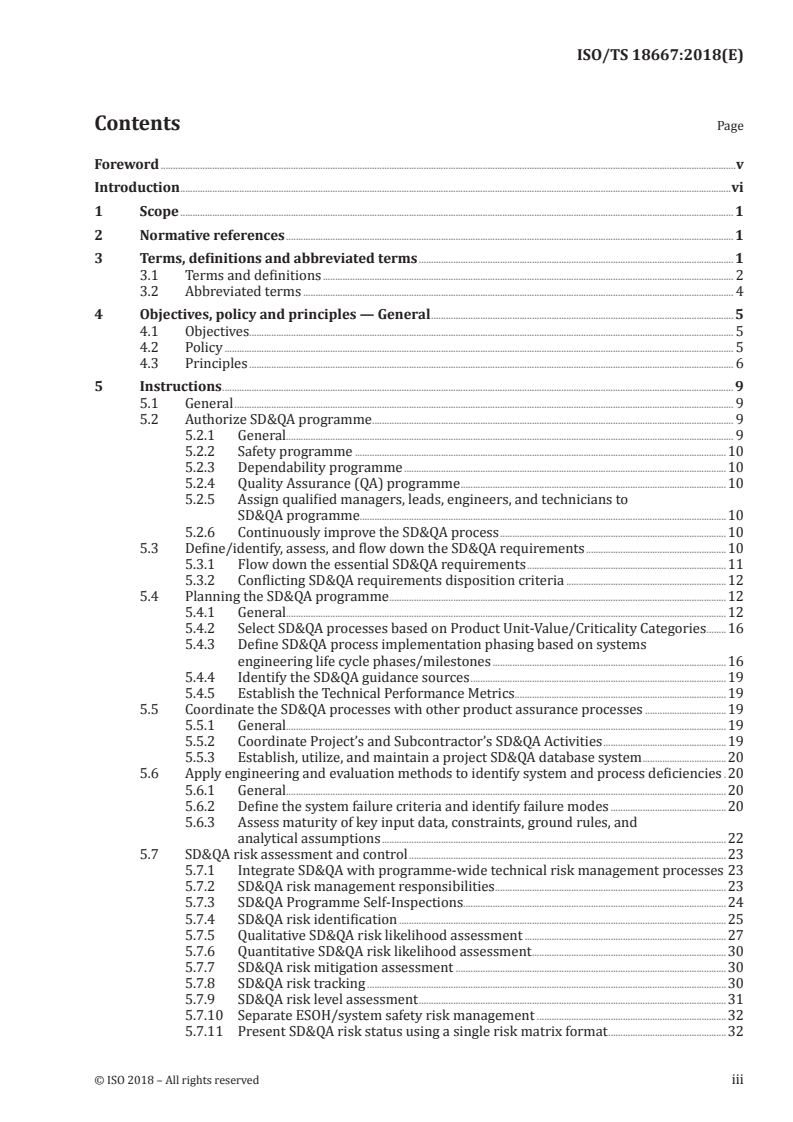
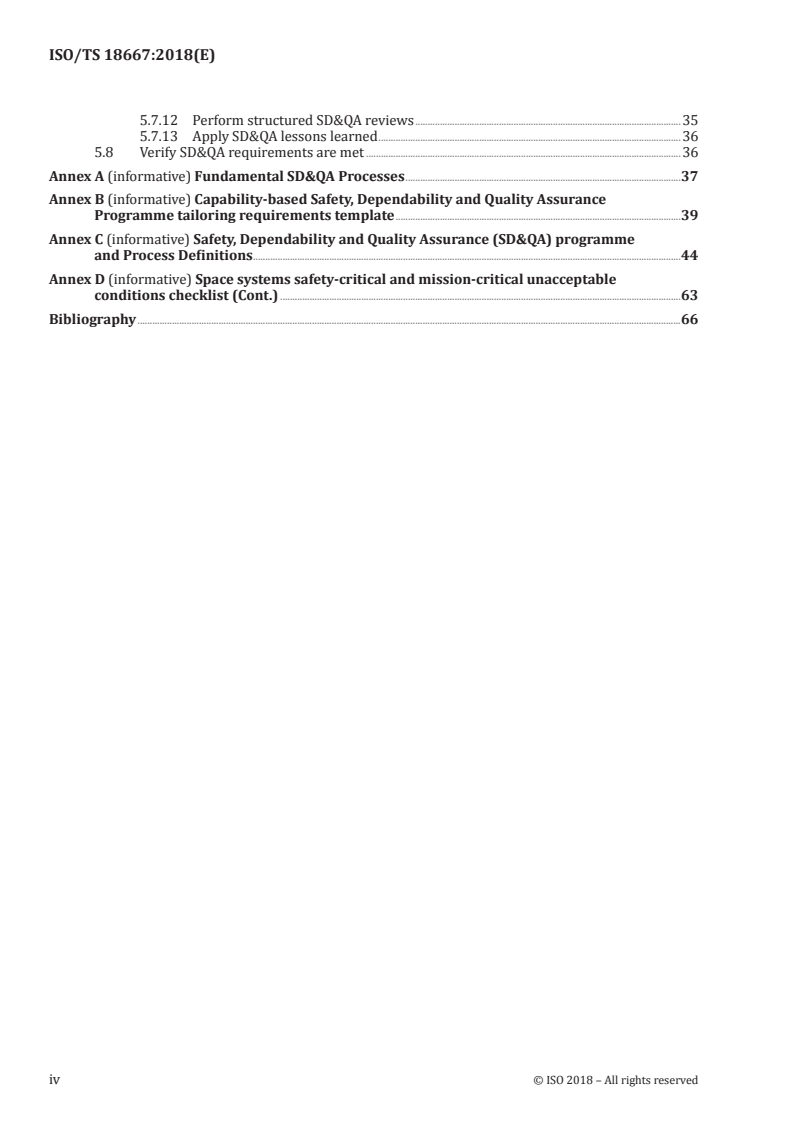
Contents Page
Foreword .v
Introduction .vi
1 Scope . 1
2 Normative references . 1
3 Terms, definitions and abbreviated terms . 1
3.1 Terms and definitions . 2
3.2 Abbreviated terms . 4
4 Objectives, policy and principles — General . 5
4.1 Objectives. 5
4.2 Policy . 5
4.3 Principles . 6
5 Instructions . 9
5.1 General . 9
5.2 Authorize SD&QA programme . 9
5.2.1 General. 9
5.2.2 Safety programme .10
5.2.3 Dependability programme .10
5.2.4 Quality Assurance (QA) programme .10
5.2.5 Assign qualified managers, leads, engineers, and technicians to
SD&QA programme.10
5.2.6 Continuously improve the SD&QA process .10
5.3 Define/identify, assess, and flow down the SD&QA requirements .10
5.3.1 Flow down the essential SD&QA requirements .11
5.3.2 Conflicting SD&QA requirements disposition criteria .12
5.4 Planning the SD&QA programme .12
5.4.1 General.12
5.4.2 Select SD&QA processes based on Product Unit-Value/Criticality Categories .16
5.4.3 Define SD&QA process implementation phasing based on systems
engineering life cycle phases/milestones .16
5.4.4 Identify the SD&QA guidance sources .19
5.4.5 Establish the Technical Performance Metrics .19
5.5 Coordinate the SD&QA processes with other product assurance processes .19
5.5.1 General.19
5.5.2 Coordinate Project’s and Subcontractor’s SD&QA Activities .19
5.5.3 Establish, utilize, and maintain a project SD&QA database system .20
5.6 Apply engineering and evaluation methods to identify system and process deficiencies .20
5.6.1 General.20
5.6.2 Define the system failure criteria and identify failure modes .20
5.6.3 Assess maturity of key input data, constraints, ground rules, and
analytical assumptions .22
5.7 SD&QA risk assessment and control .23
5.7.1 Integrate SD&QA with programme-wide technical risk management processes 23
5.7.2 SD&QA risk management responsibilities .23
5.7.3 SD&QA Programme Self-Inspections.24
5.7.4 SD&QA risk identification .25
5.7.5 Qualitative SD&QA risk likelihood assessment .27
5.7.6 Quantitative SD&QA risk likelihood assessment .30
5.7.7 SD&QA risk mitigation assessment .30
5.7.8 SD&QA risk tracking .30
5.7.9 SD&QA risk level assessment .31
5.7.10 Separate ESOH/system safety risk management .32
5.7.11 Present SD&QA risk status using a single risk matrix format .32
5.7.12 Perform structured SD&QA reviews .35
5.7.13 Apply SD&QA lessons learned .36
5.8 Verify SD&QA requirements are met .36
Annex A (informative) Fundamental SD&QA Processes .37
Annex B (informative) Capability-based Safety, Dependability and Quality Assurance
Programme tailoring requirements template .39
Annex C (informative) Safety, Dependability and Quality Assurance (SD&QA) programme
and Process Definitions .44
Annex D (informative) Space systems safety-critical and mission-critical unacceptable
conditions checklist (Cont.) .63
Bibliography .66
iv © ISO 2018 – All rights reserved
Foreword
ISO (the International Organization for Standardization) is a worldwide federation of national standards
bodies (ISO member bodies). The work of preparing International Standards is normally carried out
through ISO technical committees. Each member body interested in a subject for which a technical
committee has been established has the right to be represented on that committee. International
organizations, governmental and non-governmental, in liaison with ISO, also take part in the work.
ISO collaborates closely with the International Electrotechnical Commission (IEC) on all matters of
electrotechnical standardization.
The procedures used to develop this document and those intended for its further maintenance are
described in the ISO/IEC Directives, Part 1. In particular the different approval criteria needed for the
different types of ISO documents should be noted. This document was drafted in accordance with the
editorial rules of the ISO/IEC Directives, Part 2 (see www .iso .org/ directives).
Attention is drawn to the possibility that some of the elements of this document may be the subject of
patent rights. ISO shall not be held responsible for identifying any or all such patent rights. Details of
any patent rights identified during the development of the document will be in the Introduction and/or
on the ISO list of patent declarations received (see www .iso .org/ patents).
Any trade name used in this document is information given for the convenience of users and does not
constitute an endorsement.
For an explanation on the voluntary nature of standards, the meaning of ISO specific terms and
expressions related to conformity assessment, as well as information about ISO's adherence to the
World Trade Organization (WTO) principles in the Technical Barriers to Trade (TBT) see the following
URL: www .iso .org/ iso/ foreword .html
This document was prepared by Technical Committee ISO/TC 20, Aircraft and space vehicles,
Subcommittee SC 14, Space systems and operations.
Introduction
This document is intended for use in the engineering community.
The terms Safety, Dependability, and Quality Assurance (SD&QA) are often used interchangeably, but
they have very different meanings. Safety is the system state with acceptable levels of risk for conditions
that can cause death, injury, occupational illness, damage to or loss of equipment or property, or
damage to the environment. Dependability is the ability of an item or system to perform as and when
required. Quality Assurance is the part of quality management focused on providing confidence that
quality requirements are fulfilled.
This document defines the “what to do’s” at depths that facilitate consistency in planning and
implementing SD&QA programme which identify, assess, and eliminate or mitigate technical risks
using levels of effort commensurate with the product’s unit-value/criticality and systems engineering
life cycle data content/maturity.
The fundamental building blocks of the capability-based SD&QA programme consists of the SD&QA
processes identified in Annex A and described in Annex C. The fundamental SD&QA processes are
grouped programmatically according to separate SD&QA domains, and functionally according to
documented management, engineering, and testing approaches. Annex B defines the tiered criteria
used for rating the SD&QA risk management capability of existing SD&QA programme or for planning
the desired SD&QA risk management capability of new SD&QA programme. The unique provisions of
this document include the following:
— Consistent criteria (see Annex B) for rating the capability of SD&QA programme to identify, analyse,
and mitigate or control, potential and existing, product and process deficiencies in a manner that is
commensurate with the product’s unit-value/criticality (see Table 1) and systems engineering life
cycle data content/maturity (see Table 3);
— Structured planning to achieve a predefined level of SD&QA risk management capability for the
overall SD&QA programme or any individual SD&QA process through a statement of work (SOW) or
memorandum of agreement (MOA);
— Collecting, reviewing, and applying existing lessons learned for rating the maturity of input data
used for performing SD&QA analyses;
— Creating and disseminating new lessons learned to sustain continuous improvement of the SD&QA
programme through the enterprise.
vi © ISO 2018 – All rights reserved
TECHNICAL SPECIFICATION ISO/TS 18667:2018(E)
Space systems — Capability-based Safety, Dependability,
and Quality Assurance (SD&QA) programme management
1 Scope
This document applies to the design, development, fabrication, test, and operation of commercial, civil,
and military space and ground control systems, sites/facilities, services, equipment, and computer
software. Criteria is provided for rating the capability of the entire SD&QA programme or an individual
SD&QA process to identify, assess, and eliminate or mitigate risks that threaten safety or mission
success. The predefined capability rating criteria define the sequence of activities necessary to achieve
a measurable improvement in the effectiveness of SD&QA risk management by implementing it in stages.
Organizations can evaluate their existing SD&QA programme against the criteria in this document to
identify the activities that need to be added, deleted, or modified to achieve the desired technical risk
management effort. The phrase “desired technical risk management effort” means the activities and
resources used to identify, assess, and eliminate or mitigate technical risks are commensurate with the
product’s unit-value/criticality and systems engineering life cycle data content/maturity.
2 Normative references
The following documents are referred to in the text in such a way that some or all of their content
constitutes requirements of this document. For dated references, only the edition cited applies. For
undated references, the latest edition of the referenced document (including any amendments) applies.
ISO 10794, Space systems — Programme management, materials, mechanical parts and processes
ISO 10795, Space systems — Programme management and quality — Vocabulary
ISO 14300-2, Space systems — Programme management — Part 2: Product assurance
ISO 14620-1, Space systems — Safety requirements — Part 1: System safety
ISO 17666, Space systems — Risk management
ISO 23460, Space systems — Programme management — Dependability requirements
ISO 27025, Space systems — Programme management — Quality assurance requirements
ISO 9000, Quality management systems — Fundamentals and vocabulary
NOTE A number of process level documents that are available to aid contractors achieve their safety,
dependability, and quality assurance requirements are provided in the Annex D.
3 Terms, definitions and abbreviated terms
For the purposes of this document, the terms and definitions given in ISO 10794, ISO 10795, ISO 14300-2,
ISO 14620-1, ISO 17666, ISO 23460, ISO 27025, and ISO 9000 apply.
ISO and IEC maintain terminological databases for use in standardization at the following addresses:
— IEC Electropedia: available at http:// www .electropedia .org/
— ISO Online browsing platform: available at https:// www .iso .org/ obp
3.1 Terms and definitions
3.1.1
benchmark
any standard or reference by which others can be measured
3.1.2
best technical practice
documented technique, method, procedure, or process based on a standard or guide, that was developed
through experience and research, and is being used as a benchmark by multiple organizations to
efficiently obtain prescribed results with consistent quality and to measure against
3.1.3
capability
ability to achieve a desired effect under specified standards and conditions
3.1.4
capability-based Safety, Dependability and Quality Assurance (SD&QA) programme
programme for space and ground control systems that consists of three groups of processes; the
Safety programme; the Dependability Programme; and the Quality Assurance Programme, which are
pre-tailored to efficiently identify, assess, and eliminate or mitigate specific types of technical risks
throughout the product’s mission duration and post-mission disposal
3.1.5
capability-based Safety, Dependability and Quality Assurance (SD&QA) process
individual process that consists of a group of activities which are capable of efficiently identifying,
assessing, and mitigating or controlling specified types of technical risks
Note 1 to entry: The list of capability levels is as follows:
— Capability Level 1 process is the minimum set or “base” activities that constitute an appropriate process for
a low unit-value/criticality product;
— Capability Level 2 process includes all the Capability Level 1 activities plus additional activities for
documenting a procedure, and expanding the comprehensiveness and accuracy of the process to address
risks associated with a medium unit-value/criticality product.
— Capability Level 3 process includes all the Capability Level 1 and 2 activities plus additional activities for
developing a database, reviewing lessons learned, verifying products and processes, and exchanging SD&QA
data throughout the Systems Engineering Process.
— Capability Level 4 process includes all the Capability Level 1, 2 and 3 activities plus additional activities for
generating lessons learned, improving the process, and standardizing the formats of empirical and analytical
input data used for assessments.
— Capability Level 5 process includes all the Capability Level 1, 2, 3 and 4 activities plus additional activities for
continuous improvement of the process.
3.1.6
capability level growth
measurable improvement in the ability of a SD&QA programme or process to support the system safety
and mission success needs of a systems engineering process
EXAMPLE An increase in resources, scope of effort, or maturity of input data.
3.1.7
deficiency
amount that is lacking or inadequate
3.1.8
operational safety
level of safety risk to a system, the environment, or the occupational health of personnel caused by
another system or end item when employed in an operational environment
2 © ISO 2018 – All rights reserved
3.1.9
product unit-value/criticality categories
five pre-defined categories of products where Category 1 is the lowest value product group and
Category 5 is the highest value product group
Note 1 to entry: See Figure D.1.
3.1.10
requirements creep
discovery of one or more new requirements after start of a project, statement of work (SOW), or
memorandum of agreement (MOA)
3.1.11
requirements falsification
act of creating one or more false requirements after start of a project, statement of work (SOW), or
memorandum of agreement (MOA)
3.1.12
Safety, Dependability and Quality Assurance (SD&QA) programme capability levels
pre-tailored groups of processes that are capable of achieving measurable improvement in
comprehensiveness, accuracy, and efficiency, with regard to technical risk identification, assessment,
and mitigation, when implemented by transitioning from the lowest process group level (i.e. Capability
level 1) through the process group levels (i.e. capability levels) that cumulatively involve a level of
effort commensurate with the product’s unit-value/criticality and systems engineering life cycle data
content/maturity throughout its mission duration and post-mission disposal
Note 1 to entry: The product’s unit-value/criticality is provided in Table 1.
Note 2 to entry: The systems engineering life cycle data content/maturity is provided in Table 3.
3.1.13
subject matter expert
SME
person that completed a technical education programme, was formally trained in real-world
applications, and has acquired extensive experience in a technical area
3.1.14
system of systems
integration of existing and/or new systems into an over-arching system with capabilities that are
greater than the sum of the capabilities of the constituent component systems
3.1.15
validation
confirmation, through objective evidence, that the requirements for a specific intended use or
application have been fulfilled
Note 1 to entry: The term “validated” is used to designate the corresponding status.
Note 2 to entry: The use conditions for validation can be real or simulated.
Note 3 to entry: Validation may be determined by a combination of test, analysis, demonstration, and inspection.
3.1.16
verification
confirmation through the provision of objective evidence that specified requirements have been
fulfilled
Note 1 to entry: The term “verified” is used to designate the corresponding status.
Note 2 to entry: Confirmation can be comprised of activities such as performing alternative calculations,
comparing a new design specification with a similar proven design specification, undertaking tests and
demonstrations, reviewing documents prior to issue.
Note 3 to entry: Verification may be determined by a combination of test, analysis, demonstration, and inspection.
3.2 Abbreviated terms
For the purposes of this document, the following abbreviated terms apply.
A Availability (Operational)
O
CA Criticality Analysis
CIRM Critical Item Risk Management
CDR Critical Design Review
CN Criticality Number
DCA Design Concern Analysis
ESS Environmental Stress Screening
ETA Event Tree Analysis
ETC Estimate to Complete
ESOH Environment, Safety, and Occupational Health
FDM Functional Diagram Modelling
FMEA Failure Mode and Effects Analysis
FMECA Failure Mode, Effects, and Criticality Analysis
FRACAS Failure Reporting, Analysis, and Corrective Action System
FRB Failure Review Board
FTA Fault Tree Analysis
HA Hazard Analysis
HW Hardware
IMS Integrated Master Schedule
LLAA Lessons Learned Approval Authority
LOE Level of Effort
MCLP Multiple Capability Level Process
MDR Material Development Requirements
NCRB Non-Conformance Review Board
NCCS Non-Conformance Control System
ORR Operational Readiness Review
PA Product Assurance
PAP Product Assurance Plan
4 © ISO 2018 – All rights reserved
PDR Preliminary Design Review
PMP Parts, Materials and Processes
PoF Physics of Failure
PMP Project Management Plan
PRR Preliminary Requirements Review
QA Quality Assurance
R&M Reliability and Maintainability
RD/GT Reliability Development/Growth Testing
RMP Risk Management Plan
SCA Sneak Circuit Analysis
SEP Systems Engineering Plan
SPFM Single Point Failure Mode
SD&QA Safety, Dependability and Quality Assurance
SSP System safety programme
SSPP System safety programme plan
SW Software
TAAF Test, Analyse and Fix
TS Technical Specification
WG Working Group
4 Objectives, policy and principles — General
4.1 Objectives
The capability-based SD&QA programme is used to identify, evaluate, and eliminate or mitigate
technical risks that pose a threat to system safety or mission success, throughout the product’s planned
mission duration and post-mission disposal. The types of deficiencies addressed include damage-
threatening hazards, mission-impacting failures modes, and system performance anomalies that result
from unverified requirements, optimistic assumptions, unplanned activities, ambiguous procedures,
undesired environmental conditions, latent physical faults, inappropriate corrective actions, and
operator errors.
4.2 Policy
The contractor and its subcontractors provide the standards, guides, resources, and training necessary
to ensure the SD&QA programme is cost-effectively implemented in accordance with the mandatory
1)
SD&QA policy and this document. Optional approaches for eliminating or mitigating each identified
technical risk are determined by subject matter experts (SMEs), or they develop rationale for taking
no action. The timing of the SD&QA programme accommodates identifying and implementing needed
1) Optional risk mitigations include verifiable controls implemented through special design features, procedures,
inspections, or tests.
corrective actions in a timely manner. The data products of the SD&QA programme are made accessible
to all major stakeholders. For Capability Level 3 or higher SD&QA programme:
1) establish a database system that can automatically generate a draft SD&QA assessment report; and
2) charter a Lessons Learned Approval Authority (e.g. Lessons Learned Committee) to document
lessons learned associated with unacceptable deficiencies.
For Capability Level 4 or higher SD&QA programme, the format of the input and output data of SD&QA
computerized tools is compatible with the format of the project SD&QA database system.
4.3 Principles
This document applies to the integration of the SD&QA programme with the project’s over-arching
systems engineering process. In the context of the systems engineering process, the SD&QA programme
is both a “spiral” and a “vector” conglomeration of processes. It’s a “spiral” in the sense that the product
synthesis loop begins in the first life cycle phase and is repeated in each successive life cycle phase. It’s
a “vector” in the sense that at the end of each life cycle phase, artifacts and output data are produced to
initiate the product synthesis loop in the next life cycle phase.
When specifying this document as a compliance document, consider also specifying other supplementary
SD&QA specifications and standards, given those documents define validated methodologies which
generate artifacts and data that are consistent with the artifacts and data defined in this document.
Capability-based SD&QA programme include, but are not limited, to the following essential functions:
— Programme authorization. Authorize and define the management responsibilities of the
appointed leads of the SD&QA programme in accordance with an approved charter, which includes
identification of the approval authority for each risk domain and level.
— Requirements definition. Internal requirements: Require the SD&QA programme to have
appropriately trained, qualified, and supported managers. Require SD&QA activities to be
based on best practices, i.e. industry consensus or validated practices. Customer requirements:
Define/identify the SD&QA design, procedural, and operational requirements that are consistent
with the customer’s requirements and this document.
— Planning. For Capability Level 2 or higher SD&QA programme, document, approve, and flow down,
as necessary, a SD&QA programme plan that identifies the quantitative and/or qualitative SD&QA
requirements, the project’s SD&QA compliance and guidance documents, and the processes selected
to achieve the SD&QA requirements. Describe and interpret as necessary the SD&QA requirements
in accordance with the contract and this document. Follow the flow diagram in Figure 1 to develop a
detailed plan for each of the three top-level groups of SD&QA programme, i.e. the Safety programme,
the Dependability Programme, and the Quality Assurance Programme. Plan the scope of the SD&QA
programme to be commensurate with the space system’s unit-value/criticality as defined in Table 1,
and the space’s system life cycle as defined in Table 2. Tailor the seven essential functions of the
SD&QA programme to effectively and efficiently integrate with the systems engineering life cycle
(see Figures 2 and 3). Identify the types of input data that are available for initiating each SD&QA
process and assess its maturity in accordance with the criteria in Table 3.
6 © ISO 2018 – All rights reserved
Figure 1 — Example Capability-based SD&QA programme planning flow diagram
For Capability Level 2 SD&QA programme, the SD&QA programme plan is an integral part of the Systems
Engineering Plan (SEP). Establish a formal SD&QA programme plan approval process that includes
customer review and concurrence. Use the space system unit-value/criticality categorizations defined
in Figure D.1 to tailor an entire SD&QA programme or a single SD&QA process, or provide rationale for
putting a different space system in one of the unit-value/criticality categories in Figure D.1.
For Capability Level 3 SD&QA programme, the SD&QA programme plan identifies all key inputs and
outputs of each SD&QA process. Consider the applicability of process capability-level growth and
maturation of analyses input data over the course of the space system’s life cycle when planning the
SD&QA programme. Update the SD&QA programme plan(s) on an as required or as needed basis.
As required updates include those that are contractually required. As needed updates include those
necessitated by changes made to the space system’s design.
— Programme coordination. Coordinate integration of SD&QA processes within the SD&QA
programme and with other processes outside of the SD&QA programme, e.g. the Design process,
the Manufacturing process, and the Logistics process. Coordinate SD&QA programme planning
as necessary to achieve an optimum balance among the design requirements for system safety,
reliability, maintainability, operational availability, electromagnetic interference/compatibility, and
product quality. Implement the SD&QA programme in a holistic manner that minimizes duplication
in effort and maximizes the timely exchange of SD&QA data.
— Engineering and evaluation. Define analysis methods based on the space system’s
unit-value/criticality, the space system’s life cycle, and the maturity of the analysis input data.
Identify potential and existing deficiencies that pose a threat to system safety or mission success,
throughout the space system’s planned mission duration and post-mission disposal.
— Risk assessment and tracking. Assess initial, intermediate, and final risk for each of the identified
deficiencies that may affect the space system’s ability to achieve its specified SD&QA requirements.
Identify practical mitigations or controls for all unacceptable risks, and track their implementation
and verification. Document and categorized all approved residual risks for future reference.
— Verification. Apply consistent and measurable verification criteria for the key design parameters
of items that are critical to the system safety and mission success of the space system or system of
systems. Ensure SD&QA verification activities are properly planned and all applicable requirements
successfully met, or instances of non-compliance documented.
Figure 2 — Example systems engineering process flow
8 © ISO 2018 – All rights reserved
Figure 3 — Example systems engineering process life cycle implementation
5 Instructions
5.1 General
The following instructions pertain to an SD&QA programme of equivalent capability, as defined by
Annex B.
5.2 Authorize SD&QA programme
5.2.1 General
For all space systems regardless of unit-value/criticality, either a contract or organizational standard
authorizes the creation of a SD&QA programme for a project. The responsibility for managing the
SD&QA programme is assigned by the project manager (PM). If a Safety programme, Dependability
programme, or QA programme is not authorized to be created in a project, or only partially authorized
in accordance with this document, then it is the responsibility of the PM to provide the customer with
documented evidence that verifies only negligible or non-credible deficiencies, faults, or weaknesses
will be present in the operating space system.
5.2.2 Safety programme
The Safety programme lead is assigned responsibility to identify and assess hazards during the design,
manufacture, assembly, testing, transportation, and operational phases of the space system or system
of systems. Furthermore, the system safety lead is authorized to:
1) ensure all Environment, Safety, and Occupational Health (ESOH) requirements are met;
2) evaluate potential ESOH hazards throughout the space system’s life cycle, as applicable; and
3) implement identified operating, manufacturing, and maintenance safety procedures.
5.2.3 Dependability programme
The Dependability programme lead is assigned responsibility to evaluate potential failure modes
during the design, manufacture, assembly, testing, transportation, and operational phases of the space
system or system of systems. Furthermore, the Dependability programme lead is authorized to:
1) ensure all reliability, maintainability, and availability risks are balanced within the project’s
objectives, constraints, and budget;
2) assess potential failure modes throughout the space system’s life cycle, as applicable; and
3) predict the inherent and operational reliability of the space system or system of systems.
5.2.4 Quality Assurance (QA) programme
The QA programme lead is assigned responsibility to proactively prevent anticipated processing errors
during the design, manufacturing, testing, transportation, integration, and operations phases of the
space system or system of systems. Furthermore, the QA programme is authorized to ensure all QA
requirements are met throughout the space system’s life cycle.
5.2.5 Assign qualified managers, leads, engineers, and technicians to SD&QA programme
For Capability Level 3 or higher SD&QA programme, qualification requirements are established for
all individuals assigned to the SD&QA programme as managers, leads, engineers, or technicians. The
qualification requirements include, but are not limited to, verifiable experience or training necessary
to properly develop/acquire and manage/monitor a SD&QA programme plan that is consistent with the
instructions in this document.
5.2.6 Continuously improve the SD&QA process
For Capability Level 5 SD&QA programme, an approach is establish to continuously improve the SD&QA
processes. The continuous improvement approach includes, but is not limited to the following activities:
— instituting procedures to facilitate the proactive identification and implementation of needed
improvements in SD&QA processes;
— periodically training management and engineering personnel in the use of SD&QA tools and the
cost-effective implementation of SD&QA processes; and
— integration of SD&QA lessons learned into the training materials. (See ISO 16192).
5.3 Define/identify, assess, and flow down the SD&QA requirements
Define/identify and assess space systems SD&QA requirements that are consistent with the contractual
requirements and this document, and flow them down to all affiliated subcontractors. The space
10 © ISO 2018 – All rights reserved
systems SD&QA requirements shall be categorized as design, procedural, or operational. The most
typical SD&QA requirements applied to commercial space systems are the following:
— Design:
— mission reliability;
— safety-critical/mission-critical item reliability;
— orbital explosion probability;
— mean mission duration;
— launch reliability;
— LEO/GEO collision probability;
— disposal manoeuvre reliability;
— unusually hazardous risks;
— Procedural:
— safety-critical/mission-critical item control;
— Operational:
— operational dependability; and
— re-entry casualty expectation.
Guidelines for defining system safety requirements for space systems are found in ISO 14620-1;
guidelines for defining dependability requirements for space systems are found in ISO 23460 and
IEC 60300-3-4:2007; and guidelines for defining quality assurance requirements for space systems are
found in ISO 27025.
For Capability Level 2 or higher SD&QA programme, the defined/identified SD&QA requirements
are documented in an approved SD&QA programme plan. For Capability Level 3 or higher SD&QA
programme, the identified SD&QA requirements are assessed using System Requirements Hazard
Analysis (SRHA), or an equivalent methodology, to determine the risk of conflicting requirements,
requirements creep, requirements falsification, and other undesirable conditions caused by unintended
or bad requirements.
5.3.1 Flow down the essential SD&QA requirements
The following SD&QA requirements are considered essential and are flowed and are down to all
affiliated subcontractors:
— identify design and process conditions that are unacceptable for safety-critical and mission-
critical items;
— mitigate/correct unacceptable design and process conditions or verify acceptability of the associated
mishap/failure risk;
— use quantitative risk assessment approaches to verify mission-critical functions for High I
unit-value/criticality and above space systems are single-fault tolerant against loss or degradation
due to:
1) a single hardware or software component failure/fault;
2) propagating failure mode; or
3) human error;
— use quantitative risk assessment approaches to verify safety-critical functions for High III
unit-value/criticality and above space systems are dual-fault tolerant against loss or degradation
due to:
1) dual independent hardware or software component failures/faults;
2) dual independent human errors; or
3) a combination of a component failure/fault and a human error;
— use quantified risk assessment approaches to verify High III unit-value/criticality systems do not
generate hazardous radiation or energy, when no provisions have been made to protect personnel
or sensitive subsystems/components from damage or adverse effects;
— use quantified risk assessment approaches to verify that there is an acceptable level of risk that no
packaging, handling or storage procedures will cause a catastrophic accident/mishap for which no
controls have been provided to protect personnel or safety-critical/mission-critical equipment;
— identify any SD&QA requirements that can be verified by existing analyses, inspections, test reports,
or data products. For Capability Level 2 or higher SD&QA programme, document these requirements
and verification methods in approved SD&QA programme plans.
5.3.2 Conflicting SD&QA requirements disposition criteria
Note for cases of conflicting SD&QA requirements, the issue is resolved using the following order of
precedence:
1) system safety requirements;
2) availability requirements;
3) reliability requirements; and
4) maintainability and testability requirements.
The order of precedence for SD&QA requirements is based on hierarchical “tiers” of influence each
requirement has on the others requirements. System safety requirements are in tier 1 because they
drive availability and testability requirements. Availability requirements are in tier 2 because they drive
reliability and maintainability requirements. Reliability requirements are in tier 3 because they drive
maintainability and testability requirements. Finally, maintainability and testability requirements are
in tier 4.
5.4 Planning the SD&QA programme
5.4.1 General
Planning for the SD&QA programme is in accordance with the groups of pre-tailored processes
shown in Figures 4, 5 and 6, the Product Unit-Value/Criticality definitions in Figure 1, and the five
SD&QA programme capability levels defined in Annex B. Additional guidance for planning the SD&QA
programme is found in ISO 14620-1, ISO 23460, ISO 27025, and IEC 60300-3-1:2003.
12 © ISO 2018 – All rights reserved
Figure 4 — Example pre-tailored system safety programme for space systems
(See ISO 14620-1)
Figure 5 — Example pre-tailored Quality Assurance programme for space systems
(See ISO 27025)
14 © ISO 2018 – All rights reserved
Figure 6 — Example pre-tailored dependability programme for space systems
(See ISO 23460)
5.4.2 Select SD&QA processes based on Product Unit-Value/Criticality Categories
Select a group of SD&QA processes that are commensurate with the space system’s unit-value/criticality,
life cycle phase, and availability/maturity of SD&QA analyses input data.
5.4.3 Define SD&QA process implementation phasing based on systems engineering life cycle
phases/milestones
Define the following space system project characteristics:
1) SD&QA activities to be performed in each systems engineering life cycle phase;
2) key inputs of each
...
TECHNICAL ISO/TS
SPECIFICATION 18667
First edition
2018-02
Space systems — Capability-based
Safety, Dependability, and Quality
Assurance (SD&QA) programme
management
Systèmes spatiaux — Management de programmes de sécurité, de
sûreté de fonctionnement et d'assurance de la qualité (SD&QA), axé
sur les capacités
Reference number
©
ISO 2018
© ISO 2018
All rights reserved. Unless otherwise specified, or required in the context of its implementation, no part of this publication may
be reproduced or utilized otherwise in any form or by any means, electronic or mechanical, including photocopying, or posting
on the internet or an intranet, without prior written permission. Permission can be requested from either ISO at the address
below or ISO’s member body in the country of the requester.
ISO copyright office
CP 401 • Ch. de Blandonnet 8
CH-1214 Vernier, Geneva
Phone: +41 22 749 01 11
Fax: +41 22 749 09 47
Email: copyright@iso.org
Website: www.iso.org
Published in Switzerland
ii © ISO 2018 – All rights reserved
Contents Page
Foreword .v
Introduction .vi
1 Scope . 1
2 Normative references . 1
3 Terms, definitions and abbreviated terms . 1
3.1 Terms and definitions . 2
3.2 Abbreviated terms . 4
4 Objectives, policy and principles — General . 5
4.1 Objectives. 5
4.2 Policy . 5
4.3 Principles . 6
5 Instructions . 9
5.1 General . 9
5.2 Authorize SD&QA programme . 9
5.2.1 General. 9
5.2.2 Safety programme .10
5.2.3 Dependability programme .10
5.2.4 Quality Assurance (QA) programme .10
5.2.5 Assign qualified managers, leads, engineers, and technicians to
SD&QA programme.10
5.2.6 Continuously improve the SD&QA process .10
5.3 Define/identify, assess, and flow down the SD&QA requirements .10
5.3.1 Flow down the essential SD&QA requirements .11
5.3.2 Conflicting SD&QA requirements disposition criteria .12
5.4 Planning the SD&QA programme .12
5.4.1 General.12
5.4.2 Select SD&QA processes based on Product Unit-Value/Criticality Categories .16
5.4.3 Define SD&QA process implementation phasing based on systems
engineering life cycle phases/milestones .16
5.4.4 Identify the SD&QA guidance sources .19
5.4.5 Establish the Technical Performance Metrics .19
5.5 Coordinate the SD&QA processes with other product assurance processes .19
5.5.1 General.19
5.5.2 Coordinate Project’s and Subcontractor’s SD&QA Activities .19
5.5.3 Establish, utilize, and maintain a project SD&QA database system .20
5.6 Apply engineering and evaluation methods to identify system and process deficiencies .20
5.6.1 General.20
5.6.2 Define the system failure criteria and identify failure modes .20
5.6.3 Assess maturity of key input data, constraints, ground rules, and
analytical assumptions .22
5.7 SD&QA risk assessment and control .23
5.7.1 Integrate SD&QA with programme-wide technical risk management processes 23
5.7.2 SD&QA risk management responsibilities .23
5.7.3 SD&QA Programme Self-Inspections.24
5.7.4 SD&QA risk identification .25
5.7.5 Qualitative SD&QA risk likelihood assessment .27
5.7.6 Quantitative SD&QA risk likelihood assessment .30
5.7.7 SD&QA risk mitigation assessment .30
5.7.8 SD&QA risk tracking .30
5.7.9 SD&QA risk level assessment .31
5.7.10 Separate ESOH/system safety risk management .32
5.7.11 Present SD&QA risk status using a single risk matrix format .32
5.7.12 Perform structured SD&QA reviews .35
5.7.13 Apply SD&QA lessons learned .36
5.8 Verify SD&QA requirements are met .36
Annex A (informative) Fundamental SD&QA Processes .37
Annex B (informative) Capability-based Safety, Dependability and Quality Assurance
Programme tailoring requirements template .39
Annex C (informative) Safety, Dependability and Quality Assurance (SD&QA) programme
and Process Definitions .44
Annex D (informative) Space systems safety-critical and mission-critical unacceptable
conditions checklist (Cont.) .63
Bibliography .66
iv © ISO 2018 – All rights reserved
Foreword
ISO (the International Organization for Standardization) is a worldwide federation of national standards
bodies (ISO member bodies). The work of preparing International Standards is normally carried out
through ISO technical committees. Each member body interested in a subject for which a technical
committee has been established has the right to be represented on that committee. International
organizations, governmental and non-governmental, in liaison with ISO, also take part in the work.
ISO collaborates closely with the International Electrotechnical Commission (IEC) on all matters of
electrotechnical standardization.
The procedures used to develop this document and those intended for its further maintenance are
described in the ISO/IEC Directives, Part 1. In particular the different approval criteria needed for the
different types of ISO documents should be noted. This document was drafted in accordance with the
editorial rules of the ISO/IEC Directives, Part 2 (see www .iso .org/ directives).
Attention is drawn to the possibility that some of the elements of this document may be the subject of
patent rights. ISO shall not be held responsible for identifying any or all such patent rights. Details of
any patent rights identified during the development of the document will be in the Introduction and/or
on the ISO list of patent declarations received (see www .iso .org/ patents).
Any trade name used in this document is information given for the convenience of users and does not
constitute an endorsement.
For an explanation on the voluntary nature of standards, the meaning of ISO specific terms and
expressions related to conformity assessment, as well as information about ISO's adherence to the
World Trade Organization (WTO) principles in the Technical Barriers to Trade (TBT) see the following
URL: www .iso .org/ iso/ foreword .html
This document was prepared by Technical Committee ISO/TC 20, Aircraft and space vehicles,
Subcommittee SC 14, Space systems and operations.
Introduction
This document is intended for use in the engineering community.
The terms Safety, Dependability, and Quality Assurance (SD&QA) are often used interchangeably, but
they have very different meanings. Safety is the system state with acceptable levels of risk for conditions
that can cause death, injury, occupational illness, damage to or loss of equipment or property, or
damage to the environment. Dependability is the ability of an item or system to perform as and when
required. Quality Assurance is the part of quality management focused on providing confidence that
quality requirements are fulfilled.
This document defines the “what to do’s” at depths that facilitate consistency in planning and
implementing SD&QA programme which identify, assess, and eliminate or mitigate technical risks
using levels of effort commensurate with the product’s unit-value/criticality and systems engineering
life cycle data content/maturity.
The fundamental building blocks of the capability-based SD&QA programme consists of the SD&QA
processes identified in Annex A and described in Annex C. The fundamental SD&QA processes are
grouped programmatically according to separate SD&QA domains, and functionally according to
documented management, engineering, and testing approaches. Annex B defines the tiered criteria
used for rating the SD&QA risk management capability of existing SD&QA programme or for planning
the desired SD&QA risk management capability of new SD&QA programme. The unique provisions of
this document include the following:
— Consistent criteria (see Annex B) for rating the capability of SD&QA programme to identify, analyse,
and mitigate or control, potential and existing, product and process deficiencies in a manner that is
commensurate with the product’s unit-value/criticality (see Table 1) and systems engineering life
cycle data content/maturity (see Table 3);
— Structured planning to achieve a predefined level of SD&QA risk management capability for the
overall SD&QA programme or any individual SD&QA process through a statement of work (SOW) or
memorandum of agreement (MOA);
— Collecting, reviewing, and applying existing lessons learned for rating the maturity of input data
used for performing SD&QA analyses;
— Creating and disseminating new lessons learned to sustain continuous improvement of the SD&QA
programme through the enterprise.
vi © ISO 2018 – All rights reserved
TECHNICAL SPECIFICATION ISO/TS 18667:2018(E)
Space systems — Capability-based Safety, Dependability,
and Quality Assurance (SD&QA) programme management
1 Scope
This document applies to the design, development, fabrication, test, and operation of commercial, civil,
and military space and ground control systems, sites/facilities, services, equipment, and computer
software. Criteria is provided for rating the capability of the entire SD&QA programme or an individual
SD&QA process to identify, assess, and eliminate or mitigate risks that threaten safety or mission
success. The predefined capability rating criteria define the sequence of activities necessary to achieve
a measurable improvement in the effectiveness of SD&QA risk management by implementing it in stages.
Organizations can evaluate their existing SD&QA programme against the criteria in this document to
identify the activities that need to be added, deleted, or modified to achieve the desired technical risk
management effort. The phrase “desired technical risk management effort” means the activities and
resources used to identify, assess, and eliminate or mitigate technical risks are commensurate with the
product’s unit-value/criticality and systems engineering life cycle data content/maturity.
2 Normative references
The following documents are referred to in the text in such a way that some or all of their content
constitutes requirements of this document. For dated references, only the edition cited applies. For
undated references, the latest edition of the referenced document (including any amendments) applies.
ISO 10794, Space systems — Programme management, materials, mechanical parts and processes
ISO 10795, Space systems — Programme management and quality — Vocabulary
ISO 14300-2, Space systems — Programme management — Part 2: Product assurance
ISO 14620-1, Space systems — Safety requirements — Part 1: System safety
ISO 17666, Space systems — Risk management
ISO 23460, Space systems — Programme management — Dependability requirements
ISO 27025, Space systems — Programme management — Quality assurance requirements
ISO 9000, Quality management systems — Fundamentals and vocabulary
NOTE A number of process level documents that are available to aid contractors achieve their safety,
dependability, and quality assurance requirements are provided in the Annex D.
3 Terms, definitions and abbreviated terms
For the purposes of this document, the terms and definitions given in ISO 10794, ISO 10795, ISO 14300-2,
ISO 14620-1, ISO 17666, ISO 23460, ISO 27025, and ISO 9000 apply.
ISO and IEC maintain terminological databases for use in standardization at the following addresses:
— IEC Electropedia: available at http:// www .electropedia .org/
— ISO Online browsing platform: available at https:// www .iso .org/ obp
3.1 Terms and definitions
3.1.1
benchmark
any standard or reference by which others can be measured
3.1.2
best technical practice
documented technique, method, procedure, or process based on a standard or guide, that was developed
through experience and research, and is being used as a benchmark by multiple organizations to
efficiently obtain prescribed results with consistent quality and to measure against
3.1.3
capability
ability to achieve a desired effect under specified standards and conditions
3.1.4
capability-based Safety, Dependability and Quality Assurance (SD&QA) programme
programme for space and ground control systems that consists of three groups of processes; the
Safety programme; the Dependability Programme; and the Quality Assurance Programme, which are
pre-tailored to efficiently identify, assess, and eliminate or mitigate specific types of technical risks
throughout the product’s mission duration and post-mission disposal
3.1.5
capability-based Safety, Dependability and Quality Assurance (SD&QA) process
individual process that consists of a group of activities which are capable of efficiently identifying,
assessing, and mitigating or controlling specified types of technical risks
Note 1 to entry: The list of capability levels is as follows:
— Capability Level 1 process is the minimum set or “base” activities that constitute an appropriate process for
a low unit-value/criticality product;
— Capability Level 2 process includes all the Capability Level 1 activities plus additional activities for
documenting a procedure, and expanding the comprehensiveness and accuracy of the process to address
risks associated with a medium unit-value/criticality product.
— Capability Level 3 process includes all the Capability Level 1 and 2 activities plus additional activities for
developing a database, reviewing lessons learned, verifying products and processes, and exchanging SD&QA
data throughout the Systems Engineering Process.
— Capability Level 4 process includes all the Capability Level 1, 2 and 3 activities plus additional activities for
generating lessons learned, improving the process, and standardizing the formats of empirical and analytical
input data used for assessments.
— Capability Level 5 process includes all the Capability Level 1, 2, 3 and 4 activities plus additional activities for
continuous improvement of the process.
3.1.6
capability level growth
measurable improvement in the ability of a SD&QA programme or process to support the system safety
and mission success needs of a systems engineering process
EXAMPLE An increase in resources, scope of effort, or maturity of input data.
3.1.7
deficiency
amount that is lacking or inadequate
3.1.8
operational safety
level of safety risk to a system, the environment, or the occupational health of personnel caused by
another system or end item when employed in an operational environment
2 © ISO 2018 – All rights reserved
3.1.9
product unit-value/criticality categories
five pre-defined categories of products where Category 1 is the lowest value product group and
Category 5 is the highest value product group
Note 1 to entry: See Figure D.1.
3.1.10
requirements creep
discovery of one or more new requirements after start of a project, statement of work (SOW), or
memorandum of agreement (MOA)
3.1.11
requirements falsification
act of creating one or more false requirements after start of a project, statement of work (SOW), or
memorandum of agreement (MOA)
3.1.12
Safety, Dependability and Quality Assurance (SD&QA) programme capability levels
pre-tailored groups of processes that are capable of achieving measurable improvement in
comprehensiveness, accuracy, and efficiency, with regard to technical risk identification, assessment,
and mitigation, when implemented by transitioning from the lowest process group level (i.e. Capability
level 1) through the process group levels (i.e. capability levels) that cumulatively involve a level of
effort commensurate with the product’s unit-value/criticality and systems engineering life cycle data
content/maturity throughout its mission duration and post-mission disposal
Note 1 to entry: The product’s unit-value/criticality is provided in Table 1.
Note 2 to entry: The systems engineering life cycle data content/maturity is provided in Table 3.
3.1.13
subject matter expert
SME
person that completed a technical education programme, was formally trained in real-world
applications, and has acquired extensive experience in a technical area
3.1.14
system of systems
integration of existing and/or new systems into an over-arching system with capabilities that are
greater than the sum of the capabilities of the constituent component systems
3.1.15
validation
confirmation, through objective evidence, that the requirements for a specific intended use or
application have been fulfilled
Note 1 to entry: The term “validated” is used to designate the corresponding status.
Note 2 to entry: The use conditions for validation can be real or simulated.
Note 3 to entry: Validation may be determined by a combination of test, analysis, demonstration, and inspection.
3.1.16
verification
confirmation through the provision of objective evidence that specified requirements have been
fulfilled
Note 1 to entry: The term “verified” is used to designate the corresponding status.
Note 2 to entry: Confirmation can be comprised of activities such as performing alternative calculations,
comparing a new design specification with a similar proven design specification, undertaking tests and
demonstrations, reviewing documents prior to issue.
Note 3 to entry: Verification may be determined by a combination of test, analysis, demonstration, and inspection.
3.2 Abbreviated terms
For the purposes of this document, the following abbreviated terms apply.
A Availability (Operational)
O
CA Criticality Analysis
CIRM Critical Item Risk Management
CDR Critical Design Review
CN Criticality Number
DCA Design Concern Analysis
ESS Environmental Stress Screening
ETA Event Tree Analysis
ETC Estimate to Complete
ESOH Environment, Safety, and Occupational Health
FDM Functional Diagram Modelling
FMEA Failure Mode and Effects Analysis
FMECA Failure Mode, Effects, and Criticality Analysis
FRACAS Failure Reporting, Analysis, and Corrective Action System
FRB Failure Review Board
FTA Fault Tree Analysis
HA Hazard Analysis
HW Hardware
IMS Integrated Master Schedule
LLAA Lessons Learned Approval Authority
LOE Level of Effort
MCLP Multiple Capability Level Process
MDR Material Development Requirements
NCRB Non-Conformance Review Board
NCCS Non-Conformance Control System
ORR Operational Readiness Review
PA Product Assurance
PAP Product Assurance Plan
4 © ISO 2018 – All rights reserved
PDR Preliminary Design Review
PMP Parts, Materials and Processes
PoF Physics of Failure
PMP Project Management Plan
PRR Preliminary Requirements Review
QA Quality Assurance
R&M Reliability and Maintainability
RD/GT Reliability Development/Growth Testing
RMP Risk Management Plan
SCA Sneak Circuit Analysis
SEP Systems Engineering Plan
SPFM Single Point Failure Mode
SD&QA Safety, Dependability and Quality Assurance
SSP System safety programme
SSPP System safety programme plan
SW Software
TAAF Test, Analyse and Fix
TS Technical Specification
WG Working Group
4 Objectives, policy and principles — General
4.1 Objectives
The capability-based SD&QA programme is used to identify, evaluate, and eliminate or mitigate
technical risks that pose a threat to system safety or mission success, throughout the product’s planned
mission duration and post-mission disposal. The types of deficiencies addressed include damage-
threatening hazards, mission-impacting failures modes, and system performance anomalies that result
from unverified requirements, optimistic assumptions, unplanned activities, ambiguous procedures,
undesired environmental conditions, latent physical faults, inappropriate corrective actions, and
operator errors.
4.2 Policy
The contractor and its subcontractors provide the standards, guides, resources, and training necessary
to ensure the SD&QA programme is cost-effectively implemented in accordance with the mandatory
1)
SD&QA policy and this document. Optional approaches for eliminating or mitigating each identified
technical risk are determined by subject matter experts (SMEs), or they develop rationale for taking
no action. The timing of the SD&QA programme accommodates identifying and implementing needed
1) Optional risk mitigations include verifiable controls implemented through special design features, procedures,
inspections, or tests.
corrective actions in a timely manner. The data products of the SD&QA programme are made accessible
to all major stakeholders. For Capability Level 3 or higher SD&QA programme:
1) establish a database system that can automatically generate a draft SD&QA assessment report; and
2) charter a Lessons Learned Approval Authority (e.g. Lessons Learned Committee) to document
lessons learned associated with unacceptable deficiencies.
For Capability Level 4 or higher SD&QA programme, the format of the input and output data of SD&QA
computerized tools is compatible with the format of the project SD&QA database system.
4.3 Principles
This document applies to the integration of the SD&QA programme with the project’s over-arching
systems engineering process. In the context of the systems engineering process, the SD&QA programme
is both a “spiral” and a “vector” conglomeration of processes. It’s a “spiral” in the sense that the product
synthesis loop begins in the first life cycle phase and is repeated in each successive life cycle phase. It’s
a “vector” in the sense that at the end of each life cycle phase, artifacts and output data are produced to
initiate the product synthesis loop in the next life cycle phase.
When specifying this document as a compliance document, consider also specifying other supplementary
SD&QA specifications and standards, given those documents define validated methodologies which
generate artifacts and data that are consistent with the artifacts and data defined in this document.
Capability-based SD&QA programme include, but are not limited, to the following essential functions:
— Programme authorization. Authorize and define the management responsibilities of the
appointed leads of the SD&QA programme in accordance with an approved charter, which includes
identification of the approval authority for each risk domain and level.
— Requirements definition. Internal requirements: Require the SD&QA programme to have
appropriately trained, qualified, and supported managers. Require SD&QA activities to be
based on best practices, i.e. industry consensus or validated practices. Customer requirements:
Define/identify the SD&QA design, procedural, and operational requirements that are consistent
with the customer’s requirements and this document.
— Planning. For Capability Level 2 or higher SD&QA programme, document, approve, and flow down,
as necessary, a SD&QA programme plan that identifies the quantitative and/or qualitative SD&QA
requirements, the project’s SD&QA compliance and guidance documents, and the processes selected
to achieve the SD&QA requirements. Describe and interpret as necessary the SD&QA requirements
in accordance with the contract and this document. Follow the flow diagram in Figure 1 to develop a
detailed plan for each of the three top-level groups of SD&QA programme, i.e. the Safety programme,
the Dependability Programme, and the Quality Assurance Programme. Plan the scope of the SD&QA
programme to be commensurate with the space system’s unit-value/criticality as defined in Table 1,
and the space’s system life cycle as defined in Table 2. Tailor the seven essential functions of the
SD&QA programme to effectively and efficiently integrate with the systems engineering life cycle
(see Figures 2 and 3). Identify the types of input data that are available for initiating each SD&QA
process and assess its maturity in accordance with the criteria in Table 3.
6 © ISO 2018 – All rights reserved
Figure 1 — Example Capability-based SD&QA programme planning flow diagram
For Capability Level 2 SD&QA programme, the SD&QA programme plan is an integral part of the Systems
Engineering Plan (SEP). Establish a formal SD&QA programme plan approval process that includes
customer review and concurrence. Use the space system unit-value/criticality categorizations defined
in Figure D.1 to tailor an entire SD&QA programme or a single SD&QA process, or provide rationale for
putting a different space system in one of the unit-value/criticality categories in Figure D.1.
For Capability Level 3 SD&QA programme, the SD&QA programme plan identifies all key inputs and
outputs of each SD&QA process. Consider the applicability of process capability-level growth and
maturation of analyses input data over the course of the space system’s life cycle when planning the
SD&QA programme. Update the SD&QA programme plan(s) on an as required or as needed basis.
As required updates include those that are contractually required. As needed updates include those
necessitated by changes made to the space system’s design.
— Programme coordination. Coordinate integration of SD&QA processes within the SD&QA
programme and with other processes outside of the SD&QA programme, e.g. the Design process,
the Manufacturing process, and the Logistics process. Coordinate SD&QA programme planning
as necessary to achieve an optimum balance among the design requirements for system safety,
reliability, maintainability, operational availability, electromagnetic interference/compatibility, and
product quality. Implement the SD&QA programme in a holistic manner that minimizes duplication
in effort and maximizes the timely exchange of SD&QA data.
— Engineering and evaluation. Define analysis methods based on the space system’s
unit-value/criticality, the space system’s life cycle, and the maturity of the analysis input data.
Identify potential and existing deficiencies that pose a threat to system safety or mission success,
throughout the space system’s planned mission duration and post-mission disposal.
— Risk assessment and tracking. Assess initial, intermediate, and final risk for each of the identified
deficiencies that may affect the space system’s ability to achieve its specified SD&QA requirements.
Identify practical mitigations or controls for all unacceptable risks, and track their implementation
and verification. Document and categorized all approved residual risks for future reference.
— Verification. Apply consistent and measurable verification criteria for the key design parameters
of items that are critical to the system safety and mission success of the space system or system of
systems. Ensure SD&QA verification activities are properly planned and all applicable requirements
successfully met, or instances of non-compliance documented.
Figure 2 — Example systems engineering process flow
8 © ISO 2018 – All rights reserved
Figure 3 — Example systems engineering process life cycle implementation
5 Instructions
5.1 General
The following instructions pertain to an SD&QA programme of equivalent capability, as defined by
Annex B.
5.2 Authorize SD&QA programme
5.2.1 General
For all space systems regardless of unit-value/criticality, either a contract or organizational standard
authorizes the creation of a SD&QA programme for a project. The responsibility for managing the
SD&QA programme is assigned by the project manager (PM). If a Safety programme, Dependability
programme, or QA programme is not authorized to be created in a project, or only partially authorized
in accordance with this document, then it is the responsibility of the PM to provide the customer with
documented evidence that verifies only negligible or non-credible deficiencies, faults, or weaknesses
will be present in the operating space system.
5.2.2 Safety programme
The Safety programme lead is assigned responsibility to identify and assess hazards during the design,
manufacture, assembly, testing, transportation, and operational phases of the space system or system
of systems. Furthermore, the system safety lead is authorized to:
1) ensure all Environment, Safety, and Occupational Health (ESOH) requirements are met;
2) evaluate potential ESOH hazards throughout the space system’s life cycle, as applicable; and
3) implement identified operating, manufacturing, and maintenance safety procedures.
5.2.3 Dependability programme
The Dependability programme lead is assigned responsibility to evaluate potential failure modes
during the design, manufacture, assembly, testing, transportation, and operational phases of the space
system or system of systems. Furthermore, the Dependability programme lead is authorized to:
1) ensure all reliability, maintainability, and availability risks are balanced within the project’s
objectives, constraints, and budget;
2) assess potential failure modes throughout the space system’s life cycle, as applicable; and
3) predict the inherent and operational reliability of the space system or system of systems.
5.2.4 Quality Assurance (QA) programme
The QA programme lead is assigned responsibility to proactively prevent anticipated processing errors
during the design, manufacturing, testing, transportation, integration, and operations phases of the
space system or system of systems. Furthermore, the QA programme is authorized to ensure all QA
requirements are met throughout the space system’s life cycle.
5.2.5 Assign qualified managers, leads, engineers, and technicians to SD&QA programme
For Capability Level 3 or higher SD&QA programme, qualification requirements are established for
all individuals assigned to the SD&QA programme as managers, leads, engineers, or technicians. The
qualification requirements include, but are not limited to, verifiable experience or training necessary
to properly develop/acquire and manage/monitor a SD&QA programme plan that is consistent with the
instructions in this document.
5.2.6 Continuously improve the SD&QA process
For Capability Level 5 SD&QA programme, an approach is establish to continuously improve the SD&QA
processes. The continuous improvement approach includes, but is not limited to the following activities:
— instituting procedures to facilitate the proactive identification and implementation of needed
improvements in SD&QA processes;
— periodically training management and engineering personnel in the use of SD&QA tools and the
cost-effective implementation of SD&QA processes; and
— integration of SD&QA lessons learned into the training materials. (See ISO 16192).
5.3 Define/identify, assess, and flow down the SD&QA requirements
Define/identify and assess space systems SD&QA requirements that are consistent with the contractual
requirements and this document, and flow them down to all affiliated subcontractors. The space
10 © ISO 2018 – All rights reserved
systems SD&QA requirements shall be categorized as design, procedural, or operational. The most
typical SD&QA requirements applied to commercial space systems are the following:
— Design:
— mission reliability;
— safety-critical/mission-critical item reliability;
— orbital explosion probability;
— mean mission duration;
— launch reliability;
— LEO/GEO collision probability;
— disposal manoeuvre reliability;
— unusually hazardous risks;
— Procedural:
— safety-critical/mission-critical item control;
— Operational:
— operational dependability; and
— re-entry casualty expectation.
Guidelines for defining system safety requirements for space systems are found in ISO 14620-1;
guidelines for defining dependability requirements for space systems are found in ISO 23460 and
IEC 60300-3-4:2007; and guidelines for defining quality assurance requirements for space systems are
found in ISO 27025.
For Capability Level 2 or higher SD&QA programme, the defined/identified SD&QA requirements
are documented in an approved SD&QA programme plan. For Capability Level 3 or higher SD&QA
programme, the identified SD&QA requirements are assessed using System Requirements Hazard
Analysis (SRHA), or an equivalent methodology, to determine the risk of conflicting requirements,
requirements creep, requirements falsification, and other undesirable conditions caused by unintended
or bad requirements.
5.3.1 Flow down the essential SD&QA requirements
The following SD&QA requirements are considered essential and are flowed and are down to all
affiliated subcontractors:
— identify design and process conditions that are unacceptable for safety-critical and mission-
critical items;
— mitigate/correct unacceptable design and process conditions or verify acceptability of the associated
mishap/failure risk;
— use quantitative risk assessment approaches to verify mission-critical functions for High I
unit-value/criticality and above space systems are single-fault tolerant against loss or degradation
due to:
1) a single hardware or software component failure/fault;
2) propagating failure mode; or
3) human error;
— use quantitative risk assessment approaches to verify safety-critical functions for High III
unit-value/criticality and above space systems are dual-fault tolerant against loss or degradation
due to:
1) dual independent hardware or software component failures/faults;
2) dual independent human errors; or
3) a combination of a component failure/fault and a human error;
— use quantified risk assessment approaches to verify High III unit-value/criticality systems do not
generate hazardous radiation or energy, when no provisions have been made to protect personnel
or sensitive subsystems/components from damage or adverse effects;
— use quantified risk assessment approaches to verify that there is an acceptable level of risk that no
packaging, handling or storage procedures will cause a catastrophic accident/mishap for which no
controls have been provided to protect personnel or safety-critical/mission-critical equipment;
— identify any SD&QA requirements that can be verified by existing analyses, inspections, test reports,
or data products. For Capability Level 2 or higher SD&QA programme, document these requirements
and verification methods in approved SD&QA programme plans.
5.3.2 Conflicting SD&QA requirements disposition criteria
Note for cases of conflicting SD&QA requirements, the issue is resolved using the following order of
precedence:
1) system safety requirements;
2) availability requirements;
3) reliability requirements; and
4) maintainability and testability requirements.
The order of precedence for SD&QA requirements is based on hierarchical “tiers” of influence each
requirement has on the others requirements. System safety requirements are in tier 1 because they
drive availability and testability requirements. Availability requirements are in tier 2 because they drive
reliability and maintainability requirements. Reliability requirements are in tier 3 because they drive
maintainability and testability requirements. Finally, maintainability and testability requirements are
in tier 4.
5.4 Planning the SD&QA programme
5.4.1 General
Planning for the SD&QA programme is in accordance with the groups of pre-tailored processes
shown in Figures 4, 5 and 6, the Product Unit-Value/Criticality definitions in Figure 1, and the five
SD&QA programme capability levels defined in Annex B. Additional guidance for planning the SD&QA
programme is found in ISO 14620-1, ISO 23460, ISO 27025, and IEC 60300-3-1:2003.
12 © ISO 2018 – All rights reserved
Figure 4 — Example pre-tailored system safety programme for space systems
(See ISO 14620-1)
Figure 5 — Example pre-tailored Quality Assurance programme for space systems
(See ISO 27025)
14 © ISO 2018 – All rights reserved
Figure 6 — Example pre-tailored dependability programme for space systems
(See ISO 23460)
5.4.2 Select SD&QA processes based on Product Unit-Value/Criticality Categories
Select a group of SD&QA processes that are commensurate with the space system’s unit-value/criticality,
life cycle phase, and availability/maturity of SD&QA analyses input data.
5.4.3 Define SD&QA process implementation phasing based on systems engineering life cycle
phases/milestones
Define the following space system project characteristics:
1) SD&QA activities to be performed in each systems engineering life cycle phase;
2) key inputs of each
...