

ISO 3026:1992
(Main)Cinematography — Printed 8 mm Type S image area on 35 mm motion-picture film perforated 8 mm Type S, 2R-4.227 (1664) or 5R-4.234 (1667) — Position and dimensions
General Information
- Abstract
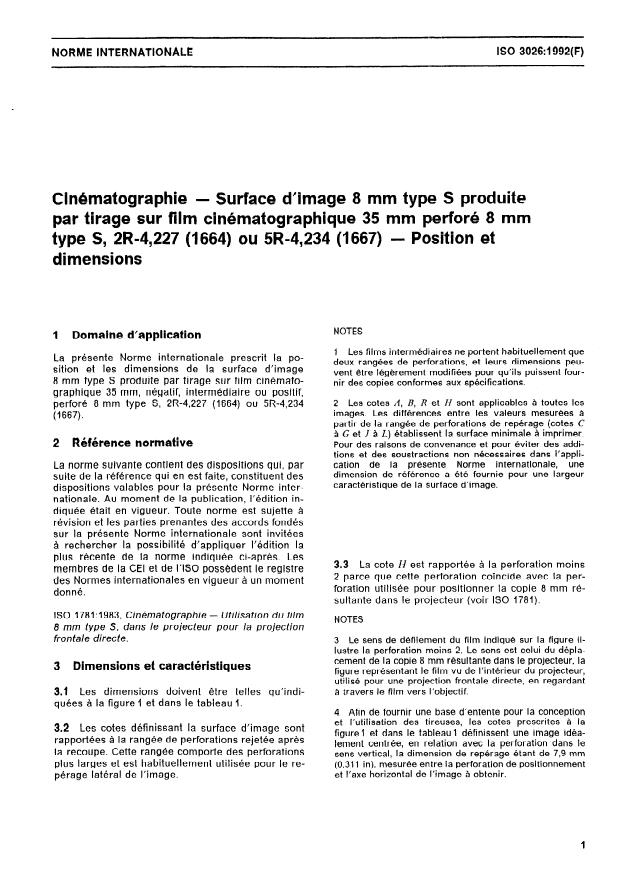
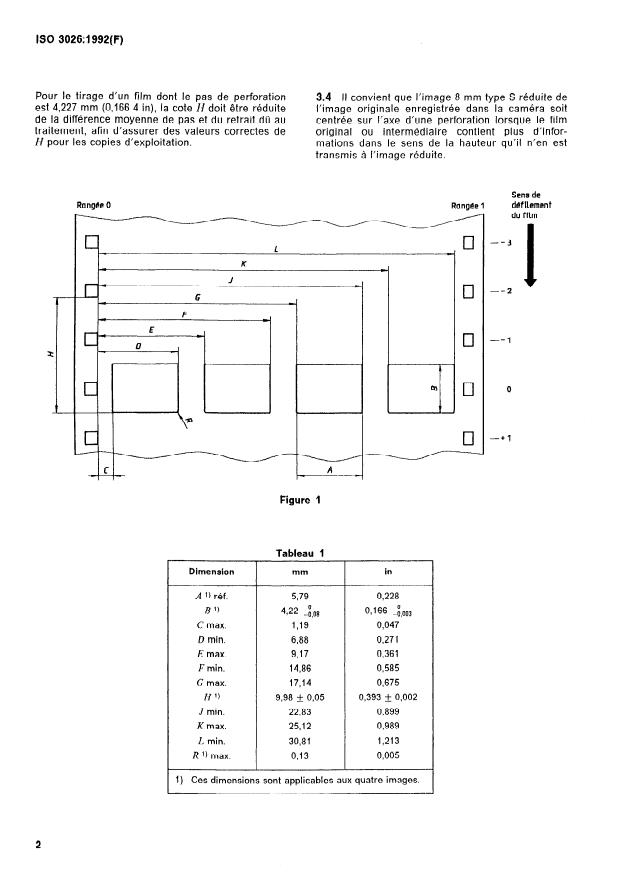
The dimensions which define the image area are established from the row of perforations discarded after slitting. This row contains a wider perforation and is customarily used for lateral resgistration of the image. Annex A describes the use of a registration device for prints made with a step printer.
- Status
- Published
- Publication Date
- 08-Jul-1992
- Technical Committee
- ISO/TC 36 - Cinematography
- Drafting Committee
- ISO/TC 36/WG 2 - Laboratory and distribution services technology
- Current Stage
- 9060 - Close of review
- Completion Date
- 04-Jun-2029
Buy Documents
ISO 3026:1992 - Cinematography — Printed 8 mm Type S image area on 35 mm motion-picture film perforated 8 mm Type S, 2R-4.227 (1664) or 5R-4.234 (1667) — Position and dimensions Released:7/9/1992
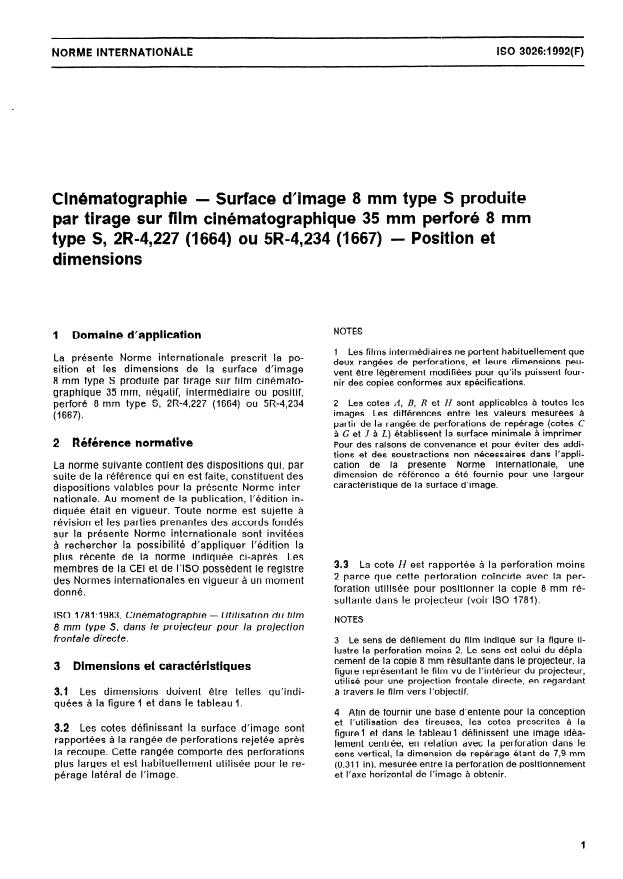
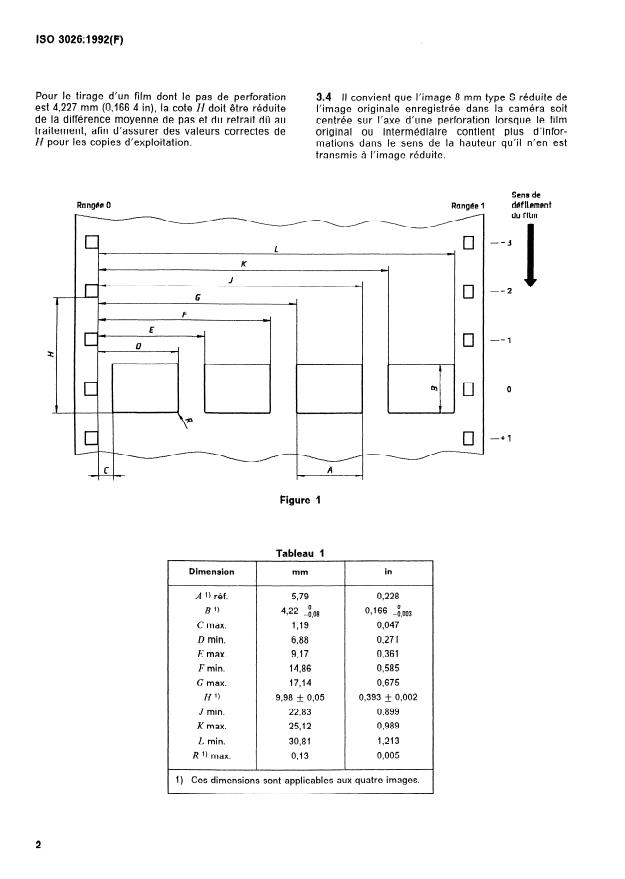
ISO 3026:1992 - Cinématographie — Surface d'image 8 mm type S produite par tirage sur film cinématographique 35 mm perforé 8 mm type S, 2R-4,227 (1664) ou 5R-4,234 (1667) — Position et dimensions Released:7/9/1992
ISO 3026:1992 - Cinématographie — Surface d'image 8 mm type S produite par tirage sur film cinématographique 35 mm perforé 8 mm type S, 2R-4,227 (1664) ou 5R-4,234 (1667) — Position et dimensions Released:7/9/1992
Overview
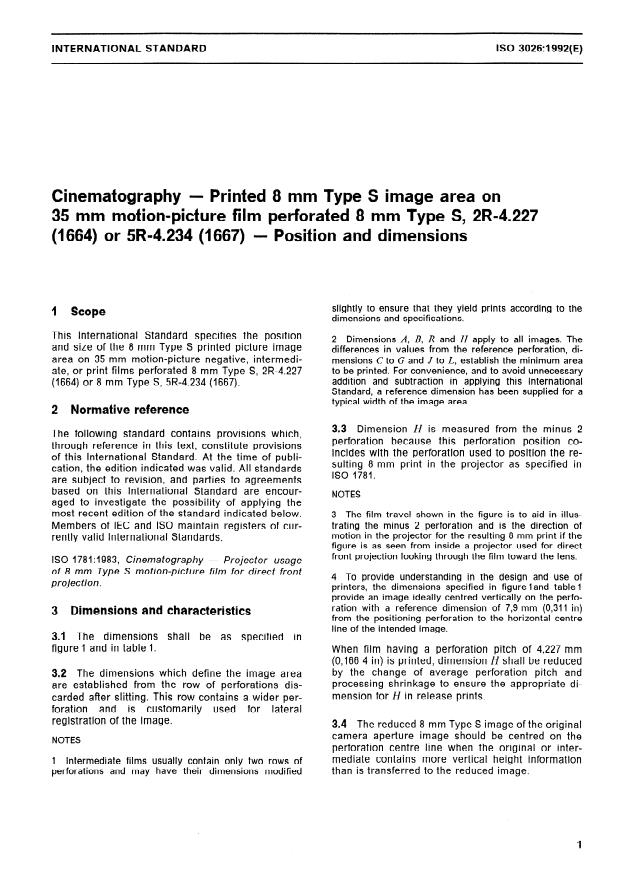
ISO 3026:1992 specifies the position and dimensions of the printed 8 mm Type S image area when produced by optical or contact printing onto 35 mm motion‑picture film perforated 8 mm Type S (pitch variants 2R-4.227 (1664) or 5R-4.234 (1667)). The standard defines how the image area is located relative to a row of perforations that is discarded after slitting; this discarded row contains a wider perforation customarily used for lateral registration. Annex A gives informative guidance on using a registration (stop) device for prints made with step printers.
Key topics and technical requirements
- Scope: Applies to negative, intermediate or positive prints produced on 35 mm film perforated 8 mm Type S.
- Image referencing: Image dimensions and positions are referenced to the row of perforations removed after slitting; this ensures consistent lateral registration.
- Registration spacing: A reference lateral registration dimension of 7.9 mm (0.311 in) is used, measured between the positioning perforation and the horizontal axis of the produced 8 mm image.
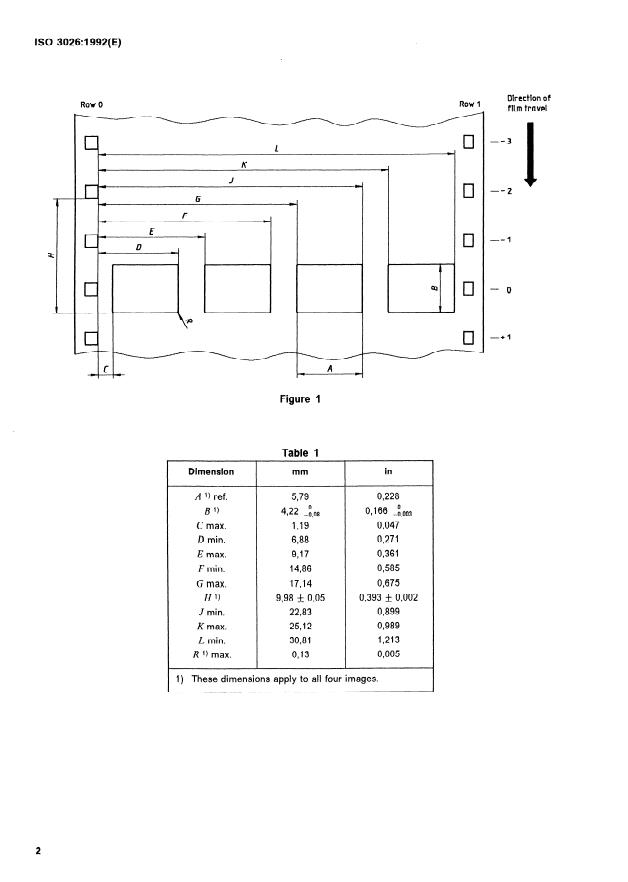
- Dimension set: The standard provides a table (Table 1) and figure defining dimensional callouts (A–L and R) in both metric and inch units for accurate printing and verification.
- Projector alignment: The vertical reference (cote H) is tied to “perforation minus 2” because that perforation aligns with the projector positioning used for direct front projection (see ISO 1781).
- Informative annexes: Annex A - use of stop devices on alternative printers; Annex B - bibliographic references.
Practical applications and users
ISO 3026:1992 is intended for professionals and organizations involved in film production, printing and archiving, including:
- Film laboratories performing optical contact or step printing of 8 mm Type S images onto 35 mm stock
- Post‑production and finishing houses ensuring printed frames meet positional tolerances
- Equipment designers (tireuses, step printers, registration devices) and projector manufacturers needing compatibility with projector positioning standards
- Film restorers and archives validating historic prints and remastering workflows
- Quality assurance and standards compliance teams implementing consistent image registration across prints
Using ISO 3026 helps ensure consistent image placement, reliable lateral registration, and projector compatibility - essential for projection, duplication and long‑term preservation of 8 mm Type S material.
Related standards
Informative references listed in the standard include:
- ISO 1781:1983 (use of 8 mm Type S film in projectors)
- ISO 1785:1983 and ISO 1787:1984 (8 mm image area and camera specifications)
- ISO 3774:1988 and ISO 3775:1990 (35 mm film perforation, cut dimensions and 8 mm format image fields)
Keywords: ISO 3026, 8 mm Type S, 35 mm film, image area, film perforations, position and dimensions, film printing, registration device.
Relations
- Effective Date
- 15-Apr-2008
Buy Documents
ISO 3026:1992 - Cinematography — Printed 8 mm Type S image area on 35 mm motion-picture film perforated 8 mm Type S, 2R-4.227 (1664) or 5R-4.234 (1667) — Position and dimensions Released:7/9/1992
ISO 3026:1992 - Cinématographie — Surface d'image 8 mm type S produite par tirage sur film cinématographique 35 mm perforé 8 mm type S, 2R-4,227 (1664) ou 5R-4,234 (1667) — Position et dimensions Released:7/9/1992
ISO 3026:1992 - Cinématographie — Surface d'image 8 mm type S produite par tirage sur film cinématographique 35 mm perforé 8 mm type S, 2R-4,227 (1664) ou 5R-4,234 (1667) — Position et dimensions Released:7/9/1992
Frequently Asked Questions
ISO 3026:1992 is a standard published by the International Organization for Standardization (ISO). Its full title is "Cinematography — Printed 8 mm Type S image area on 35 mm motion-picture film perforated 8 mm Type S, 2R-4.227 (1664) or 5R-4.234 (1667) — Position and dimensions". This standard covers: The dimensions which define the image area are established from the row of perforations discarded after slitting. This row contains a wider perforation and is customarily used for lateral resgistration of the image. Annex A describes the use of a registration device for prints made with a step printer.
The dimensions which define the image area are established from the row of perforations discarded after slitting. This row contains a wider perforation and is customarily used for lateral resgistration of the image. Annex A describes the use of a registration device for prints made with a step printer.
ISO 3026:1992 is classified under the following ICS (International Classification for Standards) categories: 37.060.20 - Motion picture films. Cartridges. The ICS classification helps identify the subject area and facilitates finding related standards.
ISO 3026:1992 has the following relationships with other standards: It is inter standard links to ISO 3026:1975. Understanding these relationships helps ensure you are using the most current and applicable version of the standard.
ISO 3026:1992 is available in PDF format for immediate download after purchase. The document can be added to your cart and obtained through the secure checkout process. Digital delivery ensures instant access to the complete standard document.
Standards Content (Sample)
ISO
INTERNATIONAL
STANDARD
Second edition
1992-07-15
Cinematography - Printed 8 mm Type S image
area on 35 mm motion-pictwe film perfor&d
8 mm Type S, 2R-4.227 (1664) or SR-4.234
(1667) - Position and dimensions
Cin&natographie -
Surface d’image 8 min type S produife par tirage sur
film cinematographique 35 mm perfore 8 r-nm type s, 2~4,227 (1664) 0~
Position et dimensions
5R-4,234 (1667) -
:=
-- --
Reference number
ISO 3026: 1992(E)
Foreword
ISO (the International Organization for Standardization) is a worldwide
federation of national Standards bodies (ISO member bodies). The work
of preparing International Standards is normally carried out through ISO
technical committees. Esch member body interested in a subject for
which a technical committee has been established has the right to be
represented on that committee. International organizations, govern-
mental and non-governmental, in liaison with ISO, also take patt in the
work. ISO collaborates closely with the International Electrotechnical
Commission (IEC) on all matters of electrotechnical standardization.
Draft International Standards adopted by the technical committees are
circulated to the member bodies for voting. Publication as an Inter-
national Standard requires approval by at least 75 % of the member
bodies casting a vote.
International Standard ISO 3026 was prepared by Technical Committee
ISO/TC 36, Cinematography.
This second edition cancels and replaces the fit-st edition
(ISO 3026:1975), of which it constitutes a minor revision.
Annexes A and B of this International Standard are for information only.
0 ISO 1992
All rights reserved. No part of this publication may be reproduced or utilized in any form
or by any means, electronie or mechanical, including photocopying and microfilm, without
Permission in writing from the publisher.
International Organizati on for Standard ization
211 Geneve 20 l Switzer land
Case Postale 56 l CH-1
Printed in Switzerland
INTERNATIONAL STANDARD
Cinematography - Printed 8 mm Type S image area on
35 mm motion-picture film perforated 8 mm Type S, 2R-4.227
(1664) or 5R-4.234 (1667) - Position and dimensions
slightly to ensure that they yield prints according to the
1 Scope
dimensions and specifications.
This International Standard specifies the Position
2 Dimensions A, ZI, R and 11 apply to all images. The
and size of the 8 mm Type S printed picture image
differentes in values from the reference Perforation, di-
area on 35 mm motion-picture negative, intermedi- mensions C to C and J to L, establish the minimum area
to be printed. For convenience, and to avoid unnecessary
ate, or print films perforated 8 mm Type S, 2R-4.227
addition and subtraction in applying this International
(1664) or 8 mm Type S, 5R-4.234 (1667).
Standard, a reference dimension has been supplied for a
typical width of the image area.
2 Normative reference
3.3 Dimension H is measured from the minus 2
The following Standard contains provisions which,
Perforation because this Perforation Position co-
through reference in this text, constitute provisions
incides with the Perforation used to Position the re-
of this International Standard. At the time of publi-
sulting 8 mm print in the projector as specified in
cation, the edition indicated was valid. All Standards
ISO 1781.
are subject to revision, and Parties to agreements
based on this International Standard are encour-
NOTES
aged to investigate the possibility of applying the
most recent edition of the Standard indicated below.
3 The film travel shown in the figure is
...
NORME
INTERNATIONALE
Deuxième édition
1992-07-l 5
Cinématographie - Surface d’image 8 mm
jype S produite par tirage sur film
cinématographique 35 mm perforé 8 mm type S,
2R-4,227 (1664) ou 5R-4,234 (1667) - Position et
dimensions
Cinematography - Printed 8 mm Type S image area on 35 mm
motion-picture film perforated 8 mm Type S, 2R-4.227 (1664) OI- 5R-4.234
(1667) - Position and dimensions
Numéro de référence
ISO 3026: 1992(F)
Avant-propos
L’ISO (Organisation internationale de normalisation) est une fédération
mondiale d’organismes nationaux de normalisation (comités membres
de I’ISO). L’élaboration des Normes internationales est en général
confiée aux comités techniques de I’ISO. Chaque comité membre inté-
ressé par une étude a le droit de faire partie du comité technique créé
à cet effet. Les organisations internationales, gouvernementales et non
gouvernementales, en liaison avec I’ISO participent également aux tra-
vaux. L’ISO collabore étroitement avec la Commission électrotechnique
internationale (CEI) en ce qui concerne la normalisation électrotech-
nique.
Les projets de Normes internationales adoptés par les comités techni-
ques sont soumis aux comités membres pour vote. Leur publication
comme Normes internationales requiert l’approbation de 75 % au moins
des comités membres votants.
La Norme internationale ISO 3026 a été élaborée par le comité techni-
que ISO/TC 36, Cinématographie.
Cette deuxième édition annule et remplace la première édition
(ISO 3026:1975), dont elle constitue une révision mineure.
Les annexes A et B de la présente Norme internationale sont données
uniq uement à titre d ‘information.
0 ISO 1992
Droits de reproduction réservés. Aucune partie de cette publication ne peut être repro-
duite ni utilisée sous quelque forme que ce soit et par aucun procédé, électronique ou
mécanique, y compris la photocopie et les microfilms, sans l’accord écrit de l’éditeur.
internationale de normalisation
Organisation
Case Postale 56 l CH-1211 Genève 20 * Suisse
Imprimé en Suisse
ii
~-~ -~
NORME INTERNATIONALE
Cinématographie - Surface d’image 8 mm type S produite
par tirage sur film cinématographique 35 mm perforé 8 mm
type S, 2R-4,227 (1664) ou 5R-4,234 (1667) - Position et
dimensions
NOTES
1 Domaine d’application
1 Les films intermédiaires ne portent habituellement que
La présente Norme internationale prescrit la po-
deux rangées de perforations, et leurs dimensions peu-
sition et les dimensions de la surface d’image
vent être légèrement modifiées pour qu’ils puissent four-
8 mm type S produite par tirage sur film cinémato-
nir des copies conformes aux spécifications.
graphique 35 mm, négatif, intermédiaire ou positif,
2 Les cotes A, B, R et H sont applicables à toutes les
perforé 8 mm type S, 2R-4,227 (1664) ou 5R-4,234
images. Les différences entre les valeurs mesurées à
(1667).
partir de la rangée de perforations de repérage (cotes C
à G et J à L) établissent la surface minimale à imprimer.
2 Référence normative Pour des raisons de convenance et pour éviter des addi-
tions et des soustractions non nécessaires dans I’appli-
de la présente Norme internationale, une
La norme suivante contient des dispositions qui, par cation
dimension de référence a été fournie pour une largeur
suite de la référence qui en est faite, constituent des
caractéristique de la surface d’image.
dispositions valables pour la présente Norme inter-
nationale. Au moment de la publication, l’édition in-
diquée était en vigueur. Toute norme est sujette à
révision et les parties prenantes des accords fondés
sur la présente Norme internationale sont invitées
à rechercher la possibilité d’appliquer l’édition la
plus récente de la norme indiquée ci-après. Les
3.3 La cote H est rapportée à la perforation moins
membres de la CEI et de I’ISO possèdent le registre
2 parce que cette perforation coïncide avec la per-
de
...
NORME
INTERNATIONALE
Deuxième édition
1992-07-l 5
Cinématographie - Surface d’image 8 mm
jype S produite par tirage sur film
cinématographique 35 mm perforé 8 mm type S,
2R-4,227 (1664) ou 5R-4,234 (1667) - Position et
dimensions
Cinematography - Printed 8 mm Type S image area on 35 mm
motion-picture film perforated 8 mm Type S, 2R-4.227 (1664) OI- 5R-4.234
(1667) - Position and dimensions
Numéro de référence
ISO 3026: 1992(F)
Avant-propos
L’ISO (Organisation internationale de normalisation) est une fédération
mondiale d’organismes nationaux de normalisation (comités membres
de I’ISO). L’élaboration des Normes internationales est en général
confiée aux comités techniques de I’ISO. Chaque comité membre inté-
ressé par une étude a le droit de faire partie du comité technique créé
à cet effet. Les organisations internationales, gouvernementales et non
gouvernementales, en liaison avec I’ISO participent également aux tra-
vaux. L’ISO collabore étroitement avec la Commission électrotechnique
internationale (CEI) en ce qui concerne la normalisation électrotech-
nique.
Les projets de Normes internationales adoptés par les comités techni-
ques sont soumis aux comités membres pour vote. Leur publication
comme Normes internationales requiert l’approbation de 75 % au moins
des comités membres votants.
La Norme internationale ISO 3026 a été élaborée par le comité techni-
que ISO/TC 36, Cinématographie.
Cette deuxième édition annule et remplace la première édition
(ISO 3026:1975), dont elle constitue une révision mineure.
Les annexes A et B de la présente Norme internationale sont données
uniq uement à titre d ‘information.
0 ISO 1992
Droits de reproduction réservés. Aucune partie de cette publication ne peut être repro-
duite ni utilisée sous quelque forme que ce soit et par aucun procédé, électronique ou
mécanique, y compris la photocopie et les microfilms, sans l’accord écrit de l’éditeur.
internationale de normalisation
Organisation
Case Postale 56 l CH-1211 Genève 20 * Suisse
Imprimé en Suisse
ii
~-~ -~
NORME INTERNATIONALE
Cinématographie - Surface d’image 8 mm type S produite
par tirage sur film cinématographique 35 mm perforé 8 mm
type S, 2R-4,227 (1664) ou 5R-4,234 (1667) - Position et
dimensions
NOTES
1 Domaine d’application
1 Les films intermédiaires ne portent habituellement que
La présente Norme internationale prescrit la po-
deux rangées de perforations, et leurs dimensions peu-
sition et les dimensions de la surface d’image
vent être légèrement modifiées pour qu’ils puissent four-
8 mm type S produite par tirage sur film cinémato-
nir des copies conformes aux spécifications.
graphique 35 mm, négatif, intermédiaire ou positif,
2 Les cotes A, B, R et H sont applicables à toutes les
perforé 8 mm type S, 2R-4,227 (1664) ou 5R-4,234
images. Les différences entre les valeurs mesurées à
(1667).
partir de la rangée de perforations de repérage (cotes C
à G et J à L) établissent la surface minimale à imprimer.
2 Référence normative Pour des raisons de convenance et pour éviter des addi-
tions et des soustractions non nécessaires dans I’appli-
de la présente Norme internationale, une
La norme suivante contient des dispositions qui, par cation
dimension de référence a été fournie pour une largeur
suite de la référence qui en est faite, constituent des
caractéristique de la surface d’image.
dispositions valables pour la présente Norme inter-
nationale. Au moment de la publication, l’édition in-
diquée était en vigueur. Toute norme est sujette à
révision et les parties prenantes des accords fondés
sur la présente Norme internationale sont invitées
à rechercher la possibilité d’appliquer l’édition la
plus récente de la norme indiquée ci-après. Les
3.3 La cote H est rapportée à la perforation moins
membres de la CEI et de I’ISO possèdent le registre
2 parce que cette perforation coïncide avec la per-
de
...