


ISO 9138:1993
(Main)Abrasive grains — Sampling and splitting
Abrasive grains — Sampling and splitting
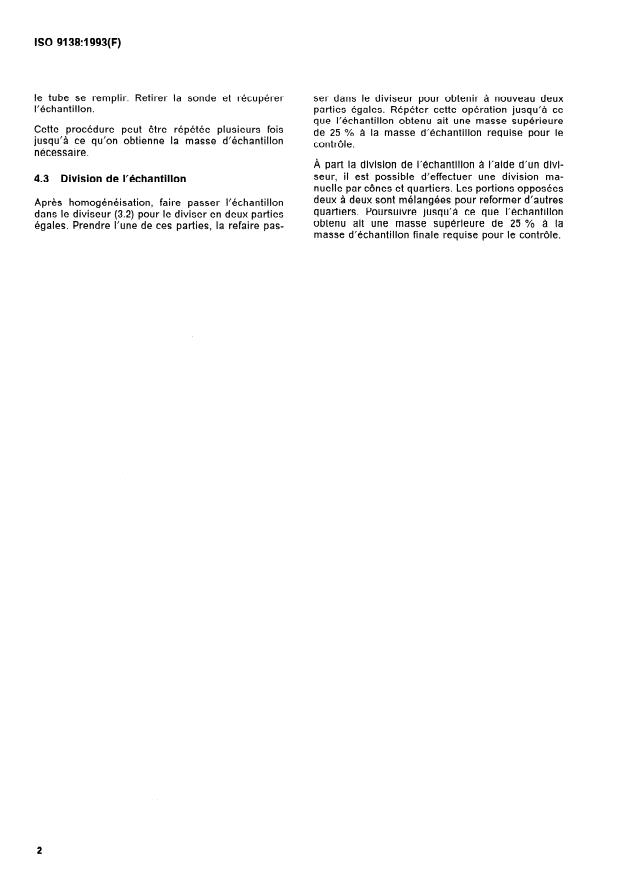
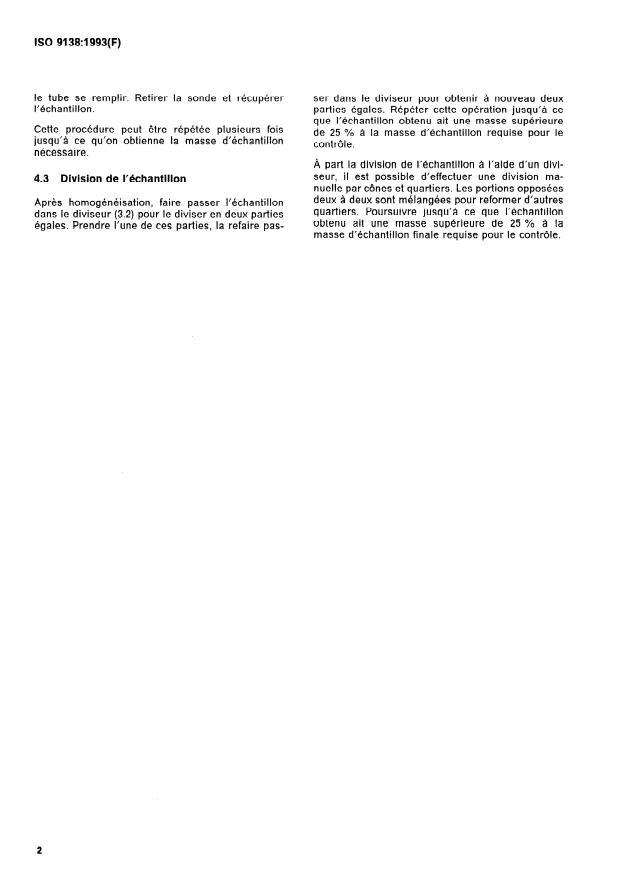
Sampling is made using a sampling thief. Splitting means dividing into two equal portions using a splitter (commonly a Jones sampler) and repeating this procedure at each of the portions obtained until the sample is 25 % larger than the amount required for testing. The method may be used in the comparative testing of uniformly produced abrasive grains.
Grains abrasifs — Échantillonnage et division
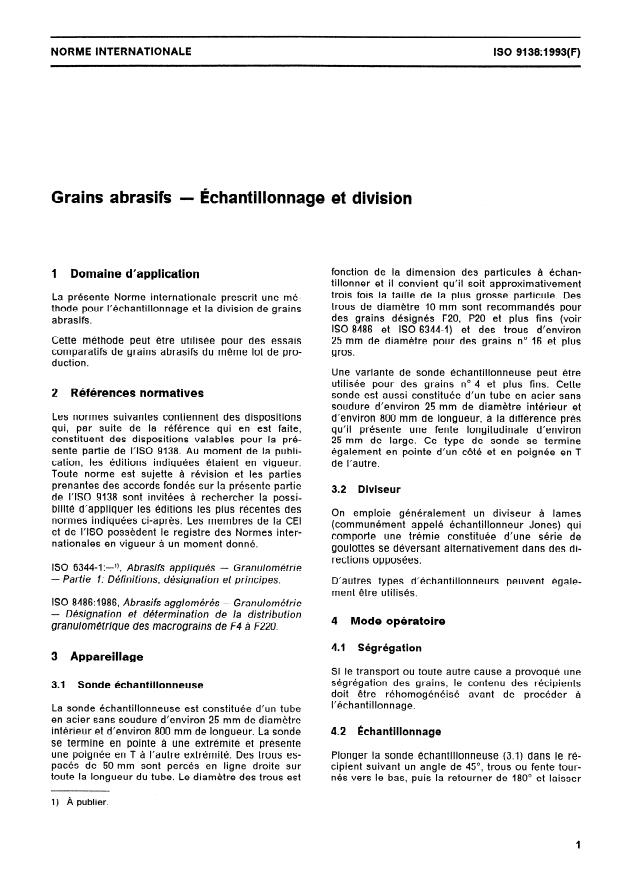
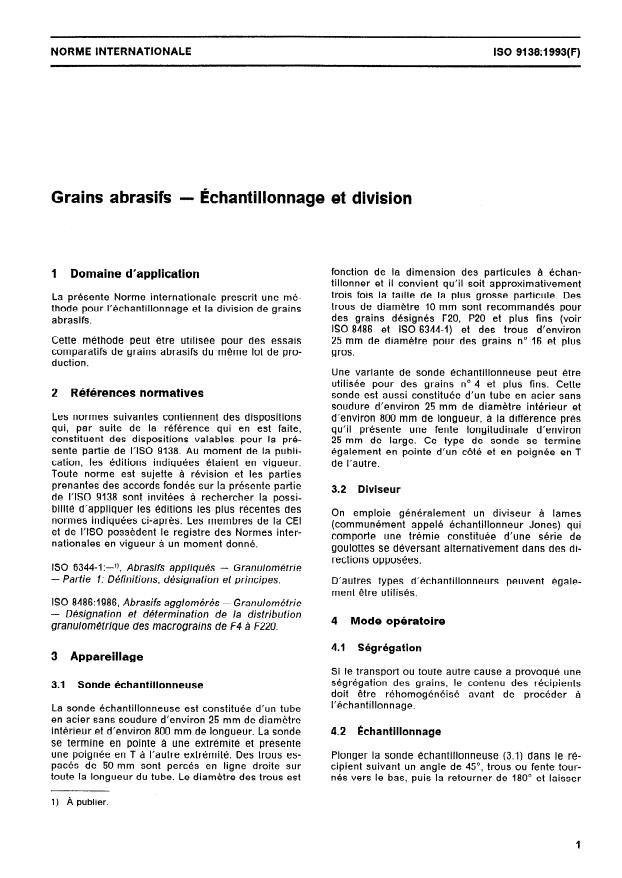
La présente Norme internationale prescrit une méthode pour l'échantillonnage et la division de grains abrasifs. Cette méthode peut être utilisée pour des essais comparatifs de grains abrasifs du même lot de production.
General Information
- Status
- Withdrawn
- Publication Date
- 27-Jan-1993
- Withdrawal Date
- 27-Jan-1993
- Technical Committee
- ISO/TC 29/SC 5 - Grinding wheels and abrasives
- Drafting Committee
- ISO/TC 29/SC 5/WG 7 - Grain characteristics
- Current Stage
- 9599 - Withdrawal of International Standard
- Start Date
- 30-Jan-2015
- Completion Date
- 12-Feb-2026
Relations
- Effective Date
- 09-Jul-2011
ISO 9138:1993 - Abrasive grains -- Sampling and splitting
ISO 9138:1993 - Grains abrasifs -- Échantillonnage et division
ISO 9138:1993 - Grains abrasifs -- Échantillonnage et division
Get Certified
Connect with accredited certification bodies for this standard

National Aerospace and Defense Contractors Accreditation Program (NADCAP)
Global cooperative program for special process quality in aerospace.
CARES (UK Certification Authority for Reinforcing Steels)
UK certification for reinforcing steels and construction.
DVS-ZERT GmbH
German welding certification society.
Sponsored listings
Frequently Asked Questions
ISO 9138:1993 is a standard published by the International Organization for Standardization (ISO). Its full title is "Abrasive grains — Sampling and splitting". This standard covers: Sampling is made using a sampling thief. Splitting means dividing into two equal portions using a splitter (commonly a Jones sampler) and repeating this procedure at each of the portions obtained until the sample is 25 % larger than the amount required for testing. The method may be used in the comparative testing of uniformly produced abrasive grains.
Sampling is made using a sampling thief. Splitting means dividing into two equal portions using a splitter (commonly a Jones sampler) and repeating this procedure at each of the portions obtained until the sample is 25 % larger than the amount required for testing. The method may be used in the comparative testing of uniformly produced abrasive grains.
ISO 9138:1993 is classified under the following ICS (International Classification for Standards) categories: 25.100.70 - Abrasives. The ICS classification helps identify the subject area and facilitates finding related standards.
ISO 9138:1993 has the following relationships with other standards: It is inter standard links to ISO 9138:2015. Understanding these relationships helps ensure you are using the most current and applicable version of the standard.
ISO 9138:1993 is available in PDF format for immediate download after purchase. The document can be added to your cart and obtained through the secure checkout process. Digital delivery ensures instant access to the complete standard document.
Standards Content (Sample)
ISO
INTERNATIONAL
STANDARD
First edition
1993-02-0 1
- Sampling and splitting
Abrasive grains
- khantillonnage et division
Grains abrasifs
Reference number
ISO 9 138: 1993(E)
Foreword
ISO (the International Organization for Standardization) is a worldwide
federation of national Standards bodies (ISO member bodies). The work
of preparing International Standards is normally carried out through ISO
technical committees. Esch member body interested in a subject for
which a technical committee has been established has the right to be
represented on that committee. International organizations, govern-
mental and non-governmental, in liaison with ISO, also take part in the
work. ISO collaborates closely with the International Electrotechnical
Commission (IEC) on all matters of electrotechnical standardization.
Draft International Standards adopted by the technical committees are
circulated to the member bodies for voting. Publication as an Inter-
national Standard requires approval by at least 75 % of the member
bodies casting a vote.
International Standard ISO 9138 was prepared by Technical Committee
ISO/TC 29, Small tools, Sub-Committee SC 5, Grinding wheels and
abrasives.
0 ISO 1993
All rights reserved. No part of this publication may be reproduced or utilized in any form
or by any means, electronie or mechanical, including photocopying and microfilm, without
Permission in writing from the publisher.
International Organization for Standardization
Case Postale 56 l CH-121 1 Geneve 20 l Switzerland
Printed in Switzerland
ii
INTERNATIONAL STANDARD
Abrasive grains - Sampling and splitting
it is usually sufficient to use holes 10 mm in diam-
1 Scope
eter for grains designated F20, P20 and finer (see
ISO 8486 and ISO 6344,l), while holes approximately
This Inter ,national Standard spec ifies a method for
25 mm in diameter are recommended for grains
ing and splitting of a lot ofab rasive grains.
the sampl
No. 16 and coarser.
rative testing
Th is method may be u sed in the compa
An alternative type of sampling thief may be used for
of uniformly produced abrasive grains.
grains No. 4 and finer. This sampling thief is again
made from seamless steel tubing of inside diameter
approximately 25 mm and length approximately
2 Normative references
800 mm, but is provided with a lengthwise slot of
approximately 25 mm in width. This type of sampling
The following Standards contain provisions which,
thief is also pointed at one end and provided with a
through reference in this text, constitute provisions
“T” handle at the other end.
of this part of ISO 9138. At the time of publication,
the editions indicated were valid. All Standards are
3.2 Splitter
subject to revision, and Parti
...
ISO
NORME
INTERNATIONALE
Première édition
1993-02-O 1
Grains abrasifs - Échantillonnage et division
Abrasive grains - Sampling and splitting
-
-
-.-
Numéro de référence
-- --
-----.~
--_.--_---_ _. __- _ _ ISO 9138:1993(F)
Avant-,propos
L’ISO (Organisation internationale de normalisation) est une fédération
mondiale d’organismes nationaux de normalisation (comités membres
de I’ISO). L’élaboration des Normes internationales est en général
confiée aux comités techniques de I’ISO. Chaque comité membre inté-
ressé par une étude a le droit de faire partie du comité technique créé
à cet effet. Les organisations internationales, gouvernementales et non
gouvernementales, en liaison avec I’ISO participent également aux tra-
vaux. L’ISO collabore étroitement avec la Commission électrotechnique
internationale (CEI) en ce qui concerne la normalisation électrotech-
nique.
Les projets de Normes internationales adoptés par les comités techni-
ques sont soumis aux comités membres pour vote. Leur publication
comme Normes internationales requiert l’approbation de 75 % au moins
des comités membres votants.
La Norme internationale ISO 9138 a été élaborée par le comité techni-
que ISO/TC 29, Petit outillage, sous-comité SC 5, Meules ef abrasifs.
0 ISO 1993
Droits de reproduction réservés. Aucune partie de cette publication ne peut être repro-
ou
duite ni util isée sous quelque forme q ue ce soit et par aucun procédé, électronique
la photocopie et les microfil ms, sans l’accord écrit de l’éditeur.
mécanique, y compris
Organisation internationale de normalisa tion
56 l CH-1211 Genève 20 l Suisse
Case Postale
Imprimé en Suisse
ii
NORME INTERNATIONALE
- Échantillonnage et division
Grains abrasifs
fonction de la dimension des particules à échan-
1 Domaine d’application
tillonner et il convient qu’il soit approximativement
trois fois la taille de la plus grosse particule. Des
La présente Norme internationale prescrit une mé-
trous de diamètre 10 mm sont recommandés pour
thode pour l’échantillonnage et la division de grains
des grains désignés F20, P20 et plus fins (voir
abrasifs.
ISO 8486 et ISO 6344-l) et des trous d’environ
25 mm de diamètre pour des grains no 16 et plus
Cette méthode peut être utilisée pour des essais
comparatifs de grains abrasifs du même lot de pro- gros.
duction.
Une variante de sonde échantillonneuse peut être
utilisée pour des grains no 4 et plus fins. Cette
2 Références normatives sonde est aussi constituée d’un tube en acier sans
soudure d’environ 25 mm de diamètre intérieur et
Les normes suivantes contiennent des dispositions d’environ 800 mm de longueur, à la différence près
qui, par suite de la référence qui en est faite, qu’il présente une fente longitudinale d’environ
constituent des dispositions valables pour la pré- 25 mm de large. Ce type de sonde se termine
sente partie de I’ISO 9138. Au moment de la publi- également en pointe d’un côté et en poignée en T
cation, les éditions indiquées étaient en vigueur. de l’autre.
...
ISO
NORME
INTERNATIONALE
Première édition
1993-02-O 1
Grains abrasifs - Échantillonnage et division
Abrasive grains - Sampling and splitting
-
-
-.-
Numéro de référence
-- --
-----.~
--_.--_---_ _. __- _ _ ISO 9138:1993(F)
Avant-,propos
L’ISO (Organisation internationale de normalisation) est une fédération
mondiale d’organismes nationaux de normalisation (comités membres
de I’ISO). L’élaboration des Normes internationales est en général
confiée aux comités techniques de I’ISO. Chaque comité membre inté-
ressé par une étude a le droit de faire partie du comité technique créé
à cet effet. Les organisations internationales, gouvernementales et non
gouvernementales, en liaison avec I’ISO participent également aux tra-
vaux. L’ISO collabore étroitement avec la Commission électrotechnique
internationale (CEI) en ce qui concerne la normalisation électrotech-
nique.
Les projets de Normes internationales adoptés par les comités techni-
ques sont soumis aux comités membres pour vote. Leur publication
comme Normes internationales requiert l’approbation de 75 % au moins
des comités membres votants.
La Norme internationale ISO 9138 a été élaborée par le comité techni-
que ISO/TC 29, Petit outillage, sous-comité SC 5, Meules ef abrasifs.
0 ISO 1993
Droits de reproduction réservés. Aucune partie de cette publication ne peut être repro-
ou
duite ni util isée sous quelque forme q ue ce soit et par aucun procédé, électronique
la photocopie et les microfil ms, sans l’accord écrit de l’éditeur.
mécanique, y compris
Organisation internationale de normalisa tion
56 l CH-1211 Genève 20 l Suisse
Case Postale
Imprimé en Suisse
ii
NORME INTERNATIONALE
- Échantillonnage et division
Grains abrasifs
fonction de la dimension des particules à échan-
1 Domaine d’application
tillonner et il convient qu’il soit approximativement
trois fois la taille de la plus grosse particule. Des
La présente Norme internationale prescrit une mé-
trous de diamètre 10 mm sont recommandés pour
thode pour l’échantillonnage et la division de grains
des grains désignés F20, P20 et plus fins (voir
abrasifs.
ISO 8486 et ISO 6344-l) et des trous d’environ
25 mm de diamètre pour des grains no 16 et plus
Cette méthode peut être utilisée pour des essais
comparatifs de grains abrasifs du même lot de pro- gros.
duction.
Une variante de sonde échantillonneuse peut être
utilisée pour des grains no 4 et plus fins. Cette
2 Références normatives sonde est aussi constituée d’un tube en acier sans
soudure d’environ 25 mm de diamètre intérieur et
Les normes suivantes contiennent des dispositions d’environ 800 mm de longueur, à la différence près
qui, par suite de la référence qui en est faite, qu’il présente une fente longitudinale d’environ
constituent des dispositions valables pour la pré- 25 mm de large. Ce type de sonde se termine
sente partie de I’ISO 9138. Au moment de la publi- également en pointe d’un côté et en poignée en T
cation, les éditions indiquées étaient en vigueur. de l’autre.
...
Questions, Comments and Discussion
Ask us and Technical Secretary will try to provide an answer. You can facilitate discussion about the standard in here.
Loading comments...