

ISO 19127:2019
(Main)Geographic information — Geodetic register
General Information
- Abstract
This document defines the management and operations of the ISO geodetic register and identifies the data elements, in accordance with ISO 19111:2007 and the core schema within ISO 19135‑1:2015, required within the geodetic register.
- Status
- Withdrawn
- Publication Date
- 12-Feb-2019
- Technical Committee
- ISO/TC 211 - Geographic information/Geomatics
- Drafting Committee
- ISO/TC 211/WG 9 - Information management
- Current Stage
- 9599 - Withdrawal of International Standard
- Start Date
- 03-Aug-2026
- Completion Date
- 29-Aug-2026
Buy Documents






ISO 19127:2019 - Geographic information -- Geodetic register
ISO 19127:2019 - Geographic information — Geodetic register/13/2019
Overview
ISO 19127:2019 - Geographic information - Geodetic register defines management, operations and required data elements for the ISO geodetic register (geodetic registry). It aligns geodetic codes and parameters with ISO 19111:2007 (spatial referencing by coordinates) and the core schema of ISO 19135‑1:2015 (procedures for item registration). The standard specifies how geodetic items (coordinate reference systems, coordinate operations, parameters and codes) are recorded, maintained and published in a centrally managed registry.
Key topics and technical requirements
- Scope and conformance: Defines conditions for conformance (Annex A normative test suite) and requires that the geodetic register satisfy the specified tests.
- Management roles: Responsibilities for the register owner, register manager, registry manager, control body (optional), submitting organizations and users are defined in line with ISO 19135‑1:2015.
- Management rules & procedures: Uses ISO 19135‑1:2015 core schema to define unmodified, modified and additional requirements for registration workflows, including submission, review, approval, appeals and change-recording.
- Registry operational requirements: The ISO geodetic registry must be publicly available with a web-based human interface and web service APIs, a stable domain name, at least 95% annual availability, and an authoritative review process.
- Content requirements: Specifies the data elements required in the register by referencing ISO 19111:2007 and ISO 19135‑1:2015; some ISO 19111 optional elements are made mandatory for clarity and interoperability. Annex B (normative) lists required geodetic codes and parameters; Annex C–E provide best practices, metadata guidance and a requirements list.
- History & lifecycle: Defines item lifecycle terms such as retirement and supersession, and mandates a publicly available record of changes so historical items remain accessible.
Practical applications
- Standardizes how coordinate reference systems, geodetic parameters and transformation methods are published and referenced across software, data portals and national geodetic services.
- Enables consistent, interoperable exchange of geodetic metadata and well-known text (WKT) representations when combined with ISO 19162:2015.
- Supports authoritative registries used by GIS vendors, survey agencies, mapping authorities, spatial data infrastructures (SDI) and software developers to ensure unambiguous spatial referencing.
Who should use this standard
- National mapping and geodetic agencies, spatial data infrastructure operators, registry managers, GIS software implementers, and anyone responsible for publishing or consuming geodetic coordinate reference systems and transformation parameters.
Related standards
- ISO 19111:2007 - Spatial referencing by coordinates
- ISO 19135‑1:2015 - Procedures for item registration (core schema)
- ISO 19115‑1:2014 - Metadata - Fundamentals
- ISO 19162:2015 - WKT representation of coordinate reference systems
Keywords: ISO 19127:2019, geodetic register, geodetic registry, geodetic codes and parameters, ISO 19111, ISO 19135, coordinate reference systems, geodetic metadata.
Relations
- Effective Date
- 27-May-2023
- Effective Date
- 16-Aug-2014
Buy Documents
ISO 19127:2019 - Geographic information -- Geodetic register
ISO 19127:2019 - Geographic information — Geodetic register/13/2019
Get Certified
Connect with accredited certification bodies for this standard

BSI Group
BSI (British Standards Institution) is the business standards company that helps organizations make excellence a habit.

NYCE
Mexican standards and certification body.
Sponsored listings
Frequently Asked Questions
ISO 19127:2019 is a standard published by the International Organization for Standardization (ISO). Its full title is "Geographic information — Geodetic register". This standard covers: This document defines the management and operations of the ISO geodetic register and identifies the data elements, in accordance with ISO 19111:2007 and the core schema within ISO 19135‑1:2015, required within the geodetic register.
This document defines the management and operations of the ISO geodetic register and identifies the data elements, in accordance with ISO 19111:2007 and the core schema within ISO 19135‑1:2015, required within the geodetic register.
ISO 19127:2019 is classified under the following ICS (International Classification for Standards) categories: 07.040 - Astronomy. Geodesy. Geography; 35.240.70 - IT applications in science. The ICS classification helps identify the subject area and facilitates finding related standards.
ISO 19127:2019 has the following relationships with other standards: It is inter standard links to ISO 19127:2026, ISO/TS 19127:2005. Understanding these relationships helps ensure you are using the most current and applicable version of the standard.
ISO 19127:2019 is available in PDF format for immediate download after purchase. The document can be added to your cart and obtained through the secure checkout process. Digital delivery ensures instant access to the complete standard document.
Standards Content (Sample)
SLOVENSKI STANDARD
01-november-2019
Nadomešča:
SIST-TS ISO/TS 19127:2009
Geografske informacije - Geodetski register
Geographic information - Geodetic register
Information géographique - Registre géodésiques
Ta slovenski standard je istoveten z: ISO 19127:2019
ICS:
07.040 Astronomija. Geodezija. Astronomy. Geodesy.
Geografija Geography
35.240.70 Uporabniške rešitve IT v IT applications in science
znanosti
2003-01.Slovenski inštitut za standardizacijo. Razmnoževanje celote ali delov tega standarda ni dovoljeno.
INTERNATIONAL ISO
STANDARD 19127
First edition
2019-02
Geographic information — Geodetic
register
Information géographique — Registre géodésiques
Reference number
©
ISO 2019
© ISO 2019
All rights reserved. Unless otherwise specified, or required in the context of its implementation, no part of this publication may
be reproduced or utilized otherwise in any form or by any means, electronic or mechanical, including photocopying, or posting
on the internet or an intranet, without prior written permission. Permission can be requested from either ISO at the address
below or ISO’s member body in the country of the requester.
ISO copyright office
CP 401 • Ch. de Blandonnet 8
CH-1214 Vernier, Geneva
Phone: +41 22 749 01 11
Fax: +41 22 749 09 47
Email: copyright@iso.org
Website: www.iso.org
Published in Switzerland
ii © ISO 2019 – All rights reserved
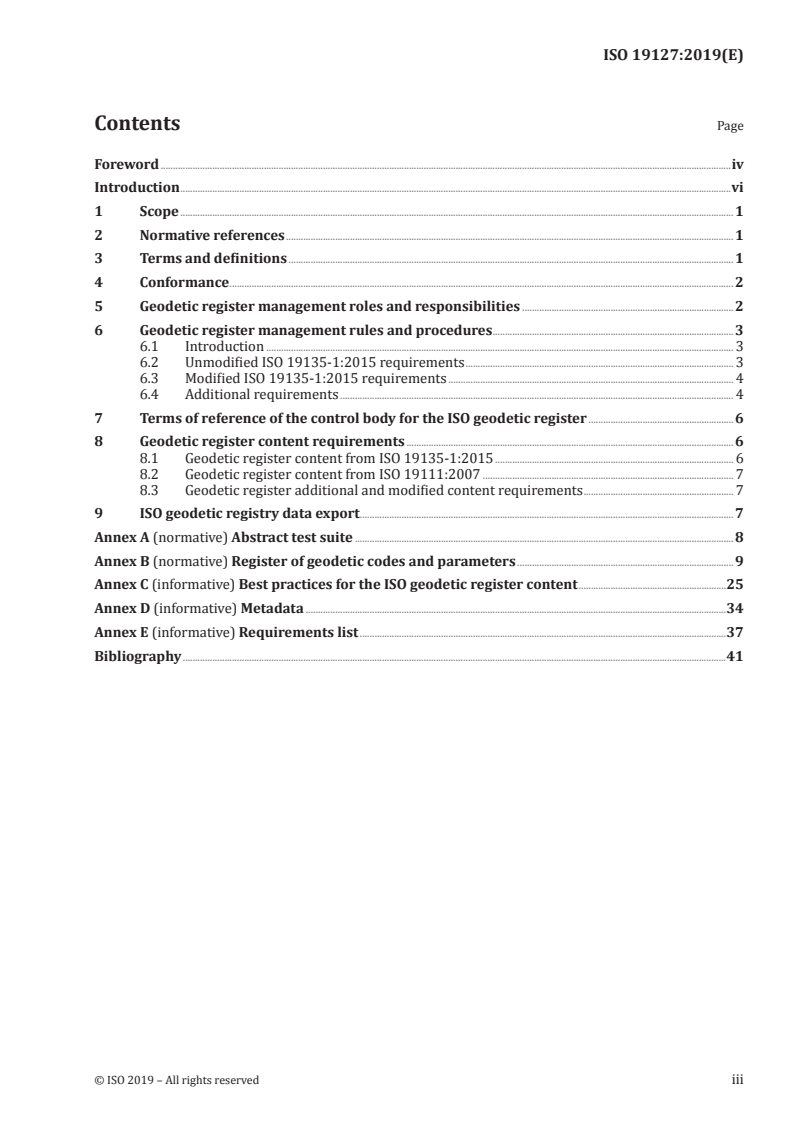
Contents Page
Foreword .iv
Introduction .vi
1 Scope . 1
2 Normative references . 1
3 Terms and definitions . 1
4 Conformance . 2
5 Geodetic register management roles and responsibilities . 2
6 Geodetic register management rules and procedures . 3
6.1 Introduction . 3
6.2 Unmodified ISO 19135-1:2015 requirements . 3
6.3 Modified ISO 19135-1:2015 requirements . 4
6.4 Additional requirements . 4
7 Terms of reference of the control body for the ISO geodetic register .6
8 Geodetic register content requirements . 6
8.1 Geodetic register content from ISO 19135-1:2015 . 6
8.2 Geodetic register content from ISO 19111:2007 . 7
8.3 Geodetic register additional and modified content requirements . 7
9 ISO geodetic registry data export . 7
Annex A (normative) Abstract test suite . 8
Annex B (normative) Register of geodetic codes and parameters . 9
Annex C (informative) Best practices for the ISO geodetic register content .25
Annex D (informative) Metadata .34
Annex E (informative) Requirements list .37
Bibliography .41
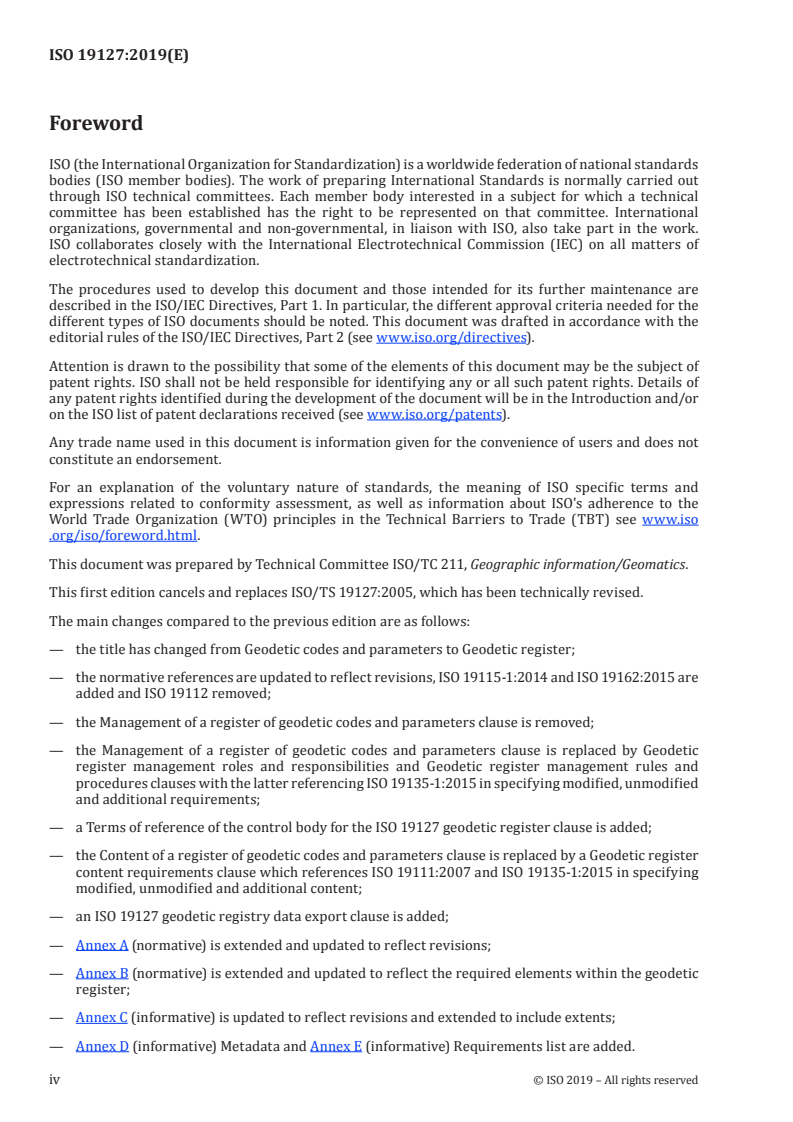
Foreword
ISO (the International Organization for Standardization) is a worldwide federation of national standards
bodies (ISO member bodies). The work of preparing International Standards is normally carried out
through ISO technical committees. Each member body interested in a subject for which a technical
committee has been established has the right to be represented on that committee. International
organizations, governmental and non-governmental, in liaison with ISO, also take part in the work.
ISO collaborates closely with the International Electrotechnical Commission (IEC) on all matters of
electrotechnical standardization.
The procedures used to develop this document and those intended for its further maintenance are
described in the ISO/IEC Directives, Part 1. In particular, the different approval criteria needed for the
different types of ISO documents should be noted. This document was drafted in accordance with the
editorial rules of the ISO/IEC Directives, Part 2 (see www .iso .org/directives).
Attention is drawn to the possibility that some of the elements of this document may be the subject of
patent rights. ISO shall not be held responsible for identifying any or all such patent rights. Details of
any patent rights identified during the development of the document will be in the Introduction and/or
on the ISO list of patent declarations received (see www .iso .org/patents).
Any trade name used in this document is information given for the convenience of users and does not
constitute an endorsement.
For an explanation of the voluntary nature of standards, the meaning of ISO specific terms and
expressions related to conformity assessment, as well as information about ISO's adherence to the
World Trade Organization (WTO) principles in the Technical Barriers to Trade (TBT) see www .iso
.org/iso/foreword .html.
This document was prepared by Technical Committee ISO/TC 211, Geographic information/Geomatics.
This first edition cancels and replaces ISO/TS 19127:2005, which has been technically revised.
The main changes compared to the previous edition are as follows:
— the title has changed from Geodetic codes and parameters to Geodetic register;
— the normative references are updated to reflect revisions, ISO 19115-1:2014 and ISO 19162:2015 are
added and ISO 19112 removed;
— the Management of a register of geodetic codes and parameters clause is removed;
— the Management of a register of geodetic codes and parameters clause is replaced by Geodetic
register management roles and responsibilities and Geodetic register management rules and
procedures clauses with the latter referencing ISO 19135-1:2015 in specifying modified, unmodified
and additional requirements;
— a Terms of reference of the control body for the ISO 19127 geodetic register clause is added;
— the Content of a register of geodetic codes and parameters clause is replaced by a Geodetic register
content requirements clause which references ISO 19111:2007 and ISO 19135-1:2015 in specifying
modified, unmodified and additional content;
— an ISO 19127 geodetic registry data export clause is added;
— Annex A (normative) is extended and updated to reflect revisions;
— Annex B (normative) is extended and updated to reflect the required elements within the geodetic
register;
— Annex C (informative) is updated to reflect revisions and extended to include extents;
— Annex D (informative) Metadata and Annex E (informative) Requirements list are added.
iv © ISO 2019 – All rights reserved
In accordance with the ISO/IEC Directives, Part 2, 2018, Rules for the structure and drafting of
International Standards, in International Standards the decimal sign is a comma on the line. However,
the General Conference on Weights and Measures (Conférence Générale des Poids et Mesures) at its
meeting in 2003 passed unanimously the following resolution:
“The decimal marker shall be either a point on the line or a comma on the line.”
In practice, the choice between these alternatives depends on customary use in the language concerned.
In the technical areas of geodesy and geographic information it is customary for the decimal point
always to be used, for all languages. That practice is used throughout this document.
Any feedback or questions on this document should be directed to the user’s national standards body. A
complete listing of these bodies can be found at www .iso .org/members .html.
Introduction
This document specifically governs procedures for the ISO 19127 geodetic register, but may have
applicability to similar national and international registers of geodetic information.
The ISO 19127 geodetic register and the ISO 19127 geodetic registry are referred to as the ISO geodetic
register and ISO geodetic registry, respectively, throughout this document.
ISO 19135-1:2015 specifies procedures for the registration of items of geographic information. ISO/
IEC JTC 1 defines registration as the assignment of an unambiguous name to an object in a way that
makes the object available to interested parties. ISO 19135-1:2015 has changed the definition of
registration to the assignment of linguistically independent identifiers, rather than names, to items
of geographic information. ISO 19135-1:2015, Annex C is applicable to ISO/TC 211 registers. The
ISO geodetic register is one such register.
ISO 19111:2007 describes elements necessary to define single and compound coordinate reference
systems so that coordinates for positions on or near the Earth’s surface can be unambiguously
referenced. ISO 19111:2007 also describes elements to define coordinate operations that change
coordinate values from one coordinate reference system to coordinate values based on another
coordinate reference system.
This document describes how the procedures specified in the core schema within ISO 19135-1:2015 are
to be applied to the ISO geodetic register of elements applicable to spatial referencing by coordinates
in accordance with ISO 19111:2007. Some elements that are optional in ISO 19111:2007 become
mandatory in this document to provide guidance on applicability and appropriate use.
Annex A, which is normative, provides four tests for conformance to this document.
Annex B, which is normative, provides tables that specify information for elements to be included in the
ISO geodetic register.
Annex C, which is informative, provides best practices for the ISO geodetic register content.
Annex D, which is informative, provides the metadata for the ISO geodetic register.
Annex E, which is informative, provides a summary of the conformance requirements that are found in
the text body of this document.
vi © ISO 2019 – All rights reserved
INTERNATIONAL STANDARD ISO 19127:2019(E)
Geographic information — Geodetic register
1 Scope
This document defines the management and operations of the ISO geodetic register and identifies
the data elements, in accordance with ISO 19111:2007 and the core schema within ISO 19135-1:2015,
required within the geodetic register.
2 Normative references
The following documents are referred to in the text in such a way that some or all of their content
constitutes requirements of this document. For dated references, only the edition cited applies. For
undated references, the latest edition of the referenced document (including any amendments) applies.
ISO 19111:2007, Geographic information — Spatial referencing by coordinates
ISO 19115-1:2014, Geographic information — Metadata — Part 1: Fundamentals
ISO 19135-1:2015, Geographic information — Procedures for item registration — Part 1: Fundamentals
ISO 19162:2015, Geographic information — Well-known text representation of coordinate reference systems
3 Terms and definitions
For the purposes of this document, the terms and definitions given in ISO 19111:2007, ISO 19135-1:2015
and the following apply.
ISO and IEC maintain terminological databases for use in standardization at the following addresses:
— IEC Electropedia: available at http: //www .electropedia .org/
— ISO Online browsing platform: available at https: //www .iso .org/obp
3.1
retirement
declaration that a register item is no longer suitable for use in the production of new data
Note 1 to entry: The status of the retired item changes from “valid” to “retired”. A retired item is kept in the
register to support the interpretation of data produced before its retirement and has not been superseded by
another item.
Note 2 to entry: In the geodetic register retired items are not necessarily invalid.
[SOURCE: ISO 19135-1:2015, 4.1.14, modified — Note 2 to entry has been added.]
3.2
supersession
declaration that a register item has been retired and replaced by one or more new items
Note 1 to entry: The status of the replaced item changes from “valid” to “superseded”.
Note 2 to entry: In the geodetic register superseded items are not necessarily invalid.
[SOURCE: ISO 19135-1:2015, 4.1.17, modified — Note 2 to entry has been added.]
4 Conformance
To conform to this document, the ISO geodetic register shall satisfy all of the conditions specified in
Annex A.
5 Geodetic register management roles and responsibilities
The roles and responsibilities of the register owner, register manager, submitting organizations, control
body, registry manager and register user are set out in ISO 19135-1:2015, Clause 5. This clause sets out
specific requirements as follows:
NOTE Reference to the ISO 19135-1:2015 requirement is denoted by ᶯ (i.e. [ᶯ2] = Requirement 2).
— Requirement 1 [ᶯ1]: The register owner shall set terms and conditions regarding different levels of
access to the register and make the contents available to the public. In addition, the register owner
shall specify the time period in which the approval process shall be completed.
— Requirement 2 [ᶯ2]: The register owner shall appoint a register manager. The register owner may
serve as the register manager for any register that it has established or it may appoint another
organization to serve as the register manager.
— Requirement 3 [ᶯ3]: The register owner shall decide whether a control body is required for the
register and if so appoint the control body. The register owner may serve as the control body for any
register that it has established or it may delegate that role to a subgroup within the organization or
to the register manager.
— Requirement 4 [ᶯ4]: The register owner shall specify the criteria that determine which
organizations may act as submitting organizations.
— Requirement 5 [ᶯ5]: The register owner shall clarify the process for a submitting organization to
appeal decisions of the control body (if such a body is appointed). The register owner may establish
a procedure for such a process. The specification of this procedure shall include appropriate time
limits for the completion of the process. An alternative solution may be for a submitting organization
to resubmit a new proposal with changes or a better justification.
— Requirement 6 [ᶯ6]: The register manager shall manage a register in conformance with
ISO 19135-1:2015, Clause 6.
— Requirement 7 [ᶯ7]: Upon request, the register manager shall distribute an information package
containing a description of the register and how to submit proposals for changes to the content of
the register. The information package shall describe what proposed changes to the content may be
considered to be substantive.
— Requirement 8 [ᶯ8]: The register manager shall accept proposals from submitting organizations
and manage the proposals as specified in ISO 19135-1:2015, 6.4. The register manager shall pass
proposals to the control body for decisions as to acceptability and shall serve as the point of contact
between the control body and the submitting organization for negotiations regarding changes to
the proposal.
— Requirement 9 [ᶯ9]: The register manager shall determine whether a submitting organization is
qualified in accordance with the criteria established by the register owner.
— Requirement 10 [ᶯ10]: If a control body is appointed, it shall accept proposals from the register
manager and render a decision regarding each proposal within the time limits specified by the
register owner.
— Requirement 11 [ᶯ11]: The registry manager shall ensure the integrity of any register held in the
registry and shall provide means for electronic access to the registry for register managers, control
body members, and register users.
2 © ISO 2019 – All rights reserved
— Requirement 12 [ᶯ12]: The register manager shall consider the requirements of different categories
of users in selecting methods for publishing the content of a register.
— Requirement 13: The ISO geodetic register shall have a publicly available record of changes where
historical content shall remain publicly available.
Submitting organizations for the ISO geodetic register consist of organizations and/or persons
responsible for defining and maintaining geodetic parameters.
6 Geodetic register management rules and procedures
6.1 Introduction
The ISO geodetic register will be publicly available through a registry with a web-based human interface
for browsing/displaying register content, provide a web service interface that ensures interoperability
based on open standards, have a stable Internet domain name, be available at least 95 % of the time
over one year period and have an authoritative review process.
The ISO geodetic register is a non-hierarchical register. References to principal registers and sub
registers are excluded from this document.
Rules for managing a register of geographical information items, including the submission of
information, are found in ISO 19135-1:2015, Clause 6.
NOTE Reference to the ISO 19135-1:2015 requirement is denoted by ᶯ (i.e. [ᶯ2] = Requirement 2).
6.2 Unmodified ISO 19135-1:2015 requirements
The unmodified ISO 19135-1:2015 requirements are as follows.
— Requirement 14 [ᶯ13]: Every register shall have a technical document describing the item classes
to be registered.
NOTE For the ISO geodetic register that technical document is this document.
— Requirement 15 [ᶯ14]: Items shall be individually managed, moving through a set of well-defined
states. Information about the temporal history of each item shall be maintained.
— Requirement 16 [ᶯ16]: A clarification shall not cause any substantive semantic or technical change
to a registered item.
— Requirement 17 [ᶯ17]: Clarification shall be accomplished by updating the existing item in the
register. The clarification shall be recorded with a justification of the change and the date on which
the register transaction was made.
— Requirement 18 [ᶯ19]: Retirement shall be accomplished by leaving the item in the register, having
its status changed to retired, and including the date on which the register transaction was made.
— Requirement 19 [ᶯ21]: The register manager shall review proposals received from third parties
for completeness and return proposals to the submitting organization if the proposal is incomplete
or if the submitting organization is not qualified, else initiate the approval process.
— Requirement 20 [ᶯ22]: The approval process shall be completed within the time period specified
by the register owner.
— Requirement 21 [ᶯ23]: A registry manager shall ensure that information about valid, invalidated,
superseded, or retired items in the register is readily available to users.
6.3 Modified ISO 19135-1:2015 requirements
The ISO 19135-1:2015 requirements modified for this document are as follows.
— Requirement 22 [ᶯ15]: If an item is superseded by another item, the date the succession occurred
shall be captured, along with references to and from the item that superseded it. At any given time,
only one item in the series should be “valid”.
NOTE 1 The requirement that only one item in the series is "valid" is removed.
— Requirement 23 [ᶯ20]: If a register item is deemed to be no longer suitable for the use in the
production of new data and has been superseded by a new register item, the original item shall
remain in the register, have its status changed to superseded and have a reference to the item(s)
that superseded it, including the date on which the register transaction was made.
NOTE 2 The option of removing a superseded item from the register is removed.
— Requirement 24 [ᶯ18]: If an item in a register is found to have substantive error, it shall be left in
the register, have its status changed to invalid, have a reference to the item(s) that replaced it and
have the date when the register transaction was made.
NOTE 3 The option of removing an invalidated item from the register is removed.
6.4 Additional requirements
The additional requirements are as follows.
— Requirement 25: The minimum level of information that the register manager shall accept from
a submitting organization is complete data for a coordinate reference system that conforms to the
requirements as specified in Clause 8. The register manager shall also accept data for compound
coordinate reference systems, single coordinate operations and concatenated coordinate operations
that conform to the requirements of ISO 19111:2007 and Clause 8.
— Requirement 26: The register manager shall assign individual registration identifiers for records
for entities so that multiple records can point to them. Records for geodetic register entities are
interdependent. When a record for an entity is modified, dependent records shall be assessed and,
if required, modified.
— Requirement 27: The ISO geodetic register shall use open standardization (refer to C.1.) for the
units of measure of ellipsoids, coordinate conversion and coordinate transformation parameters.
— Requirement 28: The ISO geodetic register shall conform to the ISO 6709:2008 conventions that
geographic latitude is positive north of the equator and geographic longitude is positive east of
Greenwich (refer to C.3.1).
— Requirement 29: Geographic coordinates and angles, which are natively in sexagesimal degree
representation, shall be held in the ISO geodetic register as a single real number unit, termed a
“sexagesimal DMS”, which is a concatenation of degree, minute and second values stored as a single
decimal number. A leading zero shall be used for the minute and second values less than 10 (refer
to C.2).
— Requirement 30: The ISO geodetic register shall conform to the International Association of
Geodesy's convention for a geocentric Cartesian coordinate system, with origin at the centre of the
Earth, that the Z axis is along the Earth’s rotation axis through the north pole, X is in the plane of the
equator and through the intersection of the prime meridian with the equator, and Y is in the plane
of the equator forming a right-handed coordinate system (refer to C.3.1).
— Requirement 31: The ISO geodetic register shall apply a closed standard (refer to C.1.) for the
presentation of coordinate system coordinates as follows (refer to C.3.2):
— geocentric Cartesian coordinates: X, Y, Z;
4 © ISO 2019 – All rights reserved
— geographical two-dimensional coordinates: latitude, longitude or longitude, latitude;
— geographical three-dimensional coordinates: latitude, longitude, ellipsoidal height or longitude,
latitude, ellipsoidal height.
— Requirement 32: The ISO geodetic register shall apply an open standard (refer to C.1.) for the
positive direction of axes, and the order in which the axes are presented, in a projected coordinate
reference system as part of the system definition (i.e. the positive direction of axes may be in any
order of north/south and east/west) (refer to C.3.1).
— Requirement 33: The ISO geodetic register shall implement an open standard (refer to C.1.) for
coordinate system linear units. Allowing native units for coordinate system linear units will avoid
the danger of corruption of values caused by the misunderstanding of conversion factors.
— Requirement 34: The ISO geodetic register shall apply an open standard to the two rotation
conventions, which are to apply the rotations to the point's vector or to apply the rotations to the
coordinate frame, with the proviso that the applied algorithm is valid for that convention (refer
to C.4.1).
— Requirement 35: The ISO geodetic register shall name and describe coordinate operation formulae
clearly and unambiguously.
— Requirement 36: The ISO geodetic register shall include coordinate operation formulae for
each coordinate operation method, define the coordinate operation parameters that are used as
variables in those formulae and have coordinate operation parameter values that are relevant to
those formulae.
— Requirement 37: The ISO geodetic register shall describe whether a coordinate operation method
may be used for the reverse operation and, when reversible, indicate whether the coordinate operation
parameters are used in the reverse operation with the same or reversed sign (refer to C.4.2).
— Requirement 38: The ISO geodetic register shall record coordinate transformation parameter
values between a local coordinate reference system and a global coordinate reference system
from the local system (source) to the global system (target), subject to this direction not being
indeterminate (refer to C.7.11).
— Requirement 39: The ISO geodetic register shall identify the unit for each parameter and include
the conversion ratio required to change that unit to the ISO standard unit. Scalars shall include the
conversion ratio required to change the scalar to unity (refer to C.4.4).
— Requirement 40: The ISO geodetic register shall record zoned map projections individually (refer
to C.4.5).
— Requirement 41: The ISO geodetic register shall apply a closed standard by recording the semi-
major axis radius (a) and the inverse of the flattening (1/f) as defining parameters for the ellipsoid.
Where the inverse of the flattening (1/f) is derived from other parameters, it should be captured to
a precision of not less than 10 significant digits (refer to C.5).
— Requirement 42: The ISO geodetic register shall apply a naming format for coordinate systems as
follows (refer to C.7.3):
. Axes:. Orientations:. Uom:
measure description(s)>
— Requirement 43: The ISO geodetic register shall apply a naming format for geodetic and vertical
coordinate reference systems as follows (refer to C.7.5, C.7.6 and C.7.9):
-
-
— Requirement 44: The ISO geodetic register shall apply a naming format for projected coordinate
reference systems as follows (refer to C.7.8):
/
()
— Requirement 45: The ISO geodetic register shall apply a naming format for compound coordinate
reference systems as follows (refer to C.7.10):
() +
name> ()
— Requirement 46: The ISO geodetic register shall apply a naming format for coordinate
transformations as follows (refer to C.7.11):
— Requirement 47: The ISO geodetic register shall have a unique name for each unit of measure,
coordinate operation, ellipsoid, prime meridian, datum, coordinate system and coordinate
reference system.
7 Terms of reference of the control body for the ISO geodetic register
The control body for the ISO geodetic register shall consist of experts nominated by ISO/TC 211. Each
P-member and external liaison is permitted to nominate only one primary person and an alternate. The
control body itself may also invite geodetic experts to join the control body for a specified period of
time. The Chair and Co-Chair of the control body shall be nominated by the International Association of
Geodesy. The membership of the control body shall be reviewed every two years or as needed (e.g. for
resignations). In rendering decisions to address specific technical issues, the control body may consult
with external technical advisors as required.
The control body is responsible for approving the content of the ISO geodetic register and advising the
register manager of its decisions.
Control body decisions shall be made by consensus. In the event that a consensus is not possible a
decision may be made if there is a two thirds (2/3) voting majority of members. A minimum of three (3)
votes is required.
Summary reports of control body activities shall be submitted to TC 211 annually or as otherwise
appropriate.
8 Geodetic register content requirements
8.1 Geodetic register content from ISO 19135-1:2015
The ISO geodetic register shall conform to the core register schema in ISO 19135-1:2015, Clause 7. This
clause sets out specific requirements as follows.
NOTE Reference to the ISO 19135-1:2015 requirement is denoted by ᶯ (i.e. [ᶯ2] = Requirement 2).
— Requirement 48 [ᶯ24]: The core register shall conform to the register schema as specified in UML
in ISO 19135-1:2015, Clause 7.
— Requirement 49 [ᶯ25]: The attribute identifier that designates an item class held in a register that
conforms to ISO 19135-1:2015, Clause 7, shall uniquely denote the item class within the context of
the register.
— Requirement 50 [ᶯ26]: The attribute “itemIdentifier” is represented as a CharacterString that is
used to uniquely denote that item within an item class and is intended for information processing.
6 © ISO 2019 – All rights reserved
Once a value has been assigned, it shall not be reused. The class/identifier union shall be unique
within the register.
8.2 Geodetic register content from ISO 19111:2007
— Requirement 51: The ISO geodetic register shall contain coordinate reference system data and
coordinate operation data that conform to ISO 19111:2007 and are international in geographic
extent of application, widely used and well defined. See Tables B.1 through B.16 for requirements
for entries into the geodetic register.
8.3 Geodetic register additional and modified content requirements
Additional and modified geodetic register content requirements are as follows.
— Requirement 52: Information on the scope of a coordinate reference system and a coordinate
operation and their elements is mandatory for acceptance in the register. Some coordinate reference
systems have a legal status in their valid area; this status shall be included in the scope.
— Requirement 53: The geographic extent description and bounding box is mandatory for acceptance
in the register.
— Requirement 54: The geographic extent shall comprise of a north up bounding box with the
southern and western extents preceding the northern and eastern extents. The southern and
northern extents shall be described as decimal degrees about the equator (±90) that are positive in
the northern hemisphere. The western and eastern extents shall be described as decimal degrees
about the zero meridian (±180) that are positive in the eastern hemisphere (refer to C.6.2).
— Requirement 55: The geographic area(s) where use of the coordinate reference system is accepted
shall be logically consistent with the geographic area(s) where use of the datum is accepted and, if
applicable, the geographic area where use of the map projection is accepted.
— Requirement 56: Description of valid area(s) for a coordinate operation shall be logically consistent
with the valid area(s) for the source coordinate reference system and the target coordinate
reference system.
— Requirement 57: Information on datum type is mandatory for registration validation purposes.
— Requirement 58: The attributes of the submitting organization shall be accessible to register users.
9 ISO geodetic registry data export
— Requirement 59: The ISO geodetic registry shall export data using well-known text in accordance
with ISO 19162:2015.
Annex A
(normative)
Abstract test suite
A.1 Geodetic register management roles and responsibilities
a) Test purpose: Verify that the register has a management system which addresses all requirements
in this document.
b) Test method: Request information about the register from the register. Verify that required
information is included.
c) Reference: Clause 5, requirements 1 to 13.
d) Test type: Capability.
A.2 Geodetic register management rules and procedures
a) Test purpose: Verify that the register is managed according to the rules specified in this document.
b) Test method: Check the procedures described in the information package distributed by the
register manager.
c) Reference: Clause 6, requirements 14 to 47.
d) Test type: Capability.
A.3 Geodetic register content
a) Test purpose: Verify that the register contains the minimum specified content.
b) Test method: Inspect a sample of entries in the register to ensure that they include all elements of
information required by the core register schema of ISO 19135-1:2015 and this document.
c) Reference: Clause 8, requirements 48 to 58.
d) Test type: Capability.
A.4 Publication of register contents
a) Test purpose: Verify that the contents of the register are publicly available.
b) Test method: Check the information package distributed by the registration manager. Visit the
website and inspect the information made available.
c) Reference: Clause 5, requirement 12 and 13, and Clause 9, requirement 59.
d) Test type: Capability.
8 © ISO 2019 – All rights reserved
Annex B
(normative)
Register of geodetic codes and parameters
This Annex contains Tables B.1 through B.16, which specify information for elements to be included in
the ISO geodetic register. Many of these elements are taken from ISO 19111:2007 and ISO 19135-1:2015,
but this annex contains additional elements and guidance for completing those elements beyond those
provided in ISO 19111:2007.
Table B.1 — Requirements for a geodetic coordinate reference system
Geodetic coordinate reference system
Obligation/ Maximum
Attribute name Attribute description
Condition occurrences
Geodetic CRS Description: A coordinate reference system associated with a geodetic datum.
Derived Geodetic CRS Description: Where a conversion is incorporated the Geodetic CRS inherits its defining
attributes (datum, ellipsoid and prime meridian) from the base Geodetic CRS.
CRS name M 1 This is the primary name for the CRS.
CRS identifier M 1 An identifier by which this CRS is referenced.
CRS alias O N Alias(es) by which this CRS is known.
CRS scope M 1 Description of usage, or limitations of usage, for which
this CRS is valid. If unknown, enter “not known”.
CRS remarks O 1 Comments on or information about this CRS, including
data source information.
CRS extent M 1 Geographic area or region or time frame in which this
CRS is valid (refer to Table B.15).
CRS extent identifier M 1 An identifier which references elsewhere the CRS extent
source's defining information (refer to Table B.15).
CRS source citation M N Source citation information – ISO 19115-1:2014, B.3.2.1
(refer to Table B.16).
CRS source citation M N An identifier which references elsewhere the CRS source
identifier citation's defining information (refer to Table B.16).
Datum type M 1 Type of datum, which is Geodetic Datum.
Datum name M 1 This is the primary name for the datum. For a Derived
Geodetic CRS the datum is inherited from the base Geo-
detic CRS (refer to Table B.5).
Datum identifier M 1 An identifier by which this datum is referenced. For a
Derived Geodetic CRS the datum is inherited from the
base Geodetic CRS (refer to Table B.5).
Coordinate system type M 1 Type of coordinate system, which is either Cartesian,
Ellipsoidal or Spherical.
Coordinate system name M 1 This is the primary name for the CS (refer to Table B.6).
Coordinate system M 1 An identifier which references elsewhere the CS's defin-
identifier ing information (refer to Table B.6).
Base CRS type C 1 Primary name of the type of base CRS, which is Geodetic.
Base CRS name C 1 This is the primary name for the CRS.
Base CRS identifier C 1 An identifier which references elsewhere the CRS's de-
fining information.
Table B.1 (continued)
Geodetic coordinate reference system
Obligation/ Maximum
Attribute name Attribute description
Condition occurrences
Conversion type C 1 Primary name of the type of the coordinate operation
method, which is Conversion.
Coordinate operation C 1 This is the primary name for the deriving coordinate op-
name eration, an optional entity for derived geodetic CRSs de-
scribing the deriving conversion (refer to Table B.11).
Coordinate operation C 1 An identifier which references elsewhere the coordinate
identifier operation's defining information (refer to Table B.11).
Condition: These attributes are mandatory in a Derived Geodetic CRS; they are not used for a Geodetic CRS.
Table B.2 — Requirements for a vertical coordinate reference system
Vertical coordinate reference system
Obligation/ Maximum
Attribute name Attribute description
Condition occurrences
Vertical CRS Description: A 1D coordinate reference system used for recording heights or depths. Vertical
CRSs make use of the direction of gravity to define the concept of height or depth, but the relationship with
gravity may not be straightforward.
Derived Vertical CRS Description: Where a conversion is incorporated the Vertical CRS inherits its defining
attributes (datum) from the base Vertical CRS.
By implication, ellipsoidal heights (h) cannot be captured in a vertical coordinate reference system. Ellipsoidal
heights cannot exist independently, but only as an inseparable part of a 3D coordinate tuple defined in a geo-
detic 3D coordinate reference system.
CRS name M 1 This is the primary name for the CRS. Aliases and other
identifiers may be given through the attributes alias
and identifier.
CRS identifier M 1 An identifier by which this CRS can be referenced.
CRS alias O N An alias by which this CRS is known.
CRS scope M 1 Description of usage, or limitations of usage, for which
this CRS is valid. If unknown, enter “not known”.
CRS remarks O 1 Comments on or information about this CRS, including
data source information.
CRS extent M 1 Geographic area or region or time frame in which this
CRS is valid (refer to Table B.15).
CRS extent identifier M 1 An identifier which references elsewhere the CRS ex-
tent's defining information (refer to Table B.15).
CRS source citation M N Source citation information – ISO 19115-1:2014, B.3.2.1
(refer to Table B.16).
CRS source citation M N An identifier which references elsewhere the CRS
identifier source citation's defining information (refer to
Table B.16).
Datum type M 1 Type of datum, which is Vertical Datum.
Datum name M 1 This is the primary name for the datum. For a Derived
Vertical CRS the datum is inherited from the base Ver-
tical CRS (refer to Table B.5).
Datum identifier M 1 An identifier by which this datum is referenced. For a
Derived Vertical CRS the datum is inherited from the
base Vertical CRS (refer to Table B.5).
Coordinate system type M 1 Type of coordinate system, which is Vertical.
10 © ISO 2019 – All rights reserved
Table B.2 (continued)
Vertical coordinate reference system
Obligation/ Maximum
Attribute name Attribute description
Condition occurrences
Coordinate system name M 1 This is the primary name for the CS (refer to
Table B.6).
Coordinate system iden- M 1 An identifier which references elsewhere the CS's defin-
tifier ing information (refer to Table B.6).
Base CRS type C 1 Primary name of the type of base CRS, which is Vertical.
Base CRS name C 1 This is the primary name for the CRS.
Base CRS identifier C 1 An identifier which references elsewhere the CRS's
defining information.
Conversion type C 1 Primary name of the type of the coordinate operation
method, which is Conversion.
Coordinate operation C 1 This is the primary name for the deriving coordinate
name operation, an optional entity for derived vertical
CRSs describing the deriving conversion (refer to
Table B.11).
Coordinate operation C 1 An identifier which references elsewhere the coor-
identifier dinate operation's defining information (refer to
Table B.11).
Condition: These attributes are mandatory in a Derived Vertical CRS; they are not used for a Vertical CRS.
Table B.3 — Requirements for a projected coordinate reference system
Projected coordinate reference system
Obligation/ Maximum
Attribute name Attribute description
Condition occurrences
Projected CRS Description: A CRS which is derived from a base geodetic CRS by applying the coordinate con-
version known as a map projection to ellipsoidal coordinate values.
The Projected CRS inherits its defining attributes (datum, ellipsoid and prime meridian) from the base geo-
detic CRS.
CRS name M 1 This is the primary name for the CRS. Aliases and
...
INTERNATIONAL ISO
STANDARD 19127
First edition
2019-02
Geographic information — Geodetic
register
Information géographique — Registre géodésiques
Reference number
©
ISO 2019
© ISO 2019
All rights reserved. Unless otherwise specified, or required in the context of its implementation, no part of this publication may
be reproduced or utilized otherwise in any form or by any means, electronic or mechanical, including photocopying, or posting
on the internet or an intranet, without prior written permission. Permission can be requested from either ISO at the address
below or ISO’s member body in the country of the requester.
ISO copyright office
CP 401 • Ch. de Blandonnet 8
CH-1214 Vernier, Geneva
Phone: +41 22 749 01 11
Fax: +41 22 749 09 47
Email: copyright@iso.org
Website: www.iso.org
Published in Switzerland
ii © ISO 2019 – All rights reserved
Contents Page
Foreword .iv
Introduction .vi
1 Scope . 1
2 Normative references . 1
3 Terms and definitions . 1
4 Conformance . 2
5 Geodetic register management roles and responsibilities . 2
6 Geodetic register management rules and procedures . 3
6.1 Introduction . 3
6.2 Unmodified ISO 19135-1:2015 requirements . 3
6.3 Modified ISO 19135-1:2015 requirements . 4
6.4 Additional requirements . 4
7 Terms of reference of the control body for the ISO geodetic register .6
8 Geodetic register content requirements . 6
8.1 Geodetic register content from ISO 19135-1:2015 . 6
8.2 Geodetic register content from ISO 19111:2007 . 7
8.3 Geodetic register additional and modified content requirements . 7
9 ISO geodetic registry data export . 7
Annex A (normative) Abstract test suite . 8
Annex B (normative) Register of geodetic codes and parameters . 9
Annex C (informative) Best practices for the ISO geodetic register content .25
Annex D (informative) Metadata .34
Annex E (informative) Requirements list .37
Bibliography .41
Foreword
ISO (the International Organization for Standardization) is a worldwide federation of national standards
bodies (ISO member bodies). The work of preparing International Standards is normally carried out
through ISO technical committees. Each member body interested in a subject for which a technical
committee has been established has the right to be represented on that committee. International
organizations, governmental and non-governmental, in liaison with ISO, also take part in the work.
ISO collaborates closely with the International Electrotechnical Commission (IEC) on all matters of
electrotechnical standardization.
The procedures used to develop this document and those intended for its further maintenance are
described in the ISO/IEC Directives, Part 1. In particular, the different approval criteria needed for the
different types of ISO documents should be noted. This document was drafted in accordance with the
editorial rules of the ISO/IEC Directives, Part 2 (see www .iso .org/directives).
Attention is drawn to the possibility that some of the elements of this document may be the subject of
patent rights. ISO shall not be held responsible for identifying any or all such patent rights. Details of
any patent rights identified during the development of the document will be in the Introduction and/or
on the ISO list of patent declarations received (see www .iso .org/patents).
Any trade name used in this document is information given for the convenience of users and does not
constitute an endorsement.
For an explanation of the voluntary nature of standards, the meaning of ISO specific terms and
expressions related to conformity assessment, as well as information about ISO's adherence to the
World Trade Organization (WTO) principles in the Technical Barriers to Trade (TBT) see www .iso
.org/iso/foreword .html.
This document was prepared by Technical Committee ISO/TC 211, Geographic information/Geomatics.
This first edition cancels and replaces ISO/TS 19127:2005, which has been technically revised.
The main changes compared to the previous edition are as follows:
— the title has changed from Geodetic codes and parameters to Geodetic register;
— the normative references are updated to reflect revisions, ISO 19115-1:2014 and ISO 19162:2015 are
added and ISO 19112 removed;
— the Management of a register of geodetic codes and parameters clause is removed;
— the Management of a register of geodetic codes and parameters clause is replaced by Geodetic
register management roles and responsibilities and Geodetic register management rules and
procedures clauses with the latter referencing ISO 19135-1:2015 in specifying modified, unmodified
and additional requirements;
— a Terms of reference of the control body for the ISO 19127 geodetic register clause is added;
— the Content of a register of geodetic codes and parameters clause is replaced by a Geodetic register
content requirements clause which references ISO 19111:2007 and ISO 19135-1:2015 in specifying
modified, unmodified and additional content;
— an ISO 19127 geodetic registry data export clause is added;
— Annex A (normative) is extended and updated to reflect revisions;
— Annex B (normative) is extended and updated to reflect the required elements within the geodetic
register;
— Annex C (informative) is updated to reflect revisions and extended to include extents;
— Annex D (informative) Metadata and Annex E (informative) Requirements list are added.
iv © ISO 2019 – All rights reserved
In accordance with the ISO/IEC Directives, Part 2, 2018, Rules for the structure and drafting of
International Standards, in International Standards the decimal sign is a comma on the line. However,
the General Conference on Weights and Measures (Conférence Générale des Poids et Mesures) at its
meeting in 2003 passed unanimously the following resolution:
“The decimal marker shall be either a point on the line or a comma on the line.”
In practice, the choice between these alternatives depends on customary use in the language concerned.
In the technical areas of geodesy and geographic information it is customary for the decimal point
always to be used, for all languages. That practice is used throughout this document.
Any feedback or questions on this document should be directed to the user’s national standards body. A
complete listing of these bodies can be found at www .iso .org/members .html.
Introduction
This document specifically governs procedures for the ISO 19127 geodetic register, but may have
applicability to similar national and international registers of geodetic information.
The ISO 19127 geodetic register and the ISO 19127 geodetic registry are referred to as the ISO geodetic
register and ISO geodetic registry, respectively, throughout this document.
ISO 19135-1:2015 specifies procedures for the registration of items of geographic information. ISO/
IEC JTC 1 defines registration as the assignment of an unambiguous name to an object in a way that
makes the object available to interested parties. ISO 19135-1:2015 has changed the definition of
registration to the assignment of linguistically independent identifiers, rather than names, to items
of geographic information. ISO 19135-1:2015, Annex C is applicable to ISO/TC 211 registers. The
ISO geodetic register is one such register.
ISO 19111:2007 describes elements necessary to define single and compound coordinate reference
systems so that coordinates for positions on or near the Earth’s surface can be unambiguously
referenced. ISO 19111:2007 also describes elements to define coordinate operations that change
coordinate values from one coordinate reference system to coordinate values based on another
coordinate reference system.
This document describes how the procedures specified in the core schema within ISO 19135-1:2015 are
to be applied to the ISO geodetic register of elements applicable to spatial referencing by coordinates
in accordance with ISO 19111:2007. Some elements that are optional in ISO 19111:2007 become
mandatory in this document to provide guidance on applicability and appropriate use.
Annex A, which is normative, provides four tests for conformance to this document.
Annex B, which is normative, provides tables that specify information for elements to be included in the
ISO geodetic register.
Annex C, which is informative, provides best practices for the ISO geodetic register content.
Annex D, which is informative, provides the metadata for the ISO geodetic register.
Annex E, which is informative, provides a summary of the conformance requirements that are found in
the text body of this document.
vi © ISO 2019 – All rights reserved
INTERNATIONAL STANDARD ISO 19127:2019(E)
Geographic information — Geodetic register
1 Scope
This document defines the management and operations of the ISO geodetic register and identifies
the data elements, in accordance with ISO 19111:2007 and the core schema within ISO 19135-1:2015,
required within the geodetic register.
2 Normative references
The following documents are referred to in the text in such a way that some or all of their content
constitutes requirements of this document. For dated references, only the edition cited applies. For
undated references, the latest edition of the referenced document (including any amendments) applies.
ISO 19111:2007, Geographic information — Spatial referencing by coordinates
ISO 19115-1:2014, Geographic information — Metadata — Part 1: Fundamentals
ISO 19135-1:2015, Geographic information — Procedures for item registration — Part 1: Fundamentals
ISO 19162:2015, Geographic information — Well-known text representation of coordinate reference systems
3 Terms and definitions
For the purposes of this document, the terms and definitions given in ISO 19111:2007, ISO 19135-1:2015
and the following apply.
ISO and IEC maintain terminological databases for use in standardization at the following addresses:
— IEC Electropedia: available at http: //www .electropedia .org/
— ISO Online browsing platform: available at https: //www .iso .org/obp
3.1
retirement
declaration that a register item is no longer suitable for use in the production of new data
Note 1 to entry: The status of the retired item changes from “valid” to “retired”. A retired item is kept in the
register to support the interpretation of data produced before its retirement and has not been superseded by
another item.
Note 2 to entry: In the geodetic register retired items are not necessarily invalid.
[SOURCE: ISO 19135-1:2015, 4.1.14, modified — Note 2 to entry has been added.]
3.2
supersession
declaration that a register item has been retired and replaced by one or more new items
Note 1 to entry: The status of the replaced item changes from “valid” to “superseded”.
Note 2 to entry: In the geodetic register superseded items are not necessarily invalid.
[SOURCE: ISO 19135-1:2015, 4.1.17, modified — Note 2 to entry has been added.]
4 Conformance
To conform to this document, the ISO geodetic register shall satisfy all of the conditions specified in
Annex A.
5 Geodetic register management roles and responsibilities
The roles and responsibilities of the register owner, register manager, submitting organizations, control
body, registry manager and register user are set out in ISO 19135-1:2015, Clause 5. This clause sets out
specific requirements as follows:
NOTE Reference to the ISO 19135-1:2015 requirement is denoted by ᶯ (i.e. [ᶯ2] = Requirement 2).
— Requirement 1 [ᶯ1]: The register owner shall set terms and conditions regarding different levels of
access to the register and make the contents available to the public. In addition, the register owner
shall specify the time period in which the approval process shall be completed.
— Requirement 2 [ᶯ2]: The register owner shall appoint a register manager. The register owner may
serve as the register manager for any register that it has established or it may appoint another
organization to serve as the register manager.
— Requirement 3 [ᶯ3]: The register owner shall decide whether a control body is required for the
register and if so appoint the control body. The register owner may serve as the control body for any
register that it has established or it may delegate that role to a subgroup within the organization or
to the register manager.
— Requirement 4 [ᶯ4]: The register owner shall specify the criteria that determine which
organizations may act as submitting organizations.
— Requirement 5 [ᶯ5]: The register owner shall clarify the process for a submitting organization to
appeal decisions of the control body (if such a body is appointed). The register owner may establish
a procedure for such a process. The specification of this procedure shall include appropriate time
limits for the completion of the process. An alternative solution may be for a submitting organization
to resubmit a new proposal with changes or a better justification.
— Requirement 6 [ᶯ6]: The register manager shall manage a register in conformance with
ISO 19135-1:2015, Clause 6.
— Requirement 7 [ᶯ7]: Upon request, the register manager shall distribute an information package
containing a description of the register and how to submit proposals for changes to the content of
the register. The information package shall describe what proposed changes to the content may be
considered to be substantive.
— Requirement 8 [ᶯ8]: The register manager shall accept proposals from submitting organizations
and manage the proposals as specified in ISO 19135-1:2015, 6.4. The register manager shall pass
proposals to the control body for decisions as to acceptability and shall serve as the point of contact
between the control body and the submitting organization for negotiations regarding changes to
the proposal.
— Requirement 9 [ᶯ9]: The register manager shall determine whether a submitting organization is
qualified in accordance with the criteria established by the register owner.
— Requirement 10 [ᶯ10]: If a control body is appointed, it shall accept proposals from the register
manager and render a decision regarding each proposal within the time limits specified by the
register owner.
— Requirement 11 [ᶯ11]: The registry manager shall ensure the integrity of any register held in the
registry and shall provide means for electronic access to the registry for register managers, control
body members, and register users.
2 © ISO 2019 – All rights reserved
— Requirement 12 [ᶯ12]: The register manager shall consider the requirements of different categories
of users in selecting methods for publishing the content of a register.
— Requirement 13: The ISO geodetic register shall have a publicly available record of changes where
historical content shall remain publicly available.
Submitting organizations for the ISO geodetic register consist of organizations and/or persons
responsible for defining and maintaining geodetic parameters.
6 Geodetic register management rules and procedures
6.1 Introduction
The ISO geodetic register will be publicly available through a registry with a web-based human interface
for browsing/displaying register content, provide a web service interface that ensures interoperability
based on open standards, have a stable Internet domain name, be available at least 95 % of the time
over one year period and have an authoritative review process.
The ISO geodetic register is a non-hierarchical register. References to principal registers and sub
registers are excluded from this document.
Rules for managing a register of geographical information items, including the submission of
information, are found in ISO 19135-1:2015, Clause 6.
NOTE Reference to the ISO 19135-1:2015 requirement is denoted by ᶯ (i.e. [ᶯ2] = Requirement 2).
6.2 Unmodified ISO 19135-1:2015 requirements
The unmodified ISO 19135-1:2015 requirements are as follows.
— Requirement 14 [ᶯ13]: Every register shall have a technical document describing the item classes
to be registered.
NOTE For the ISO geodetic register that technical document is this document.
— Requirement 15 [ᶯ14]: Items shall be individually managed, moving through a set of well-defined
states. Information about the temporal history of each item shall be maintained.
— Requirement 16 [ᶯ16]: A clarification shall not cause any substantive semantic or technical change
to a registered item.
— Requirement 17 [ᶯ17]: Clarification shall be accomplished by updating the existing item in the
register. The clarification shall be recorded with a justification of the change and the date on which
the register transaction was made.
— Requirement 18 [ᶯ19]: Retirement shall be accomplished by leaving the item in the register, having
its status changed to retired, and including the date on which the register transaction was made.
— Requirement 19 [ᶯ21]: The register manager shall review proposals received from third parties
for completeness and return proposals to the submitting organization if the proposal is incomplete
or if the submitting organization is not qualified, else initiate the approval process.
— Requirement 20 [ᶯ22]: The approval process shall be completed within the time period specified
by the register owner.
— Requirement 21 [ᶯ23]: A registry manager shall ensure that information about valid, invalidated,
superseded, or retired items in the register is readily available to users.
6.3 Modified ISO 19135-1:2015 requirements
The ISO 19135-1:2015 requirements modified for this document are as follows.
— Requirement 22 [ᶯ15]: If an item is superseded by another item, the date the succession occurred
shall be captured, along with references to and from the item that superseded it. At any given time,
only one item in the series should be “valid”.
NOTE 1 The requirement that only one item in the series is "valid" is removed.
— Requirement 23 [ᶯ20]: If a register item is deemed to be no longer suitable for the use in the
production of new data and has been superseded by a new register item, the original item shall
remain in the register, have its status changed to superseded and have a reference to the item(s)
that superseded it, including the date on which the register transaction was made.
NOTE 2 The option of removing a superseded item from the register is removed.
— Requirement 24 [ᶯ18]: If an item in a register is found to have substantive error, it shall be left in
the register, have its status changed to invalid, have a reference to the item(s) that replaced it and
have the date when the register transaction was made.
NOTE 3 The option of removing an invalidated item from the register is removed.
6.4 Additional requirements
The additional requirements are as follows.
— Requirement 25: The minimum level of information that the register manager shall accept from
a submitting organization is complete data for a coordinate reference system that conforms to the
requirements as specified in Clause 8. The register manager shall also accept data for compound
coordinate reference systems, single coordinate operations and concatenated coordinate operations
that conform to the requirements of ISO 19111:2007 and Clause 8.
— Requirement 26: The register manager shall assign individual registration identifiers for records
for entities so that multiple records can point to them. Records for geodetic register entities are
interdependent. When a record for an entity is modified, dependent records shall be assessed and,
if required, modified.
— Requirement 27: The ISO geodetic register shall use open standardization (refer to C.1.) for the
units of measure of ellipsoids, coordinate conversion and coordinate transformation parameters.
— Requirement 28: The ISO geodetic register shall conform to the ISO 6709:2008 conventions that
geographic latitude is positive north of the equator and geographic longitude is positive east of
Greenwich (refer to C.3.1).
— Requirement 29: Geographic coordinates and angles, which are natively in sexagesimal degree
representation, shall be held in the ISO geodetic register as a single real number unit, termed a
“sexagesimal DMS”, which is a concatenation of degree, minute and second values stored as a single
decimal number. A leading zero shall be used for the minute and second values less than 10 (refer
to C.2).
— Requirement 30: The ISO geodetic register shall conform to the International Association of
Geodesy's convention for a geocentric Cartesian coordinate system, with origin at the centre of the
Earth, that the Z axis is along the Earth’s rotation axis through the north pole, X is in the plane of the
equator and through the intersection of the prime meridian with the equator, and Y is in the plane
of the equator forming a right-handed coordinate system (refer to C.3.1).
— Requirement 31: The ISO geodetic register shall apply a closed standard (refer to C.1.) for the
presentation of coordinate system coordinates as follows (refer to C.3.2):
— geocentric Cartesian coordinates: X, Y, Z;
4 © ISO 2019 – All rights reserved
— geographical two-dimensional coordinates: latitude, longitude or longitude, latitude;
— geographical three-dimensional coordinates: latitude, longitude, ellipsoidal height or longitude,
latitude, ellipsoidal height.
— Requirement 32: The ISO geodetic register shall apply an open standard (refer to C.1.) for the
positive direction of axes, and the order in which the axes are presented, in a projected coordinate
reference system as part of the system definition (i.e. the positive direction of axes may be in any
order of north/south and east/west) (refer to C.3.1).
— Requirement 33: The ISO geodetic register shall implement an open standard (refer to C.1.) for
coordinate system linear units. Allowing native units for coordinate system linear units will avoid
the danger of corruption of values caused by the misunderstanding of conversion factors.
— Requirement 34: The ISO geodetic register shall apply an open standard to the two rotation
conventions, which are to apply the rotations to the point's vector or to apply the rotations to the
coordinate frame, with the proviso that the applied algorithm is valid for that convention (refer
to C.4.1).
— Requirement 35: The ISO geodetic register shall name and describe coordinate operation formulae
clearly and unambiguously.
— Requirement 36: The ISO geodetic register shall include coordinate operation formulae for
each coordinate operation method, define the coordinate operation parameters that are used as
variables in those formulae and have coordinate operation parameter values that are relevant to
those formulae.
— Requirement 37: The ISO geodetic register shall describe whether a coordinate operation method
may be used for the reverse operation and, when reversible, indicate whether the coordinate operation
parameters are used in the reverse operation with the same or reversed sign (refer to C.4.2).
— Requirement 38: The ISO geodetic register shall record coordinate transformation parameter
values between a local coordinate reference system and a global coordinate reference system
from the local system (source) to the global system (target), subject to this direction not being
indeterminate (refer to C.7.11).
— Requirement 39: The ISO geodetic register shall identify the unit for each parameter and include
the conversion ratio required to change that unit to the ISO standard unit. Scalars shall include the
conversion ratio required to change the scalar to unity (refer to C.4.4).
— Requirement 40: The ISO geodetic register shall record zoned map projections individually (refer
to C.4.5).
— Requirement 41: The ISO geodetic register shall apply a closed standard by recording the semi-
major axis radius (a) and the inverse of the flattening (1/f) as defining parameters for the ellipsoid.
Where the inverse of the flattening (1/f) is derived from other parameters, it should be captured to
a precision of not less than 10 significant digits (refer to C.5).
— Requirement 42: The ISO geodetic register shall apply a naming format for coordinate systems as
follows (refer to C.7.3):
. Axes:. Orientations:. Uom:
measure description(s)>
— Requirement 43: The ISO geodetic register shall apply a naming format for geodetic and vertical
coordinate reference systems as follows (refer to C.7.5, C.7.6 and C.7.9):
-
-
— Requirement 44: The ISO geodetic register shall apply a naming format for projected coordinate
reference systems as follows (refer to C.7.8):
/
()
— Requirement 45: The ISO geodetic register shall apply a naming format for compound coordinate
reference systems as follows (refer to C.7.10):
() +
name> ()
— Requirement 46: The ISO geodetic register shall apply a naming format for coordinate
transformations as follows (refer to C.7.11):
— Requirement 47: The ISO geodetic register shall have a unique name for each unit of measure,
coordinate operation, ellipsoid, prime meridian, datum, coordinate system and coordinate
reference system.
7 Terms of reference of the control body for the ISO geodetic register
The control body for the ISO geodetic register shall consist of experts nominated by ISO/TC 211. Each
P-member and external liaison is permitted to nominate only one primary person and an alternate. The
control body itself may also invite geodetic experts to join the control body for a specified period of
time. The Chair and Co-Chair of the control body shall be nominated by the International Association of
Geodesy. The membership of the control body shall be reviewed every two years or as needed (e.g. for
resignations). In rendering decisions to address specific technical issues, the control body may consult
with external technical advisors as required.
The control body is responsible for approving the content of the ISO geodetic register and advising the
register manager of its decisions.
Control body decisions shall be made by consensus. In the event that a consensus is not possible a
decision may be made if there is a two thirds (2/3) voting majority of members. A minimum of three (3)
votes is required.
Summary reports of control body activities shall be submitted to TC 211 annually or as otherwise
appropriate.
8 Geodetic register content requirements
8.1 Geodetic register content from ISO 19135-1:2015
The ISO geodetic register shall conform to the core register schema in ISO 19135-1:2015, Clause 7. This
clause sets out specific requirements as follows.
NOTE Reference to the ISO 19135-1:2015 requirement is denoted by ᶯ (i.e. [ᶯ2] = Requirement 2).
— Requirement 48 [ᶯ24]: The core register shall conform to the register schema as specified in UML
in ISO 19135-1:2015, Clause 7.
— Requirement 49 [ᶯ25]: The attribute identifier that designates an item class held in a register that
conforms to ISO 19135-1:2015, Clause 7, shall uniquely denote the item class within the context of
the register.
— Requirement 50 [ᶯ26]: The attribute “itemIdentifier” is represented as a CharacterString that is
used to uniquely denote that item within an item class and is intended for information processing.
6 © ISO 2019 – All rights reserved
Once a value has been assigned, it shall not be reused. The class/identifier union shall be unique
within the register.
8.2 Geodetic register content from ISO 19111:2007
— Requirement 51: The ISO geodetic register shall contain coordinate reference system data and
coordinate operation data that conform to ISO 19111:2007 and are international in geographic
extent of application, widely used and well defined. See Tables B.1 through B.16 for requirements
for entries into the geodetic register.
8.3 Geodetic register additional and modified content requirements
Additional and modified geodetic register content requirements are as follows.
— Requirement 52: Information on the scope of a coordinate reference system and a coordinate
operation and their elements is mandatory for acceptance in the register. Some coordinate reference
systems have a legal status in their valid area; this status shall be included in the scope.
— Requirement 53: The geographic extent description and bounding box is mandatory for acceptance
in the register.
— Requirement 54: The geographic extent shall comprise of a north up bounding box with the
southern and western extents preceding the northern and eastern extents. The southern and
northern extents shall be described as decimal degrees about the equator (±90) that are positive in
the northern hemisphere. The western and eastern extents shall be described as decimal degrees
about the zero meridian (±180) that are positive in the eastern hemisphere (refer to C.6.2).
— Requirement 55: The geographic area(s) where use of the coordinate reference system is accepted
shall be logically consistent with the geographic area(s) where use of the datum is accepted and, if
applicable, the geographic area where use of the map projection is accepted.
— Requirement 56: Description of valid area(s) for a coordinate operation shall be logically consistent
with the valid area(s) for the source coordinate reference system and the target coordinate
reference system.
— Requirement 57: Information on datum type is mandatory for registration validation purposes.
— Requirement 58: The attributes of the submitting organization shall be accessible to register users.
9 ISO geodetic registry data export
— Requirement 59: The ISO geodetic registry shall export data using well-known text in accordance
with ISO 19162:2015.
Annex A
(normative)
Abstract test suite
A.1 Geodetic register management roles and responsibilities
a) Test purpose: Verify that the register has a management system which addresses all requirements
in this document.
b) Test method: Request information about the register from the register. Verify that required
information is included.
c) Reference: Clause 5, requirements 1 to 13.
d) Test type: Capability.
A.2 Geodetic register management rules and procedures
a) Test purpose: Verify that the register is managed according to the rules specified in this document.
b) Test method: Check the procedures described in the information package distributed by the
register manager.
c) Reference: Clause 6, requirements 14 to 47.
d) Test type: Capability.
A.3 Geodetic register content
a) Test purpose: Verify that the register contains the minimum specified content.
b) Test method: Inspect a sample of entries in the register to ensure that they include all elements of
information required by the core register schema of ISO 19135-1:2015 and this document.
c) Reference: Clause 8, requirements 48 to 58.
d) Test type: Capability.
A.4 Publication of register contents
a) Test purpose: Verify that the contents of the register are publicly available.
b) Test method: Check the information package distributed by the registration manager. Visit the
website and inspect the information made available.
c) Reference: Clause 5, requirement 12 and 13, and Clause 9, requirement 59.
d) Test type: Capability.
8 © ISO 2019 – All rights reserved
Annex B
(normative)
Register of geodetic codes and parameters
This Annex contains Tables B.1 through B.16, which specify information for elements to be included in
the ISO geodetic register. Many of these elements are taken from ISO 19111:2007 and ISO 19135-1:2015,
but this annex contains additional elements and guidance for completing those elements beyond those
provided in ISO 19111:2007.
Table B.1 — Requirements for a geodetic coordinate reference system
Geodetic coordinate reference system
Obligation/ Maximum
Attribute name Attribute description
Condition occurrences
Geodetic CRS Description: A coordinate reference system associated with a geodetic datum.
Derived Geodetic CRS Description: Where a conversion is incorporated the Geodetic CRS inherits its defining
attributes (datum, ellipsoid and prime meridian) from the base Geodetic CRS.
CRS name M 1 This is the primary name for the CRS.
CRS identifier M 1 An identifier by which this CRS is referenced.
CRS alias O N Alias(es) by which this CRS is known.
CRS scope M 1 Description of usage, or limitations of usage, for which
this CRS is valid. If unknown, enter “not known”.
CRS remarks O 1 Comments on or information about this CRS, including
data source information.
CRS extent M 1 Geographic area or region or time frame in which this
CRS is valid (refer to Table B.15).
CRS extent identifier M 1 An identifier which references elsewhere the CRS extent
source's defining information (refer to Table B.15).
CRS source citation M N Source citation information – ISO 19115-1:2014, B.3.2.1
(refer to Table B.16).
CRS source citation M N An identifier which references elsewhere the CRS source
identifier citation's defining information (refer to Table B.16).
Datum type M 1 Type of datum, which is Geodetic Datum.
Datum name M 1 This is the primary name for the datum. For a Derived
Geodetic CRS the datum is inherited from the base Geo-
detic CRS (refer to Table B.5).
Datum identifier M 1 An identifier by which this datum is referenced. For a
Derived Geodetic CRS the datum is inherited from the
base Geodetic CRS (refer to Table B.5).
Coordinate system type M 1 Type of coordinate system, which is either Cartesian,
Ellipsoidal or Spherical.
Coordinate system name M 1 This is the primary name for the CS (refer to Table B.6).
Coordinate system M 1 An identifier which references elsewhere the CS's defin-
identifier ing information (refer to Table B.6).
Base CRS type C 1 Primary name of the type of base CRS, which is Geodetic.
Base CRS name C 1 This is the primary name for the CRS.
Base CRS identifier C 1 An identifier which references elsewhere the CRS's de-
fining information.
Table B.1 (continued)
Geodetic coordinate reference system
Obligation/ Maximum
Attribute name Attribute description
Condition occurrences
Conversion type C 1 Primary name of the type of the coordinate operation
method, which is Conversion.
Coordinate operation C 1 This is the primary name for the deriving coordinate op-
name eration, an optional entity for derived geodetic CRSs de-
scribing the deriving conversion (refer to Table B.11).
Coordinate operation C 1 An identifier which references elsewhere the coordinate
identifier operation's defining information (refer to Table B.11).
Condition: These attributes are mandatory in a Derived Geodetic CRS; they are not used for a Geodetic CRS.
Table B.2 — Requirements for a vertical coordinate reference system
Vertical coordinate reference system
Obligation/ Maximum
Attribute name Attribute description
Condition occurrences
Vertical CRS Description: A 1D coordinate reference system used for recording heights or depths. Vertical
CRSs make use of the direction of gravity to define the concept of height or depth, but the relationship with
gravity may not be straightforward.
Derived Vertical CRS Description: Where a conversion is incorporated the Vertical CRS inherits its defining
attributes (datum) from the base Vertical CRS.
By implication, ellipsoidal heights (h) cannot be captured in a vertical coordinate reference system. Ellipsoidal
heights cannot exist independently, but only as an inseparable part of a 3D coordinate tuple defined in a geo-
detic 3D coordinate reference system.
CRS name M 1 This is the primary name for the CRS. Aliases and other
identifiers may be given through the attributes alias
and identifier.
CRS identifier M 1 An identifier by which this CRS can be referenced.
CRS alias O N An alias by which this CRS is known.
CRS scope M 1 Description of usage, or limitations of usage, for which
this CRS is valid. If unknown, enter “not known”.
CRS remarks O 1 Comments on or information about this CRS, including
data source information.
CRS extent M 1 Geographic area or region or time frame in which this
CRS is valid (refer to Table B.15).
CRS extent identifier M 1 An identifier which references elsewhere the CRS ex-
tent's defining information (refer to Table B.15).
CRS source citation M N Source citation information – ISO 19115-1:2014, B.3.2.1
(refer to Table B.16).
CRS source citation M N An identifier which references elsewhere the CRS
identifier source citation's defining information (refer to
Table B.16).
Datum type M 1 Type of datum, which is Vertical Datum.
Datum name M 1 This is the primary name for the datum. For a Derived
Vertical CRS the datum is inherited from the base Ver-
tical CRS (refer to Table B.5).
Datum identifier M 1 An identifier by which this datum is referenced. For a
Derived Vertical CRS the datum is inherited from the
base Vertical CRS (refer to Table B.5).
Coordinate system type M 1 Type of coordinate system, which is Vertical.
10 © ISO 2019 – All rights reserved
Table B.2 (continued)
Vertical coordinate reference system
Obligation/ Maximum
Attribute name Attribute description
Condition occurrences
Coordinate system name M 1 This is the primary name for the CS (refer to
Table B.6).
Coordinate system iden- M 1 An identifier which references elsewhere the CS's defin-
tifier ing information (refer to Table B.6).
Base CRS type C 1 Primary name of the type of base CRS, which is Vertical.
Base CRS name C 1 This is the primary name for the CRS.
Base CRS identifier C 1 An identifier which references elsewhere the CRS's
defining information.
Conversion type C 1 Primary name of the type of the coordinate operation
method, which is Conversion.
Coordinate operation C 1 This is the primary name for the deriving coordinate
name operation, an optional entity for derived vertical
CRSs describing the deriving conversion (refer to
Table B.11).
Coordinate operation C 1 An identifier which references elsewhere the coor-
identifier dinate operation's defining information (refer to
Table B.11).
Condition: These attributes are mandatory in a Derived Vertical CRS; they are not used for a Vertical CRS.
Table B.3 — Requirements for a projected coordinate reference system
Projected coordinate reference system
Obligation/ Maximum
Attribute name Attribute description
Condition occurrences
Projected CRS Description: A CRS which is derived from a base geodetic CRS by applying the coordinate con-
version known as a map projection to ellipsoidal coordinate values.
The Projected CRS inherits its defining attributes (datum, ellipsoid and prime meridian) from the base geo-
detic CRS.
CRS name M 1 This is the primary name for the CRS. Aliases and
other identifiers may be given through the attributes
alias and identifier.
CRS identifier M 1 An identifier by which this CRS is referenced.
CRS alias O N An alias by which this CRS is known.
CRS scope M 1 Description of usage, or limitations of usage, for which
this CRS is valid. If unknown, enter “not known”.
CRS remarks O 1 Comments on or information about this CRS, including
data source information.
CRS extent M 1 Geographic area or region or time frame in which this
CRS is valid (refer to Table B.15).
CRS extent identifier M 1 An identifier which references elsewhere the CRS
extent's defining information (refer to Table B.15).
CRS source citation M N Source citation information – ISO 19115-1:2014,
B.3.2.1 (refer to Table B.16).
CRS source citation iden- M N An identifier which references elsewhere the CRS
tifier source citation's defining information (refer to
Table B.16).
Datum type M 1 Type of datum, which is a Geodetic Datum.
...
INTERNATIONAL ISO
STANDARD 19127
First edition
2019-02
Geographic information — Geodetic
register
Information géographique — Registre géodésiques
Reference number
©
ISO 2019
© ISO 2019
All rights reserved. Unless otherwise specified, or required in the context of its implementation, no part of this publication may
be reproduced or utilized otherwise in any form or by any means, electronic or mechanical, including photocopying, or posting
on the internet or an intranet, without prior written permission. Permission can be requested from either ISO at the address
below or ISO’s member body in the country of the requester.
ISO copyright office
CP 401 • Ch. de Blandonnet 8
CH-1214 Vernier, Geneva
Phone: +41 22 749 01 11
Fax: +41 22 749 09 47
Email: copyright@iso.org
Website: www.iso.org
Published in Switzerland
ii © ISO 2019 – All rights reserved
Contents Page
Foreword .iv
Introduction .vi
1 Scope . 1
2 Normative references . 1
3 Terms and definitions . 1
4 Conformance . 2
5 Geodetic register management roles and responsibilities . 2
6 Geodetic register management rules and procedures . 3
6.1 Introduction . 3
6.2 Unmodified ISO 19135-1:2015 requirements . 3
6.3 Modified ISO 19135-1:2015 requirements . 4
6.4 Additional requirements . 4
7 Terms of reference of the control body for the ISO geodetic register .6
8 Geodetic register content requirements . 6
8.1 Geodetic register content from ISO 19135-1:2015 . 6
8.2 Geodetic register content from ISO 19111:2007 . 7
8.3 Geodetic register additional and modified content requirements . 7
9 ISO geodetic registry data export . 7
Annex A (normative) Abstract test suite . 8
Annex B (normative) Register of geodetic codes and parameters . 9
Annex C (informative) Best practices for the ISO geodetic register content .25
Annex D (informative) Metadata .34
Annex E (informative) Requirements list .37
Bibliography .41
Foreword
ISO (the International Organization for Standardization) is a worldwide federation of national standards
bodies (ISO member bodies). The work of preparing International Standards is normally carried out
through ISO technical committees. Each member body interested in a subject for which a technical
committee has been established has the right to be represented on that committee. International
organizations, governmental and non-governmental, in liaison with ISO, also take part in the work.
ISO collaborates closely with the International Electrotechnical Commission (IEC) on all matters of
electrotechnical standardization.
The procedures used to develop this document and those intended for its further maintenance are
described in the ISO/IEC Directives, Part 1. In particular, the different approval criteria needed for the
different types of ISO documents should be noted. This document was drafted in accordance with the
editorial rules of the ISO/IEC Directives, Part 2 (see www .iso .org/directives).
Attention is drawn to the possibility that some of the elements of this document may be the subject of
patent rights. ISO shall not be held responsible for identifying any or all such patent rights. Details of
any patent rights identified during the development of the document will be in the Introduction and/or
on the ISO list of patent declarations received (see www .iso .org/patents).
Any trade name used in this document is information given for the convenience of users and does not
constitute an endorsement.
For an explanation of the voluntary nature of standards, the meaning of ISO specific terms and
expressions related to conformity assessment, as well as information about ISO's adherence to the
World Trade Organization (WTO) principles in the Technical Barriers to Trade (TBT) see www .iso
.org/iso/foreword .html.
This document was prepared by Technical Committee ISO/TC 211, Geographic information/Geomatics.
This first edition cancels and replaces ISO/TS 19127:2005, which has been technically revised.
The main changes compared to the previous edition are as follows:
— the title has changed from Geodetic codes and parameters to Geodetic register;
— the normative references are updated to reflect revisions, ISO 19115-1:2014 and ISO 19162:2015 are
added and ISO 19112 removed;
— the Management of a register of geodetic codes and parameters clause is removed;
— the Management of a register of geodetic codes and parameters clause is replaced by Geodetic
register management roles and responsibilities and Geodetic register management rules and
procedures clauses with the latter referencing ISO 19135-1:2015 in specifying modified, unmodified
and additional requirements;
— a Terms of reference of the control body for the ISO 19127 geodetic register clause is added;
— the Content of a register of geodetic codes and parameters clause is replaced by a Geodetic register
content requirements clause which references ISO 19111:2007 and ISO 19135-1:2015 in specifying
modified, unmodified and additional content;
— an ISO 19127 geodetic registry data export clause is added;
— Annex A (normative) is extended and updated to reflect revisions;
— Annex B (normative) is extended and updated to reflect the required elements within the geodetic
register;
— Annex C (informative) is updated to reflect revisions and extended to include extents;
— Annex D (informative) Metadata and Annex E (informative) Requirements list are added.
iv © ISO 2019 – All rights reserved
In accordance with the ISO/IEC Directives, Part 2, 2018, Rules for the structure and drafting of
International Standards, in International Standards the decimal sign is a comma on the line. However,
the General Conference on Weights and Measures (Conférence Générale des Poids et Mesures) at its
meeting in 2003 passed unanimously the following resolution:
“The decimal marker shall be either a point on the line or a comma on the line.”
In practice, the choice between these alternatives depends on customary use in the language concerned.
In the technical areas of geodesy and geographic information it is customary for the decimal point
always to be used, for all languages. That practice is used throughout this document.
Any feedback or questions on this document should be directed to the user’s national standards body. A
complete listing of these bodies can be found at www .iso .org/members .html.
Introduction
This document specifically governs procedures for the ISO 19127 geodetic register, but may have
applicability to similar national and international registers of geodetic information.
The ISO 19127 geodetic register and the ISO 19127 geodetic registry are referred to as the ISO geodetic
register and ISO geodetic registry, respectively, throughout this document.
ISO 19135-1:2015 specifies procedures for the registration of items of geographic information. ISO/
IEC JTC 1 defines registration as the assignment of an unambiguous name to an object in a way that
makes the object available to interested parties. ISO 19135-1:2015 has changed the definition of
registration to the assignment of linguistically independent identifiers, rather than names, to items
of geographic information. ISO 19135-1:2015, Annex C is applicable to ISO/TC 211 registers. The
ISO geodetic register is one such register.
ISO 19111:2007 describes elements necessary to define single and compound coordinate reference
systems so that coordinates for positions on or near the Earth’s surface can be unambiguously
referenced. ISO 19111:2007 also describes elements to define coordinate operations that change
coordinate values from one coordinate reference system to coordinate values based on another
coordinate reference system.
This document describes how the procedures specified in the core schema within ISO 19135-1:2015 are
to be applied to the ISO geodetic register of elements applicable to spatial referencing by coordinates
in accordance with ISO 19111:2007. Some elements that are optional in ISO 19111:2007 become
mandatory in this document to provide guidance on applicability and appropriate use.
Annex A, which is normative, provides four tests for conformance to this document.
Annex B, which is normative, provides tables that specify information for elements to be included in the
ISO geodetic register.
Annex C, which is informative, provides best practices for the ISO geodetic register content.
Annex D, which is informative, provides the metadata for the ISO geodetic register.
Annex E, which is informative, provides a summary of the conformance requirements that are found in
the text body of this document.
vi © ISO 2019 – All rights reserved
INTERNATIONAL STANDARD ISO 19127:2019(E)
Geographic information — Geodetic register
1 Scope
This document defines the management and operations of the ISO geodetic register and identifies
the data elements, in accordance with ISO 19111:2007 and the core schema within ISO 19135-1:2015,
required within the geodetic register.
2 Normative references
The following documents are referred to in the text in such a way that some or all of their content
constitutes requirements of this document. For dated references, only the edition cited applies. For
undated references, the latest edition of the referenced document (including any amendments) applies.
ISO 19111:2007, Geographic information — Spatial referencing by coordinates
ISO 19115-1:2014, Geographic information — Metadata — Part 1: Fundamentals
ISO 19135-1:2015, Geographic information — Procedures for item registration — Part 1: Fundamentals
ISO 19162:2015, Geographic information — Well-known text representation of coordinate reference systems
3 Terms and definitions
For the purposes of this document, the terms and definitions given in ISO 19111:2007, ISO 19135-1:2015
and the following apply.
ISO and IEC maintain terminological databases for use in standardization at the following addresses:
— IEC Electropedia: available at http: //www .electropedia .org/
— ISO Online browsing platform: available at https: //www .iso .org/obp
3.1
retirement
declaration that a register item is no longer suitable for use in the production of new data
Note 1 to entry: The status of the retired item changes from “valid” to “retired”. A retired item is kept in the
register to support the interpretation of data produced before its retirement and has not been superseded by
another item.
Note 2 to entry: In the geodetic register retired items are not necessarily invalid.
[SOURCE: ISO 19135-1:2015, 4.1.14, modified — Note 2 to entry has been added.]
3.2
supersession
declaration that a register item has been retired and replaced by one or more new items
Note 1 to entry: The status of the replaced item changes from “valid” to “superseded”.
Note 2 to entry: In the geodetic register superseded items are not necessarily invalid.
[SOURCE: ISO 19135-1:2015, 4.1.17, modified — Note 2 to entry has been added.]
4 Conformance
To conform to this document, the ISO geodetic register shall satisfy all of the conditions specified in
Annex A.
5 Geodetic register management roles and responsibilities
The roles and responsibilities of the register owner, register manager, submitting organizations, control
body, registry manager and register user are set out in ISO 19135-1:2015, Clause 5. This clause sets out
specific requirements as follows:
NOTE Reference to the ISO 19135-1:2015 requirement is denoted by ᶯ (i.e. [ᶯ2] = Requirement 2).
— Requirement 1 [ᶯ1]: The register owner shall set terms and conditions regarding different levels of
access to the register and make the contents available to the public. In addition, the register owner
shall specify the time period in which the approval process shall be completed.
— Requirement 2 [ᶯ2]: The register owner shall appoint a register manager. The register owner may
serve as the register manager for any register that it has established or it may appoint another
organization to serve as the register manager.
— Requirement 3 [ᶯ3]: The register owner shall decide whether a control body is required for the
register and if so appoint the control body. The register owner may serve as the control body for any
register that it has established or it may delegate that role to a subgroup within the organization or
to the register manager.
— Requirement 4 [ᶯ4]: The register owner shall specify the criteria that determine which
organizations may act as submitting organizations.
— Requirement 5 [ᶯ5]: The register owner shall clarify the process for a submitting organization to
appeal decisions of the control body (if such a body is appointed). The register owner may establish
a procedure for such a process. The specification of this procedure shall include appropriate time
limits for the completion of the process. An alternative solution may be for a submitting organization
to resubmit a new proposal with changes or a better justification.
— Requirement 6 [ᶯ6]: The register manager shall manage a register in conformance with
ISO 19135-1:2015, Clause 6.
— Requirement 7 [ᶯ7]: Upon request, the register manager shall distribute an information package
containing a description of the register and how to submit proposals for changes to the content of
the register. The information package shall describe what proposed changes to the content may be
considered to be substantive.
— Requirement 8 [ᶯ8]: The register manager shall accept proposals from submitting organizations
and manage the proposals as specified in ISO 19135-1:2015, 6.4. The register manager shall pass
proposals to the control body for decisions as to acceptability and shall serve as the point of contact
between the control body and the submitting organization for negotiations regarding changes to
the proposal.
— Requirement 9 [ᶯ9]: The register manager shall determine whether a submitting organization is
qualified in accordance with the criteria established by the register owner.
— Requirement 10 [ᶯ10]: If a control body is appointed, it shall accept proposals from the register
manager and render a decision regarding each proposal within the time limits specified by the
register owner.
— Requirement 11 [ᶯ11]: The registry manager shall ensure the integrity of any register held in the
registry and shall provide means for electronic access to the registry for register managers, control
body members, and register users.
2 © ISO 2019 – All rights reserved
— Requirement 12 [ᶯ12]: The register manager shall consider the requirements of different categories
of users in selecting methods for publishing the content of a register.
— Requirement 13: The ISO geodetic register shall have a publicly available record of changes where
historical content shall remain publicly available.
Submitting organizations for the ISO geodetic register consist of organizations and/or persons
responsible for defining and maintaining geodetic parameters.
6 Geodetic register management rules and procedures
6.1 Introduction
The ISO geodetic register will be publicly available through a registry with a web-based human interface
for browsing/displaying register content, provide a web service interface that ensures interoperability
based on open standards, have a stable Internet domain name, be available at least 95 % of the time
over one year period and have an authoritative review process.
The ISO geodetic register is a non-hierarchical register. References to principal registers and sub
registers are excluded from this document.
Rules for managing a register of geographical information items, including the submission of
information, are found in ISO 19135-1:2015, Clause 6.
NOTE Reference to the ISO 19135-1:2015 requirement is denoted by ᶯ (i.e. [ᶯ2] = Requirement 2).
6.2 Unmodified ISO 19135-1:2015 requirements
The unmodified ISO 19135-1:2015 requirements are as follows.
— Requirement 14 [ᶯ13]: Every register shall have a technical document describing the item classes
to be registered.
NOTE For the ISO geodetic register that technical document is this document.
— Requirement 15 [ᶯ14]: Items shall be individually managed, moving through a set of well-defined
states. Information about the temporal history of each item shall be maintained.
— Requirement 16 [ᶯ16]: A clarification shall not cause any substantive semantic or technical change
to a registered item.
— Requirement 17 [ᶯ17]: Clarification shall be accomplished by updating the existing item in the
register. The clarification shall be recorded with a justification of the change and the date on which
the register transaction was made.
— Requirement 18 [ᶯ19]: Retirement shall be accomplished by leaving the item in the register, having
its status changed to retired, and including the date on which the register transaction was made.
— Requirement 19 [ᶯ21]: The register manager shall review proposals received from third parties
for completeness and return proposals to the submitting organization if the proposal is incomplete
or if the submitting organization is not qualified, else initiate the approval process.
— Requirement 20 [ᶯ22]: The approval process shall be completed within the time period specified
by the register owner.
— Requirement 21 [ᶯ23]: A registry manager shall ensure that information about valid, invalidated,
superseded, or retired items in the register is readily available to users.
6.3 Modified ISO 19135-1:2015 requirements
The ISO 19135-1:2015 requirements modified for this document are as follows.
— Requirement 22 [ᶯ15]: If an item is superseded by another item, the date the succession occurred
shall be captured, along with references to and from the item that superseded it. At any given time,
only one item in the series should be “valid”.
NOTE 1 The requirement that only one item in the series is "valid" is removed.
— Requirement 23 [ᶯ20]: If a register item is deemed to be no longer suitable for the use in the
production of new data and has been superseded by a new register item, the original item shall
remain in the register, have its status changed to superseded and have a reference to the item(s)
that superseded it, including the date on which the register transaction was made.
NOTE 2 The option of removing a superseded item from the register is removed.
— Requirement 24 [ᶯ18]: If an item in a register is found to have substantive error, it shall be left in
the register, have its status changed to invalid, have a reference to the item(s) that replaced it and
have the date when the register transaction was made.
NOTE 3 The option of removing an invalidated item from the register is removed.
6.4 Additional requirements
The additional requirements are as follows.
— Requirement 25: The minimum level of information that the register manager shall accept from
a submitting organization is complete data for a coordinate reference system that conforms to the
requirements as specified in Clause 8. The register manager shall also accept data for compound
coordinate reference systems, single coordinate operations and concatenated coordinate operations
that conform to the requirements of ISO 19111:2007 and Clause 8.
— Requirement 26: The register manager shall assign individual registration identifiers for records
for entities so that multiple records can point to them. Records for geodetic register entities are
interdependent. When a record for an entity is modified, dependent records shall be assessed and,
if required, modified.
— Requirement 27: The ISO geodetic register shall use open standardization (refer to C.1.) for the
units of measure of ellipsoids, coordinate conversion and coordinate transformation parameters.
— Requirement 28: The ISO geodetic register shall conform to the ISO 6709:2008 conventions that
geographic latitude is positive north of the equator and geographic longitude is positive east of
Greenwich (refer to C.3.1).
— Requirement 29: Geographic coordinates and angles, which are natively in sexagesimal degree
representation, shall be held in the ISO geodetic register as a single real number unit, termed a
“sexagesimal DMS”, which is a concatenation of degree, minute and second values stored as a single
decimal number. A leading zero shall be used for the minute and second values less than 10 (refer
to C.2).
— Requirement 30: The ISO geodetic register shall conform to the International Association of
Geodesy's convention for a geocentric Cartesian coordinate system, with origin at the centre of the
Earth, that the Z axis is along the Earth’s rotation axis through the north pole, X is in the plane of the
equator and through the intersection of the prime meridian with the equator, and Y is in the plane
of the equator forming a right-handed coordinate system (refer to C.3.1).
— Requirement 31: The ISO geodetic register shall apply a closed standard (refer to C.1.) for the
presentation of coordinate system coordinates as follows (refer to C.3.2):
— geocentric Cartesian coordinates: X, Y, Z;
4 © ISO 2019 – All rights reserved
— geographical two-dimensional coordinates: latitude, longitude or longitude, latitude;
— geographical three-dimensional coordinates: latitude, longitude, ellipsoidal height or longitude,
latitude, ellipsoidal height.
— Requirement 32: The ISO geodetic register shall apply an open standard (refer to C.1.) for the
positive direction of axes, and the order in which the axes are presented, in a projected coordinate
reference system as part of the system definition (i.e. the positive direction of axes may be in any
order of north/south and east/west) (refer to C.3.1).
— Requirement 33: The ISO geodetic register shall implement an open standard (refer to C.1.) for
coordinate system linear units. Allowing native units for coordinate system linear units will avoid
the danger of corruption of values caused by the misunderstanding of conversion factors.
— Requirement 34: The ISO geodetic register shall apply an open standard to the two rotation
conventions, which are to apply the rotations to the point's vector or to apply the rotations to the
coordinate frame, with the proviso that the applied algorithm is valid for that convention (refer
to C.4.1).
— Requirement 35: The ISO geodetic register shall name and describe coordinate operation formulae
clearly and unambiguously.
— Requirement 36: The ISO geodetic register shall include coordinate operation formulae for
each coordinate operation method, define the coordinate operation parameters that are used as
variables in those formulae and have coordinate operation parameter values that are relevant to
those formulae.
— Requirement 37: The ISO geodetic register shall describe whether a coordinate operation method
may be used for the reverse operation and, when reversible, indicate whether the coordinate operation
parameters are used in the reverse operation with the same or reversed sign (refer to C.4.2).
— Requirement 38: The ISO geodetic register shall record coordinate transformation parameter
values between a local coordinate reference system and a global coordinate reference system
from the local system (source) to the global system (target), subject to this direction not being
indeterminate (refer to C.7.11).
— Requirement 39: The ISO geodetic register shall identify the unit for each parameter and include
the conversion ratio required to change that unit to the ISO standard unit. Scalars shall include the
conversion ratio required to change the scalar to unity (refer to C.4.4).
— Requirement 40: The ISO geodetic register shall record zoned map projections individually (refer
to C.4.5).
— Requirement 41: The ISO geodetic register shall apply a closed standard by recording the semi-
major axis radius (a) and the inverse of the flattening (1/f) as defining parameters for the ellipsoid.
Where the inverse of the flattening (1/f) is derived from other parameters, it should be captured to
a precision of not less than 10 significant digits (refer to C.5).
— Requirement 42: The ISO geodetic register shall apply a naming format for coordinate systems as
follows (refer to C.7.3):
. Axes:. Orientations:. Uom:
measure description(s)>
— Requirement 43: The ISO geodetic register shall apply a naming format for geodetic and vertical
coordinate reference systems as follows (refer to C.7.5, C.7.6 and C.7.9):
-
-
— Requirement 44: The ISO geodetic register shall apply a naming format for projected coordinate
reference systems as follows (refer to C.7.8):
/
()
— Requirement 45: The ISO geodetic register shall apply a naming format for compound coordinate
reference systems as follows (refer to C.7.10):
() +
name> ()
— Requirement 46: The ISO geodetic register shall apply a naming format for coordinate
transformations as follows (refer to C.7.11):
— Requirement 47: The ISO geodetic register shall have a unique name for each unit of measure,
coordinate operation, ellipsoid, prime meridian, datum, coordinate system and coordinate
reference system.
7 Terms of reference of the control body for the ISO geodetic register
The control body for the ISO geodetic register shall consist of experts nominated by ISO/TC 211. Each
P-member and external liaison is permitted to nominate only one primary person and an alternate. The
control body itself may also invite geodetic experts to join the control body for a specified period of
time. The Chair and Co-Chair of the control body shall be nominated by the International Association of
Geodesy. The membership of the control body shall be reviewed every two years or as needed (e.g. for
resignations). In rendering decisions to address specific technical issues, the control body may consult
with external technical advisors as required.
The control body is responsible for approving the content of the ISO geodetic register and advising the
register manager of its decisions.
Control body decisions shall be made by consensus. In the event that a consensus is not possible a
decision may be made if there is a two thirds (2/3) voting majority of members. A minimum of three (3)
votes is required.
Summary reports of control body activities shall be submitted to TC 211 annually or as otherwise
appropriate.
8 Geodetic register content requirements
8.1 Geodetic register content from ISO 19135-1:2015
The ISO geodetic register shall conform to the core register schema in ISO 19135-1:2015, Clause 7. This
clause sets out specific requirements as follows.
NOTE Reference to the ISO 19135-1:2015 requirement is denoted by ᶯ (i.e. [ᶯ2] = Requirement 2).
— Requirement 48 [ᶯ24]: The core register shall conform to the register schema as specified in UML
in ISO 19135-1:2015, Clause 7.
— Requirement 49 [ᶯ25]: The attribute identifier that designates an item class held in a register that
conforms to ISO 19135-1:2015, Clause 7, shall uniquely denote the item class within the context of
the register.
— Requirement 50 [ᶯ26]: The attribute “itemIdentifier” is represented as a CharacterString that is
used to uniquely denote that item within an item class and is intended for information processing.
6 © ISO 2019 – All rights reserved
Once a value has been assigned, it shall not be reused. The class/identifier union shall be unique
within the register.
8.2 Geodetic register content from ISO 19111:2007
— Requirement 51: The ISO geodetic register shall contain coordinate reference system data and
coordinate operation data that conform to ISO 19111:2007 and are international in geographic
extent of application, widely used and well defined. See Tables B.1 through B.16 for requirements
for entries into the geodetic register.
8.3 Geodetic register additional and modified content requirements
Additional and modified geodetic register content requirements are as follows.
— Requirement 52: Information on the scope of a coordinate reference system and a coordinate
operation and their elements is mandatory for acceptance in the register. Some coordinate reference
systems have a legal status in their valid area; this status shall be included in the scope.
— Requirement 53: The geographic extent description and bounding box is mandatory for acceptance
in the register.
— Requirement 54: The geographic extent shall comprise of a north up bounding box with the
southern and western extents preceding the northern and eastern extents. The southern and
northern extents shall be described as decimal degrees about the equator (±90) that are positive in
the northern hemisphere. The western and eastern extents shall be described as decimal degrees
about the zero meridian (±180) that are positive in the eastern hemisphere (refer to C.6.2).
— Requirement 55: The geographic area(s) where use of the coordinate reference system is accepted
shall be logically consistent with the geographic area(s) where use of the datum is accepted and, if
applicable, the geographic area where use of the map projection is accepted.
— Requirement 56: Description of valid area(s) for a coordinate operation shall be logically consistent
with the valid area(s) for the source coordinate reference system and the target coordinate
reference system.
— Requirement 57: Information on datum type is mandatory for registration validation purposes.
— Requirement 58: The attributes of the submitting organization shall be accessible to register users.
9 ISO geodetic registry data export
— Requirement 59: The ISO geodetic registry shall export data using well-known text in accordance
with ISO 19162:2015.
Annex A
(normative)
Abstract test suite
A.1 Geodetic register management roles and responsibilities
a) Test purpose: Verify that the register has a management system which addresses all requirements
in this document.
b) Test method: Request information about the register from the register. Verify that required
information is included.
c) Reference: Clause 5, requirements 1 to 13.
d) Test type: Capability.
A.2 Geodetic register management rules and procedures
a) Test purpose: Verify that the register is managed according to the rules specified in this document.
b) Test method: Check the procedures described in the information package distributed by the
register manager.
c) Reference: Clause 6, requirements 14 to 47.
d) Test type: Capability.
A.3 Geodetic register content
a) Test purpose: Verify that the register contains the minimum specified content.
b) Test method: Inspect a sample of entries in the register to ensure that they include all elements of
information required by the core register schema of ISO 19135-1:2015 and this document.
c) Reference: Clause 8, requirements 48 to 58.
d) Test type: Capability.
A.4 Publication of register contents
a) Test purpose: Verify that the contents of the register are publicly available.
b) Test method: Check the information package distributed by the registration manager. Visit the
website and inspect the information made available.
c) Reference: Clause 5, requirement 12 and 13, and Clause 9, requirement 59.
d) Test type: Capability.
8 © ISO 2019 – All rights reserved
Annex B
(normative)
Register of geodetic codes and parameters
This Annex contains Tables B.1 through B.16, which specify information for elements to be included in
the ISO geodetic register. Many of these elements are taken from ISO 19111:2007 and ISO 19135-1:2015,
but this annex contains additional elements and guidance for completing those elements beyond those
provided in ISO 19111:2007.
Table B.1 — Requirements for a geodetic coordinate reference system
Geodetic coordinate reference system
Obligation/ Maximum
Attribute name Attribute description
Condition occurrences
Geodetic CRS Description: A coordinate reference system associated with a geodetic datum.
Derived Geodetic CRS Description: Where a conversion is incorporated the Geodetic CRS inherits its defining
attributes (datum, ellipsoid and prime meridian) from the base Geodetic CRS.
CRS name M 1 This is the primary name for the CRS.
CRS identifier M 1 An identifier by which this CRS is referenced.
CRS alias O N Alias(es) by which this CRS is known.
CRS scope M 1 Description of usage, or limitations of usage, for which
this CRS is valid. If unknown, enter “not known”.
CRS remarks O 1 Comments on or information about this CRS, including
data source information.
CRS extent M 1 Geographic area or region or time frame in which this
CRS is valid (refer to Table B.15).
CRS extent identifier M 1 An identifier which references elsewhere the CRS extent
source's defining information (refer to Table B.15).
CRS source citation M N Source citation information – ISO 19115-1:2014, B.3.2.1
(refer to Table B.16).
CRS source citation M N An identifier which references elsewhere the CRS source
identifier citation's defining information (refer to Table B.16).
Datum type M 1 Type of datum, which is Geodetic Datum.
Datum name M 1 This is the primary name for the datum. For a Derived
Geodetic CRS the datum is inherited from the base Geo-
detic CRS (refer to Table B.5).
Datum identifier M 1 An identifier by which this datum is referenced. For a
Derived Geodetic CRS the datum is inherited from the
base Geodetic CRS (refer to Table B.5).
Coordinate system type M 1 Type of coordinate system, which is either Cartesian,
Ellipsoidal or Spherical.
Coordinate system name M 1 This is the primary name for the CS (refer to Table B.6).
Coordinate system M 1 An identifier which references elsewhere the CS's defin-
identifier ing information (refer to Table B.6).
Base CRS type C 1 Primary name of the type of base CRS, which is Geodetic.
Base CRS name C 1 This is the primary name for the CRS.
Base CRS identifier C 1 An identifier which references elsewhere the CRS's de-
fining information.
Table B.1 (continued)
Geodetic coordinate reference system
Obligation/ Maximum
Attribute name Attribute description
Condition occurrences
Conversion type C 1 Primary name of the type of the coordinate operation
method, which is Conversion.
Coordinate operation C 1 This is the primary name for the deriving coordinate op-
name eration, an optional entity for derived geodetic CRSs de-
scribing the deriving conversion (refer to Table B.11).
Coordinate operation C 1 An identifier which references elsewhere the coordinate
identifier operation's defining information (refer to Table B.11).
Condition: These attributes are mandatory in a Derived Geodetic CRS; they are not used for a Geodetic CRS.
Table B.2 — Requirements for a vertical coordinate reference system
Vertical coordinate reference system
Obligation/ Maximum
Attribute name Attribute description
Condition occurrences
Vertical CRS Description: A 1D coordinate reference system used for recording heights or depths. Vertical
CRSs make use of the direction of gravity to define the concept of height or depth, but the relationship with
gravity may not be straightforward.
Derived Vertical CRS Description: Where a conversion is incorporated the Vertical CRS inherits its defining
attributes (datum) from the base Vertical CRS.
By implication, ellipsoidal heights (h) cannot be captured in a vertical coordinate reference system. Ellipsoidal
heights cannot exist independently, but only as an inseparable part of a 3D coordinate tuple defined in a geo-
detic 3D coordinate reference system.
CRS name M 1 This is the primary name for the CRS. Aliases and other
identifiers may be given through the attributes alias
and identifier.
CRS identifier M 1 An identifier by which this CRS can be referenced.
CRS alias O N An alias by which this CRS is known.
CRS scope M 1 Description of usage, or limitations of usage, for which
this CRS is valid. If unknown, enter “not known”.
CRS remarks O 1 Comments on or information about this CRS, including
data source information.
CRS extent M 1 Geographic area or region or time frame in which this
CRS is valid (refer to Table B.15).
CRS extent identifier M 1 An identifier which references elsewhere the CRS ex-
tent's defining information (refer to Table B.15).
CRS source citation M N Source citation information – ISO 19115-1:2014, B.3.2.1
(refer to Table B.16).
CRS source citation M N An identifier which references elsewhere the CRS
identifier source citation's defining information (refer to
Table B.16).
Datum type M 1 Type of datum, which is Vertical Datum.
Datum name M 1 This is the primary name for the datum. For a Derived
Vertical CRS the datum is inherited from the base Ver-
tical CRS (refer to Table B.5).
Datum identifier M 1 An identifier by which this datum is referenced. For a
Derived Vertical CRS the datum is inherited from the
base Vertical CRS (refer to Table B.5).
Coordinate system type M 1 Type of coordinate system, which is Vertical.
10 © ISO 2019 – All rights reserved
Table B.2 (continued)
Vertical coordinate reference system
Obligation/ Maximum
Attribute name Attribute description
Condition occurrences
Coordinate system name M 1 This is the primary name for the CS (refer to
Table B.6).
Coordinate system iden- M 1 An identifier which references elsewhere the CS's defin-
tifier ing information (refer to Table B.6).
Base CRS type C 1 Primary name of the type of base CRS, which is Vertical.
Base CRS name C 1 This is the primary name for the CRS.
Base CRS identifier C 1 An identifier which references elsewhere the CRS's
defining information.
Conversion type C 1 Primary name of the type of the coordinate operation
method, which is Conversion.
Coordinate operation C 1 This is the primary name for the deriving coordinate
name operation, an optional entity for derived vertical
CRSs describing the deriving conversion (refer to
Table B.11).
Coordinate operation C 1 An identifier which references elsewhere the coor-
identifier dinate operation's defining information (refer to
Table B.11).
Condition: These attributes are mandatory in a Derived Vertical CRS; they are not used for a Vertical CRS.
Table B.3 — Requirements for a projected coordinate reference system
Projected coordinate reference system
Obligation/ Maximum
Attribute name Attribute description
Condition occurrences
Projected CRS Description: A CRS which is derived from a base geodetic CRS by applying the coordinate con-
version known as a map projection to ellipsoidal coordinate values.
The Projected CRS inherits its defining attributes (datum, ellipsoid and prime meridian) from the base geo-
detic CRS.
CRS name M 1 This is the primary name for the CRS. Aliases and
other identifiers may be given through the attributes
alias and identifier.
CRS identifier M 1 An identifier by which this CRS is referenced.
CRS alias O N An alias by which this CRS is known.
CRS scope M 1 Description of usage, or limitations of usage, for which
this CRS is valid. If unknown, enter “not known”.
CRS remarks O 1 Comments on or information about this CRS, including
data source information.
CRS extent M 1 Geographic area or region or time frame in which this
CRS is valid (refer to Table B.15).
CRS extent identifier M 1 An identifier which references elsewhere the CRS
extent's defining information (refer to Table B.15).
CRS source citation M N Source citation information – ISO 19115-1:2014,
B.3.2.1 (refer to Table B.16).
CRS source citation iden- M N An identifier which references elsewhere the CRS
tifier source citation's defining information (refer to
Table B.16).
Datum type M 1 Type of datum, which is a Geodetic Datum.
...