


ISO/IEC 29500-4:2008
(Main)Information technology — Document description and processing languages — Office Open XML File Formats — Part 4: Transitional Migration Features
Information technology — Document description and processing languages — Office Open XML File Formats — Part 4: Transitional Migration Features
ISO/IEC 29500-4:2008 defines a set of XML elements and attributes, over and above those defined by ISO/IEC 29500-1, that provide support for legacy Microsoft Office applications; that is, those prior to the 2008 release. It specifies requirements for Office Open XML consumers and producers that comply to the transitional conformance category.
Technologies de l'information — Description des documents et langages de traitement — Formats de fichier "Office Open XML" — Partie 4: Caractéristiques de migration transitoire
General Information
- Status
- Withdrawn
- Publication Date
- 16-Nov-2008
- Withdrawal Date
- 16-Nov-2008
- Technical Committee
- ISO/IEC JTC 1/SC 34 - Document description and processing languages
- Drafting Committee
- ISO/IEC JTC 1/SC 34 - Document description and processing languages
- Current Stage
- 9599 - Withdrawal of International Standard
- Start Date
- 12-Aug-2011
- Completion Date
- 12-Feb-2026
Relations
- Effective Date
- 09-May-2020
- Effective Date
- 02-Apr-2011
Get Certified
Connect with accredited certification bodies for this standard

BSI Group
BSI (British Standards Institution) is the business standards company that helps organizations make excellence a habit.

NYCE
Mexican standards and certification body.
Sponsored listings
Frequently Asked Questions
ISO/IEC 29500-4:2008 is a standard published by the International Organization for Standardization (ISO). Its full title is "Information technology — Document description and processing languages — Office Open XML File Formats — Part 4: Transitional Migration Features". This standard covers: ISO/IEC 29500-4:2008 defines a set of XML elements and attributes, over and above those defined by ISO/IEC 29500-1, that provide support for legacy Microsoft Office applications; that is, those prior to the 2008 release. It specifies requirements for Office Open XML consumers and producers that comply to the transitional conformance category.
ISO/IEC 29500-4:2008 defines a set of XML elements and attributes, over and above those defined by ISO/IEC 29500-1, that provide support for legacy Microsoft Office applications; that is, those prior to the 2008 release. It specifies requirements for Office Open XML consumers and producers that comply to the transitional conformance category.
ISO/IEC 29500-4:2008 is classified under the following ICS (International Classification for Standards) categories: 35.060 - Languages used in information technology; 35.240.30 - IT applications in information, documentation and publishing. The ICS classification helps identify the subject area and facilitates finding related standards.
ISO/IEC 29500-4:2008 has the following relationships with other standards: It is inter standard links to ISO/IEC 29500-4:2008/Amd 1:2010, ISO/IEC 29500-4:2011. Understanding these relationships helps ensure you are using the most current and applicable version of the standard.
ISO/IEC 29500-4:2008 is available in PDF format for immediate download after purchase. The document can be added to your cart and obtained through the secure checkout process. Digital delivery ensures instant access to the complete standard document.
Standards Content (Sample)
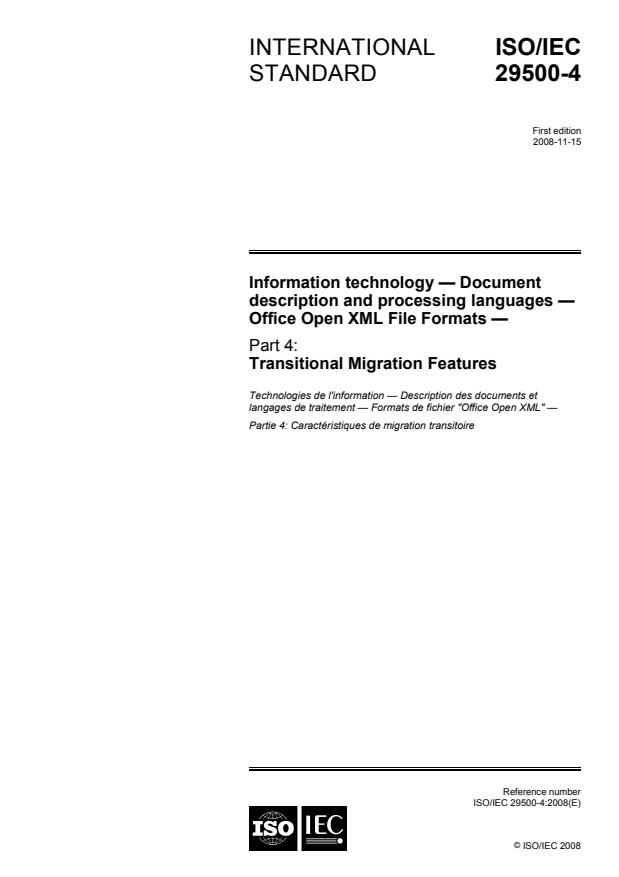
INTERNATIONAL ISO/IEC
STANDARD 29500-4
First edition
2008-11-15
Information technology — Document
description and processing languages —
Office Open XML File Formats —
Part 4:
Transitional Migration Features
Technologies de l'information — Description des documents et
langages de traitement — Formats de fichier "Office Open XML" —
Partie 4: Caractéristiques de migration transitoire
Reference number
©
ISO/IEC 2008
PDF disclaimer
This PDF file may contain embedded typefaces. In accordance with Adobe's licensing policy, this file may be printed or viewed but
shall not be edited unless the typefaces which are embedded are licensed to and installed on the computer performing the editing. In
downloading this file, parties accept therein the responsibility of not infringing Adobe's licensing policy. The ISO Central Secretariat
accepts no liability in this area.
Adobe is a trademark of Adobe Systems Incorporated.
Details of the software products used to create this PDF file can be found in the General Info relative to the file; the PDF-creation
parameters were optimized for printing. Every care has been taken to ensure that the file is suitable for use by ISO member bodies. In
the unlikely event that a problem relating to it is found, please inform the Central Secretariat at the address given below.
© ISO/IEC 2008
All rights reserved. Unless otherwise specified, no part of this publication may be reproduced or utilized in any form or by any means,
electronic or mechanical, including photocopying and microfilm, without permission in writing from either ISO at the address below or
ISO's member body in the country of the requester.
ISO copyright office
Case postale 56 • CH-1211 Geneva 20
Tel. + 41 22 749 01 11
Fax + 41 22 749 09 47
E-mail copyright@iso.org
Web www.iso.org
Published in Switzerland
ii © ISO/IEC 2008 – All rights reserved
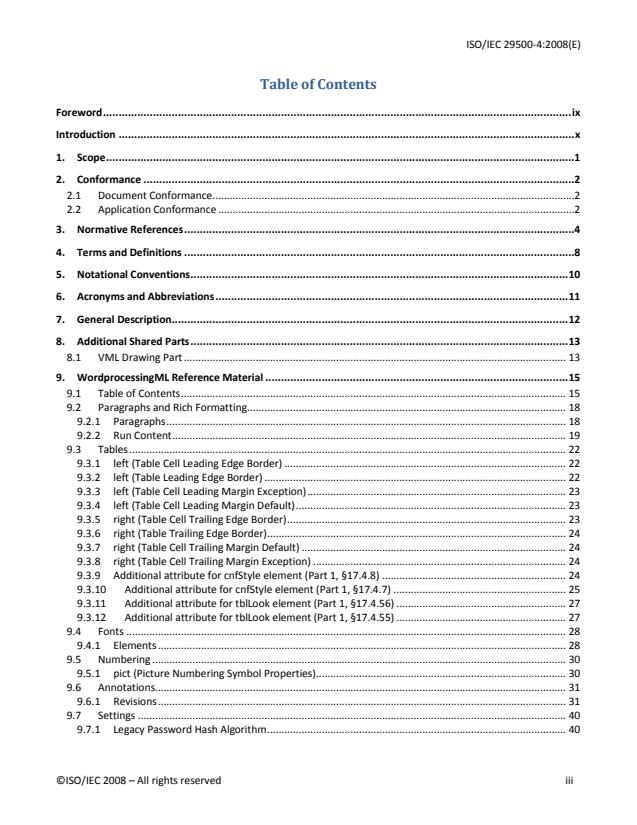
Table of Contents
Foreword . ix
Introduction . x
1. Scope .1
2. Conformance .2
2.1 Document Conformance .2
2.2 Application Conformance .2
3. Normative References .4
4. Terms and Definitions .8
5. Notational Conventions . 10
6. Acronyms and Abbreviations . 11
7. General Description. 12
8. Additional Shared Parts . 13
8.1 VML Drawing Part . 13
9. WordprocessingML Reference Material . 15
9.1 Table of Contents . 15
9.2 Paragraphs and Rich Formatting. 18
9.2.1 Paragraphs . 18
9.2.2 Run Content . 19
9.3 Tables . 22
9.3.1 left (Table Cell Leading Edge Border) . 22
9.3.2 left (Table Leading Edge Border) . 22
9.3.3 left (Table Cell Leading Margin Exception) . 23
9.3.4 left (Table Cell Leading Margin Default) . 23
9.3.5 right (Table Cell Trailing Edge Border) . 23
9.3.6 right (Table Trailing Edge Border) . 24
9.3.7 right (Table Cell Trailing Margin Default) . 24
9.3.8 right (Table Cell Trailing Margin Exception) . 24
9.3.9 Additional attribute for cnfStyle element (Part 1, §17.4.8) . 24
9.3.10 Additional attribute for cnfStyle element (Part 1, §17.4.7) . 25
9.3.11 Additional attribute for tblLook element (Part 1, §17.4.56) . 27
9.3.12 Additional attribute for tblLook element (Part 1, §17.4.55) . 27
9.4 Fonts . 28
9.4.1 Elements . 28
9.5 Numbering . 30
9.5.1 pict (Picture Numbering Symbol Properties) . 30
9.6 Annotations. 31
9.6.1 Revisions . 31
9.7 Settings . 40
9.7.1 Legacy Password Hash Algorithm . 40
©ISO/IEC 2008 – All rights reserved iii
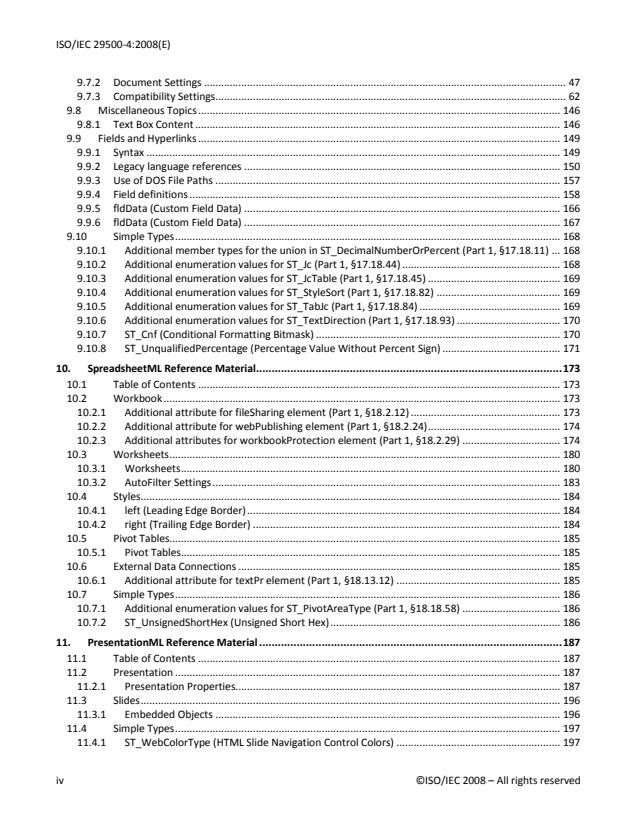
9.7.2 Document Settings . 47
9.7.3 Compatibility Settings . 62
9.8 Miscellaneous Topics . 146
9.8.1 Text Box Content . 146
9.9 Fields and Hyperlinks . 149
9.9.1 Syntax . 149
9.9.2 Legacy language references . 150
9.9.3 Use of DOS File Paths . 157
9.9.4 Field definitions . 158
9.9.5 fldData (Custom Field Data) . 166
9.9.6 fldData (Custom Field Data) . 167
9.10 Simple Types . 168
9.10.1 Additional member types for the union in ST_DecimalNumberOrPercent (Part 1, §17.18.11) . 168
9.10.2 Additional enumeration values for ST_Jc (Part 1, §17.18.44) . 168
9.10.3 Additional enumeration values for ST_JcTable (Part 1, §17.18.45) . 169
9.10.4 Additional enumeration values for ST_StyleSort (Part 1, §17.18.82) . 169
9.10.5 Additional enumeration values for ST_TabJc (Part 1, §17.18.84) . 169
9.10.6 Additional enumeration values for ST_TextDirection (Part 1, §17.18.93) . 170
9.10.7 ST_Cnf (Conditional Formatting Bitmask) . 170
9.10.8 ST_UnqualifiedPercentage (Percentage Value Without Percent Sign) . 171
10. SpreadsheetML Reference Material . 173
10.1 Table of Contents . 173
10.2 Workbook . 173
10.2.1 Additional attribute for fileSharing element (Part 1, §18.2.12) . 173
10.2.2 Additional attribute for webPublishing element (Part 1, §18.2.24) . 174
10.2.3 Additional attributes for workbookProtection element (Part 1, §18.2.29) . 174
10.3 Worksheets . 180
10.3.1 Worksheets . 180
10.3.2 AutoFilter Settings . 183
10.4 Styles . 184
10.4.1 left (Leading Edge Border) . 184
10.4.2 right (Trailing Edge Border) . 184
10.5 Pivot Tables. 185
10.5.1 Pivot Tables. 185
10.6 External Data Connections . 185
10.6.1 Additional attribute for textPr element (Part 1, §18.13.12) . 185
10.7 Simple Types . 186
10.7.1 Additional enumeration values for ST_PivotAreaType (Part 1, §18.18.58) . 186
10.7.2 ST_UnsignedShortHex (Unsigned Short Hex) . 186
11. PresentationML Reference Material . 187
11.1 Table of Contents . 187
11.2 Presentation . 187
11.2.1 Presentation Properties . 187
11.3 Slides . 196
11.3.1 Embedded Objects . 196
11.4 Simple Types . 197
11.4.1 ST_WebColorType (HTML Slide Navigation Control Colors) . 197
iv ©ISO/IEC 2008 – All rights reserved
11.4.2 ST_WebEncoding (Web Encoding) . 197
11.4.3 ST_WebScreenSize (HTML/Web Screen Size Target) . 197
12. DrawingML - Framework Reference Material . 199
12.1 DrawingML - Main . 199
12.1.1 Table of Contents . 199
12.1.2 Simple Types . 199
12.2 DrawingML - Legacy Compatibility . 202
12.2.1 Table of Contents . 202
12.2.2 Basics . 202
13. DrawingML - Components Reference Material . 204
13.1 DrawingML - Charts . 204
13.1.1 Table of Contents . 204
13.1.2 Elements . 204
14. VML Reference Material . 205
14.1 VML . 205
14.1.1 Table of Contents . 206
14.1.2 Elements . 207
14.1.3 Simple Types . 595
14.2 VML - Office Drawing . 603
14.2.1 Table of Contents . 604
14.2.2 Elements . 605
14.2.3 Simple Types . 731
14.3 VML - WordprocessingML Drawing . 744
14.3.1 Table of Contents . 744
14.3.2 Elements . 745
14.3.3 Simple Types . 754
14.4 VML - SpreadsheetML Drawing . 760
14.4.1 Table of Contents . 761
14.4.2 Elements . 763
14.4.3 Simple Types . 797
14.5 VML - PresentationML Drawing . 799
14.5.1 Table of Contents . 800
14.5.2 Elements . 800
15. Shared MLs Reference Material . 802
15.1 Shared Simple Types . 802
15.1.1 Table of Contents . 802
15.1.2 Simple Types . 802
Annex A. (normative) Schemas – W3C XML Schema . 811
A.1 WordprocessingML . 811
A.2 SpreadsheetML . 879
A.3 PresentationML. 963
A.4 DrawingML - Framework . 996
A.4.1 DrawingML - Main . 996
A.4.2 DrawingML - Picture . 1054
A.4.3 DrawingML - Legacy Compatibility . 1054
©ISO/IEC 2008 – All rights reserved v
A.4.4 DrawingML - Locked Canvas . 1054
A.4.5 DrawingML - WordprocessingML Drawing . 1055
A.4.6 DrawingML - SpreadsheetML Drawing . 1058
A.5 DrawingML - Components . 1062
A.5.1 DrawingML - Charts . 1062
A.5.2 DrawingML - Chart Drawings . 1089
A.5.3 DrawingML - Diagrams . 1092
A.6 VML . 1113
A.6.1 VML . 1113
A.6.2 VML - Office Drawing . 1123
A.6.3 VML - WordprocessingML Drawing . 1133
A.6.4 VML - SpreadsheetML Drawing . 1135
A.6.5 VML - PresentationML Drawing . 1137
A.7 Shared MLs. 1137
A.7.1 Math . 1137
A.7.2 Extended Properties . 1148
A.7.3 Custom Properties . 1149
A.7.4 Variant Types . 1151
A.7.5 Custom XML Data Properties . 1154
A.7.6 Bibliography . 1155
A.7.7 Additional Characteristics . 1158
A.7.8 Office Document Relationships . 1158
A.7.9 Shared Simple Types . 1159
A.8 Custom XML Schema References . 1162
Annex B. (informative) Schemas – RELAX NG . 1163
B.1 WordprocessingML . 1163
B.1.1 Part Schemas . 1207
B.2 SpreadsheetML . 1213
B.2.1 Part Schemas . 1301
B.3 PresentationML. 1308
B.3.1 Part Schemas . 1331
B.4 DrawingML - Framework . 1334
B.4.1 DrawingML - Main . 1334
B.4.2 DrawingML – Compatibility . 1379
B.4.3 DrawingML - Picture . 1379
B.4.4 DrawingML - Locked Canvas . 1379
B.4.5 DrawingML - Wordprocessing Drawing . 1380
B.4.6 DrawingML - Spreadsheet Drawing . 1382
B.5 DrawingML - Components . 1384
B.5.1 DrawingML - Chart . 1384
B.5.2 DrawingML - Chart Drawing . 1402
B.5.3 DrawingML - Diagrams . 1404
B.6 VML . 1420
B.6.1 VML - Main . 1420
B.6.2 VML - Office Drawing . 1427
B.6.3 VML - Wordprocessing Drawing . 1435
B.6.4 VML - Spreadsheet Drawing . 1436
vi ©ISO/IEC 2008 – All rights reserved
B.6.5 VML - Presentation Drawing. 1438
B.7 Shared MLs. 1439
B.7.1 Math . 1439
B.7.2 Extended Properties . 1444
B.7.3 Custom Properties . 1445
B.7.4 Variant Types . 1446
B.7.5 Custom XML Data Properties . 1450
B.7.6 Bibliography . 1450
B.7.7 Additional Characteristics . 1452
B.7.8 Office Document Relationships . 1453
B.7.9 Shared Simple Types . 1453
B.8 Custom XML Schema References . 1455
B.9 Additional Resources . 1456
B.9.1 Any . 1456
B.9.2 XML . 1456
Annex C. (informative) Namespace Prefix Mapping in Examples . 1457
Annex D. (informative) Differences Between ISO/IEC 29500:2008 and ECMA-376:2006 . 1459
©ISO/IEC 2008 – All rights reserved vii
(Blank page)
v iii ©ISO/IEC 2008 – All rights reserved
Foreword
ISO (the International Organization for Standardization) and IEC (the International Electrotechnical Commission)
form the specialized system for worldwide standardization. National bodies that are members of ISO or IEC
participate in the development of International Standards through technical committees established by the
respective organization to deal with particular fields of technical activity. ISO and IEC technical committees
collaborate in fields of mutual interest. Other international organizations, governmental and non-governmental,
in liaison with ISO and IEC, also take part in the work. In the field of information technology, ISO and IEC have
established a joint technical committee, ISO/IEC JTC 1.
International Standards are drafted in accordance with the rules given in the ISO/IEC Directives, Part 2.
The main task of the joint technical committee is to prepare International Standards. Draft International
Standards adopted by the joint technical committee are circulated to national bodies for voting. Publication as
an International Standard requires approval by at least 75 % of the national bodies casting a vote.
Attention is drawn to the possibility that some of the elements of this document may be the subject of patent
rights. ISO and IEC shall not be held responsible for identifying any or all such patent rights.
ISO/IEC 29500 was prepared by Ecma International (as ECMA-376:2006) and was adopted, under a special “fast-
track procedure”, by Joint Technical Committee ISO/IEC JTC 1, Information technology, in parallel with its
approval by the national bodies of ISO and IEC.
Some important differences between ISO/IEC 29500 and ECMA-376:2006 are given in Annex D.
ISO/IEC 29500 consists of the following parts, under the general title Information technology — Document
description and processing languages — Office Open XML File Formats:
Part 1: Fundamentals and Markup Language Reference
Part 2: Open Packaging Conventions
Part 3: Markup Compatibility and Extensibility
Part 4: Transitional Migration Features
Annex A forms a normative part of this Part of ISO/IEC 29500. Annexes B, C, and D are for information only.
This Part of ISO/IEC 29500 includes two annexes (Annex A and Annex B) that refer to data files provided in
electronic form.
©ISO/IEC 2008 – All rights reserved ix
Introduction
ISO/IEC 29500 specifies a family of XML schemas, collectively called Office Open XML, which define the XML
vocabularies for word-processing, spreadsheet, and presentation documents, as well as the packaging of
documents that conform to these schemas.
The goal is to enable the implementation of the Office Open XML formats by the widest set of tools and
platforms, fostering interoperability across office productivity applications and line-of-business systems, as well
as to support and strengthen document archival and preservation, all in a way that is fully compatible with the
existing corpus of Microsoft Office documents.
The following organizations have participated in the creation of ISO/IEC 29500 and their contributions are
gratefully acknowledged:
Apple, Barclays Capital, BP, The British Library, Essilor, Intel, Microsoft, NextPage, Novell, Statoil, Toshiba, and
the United States Library of Congress
x ©ISO/IEC 2008 – All rights reserved
INTERNATIONAL STANDARD ISO/IEC 29500-4:2008(E)
Information technology — Document description and
processing languages — Office Open XML File Formats
Part 4:
Transitional Migration Features
1. Scope
ISO/IEC 29500 defines a set of XML vocabularies for representing word-processing documents, spreadsheets and
presentations. On the one hand, the goal of ISO/IEC 29500 is to represent faithfully the existing corpus of word-
processing documents, spreadsheets and presentations that have been produced by Microsoft Office
applications (from Microsoft Office 97 to Microsoft Office 2008, inclusive). It also specifies requirements for
Office Open XML consumers and producers. On the other hand, the goal is to facilitate extensibility and
interoperability by enabling implementations by multiple vendors and on multiple platforms.
This Part of ISO/IEC 29500 defines features for backward-compatibility and that are useful for high-quality
migration of existing binary documents to ISO/IEC 29500. These features shall only be used by documents of
conformance class WML Transitional, SML Transitional, or PML Transitional.
©ISO/IEC 2008 – All rights reserved 1
2. Conformance
2.1 Document Conformance
Document conformance is purely syntactic.
A conforming document shall conform to the transitional W3C XML Schema, and any additional syntax
constraints.
The document shall be of category Wordprocessing, Spreadsheet, or Presentation (see Part 1, §4).
The document character set shall conform to the Unicode Standard and ISO/IEC 10646:2003, with either
the UTF-8 or UTF-16 encoding form, as required by the XML 1.0 standard.
Any XML element or attribute not explicitly included in ISO/IEC 29500 shall use the extensibility
mechanisms described by ISO/IEC 29500-1 and ISO/IEC 29500-3.
Each Part of this multi-part standard has its own conformance clause. The term conformance class is used to
disambiguate conformance within different Parts of this multi-part standard. This Part of ISO/IEC 29500 defines
the following document conformance classes:
WML Transitional, if the document is a conforming document of category Wordprocessing that
conforms to the transitional schema.
SML Transitional, if the document is a conforming document of category Spreadsheet that conforms to
the transitional schema.
PML Transitional, if the document is a conforming document of category Presentation that conforms to
the transitional schema.
[Note: Other document conformance classes could be defined in the future. end note]
[Note: A document cannot be of more than one of the above conformance classes. end note]
2.2 Application Conformance
Application conformance incorporates both syntax and semantics.
A conforming consumer shall not reject any conforming documents of at least one document
conformance class.
A conforming producer shall be able to produce conforming documents of at least one document
conformance class.
A conforming application shall treat the information in Office Open XML documents in a manner
consistent with the semantic definitions given in ISO/IEC 29500. An application's intended behavior
need not require that application to process all of the information in an Office Open XML document.
However, the information that it does process shall be processed in a manner that is consistent with the
semantic definitions given in ISO/IEC 29500.
2 ©ISO/IEC 2008 – All rights reserved
[Note: This note illustrates the third bullet above. Conforming applications might serve various functions.
Examples include a viewer, an editor, and a back-end processor. Here is an illustration of how the third bullet
applies to each of those examples:
If a conforming viewer supports a given feature, then when it displays information using that feature, it
respects the semantics of that feature as described in the Standard.
If a conforming editor supports a given feature, then when it provides its user with an interface for
manipulating information using that feature, it respects the semantics of that feature as described in the
Standard.
If a conforming back-end processor supports a given feature, then when that processor transforms or
assembles information involving that feature, that processor respects the semantics of that feature as
described in the Standard.
end note]
This Part of ISO/IEC 29500 defines the following application conformance classes:
WML Transitional, if the application is a conforming application that is a consumer or producer of
documents having conformance class WML Transitional.
SML Transitional, if the application is a conforming application that is a consumer or producer of
documents having conformance class SML Transitional.
PML Transitional, if the application is a conforming application that is a consumer or producer of
documents having conformance class PML Transitional.
©ISO/IEC 2008 – All rights reserved 3
3. Normative References
The following referenced documents are indispensable for the application of this document. For dated
references, only the edition cited applies. For undated references, the latest edition of the referenced document
(including any amendments) applies.
ANSI X3.4-1986, American Standard Code for Information Interchange (ASCII)
Bureau of Standards, Metrology and Inspection of the Ministry of Economic Affairs, CNS 7648: Data Elements
and Interchange Formats — Information Interchange — Representation of Dates and Times
Calendar Reform Committee, Indian Ephemeris and Nautical Almanac. 1957
Stokes, M., M. Anderson, S. Chandrasekar, and R. Motta. A Standard Default color Space for the Internet. Vers.
1.10. November 5, 1996. http://www.w3.org/Graphics/Color/sRGB
Har'El, Zvi, Gauss Formula for the Julian Date of Passover. Deptartment of Mathematics, Technion, Israel Institue
of Technology, Haifa 32000, Israel, 2005, 6
Duerst, M, and M Suignard. Internationalized Resource Identifiers (IRIs). IETF. January 2005.
http://tools.ietf.org/html/rfc3987
IANA, Character Sets from IANA, as specified at http://www.iana.org/assignments/character-sets
IANA. MIME Media Types. Internet Assigned Numbers Authority. http://www.iana.org/assignments/media-
types/
IEC 60559:1989, Binary Floating-Point Arithmetic for Microprocessor Systems
ISO/IEC 2382-1:1993, Information technology — Vocabulary — Part 1: Fundamental terms
ISO 8601:2004, Data elements and interchange formats — Information interchange — Representation of dates
and times
ISO/IEC 8859-1:1998, Information technology — 8-bit single-byte coded graphic character sets — Part 1: Latin
alphabet No. 1 (referred to in ISO/IEC 29500 as the ANSI character set)
ISO/IEC 9075-1, Information technology — Database languages — SQL — Part 1: Framework (SQL/Framework)
ISO/IEC 10118-3:2004, Information technology — Security techniques — Hash-functions — Part 3: Dedicated
hash-functions.
ISO/IEC 10646:2003, Information technology — Universal Multiple-Octet Coded Character Set (UCS).
4 ©ISO/IEC 2008 – All rights reserved
ISO/IEC 14496-22:2007, Information technology — Coding of audio-visual objects — Part 22: Open Font Format
Japanese Industrial Standard, JIS X 0301: Data elements and interchange formats —Information interchange —
Representation of dates and times. Japan, 2002.
Kingdom of Saudi Arabia, Ministry of Islamic Affairs, Endowments, Da‘wah and Guidance.
Korean Law Enactment No. 4, 1961.
Faure, D. (n.d.). Creating and Using Components (KParts). Retrieved from KDE Developer's Corner:
http://developer.kde.org/documentation/tutorials/kparts/
Maimon, Rabbi Moshe ben, Complete Restatement of the Oral Law (Mishneh Torah).
Ausbrooks, Ron, et al. Mathematical Markup Language (MathML) Version 2.0 (Second Edition). October 21,
2003. http://www.w3.org/TR/MathML/.
Kaliski, B. The MD2 Message-Digest Algorithm. April 1992. http://www.ietf.org/rfc/rfc1319.txt
Rivest, R. The MD4 Message-Digest Algorithm. April 1992. http://www.ietf.org/rfc/rfc1320.txt
The MD5 Message-Digest Algorithm. April 1992. http://www.ietf.org/rfc/rfc1321.txt.
National Measurement Regulations 1999, Commonwealth of Australia
http://scaleplus.law.gov.au/html/pastereg/3/1519/pdf/NatMeasurement1999.pdf
NIST Guide to SI Units, http://physics.nist.gov/Pubs/SP811/appenB9.html
QuickTime File Format Specification (2007-09-04 version)
http://developer.apple.com/documentation/QuickTime/QTFF/qtff.pdf
Resource Description Framework (RDF), http://www.w3.org/RDF/
RFC 822, Standard for ARPA Internet Text Messages (http://www.ietf.org/rfc/rfc0822.txt)
RFC 2045, Borenstein, N., and N. Freed. Multipurpose Internet Mail Extensions (MIME) Part One: Format of
Internet Message Bodies. The Internet Society. 1996. http://www.ietf.org/rfc/rfc2045.txt
RFC 2119, Bradner, Scott, 1997: Key words for use in RFCs to Indicate Requirement Levels.
http://www.ietf.org/rfc/rfc2119.txt
RFC 2616, Berners-Lee, T., R. Fielding, H. Frystyk, J. Gettys, P. Leach, L. Masinter, and J. Mogul. Hypertext
Tran
...
Questions, Comments and Discussion
Ask us and Technical Secretary will try to provide an answer. You can facilitate discussion about the standard in here.
Loading comments...