


ISO 24917:2010
(Main)Space systems — General test requirements for launch vehicles
Space systems — General test requirements for launch vehicles
ISO 24917:2010 establishes general test requirements for launch vehicles equipped with liquid-propellant engines, launched from stationary ground-, sea- and air-based launchers, in all phases of their development.
Systèmes spatiaux — Exigences générales d'essai pour véhicules lanceurs
General Information
- Status
- Withdrawn
- Publication Date
- 29-Sep-2010
- Withdrawal Date
- 29-Sep-2010
- Technical Committee
- ISO/TC 20/SC 14 - Space systems and operations
- Current Stage
- 9599 - Withdrawal of International Standard
- Start Date
- 23-Jul-2020
- Completion Date
- 12-Feb-2026
Relations
- Effective Date
- 18-Jun-2016
Get Certified
Connect with accredited certification bodies for this standard

DEKRA North America
DEKRA certification services in North America.

Eagle Registrations Inc.
American certification body for aerospace and defense.

Element Materials Technology
Materials testing and product certification.
Sponsored listings
Frequently Asked Questions
ISO 24917:2010 is a standard published by the International Organization for Standardization (ISO). Its full title is "Space systems — General test requirements for launch vehicles". This standard covers: ISO 24917:2010 establishes general test requirements for launch vehicles equipped with liquid-propellant engines, launched from stationary ground-, sea- and air-based launchers, in all phases of their development.
ISO 24917:2010 establishes general test requirements for launch vehicles equipped with liquid-propellant engines, launched from stationary ground-, sea- and air-based launchers, in all phases of their development.
ISO 24917:2010 is classified under the following ICS (International Classification for Standards) categories: 49.140 - Space systems and operations. The ICS classification helps identify the subject area and facilitates finding related standards.
ISO 24917:2010 has the following relationships with other standards: It is inter standard links to ISO 24917:2020. Understanding these relationships helps ensure you are using the most current and applicable version of the standard.
ISO 24917:2010 is available in PDF format for immediate download after purchase. The document can be added to your cart and obtained through the secure checkout process. Digital delivery ensures instant access to the complete standard document.
Standards Content (Sample)
INTERNATIONAL ISO
STANDARD 24917
First edition
2010-10-15
Space systems — General test
requirements for launch vehicles
Systèmes spatiaux — Exigences générales d'essai pour véhicules
lanceurs
Reference number
©
ISO 2010
PDF disclaimer
This PDF file may contain embedded typefaces. In accordance with Adobe's licensing policy, this file may be printed or viewed but
shall not be edited unless the typefaces which are embedded are licensed to and installed on the computer performing the editing. In
downloading this file, parties accept therein the responsibility of not infringing Adobe's licensing policy. The ISO Central Secretariat
accepts no liability in this area.
Adobe is a trademark of Adobe Systems Incorporated.
Details of the software products used to create this PDF file can be found in the General Info relative to the file; the PDF-creation
parameters were optimized for printing. Every care has been taken to ensure that the file is suitable for use by ISO member bodies. In
the unlikely event that a problem relating to it is found, please inform the Central Secretariat at the address given below.
© ISO 2010
All rights reserved. Unless otherwise specified, no part of this publication may be reproduced or utilized in any form or by any means,
electronic or mechanical, including photocopying and microfilm, without permission in writing from either ISO at the address below or
ISO's member body in the country of the requester.
ISO copyright office
Case postale 56 • CH-1211 Geneva 20
Tel. + 41 22 749 01 11
Fax + 41 22 749 09 47
E-mail copyright@iso.org
Web www.iso.org
Published in Switzerland
ii © ISO 2010 – All rights reserved
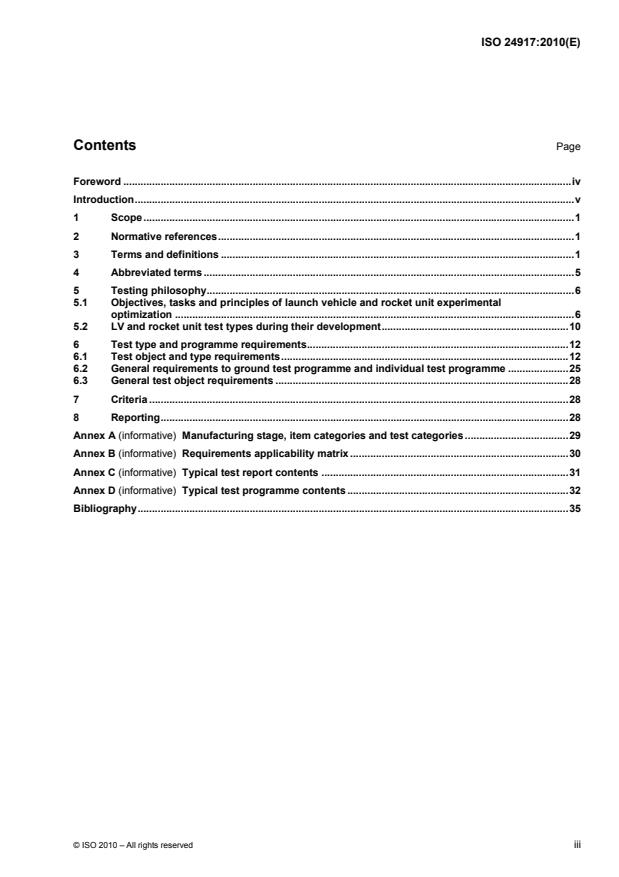
Contents Page
Foreword .iv
Introduction.v
1 Scope.1
2 Normative references.1
3 Terms and definitions .1
4 Abbreviated terms .5
5 Testing philosophy.6
5.1 Objectives, tasks and principles of launch vehicle and rocket unit experimental
optimization .6
5.2 LV and rocket unit test types during their development.10
6 Test type and programme requirements.12
6.1 Test object and type requirements.12
6.2 General requirements to ground test programme and individual test programme .25
6.3 General test object requirements .28
7 Criteria .28
8 Reporting.28
Annex A (informative) Manufacturing stage, item categories and test categories .29
Annex B (informative) Requirements applicability matrix .30
Annex C (informative) Typical test report contents .31
Annex D (informative) Typical test programme contents .32
Bibliography.35
Foreword
ISO (the International Organization for Standardization) is a worldwide federation of national standards bodies
(ISO member bodies). The work of preparing International Standards is normally carried out through ISO
technical committees. Each member body interested in a subject for which a technical committee has been
established has the right to be represented on that committee. International organizations, governmental and
non-governmental, in liaison with ISO, also take part in the work. ISO collaborates closely with the
International Electrotechnical Commission (IEC) on all matters of electrotechnical standardization.
International Standards are drafted in accordance with the rules given in the ISO/IEC Directives, Part 2.
The main task of technical committees is to prepare International Standards. Draft International Standards
adopted by the technical committees are circulated to the member bodies for voting. Publication as an
International Standard requires approval by at least 75 % of the member bodies casting a vote.
Attention is drawn to the possibility that some of the elements of this document may be the subject of patent
rights. ISO shall not be held responsible for identifying any or all such patent rights.
ISO 24917 was prepared by Technical Committee ISO/TC 20, Aircraft and space vehicles, Subcommittee
SC 14, Space systems and operations.
iv © ISO 2010 – All rights reserved
Introduction
This International Standard provides space launch vehicle customers, contractors and manufacturers with
general requirements for test types and programmes for space launch vehicles and rocket units (modules) to
be used in the documentation associated with their test activity.
This International Standard is intended to help reduce the development time and cost of space launch
vehicles and rocket units, and to enhance their quality and reliability through the use of common, optimized
and approved requirements in the space launch vehicle test scope and organization.
INTERNATIONAL STANDARD ISO 24917:2010(E)
Space systems — General test requirements for launch
vehicles
1 Scope
This International Standard establishes general test requirements for launch vehicles equipped with
liquid-propellant engines, launched from stationary ground-, sea- and air-based launchers, in all phases of
their development.
2 Normative references
The following referenced documents are indispensable for the application of this document. For dated
references, only the edition cited applies. For undated references, the latest edition of the referenced
document (including any amendments) applies.
ISO 14302, Space systems — Electromagnetic compatibility requirements
ISO 14303, Space systems — Launch-vehicle-to-spacecraft interfaces
3 Terms and definitions
For the purposes of this document, the following terms and definitions apply.
3.1
space-rocket complex
set of a space vehicle or space launch vehicles with functionally interconnected means and the constructions
intended for transportation, storage, maintenance service, preparation, launching and flight control of space
launch vehicles on a trajectory of launching of payload
3.2
space rocket
space launch vehicle plus space nose section integration
3.3
space launch vehicle
component of the space rocket designed for payload injection in a pre-assigned trajectory or orbit
3.4
rocket unit
space launch vehicle stage including the upper stage vehicle, body, propulsion system, control systems or
control system elements, rocket units separation aids and telemetry hardware
3.5
upper stage vehicle
upper stage of flight vehicle capable of injecting a space vehicle or vehicles into their orbit from the sub-orbital
trajectory that resulted from operation of a launch vehicle
3.6
space nose section
set of a space vehicle with fairing and adapter and upper stage vehicle
NOTE Upper stage vehicle can be absent.
3.7
fairing
technical device intended for protection of a space vehicle or of a space nose section from external influences
at transportation of the space launch vehicle on a launcher and on a start of the space launch vehicle and on
a trajectory of launching into an orbit of a space vehicle
3.8
integration site
equipment and facility designed for launch vehicle storage, assembly, testing, preparation, maintenance,
servicing and preparation for transportation to the launch pad
[ISO/TR 17400:2003, definition 3.1]
3.9
launch pad
equipment and facility designed to provide for the pre-launch and launch operations of spacecraft
[ISO/TR 17400:2003, definition 3.3]
3.10
launch pad for space launch vehicle
device intended to maintain the space launch vehicle in readiness for launch, and for the launch itself
3.11
technical project on development of a product
initial document establishing a complex of technical requirements to created products, and to the contents,
volume and terms of performance of design experiment works as well
3.12
technical specification
specification expressing technical requirements for designing and developing the solution to be implemented
NOTE The technical specification evolves from the functional specification and defines the technical requirements for
the selected solution as part of a business agreement.
[ISO 21351:2005, definition 3.1.11]
3.13
requirement
need or expectation that is stated, generally implied or obligatory
NOTE 1 “Generally implied” means that it is custom or common practice for the organization, its customers and other
interested parties that the need or expectation under consideration is implied.
NOTE 2 A qualifier can be used to denote a specific type of requirement, e.g. product requirement, quality
management requirement, customer requirement.
NOTE 3 A specified requirement is one which is stated, for example, in a document.
NOTE 4 Requirements can be generated by different interested parties.
[ISO 9000:2005, definition 3.1.2]
2 © ISO 2010 – All rights reserved
3.14
interface control document
ICD
document of launcher and fairing/payload which defines all physical, electrical and mechanical interfaces
between the payload and the launch vehicle hardware and software, and interfaces between payload and
support equipment and space site facilities, systems and hardware used for spacecraft launch preparation
3.15
test
formal process of exercising or putting to trial a system or item by manual or automatic means to identify
differences between specified, expected and actual results
3.16
test conditions
combination of effects of factors, or object operation conditions, or both, during the test
3.17
test metrological provision
establishment and application of scientific and organizational basis, technical means, rules and standards
necessary for achieving the measurement unity demanded, precision, completeness, operativeness and the
reliability of parameters control and technical characteristics of items
3.18
ground test programme
organizational-methodological document obligatory for execution, which specifies the test object and
objectives, types, sequence and scope of conducted experiments, order, conditions, place, time and support
of test, test reporting, as well as responsibility for test support and conduct
3.19
reliability assurance programme
programme document specifying a set of requirements and measures aimed at providing and controlling the
satisfaction of requirements established for the statement of work for a space launch vehicle and its
components reliability during their development
3.20
space launch vehicle (unit) experimental optimization
operations of modelling units, mock-ups, test prototypes in order to assure operation of items in accordance
with statement of work, definition their efficiency margins
3.21
safety assurance programme
programme document which establishes a set of requirements and measures aimed at assuring that all safety
risks associated with the space launch vehicle design, development, manufacture and use are accordingly
identified, assessed, minimized, controlled and accepted
3.22
telemetry measurement programme
programme document establishing the composition of telemetry measurement hardware born set on space
launch vehicle, launch pad and positioned along the flight route necessary for satisfying the measurement
requirements as well as places and orientation of sensors arrangement and their characteristics, frequency
bands, minimal frequency of sensor polling
3.23
flight test
tests in real conditions of functioning and performance of target tasks
3.24
test prototype of rocket and space technology item
item produced in the research and development process applying the newly developed working engineering
and technological documentation for test verification of the conformity of its parameters and characteristics
with the requirements specified in statement of work to research and development and correctness of adopted
technical solutions
3.25
test mock-up (model)
structurally, or physically, or structurally and physically similar item presenting a simplified reproduction of a
test object or its part intended for test
3.26
structural model
model representing the structural flight characteristics
3.27
electrical model
model representing the electrical flight characteristics
3.28
test object
item under test
3.29
test type
classified test grouping identified according to a certain attribute
3.30
preliminary (development) tests
check test of test object prototypes conducted with the purpose of evaluating their conformity with the
statement of work requirements and determining their readiness for flight test
NOTE Items are subjected to development tests as required, in order to minimize design risk, to demonstrate
manufacturing feasibility, to establish packaging designs, to demonstrate electrical and mechanical performance and to
demonstrate the capability to withstand environmental stress, including storage, transportation, extreme combined
environments and launch base operations
3.31
qualification tests
required formal contractual tests used to demonstrate that the design, manufacturing, and assembly have
resulted in hardware designs conforming to specification requirements
[ISO 14623:2003, definition 2.52]
3.32
acceptance tests
required formal tests conducted on flight hardware to ascertain that the materials, manufacturing processes
and workmanship meet specifications and that the hardware is acceptable for intended usage
[ISO 14623:2003, definition 2.2]
3.33
operational tests
tests conducted at the launch vehicle site in an operational environment, with the equipment in its operational
configuration
4 © ISO 2010 – All rights reserved
3.34
service (guarantee) life
period starting at the completion of fabrication and continuing through all acceptance testing, maintenance,
handling, storage, transportation, pre-launch testing, all phases of launch, orbital operations, disposal, re-entry
or recovery from orbit
3.35
critical unit
unit whose failure can affect the system operation sufficiently to cause the failure of the stated vehicle
objectives or a partial loss of the mission, or whose proper performance is essential from a safety standpoint
3.36
explosive-ordnance device
device that contains explosives or is operated by explosives
NOTE A cartridge actuated device, one type of explosive device, is a mechanism that employs the energy produced
by an explosive charge to perform or initiate a mechanical action.
4 Abbreviated terms
CTS control-test station
EMC electromagnetic compatibility
FTP flight test programme
GTP ground test programme
ICD interface control document
IS integration site
LPRE liquid-propellant engine
LS launching site
LV launch vehicle
OCN on-board cable network
PHS pneumatic/hydraulic system
RAP reliability assurance programme
SC spacecraft
SLV space launch vehicle
SNS space nose section
SOW statement of work
SGP safety guarantee programme
SRC space rocket complex
TMP telemetry measurements programme
USV upper stage vehicle
5 Testing philosophy
5.1 Objectives, tasks and principles of launch vehicle and rocket unit experimental
optimization
5.1.1 Experimental optimization is one of the methods of verification which guarantees that all
characteristics of the space launch vehicle (SLV) meet the requirements of the statement of work (SOW). The
SLV is tested in the structure of the space rocket complex (SRC).
Experimental optimization of SLV, launch vehicle (LV) units and unit components includes ground
experimental optimization phases and flight test. The complete test programme for launch vehicles, upper
stage, encompasses development, qualification, acceptance, pre-launch validation and follow-on operational
test and evaluations. The test programme encompasses the testing of progressively more complex
assemblies of hardware and computer software. Generally the SLV experimental optimization structure may
be represented as a scheme (see Figure 1).
5.1.2 The major objective of ground experimental optimization is to optimize and verify the SLV preparation
technology for launch and launch itself, preliminarily verify and evaluate implementation of the project-
specified parameters and characteristics, operation and interaction patterns of all SLV components and SLV
as a whole when the operation conditions are being simulated (or under effect of these conditions).
5.1.3 The major objective of flight test is to comprehensively check the SLV serviceability and confirm the
SOW-specified requirements for the space rocket complex under real operation conditions.
5.1.4 One of the major objectives of SLV [upper stage vehicle (USV)] ground experimental optimization is to
achieve the SOW-assigned levels of reliability and safety indexes before flight test commencement to be
confirmed during the flight test. The reliability and safety index levels are normalized in the reliability
assurance programme (RAP) and the safety guarantee programme (SGP), the latter including environment
safety guarantee.
5.1.5 The main objectives of experimental optimization of SLV, LV units and SLV unit components are as
follows:
a) verification of unit structure strength, rigidity, confirmation of rocket module parameters, verification of
equipment mechanical loading regimes;
b) breadboarding;
c) optimization of technological cycle of preparing SLV for launch and launch itself;
d) comprehensive verification of rocket unit systems functioning during launch and propulsion system
operation in the assigned regimes;
e) verification of the ground technical means/launch vehicle compatibility;
f) optimization of SLV interfaces [LV, upper stage vehicle, spacecraft (SC)];
g) experimental confirmation of the correctness of adopted engineering solutions;
h) verification of the sufficiency of measuring aids and TM data processing techniques;
i) individual optimization of all SLV components;
j) verification of operation convenience;
k) personnel training.
6 © ISO 2010 – All rights reserved
5.1.6 The problems to be solved while testing specific LVs are identified according to the engineering make,
assigned characteristics, LV optimization degree, design novelty (modification scope), dedicated operation
conditions change and are presented in the test programmes.
The environmental factors specified in SOW tests are intended to be imposed sequentially, rather than in
combination. Nevertheless, features of the hardware design or of the service environments may warrant the
imposition of combined environments in some tests, e.g. combined shock, vibrations. In formulating the test
requirements in these situations, a logical combination of environmental factors should be imposed to
enhance test effectiveness.
5.1.7 Organization and order of conducting the experimental optimization are determined by the
comprehensive experimental optimization programme.
Figure 1 — Space launch vehicle experimental optimization structure
5.1.8 In order to meet the assigned LV (USV) characteristics requirements, the supplier plans experimental
optimization.
5.1.9 The comprehensive experimental optimization programme is developed in accordance with the LV
(USV) hierarchical structure. The main starting documents for developing the SLV ground test programme are
the statement of work, the preliminary project and the reliability assurance programme.
5.1.10 The SLV comprehensive experimental optimization programme is a common system of independent,
particular programme-technical documents, identifying the individual test objectives and scope, establishing
the criteria of USV or LV completeness and readiness for transferring to higher test levels.
The test sequence, scope and object, controlled characteristics, types of test and test phasing in the course of
LV (rocket unit) development are assigned by the LV (rocket unit) manufacturers-contractors in the
comprehensive experimental optimization programme, other test programmes.
5.1.11 The LV (USV) ground test programme (GTP) is planned and arranged on the basis of the following
principles:
a) system approach to the optimization planning with a detailed coordination of all types and phases of
optimization test; absolute assurance and confirmation of the assigned characteristics of the SRC items
during ground test; use of results of optimizing the complex systems functioning as a component of other
complexes;
b) fulfilment of the major optimization work scope applying test facilities (benches, rigs, models, etc.) before
starting ready-made (standard) LV (USV) test under real operation conditions (full-scale test);
c) confirmation of all-round interaction of all SLV components and demonstration of their functioning
reliability under full-scale conditions, as well as conduct of that part of optimization applying test means
which cannot be technically performed or are economically inexpedient within the assigned time during
flight test, and on the basis of the following provisions:
1) determination of nomenclature and characteristics of modified and newly developed test benches
(rigs) on condition that they would assure fulfilment of the planned test types and scopes;
2) use (if necessary with updating) of test facilities, benches and technological fittings developed for
previous items;
3) assessment of the sufficiency and correctness of selecting equipment, control-measuring aids,
mathematical software for test;
4) planning of each experiment with the aim of obtaining a maximal data volume necessary for
evaluating the operation reliability; use of the capability of multiple starting the systems and
assemblies under ground conditions for conducting multiple optimization tests (including different test
types) applying limited number of items;
5) complex components control during the test;
6) all-round coordination of all test types of items at LV (USV) hierarchical structure levels with due
regard for the values of tested characteristics, measurement precision, reproducibility of bench test,
as well as test completeness requirements;
7) feasibility study of the test tasks, types and scopes stipulated in the comprehensive experimental
optimization and flight test programmes (FTP);
8) satisfaction of the active normative document requirements (including standards for test types and
norms, technical state review, information exchange, industrial safety measures, etc.);
9) planning of experimental works to optimize new technological processes including the planning of
optimization technology for assuring the cleanness of internal cavities of propulsion system tanks,
pneumatic/hydraulic systems, internal volume of the integration-protection block;
8 © ISO 2010 – All rights reserved
10) keeping to the test phasing (individual, integrated, flight test);
11) timely preparation of bench and metrological facilities, data processing aids for test applying the test
product;
12) manufacture of test objects maximally corresponding to the standard make, as a minimum
concerning that part of the engineering make and characteristics which are decisive for the
corresponding test types;
13) if practicable, use of the material available after completing the individual test of assemblies and
systems for making up bench items;
14) multiple use of material (bench items) designed for optimization (testing) at the expense of its
updating and replenishment;
15) development and introduction of means, measures and methods of safety assurance of all test types
(including environmental safety), with due regard for data obtained while analysing the types of
critical failures, their consequences and critical elements;
16) preparation and uninterrupted specification of the list of unacceptable risks and mitigation measures
either already performed or currently being carried out, as well as the list of actions and the devices
providing the exception of space debris formation during the SLV launch;
17) test conduct under real complicated operation regimes, and non-standard situation simulation;
18) test simulation of external affecting factors in the volumes specified by the test programmes and
methods; in this case the test is conducted in the tolerable serviceability regimes simultaneously
simulating various affecting factors (with their most unfavourable combination) and modelling items
interaction;
19) optimal combination of aids and methods of physical and mathematical modelling with subsequent
confirmation of object test results;
20) use of computerized data processing and analysis aids in all test phases;
21) use of serviceability diagnostics systems, non-destructive serviceability control aids and non-
destructive control aids for elements and assemblies;
22) obligatory failure examination, analysis of effect of the reasons of all faults and defects detected
during the test on the system and assembly operation with publication of relevant reports (statements,
opinions) and relevant modification of engineering, technological and operation documentation;
23) confirmation by additional test of modification efficiency performed because of revealed defects with
publication of corresponding opinions as to clearing the modified assembly (system) for further higher
level test;
24) observance of the order of assigning letters to design documentation in the course of individual and
comprehensive optimization;
25) justification of all changes of test scopes and types made while realizing the comprehensive
experimental optimization programme and flight test (applying the previous test results, etc.) taking
into account the necessity of assuring the achievement of given optimization objectives and tasks;
26) system analysis of the technical state of the complex items during ground and flight test; entry of
faults revealed during test, results of analysing their reasons and corrective actions in the database;
27) repeated test to be conducted due to revealed faults or necessity to update the test object;
28) keeping the strict reporting on the results of conducted test types;
29) analysis of the previous optimization and preparation of an opinion as to LV (USV) clearance for
subsequent test when transferring from one test phase to another (before starting the comprehensive
and flight test), issue of the final report on the ground test results and SLV readiness for flight test;
30) reduction of optimization time and costs with satisfaction of requirements for the LV technical
characteristics and reliability, test conduct and control automation;
31) planning of experimental works on confirming new periods of guarantee for attracted systems and
assemblies operation;
32) the test scope shall be sufficient for validated experimental confirmation of the structure serviceability
issuing of an opinion as to the test object clearance for flight test;
33) distribution of responsibilities among organizations-subcontractors for conduct of all test types.
5.1.12 Implementation during the test of the principles stated in 5.1.11 enables the following:
a) when testing the elements: to assess the external factors effect and physical parameters limits and their
spread;
b) when testing the units and elements: to detect failures brought about by the structure peculiar features
and determine the conditions of operation and use for fulfilling the dedicated tasks;
c) when testing the assemblies: to assess their interaction and mutual influence, to check supplementary
equipment;
d) when testing the complex as a whole:
1) to verify satisfaction of the SC/LV/LS requirements;
2) to conduct SLV testing at the integration site (IS) and launching site (LS) simultaneously;
3) to check their interaction taking into account the operation time line of all SLV systems under full-
scale conditions;
4) to find defects in the systems interfaces;
5) to optimize the SLV preparation technology for performing the dedicated tasks;
6) to assure the sufficiency and efficiency of mathematical software control and optimization;
7) to assure optimization of the order of eliminating non-standard and emergency situations;
8) to assure the sufficiency of SLV-born measuring aids;
9) to identify unacceptable risks during operation of SLV;
10) to reduce the level of space debris formation during SLV launches.
5.2 LV and rocket unit test types during their development
5.2.1 When developing space launch vehicles, as a rule the latter undergo the following tests:
a) engineering-technological (LV, unit) mock-up test;
b) scaled SLV model test (for identifying their aerogasdynamic characteristics);
c) integration/check-out mock-up test;
10 © ISO 2010 – All rights reserved
d) electrical mock-up test;
e) functional mock-up test;
f) fuelling mock-up test;
g) hydraulic test;
h) static rating test;
i) vibration test;
j) acoustic test;
k) separation test;
l) explosive-ordnance device response test;
m) cold unit test;
n) firing bench test;
o) lifetime test;
p) pressurization test [for LV with liquid-propellant engine (LPRE)];
q) climatic test;
r) thermal vacuum test;
s) thermal cycle test;
t) antenna mock-up test;
u) SLV and ground radio-electronic aids EMC test;
v) fire and explosion safety test;
w) transportability test;
x) lightning and statics resistance test;
y) mathematical software and information support test;
z) IS and LS test;
aa) LV/SC launcher interfaces test (to be conducted in accordance with ISO 14303);
bb) flight test;
cc) batch production test;
dd) operation test;
ee) LV components disposal.
5.2.2 Upon agreement with the customer (or with the customer's organization, at his instruction), permission
can be given to conduct additional test types not stipulated by the given standard, just as permission can be
refused to conduct certain test types stipulated by the said standard or to combine separate test types
planned in the comprehensive experimental test programme.
5.2.3 The manufacturing stage, item categories and test categories conducted during LV and its units
development are illustrated in Annex A.
5.2.4 The requirements applicability matrix is illustrated in Annex B.
5.2.5 The liquid-propellant rocket engine is the most intensive assembly of a propulsion system; therefore
success of designing an LPRE in many respects determines the success of developing a propulsion system
and an LV as a whole. The LPRE as a whole is tested in the following sequence:
a) tentative (comparative test, specifying test, updating test, final updating test, LPRE bench test as a
propulsion system component, throwing test, flight test) tests;
b) acceptance test (interagency LPRE test and LPRE test as a propulsion system component);
c) verification (control-technological) test;
d) acceptance (control/batch-by-batch) test;
e) periodical test;
f) type test.
5.2.6 During the cold technological test, firing control technological test of individual LPREs, or firing
technological test of LPRE as a component of the rocket unit, the following steps are carried out:
⎯ the production quality of a specific item is checked,
⎯ the characteristics conformity with the assigned requirements is assessed, and
⎯ the feasibility of presenting the given LPRE model for operation as a space launch vehicle component is
evaluated.
6 Test type and programme requirements
6.1 Test object and type requirements
6.1.1 Engineering and engineering-technological breadboarding
6.1.1.1 The engineering and engineering-technological breadboarding is aimed at coordinating LV
individual elements, optimizing the production and integration technology, and specifying starting design data.
6.1.1.2 Breadboarding is divided into two phases:
a) tentative breadboarding applying an engineering mock-up;
b) final breadboarding applying an engineering-technological mock-up.
12 © ISO 2010 – All rights reserved
6.1.1.3 At least the following tasks should be fulfilled applying the engineering mock-up:
a) verification of the arrangement and mutual positions of the parts and integration units, feasibility of LV
(unit) integration;
b) verification of tolerable clearances between mutually moving integration units when they are integrated;
c) laying of pneumatic/hydraulic lines (verification of their sufficiency and feasibility of pipeline fastening
taking into account the vibration strength conditions) and building of pipeline prototypes (assurance of the
tolerable pipeline bending radii);
d) identification of a preliminary on-board cable network (OCN) configuration and lengths, assessment of
electrical connection positions, correctness of OCN laying and sufficiency of attaching points on the
structure elements;
e) breadboarding of the detachable equipment installation (assembly) and sealing;
f) preliminary assessment of the sufficiency of measures for ruling out inadequate mating of the electrical,
pneumatic and hydraulic systems;
g) confirmation of the correctness of selecting the support, lift and handling patterns, transportation
conditions, etc.
6.1.1.4 At least the following tasks should be fulfilled during the unit engineering-technological mock-up
test:
a) verification of the practicability of manufacturing LV assemblies and systems applying the engineering
documentation;
b) specification of the arrangement and mutual positions of the parts and integration units;
c) control of tolerable clearances between the mutually moving integration units when integrated and
operating;
d) specification of the pneumatic/hydraulic line laying and reference pipeline building;
e) specification of the OCN configuration and lengths and assessment of the electrical connection positions,
cable network laying;
f) verification of the practicability of replacing the control system devices without dismantling the adjacent
devices and other structural elements;
g) ruling out of the situations leading to inadequate mating of the electrical/pneumatic/hydraulic system
elements;
h) verification of the structure interface requirement satisfaction;
i) integration technology optimization;
j) breadboarding of the detachable equipment assembly and sealing;
k) optimization of the technology and safety of haul-transport operations, assembly-mating operations when
transporting an item, and technological processes of SLV preparation at IS and LS;
l) optimization of the control technology and the problems of system and assembly maintainability, ecology,
ergonomics, operational safety.
6.1.2 Integration/check-out mock-up test
6.1.2.1 The LV integration/check-out mock-up elements are directly mated with the ground equipment
assemblies defining the external dimensions. The mock-up mass, its centre-of-mass and strength
characteristics shall be in accordance with those of the standard-completeness LV.
6.1.2.2 The integration/check-out mock-up test is aimed at optimizing the launch vehicle/launch
pad/ground technological equipment interface, verifying the works technology on LV and simultaneous
interaction of assemblies.
6.1.2.3 At least the following tasks should be fulfilled during the integration/check-out mock-up test:
a) optimization of the LV preparation technology for launch at IS and LS including simultaneous preparation
of the ground equipment set and space nose section (SNS);
b) optimization of interaction of the technological equipment, technical systems and movable assets with LV;
c) verification of the industrial safety rules observance when simultaneously carrying out works on SLV,
launcher, technological equipment, technical systems and movable assets;
d) verification of the sufficiency of the arrangement and engineering solutions, specified in the engineering
documentation on LV protection against statics;
e) optimization of the operation documentation; verification of the sufficiency and employment of the (SLV,
LV) crew personnel.
6.1.2.4 The integration/check-out mock-up test is conducted under the programme to be developed by
the contractor of ground equipment agreed upon with the LV contractor and organizations concerned.
Operations are carried out applying the operation documents.
6.1.3 Electrical mock-up test
6.1.3.1 Electrical mock-up is an LV mock-up fully conforming to electrical system parameters of the LV
flight sample. If necessary, instead of the standard set of devices and assemblies, it is permitted to install
dummies having electrical parameters and attaching points identical to those of the standard devices and
assemblies. The electrical mock-up shall enable the carrying out of loading/unloading works and
transportation operations provided for the standard LV. Explosive-ordnance devices (stage separation means,
deceleration engine ignition means, etc.) are installed with inert filling simulating electrical characteristics,
attaching points and techniques of the standard devices.
6.1.3.2 The electrical mock-up test is aimed at optimizing the LV electrical test technology at the control-
test station (CTS) of the manufacturer and the launch pad, checking the CTS equipment of the manufacturer
(supplier).
6.1.3.3 At least the following tasks should be fulfilled when carrying out the electrical mock-up test:
a) optimization of the ways out of non-standard situations;
b) verification of the serviceability of LV electrical and radio systems individually and integrally;
c) optimization of the launch preparation schedule;
d) simulation of in-flight failures of LV systems;
e) verification of simultaneous operation of on-board and ground electrical and radio systems;
f) optimization of engineering documentation and operation manuals;
g) verification of the sufficiency and employment of the team personnel;
14 © ISO 2010 – All rights reserved
h) verification of electrical circuits of on-board equipment;
i) verification of the conformity with the electrical interface requirements (explosive-ordnance device
interface, LV-generated electrical commands interface, interface of upper stage vehicle-generated
commands to spacecraft, telemetry information interface, etc.).
6.1.3.4 The electrical mock-up test is conducted under programmes, applying methods (instructions)
worked out by the manufacturer of the SLV and its systems agreed upon by the customer's representative and
organizations concerned.
6.1.3.5 The electrical mock-up test is conducted at the manufacturer's CTS, at IS and LS.
6.1.4 Fuelling mock-up test
6.1.4.1 The fuelling mock-up test is aimed at optimizing the fuelling and drainage systems of rocket
propellant components and propulsive masses.
6.1.4.2 At least the following tasks should be fulfilled when testing the fuelling mock-up:
a) optimization of the ground fuelling equipment, fuelling system, as well as verification of the efficiency of
the LV automation subassemblies responsible for fuelling/drainage operations;
b) optimization of the operation manuals;
c) optimization of the thermal regimes;
d) verification of the sufficiency and employment of the team personnel;
e) optimization of the fire-extinguishing techniques and propellant component neutralization;
f) verification of the conformity with the safety precautions when filling and venting propellant components
and other propulsive masses (gases, liquids).
6.1.4.3 The fuelling mock-up is tested under a programme, worked out by the contractor of the fuelling
equipment agreed upon with the LV contractor, primary contractor of ground equipment and organizations
concerned.
6.1.4.4 The fuelling mock-up is tested by a commission having on its staff representatives of enterprises
developing fuelling facility, LV, test facility and other enterprises concerned chaired by a test facilities
representative.
6.1.4.5 In addition to 6.1.4.1 to 6.1.4.4, the following tasks are fulfilled in the course of testing the fuelling
mock-up:
a) integrated optimization of the LV assembly and testing at IS and its haulage to LS;
b) optimization of the technology of SLV pre-launch checks and preparation simultaneously with ground
equipment set at LS;
c) verification of the serviceability, maintainability of assemblies and systems; operational ergonomics,
bionomics and safety as well as optimization of the technological processes of transferring the space
rocket in different levels of preparedness;
d) verification of the conformity with the SOW requirements to the number (multiplicity) of “fuelling-drainage”
cycles (for rocket propellant components), “charging-discharging” cycles (for gases), time of stay of a
fuelled space rocket at LS, etc.
6.1.5 Antenna mock-up test
6.1.5.1 The antenna mock-up test is aimed at complex optimization of electrical and radio-technical
characteristics of antennas and feeders and optimization of SLV antenna patterns.
6.1.5.2 At least the following tasks should be fulfilled when testing the antenna mock-up:
a) determination of electrical and radio-technical characteristics of antennas and feeders mounted on space
rocket stages and nose fairing;
b) antenna pattern parameter determin
...
Questions, Comments and Discussion
Ask us and Technical Secretary will try to provide an answer. You can facilitate discussion about the standard in here.
Loading comments...