

ISO 15142-2:2003
(Main)Implants for surgery — Metal intramedullary nailing systems — Part 2: Locking components
General Information
- Abstract
ISO 15142-2:2003 specifies metallic medical devices used for the temporary intramedullary stabilization of long bones by surgical implantation, classifying and giving requirements for the locking components of intramedullary nails. It is applicable to all metal intramedullary fixation devices used for temporary fixation of long bones in the human body, except unlockable nails.
- Status
- Published
- Publication Date
- 11-Aug-2003
- Technical Committee
- ISO/TC 150/SC 5 - Osteosynthesis and spinal devices
- Drafting Committee
- ISO/TC 150/SC 5 - Osteosynthesis and spinal devices
- Current Stage
- 9093 - International Standard confirmed
- Start Date
- 04-May-2022
- Completion Date
- 29-Aug-2026
Overview
ISO 15142-2:2003 - "Implants for surgery - Metal intramedullary nailing systems - Part 2: Locking components" specifies requirements and classification for metallic locking components used with intramedullary nails for temporary stabilization of long bones. The standard applies to all metal intramedullary fixation devices used for temporary fixation in the human body, excluding non-lockable (unlockable) nails. It focuses on the locking elements (screws, bolts, wires, expanding elements, claws, etc.) that control relative motion between nail and bone.
Key topics and technical requirements
- Scope and classification
- Defines what constitutes a locking component and classifies components as bolts/screws, wires, expanding elements, or other (claws, hooks).
- Materials and biocompatibility
- Locking components should be manufactured from the same material as the nail, or else biocompatibility must be demonstrated per ISO 10993.
- A risk assessment per ISO 14971 is required to address corrosion and other hazards; galvanic corrosion effects must be considered if different metals are used.
- Surface requirements
- Surface finish must not adversely affect biocompatibility and should be assessed in the device risk analysis (see ISO 14602). Surface selection often aims to avoid bone ongrowth that could impede removal.
- Marking and labelling
- Implants must be marked per ISO 14630; orientation (left/right) must have unique markings to prevent misplacement.
- Package labelling must include minimum data (e.g., length, diameter) following ISO 14602; material composition should be stated when compatibility with specific nail metallurgy is required.
- Drive connections
- Screw/bolt locking components are to be inserted/removed with screwdrivers per ISO 8319, using recesses in accordance with ISO 5835. The standard acknowledges compatibility with established ASTM drive/recess designs.
Applications and users
- Medical device manufacturers designing metal intramedullary nails and locking components will use ISO 15142-2 to ensure product consistency, safety, and regulatory readiness.
- Design engineers and R&D teams for orthopedic implants to guide material selection, surface treatment, and mechanical interfaces.
- Regulatory affairs and quality managers for compliance, labelling, and risk management (ISO 14971).
- Test laboratories and certification bodies validating biocompatibility, mechanical fit, and drive interfaces.
- Hospitals and procurement teams referencing standards when specifying implant systems for fracture fixation and temporary long-bone stabilization.
Related standards
- ISO 15142-1 (Intramedullary nails) and ISO 15142-3 (Connection devices and reamer diameter measurements)
- ISO 10993 (Biological evaluation), ISO 14971 (Risk management), ISO 14602 / ISO 14630 (Implant requirements and labelling)
- ISO 5835 (Bone screw dimensions), ISO 8319 (Drive connections)
- ASTM F116 / ASTM F543 (common alternative drive and screw specifications)
ISO 15142-2:2003 is essential for anyone involved in the design, manufacture, testing, and clinical use of metal intramedullary nailing systems and their locking components.
Get Certified
Connect with accredited certification bodies for this standard

BSI Group
BSI (British Standards Institution) is the business standards company that helps organizations make excellence a habit.

TÜV Rheinland
TÜV Rheinland is a leading international provider of technical services.

TÜV SÜD
TÜV SÜD is a trusted partner of choice for safety, security and sustainability solutions.
Sponsored listings
Frequently Asked Questions
ISO 15142-2:2003 is a standard published by the International Organization for Standardization (ISO). Its full title is "Implants for surgery — Metal intramedullary nailing systems — Part 2: Locking components". This standard covers: ISO 15142-2:2003 specifies metallic medical devices used for the temporary intramedullary stabilization of long bones by surgical implantation, classifying and giving requirements for the locking components of intramedullary nails. It is applicable to all metal intramedullary fixation devices used for temporary fixation of long bones in the human body, except unlockable nails.
ISO 15142-2:2003 specifies metallic medical devices used for the temporary intramedullary stabilization of long bones by surgical implantation, classifying and giving requirements for the locking components of intramedullary nails. It is applicable to all metal intramedullary fixation devices used for temporary fixation of long bones in the human body, except unlockable nails.
ISO 15142-2:2003 is classified under the following ICS (International Classification for Standards) categories: 11.040.40 - Implants for surgery, prosthetics and orthotics. The ICS classification helps identify the subject area and facilitates finding related standards.
ISO 15142-2:2003 is available in PDF format for immediate download after purchase. The document can be added to your cart and obtained through the secure checkout process. Digital delivery ensures instant access to the complete standard document.
Standards Content (Sample)
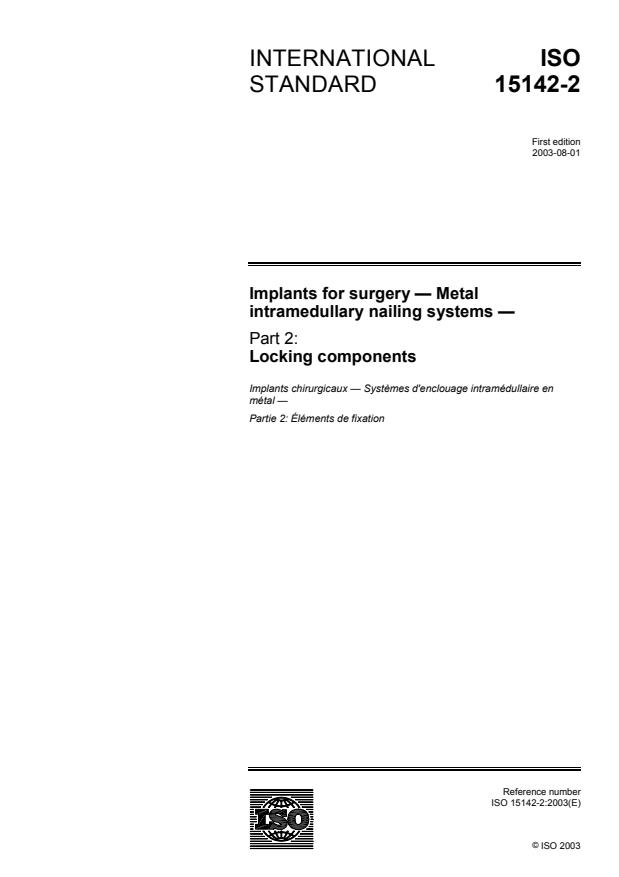
INTERNATIONAL ISO
STANDARD 15142-2
First edition
2003-08-01
Implants for surgery — Metal
intramedullary nailing systems —
Part 2:
Locking components
Implants chirurgicaux — Systèmes d'enclouage intramédullaire en
métal —
Partie 2: Éléments de fixation
Reference number
©
ISO 2003
PDF disclaimer
This PDF file may contain embedded typefaces. In accordance with Adobe's licensing policy, this file may be printed or viewed but
shall not be edited unless the typefaces which are embedded are licensed to and installed on the computer performing the editing. In
downloading this file, parties accept therein the responsibility of not infringing Adobe's licensing policy. The ISO Central Secretariat
accepts no liability in this area.
Adobe is a trademark of Adobe Systems Incorporated.
Details of the software products used to create this PDF file can be found in the General Info relative to the file; the PDF-creation
parameters were optimized for printing. Every care has been taken to ensure that the file is suitable for use by ISO member bodies. In
the unlikely event that a problem relating to it is found, please inform the Central Secretariat at the address given below.
© ISO 2003
All rights reserved. Unless otherwise specified, no part of this publication may be reproduced or utilized in any form or by any means,
electronic or mechanical, including photocopying and microfilm, without permission in writing from either ISO at the address below or
ISO's member body in the country of the requester.
ISO copyright office
Case postale 56 • CH-1211 Geneva 20
Tel. + 41 22 749 01 11
Fax + 41 22 749 09 47
E-mail copyright@iso.org
Web www.iso.org
Published in Switzerland
ii © ISO 2003 — All rights reserved
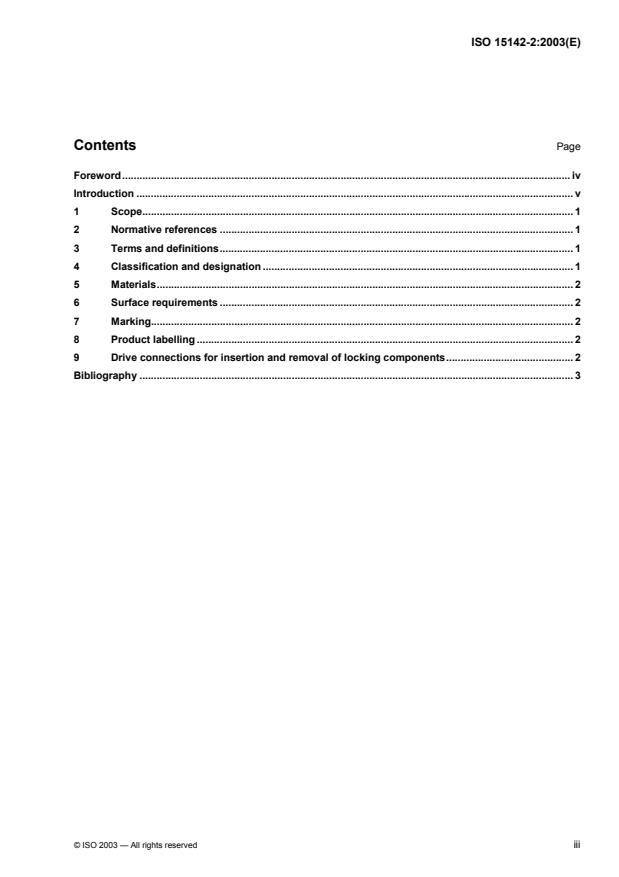
Contents Page
Foreword. iv
Introduction . v
1 Scope. 1
2 Normative references. 1
3 Terms and definitions. 1
4 Classification and designation . 1
5 Materials. 2
6 Surface requirements. 2
7 Marking. 2
8 Product labelling. 2
9 Drive connections for insertion and removal of locking components. 2
Bibliography . 3
Foreword
ISO (the International Organization for Standardization) is a worldwide federation of national standards bodies
(ISO member bodies). The work of preparing International Standards is normally carried out through ISO
technical committees. Each member body interested in a subject for which a technical committee has been
established has the right to be represented on that committee. International organizations, governmental and
non-governmental, in liaison with ISO, also take part in the work. ISO collaborates closely with the
International Electrotechnical Commission (IEC) on all matters of electrotechnical standardization.
International Standards are drafted in accordance with the rules given in the ISO/IEC Directives, Part 2.
The main task of technical committees is to prepare International Standards. Draft International Standards
adopted by the technical committees are circulated to the member bodies for voting. Publication as an
International Standard requires approval by at least 75 % of the member bodies casting a vote.
Attention is drawn to the possibility that some of the elements of this document may be the subject of patent
rights. ISO shall not be held responsible for identifying any or all such patent rights.
ISO 15142-2 was prepared by Technical Committee ISO/TC 150, Implants for surgery, Subcommittee SC 5,
Osteosynthesis and spinal devices.
ISO 15142 consists of the following parts, under the general title Implants for surgery — Metal intramedullary
nailing systems:
Part 1: Intr
...