

ISO/FDIS 16703
(Main)Environmental solid matrices — Determination of hydrocarbon content in the range of C10 to C40 by gas chromatography
- Abstract
ISO 16703:2004 specifies a method for the quantitative determination of the mineral oil (hydrocarbon) content in field-moist soil samples by gas chromatography. The method is applicable to mineral oil contents (mass fraction) between 100 mg/kg and 10 000 mg/kg soil, expressed as dry matter, and can be adapted to lower detection limits. ISO 16703:2004 is applicable to the determination of all hydrocarbons with a boiling range of 175 °C to 525 °C, n-alkanes from C10H22 to C40H82, isoalkanes, cycloalkanes, alkylbenzenes, alkylnaphthalenes and polycyclic aromatic compounds, provided that they are not absorbed on the specified column during the clean-up procedure. ISO 16703:2004 is not applicable to the quantitative determination of hydrocarbons 10 originating from gasolines. On the basis of the peak pattern of the gas chromatogram obtained, and of the boiling points of the individual n-alkanes listed in Annex B, the approximate boiling range of the mineral oil and some qualitative information on the composition of the contamination can be achieved.
- Status
- Not Published
- Technical Committee
- ISO/TC 190/SC 3 - Chemical and physical characterization
- Drafting Committee
- ISO/TC 190/SC 3/WG 6 - Organic analysis
- Current Stage
- 5000 - Final text received or FDIS registered for formal approval - 50 Approval
- Start Date
- 21-Sep-2026
- Due Date
- 31-Mar-2026
- Completion Date
- 31-Mar-2026
Buy Documents
ISO/FDIS 16703 - Environmental solid matrices — Determination of hydrocarbon content in the range of C10 to C40 by gas chromatography

REDLINE ISO/FDIS 16703 - Environmental solid matrices — Determination of hydrocarbon content in the range of C10 to C40 by gas chromatography
ISO/FDIS 16703 is an ISO standard for determining hydrocarbon content in environmental solid matrices by gas chromatography with flame ionization detection (GC-FID). It specifies how to extract, clean up, calibrate and quantify mineral oil-based hydrocarbons in soil, waste and sediment samples in the C10 to C40 range. The document is aimed at laboratories that measure contamination and need results in dry-mass-based mg/kg units.
What does ISO/FDIS 16703 specify?
ISO/FDIS 16703 specifies a quantitative GC-FID method for mineral oil-based hydrocarbons in soil, waste, contaminated materials and sediment. It is intended for samples with hydrocarbon contents between 100 mg/kg and 10 000 mg/kg dry mass, and it can be adapted to lower detection limits.
The method covers hydrocarbons with an approximate boiling range of 175 °C to 525 °C, including n-alkanes from C10 to C40, isoalkanes, cycloalkanes, alkylbenzenes, alkylnaphthalenes and polycyclic aromatic compounds when they survive the cleanup step. It is not intended for quantitative determination of hydrocarbons originating from gasolines, where volatile components are a problem.
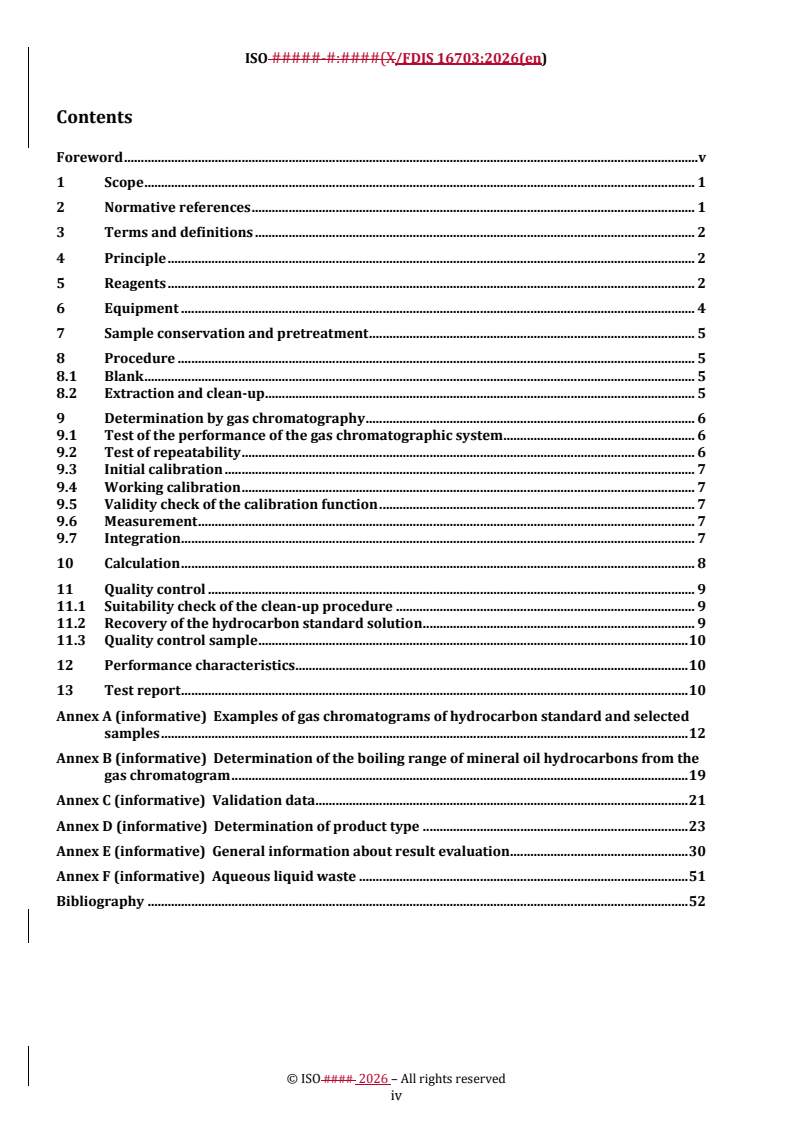
The document is organized into clauses 1 to 13 on scope, references, terms, principle, reagents, equipment, sample pretreatment, procedure, gas chromatography, calculation, quality control, performance characteristics and test report. It also includes six informative annexes that support identification, evaluation and special cases.
| Annex | What it covers |
|---|---|
| Annex A | Examples of gas chromatograms for the hydrocarbon standard and selected samples |
| Annex B | Estimating boiling range from the gas chromatogram |
| Annex C | Validation data from interlaboratory studies |
| Annex D | Determining product type from chromatographic patterns |
| Annex E | General guidance for result evaluation and integration |
| Annex F | Procedure for aqueous liquid waste |
What are the key requirements of ISO/FDIS 16703?
ISO/FDIS 16703 is built around a defined extraction, cleanup, calibration and integration sequence. In practice, the laboratory has to control the sample state, the cleanup performance and the chromatographic baseline, because each of those steps directly affects the reported hydrocarbon mass fraction.
Sample handling and extraction
Clause 7 requires the sample to be homogenized before analysis, and storage and pretreatment should follow ISO 18512 and ISO 14507. Drying at up to 40 °C is allowed only when hydrocarbon losses are negligible; otherwise freeze drying is preferred.
Clause 8.2 then specifies extraction with an acetone/hexane-like solvent, phase separation, two water washes, drying over sodium sulfate and cleanup on Florisil®. This matters because polar material must be removed before GC-FID, otherwise the chromatogram and the reported index are distorted.
For samples with more than 25 % water, the procedure becomes less effective and more acetone is needed. For plastic-containing samples, acetone is avoided and a hexane-like solvent is used alone to reduce false high results from dissolved plastic material.
Gas chromatographic system and calibration
Clause 9 requires a GC system with a non-discriminating injector, an FID and a programmable oven, together with a non-polar capillary column. The system-performance standard solution must show baseline separation of the n-alkanes, and the response of n-tetracontane is checked against n-eicosane.
The method uses an initial calibration in line with ISO 8466-1 when the system is first used or changed. Working calibration is then built from at least three dilutions of the hydrocarbon standard solution, and the calibration is verified with an independent calibration control solution.
Integration and quantification
Clause 9.7 defines the integration window as the area between n-decane and n-tetracontane, with the start and end tied to the retention times of those markers. n-Tetracontane is integrated separately as a recovery check.
This is important in practice because the method measures an index-like total area, not individual compounds. A rising baseline, poorly corrected column bleed, or carryover from an overloaded sample can change the result, so the chromatogram must be checked visually and corrected against the extraction solvent blank.
Quality control checks
Clause 8.1 requires a blank with every sample series. If the blank is unusually high, the procedure has to be checked step by step, because blank contamination can dominate low-level results.
Clause 11 adds two cleanup checks. The Florisil® cleanup must remove stearyl stearate strongly enough, and the hydrocarbon standard recovery must remain above the stated acceptance level. The calibration control solution is then used every 10 to 20 samples, and the results are recorded, for example in a control chart.
Calculation and reporting
Clause 10 calculates hydrocarbon content from the calibration function, extract volume, dilution factor, sample mass and dry matter content. The result is reported in mg/kg dry matter and rounded to two significant figures.
Clause 13 says the test report should identify the standard used, the extraction method, the sample, any deviations, and the test date. That gives the buyer or regulator enough information to judge whether the result came from the intended procedure.
What terms does ISO/FDIS 16703 define?
- Hydrocarbon content - the sum of compounds extracted from the matrix with the specified solvent, cleaned on Florisil®, and measured by GC-FID between n-decane and n-tetracontane.
- GC-FID - gas chromatography with flame ionization detection, the measurement technique used to integrate the hydrocarbon signal.
- Retention-time window (RTW) standard solution - a solution containing n-decane and n-tetracontane that defines the quantification window and supports dilution of the calibration standard.
- Hydrocarbon standard solution - the calibration mixture made from two different mineral oil types, chosen to give both separated peaks and a broad hump.
- System-performance standard solution - a mixture of even-carbon n-alkanes used to check separation, detector response and retention times.
- Calibration control solution - an independent reference solution used to check that the calibration still remains valid during a sample batch.
- Florisil® - activated magnesium silicate used in the cleanup column to remove polar compounds before GC-FID.
- PAH - polycyclic aromatic hydrocarbons, which the document discusses as part of the qualitative pattern but not as a quantified result.
Who uses ISO/FDIS 16703?
ISO/FDIS 16703 is used by environmental laboratories, soil and sediment testing labs, waste analysts and contamination assessment specialists. It supports routine work on polluted sites, waste materials, sludge-like solids and other environmental matrices where mineral oil contamination must be measured.
It is also relevant to quality managers and technical buyers who need a defined method for receiving, comparing or subcontracting hydrocarbon analyses. The annexes are especially useful for analysts who need to interpret product type, aging effects, biogenic patterns or plastic-related interferences.
What changed in ISO/FDIS 16703 from the previous edition?
ISO/FDIS 16703 cancels and replaces ISO 16703:2004. The foreword says the revision expands the scope to include waste by merging with EN 14039, describes the possibility of quantifying fractions within the stated hydrocarbon range, adds a way to determine product-specific patterns, gives more detail on integration and graphical data handling, and extends Annex C with additional examples of product types and typical patterns.
Which standards are used with ISO/FDIS 16703?
- ISO 8466-1 - provides the linear calibration framework used for initial calibration and evaluation of the calibration function.
- ISO 18512 - gives guidance for long- and short-term storage of soil samples before analysis.
- ISO 14507 - supports pretreatment of soil samples for organic contaminants.
- ISO 11465 - is used for determining dry matter or water content, which enters the final calculation.
- ISO 9377-2 - is named as an alternative for aqueous liquid waste samples.
- ISO 22155 - is mentioned for volatile aromatic and halogenated hydrocarbons when those compounds need separate analysis.
- ISO 18287 - is cited for PAH analysis when PAH quantification is needed separately from the hydrocarbon index.
What does the ISO/FDIS 16703 document contain?
The document contains a full laboratory method, not just a result definition. It gives the reagent list, equipment requirements, sample pretreatment, extraction and Florisil® cleanup procedure, GC conditions, calibration steps, integration rules, calculation formulae, quality control checks and reporting requirements.
Annex A provides example chromatograms for standards and real samples, including bleed correction and integrated areas. Annex B gives a boiling-point table for n-alkanes so users can estimate the approximate boiling range from the chromatogram. Annex C supplies validation data from interlaboratory studies, while Annex D gives product-type patterns such as petrol, jet fuel, diesel/heating fuel, lubricant oil, bitumen and PAH. Annex E explains how to evaluate chromatograms correctly, including baseline setting and carryover, and Annex F adapts the method to aqueous liquid waste.
Relations
- Effective Date
- 12-Feb-2026
- Effective Date
- 18-Nov-2023
- Effective Date
- 04-Nov-2023
Buy Documents
ISO/FDIS 16703 - Environmental solid matrices — Determination of hydrocarbon content in the range of C10 to C40 by gas chromatography
REDLINE ISO/FDIS 16703 - Environmental solid matrices — Determination of hydrocarbon content in the range of C10 to C40 by gas chromatography
Get Certified
Connect with accredited certification bodies for this standard

CIS Institut d.o.o.
Personal Protective Equipment (PPE) certification body. Notified Body NB-2890 for EU Regulation 2016/425 PPE.

Kiwa BDA Testing
Building and construction product certification.
Kmetijski inštitut Slovenije
Agricultural Institute of Slovenia. Soil testing, plant health, agricultural product analysis.
Sponsored listings
Frequently Asked Questions
ISO/FDIS 16703 is a draft published by the International Organization for Standardization (ISO). Its full title is "Environmental solid matrices — Determination of hydrocarbon content in the range of C10 to C40 by gas chromatography". This standard covers: ISO 16703:2004 specifies a method for the quantitative determination of the mineral oil (hydrocarbon) content in field-moist soil samples by gas chromatography. The method is applicable to mineral oil contents (mass fraction) between 100 mg/kg and 10 000 mg/kg soil, expressed as dry matter, and can be adapted to lower detection limits. ISO 16703:2004 is applicable to the determination of all hydrocarbons with a boiling range of 175 °C to 525 °C, n-alkanes from C10H22 to C40H82, isoalkanes, cycloalkanes, alkylbenzenes, alkylnaphthalenes and polycyclic aromatic compounds, provided that they are not absorbed on the specified column during the clean-up procedure. ISO 16703:2004 is not applicable to the quantitative determination of hydrocarbons 10 originating from gasolines. On the basis of the peak pattern of the gas chromatogram obtained, and of the boiling points of the individual n-alkanes listed in Annex B, the approximate boiling range of the mineral oil and some qualitative information on the composition of the contamination can be achieved.
ISO 16703:2004 specifies a method for the quantitative determination of the mineral oil (hydrocarbon) content in field-moist soil samples by gas chromatography. The method is applicable to mineral oil contents (mass fraction) between 100 mg/kg and 10 000 mg/kg soil, expressed as dry matter, and can be adapted to lower detection limits. ISO 16703:2004 is applicable to the determination of all hydrocarbons with a boiling range of 175 °C to 525 °C, n-alkanes from C10H22 to C40H82, isoalkanes, cycloalkanes, alkylbenzenes, alkylnaphthalenes and polycyclic aromatic compounds, provided that they are not absorbed on the specified column during the clean-up procedure. ISO 16703:2004 is not applicable to the quantitative determination of hydrocarbons 10 originating from gasolines. On the basis of the peak pattern of the gas chromatogram obtained, and of the boiling points of the individual n-alkanes listed in Annex B, the approximate boiling range of the mineral oil and some qualitative information on the composition of the contamination can be achieved.
ISO/FDIS 16703 is classified under the following ICS (International Classification for Standards) categories: 13.080.10 - Chemical characteristics of soils. The ICS classification helps identify the subject area and facilitates finding related standards.
ISO/FDIS 16703 has the following relationships with other standards: It is inter standard links to prEN ISO 16703, ISO/IEC 27035-1:2023, ISO 16703:2004. Understanding these relationships helps ensure you are using the most current and applicable version of the standard.
ISO/FDIS 16703 is available in PDF format for immediate download after purchase. The document can be added to your cart and obtained through the secure checkout process. Digital delivery ensures instant access to the complete standard document.
Standards Content (Sample)
Contents
- 1 Scope
- 2 Normative references
- 3 Terms and definitions
- 3.1 hydrocarbon content
- 4 Principle
- 5 Reagents
- 5.3 Activated magnesium silicate (Florisil®) for preparation of clean-up column, particle size
- 6 Equipment
- 7 Sample conservation and pretreatment
- 8 Procedure
- 8.1 Blank
- 8.2 Extraction and clean-up
- 9 Determination by gas chromatography
- 9.1 Test of the performance of the gas chromatographic system
- 9.2 Test of repeatability
- 9.3 Initial calibration
- 9.4 Working calibration
- 9.5 Validity check of the calibration function
- 9.6 Measurement
- 9.7 Integration
- 10 Calculation
- 11 Quality control
- 11.1 Suitability check of the clean-up procedure
- 11.2 Recovery of the hydrocarbon standard solution
- 11.3 Quality control sample
- 12 Performance characteristics
- 13 Test report
- Annex A
- Annex B
- Annex C
- Annex D
- Annex E
- Annex F
- Bibliography
1 Scope
This document specifies a method for the quantitative determination of the mineral oil-based hydrocarbon content (C to C ) in soil and waste samples by gas chromatography coupled with flame ionization 10 40 detection (GC-FID). This document is also applicable to sediment samples. It is generally applicable to all solid waste, soil and contaminated materials with hydrocarbon contents between 100 mg/kg and 10 000 mg/kg dry mass and can be adapted to lower limits of detection. Using this document all hydrocarbons with a boiling range of approximately 175 °C to 525 °C, e.g. n-alkanes from C H to C H , isoalkanes, cycloalkanes, alkyl benzenes, alkyl naphthalenes and polycyclic aromatic 10 22 40 82 1) compounds are determined as hydrocarbons, provided they do not adsorb on the Florisil® column during clean-up.
The document can also be applied to determine any fraction in the range n-C to n-C . 10 40 Volatile hydrocarbons cannot be quantitatively determined using this document. This can affect the determination of some common hydrocarbon fuels, e.g. petrol.
NOTE 1 On the basis of the peak pattern of the gas chromatogram (see Annex D) and of the boiling points of the individual n-alkanes listed in Annex B the approximate boiling range of the hydrocarbons and some qualitative information on the nature of the hydrocarbons can be obtained. NOTE 2 At the moment there is no sufficient information on how to handle organic liquid wastes (e.g. by-product of a manufacturing process, oils and greases) for the analysis of hydrocarbons. NOTE 3 Aqueous liquid waste samples can be analysed using ISO 9377-2 or the procedure specified in Annex F. Plastic-containing samples are treated by a hexane-like extraction solvent without usage of acetone in order to avoid overfindings (false-high content).
2 Normative references
The following documents are referred to in the text in such a way that some or all of their content constitutes requirements of this document. For dated references, only the edition cited applies. For undated references, the latest edition of the referenced document (including any amendments) applies. ISO 8466-1, Water quality — Calibration and evaluation of analytical methods — Part 1: Linear calibration function
3 Terms and definitions
For the purposes of this document, the following terms and definitions apply. 1) Florisil® is a trade mark of U.S. Silica Company and is an example of a suitable product available commercially. The term Florisil® is used in the document, as this is the term commonly used by experts. This information is given for the convenience of users of this document and does not constitute an endorsement by ISO of the product named.
ISO/FDIS 16703:2026(en) ISO and IEC maintain terminology databases for use in standardization at the following addresses:
- ISO Online browsing platform: available at https:// www .iso .org/ obp
- IEC Electropedia: available at https:// www .electropedia .org/
3.1 hydrocarbon content
sum of compounds that are extractable with acetone/hexane-like solvent (2+1) from environmental solid matrices, that do not adsorb on a specified single Florisil® column cleanup and can be chromatographed on a non-polar capillary column with retention times between those of n-decane (C H ) and n-tetracontane 10 22 (C H ) utilizing gas chromatography coupled with flame ionization detection GC-FID 40 82 Note 1 to entry: Substances that comply with this definition are mainly non-polar long chain or branched aliphatic, alicyclic, alkyl substituted aromatic or polycyclic aromatic compounds. Note 2 to entry: This definition differs from that given by utilizing a gravimetric approach (e.g. EN 14345). Note 3 to entry: Non-polar and weakly polar compounds (e.g. halogenated hydrocarbons) and high contents of more polar compounds, e.g. animal and vegetable fats and oils, can exceed the adsorption capacity of the Florisil used and will be included in the results.
4 Principle
A known amount of the homogenized sample is extracted by mechanical shaking or sonication with acetone/ hexane-like solvent. The organic phase is separated and washed twice with water. Polar compounds are removed by adsorption on Florisil®. An aliquot of the purified extract is analysed by capillary gas chromatography with flame ionization detection.
The total peak area between the retention time window standards n-decane and n-tetracontane is measured and the amount of hydrocarbons in the sample is quantified against an external standard consisting of equal amounts of two different types of mineral oil.
NOTE 1 Hexane-like solvent can be understood as n-heptane, or other non-polar solvent (e.g. n-hexane, iso-hexane, petroleum ether, cyclohexane).
NOTE 2 If lower limits of qualifications are required, large-volume injection or concentration of the final extract can be applied.
5 Reagents
All reagents shall be reagent grade and suitable for their specific purposes. 5.1 Acetone, (CH ) CO.
3 2 5.2 Hexane-like solvent such as n-Heptane, C H ; alternatively, other hexane-like solvents after proving 7 16 suitability (range of boiling point 60 °C to 100 °C).
5.3 Activated magnesium silicate (Florisil®) for preparation of clean-up column, particle size
150 µm to 250 µm (60 mesh to 100 mesh), heated for at least 16 h at 140 °C and stored in a desiccator over a molecular sieve.
NOTE Commercially available cartridges containing activated magnesium silicate (Florisil®) and sodium sulfate are also applicable.
5.4 Anhydrous sodium sulfate (Na SO ), heated for at least 2 h at 550 °C. Afterwards the sodium sulfate 2 4 should be stored under dry conditions (e.g. a desiccator).
ISO/FDIS 16703:2026(en) 5.5 Test solution of stearyl stearate (C H O ); n-octadecanoic acid octadecyl ester. 36 72 2 Dissolve e.g. (100 ± 1) mg of n-octadecanoic acid octadecyl ester in 100 ml hexane-like solvent (5.2) to yield a concentration of 1 mg/ml. The solution is stable for 6 months when stored in a refrigerator between 1 °C and 5 °C.
5.6 Retention-time window (RTW) standard solution, containing n-tetracontane and n-decane. RTW standard solution is needed to define the quantification-range between C and C . Weigh e.g. 10 40 (30 ± 1) mg of n-tetracontane [5.13] and transfer it into a 1 l volumetric flask, dissolve completely in an appropriate volume of hexane-like solvent (5.2), add e.g. 30 µl of n-decane (approximately 21 mg) [5.12], mix well, fill up to volume with hexane-like solvent and homogenize. This solution shall be used for all dilution steps of the hydrocarbon standard (5.7). The ration n-C to n-C should be kept as described above. 10 40 Store at room temperature.
NOTE n-Tetracontane is only moderately soluble in hexane-like solvent. Slightly warming up or sonicating can help accelerating the dissolution processes.
5.7 Hydrocarbon standard solution for calibration.
Mix approximately equal masses of two different types of mineral oil. Weigh accurately this mixture and dissolve in the RTW standard solution (5.6) to give a hydrocarbon mass concentration of approximately 8 g/l.
The first oil type should show separated peaks (e.g. a diesel fuel) in the gas chromatogram, as can be seen in Figure A.1 (left part of the chromatogram). The second type should have a boiling range higher than the first one, and should show a hump in the gas chromatogram, as can be seen in Figure A.1 (right part of the chromatogram). A suitable oil of this type is for example a lubricating oil without any additives. The calibration solutions can be prepared by diluting an aliquot of this standard solution with different volumes of the RTW standard solution (5.6).
NOTE Commercially available columns can be used, if suitability has been proven and meets the criteria in 5.7. 5.8 Calibration control solution.
Prepare an independent control solution in accordance with (5.7) using a hydrocarbon concentration approximately in the middle of the working range.
5.9 System-performance standard solution.
Prepare a mixture of equal amounts, on a mass basis, of the n-alkanes with even carbon numbers from C to
C , dissolved in hexan-like solvent (5.2), to give a concentration of approximately 50 mg/l of each n-alkane.
Store at room temperature.
This solution is used to verify the suitability of the gas chromatographic system for the resolution of n-alkanes as well as for the detector response.
NOTE This solution is in addition used to give information of the retention times of the n-alkanes to characterize the hydrocarbons in the samples (see Annex D).
5.10 Solution for definition of retention times.
For all fraction-based on even carbon numbers, the system-performance standard solution (5.9) can be used for determination of retention times. If fractions are to be determined with odd carbon numbers (e.g. > C -C ), a standard solution containing at least all relevant n-alkanes shall be applied. 10 25
ISO/FDIS 16703:2026(en) 5.11 Preparation of the clean-up column.
A plug of pre-washed glass wool or a PTFE frit is pushed down into the column (6.9). Then, successively 2 g Florisil® (5.3) and 2 g sodium sulfate (5.4) are added. The column shall be prepared immediately before use or stored in a dry environment (e.g. desiccator). In addition, commercially available columns can be used, if suitability has been proven.
After proving suitability, a miniaturization of the cleanup can be applied, and the ratio used extract to Florisil®/sodium sulfate shall remain the same (10:2:2; e.g. 5 ml with 1 g Florisil® and 1 g sodium sulfate). 5.12 n-decane; linear hydrocarbon n-C (CAS 124-18-5); used as retention-time marker in RTW (5.6)
5.13 n-tetradecane; linear hydrocarbon n-C (CAS 629-59-4); used as retention-time marker in RTW (5.6)
5.14 Water; should not cause high blank according to 8.1.
6 Equipment
6.1 Standard laboratory glassware, which shall be treated at high temperatures or rinsed with acetone (5.1) and dried before use.
6.2 Devices for extraction, mechanical shaker (at least 120 r/min) or ultrasonic bath. 6.3 Gas chromatograph, equipped with a non-discriminating injector, a flame ionization detector (FID) and a temperature programmable oven.
NOTE The use of a large-volume injection system can improve the limit of detection considerably. 6.4 Capillary column, fused silica column with suitable stationary phase and dimensions, e.g. stationary phase: non-polar (e.g. immobilised 100 % dimethyl polysiloxane, 95 %-dimethyl-5 %-diphenyl polysiloxane, modified siloxane polymer); length: 2 m to 20 m; internal diameter: 0,1 mm to 0,32 mm; film thickness: 0,1 µm to 1,0 µm.
The column should give a base-line separation of the n-alkanes when the system performance standard solution (5.9) is run. The use of a pre-column, e.g. wide-bore (0,53 mm internal diameter) deactivated fused silica of at least 2 m of length is recommended. Thermally stable low bleed columns should be preferred. 6.5 Data system, capable of integrating the total peak area of the chromatogram, compensating for column bleed and reintegrating after defining a new baseline.
6.6 Glass extraction vessel of volume at least 100 ml, with screw caps provided with a septum coated with polytetrafluoroethylene (PTFE).
6.7 Glass tube, e.g. 25 ml, with ground glass stopper or screw caps incorporating a septum coated with polytetrafluoroethylene (PTFE).
6.8 Separation funnel, at least 500 ml, with a ground glass stopper.
ISO/FDIS 16703:2026(en) 6.9 Chromatography column for clean-up, glass columns of about 10 mm internal diameter. Preferably, the upper part of the column should be widened to use as solvent reservoir and the lower part should be narrowed to form a tip.
Plastic columns can be used if they meet the requirements given in 8.2.
7 Sample conservation and pretreatment
Storage and pretreatment should be according to ISO 18512, if not otherwise specified. Before analysis, the samples shall be homogenized. Sample treatment should be performed according to ISO 14507 or other suitable standards.
Drying of the sample at maximum 40 °C can be applied, if losses of hydrocarbons can be neglected (e.g. products HF, LO or BI according to Table D.1). If drying at 40 °C is not applicable due to high water content of the sample, freeze drying is preferable.
8 Procedure
8.1 Blank
With each series of samples, carry out a blank determination according to 8.2 using all reagents in identical amounts but without a sample. If blank values are unusually high (more than 50 % of the lowest value of interest), every step in the procedure shall be checked to determine the cause of these high blanks.
8.2 Extraction and clean-up
Weigh an amount of approximately e.g. 20 g of the homogenized field-moist or pretreated sample into a glass extraction vessel (6.6) and add e.g. 40 ml of acetone (5.1) with a precision of ± 1 ml. After briefly shaking by hand, add e.g. 20 ml of the RTW standard solution (5.6) with a precision of ± 1 ml. Close the vessel and extract the sample for 1 h using mechanical shaking or sonication (6.2). After settling of the solid material, transfer as much as possible of the supernatant into e.g. a separatory funnel (6.8) or use alternative tools to remove the extract as completely as possible (e.g. bottleneck). To remove the acetone, wash the organic phase twice by shaking thoroughly with e.g. 100 ml of water each time. Collect the organic phase in a glass tube (6.7). Add sufficient sodium sulfate so that no lumps are formed. Transfer e.g. 10 ml of the extract to a clean-up column filled with Florisil® (5.3). In case of significant deviation to 10 ml, the amount of applied Florisil® shall be adjusted so that the ratio of used extract to Florisil®/sodium sulfate remains the same (10:2:2). Do not pre-wash the column with organic solvent. Collect the eluate. Transfer an aliquot of the purified extract to a GC-vial and analyse by gas chromatography. This method can be used if the sample contains up to 25 % water. If the water content of the sample is higher than 25 %, this procedure is less effective and the amount of acetone shall be increased. The acetone: water ratio should be at least 9:1.
Beside the mentioned default test portion of approximately 20 g and a solid/hexan-like solvent ratio of 1:1, in special cases test portions of 5 g to 30 g can be used based on type of matrix and contamination of the sample. For example:
- smaller test portions should be used if samples sorb the major portion of the extraction solvent added;
- the extract shall be diluted by utilizing the entire process in the case of high contamination;
- sample intake should be increased if high sensitivity is required. Due to sample homogeneity, the application of less than 5 g to 10 g of sample material should be avoided. In case of plastic containing samples, the utilization of acetone shall be avoided. In such cases the sample shall be dried (chemically or at room temperature) and only treated by a hexane-like extraction solvent. For inhomogeneous samples, the weight and solvent amount should be increased. In case of plastic-containing
ISO/FDIS 16703:2026(en) samples, the recovery of hydrocarbons can be lower, but overfindings (false-high content) by extracted plastic material are avoided by means of excluding the extraction step with acetone. A pre-dilution (1:5 to 1:20) of such extract before clean-up can be meaningful in selected cases in order to reduce the concentration of matrix components in the extract.
NOTE 1 Alternative extraction procedures e.g. pressurized liquid extraction (PLE) can be used provided they give comparable extraction performances.
NOTE 2 To improve and accelerate phase separation, centrifugation can be applied provided that the necessary safety precautions, especially with regard to inflammable solvents, are taken into account. In case of sediments or other matrices potentially rich of plant materials, the standard procedure shall be applied. The resulting biogenic hydrocarbons are in this case included to definition in 3.1. IMPORTANT — It is very important that the Florisil is freshly prepared and active, and the extract is free of acetone (less than 0,1 volume %), especially when the sample contains polycyclic aromatic hydrocarbons (PAH) besides mineral oil based hydrocarbons.
9 Determination by gas chromatography
9.1 Test of the performance of the gas chromatographic system
Use a capillary column with one of the specified stationary phases (6.4) for gas chromatographic analysis. Adjust the gas chromatograph (6.3) to provide a sufficient separation. The n-alkanes in the systemperformance standard solution (5.9) shall be baseline-separated. The relative response of the n-tetracontane (C ) shall be at least 0,8, with respect to n-eicosane (C ).
...
Contents
- 1 Scope
- 2 Normative references
- 3 Terms and definitions
- 4 Principle
- 5 Reagents
- 6 Equipment
- 7 Sample conservation and pretreatment
- 8 Procedure
- 8.1 Blank
- 8.2 Extraction and clean-up
- 9 Determination by gas chromatography
- 9.1 Test of the performance of the gas chromatographic system
- 9.2 Test of repeatability
- 9.3 Initial calibration
- 9.4 Working calibration
- 9.5 Validity check of the calibration function
- 9.6 Measurement
- 9.7 Integration
- 10 Calculation
- 11 Quality control
- 11.1 Suitability check of the clean-up procedure
- 11.2 Recovery of the hydrocarbon standard solution
- 11.3 Quality control sample
- 12 Performance characteristics
- 13 Test report
- Annex A
- Annex B
- Annex C
- Annex D
- Annex E
- 1 Starting point of the integration (after the signal of decane)
- 2 Integration point at the retention time of docosane to
- 3 Endpoint of the integration before tetracontane to determine
- 1 Lacking subtract of the blanks causes the integration of column bleeding
- Bibliography
1 Scope
This document specifies a method for the quantitative determination of the mineral oil-based hydrocarbon content (C to C ) in soil and waste samples by gas chromatography coupled with flame ionization detection 10 40 (GC - -FID). This document is also applicable to sediment samples. It is generally applicable to all solid waste, soil and contaminated materials with hydrocarbon contents between 100 - mg/kg and 10 ,000 mg/kg dry mass and can be adapted to lower limits of detection. Using this document all hydrocarbons with a boiling range of approximately 175 °C to 525 °C, e.g. n--alkanes from C H to C H , isoalkanes, cycloalkanes, alkyl benzenes, alkyl naphthalenes and polycyclic aromatic 10 22 40 82 11) compounds are determined as hydrocarbons, provided they do not adsorb on the Florisil® column during clean-up.
The document can also be applied to determine any fraction in-between the range n-C to n-C . 10 40 Volatile hydrocarbons cannot be quantitatively determined using this document. This can affect the determination of some common hydrocarbon fuels, e.g. petrol.
NOTE 1 On the basis of the peak pattern of the gas chromatogram (see Annex DAnnex D)) and of the boiling points of the individual n--alkanes listed in Annex BAnnex B the approximate boiling range of the hydrocarbons and some qualitative information on the nature of the hydrocarbons can be obtained. NOTE 2 At the moment there is no sufficient information on how to handle organic liquid wastes (e.g. by-product of a manufacturing process, oils and greases) for the analysis of hydrocarbons. NOTE 3 Aqueous liquid waste samples can be analysed using ISO 9377-2 [2] or the procedure specified in Annex FAnnex E..
Plastic-containing samples are treated by a hexane-like extraction solvent without usage of acetone in order to avoid overfindings (false-high content).
2 Normative references
The following documents are referred to in the text in such a way that some or all of their content constitutes requirements of this document. For dated references, only the edition cited applies. For undated references, the latest edition of the referenced document (including any amendments) applies. ISO 8466--1, Water quality — Calibration and evaluation of analytical methods — Part 1: Linear calibration function
Florisil® is a trade mark. The chemical specification is given in chapter 5.3. for better readability, the term Florisil® is used in the document, as this is the term commonly used by experts. The ISO does not specify any preferences for a corresponding supplier company.
1) Florisil® is a trade mark of U.S. Silica Company and is an example of a suitable product available commercially. The term Florisil® is used in the document, as this is the term commonly used by experts. This information is given for the convenience of users of this document and does not constitute an endorsement by ISO of the product named.
ISO/FDIS 16703:2026(en)
3 Terms and definitions
For the purposes of this document, the following terms and definitions apply. ISO and IEC maintain terminology databases for use in standardization at the following addresses:
- — ISO Online browsing platform: available at https://www.iso.org/obp
- — IEC Electropedia: available at https://www.electropedia.org/ 3.1 3.1 hydrocarbon content sum of compounds that are extractable with acetone/hexane-like solvent (2+1) from environmental solid matrices, that do not adsorb on a specified single Florisil® column cleanup and can be chromatographed on a non-polar capillary column with retention times between those of n-decane (C H ) and n-tetracontane 10 22 (C H ) utilizing a GC/FID.gas chromatography coupled with flame ionization detection GC-FID 40 82 Note 1 to entry: Substances that comply with this definition are mainly non-polar long chain or branched aliphatic, alicyclic, alkyl substituted aromatic or polycyclic aromatic compounds. Note 2 to entry: This definition differs from that given by utilizing a gravimetric approach (e.g. EN 14345 [8]).). Note 3 to entry: Non-polar and weakly polar compounds (e.g. halogenated hydrocarbons) and high contents of more polar compounds, e.g. animal and vegetable fats and oils, maycan exceed the adsorption capacity of the Florisil used and will be included in the results.
4 Principle
A known amount of the homogenized sample is extracted by mechanical shaking or sonication with acetone/hexane-like solvent. The organic phase is separated and washed twice with water. Polar compounds are removed by adsorption on Florisil®. An aliquot of the purified extract is analysed by capillary gas chromatography with flame ionization detection.
The total peak area between the retention time window standards n-decane and n-tetracontane is measured and the amount of hydrocarbons in the sample is quantified against an external standard consisting of equal amounts of two different types of mineral oil.
NOTE 1 Hexane-like solvent can be understood as n-heptane, or other non-polar solvent (e.g. n-hexane, iso-hexane, petroleum ether, cyclohexane).
NOTE 2 If lower limits of qualifications are required, large-volume injection or concentration of the final extract can be applied.
5 Reagents
All reagents shall be reagent grade and suitable for their specific purposes. 5.1 5.1 Acetone, (CH ) CO.
3 2 5.2 5.2 Hexane-like solvent such as n-Heptane, C H ; alternatively, other hexane-like solvents after 7 16 proving suitability (range of boiling point 60 °C- to 100 °C).
ISO/FDIS 16703:2026(en)
5.3 5.3 Activated magnesium silicate (Florisil®) for preparation of clean-up column, particle size 150 µm to 250 µm (60 mesh to 100 mesh), heated for at least 16 h at 140 °C and stored in a desiccator over a molecular sieve.
NOTE Commercially available cartridges containing activated magnesium silicate (Florisil®) and sodium sulfate are also applicable.
5.4 5.4 Anhydrous sodium sulfate (Na SO ), heated for at least 2 h at 550 °C. Afterwards the sodium 2 4 sulfate should be stored under dry conditions (e.g. a desiccator). 5.5 5.5 Test solution of stearyl stearate (C H O ); n-octadecanoic acid octadecyl ester. 36 72 2 Dissolve e.g. (100 ± 1) mg of n-octadecanoic acid octadecyl ester in 100 ml hexane-like solvent (5.2(5.2)) to yield a concentration of 1 mg/ml. The solution is stable for 6 months when stored in a refrigerator between 1 °C and 5 °C.
5.6 5.6 Retention-time window (RTW) standard solution, containing n-tetracontane and n-decane. Retention-time window (RTW) standard solution is needed to define the quantification-range between C -
and C . Weigh e.g. (30 ± 1) mg of n-tetracontane5.13 [5.13] and transfer it into a 1 l volumetric flask, dissolve
completely in an appropriate volume of hexane-like solvent (5.2(5.2),), add e.g. 30 µl of n-decane (approximately 21 mg)5.12) [5.12],, mix well, fill up to volume with hexane-like solvent and homogenize. This solution shall be used for all dilution steps of the hydrocarbon standard (5.7(5.7).). The ration n-C to n-C 10 40 should be kept as described above.
Store at room temperature.
NOTE n-Tetracontane is only moderately soluble in hexane-like solvent. Slightly warming up or sonicating can help accelerating the dissolution processes.
5.7 5.7 Hydrocarbon standard solution for calibration.
Mix approximately equal masses of two different types of mineral oil. Weigh accurately this mixture and dissolve in the RTW standard solution (5.6(5.6)) to give a hydrocarbon mass concentration of aboutapproximately 8 g/l.
The first oil type should show separated peaks (e.g. a diesel fuel) in the gas chromatogram, as can be seen in Figure A.1Figure A.1 (left part of the chromatogram). The second type should have a boiling range higher than the first one, and should show a hump in the gas chromatogram, as can be seen in Figure A.1Figure A.1 (right part of the chromatogram). A suitable oil of this type is for example a lubricating oil without any additives. The calibration solutions can be prepared by diluting an aliquot of this standard solution with different volumes of the RTW standard solution (5.6(5.6).).
NOTE Commercially available columns can be used, if suitability has been proven and meets the criteria in 5.7made above..
5.8 5.8 Calibration control solution.
Prepare an independent control solution in accordance with (5.7(5.7)) using a hydrocarbon concentration approximately in the middle of the working range.
Florisil is an example of a suitable product available commercially. This information is given for the convenience of users of this document and does not constitute an endorsement by ISO of this product.
ISO/FDIS 16703:2026(en) 5.9 5.9 System-performance standard solution.
Prepare a mixture of equal amounts, on a mass basis, of the n-alkanes with even carbon numbers from C to
C , dissolved in hexan-like solvent (5.2(5.2),), to give a concentration of aboutapproximately 50 mg/l of each
n-alkane. Store at room temperature.
This solution is used to verify the suitability of the gas chromatographic system for the resolution of n--alkanes as well as for the detector response.
NOTE This solution is in addition used to give information of the retention times of the n-alkanes to characterize the hydrocarbons in the samples (see Annex Dc.f. Annex D).).
5.10 5.10 Solution for definition of retention times.
For all fraction-based on even carbon numbers, the system-performance standard solution (5.9(5.9)) can be used for determination of retention times. If fractions are to be determined with odd carbon numbers (e.g. > C -C ), a standard solution containing at least all relevant n-alkanes have toshall be applied. 10 25 5.11 5.11 Preparation of the clean-up column.
A plug of pre-washed glass wool or a PTFE frit is pushed down into the column (6.9(6.9).). Then, successively 2 g Florisil® (5.3(5.3)) and 2 g sodium sulfate (5.4(5.4)) are added. The column shall be prepared immediately before use or stored in a dry environment (e.g. desiccator). In addition, commercially available columns can be used, if suitability has been proven.
After proving suitability, a miniaturization of the cleanup can be applied, and the ratio used extract to Florisil®/sodium sulfate shall remain the same (10:2:2; e.g. 5 ml with 1 g Florisil® and 1 g sodium sulfate). 5.12 5.12 n-decane; linear hydrocarbon n-C (CAS 124-18-5); used as retention-time marker in RTW
(5.6(5.6)) 5.13 5.13 n-tetradecane; linear hydrocarbon n-C (CAS 629-59-4); used as retention-time marker in RTW
(5.6(5.6)) 5.14 5.14 waterWater; should not cause high blank according to 8.1(8.1).
6 Equipment
6.1 6.1 Standard laboratory glassware, which shall be treated at high temperatures or rinsed with acetone (5.1(5.1)) and dried before use.
6.2 6.2 Devices for extraction, mechanical shaker (at least 120 rpmr/min) or ultrasonic bath. 6.3 6.3 Gas chromatograph, equipped with a non-discriminating injector, a flame ionization detector (FID) and a temperature programmable oven.
NOTE The use of a large-volume injection system can improve the limit of detection considerably. 6.4 6.4 Capillary column, fused silica column with suitable stationary phase and dimensions, e.g. stationary phase: non-polar (e.g. immobilised 100 % dimethyl polysiloxane, 95 %-dimethyl-5 %-diphenyl polysiloxane, modified siloxane polymer, etc.);); length: 2 m to 20 m; internal diameter: 0,1 mm to 0,32 mm;
ISO/FDIS 16703:2026(en) film thickness: 0,1 µm to 1,0 µm.
The column should give a base-line separation of the n-alkanes when the system performance standard solution (5.9(5.9)) is run. The use of a pre-column, e.g. wide-bore (0,53 mm internal diameter) deactivated fused silica of at least 2 m of length is recommended. Thermally stable low bleed columns should be preferred. 6.5 6.5 Data system, capable of integrating the total peak area of the chromatogram, compensating for column bleed and reintegrating after defining a new baseline. 6.6 6.6 Glass extraction vessel of volume at least 100 ml, with screw caps provided with a septum coated with polytetrafluoroethylene (PTFE).
6.7 6.7 Glass tube, e.g. 25 ml, with ground glass stopper or screw caps incorporating a septum coated with polytetrafluoroethylene (PTFE).
6.8 6.8 Separation funnel, at least 500 ml, with a ground glass stopper. 6.9 6.9 Chromatography column for clean-up, glass columns of about 10 mm internal diameter. Preferably, the upper part of the column should be widened to use as solvent reservoir and the lower part toshould be narrowed to form a tip.
Plastic columns can be used if they meet the requirements given in 8.28.1..
7 Sample conservation and pretreatment
Storage and pretreatment should be according to ISO 18512 [3],, if not otherwise specified. Before analysis, the samples shall be homogenized. Sample treatment should be performed according to ISO 14507[4] or other suitable standards.
Drying of the sample at max.maximum 40 °C can be applied, if losses of hydrocarbons can be neglected (e.g. products HF, LO or BI according to Table D.1table D.1).). If drying at 40 °C is not applicable due to high water content of the sample, freeze drying is preferable.
8 Procedure
8.1 Blank
With each series of samples, carry out a blank determination according to 8.28.2 using all reagents in identical amounts but without a sample. If blank values are unusually high (more than 50 % of the lowest value of interest), every step in the procedure shall be checked to determine the cause of these high blanks.
8.2 Extraction and clean-up
Weigh an amount of approximately e.g. 20 g of the homogenized field-moist or pretreated sample into a glass extraction vessel (6.6(6.6)) and add e.g. 40 ml of acetone (5.1) with a precision of +/-± 1 ml (5.1).. After briefly shaking by hand, add e.g. 20 ml of the RTW -standard solution (5.6(5.6)) with a precision of +/-± 1 ml. Close the vessel and extract the sample for 1 h using mechanical shaking or sonication (6.2(6.2).). After settling of the solid material, transfer as much as possible of the supernatant into e.g. a separatory funnel (6.8(6.8)) or use alternative tools to remove the extract as completely as possible (e.g. bottleneck). To remove the acetone, wash the organic phase twice by shaking thoroughly with e.g. 100 ml of water each time. Collect the organic phase in a glass tube (6.7(6.7).). Add sufficient sodium sulfate so that no lumps are formed. Transfer e.g. 10 ml of the extract to a clean-up column filled with Florisil® (5.3(5.3).). In case of significant deviation to 10 ml, the amount of applied Florisil® has toshall be adjusted in a way,so that the ratio of used extract to
ISO/FDIS 16703:2026(en) Florisil®/sodium sulfate remains the same (10:2:2). Do not pre-wash the column with organic solvent. Collect the eluate. Transfer an aliquot of the purified extract to a GC-vial and analyse by gas chromatography. This method can be used if the sample contains up to 25 % water. If the water content of the sample is higher than 25 %, this procedure is less effective and the amount of acetone shall be increased. The acetone:water ratio should be at least 9:1.
Beside the mentioned default test portion of aboutapproximately 20 g and a solid / /hexan-like solvent ratio of 1:1, in special cases test portions of 5 g to 30 g can be used based on type of matrix and contamination of the sample. For example, :
- smaller test portions should be used if samples sorb the major portion of the extraction solvent added, ;
- the extract shall be diluted by utilizing the entire process in the case of high contamination and ;
- sample intake should be increased if high sensitivity is required. Due to sample homogeneity, the application of less than 5- g to 10 g of sample material should be avoided. In case of plastic containing samples, the utilization of acetone shall be avoided. In such cases the sample shall be dryeddried (chemically or at room temperature) and only treated by a hexane-like extraction solvent. For inhomogeneous samples, the weight and solvent amount should be increased. In case of plastic-containing samples, the recovery of hydrocarbons can be lower, but overfindings (false-high content) by extracted plastic material are avoided by means of excluding the extraction step with acetone. A pre-dilution (1:5 – to 1:20) of such extract before clean-up can be meaningful in selected cases in order to reduce the concentration of matrix components in the extract.
NOTE 1 Alternative extraction procedures e.g. pressurized liquid extraction (PLE) can be used provided they give comparable extraction performances.
NOTE 2 To improve and accelerate phase separation, centrifugation can be applied provided that the necessary safety precautions, especially with regard to inflammable solvents, are taken into account. In case of sediments or other matrices potentially rich of plant materials, the standard procedure shall be applied. The resulting biogenic hydrocarbons are in this case included to definition in 3.13.1.. IMPORTANT — It is very important that the Florisil is freshly prepared and active, and the extract is free of acetone (less than 0,1 volume %), especially when the sample contains polycyclic aromatic hydrocarbons (PAH) besides mineral oil based hydrocarbons.”.
9 Determination by gas chromatography
9.1 Test of the performance of the gas chromatographic system
Use a capillary column with one of the specified stationary phases (6.4(6.4)) for gas chromatographic analysis. Adjust the gas chromatograph (6.3(6.3)) to provide a sufficiantsufficient separation. The n-alkanes in the system-performance standard solution (5.9(5.9)) shall be baseline-separated. The relative response of the n--tetracontane (C ) shall be at least 0,8, with respect to n-eicosane (C ). 40 20 For an example of gas chromatographic conditions, see Annex AAnnex A..
9.2 Test of repeatability
Record a gas chromatogram of the column bleed by injection of an appropriate volume of hexane-like solvent (5.2.). Then inject the same volume of a suitable concentration of the calibration control solution (5.8(5.8)) three times and record the chromatogram for each injection. Integrate the chromatograms according to 9.79.7
...