

ISO 687:2024
(Main)Coke — Determination of moisture in the general analysis test sample
General Information
- Abstract
This document specifies a method for determining the moisture in the general analysis test sample of coke. It can be used for the determination of moisture in blast-furnace coke, foundry-coke and other high-temperature carbonization products.
- Status
- Published
- Publication Date
- 14-Mar-2024
- Technical Committee
- ISO/TC 27/SC 5 - Methods of analysis
- Drafting Committee
- ISO/TC 27/SC 5 - Methods of analysis
- Current Stage
- 6060 - International Standard published
- Start Date
- 15-Mar-2024
- Due Date
- 06-Feb-2025
- Completion Date
- 15-Mar-2024
Overview
ISO 687:2024 - "Coke - Determination of moisture in the general analysis test sample" specifies a standardized gravimetric method for measuring moisture in coke test samples. Applicable to blast-furnace coke, foundry coke and other high‑temperature carbonization products, the method determines moisture by heating a known mass of the general analysis sample until constant mass and calculating the moisture mass fraction from the mass loss. The 2024 fourth edition adds the optional use of nitrogen atmospheres and a minimum free space oven.
Key topics and technical requirements
- Scope: Moisture determination for general analysis test samples of coke and related products.
- Principle: Gravimetric loss-on-drying - heat a weighed sample in air or nitrogen at a controlled temperature until constant mass is achieved.
- Temperatures:
- Typical range: 120 °C to 200 °C (optionally 105 °C for lower-temperature drying).
- Faster procedure: 320 °C in nitrogen (1 h usually sufficient) using a minimum free space oven.
- Atmosphere:
- Dry air or nitrogen (optional); nitrogen must have oxygen < 30 µl/l. Commercial nitrogen with moisture < 5 µl/l is acceptable.
- For nitrogen operation, recommended flow ≈ 15 × oven volume per hour in minimum free space ovens.
- Apparatus and sample:
- Analytical balance with 0.1 mg readability.
- Shallow glass or corrosion‑resistant metal dish with cover; sample layer ≤ 0.20 g/cm²; nominal sample mass 1 ± 0.1 g.
- Cooling vessel (desiccator) without desiccant; option to cool under air or nitrogen flow.
- Procedure highlights:
- Weigh empty dish + cover, add sample, heat until constant mass (reheat 30 min intervals if needed until mass change ≤ 1 mg).
- Report mean of duplicate determinations to nearest 0.1 %.
- Calculation:
- Moisture mass fraction (%) = (mass loss on drying / sample mass before drying) × 100.
- Precision:
- Repeatability limit: 0.2 % absolute for duplicate determinations in the same lab. Reproducibility across labs not specified due to varying humidity conditions.
Applications and users
- Quality control and routine testing in metallurgical plants, coke producers, foundries, and independent analytical laboratories.
- Laboratories correcting other analyses (e.g., volatile matter, hydrogen) to a dry basis when moisture in the general analysis sample must be known.
- Users who require standardized, traceable moisture results for product specification, process control, compliance and inter‑laboratory comparison.
Related standards
- ISO 1213-2 (vocabulary for sampling, testing and analysis) - referenced for terms and definitions.
- ISO 687:2024 complements other coke and coal test methods used in laboratory quality systems.
Keywords: ISO 687:2024, coke moisture determination, moisture in coke, general analysis test sample, minimum free space oven, nitrogen drying, blast-furnace coke, foundry coke.
Relations
- Effective Date
- 11-Feb-2023
Get Certified
Connect with accredited certification bodies for this standard

Element Materials Technology
Materials testing and product certification.

ABS Group Brazil
ABS Group certification services in Brazil.

ABS Quality Evaluations Inc.
American Bureau of Shipping quality certification.
Sponsored listings
Frequently Asked Questions
ISO 687:2024 is a standard published by the International Organization for Standardization (ISO). Its full title is "Coke — Determination of moisture in the general analysis test sample". This standard covers: This document specifies a method for determining the moisture in the general analysis test sample of coke. It can be used for the determination of moisture in blast-furnace coke, foundry-coke and other high-temperature carbonization products.
This document specifies a method for determining the moisture in the general analysis test sample of coke. It can be used for the determination of moisture in blast-furnace coke, foundry-coke and other high-temperature carbonization products.
ISO 687:2024 is classified under the following ICS (International Classification for Standards) categories: 75.160.10 - Solid fuels. The ICS classification helps identify the subject area and facilitates finding related standards.
ISO 687:2024 has the following relationships with other standards: It is inter standard links to ISO 687:2010. Understanding these relationships helps ensure you are using the most current and applicable version of the standard.
ISO 687:2024 is available in PDF format for immediate download after purchase. The document can be added to your cart and obtained through the secure checkout process. Digital delivery ensures instant access to the complete standard document.
Standards Content (Sample)
International
Standard
ISO 687
Fourth edition
Coke — Determination of moisture
2024-03
in the general analysis test sample
Coke — Détermination de l'humidité de l'échantillon pour
analyse
Reference number
© ISO 2024
All rights reserved. Unless otherwise specified, or required in the context of its implementation, no part of this publication may
be reproduced or utilized otherwise in any form or by any means, electronic or mechanical, including photocopying, or posting on
the internet or an intranet, without prior written permission. Permission can be requested from either ISO at the address below
or ISO’s member body in the country of the requester.
ISO copyright office
CP 401 • Ch. de Blandonnet 8
CH-1214 Vernier, Geneva
Phone: +41 22 749 01 11
Email: copyright@iso.org
Website: www.iso.org
Published in Switzerland
ii
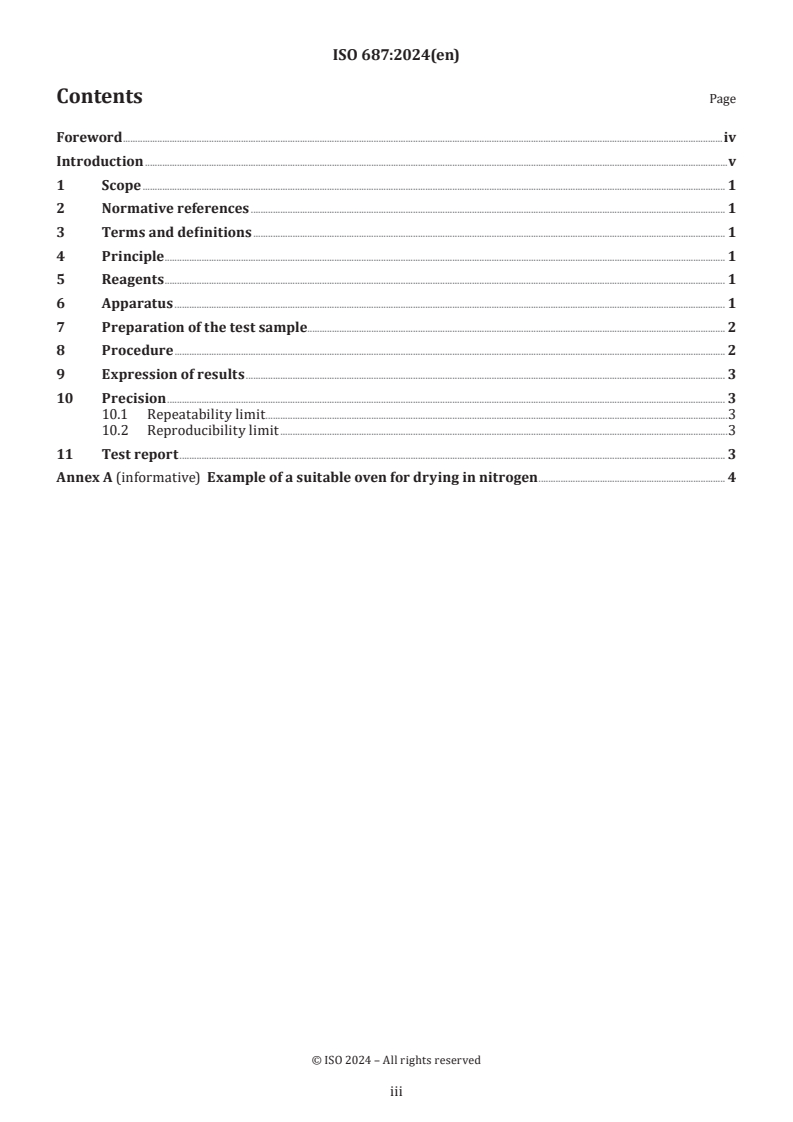
Contents Page
Foreword .iv
Introduction .v
1 Scope . 1
2 Normative references . 1
3 Terms and definitions . 1
4 Principle . 1
5 Reagents . 1
6 Apparatus . 1
7 Preparation of the test sample. 2
8 Procedure . 2
9 Expression of results . 3
10 Precision . 3
10.1 Repeatability limit .3
10.2 Reproducibility limit .3
11 Test report . 3
Annex A (informative) Example of a suitable oven for drying in nitrogen . 4
iii
Foreword
ISO (the International Organization for Standardization) is a worldwide federation of national standards
bodies (ISO member bodies). The work of preparing International Standards is normally carried out through
ISO technical committees. Each member body interested in a subject for which a technical committee
has been established has the right to be represented on that committee. International organizations,
governmental and non-governmental, in liaison with ISO, also take part in the work. ISO collaborates closely
with the International Electrotechnical Commission (IEC) on all matters of electrotechnical standardization.
The procedures used to develop this document and those intended for its further maintenance are described
in the ISO/IEC Directives, Part 1. In particular, the different approval criteria needed for the different types
of ISO document should be noted. This document was drafted in accordance with the editorial rules of the
ISO/IEC Directives, Part 2 (see www.iso.org/directives).
ISO draws attention to the possibility that the implementation of this document may involve the use of (a)
patent(s). ISO takes no position concerning the evidence, validity or applicability of any claimed patent
rights in respect thereof. As of the date of publication of this document, ISO had not received notice of (a)
patent(s) which may be required to implement this document. However, implementers are cautioned that
this may not represent the latest information, which may be obtained from the patent database available at
www.iso.org/patents. ISO shall not be held responsible for identifying any or all such patent rights.
Any trade name used in this document is information given for the convenience of users and does not
constitute an endorsement.
For an explanation of the voluntary nature of standards, the meaning of ISO specific terms and expressions
related to conformity assessment, as well as information about ISO’s adherence to the World Trade
Organization (WTO) principles in the Technical Barriers to Trade (TBT), see www.iso.org/iso/foreword.html.
This document was prepared by Technical Committee ISO/TC 27, Coal and coke, Subcommittee SC 5, Methods
of analysis.
This fourth edition cancels and replaces the third edition (ISO 687:2010), which has been technically revised.
The main change is as follows:
— adding the optional use of nitrogen and a minimum free space oven.
Any feedback or questions on this document should be directed to the user’s national standards body. A
complete listing of these bodies can be found at www.iso.org/members.html.
iv
Introduction
The determination of moisture in the general analysis test sample is required to correct the results of certain
analytical determinations, e.g. volatile matter and hydrogen, for the effect of water in the determination and
to allow all determinations to be corrected to a dry basis.
Since coke is hygroscopic, its moisture will vary with a change in humidity of the atmosphere, and the
moisture in the genera
...