

ISO 17361:2017/Amd 1:2023
(Amendment)Intelligent transport systems — Lane departure warning systems — Performance requirements and test procedures — Amendment 1
General Information
- Abstract
- Status
- Published
- Publication Date
- 18-Dec-2023
- Technical Committee
- ISO/TC 204 - Intelligent transport systems
- Drafting Committee
- ISO/TC 204 - Intelligent transport systems
- Current Stage
- 6060 - International Standard published
- Start Date
- 19-Dec-2023
- Due Date
- 25-Oct-2024
- Completion Date
- 19-Dec-2023


Overview
ISO 17361:2017/Amd 1:2023 is an important amendment to the international standard focused on Intelligent Transport Systems (ITS), specifically addressing Lane Departure Warning Systems (LDWS). This standard, developed by ISO technical committee ISO/TC 204, defines the performance requirements and test procedures for LDWS to enhance road safety by alerting drivers when their vehicle unintentionally departs from its lane.
The 2023 amendment introduces key updates to testing speeds for different vehicle classes, reflecting the evolving technical and safety considerations in intelligent transport. By adhering to this standard, manufacturers and testing organizations ensure that LDWS technologies meet consistent quality and reliability benchmarks worldwide.
Key Topics
Lane Departure Warning System Performance: The standard outlines how LDWS must perform under various driving conditions to reliably detect lane departures and warn drivers, reducing accident risks caused by unintentional lane drifting.
Test Procedures: Defines rigorous procedures and scenarios to test LDWS effectiveness, including detection algorithms, warning timing, and system accuracy for different vehicle categories.
Vehicle Classes and Speed Specifications: The 2023 amendment updates speed criteria - Changing speeds from “17 m/s for Class I and 20 m/s for Class II” to “20 m/s for Class I and 17 m/s for Class II,” reflecting nuances in vehicle dynamics and system response requirements.
International Standardization: Harmonizes LDWS requirements across markets, facilitating global compatibility for ITS devices, easing regulatory compliance, and supporting international trade.
Safety and Reliability: Emphasizes system robustness and real-world applicability to ensure LDWS contributes effectively to accident prevention and driver assistance.
Applications
Automotive Manufacturing: OEMs integrate ISO 17361 compliant LDWS into vehicles to meet safety regulations and consumer expectations for advanced driver assistance systems (ADAS).
Testing and Certification: Vehicle testing laboratories use the standard’s specified test procedures to verify LDWS performance for certification and regulatory approval.
Intelligent Transport Systems Development: Developers of ITS technologies leverage this standard to design and validate lane adherence features that enhance automated vehicle safety.
Road Safety Programs: Regulators and policymakers adopt the standard to set minimum performance thresholds for LDWS, promoting safer road environments.
Aftermarket Safety Devices: Manufacturers of aftermarket lane departure warning products use these requirements to ensure compatibility and effectiveness with various vehicle types.
Related Standards
ISO 26262 - Functional safety of road vehicles, covering safety requirements for electronic systems including LDWS components.
ISO 14813 - Reference model for intelligent transport system architectures, supporting system-level integration of LDWS.
ISO 19091 - Cooperative ITS, relates to how LDWS can be enhanced via vehicle-to-infrastructure communications.
ISO/IEC 27000 series - Information security standards relevant to protecting LDWS software and communications.
UNECE WP.29 Regulations - Vehicle safety and software update regulations that often reference international standards for ADAS systems.
Conclusion
ISO 17361:2017/Amd 1:2023 represents a critical evolution of the global framework for lane departure warning systems in intelligent transport. By clearly defining updated performance requirements and test methods, it supports safer roads and innovation in automotive safety technology. Adherence to this standard enhances LDWS reliability, facilitates regulatory compliance, and promotes harmonized ITS development worldwide. For automotive manufacturers, testers, and regulators, ISO 17361 remains a foundational document for advancing driving assistance systems that prevent lane departure-related accidents.
Relations
- Effective Date
- 29-Oct-2022
Get Certified
Connect with accredited certification bodies for this standard

BSI Group
BSI (British Standards Institution) is the business standards company that helps organizations make excellence a habit.

Great Wall Tianjin Quality Assurance Center
Established 1993, first batch to receive national accreditation with IAF recognition.
Hong Kong Quality Assurance Agency (HKQAA)
Hong Kong's leading certification body.
Sponsored listings
Frequently Asked Questions
ISO 17361:2017/Amd 1:2023 is a standard published by the International Organization for Standardization (ISO). Its full title is "Intelligent transport systems — Lane departure warning systems — Performance requirements and test procedures — Amendment 1". This standard covers: Intelligent transport systems — Lane departure warning systems — Performance requirements and test procedures — Amendment 1
Intelligent transport systems — Lane departure warning systems — Performance requirements and test procedures — Amendment 1
ISO 17361:2017/Amd 1:2023 is classified under the following ICS (International Classification for Standards) categories: 03.220.20 - Road transport; 35.240.60 - IT applications in transport. The ICS classification helps identify the subject area and facilitates finding related standards.
ISO 17361:2017/Amd 1:2023 has the following relationships with other standards: It is inter standard links to ISO 17361:2017. Understanding these relationships helps ensure you are using the most current and applicable version of the standard.
ISO 17361:2017/Amd 1:2023 is available in PDF format for immediate download after purchase. The document can be added to your cart and obtained through the secure checkout process. Digital delivery ensures instant access to the complete standard document.
Standards Content (Sample)
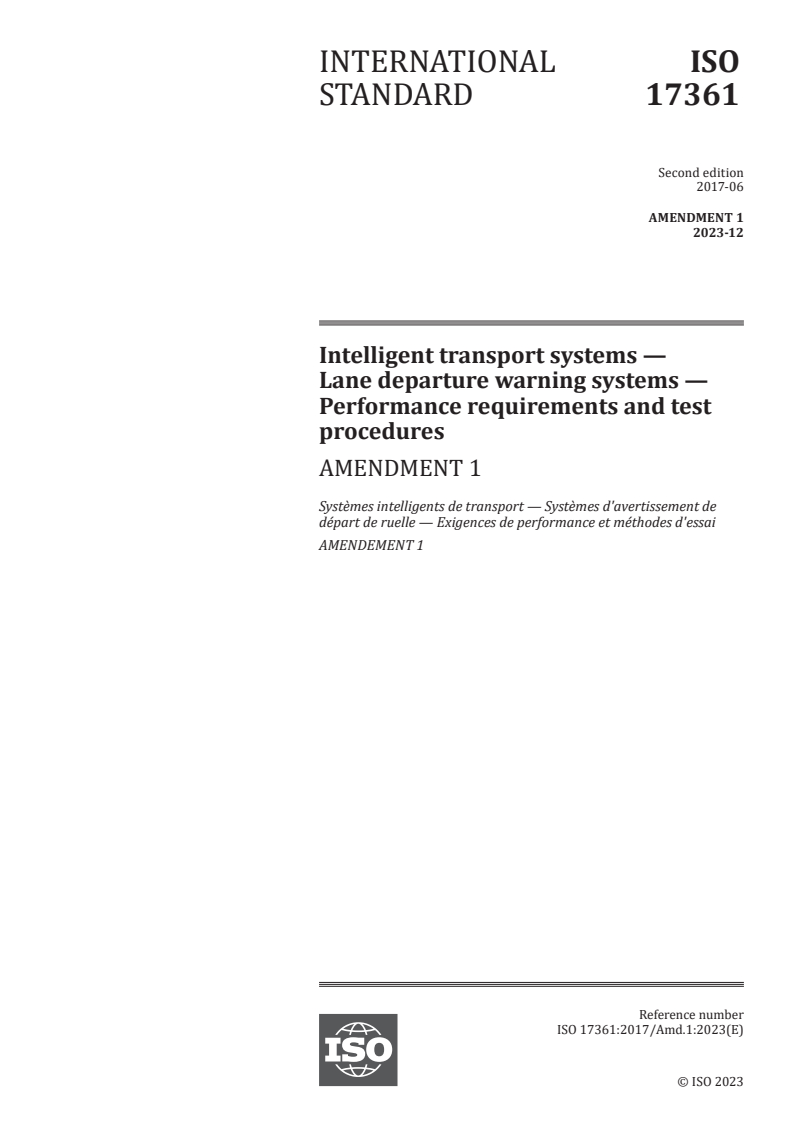
INTERNATIONAL ISO
STANDARD 17361
Second edition
2017-06
AMENDMENT 1
2023-12
Intelligent transport systems —
Lane departure warning systems —
Performance requirements and test
procedures
AMENDMENT 1
Systèmes intelligents de transport — Systèmes d'avertissement de
départ de ruelle — Exigences de performance et méthodes d'essai
AMENDEMENT 1
Reference number
ISO 17361:2017/Amd.1:2023(E)
ISO 17361:2017/Amd.1:2023(E)
© ISO 2023
All rights reserved. Unless otherwise specified, or required in the context of its implementation, no part of this publication may
be reproduced or utilized otherwise in any form or by any means, electronic or mechanical, including photocopying, or posting on
the internet or an intranet, without prior written permission. Permission can be requested from either ISO at the address below
or ISO’s member body in the country of the requester.
ISO copyright office
CP 401 • Ch. de Blandonnet 8
CH-1214 Vernier, Geneva
Phone: +41 22 749 01 11
Email: copyright@iso.org
Website: www.iso.org
Published in Switzerland
ii
ISO 17361:2017/Amd.1:2023(E)
Foreword
ISO (the International Organization for Standardization) is a worldwide federation of national standards
bodies (ISO member bodies). The work of preparing International Standards is normally carried out
through ISO technical committees. Each member body interested in a subject for which a technical
committee has been established has the right to be represented on that committee. International
organizations, governmental and non-governmental, in liaison with ISO, also take part in the work.
ISO collaborates closely with the International Electrotechnical Commission (IEC) on all matters of
electrotechnical standardization.
The procedures used to develop this document and those intended for its further maintenance are
described in the ISO/IEC Directives, Part 1. In particular, the different approval criteria needed for the
different ty
...