


ISO 13370:1998
(Main)Thermal performance of buildings - Heat transfer via the ground - Calculation methods
Thermal performance of buildings - Heat transfer via the ground - Calculation methods
Performance thermique des bâtiments —Transfert de chaleur par le sol — Méthodes de calcul
General Information
Relations
Frequently Asked Questions
ISO 13370:1998 is a standard published by the International Organization for Standardization (ISO). Its full title is "Thermal performance of buildings - Heat transfer via the ground - Calculation methods". This standard covers: Thermal performance of buildings - Heat transfer via the ground - Calculation methods
Thermal performance of buildings - Heat transfer via the ground - Calculation methods
ISO 13370:1998 is classified under the following ICS (International Classification for Standards) categories: 91.120.10 - Thermal insulation of buildings. The ICS classification helps identify the subject area and facilitates finding related standards.
ISO 13370:1998 has the following relationships with other standards: It is inter standard links to ISO 2759:1974, ISO 13370:2007. Understanding these relationships helps ensure you are using the most current and applicable version of the standard.
You can purchase ISO 13370:1998 directly from iTeh Standards. The document is available in PDF format and is delivered instantly after payment. Add the standard to your cart and complete the secure checkout process. iTeh Standards is an authorized distributor of ISO standards.
Standards Content (Sample)
INTERNATIONAL ISO
STANDARD 13370
First edition
1998-10-15
Thermal performance of buildings — Heat
transfer via the ground — Calculation
methods
Performance thermique des bâtiments — Transfert de chaleur par le sol —
Méthodes de calcul
A
Reference number
Foreword
ISO (the International Organization for Standardization) is a worldwide
federation of national standards bodies (ISO member bodies). The work of
preparing International Standards is normally carried out through ISO
technical committees. Each member body interested in a subject for which
a technical committee has been established has the right to be represented
on that committee. International organizations, governmental and non-
governmental, in liaison with ISO, also take part in the work. ISO
collaborates closely with the International Electrotechnical Commission
(IEC) on all matters of electrotechnical standardization.
Draft International Standards adopted by the technical committees are
circulated to the member bodies for voting. Publication as an International
Standard requires approval by at least 75 % of the member bodies casting
a vote.
International Standard ISO 13370 was prepared by the European
Committee for Standardization (CEN) in collaboration with ISO Technical
Committee TC 163, Thermal insulation, Subcommittee SC 2, Calculation
methods, in accordance with the Agreement on technical cooperation
between ISO and CEN (Vienna Agreement).
Annexes A to F form an integral part of this International Standard.
Annexes G to L are for information only.
© ISO 1998
All rights reserved. Unless otherwise specified, no part of this publication may be reproduced
or utilized in any form or by any means, electronic or mechanical, including photocopying and
microfilm, without permission in writing from the publisher.
International Organization for Standardization
Case postale 56 • CH-1211 Genève 20 • Switzerland
Internet iso@iso.ch
Printed in Switzerland
ii
©
ISO ISO 13370:1998(E)
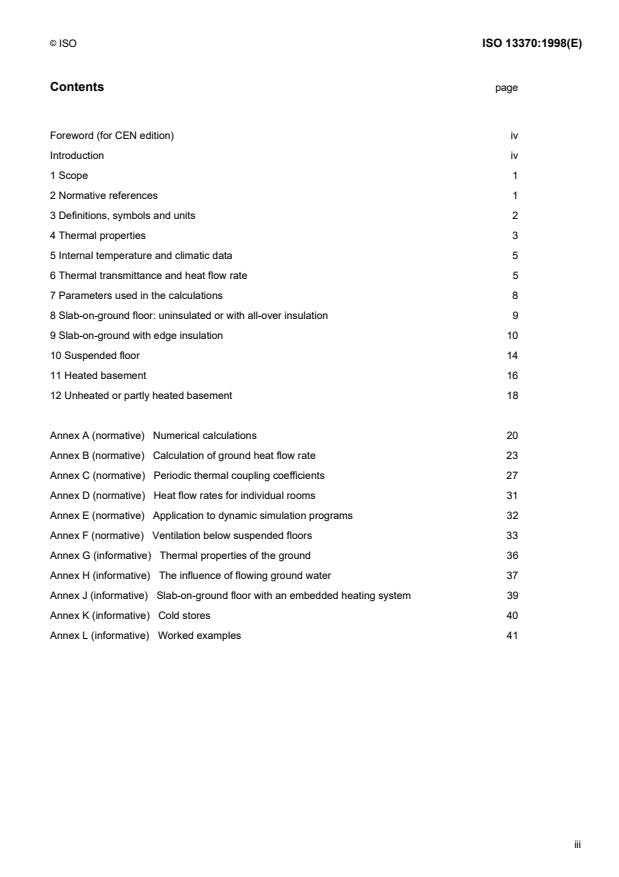
Contents page
Foreword (for CEN edition) iv
Introduction iv
1 Scope 1
2 Normative references 1
3 Definitions, symbols and units 2
4 Thermal properties 3
5 Internal temperature and climatic data 5
6 Thermal transmittance and heat flow rate 5
7 Parameters used in the calculations 8
8 Slab-on-ground floor: uninsulated or with all-over insulation 9
9 Slab-on-ground with edge insulation 10
10 Suspended floor 14
11 Heated basement 16
12 Unheated or partly heated basement 18
Annex A (normative) Numerical calculations 20
Annex B (normative) Calculation of ground heat flow rate 23
Annex C (normative) Periodic thermal coupling coefficients 27
Annex D (normative) Heat flow rates for individual rooms 31
Annex E (normative) Application to dynamic simulation programs 32
Annex F (normative) Ventilation below suspended floors 33
Annex G (informative) Thermal properties of the ground 36
Annex H (informative) The influence of flowing ground water 37
Annex J (informative) Slab-on-ground floor with an embedded heating system 39
Annex K (informative) Cold stores 40
Annex L (informative) Worked examples 41
iii
©
Foreword
The text of EN ISO 13370:1998 has been prepared by Technical Committee CEN/TC 89 "Thermal
performance of buildings and building components", the secretariat of which is held by SIS, in
collaboration with Technical Committee ISO/TC 163 "Thermal insulation".
This European Standard shall be given the status of a national standard, either by publication of an
identical text or by endorsement, at the latest by April 1999, and conflicting national standards shall be
withdrawn at the latest by April 1999.
This standard is one of a series of standards on calculation methods for the design and evaluation of the
thermal performance of buildings and building components.
According to the CEN/CENELEC Internal Regulations, the national standards organizations of the
following countries are bound to implement this European Standard: Austria, Belgium, Czech Republic,
Denmark, Finland, France, Germany, Greece, Iceland, Ireland, Italy, Luxembourg, Netherlands, Norway,
Portugal, Spain, Sweden, Switzerland and the United Kingdom.
Introduction
EN ISO 6946 gives the method of calculation of the thermal transmittance of building elements in contact
with the external air; this standard deals with elements in thermal contact with the ground. The division
between these two standards is at the level of the inside floor surface for slab-on-ground floors,
suspended floors and unheated basements, and at the level of the external ground surface for heated
basements. In general, a term to allow for a thermal bridge associated with the wall/floor junction is
included when assessing the total heat loss from a building using methods such as prEN ISO 13789.
The calculation of heat transfer through the ground can be done by numerical calculations, which also
allow analysis of thermal bridges, including wall/floor junctions, for assessment of minimum internal
surface temperatures.
In this standard, simplified procedures are provided which take account of the 3-dimensional nature of the
heat flow and which are suitable for the evaluation of heat transfer coefficients and heat flow rates in most
cases.
Thermal transmittances of floors give useful comparative values of the insulation properties of different
floor constructions, and are used in building regulations in some countries for the limitation of heat losses
through floors.
Thermal transmittance, although defined for steady-state conditions, also relates average heat flow to
average temperature difference. In the case of walls and roofs exposed to the external air there are daily
periodic variations in heat flow into and out of storage related to daily temperature variations, but this
averages out and the daily average heat loss can be found from the thermal transmittance and daily
average inside-to-outside temperature difference. For floors and basement walls in contact with the
ground, however, the large thermal inertia of the ground results in periodic heat flows related to the
annual cycle of internal and external temperatures. The steady-state heat flow is often a good
approximation to the average heat flow over the heating season.
A detailed assessment of floor losses is obtained from, in addition to the steady-state part, annual
periodic heat transfer coefficients related to the thermal capacity of the soil as well as its thermal
conductivity, together with the amplitude of annual variations in monthly mean temperature. Methods of
obtaining these periodic coefficients are also given in this standard, and their application to the calculation
of heat flow rates is described in annex B.
Worked examples illustrating the use of the methods in this standard are given in annex L.
iv
©
ISO ISO 13370:1998(E)
1 Scope
This standard gives methods of calculation of heat transfer coefficients and heat flow rates, for building
elements in thermal contact with the ground, including slab-on-ground floors, suspended floors and
basements. It applies to building elements, or parts of them, below a horizontal plane in the bounding
walls of the building situated
- for slab-on-ground floors and suspended floors, at the level of the inside floor surface;
- for basements, at the level of the external ground surface.
It includes calculation of the steady-state part of the heat transfer (the annual average rate of heat flow),
and the part due to annual periodic variations in temperature (the seasonal variations of the heat flow rate
about the annual average). These seasonal variations are obtained on a monthly basis; this standard
does not apply to shorter periods of time.
2 Normative references
This standard incorporates by dated or undated reference, provisions from other publications. These
normative references are cited at the appropriate places in the text and the publications are listed
hereafter. For dated references, subsequent amendments to or revisions of any of these publications
apply to this standard only when incorporated in it by amendment or revision. For undated references the
latest edition of the publication referred to applies.
EN ISO 6946 Building components and building elements - Thermal resistance and thermal
transmittance - Calculation method (ISO 6946:1996)
EN ISO 7345 Thermal insulation - Physical quantities and definitions (ISO 7345:1987)
EN ISO 10211-1 Thermal bridges - Calculation of heat flows and surface temperatures - Part 1:
General calculation methods (ISO 10211-1:1995)
prEN ISO 10211-2 Thermal bridges - Calculation of heat flows and surface temperatures - Part 2:
Linear thermal bridges (ISO/DIS 10211-2:1995)
ISO 10456 Building materials and products - Procedures for determining declared and
design thermal values
©
3 Definitions, symbols and units
3.1 Definitions
For the purposes of this standard the definitions in EN ISO 7345 apply, together with the following.
3.1.1 slab on ground: Floor construction directly on the ground over its whole area.
3.1.2 suspended floor: Floor construction in which the floor is held off the ground, resulting in an air void
between the floor and the ground.
NOTE - This air void, also called underfloor space or crawl space, may be ventilated or
unventilated, and does not form part of the habitable space.
3.1.3 basement:Usable part of a building that is situated partly or entirely below ground level.
NOTE - This space may be heated or unheated.
Thickness of ground (having the thermal
3.1.4 equivalent thickness (of a thermal resistance):
conductivity of the actual ground) which has the same thermal resistance.
3.1.5 steady-state thermal coupling coefficient: Steady-state heat flow divided by temperature
difference between internal and external environments.
3.1.6 internal periodic thermal coupling coefficient: Amplitude of periodic heat flow divided by
amplitude of internal temperature variation over an annual cycle.
3.1.7 external periodic thermal coupling coefficient: Amplitude of periodic heat flow divided by
amplitude of external temperature over an annual cycle.
3.1.8 characteristic dimension of floor: Area of floor divided by half the perimeter of floor.
3.1.9 phase difference: Period of time between the maximum or minimum of a cyclic temperature and
the consequential maximum or minimum heat flow rate.
3.2 Symbols and units
The following is a list of the principal symbols used. Other symbols are defined where they are used within
the text.
Symbol Quantity Unit
A area of floor m²
B'
characteristic dimension of floor m
D
width or depth of edge insulation m
L steady-state thermal coupling coefficient W/K
s
L internal periodic thermal coupling coefficient W/K
pi
L external periodic thermal coupling coefficient W/K
pe
©
ISO ISO 13370:1998(E)
Symbol Quantity Unit
P
exposed perimeter of floor m
Q quantity of heat J
R thermal resistance m²·K/W
R thermal resistance of floor construction m²·K/W
f
R
thermal resistance of insulation m²·K/W
ins
R
internal surface resistance m²·K/W
si
R external surface resistance m²·K/W
se
T temperature K or °C
U thermal transmittance between internal and external environments W/(m²·K)
U
basic thermal transmittance of slab-on-ground floor W/(m²·K)
o
U
thermal transmittance of basement floor W/(m²·K)
bf
U thermal transmittance of basement walls W/(m²·K)
bw
U' effective thermal tranmittance for whole basement W/(m²·K)
d total equivalent thickness - floor m
t
d
total equivalent thickness - basement wall m
w
c
specific heat capacity of unfrozen ground J/(kg·K)
d' additional equivalent thickness due to edge insulation m
h height of floor surface above outside ground level m
w thickness of external walls m
z
depth of basement floor below ground level m
δ
periodic penetration depth m
λ
thermal conductivity of unfrozen ground W/(m·K)
λ
thermal conductivity of insulation W/(m·K)
n
ρ
density of unfrozen ground kg/m³
Φ
heat flow rate W
Ψ
linear thermal transmittance associated with wall/floor junction W/(m·K)
g
ΔΨ
correction term for edge insulation of floor slab W/(m·K)
4 Thermal properties
4.1 Thermal properties of the ground
The thermal properties of the ground may be specified in national regulations or other documents, and
such values may be used where appropriate. In other cases:
a) if known, use values for the actual location, averaged over a depth equal to the width of the building
and allowing for the normal moisture content;
©
b) otherwise, if the soil type is known or specified, use the values in table 1;
c) otherwise use λ = 2,0 W/(m·K) and ρc = 2,0 x 10 J/(m³·K).
Table 1 - Thermal properties of the ground
Category Description Thermal Heat capacity
conductivity per volume
λ (W/(m·K)) ρc (J/(m³·K))
1 clay or silt 1,5 3,0 x 10
2 sand or gravel 2,0 2,0 x 10
3 homogeneous rock 3,5 2,0 x 10
NOTE - Annex G gives information about the range of values of ground properties.
4.2 Thermal properties of building materials
For the thermal resistance of any building product use the appropriate design value as defined in
ISO 10456. The thermal resistance of products used below ground level should reflect the moisture
conditions of the application.
If thermal conductivity is quoted, obtain the thermal resistance as the thickness divided by thermal
conductivity.
NOTE - The heat capacity of building materials used in floor constructions is small compared with
that of the ground, and is neglected.
4.3 Surface resistances
Use the following values:
– internal, downwards heat flow: R = 0,17 m²·K/W
si
– internal, horizontal heat flow: R = 0,13 m²·K/W
si
– internal, upwards heat flow: R = 0,10 m²·K/W
si
– external, all cases: R = 0,04 m²·K/W
se
NOTE - These values are taken from ISO 6946.
R for downwards heat flow applies both at the top and the bottom of an underfloor space. R for
si si
upwards heat flow applies to floors with an embedded heating system and to cold stores.
©
ISO ISO 13370:1998(E)
5 Internal temperature and climatic data
5.1 Internal temperature.
If there are different temperatures in different rooms or spaces immediately above the floor, a spatial
average should be used. Obtain this average by weighting the temperature of each space by the area of
that space in contact with the ground.
To calculate heat flow rates this standard requires:
a) annual mean internal temperature;
b) if variations in internal temperature are included, amplitude of variation of internal temperature from
the annual mean: this amplitude is defined as half the difference between the maximum and
minimum values of the average temperatures for each month.
5.2 Climatic data
To calculate heat flow rates this standard requires:
a) annual mean external air temperature;
b) if variations in external temperature are included, amplitude of variation of external air temperature
from the annual mean: this amplitude is defined as half the difference between the maximum and
minimum values of the average temperatures for each month;
c) for suspended floors that are naturally ventilated, the average wind speed measured at a height of
10 m.
If the ground surface temperature is known or can be estimated, this can be used in place of the external
air temperature, in order to allow for effects of snow cover, solar gain on the ground surface, and/or
R
longwave radiation to clear skies. In that case should be excluded from all formulae.
se
6 Thermal transmittance and heat flow rate
6.1 Thermal transmittance
Thermal transmittances for floors and basements are related to the steady-state component of the heat
transfer. Methods of calculation are given in clauses 8 to 12 for the various types of floor and basement: a
summary of the relevant equations is provided in table 2.
If the transmission heat loss coefficient for the ground is required, take this as equal to the steady-state
thermal coupling coefficient, L .
s
©
Table 2 - Selection of equations
Floor type: For all floor types obtain B' using equation (1)
d U U
Slab-on-ground Calculate using (2), No edge insulation: =
t o
U
and using (3) or (4)
o
Edge insulation: U = U + 2 ΔΨ/B'
o
Horizontal edge insulation: d' from (8)
and ΔΨ from (10)
Vertical edge insulation: d' from (8) and
ΔΨ from (11)
Calculate d using (14), U using (15), U using (16) and finally U using (13)
Suspended
g g x
Basement Basement floor: Heated basement: Calculate U' using (23)
d
Calculate using (18)
t
U
Calculate using (19)
bf
or (20)
Basement walls: Unheated basement : Calculate U using (25)
Calculate d using (21)
w
and U using (22)
bw
6.2 Thermal bridges at edge of floor
The formulae in this standard are based on an isolated floor considered independently of any interaction
between floor and wall. They also assume uniform thermal properties of the soil (except for effects solely
due to edge insulation).
In practice, wall/floor junctions for slab-on-ground floors do not correspond with this ideal, giving rise to
thermal bridge effects. These shall be allowed for in calculations of the total heat loss from a building, by
using a linear thermal transmittance (Ψ).
Ψ
Typical values of for slab-on-ground floors are given in table 3. This table may be extended on a
national basis to include specific wall/floor details, and for a particular dimension system, provided that
these values have been obtained in accordance with annex A. The linear thermal transmittance term
associated with basements is small and may be neglected.
NOTE: The linear thermal transmittance depends on the system being used for defining building
dimensions: see prEN ISO 13789 Thermal performance of buildings - Transmission heat loss
coefficient - Calculation Method (ISO/DIS 13789:1997)
©
ISO ISO 13370:1998(E)
Table 3 - Values of linear thermal transmittance for wall/floor junctions
for slab-on-ground and suspended floors
Insulation Linear thermal
arrangement transmittance
Ψ
W/(m·K)
Uninsulated floor, or floor in which floor
insulation connects directly to wall 0,0
insulation
Wall insulation not directly connected to
floor insulation, but overlapped with it by 0,1
at least 200 mm
Wall insulation not connected to floor
insulation 0,2
The total heat loss from a building is then calculated on the basis of a separating plane:
- at the level of the inside floor surface for slab-on-ground floors, suspended floors and unheated
basements, or
- at the level of the outside ground surface for heated basements.
The thermal transmittance of elements above the separating plane should be assessed according to EN
ISO 6946.
6.3 Calculation of heat flow rate
Heat transfer via the ground can be calculated on an annual basis using thermal transmittances only, or
on a seasonal or monthly basis using additional periodic coefficients that take account of the thermal
inertia of the ground. The relevant equations are given in annex B, and formulae for the periodic
coefficients in annex C.
6.4 Effect of ground water
Ground water has a negligible effect on the heat transfer unless it is at a shallow depth and has a high
flow rate. Such conditions are rarely encountered and in most cases no allowance should be made for the
effect of ground water.
When the depth of the water table below ground level and the rate of ground water flow are known, the
L G
steady-state thermal coupling coefficient may be multiplied by a factor .
s w
NOTE - Illustrative values of G are given in annex H.
w
©
6.5 Special cases
The methods in this standard are also applicable to the following situations, with the modifications
described in the relevant annex:
– Heat flow rates for individual rooms : annex D
– Application to dynamic simulation programs: annex E
NOTE: This standard can also be used for slab-on-ground floors with an embedded heating
system (see annex J) and for cold stores (see annex K).
7 Parameters used in the calculations
7.1 Characteristic dimension of floor
To allow for the 3-dimensional nature of heat flow within the ground, the formulae in this standard are
B'
expressed in terms of the "characteristic dimension" of the floor, , defined as the area of the floor
divided by half the perimeter:
A
B' =
(1)
½ P
NOTE - For an infinitely long floor, B' is the width of the floor; for a square floor, B' is half the
length of one side.
Special foundation details, for example edge insulation of the floor, are treated as modifying the heat flow
at the perimeter.
In the case of basements, B' is calculated from the area and perimeter of the floor of the basement, not
including the walls of the basement; and the heat flow from the basement includes an additional term
related to the perimeter and the depth of the basement floor below ground level.
In this standard, P is the exposed perimeter of the floor: the total length of external wall dividing the
heated building from the external environment or from an unheated space outside the insulated fabric.
Thus:
P A
– for a complete building is the total perimeter of the building and is its total ground-floor area;
– to calculate the heat loss from part of a building (for example for each individual dwelling in a row of
terraced houses), P includes the lengths of external walls separating the heated space from the
external environment and excludes the lengths of walls separating the part under consideration
A
from other heated parts of the building, while is the ground-floor area under consideration;
– unheated spaces outside the insulated fabric of the building, such as porches, attached garages or
storage areas, are excluded when determining P and A (but the length of the wall between the
heated building and the unheated space is included in the perimeter: the ground heat losses are
assessed as if the unheated spaces were not present).
©
ISO ISO 13370:1998(E)
7.2 Equivalent thickness
The concept of "equivalent thickness" is introduced to simplify the expression of the thermal coupling
coefficients.
A thermal resistance is represented by its equivalent thickness, which is the thickness of ground that has
the same thermal resistance. In this standard:
d
– is the equivalent thickness for floors;
t
– d is the equivalent thickness for walls of basements below ground level.
w
The steady-state thermal coupling coefficients are related to the ratio of equivalent thickness to
characteristic floor dimension, and the periodic thermal coupling coefficients are related to the ratio of
equivalent thickness to periodic penetration depth.
8 Slab-on-ground floor: uninsulated or with all-over insulation
Slab-on-ground floors include any floor consisting of a slab in contact with the ground over its whole area,
whether or not supported by the ground over its whole area, and situated at or near the level of the
external ground surface (see figure 1). This floor slab may be:
– uninsulated, or
– evenly insulated (above, below or within the slab) over its whole area.
NOTE - Both uninsulated and evenly insulated slabs may have horizontal and/or vertical edge
insulation: these are treated in clause 9.
w
Floor slab
Ground
Figure 1 - Schematic diagram of slab-on-ground floor
©
The thermal transmittance depends on the characteristic dimension of the floor B' (see 7.1 and equation
d
(1)), and the total equivalent thickness (see 7.2) defined as follows:
t
d = w + λ (R + R + R ) (2)
t si f se
where the symbols are defined in 3.2.
w R
is the full thickness of the walls, including all layers. includes the thermal resistance of any all-over
f
insulation layers above, below or within the floor slab, and that of any floor covering. The thermal
resistance of dense concrete slabs and thin floor coverings may be neglected. Hardcore below the slab is
assumed to have the same thermal conductivity as the ground and its thermal resistance should not be
included.
To calculate the basic thermal transmittance, U , use either (3) or (4), depending on the thermal
o
insulation of the floor.
d B'
If < (uninsulated and moderately insulated floors):
t
λ πB
2 '
U= ln +1 (3)
o
πBd+ d
'
tt
If d > B' (well-insulated floors):
t
λ
U =
(4)
o
04,'57Bd+
t
For floors without edge insulation
U = U (5)
o
and with edge insulation
U = U + 2 ΔΨ/B' (6)
o
The steady-state thermal coupling coefficient is:
L = A U + P ΔΨ (7)
s o
9 Slab-on-ground with edge insulation
9.1 General
A slab-on-ground floor can have edge insulation, placed either horizontally or vertically along the
perimeter of the floor. The formulae given in this clause are applicable when the width or depth of the
edge insulation, D, is small compared to the width of the building. Numerical methods may be used as an
alternative (see annex A).
©
ISO ISO 13370:1998(E)
First obtain the basic thermal transmittance U according to clause 8 ignoring the edge insulation (but
o
including any all-over insulation). Then obtain the correction term ΔΨ according to 9.2 for horizontal edge
insulation, or according to 9.3 for vertical edge insulation. The thermal transmittance of the floor is given
by equation (6) and the steady-state thermal coupling coefficient by equation (7).
Low-density foundations, of thermal conductivity less than that of the soil, are treated as vertical edge
insulation.
If the foundation detail has more than one piece of edge insulation (vertically or horizontally, internally or
ΔΨ
externally), calculate by the procedures below for each edge insulation separately, and use that giving
the greatest reduction in heat loss.
NOTE - The formulae given below provide good estimates of the effect of adding edge insulation
to uninsulated floors. They underestimate the effect of adding additional edge insulation to an
already insulated floor, but can nevertheless be used: the effect of the edge insulation will be at
least that predicted.
The equations (10) and (11) include the additional equivalent thickness resulting from the edge insulation,
d' :
d' = R' λ (8)
where R' is the additional thermal resistance introduced by the edge insulation (or foundation), ie the
difference between the thermal resistance of the edge insulation and that of the soil (or slab) it replaces:
R' = R - d /λ (9)
n n
where:
R is the thermal resistance of the horizontal or vertical edge insulation (or foundation), in
n
m²·K/W;
d
is the thickness of the edge insulation (or foundation), in m.
n
©
9.2 Horizontal edge insulation
Floor slab
Horizontal edge
insulation
d
n
D
Foundation wall
Figure 2 - Schematic diagram of horizontal edge insulation
Equation (10) applies to insulation placed horizontally along the perimeter of the floor (see figure 2).
λ D D
ΔΨ = − +
ln 1 − ln + 1 (10)
π d dd+
'
tt
where D is the width of horizontal edge insulation (in m) and d is as defined in 9.1.
t
Figure 2 shows edge insulation below the slab. Equation (10) also applies to horizontal edge insulation
above the slab or external to the building.
©
ISO ISO 13370:1998(E)
9.3 Vertical edge insulation
d
n
Floor slab
Foundation wall
D
Vertical edge
insulation
Figure 3 - Vertical edge insulation (insulation layer)
Low density Floor slab
foundation wall
with λ < λ
n
D
d
n
Figure 4 - Vertical edge insulation (low density foundation)
Equation (11) applies to insulation placed vertically below ground along the perimeter of the floor (see
figure 3), and to foundations of material of lower thermal conductivity than the ground (see figure 4):
©
λ 2D 2D
ΔΨ = − ln + 1 − ln + 1 (11)
π d dd+ '
tt
where D is the depth of vertical edge insulation (or foundation) below ground level (in metres) and d is as
t
defined in clause 8.
Figure 3 shows edge insulation inside the foundation wall. Equation (11) also applies to vertical edge
insulation outside or within the foundation wall.
10 Suspended floor
A suspended floor is any type of floor held off the ground, for example timber or beam-and-block (see
figure 5). This clause deals with the conventional design of suspended floor in which the underfloor space
is naturally ventilated with external air. For mechanical ventilation of the underfloor space, or if the
ventilation rate is specified, see annex F.
R
f
R
g h
Ground
Figure 5 - Schematic diagram of suspended floor
The steady-state thermal coupling coefficient between internal and external environments is
L = A U (12)
s
©
ISO ISO 13370:1998(E)
and the thermal transmittance is given by
11 1
=+
(13)
UU U+U
fg x
where:
U is the thermal transmittance of suspended part of floor, in W/(m²·K)
f
(between the internal environment and the underfloor space);
U
is the thermal transmittance for heat flow through the ground, in W/(m²·K);
g
U
is an equivalent thermal transmittance between the underfloor space and the outside
x
accounting for heat flow through the walls of the underfloor space and by ventilation of the
underfloor space, in W/(m²·K).
U
Calculate according to EN ISO 6946 using the surface resistance values given in 4.3.
f
Calculate U by means of equations (1), (14) and (15):
g
d w λ R + R + R
= + ( ) (14)
g si g se
2λ πB'
= +
U ln 1 (15)
g
πBd+ d
'
gg
where R is the thermal resistance of any insulation on the base of the underfloor space, in m²·K/W.
g
If the underfloor space extends to an average depth of more than 0,5 m below ground level, U should be
g
calculated according to equation (F.2) in annex F.
Obtain U from:
x
U hU /B' εvf /B'
= 2 + 1450 (16)
x w w
where:
h is the height of the upper surface of the floor above external ground level, in m;
U is the thermal transmittance of walls of underfloor space above ground level, in W/(m²·K),
w
calculated according to EN ISO 6946;
ε is the area of ventilation openings per perimeter length of underfloor space, in m²/m;
v
is the average wind speed at 10 m height, in m/s;
f is the wind shielding factor.
w
©
If h varies round the perimeter of the floor, its average value should be used in equation (16).
Annex F gives equations for the calculation of the average temperature in the underfloor space.
The wind shielding factor relates the wind speed at 10 m height (assumed unobstructed) to that near
ground level, allowing for the shielding by adjacent buildings, etc. Representative values are given in table
4.
Table 4 - Values of the wind shielding factor f
w
Location Example Wind shielding
factor
f
w
Sheltered City centre 0,02
Average Suburban 0,05
Exposed Rural 0,10
11 Heated basement
The procedures given for basements apply to buildings in which part of the habitable space is below
ground level (see figure 6). The basis is similar to that for the slab-on-ground, but allowing for:
z
- the depth of the floor of the basement below ground level;
- the possibility of different insulation levels being applied to the walls of the basement and to the floor of
the basement.
z
If varies round the perimeter of the building, its mean value should be used in the calculations.
NOTE 1 - If z = 0 the formulae reduce to those of clause 8 for the slab-on-ground.
This standard does not directly cover the case of a building having a floor on the ground for part of it and
a basement for part of it. However, an approximation to the total heat loss via the ground from such a
building can be obtained by treating the building as if it had a basement over its whole area with depth
equal to half the actual depth of the basement part.
The procedures described give the total heat flow from the basement via the ground, i.e. through the floor
of the basement and through the walls of the basement below ground level. The parts of the walls above
ground level should be assessed by their thermal transmittance calculated according to
EN ISO 6946.
©
ISO ISO 13370:1998(E)
w
R
w
z
R
f
Ground
Figure 6 - Schematic diagram of building with heated basement
The steady-state thermal coupling coefficient L is given by:
s
L = A U z P U
+ (17)
s bf bw
NOTE 2 - Equation (17) gives the heat flow from the whole basement. The heat transfers through
the floor and walls of the basement are interlinked, and for this reason the two terms in (17), for
the heat flow through the floor and walls respectively, are approximations.
To determine U , calculate the characteristic dimension for the basement floor using equation (1), and
bf
include any insulation of the basement floor in the total equivalent thickness:
d = w + λ (R + R + R ) (18)
t si f se
w is the full thickness of the walls of the building at ground level, including all layers. R is the thermal
f
resistance of the floor slab including that of any all-over insulation layers above, below or within the floor
slab, and that of any floor covering.
The thermal resistance of dense concrete slabs and thin floor coverings may be neglected. Hardcore
below the slab is assumed to have the same thermal conductivity as the ground and its thermal
resistance should be neglected.
Use either (19) or (20), depending on the thermal insulation of the basement floor.
©
If (d + ½z) < B' (uninsulated and moderately insulated basement floors):
t
2λ πB'
U
= ln +1 (19)
bf
πBd++ z dz+
'½ ½
tt
If (d + ½z) ≥ B' (well-insulated basement floors):
t
λ
U = (20)
bf
04,'57Bd++½z
t
U
depends on total equivalent thickness for the basement walls:
bw
d = λ (R + R + R ) (21)
w si w se
where R is the thermal resistance of the walls of the basement all layers, and the other symbols are
w
defined in 3.2.
Obtain U from:
bw
2λ 05, d z
t
U=+1 ln +1 (22)
bw
πz dz+d
tw
The formula for U involves both d and d . It is valid for d ≥ d , which is usually the case. If, however,
bw w t w t
d < d then d should be replaced by d in (22).
w t t w
The effective thermal transmittance characterising the whole of the basement in contact with the ground
is:
AU + zPU
bw
bf
U'=
(23)
Az+ P
12 Unheated or partly heated basement
12.1 Unheated basement
The formulae given in this subclause apply to unheated basements ventilated from the outside.
The steady-state thermal coupling coefficient between the internal and external environments is given by:
L = A U (24)
s
U
The thermal transmittance is given by
A
=+ (25)
UU AU++zP U hPU+ nV
03, 3
fbf bw w
©
ISO ISO 13370:1998(E)
where:
U
is the thermal transmittance of the floor (between the internal environment and the
f
basement);
U is the thermal transmittance of the walls of the basement above ground level;
w
n is the ventilation rate of the basement, in air changes per hour;
V is the air volume of the basement.
n
In the absence of specific information a value of = 0,3 air changes per hour may be used.
Calculate U and U according to ISO 6946 using the surface resistance values given in 4.3.
f w
U U
Calculate and according to clause 11.
bf bw
NOTE - The average temperature in the basement may be calculated by the method in annex F.
12.2 Partly heated basement
The heat flow rates for partly heated basements may be calculated as follows:
1) Calculate the heat flow rate for a fully heated basement;
2) Calculate the heat flow rate for an unheated basement;
3) Combine the heat flow rates in 1) and 2) in proportion to the areas of heated and unheated parts of
the basement respectively in contact with the ground to obtain the heat flow rate for a partly heated
basement.
©
Annex A (normative)
Numerical calculations
Numerical methods which conform with A.1 and EN ISO 10211-1 or prEN ISO 10211-2 may be used as
an alternative to, or in conjunction with, the methods given in this standard for the calculation of the heat
transfer from a building via the ground, via:
a) a three-dimensional numerical calculation, giving the result directly for the floor concerned;
b) a two-dimensional numerical calculation, using the characteristic dimension as the floor width, also
giving the total heat flow for that floor;
c) a two-dimensional calculation giving the linear thermal transmittance Ψ associated with the floor
g
junction and/or the factor ΔΨ for edge insulation, and using these in conjunction with the formulae in
the standard for any size of floor.
NOTE - Usually the largest heat flows occur near the edges of the floor, and in most cases only
small errors result from converting the three-dimensional problem to a two-dimensional problem
in which the width of the building is taken as the characteristic dimension of the floor (area divided
by half perimeter).
A.1 Conditions for numerical calculations
A.1.1 Subdivision of the geometrical model
The geometrical model of the ground is sub-divided in such a way that the sub-divisions are smallest near
to the edge of the floor, and gradually increasing in size to much larger sub-divisions near the truncation
planes. EN ISO 10211-1 gives criteria for judging whether sufficient sub-divisions have been used.
A.1.2 Dimensions of the ground
The following minimum dimensions of the ground define the truncation planes in the geomerical model:
– in the horizontal direction inside the building: 0,5 B',
– in the horizontal direction outside the building: 2,5 B',
– in the vertical direction below ground level: 2,5 B',
where B' is the characteristic dimension of the floor for two-dimensional calculations, or the smaller
dimension of the floor for three-dimensional calculations.
A.1.3 Boundary conditions
For two-dimensional calculations there is a vertical symmetry plane in the middle of the floor, which is
taken as an adiabatic boundary (so that one half of the building is modelled). For three-dimensional
calculations on a rectangular building, vertical adiabatic boundaries are taken in the ground mid-way
across the floor in each direction (so that one quarter of the building is modelled). For non-rectangular
buildings, it is necessary either to model the complete building (together with the ground on all sides), or
to convert the problem to a two-dimensional one using a building of width equal to the characteristic
dimension of the floor.
Outside the building, the vertical truncation plane is taken as an adiabatic boundary.
©
ISO ISO 13370:1998(E)
The horizontal truncation plane in the ground is taken as an adiabatic boundary.
Surface resistances as specified in 4.3 apply at the inside floor surface and at the outside ground surface.
Ψ
A.2 Determination of the linear thermal transmittance for wall/floor junctions
Numerical calculations using a two-dimensional
geometrical model can be used to determine
values of linear thermal transmittance for wall
adiabatic
floor junctions. boundary
for L
h
w
First model the full detail, including a section of
2D
h L
the wall to height , and calculate as the
w
heat flow rate per temperature difference and
per perimeter length. h should be the minimum
w
distance from the junction to a cut-off plane
according to the criteria in prEN ISO 10211-2.
Then replace all material below ground with soil
(but retaining any all-over or edge insulation)
and remove the wall down to outside ground@A`@`@`@`@`@`@`@`@`@`AAAAAAAAA
level (see figure A.2). Use adiabatic boundaries
where the wall was previously in contact with the
2D
L
floor slab or the ground. Obtain by a second
adiabatic
numerical calculation on the revised detail.
boundary
for L
Then
2D 2D
Ψ=Lh− U −L
()ww
1 2
2D
Figure A.1: Schematic diagram for calculation of L
where Uw is the thermal transmittance of the
wall above ground, as modelled in the first
2D
calculation.
Figure A.2: Schematic diagram for calculation of L
A.3 Determination of the correction term ΔΨ for edge insulation
Numerical calculations using a two-dimensional geometrical model can be used to determine correction
terms ΔΨ.
2D
First undertake the second calculation described in A.2, giving L .
2D
Then replace the edge insulation with soil and obtain L by a further numerical calculation.
Then
2DD2
ΔΨ =LL−
3 2
©
A.4 Periodic heat flows
Similar criteria to the foregoing apply to time-dependent numerical calculations for the determination of
periodic thermal coupling coefficients, except that adiabatic truncation planes may be taken at positions
equal to twice the periodic penetration depth measured from the edge of the floor in any direction (if these
dimensions are less than those specified in A.1).
©
ISO ISO 13370:1998(E)
Annex B (normative)
Calculation of ground heat flow rate
Three methods of calculating the heat flow rate are provided, to be chosen by the user having regard to
the purpose of the calculation and accuracy to which it is necessary or appropriate to evaluate the heat
flow rate:
a) calculation of the ground heat flow rate separately for each month (see B.1);
b) calculation of the average ground heat flow rate during the heating season (see B.2);
c) calculation of the annual average ground heat flow rate (see B.3).
B.1 Monthly heat flow rate
To allow for the effect of the large thermal inertia of the ground, the heat transfer is represented by a
steady-state, or average, component, together with an annual periodic component. The steady-state
component is related to the difference between annual average internal temperature and annual average
external temperature. The periodic component is related to the amplitude of the variation of the internal
and external temperatures about their respective average values.
For the purposes of calculations according to this standard, the internal and external temperatures are
assumed to vary sinusoidally about their annual average values in the following form:
m− τ
$=− π
TTT cos2 (B.1)
m
i, i i
m− τ
$
TT=−T cos2π (B.2)
m
e, e e
where:
T is the monthly mean internal temperature for month m, in °C;
i,m
is the annual average internal temperature, in °C;
T
i
$is the amplitude of variations in monthly mean internal temperature, in K, as defined in 5.1;
T
i
T is the monthly mean external temperature for month m, in °C;
e,m
T
is the annual average external temperature, in °C;
e
$
T
is the amplitude of variations in monthly mean external temperature, in K, as defined in 5.2;
e
m m m
is the month number ( = 1 for January to = 12 for December).
τ is the month number in which the minimum external temperature occurs.
τ should be assessed from consideration of the average external temperature for each month; shorter
term fluctuations should not be included. It can be based on climatological information for the country or
location concerned, expressed in whole months or a fraction of a month depending on the information
available. In the absence of specific information use τ = 1 in the Northern Hemisphere and τ = 7 in the
Southern Hemisphere.
NOTE 1: τ = 1 assumes the minimum temperature occurs in the middle of January and the
maximum temperature in the middle of July, and τ = 7 assumes the converse: this is a good
approximation for many climates.
©
NOTE 2: Only the annual average temperature and the annual amplitude are required for
calculations: these quantities may be derived from monthly values.
$
Figure B.1 illustrates the definitions of T and T . The same applies to the internal temperature.
e e
T
e,m
^
T
e
T
e
Jan Feb Mar Apr May Jun Jul Aug Sep Oct Nov Dec
Figure B.1 - Illustration of the variation of external temperature over a year (in Northern
hemisphere)
...
NORME ISO
INTERNATIONALE 13370
Première édition
1998-10-15
Performance thermique des bâtiments —
Transfert de chaleur par le sol — Méthodes
de calcul
Thermal performance of buildings — Heat transfer via the ground —
Calculation methods
A
Numéro de référence
Avant-propos
L'ISO (Organisation internationale de normalisation) est une fédération
mondiale d'organismes nationaux de normalisation (comités membres de
l'ISO). L'élaboration des Normes internationales est en général confiée aux
comités techniques de l'ISO. Chaque comité membre intéressé par une
étude a le droit de faire partie du comité technique créé à cet effet. Les
organisations internationales, gouvernementales et non gouvernementales,
en liaison avec l'ISO participent également aux travaux. L'ISO collabore
étroitement avec la Commission électrotechnique internationale (CEI) en
ce qui concerne la normalisation électrotechnique.
Les projets de Normes internationales adoptés par les comités techniques
sont soumis aux comités membres pour vote. Leur publication comme
Normes internationales requiert l'approbation de 75 % au moins des
comités membres votants.
La Norme internationale ISO 13370 a été élaborée par le Comité européen
de normalisation (CEN) en collaboration avec le comité technique
ISO/TC 163, Isolation thermique, sous-comité SC 2, Méthodes de calcul,
conformément à l'Accord de coopération technique entre l'ISO et le CEN
(Accord de Vienne).
Les annexes A à F font partie intégrante de la présente Norme
internationale. Les annexes G à L sont données uniquement à titre
d’information.
© ISO 1998
Droits de reproduction réservés. Sauf prescription différente, aucune partie de cette publi-
cation ne peut être reproduite ni utilisée sous quelque forme que ce soit et par aucun pro-
cédé, électronique ou mécanique, y compris la photocopie et les microfilms, sans l'accord
écrit de l'éditeur.
Organisation internationale de normalisation
Case postale 56 • CH-1211 Genève 20 • Suisse
Internet iso@iso.ch
Imprimé en Suisse
ii
©
ISO ISO 13370:1998(F)
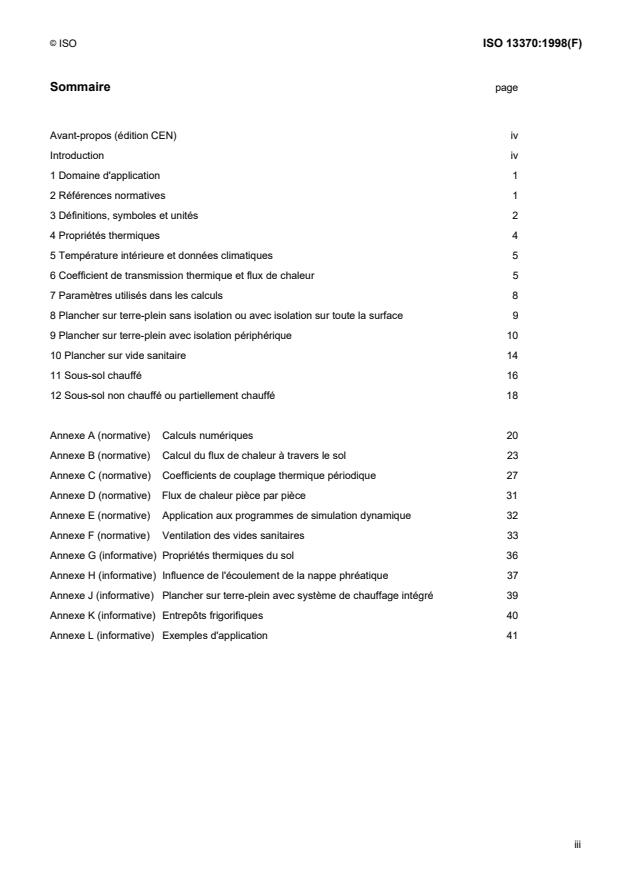
Sommaire page
Avant-propos (édition CEN) iv
Introduction iv
1 Domaine d'application 1
2 Références normatives 1
3 Définitions, symboles et unités 2
4 Propriétés thermiques 4
5 Température intérieure et données climatiques 5
6 Coefficient de transmission thermique et flux de chaleur 5
7 Paramètres utilisés dans les calculs 8
8 Plancher sur terre-plein sans isolation ou avec isolation sur toute la surface 9
9 Plancher sur terre-plein avec isolation périphérique 10
10 Plancher sur vide sanitaire 14
11 Sous-sol chauffé 16
12 Sous-sol non chauffé ou partiellement chauffé 18
Annexe A (normative) Calculs numériques 20
Annexe B (normative) Calcul du flux de chaleur à travers le sol 23
Annexe C (normative) Coefficients de couplage thermique périodique 27
Annexe D (normative) Flux de chaleur pièce par pièce 31
Annexe E (normative) Application aux programmes de simulation dynamique 32
Annexe F (normative) Ventilation des vides sanitaires 33
Annexe G (informative) Propriétés thermiques du sol 36
Annexe H (informative) Influence de l'écoulement de la nappe phréatique 37
Annexe J (informative) Plancher sur terre-plein avec système de chauffage intégré 39
Annexe K (informative) Entrepôts frigorifiques 40
Annexe L (informative) Exemples d'application 41
iii
©
Avant-propos
Le texte du EN ISO 13370:1998 a été élaboré par le Comité Technique CEN/TC 89 "Performance
thermique des bâtiments et des composants du bâtiment"dont le secrétariat est tenu par le SIS, en
collaboration avec le Comité Technique ISO/TC 163 "Isolation thermique".
Cette norme européenne devra recevoir le statut de norme nationale, soit par publication d'un texte
identique, soit par entérinement, au plus tard en avril 1999, et toutes les normes nationales en
contradiction devront être retirées au plus tard en avril 1999.
Selon le Règlement Intérieur du CEN/CENELEC, les instituts de normalisation nationaux des pays
suivants sont tenus de mettre cette norme européenne en application: Allemagne, Autriche, Belgique,
Danemark, Espagne, Finlande, France, Grèce, Irlande, Islande, Italie, Luxembourg, Norvège, Pays-Bas,
Portugal, République Tchèque, Royaume-Uni, Suède et Suisse.
Introduction
La norme EN ISO 6946 définit la méthode de calcul du coefficient de transmission thermique des parois
de bâtiments en contact avec l'air extérieur; la présente norme concerne les parois en contact thermique
avec le sol. La frontière entre ces deux normes se situe au niveau de la surface du plancher intérieur
quand il s’agit de planchers sur terre-plein, de planchers sur vide sanitaire et de sous-sols non chauffés,
et au niveau de la surface du sol extérieur pour les sous-sols chauffés. En général, une expression tenant
compte d’un pont thermique associé à une jonction mur/plancher est ajoutée lorsqu’on calcule les
déperditions totales d’un bâtiment suivant des méthodes comme celle du prEN ISO 13789.
Le transfert thermique à travers le sol peut être déterminé au moyen de calculs numériques, qui
permettent également d'analyser les ponts thermiques, y compris les jonctions mur/plancher, afin
d'évaluer les températures superficielles intérieures minimales.
La présente norme donne des procédures simplifiées tenant compte de la nature tridimensionnelle du flux
thermique et permettant d'évaluer les coefficients de transfert thermique et les flux de chaleur dans la
plupart des cas.
Les valeurs des coefficients de transmission thermique des planchers donnent des indications utiles pour
comparer les propriétés isolantes des différents types de plancher ; elles sont employées dans les
règlements de construction de certains pays pour limiter les déperditions thermiques à travers les
planchers.
Le coefficient de transmission thermique, bien qu'il soit défini pour un régime stationnaire, relie également
le flux de chaleur moyen à l’écart écart moyen de température. Dans le cas des murs et toitures qui sont
exposés à l'air extérieur, il se produit quotidiennement des stockages et des déstockages de chaleur
périodiques en relation avec les variations journalières de température, mais en moyenne ceci s'équilibre
et la déperdition de chaleur moyenne journalière peut être déterminée à partir de la valeur du coefficient
de transmission thermique et de la moyenne journalière de l'écart entre les températures intérieure et
extérieure. Pour les planchers et les murs de sous-sol en contact avec le sol, l'importante inertie
thermique du sol occasionne des flux de chaleur périodiques en relation avec le cycle annuel des
températures intérieure et extérieure. Le flux de chaleur en régime stationnaire est souvent une bonne
approximation du flux de chaleur moyen pendant la période de chauffage.
Pour une évaluation détaillée des déperditions du plancher, on utilise, outre les valeurs en régime
stationnaire, des coefficients de transfert thermique périodique annuel fonctions de la capacité thermique
du sol et de sa conductivité thermique, ainsi que l'amplitude des variations annuelles de la température
mensuelle moyenne. La présente norme indique également des méthodes de détermination de ces
coefficients périodiques ; leur application au calcul des flux thermiques est décrite à l'annexe B.
L’annexe L donne des exemples d’application illustrant l’emploi des méthodes décrites dans la présente
norme.
iv
©
ISO ISO 13370:1998(F)
1 Domaine d'application
La présente norme décrit des méthodes de calcul des coefficients de transfert thermique et des flux
thermiques des parois de bâtiments en contact avec le sol, comprenant les planchers sur terre-plein, les
planchers sur vide sanitaire et les sous-sols. Elle s’applique aux parois, ou portions de parois, se trouvant
en-dessous d’un plan horizontal dans l’enveloppe extérieure du bâtiment, qui est situé :
- au niveau de la surface du plancher intérieur dans le cas de planchers sur terre-plein et de
planchers sur vide sanitaire;
- au niveau de la surface du sol extérieur dans le cas de sous-sols.
Elle comprend le calcul de la partie du transfert thermique correspondant au régime stationnaire (flux de
chaleur moyen annuel), ainsi que de la partie du transfert thermique résultant des variations périodiques
annuelles de la température (variations saisonnières du flux de chaleur autour de la moyenne annuelle).
Ces variations saisonnières sont déterminées sur une base mensuelle ; la présente norme ne s’applique
pas pour des périodes de temps plus courtes.
2 Références normatives
La présente norme comporte par référence datée ou non datée des dispositions d'autres publications.
Ces références normatives sont citées aux endroits appropriés dans le texte et les publications sont
énumérées ci-après. Pour les références datées, les amendements ou révisions ultérieurs de l'une
quelconque de ces publications ne s'appliquent à cette norme que s'ils y ont été incorporés par
amendement ou révision. Pour les références non datées, la dernière édition de la publication à laquelle il
est fait référence s'applique.
EN ISO 6946 Composants et parois de bâtiments - Résistance thermique et coefficient de
transmission thermique - Méthode de calcu (ISO 6946:1996)
EN ISO 7345 Isolation thermique - Grandeurs physiques et définitions (ISO 7345:1987)
EN ISO 10211-1 Ponts thermiques dans le bâtiment - Calcul des flux thermiques et des
températures superficielles - Partie 1 : Méthodes générales de calcul (ISO
10211-1:1995)
prEN ISO 10211-2 Ponts thermiques dans le bâtiment - Calcul des flux thermiques et des
températures superficielles - Partie 2 : Calcul des ponts thermiques linéaires
(ISO/DIS 10211-2:1995)
ISO 10456 Matériaux et produits de construction - Procédures de détermination des valeurs
thermiques déclarées et de calcul
©
3 Définitions, symboles et unités
3.1 Définitions
Pour les besoins de la présente norme, les définitions de l'EN ISO 7345 s’appliquent ainsi que les
suivantes :
3.1.1 plancher sur terre-plein : Plancher dont la totalité de la surface reposant directement sur le sol
sur toute sa surface.
Plancher maintenu au-dessus du sol de façon à ménager un vide
3.1.2 plancher sur vide sanitaire :
d'air entre le plancher et le sol.
NOTE - Ce vide d'air, également appelé espace sous plancher ou vide sanitaire, peut être ventilé
ou non, et ne fait pas partie du volume habitable.
3.1.3 sous-sol : Partie utilisable d’un bâtiment, situé en tout ou partie sous le niveau du sol .
NOTE - Cet espace peut être chauffé ou non.
3.1.4 épaisseur équivalente (d'une résistance thermique) : Epaisseur de sol (ayant la conductivité
thermique du sol concerné) ayant la même résistance thermique.
Flux de chaleur en régime
3.1.5 coefficient de couplage thermique en régime stationnaire :
stationnaire divisé par la différence de température entre les ambiances intérieure et extérieure.
3.1.6 coefficient de couplage thermique périodique intérieur : Amplitude du flux de chaleur
périodique divisée par l'amplitude de la température intérieure au cours d’un cycle annuel.
3.1.7 coefficient de couplage thermique périodique extérieur : Amplitude du flux de chaleur
périodique divisée par l'amplitude de la température extérieure au cours d’un cycle annuel.
3.1.8 dimension caractéristique d’un plancher : Aire du plancher divisée par son demi-périmètre.
3.1.9 différence de phase : période de temps entre le maximum ou le minimum d’un cycle de
température et le flux de chaleur maximal ou minimal correspondant.
3.2 Symboles et unités
Les principaux symboles utilisés sont énumérés ci-après. Les autres symboles sont définis à l’endroit où
ils sont utilisés dans le texte.
©
ISO ISO 13370:1998(F)
Symbole Grandeur Unité
A
surface du plancher m
B’
dimension caractéristique du plancher m
D largeur ou profondeur de l’isolation périphérique m
L coefficient de couplage thermique en régime stationnaire W/K
s
L coefficient de couplage thermique périodique intérieur W/K
pi
L
coefficient de couplage thermique périodique extérieur W/K
pe
P
Périmètre exposé du plancher m
Q quantité de chaleur J
R résistance thermique m²·K/W
R résistance thermique du plancher m²·K/W
f
R
résistance thermique de l'isolation m²·K/W
ins
R
résistance superficielle intérieure m²·K/W
si
R résistance superficielle extérieure m²·K/W
se
T température K ou °C
U coefficient de transmission thermique entre les ambiances intérieure W/(m²·K)
et extérieure
U coefficient de transmission thermique de base d’un plancher sur terre- W/(m²·K)
o
plein
U coefficient de transmission thermique du plancher d’un sous-sol W/(m²·K)
bf
U
coefficient de transmission thermique des murs d’un sous-sol W/(m²·K)
bw
U'
coefficient de transmission thermique effectif pour le sous-sol entier W/(m²·K)
c capacité thermique massique du sol non gelé J/(kg·K)
d épaisseur totale équivalente - plancher m
t
d épaisseur équivalente totale - mur de sous-sol m
w
d'
épaisseur équivalente supplémentaire due à l'isolation périphérique m
h
hauteur de la surface du plancher au-dessus du niveau du sol m
extérieur
w
épaisseur des murs extérieurs m
z profondeur du sous-sol au-dessous du niveau du sol m
δ
profondeur de pénétration périodique m
λ
conductivité thermique du sol non gelé W/(m·K)
λ
conductivité thermique de l'isolation W/(m·K)
n
ρ
masse volumique du sol non-gelé kg/m³
Φ
flux de chaleur W
coefficient de transmission thermique linéique associé à la jonction W/(m·K)
Ψ
g
mur/plancher
ΔΨ
terme correctif pour l'isolation périphérique d’un plancher sur terre- W/(m·K)
plein
©
4 Propriétés thermiques
4.1 Propriétés thermiques du sol
Les propriétés thermiques du sol spécifiées dans les réglementations nationales ou autres documents,
peuvent être utilisées le cas échéant. Dans les autres cas, il faut :
a) lorsqu'elles sont connues, utiliser les valeurs réelles du site, moyennées sur une profondeur égale
à la largeur du bâtiment en tenant compte de la teneur normale en eau ;
b) dans le cas contraire et si le type de sol est connu ou précisé, utiliser les valeurs du tableau 1 ;
λ ρc ×
c) sinon, utiliser = 2,0 W/(m·K) et = 2,0 10 J/(m³·K).
Tableau 1 - Propriétés thermiques du sol
Catégorie Description Conductivité Capacité thermique
thermique volumique
λ (W/(m·K)) ρc (J/(m³·K))
1 argile ou limon 1,5 3,0 x 10
2 sable ou gravier 2,0 2,0 x 10
3 roche homogène 3,5 2,0 x 10
NOTE - L’annexe G donne des informations sur la plage des valeurs des propriétés du sol.
4.2 Propriétés thermiques des matériaux de construction
Pour la résistance thermique de tout produit de construction, il faut utiliser la valeur utile appropriée
définie par la norme ISO 10456. La résistance thermique des produits utilisés au-dessous du niveau du
sol doit tenir compte des conditions hygrométriques de l'application.
Si la conductivité thermique est précisée, la résistance thermique est obtenue en divisant l'épaisseur par
la conductivité thermique.
NOTE - La capacité thermique des matériaux de construction utilisés dans les différents types de
planchers est faible par rapport à celle du sol et elle n’est donc pas prise en compte.
4.3 Résistances superficielles
Les valeurs suivantes doivent être utilisées:
– face intérieure, flux descendant : R = 0,17 m²·K/W
si
R =
– face intérieure, flux horizontal : 0,13 m²·K/W
si
– face intérieure, flux ascendant : R = 0,10 m²·K/W
si
– face extérieure, dans tous les cas : R = 0,04 m²·K/W
se
NOTE - Ces valeurs sont extraites de la norme ISO 6946.
La valeur de R correspondant à un flux descendant s'applique aussi bien en haut qu'en bas d'un espace
si
sous plancher. La valeur de R pour le flux ascendant s'applique aux planchers dotés d'un système de
si
chauffage intégré et aux entrepôts frigorifiques.
©
ISO ISO 13370:1998(F)
5 Température intérieure et données climatiques
5.1 Température intérieure
S'il existe des écarts de température entre les différentes pièces ou espaces immédiatement au-dessus
du plancher, il convient d'utiliser une moyenne spatiale. Pour calculer cette moyenne, il faut pondérer la
température de chaque espace par l’aire de l'espace en contact avec le plancher.
Le calcul des flux de chaleur selon la présente norme nécessite de connaître :
a) la température intérieure moyenne annuelle ;
b) si les variations de la température intérieure sont prises en compte, l'amplitude de la variation de la
température intérieure par rapport à la moyenne annuelle ; cette amplitude est définie comme la
demi-différence entre les valeurs maximale et minimale de la température moyenne de chaque
mois.
5.2 Données climatiques
Le calcul des flux de chaleur selon la présente norme nécessite de connaître :
a) la température moyenne annuelle de l'air extérieur ;
b) si les variations de la température extérieure sont prises en compte, l'amplitude de la variation de la
température de l'air extérieur par rapport à la moyenne annuelle : cette amplitude est définie
comme la demi-différence entre les valeurs maximale et minimale de la température moyenne de
chaque mois ;
c) pour les planchers sur vide sanitaire à ventilation naturelle, la vitesse moyenne du vent mesurée à
une hauteur de 10 m.
Si l'on connaît ou si l'on peut estimer la température superficielle du sol, on peut l'utiliser à la place de la
température de l'air extérieur, afin de tenir compte des effets de la couverture de neige, des apports
solaires à la surface du sol, et/ou du rayonnement de grande longueur d'onde vers le ciel dégagé. Dans
ce cas, R doit être exclu de toutes les formules.
se
6 Coefficient de transmission thermique et flux de chaleur
6.1 Coefficient de transmission thermique
Les coefficients de transmission thermique des planchers et des sous-sols sont liés à la composante du
transfert thermique en régime stationnaire. Des méthodes de calcul sont données dans les articles 8 à 12
pour les différents types de plancher et de sous-sol ; un résumé des principales formules à utiliser est
donné au tableau 2.
Si le coefficient des déperditions par transmission est requis pour le sol, il doit être pris égal au coefficient
de couplage thermique en régime stationnaire, L .
s
©
Tableau 2 - Sélection des formules
Type de plancher Pour chaque type de plancher: calculer B' en utilisant l’équation (1)
d U U
Plancher sur terre- Calculer suivant (2), Pas d’isolation périphérique: =
t o
U
plein et suivant (3) ou (4)
o
Isolation périphérique: U = U + 2 Δ Ψ /B'
o
Isolation périphérique horizontale: d'
suivant (8) et ΔΨ suivant (10)
Isolation périphérique verticale: d'
suivant (8) et ΔΨ suivant (11)
Calculer d suivant (14), U suivant (15), U suivant (16) et finalement U suivant
Plancher sur vide
g g x
sanitaire (13)
Sous-sol Plancher de sous-sol : Sous-sol chauffé : Calculer U' suivant (23)
Calculer d suivant (18)
t
U
Calculer suivant
bf
(19) ou (20)
U
Murs en sous-sol : Sous-sol non-chauffé : Calculer suivant (25)
Calculer d suivant (21)
w
et U suivant (22)
bw
6.2 Ponts thermiques au bord du plancher
Les formules dans la présente norme sont valables pour un plancher isolé, considéré indépendamment
de toute interaction entre mur et plancher. De plus il est supposé que les propriétés thermiques du sol
sont uniformes (exception faite des seuls effets de l’isolation périphérique).
En pratique, les jonctions mur/plancher pour les planchers sur terre-plein ne correspondent pas à cette
situation idéale et donnent lieu à des effets de pont thermique. Il doit en être tenu compte dans les calculs
des déperditions thermiques totales d’un bâtiment, en utilisant un coefficient de transmission thermique
linéique (Ψ).
Des valeurs types de Ψ sont données au tableau 3 pour les planchers sur terre-plein. Ce tableau peut
être complété au niveau national afin de tenir compte de jonctions particulières mur/plancher et d’un
système particulier pour la définition des dimensions, pour autant que ces valeurs ont été obtenues en
concordance avec l’annexe A. Le coefficient de transmission thermique linéique associé aux sous-sols
est faible et peut par conséquent être négligé.
NOTE - Le coefficient de transmission thermique linéique dépend du système choisi pour la
définition des dimensions : voir ISO 13789 Performance thermique des bâtiments - Coefficient de
déperditions thermiques par transmission - Méthode de calcul (ISO/DIS 13789:1997).
©
ISO ISO 13370:1998(F)
Tableau 3 - Valeurs du coefficient de transmission thermique linéique des jonctions mur/plancher
pour planchers sur terre-plein et sur vide sanitaire
Type d’isolation Coefficient de transmission
thermique linéique
Y
W/(m·K)
Plancher non-isolé, ou plancher dont
l’isolation est en contact direct avec 0,0
l’isolation du mur
Isolations du mur et du plancher sans
contact direct, mais se recouvrant sur au 0,1
moins 200 mm
Isolation du mur totalement disjointe de celle
du plancher 0,2
Les déperditions thermiques totales du bâtiment sont ensuite calculées à partir d’un plan de séparation
qui se trouve :
− au niveau de la face interne du plancher pour les planchers sur terre-plein, planchers sur vide
sanitaire et sous-sols non-chauffés, ou
−
au niveau de la surface du sol extérieur dans le cas de sous-sols chauffés.
Le coefficient de transmission thermique des parois situées au-dessus du plan de séparation doit être
évalué selon l’EN ISO 6946.
6.3 Calcul du flux de chaleur
Le flux de chaleur à travers le sol peut être calculé pour une période annuelle en utilisant uniquement les
coefficients de transmission thermique, ou pour une période saisonnière ou mensuelle en utilisant des
coefficients périodiques complémentaires, qui tiennent compte de l’inertie thermique du sol. Les
équations à utiliser sont données à l’annexe B, et les formules donnant les coefficients périodiques à
l’annexe C.
6.4 Effet de la nappe phréatique
L’effet de la nappe phréatique sur le transfert thermique est négligeable, sauf si elle est peu profonde
avec un débit élevé. Ces conditions sont rarement réunies et le plus souvent il n'y a pas lieu de tenir
compte de l'effet de la nappe phréatique.
Lorsque l'on connaît la profondeur de la nappe d'eau au-dessous du niveau du sol et le débit de la nappe
phréatique, le coefficient de couplage thermique en régime stationnaire L peut être multiplié par un
s
facteur G .
w
G
NOTE - Des valeurs indicatives de sont fournies à l'annexe H.
w
©
6.5 Cas particuliers
Les méthodes indiquées dans la présente norme sont également applicables dans les situations ci-après,
avec les modifications décrites dans les annexes correspondantes :
- Flux de chaleur dans le cas de locaux individuels : annexe D
– Application aux programmes de simulation en régime varié : annexe E
NOTE: La présente norme peut aussi être appliquée pour plancher sur terre-plein avec système de
chauffage intégré (voir annexe J) et pour entrepôts frigorifiques (voir annexe K).
7 Paramètres utilisés dans les calculs
7.1 Dimension caractéristique du plancher
Etant donné le caractère tridimensionnel du flux de chaleur dans le sol, les formules dans la présente
B'
norme sont exprimées en fonction de la "dimension caractéristique" du plancher, , définie comme la
surface du plancher divisée par son demi-périmètre :
A
B' =
(1)
½ P
NOTE - Pour un plancher de longueur infinie, B' est la largeur du plancher ; pour un plancher
carré, B' est la demi-longueur d'un côté.
Des détails de fondation particuliers, tels que l'isolation périphérique du plancher, sont traités comme
modifiant le flux thermique périphérique.
Dans le cas de sous-sol, B' est calculé à partir de l’aire et du périmètre du plancher du sous-sol, à
l’exclusion des murs du soubassement ; le transfert de chaleur depuis le sous-sol contient un terme
supplémentaire fonction du périmètre et de la profondeur du plancher du sous-sol au-dessous du niveau
du sol.
Dans la présente norme, P désigne le périmètre exposé du plancher, c'est-à-dire la longueur totale du
mur extérieur qui sépare le bâtiment chauffé de l'extérieur ou d'un espace non chauffé à l'extérieur du
bâti isolé. Ainsi :
– pour un bâtiment entier, P désigne le périmètre total du bâtiment et A l’aire totale du plancher au
sol ;
– pour calculer la déperdition de chaleur d'une partie d'un bâtiment (par exemple, pour chaque
habitation individuelle d'une rangée de maisons en bande), P comprend les longueurs des murs
extérieurs qui séparent l'espace chauffé de l'extérieur et ne comprend pas les longueurs des murs
qui séparent la partie considérée des autres parties chauffées du bâtiment, tandis que A représente
l’aire au sol du plancher considéré ;
– il n'est pas tenu compte des espaces non chauffés en dehors du bâti isolé du bâtiment, comme les
porches, les garages attenants ou les aires de stockage, pour déterminer P et A (mais la longueur
du mur entre le bâtiment chauffé et l'espace non chauffé est comprise dans le périmètre : les
déperditions par le sol sont évaluées comme s'il n'y avait pas d'espaces non chauffés).
©
ISO ISO 13370:1998(F)
7.2 Epaisseur équivalente
L'introduction du concept d'"épaisseur équivalente" permet de simplifier l'expression des coefficients de
couplage thermique.
Une résistance thermique est représentée par son épaisseur équivalente, c'est-à-dire par l'épaisseur de
sol ayant la même résistance thermique. Dans la présente norme :
–d
désigne l’épaisseur équivalente des planchers ;
t
–d désigne l’épaisseur équivalente des murs des sous-sol au-dessous du niveau du sol.
w
Les coefficients de couplage thermique en régime stationnaire sont fonction du rapport de l'épaisseur
équivalente à la dimension caractéristique du plancher ; les coefficients de couplage thermique
périodique sont fonction du rapport de l'épaisseur équivalente à la profondeur de pénétration périodique.
8 Plancher sur terre-plein sans isolation ou avec isolation sur toute la surface
Tout plancher sur terre-plein est constitué d'une dalle en contact avec le sol sur la totalité de sa surface,
qu'elle soit ou non supportée par le sol sur toute sa surface, et qui est située au niveau ou à proximité de
la surface du sol extérieur (voir figure 1). Cette dalle de plancher peut être :
– non isolée, ou
– uniformément isolée (au-dessus, au-dessous ou à l'intérieur de la dalle) sur toute sa surface.
NOTE - Les planchers sur terre-plein non isolés ou uniformément isolés, peuvent être isolés
horizontalement et/ou verticalement à leur périphérie. Ces cas sont traités à l'article 9.
w
Dalle plancher
Sol
Figure 1 : Représentation schématique d'un plancher sur terre-plein
©
Le coefficient de transmission thermique dépend de la dimension caractéristique du plancher B' (voir 7.1
d
et l'équation (1)), et de l'épaisseur totale équivalente (voir 7.2) définie comme suit :
t
d = w + λ (R + R + R ) (2)
t si f se
au moyen des symboles définis en 3.2.
w R
est l’épaisseur totale du mur, toutes couches comprises. comprend la résistance thermique de toute
f
couche continue d'isolation située au-dessus, au-dessous ou à l'intérieur de la dalle plancher, ainsi que
celle de tout revêtement de sol. La résistance thermique des dalles en béton plein et des revêtements de
sol peu épais peut être négligée. On suppose que le blocage situé au-dessous de la dalle a la même
conductivité thermique que le sol et il n’y a pas lieu de tenir compte de sa résistance thermique.
Pour calculer le coefficient de transmission thermique de base U , on utilise l'équation (3) ou (4), selon
o
l'isolation thermique du plancher.
d B'
Si < (planchers non isolés ou modérément isolés) :
t
λ πB
2 '
U = ln +1 (3)
o
πBd+ d
'
tt
Si d > B' (planchers bien isolés) :
t
λ
U =
(4)
o
04,'57Bd+
t
Dans le cas de planchers sans isolation périphérique :
U = U (5)
o
et avec isolation périphérique :
U = U + 2 ΔΨ/B' (6)
o
Le coefficient de couplage thermique en régime stationnaire est :
L = A U + P ΔΨ (7)
s o
9 Plancher sur terre-plein avec isolation périphérique
9.1 Généralités
Un plancher sur terre-plein peut être doté d’une isolation périphérique placée horizontalement ou
verticalement le long de son périmètre. Les formules données dans le présent article s’appliquent lorsque
D,
la largeur ou la profondeur de l’isolation périphérique, est petite vis-à-vis de la largeur du bâtiment.
Des méthodes numériques peuvent être utilisées comme alternative (voir annexe A).
©
ISO ISO 13370:1998(F)
On calcule tout d’abord le coefficient de transmission thermique de base U comme indiqué à l'article 8
o
sans tenir compte de l'isolation périphérique (mais en tenant compte de toute isolation continue). On
calcule ensuite le terme correctif ΔΨ lié à l'isolation périphérique comme indiqué en 9.2 pour l'isolation
périphérique horizontale, ou en 9.3 pour l'isolation périphérique verticale. Le coefficient de transmission
thermique du plancher est donné par l’équation (6) et le coefficient de couplage thermique en régime
stationnaire par l’équation (7).
Les fondations de faible masse volumique, dont la conductivité thermique est inférieure à celle du sol,
sont assimilées à une isolation périphérique verticale.
Si la fondation comporte plusieurs éléments d'isolation périphérique (verticaux ou horizontaux, intérieurs
ou extérieurs), on calcule ΔΨ au moyen des procédures indiquées ci-après pour chaque type d'isolation,
et l’on retient le résultat donnant la déperdition de chaleur la plus faible.
NOTE - Les formules indiquées ci-après permettent d'obtenir de bonnes estimations de l'effet de
l’adjonction d’une isolation périphérique à des planchers non isolés. Elles sous-estiment l'effet de
l'adjonction d'une isolation périphérique à un plancher déjà isolé, mais on peut néanmoins les
utiliser : l'effet de l'isolation périphérique sera au moins égal à l'effet prévu.
Les équations (10) et (11) font intervenir l'épaisseur supplémentaire équivalente résultant de cette
d'
isolation, :
d' = R' λ (8)
où R' est la résistance thermique supplémentaire introduite par l'isolation périphérique (ou la fondation),
c'est-à-dire la différence entre la résistance thermique de cette isolation et la résistance du sol (ou de la
dalle) remplacé :
R' R - d λ
= / (9)
n n
où :
R
est la résistance thermique de l'isolation périphérique horizontale ou verticale (ou de la
n
fondation), en m²·K/W ;
d est l'épaisseur de cette isolation (ou de la fondation), en mètres.
n
©
9.2 Isolation périphérique horizontale
Dalle plancher
Isolation périphérique
horizontale
d
n
D
Mur de fondation
Figure 2 - Représentation schématique de l'isolation périphérique horizontale
L'équation (10) s'applique à une isolation placée horizontalement autour du périmètre du plancher (voir
figure 2) :
λD D
Δ Ψ =− ln +11 − ln + (10)
πd dd+
'
tt
où D est la largeur de l'isolation horizontale (en mètres) et d correspond à la définition figurant en 9.1.
t
La figure 2 montre une isolation périphérique placée sous la dalle. L'équation (10) s'applique également à
une isolation périphérique horizontale placée au-dessus de la dalle ou à l'extérieur du bâtiment.
©
ISO ISO 13370:1998(F)
9.3 Isolation périphérique verticale
d
n
Dalle plancher
Mur de fondation
D
Isolation périphérique
verticale
Figure 3 - Isolation périphérique verticale (couche isolante)
Mur de fondation
Dalle plancher
de faible masse
volumique avec λ < λ
n
D
d
n
Figure 4 - Isolation périphérique verticale (fondation de faible masse volumique)
©
L'équation (11) s'applique à une isolation placée verticalement au-dessous du sol le long du périmètre du
plancher (voir figure 3), et aux fondations constituées de matériaux dont la conductivité thermique est
inférieure à celle du sol (voir figure 4) :
λ 2D 2D
Δ Ψ =− ln + 1 − ln + 1 (11)
π d dd+ '
tt
où D est la profondeur de l'isolation périphérique verticale (ou de la fondation) au-dessous du niveau du
d
sol (en mètres) et correspond à la définition fournie à l'article 8.
t
La figure 3 illustre l'isolation des faces à l'intérieur du mur de fondation. L'équation (11) s'applique
également à l'isolation périphérique à l'extérieur ou à l'intérieur du mur de fondation.
10 Plancher sur vide sanitaire
Un plancher sur vide sanitaire désigne n'importe quel type de plancher, par exemple sur solives ou à
poutrelles et hourdis, maintenu au-dessus du sol (voir figure 5). Le présent article traite du modèle de
plancher sur vide sanitaire classique dans lequel l'espace sous plancher est ventilé naturellement par l'air
extérieur. En cas de ventilation mécanique du vide sanitaire, ou si le taux de renouvellement d’air est
spécifié, se reporter à l'annexe F.
R
f
R
g
h
Sol
Figure 5 - Représentation schématique d'un plancher sur vide sanitaire
Le coefficient de couplage thermique en régime stationnaire entre les environnements intérieur et
extérieur est :
L = A U
(12)
s
©
ISO ISO 13370:1998(F)
et le coefficient de transmission thermique est donnée par :
11 1
=+
(13)
UU U+U
fg x
où :
U est le coefficient de transmission thermique de la partie du plancher sur vide sanitaire (entre
f
l'ambiance intérieure et l'espace sous plancher), en W/(m²·K) ;
U
est le coefficient de transmission thermique correspondant au flux de chaleur à travers le
g
sol, en W/(m²·K) ;
U est un coefficient de transmission thermique équivalent entre l’espace sous plancher et
x
l’extérieur, qui correspond au flux de chaleur à travers les murs du vide sanitaire et à celui
résultant de la ventilation du vide sanitaire, en W/(m²·K).
U
se calcule selon l’EN ISO 6946 en utilisant les valeurs de résistance superficielle indiquées en 4.3.
f
U se calcule en utilisant les équations (1), (14) et (15) :
g
d w λ R + R + R
= + ( ) (14)
g si g se
2λ πB'
= +
U ln 1 (15)
g
πBd+ d
'
gg
R
où est la résistance thermique de toute isolation disposée sur le sol du vide sanitaire, en m²·K/W.
g
Si le vide sanitaire atteint une profondeur moyenne de plus de 0,5 m au-dessous du niveau du sol, il
convient de calculer U en utilisant l'équation (F.2) de l'annexe F.
g
Calculer U d'après l'équation suivante :
x
U = 2hU /B' + 1450 εvf /B' (16)
x w w
où :
h est la hauteur de la face supérieure du plancher au-dessus du niveau du sol extérieur, en
mètres ;
U est le coefficient de transmission thermique des murs du vide sanitaire situés au-dessus du
w
niveau du sol, en W/(m²·K), calculé selon EN ISO 6946 ;
ε est l’aire des ouvertures de ventilation divisée par le périmètre du vide sanitaire, en m²/m ;
v est la vitesse moyenne du vent à 10 m de hauteur, en m/s ;
f est le facteur de protection contre le vent.
w
Si h varie le long du périmètre du plancher, il convient d'utiliser sa valeur moyenne dans l'équation (16).
L’annexe F fournit des équations pour le calcul de la température moyenne du vide sanitaire.
Le facteur de protection contre le vent établit une relation entre la vitesse du vent à 10 m de hauteur (en
l'absence d'obstacle) et celle près du au du sol, en tenant compte de la protection assurée par les
bâtiments adjacents, etc. Des valeurs représentatives sont fournies au tableau 4.
©
Tableau 4 - Valeurs du facteur de protection contre le vent f
w
Situation Exemple Facteur de protection
contre le vent
f
w
Abritée Centre ville 0,02
Moyenne Banlieue 0,05
Exposée Milieu rural 0,10
11 Sous-sol chauffé
Les procédures indiquées pour les sous-sols s'appliquent aux bâtiments dans lesquels une partie de
l'espace habitable se trouve au-dessous du niveau du sol (voir figure 6). La base du calcul est la même que
pour les planchers sur terre-plein, mais en tenant compte :
- de la profondeur z du plancher du sous-sol au-dessous du niveau du sol ;
- de la différence éventuelle des niveaux d'isolation des murs du sous-sol et de son plancher.
Si z varie le long du périmètre du bâtiment, il convient d'utiliser sa valeur moyenne dans les calculs.
NOTE 1 - Si z = 0, les formules se réduisent à celles de l'article 8 pour le plancher sur terre-plein.
La présente norme ne couvre pas directement le cas d’un bâtiment possédant à la fois un plancher sur
terre-plein et un sous-sol. Toutefois, il est possible d’évaluer approximativement les déperditions totales
par le sol d’un tel bâtiment, en considérant que le sous-sol couvre la totalité de la surface du bâtiment,
mais avec une profondeur égale à la moitié de la profondeur réelle de la partie en sous-sol.
Les procédures décrites donnent la totalité du flux de chaleur à travers le sol, c'est-à-dire celui passant à
travers le plancher du sous-sol et à travers les murs du sous-sol sous le niveau du sol. Pour l’évaluation
des parties de murs situées au-dessus du niveau du sol, il convient d’utiliser leur coefficient de
transmission thermique calculé selon EN ISO 6946.
©
ISO ISO 13370:1998(F)
w
R
w
z
R
f
Sol
Figure 6 - Représentation schématique d'un sous-sol
Le coefficient de couplage thermique en régime stationnaire L est donné par :
s
L = A U z P U
+ (17)
s bf bw
NOTE 2 - L'équation (17) donne le flux de chaleur total en provenance du sous-sol. Les flux de
chaleur passant à travers le plancher et les murs du sous-sol sont interdépendants, et de ce fait
les deux termes de l'équation (17), qui représentent respectivement le flux de chaleur à travers le
plancher et à travers les murs, sont des approximations.
Pour déterminer U , il faut calculer la dimension caractéristique du plancher du sous-sol en utilisant
bf
l'équation (1), et inclure toute isolation du plancher du sous-sol dans l'épaisseur totale équivalente :
d = w + λ (R + R + R ) (18)
t si f se
w est l’épaisseur totale des murs du bâtiment au niveau du sol, toutes couches comprises. R est la
f
résistance thermique de la dalle de plancher, qui comprend la résistance thermique de toutes les
couches d'isolation continues situées au-dessus, en-dessous ou à l'intérieur de la dalle de plancher, et
celle de tout revêtement de sol.
La résistance thermique des dalles en béton lourd et des revêtements de sol peu épais peut être
négligée. On suppose que le blocage situé au-dessous de la dalle a la même conductivité thermique que
le sol et il n’y a pas lieu de prendre en compte sa résistance thermique.
On utilise l'équation (19) ou (20), selon l'isolation thermique du plancher du sous-sol.
©
Si (d + ½z) < B' (planchers de sous-sol non isolés ou modérément isolés) :
t
λ πB
2 '
U= +
ln 1 (19)
bf
πBd'½++ z dz+ ½
tt
Si (d + ½z) > B' (planchers de sous-sol bien isolés) :
t
λ
U = (20)
bf
04,'57Bd++½z
t
U
dépend de l'épaisseur totale équivalente des murs du sous-sol :
bw
d = λ (R + R + R ) (21)
w si w se
où R est la résistance thermique des murs du sous-sol, toutes couches comprises ; les autres symboles
w
sont définis en 3.2.
Déterminer U selon l'équation suivante :
bw
d
2λ 05, z
t
U =+1 ln +1 (22)
bw
πz dz+ d
t
w
U d d d d
La formule de calcul de utilise et . Elle n'est valable que si > , ce qui est généralement le
bw w t w t
d d d d
cas. Néanmoins, si < , il y a lieu de remplacer par dans l'équation (22).
w t t w
Le coefficient de transmission thermique effectif qui caractérise l'ensemble du sous-sol est :
AU + zPU
bf bw
U=
'
(23)
Az+ P
12 Sous-sol non chauffé ou partiellement chauffé
12.1 Sous-sol non chauffé
Les formules indiquées dans ce paragraphe s'appliquent aux sous-sol non chauffés ventilés depuis
l'extérieur.
Le coefficient de couplage thermique en régime stationnaire entre les ambiances intérieure et extérieure
est donné par l'équation suivante :
L = A U (24)
s
Le coefficient de transmission thermique U est donnée par l'équation suivante :
A
=+ (25)
UU AU++zP U hP U+ nV
03, 3
fbf bw w
©
ISO ISO 13370:1998(F)
où :
U
est le coefficient de transmission thermique du plancher (entre l'ambiance intérieure et le
f
sous-sol) ;
U est le coefficient de transmission thermique des murs du sous-sol au-dessus du niveau du
w
sol ;
n est le taux de renouvellement d'air du sous-sol, en nombre de renouvellements d'air par
heure ;
V
est le volume d'air du sous-sol.
En l'absence d'informations spécifiques, on peut utiliser une valeur de n = 0,3 renouvellements d'air par
heure.
U U
et se calculent selon l’EN ISO 6946 en utilisant les valeurs de résistance superficielle fournies en
f w
4.3.
U et U se calculent selon l'article 11.
bf bw
NOTE: La température moyenne dans le sous-sol peut être calculée au moyen de la méthode
décrite à l'annexe F.
12.2 Sous-sol partiellement chauffé
Pour les sous-sol partiellement chauffés, les flux de chaleur peuvent être calculés comme suit :
1) Calculer le flux de chaleur pour un sous-sol entièrement chauffé ;
2) Calculer le flux de chaleur pour un sous-sol non chauffé ;
3) Pour déterminer le flux de chaleur pour un sous-sol partiellement chauffé, appliquer les flux de
chaleur obtenus en 1) et 2) proportionnellement aux aires respectivement en contact avec le sol
des parties chauffées et non chauffées du sous-sol.
©
Annexe A (normative)
Calculs numériques
Pour le calcul des déperditions d’un bâtiment à travers le sol, des méthodes numériques conformes à
l’article A.1 et à l’EN ISO 10211-1 ou au prEN ISO 10211-2 peuvent être utilisées en alternative ou
conjointement aux méthodes indiquées dans la présente norme, en utilisant :
a) un calcul numérique tri-dimensionnel, donnant directement le résultat pour le plancher concerné ;
b) un calcul numérique bi-dimensionnel, en prenant pour largeur du plancher la dimension
caractéristique, ce qui permet aussi d’obtenir les déperditions totales pour ce plancher ;
c) un calcul bi-dimensionnel donnant le coefficient de transmission thermique linéique Ψ associé à la
g
jonction du plancher, et/ou le facteur ΔΨ dans le cas d’isolation périphérique, et en utilisant ces
résultats en conjonction avec les formules de la présente norme pour n’importe quelle dimension du
plancher.
NOTE - En général, les flux de chaleur les plus importants se produisent près des bords du
plancher, et le plus souvent seules de petites erreurs résultent de la conversion du problème tri-
dimensionnel en un problème bi-dimensionnel dans lequel la largeur du bâtiment est prise égale
à la dimension caractéristique du plancher (son aire divisée par son demi-périmètre).
A.1 Conditions d'application des calculs numériques
A.1.1 Subdivision du modèle géométrique
Le modèle géométrique du sol est subdivisé de façon que les plus petites subdivisions soient vers le bord
du plancher, et que leurs dimensions augmentent progressivement pour devenir beaucoup plus grandes
à proximité des plans de troncature. La norme EN ISO 10211-1 définit les critères qui permettent de
déterminer si le nombre de subdivisions utilisées est suffisant.
A.1.2 Dimensions du sol
Les plans de troncature du modèle géométrique sont définis par les dimensions minimales du sol ci-
dessous :
B’
– dans le sens horizontal à l'intérieur du bâtiment : 0,5 ,
– dans le sens horizontal à l'extérieur du bâtiment : 2,5 B',
– dans le sens vertical au-dessous du niveau du sol : 2,5 B',
B' étant la dimension caractéristique du plancher pour les calculs bi-dimensionnels ou la dimension
réduite du plancher pour les calculs tri-dimensionnel.
A.1.3 Conditions aux limites
Pour les calculs bi-dimensionnels, il existe au milieu du plancher un plan de symétrie vertical considéré
comme frontière adiabatique (si bien qu’on modélise une moitié du bâtiment). Pour les calculs tri-
dimensionnels portant sur un bâtiment rectangulaire, on fixe dans le sol des frontières adiabatiques
verticales traversant le plancher par le milieu dans les deux directions (de sorte qu'un quart du bâtiment
est modélisé). Pour les bâtiments
...
Questions, Comments and Discussion
Ask us and Technical Secretary will try to provide an answer. You can facilitate discussion about the standard in here.
Loading comments...