

ISO 13370:2017
(Main)Thermal performance of buildings — Heat transfer via the ground — Calculation methods
General Information
- Abstract
ISO 13370:2017 provides methods of calculation of heat transfer coefficients and heat flow rates for building elements in thermal contact with the ground, including slab‐on‐ground floors, suspended floors and basements. It applies to building elements, or parts of them, below a horizontal plane in the bounding walls of the building situated - at the level of the inside floor surface, for slab‐on‐ground floors, suspended floors and unheated basements; NOTE 1 In some cases, external dimension systems define the boundary at the lower surface of the floor slab. - at the level of the external ground surface, for heated basements. ISO 13370:2017 includes calculation of the steady‐state part of the heat transfer (the annual average rate of heat flow) and the part due to annual periodic variations in temperature (the seasonal variations of the heat flow rate about the annual average). These seasonal variations are obtained on a monthly basis and, except for the application to dynamic simulation programmes in Annex D, ISO 13370:2017 does not apply to shorter periods of time. NOTE 2 Table 1 in the Introduction shows the relative position of ISO 13370:2017 within the set of EPB standards in the context of the modular structure as set out in ISO 52000-1.
- Status
- Published
- Publication Date
- 20-Jun-2017
- Technical Committee
- ISO/TC 163/SC 2 - Calculation methods
- Drafting Committee
- ISO/TC 163/SC 2 - Calculation methods
- Current Stage
- 9093 - International Standard confirmed
- Start Date
- 09-Dec-2022
- Completion Date
- 29-Aug-2026
Buy Documents



ISO 13370:2017 - Thermal performance of buildings -- Heat transfer via the ground -- Calculation methods


ISO 13370:2017 - Thermal performance of buildings — Heat transfer via the ground — Calculation methods/21/2017


ISO 13370:2017 - Performance thermique des bâtiments -- Transfert de chaleur par le sol -- Méthodes de calcul

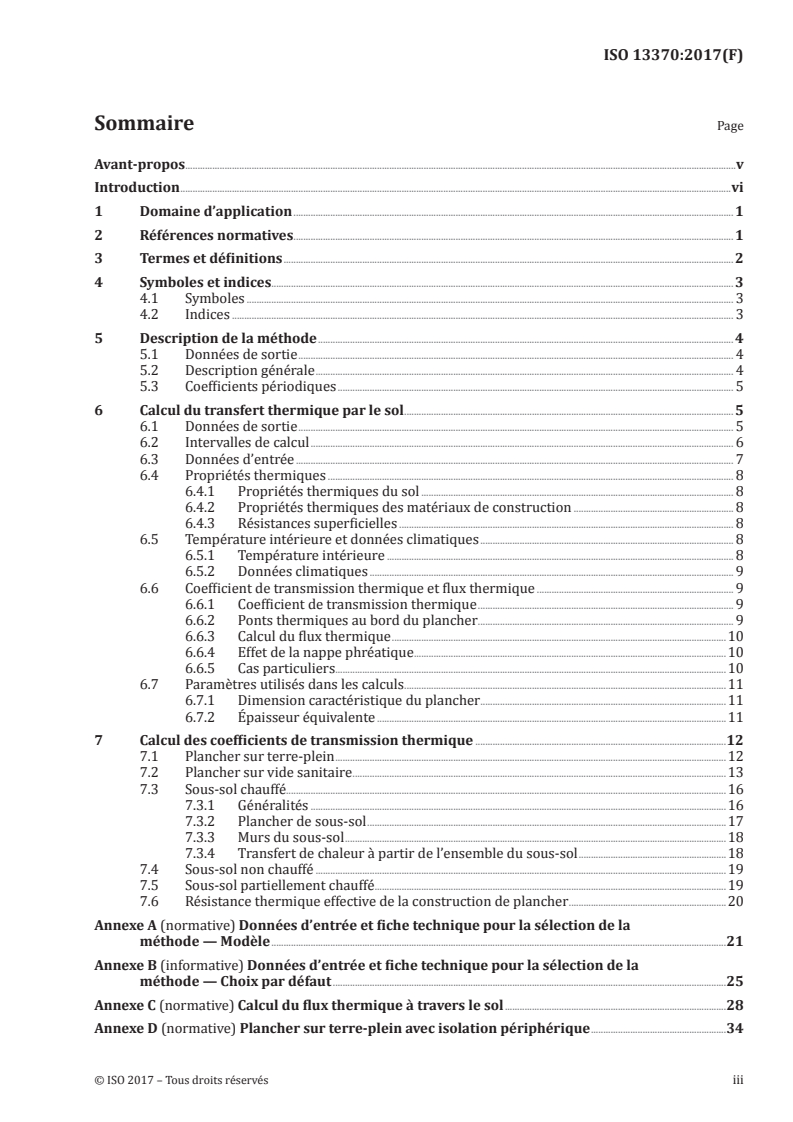

ISO 13370:2017 - Performance thermique des bâtiments — Transfert de chaleur par le sol — Méthodes de calcul/29/2017
Overview
ISO 13370:2017 - "Thermal performance of buildings - Heat transfer via the ground - Calculation methods" provides standardized calculation methods for heat transfer between buildings and the ground. It covers slab‑on‑ground floors, suspended floors and basements, and defines the boundary planes for different cases (inside floor surface for slab‑on‑ground, suspended and unheated basements; external ground surface for heated basements). The standard calculates both the steady‑state (annual average) heat flow and the seasonal (monthly) variations caused by annual temperature cycles.
Key topics and technical requirements
- Calculation methods for heat transfer coefficients and heat flow rates for building elements in contact with the ground.
- Treatment of both steady‑state thermal transmittance and periodic (seasonal) heat flow variations on a monthly basis; shorter time steps are outside the standard except where covered for dynamic simulation (Annex F).
- Definitions of input data and thermal properties: ground and building materials, surface resistances, internal temperatures and climatic data.
- Consideration of thermal bridges (e.g., wall/floor junctions) and methods to include their effect in overall heat loss assessments.
- Parameters such as characteristic floor dimension and equivalent thickness used to simplify ground heat flow modelling.
- Normative and informative annexes addressing specific modelling cases:
- Annex C: ground heat flow calculation
- Annex D: slab‑on‑ground with edge insulation
- Annex F: application to dynamic calculation programs
- Annex G: ventilation below suspended floors
- Annex H: periodic heat transfer coefficients
Applications and who uses it
ISO 13370:2017 is intended for practical use in:
- Architects and building designers specifying floor and basement assemblies
- Energy engineers and thermal modelers calculating building energy performance and heat loss to ground
- Regulators and compliance bodies adopting consistent methods for building codes and EPB (energy performance of buildings) assessments
- Construction product manufacturers and consultants evaluating effective thermal resistance and insulation strategies for ground‑contact elements
Typical applications:
- Assessing floor and basement heat losses for energy performance certificates and compliance
- Designing foundation insulation strategies (e.g., edge insulation for slabs)
- Incorporating ground heat transfer into whole‑building energy simulations
- Estimating thermal bridging at floor/wall junctions and impacts on internal surface temperatures
Related standards
- ISO 52000‑1 (EPB modular structure; linkages with output variables)
- ISO 6946 (thermal transmittance for elements exposed to external air)
- ISO 13789 (methods for overall heat loss of buildings)
ISO 13370:2017 is a practical, internationally recognized reference for consistent modelling of ground‑related heat transfer in building energy assessments.
Relations
- Effective Date
- 25-Aug-2026
- Effective Date
- 25-Aug-2026
- Effective Date
- 25-Aug-2026
- Effective Date
- 25-Aug-2026
- Effective Date
- 25-Aug-2026
- Effective Date
- 12-Feb-2026
- Effective Date
- 28-Dec-2013
Buy Documents
ISO 13370:2017 - Thermal performance of buildings -- Heat transfer via the ground -- Calculation methods
ISO 13370:2017 - Thermal performance of buildings — Heat transfer via the ground — Calculation methods/21/2017
ISO 13370:2017 - Performance thermique des bâtiments -- Transfert de chaleur par le sol -- Méthodes de calcul
ISO 13370:2017 - Performance thermique des bâtiments — Transfert de chaleur par le sol — Méthodes de calcul/29/2017
Get Certified
Connect with accredited certification bodies for this standard

DIBt (Deutsches Institut für Bautechnik)
German Institute for Building Technology.
DIN CERTCO
DIN Group product certification.

Aboma Certification B.V.
Specialized in construction, metal, and transport sectors.
Sponsored listings
Frequently Asked Questions
ISO 13370:2017 is a standard published by the International Organization for Standardization (ISO). Its full title is "Thermal performance of buildings — Heat transfer via the ground — Calculation methods". This standard covers: ISO 13370:2017 provides methods of calculation of heat transfer coefficients and heat flow rates for building elements in thermal contact with the ground, including slab‐on‐ground floors, suspended floors and basements. It applies to building elements, or parts of them, below a horizontal plane in the bounding walls of the building situated - at the level of the inside floor surface, for slab‐on‐ground floors, suspended floors and unheated basements; NOTE 1 In some cases, external dimension systems define the boundary at the lower surface of the floor slab. - at the level of the external ground surface, for heated basements. ISO 13370:2017 includes calculation of the steady‐state part of the heat transfer (the annual average rate of heat flow) and the part due to annual periodic variations in temperature (the seasonal variations of the heat flow rate about the annual average). These seasonal variations are obtained on a monthly basis and, except for the application to dynamic simulation programmes in Annex D, ISO 13370:2017 does not apply to shorter periods of time. NOTE 2 Table 1 in the Introduction shows the relative position of ISO 13370:2017 within the set of EPB standards in the context of the modular structure as set out in ISO 52000-1.
ISO 13370:2017 provides methods of calculation of heat transfer coefficients and heat flow rates for building elements in thermal contact with the ground, including slab‐on‐ground floors, suspended floors and basements. It applies to building elements, or parts of them, below a horizontal plane in the bounding walls of the building situated - at the level of the inside floor surface, for slab‐on‐ground floors, suspended floors and unheated basements; NOTE 1 In some cases, external dimension systems define the boundary at the lower surface of the floor slab. - at the level of the external ground surface, for heated basements. ISO 13370:2017 includes calculation of the steady‐state part of the heat transfer (the annual average rate of heat flow) and the part due to annual periodic variations in temperature (the seasonal variations of the heat flow rate about the annual average). These seasonal variations are obtained on a monthly basis and, except for the application to dynamic simulation programmes in Annex D, ISO 13370:2017 does not apply to shorter periods of time. NOTE 2 Table 1 in the Introduction shows the relative position of ISO 13370:2017 within the set of EPB standards in the context of the modular structure as set out in ISO 52000-1.
ISO 13370:2017 is classified under the following ICS (International Classification for Standards) categories: 91.120.10 - Thermal insulation of buildings. The ICS classification helps identify the subject area and facilitates finding related standards.
ISO 13370:2017 has the following relationships with other standards: It is inter standard links to EN ISO 13789:2017, EN ISO 52017-1:2017, EN ISO 14683:2017, EN ISO 10211:2017, CEN ISO/TR 52019-2:2017, EN ISO 13370:2017, ISO 13370:2007. Understanding these relationships helps ensure you are using the most current and applicable version of the standard.
ISO 13370:2017 is available in PDF format for immediate download after purchase. The document can be added to your cart and obtained through the secure checkout process. Digital delivery ensures instant access to the complete standard document.
Standards Content (Sample)
INTERNATIONAL ISO
STANDARD 13370
Third edition
2017-06
Thermal performance of buildings —
Heat transfer via the ground —
Calculation methods
Performance thermique des bâtiments — Transfert de chaleur par le
sol — Méthodes de calcul
Reference number
©
ISO 2017
© ISO 2017, Published in Switzerland
All rights reserved. Unless otherwise specified, no part of this publication may be reproduced or utilized otherwise in any form
or by any means, electronic or mechanical, including photocopying, or posting on the internet or an intranet, without prior
written permission. Permission can be requested from either ISO at the address below or ISO’s member body in the country of
the requester.
ISO copyright office
Ch. de Blandonnet 8 • CP 401
CH-1214 Vernier, Geneva, Switzerland
Tel. +41 22 749 01 11
Fax +41 22 749 09 47
copyright@iso.org
www.iso.org
ii © ISO 2017 – All rights reserved
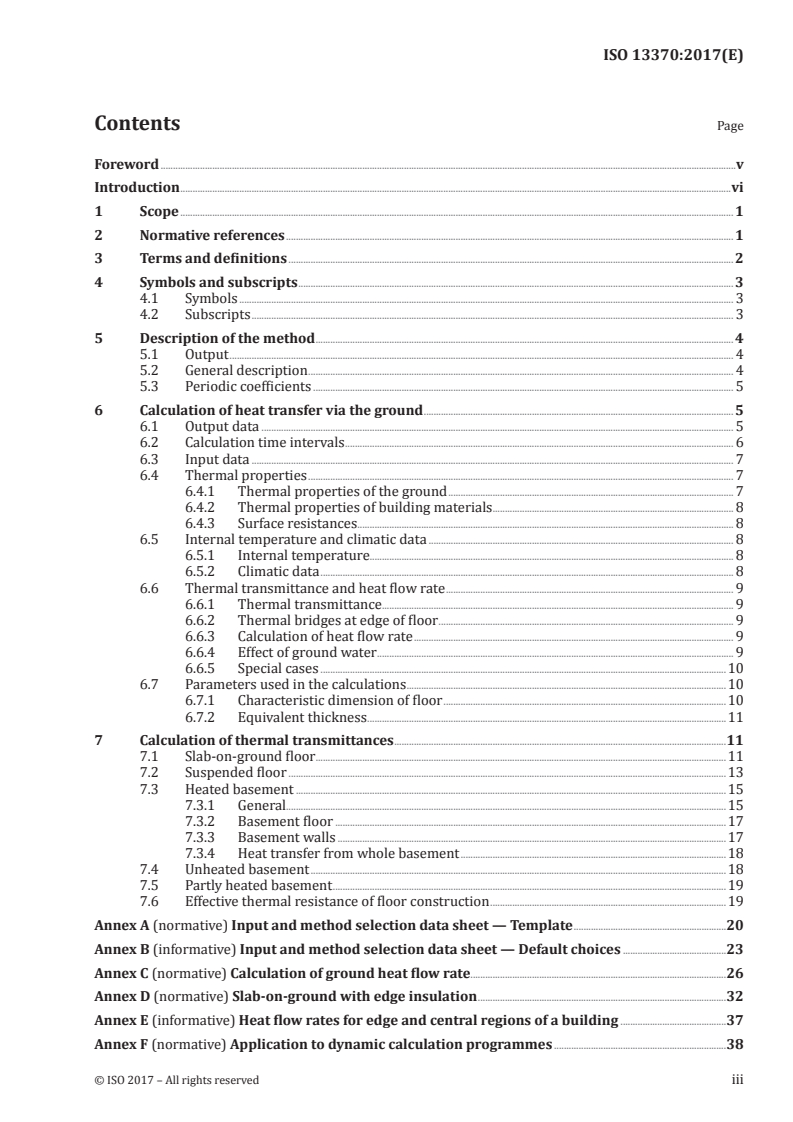
Contents Page
Foreword .v
Introduction .vi
1 Scope . 1
2 Normative references . 1
3 Terms and definitions . 2
4 Symbols and subscripts . 3
4.1 Symbols . 3
4.2 Subscripts . 3
5 Description of the method . 4
5.1 Output . 4
5.2 General description . 4
5.3 Periodic coefficients . 5
6 Calculation of heat transfer via the ground . 5
6.1 Output data . 5
6.2 Calculation time intervals . 6
6.3 Input data . 7
6.4 Thermal properties . 7
6.4.1 Thermal properties of the ground . 7
6.4.2 Thermal properties of building materials . 8
6.4.3 Surface resistances . . 8
6.5 Internal temperature and climatic data . 8
6.5.1 Internal temperature. 8
6.5.2 Climatic data . 8
6.6 Thermal transmittance and heat flow rate . 9
6.6.1 Thermal transmittance . . 9
6.6.2 Thermal bridges at edge of floor . 9
6.6.3 Calculation of heat flow rate . 9
6.6.4 Effect of ground water . . 9
6.6.5 Special cases .10
6.7 Parameters used in the calculations .10
6.7.1 Characteristic dimension of floor .10
6.7.2 Equivalent thickness .11
7 Calculation of thermal transmittances .11
7.1 Slab-on-ground floor .11
7.2 Suspended floor .13
7.3 Heated basement .15
7.3.1 General.15
7.3.2 Basement floor .17
7.3.3 Basement walls .17
7.3.4 Heat transfer from whole basement .18
7.4 Unheated basement .18
7.5 Partly heated basement .19
7.6 Effective thermal resistance of floor construction .19
Annex A (normative) Input and method selection data sheet — Template .20
Annex B (informative) Input and method selection data sheet — Default choices .23
Annex C (normative) Calculation of ground heat flow rate .26
Annex D (normative) Slab-on-ground with edge insulation .32
Annex E (informative) Heat flow rates for edge and central regions of a building .37
Annex F (normative) Application to dynamic calculation programmes .38
Annex G (normative) Ventilation below suspended floors .40
Annex H (normative) Periodic heat transfer coefficients .43
Bibliography .49
iv © ISO 2017 – All rights reserved
Foreword
ISO (the International Organization for Standardization) is a worldwide federation of national standards
bodies (ISO member bodies). The work of preparing International Standards is normally carried out
through ISO technical committees. Each member body interested in a subject for which a technical
committee has been established has the right to be represented on that committee. International
organizations, governmental and non-governmental, in liaison with ISO, also take part in the work.
ISO collaborates closely with the International Electrotechnical Commission (IEC) on all matters of
electrotechnical standardization.
The procedures used to develop this document and those intended for its further maintenance are
described in the ISO/IEC Directives, Part 1. In particular, the different approval criteria needed for the
different types of ISO documents should be noted. This document was drafted in accordance with the
editorial rules of the ISO/IEC Directives, Part 2 (see www. iso. org/d irectives).
Attention is drawn to the possibility that some of the elements of this document may be the subject of
patent rights. ISO shall not be held responsible for identifying any or all such patent rights. Details of
any patent rights identified during the development of the document will be in the Introduction and/or
on the ISO list of patent declarations received (see www. iso. org/p atents).
Any trade name used in this document is information given for the convenience of users and does not
constitute an endorsement.
For an explanation on the voluntary nature of standards, the meaning of ISO specific terms and
expressions related to conformity assessment, as well as information about ISO’s adherence to the
World Trade Organization (WTO) principles in the Technical Barriers to Trade (TBT) see the following
URL: ww w .iso. org/iso / foreword. html.
ISO 13370 was prepared by ISO Technical Committee ISO/TC 163, Thermal performance and energy use
in the built environment, Subcommittee SC 2, Calculation methods, in collaboration with the European
Committee for Standardization (CEN) Technical Committee CEN/TC 89, Thermal performance of
buildings and building components, in accordance with the Agreement on technical cooperation between
ISO and CEN (Vienna Agreement).
This third edition cancels and replaces the second edition (ISO 13370:2007), which has been technically
revised.
The changes in this third edition are mostly editorial. This document has been re-drafted according to
CEN/TS 16629:2014. Some additional output variables have been introduced to facilitate the linkages
between this document and ISO 52016-1.
Introduction
This document is part of a series aimed at the international harmonization of the methodology for
assessing the energy performance of buildings. Throughout, this series is referred to as a “set of EPB
standards”.
All EPB standards follow specific rules to ensure overall consistency, unambiguity and transparency.
All EPB standards provide a certain flexibility with regard to the methods, the required input data and
references to other EPB standards, by the introduction of a normative template in Annex A and Annex B
with informative default choices.
For the correct use of this document, a normative template is given in Annex A to specify these choices.
Informative default choices are provided in Annex B.
The main target groups for this document are architects, engineers and regulators.
Use by or for regulators: In case the document is used in the context of national or regional legal
requirements, mandatory choices may be given at national or regional level for such specific
applications. These choices (either the informative default choices from Annex B or choices adapted to
national/regional needs, but in any case following the template of Annex A) can be made available as
national annex or as separate (e.g. legal) document (national data sheet).
NOTE 1 So in this case:
— the regulators will specify the choices;
— the individual user will apply the document to assess the energy performance of a building, and thereby use
the choices made by the regulators.
Topics addressed in this document can be subject to public regulation. Public regulation on the same
topics can override the default values in Annex B. Public regulation on the same topics can even, for
certain applications, override the use of this document. Legal requirements and choices are in general
not published in standards but in legal documents. In order to avoid double publications and difficult
updating of double documents, a national annex may refer to the legal texts where national choices
have been made by public authorities. Different national annexes or national data sheets are possible,
for different applications.
It is expected, if the default values, choices and references to other EPB standards in Annex B are not
followed due to national regulations, policy or traditions, that:
— national or regional authorities prepare data sheets containing the choices and national or regional
values, according to the model in Annex A. In this case a national annex (e.g. NA) is recommended,
containing a reference to these data sheets;
— or, by default, the national standards body will consider the possibility to add or include a national
annex in agreement with the template of Annex A, in accordance to the legal documents that give
national or regional values and choices.
Further target groups are parties wanting to motivate their assumptions by classifying the building
energy performance for a dedicated building stock.
More information is provided in the Technical Report (ISO/TR 52019-2) accompanying this document.
The subset of EPB standards prepared under the responsibility of ISO/TC 163/SC 2 cover inter alia:
— calculation procedures on the overall energy use and energy performance of buildings;
— calculation procedures on the internal temperature in buildings (e.g. in case of no space heating or
cooling);
— indicators for partial EPB requirements related to thermal energy balance and fabric features;
vi © ISO 2017 – All rights reserved
— calculation methods covering the performance and thermal, hygrothermal, solar and visual
characteristics of specific parts of the building and specific building elements and components, such
as opaque envelope elements, ground floor, windows and facades.
ISO/TC 163/SC 2 cooperates with other technical committees for the details on appliances, technical
building systems, indoor environment, etc.
This document provides the means (in part) to assess the contribution that building products and
services make to energy conservation and to the overall energy performance of buildings.
In contrast with ISO 6946, which gives the method of calculation of the thermal transmittance of
building elements in contact with the external air, this document deals with elements in thermal
contact with the ground. The division between these two International Standards is at the level of the
inside floor surface for slab-on-ground floors, suspended floors and unheated basements, and at the
level of the external ground surface for heated basements. In general, a term to allow for a thermal
bridge associated with the wall/floor junction is included when assessing the total heat loss from a
building using methods such as ISO 13789.
The calculation of heat transfer through the ground can be done by numerical calculations, which also
allow analysis of thermal bridges, including wall/floor junctions, for assessment of minimum internal
surface temperatures.
In this document, methods are provided which take account of the three-dimensional nature of the heat
flow in the ground below buildings.
Thermal transmittances of floors give useful comparative values of the insulation properties of
different floor constructions and are used in building regulations in some countries for the limitation of
heat losses through floors.
Thermal transmittance, although defined for steady-state conditions, also relates average heat flow to
average temperature difference. In the case of walls and roofs exposed to the external air, there are
daily periodic variations in heat flow into and out of storage related to daily temperature variations,
but this averages out, and the daily average heat loss can be found from the thermal transmittance
and daily average inside-to-outside temperature difference. For floors and basement walls in contact
with the ground, however, the large thermal inertia of the ground results in periodic heat flows related
to the annual cycle of internal and external temperatures. The steady-state heat flow is often a good
approximation to the average heat flow over the heating season.
In addition to the steady-state part, a detailed assessment of floor losses is obtained from annual
periodic heat transfer coefficients related to the thermal capacity of the soil, as well as its thermal
conductivity, together with the amplitude of annual variations in monthly mean temperature.
Annex F provides a method for incorporating heat transfers to and from the ground into calculations
undertaken at short time intervals (e.g. 1 h).
ISO/TR 52019-2 provides information on
— thermal properties of the ground,
— the influence of flowing ground water,
— ground floors with an embedded heating or cooling system, and
— ground floors of cold stores
along with worked examples illustrating the use of the procedures in this document.
Table 1 shows the relative position of this document within the set of EPB standards in the context of
the modular structure as set out in ISO 52000-1.
NOTE 2 In ISO/TR 52000-2, the same table can be found, with, for each module, the numbers of the relevant
EPB standards and accompanying technical reports that are published or in preparation.
NOTE 3 The modules represent EPB standards, although one EPB standard could cover more than one module
and one module could be covered by more than one EPB standard, for instance, a simplified and a detailed method
respectively. See also Tables A.1 and B.1.
Table 1 — Position of this document (in casu M2–5) within the modular structure of the set of
EPB standards
Building
Overarching Technical building systems
(as such)
Buil
De Do ding
Hu
hu mes auto
Sub Ven mi PV,
Descrip Descrip Descrip Hea Coo mi tic Ligh ma
mo tila difi wind,
tions tions tions ting ling difi hot ting tion
dule tion ca .
ca wat and
tion
tion er cont
rol
sub1 M1 M2 M3 M4 M5 M6 M7 M8 M9 M10 M11
1 General General General
Common
terms and
Building
definitions;
a
2 energy Needs
symbols,
needs
units and
subscripts
(Free)
Indoor Maximum
Applica-
3 conditions load and
tions
without power
systems
Ways to Ways to
Ways to
express express
express
4 energy energy
energy per-
perfor- perfor-
formance
mance mance
Building
Heat
categories
transfer by ISO Emission
5 and
transmis- 13370 and control
building
sion
boundaries
Building Heat trans-
occupancy fer Distribu-
6 and by infiltra- tion
operating tion and and control
conditions ventilation
Aggre-
gation of
energy Internal Storage
services heat gains and control
and energy
carriers
Building Solar Generation
zoning heat gains and control
a
The shaded modules are not applicable.
viii © ISO 2017 – All rights reserved
Table 1 (continued)
Building
Overarching Technical building systems
(as such)
Buil
De Do ding
Hu
hu mes auto
Sub Ven mi PV,
Descrip Descrip Descrip Hea Coo mi tic Ligh ma
mo tila difi wind,
tions tions tions ting ling difi hot ting tion
dule tion ca .
ca wat and
tion
tion er cont
rol
sub1 M1 M2 M3 M4 M5 M6 M7 M8 M9 M10 M11
Load
Calculated Building dispatch-
energy dynamics ing
perfor- (thermal and oper-
mance mass) ating
conditions
Measured Measured Measured
energy energy energy
perfor- perfor- perfor-
mance mance mance
11 Inspection Inspection Inspection
Ways to
express
12 BMS
indoor
comfort
External
environ-
ment
conditions
Economic
calculation
a
The shaded modules are not applicable.
INTERNATIONAL STANDARD ISO 13370:2017(E)
Thermal performance of buildings — Heat transfer via the
ground — Calculation methods
1 Scope
This document provides methods of calculation of heat transfer coefficients and heat flow rates for
building elements in thermal contact with the ground, including slab-on-ground floors, suspended
floors and basements. It applies to building elements, or parts of them, below a horizontal plane in the
bounding walls of the building situated
— at the level of the inside floor surface, for slab-on-ground floors, suspended floors and unheated
basements;
NOTE 1 In some cases, external dimension systems define the boundary at the lower surface of the floor slab.
— at the level of the external ground surface, for heated basements.
This document includes calculation of the steady-state part of the heat transfer (the annual average rate
of heat flow) and the part due to annual periodic variations in temperature (the seasonal variations of
the heat flow rate about the annual average). These seasonal variations are obtained on a monthly basis
and, except for the application to dynamic simulation programmes in Annex D, this document does not
apply to shorter periods of time.
NOTE 2 Table 1 in the Introduction shows the relative position of this document within the set of EPB
standards in the context of the modular structure as set out in ISO 52000-1.
2 Normative references
The following documents are referred to in text in such a way that some or all of their content
constitutes requirements of this document. For dated references, only the edition cited applies. For
undated references, the latest edition of the referenced document (including any amendments) applies.
ISO 6946, Building components and building elements — Thermal resistance and thermal
transmittance — Calculation method
ISO 7345, Thermal insulation — Physical quantities and definitions
ISO 10211, Thermal bridges in building construction — Heat flows and surface temperatures — Detailed
calculations
ISO 14683, Thermal bridges in building construction — Linear thermal transmittance — Simplified
methods and default values
ISO 52000-1:2017, Energy performance of buildings — Overarching EPB assessment — Part 1: General
framework and procedures
NOTE 1 Default references to EPB standards other than ISO 52000-1 are identified by the EPB module code
number and given in Annex A (normative template in Table A.1) and Annex B (informative default choice in
Table B.1).
EXAMPLE EPB module code number: M5–5, or M5–5,1 (if module M5–5 is subdivided), or M5–5/1 (if
reference to a specific clause of the standard covering M5–5).
NOTE 2 In this document, there are no choices in references to other EPB standards. The sentence and note
above is kept to maintain uniformity between all EPB standards.
3 Terms and definitions
For the purposes of this document, the terms and definitions given in ISO 7345 and ISO 52000-1 and the
following apply.
ISO and IEC maintain terminological databases for use in standardization at the following addresses:
— IEC Electropedia: available at http:// www .electropedia .org/
— ISO Online browsing platform: available at http:// www .iso .org/ obp
3.1
slab on ground
floor construction directly on the ground over its whole area
3.2
suspended floor
floor construction in which the lowest floor is held off the ground, resulting in an air void between the
floor and the ground
Note 1 to entry: This air void, also called underfloor space or crawl space, may be ventilated or unventilated, and
does not form part of the habitable space.
3.3
basement
usable part of a building that is situated partly or entirely below ground level
Note 1 to entry: This space may be heated or unheated.
3.4
equivalent thickness
thickness of ground (having the thermal conductivity of the actual ground) which
has the same thermal resistance as the element under consideration
3.5
steady-state heat transfer coefficient
steady-state heat flow divided by temperature difference between internal and external environments
3.6
internal periodic heat transfer coefficient
amplitude of periodic heat flow divided by amplitude of internal temperature variation over an
annual cycle
3.7
external periodic heat transfer coefficient
amplitude of periodic heat flow divided by amplitude of external temperature over an annual cycle
3.8
characteristic dimension of floor
area of floor divided by half the perimeter of floor
3.9
phase difference
period of time between the maximum or minimum of a cyclic temperature and the consequential
maximum or minimum heat flow rate
2 © ISO 2017 – All rights reserved
3.10
EPB standard
[6]
standard that complies with the requirements given in ISO 52000-1, CEN/TS 16628 and
[7]
CEN/TS 16629
Note 1 to entry: These three basic EPB documents were developed under a mandate given to CEN by the
European Commission and the European Free Trade Association and support essential requirements of EU
Directive 2010/31/EU on the energy performance of buildings. Several EPB standards and related documents
are developed or revised under the same mandate.
[SOURCE: ISO 52000-1:2017, 3.5.14]
4 Symbols and subscripts
4.1 Symbols
Symbol Quantity Unit
A area of floor m
B characteristic dimension of floor m
d total equivalent thickness m
z depth m
H steady-state heat transfer coefficient W/K
h height of floor surface above outside ground level m
m month number (m = 1 for January to m = 12 for December) —
P exposed perimeter m
R thermal resistance m ·K/W
U thermal transmittance between internal and external environments W/(m ·K)
z depth of basement floor below ground level m
Φ heat flow rate W
λ thermal conductivity W/(m·K)
δ periodic penetration depth m
θ temperature °C
Ψ linear thermal transmittance W/(m·K)
4.2 Subscripts
For the purposes of this document, the subscripts given in ISO 52000-1 and the following apply.
adj adjusted
an annual
b basement, below ground level; width
basement, including the effect of
bg
the ground
bsf below suspended floor
C cooling
e external
ed edge
effective (including effect of ground
eff
and/or basement)
f floor
ground floor, including the effect of
fg
the ground
g ground
H heating
ins insulation
int internal
m month; middle (of building)
p constant pressure
pe external periodic
pi internal periodic
sog slab on ground
si internal surface
se external surface
sus suspended
unheated basement, including the
ub
effect of the ground
ve ventilation
vi virtual
w wall
wf wall/floor junction
wg wall, including the effect of the ground
combined (through walls of under-
x floor space and by ventilation of the
underfloor space)
5 Description of the method
5.1 Output
The output of this document is the thermal resistance and thermal transmittance of floors next to
the ground and basements, together with coefficients that enable heat flows to be calculated on a
monthly basis.
5.2 General description
Heat transfer via the ground is characterized by
— heat flow related to the area of the floor, depending on the construction of the floor,
— heat flow related to the perimeter of the floor, depending on thermal bridging at the edge of the
floor, and
— annual periodic heat flow, also related to the perimeter of the floor, resulting from the thermal
inertia of the ground.
The steady-state, or annual average, part of the heat transfer shall be evaluated using one of the
methods described below.
a) A full three-dimensional numerical calculation, giving the result directly for the floor concerned:
calculations shall be done in accordance with ISO 10211. The result is applicable only for the actual
floor dimensions modelled.
4 © ISO 2017 – All rights reserved
b) A two-dimensional numerical calculation, using a floor that is infinitely long and has a width
equal to the characteristic dimension of the floor (floor area divided by half perimeter, see 6.7.1);
calculations shall be done in accordance with ISO 10211. The result is applicable to floors having
the characteristic dimension that was modelled.
NOTE 1 The largest heat flows usually occur near the edges of the floor, and in most cases only small
errors result from converting the three-dimensional problem to a two-dimensional problem in which the
width of the building is taken as the characteristic dimension of the floor.
c) The area-related heat transfer calculated by the formulae given in this document (see Clause 7),
together with the edge-related heat transfer obtained from linear thermal transmittances that are
in accordance with any of the methods in ISO 14683 (numerical method, thermal bridge catalogues,
manual calculation or default values).
NOTE 2 Linear thermal transmittance is calculated according to ISO 10211 or obtained from tables.
ISO 13789:2017, Annex A has template for identifying sources of tabulated values of linear thermal transmittance,
providing data for existing buildings, and identifying thermal bridges that can be neglected, with an informative
default choice provided in Annex B.
For c), the steady-state part of the heat transfer is given by Formula (1):
HA=⋅UP+⋅Ψ (1)
gwf
where
H is the steady-state heat transfer coefficient via the ground, in W/K;
g
A is the area of floor, in m ;
U is the thermal transmittance between internal and external environments (U , U
fg;sog fg;sus
U or U , depending on floor type; see Table 4), in W/(m ·K);
bg;eff ub
P is the exposed perimeter, in m;
Ψ is the linear thermal transmittance of the wall/floor junction, in W/(m·K).
wf
Method c) is applicable to a floor of any size or shape. U depends on floor size, but Ψ is independent
wf
of the floor dimensions. Formula (1) is modified in the case of a heated basement (see 7.3.4) and in the
case of application of Annex D (see D.1).
A template for defining whether method c) is allowed is given in Table A.2, with an informative default
choice provided in Table B.2. A template for tabulated U-values is also given in Table A.2, with an
informative default list in Table B.2.
5.3 Periodic coefficients
The document allows for different methods of allowing for phase differences between the annual cycle
of temperature variation and heat flow (see C.1).
A template for defining which method is to be used is given in Table A.3, with an informative default
choice provided in Table B.3.
6 Calculation of heat transfer via the ground
6.1 Output data
The output data are listed in Table 2.
Table 2 — Output data
Destination mod-
Validity
Description Symbol Unit ule Varying
interval
(Table 1)
Thermal transmittance of slab on ground
U W/(m ·K) M2–5 >0 No
fg;sog
floor, including the effect of the ground
Thermal transmittance of suspended
U W/(m ·K) M2–5 >0 No
fg;sus
floor, including the effect of the ground
Thermal transmittance of wall of
heated basement, including the effect U W/(m ·K) M2–5 >0 No
wg;b
of the ground
Thermal transmittance of floor of
heated basement, including the effect U W/(m ·K) M2–5 >0 No
fg;b
of the ground
Effective thermal transmittance of
whole heated basement, including the U W/(m ·K) M2–5 >0 No
bg;eff
effect of the ground
Thermal transmittance of unheated
basement, including the effect of the U W/(m ·K) M2–5 >0 No
ub
ground
Thermal resistance of slab on ground
R m ·K/W M2–5 >0 No
f;sog
floor
Thermal resistance of suspended floor R m ·K/W M2–5 >0 No
f;sus
Thermal resistance of basement wall R m ·K/W M2–5 >0 No
w;b
Thermal resistance of basement floor R m ·K/W M2–5 >0 No
f;b
Effective thermal resistance of floor
construction (including the effect of R m ·K/W M2–5 >0 No
f;eff
the ground)
Ground heat transfer coefficient for
H W/K M2–5 >0 Yes
g;an,m
each month
Ground heat transfer coefficient for the
H W/K M2–5 >0 No
g;H;adj
heating season
Ground heat transfer coefficient for the
H W/K M2–5 >0 No
g;C;adj
cooling season
Thermal resistance of 0,5 m of ground
(for dynamic calculations according to R m ·K/W M2–5 >0 No
g
Annex F)
Thermal capacity of 0,5 m of ground
(for dynamic calculations according to κ J/(m ·K) M2–5 >0 No
g
Annex F)
Thermal resistance of virtual layer
(for dynamic calculations according to R m ·K/W M2–5 >0 No
vi
Annex F)
Virtual temperature in ground for each
month (for dynamic calculations accord- θ °C M2–5 — Yes
vi
ing to Annex F)
6.2 Calculation time intervals
The calculation of periodic coefficients and heat flows apply to a time interval of one month. For other
quantities the input, the method and the output data are for steady-state conditions and assumed to
be independent of actual conditions, such as indoor temperature or effect of wind or solar radiation, so
there is no need to consider a specific time interval length.
6 © ISO 2017 – All rights reserved
6.3 Input data
Tables 3, 4, 5 and 6 list identifiers for input data required for the calculation.
Table 3 — Identifiers for building geometric characteristics
Name Symbol Unit Value Range Origin Varying
Area of floor A m — ≥0 — No
Exposed perimeter P m — ≥0 — No
Length of linear thermal bridge k l m — ≥0 — No
k
Thickness of the walls of the dwelling d m — ≥0 — No
w;e
Height of the upper surface of the floor
h m — ≥0 — No
above external ground level
Depth of basement floor below ground
z m — ≥0 — No
level
Table 4 — Identifiers for building boundary conditions
Name Symbol Unit Value Range Origin Varying
Indoor environment temperature in the
θ °C — 0 to 50 — Yes
int
building under consideration
External air temperature θ °C — −50 to 50 — Yes
e
Virtual temperature of the ground θ °C — 0.∞ — Yes
vi,m
Table 5 — Identifiers for thermal characteristics of building fabric
Name Symbol Unit Value Range Origin Varying
Thermal transmittance of element i U W/(m ·K) — 0 to 10 ISO 6946 No
i
ISO 14683
Linear thermal transmittance associat-
Ψ W/(m·K) — 0 to 10 or No
k
ed with wall/floor junction
ISO 10211
Table 8 lists identifiers for constants.
Table 6 — Identifiers for constants
Name Symbol Unit Value Range Origin Varying
J/(kg·K) 1 008
Specific heat capacity of air at constant
c — — No
p
pressure
Wh/(kg·K) 0,28
Density of air
ρ kg/m 1,23 — — No
(at 10 °C and 100 kPa pressure)
6.4 Thermal properties
6.4.1 Thermal properties of the ground
Default values are given in Table 7. If the ground type is unknown, category 2 should be used.
NOTE ISO/TR 52019-2 gives information about the range of values of ground properties.
Table 7 — Thermal properties of the ground
Heat capacity
Thermal conductivity
per volume
Category Description λ
g
ρ c
W/(m·K)
J/(m ·K)
1 clay or silt 1,5 3,0 × 10
2 sand or gravel 2,0 2,0 × 10
3 homogeneous rock 3,5 2,0 × 10
A template for providing properties of the ground is given in Table A.4, with an informative default
choice provided in Table B.4.
6.4.2 Thermal properties of building materials
Thermal resistance values shall conform with ISO 6946. The thermal resistance of materials used
below ground level should reflect the moisture and temperature conditions of the application.
NOTE The heat capacity of building materials used in floor constructions is small compared with that of the
ground and is neglected.
6.4.3 Surface resistances
Values of surface resistance shall conform to ISO 6946.
The value of R is used both at the top and at the bottom of an underfloor space.
si
6.5 Internal temperature and climatic data
6.5.1 Internal temperature
If there are different temperatures in different rooms or spaces immediately above the floor, use a
spatial average. Obtain this average by weighting the temperature of each space by the area of that
space in contact with the ground.
To calculate heat flow rates, this document requires
a) annual mean internal temperature, and
b) if variations in internal temperature are to be included, amplitude of variation of internal
temperature from the annual mean; this amplitude is defined as half the difference between the
maximum and minimum values of the average temperatures for each month.
6.5.2 Climatic data
To calculate heat flow rates, this document requires
a) annual mean external air temperature,
b) if variations in external temperature are to be included, amplitude of variation of external air
temperature from the annual mean; this amplitude is defined as half the difference between the
maximum and minimum values of the average temperatures for each month, and
c) for suspended floors that are naturally ventilated, the average wind speed measured at a height of
10 m above external ground level.
If the ground surface temperature is known, this can be used in place of the external air temperature, in
order to allow for effects of snow cover, solar gain on the ground surface and/or long wave radiation to
clear skies. In such cases, R should be excluded from all formulae.
se
8 © ISO 2017 – All rights reserved
A template for providing ground surface temperatures is given in Table A.5, with an informative default
choice provided in Table B.5.
6.6 Thermal transmittance and heat flow rate
6.6.1 Thermal transmittance
Thermal transmittances for floors and basements are related to the steady-state component of the heat
transfer. Methods of calculation are given in Clause 7 for the various types of floor and basement. The
formulae use the characteristic dimension of the floor and the equivalent thickness of floor insulation
(see 6.7).
If the transmission heat loss coefficient for the ground is required, take this as equal to the steady-state
ground heat transfer coefficient, H , calculated using Formula (1).
g
6.6.2 Thermal bridges at edge of floor
The formulae in this document are based on an isolated floor considered independently of any
interaction between floor and wall. They also assume uniform thermal properties of the soil (except for
effects solely due to edge insulation).
In practice, wall/floor junctions for slab-on-ground floors do not correspond with this ideal, giving rise
to thermal bridge effects. These shall be allowed for in calculations of the total heat loss from a building,
by using a linear thermal transmittance, Ψ .
wf
NOTE The linear thermal transmittance depends on the system being used for defining building dimensions
(see ISO 13789).
The total heat loss from a building is then calculated on the basis of a separating plane
— at the level of the inside floor surface for slab-on-ground floors, suspended floors and unheated
basements, or
— at the level of the outside ground surface for heated basements.
NOTE In some cases, external dimension systems define the boundary at the lower surface of the floor slab.
The thermal transmittance of elements above the separating plane should be assessed in accordance
with appropriate standards, such as ISO 6946.
6.6.3 Calculation of heat flow rate
Heat transfer via the ground can be calculated on an annual basis using only the steady-state ground
heat transfer coefficient, or on a seasonal or monthly basis using additional periodic coefficients
that take account of the thermal inertia of the ground (see 5.2). The relevant formulae for periodic
coefficients are given in Annex C.
6.6.4 Effect of ground water
Ground water has a negligible effect on the heat transfer, unless it is at a shallow depth and has a high
flow rate. Such conditions are rarely encountered and in most cases no allowance should be made for
the effect of ground water.
A template for providing ground surface temperatures is given in Table A.5, with an informative default
choice provided in Table B.5.
When the depth of the water table below ground level and the rate of ground water flow are known, the
steady-state ground heat transfer coefficient, H , may be multiplied by a factor, G .
g w
NOTE ISO/TR 52019-2 contains illustrative values of G .
w
A template for defining when the effect of flowing ground water is to be included is given in Table A.6,
with an informative default choice provided in Table B.6.
6.6.5 Special cases
The methods in this document are also applicable to the following situations, with the modifications
described in the relevant annex:
— heat flow rates for edge and central regions of a floor (see Annex E);
— application to dynamic simulation programs (see Annex F).
NOTE For the floors of cold stores and slab-on-ground floors with an embedded heating system, see
ISO/TR 52019-2.
6.7 Parameters used in the calculations
6.7.1 Characteristic dimension of floor
To allow for the three-dimensional nature of heat flow within the ground, the formulae in this document
are expressed in terms of the “characteristic dimension” of the floor, B
...
INTERNATIONAL ISO
STANDARD 13370
Third edition
2017-06
Thermal performance of buildings —
Heat transfer via the ground —
Calculation methods
Performance thermique des bâtiments — Transfert de chaleur par le
sol — Méthodes de calcul
Reference number
©
ISO 2017
© ISO 2017, Published in Switzerland
All rights reserved. Unless otherwise specified, no part of this publication may be reproduced or utilized otherwise in any form
or by any means, electronic or mechanical, including photocopying, or posting on the internet or an intranet, without prior
written permission. Permission can be requested from either ISO at the address below or ISO’s member body in the country of
the requester.
ISO copyright office
Ch. de Blandonnet 8 • CP 401
CH-1214 Vernier, Geneva, Switzerland
Tel. +41 22 749 01 11
Fax +41 22 749 09 47
copyright@iso.org
www.iso.org
ii © ISO 2017 – All rights reserved
Contents Page
Foreword .v
Introduction .vi
1 Scope . 1
2 Normative references . 1
3 Terms and definitions . 2
4 Symbols and subscripts . 3
4.1 Symbols . 3
4.2 Subscripts . 3
5 Description of the method . 4
5.1 Output . 4
5.2 General description . 4
5.3 Periodic coefficients . 5
6 Calculation of heat transfer via the ground . 5
6.1 Output data . 5
6.2 Calculation time intervals . 6
6.3 Input data . 7
6.4 Thermal properties . 7
6.4.1 Thermal properties of the ground . 7
6.4.2 Thermal properties of building materials . 8
6.4.3 Surface resistances . . 8
6.5 Internal temperature and climatic data . 8
6.5.1 Internal temperature. 8
6.5.2 Climatic data . 8
6.6 Thermal transmittance and heat flow rate . 9
6.6.1 Thermal transmittance . . 9
6.6.2 Thermal bridges at edge of floor . 9
6.6.3 Calculation of heat flow rate . 9
6.6.4 Effect of ground water . . 9
6.6.5 Special cases .10
6.7 Parameters used in the calculations .10
6.7.1 Characteristic dimension of floor .10
6.7.2 Equivalent thickness .11
7 Calculation of thermal transmittances .11
7.1 Slab-on-ground floor .11
7.2 Suspended floor .13
7.3 Heated basement .15
7.3.1 General.15
7.3.2 Basement floor .17
7.3.3 Basement walls .17
7.3.4 Heat transfer from whole basement .18
7.4 Unheated basement .18
7.5 Partly heated basement .19
7.6 Effective thermal resistance of floor construction .19
Annex A (normative) Input and method selection data sheet — Template .20
Annex B (informative) Input and method selection data sheet — Default choices .23
Annex C (normative) Calculation of ground heat flow rate .26
Annex D (normative) Slab-on-ground with edge insulation .32
Annex E (informative) Heat flow rates for edge and central regions of a building .37
Annex F (normative) Application to dynamic calculation programmes .38
Annex G (normative) Ventilation below suspended floors .40
Annex H (normative) Periodic heat transfer coefficients .43
Bibliography .49
iv © ISO 2017 – All rights reserved
Foreword
ISO (the International Organization for Standardization) is a worldwide federation of national standards
bodies (ISO member bodies). The work of preparing International Standards is normally carried out
through ISO technical committees. Each member body interested in a subject for which a technical
committee has been established has the right to be represented on that committee. International
organizations, governmental and non-governmental, in liaison with ISO, also take part in the work.
ISO collaborates closely with the International Electrotechnical Commission (IEC) on all matters of
electrotechnical standardization.
The procedures used to develop this document and those intended for its further maintenance are
described in the ISO/IEC Directives, Part 1. In particular, the different approval criteria needed for the
different types of ISO documents should be noted. This document was drafted in accordance with the
editorial rules of the ISO/IEC Directives, Part 2 (see www. iso. org/d irectives).
Attention is drawn to the possibility that some of the elements of this document may be the subject of
patent rights. ISO shall not be held responsible for identifying any or all such patent rights. Details of
any patent rights identified during the development of the document will be in the Introduction and/or
on the ISO list of patent declarations received (see www. iso. org/p atents).
Any trade name used in this document is information given for the convenience of users and does not
constitute an endorsement.
For an explanation on the voluntary nature of standards, the meaning of ISO specific terms and
expressions related to conformity assessment, as well as information about ISO’s adherence to the
World Trade Organization (WTO) principles in the Technical Barriers to Trade (TBT) see the following
URL: ww w .iso. org/iso / foreword. html.
ISO 13370 was prepared by ISO Technical Committee ISO/TC 163, Thermal performance and energy use
in the built environment, Subcommittee SC 2, Calculation methods, in collaboration with the European
Committee for Standardization (CEN) Technical Committee CEN/TC 89, Thermal performance of
buildings and building components, in accordance with the Agreement on technical cooperation between
ISO and CEN (Vienna Agreement).
This third edition cancels and replaces the second edition (ISO 13370:2007), which has been technically
revised.
The changes in this third edition are mostly editorial. This document has been re-drafted according to
CEN/TS 16629:2014. Some additional output variables have been introduced to facilitate the linkages
between this document and ISO 52016-1.
Introduction
This document is part of a series aimed at the international harmonization of the methodology for
assessing the energy performance of buildings. Throughout, this series is referred to as a “set of EPB
standards”.
All EPB standards follow specific rules to ensure overall consistency, unambiguity and transparency.
All EPB standards provide a certain flexibility with regard to the methods, the required input data and
references to other EPB standards, by the introduction of a normative template in Annex A and Annex B
with informative default choices.
For the correct use of this document, a normative template is given in Annex A to specify these choices.
Informative default choices are provided in Annex B.
The main target groups for this document are architects, engineers and regulators.
Use by or for regulators: In case the document is used in the context of national or regional legal
requirements, mandatory choices may be given at national or regional level for such specific
applications. These choices (either the informative default choices from Annex B or choices adapted to
national/regional needs, but in any case following the template of Annex A) can be made available as
national annex or as separate (e.g. legal) document (national data sheet).
NOTE 1 So in this case:
— the regulators will specify the choices;
— the individual user will apply the document to assess the energy performance of a building, and thereby use
the choices made by the regulators.
Topics addressed in this document can be subject to public regulation. Public regulation on the same
topics can override the default values in Annex B. Public regulation on the same topics can even, for
certain applications, override the use of this document. Legal requirements and choices are in general
not published in standards but in legal documents. In order to avoid double publications and difficult
updating of double documents, a national annex may refer to the legal texts where national choices
have been made by public authorities. Different national annexes or national data sheets are possible,
for different applications.
It is expected, if the default values, choices and references to other EPB standards in Annex B are not
followed due to national regulations, policy or traditions, that:
— national or regional authorities prepare data sheets containing the choices and national or regional
values, according to the model in Annex A. In this case a national annex (e.g. NA) is recommended,
containing a reference to these data sheets;
— or, by default, the national standards body will consider the possibility to add or include a national
annex in agreement with the template of Annex A, in accordance to the legal documents that give
national or regional values and choices.
Further target groups are parties wanting to motivate their assumptions by classifying the building
energy performance for a dedicated building stock.
More information is provided in the Technical Report (ISO/TR 52019-2) accompanying this document.
The subset of EPB standards prepared under the responsibility of ISO/TC 163/SC 2 cover inter alia:
— calculation procedures on the overall energy use and energy performance of buildings;
— calculation procedures on the internal temperature in buildings (e.g. in case of no space heating or
cooling);
— indicators for partial EPB requirements related to thermal energy balance and fabric features;
vi © ISO 2017 – All rights reserved
— calculation methods covering the performance and thermal, hygrothermal, solar and visual
characteristics of specific parts of the building and specific building elements and components, such
as opaque envelope elements, ground floor, windows and facades.
ISO/TC 163/SC 2 cooperates with other technical committees for the details on appliances, technical
building systems, indoor environment, etc.
This document provides the means (in part) to assess the contribution that building products and
services make to energy conservation and to the overall energy performance of buildings.
In contrast with ISO 6946, which gives the method of calculation of the thermal transmittance of
building elements in contact with the external air, this document deals with elements in thermal
contact with the ground. The division between these two International Standards is at the level of the
inside floor surface for slab-on-ground floors, suspended floors and unheated basements, and at the
level of the external ground surface for heated basements. In general, a term to allow for a thermal
bridge associated with the wall/floor junction is included when assessing the total heat loss from a
building using methods such as ISO 13789.
The calculation of heat transfer through the ground can be done by numerical calculations, which also
allow analysis of thermal bridges, including wall/floor junctions, for assessment of minimum internal
surface temperatures.
In this document, methods are provided which take account of the three-dimensional nature of the heat
flow in the ground below buildings.
Thermal transmittances of floors give useful comparative values of the insulation properties of
different floor constructions and are used in building regulations in some countries for the limitation of
heat losses through floors.
Thermal transmittance, although defined for steady-state conditions, also relates average heat flow to
average temperature difference. In the case of walls and roofs exposed to the external air, there are
daily periodic variations in heat flow into and out of storage related to daily temperature variations,
but this averages out, and the daily average heat loss can be found from the thermal transmittance
and daily average inside-to-outside temperature difference. For floors and basement walls in contact
with the ground, however, the large thermal inertia of the ground results in periodic heat flows related
to the annual cycle of internal and external temperatures. The steady-state heat flow is often a good
approximation to the average heat flow over the heating season.
In addition to the steady-state part, a detailed assessment of floor losses is obtained from annual
periodic heat transfer coefficients related to the thermal capacity of the soil, as well as its thermal
conductivity, together with the amplitude of annual variations in monthly mean temperature.
Annex F provides a method for incorporating heat transfers to and from the ground into calculations
undertaken at short time intervals (e.g. 1 h).
ISO/TR 52019-2 provides information on
— thermal properties of the ground,
— the influence of flowing ground water,
— ground floors with an embedded heating or cooling system, and
— ground floors of cold stores
along with worked examples illustrating the use of the procedures in this document.
Table 1 shows the relative position of this document within the set of EPB standards in the context of
the modular structure as set out in ISO 52000-1.
NOTE 2 In ISO/TR 52000-2, the same table can be found, with, for each module, the numbers of the relevant
EPB standards and accompanying technical reports that are published or in preparation.
NOTE 3 The modules represent EPB standards, although one EPB standard could cover more than one module
and one module could be covered by more than one EPB standard, for instance, a simplified and a detailed method
respectively. See also Tables A.1 and B.1.
Table 1 — Position of this document (in casu M2–5) within the modular structure of the set of
EPB standards
Building
Overarching Technical building systems
(as such)
Buil
De Do ding
Hu
hu mes auto
Sub Ven mi PV,
Descrip Descrip Descrip Hea Coo mi tic Ligh ma
mo tila difi wind,
tions tions tions ting ling difi hot ting tion
dule tion ca .
ca wat and
tion
tion er cont
rol
sub1 M1 M2 M3 M4 M5 M6 M7 M8 M9 M10 M11
1 General General General
Common
terms and
Building
definitions;
a
2 energy Needs
symbols,
needs
units and
subscripts
(Free)
Indoor Maximum
Applica-
3 conditions load and
tions
without power
systems
Ways to Ways to
Ways to
express express
express
4 energy energy
energy per-
perfor- perfor-
formance
mance mance
Building
Heat
categories
transfer by ISO Emission
5 and
transmis- 13370 and control
building
sion
boundaries
Building Heat trans-
occupancy fer Distribu-
6 and by infiltra- tion
operating tion and and control
conditions ventilation
Aggre-
gation of
energy Internal Storage
services heat gains and control
and energy
carriers
Building Solar Generation
zoning heat gains and control
a
The shaded modules are not applicable.
viii © ISO 2017 – All rights reserved
Table 1 (continued)
Building
Overarching Technical building systems
(as such)
Buil
De Do ding
Hu
hu mes auto
Sub Ven mi PV,
Descrip Descrip Descrip Hea Coo mi tic Ligh ma
mo tila difi wind,
tions tions tions ting ling difi hot ting tion
dule tion ca .
ca wat and
tion
tion er cont
rol
sub1 M1 M2 M3 M4 M5 M6 M7 M8 M9 M10 M11
Load
Calculated Building dispatch-
energy dynamics ing
perfor- (thermal and oper-
mance mass) ating
conditions
Measured Measured Measured
energy energy energy
perfor- perfor- perfor-
mance mance mance
11 Inspection Inspection Inspection
Ways to
express
12 BMS
indoor
comfort
External
environ-
ment
conditions
Economic
calculation
a
The shaded modules are not applicable.
INTERNATIONAL STANDARD ISO 13370:2017(E)
Thermal performance of buildings — Heat transfer via the
ground — Calculation methods
1 Scope
This document provides methods of calculation of heat transfer coefficients and heat flow rates for
building elements in thermal contact with the ground, including slab-on-ground floors, suspended
floors and basements. It applies to building elements, or parts of them, below a horizontal plane in the
bounding walls of the building situated
— at the level of the inside floor surface, for slab-on-ground floors, suspended floors and unheated
basements;
NOTE 1 In some cases, external dimension systems define the boundary at the lower surface of the floor slab.
— at the level of the external ground surface, for heated basements.
This document includes calculation of the steady-state part of the heat transfer (the annual average rate
of heat flow) and the part due to annual periodic variations in temperature (the seasonal variations of
the heat flow rate about the annual average). These seasonal variations are obtained on a monthly basis
and, except for the application to dynamic simulation programmes in Annex D, this document does not
apply to shorter periods of time.
NOTE 2 Table 1 in the Introduction shows the relative position of this document within the set of EPB
standards in the context of the modular structure as set out in ISO 52000-1.
2 Normative references
The following documents are referred to in text in such a way that some or all of their content
constitutes requirements of this document. For dated references, only the edition cited applies. For
undated references, the latest edition of the referenced document (including any amendments) applies.
ISO 6946, Building components and building elements — Thermal resistance and thermal
transmittance — Calculation method
ISO 7345, Thermal insulation — Physical quantities and definitions
ISO 10211, Thermal bridges in building construction — Heat flows and surface temperatures — Detailed
calculations
ISO 14683, Thermal bridges in building construction — Linear thermal transmittance — Simplified
methods and default values
ISO 52000-1:2017, Energy performance of buildings — Overarching EPB assessment — Part 1: General
framework and procedures
NOTE 1 Default references to EPB standards other than ISO 52000-1 are identified by the EPB module code
number and given in Annex A (normative template in Table A.1) and Annex B (informative default choice in
Table B.1).
EXAMPLE EPB module code number: M5–5, or M5–5,1 (if module M5–5 is subdivided), or M5–5/1 (if
reference to a specific clause of the standard covering M5–5).
NOTE 2 In this document, there are no choices in references to other EPB standards. The sentence and note
above is kept to maintain uniformity between all EPB standards.
3 Terms and definitions
For the purposes of this document, the terms and definitions given in ISO 7345 and ISO 52000-1 and the
following apply.
ISO and IEC maintain terminological databases for use in standardization at the following addresses:
— IEC Electropedia: available at http:// www .electropedia .org/
— ISO Online browsing platform: available at http:// www .iso .org/ obp
3.1
slab on ground
floor construction directly on the ground over its whole area
3.2
suspended floor
floor construction in which the lowest floor is held off the ground, resulting in an air void between the
floor and the ground
Note 1 to entry: This air void, also called underfloor space or crawl space, may be ventilated or unventilated, and
does not form part of the habitable space.
3.3
basement
usable part of a building that is situated partly or entirely below ground level
Note 1 to entry: This space may be heated or unheated.
3.4
equivalent thickness
thickness of ground (having the thermal conductivity of the actual ground) which
has the same thermal resistance as the element under consideration
3.5
steady-state heat transfer coefficient
steady-state heat flow divided by temperature difference between internal and external environments
3.6
internal periodic heat transfer coefficient
amplitude of periodic heat flow divided by amplitude of internal temperature variation over an
annual cycle
3.7
external periodic heat transfer coefficient
amplitude of periodic heat flow divided by amplitude of external temperature over an annual cycle
3.8
characteristic dimension of floor
area of floor divided by half the perimeter of floor
3.9
phase difference
period of time between the maximum or minimum of a cyclic temperature and the consequential
maximum or minimum heat flow rate
2 © ISO 2017 – All rights reserved
3.10
EPB standard
[6]
standard that complies with the requirements given in ISO 52000-1, CEN/TS 16628 and
[7]
CEN/TS 16629
Note 1 to entry: These three basic EPB documents were developed under a mandate given to CEN by the
European Commission and the European Free Trade Association and support essential requirements of EU
Directive 2010/31/EU on the energy performance of buildings. Several EPB standards and related documents
are developed or revised under the same mandate.
[SOURCE: ISO 52000-1:2017, 3.5.14]
4 Symbols and subscripts
4.1 Symbols
Symbol Quantity Unit
A area of floor m
B characteristic dimension of floor m
d total equivalent thickness m
z depth m
H steady-state heat transfer coefficient W/K
h height of floor surface above outside ground level m
m month number (m = 1 for January to m = 12 for December) —
P exposed perimeter m
R thermal resistance m ·K/W
U thermal transmittance between internal and external environments W/(m ·K)
z depth of basement floor below ground level m
Φ heat flow rate W
λ thermal conductivity W/(m·K)
δ periodic penetration depth m
θ temperature °C
Ψ linear thermal transmittance W/(m·K)
4.2 Subscripts
For the purposes of this document, the subscripts given in ISO 52000-1 and the following apply.
adj adjusted
an annual
b basement, below ground level; width
basement, including the effect of
bg
the ground
bsf below suspended floor
C cooling
e external
ed edge
effective (including effect of ground
eff
and/or basement)
f floor
ground floor, including the effect of
fg
the ground
g ground
H heating
ins insulation
int internal
m month; middle (of building)
p constant pressure
pe external periodic
pi internal periodic
sog slab on ground
si internal surface
se external surface
sus suspended
unheated basement, including the
ub
effect of the ground
ve ventilation
vi virtual
w wall
wf wall/floor junction
wg wall, including the effect of the ground
combined (through walls of under-
x floor space and by ventilation of the
underfloor space)
5 Description of the method
5.1 Output
The output of this document is the thermal resistance and thermal transmittance of floors next to
the ground and basements, together with coefficients that enable heat flows to be calculated on a
monthly basis.
5.2 General description
Heat transfer via the ground is characterized by
— heat flow related to the area of the floor, depending on the construction of the floor,
— heat flow related to the perimeter of the floor, depending on thermal bridging at the edge of the
floor, and
— annual periodic heat flow, also related to the perimeter of the floor, resulting from the thermal
inertia of the ground.
The steady-state, or annual average, part of the heat transfer shall be evaluated using one of the
methods described below.
a) A full three-dimensional numerical calculation, giving the result directly for the floor concerned:
calculations shall be done in accordance with ISO 10211. The result is applicable only for the actual
floor dimensions modelled.
4 © ISO 2017 – All rights reserved
b) A two-dimensional numerical calculation, using a floor that is infinitely long and has a width
equal to the characteristic dimension of the floor (floor area divided by half perimeter, see 6.7.1);
calculations shall be done in accordance with ISO 10211. The result is applicable to floors having
the characteristic dimension that was modelled.
NOTE 1 The largest heat flows usually occur near the edges of the floor, and in most cases only small
errors result from converting the three-dimensional problem to a two-dimensional problem in which the
width of the building is taken as the characteristic dimension of the floor.
c) The area-related heat transfer calculated by the formulae given in this document (see Clause 7),
together with the edge-related heat transfer obtained from linear thermal transmittances that are
in accordance with any of the methods in ISO 14683 (numerical method, thermal bridge catalogues,
manual calculation or default values).
NOTE 2 Linear thermal transmittance is calculated according to ISO 10211 or obtained from tables.
ISO 13789:2017, Annex A has template for identifying sources of tabulated values of linear thermal transmittance,
providing data for existing buildings, and identifying thermal bridges that can be neglected, with an informative
default choice provided in Annex B.
For c), the steady-state part of the heat transfer is given by Formula (1):
HA=⋅UP+⋅Ψ (1)
gwf
where
H is the steady-state heat transfer coefficient via the ground, in W/K;
g
A is the area of floor, in m ;
U is the thermal transmittance between internal and external environments (U , U
fg;sog fg;sus
U or U , depending on floor type; see Table 4), in W/(m ·K);
bg;eff ub
P is the exposed perimeter, in m;
Ψ is the linear thermal transmittance of the wall/floor junction, in W/(m·K).
wf
Method c) is applicable to a floor of any size or shape. U depends on floor size, but Ψ is independent
wf
of the floor dimensions. Formula (1) is modified in the case of a heated basement (see 7.3.4) and in the
case of application of Annex D (see D.1).
A template for defining whether method c) is allowed is given in Table A.2, with an informative default
choice provided in Table B.2. A template for tabulated U-values is also given in Table A.2, with an
informative default list in Table B.2.
5.3 Periodic coefficients
The document allows for different methods of allowing for phase differences between the annual cycle
of temperature variation and heat flow (see C.1).
A template for defining which method is to be used is given in Table A.3, with an informative default
choice provided in Table B.3.
6 Calculation of heat transfer via the ground
6.1 Output data
The output data are listed in Table 2.
Table 2 — Output data
Destination mod-
Validity
Description Symbol Unit ule Varying
interval
(Table 1)
Thermal transmittance of slab on ground
U W/(m ·K) M2–5 >0 No
fg;sog
floor, including the effect of the ground
Thermal transmittance of suspended
U W/(m ·K) M2–5 >0 No
fg;sus
floor, including the effect of the ground
Thermal transmittance of wall of
heated basement, including the effect U W/(m ·K) M2–5 >0 No
wg;b
of the ground
Thermal transmittance of floor of
heated basement, including the effect U W/(m ·K) M2–5 >0 No
fg;b
of the ground
Effective thermal transmittance of
whole heated basement, including the U W/(m ·K) M2–5 >0 No
bg;eff
effect of the ground
Thermal transmittance of unheated
basement, including the effect of the U W/(m ·K) M2–5 >0 No
ub
ground
Thermal resistance of slab on ground
R m ·K/W M2–5 >0 No
f;sog
floor
Thermal resistance of suspended floor R m ·K/W M2–5 >0 No
f;sus
Thermal resistance of basement wall R m ·K/W M2–5 >0 No
w;b
Thermal resistance of basement floor R m ·K/W M2–5 >0 No
f;b
Effective thermal resistance of floor
construction (including the effect of R m ·K/W M2–5 >0 No
f;eff
the ground)
Ground heat transfer coefficient for
H W/K M2–5 >0 Yes
g;an,m
each month
Ground heat transfer coefficient for the
H W/K M2–5 >0 No
g;H;adj
heating season
Ground heat transfer coefficient for the
H W/K M2–5 >0 No
g;C;adj
cooling season
Thermal resistance of 0,5 m of ground
(for dynamic calculations according to R m ·K/W M2–5 >0 No
g
Annex F)
Thermal capacity of 0,5 m of ground
(for dynamic calculations according to κ J/(m ·K) M2–5 >0 No
g
Annex F)
Thermal resistance of virtual layer
(for dynamic calculations according to R m ·K/W M2–5 >0 No
vi
Annex F)
Virtual temperature in ground for each
month (for dynamic calculations accord- θ °C M2–5 — Yes
vi
ing to Annex F)
6.2 Calculation time intervals
The calculation of periodic coefficients and heat flows apply to a time interval of one month. For other
quantities the input, the method and the output data are for steady-state conditions and assumed to
be independent of actual conditions, such as indoor temperature or effect of wind or solar radiation, so
there is no need to consider a specific time interval length.
6 © ISO 2017 – All rights reserved
6.3 Input data
Tables 3, 4, 5 and 6 list identifiers for input data required for the calculation.
Table 3 — Identifiers for building geometric characteristics
Name Symbol Unit Value Range Origin Varying
Area of floor A m — ≥0 — No
Exposed perimeter P m — ≥0 — No
Length of linear thermal bridge k l m — ≥0 — No
k
Thickness of the walls of the dwelling d m — ≥0 — No
w;e
Height of the upper surface of the floor
h m — ≥0 — No
above external ground level
Depth of basement floor below ground
z m — ≥0 — No
level
Table 4 — Identifiers for building boundary conditions
Name Symbol Unit Value Range Origin Varying
Indoor environment temperature in the
θ °C — 0 to 50 — Yes
int
building under consideration
External air temperature θ °C — −50 to 50 — Yes
e
Virtual temperature of the ground θ °C — 0.∞ — Yes
vi,m
Table 5 — Identifiers for thermal characteristics of building fabric
Name Symbol Unit Value Range Origin Varying
Thermal transmittance of element i U W/(m ·K) — 0 to 10 ISO 6946 No
i
ISO 14683
Linear thermal transmittance associat-
Ψ W/(m·K) — 0 to 10 or No
k
ed with wall/floor junction
ISO 10211
Table 8 lists identifiers for constants.
Table 6 — Identifiers for constants
Name Symbol Unit Value Range Origin Varying
J/(kg·K) 1 008
Specific heat capacity of air at constant
c — — No
p
pressure
Wh/(kg·K) 0,28
Density of air
ρ kg/m 1,23 — — No
(at 10 °C and 100 kPa pressure)
6.4 Thermal properties
6.4.1 Thermal properties of the ground
Default values are given in Table 7. If the ground type is unknown, category 2 should be used.
NOTE ISO/TR 52019-2 gives information about the range of values of ground properties.
Table 7 — Thermal properties of the ground
Heat capacity
Thermal conductivity
per volume
Category Description λ
g
ρ c
W/(m·K)
J/(m ·K)
1 clay or silt 1,5 3,0 × 10
2 sand or gravel 2,0 2,0 × 10
3 homogeneous rock 3,5 2,0 × 10
A template for providing properties of the ground is given in Table A.4, with an informative default
choice provided in Table B.4.
6.4.2 Thermal properties of building materials
Thermal resistance values shall conform with ISO 6946. The thermal resistance of materials used
below ground level should reflect the moisture and temperature conditions of the application.
NOTE The heat capacity of building materials used in floor constructions is small compared with that of the
ground and is neglected.
6.4.3 Surface resistances
Values of surface resistance shall conform to ISO 6946.
The value of R is used both at the top and at the bottom of an underfloor space.
si
6.5 Internal temperature and climatic data
6.5.1 Internal temperature
If there are different temperatures in different rooms or spaces immediately above the floor, use a
spatial average. Obtain this average by weighting the temperature of each space by the area of that
space in contact with the ground.
To calculate heat flow rates, this document requires
a) annual mean internal temperature, and
b) if variations in internal temperature are to be included, amplitude of variation of internal
temperature from the annual mean; this amplitude is defined as half the difference between the
maximum and minimum values of the average temperatures for each month.
6.5.2 Climatic data
To calculate heat flow rates, this document requires
a) annual mean external air temperature,
b) if variations in external temperature are to be included, amplitude of variation of external air
temperature from the annual mean; this amplitude is defined as half the difference between the
maximum and minimum values of the average temperatures for each month, and
c) for suspended floors that are naturally ventilated, the average wind speed measured at a height of
10 m above external ground level.
If the ground surface temperature is known, this can be used in place of the external air temperature, in
order to allow for effects of snow cover, solar gain on the ground surface and/or long wave radiation to
clear skies. In such cases, R should be excluded from all formulae.
se
8 © ISO 2017 – All rights reserved
A template for providing ground surface temperatures is given in Table A.5, with an informative default
choice provided in Table B.5.
6.6 Thermal transmittance and heat flow rate
6.6.1 Thermal transmittance
Thermal transmittances for floors and basements are related to the steady-state component of the heat
transfer. Methods of calculation are given in Clause 7 for the various types of floor and basement. The
formulae use the characteristic dimension of the floor and the equivalent thickness of floor insulation
(see 6.7).
If the transmission heat loss coefficient for the ground is required, take this as equal to the steady-state
ground heat transfer coefficient, H , calculated using Formula (1).
g
6.6.2 Thermal bridges at edge of floor
The formulae in this document are based on an isolated floor considered independently of any
interaction between floor and wall. They also assume uniform thermal properties of the soil (except for
effects solely due to edge insulation).
In practice, wall/floor junctions for slab-on-ground floors do not correspond with this ideal, giving rise
to thermal bridge effects. These shall be allowed for in calculations of the total heat loss from a building,
by using a linear thermal transmittance, Ψ .
wf
NOTE The linear thermal transmittance depends on the system being used for defining building dimensions
(see ISO 13789).
The total heat loss from a building is then calculated on the basis of a separating plane
— at the level of the inside floor surface for slab-on-ground floors, suspended floors and unheated
basements, or
— at the level of the outside ground surface for heated basements.
NOTE In some cases, external dimension systems define the boundary at the lower surface of the floor slab.
The thermal transmittance of elements above the separating plane should be assessed in accordance
with appropriate standards, such as ISO 6946.
6.6.3 Calculation of heat flow rate
Heat transfer via the ground can be calculated on an annual basis using only the steady-state ground
heat transfer coefficient, or on a seasonal or monthly basis using additional periodic coefficients
that take account of the thermal inertia of the ground (see 5.2). The relevant formulae for periodic
coefficients are given in Annex C.
6.6.4 Effect of ground water
Ground water has a negligible effect on the heat transfer, unless it is at a shallow depth and has a high
flow rate. Such conditions are rarely encountered and in most cases no allowance should be made for
the effect of ground water.
A template for providing ground surface temperatures is given in Table A.5, with an informative default
choice provided in Table B.5.
When the depth of the water table below ground level and the rate of ground water flow are known, the
steady-state ground heat transfer coefficient, H , may be multiplied by a factor, G .
g w
NOTE ISO/TR 52019-2 contains illustrative values of G .
w
A template for defining when the effect of flowing ground water is to be included is given in Table A.6,
with an informative default choice provided in Table B.6.
6.6.5 Special cases
The methods in this document are also applicable to the following situations, with the modifications
described in the relevant annex:
— heat flow rates for edge and central regions of a floor (see Annex E);
— application to dynamic simulation programs (see Annex F).
NOTE For the floors of cold stores and slab-on-ground floors with an embedded heating system, see
ISO/TR 52019-2.
6.7 Parameters used in the calculations
6.7.1 Characteristic dimension of floor
To allow for the three-dimensional nature of heat flow within the ground, the formulae in this document
are expressed in terms of the “characteristic dimension” of the floor, B
...
NORME ISO
INTERNATIONALE 13370
Troisième édition
2017-06
Performance thermique des
bâtiments — Transfert de chaleur par
le sol — Méthodes de calcul
Thermal performance of buildings — Heat transfer via the ground —
Calculation methods
Numéro de référence
©
ISO 2017
DOCUMENT PROTÉGÉ PAR COPYRIGHT
© ISO 2017, Publié en Suisse
Droits de reproduction réservés. Sauf indication contraire, aucune partie de cette publication ne peut être reproduite ni utilisée
sous quelque forme que ce soit et par aucun procédé, électronique ou mécanique, y compris la photocopie, l’affichage sur
l’internet ou sur un Intranet, sans autorisation écrite préalable. Les demandes d’autorisation peuvent être adressées à l’ISO à
l’adresse ci-après ou au comité membre de l’ISO dans le pays du demandeur.
ISO copyright office
Ch. de Blandonnet 8 • CP 401
CH-1214 Vernier, Geneva, Switzerland
Tel. +41 22 749 01 11
Fax +41 22 749 09 47
copyright@iso.org
www.iso.org
ii © ISO 2017 – Tous droits réservés
Sommaire Page
Avant-propos .v
Introduction .vi
1 Domaine d’application . 1
2 Références normatives . 1
3 Termes et définitions . 2
4 Symboles et indices. 3
4.1 Symboles . 3
4.2 Indices . 3
5 Description de la méthode . 4
5.1 Données de sortie . 4
5.2 Description générale . 4
5.3 Coefficients périodiques . 5
6 Calcul du transfert thermique par le sol . 5
6.1 Données de sortie . 5
6.2 Intervalles de calcul . 6
6.3 Données d’entrée . 7
6.4 Propriétés thermiques . 8
6.4.1 Propriétés thermiques du sol . 8
6.4.2 Propriétés thermiques des matériaux de construction . 8
6.4.3 Résistances superficielles . 8
6.5 Température intérieure et données climatiques . 8
6.5.1 Température intérieure . 8
6.5.2 Données climatiques . 9
6.6 Coefficient de transmission thermique et flux thermique . 9
6.6.1 Coefficient de transmission thermique . 9
6.6.2 Ponts thermiques au bord du plancher . 9
6.6.3 Calcul du flux thermique .10
6.6.4 Effet de la nappe phréatique .10
6.6.5 Cas particuliers . .10
6.7 Paramètres utilisés dans les calculs . .11
6.7.1 Dimension caractéristique du plancher .11
6.7.2 Épaisseur équivalente .11
7 Calcul des coefficients de transmission thermique .12
7.1 Plancher sur terre-plein .12
7.2 Plancher sur vide sanitaire .13
7.3 Sous-sol chauffé.16
7.3.1 Généralités .16
7.3.2 Plancher de sous-sol .17
7.3.3 Murs du sous-sol .18
7.3.4 Transfert de chaleur à partir de l’ensemble du sous-sol .18
7.4 Sous-sol non chauffé .19
7.5 Sous-sol partiellement chauffé .19
7.6 Résistance thermique effective de la construction de plancher .20
Annexe A (normative) Données d’entrée et fiche technique pour la sélection de la
méthode — Modèle .21
Annexe B (informative) Données d’entrée et fiche technique pour la sélection de la
méthode — Choix par défaut .25
Annexe C (normative) Calcul du flux thermique à travers le sol .28
Annexe D (normative) Plancher sur terre-plein avec isolation périphérique .34
Annexe E (informative) Flux thermique pour les zones périphérique et centrale d’un bâtiment .39
Annexe F (normative) Application aux programmes de calcul dynamique .40
Annexe G (normative) Ventilation des vides sanitaires .42
Annexe H (normative) Coefficients de transfert thermique périodique .45
Bibliographie .51
iv © ISO 2017 – Tous droits réservés
Avant-propos
L’ISO (Organisation internationale de normalisation) est une fédération mondiale d’organismes
nationaux de normalisation (comités membres de l’ISO). L’élaboration des Normes internationales est
en général confiée aux comités techniques de l’ISO. Chaque comité membre intéressé par une étude
a le droit de faire partie du comité technique créé à cet effet. Les organisations internationales,
gouvernementales et non gouvernementales, en liaison avec l’ISO participent également aux travaux.
L’ISO collabore étroitement avec la Commission électrotechnique internationale (IEC) en ce qui
concerne la normalisation électrotechnique.
Les procédures utilisées pour élaborer le présent document et celles destinées à sa mise à jour sont
décrites dans les Directives ISO/IEC, Partie 1. Il convient, en particulier de prendre note des différents
critères d’approbation requis pour les différents types de documents ISO. Le présent document a été
rédigé conformément aux règles de rédaction données dans les Directives ISO/IEC, Partie 2 (voir www
.iso .org/ directives).
L’attention est appelée sur le fait que certains des éléments du présent document peuvent faire l’objet de
droits de propriété intellectuelle ou de droits analogues. L’ISO ne saurait être tenue pour responsable
de ne pas avoir identifié de tels droits de propriété et averti de leur existence. Les détails concernant
les références aux droits de propriété intellectuelle ou autres droits analogues identifiés lors de
l’élaboration du document sont indiqués dans l’Introduction et/ou dans la liste des déclarations de
brevets reçues par l’ISO (voir www .iso .org/ brevets).
Les appellations commerciales éventuellement mentionnées dans le présent document sont données
pour information, par souci de commodité, à l’intention des utilisateurs et ne sauraient constituer un
engagement.
Pour une explication de la nature volontaire des normes, la signification des termes et expressions
spécifiques de l’ISO liés à l’évaluation de la conformité, ou pour toute information au sujet de l’adhésion
de l’ISO aux principes de l’Organisation mondiale du commerce (OMC) concernant les obstacles
techniques au commerce (OTC), voir le lien suivant: w w w . i s o .org/ iso/ fr/ avant -propos .html
Le présent document a été élaboré l’ISO/TC 163, Performance thermique et utilisation de l’énergie en
environnement bâti, sous-comité SC 2, Méthodes de calcul, en collaboration avec le Comité européen
de normalisation (CEN) Comité technique CEN/TC 89, Performances thermiques des bâtiments et
composants pour le bâtiment, conformément à l’Accord de coopération technique entre l’ISO et le CEN
(Accord de Vienne).
Cette troisième édition annule et remplace la deuxième édition (ISO 13370:2007), qui a fait l’objet d’une
révision technique.
Les modifications apportées dans cette troisième édition sont principalement rédactionnelles.
Le présent document a été reformulé conformément à la CEN/TS 16629:2014. Des variables de
sortie supplémentaires ont été introduites pour simplifier les liaisons entre le présent document et
l’ISO 52016-1.
Introduction
Le présent document fait partie d’une série visant à l’harmonisation internationale de la méthodologie
d’évaluation de la performance énergétique des bâtiments. Cette série est appelée «ensemble de
normes PEB».
Toutes les normes PEB suivent des règles spécifiques pour assurer leur cohérence globale, leur univocité
et leur transparence.
Toutes les normes PEB offrent une certaine souplesse en ce qui concerne les méthodes, les données
d’entrée nécessaires et des références à d’autres normes PEB, par l’introduction d’un modèle normatif à
l’Annexe A et à l’Annexe B avec des choix par défaut indiqués à titre informatif.
Pour l’utilisation correcte du présent document, un modèle normatif est donné à l’Annexe A afin de
préciser ces choix. Les choix par défaut indiqués à titre informatif sont fournis à l’Annexe B.
Le principal groupe cible du présent document sont les architectes, les ingénieurs et les autorités de
réglementation).
Utilisation par ou pour les autorités de réglementation: Dans le cas où le document est utilisé dans
le cadre des exigences légales nationales ou régionales, des choix obligatoires peuvent être donnés au
niveau national ou régional pour ces applications spécifiques. Ces choix (les choix par défaut indiqués
à titre informatif issus de l’Annexe B ou des choix adaptés aux besoins nationaux/régionaux, mais en
tout cas suivant le modèle de l’Annexe A) peuvent être mis à la disposition comme annexe nationale ou
comme document séparé (par exemple légal) (fiche de données nationale).
NOTE 1 Par conséquent dans ce cas:
— les autorités de réglementation spécifieront les choix;
— l’utilisateur individuel appliquera le document pour évaluer la performance énergétique d’un bâtiment et
ainsi utiliser les choix effectués par les autorités de réglementation.
Les sujets abordés dans le présent document peuvent être soumis à une réglementation publique.
La réglementation publique sur les mêmes sujets peut remplacer les valeurs par défaut fournies à
l’Annexe B. La réglementation publique sur les mêmes sujets peut même, pour certaines applications,
remplacer l’utilisation du présent document. Les exigences légales et les choix ne sont généralement
pas publiés sous forme de normes mais plutôt sous forme de documents juridiques. Afin d’éviter des
doubles publications et une mise à jour difficile des documents en double, l’annexe nationale peut se
référer aux textes juridiques lorsque des choix nationaux ont été faits par les autorités publiques. Des
annexes nationales ou des fiches de données nationales différentes sont possibles pour des applications
différentes.
Il est prévu, si les valeurs par défaut, les choix et les références à d’autres normes PEB à l’Annexe B ne
sont pas respectés en raison de réglementations, de politique ou de traditions nationales, que:
— les autorités nationales ou régionales préparent des fiches de données contenant les choix et les
valeurs nationales ou régionales, selon le modèle de l’Annexe A. Dans ce cas, une annexe nationale
(par exemple NA) est recommandée, contenant une référence à ces feuilles de données;
— ou, par défaut, l’organisme national de normalisation examinera la possibilité d’ajouter ou d’inclure
une annexe nationale en accord avec le modèle de l’Annexe A, conformément aux documents
juridiques qui donnent des valeurs et des choix nationaux ou régionaux.
D’autres groupes cibles correspondent aux parties souhaitant motiver leurs hypothèses en classant la
performance énergétique des bâtiments d’un parc immobilier dédié.
Des informations supplémentaires sont fournies dans le Rapport technique (ISO/TR 52019-2) qui
accompagne le présent document.
vi © ISO 2017 – Tous droits réservés
Le sous-ensemble de normes PEB préparées sous la responsabilité de l’ISO/TC 163/SC 2 couvrent
entre autres:
— les méthodes de calcul relatives à l’utilisation globale de l’énergie et à la performance énergétique
des bâtiments;
— les méthodes de calcul relatives à la température intérieure des bâtiments (par exemple en l’absence
de chauffage ou de refroidissement des locaux);
— les indicateurs pour les exigences de PEB partielle liées au bilan énergétique thermique et aux
éléments de l’enveloppe;
— les méthodes de calcul couvrant la performance et les caractéristiques thermiques, hygrothermiques,
solaires et visuelles des parties spécifiques du bâtiment et des éléments et composants spécifiques
du bâtiment, tels que les éléments opaques de l’enveloppe, le plancher sur-terre, les fenêtres et les
façades.
L’ISO/TC 163/SC 2 coopère avec d’autres TC pour les détails concernant par exemple les appareils, les
systèmes techniques des bâtiments et l’environnement intérieur.
Le présent document est destiné aux spécialistes pour leur permettre de développer des méthodes de
calcul horaire ou subhoraire pour les températures intérieures et/ou la charge calorifique et frigorifique
et/ou la charge d’humidification d’une zone thermique d’un bâtiment.
Le présent document permet (en partie) d’évaluer la contribution des produits et services des bâtiments
à la conservation de l’énergie et à la performance énergétique globale des bâtiments.
À la différence de l’ISO 6946, qui fournit la méthode de calcul du coefficient de transmission thermique
des parois de bâtiments en contact avec l’air extérieur, le présent document traite des parois en
contact thermique avec le sol. La frontière entre ces deux Normes internationales se situe au niveau
de la surface du plancher intérieur, quand il s’agit de planchers sur terre-plein, de planchers sur vide
sanitaire et de sous-sols non chauffés, et au niveau de la surface du sol extérieur, pour les sous-sols
chauffés. En général, un terme tenant compte d’un pont thermique associé à une jonction mur/plancher
est ajouté lorsqu’on calcule les déperditions totales d’un bâtiment suivant des méthodes comme celle
de l’ISO 13789.
Le transfert thermique à travers le sol peut être déterminé au moyen de calculs numériques, qui
permettent également d’analyser les ponts thermiques, y compris les jonctions mur/plancher, afin
d’évaluer les températures superficielles intérieures minimales.
Le présent document fournit des méthodes qui tiennent compte de la nature tridimensionnelle du flux
thermique dans le sol situé sous le bâtiment.
Les valeurs des coefficients de transmission thermique des planchers donnent des indications utiles
pour comparer les propriétés isolantes des différents types de plancher; elles sont employées dans les
réglementations sur le bâtiment de certains pays pour limiter les déperditions thermiques à travers les
planchers.
Le coefficient de transmission thermique, bien qu’il soit défini pour un régime stationnaire, relie
également le flux thermique moyen à l’écart moyen de température. Dans le cas des murs et des toitures
qui sont exposés à l’air extérieur, il se produit quotidiennement des stockages et des déstockages de
chaleur périodiques, en relation avec les variations journalières de température, mais, en moyenne, cela
s’équilibre, et la déperdition de chaleur moyenne journalière peut être déterminée à partir de la valeur
du coefficient de transmission thermique et de la moyenne journalière de l’écart entre les températures
intérieure et extérieure. Pour les planchers et les murs de sous-sol en contact avec le sol, l’importante
inertie thermique du sol occasionne cependant des flux thermiques périodiques en relation avec le cycle
annuel des températures intérieure et extérieure. Le flux thermique en régime stationnaire est souvent
une bonne approximation du flux thermique moyen pendant la période de chauffage.
Pour une évaluation détaillée des déperditions du plancher, on utilise, outre les valeurs en régime
stationnaire, des coefficients de transfert thermique périodique annuel, qui sont des fonctions de la
capacité thermique du sol et de sa conductivité thermique, ainsi que l’amplitude des variations annuelles
de la température mensuelle moyenne.
L’Annexe F fournit une méthode permettant de prendre en compte les transferts thermiques, vers et
à partir du sol, dans les calculs effectués à de courts intervalles de temps (par exemple 1 h).
L’ISO/TR 52019-2 fournit des informations sur:
— les propriétés thermiques du sol;
— l’influence de l’écoulement de la nappe phréatique;
— les planchers au sol avec un système de chauffage ou de refroidissement intégré; et
— les planchers au sol des entrepôts frigorifiques;
ainsi que des exemples d’application illustrant l’utilisation des modes opératoires du présent document.
Le Tableau 1 indique la position relative du présent document dans l’ensemble de normes PEB dans le
cadre de la structure modulaire donnée dans l’ISO 52000-1.
NOTE 2 Le même tableau figure dans l’ISO/TR 52000-2 avec, pour chaque module, le numéro des normes PEB
correspondantes et les rapports techniques associés qui sont publiés ou en cours d’élaboration.
NOTE 3 Les modules représentent des normes PEB, bien qu’une norme PEB puisse couvrir plus d’un module
et qu’un module puisse être couvert par plusieurs normes PEB, par exemple une méthode simplifiée et détaillée
respectivement. Voir également les Tableaux A.1 et B.1
Tableau 1 — Position du présent document (dans le cas présent M2–5) dans la structure
modulaire de l’ensemble de normes PEB
Bâtiment
Cadre Systèmes techniques du bâtiment
(en tant que tel)
Automa- Énergie
Dés- Eau
Sous- Refroi- Humi- tisation photovol-
Descrip- Descrip- Descrip- Chauf- Venti- humi- chaude Éclai-
mo- disse- difi- et régu- taïque,
tions tions tions fage lation difica- sani- rage
dule ment cation lation du éolienne,
tion taire
bâtiment etc.
sous1 M1 M2 M3 M4 M5 M6 M7 M8 M9 M10 M11
Généra-
1 Généralités Généralités
lités
Termes et
définitions, Besoins
symboles, énergé-
2 Besoins a
unités et tiques du
indices bâtiment
communs
Conditions
Charge et
intérieures
Applica- puissance
3 (libres)
tions maxi-
sans sys-
males
tème
Manières
Manières
Manières d’expri-
d’exprimer
d’exprimer mer la
la perfor-
4 la perfor- perfor-
mance
mance mance
énergé-
énergétique énergé-
tique
tique
Catégories
Transfert
de bâti- Émission
thermique ISO
5 ments et et régula-
par trans- 13370
limites des tion
mission
bâtiments
viii © ISO 2017 – Tous droits réservés
Tableau 1 (suite)
Bâtiment
Cadre Systèmes techniques du bâtiment
(en tant que tel)
Automa- Énergie
Dés- Eau
Sous- Refroi- Humi- tisation photovol-
Descrip- Descrip- Descrip- Chauf- Venti- humi- chaude Éclai-
mo- disse- difi- et régu- taïque,
tions tions tions fage lation difica- sani- rage
dule ment cation lation du éolienne,
tion taire
bâtiment etc.
sous1 M1 M2 M3 M4 M5 M6 M7 M8 M9 M10 M11
Occupa-
Transfert
tion du
thermique Distri-
bâtiment et
6 par infil- bution et
conditions
tration et régulation
de fonc-
ventilation
tionnement
Agrégation
de services
énergé- Apports Stockage
7 tiques et de chaleur et régula-
vecteurs internes tion
énergé-
tiques
Généra-
Zonage du Apports
8 tion et
bâtiment solaires
régulation
Réparti-
Perfor- tion de la
Dynamique
mance charge et
du bâtiment
9 éner- condi-
(masse
gétique tions de
thermique)
calculée fonction-
nement
Perfor- Perfor-
Perfor-
mance mance
mance
10 éner- éner-
énergétique
gétique gétique
mesurée
mesurée mesurée
Inspec-
11 Inspection Inspection
tion
Systèmes
Manières de gestion
d’exprimer tech-
le confort nique du
intérieur bâtiment
(GTB)
Conditions
de l’envi-
ronnement
extérieur
Calculs
14 écono-
miques
a
Les modules grisés ne sont pas applicables.
NORME INTERNATIONALE ISO 13370:2017(F)
Performance thermique des bâtiments — Transfert de
chaleur par le sol — Méthodes de calcul
1 Domaine d’application
Le présent document décrit des méthodes de calcul des coefficients de transfert thermique et des flux
thermiques des parois de bâtiments en contact avec le sol, comprenant les planchers sur terre-plein, les
planchers sur vide sanitaire et les sous-sols. Il s’applique aux parois, ou portions de parois, se trouvant
en dessous d’un plan horizontal dans l’enveloppe extérieure du bâtiment, qui est situé:
— au niveau de la surface du plancher intérieur, dans le cas de planchers sur terre-plein, de planchers
sur vide sanitaire et de sous-sols non chauffés;
NOTE Pour certains cas, les dimensions extérieures définissent la limite à la surface inférieure de la
dalle de plancher.
— au niveau de la surface du sol extérieur, dans le cas de sous-sols chauffés.
Le présent document comprend le calcul de la partie du transfert thermique correspondant au régime
stationnaire (flux thermique moyen annuel), ainsi que de la partie du transfert thermique résultant des
variations périodiques annuelles de la température (variations saisonnières du flux thermique autour
de la moyenne annuelle). Ces variations saisonnières sont déterminées sur une base mensuelle. Le
présent document n’est pas applicable à des périodes de temps plus courtes, sauf pour l’application aux
programmes de simulation dynamique de l’Annexe D.
NOTE Le Tableau 1 de l’Introduction indique la position relative du présent document dans la série de
normes PEB dans le contexte de la structure modulaire définie dans l’ISO 52000-1.
2 Références normatives
Les documents ci-après, dans leur intégralité ou non, sont des références normatives indispensables à
l’application du présent document. Pour les références datées, seule l’édition citée s’applique. Pour les
références non datées, la dernière édition du document de référence s’applique (y compris les éventuels
amendements).
ISO 6946, Composants et parois de bâtiments — Résistance thermique et coefficient de transmission
thermique — Méthode de calcul
ISO 7345, Isolation thermique — Grandeurs physiques et définitions
ISO 10211, Ponts thermiques dans les bâtiments — Flux thermiques et températures superficielles —
Calculs détaillés
ISO 14683, Ponts thermiques dans les bâtiments — Coefficient linéique de transmission thermique —
Méthodes simplifiées et valeurs par défaut
ISO 52000-1:2017, Performance énergétique des bâtiments — Évaluation cadre PEB — Partie 1: Cadre
général et modes opératoires
NOTE 1 Les références par défaut à des normes PEB différentes de l’ISO 52000-1 sont identifiées par le numéro
de code du module PEB et données à l’Annexe A (modèle normatif dans le Tableau A.1) et l’Annexe B (choix par
défaut indiqué à titre informatif dans le Tableau B.1).
EXEMPLE Numéro de code de module PEB: M5-5 ou M5-5.1 (si le module M5-5 est subdivisé) ou M5-5/1 (s’il
est fait référence à un article spécifique des documents traitant de M5-5).
NOTE 2 Dans le présent document il n’y a pas le choix de faire référence à d’autres normes PEB. La phrase et la
note ci-dessus sont gardées pour maintenir une uniformité entre toutes les normes PEB.
3 Termes et définitions
Pour les besoins du présent document, les termes et définitions de l’ISO 7345 et de l’ISO 52000-1 ainsi
que les suivants, s’appliquent.
— IEC Electropedia: disponible à l’adresse http:// www .electropedia .org/ .
— ISO Online browsing platform: disponible à l’adresse http:// www .iso .org/ obp.
3.1
plancher sur terre-plein
plancher dont la totalité de la surface repose directement sur le sol
3.2
plancher sur vide sanitaire
plancher maintenu au-dessus du sol de façon à ménager un vide d’air entre le plancher et le sol
Note 1 à l’article: Ce vide d’air, également appelé espace sous plancher ou vide sanitaire, peut être ventilé ou non
et ne fait pas partie du volume habitable.
3.3
sous-sol
partie utilisable d’un bâtiment, située en tout ou partie sous le niveau du sol
Note 1 à l’article: Cet espace peut être chauffé ou non.
3.4
épaisseur équivalente
épaisseur de sol (ayant la conductivité thermique du sol concerné) qui a la
même résistance thermique que l’élément considéré
3.5
coefficient de transfert thermique en régime stationnaire
flux thermique en régime stationnaire divisé par la différence de température entre les ambiances
intérieure et extérieure
3.6
coefficient de transfert thermique périodique intérieur
amplitude du flux thermique périodique divisée par l’amplitude de la température intérieure au cours
d’un cycle annuel
3.7
coefficient de transfert thermique périodique extérieur
amplitude du flux thermique périodique divisée par l’amplitude de la température extérieure au cours
d’un cycle annuel
3.8
dimension caractéristique du plancher
aire du plancher divisée par son demi-périmètre
3.9
différence de phase
période de temps entre le maximum ou le minimum d’un cycle de température et le flux thermique
maximal ou minimal correspondant
2 © ISO 2017 – Tous droits réservés
3.10
norme PEB
[6] [7]
norme satisfaisant aux exigences spécifiées dans l’ISO 52000-1, le CEN/TS 16628 et le CEN/TS 16629
Note 1 à l’article: Ces trois documents PEB de base ont été élaborés dans le cadre d’un mandat donné au CEN
par la Commission Européenne et l’Association Européenne de Libre Échange et viennent à l’appui des exigences
essentielles de la Directive UE 2010/31/UE sur la performance énergétique des bâtiments (DPEB). Plusieurs
normes PEB ainsi que des documents associés sont développés ou révisés dans le cadre du même mandat.
[SOURCE: ISO 52000-1:2017, 3.5.14]
4 Symboles et indices
4.1 Symboles
Symbole Grandeur Unité
A aire du plancher m
B dimension caractéristique du plancher m
d épaisseur équivalente totale m
z profondeur m
H coefficient de transfert thermique en régime stationnaire W/K
h hauteur de la surface du plancher au-dessus du niveau du sol extérieur m
m numéro du mois (compris entre m = 1 pour janvier et m = 12 pour décembre) —
P périmètre exposé m
R résistance thermique m2·K/W
U coefficient de transmission thermique entre les ambiances intérieure et extérieure W/(m2·K)
z profondeur du sous-sol en dessous du niveau du sol m
Φ flux thermique W
λ conductivité thermique W/(m·K)
δ profondeur de pénétration périodique m
θ température °C
Ψ coefficient linéique de transmission thermique W/(m·K)
4.2 Indices
Pour les besoins du présent document, les indices figurant dans l’ISO 52000-1 ainsi que les suivants
s’appliquent.
adj ajusté
an annuel
b sous-sol, sous le niveau du sol
bg fondation, sous le niveau du sol; largeur
bsf sous le plancher sur vide sanitaire
C refroidissement
e extérieur
ed périphérie
eff Effectif(ve) incluant l’effet de sol et/ou sous-sol)
f plancher
fg plancher sans isolation périphérique
g sol
H chauffage
ins isolation
int interne
m mois; milieu (du bâtiment)
p pression constante
pe périodique extérieur
pi périodique intérieur
sog plancher sur terre-plein
si surface intérieure
se surface extérieure
sus suspendu
ub sous-sol non chauffé, incluant l’effet de plancher
ve ventilation
vi virtuel
w paroi, mur
wf jonction paroi/plancher
wg mur, incluant l’effet de plancher
combiné (à travers les murs de l’espace sous plancher
x
et par la ventilation de l’espace sous plancher
5 Description de la méthode
5.1 Données de sortie
Les données de sortie du présent document sont la résistance thermique et le coefficient de transmission
thermique des planchers à proximité du sol et des sous-sols, ainsi que les coefficients qui permettent de
calculer les flux thermiques sur une base mensuelle.
5.2 Description générale
Le transfert de chaleur par le sol est caractérisé par:
— le flux thermique relatif à l’aire du plancher, dépendant de la construction du plancher;
— le flux thermique relatif au périmètre du plancher, dépendant des ponts thermiques en périphérie
du plancher; et
— le flux thermique périodique annuel, également relatif au périmètre du plancher et résultant de
l’inertie thermique du sol.
La partie en régime stationnaire, ou la moyenne annuelle, du transfert thermique doit être évaluée
d’après l’une des méthodes suivantes:
a) un calcul numérique tridimensionnel, donnant directement le résultat pour le plancher concerné:
les calculs doivent être effectués conformément à l’ISO 10211. Le résultat s’applique uniquement
aux dimensions du plancher modélisées;
b) un calcul numérique bidimensionnel, avec un plancher de longueur infinie et dont la largeur est
égale à la dimension caractéristique du plancher (aire du plancher divisée par son demi-périmètre,
(voir 6.7.1); les calculs doivent être effectués conformément à l’ISO 10211. Le résultat s’applique aux
planchers dont la dimension caractéristique a été modélisée;
4 © ISO 2017 – Tous droits réservés
NOTE 1 En règle générale, les flux thermiques les plus importants se produisent près de la périphérie du
plancher, et, dans la plupart des cas, la conversion du problème tridimensionnel en problème bidimensionnel
— où la largeur du bâtiment est prise comme dimension caractéristique du plancher — n’engendre que des
erreurs négligeables.
c) le transfert thermique relatif à l’aire du plancher, calculé à l’aide des formules indiquées dans le
présent document (voir Article 7), ainsi que les coefficients relatifs à la périphérie, obtenus, par
exemple, à partir des coefficients linéiques de transmission thermique qui sont conformes à l’une
des méthodes de l’ISO 14683 (méthode numérique, catalogues de ponts thermiques, calcul manuel
ou valeurs par défaut).
NOTE 2 Le coefficient linéique de transmission thermique est calculé conformément à l’ISO 10211 ou obtenu à
partir des tableaux. L’Annexe A de l’ISO 13789:2017 comprend un modèle permettant d’identifier les sources des
valeurs tabulées de coefficient linéique de transmission thermique, fournissant des données pour les bâtiments
existants, et d’identifier les ponts thermiques qui peuvent être ignorés, avec un choix par défaut fourni à titre
informatif à l’Annexe B.
Pour c), la partie du transfert thermique en régime stationnaire s’obtient à partir de la Formule (1):
HA=⋅UP+⋅Ψ (1)
gwf
où
H est le coefficient de transfert thermique en régime stationnaire par le sol, en W/K;
g
A est l’aire du plancher, en m ;
U est le coefficient de transmission thermique entre les ambiances intérieure et extérieure (U ,
fg;sog
U , U ou U , selon le type de plancher; voir Tableau 4), en W/(m K);
fg;sus bg;eff ub
P est le périmètre exposé, en m;
Ψ est le coefficient linéique de transmission thermique de la jonction paroi/plancher, en W/(m·K).
wf
La méthode c) est applicable à un plancher de n’importe quelle taille ou forme. U dépend de la taille du
plancher, mais Ψ est indépendant des dimensions du plancher. La Formule (1) est modifiée dans le cas
wf
d’un sous-sol chauffé (voir 7.3.4) et en cas d’application de l’Annexe D (voir D.1).
Un modèle permettant de définir si la méthode c) est autorisée est donné dans le Tableau A.2, avec
un choix par défaut donné à titre informatif dans le Tableau B.2. Un modèle des valeurs U tabulées
au Tableau A.2, tandis qu’une liste par défaut est donnée à titre d’information dans le Tableau B.2.
5.3 Coefficients périodiques
Le document prévoit différentes méthodes pour permettre de réaliser des différences de phase entre le
cycle annuel de variation de la température et le flux thermique (voir C.1).
Un modèle permettant de définir la méthode à utiliser est donné dans le Tableau A.3 tandis qu’un choix
par défaut est donné à titre d’information dans le Tableau B.3.
6 Calcul du transfert thermique par le sol
6.1 Données de sortie
Les données de sortie sont répertoriées dans le Tableau 2.
Tableau 2 — Données de sortie
Module de destina- Intervalle
Description Symbole Unité Variable
tion (Tableau 1) de validité
Coefficient de transmission thermique
du plancher sur terre-plein, effet du U W/(m ·K) M2–5 > 0 Non
fg;sog
sol compris
Coefficient de transmission thermique
du plancher sur vide sanitaire, effet U W/(m ·K) M2–5 > 0 Non
fg;sus
du sol compris
Coefficient de transmission thermique
des murs du sous-sol chauffé, effet du U W/(m ·K) M2–5 > 0 Non
wg;b
sol compris
Coefficient de transmission thermique
des planchers du sous-sol chauffé, U W/(m ·K) M2–5 > 0 Non
fg;b
effet du sol compris
Coefficient de transmission thermique
de l’ensemble du sous-sol chauffé, U W/(m ·K) M2–5 > 0 Non
bg;eff
effet du sol compris
Coefficient de transmission ther-
mique du sous-sol non chauffé, effet U W/(m ·K) M2–5 > 0 Non
ub
du sol compris
Résistance thermique du plancher sur
R W/(m ·K) M2–5 > 0 Non
f;sog
terre-plein
Résistance thermique du plancher sur
R m ·K/W M2–5 > 0 Non
f;sus
vide sanitaire
Résistance thermique des murs du
R m ·K/W M2–5 > 0 Non
w;b
sous-sol
Résistance thermique du plancher du
R m ·K/W M2–5 > 0 Non
f;b
sous-sol
Résistance thermique effective de la
construction de plancher (effet du sol R m ·K/W M2–5 > 0 Non
f;eff
compris)
Coefficient de transfert thermique du
H W/K M2–5 > 0 Oui
g;an,m
sol pour chaque mois
Coefficient de transfert thermique du
H W/K M2–5 > 0 Non
g;H;adj
sol pour la saison de chauffage
Coefficient de transfert thermique du
H W/K M2–5 > 0 Non
g;C;adj
sol pour la saison de refroidissement
Résistance thermique de 0,5 m de sol
(pour les calculs dynamiques confor- R m ·K/W M2–5 > 0 Non
g
mément à l’Annexe F)
Capacité thermique de 0,5 m de sol
(pour les calculs dynamiques confor- κ J/(m ·K) M2–5 > 0 Non
g
mément à l’Annexe F)
Résistance thermique d’une couche
virtuelle (pour les calculs dynamiques R m ·K/W M2–5 > 0 Non
vi
conformément à l’Annexe F)
Température virtuelle dans le sol pour
chaque mois (pour les calculs dyna- θ °C M2–5 — Oui
vi
miques conformément à l’Annexe F)
6.2 Intervalles de calcul
Le calcul des coefficients périodiques et des flux thermiques s’applique à un intervalle de temps d’un
mois. Pour d’autres grandeurs, les données d’entrée, la méthode et les données de sortie concernent un
6 © ISO 2017 – Tous droits réservés
régime stationnaire et sont supposées indépendantes des conditions réelles, telles que la température
intérieure ou l’effet du vent ou du rayonnement solaire, il n’est donc pas nécessaire de considérer un
intervalle de temps spécifique.
6.3 Données d’entrée
Les Tableaux 3, 4, 5 et 6 répertorient les identifiants pour les données d’entrée requises pour le calcul.
Tableau 3 — Identifiants des caractéristiques géométriques du bâtiment
Nom Symbole Unité Valeur Plage Source Variable
Aire du plancher A m — ≥ 0 — Non
Périmètre exposé P m — ≥ 0 — Non
Longueur des ponts thermiques
l m — ≥ 0 — Non
k
linéiques k
Épaisseur des murs de l’habitation d m — ≥ 0 — Non
w;e
Hauteur de la surface du plancher au-des-
h m — ≥ 0 — Non
sus du niveau du sol extérieur
Profondeur du sous-sol en dessous du
z m — ≥ 0 — Non
niveau du sol
Tableau 4 — Identifiants des conditions aux limites du bâtiment
Nom Symbole Unité Valeur Plage Source Variable
Température ambiante intérieure dans
θ t °C — 0 à 50 — Oui
in
le bâtiment considéré
Température de l’air extérieur θ °C — −50 à 50 — Oui
e
Température virtuelle du sol θ °C — 0.∞ — Oui
vi,m
Tableau 5 — Identifiants des caractéristiques thermiques de la structure du bâtiment
Nom Symbole Unité Valeur Plage Source Variable
Coefficient de transmission ther-
U W/(m ·K) — 0 à 10 ISO 6946 Non
i
mique de l’élément i
Coefficient linéique de transmis- ISO 14683
sion thermique associé à la jonc- Ψ W/(m ·K) — 0 à 10 ou Non
k
tion mur/plancher ISO 10211
Le Tableau 8 répertorie les identifiants des constantes.
Tableau 6 — Identifiants des constantes
Nom Symbole Unité Valeur Plage Source Variable
Capacité thermique massique de l’air
c Wh/(kg·K) 1 008 — — Non
p
à pression constante
Masse volumique de l’air
ρ kg/m 1,23 — — Non
(à 10 °C et une pression de 100 kPa)
6.4 Propriétés thermiques
6.4.1 Propriétés thermiques du sol
Les valeurs par défaut sont données dans le Tableau 7. Si le type de sol est inconnu, il convient d’utiliser
la catégorie 2.
NOTE L’ISO/TR 52019-2 donne des informations sur la plage de valeurs des propriétés du sol.
Tableau 7 — Propriétés thermiques du sol
Conductivité ther- Capacité thermique
mique volumique
Catégorie Description
λg ρ c
W/(m·K) J/(m3·K)
1 argile ou limon 1,5 3,0 × 10
2 sable ou gravier 2,0 2,0 × 10
3 roche homogène 3,5 2,0 × 10
Un modèle permettant de fournir les propriétés du sol est donné dans le Tableau A.4, tandis qu’un choix
par défaut est donnés à titre d’information dans le Tableau B.4.
6.4.2 Propriétés thermiques des matériaux de construction
Les valeurs de résistance thermique doivent être conformes à l’ISO 6946. Il convient que la résistance
thermique des matériaux utilisés en dessous du niveau du sol tienne compte des conditions d’humidité
et de température de l’application.
NOTE La capacité thermique des matériaux de construction utilisés dans les différents types de planchers
est faible par rapport à celle du sol et elle n’est donc pas prise en compte.
6.4.3 Résistances superficielles
Les valeurs de résistance superficielle doivent être conformes à l’ISO 6946.
La valeur de R s’applique aussi bien en haut qu’en bas d’un espace sous plancher.
si
6.5 Température intérieure et données climatiques
6.5.1 Température intérieure
S’il existe des écarts de température entre les différents locaux ou les espaces immédiatement au-
dessus du plancher, utiliser une moyenne spatiale. Pour calculer cette moyenne, il faut pondérer la
température de chaque espace par l’aire de l’espace en contact avec le sol.
8 © ISO 2017 – Tous droits réservés
Le calcul des flux thermiques selon le présent document nécessite de connaître:
a) la température intérieure moyenne annuelle; et
b) si les variations de la température intérieure sont prises en compte, l’amplitude de la variation de
la température intérieure par rapport à la moyenne annuelle; cette amplitude est définie comme
étant la demi-différence entre les valeurs maximale et minimale de la température moyenne d
...
NORME ISO
INTERNATIONALE 13370
Troisième édition
2017-06
Performance thermique des
bâtiments — Transfert de chaleur par
le sol — Méthodes de calcul
Thermal performance of buildings — Heat transfer via the ground —
Calculation methods
Numéro de référence
©
ISO 2017
DOCUMENT PROTÉGÉ PAR COPYRIGHT
© ISO 2017, Publié en Suisse
Droits de reproduction réservés. Sauf indication contraire, aucune partie de cette publication ne peut être reproduite ni utilisée
sous quelque forme que ce soit et par aucun procédé, électronique ou mécanique, y compris la photocopie, l’affichage sur
l’internet ou sur un Intranet, sans autorisation écrite préalable. Les demandes d’autorisation peuvent être adressées à l’ISO à
l’adresse ci-après ou au comité membre de l’ISO dans le pays du demandeur.
ISO copyright office
Ch. de Blandonnet 8 • CP 401
CH-1214 Vernier, Geneva, Switzerland
Tel. +41 22 749 01 11
Fax +41 22 749 09 47
copyright@iso.org
www.iso.org
ii © ISO 2017 – Tous droits réservés
Sommaire Page
Avant-propos .v
Introduction .vi
1 Domaine d’application . 1
2 Références normatives . 1
3 Termes et définitions . 2
4 Symboles et indices. 3
4.1 Symboles . 3
4.2 Indices . 3
5 Description de la méthode . 4
5.1 Données de sortie . 4
5.2 Description générale . 4
5.3 Coefficients périodiques . 5
6 Calcul du transfert thermique par le sol . 5
6.1 Données de sortie . 5
6.2 Intervalles de calcul . 6
6.3 Données d’entrée . 7
6.4 Propriétés thermiques . 8
6.4.1 Propriétés thermiques du sol . 8
6.4.2 Propriétés thermiques des matériaux de construction . 8
6.4.3 Résistances superficielles . 8
6.5 Température intérieure et données climatiques . 8
6.5.1 Température intérieure . 8
6.5.2 Données climatiques . 9
6.6 Coefficient de transmission thermique et flux thermique . 9
6.6.1 Coefficient de transmission thermique . 9
6.6.2 Ponts thermiques au bord du plancher . 9
6.6.3 Calcul du flux thermique .10
6.6.4 Effet de la nappe phréatique .10
6.6.5 Cas particuliers . .10
6.7 Paramètres utilisés dans les calculs . .11
6.7.1 Dimension caractéristique du plancher .11
6.7.2 Épaisseur équivalente .11
7 Calcul des coefficients de transmission thermique .12
7.1 Plancher sur terre-plein .12
7.2 Plancher sur vide sanitaire .13
7.3 Sous-sol chauffé.16
7.3.1 Généralités .16
7.3.2 Plancher de sous-sol .17
7.3.3 Murs du sous-sol .18
7.3.4 Transfert de chaleur à partir de l’ensemble du sous-sol .18
7.4 Sous-sol non chauffé .19
7.5 Sous-sol partiellement chauffé .19
7.6 Résistance thermique effective de la construction de plancher .20
Annexe A (normative) Données d’entrée et fiche technique pour la sélection de la
méthode — Modèle .21
Annexe B (informative) Données d’entrée et fiche technique pour la sélection de la
méthode — Choix par défaut .25
Annexe C (normative) Calcul du flux thermique à travers le sol .28
Annexe D (normative) Plancher sur terre-plein avec isolation périphérique .34
Annexe E (informative) Flux thermique pour les zones périphérique et centrale d’un bâtiment .39
Annexe F (normative) Application aux programmes de calcul dynamique .40
Annexe G (normative) Ventilation des vides sanitaires .42
Annexe H (normative) Coefficients de transfert thermique périodique .45
Bibliographie .51
iv © ISO 2017 – Tous droits réservés
Avant-propos
L’ISO (Organisation internationale de normalisation) est une fédération mondiale d’organismes
nationaux de normalisation (comités membres de l’ISO). L’élaboration des Normes internationales est
en général confiée aux comités techniques de l’ISO. Chaque comité membre intéressé par une étude
a le droit de faire partie du comité technique créé à cet effet. Les organisations internationales,
gouvernementales et non gouvernementales, en liaison avec l’ISO participent également aux travaux.
L’ISO collabore étroitement avec la Commission électrotechnique internationale (IEC) en ce qui
concerne la normalisation électrotechnique.
Les procédures utilisées pour élaborer le présent document et celles destinées à sa mise à jour sont
décrites dans les Directives ISO/IEC, Partie 1. Il convient, en particulier de prendre note des différents
critères d’approbation requis pour les différents types de documents ISO. Le présent document a été
rédigé conformément aux règles de rédaction données dans les Directives ISO/IEC, Partie 2 (voir www
.iso .org/ directives).
L’attention est appelée sur le fait que certains des éléments du présent document peuvent faire l’objet de
droits de propriété intellectuelle ou de droits analogues. L’ISO ne saurait être tenue pour responsable
de ne pas avoir identifié de tels droits de propriété et averti de leur existence. Les détails concernant
les références aux droits de propriété intellectuelle ou autres droits analogues identifiés lors de
l’élaboration du document sont indiqués dans l’Introduction et/ou dans la liste des déclarations de
brevets reçues par l’ISO (voir www .iso .org/ brevets).
Les appellations commerciales éventuellement mentionnées dans le présent document sont données
pour information, par souci de commodité, à l’intention des utilisateurs et ne sauraient constituer un
engagement.
Pour une explication de la nature volontaire des normes, la signification des termes et expressions
spécifiques de l’ISO liés à l’évaluation de la conformité, ou pour toute information au sujet de l’adhésion
de l’ISO aux principes de l’Organisation mondiale du commerce (OMC) concernant les obstacles
techniques au commerce (OTC), voir le lien suivant: w w w . i s o .org/ iso/ fr/ avant -propos .html
Le présent document a été élaboré l’ISO/TC 163, Performance thermique et utilisation de l’énergie en
environnement bâti, sous-comité SC 2, Méthodes de calcul, en collaboration avec le Comité européen
de normalisation (CEN) Comité technique CEN/TC 89, Performances thermiques des bâtiments et
composants pour le bâtiment, conformément à l’Accord de coopération technique entre l’ISO et le CEN
(Accord de Vienne).
Cette troisième édition annule et remplace la deuxième édition (ISO 13370:2007), qui a fait l’objet d’une
révision technique.
Les modifications apportées dans cette troisième édition sont principalement rédactionnelles.
Le présent document a été reformulé conformément à la CEN/TS 16629:2014. Des variables de
sortie supplémentaires ont été introduites pour simplifier les liaisons entre le présent document et
l’ISO 52016-1.
Introduction
Le présent document fait partie d’une série visant à l’harmonisation internationale de la méthodologie
d’évaluation de la performance énergétique des bâtiments. Cette série est appelée «ensemble de
normes PEB».
Toutes les normes PEB suivent des règles spécifiques pour assurer leur cohérence globale, leur univocité
et leur transparence.
Toutes les normes PEB offrent une certaine souplesse en ce qui concerne les méthodes, les données
d’entrée nécessaires et des références à d’autres normes PEB, par l’introduction d’un modèle normatif à
l’Annexe A et à l’Annexe B avec des choix par défaut indiqués à titre informatif.
Pour l’utilisation correcte du présent document, un modèle normatif est donné à l’Annexe A afin de
préciser ces choix. Les choix par défaut indiqués à titre informatif sont fournis à l’Annexe B.
Le principal groupe cible du présent document sont les architectes, les ingénieurs et les autorités de
réglementation).
Utilisation par ou pour les autorités de réglementation: Dans le cas où le document est utilisé dans
le cadre des exigences légales nationales ou régionales, des choix obligatoires peuvent être donnés au
niveau national ou régional pour ces applications spécifiques. Ces choix (les choix par défaut indiqués
à titre informatif issus de l’Annexe B ou des choix adaptés aux besoins nationaux/régionaux, mais en
tout cas suivant le modèle de l’Annexe A) peuvent être mis à la disposition comme annexe nationale ou
comme document séparé (par exemple légal) (fiche de données nationale).
NOTE 1 Par conséquent dans ce cas:
— les autorités de réglementation spécifieront les choix;
— l’utilisateur individuel appliquera le document pour évaluer la performance énergétique d’un bâtiment et
ainsi utiliser les choix effectués par les autorités de réglementation.
Les sujets abordés dans le présent document peuvent être soumis à une réglementation publique.
La réglementation publique sur les mêmes sujets peut remplacer les valeurs par défaut fournies à
l’Annexe B. La réglementation publique sur les mêmes sujets peut même, pour certaines applications,
remplacer l’utilisation du présent document. Les exigences légales et les choix ne sont généralement
pas publiés sous forme de normes mais plutôt sous forme de documents juridiques. Afin d’éviter des
doubles publications et une mise à jour difficile des documents en double, l’annexe nationale peut se
référer aux textes juridiques lorsque des choix nationaux ont été faits par les autorités publiques. Des
annexes nationales ou des fiches de données nationales différentes sont possibles pour des applications
différentes.
Il est prévu, si les valeurs par défaut, les choix et les références à d’autres normes PEB à l’Annexe B ne
sont pas respectés en raison de réglementations, de politique ou de traditions nationales, que:
— les autorités nationales ou régionales préparent des fiches de données contenant les choix et les
valeurs nationales ou régionales, selon le modèle de l’Annexe A. Dans ce cas, une annexe nationale
(par exemple NA) est recommandée, contenant une référence à ces feuilles de données;
— ou, par défaut, l’organisme national de normalisation examinera la possibilité d’ajouter ou d’inclure
une annexe nationale en accord avec le modèle de l’Annexe A, conformément aux documents
juridiques qui donnent des valeurs et des choix nationaux ou régionaux.
D’autres groupes cibles correspondent aux parties souhaitant motiver leurs hypothèses en classant la
performance énergétique des bâtiments d’un parc immobilier dédié.
Des informations supplémentaires sont fournies dans le Rapport technique (ISO/TR 52019-2) qui
accompagne le présent document.
vi © ISO 2017 – Tous droits réservés
Le sous-ensemble de normes PEB préparées sous la responsabilité de l’ISO/TC 163/SC 2 couvrent
entre autres:
— les méthodes de calcul relatives à l’utilisation globale de l’énergie et à la performance énergétique
des bâtiments;
— les méthodes de calcul relatives à la température intérieure des bâtiments (par exemple en l’absence
de chauffage ou de refroidissement des locaux);
— les indicateurs pour les exigences de PEB partielle liées au bilan énergétique thermique et aux
éléments de l’enveloppe;
— les méthodes de calcul couvrant la performance et les caractéristiques thermiques, hygrothermiques,
solaires et visuelles des parties spécifiques du bâtiment et des éléments et composants spécifiques
du bâtiment, tels que les éléments opaques de l’enveloppe, le plancher sur-terre, les fenêtres et les
façades.
L’ISO/TC 163/SC 2 coopère avec d’autres TC pour les détails concernant par exemple les appareils, les
systèmes techniques des bâtiments et l’environnement intérieur.
Le présent document est destiné aux spécialistes pour leur permettre de développer des méthodes de
calcul horaire ou subhoraire pour les températures intérieures et/ou la charge calorifique et frigorifique
et/ou la charge d’humidification d’une zone thermique d’un bâtiment.
Le présent document permet (en partie) d’évaluer la contribution des produits et services des bâtiments
à la conservation de l’énergie et à la performance énergétique globale des bâtiments.
À la différence de l’ISO 6946, qui fournit la méthode de calcul du coefficient de transmission thermique
des parois de bâtiments en contact avec l’air extérieur, le présent document traite des parois en
contact thermique avec le sol. La frontière entre ces deux Normes internationales se situe au niveau
de la surface du plancher intérieur, quand il s’agit de planchers sur terre-plein, de planchers sur vide
sanitaire et de sous-sols non chauffés, et au niveau de la surface du sol extérieur, pour les sous-sols
chauffés. En général, un terme tenant compte d’un pont thermique associé à une jonction mur/plancher
est ajouté lorsqu’on calcule les déperditions totales d’un bâtiment suivant des méthodes comme celle
de l’ISO 13789.
Le transfert thermique à travers le sol peut être déterminé au moyen de calculs numériques, qui
permettent également d’analyser les ponts thermiques, y compris les jonctions mur/plancher, afin
d’évaluer les températures superficielles intérieures minimales.
Le présent document fournit des méthodes qui tiennent compte de la nature tridimensionnelle du flux
thermique dans le sol situé sous le bâtiment.
Les valeurs des coefficients de transmission thermique des planchers donnent des indications utiles
pour comparer les propriétés isolantes des différents types de plancher; elles sont employées dans les
réglementations sur le bâtiment de certains pays pour limiter les déperditions thermiques à travers les
planchers.
Le coefficient de transmission thermique, bien qu’il soit défini pour un régime stationnaire, relie
également le flux thermique moyen à l’écart moyen de température. Dans le cas des murs et des toitures
qui sont exposés à l’air extérieur, il se produit quotidiennement des stockages et des déstockages de
chaleur périodiques, en relation avec les variations journalières de température, mais, en moyenne, cela
s’équilibre, et la déperdition de chaleur moyenne journalière peut être déterminée à partir de la valeur
du coefficient de transmission thermique et de la moyenne journalière de l’écart entre les températures
intérieure et extérieure. Pour les planchers et les murs de sous-sol en contact avec le sol, l’importante
inertie thermique du sol occasionne cependant des flux thermiques périodiques en relation avec le cycle
annuel des températures intérieure et extérieure. Le flux thermique en régime stationnaire est souvent
une bonne approximation du flux thermique moyen pendant la période de chauffage.
Pour une évaluation détaillée des déperditions du plancher, on utilise, outre les valeurs en régime
stationnaire, des coefficients de transfert thermique périodique annuel, qui sont des fonctions de la
capacité thermique du sol et de sa conductivité thermique, ainsi que l’amplitude des variations annuelles
de la température mensuelle moyenne.
L’Annexe F fournit une méthode permettant de prendre en compte les transferts thermiques, vers et
à partir du sol, dans les calculs effectués à de courts intervalles de temps (par exemple 1 h).
L’ISO/TR 52019-2 fournit des informations sur:
— les propriétés thermiques du sol;
— l’influence de l’écoulement de la nappe phréatique;
— les planchers au sol avec un système de chauffage ou de refroidissement intégré; et
— les planchers au sol des entrepôts frigorifiques;
ainsi que des exemples d’application illustrant l’utilisation des modes opératoires du présent document.
Le Tableau 1 indique la position relative du présent document dans l’ensemble de normes PEB dans le
cadre de la structure modulaire donnée dans l’ISO 52000-1.
NOTE 2 Le même tableau figure dans l’ISO/TR 52000-2 avec, pour chaque module, le numéro des normes PEB
correspondantes et les rapports techniques associés qui sont publiés ou en cours d’élaboration.
NOTE 3 Les modules représentent des normes PEB, bien qu’une norme PEB puisse couvrir plus d’un module
et qu’un module puisse être couvert par plusieurs normes PEB, par exemple une méthode simplifiée et détaillée
respectivement. Voir également les Tableaux A.1 et B.1
Tableau 1 — Position du présent document (dans le cas présent M2–5) dans la structure
modulaire de l’ensemble de normes PEB
Bâtiment
Cadre Systèmes techniques du bâtiment
(en tant que tel)
Automa- Énergie
Dés- Eau
Sous- Refroi- Humi- tisation photovol-
Descrip- Descrip- Descrip- Chauf- Venti- humi- chaude Éclai-
mo- disse- difi- et régu- taïque,
tions tions tions fage lation difica- sani- rage
dule ment cation lation du éolienne,
tion taire
bâtiment etc.
sous1 M1 M2 M3 M4 M5 M6 M7 M8 M9 M10 M11
Généra-
1 Généralités Généralités
lités
Termes et
définitions, Besoins
symboles, énergé-
2 Besoins a
unités et tiques du
indices bâtiment
communs
Conditions
Charge et
intérieures
Applica- puissance
3 (libres)
tions maxi-
sans sys-
males
tème
Manières
Manières
Manières d’expri-
d’exprimer
d’exprimer mer la
la perfor-
4 la perfor- perfor-
mance
mance mance
énergé-
énergétique énergé-
tique
tique
Catégories
Transfert
de bâti- Émission
thermique ISO
5 ments et et régula-
par trans- 13370
limites des tion
mission
bâtiments
viii © ISO 2017 – Tous droits réservés
Tableau 1 (suite)
Bâtiment
Cadre Systèmes techniques du bâtiment
(en tant que tel)
Automa- Énergie
Dés- Eau
Sous- Refroi- Humi- tisation photovol-
Descrip- Descrip- Descrip- Chauf- Venti- humi- chaude Éclai-
mo- disse- difi- et régu- taïque,
tions tions tions fage lation difica- sani- rage
dule ment cation lation du éolienne,
tion taire
bâtiment etc.
sous1 M1 M2 M3 M4 M5 M6 M7 M8 M9 M10 M11
Occupa-
Transfert
tion du
thermique Distri-
bâtiment et
6 par infil- bution et
conditions
tration et régulation
de fonc-
ventilation
tionnement
Agrégation
de services
énergé- Apports Stockage
7 tiques et de chaleur et régula-
vecteurs internes tion
énergé-
tiques
Généra-
Zonage du Apports
8 tion et
bâtiment solaires
régulation
Réparti-
Perfor- tion de la
Dynamique
mance charge et
du bâtiment
9 éner- condi-
(masse
gétique tions de
thermique)
calculée fonction-
nement
Perfor- Perfor-
Perfor-
mance mance
mance
10 éner- éner-
énergétique
gétique gétique
mesurée
mesurée mesurée
Inspec-
11 Inspection Inspection
tion
Systèmes
Manières de gestion
d’exprimer tech-
le confort nique du
intérieur bâtiment
(GTB)
Conditions
de l’envi-
ronnement
extérieur
Calculs
14 écono-
miques
a
Les modules grisés ne sont pas applicables.
NORME INTERNATIONALE ISO 13370:2017(F)
Performance thermique des bâtiments — Transfert de
chaleur par le sol — Méthodes de calcul
1 Domaine d’application
Le présent document décrit des méthodes de calcul des coefficients de transfert thermique et des flux
thermiques des parois de bâtiments en contact avec le sol, comprenant les planchers sur terre-plein, les
planchers sur vide sanitaire et les sous-sols. Il s’applique aux parois, ou portions de parois, se trouvant
en dessous d’un plan horizontal dans l’enveloppe extérieure du bâtiment, qui est situé:
— au niveau de la surface du plancher intérieur, dans le cas de planchers sur terre-plein, de planchers
sur vide sanitaire et de sous-sols non chauffés;
NOTE Pour certains cas, les dimensions extérieures définissent la limite à la surface inférieure de la
dalle de plancher.
— au niveau de la surface du sol extérieur, dans le cas de sous-sols chauffés.
Le présent document comprend le calcul de la partie du transfert thermique correspondant au régime
stationnaire (flux thermique moyen annuel), ainsi que de la partie du transfert thermique résultant des
variations périodiques annuelles de la température (variations saisonnières du flux thermique autour
de la moyenne annuelle). Ces variations saisonnières sont déterminées sur une base mensuelle. Le
présent document n’est pas applicable à des périodes de temps plus courtes, sauf pour l’application aux
programmes de simulation dynamique de l’Annexe D.
NOTE Le Tableau 1 de l’Introduction indique la position relative du présent document dans la série de
normes PEB dans le contexte de la structure modulaire définie dans l’ISO 52000-1.
2 Références normatives
Les documents ci-après, dans leur intégralité ou non, sont des références normatives indispensables à
l’application du présent document. Pour les références datées, seule l’édition citée s’applique. Pour les
références non datées, la dernière édition du document de référence s’applique (y compris les éventuels
amendements).
ISO 6946, Composants et parois de bâtiments — Résistance thermique et coefficient de transmission
thermique — Méthode de calcul
ISO 7345, Isolation thermique — Grandeurs physiques et définitions
ISO 10211, Ponts thermiques dans les bâtiments — Flux thermiques et températures superficielles —
Calculs détaillés
ISO 14683, Ponts thermiques dans les bâtiments — Coefficient linéique de transmission thermique —
Méthodes simplifiées et valeurs par défaut
ISO 52000-1:2017, Performance énergétique des bâtiments — Évaluation cadre PEB — Partie 1: Cadre
général et modes opératoires
NOTE 1 Les références par défaut à des normes PEB différentes de l’ISO 52000-1 sont identifiées par le numéro
de code du module PEB et données à l’Annexe A (modèle normatif dans le Tableau A.1) et l’Annexe B (choix par
défaut indiqué à titre informatif dans le Tableau B.1).
EXEMPLE Numéro de code de module PEB: M5-5 ou M5-5.1 (si le module M5-5 est subdivisé) ou M5-5/1 (s’il
est fait référence à un article spécifique des documents traitant de M5-5).
NOTE 2 Dans le présent document il n’y a pas le choix de faire référence à d’autres normes PEB. La phrase et la
note ci-dessus sont gardées pour maintenir une uniformité entre toutes les normes PEB.
3 Termes et définitions
Pour les besoins du présent document, les termes et définitions de l’ISO 7345 et de l’ISO 52000-1 ainsi
que les suivants, s’appliquent.
— IEC Electropedia: disponible à l’adresse http:// www .electropedia .org/ .
— ISO Online browsing platform: disponible à l’adresse http:// www .iso .org/ obp.
3.1
plancher sur terre-plein
plancher dont la totalité de la surface repose directement sur le sol
3.2
plancher sur vide sanitaire
plancher maintenu au-dessus du sol de façon à ménager un vide d’air entre le plancher et le sol
Note 1 à l’article: Ce vide d’air, également appelé espace sous plancher ou vide sanitaire, peut être ventilé ou non
et ne fait pas partie du volume habitable.
3.3
sous-sol
partie utilisable d’un bâtiment, située en tout ou partie sous le niveau du sol
Note 1 à l’article: Cet espace peut être chauffé ou non.
3.4
épaisseur équivalente
épaisseur de sol (ayant la conductivité thermique du sol concerné) qui a la
même résistance thermique que l’élément considéré
3.5
coefficient de transfert thermique en régime stationnaire
flux thermique en régime stationnaire divisé par la différence de température entre les ambiances
intérieure et extérieure
3.6
coefficient de transfert thermique périodique intérieur
amplitude du flux thermique périodique divisée par l’amplitude de la température intérieure au cours
d’un cycle annuel
3.7
coefficient de transfert thermique périodique extérieur
amplitude du flux thermique périodique divisée par l’amplitude de la température extérieure au cours
d’un cycle annuel
3.8
dimension caractéristique du plancher
aire du plancher divisée par son demi-périmètre
3.9
différence de phase
période de temps entre le maximum ou le minimum d’un cycle de température et le flux thermique
maximal ou minimal correspondant
2 © ISO 2017 – Tous droits réservés
3.10
norme PEB
[6] [7]
norme satisfaisant aux exigences spécifiées dans l’ISO 52000-1, le CEN/TS 16628 et le CEN/TS 16629
Note 1 à l’article: Ces trois documents PEB de base ont été élaborés dans le cadre d’un mandat donné au CEN
par la Commission Européenne et l’Association Européenne de Libre Échange et viennent à l’appui des exigences
essentielles de la Directive UE 2010/31/UE sur la performance énergétique des bâtiments (DPEB). Plusieurs
normes PEB ainsi que des documents associés sont développés ou révisés dans le cadre du même mandat.
[SOURCE: ISO 52000-1:2017, 3.5.14]
4 Symboles et indices
4.1 Symboles
Symbole Grandeur Unité
A aire du plancher m
B dimension caractéristique du plancher m
d épaisseur équivalente totale m
z profondeur m
H coefficient de transfert thermique en régime stationnaire W/K
h hauteur de la surface du plancher au-dessus du niveau du sol extérieur m
m numéro du mois (compris entre m = 1 pour janvier et m = 12 pour décembre) —
P périmètre exposé m
R résistance thermique m2·K/W
U coefficient de transmission thermique entre les ambiances intérieure et extérieure W/(m2·K)
z profondeur du sous-sol en dessous du niveau du sol m
Φ flux thermique W
λ conductivité thermique W/(m·K)
δ profondeur de pénétration périodique m
θ température °C
Ψ coefficient linéique de transmission thermique W/(m·K)
4.2 Indices
Pour les besoins du présent document, les indices figurant dans l’ISO 52000-1 ainsi que les suivants
s’appliquent.
adj ajusté
an annuel
b sous-sol, sous le niveau du sol
bg fondation, sous le niveau du sol; largeur
bsf sous le plancher sur vide sanitaire
C refroidissement
e extérieur
ed périphérie
eff Effectif(ve) incluant l’effet de sol et/ou sous-sol)
f plancher
fg plancher sans isolation périphérique
g sol
H chauffage
ins isolation
int interne
m mois; milieu (du bâtiment)
p pression constante
pe périodique extérieur
pi périodique intérieur
sog plancher sur terre-plein
si surface intérieure
se surface extérieure
sus suspendu
ub sous-sol non chauffé, incluant l’effet de plancher
ve ventilation
vi virtuel
w paroi, mur
wf jonction paroi/plancher
wg mur, incluant l’effet de plancher
combiné (à travers les murs de l’espace sous plancher
x
et par la ventilation de l’espace sous plancher
5 Description de la méthode
5.1 Données de sortie
Les données de sortie du présent document sont la résistance thermique et le coefficient de transmission
thermique des planchers à proximité du sol et des sous-sols, ainsi que les coefficients qui permettent de
calculer les flux thermiques sur une base mensuelle.
5.2 Description générale
Le transfert de chaleur par le sol est caractérisé par:
— le flux thermique relatif à l’aire du plancher, dépendant de la construction du plancher;
— le flux thermique relatif au périmètre du plancher, dépendant des ponts thermiques en périphérie
du plancher; et
— le flux thermique périodique annuel, également relatif au périmètre du plancher et résultant de
l’inertie thermique du sol.
La partie en régime stationnaire, ou la moyenne annuelle, du transfert thermique doit être évaluée
d’après l’une des méthodes suivantes:
a) un calcul numérique tridimensionnel, donnant directement le résultat pour le plancher concerné:
les calculs doivent être effectués conformément à l’ISO 10211. Le résultat s’applique uniquement
aux dimensions du plancher modélisées;
b) un calcul numérique bidimensionnel, avec un plancher de longueur infinie et dont la largeur est
égale à la dimension caractéristique du plancher (aire du plancher divisée par son demi-périmètre,
(voir 6.7.1); les calculs doivent être effectués conformément à l’ISO 10211. Le résultat s’applique aux
planchers dont la dimension caractéristique a été modélisée;
4 © ISO 2017 – Tous droits réservés
NOTE 1 En règle générale, les flux thermiques les plus importants se produisent près de la périphérie du
plancher, et, dans la plupart des cas, la conversion du problème tridimensionnel en problème bidimensionnel
— où la largeur du bâtiment est prise comme dimension caractéristique du plancher — n’engendre que des
erreurs négligeables.
c) le transfert thermique relatif à l’aire du plancher, calculé à l’aide des formules indiquées dans le
présent document (voir Article 7), ainsi que les coefficients relatifs à la périphérie, obtenus, par
exemple, à partir des coefficients linéiques de transmission thermique qui sont conformes à l’une
des méthodes de l’ISO 14683 (méthode numérique, catalogues de ponts thermiques, calcul manuel
ou valeurs par défaut).
NOTE 2 Le coefficient linéique de transmission thermique est calculé conformément à l’ISO 10211 ou obtenu à
partir des tableaux. L’Annexe A de l’ISO 13789:2017 comprend un modèle permettant d’identifier les sources des
valeurs tabulées de coefficient linéique de transmission thermique, fournissant des données pour les bâtiments
existants, et d’identifier les ponts thermiques qui peuvent être ignorés, avec un choix par défaut fourni à titre
informatif à l’Annexe B.
Pour c), la partie du transfert thermique en régime stationnaire s’obtient à partir de la Formule (1):
HA=⋅UP+⋅Ψ (1)
gwf
où
H est le coefficient de transfert thermique en régime stationnaire par le sol, en W/K;
g
A est l’aire du plancher, en m ;
U est le coefficient de transmission thermique entre les ambiances intérieure et extérieure (U ,
fg;sog
U , U ou U , selon le type de plancher; voir Tableau 4), en W/(m K);
fg;sus bg;eff ub
P est le périmètre exposé, en m;
Ψ est le coefficient linéique de transmission thermique de la jonction paroi/plancher, en W/(m·K).
wf
La méthode c) est applicable à un plancher de n’importe quelle taille ou forme. U dépend de la taille du
plancher, mais Ψ est indépendant des dimensions du plancher. La Formule (1) est modifiée dans le cas
wf
d’un sous-sol chauffé (voir 7.3.4) et en cas d’application de l’Annexe D (voir D.1).
Un modèle permettant de définir si la méthode c) est autorisée est donné dans le Tableau A.2, avec
un choix par défaut donné à titre informatif dans le Tableau B.2. Un modèle des valeurs U tabulées
au Tableau A.2, tandis qu’une liste par défaut est donnée à titre d’information dans le Tableau B.2.
5.3 Coefficients périodiques
Le document prévoit différentes méthodes pour permettre de réaliser des différences de phase entre le
cycle annuel de variation de la température et le flux thermique (voir C.1).
Un modèle permettant de définir la méthode à utiliser est donné dans le Tableau A.3 tandis qu’un choix
par défaut est donné à titre d’information dans le Tableau B.3.
6 Calcul du transfert thermique par le sol
6.1 Données de sortie
Les données de sortie sont répertoriées dans le Tableau 2.
Tableau 2 — Données de sortie
Module de destina- Intervalle
Description Symbole Unité Variable
tion (Tableau 1) de validité
Coefficient de transmission thermique
du plancher sur terre-plein, effet du U W/(m ·K) M2–5 > 0 Non
fg;sog
sol compris
Coefficient de transmission thermique
du plancher sur vide sanitaire, effet U W/(m ·K) M2–5 > 0 Non
fg;sus
du sol compris
Coefficient de transmission thermique
des murs du sous-sol chauffé, effet du U W/(m ·K) M2–5 > 0 Non
wg;b
sol compris
Coefficient de transmission thermique
des planchers du sous-sol chauffé, U W/(m ·K) M2–5 > 0 Non
fg;b
effet du sol compris
Coefficient de transmission thermique
de l’ensemble du sous-sol chauffé, U W/(m ·K) M2–5 > 0 Non
bg;eff
effet du sol compris
Coefficient de transmission ther-
mique du sous-sol non chauffé, effet U W/(m ·K) M2–5 > 0 Non
ub
du sol compris
Résistance thermique du plancher sur
R W/(m ·K) M2–5 > 0 Non
f;sog
terre-plein
Résistance thermique du plancher sur
R m ·K/W M2–5 > 0 Non
f;sus
vide sanitaire
Résistance thermique des murs du
R m ·K/W M2–5 > 0 Non
w;b
sous-sol
Résistance thermique du plancher du
R m ·K/W M2–5 > 0 Non
f;b
sous-sol
Résistance thermique effective de la
construction de plancher (effet du sol R m ·K/W M2–5 > 0 Non
f;eff
compris)
Coefficient de transfert thermique du
H W/K M2–5 > 0 Oui
g;an,m
sol pour chaque mois
Coefficient de transfert thermique du
H W/K M2–5 > 0 Non
g;H;adj
sol pour la saison de chauffage
Coefficient de transfert thermique du
H W/K M2–5 > 0 Non
g;C;adj
sol pour la saison de refroidissement
Résistance thermique de 0,5 m de sol
(pour les calculs dynamiques confor- R m ·K/W M2–5 > 0 Non
g
mément à l’Annexe F)
Capacité thermique de 0,5 m de sol
(pour les calculs dynamiques confor- κ J/(m ·K) M2–5 > 0 Non
g
mément à l’Annexe F)
Résistance thermique d’une couche
virtuelle (pour les calculs dynamiques R m ·K/W M2–5 > 0 Non
vi
conformément à l’Annexe F)
Température virtuelle dans le sol pour
chaque mois (pour les calculs dyna- θ °C M2–5 — Oui
vi
miques conformément à l’Annexe F)
6.2 Intervalles de calcul
Le calcul des coefficients périodiques et des flux thermiques s’applique à un intervalle de temps d’un
mois. Pour d’autres grandeurs, les données d’entrée, la méthode et les données de sortie concernent un
6 © ISO 2017 – Tous droits réservés
régime stationnaire et sont supposées indépendantes des conditions réelles, telles que la température
intérieure ou l’effet du vent ou du rayonnement solaire, il n’est donc pas nécessaire de considérer un
intervalle de temps spécifique.
6.3 Données d’entrée
Les Tableaux 3, 4, 5 et 6 répertorient les identifiants pour les données d’entrée requises pour le calcul.
Tableau 3 — Identifiants des caractéristiques géométriques du bâtiment
Nom Symbole Unité Valeur Plage Source Variable
Aire du plancher A m — ≥ 0 — Non
Périmètre exposé P m — ≥ 0 — Non
Longueur des ponts thermiques
l m — ≥ 0 — Non
k
linéiques k
Épaisseur des murs de l’habitation d m — ≥ 0 — Non
w;e
Hauteur de la surface du plancher au-des-
h m — ≥ 0 — Non
sus du niveau du sol extérieur
Profondeur du sous-sol en dessous du
z m — ≥ 0 — Non
niveau du sol
Tableau 4 — Identifiants des conditions aux limites du bâtiment
Nom Symbole Unité Valeur Plage Source Variable
Température ambiante intérieure dans
θ t °C — 0 à 50 — Oui
in
le bâtiment considéré
Température de l’air extérieur θ °C — −50 à 50 — Oui
e
Température virtuelle du sol θ °C — 0.∞ — Oui
vi,m
Tableau 5 — Identifiants des caractéristiques thermiques de la structure du bâtiment
Nom Symbole Unité Valeur Plage Source Variable
Coefficient de transmission ther-
U W/(m ·K) — 0 à 10 ISO 6946 Non
i
mique de l’élément i
Coefficient linéique de transmis- ISO 14683
sion thermique associé à la jonc- Ψ W/(m ·K) — 0 à 10 ou Non
k
tion mur/plancher ISO 10211
Le Tableau 8 répertorie les identifiants des constantes.
Tableau 6 — Identifiants des constantes
Nom Symbole Unité Valeur Plage Source Variable
Capacité thermique massique de l’air
c Wh/(kg·K) 1 008 — — Non
p
à pression constante
Masse volumique de l’air
ρ kg/m 1,23 — — Non
(à 10 °C et une pression de 100 kPa)
6.4 Propriétés thermiques
6.4.1 Propriétés thermiques du sol
Les valeurs par défaut sont données dans le Tableau 7. Si le type de sol est inconnu, il convient d’utiliser
la catégorie 2.
NOTE L’ISO/TR 52019-2 donne des informations sur la plage de valeurs des propriétés du sol.
Tableau 7 — Propriétés thermiques du sol
Conductivité ther- Capacité thermique
mique volumique
Catégorie Description
λg ρ c
W/(m·K) J/(m3·K)
1 argile ou limon 1,5 3,0 × 10
2 sable ou gravier 2,0 2,0 × 10
3 roche homogène 3,5 2,0 × 10
Un modèle permettant de fournir les propriétés du sol est donné dans le Tableau A.4, tandis qu’un choix
par défaut est donnés à titre d’information dans le Tableau B.4.
6.4.2 Propriétés thermiques des matériaux de construction
Les valeurs de résistance thermique doivent être conformes à l’ISO 6946. Il convient que la résistance
thermique des matériaux utilisés en dessous du niveau du sol tienne compte des conditions d’humidité
et de température de l’application.
NOTE La capacité thermique des matériaux de construction utilisés dans les différents types de planchers
est faible par rapport à celle du sol et elle n’est donc pas prise en compte.
6.4.3 Résistances superficielles
Les valeurs de résistance superficielle doivent être conformes à l’ISO 6946.
La valeur de R s’applique aussi bien en haut qu’en bas d’un espace sous plancher.
si
6.5 Température intérieure et données climatiques
6.5.1 Température intérieure
S’il existe des écarts de température entre les différents locaux ou les espaces immédiatement au-
dessus du plancher, utiliser une moyenne spatiale. Pour calculer cette moyenne, il faut pondérer la
température de chaque espace par l’aire de l’espace en contact avec le sol.
8 © ISO 2017 – Tous droits réservés
Le calcul des flux thermiques selon le présent document nécessite de connaître:
a) la température intérieure moyenne annuelle; et
b) si les variations de la température intérieure sont prises en compte, l’amplitude de la variation de
la température intérieure par rapport à la moyenne annuelle; cette amplitude est définie comme
étant la demi-différence entre les valeurs maximale et minimale de la température moyenne d
...