


ISO 3180:2023
(Main)Fine ceramics (advanced ceramics, advanced technical ceramics) - Methods for chemical analysis of calcium-phosphate-based powders for non-biomedical applications
Fine ceramics (advanced ceramics, advanced technical ceramics) - Methods for chemical analysis of calcium-phosphate-based powders for non-biomedical applications
This document specifies wet chemical and inductively coupled plasma–optical emission spectrometry (ICP–OES)-based methods for the chemical analysis of calcium-phosphate-based powders for non-biomedical applications, such as those in the chemical industry, the treatment of air, water and soil contamination. It stipulates the methods used for the determination of major elements of calcium-phosphate-based powders and their impurities. Calcium-phosphate-based powders are decomposed by acid decomposition. The calcium content is determined using a titration method or an ICP–OES method. The phosphorus content is determined using a precipitation and gravimetric method or an ICP–OES method. Certain impurities, such as aluminium, barium, chromium, copper, iron, magnesium, manganese, nickel, potassium, selenium, silicon, sodium, strontium, titanium and zinc contents, are determined by an ICP–OES method. This document does not include calcium-phosphate-based powders for biomedical applications. The ISO 13779 series characterizes hydroxyapatite powders for biomedical applications using various methods, such as atomic absorption spectrometry (AAS), inductively coupled plasma–mass spectrometry (ICP–MS) and flame atomic absorption spectrometry (FAAS).
Céramiques techniques — Méthodes d'analyse chimique des poudres à base de phosphate de calcium pour applications non biomédicales
General Information
- Status
- Published
- Publication Date
- 13-Jul-2023
- Technical Committee
- ISO/TC 206 - Fine ceramics
- Drafting Committee
- ISO/TC 206/WG 3 - Chemical analysis
- Current Stage
- 6060 - International Standard published
- Start Date
- 14-Jul-2023
- Due Date
- 06-Jan-2023
- Completion Date
- 14-Jul-2023
Overview
ISO 3180:2023 - Fine ceramics (advanced ceramics, advanced technical ceramics) - Methods for chemical analysis of calcium‑phosphate‑based powders for non‑biomedical applications - defines standardized laboratory methods for accurate chemical analysis of calcium‑phosphate‑based powders used outside biomedical fields. The standard specifies wet chemical and ICP–OES (inductively coupled plasma–optical emission spectrometry) procedures for decomposition, quantification and reporting of major components (calcium, phosphorus) and trace impurities in fine ceramics and related industrial powders.
Key topics and technical requirements
- Scope: Chemical analysis of calcium‑phosphate‑based powders intended for non‑biomedical uses (e.g., chemical industry, air/water/soil treatment). It explicitly excludes biomedical powders (see ISO 13779 series).
- Analytical methods:
- Calcium (Ca): determined by titration or ICP–OES.
- Phosphorus (P): determined by precipitation and gravimetric method or ICP–OES.
- Impurities: selected elements (Al, Ba, Cr, Cu, Fe, Mg, Mn, Ni, K, Se, Si, Na, Sr, Ti, Zn) measured by ICP–OES.
- Sample preparation & decomposition:
- Acid decomposition of powders is the primary route; insoluble residues can be treated via alkali fusion (informative Annex A).
- Preparation follows ISO 8656‑1 sampling guidance; specific drying (10 g at 110 °C ± 5 °C for 2 h, desiccation 1 h) and weighing precision (0.1 mg) are required.
- Analytical ranges:
- Calcium: 30–40 % mass fraction.
- Phosphorus: 10–20 % mass fraction.
- Other analytes: 0.0005 % to 1.0 % mass fraction.
- Quality control & reporting:
- Duplicate sample preparation and analyses.
- Mandatory blank tests and calibration curves for ICP–OES.
- Reporting rules for expression of results and evaluation of analytical data.
Practical applications
- Provides a harmonized approach for quality control and specification of calcium‑phosphate powders used in:
- Chemical processing and catalyst carriers
- Environmental remediation (air, water, soil treatment)
- Advanced ceramic manufacturing and materials R&D
- Enables consistent impurity profiling for regulatory compliance, supplier qualification, incoming inspection and batch release testing.
- Useful for analytical laboratories deploying wet chemical techniques alongside ICP–OES workflows.
Who should use ISO 3180:2023
- Materials and ceramic laboratories, QA/QC teams in fine ceramics and chemical producers
- Environmental treatment product developers and testing labs
- Third‑party testing and accreditation bodies that certify powder composition and impurity levels
Related standards
- ISO 13779 series (hydroxyapatite characterization for biomedical applications)
- ISO 3696 (water for analytical laboratory use)
- ISO 6353‑2 (reagents for chemical analysis)
- ISO 8656‑1 (refractory products - sampling of raw materials)
Keywords: ISO 3180:2023, calcium‑phosphate‑based powders, ICP–OES, chemical analysis, fine ceramics, titration, gravimetric, wet chemical methods, impurity analysis.



Frequently Asked Questions
ISO 3180:2023 is a standard published by the International Organization for Standardization (ISO). Its full title is "Fine ceramics (advanced ceramics, advanced technical ceramics) - Methods for chemical analysis of calcium-phosphate-based powders for non-biomedical applications". This standard covers: This document specifies wet chemical and inductively coupled plasma–optical emission spectrometry (ICP–OES)-based methods for the chemical analysis of calcium-phosphate-based powders for non-biomedical applications, such as those in the chemical industry, the treatment of air, water and soil contamination. It stipulates the methods used for the determination of major elements of calcium-phosphate-based powders and their impurities. Calcium-phosphate-based powders are decomposed by acid decomposition. The calcium content is determined using a titration method or an ICP–OES method. The phosphorus content is determined using a precipitation and gravimetric method or an ICP–OES method. Certain impurities, such as aluminium, barium, chromium, copper, iron, magnesium, manganese, nickel, potassium, selenium, silicon, sodium, strontium, titanium and zinc contents, are determined by an ICP–OES method. This document does not include calcium-phosphate-based powders for biomedical applications. The ISO 13779 series characterizes hydroxyapatite powders for biomedical applications using various methods, such as atomic absorption spectrometry (AAS), inductively coupled plasma–mass spectrometry (ICP–MS) and flame atomic absorption spectrometry (FAAS).
This document specifies wet chemical and inductively coupled plasma–optical emission spectrometry (ICP–OES)-based methods for the chemical analysis of calcium-phosphate-based powders for non-biomedical applications, such as those in the chemical industry, the treatment of air, water and soil contamination. It stipulates the methods used for the determination of major elements of calcium-phosphate-based powders and their impurities. Calcium-phosphate-based powders are decomposed by acid decomposition. The calcium content is determined using a titration method or an ICP–OES method. The phosphorus content is determined using a precipitation and gravimetric method or an ICP–OES method. Certain impurities, such as aluminium, barium, chromium, copper, iron, magnesium, manganese, nickel, potassium, selenium, silicon, sodium, strontium, titanium and zinc contents, are determined by an ICP–OES method. This document does not include calcium-phosphate-based powders for biomedical applications. The ISO 13779 series characterizes hydroxyapatite powders for biomedical applications using various methods, such as atomic absorption spectrometry (AAS), inductively coupled plasma–mass spectrometry (ICP–MS) and flame atomic absorption spectrometry (FAAS).
ISO 3180:2023 is classified under the following ICS (International Classification for Standards) categories: 81.060.30 - Advanced ceramics. The ICS classification helps identify the subject area and facilitates finding related standards.
You can purchase ISO 3180:2023 directly from iTeh Standards. The document is available in PDF format and is delivered instantly after payment. Add the standard to your cart and complete the secure checkout process. iTeh Standards is an authorized distributor of ISO standards.
Standards Content (Sample)
INTERNATIONAL ISO
STANDARD 3180
First edition
2023-07
Fine ceramics (advanced ceramics,
advanced technical ceramics) —
Methods for chemical analysis of
calcium-phosphate-based powders for
non-biomedical applications
Céramiques techniques — Méthodes d'analyse chimique des poudres à
base de phosphate de calcium pour applications non biomédicales
Reference number
© ISO 2023
All rights reserved. Unless otherwise specified, or required in the context of its implementation, no part of this publication may
be reproduced or utilized otherwise in any form or by any means, electronic or mechanical, including photocopying, or posting on
the internet or an intranet, without prior written permission. Permission can be requested from either ISO at the address below
or ISO’s member body in the country of the requester.
ISO copyright office
CP 401 • Ch. de Blandonnet 8
CH-1214 Vernier, Geneva
Phone: +41 22 749 01 11
Email: copyright@iso.org
Website: www.iso.org
Published in Switzerland
ii
Contents Page
Foreword .v
1 Scope . 1
2 Normative references . 1
3 Terms and definitions . 1
4 Analytical ranges. 2
5 Preparation of test sample . 2
5.1 General . 2
5.2 Sampling . 2
5.3 Drying . 2
5.4 Weighing . 2
6 Reporting analytical values . 2
6.1 Number of analyses . 2
6.2 Blank test . 2
6.3 Evaluation of analytical results . 2
6.4 Expression of analytical results . 3
7 Decomposition of test sample .3
7.1 Reagents . 3
7.2 Apparatus . 3
7.3 Procedure . 3
7.3.1 Decomposition . . 3
7.3.2 Dilution . 3
7.4 Blank test . 3
8 Determination of phosphorus and calcium contents . 4
8.1 Classification of determination methods . 4
8.2 Precipitation and gravimetric method (for phosphorus) . 4
8.2.1 Principle . 4
8.2.2 Reagents . 4
8.2.3 Apparatus . 4
8.2.4 Procedure . 5
8.2.5 Blank test . 5
8.2.6 Calculation . 5
8.3 Titration method (for calcium) . 5
8.3.1 Principle . 5
8.3.2 Reagents . 5
8.3.3 Apparatus . 6
8.3.4 Procedure . 6
8.3.5 Blank test . 7
8.3.6 Calculation . 7
8.4 ICP–OES method (for calcium and phosphorus) . 7
8.4.1 Principle . 7
8.4.2 Reagents . 7
8.4.3 Apparatus . 8
8.4.4 Procedure . 8
8.4.5 Measurement . 9
8.4.6 Drawing of calibration curve . 9
8.4.7 Calculation . 10
9 Determination of impurity elements .11
9.1 Principle . 11
9.2 Reagents . 11
9.3 Apparatus .12
9.4 Procedure .12
iii
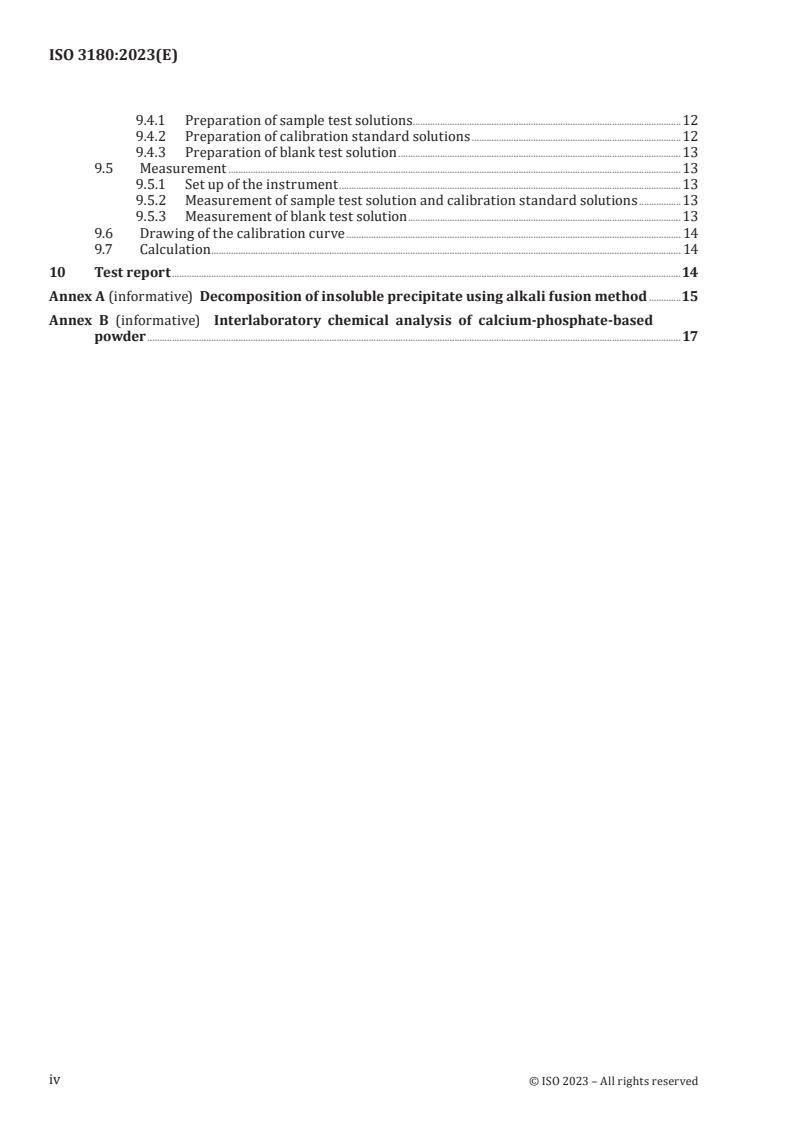
9.4.1 Preparation of sample test solutions .12
9.4.2 Preparation of calibration standard solutions .12
9.4.3 Preparation of blank test solution . 13
9.5 Measurement . 13
9.5.1 Set up of the instrument . 13
9.5.2 Measurement of sample test solution and calibration standard solutions .13
9.5.3 Measurement of blank test solution . 13
9.6 Drawing of the calibration curve . 14
9.7 Calculation . 14
10 Test report .14
Annex A (informative) Decomposition of insoluble precipitate using alkali fusion method .15
Annex B (informative) Interlaboratory chemical analysis of calcium-phosphate-based
powder .17
iv
Foreword
ISO (the International Organization for Standardization) is a worldwide federation of national standards
bodies (ISO member bodies). The work of preparing International Standards is normally carried out
through ISO technical committees. Each member body interested in a subject for which a technical
committee has been established has the right to be represented on that committee. International
organizations, governmental and non-governmental, in liaison with ISO, also take part in the work.
ISO collaborates closely with the International Electrotechnical Commission (IEC) on all matters of
electrotechnical standardization.
The procedures used to develop this document and those intended for its further maintenance are
described in the ISO/IEC Directives, Part 1. In particular, the different approval criteria needed for the
different types of ISO document should be noted. This document was drafted in accordance with the
editorial rules of the ISO/IEC Directives, Part 2 (see www.iso.org/directives).
ISO draws attention to the possibility that the implementation of this document may involve the use
of (a) patent(s). ISO takes no position concerning the evidence, validity or applicability of any claimed
patent rights in respect thereof. As of the date of publication of this document, ISO had not received
notice of (a) patent(s) which may be required to implement this document. However, implementers are
cautioned that this may not represent the latest information, which may be obtained from the patent
database available at www.iso.org/patents. ISO shall not be held responsible for identifying any or all
such patent rights.
Any trade name used in this document is information given for the convenience of users and does not
constitute an endorsement.
For an explanation of the voluntary nature of standards, the meaning of ISO specific terms and
expressions related to conformity assessment, as well as information about ISO's adherence to
the World Trade Organization (WTO) principles in the Technical Barriers to Trade (TBT), see
www.iso.org/iso/foreword.html.
This document was prepared by Technical Committee ISO/TC 206, Fine ceramics.
Any feedback or questions on this document should be directed to the user’s national standards body. A
complete listing of these bodies can be found at www.iso.org/members.html.
v
INTERNATIONAL STANDARD ISO 3180:2023(E)
Fine ceramics (advanced ceramics, advanced technical
ceramics) — Methods for chemical analysis of calcium-
phosphate-based powders for non-biomedical applications
1 Scope
This document specifies wet chemical and inductively coupled plasma–optical emission spectrometry
(ICP–OES)-based methods for the chemical analysis of calcium-phosphate-based powders for non-
biomedical applications, such as those in the chemical industry, the treatment of air, water and soil
contamination.
It stipulates the methods used for the determination of major elements of calcium-phosphate-
based powders and their impurities. Calcium-phosphate-based powders are decomposed by acid
decomposition. The calcium content is determined using a titration method or an ICP–OES method. The
phosphorus content is determined using a precipitation and gravimetric method or an ICP–OES method.
Certain impurities, such as aluminium, barium, chromium, copper, iron, magnesium, manganese, nickel,
potassium, selenium, silicon, sodium, strontium, titanium and zinc contents, are determined by an ICP–
OES method.
This document does not include calcium-phosphate-based powders for biomedical applications.
The ISO 13779 series characterizes hydroxyapatite powders for biomedical applications using
various methods, such as atomic absorption spectrometry (AAS), inductively coupled plasma–mass
spectrometry (ICP–MS) and flame atomic absorption spectrometry (FAAS).
2 Normative references
The following documents are referred to in the text in such a way that some or all of their content
constitutes requirements of this document. For dated references, only the edition cited applies. For
undated references, the latest edition of the referenced document (including any amendments) applies.
ISO 3696, Water for analytical laboratory use — Specification and test methods
ISO 6353-2, Reagents for chemical analysis — Part 2: Specifications — First series
ISO 8656-1, Refractory products — Sampling of raw materials and unshaped products — Part 1: Sampling
scheme
3 Terms and definitions
For the purposes of this document, the following terms and definitions apply.
ISO and IEC maintain terminology databases for use in standardization at the following addresses:
— ISO Online browsing platform: available at https:// www .iso .org/ obp
— IEC Electropedia: available at https:// www .electropedia .org/
3.1
calcium-phosphate-based powder
calcium phosphate powder with a small amount (not more than 1,0 % mass fraction) of each inorganic
element or impurity except calcium, phosphorous, oxygen and hydrogen
Note 1 to entry: Examples of calcium phosphate powders include tricalcium phosphate, octacalcium phosphate
and hydroxyapatite.
4 Analytical ranges
— Calcium (Ca), range of 30 % to 40 % (mass fraction).
— Phosphorus (P), range of 10 % to 20 % (mass fraction).
— Other analytes, range of 0,000 5 % to 1,0 % (mass fraction).
5 Preparation of test sample
5.1 General
Prepare the sample in accordance with ISO 8656-1, unless otherwise mutually agreed upon by the
analyst and customer.
5.2 Sampling
Collect the sample in accordance with ISO 8656-1.
5.3 Drying
Place 10 g of the sample into a flat-type weighing bottle and spread it uniformly at the bottom of
the bottle. Place the bottle for 2 h at 110 °C ± 5 °C, then cover the mouth of the bottle and cool it in a
desiccator for 1 h.
5.4 Weighing
Weigh the sample to the nearest 0,1 mg of the required quantity using a balance.
6 Reporting analytical values
6.1 Number of analyses
Prepare each sample twice and analyse them at intervals of time.
6.2 Blank test
Upon analysis, perform a blank test to correct the measured values. A double blank digestion is highly
recommended for the blank value determination.
6.3 Evaluation of analytical results
When the absolute difference between the two analytical results does not exceed the tolerance
(Table 1), the average value shall be reported. When the absolute difference between the two analytical
results exceeds the tolerance, perform two additional analyses. When the absolute difference of these
further two analyses does not exceed the tolerance, the average value thereof shall be reported. If the
difference also exceeds the tolerance, the median of four analytical results shall be reported.
Table 1 — Tolerances for two analytical results
Unit: % (mass fraction)
Analyte Range of results Tolerance
Ca, P – 0,1
Less than 0,01 % 0,001
Al, Ba, Cr, Cu, Fe, K, Mg, Mn,
Not less than 0,01 %, and less than 0,1 % 0,005
Na, Ni, Se, Si, Sr, Ti, Zn
Not less than 0,1 % 0,01
6.4 Expression of analytical results
Express the analytical results in % (mass fraction), in dryness.
a) Calcium and phosphorus: express the results to four significant digits, as required.
b) Others: express the results to four decimal places.
7 Decomposition of test sample
7.1 Reagents
It shall be ascertained that the reagents are of sufficiently high purity to permit their use without
compromising the accuracy of the determination.
7.1.1 Water, grade 1 or superior, as specified in ISO 3696.
7.1.2 Nitric acid (HNO ), 65 % min., as specified in ISO 6353-2 (R 19).
7.2 Apparatus
Use ordinary laboratory apparatus.
7.3 Procedure
7.3.1 Decomposition
Weigh 1,0 g of the test sample and transfer it to a 250 ml beaker. Add 10 ml of nitric acid (7.1.2) to the
beaker. Cover the beaker with a watch-glass and heat it at 180 °C ± 5 °C on a hot plate until the test
sample dissolves completely. Remove the beaker from the hot plate and cool it to room temperature.
If the precipitate falls out of the solution after the decomposition procedure, an additional process (e.g.
alkali fusion method) is necessary for decomposing the insoluble salt (see Annex A).
7.3.2 Dilution
After cooling, transfer the solution to a 250 ml volumetric flask. Rinse the inner wall of the beaker and
the watch-glass with a small quantity of water and put the washings into the flask. Dilute with water up
to the mark and mix well. This solution is designated the sample solution.
7.4 Blank test
Perform the operation described in 7.3 without sample. The resulting solution is designated as blank
solution.
8 Determination of phosphorus and calcium contents
8.1 Classification of determination methods
Method A: Precipitation and gravimetric method (for phosphorus).
Method B: Titration method (for calcium).
Method C: ICP–OES method (for phosphorus and calcium).
Analytical results of interlaboratory study for chemical analysis of calcium-phosphate-based powder
are described in Annex B.
8.2 Precipitation and gravimetric method (for phosphorus)
8.2.1 Principle
Phosphorus (P) in the sample solution is precipitated as quinoline phosphomolybdate
[(C H NH) PO · 12MoO ] by the addition of citromolybdate quinoline solution. After filtering, the mass
9 7 3 4 3
of the precipitate is measured. The content of phosphorus is calculated from the mass of the quinoline
phosphomolybdate.
8.2.2 Reagents
Use the reagents described in 7.1 together with the following.
8.2.2.1 Citromolybdate quinoline solution.
Dissolve 70 g of sodium molybdate dihydrate (Na MoO ·2H O) in 150 ml of water in a 250 ml beaker
2 4 2
(solution A).
Dissolve 60 g of citric acid monohydrate (C H O ·H O) in 150 ml of water in a 250 ml beaker, then add
6 8 7 2
85 ml of nitric acid (solution B).
Pour solution A and solution B into a 1 000 ml beaker and mix well (solution C).
Add 35 ml of nitric acid and 5 ml of recently distilled quinoline (C H N) to 100 ml of water in a 250 ml
9 7
beaker (solution D).
Pour solution C and solution D into a 1 000 ml beaker and mix well. Leave the solution undisturbed for
at least 12 h. Filter the solution using a filter paper. Add 280 ml of acetone (C H O) to the filtrate and
3 6
transfer it to a 1 000 ml volumetric flask. Dilute with water up to the mark and mix well.
Store the solution protected from light in a well-stoppered flask. Do not keep the solution for more than
1 week.
8.2.3 Apparatus
Use ordinary laboratory apparatus together with the following:
8.2.3.1 Sintered glass filter crucible, of porosity P10 (pore size between 4 μm and 10 μm).
Heat the filter crucible in an air bath controlled at 220 °C ± 20 °C and leave for 15 min after the
temperature stabilizes. Cool to room temperature in a desiccator containing silica gel.
8.2.3.2 Air bath, capable of heating at 250 °C ± 5 °C.
8.2.4 Procedure
Transfer 25,0 ml of the sample solution (7.3.2) into a 250 ml beaker. Add 100 ml of citromolybdate
quinoline solution (8.2.2.1) and heat the beaker on a hot plate at 75 °C ± 5 °C for 1 h. Remove the beaker
from the hot plate. Cool the solution to room temperature, stirring three or four times with a glass rod.
Decant the solution through the filter crucible (8.2.3.1). Store the filtrates and the washings for the
measurement of calcium content. This solution is designated the sample test solution for the titration
(8.3).
Wash the precipitate six times with approximately 30 ml of water each time. Place the filter crucible and
the precipitate in the air bath (8.2.3.2) at 85 °C ± 5 °C until completely dry. Cool to room temperature in
a desiccator and weigh to the nearest 0,1 mg.
8.2.5 Blank test
Perform the procedure described in 8.2.4 with the blank solution (7.4).
8.2.6 Calculation
Calculate phosphorus content, W , expressed as a percentage mass fraction, using Formula (1).
P
()mm−
SB
W = ××F ×100 (1)
P
m 25
where
W is the phosphorus content, in per cent (mass fraction);
P
m is the mass of the test sample (7.3), in g;
m is the mass of the precipitate in the sample test solution (8.2.4), in g;
S
m is the mass of the precipitate in the blank test solution (8.2.5), in g;
B
F is the conversion factor from quinoline phosphomolybdate [(C H NH) PO · 12MoO ] to
9 7 3 4 3
phosphorus (P) (= 0,014).
8.3 Titration method (for calcium)
8.3.1 Principle
Calcium (Ca) in the sample solution is precipitated as calcium oxalate (CaC O ) by the addition of
2 4
ammonium oxalate solution. After filtering, the solution is titrated with potassium permanganate. The
content of calcium is calculated from the volume of the titrant at the endpoint.
8.3.2 Reagents
It shall be ascertained that the reagents are of sufficiently high purity to permit their use without
compromising the accuracy of the determination.
8.3.2.1 Water, grade 1 or superior, as specified in ISO 3696.
8.3.2.2 Ammonium chloride (NH Cl), 99,5 % min., as specified in ISO 6353-2 (R 5).
8.3.2.3 Ammonia solution (NH OH), 25 % min., as specified in ISO 6353-2 (R 3).
8.3.2.4 Ammonium oxalate (C H N O ).
2 8 2 4
...
記事のタイトル:ISO 3180:2023 - 素晴らしいセラミック(先進的なセラミック、先進的な技術セラミック)-非バイオメディカル用途のリン酸カルシウムベースの粉末の化学分析方法 記事の内容:この文書は、化学産業、大気、水および土壌の浄化などの非バイオメディカル用途で使用されるリン酸カルシウムベースの粉末の化学分析のための湿式化学法および誘導結合プラズマ-光放射分光法(ICP-OES)に基づく方法を規定しています。リン酸カルシウムベースの粉末の主要元素と不純物の定量に使用される方法を規定しています。リン酸カルシウムベースの粉末は酸分解により分解されます。カルシウム含量は滴定法またはICP-OES法を使用して測定されます。リン含量は沈殿および重量測定法またはICP-OES法を使用して測定されます。アルミニウム、バリウム、クロム、銅、鉄、マグネシウム、マンガン、ニッケル、カリウム、セレン、ケイ素、ナトリウム、ストロンチウム、チタニウム、亜鉛などの特定の不純物はICP-OES法によって測定されます。この文書にはバイオメディカル用途に使用されるリン酸カルシウムベースの粉末は含まれていません。ISO 13779シリーズは、原子吸光分光法(AAS)、誘導結合プラズマ-質量分析法(ICP-MS)、炎原子吸光分光法(FAAS)などさまざまな方法を使用してバイオメディカル用途に使用される水酸化アパタイト粉末を特徴付けています。
기사 제목: ISO 3180:2023 - 미생물 의약품을 위한 화학적 분석 방법에 대한 미세 세라믹 (고급 세라믹, 고급 기술 세라믹) - 비생체 응용을 위한 포스페이트 기반 분말에 대한 화학적 분석 방법 기사 내용: 이 문서는 미생물 응용에 사용되지 않는 화학 산업, 대기, 수 및 토양 오염 처리와 같은 비생체 응용분야에 사용되는 포스페이트 기반 분말의 화학분석을 위한 적실 법 및 유도 결합 플라즈마-광전자 분광법 (ICP-OES) 기반 방법을 지정합니다. 이 문서는 칼슘-인산염 기반 분말의 주요 원소와 불순물의 결정에 사용되는 방법을 규정합니다. 칼슘-인산염 기반 분말은 산분해에 의해 분해됩니다. 칼슘 함량은 적산법이나 ICP-OES 방법을 사용하여 결정됩니다. 인 함량은 침전과 중량법 또는 ICP-OES 방법을 사용하여 결정됩니다. ICP-OES 방법을 사용하여 알루미늄, 바륨, 크롬, 구리, 철, 마그네슘, 망간, 니켈, 포타슘, 셀레늄, 실리콘, 나트륨, 스트론튬, 티타늄 및 아연과 같은 특정 불순물의 함량이 결정됩니다. 이 문서에는 의약품 응용분야에 사용되는 칼슘-인산염 기반 분말은 포함되어 있지 않습니다. ISO 13779 시리즈는 원자 흡수 분광법 (AAS), 유도 결합 플라즈마-질량 분석법 (ICP-MS) 및 화염 원자 흡수 분광법 (FAAS)와 같은 다양한 방법을 사용하여 의약품 응용 분야에 사용되는 수화아파타이트 분말을 특징화합니다.
記事のタイトル:ISO 3180:2023 - 磁器 (先進セラミックス、先進技術セラミックス) - 非生体医療応用向けのリン・リン酸カルシウムベースの粉末の化学分析方法 記事の内容:この文書は、非生体医療応用向けのリン・リン酸カルシウムベースの粉末の化学分析のための湿式化学法および誘導結合プラズマ-光電子分光法(ICP-OES)に基づく方法を規定しています。化学工業や大気、水、土壌の処理などの非医療応用分野で使用される粉末に適用されます。この文書では、リン・リン酸カルシウムベースの粉末の主要成分および不純物の決定に使用される方法を明記しています。カルシウム含有量は滴定法またはICP-OES法によって決定され、リン含有量は沈殿および重量法またはICP-OES法によって決定されます。アルミニウム、バリウム、クロム、銅、鉄、マグネシウム、マンガン、ニッケル、カリウム、セレン、ケイ素、ナトリウム、ストロンチウム、チタン、亜鉛などの特定の不純物はICP-OES法によって決定されます。ただし、本文書は生体医療応用向けのリン・リン酸カルシウムベースの粉末は含まれません。ISO 13779シリーズでは、各種の方法(原子吸光分光法(AAS)、誘導結合プラズマ-質量分析法(ICP-MS)、炎原子吸光分光法(FAAS)など)を使用して、生体医療応用向けのハイドロキシアパタイト粉末を特性化しています。
The article discusses the ISO 3180:2023 standard, which provides methods for the chemical analysis of calcium-phosphate-based powders used in non-biomedical applications. These powders are used in industries such as chemicals, air and water treatment, and soil contamination. The standard specifies wet chemical and ICP–OES-based methods for analyzing the major elements and impurities in these powders. The calcium and phosphorus content are determined using titration or ICP-OES methods. Impurities like aluminum, barium, chromium, copper, iron, magnesium, manganese, nickel, potassium, selenium, silicon, sodium, strontium, titanium, and zinc are also analyzed using ICP-OES. However, the standard does not cover calcium-phosphate-based powders used in biomedical applications, which are analyzed according to the ISO 13779 series using different methods such as AAS, ICP-MS, and FAAS.
기사 제목: ISO 3180:2023 - 세라믹 (고급 세라믹, 고급 기술 세라믹) - 비생체 응용용 칼슘인산염 기반 분말의 화학 분석 방법 기사 내용: 본 문서는 비생체 응용용 칼슘인산염 기반 분말의 화학 분석을 위한 물화학 및 유도 결합 플라스마-광전자 스펙트로메트리 (ICP-OES) 기반 방법을 명시한다. 이 방법은 화학 산업, 대기, 수질 및 토양 오염 처리 등 비생체 응용 분야에서 사용하는 분말에 적용된다. 이 문서는 칼슘인산염 기반 분말의 주요 성분 및 불순물 결정에 사용되는 방법을 규정하고 있다. 칼슘인산염 기반 분말은 산 분해에 의해 분해되며, 칼슘 함량은 적정법 또는 ICP-OES 방법을 통해 결정된다. 인 분량은 침전 및 중량법 또는 ICP-OES 방법을 통해 결정된다. 알루미늄, 바륨, 크롬, 구리, 철, 마그네슘, 망간, 니켈, 포타슘이, 셀레늄, 실리콘, 나트륨, 스트론튬, 티타늄 및 아연과 같은 특정 불순물은 ICP-OES 방법을 통해 결정된다. 이 문서에는 의료 생체 응용용 칼슘인산염 분말은 포함되어 있지 않다. ISO 13779 시리즈는 원자 흡광분광법 (AAS), 유도 결합 플라스마-질량분석법 (ICP-MS) 및 화염 원자흡수분광법 (FAAS) 등 다양한 방법을 사용하여 의료 생체 응용용 수산화칼슘 분말을 특성화한다.
ISO 3180:2023 is a standard that specifies wet chemical and inductively coupled plasma–optical emission spectrometry (ICP–OES) methods for the chemical analysis of calcium-phosphate-based powders. This standard applies to powders used in non-biomedical applications, such as those in the chemical industry and for treating air, water, and soil contamination. The document outlines the methods for determining the major elements and impurities in these powders. Acid decomposition is used to decompose the powders, and the calcium content can be determined through titration or ICP–OES methods. The phosphorus content can be determined through precipitation and gravimetric methods or an ICP–OES method. Impurities like aluminium, barium, chromium, copper, iron, magnesium, manganese, nickel, potassium, selenium, silicon, sodium, strontium, titanium, and zinc can be determined through the ICP–OES method. It is important to note that this standard does not cover calcium-phosphate-based powders for biomedical applications. For biomedical applications, the ISO 13779 series provides different methods like atomic absorption spectrometry (AAS), inductively coupled plasma–mass spectrometry (ICP–MS), and flame atomic absorption spectrometry (FAAS) to characterize hydroxyapatite powders.
Questions, Comments and Discussion
Ask us and Technical Secretary will try to provide an answer. You can facilitate discussion about the standard in here.
Loading comments...