


ISO/TS 4676:2022
(Main)Coal - Determination of carboxyreactivity
Coal - Determination of carboxyreactivity
This document specifies the method for determining the reactivity of coal with carbon dioxide (carboxyreactivity). It can be applied to determine the reactivity of coke for the purpose of gasification and combustion.
Charbon — Détermination de la carboxyréactivité
General Information
Overview
ISO/TS 4676:2022 - Coal - Determination of carboxyreactivity - specifies a laboratory method to measure the reactivity of coal (and coke) with carbon dioxide (CO2), commonly called carboxyreactivity. The technique quantifies the ability of coal/coke to convert CO2 to CO under controlled heating and gas-flow conditions. Results help evaluate coal quality for coal gasification, combustion, and related processes such as indirect liquefaction.
Key topics and requirements
- Scope: Applicable to coal and coke for gasification/combustion purposes; integrates/modifies GB/T 220.
- Principle: Carbonize a 3–6 mm coal fraction (except coke), place the coke residue in a high‑temperature reaction tube, pass CO2 at a controlled flow rate and temperature program, and measure residual CO using a gas analyser. Calculate the fraction α (%) of CO produced as the carboxyreactivity index.
- Sample preparation:
- Test fraction: 3 mm to 6 mm (prepared per ISO 13909‑4 and ISO 18283).
- Carbonization: dry distillation at (900 ± 20) °C for 1 h to remove volatiles (not required for coke).
- Apparatus & reagents:
- Reaction furnace and reaction tube capable to 1 100–1 300 °C, Pt/Rh thermocouple, flowmeter, CO cylinder (≥98 %), gas analyser (IR spectrometer or gas chromatograph allowable).
- Reagents like anhydrous CaCl2, H2SO4, KOH/NaOH solution for gas washing/drying.
- Procedure highlights:
- Typical CO2 flow rate: 500 ml/min (adjusted per Annex A for pressure/temperature).
- Start temperatures: ~750 °C for brown coals/lignites, ~800 °C for bituminous/anthracite; measurements taken at 50 °C increments up to 1 100 °C (or 1 300 °C if required).
- Duplicate determinations are required; results rounded to 0.1 %.
- Result expression:
- Compute α (%) from measured CO volume fraction; plot α versus temperature to produce a reactivity curve.
- Reporting & precision:
- Test report must identify the sample, method (ISO/TS 4676:2022), date and results.
- Repeatability and reproducibility limits to be provided after interlaboratory studies.
Applications
- Evaluating coals and cokes for gasification plant feedstock selection.
- Assessing reactivity parameters for combustion optimization and process modelling.
- Supporting coal trading and quality control where CO2 reactivity affects process efficiency and gas composition.
- Research into coal conversion kinetics and comparative fuel performance.
Who should use this standard
- Coal testing laboratories and quality-control units.
- Gasification and combustion plant engineers.
- Coke producers assessing feedstock reactivity.
- Researchers and consultants working on coal conversion technologies.
Related standards
- ISO 1213‑2 (vocabulary - sampling, testing, analysis)
- ISO 18283 (manual sampling of coal and coke)
- ISO 13909‑4 (mechanical sampling - test sample preparation)
Keywords: ISO/TS 4676:2022, coal carboxyreactivity, determination of carboxyreactivity, CO2 reactivity, coal gasification, coke reactivity, gas analysis.
Standards Content (Sample)
TECHNICAL ISO/TS
SPECIFICATION 4676
First edition
2022-07
Coal — Determination of
carboxyreactivity
Charbon — Détermination de la carboxyréactivité
Reference number
© ISO 2022
All rights reserved. Unless otherwise specified, or required in the context of its implementation, no part of this publication may
be reproduced or utilized otherwise in any form or by any means, electronic or mechanical, including photocopying, or posting on
the internet or an intranet, without prior written permission. Permission can be requested from either ISO at the address below
or ISO’s member body in the country of the requester.
ISO copyright office
CP 401 • Ch. de Blandonnet 8
CH-1214 Vernier, Geneva
Phone: +41 22 749 01 11
Email: copyright@iso.org
Website: www.iso.org
Published in Switzerland
ii
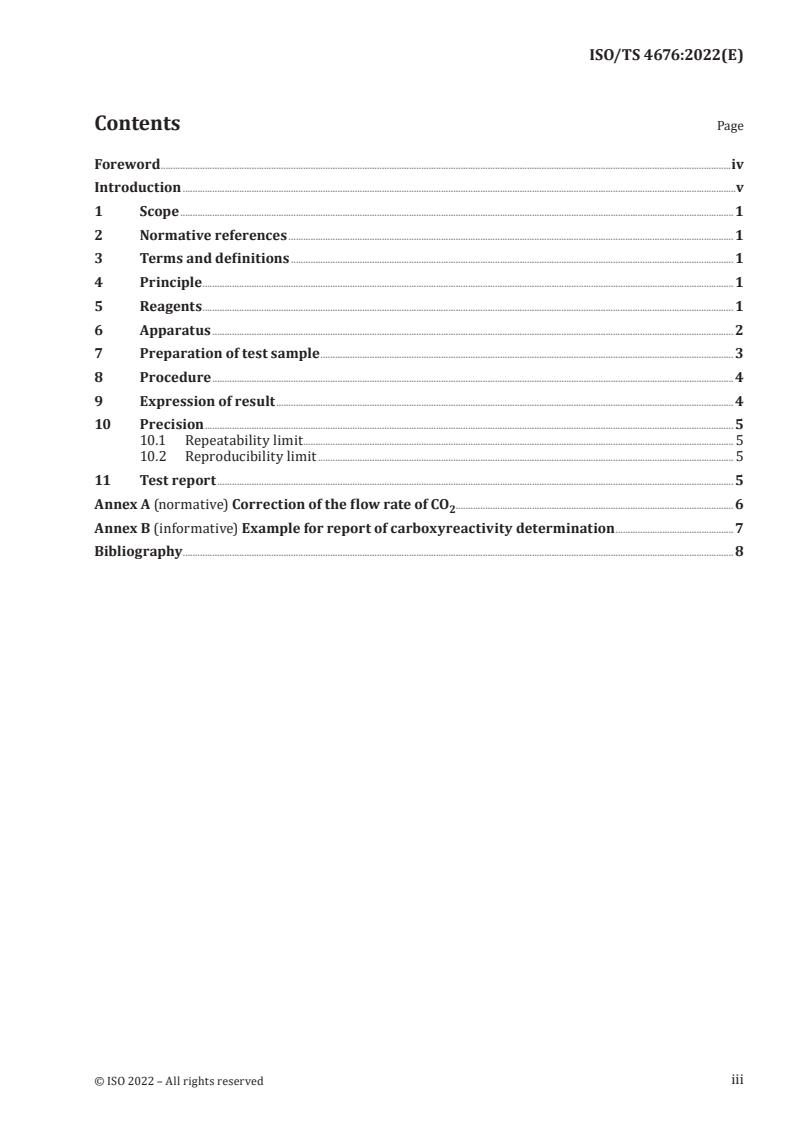
Contents Page
Foreword .iv
Introduction .v
1 Scope . 1
2 Normative references . 1
3 Terms and definitions . 1
4 Principle . 1
5 Reagents . 1
6 Apparatus . 2
7 Preparation of test sample . 3
8 Procedure .4
9 Expression of result . 4
10 Precision . 5
10.1 Repeatability limit . 5
10.2 Reproducibility limit . 5
11 Test report . 5
Annex A (normative) Correction of the flow rate of CO . 6
Annex B (informative) Example for report of carboxyreactivity determination .7
Bibliography . 8
iii
Foreword
ISO (the International Organization for Standardization) is a worldwide federation of national standards
bodies (ISO member bodies). The work of preparing International Standards is normally carried out
through ISO technical committees. Each member body interested in a subject for which a technical
committee has been established has the right to be represented on that committee. International
organizations, governmental and non-governmental, in liaison with ISO, also take part in the work.
ISO collaborates closely with the International Electrotechnical Commission (IEC) on all matters of
electrotechnical standardization.
The procedures used to develop this document and those intended for its further maintenance are
described in the ISO/IEC Directives, Part 1. In particular the different approval criteria needed for the
different types of ISO documents should be noted. This document was drafted in accordance with the
editorial rules of the ISO/IEC Directives, Part 2 (see www.iso.org/directives).
Attention is drawn to the possibility that some of the elements of this document may be the subject of
patent rights. ISO shall not be held responsible for identifying any or all such patent rights. Details of
any patent rights identified during the development of the document will be in the Introduction and/or
on the ISO list of patent declarations received (see www.iso.org/patents).
Any trade name used in this document is information given for the convenience of users and does not
constitute an endorsement.
For an explanation on the voluntary nature of standards, the meaning of ISO specific terms and
expressions related to conformity assessment, as well as information about ISO's adherence to the
World Trade Organization (WTO) principles in the Technical Barriers to Trade (TBT) see the following
URL: www.iso.org/iso/foreword.html.
This document was prepared by Technical Committee ISO/TC 27, Coal and Coke, Subcommittee SC 5,
Methods of analysis.
iv
Introduction
Coal gasification is an important technology for clean coal conversion, which involves many factors.
The chemical reactivity of coal is one of the essential parameters for the gasification industry and its
relevant coal trade.
The chemical reactivity of coal with CO (carboxyreactivity of coal) is a measurement of the coal’s ability
to reduce CO to CO, which is an important parameter of evaluating the coal quality for gasification and
combustion industry. The level of carboxyreactivity of coal is directly related to other characteristics
of the coal in the gasification or combustion furnace like the reactive extent, the reaction speed and
efficiency, the consumption of coal and oxygen, the effective compositions of the coal gas, so it is not
only used for evaluating the applicability of coal for gasification, combustion, indirect liquefaction, etc.,
but also for guiding users to select coal used for above technologies.
[2]
This document integrates and modifies GB/T 220 to specify a method for determining the reactivity
of coal with carbon dioxide (carboxyreactivity). It can also be applied to determine the reactivity of
coke for the purpose of gasification and combustion.
v
TECHNICAL SPECIFICATION ISO/TS 4676:2022(E)
Coal — Determination of carboxyreactivity
1 Scope
This document specifies the method for determining the reactivity of coal with carbon dioxide
(carboxyreactivity). It can be applied to determine the reactivity of coke for the purpose of gasification
and combustion.
2 Normative references
The following documents are referred to in the text in such a way that some or all of their content
constitutes requirements of this document. For dated references, only the edition cited applies. For
undated references, the latest edition of the referenced document (including any amendments) applies.
ISO 1213-2, Solid mineral fuels — Vocabulary — Part 2: Terms relating to sampling, testing and analysis
ISO 18283, Coal and coke — Manual sampling
ISO 13909-4, Hard coal and coke — Mechanical sampling — Part 4: Coal — Preparation of test samples
3 Terms and definitions
For the purposes of this document, the terms and definitions given in ISO 1213-2 apply.
ISO and IEC maintain terminological databases for use in standardization at the following addresses:
— ISO Online browsing platform: available at https:// www .iso .org/ obp
— IEC Electropedia: available at https:// www .electropedia .org/
4 Principle
A coal sample with the size fraction of 3 mm to 6 mm is carbonized in a dry distillation furnace to
remove the volatile matter (this is not necessary for coke samples). Sieve and collect a portion of the
carbonized products (coke residue) with the designated size. Put them into the reaction tube and heat
to the specified rates. When the required temperature is achieved, pass CO gas through the reaction
tube at a uniform flow rate. Determine the volume fraction of residual CO in the gases by a gas analyser
at the specified time of passing CO gas. Calculate the ratio α (%) of CO gas being reduced to CO and
2 2
take it as the index of the carboxyreactivity at the specified temperature.
5 Reagents
Unless otherwise specified, all reagents shall be of analytical reagent grade, and only distilled water, or
water of equivalent purity, shall be used.
5.1 Anhydrous calcium chloride.
5.2 Sulfuric acid, relative density, ρ = 1,84.
5.3 Potassium hydroxide or sodium hydroxide solution, 500 g/l.
Dissolve 50 g of potassium hydroxide or sodium hydroxide in 100 ml of distilled water.
...
Frequently Asked Questions
ISO/TS 4676:2022 is a technical specification published by the International Organization for Standardization (ISO). Its full title is "Coal - Determination of carboxyreactivity". This standard covers: This document specifies the method for determining the reactivity of coal with carbon dioxide (carboxyreactivity). It can be applied to determine the reactivity of coke for the purpose of gasification and combustion.
This document specifies the method for determining the reactivity of coal with carbon dioxide (carboxyreactivity). It can be applied to determine the reactivity of coke for the purpose of gasification and combustion.
ISO/TS 4676:2022 is classified under the following ICS (International Classification for Standards) categories: 73.040 - Coals; 75.160.10 - Solid fuels. The ICS classification helps identify the subject area and facilitates finding related standards.
You can purchase ISO/TS 4676:2022 directly from iTeh Standards. The document is available in PDF format and is delivered instantly after payment. Add the standard to your cart and complete the secure checkout process. iTeh Standards is an authorized distributor of ISO standards.
Questions, Comments and Discussion
Ask us and Technical Secretary will try to provide an answer. You can facilitate discussion about the standard in here.
Loading comments...