


ISO/TS 15143-3:2016
(Main)Earth-moving machinery and mobile road construction machinery — Worksite data exchange — Part 3: Telematics data
Earth-moving machinery and mobile road construction machinery — Worksite data exchange — Part 3: Telematics data
ISO 15143-3:2016 specifies the communication schema designed to provide mobile machinery status data from a telematics provider's server to third-party client applications via the Internet. The data are collected from a mobile machine using telematics data-logging equipment and stored on a telematics provider's server. This document describes the communications records used to request data from the server and the responses from the server containing specified data elements to be used in the analysis of machine performance and health.
Engins de terrassement et machines mobiles de construction de routes — Échange de données sur le chantier — Partie 3: Données télématiques
General Information
- Status
- Withdrawn
- Publication Date
- 27-Nov-2016
- Withdrawal Date
- 27-Nov-2016
- Current Stage
- 9599 - Withdrawal of International Standard
- Start Date
- 29-Jan-2020
- Completion Date
- 12-Feb-2026
Relations
- Effective Date
- 07-Jul-2018

Get Certified
Connect with accredited certification bodies for this standard

BSI Group
BSI (British Standards Institution) is the business standards company that helps organizations make excellence a habit.

NYCE
Mexican standards and certification body.
Sponsored listings
Frequently Asked Questions
ISO/TS 15143-3:2016 is a technical specification published by the International Organization for Standardization (ISO). Its full title is "Earth-moving machinery and mobile road construction machinery — Worksite data exchange — Part 3: Telematics data". This standard covers: ISO 15143-3:2016 specifies the communication schema designed to provide mobile machinery status data from a telematics provider's server to third-party client applications via the Internet. The data are collected from a mobile machine using telematics data-logging equipment and stored on a telematics provider's server. This document describes the communications records used to request data from the server and the responses from the server containing specified data elements to be used in the analysis of machine performance and health.
ISO 15143-3:2016 specifies the communication schema designed to provide mobile machinery status data from a telematics provider's server to third-party client applications via the Internet. The data are collected from a mobile machine using telematics data-logging equipment and stored on a telematics provider's server. This document describes the communications records used to request data from the server and the responses from the server containing specified data elements to be used in the analysis of machine performance and health.
ISO/TS 15143-3:2016 is classified under the following ICS (International Classification for Standards) categories: 35.240.99 - IT applications in other fields; 53.100 - Earth-moving machinery. The ICS classification helps identify the subject area and facilitates finding related standards.
ISO/TS 15143-3:2016 has the following relationships with other standards: It is inter standard links to ISO/TS 15143-3:2020. Understanding these relationships helps ensure you are using the most current and applicable version of the standard.
ISO/TS 15143-3:2016 is available in PDF format for immediate download after purchase. The document can be added to your cart and obtained through the secure checkout process. Digital delivery ensures instant access to the complete standard document.
Standards Content (Sample)
TECHNICAL ISO/TS
SPECIFICATION 15143-3
First edition
2016-12-01
Earth-moving machinery and mobile
road construction machinery —
Worksite data exchange —
Part 3:
Telematics data
Engins de terrassement et machines mobiles de construction de
routes — Échange de données sur le chantier —
Partie 3: Données télématiques
Reference number
©
ISO 2016
© ISO 2016, Published in Switzerland
All rights reserved. Unless otherwise specified, no part of this publication may be reproduced or utilized otherwise in any form
or by any means, electronic or mechanical, including photocopying, or posting on the internet or an intranet, without prior
written permission. Permission can be requested from either ISO at the address below or ISO’s member body in the country of
the requester.
ISO copyright office
Ch. de Blandonnet 8 • CP 401
CH-1214 Vernier, Geneva, Switzerland
Tel. +41 22 749 01 11
Fax +41 22 749 09 47
copyright@iso.org
www.iso.org
ii © ISO 2016 – All rights reserved
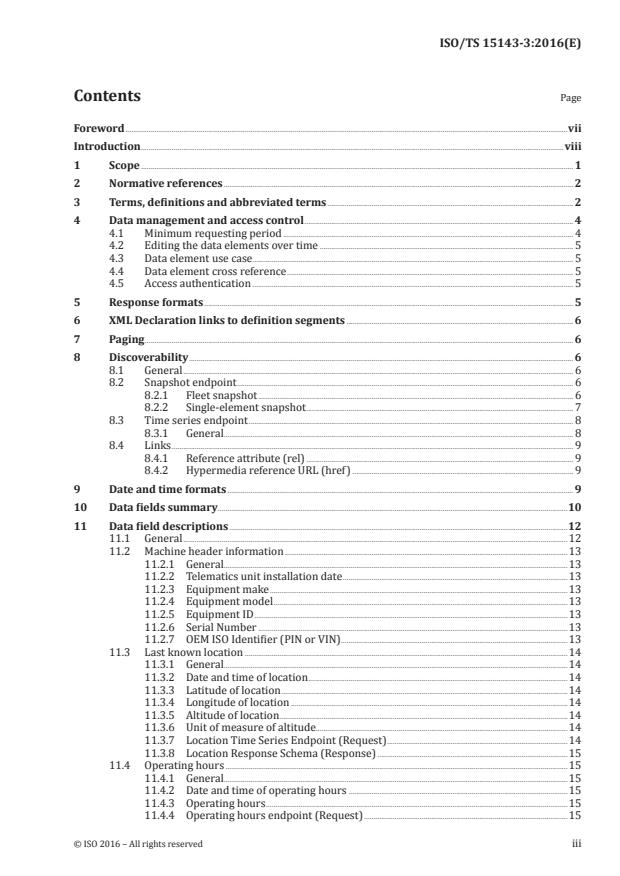
Contents Page
Foreword .vii
Introduction .viii
1 Scope . 1
2 Normative references . 2
3 Terms, definitions and abbreviated terms . 2
4 Data management and access control . 4
4.1 Minimum requesting period . 4
4.2 Editing the data elements over time . 5
4.3 Data element use case . 5
4.4 Data element cross reference . 5
4.5 Access authentication . 5
5 Response formats . 5
6 XML Declaration links to definition segments . 6
7 Paging . 6
8 Discoverability . 6
8.1 General . 6
8.2 Snapshot endpoint . 6
8.2.1 Fleet snapshot . 6
8.2.2 Single-element snapshot . 7
8.3 Time series endpoint . 8
8.3.1 General. 8
8.4 Links . 9
8.4.1 Reference attribute (rel) . 9
8.4.2 Hypermedia reference URL (href) . 9
9 Date and time formats . 9
10 Data fields summary .10
11 Data field descriptions .12
11.1 General .12
11.2 Machine header information .13
11.2.1 General.13
11.2.2 Telematics unit installation date .13
11.2.3 Equipment make .13
11.2.4 Equipment model .13
11.2.5 Equipment ID .13
11.2.6 Serial Number .13
11.2.7 OEM ISO Identifier (PIN or VIN).13
11.3 Last known location .14
11.3.1 General.14
11.3.2 Date and time of location .14
11.3.3 Latitude of location .14
11.3.4 Longitude of location .14
11.3.5 Altitude of location . .14
11.3.6 Unit of measure of altitude.14
11.3.7 Location Time Series Endpoint (Request) .14
11.3.8 Location Response Schema (Response) .15
11.4 Operating hours .15
11.4.1 General.15
11.4.2 Date and time of operating hours .15
11.4.3 Operating hours .15
11.4.4 Operating hours endpoint (Request) .15
11.4.5 Operating hours schema (Response) .16
11.5 Cumulative fuel used (preferred).16
11.5.1 General.16
11.5.2 Date and time of cumulative fuel used .16
11.5.3 Unit of measure of fuel used to date .16
11.5.4 Amount of fuel used to date .16
11.5.5 Cumulative fuel used endpoint (Request) .17
11.5.6 Cumulative fuel used schema (Response) .17
11.6 Fuel used in the preceding 24 hours (alternative, not preferred) .17
11.6.1 General.17
11.6.2 Date and time of fuel use in the preceding 24 hours .17
11.6.3 Unit of measure of fuel used in the preceding 24 hours .18
11.6.4 Fuel used in the preceding 24 hours .18
11.6.5 Fuel used in the preceding 24 hours endpoint (Request) .18
11.6.6 Fuel used in the preceding 24 hours schema (response) .18
11.7 C umulative distance travelled .18
11.7.1 General.18
11.7.2 Date and time of distance .19
11.7.3 Unit of measure of distance .19
11.7.4 Cumulative distance travelled .19
11.7.5 Cumulative distance travelled endpoint (Request) .19
11.7.6 Cumulative distance travelled schema (response) .19
11.8 Caution codes referencing number .20
11.8.1 General.20
11.8.2 Date and time of code .20
11.8.3 IEC/ISO Symbol Reference Number identifier .20
11.8.4 Code description .20
11.8.5 Caution codes referencing number endpoint (Request) .20
11.8.6 Caution codes referencing number schema (response) .20
11.9 Cumulative idle operating hours .21
11.9.1 General.21
11.9.2 Date and time of cumulative idle operating hours .21
11.9.3 Cumulative idle operating hours .21
11.9.4 Cumulative idle operating hours endpoint (Request) .21
11.9.5 Cumulative idle operating hours schema (response) .22
11.10 Fuel remaining ratio .22
11.10.1 General.22
11.10.2 Date and time of percent fuel remaining .22
11.10.3 Fuel Remaining Ratio .22
11.10.4 Unit of measure for fuel tank capacity .22
11.10.5 Fuel tank capacity .22
11.10.6 Fuel remaining ratio endpoint (Request) .23
11.10.7 Fuel remaining ratio schema (response) .23
11.11 Percent of DEF remaining .23
11.11.1 General.23
11.11.2 Date and time of percent DEF remaining .23
11.11.3 Percent of DEF remaining .23
11.11.4 Unit of measure for DEF tank capacity .24
11.11.5 DEF tank capacity . . .24
11.11.6 Percent DEF remaining endpoint (Request) .24
11.11.7 Percent DEF remaining schema (response) .24
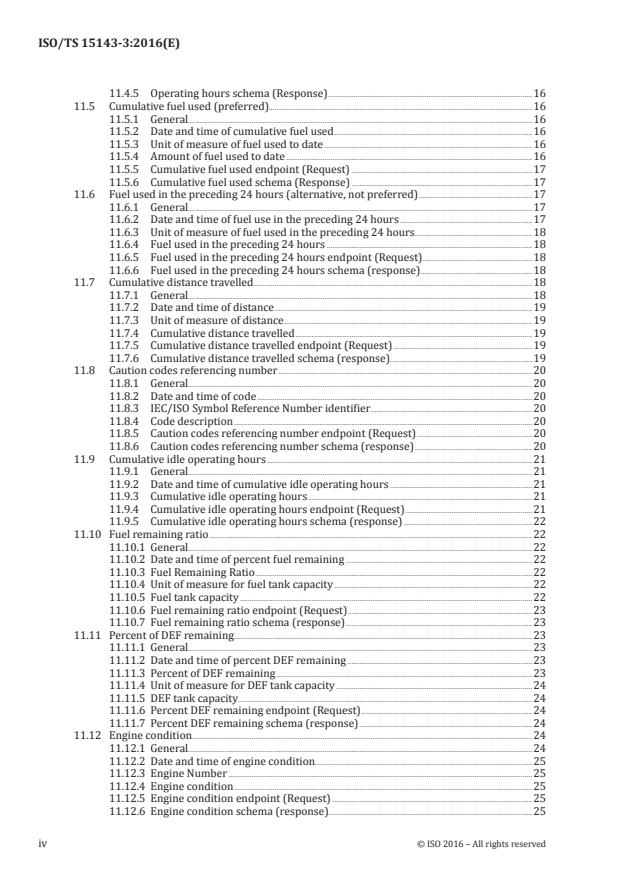
11.12 Engine condition.24
11.12.1 General.24
11.12.2 Date and time of engine condition.25
11.12.3 Engine Number .25
11.12.4 Engine condition .25
11.12.5 Engine condition endpoint (Request) .25
11.12.6 Engine condition schema (response).25
iv © ISO 2016 – All rights reserved
11.13 Digital input state .25
11.13.1 General.25
11.13.2 Date and time of digital input set response .26
11.13.3 Digital input number .26
11.13.4 1Digital input state . . .26
11.13.5 Digital input state endpoint (Request) .26
11.13.6 Digital input state schema (response) .26
11.14 Cumulative power takeoff hours .27
11.14.1 General.27
11.14.2 Date and time of cumulative power takeoff.27
11.14.3 Cumulative power takeoff hours .27
11.14.4 Cumulative power takeoff hours endpoint (Request) .27
11.14.5 Cumulative power takeoff hours schema (response) .27
11.15 A verage daily engine load factor .28
11.15.1 General.28
11.15.2 Date and time of average load factor .28
11.15.3 Average load factor for preceding 24 hour period .28
11.15.4 Average daily engine load factor endpoint (Request).28
11.15.5 Average daily engine load factor schema (response) .28
11.16 Peak daily speed .29
11.16.1 General.29
11.16.2 Date and time of peak travel speed .29
11.16.3 Units of measure for speed .29
11.16.4 Peak speed for the preceding 24 h .29
11.16.5 Peak daily speed endpoint (Request) .29
11.16.6 Peak daily speed schema (response) .29
11.17 Cumulative load count .30
11.17.1 General.30
11.17.2 Date and time of load count .30
11.17.3 Cumulative load count .30
11.17.4 Cumulative load count endpoint (Request) .30
11.17.5 Cumulative load count schema (response) .30
11.18 Cumulative payload total .31
11.18.1 General.31
11.18.2 Date and time of cumulative payload .31
11.18.3 Unit of measure for payload .31
11.18.4 Cumulative payload .31
11.18.5 Cumulative payload total endpoint (Request) .31
11.18.6 Cumulative payload total schema (response) .31
11.19 C umulative non-productive regeneration hours .32
11.19.1 General.32
11.19.2 Date and time for cumulative non-productive regeneration hours .32
11.19.3 Cumulative non-productive regeneration hours .32
11.19.4 Cumulative hours in non-productive regeneration endpoint (Request) .32
11.19.5 Cumulative hours in non-productive regeneration schema (response) .33
11.20 Cumulative idle non-operating hours .33
11.20.1 General.33
11.20.2 Date and time of cumulative idle nonoperating hours.33
11.20.3 Cumulative idle non-operating hours .33
11.20.4 Cumulative idle non-operating hours endpoint (Request) .33
11.20.5 Cumulative idle non-operating hours schema (response) .34
11.21 Data field descriptions for codes unique to each system .34
11.21.1 General.34
11.21.2 Diagnostic Trouble Code identifier .34
11.21.3 Date and time of code .35
11.21.4 Code severity .35
11.21.5 Code description .35
11.21.6 Unit of measure for ambient air temperature .35
11.21.7 Ambient air temperature at time when code was triggered .35
11.21.8 Description of code source .35
11.21.9 Data field descriptions for codes unique to each system endpoint (Request) .36
11.21.10 .
Data field descriptions for codes unique to each system schema (response) .36
12 Data schemas .36
12.1 Common schema .36
12.2 Time series schema .36
13 Syntax errors .36
Annex A (informative) Relationship between this document and ISO 15143-2 .38
Annex B (informative) Data support and collection .54
Annex C (informative) Common schema .55
Annex D (informative) Time series schema .59
Bibliography .60
vi © ISO 2016 – All rights reserved
Foreword
ISO (the International Organization for Standardization) is a worldwide federation of national standards
bodies (ISO member bodies). The work of preparing International Standards is normally carried out
through ISO technical committees. Each member body interested in a subject for which a technical
committee has been established has the right to be represented on that committee. International
organizations, governmental and non-governmental, in liaison with ISO, also take part in the work.
ISO collaborates closely with the International Electrotechnical Commission (IEC) on all matters of
electrotechnical standardization.
The procedures used to develop this document and those intended for its further maintenance are
described in the ISO/IEC Directives, Part 1. In particular the different approval criteria needed for the
different types of ISO documents should be noted. This document was drafted in accordance with the
editorial rules of the ISO/IEC Directives, Part 2 (see www.iso.org/directives).
Attention is drawn to the possibility that some of the elements of this document may be the subject of
patent rights. ISO shall not be held responsible for identifying any or all such patent rights. Details of
any patent rights identified during the development of the document will be in the Introduction and/or
on the ISO list of patent declarations received (see www.iso.org/patents).
Any trade name used in this document is information given for the convenience of users and does not
constitute an endorsement.
For an explanation on the meaning of ISO specific terms and expressions related to conformity assessment,
as well as information about ISO’s adherence to the World Trade Organization (WTO) principles in the
Technical Barriers to Trade (TBT) see the following URL: www.iso.org/iso/foreword.html.
The committee responsible for this document is Technical Committee ISO/TC 127, Earth-moving
machinery, Subcommittee SC 3, Machine characteristics, electrical and electronic systems, operation and
maintenance.
This part of ISO 15143 is intended to be used in conjunction with ISO 15143-1 and ISO 15143-2.
A list of all parts in the ISO 15143 series can be found on the ISO website.
Introduction
This document is a data schema having the purpose of providing data directly from the equipment
manufacturer or provider to the equipment owner in a standardized format for the use and convenience
of equipment owners with mixed fleets of equipment.
It defines a set of web services that provide information about fleets of mobile equipment and their
associated telematics data. The information about a fleet is provided as a resource, typically on the
Internet, at a known Uniform Resource Location (URL). Any number of fleets can be represented, each
with its own URL.
Clients can access these resources by sending HTTPS GET requests to the server at the given location.
The server responds with an equipment information document whose vocabulary is defined in this
document.
ISO/TC 127/SC 3 wishes to acknowledge the Association of Equipment Manufacturers and the
Association of Equipment Management Professionals for their contributions to prior work on this
subject.
The goal of this document is to provide direct access by end users to their specific fleet data, and
not to enable third parties for data aggregation across end users or other purposes. The use of this
document enables each end user or assigned third-party application developer to develop applications
for purposes deemed appropriate by the end user.
viii © ISO 2016 – All rights reserved
TECHNICAL SPECIFICATION ISO/TS 15143-3:2016(E)
Earth-moving machinery and mobile road construction
machinery — Worksite data exchange —
Part 3:
Telematics data
1 Scope
This document specifies the communication schema designed to provide mobile machinery status data
from a telematics provider’s server to third-party client applications via the Internet. The data are
collected from a mobile machine using telematics data-logging equipment and stored on a telematics
provider’s server. This document describes the communications records used to request data from the
server and the responses from the server containing specified data elements to be used in the analysis
of machine performance and health.
It is applicable to mobile earth-moving machinery as defined in ISO 6165 and mobile road construction
machinery as defined in ISO 22242 equipped with location and time instrumentation.
It is not applicable to the on-board data collection, on-board communication protocol (e.g. CANbus) or
wireless transmission of the mobile machinery data to the telematics provider’s server after the data
have been collected at the data logger. See Figure 1.
Figure 1 — Topography of conceptual mixed fleet telematics system
within the scope of this document
2 Normative references
The following documents are referred to in the text in such a way that some or all of their content
constitutes requirements of this document. For dated references, only the edition cited applies. For
undated references, the latest edition of the referenced document (including any amendments) applies.
ISO 3779, Road vehicles — Vehicle identification number (VIN) — Content and structure
ISO 6405-1, Earth-moving machinery — Symbols for operator controls and other displays — Part 1:
Common symbols
ISO 6405-2, Earth-moving machinery — Symbols for operator controls and other displays — Part 2: Specific
symbols for machines, equipment and accessories
ISO 8601, Data elements and interchange formats — Information interchange — Representation of dates
and times
ISO 10261, Earth-moving machinery — Product identification numbering system
ISO 15143-1:2010, Earth-moving machinery and mobile road construction machinery — Worksite data
exchange — Part 1: System architecture
ISO 15143-2:2010, Earth-moving machinery and mobile road construction machinery — Worksite data
exchange — Part 2: Data dictionary
ECMA-404, The JSON Data Interchange Format
IETFRFC 7231, Hypertext Transfer Protocol (HTTP/1.1): Semantics and Context
3 Terms, definitions and abbreviated terms
For the purposes of this document, the following terms, definitions and abbreviated terms (see
Table 1) apply.
ISO and IEC maintain terminological databases for use in standardization at the following addresses:
— ISO Online browsing platform: available at http://www.iso.org/obp
— IEC Electropedia: available at http://www.electropedia.org/
3.1
caution codes referencing number
ISO/IEC symbol registration number as defined in ISO 7000 and referenced in ISO 6405-1
Note 1 to entry: Caution codes referencing numbers are returned from the telematics provider server and refer
to standardized symbols representing various conditions present on EMM.
3.2
construction worksite
location of the operation of a fleet of mobile equipment generally identified as construction machines
where the machines are used to perform work
3.3
data element
instance of data transmitted by the OEM server to the third-party application adhering to the definition
of the quantity or condition described by Clause 11 of this document
3.4
discoverability
requirement that the data be stored in such a manner that it can be accessed if necessary
2 © ISO 2016 – All rights reserved
3.5
endpoint
address or connection point to the provider’s server for a specific API method
Note 1 to entry: Endpoints are associated by a URL.
3.6
end user
organization owning and or operating the mobile machinery
Note 1 to entry: The end user utilizes the telematics data for the purpose of managing the tasks associated with
work performed on a construction worksite.
3.7
fault code
set of codes unique to each OEM related to diagnostic trouble codes as defined in SAE J1939-73
Note 1 to entry: Fault codes are defined by the OEM and might not be standardized. The third-party application
developer needs to obtain fault code definitions from each OEM.
3.8
Internet media-type
two-part identifier for file formats on the Internet
3.9
link
element to allow the third party or end user to be directed to additional data or resources
3.10
make code
alphabetic string representing the OEM of a specific piece of equipment
3.11
model
alphanumeric string representing the machine form type and series as defined by the OEM
3.12
namespace
set of symbols that are used to organize objects of various kinds, so that these objects may be referred
to by name
3.13
namespace URI
uniquely named elements and attributes in an XML document
Note 1 to entry: Namespaces are defined in a W3C recommendation. An XML instance might contain element or
attribute names from more than one XML vocabulary.
3.14
serial number
alphanumeric string defined by the OEM identifying a specific piece of equipment
Note 1 to entry: The serial number is generally the PIN as defined in ISO 10261.
3.15
snapshot time
date and time at which the snapshot of the fleet was created
3.16
telematics provider
either OEM or third party providing telematics equipment or services
3.17
time series
sequence of data points, typically consisting of successive measurements made over a period of time
Note 1 to entry: Examples of a time series would be the geospatial position of a piece of equipment or the set of
fault codes generated by a piece of equipment over a period of time.
3.18
version
integer that is used to distinguish different versions of the contract
3.19
XML declaration
processing instruction that identifies the document as being XML
Note 1 to entry: All XML documents should begin with an XML declaration, which should be situated at the first
position of the first line in the XML document.
Table 1 — Abbreviations and acronyms
API Application programming interface
DEF Diesel exhaust fluid
EI Electronic interface
FMI Failure mode indicator
GPS Global positioning system
HREF Hypermedia reference URL
ID Identification
IETF Internet engineering task force
OEM Original equipment manufacturer
PIN Product identification number
REL Reference attribute
SI Systeme internationale (international system of units)
SOAP Simple object access protocol
SPN Suspect parameter number
URI Uniform resource identifier
URL Universal resource location
URN Universal Resource Name
UTC Universal Coordinated Time
UTF-8.EI Unicode transformation format, 8 bit
VIN Vehicle Identification Number
XML Extensible Markup Language
4 Data management and access control
4.1 Minimum requesting period
The recommended minimum response period from the telematics provider server to the third-party
application is one response per 15 min. The data provider may choose to provide the data less often.
The server supplies the last known data to the application independent of the update rate from
the machine to the server. The actual call-in times from the machine can vary due to cell coverage,
telematics settings, etc., so the last known data can be significantly older and can remain unchanged
between server data transmissions to the application.
4 © ISO 2016 – All rights reserved
4.2 Editing the data elements over time
The data set identified in this document is expected to be modified over time in a controlled fashion
as set forth in ISO 15143-1:2010, A.2 with updated .XSD files to be posted at http://standards.iso.
org/iso/15143/-3/ as they become available.
4.3 Data element use case
A use case as defined in ISO 15143-1 for each data element defined in this document is presented in
Table A.2.
4.4 Data element cross reference
The data element names and attributes identified in this document have been harmonized with similar
data elements defined in ISO 15143-2:2010, Table A.1 and further defined in ISO 15143-2:2010, Table A.2.
The relationships between the data elements in this document and the related ones in ISO 15143-2 are
presented in Annex A.
4.5 Access authentication
Implementers control access via OAuth Version 1.0A or OAuth Version 2.0 using HTTPS, as defined by
the Internet engineering task force (IETF). Refer to http://www.ietf.org for additional information.
The telematics provider assigns security credential and access information when the end user registers
the fleet. Eac
...
Questions, Comments and Discussion
Ask us and Technical Secretary will try to provide an answer. You can facilitate discussion about the standard in here.
Loading comments...