

ISO 18611-1:2014
(Main)Ships and marine technology — Marine NOx reduction agent AUS 40 — Part 1: Quality requirements
General Information
- Abstract
ISO 18611-1:2014 specifies the quality characteristics of the marine NOx reduction agent, aqueous urea solution at 40 % concentration (AUS 40), which is needed to operate so-called SCR (selective catalytic reduction) converters. In marine applications, for example, for engine exhaust gas treatment, SCR converters are particularly suitable for selectively reducing the nitrogen oxide (NOx) emissions of internal combustion engines and boilers. This International Standard is covering quality requirements and guidelines for AUS 40 for marine applications, irrespective of manufacturing method or technique. In the remaining parts of ISO 18611, the term "NOx reduction agent" will be abbreviated to "AUS 40".
- Status
- Published
- Publication Date
- 22-Sep-2014
- Technical Committee
- ISO/TC 8/SC 2 - Marine environment protection
- Drafting Committee
- ISO/TC 8/SC 2 - Marine environment protection
- Current Stage
- 9060 - Close of review
- Completion Date
- 02-Dec-2030
Buy Documents


ISO 18611-1:2014 - Ships and marine technology -- Marine NOx reduction agent AUS 40
ISO 18611-1:2014 - Ships and marine technology — Marine NOx reduction agent AUS 40 — Part 1: Quality requirements/23/2014
Overview
ISO 18611-1:2014 specifies the quality requirements for AUS 40, the aqueous urea solution (40 % m/m) used as a marine NOx reduction agent in Selective Catalytic Reduction (SCR) systems. The standard defines required chemical and physical characteristics, testing and monitoring obligations for manufacturers, and marking requirements to ensure reliable and stable operation of SCR converters on ships and marine installations.
Key topics and technical requirements
- Designation: Product shall be designated AUS 40 ISO 18611.
- Urea content: 39–41 % (m/m), target value 40 %.
- Physical properties:
- Density at 20 °C: 1105–1177 kg/m³ (target ~1110 kg/m³).
- Refractive index at 20 °C: 1.3947–1.3982 (target ~1.3965).
- Appearance: colourless clear liquid; incipient crystallization at 0 °C; pH < 10.
- Viscosity (25 °C): approx. 1.38 mPa·s.
- Chemical limits:
- Alkalinity (as NH3): max 0.5 % (m/m).
- Biuret: max 0.8 % (m/m).
- Aldehydes: max 100 mg/kg.
- Insoluble matter: max 50 mg/kg.
- Phosphate (PO4): max 1 mg/kg.
- Metal contaminants (Ca, Fe, Mg, Na, K): max 1 mg/kg each.
- Testing and monitoring:
- Compliance to be verified using methods referenced in ISO 18611-2 and established density methods (ISO 3675, ISO 12185).
- Annex B provides precision data (e.g., urea-content repeatability r = 0.4 % (m/m), reproducibility R = 1.0 %).
- Marking: Distribution pumps and containers must carry the AUS 40 designation per Clause 4.
Applications and users
ISO 18611-1 is intended for stakeholders in marine exhaust gas treatment and NOx control:
- Shipowners and fleet operators implementing SCR systems
- Engine and SCR OEMs specifying reagent quality
- Producers, refiners and distributors of urea solutions for marine use
- Port and regulatory bodies enforcing emissions standards
- Testing laboratories verifying product conformity
Using AUS 40 that meets ISO 18611-1 reduces risk of catalyst damage, operational downtime and non-compliance with marine NOx emission regulations.
Related standards
- ISO 18611-2: Test methods for AUS 40 (referenced for analytical procedures)
- ISO 18611-3: Handling, transportation and storage (complements quality requirements)
- ISO 3675 / ISO 12185: Density determination methods
- ISO 3696, ISO 4259: Referenced for water quality and precision/true-value considerations
Keywords: ISO 18611-1, AUS 40, marine NOx reduction agent, selective catalytic reduction, SCR urea solution, marine emissions, urea quality requirements.
Buy Documents
ISO 18611-1:2014 - Ships and marine technology -- Marine NOx reduction agent AUS 40
ISO 18611-1:2014 - Ships and marine technology — Marine NOx reduction agent AUS 40 — Part 1: Quality requirements/23/2014
Get Certified
Connect with accredited certification bodies for this standard

DNV
DNV is an independent assurance and risk management provider.

BSI Group
BSI (British Standards Institution) is the business standards company that helps organizations make excellence a habit.

Bureau Veritas
Bureau Veritas is a world leader in laboratory testing, inspection and certification services.
Sponsored listings
Frequently Asked Questions
ISO 18611-1:2014 is a standard published by the International Organization for Standardization (ISO). Its full title is "Ships and marine technology — Marine NOx reduction agent AUS 40 — Part 1: Quality requirements". This standard covers: ISO 18611-1:2014 specifies the quality characteristics of the marine NOx reduction agent, aqueous urea solution at 40 % concentration (AUS 40), which is needed to operate so-called SCR (selective catalytic reduction) converters. In marine applications, for example, for engine exhaust gas treatment, SCR converters are particularly suitable for selectively reducing the nitrogen oxide (NOx) emissions of internal combustion engines and boilers. This International Standard is covering quality requirements and guidelines for AUS 40 for marine applications, irrespective of manufacturing method or technique. In the remaining parts of ISO 18611, the term "NOx reduction agent" will be abbreviated to "AUS 40".
ISO 18611-1:2014 specifies the quality characteristics of the marine NOx reduction agent, aqueous urea solution at 40 % concentration (AUS 40), which is needed to operate so-called SCR (selective catalytic reduction) converters. In marine applications, for example, for engine exhaust gas treatment, SCR converters are particularly suitable for selectively reducing the nitrogen oxide (NOx) emissions of internal combustion engines and boilers. This International Standard is covering quality requirements and guidelines for AUS 40 for marine applications, irrespective of manufacturing method or technique. In the remaining parts of ISO 18611, the term "NOx reduction agent" will be abbreviated to "AUS 40".
ISO 18611-1:2014 is classified under the following ICS (International Classification for Standards) categories: 13.020.99 - Other standards related to environmental protection; 47.020.99 - Other standards related to shipbuilding and marine structures. The ICS classification helps identify the subject area and facilitates finding related standards.
ISO 18611-1:2014 is available in PDF format for immediate download after purchase. The document can be added to your cart and obtained through the secure checkout process. Digital delivery ensures instant access to the complete standard document.
Standards Content (Sample)
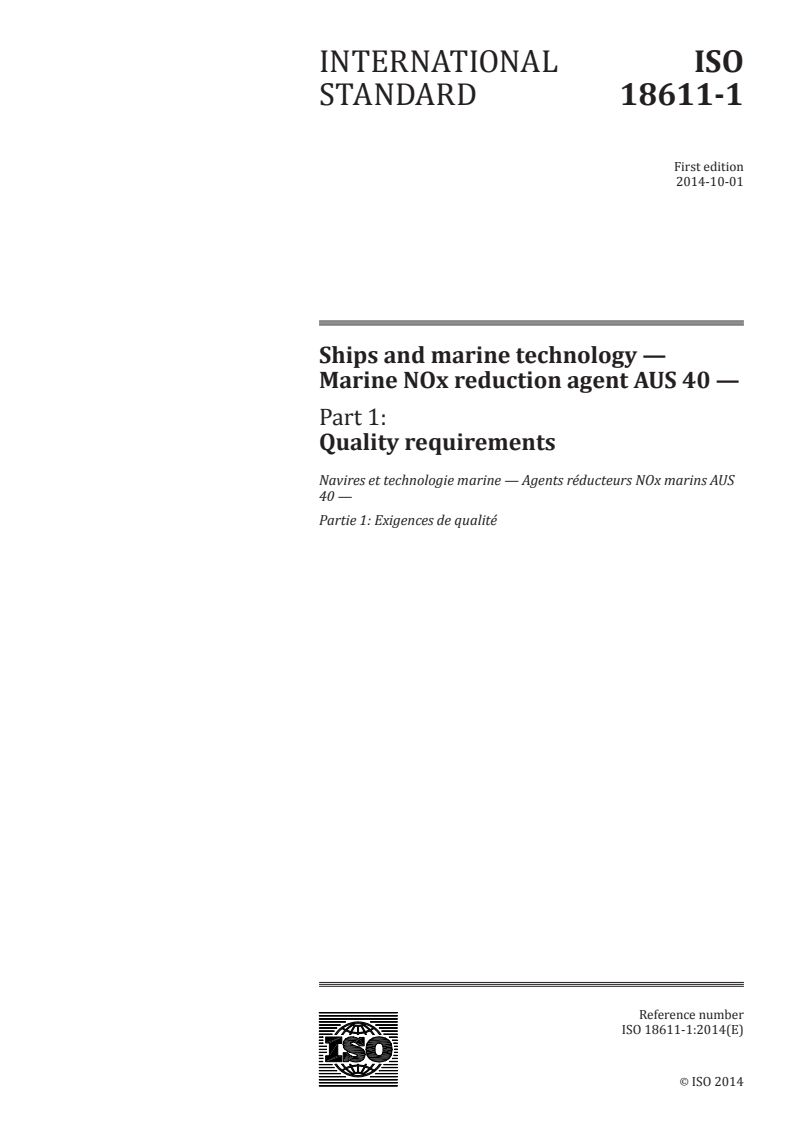
INTERNATIONAL ISO
STANDARD 18611-1
First edition
2014-10-01
Ships and marine technology —
Marine NOx reduction agent AUS 40 —
Part 1:
Quality requirements
Navires et technologie marine — Agents réducteurs NOx marins AUS
40 —
Partie 1: Exigences de qualité
Reference number
©
ISO 2014
© ISO 2014
All rights reserved. Unless otherwise specified, no part of this publication may be reproduced or utilized otherwise in any form
or by any means, electronic or mechanical, including photocopying, or posting on the internet or an intranet, without prior
written permission. Permission can be requested from either ISO at the address below or ISO’s member body in the country of
the requester.
ISO copyright office
Case postale 56 • CH-1211 Geneva 20
Tel. + 41 22 749 01 11
Fax + 41 22 749 09 47
E-mail copyright@iso.org
Web www.iso.org
Published in Switzerland
ii © ISO 2014 – All rights reserved
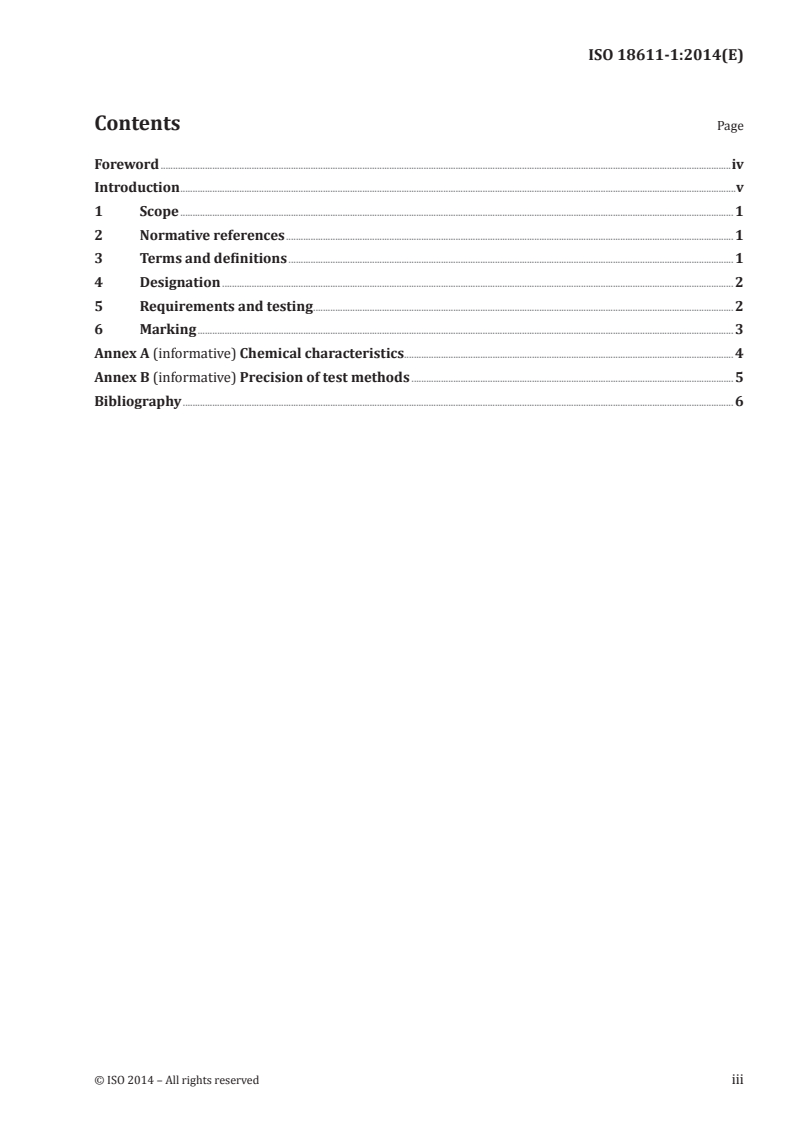
Contents Page
Foreword .iv
Introduction .v
1 Scope . 1
2 Normative references . 1
3 Terms and definitions . 1
4 Designation . 2
5 Requirements and testing . 2
6 Marking . 3
Annex A (informative) Chemical characteristics. 4
Annex B (informative) Precision of test methods . 5
Bibliography . 6
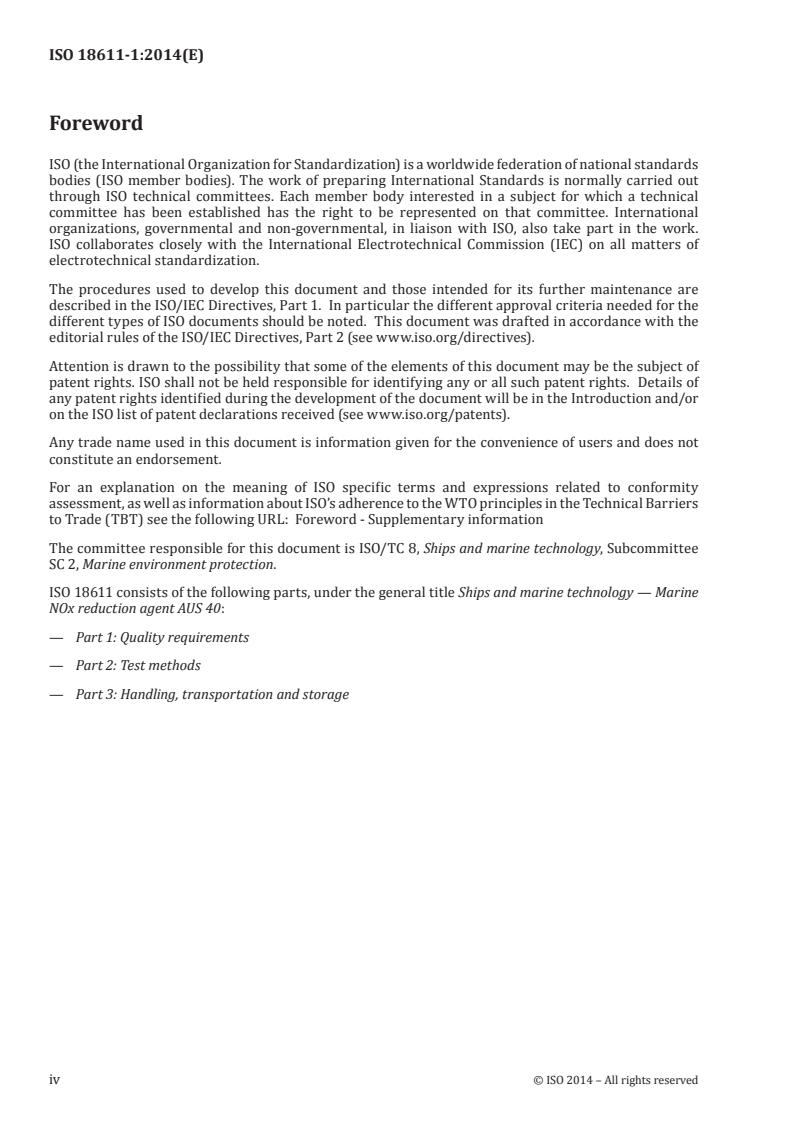
Foreword
ISO (the International Organization for Standardization) is a worldwide federation of national standards
bodies (ISO member bodies). The work of preparing International Standards is normally carried out
through ISO technical committees. Each member body interested in a subject for which a technical
committee has been established has the right to be represented on that committee. International
organizations, governmental and non-governmental, in liaison with ISO, also take part in the work.
ISO collaborates closely with the International Electrotechnical Commission (IEC) on all matters of
electrotechnical standardization.
The procedures used to develop this document and those intended for its further maintenance are
described in the ISO/IEC Directives, Part 1. In particular the different approval criteria needed for the
different types of ISO documents should be noted. This document was drafted in accordance with the
editorial rules of the ISO/IEC Directives, Part 2 (see www.iso.org/directives).
Attention is drawn to the possibility that some of the elements of this document may be the subject of
patent rights. ISO shall not be held responsible for identifying any or all such patent rights. Details of
any patent rights identified during the development of the document will be in the Introduction and/or
on the ISO list of patent declarations received (see www.iso.org/patents).
Any trade name used in this document is information given for the convenience of users and does not
constitute an endorsement.
For an explanation on the meaning of ISO specific terms and expressions related to conformity
assessment, as well as information about ISO’s adherence to the WTO principles in the Technical Barriers
to Trade (TBT) see the following URL: Foreword - Supplementary information
The committee responsible for this document is ISO/TC 8, Ships and marine technology, Subcommittee
SC 2, Marine environment protection.
ISO 18611 consists of the following parts, under the general title Ships and marine technology — Marine
NOx reduction agent AUS 40:
— Part 1: Quality requirements
— Part 2: Test methods
— Part 3: Handling, transportation and storage
iv © ISO 2014 – All rights reserved
Introduction
In order to protect the environment and to enhance air quality, exhaust emissions regulations around
the world are continuously strengthened. For ships with large combustion engines, particulate matter
(PM), nitrogen oxide (NOx) emissions, and sulfur dioxide emissions are the main concern, and efforts
have been focused on the development of technology that can reduce them effectively with minimum fuel
economy penalty. Selective catalytic reduction (SCR) converters using a urea solution as the reducing
agent is considered to be a key technology for reducing NOx emissions. The quality of the urea solution
used for that technology needs to be specified to ensure reliable and stable operation of the SCR converter
systems. The ISO 18611 series provides the specifications of urea solution for quality characteristics,
handling, transportation, and storage, as well as the test methods needed by manufacturers of SCR
converters, by engine manufacturers, by producers, distributors, and by fleet operators/ship owners.
Efficient expanding of the use of urea SCR technology requires a consolidated framework that can be
followed by producers, end users, OEMs, and catalyst suppliers.
INTERNATIONAL STANDARD ISO 18611-1:2014(E)
Ships and marine technology — Marine NOx reduction
agent AUS 40 —
Part 1:
Quality requirements
1 Scope
This part of ISO 18611 specifies the quality characteristics of the marine NOx reduction agent, aqueous
urea solution at 40 % concentration (AUS 40), which is needed to operate so-called SCR (selective
catalytic reduction) converters. In marine applications, for example, for engine exhaust gas treatment,
SCR converters are particularly suitable for selectively reducing the nitrogen oxide (NOx) emissions of
...
INTERNATIONAL ISO
STANDARD 18611-1
First edition
2014-10-01
Ships and marine technology —
Marine NOx reduction agent AUS 40 —
Part 1:
Quality requirements
Navires et technologie marine — Agents réducteurs NOx marins AUS
40 —
Partie 1: Exigences de qualité
Reference number
©
ISO 2014
© ISO 2014
All rights reserved. Unless otherwise specified, no part of this publication may be reproduced or utilized otherwise in any form
or by any means, electronic or mechanical, including photocopying, or posting on the internet or an intranet, without prior
written permission. Permission can be requested from either ISO at the address below or ISO’s member body in the country of
the requester.
ISO copyright office
Case postale 56 • CH-1211 Geneva 20
Tel. + 41 22 749 01 11
Fax + 41 22 749 09 47
E-mail copyright@iso.org
Web www.iso.org
Published in Switzerland
ii © ISO 2014 – All rights reserved
Contents Page
Foreword .iv
Introduction .v
1 Scope . 1
2 Normative references . 1
3 Terms and definitions . 1
4 Designation . 2
5 Requirements and testing . 2
6 Marking . 3
Annex A (informative) Chemical characteristics. 4
Annex B (informative) Precision of test methods . 5
Bibliography . 6
Foreword
ISO (the International Organization for Standardization) is a worldwide federation of national standards
bodies (ISO member bodies). The work of preparing International Standards is normally carried out
through ISO technical committees. Each member body interested in a subject for which a technical
committee has been established has the right to be represented on that committee. International
organizations, governmental and non-governmental, in liaison with ISO, also take part in the work.
ISO collaborates closely with the International Electrotechnical Commission (IEC) on all matters of
electrotechnical standardization.
The procedures used to develop this document and those intended for its further maintenance are
described in the ISO/IEC Directives, Part 1. In particular the different approval criteria needed for the
different types of ISO documents should be noted. This document was drafted in accordance with the
editorial rules of the ISO/IEC Directives, Part 2 (see www.iso.org/directives).
Attention is drawn to the possibility that some of the elements of this document may be the subject of
patent rights. ISO shall not be held responsible for identifying any or all such patent rights. Details of
any patent rights identified during the development of the document will be in the Introduction and/or
on the ISO list of patent declarations received (see www.iso.org/patents).
Any trade name used in this document is information given for the convenience of users and does not
constitute an endorsement.
For an explanation on the meaning of ISO specific terms and expressions related to conformity
assessment, as well as information about ISO’s adherence to the WTO principles in the Technical Barriers
to Trade (TBT) see the following URL: Foreword - Supplementary information
The committee responsible for this document is ISO/TC 8, Ships and marine technology, Subcommittee
SC 2, Marine environment protection.
ISO 18611 consists of the following parts, under the general title Ships and marine technology — Marine
NOx reduction agent AUS 40:
— Part 1: Quality requirements
— Part 2: Test methods
— Part 3: Handling, transportation and storage
iv © ISO 2014 – All rights reserved
Introduction
In order to protect the environment and to enhance air quality, exhaust emissions regulations around
the world are continuously strengthened. For ships with large combustion engines, particulate matter
(PM), nitrogen oxide (NOx) emissions, and sulfur dioxide emissions are the main concern, and efforts
have been focused on the development of technology that can reduce them effectively with minimum fuel
economy penalty. Selective catalytic reduction (SCR) converters using a urea solution as the reducing
agent is considered to be a key technology for reducing NOx emissions. The quality of the urea solution
used for that technology needs to be specified to ensure reliable and stable operation of the SCR converter
systems. The ISO 18611 series provides the specifications of urea solution for quality characteristics,
handling, transportation, and storage, as well as the test methods needed by manufacturers of SCR
converters, by engine manufacturers, by producers, distributors, and by fleet operators/ship owners.
Efficient expanding of the use of urea SCR technology requires a consolidated framework that can be
followed by producers, end users, OEMs, and catalyst suppliers.
INTERNATIONAL STANDARD ISO 18611-1:2014(E)
Ships and marine technology — Marine NOx reduction
agent AUS 40 —
Part 1:
Quality requirements
1 Scope
This part of ISO 18611 specifies the quality characteristics of the marine NOx reduction agent, aqueous
urea solution at 40 % concentration (AUS 40), which is needed to operate so-called SCR (selective
catalytic reduction) converters. In marine applications, for example, for engine exhaust gas treatment,
SCR converters are particularly suitable for selectively reducing the nitrogen oxide (NOx) emissions of
...