


ISO 6529
(Main)Protective clothing - Protection against chemicals - Determination of resistance of protective clothing materials to permeation by liquids and gases
Protective clothing - Protection against chemicals - Determination of resistance of protective clothing materials to permeation by liquids and gases
ISO 6529:2013 describes laboratory test methods to determine the resistance of materials used in protective clothing, including gloves and including footwear, when the footwear is an integral part of the clothing, to permeation by liquid or gaseous chemicals under the conditions of either continuous or intermittent contact. Method A is applicable to testing against liquid chemicals, either volatile or soluble in water, expected to be in continuous contact with the protective clothing material. Method B is applicable to testing against gaseous chemicals expected to be in continuous contact with the protective clothing material. Method C is applicable to testing against gaseous and liquid chemicals, either volatile or soluble in water, expected to be in intermittent contact with the protective clothing material. These test methods assess the permeation resistance of the protective clothing material under laboratory conditions in terms of breakthrough time, permeation rate and cumulative permeation. These test methods also enable qualitative observations to be made of the effects of the test chemical on the material under test. These test methods are only suitable for measuring permeation by liquids and gases. These test methods address only the performance of materials or certain materials' constructions (e.g. seams).
Habillement de protection — Protection contre les produits chimiques — Détermination de la résistance des matériaux utilisés pour la confection des vêtements de protection à la perméation par des liquides et des gaz
L'ISO 6529:2013 décrit des méthodes d'essai en laboratoire permettant de déterminer, pour les matériaux utilisés dans les vêtements de protection (y compris les gants et les chaussures lorsque celles-ci font partie intégrante du vêtement), la résistance à la perméation par les produits chimiques liquides ou gazeux dans des conditions de contact continu ou intermittent. La méthode A est applicable aux essais de protection contre les produits chimiques liquides, volatils ou solubles dans l'eau, destinés à être en contact continu avec le matériau du vêtement de protection. La méthode B est applicable aux essais de protection contre les produits chimiques gazeux destinés à être en contact continu avec le matériau du vêtement de protection. La méthode C est applicable aux essais relatifs à la protection contre les produits chimiques gazeux et liquides, volatils ou solubles dans l'eau, destinés à être en contact intermittent avec le matériau du vêtement de protection. Ces méthodes d'essai permettent de déterminer la résistance à la perméation du matériau du vêtement de protection dans des conditions de laboratoire en termes de temps de passage, de flux de perméation et de perméation cumulée. Ces méthodes d'essai permettent également d'observer qualitativement les effets du produit chimique d'essai sur le matériau du vêtement de protection soumis à essai. Ces méthodes d'essai sont uniquement adaptées au mesurage de la perméation par des liquides et des gaz. Ces méthodes d'essai ne traitent que de la performance des matériaux ou de certains types de fabrication de matériaux (coutures par exemple).
General Information
- Status
- Not Published
- Technical Committee
- ISO/TC 94/SC 13 - Protective clothing
- Drafting Committee
- ISO/TC 94/SC 13 - Protective clothing
- Current Stage
- 6000 - International Standard under publication
- Start Date
- 25-Nov-2025
- Completion Date
- 13-Dec-2025
Relations
- Effective Date
- 06-Jun-2022
Overview
ISO 6529 (FDIS 2025) - "Protective clothing - Protection against chemicals - Determination of resistance of protective clothing materials to permeation by liquids and gases" specifies laboratory test methods to evaluate how materials used in chemical protective clothing resist permeation by liquid and gaseous chemicals. The standard defines test Methods A, B and C for continuous or intermittent contact and reports results as breakthrough time, permeation rate and cumulative permeation. It applies to materials and certain constructions (e.g., seams), not to whole‑garment interfaces or solid challenge chemicals.
Key topics and requirements
- Test methods
- Method A: liquids (volatile or sufficiently water‑soluble) in continuous contact.
- Method B: gaseous chemicals in continuous contact.
- Method C: intermittent contact with liquids or gases.
- Measured parameters: breakthrough time, steady‑state permeation rate, cumulative permeation mass.
- Analytical techniques & collection media: guidance on choosing gaseous or liquid collection media and suitable detection techniques (see annexes for examples such as GC‑FID setups).
- System configurations: open‑loop and closed‑loop permeation test cell arrangements; calibration, validation and sensitivity checks.
- Specimen preparation: sampling, thickness/mass measurement, conditioning and visual assessment.
- Limitations & controls:
- Restrictions on volatility and solubility of challenge chemicals to ensure valid detection.
- Pressure control on the collection side to avoid specimen deformation.
- The methods are not suitable for solid challenge chemicals and do not address garment design or interfaces.
- Reporting: mandatory test report content and default test conditions (normative annex).
Applications
- Evaluating barrier performance of protective fabrics, gloves and integral footwear materials against chemical exposure.
- Supporting PPE development and material selection for chemical handling, transport, emergency response and industrial processes.
- Establishing performance data used in certification, procurement specifications and safety data sheets.
- Comparing permeation resistance across materials using standardized challenge chemicals (recommended list in annex).
Who uses this standard
- Accredited testing laboratories and analytical chemists performing permeation testing.
- PPE manufacturers and material suppliers validating chemical barrier claims.
- Occupational safety and health professionals, regulatory bodies and certification organizations.
- Product designers, procurement teams and emergency planners assessing chemical protection needs.
Related standards
- ISO 6530 - resistance to penetration by liquid chemicals
- ISO 13994 - penetration by liquids under pressure
- ISO 19918 - cumulative permeation measurement for low vapour pressure chemicals
- ISO 11610 - protective clothing vocabulary
- ISO 16602‑3 - referenced application context
Keywords: ISO 6529, protective clothing, chemical permeation, breakthrough time, permeation rate, cumulative permeation, permeation test cell, Method A B C, PPE testing.

ISO/FDIS 6529 - Protective clothing — Protection against chemicals — Determination of resistance of protective clothing materials to permeation by liquids and gases Released:15. 09. 2025
REDLINE ISO/FDIS 6529 - Protective clothing — Protection against chemicals — Determination of resistance of protective clothing materials to permeation by liquids and gases Released:15. 09. 2025

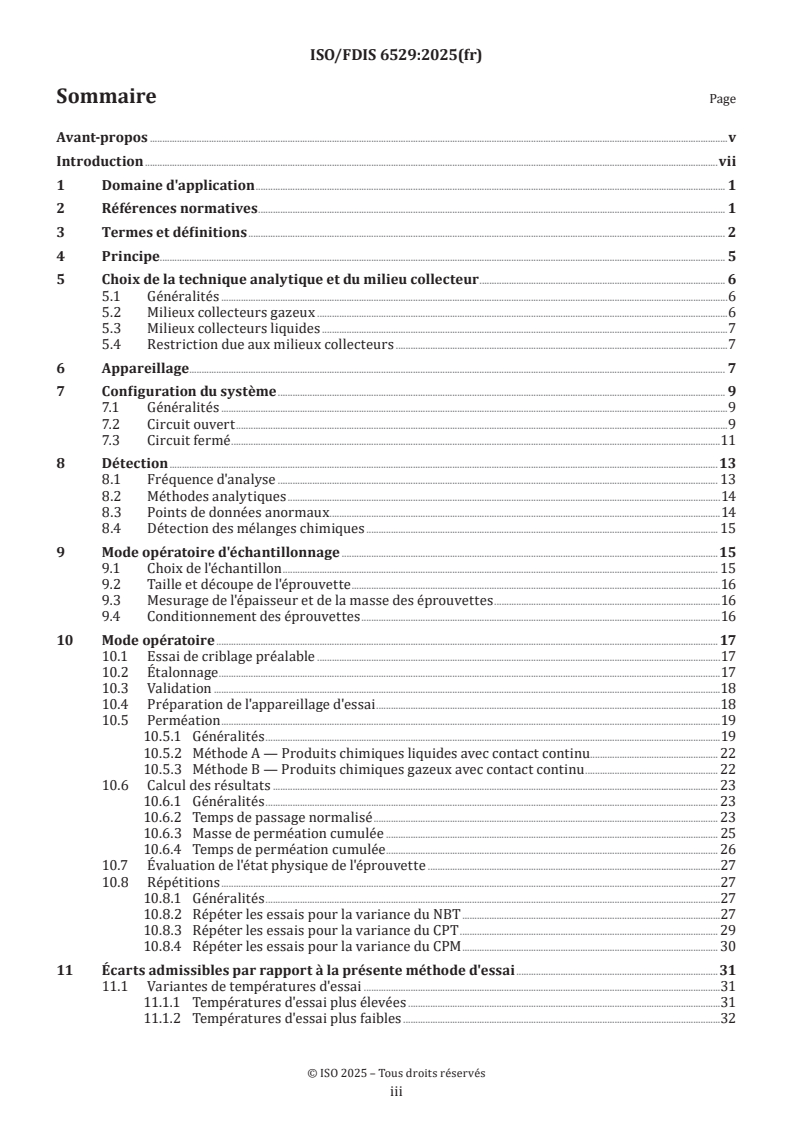
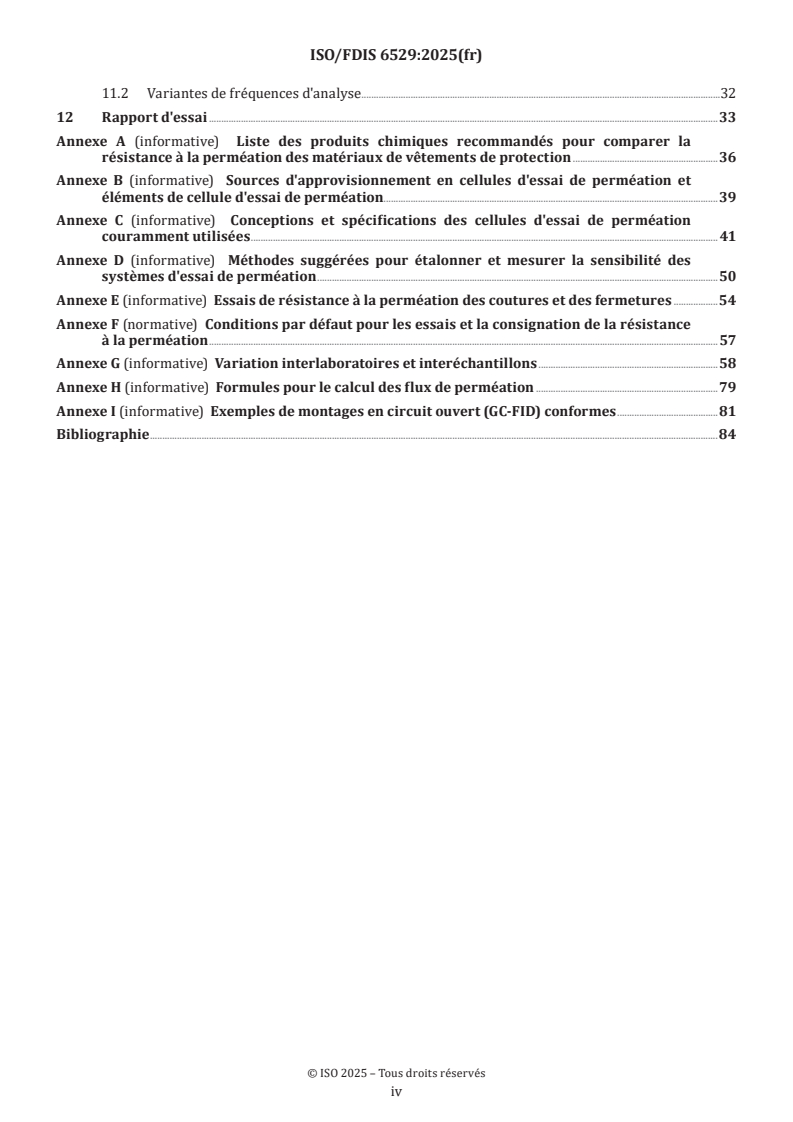
ISO/FDIS 6529 - Habillement de protection — Protection contre les produits chimiques — Détermination de la résistance des matériaux utilisés pour la confection des vêtements de protection à la perméation par des liquides et des gaz Released:12. 11. 2025
Frequently Asked Questions
ISO 6529 is a draft published by the International Organization for Standardization (ISO). Its full title is "Protective clothing - Protection against chemicals - Determination of resistance of protective clothing materials to permeation by liquids and gases". This standard covers: ISO 6529:2013 describes laboratory test methods to determine the resistance of materials used in protective clothing, including gloves and including footwear, when the footwear is an integral part of the clothing, to permeation by liquid or gaseous chemicals under the conditions of either continuous or intermittent contact. Method A is applicable to testing against liquid chemicals, either volatile or soluble in water, expected to be in continuous contact with the protective clothing material. Method B is applicable to testing against gaseous chemicals expected to be in continuous contact with the protective clothing material. Method C is applicable to testing against gaseous and liquid chemicals, either volatile or soluble in water, expected to be in intermittent contact with the protective clothing material. These test methods assess the permeation resistance of the protective clothing material under laboratory conditions in terms of breakthrough time, permeation rate and cumulative permeation. These test methods also enable qualitative observations to be made of the effects of the test chemical on the material under test. These test methods are only suitable for measuring permeation by liquids and gases. These test methods address only the performance of materials or certain materials' constructions (e.g. seams).
ISO 6529:2013 describes laboratory test methods to determine the resistance of materials used in protective clothing, including gloves and including footwear, when the footwear is an integral part of the clothing, to permeation by liquid or gaseous chemicals under the conditions of either continuous or intermittent contact. Method A is applicable to testing against liquid chemicals, either volatile or soluble in water, expected to be in continuous contact with the protective clothing material. Method B is applicable to testing against gaseous chemicals expected to be in continuous contact with the protective clothing material. Method C is applicable to testing against gaseous and liquid chemicals, either volatile or soluble in water, expected to be in intermittent contact with the protective clothing material. These test methods assess the permeation resistance of the protective clothing material under laboratory conditions in terms of breakthrough time, permeation rate and cumulative permeation. These test methods also enable qualitative observations to be made of the effects of the test chemical on the material under test. These test methods are only suitable for measuring permeation by liquids and gases. These test methods address only the performance of materials or certain materials' constructions (e.g. seams).
ISO 6529 is classified under the following ICS (International Classification for Standards) categories: 13.340.10 - Protective clothing. The ICS classification helps identify the subject area and facilitates finding related standards.
ISO 6529 has the following relationships with other standards: It is inter standard links to ISO 6529:2013. Understanding these relationships helps ensure you are using the most current and applicable version of the standard.
ISO 6529 is available in PDF format for immediate download after purchase. The document can be added to your cart and obtained through the secure checkout process. Digital delivery ensures instant access to the complete standard document.
Standards Content (Sample)
FINAL DRAFT
International
Standard
ISO/FDIS 6529
ISO/TC 94/SC 13
Protective clothing — Protection
Secretariat: SNV
against chemicals — Determination
Voting begins on:
of resistance of protective clothing
2025-09-29
materials to permeation by liquids
Voting terminates on:
and gases
2025-11-24
Habillement de protection — Protection contre les produits
chimiques — Détermination de la résistance des matériaux
utilisés pour la confection des vêtements de protection à la
perméation par des liquides et des gaz
RECIPIENTS OF THIS DRAFT ARE INVITED TO SUBMIT,
WITH THEIR COMMENTS, NOTIFICATION OF ANY
RELEVANT PATENT RIGHTS OF WHICH THEY ARE AWARE
AND TO PROVIDE SUPPOR TING DOCUMENTATION.
IN ADDITION TO THEIR EVALUATION AS
BEING ACCEPTABLE FOR INDUSTRIAL, TECHNO
LOGICAL, COMMERCIAL AND USER PURPOSES, DRAFT
INTERNATIONAL STANDARDS MAY ON OCCASION HAVE
TO BE CONSIDERED IN THE LIGHT OF THEIR POTENTIAL
TO BECOME STAN DARDS TO WHICH REFERENCE MAY BE
MADE IN NATIONAL REGULATIONS.
Reference number
ISO/FDIS 6529:2025(en) © ISO 2025
FINAL DRAFT
ISO/FDIS 6529:2025(en)
International
Standard
ISO/FDIS 6529
ISO/TC 94/SC 13
Protective clothing — Protection
Secretariat: SNV
against chemicals — Determination
Voting begins on:
of resistance of protective clothing
materials to permeation by liquids
Voting terminates on:
and gases
Habillement de protection — Protection contre les produits
chimiques — Détermination de la résistance des matériaux
utilisés pour la confection des vêtements de protection à la
perméation par des liquides et des gaz
RECIPIENTS OF THIS DRAFT ARE INVITED TO SUBMIT,
WITH THEIR COMMENTS, NOTIFICATION OF ANY
RELEVANT PATENT RIGHTS OF WHICH THEY ARE AWARE
AND TO PROVIDE SUPPOR TING DOCUMENTATION.
© ISO 2025
IN ADDITION TO THEIR EVALUATION AS
All rights reserved. Unless otherwise specified, or required in the context of its implementation, no part of this publication may
BEING ACCEPTABLE FOR INDUSTRIAL, TECHNO
LOGICAL, COMMERCIAL AND USER PURPOSES, DRAFT
be reproduced or utilized otherwise in any form or by any means, electronic or mechanical, including photocopying, or posting on
INTERNATIONAL STANDARDS MAY ON OCCASION HAVE
the internet or an intranet, without prior written permission. Permission can be requested from either ISO at the address below
TO BE CONSIDERED IN THE LIGHT OF THEIR POTENTIAL
or ISO’s member body in the country of the requester.
TO BECOME STAN DARDS TO WHICH REFERENCE MAY BE
MADE IN NATIONAL REGULATIONS.
ISO copyright office
CP 401 • Ch. de Blandonnet 8
CH-1214 Vernier, Geneva
Phone: +41 22 749 01 11
Email: copyright@iso.org
Website: www.iso.org
Published in Switzerland Reference number
ISO/FDIS 6529:2025(en) © ISO 2025
ii
ISO/FDIS 6529:2025(en)
Contents Page
Foreword .v
Introduction .vi
1 Scope . 1
2 Normative references . 1
3 Terms and definitions . 2
4 Principle . 5
5 Choice of analytical technique and collection medium . 6
5.1 General .6
5.2 Gaseous collection media .6
5.3 Liquid collection media .6
5.4 Limitation due to collection media .6
6 Apparatus . 7
7 System configuration . 9
7.1 General .9
7.2 Open-loop .9
7.3 Closed-loop .10
8 Detection .12
8.1 Frequency of analysis . 12
8.2 Analytical methods . 13
8.3 Anomalous data points . 13
8.4 Detection of chemical mixtures .14
9 Sampling procedure . 14
9.1 Choice of sample .14
9.2 Size and cutting of specimen. 15
9.3 Measurement of test specimen thickness and mass . 15
9.4 Conditioning of test specimens . 15
10 Test procedure .15
10.1 Pre-screening test . 15
10.2 Calibration .16
10.3 Validation .16
10.4 Preparation of test apparatus .16
10.5 Permeation .18
10.5.1 General .18
10.5.2 Method A — Liquid chemicals with continuous contact . 20
10.5.3 Method B — Gaseous chemicals with continuous contact.21
10.6 Calculation of results .21
10.6.1 General .21
10.6.2 Normalized breakthrough time .21
10.6.3 Cumulative permeation mass . 23
10.6.4 Cumulative permeation time .24
10.7 Visual assessment of test specimen . 25
10.8 Repeat tests . 25
10.8.1 General . 25
10.8.2 Repeat tests for NBT variance . 25
10.8.3 Repeat tests for CPT variance. 26
10.8.4 Repeat tests for CPM variance . 28
11 Permissible deviations from this test method .29
11.1 Alternative test temperatures . 29
11.1.1 Higher test temperatures . 29
11.1.2 Lower test temperatures . 29
iii
ISO/FDIS 6529:2025(en)
11.2 Alternative frequencies of analysis . 30
12 Test report .30
Annex A (informative) Recommended list of chemicals for comparing permeation resistance of
protective clothing materials .33
Annex B (informative) Sources of permeation test cells and permeation test cell parts .36
Annex C (informative) Designs and specifications of commonly-used permeation test cells .38
Annex D (informative) Suggested procedures for calibrating and measuring the sensitivity of
permeation-test systems . . 47
Annex E (informative) Testing the permeation resistance of seams and closures .51
Annex F (normative) Default conditions for testing and reporting permeation resistance .54
Annex G (informative) Interlaboratory and inter-sample variation .55
Annex H (informative) Formulae for calculating permeation rates . 76
Annex I (informative) Examples of compliant open-loop (GC-FID) setups .78
Bibliography .81
iv
ISO/FDIS 6529:2025(en)
Foreword
ISO (the International Organization for Standardization) is a worldwide federation of national standards
bodies (ISO member bodies). The work of preparing International Standards is normally carried out through
ISO technical committees. Each member body interested in a subject for which a technical committee
has been established has the right to be represented on that committee. International organizations,
governmental and non-governmental, in liaison with ISO, also take part in the work. ISO collaborates closely
with the International Electrotechnical Commission (IEC) on all matters of electrotechnical standardization.
The procedures used to develop this document and those intended for its further maintenance are described
in the ISO/IEC Directives, Part 1. In particular, the different approval criteria needed for the different types
of ISO document should be noted. This document was drafted in accordance with the editorial rules of the
ISO/IEC Directives, Part 2 (see www.iso.org/directives).
ISO draws attention to the possibility that the implementation of this document may involve the use of (a)
patent(s). ISO takes no position concerning the evidence, validity or applicability of any claimed patent
rights in respect thereof. As of the date of publication of this document, ISO had not received notice of (a)
patent(s) which may be required to implement this document. However, implementers are cautioned that
this may not represent the latest information, which may be obtained from the patent database available at
www.iso.org/patents. ISO shall not be held responsible for identifying any or all such patent rights.
Any trade name used in this document is information given for the convenience of users and does not
constitute an endorsement.
For an explanation of the voluntary nature of standards, the meaning of ISO specific terms and expressions
related to conformity assessment, as well as information about ISO's adherence to the World Trade
Organization (WTO) principles in the Technical Barriers to Trade (TBT), see www.iso.org/iso/foreword.html.
This document was prepared by Technical Committee ISO/TC 94, Personal safety — Personal protective
equipment, Subcommittee SC 13, Protective clothing.
This fourth edition cancels and replaces the third edition (ISO 6529:2013), which has been technically
revised.
The main changes are as follows:
— Restrictions have been placed on the volatility of the challenge chemical. This is because involatile
chemicals will not evaporate into a gaseous collection medium to be carried to the detector.
— Restrictions have been placed on the solubility of the challenge chemical. This is because chemicals that
are insoluble in a liquid collection medium will not be carried to the detector. Furthermore, chemicals
that are only slightly soluble in a liquid collection medium might not sufficiently dissolve in order for
detection levels to yield a breakthrough time or cumulative permeation data.
— A requirement has been made that if the above restrictions are not met, then another test method shall
be used.
— A requirement has been added to ensure that the pressure inside the collection side of the permeation
test cell relative to the pressure in the challenge side of the permeation test cell shall not exceed a certain
value. This is because it has been shown that excessive pressure causes the test specimen to deform,
become thinner, and have an increased surface area. This renders the test specimen more susceptible to
faster permeation.
Any feedback or questions on this document should be directed to the user’s national standards body. A
complete listing of these bodies can be found at www.iso.org/members.html.
v
ISO/FDIS 6529:2025(en)
Introduction
Persons involved in the production, use, transportation and emergency response with liquid and gaseous
chemicals can be exposed to numerous compounds capable of causing harm upon contact with the human
body. The deleterious effects of these chemicals can range from acute trauma such as skin irritation and burn
to chronic degenerative disease, such as cancer. Since engineering controls may not eliminate all possible
exposures, attention is often placed on reducing the potential for direct skin contact through the use of
protective clothing. Such protective clothing is typically designed to resist permeation and penetration of
hazardous chemicals and degradation of the clothing that may be caused by such chemicals.
The test methods described in this document are intended to be used to evaluate the barrier effectiveness of
materials used for protective clothing against ingress by liquid or gaseous chemicals.
These test methods provide options for reporting test results in terms of cumulative permeation, permeation
rate and breakthrough time. These parameters are key measures of the effectiveness of a clothing material
to act as a barrier to the test chemical. Low cumulative permeation mass (CPM), low permeation rates and
long breakthrough times are characteristic of effective barrier materials.
Resistance to penetration by liquid chemicals should be determined by using ISO 6530 while resistance to
penetration by liquid chemicals under pressure should be determined by using ISO 13994.
It has been assumed in the drafting of this document that the execution of its provisions will be entrusted
to appropriately qualified and experienced persons with a sound understanding of analytical chemistry
and uncertainty of measurement. Appropriate precautions should be taken when carrying out this type of
testing in order to avoid injury to health and contamination of the environment.
vi
FINAL DRAFT International Standard ISO/FDIS 6529:2025(en)
Protective clothing — Protection against chemicals —
Determination of resistance of protective clothing materials
to permeation by liquids and gases
1 Scope
This document describes laboratory test methods to determine the resistance of materials used in protective
clothing, including gloves and including footwear, when the footwear is an integral part of the clothing, to
permeation by liquid or gaseous chemicals under the conditions of continuous contact. This test method is
referred to in ISO 16602-3.
Method A is applicable to testing against liquid chemicals, either volatile or sufficiently soluble in water (such
that detection limits are possible that allow breakthrough times and/or cumulative permeation parameters
to be measured), that are expected to be in continuous contact with the protective clothing material.
Method B is applicable to testing against gaseous chemicals expected to be in continuous contact with the
protective clothing material.
These test methods assess the permeation resistance of the protective clothing material under laboratory
conditions in terms of cumulative permeation, permeation rate and breakthrough time. These test methods
also enable qualitative observations to be made of the effects of the test chemical on the material under test.
These test methods are only suitable for measuring permeation by liquids and gases. Permeation by solid
challenge chemicals is beyond the scope of this document.
NOTE It can be difficult or impossible to normalize the results of permeation tests carried out against solid
challenge chemicals. The normalized rate of permeation is dependent on the area of fabric exposed to the challenge
chemical. In the case of solids this will, in turn, depend also on factors such as particle size, size distribution, particle
shape and packing considerations.
These test methods address only the performance of materials or certain materials' constructions (e.g.
seams). These test methods do not address the design, overall construction and components, or interfaces of
garments, or interfaces between garments and gloves or garments and footwear, or other factors which can
affect the overall chemical protection offered by protective clothing, gloves or footwear or combinations of
chemical protective clothing, gloves and footwear.
It is emphasized that these tests do not necessarily simulate conditions to which materials are likely to be
exposed in practice. In most cases the conditions of the permeation test will be far more challenging than
expected workplace conditions.
2 Normative references
The following documents are referred to in the text in such a way that some or all of their content constitutes
requirements of this document. For dated references, only the edition cited applies. For undated references,
the latest edition of the referenced document (including any amendments) applies.
ISO 2286-2, Rubber- or plastics-coated fabrics — Determination of roll characteristics — Part 2: Methods for
determination of total mass per unit area, mass per unit area of coating and mass per unit area of substrate
ISO 2286-3, Rubber- or plastics-coated fabrics — Determination of roll characteristics — Part 3: Method for
determination of thickness
ISO 11610, Protective clothing — Vocabulary
ISO/FDIS 6529:2025(en)
ISO 13994, Clothing for protection against liquid chemicals — Determination of the resistance of protective
clothing materials to penetration by liquids under pressure
ISO 19918, Protective clothing — Protection against chemicals — Measurement of cumulative permeation of
chemicals with low vapour pressure through materials
3 Terms and definitions
For the purposes of this document, the terms and definitions given in ISO 11610 and the following apply (see
also Figure 1).
ISO and IEC maintain terminology databases for use in standardization at the following addresses:
— ISO Online browsing platform: available at https:// www .iso .org/ obp
— IEC Electropedia: available at https:// www .electropedia .org/
3.1
analytical technique
method of quantification of the amount of permeated chemical in the collection medium
Note 1 to entry: Such methods are often specific to individual chemical and collection-medium combinations.
Note 2 to entry: A chosen analytical technique may also qualify the chemical/s being tested. Particularly relevant
if testing a mixture and identifying and then further quantifying the specific chosen chemical of interest (i.e. some
chemicals in a mixture may be toxic and desired to be quantified, others may be ignored, but the method would
therefore need to distinguish between them.)
EXAMPLE Applicable analytical techniques can include ultraviolet (UV) and infrared (IR) spectrophotometry,
mass spectrometry, pH measurement, ion chromatography, conductimetry, colourimetry, atmospheric analytical
detector tubes and radionuclide tagging/detection counting. Although gas- and liquid-chromatography are separation
techniques rather than detection methods they can be used in conjunction with suitable detectors to quantify the
amount of permeated chemical in the collection medium.
3.2
breakthrough detection time
BDT
time elapsed from the start of the test to the sampling time at which the test chemical is first detected
Note 1 to entry: See Figure 1.
Note 2 to entry: Breakthrough detection time is related to MDPR (minimum detectable permeation rate) which is
specific to the test, the test equipment and analytical technique.
3.3
collection medium
liquid or gas on the inner unexposed side of the test sample in which any permeated chemical is collected
3.4
cumulative permeation mass
CPM
total amount of chemical that permeates during a specified period of time since the start of the test
3.5
cumulative permeation time
CPT
time at which the total quantity of chemical that has permeated through each square centimetre of fabric
has reached a predetermined mass
Note 1 to entry: The predetermined mass can vary and would typically be stipulated as per the performance standard.
ISO/FDIS 6529:2025(en)
3.6
degradation
deleterious change in one or more physical properties of a protective clothing material
Note 1 to entry: Deleterious changes can be manifest as either an increase or decrease in a physical property. For
example, if the protective clothing material has been embrittled an increase in puncture resistance may be observed.
3.7
lag time
the time elapsed between the permeated chemical arriving in the collection chamber of the permeation cell
and the time at which that same chemical reaches the detector
3.8
loop
3.8.1
closed-loop
testing mode in which the collection medium (3.3) volume is fixed and continuously circulated or recycled
Note 1 to entry: The collection medium volume may change slightly as a consequence of sampling without replacement
of the sampled collection medium.
Note 2 to entry: The closed-loop collection medium need not necessarily be completely physically enclosed. For
example, liquid collection media may be open to the air in an expansion vessel or constant-pressure header vessel.
3.8.2
open-loop
testing mode in which fresh collection medium (3.3) flows continuously through the collection chamber of
the test cell and is not reused or recycled
3.9
minimum detectable permeated mass
smallest mass of test chemical that is detectable with the complete permeation-test system
Note 1 to entry: This value is not necessarily the intrinsic limit of detection for the analytical instrument.
3.10
minimum detectable permeation rate
MDPR
lowest rate of permeation that is measurable with the complete permeation-test system
Note 1 to entry: This value is not necessarily the intrinsic limit of detection for the analytical instrument.
Note 2 to entry: This value defines the sensitivity of the test, which may be reflected in other values when calculated
based on MDPR, for example cumulative permeated mass.
3.11
normalization permeation rate
NPR
permeation rate used for determining the normalized breakthrough detection time (3.2)
2 2
Note 1 to entry: This test method provides two normalisation permeation rates: 0,1 μg/cm /min or 1,0 μg/cm /min,
although Annex F specifies the latter for tests carried out in support of CE certification.
3.12
normalized breakthrough (detection) time
NBT
time at which the permeation rate reaches the normalization permeation rate (3.10)
ISO/FDIS 6529:2025(en)
Key
t time (min)
Y permeation rate (μg/cm /min)
1 steady-state permeation rate (SSPR)
a normalized permeation rate (NPR)
b minimum detectable permeation rate (MDPR)
t normalized breakthrough time (NBT)
Figure 1 — Schematic permeation graph showing normalised breakthrough times and cumulative
permeation mass
Note 1 to entry: The breakthrough detection time is dependent on the sensitivity of the method and the frequency of
sampling of the collection medium.
Note 2 to entry: The cumulative permeated mass over a t period is equal to the area of the shaded region under the graph.
3.13
penetration
flow of a chemical through closures, porous materials, seams and holes or other imperfections in a protective
clothing material on a non-molecular level
3.14
permeation
process by which a chemical moves through a protective clothing material on a molecular level
Note 1 to entry: Permeation involves a) sorption of molecules of the chemical into the contacted (outside) surface of
a material, b) diffusion of the sorbed molecules in the material, and c) desorption of the molecules from the opposite
(inside) surface of the material into the collection medium.
3.15
permeation mass
quantity of test chemical that passes through the protective clothing material within a given time
3.16
permeation rate
mass of test chemical permeating a unit area of the test specimen per unit time
Note 1 to entry: Permeation rate is usually expressed in the units micrograms per square centimetre per minute (μg/
cm /min).
ISO/FDIS 6529:2025(en)
3.17
protective clothing material
any material or combination of materials used in an item of protective garment for the purpose of isolating
parts of the body from hazard
Note 1 to entry: This includes chemical protective gloves and, when attached to chemical protective clothing, boots.
3.18
response time
time between the actual arrival of the challenge chemical on the collecting side of the specimen and the time
when the analytical instrumentation responds to it
3.19
steady-state permeation rate
SSPR
constant rate of permeation (3.13) that usually occurs after breakthrough when the chemical contact is
continuous and all forces affecting permeation (3.13) have reached equilibrium
Note 1 to entry: Steady-state permeation may not be achieved during the period for which permeation testing is
conducted.
3.20
test chemical
challenge chemical
liquid or gas that is used to challenge the protective clothing material (3.17) specimen when testing
Note 1 to entry: The liquid or gas may be either one component (that is, a neat liquid or gas) or have several components
(that is, a mixture or solution).
3.21
volatile liquid
liquid with a vapour pressure in excess of 133,332 Pa (1 mmHg) at 20 °C
4 Principle
The protective clothing material specimen acts as a partition between one chamber of a permeation test
cell, which contains the test chemical, and another chamber, which contains the collection medium.
The test chemical may be either a liquid or a gas. In the case of liquids, they shall be either volatile or
sufficiently soluble in water to determine breakthrough times and/or cumulative permeation limits as
defined in this document. If this condition cannot be met, then ISO 19918 shall be used. The challenge
chemical shall be in continuous contact with the protective clothing material.
The collection medium, which may be liquid or gas, is (either periodically or continuously, for example
using an analogue detector and chart recorder for continuous measurement) analysed quantitatively for its
concentration of the challenge chemical. The amount of that chemical that has passed through the material
specimen is recorded as a function of time after its initial contact with the material.
Different test configurations may be used depending on the choice of the test chemical, collection medium
and conditions of the test.
The breakthrough detection time (BDT), normalized breakthrough detection time, permeation rate, and
cumulative permeation of the test chemical may be determined by either graphical representation or
appropriate calculations, or both.
This test method can also be used with a number of pre-conditioning procedures such as flexing, abrasion,
or practical performance tests.
ISO/FDIS 6529:2025(en)
5 Choice of analytical technique and collection medium
5.1 General
The combination of the analytical technique and the collection medium shall be selected to optimize
sensitivity for the detection of the test chemical. The collection medium shall be at the temperature defined
for the permeation test as per 10.4.2.
This test method allows for the use of either gaseous or liquid collection media. In some instances, it might
be possible to test against the same challenge chemical using either collection medium. Experience has
shown that the use of different collection media does not always yield the same results. Where there is a
choice, a gaseous collection medium is preferred for testing clothing materials (see NOTE 2), and an aqueous
collection medium is preferred when testing gloves or footwear (see NOTE 3).
NOTE 1 When in use, the inner face of chemical protective clothing fabrics is usually exposed to either air inside
the garment, aqueous solutions from perspiration, or both. The use of, for example, ammonia or methane as collection
media is not appropriate since neither is present inside the protective clothing during normal use. Use of such collection
media can also affect the test results since these substances can permeate the test specimen from the collection side of
the test cell.
NOTE 2 Gaseous collection media are preferred when testing clothing fabrics because, when in use, the inside of
the garment is usually in contact with air inside the clothing.
NOTE 3 Aqueous collection media are preferred when testing footwear or gloves because, when in use, the inside of
these items of PPE is usually in contact either directly with the skin, or in contact with the wearer’s perspiration.
5.2 Gaseous collection media
A gaseous collection medium is typically used under continuous flow conditions for the collection of
permeating molecules that are capable of vaporizing from the inner surface of the fabric under the conditions
of the test both quantitatively and in sufficient quantities for analysis. The gaseous collection medium shall
be a gas or gas mixture which does not interfere with the detection of the test chemical and does not itself
permeate or degrade the fabric under test. The quality of the gas supply shall be of sufficient consistency
over the duration of the test that changes do not interfere with detection of the test chemical.
EXAMPLES Nitrogen or dry air.
If ambient air is used as a collection medium care shall be taken to ensure that the moisture content does not
vary significantly during the test.
Helium and hydrogen shall not be used as collection media since these gases can permeate some plastics and
elastomers, including gaskets and sealing-washers.
If reactive gases such as oxygen are used as collection media appropriate safety measures should be adopted.
5.3 Liquid collection media
A liquid collection medium is typically used for the collection of permeated molecules of low volatility that
are soluble in the collecting medium under the conditions of the test in sufficient quantities for analysis. The
liquid collection medium shall be water, an aqueous solution or another liquid which does not interfere with
the detection of the test chemical and does not itself permeate or degrade the fabric under test.
NOTE Water grade 3 (see ISO 3696) or distilled water is often used.
5.4 Limitation due to collection media
If there is any doubt as to whether a liquid collection medium will degrade or permeate a test fabric then
the test fabric shall first be tested for permeation resistance to the collection medium. In many cases this
ISO/FDIS 6529:2025(en)
will be possible by open-loop testing using a gaseous collection medium. If any permeation or degradation is
observed over an 8 h exposure then the collection medium shall be deemed to be inappropriate.
NOTE 1 There are circumstances under which the above criteria are mutually exclusive. For example, when testing
a PVC fabric for resistance to permeation by an involatile isocyanate it is found that the challenge chemical is insoluble
in aqueous collection media and that the test fabric is readily permeated or degraded by virtually all non-aqueous
liquids. Under such circumstances testing is, unfortunately, not possible.
NOTE 2 Water soluble test specimen (e.g. PVAL-polyvinyl alcohol), an aqueous collecting medium is not appropriate.
6 Apparatus
6.1 Thickness gauge, suitable for measuring thickness to the nearest 0,02 mm, as specified in ISO 2286-3,
to determine the thickness of each protective clothing material specimen tested.
NOTE 1 The purpose of this gauge is not to give a definitive measurement of fabric thickness but to highlight any
inter-sample thickness variations. Permeation can be extremely sensitive to very minor variations in sample thickness.
NOTE 2 The thickness of the sample is not used in the calculation of any results in this test standard.
6.2 Analytical balance, capable of being read to the nearest 0,01 g.
NOTE The level of precision stated above is that necessary for measuring the mass per unit area of test fabrics.
If mass is used in any procedures for the calibration of detection equipment it can be necessary to have a balance
capable of being read to the nearest 0,000 1 g
6.3 Permeation test cell, consisting of a two-chambered cell for bringing the test fabric into contact with
the test chemical on the fabric’s normal outside surface (clothing exterior) and with a collection medium on
the fabric’s normal inside surface (clothing interior).
Test cells conforming to one of the diagrams and associated descriptions in Annex C are suitable but other
designs are acceptable provided that they meet the following criteria:
— The difference in pressure between the two surfaces of the test sample shall not exceed 2 500 Pa. This
has been found to be critically important.
— If measurement of the hydrostatic pressure of the liquid challenge chemical is not possible for any reason,
an estimate shall be reported according to liquid depth and density. If an estimate is used, this shall be
reported.
— The area of the outer surface of the fabric that is exposed to the test chemical shall coincide with the area
of the inner surface of the fabric which is exposed to the collection medium.
— The capacity of the challenge side of the apparatus shall be sufficiently large that volume and/or
concentration of test chemical are not significantly diminished by permeation.
— The challenge side of the apparatus shall be so designed that the mass or flow of the test chemical does
not apply undue force to the fabric under test.
— The collection side of the apparatus shall be so designed that the mass or flow of the collection medium
does not apply undue force to the fabric under test.
The apparatus shall be so designed that the outer surface of the test sample is in complete contact with the
test chemical and the inner surface is in complete contact with the collection medium.
ISO/FDIS 6529:2025(en)
The collection side of the apparatus shall be so designed that the collection medium is thoroughly mixed and
that aliquots of collection medium analysed for the presence of test chemical are representative of the whole
of the collection medium.
NOTE 1 Gaskets are used to get a good seal. The choice of gasket is very important due to the chemical resistance of
different materials. Gaskets can become permeated and might need to be replaced to avoid cross contamination from
one test to the next.
NOTE 2 Annex B contains a list of suppliers of permeation test cells.
NOTE 3 Excessive pressure can cause the fabric to stretch thereby rendering it thinner and less resistant to
permeation. It is required that the difference in pressure between the two test surfaces not exceed 2 500 Pa in order to
avoid the majority of issues that can arise from this, although the stretching is material dependent and can still occur
with this small pressure difference for certain material types. Measurement of the hydrostatic pressure exerted by
the challenge liquid can be facilitated by a standard probe with a protective sheath, for example. If measurement is not
possible for any reason, estimations can be used according to liquid depth and density.
NOTE 4 For open-loop testing, a larger test cell is preferred because the larger area of fabric exposed to the challenge
chemical increases sensitivity. For closed-loop testing, a smaller test cell is preferred in order to reduce the volume of
the collection medium and thereby increase the sensitivity of detection. Smaller test cells can nonetheless be used
in the open-loop configuration if the challenge chemical is particularly hazardous or expensive and it is necessary to
limit the volume used.
NOTE 5 If either the test chemical or the collection medium flows into and out of the apparatus the pipes into
and out of the cell are of sufficient internal cross-sectional area that no significant pressure is generated under flow
conditions.
NOTE 6 The validity of the results can be affected by air bubbles in liquid collection media and liquid test chemicals
resting against the fabric under test.
NOTE 7 This can be achieved in a number of ways including physical agitation or turbulent flow of the collection medium.
The materials of construction of the apparatus (including piping, tubing, etc.) shall be such that they do not
alter the nature or composition of the test chemical, the collection medium or any of the test chemical that
has permeated through the fabric.
The apparatus shall be so designed that the only way that test chemical can get into the collection medium is
by first permeating through the test fabric.
Care shall be taken to ensure that test chemical cannot leak out of the challenge side of the apparatus, flow
around the edge of the test sample and then leak into the collection side. This is particularly likely to happen
by capillary action if one or both surfaces of the test fabric are made from a text
...
ISO/FDIS 6529:2025(en)
ISO /TC 94/SC 13/WG 3
Secretariat: SNV
Date: 2025-07-28xx
Protective clothing -- — Protection against chemicals --—
Determination of resistance of protective clothing materials to
permeation by liquids and gases
Habillement de protection — Protection contre les produits chimiques — Détermination de la résistance des
matériaux utilisés pour la confection des vêtements de protection à la perméation par des liquides et des gaz
FDIS stage
ISO/FDIS 6529:2025(en)
All rights reserved. Unless otherwise specified, or required in the context of its implementation, no part of this publication
may be reproduced or utilized otherwise in any form or by any means, electronic or mechanical, including photocopying,
or posting on the internet or an intranet, without prior written permission. Permission can be requested from either ISO
at the address below or ISO’s member body in the country of the requester.
ISO copyright office
CP 401 • Ch. de Blandonnet 8
CH-1214 Vernier, Geneva
Phone: + 41 22 749 01 11
Fax: +41 22 749 09 47
EmailE-mail: copyright@iso.org
Website: www.iso.org
Published in Switzerland
ii
ISO/FDIS 6529:2025(en)
Contents
Foreword . v
Introduction . vi
1 Scope . 1
2 Normative references . 1
3 Terms and definitions . 2
4 Principle . 5
5 Choice of analytical technique and collection medium . 6
5.1 General. 6
5.2 Gaseous collection media . 6
5.3 Liquid collection media . 7
5.4 Limitation due to collection media . 7
6 Apparatus . 7
7 System configuration . 9
7.1 General. 9
7.2 Open-loop . 9
7.3 Closed-loop . 11
8 Detection . 12
8.1 Frequency of analysis . 12
8.2 Analytical methods . 13
8.3 Anomalous data points . 14
8.4 Detection of chemical mixtures . 15
9 Sampling procedure . 15
9.1 Choice of sample . 15
9.2 Size and cutting of specimen . 16
9.3 Measurement of test specimen thickness and mass . 16
9.4 Conditioning of test specimens . 16
10 Test procedure . 16
10.1 Pre-screening test . 16
10.2 Calibration . 17
10.3 Validation . 17
10.4 Preparation of test apparatus . 18
10.5 Permeation . 19
10.6 Calculation of results . 22
10.7 Visual assessment of test specimen . 27
10.8 Repeat tests . 27
11 Permissible deviations from this test method . 31
11.1 Alternative test temperatures . 31
11.2 Alternative frequencies of analysis . 32
12 Test report . 33
Annex A (informative) Recommended list of chemicals for comparing permeation resistance of
protective clothing materials . 36
Annex B (informative) Sources of permeation test cells and permeation test cell parts . 39
Annex C (informative) Designs and specifications of commonly-used permeation test cells. 41
iii
ISO/FDIS 6529:2025(en)
Annex D (informative) Suggested procedures for calibrating and measuring the sensitivity of
permeation-test systems . 50
Annex E (informative) Testing the permeation resistance of seams and closures . 54
Annex F (normative) Default conditions for testing and reporting permeation resistance . 57
Annex G (informative) Interlaboratory and inter-sample variation. 58
Annex H (informative) Formulae for calculating permeation rates . 81
Annex I (informative) Examples of compliant open-loop (GC-FID) setups . 83
Bibliography . 85
iv
ISO/FDIS 6529:2025(en)
Foreword
ISO (the International Organization for Standardization) is a worldwide federation of national standards
bodies (ISO member bodies). The work of preparing International Standards is normally carried out through
ISO technical committees. Each member body interested in a subject for which a technical committee has been
established has the right to be represented on that committee. International organizations, governmental and
non-governmental, in liaison with ISO, also take part in the work. ISO collaborates closely with the
International Electrotechnical Commission (IEC) on all matters of electrotechnical standardization.
The procedures used to develop this document and those intended for its further maintenance are described
in the ISO/IEC Directives, Part 1. In particular, the different approval criteria needed for the different types of
ISO document should be noted. This document was drafted in accordance with the editorial rules of the
ISO/IEC Directives, Part 2 (see www.iso.org/directives).
ISO draws attention to the possibility that the implementation of this document may involve the use of (a)
patent(s). ISO takes no position concerning the evidence, validity or applicability of any claimed patent rights
in respect thereof. As of the date of publication of this document, ISO had not received notice of (a) patent(s)
which may be required to implement this document. However, implementers are cautioned that this may not
represent the latest information, which may be obtained from the patent database available at
www.iso.org/patents. ISO shall not be held responsible for identifying any or all such patent rights.
Any trade name used in this document is information given for the convenience of users and does not
constitute an endorsement.
For an explanation of the voluntary nature of standards, the meaning of ISO specific terms and expressions
related to conformity assessment, as well as information about ISO's adherence to the World Trade
Organization (WTO) principles in the Technical Barriers to Trade (TBT), see www.iso.org/iso/foreword.html.
This document was prepared by Technical Committee ISO/TC 94, Personal safety — Personal protective
equipment, Subcommittee SC 13, Protective clothing.
This fourth edition cancels and replaces the third edition (ISO 6529:2013), which has been technically revised.
The main changes are as follows:
— — Restrictions have been placed on the volatility of the challenge chemical. This is because involatile
chemicals will not evaporate into a gaseous collection medium to be carried to the detector.
— — Restrictions have been placed on the solubility of the challenge chemical. This is because chemicals
that are insoluble in a liquid collection medium will not be carried to the detector. Furthermore, chemicals
that are only slightly soluble in a liquid collection medium might not sufficiently dissolve in order for
detection levels to yield a breakthrough time or cumulative permeation data.
— — A requirement has been made that if the above restrictions are not met, then another test method shall
be used.
— — A requirement has been added to ensure that the pressure inside the collection side of the permeation
test cell relative to the pressure in the challenge side of the permeation test cell shall not exceed a certain
value. This is because it has been shown that excessive pressure causes the test specimen to deform,
become thinner, and have an increased surface area. This renders the test specimen more susceptible to
faster permeation.
Any feedback or questions on this document should be directed to the user’s national standards body. A
complete listing of these bodies can be found at www.iso.org/members.html.
v
ISO/FDIS 6529:2025(en)
Introduction
Persons involved in the production, use, transportation and emergency response with liquid and gaseous
chemicals can be exposed to numerous compounds capable of causing harm upon contact with the human
body. The deleterious effects of these chemicals can range from acute trauma such as skin irritation and burn
to chronic degenerative disease, such as cancer. Since engineering controls may not eliminate all possible
exposures, attention is often placed on reducing the potential for direct skin contact through the use of
protective clothing. Such protective clothing is typically designed to resist permeation and penetration of
hazardous chemicals and degradation of the clothing that may be caused by such chemicals.
The test methods described in this document are intended to be used to evaluate the barrier effectiveness of
materials used for protective clothing against ingress by liquid or gaseous chemicals.
These test methods provide options for reporting test results in terms of cumulative permeation, permeation
rate and breakthrough time. These parameters are key measures of the effectiveness of a clothing material to
act as a barrier to the test chemical. Low cumulative permeation mass (CPM), low permeation rates and long
breakthrough times are characteristic of effective barrier materials.
Resistance to penetration by liquid chemicals should be determined by using ISO 6530 while resistance to
penetration by liquid chemicals under pressure should be determined by using ISO 13994.
It has been assumed in the drafting of this document that the execution of its provisions will be entrusted to
appropriately qualified and experienced persons with a sound understanding of analytical chemistry and
uncertainty of measurement. Appropriate precautions should be taken when carrying out this type of testing
in order to avoid injury to health and contamination of the environment.
vi
ISO/FDIS 6529:2025(en)
Protective clothing — Protection against chemicals — Determination
of resistance of protective clothing materials to permeation by liquids
and gases
1 Scope
This document describes laboratory test methods to determine the resistance of materials used in protective
clothing, including gloves and including footwear, when the footwear is an integral part of the clothing, to
permeation by liquid or gaseous chemicals under the conditions of continuous contact. This test method is
referred to in ISO 16602-3.
Method A is applicable to testing against liquid chemicals, either volatile or sufficiently soluble in water (such
that detection limits are possible that allow breakthrough times and/or cumulative permeation parameters
to be measured), that are expected to be in continuous contact with the protective clothing material.
Method B is applicable to testing against gaseous chemicals expected to be in continuous contact with the
protective clothing material.
These test methods assess the permeation resistance of the protective clothing material under laboratory
conditions in terms of cumulative permeation, permeation rate and breakthrough time. These test methods
also enable qualitative observations to be made of the effects of the test chemical on the material under test.
These test methods are only suitable for measuring permeation by liquids and gases. Permeation by solid
challenge chemicals is beyond the scope of this document.
NOTE It can be difficult or impossible to normalize the results of permeation tests carried out against solid challenge
chemicals. The normalized rate of permeation is dependent on the area of fabric exposed to the challenge chemical. In
the case of solids this will, in turn, depend also on factors such as particle size, size distribution, particle shape and packing
considerations.
These test methods address only the performance of materials or certain materials' constructions (e.g. seams).
These test methods do not address the design, overall construction and components, or interfaces of garments,
or interfaces between garments and gloves or garments and footwear, or other factors which maycan affect
the overall chemical protection offered by protective clothing, gloves or footwear or combinations of chemical
protective clothing, gloves and footwear.
It is emphasized that these tests do not necessarily simulate conditions to which materials are likely to be
exposed in practice. In most cases the conditions of the permeation test will be far more challenging than
expected workplace conditions.
2 Normative references
The following documents are referred to in the text in such a way that some or all of their content constitutes
requirements of this document. For dated references, only the edition cited applies. For undated references,
the latest edition of the referenced document (including any amendments) applies.
ISO 2286--2, Rubber- or plastics-coated fabrics — Determination of roll characteristics — Part 2: Methods for
determination of total mass per unit area, mass per unit area of coating and mass per unit area of substrate
ISO 2286--3, Rubber- or plastics-coated fabrics — Determination of roll characteristics — Part 3: Method for
determination of thickness
ISO 11610, Protective clothing — Vocabulary
ISO/FDIS 6529:2025(en)
ISO 13994, Clothing for protection against liquid chemicals — Determination of the resistance of protective
clothing materials to penetration by liquids under pressure
ISO 19918, Protective clothing — Protection against chemicals — Measurement of cumulative permeation of
chemicals with low vapour pressure through materials
3 Terms and definitions
For the purposes of this document, the terms and definitions given in ISO 11610:2023 and the following apply
(see also Figure 1Figure 1).).
ISO and IEC maintain terminology databases for use in standardization at the following addresses:
— — ISO Online browsing platform: available at https://www.iso.org/obp
— — IEC Electropedia: available at https://www.electropedia.org/
3.1 3.1
analytical technique
method of quantification of the amount of permeated chemical in the collection medium
Note 1 to entry: Such methods are often specific to individual chemical and collection-medium combinations.
Note 2 to entry: A chosen analytical technique may also qualify the chemical/s being tested. Particularly relevant if
testing a mixture and identifying and then further quantifying the specific chosen chemical of interest (i.e. some chemicals
in a mixture may be toxic and desired to be quantified, others may be ignored, but the method would therefore need to
distinguish between them.)
EXAMPLESEXAMPLE Applicable analytical techniques can include ultraviolet (UV) and infrared (IR)
spectrophotometry, mass spectrometry, pH measurement, ion chromatography, conductimetry, colourimetry,
atmospheric analytical detector tubes and radionuclide tagging/detection counting. Although gas- and liquid-
chromatography are separation techniques rather than detection methods they can be used in conjunction with suitable
detectors to quantify the amount of permeated chemical in the collection medium.
3.2 3.2
breakthrough detection time
BDT
time elapsed from the start of the test to the sampling time at which the test chemical is first detected
Note 1 to entry: See Figure 1Figure 1.
Note 2 to entry: Breakthrough detection time is related to MDPR (minimum detectable permeation rate) which is
specific to the test, the test equipment and analytical technique.
3.3 3.3
collection medium
liquid or gas on the inner unexposed side of the test sample in which any permeated chemical is collected
3.4 3.4
cumulative permeation mass
CPM
total amount of chemical that permeates during a specified period of time since the start of the test
ISO/FDIS 6529:2025(en)
3.5 3.5
cumulative permeation time
CPT
time at which the total quantity of chemical that has permeated through each square centimetre of fabric has
reached a predetermined mass
Note 1 to entry: The predetermined mass can vary and would typically be stipulated as per the performance standard.
3.7
3.6 3.6
degradation
deleterious change in one or more physical properties of a protective clothing material
Note 1 to entry: Deleterious changes can be manifest as either an increase or decrease in a physical property. For
example, if the protective clothing material has been embrittled an increase in puncture resistance may be observed.
3.7 3.7
lag time
the time elapsed between the permeated chemical arriving in the collection chamber of the permeation cell
and the time at which that same chemical reaches the detector
3.8 3.8
loop
3.8.1 3.8.1
closed-loop
testing mode in which the collection medium (3.3(3.3)) volume is fixed and continuously circulated or recycled
Note 1 to entry: The collection medium volume may change slightly as a consequence of sampling without replacement
of the sampled collection medium.
Note 2 to entry: The closed-loop collection medium need not necessarily be completely physically enclosed. For
example, liquid collection media may be open to the air in an expansion vessel or constant-pressure header vessel.
3.8.2 3.8.2
open-loop
testing mode in which fresh collection medium (3.3(3.3)) flows continuously through the collection chamber
of the test cell and is not reused or recycled
3.9 3.9
minimum detectable permeated mass
smallest mass of test chemical that is detectable with the complete permeation-test system
Note 1 to entry: This value is not necessarily the intrinsic limit of detection for the analytical instrument.
3.10 3.10
minimum detectable permeation rate
MDPR
lowest rate of permeation that is measurable with the complete permeation-test system
Note 1 to entry: This value is not necessarily the intrinsic limit of detection for the analytical instrument.
Note 2 to entry: This value defines the sensitivity of the test, which may be reflected in other values when calculated
based on MDPR, for example cumulative permeated mass.
ISO/FDIS 6529:2025(en)
3.11 3.11
normalization permeation rate
NPR
permeation rate used for determining the normalized breakthrough detection time (3.2(3.2))
2 2
Note 1 to entry: This test method provides two normalisation permeation rates: 0,1 μg/cm /min or 1,0 μg/cm /min,
although Annex FAnnex F specifies the latter for tests carried out in support of CE certification.
3.12 3.12
normalized breakthrough (detection) time
NBT
time at which the permeation rate reaches the normalization permeation rate (3.10(3.10))
6529_ed4fig1.EPS
Key
t time (min)
Y permeation rate (μg/cm /min)
1 steady-state permeation rate (SSPR)
a normalized permeation rate (NPR)
b minimum detectable permeation rate (MDPR)
t2 normalized breakthrough time (NBT)
Figure 1 — Schematic permeation graph showing normalised breakthrough times and cumulative
permeation mass
Note 1 to entry: The breakthrough detection time is dependent on the sensitivity of the method and the
frequency of sampling of the collection medium.
Note 2 to entry: The cumulative permeated mass over a t period is equal to the area of the shaded
region under the graph.
3.13 3.13
penetration
flow of a chemical through closures, porous materials, seams and holes or other imperfections in a protective
clothing material on a non-molecular level
3.14 3.14
permeation
process by which a chemical moves through a protective clothing material on a molecular level
ISO/FDIS 6529:2025(en)
Note 1 to entry: Permeation involves a) sorption of molecules of the chemical into the contacted (outside) surface of a
material, b) diffusion of the sorbed molecules in the material, and c) desorption of the molecules from the opposite
(inside) surface of the material into the collection medium.
3.15 3.15
permeation mass
quantity of test chemical that passes through the protective clothing material within a given time
3.16 3.16
permeation rate
mass of test chemical permeating a unit area of the test specimen per unit time
Note 1 to entry: Permeation rate is usually expressed in the units micrograms per square centimetre per minute
(μg/cm /min).
3.17 3.17
protective clothing material
any material or combination of materials used in an item of protective garment for the purpose of isolating
parts of the body from hazard
Note 1 to entry: This includes chemical protective gloves and, when attached to chemical protective clothing, boots.
3.18 3.18
response time
time between the actual arrival of the challenge chemical on the collecting side of the specimen and the time
when the analytical instrumentation responds to it
3.19 3.19
steady-state permeation rate
SSPR
constant rate of permeation (3.13(3.13)) that usually occurs after breakthrough when the chemical contact is
continuous and all forces affecting permeation (3.13(3.13)) have reached equilibrium
Note 1 to entry: Steady-state permeation may not be achieved during the period for which permeation testing is
conducted.
3.20 3.20
test chemical
challenge chemical
liquid or gas that is used to challenge the protective clothing material (3.17(3.17)) specimen when testing
Note 1 to entry: The liquid or gas may be either one component (that is, a neat liquid or gas) or have several components
(that is, a mixture or solution).
3.21 3.21
volatile liquid
liquid with a vapour pressure in excess of 133,332 Pa (1 mmHg) at 20 °C
4 Principle
The protective clothing material specimen acts as a partition between one chamber of a permeation test cell,
which contains the test chemical, and another chamber, which contains the collection medium.
The test chemical may be either a liquid or a gas. In the case of liquids, they shall be either volatile or
sufficiently soluble in water to determine breakthrough times and/or cumulative permeation limits as defined
in this document. If this condition cannot be met, then ISO 19918 (Measurement of cumulative permeation of
ISO/FDIS 6529:2025(en)
chemicals with low vapour pressure through materials) shall be used. The challenge chemical shall be in
continuous contact with the protective clothing material.
The collection medium, which may be liquid or gas, is (either periodically or continuously, for example using
an analogue detector and chart recorder for continuous measurement) analysed quantitatively for its
concentration of the challenge chemical. The amount of that chemical that has passed through the material
specimen is recorded as a function of time after its initial contact with the material.
Different test configurations may be used depending on the choice of the test chemical, collection medium and
conditions of the test.
The breakthrough detection time (BDT), normalized breakthrough detection time, permeation rate, and
cumulative permeation of the test chemical may be determined by either graphical representation or
appropriate calculations, or both.
This test method can also be used with a number of pre-conditioning procedures such as flexing, abrasion, or
practical performance tests.
5 Choice of analytical technique and collection medium
5.1 General
The combination of the analytical technique and the collection medium shall be selected to optimize sensitivity
for the detection of the test chemical. The collection medium shall be at the temperature defined for the
permeation test as per 10.4.210.4.2.
This test method allows for the use of either gaseous or liquid collection media. In some instances, it might be
possible to test against the same challenge chemical using either collection medium. Experience has shown
that the use of different collection media does not always yield the same results. Where there is a choice, a
gaseous collection medium is preferred for testing clothing materials (see NOTE 2), and an aqueous collection
medium is preferred when testing gloves or footwear (see NOTE 3).
NOTE 1 When in use, the inner face of chemical protective clothing fabrics is usually exposed to either air inside the
garment, aqueous solutions from perspiration, or both. The use of, for example, ammonia or methane as collection media
is not appropriate since neither will beis present inside the protective clothing during normal use. Use of such collection
media can also affect the test results since these substances can permeate the test specimen from the collection side of
the test cell.
NOTE 2 Gaseous collection media are preferred when testing clothing fabrics because, when in use, the inside of the
garment is usually in contact with air inside the clothing.
NOTE 3 Aqueous collection media are preferred when testing footwear or gloves because, when in use, the inside of
these items of PPE is usually in contact either directly with the skin, or in contact with the wearer’s perspiration.
5.2 Gaseous collection media
A gaseous collection medium is typically used under continuous flow conditions for the collection of
permeating molecules that are capable of vaporizing from the inner surface of the fabric under the conditions
of the test both quantitatively and in sufficient quantities for analysis. The gaseous collection medium shall be
a gas or gas mixture which does not interfere with the detection of the test chemical and does not itself
permeate or degrade the fabric under test. The quality of the gas supply shall be of sufficient consistency over
the duration of the test that changes do not interfere with detection of the test chemical.
EXAMPLES Nitrogen or dry air.
ISO/FDIS 6529:2025(en)
If ambient air is used as a collection medium care shall be taken to ensure that the moisture content does not
vary significantly during the test.
Helium and hydrogen shall not be used as collection media since these gases can permeate some plastics and
elastomers, including gaskets and sealing-washers.
If reactive gases such as oxygen are used as collection media appropriate safety measures should be adopted.
5.3 Liquid collection media
A liquid collection medium is typically used for the collection of permeated molecules of low volatility that are
soluble in the collecting medium under the conditions of the test in sufficient quantities for analysis. The liquid
collection medium shall be water, an aqueous solution or another liquid which does not interfere with the
detection of the test chemical and does not itself permeate or degrade the fabric under test.
NOTE Water grade 3 (see ISO 3696) or distilled water is often used.
5.4 Limitation due to collection media
If there is any doubt as to whether a liquid collection medium will degrade or permeate a test fabric then the
test fabric shall first be tested for permeation resistance to the collection medium. In many cases this will be
possible by open-loop testing using a gaseous collection medium. If any permeation or degradation is
observed over an 8 h exposure then the collection medium shall be deemed to be inappropriate.
NOTE 1 There are circumstances under which the above criteria are mutually exclusive. For example, when testing a
PVC fabric for resistance to permeation by an involatile isocyanate it is found that the challenge chemical is insoluble in
aqueous collection media and that the test fabric is readily permeated or degraded by virtually all non-aqueous liquids.
Under such circumstances testing is, unfortunately, not possible.
NOTE 2 Water soluble test specimen (e.g. PVAL-polyvinyl alcohol), an aqueous collecting medium is not appropriate.
6 Apparatus
6.1 6.1 Thickness gauge, suitable for measuring thickness to the nearest 0,02 mm, as specified in
ISO 2286--3, to determine the thickness of each protective clothing material specimen tested.
NOTE 1 The purpose of this gauge is not to give a definitive measurement of fabric thickness but to highlight any inter-
sample thickness variations. Permeation can be extremely sensitive to very minor variations in sample thickness.
NOTE 2 The thickness of the sample is not used in the calculation of any results in this test standard.
6.2 6.2 Analytical balance, capable of being read to the nearest 0,01 g.
NOTE The level of precision stated above is that necessary for measuring the mass per unit area of test fabrics. If
mass is used in any procedures for the calibration of detection equipment it can be necessary to have a balance capable
of being read to the nearest 0,000 1 g
6.3 6.3 Permeation test cell, consisting of a two-chambered cell for bringing the test fabric into
contact with the test chemical on the fabric’s normal outside surface (clothing exterior) and with a collection
medium on the fabric’s normal inside surface (clothing interior).
Test cells conforming to one of the diagrams and associated descriptions in Annex CAnnex C are suitable but
other designs are acceptable provided that they meet the following criteria:
— — The difference in pressure between the two surfaces of the test sample shall not exceed 2 500 Pa. This
has been found to be critically important.
ISO/FDIS 6529:2025(en)
— — If measurement of the hydrostatic pressure of the liquid challenge chemical is not possible for any
reason, an estimate shall be reported according to liquid depth and density. If an estimate is used, this shall
be reported.
— — The area of the outer surface of the fabric that is exposed to the test chemical shall coincide with the
area of the inner surface of the fabric which is exposed to the collection medium.
— — The capacity of the challenge side of the apparatus shall be sufficiently large that volume and/or
concentration of test chemical are not significantly diminished by permeation.
— — The challenge side of the apparatus shall be so designed that the mass or flow of the test chemical does
not apply undue force to the fabric under test.
— — The collection side of the apparatus shall be so designed that the mass or flow of the collection medium
does not apply undue force to the fabric under test.
The apparatus shall be so designed that the outer surface of the test sample is in complete contact with the
test chemical and the inner surface is in complete contact with the collection medium.
The collection side of the apparatus shall be so designed that the collection medium is thoroughly mixed and
that aliquots of collection medium analysed for the presence of test chemical are representative of the whole
of the collection medium.
NOTE 1 Gaskets are used to get a good seal. The choice of gasket is very important due to the chemical resistance of
different materials. Gaskets can become permeated and might need to be replaced to avoid cross contamination from one
test to the next.
NOTE 2 Annex BAnnex B contains a list of suppliers of permeation test cells.
NOTE 3 Excessive pressure can cause the fabric to stretch thereby rendering it thinner and less resistant to
permeation. It is required that the difference in pressure between the two test surfaces not exceed 2 500 Pa in order to
avoid the majority of issues that can arise from this, although the stretching is material dependent and can still occur
with this small pressure difference for certain material types. Measurement of the hydrostatic pressure exerted by the
challenge liquid can be facilitated by a standard probe with a protective sheath, for example. If measurement is not
possible for any reason, estimations can be used according to liquid depth and density.
NOTE 4 For open-loop testing, a larger test cell is preferred because the larger area of fabric exposed to the challenge
chemical increases sensitivity. For closed-loop testing, a smaller test cell is preferred in order to reduce the volume of the
collection medium and thereby increase the sensitivity of detection. Smaller test cells can nonetheless be used in the
open-loop configuration if the challenge chemical is particularly hazardous or expensive and it is necessary to limit the
volume used.
NOTE 5 If either the test chemical or the collection medium flows into and out of the apparatus the pipes into and out
of the cell are of sufficient internal cross-sectional area that no significant pressure is generated under flow conditions.
NOTE 6 The validity of the results can be affected by air bubbles in liquid collection media and liquid test chemicals
resting against the fabric under test.
NOTE 7 This can be achieved in a number of ways including physical agitation or turbulent flow of the collection
medium.
The materials of construction of the apparatus (including piping, tubing, etc.) shall be such that they do not
alter the nature or composition of the test chemical, the collection medium or any of the test chemical that has
permeated through the fabric.
The apparatus shall be so designed that the only way that test chemical can get into the collection medium is
by first permeating through the test fabric.
ISO/FDIS 6529:2025(en)
Care shall be taken to ensure that test chemical cannot leak out of the challenge side of the apparatus, flow
around the edge of the test sample and then leak into the collection side. This is particularly likely to happen
by capillary action if one or both surfaces of the test fabric are made from a textile for example.
6.4 6.4 Stopwatch, or electronic timer capable of measuring to the nearest second.
NOTE 1 Computer calculation based on their own internal clock are source of deviation (e.g. 1 s is actually only 0,99 s).
6.5 6.5 Constant temperature chamber, bath or room, used to maintain the permeation test cell
within ±1,0 °C of the test temperature as defined in 10.4.210.4.2. For example, if the test temperature is
23 ± 1,0 °C, then the water bath shall maintain a temperature of 23 ± 1,0 °C.
NOTE 1 For reasons of safety, chemical permeation testing is often carried out in laboratory fume-cupboards or in
association with other fume-extraction equipment. If air conditioning equipment is used to maintain the test
temperature, air flowing into the laboratory (to replace air and fumes extracted) might first need to be conditioned to
the appropriate temperature.
The use of water baths shall be restricted to the testing of PPE (protective clothing, gloves and footwear)
material without textile liner, except when demonstrably adequate measures are taken to prevent the
migration of water into either side of the test cell or the wicking of water into any internal or external textile
component of the test specimen, e.g. by enclosing the permeation cell in a waterproof bag.
7 System configuration
7.1 General
The apparatus shall be arranged in either the open-loop or closed-loop configuration. The collection medium
flow rate shall be induced upstream of the cell either through a pump or other method. Open and closed loop
systems do not necessarily provide comparable results.
NOTE 1 The specific configuration is generally dependent on the method of collection in combination with the
techniques used for detection of the test chemical or its component chemicals.
NOTE 2 Closed-loop testing can sometimes provide different results from open-loop testing as a consequence of
differences in the system configuration and collection media. The rate of desorption of permeated molecules from the
inner face of the test chemical can depend on the nature of the collection medium.
7.2 Open-loop
In the open-loop configuration, the collection medium flows (see NOTE 1) from a supply reservoir, through
the collection side of the permeation test cell, to a detector where it is analysed for the presence of test
chemical. After analysis the collection medium flows to waste.
NOTE 1 The collection medium can be designed to flow under gravity (in the case of a liquid), under pressure (in the
case of a gas) or can flow by the action of a suitable pump (as illustrated in Figure 2below).).
NOTE 2 The open-loop configuration is typically used in conjunction with gaseous collection media when testing
against volatile organic challenge chemicals.
The apparatus shall be selected, designed and configured so as optimize the test sensitivity. The sensitivity is
dependent on the minimum detectable rate. For the open-loop configuration this is usually best achieved by
keeping the area of fabric exposed to the test chemical as large as practicable. In this regard, larger models of
test-cell tend to give higher sensitivity.
NOTE 3 The ASTM F 739-20 appendix provides a method for checking sensitivity for an open loop system.
ISO/FDIS 6529:2025(en)
The system shall be configured so as to ensure that any molecules of challenge chemical permeating through
the test fabric are rapidly mixed into the collection medium. This may be achieved by either or both of:
a) a) Ensuring that the flow of collection medium through the collection side of the test cell is
sufficiently turbulent that mixing is efficient.
NOTE 4 A flowrate corresponding to 3x cell collection volume per minute has been found to be sufficient in some
cases, but individual system designs should be independently validated, taking into account in particular system
pressure as per 6.36.3.
b) b) In such cases mixing may be deemed sufficient if a further increase in flow rate, subject to the
system pressure requirement in 6.36.3 does not alter the measured cumulative permeation, breakthrough
time or steady-state permeation rate. At the same time too high a flow rate will dilute the concentration
and therefore impact the available detection limit.
c) c) The addition of some means of stirring or agitating the collection medium in the collection side
of the test cell. Such stirring may include, but is not limited to:
1) 1) the use of a shaft-driven stirrer (it must not create a push or pull effect on the test sample), and
2) 2) the use of a magnetic flea stirrer.
NOTE 5 For liquid collection media, adequate mixing levels can be determined by preliminary experiments in which
the rapidity of the dispersion of a dye is observed.
NOTE 6 It has previously been found that, for some designs of test cell a gaseous flow rate equal to five (±0,5) times
the volume of the collection side of the test cell per minute can result in sufficient mixing.
NOTE 7 Lower flow-rates result in lower dilution of permeated chemical and thereby increase minimum detection
levels.
6529_ed4fig2.EPS
Key
1 fresh collection medium
2 pump
3 sampling side for collection medium
4 collection medium flow path
ISO/FDIS 6529:2025(en)
5 sample analyser
6 waste
Figure 2 — Example of configuration of open-loop permeation tes
...
PROJET FINAL
Norme
internationale
ISO/FDIS 6529
ISO/TC 94/SC 13
Habillement de protection —
Secrétariat: SNV
Protection contre les produits
Début de vote:
chimiques — Détermination de la
2025-09-29
résistance des matériaux utilisés
Vote clos le:
pour la confection des vêtements de
2025-11-24
protection à la perméation par des
liquides et des gaz
Protective clothing — Protection against chemicals —
Determination of resistance of protective clothing materials to
permeation by liquids and gases
LES DESTINATAIRES DU PRÉSENT PROJET SONT
INVITÉS À PRÉSENTER, AVEC LEURS OBSERVATIONS,
NOTIFICATION DES DROITS DE PROPRIÉTÉ DONT ILS
AURAIENT ÉVENTUELLEMENT CONNAISSANCE ET À
FOURNIR UNE DOCUMENTATION EXPLICATIVE.
OUTRE LE FAIT D’ÊTRE EXAMINÉS POUR
ÉTABLIR S’ILS SONT ACCEPTABLES À DES FINS
INDUSTRIELLES, TECHNOLOGIQUES ET COM-MERCIALES,
AINSI QUE DU POINT DE VUE DES UTILISATEURS, LES
PROJETS DE NORMES
INTERNATIONALES DOIVENT PARFOIS ÊTRE CONSIDÉRÉS
DU POINT DE VUE DE LEUR POSSI BILITÉ DE DEVENIR DES
NORMES POUVANT
SERVIR DE RÉFÉRENCE DANS LA RÉGLEMENTATION
NATIONALE.
Numéro de référence
ISO/FDIS 6529:2025(fr) © ISO 2025
PROJET FINAL
ISO/FDIS 6529:2025(fr)
Norme
internationale
ISO/FDIS 6529
ISO/TC 94/SC 13
Habillement de protection —
Secrétariat: SNV
Protection contre les produits
Début de vote:
chimiques — Détermination de la
2025-09-29
résistance des matériaux utilisés
Vote clos le:
pour la confection des vêtements de
2025-11-24
protection à la perméation par des
liquides et des gaz
Protective clothing — Protection against chemicals —
Determination of resistance of protective clothing materials to
permeation by liquids and gases
LES DESTINATAIRES DU PRÉSENT PROJET SONT
INVITÉS À PRÉSENTER, AVEC LEURS OBSERVATIONS,
NOTIFICATION DES DROITS DE PROPRIÉTÉ DONT ILS
AURAIENT ÉVENTUELLEMENT CONNAISSANCE ET À
FOURNIR UNE DOCUMENTATION EXPLICATIVE.
DOCUMENT PROTÉGÉ PAR COPYRIGHT
OUTRE LE FAIT D’ÊTRE EXAMINÉS POUR
ÉTABLIR S’ILS SONT ACCEPTABLES À DES FINS
© ISO 2025 INDUSTRIELLES, TECHNOLOGIQUES ET COM-MERCIALES,
AINSI QUE DU POINT DE VUE DES UTILISATEURS, LES
Tous droits réservés. Sauf prescription différente ou nécessité dans le contexte de sa mise en œuvre, aucune partie de cette
PROJETS DE NORMES
INTERNATIONALES DOIVENT PARFOIS ÊTRE CONSIDÉRÉS
publication ne peut être reproduite ni utilisée sous quelque forme que ce soit et par aucun procédé, électronique ou mécanique,
DU POINT DE VUE DE LEUR POSSI BILITÉ DE DEVENIR DES
y compris la photocopie, ou la diffusion sur l’internet ou sur un intranet, sans autorisation écrite préalable. Une autorisation peut
NORMES POUVANT
être demandée à l’ISO à l’adresse ci-après ou au comité membre de l’ISO dans le pays du demandeur.
SERVIR DE RÉFÉRENCE DANS LA RÉGLEMENTATION
NATIONALE.
ISO copyright office
Case postale 401 • Ch. de Blandonnet 8
CH-1214 Vernier, Genève
Tél.: +41 22 749 01 11
E-mail: copyright@iso.org
Web: www.iso.org
Publié en Suisse Numéro de référence
ISO/FDIS 6529:2025(fr) © ISO 2025
ii
ISO/FDIS 6529:2025(fr)
Sommaire Page
Avant-propos .v
Introduction .vii
1 Domaine d'application . 1
2 Références normatives . 1
3 Termes et définitions . 2
4 Principe. 5
5 Choix de la technique analytique et du milieu collecteur . 6
5.1 Généralités .6
5.2 Milieux collecteurs gazeux .6
5.3 Milieux collecteurs liquides .7
5.4 Restriction due aux milieux collecteurs .7
6 Appareillage . 7
7 Configuration du système . 9
7.1 Généralités .9
7.2 Circuit ouvert .9
7.3 Circuit fermé .11
8 Détection .13
8.1 Fréquence d'analyse . 13
8.2 Méthodes analytiques .14
8.3 Points de données anormaux .14
8.4 Détection des mélanges chimiques . 15
9 Mode opératoire d'échantillonnage .15
9.1 Choix de l'échantillon . 15
9.2 Taille et découpe de l'éprouvette .16
9.3 Mesurage de l'épaisseur et de la masse des éprouvettes .16
9.4 Conditionnement des éprouvettes .16
10 Mode opératoire . 17
10.1 Essai de criblage préalable .17
10.2 Étalonnage .17
10.3 Validation .18
10.4 Préparation de l'appareillage d'essai .18
10.5 Perméation .19
10.5.1 Généralités .19
10.5.2 Méthode A — Produits chimiques liquides avec contact continu. 22
10.5.3 Méthode B — Produits chimiques gazeux avec contact continu . 22
10.6 Calcul des résultats . 23
10.6.1 Généralités . 23
10.6.2 Temps de passage normalisé . 23
10.6.3 Masse de perméation cumulée . 25
10.6.4 Temps de perméation cumulée . 26
10.7 Évaluation de l'état physique de l'éprouvette .27
10.8 Répétitions .27
10.8.1 Généralités .27
10.8.2 Répéter les essais pour la variance du NBT .27
10.8.3 Répéter les essais pour la variance du CPT . 29
10.8.4 Répéter les essais pour la variance du CPM . 30
11 Écarts admissibles par rapport à la présente méthode d'essai .31
11.1 Variantes de températures d'essai .31
11.1.1 Températures d'essai plus élevées .31
11.1.2 Températures d'essai plus faibles .32
iii
ISO/FDIS 6529:2025(fr)
11.2 Variantes de fréquences d'analyse .32
12 Rapport d'essai .33
Annexe A (informative) Liste des produits chimiques recommandés pour comparer la
résistance à la perméation des matériaux de vêtements de protection .36
Annexe B (informative) Sources d'approvisionnement en cellules d'essai de perméation et
éléments de cellule d'essai de perméation.39
Annexe C (informative) Conceptions et spécifications des cellules d'essai de perméation
couramment utilisées . 41
Annexe D (informative) Méthodes suggérées pour étalonner et mesurer la sensibilité des
systèmes d'essai de perméation .50
Annexe E (informative) Essais de résistance à la perméation des coutures et des fermetures .54
Annexe F (normative) Conditions par défaut pour les essais et la consignation de la résistance
à la perméation .57
Annexe G (informative) Variation interlaboratoires et interéchantillons .58
Annexe H (informative) Formules pour le calcul des flux de perméation .79
Annexe I (informative) Exemples de montages en circuit ouvert (GC-FID) conformes .81
Bibliographie .84
iv
ISO/FDIS 6529:2025(fr)
Avant-propos
L'ISO (Organisation internationale de normalisation) est une fédération mondiale d'organismes nationaux
de normalisation (comités membres de l'ISO). L'élaboration des Normes internationales est en général
confiée aux comités techniques de l'ISO. Chaque comité membre intéressé par une étude a le droit de faire
partie du comité technique créé à cet effet. Les organisations internationales, gouvernementales et non
gouvernementales, en liaison avec l'ISO participent également aux travaux. L'ISO collabore étroitement avec
la Commission électrotechnique internationale (IEC) en ce qui concerne la normalisation électrotechnique.
Les procédures utilisées pour élaborer le présent document et celles destinées à sa mise à jour sont
décrites dans les Directives ISO/IEC, Partie 1. Il convient, en particulier, de prendre note des différents
critères d'approbation requis pour les différents types de documents ISO. Le présent document
a été rédigé conformément aux règles de rédaction données dans les Directives ISO/IEC, Partie 2
(voir www.iso.org/directives).
L'ISO attire l'attention sur le fait que la mise en application du présent document peut entraîner l'utilisation
d'un ou de plusieurs brevets. L'ISO ne prend pas position quant à la preuve, à la validité et à l'applicabilité
de tout droit de propriété revendiqué à cet égard. À la date de publication du présent document, l'ISO
n'avait pas reçu notification qu'un ou plusieurs brevets pouvaient être nécessaires à sa mise en application.
Toutefois, il y a lieu d'avertir les responsables de la mise en application du présent document que des
informations plus récentes sont susceptibles de figurer dans la base de données de brevets, disponible à
l'adresse www.iso.org/brevets. L'ISO ne saurait être tenue pour responsable de ne pas avoir identifié tout ou
partie de tels droits de brevet.
Les appellations commerciales éventuellement mentionnées dans le présent document sont données pour
information, par souci de commodité, à l'intention des utilisateurs et ne sauraient constituer un engagement.
Pour une explication de la nature volontaire des normes, la signification des termes et expressions
spécifiques de l'ISO liés à l'évaluation de la conformité, ou pour toute information au sujet de l'adhésion de
l'ISO aux principes de l'Organisation mondiale du commerce (OMC) concernant les obstacles techniques au
commerce (OTC), voir www.iso.org/avant-propos.
Le présent document a été élaboré par le comité technique ISO/TC 94, Sécurité individuelle — Équipements de
protection individuelle, sous-comité SC 13, Vêtements de protection.
Cette quatrième édition annule et remplace la troisième édition (ISO 6529:2013), qui a fait l'objet d'une
révision technique.
Les principales modifications sont les suivantes:
— des restrictions sur la volatilité du produit chimique d'épreuve ont été ajoutées. En effet, les produits
chimiques non volatils, qui ne s'évaporent pas dans un milieu collecteur gazeux, ne sont pas transportés
jusqu'au détecteur;
— des restrictions sur la solubilité du produit chimique d'épreuve ont été ajoutées. En effet, les produits
chimiques non solubles dans un milieu collecteur liquide ne sont pas transportés jusqu'au détecteur.
En outre, les produits chimiques qui ne sont que légèrement solubles dans un milieu collecteur liquide
peuvent ne pas se dissoudre suffisamment pour que les niveaux de détection permettent d'obtenir des
données sur le temps de passage ou sur la perméation cumulée;
— une exigence a été ajoutée pour préciser qu'une autre méthode d'essai doit être utilisée si les restrictions
ci-dessus ne sont pas respectées;
— une exigence a été ajoutée pour s'assurer que la pression à l'intérieur du côté collecteur de la cellule
d'essai de perméation par rapport à la pression du côté essai de la cellule d'essai de perméation ne doit
pas dépasser une certaine valeur. Il a en effet été démontré que sous l'effet d'une pression excessive,
l'éprouvette se déforme et s'amincit, et que sa surface augmente. Cela rend l'éprouvette plus sujette à une
perméation plus rapide.
v
ISO/FDIS 6529:2025(fr)
Il convient que l'utilisateur adresse tout retour d'information ou toute question concernant le présent
document à l'organisme national de normalisation de son pays. Une liste exhaustive desdits organismes se
trouve à l'adresse www.iso.org/fr/members.html.
vi
ISO/FDIS 6529:2025(fr)
Introduction
Les personnes impliquées dans la production, l'utilisation, le transport de produits chimiques liquides et
gazeux, ainsi que dans l'intervention d'urgence avec ces produits, peuvent être exposés à de nombreux
composés pouvant devenir nocifs au contact avec le corps humain. Les effets nocifs de ces produits chimiques
peuvent aller du traumatisme aigu, tel que des irritations ou brûlures cutanées, à des maladies dégénératives
chroniques, telles que le cancer. Étant donné que les solutions techniques ne peuvent pas éliminer toutes les
expositions possibles, l'orientation la plus souvent adoptée consiste à réduire le risque de contact direct
avec la peau grâce à l'utilisation de vêtements de protection. Ces vêtements de protection sont généralement
conçus pour résister à la perméation, à la pénétration et à la dégradation des vêtements que peuvent causer
ces produits chimiques.
Les méthodes d'essai décrites dans le présent document sont destinées à être utilisées pour évaluer
l'efficacité de la fonction barrière des matériaux utilisés pour la confection des vêtements de protection
contre la pénétration de produits chimiques liquides ou gazeux.
Ces méthodes d'essai fournissent des options pour la consignation des résultats d'essai en termes de
perméation cumulée, de flux de perméation et de temps de passage. Ces paramètres sont essentiels pour
mesurer l'efficacité d'un matériau de vêtement à agir comme une barrière pour le produit chimique d'essai.
Une faible masse de perméation cumulée (CPM), de faibles flux de perméation et de longs temps de passage
sont caractéristiques des matériaux offrant une barrière efficace.
Il convient de déterminer la résistance à la pénétration par des produits chimiques liquides à l'aide de
l'ISO 6530 et la résistance à la pénétration par des produits chimiques liquides sous pression à l'aide de
l'ISO 13994.
Lors de l'élaboration du présent document, il a été supposé que l'exécution de ses dispositions sera confiée
à un personnel dûment qualifié et expérimenté ayant une solide compréhension de la chimie analytique. Il
convient que des précautions appropriées soient prises lors de la réalisation de ce type d'essai, afin d'éviter
toute atteinte à la santé et toute contamination de l'environnement.
vii
PROJET FINAL Norme internationale ISO/FDIS 6529:2025(fr)
Habillement de protection — Protection contre les produits
chimiques — Détermination de la résistance des matériaux
utilisés pour la confection des vêtements de protection à la
perméation par des liquides et des gaz
1 Domaine d'application
Le présent document décrit des méthodes d'essai en laboratoire permettant de déterminer, pour les
matériaux utilisés dans les vêtements de protection (y compris les gants et les chaussures lorsque celles-
ci font partie intégrante du vêtement), la résistance à la perméation par les produits chimiques liquides ou
gazeux dans des conditions de contact continu. Cette méthode d'essai est décrite dans l'ISO 16602-3.
La méthode A est applicable aux essais de protection contre les produits chimiques liquides, volatils ou
suffisamment solubles dans l'eau (de manière à obtenir des limites de détection permettant de mesurer les
temps de passage et/ou les paramètres de perméation cumulée), qui sont destinés à être en contact continu
avec le matériau du vêtement de protection.
La méthode B est applicable aux essais de protection contre les produits chimiques gazeux destinés à être en
contact continu avec le matériau du vêtement de protection.
Ces méthodes d'essai permettent de déterminer la résistance à la perméation du matériau du vêtement de
protection dans des conditions de laboratoire en termes de perméation cumulée, de flux de perméation et
de temps de passage. Ces méthodes d'essai permettent également d'observer qualitativement les effets du
produit chimique d'essai sur le matériau du vêtement de protection soumis à essai.
Ces méthodes d'essai sont uniquement adaptées au mesurage de la perméation par des liquides et des gaz.
La perméation par des produits chimiques d'essai solides ne relève pas du domaine d'application du présent
document.
NOTE Il peut s'avérer difficile, voire impossible, de normaliser les résultats des essais de perméation réalisés
par rapport à des produits chimiques d'essai solides. Le flux de perméation normalisé dépend de la surface de tissu
exposée au produit chimique d'essai. Dans le cas de solides, il dépendra également de facteurs tels que la taille des
particules, la distribution granulométrique, la forme des particules et des considérations relatives à l'agrégation.
Ces méthodes d'essai ne traitent que de la performance des matériaux ou de certains types de fabrication
de matériaux (coutures par exemple). Ces méthodes d'essai ne couvrent pas la conception, la fabrication
générale et les composants; elles ne couvrent pas non plus les zones de jonction de vêtements, les zones
de jonction entre les vêtements et les gants ou entre les vêtements et les chaussures, ou autres facteurs
susceptibles d'avoir une incidence sur la protection globale offerte par le vêtement, les gants ou les
chaussures de protection ou par des combinaisons de vêtements, de gants et de chaussures de protection
contre les produits chimiques.
Il est à signaler que ces essais ne simulent pas nécessairement les conditions dans lesquelles les matériaux
sont susceptibles d'être exposés dans la pratique. Dans la plupart des cas, les conditions de l'essai de
perméation seront nettement plus rigoureuses que les conditions attendues sur le lieu de travail.
2 Références normatives
Les documents suivants sont cités dans le texte de sorte qu'ils constituent, pour tout ou partie de leur
contenu, des exigences du présent document. Pour les références datées, seule l'édition citée s'applique. Pour
les références non datées, la dernière édition du document de référence s'applique (y compris les éventuels
amendements).
ISO/FDIS 6529:2025(fr)
ISO 2286-2, Supports textiles revêtus de caoutchouc ou de plastique — Détermination des caractéristiques
des rouleaux — Partie 2: Méthodes de détermination de la masse surfacique totale, de la masse surfacique du
revêtement et de la masse surfacique du support
ISO 2286-3, Supports textiles revêtus de caoutchouc ou de plastique — Détermination des caractéristiques des
rouleaux — Partie 3: Méthode de détermination de l'épaisseur
ISO 11610, Habillement de protection — Vocabulaire
ISO 13994, Vêtements de protection contre les produits chimiques liquides — Détermination de la résistance des
matériaux des vêtements de protection à la pénétration des liquides sous pression
ISO 19918, Habillement de protection — Protection contre les produits chimiques — Mesure de la perméation
cumulée à travers des matériaux des produits chimiques ayant une faible pression de vapeur
3 Termes et définitions
Pour les besoins du présent document, les termes et les définitions de l'ISO 11610 ainsi que les suivants
s'appliquent (voir également la Figure 1).
L'ISO et l'IEC tiennent à jour des bases de données terminologiques destinées à être utilisées en normalisation,
consultables aux adresses suivantes:
— ISO Online browsing platform: disponible à l'adresse https:// www .iso .org/ obp
— IEC Electropedia: disponible à l'adresse https:// www .electropedia .org/
3.1
technique analytique
méthode de quantification de la quantité de produit chimique ayant traversé par perméation dans le milieu
collecteur
Note 1 à l'article: De telles méthodes sont souvent spécifiques de combinaisons particulières de produit chimique et de
milieu collecteur.
Note 2 à l'article: Une technique analytique choisie peut également qualifier le ou les produits chimiques soumis à
l'essai. Cela est particulièrement pertinent s'il s'agit de soumettre à l'essai un mélange et d'identifier, puis quantifier, le
produit chimique d'intérêt spécifique choisi (certains produits chimiques d'un mélange peuvent être toxiques, auquel
cas il est souhaitable de les quantifier, tandis que d'autres peuvent être ignorés, mais il est alors nécessaire que la
méthode établisse une distinction à cet égard).
EXEMPLE Les techniques d'analyse applicables peuvent inclure la spectrophotométrie par ultraviolets
(UV) et par infrarouges (IR), la spectrométrie de masse, la mesure du pH, la chromatographie par échange d'ions,
la conductimétrie, la colorimétrie, les tubes réactifs pour analyse d'atmosphère et l'étiquetage/le comptage de
radionucléides par détection. Bien que la chromatographie en phase gazeuse et en phase liquide soient des techniques
de séparation plutôt que des méthodes de détection, elles peuvent être utilisées avec des détecteurs appropriés pour
quantifier la quantité de produit chimique ayant atteint le milieu collecteur par perméation.
3.2
temps de détection du passage
BDT
intervalle de temps entre le début de l'essai et l'instant au cours du prélèvement où le produit chimique
d'essai est détecté pour la première fois
Note 1 à l'article: Voir Figure 1.
Note 2 à l'article: Le temps de détection du passage dépend du MDPR (flux minimal détectable de perméation) qui lui-
même est spécifique à l'essai, à l'appareillage d'essai et à la technique analytique.
3.3
milieu collecteur
liquide ou gaz du côté intérieur non exposé de l'éprouvette pour essai dans lequel est collecté tout produit
chimique ayant traversé par perméation
ISO/FDIS 6529:2025(fr)
3.4
masse de perméation cumulée
CPM
quantité totale de produit chimique ayant traversé l'éprouvette par perméation pendant une durée spécifiée
depuis le début de l'essai
3.5
temps de perméation cumulée
CPT
instant où la quantité totale de produit chimique ayant traversé chaque centimètre carré d'étoffe par
perméation a atteint une masse prédéterminée
Note 1 à l'article: La masse prédéterminée peut varier et est généralement stipulée conformément à la norme de
performance.
3.6
dégradation
modification nuisible d'une ou plusieurs propriétés physiques d'un matériau de vêtement de protection
Note 1 à l'article: Les modifications nuisibles peuvent se manifester par l'augmentation ou la réduction d'une propriété
physique. Par exemple, si le matériau du vêtement de protection a été fragilisé, une augmentation de la résistance à la
perforation peut être observée.
3.7
décalage de temps
temps écoulé entre l'arrivée du produit chimique ayant traversé par perméation dans le compartiment de
collecte de la cellule de perméation et le moment auquel ce même produit chimique atteint le détecteur
3.8
circuit
3.8.1
circuit fermé
méthode d'essai dans laquelle le volume du milieu collecteur (3.3) est fixe et continuellement remis en
circulation ou recyclé
Note 1 à l'article: Le volume du milieu collecteur peut être légèrement modifié à la suite du prélèvement sans que le
milieu collecteur prélevé ne soit remplacé.
Note 2 à l'article: Le milieu collecteur en circuit fermé ne doit pas nécessairement être physiquement totalement
enfermé. Par exemple, les milieux collecteurs liquides peuvent être mis à l'air libre dans un vase d'expansion ou un
récipient collecteur à pression constante.
3.8.2
circuit ouvert
caractérise une méthode d'essai dans laquelle un milieu collecteur (3.3) récent s'écoule en continu dans le
compartiment de collecte de la cellule d'essai et n'est ni réutilisé ni recyclé
3.9
masse de perméation minimale détectable
plus petite masse de produit chimique d'essai détectable par le système d'essai de perméation complet
Note 1 à l'article: Cette valeur ne correspond pas nécessairement la limite de détection intrinsèque de l'instrument
d'analyse.
3.10
flux minimal détectable de perméation
MDPR
plus petit flux de perméation mesurable avec le système d'essai de perméation complet
Note 1 à l'article: Cette valeur ne correspond pas nécessairement la limite de détection intrinsèque de l'instrument
d'analyse.
ISO/FDIS 6529:2025(fr)
Note 2 à l'article: Cette valeur définit la sensibilité de l'essai, qui peut être reflétée dans d'autres valeurs lorsqu'elle est
calculée à partir du MDPR, par exemple la masse de perméation cumulée.
3.11
flux de perméation normalisé
NPR
flux de perméation utilisé pour déterminer le temps de détection du passage (3.2) normalisé
2 2
Note 1 à l'article: Cette méthode d'essai donne deux flux de perméation normalisés: 0,1 µg/cm /min ou 1,0 µg/cm /
min, bien que l'Annexe F spécifie ce dernier pour les essais effectués dans le cadre d'une certification CE.
3.12
temps de détection du passage normalisé
NBT
instant où le flux de perméation atteint la valeur du flux de perméation normalisé (3.10)
Légende
t temps (min)
Y flux de perméation (μg/cm /min)
1 flux de perméation stationnaire (SSPR)
a flux de perméation normalisé (NPR)
b flux de perméation détectable minimal (MDPR)
t temps de passage normalisé (NBT)
Figure 1 — Représentation schématique de la perméation montrant le temps de passage normalisé
et la masse de perméation cumulée
Note 1 à l'article: Le temps de détection du passage dépend de la sensibilité de la méthode et de la fréquence de
prélèvement du milieu collecteur.
Note 2 à l'article: La masse de perméation cumulée sur une période t est égale à la surface de la zone ombrée dans le
graphique.
3.13
pénétration
écoulement d'un produit chimique, à une échelle non moléculaire, à travers les fermetures, porosités,
assemblages et trous ou autres imperfections du matériau d'un vêtement de protection
ISO/FDIS 6529:2025(fr)
3.14
perméation
processus par lequel un produit chimique traverse le matériau d'un vêtement de protection à une échelle
moléculaire
Note 1 à l'article: La perméation implique: a) la sorption des molécules d'un produit chimique par la surface de contact
(extérieure) d'un matériau; b) la diffusion des molécules adsorbées dans le matériau; et c) la désorption des molécules
par la surface opposée (intérieure) du matériau dans le milieu collecteur.
3.15
masse de perméation
quantité de produit chimique d'essai qui traverse le matériau d'un vêtement de protection en un temps donné
3.16
flux de perméation
masse de produit chimique d'essai traversant par perméation une unité de surface de l'éprouvette, par unité
de temps
Note 1 à l'article: Le flux de perméation est généralement exprimé en microgrammes par centimètre carré par minute
(μg/cm /min).
3.17
matériau d’un vêtement de protection
tout matériau ou combinaison de matériaux utilisés dans un vêtement de protection afin d'isoler certaines
parties du corps d'un phénomène dangereux
Note 1 à l'article: Cela comprend les gants de protection contre les produits chimiques ainsi que les bottes de protection
lorsque celles-ci font partie intégrante d'un vêtement de protection contre les produits chimiques.
3.18
temps de réponse
temps écoulé entre l'apparition effective du produit chimique d’essai sur la face de collecte de l'éprouvette et
le moment où les instruments d'analyse y répondent
3.19
flux de perméation stationnaire
SSPR
flux de perméation (3.13) constant qui se produit généralement après le passage lorsque le contact chimique
est continu et que toutes les forces ayant un effet sur la perméation (3.13) ont atteint un état d'équilibre
Note 1 à l'article: Il est possible que l'état de perméation stationnaire ne soit pas atteint au cours de la période durant
laquelle l'essai de perméation est réalisé.
3.20
produit chimique d'essai
produit chimique d'épreuve
liquide ou gaz utilisé pour soumettre à essai l'éprouvette de matériau d'un vêtement de protection (3.17)
Note 1 à l'article: Le liquide ou le gaz peut être constitué d'un seul composant (c'est-à-dire un liquide ou un gaz pur) ou
de plusieurs composants (c'est-à-dire un mélange ou une solution).
3.21
liquide volatil
liquide ayant une pression de vapeur supérieure à 133 332 Pa (1 mmHg) à 20 °C
4 Principe
L'éprouvette de matériau de vêtement de protection agit comme une séparation entre le compartiment de la
cellule d'essai de perméation, qui contient le produit chimique d'essai, et l'autre compartiment, qui contient
le milieu collecteur.
ISO/FDIS 6529:2025(fr)
Le produit chimique d'essai peut être un liquide ou un gaz. Si des liquides sont utilisés, ceux-ci doivent être
volatils ou suffisamment solubles dans l'eau pour déterminer les temps de passage et/ou les limites de
perméation cumulée, comme cela est défini dans le présent document. Si cette condition ne peut être remplie,
l'ISO 19918 doit être utilisée. Le produit chimique d'essai doit être en contact continu avec le matériau du
vêtement de protection.
Le milieu collecteur, qui peut être un liquide ou un gaz, est analysé quantitativement (périodiquement ou
en continu, par exemple à l'aide d'un détecteur analogique et d'un enregistreur pour un mesurage continu)
pour déterminer sa concentration en produit chimique d'épreuve. La quantité de ce produit chimique ayant
traversé l'éprouvette de matériau est enregistrée en fonction du temps écoulé depuis le premier contact avec
le matériau.
Différentes configurations d'essai peuvent être utilisées en fonction du produit chimique d'essai, du milieu
collecteur et des conditions d'essai choisies.
Le temps de détection du passage (BDT), le temps de détection du passage normalisé, le flux de perméation
et la perméation cumulée peuvent être déterminés pour le produit chimique d'essai au moyen d'une
représentation graphique, par des calculs appropriés ou les deux.
Cette méthode d'essai peut également être utilisée avec un certain nombre de modes opératoires de
préconditionnement telles que des essais de flexion, d'abrasion ou des essais pratiques de performance.
5 Choix de la technique analytique et du milieu collecteur
5.1 Généralités
La technique analytique et le milieu collecteur choisis doivent être combinés de manière à optimiser la
sensibilité de détection du produit chimique utilisé pour l'essai. Le milieu collecteur doit être à la température
définie pour l'essai de perméation conformément à 10.4.2.
Cette méthode d'essai permet d'utiliser un milieu collecteur gazeux ou liquide. Dans certains cas, il peut
être possible de soumettre à l'essai le même produit chimique d'essai à l'aide de l'un ou l'autre milieu
collecteur. L'expérience a montré que l'utilisation de différents milieux collecteurs ne donne pas toujours
les mêmes résultats. Lorsqu'il existe un choix, un milieu collecteur gazeux est préféré pour les essais des
matériaux (voir NOTE 2) de vêtements, et un milieu collecteur aqueux est préféré pour l'essai des gants ou
des chaussures (voir NOTE 3).
NOTE 1 Lors de l'utilisation, la face intérieure des étoffes du vêtement de protection contre les produits chimiques
est généralement exposée à l'air contenu à l'intérieur du vêtement, aux solutions aqueuses liées à la transpiration ou
aux deux. L'utilisation, par exemple, d'ammoniac ou de méthane comme milieu collecteur n'est pas appropriée, car
aucun d'eux ne sera présent à l'intérieur du vêtement de protection pendant son utilisation normale. L'utilisation
de tels milieux collecteurs peut également avoir une incidence sur les résultats d'essai, car ces substances peuvent
traverser l'éprouvette par perméation à partir du compartiment de collecte de la cellule d'essai.
NOTE 2 Les milieux collecteurs gazeux sont privilégiés pour les essais des étoffes de vêtements, car, lorsqu'ils sont
utilisés, l'intérieur du vêtement est généralement en contact avec l'air contenu à l'intérieur du vêtement.
NOTE 3 Les milieux collecteurs aqueux sont privilégiés pour les essais de chaussures ou de gants, car, lorsqu'ils
sont utilisés, l'intérieur de ces ÉPI est généralement en contact direct avec la peau ou en contact avec la transpiration
de l'utilisateur.
5.2 Milieux collecteurs gazeux
Un milieu collecteur gazeux est généralement utilisé, dans des conditions d'écoulement en continu, pour
fixer, quantitativement et en quantité suffisante pour l'analyse, les molécules diffusées qui peuvent se
vaporiser de la surface intérieure de l'étoffe dans les conditions de l'essai. Le milieu collecteur gazeux
doit être un gaz ou un mélange de gaz qui n'interfère pas la détection du produit chimique d'essai, et qui
n’interfère pas lui-même par perméation ou dégradation de l'étoffe testée. La qualité de l'alimentation en gaz
ISO/FDIS 6529:2025(fr)
doit être suffisamment constante pendant toute la durée de l'essai pour que les variations n'interfèrent pas
la détection du produit chimique d'essai.
EXEMPLES Azote ou air sec.
Lorsque l'air ambiant est utilisé comme milieu collecteur, il faut s'assurer que la teneur en humidité ne varie
pas de manière significative pendant l'essai.
L'hélium et l'hydrogène ne doivent pas être utilisés comme des milieux collecteurs adéquats, car ces gaz
peuvent traverser par perméation certains plastiques et élastomères, y compris les joints et rondelles
d'étanchéité.
Lorsque des gaz réactifs, tels que l'oxygène, sont utilisés comme milieux collecteurs, il convient de prendre
des mesures de sécurité appropriées.
5.3 Milieux collecteurs liquides
Un milieu collecteur liquide est généralement utilisé pour fixer, en quantités suffisantes pour l'analyse, les
molécules diffusées de faible volatilité solubles dans le milieu collecteur dans les conditions de l'essai. Le milieu
collecteur liquide doit être de l'eau, une solution aqueuse ou un autre liquide qui n'entrave pas la détection du
produit chimique d'essai, n’interfère pas lui-même par perméation ou détérioration de l’étoffe testée.
NOTE De l'eau de qualité 3 (voir ISO 3696) ou de l'eau distillée est souvent utilisée.
5.4 Restriction due aux milieux collecteurs
En cas de doute concernant la capacité d'un milieu collecteur liquide à détériorer ou à traverser une étoffe
d'essai par perméation, cette dernière doit tout d'abord être soumise à un essai de résistance à la perméation
du milieu collecteur. Dans de nombreux cas, cet essai pourra être réalisé en circuit ouvert en utilisant un
milieu collecteur gazeux. Si une perméation ou une détérioration est observée au cours d'une exposition de
8 h, le milieu collecteur doit alors être jugé inapproprié.
NOTE 1 Dans certaines circonstances, les critères ci-dessus sont mutuellement exclusifs. Par exemple, lorsque
la résistance à la perméation d'une toile en PVC est évaluée à l'aide d'un isocyanate non volatil, il s'avère que le
produit chimique d'épreuve est insoluble dans les milieux collecteurs aqueux et que l'étoffe d'essai est facilement
traversée ou détériorée par pratiquement tous les liquides non aqueux. Dans de telles circonstances, les essais sont
malheureusement impossibles.
NOTE 2 Pour une éprouvette soluble dans l'eau (par exemple, PVAL ou alcool polyvinylique), un milieu collecteur
non aqueux n'est pas approprié.
6 Appareillage
6.1 Jauge d'épaisseur, permettant de mesurer l'épaisseur à 0,02 mm près, conformément à l'ISO 2286-3,
pour mesurer l'épaisseur de chacune des éprouvettes de matériau de vêtement de protection soumises à essai.
NOTE 1 Cette jauge n'a pas pour fonction de donner une mesure définitive de l'épaisseur de l'étoffe, mais de mettre
en évidence les variations d'épaisseur au sein d'un échantillon. La perméation peut être extrêmement sensible à de
très faibles variations de l'épaisseur de l'échantillon.
NOTE 2 Dans la présente norme d'essai, l'épaisseur de l'échantillon n'est pas utilisée dans le calcul des résultats.
6.2 Balance analytique, qui doit être capable de peser à 0,01 g près.
NOTE Le niveau de précision indiqué ci-dessus est celui requis pour mesurer la masse surfacique des étoffes
d'essai. Si la masse est utilisée dans les modes opératoires d'étalonnage de l'équipement de détection, il peut être
nécessaire de disposer d'une balance à même de peser à 0,
...
Questions, Comments and Discussion
Ask us and Technical Secretary will try to provide an answer. You can facilitate discussion about the standard in here.
Loading comments...