


ISO/IEC 29109-5:2012
(Main)Information technology — Conformance testing methodology for biometric data interchange formats defined in ISO/IEC 19794 — Part 5: Face image data
Information technology — Conformance testing methodology for biometric data interchange formats defined in ISO/IEC 19794 — Part 5: Face image data
ISO/IEC 29109-5:2012 supports applications using face images formatted according to ISO/IEC 19794-5:2005. It defines conformance test assertions that allow a receiving system to check the encoding requirements of ISO/IEC 19794-5:2005 are met and are internally consistent. Formally, ISO/IEC 29109-5:2012 establishes requirements for a conformance test suite that assesses conformity of ISO/IEC 19794-5:2005 records from conformant products. It is intended primarily for use by testing organizations, but may be applied by developers and users of test method specifications and test method implementations.
Technologies de l'information — Méthodologie d'essai de conformité pour les formats d'interéchange de données biométriques définis dans l'ISO/CEI 19794 — Partie 5: Données d'image de la face
General Information
- Status
- Withdrawn
- Publication Date
- 18-Apr-2012
- Withdrawal Date
- 18-Apr-2012
- Technical Committee
- ISO/IEC JTC 1/SC 37 - Biometrics
- Drafting Committee
- ISO/IEC JTC 1/SC 37/WG 3 - Biometric data interchange formats
- Current Stage
- 9599 - Withdrawal of International Standard
- Start Date
- 14-Apr-2014
- Completion Date
- 12-Feb-2026
Relations
- Effective Date
- 31-Mar-2012
- Effective Date
- 07-May-2011


Get Certified
Connect with accredited certification bodies for this standard

BSI Group
BSI (British Standards Institution) is the business standards company that helps organizations make excellence a habit.

NYCE
Mexican standards and certification body.
Sponsored listings
Frequently Asked Questions
ISO/IEC 29109-5:2012 is a standard published by the International Organization for Standardization (ISO). Its full title is "Information technology — Conformance testing methodology for biometric data interchange formats defined in ISO/IEC 19794 — Part 5: Face image data". This standard covers: ISO/IEC 29109-5:2012 supports applications using face images formatted according to ISO/IEC 19794-5:2005. It defines conformance test assertions that allow a receiving system to check the encoding requirements of ISO/IEC 19794-5:2005 are met and are internally consistent. Formally, ISO/IEC 29109-5:2012 establishes requirements for a conformance test suite that assesses conformity of ISO/IEC 19794-5:2005 records from conformant products. It is intended primarily for use by testing organizations, but may be applied by developers and users of test method specifications and test method implementations.
ISO/IEC 29109-5:2012 supports applications using face images formatted according to ISO/IEC 19794-5:2005. It defines conformance test assertions that allow a receiving system to check the encoding requirements of ISO/IEC 19794-5:2005 are met and are internally consistent. Formally, ISO/IEC 29109-5:2012 establishes requirements for a conformance test suite that assesses conformity of ISO/IEC 19794-5:2005 records from conformant products. It is intended primarily for use by testing organizations, but may be applied by developers and users of test method specifications and test method implementations.
ISO/IEC 29109-5:2012 is classified under the following ICS (International Classification for Standards) categories: 35.040 - Information coding; 35.240.15 - Identification cards. Chip cards. Biometrics. The ICS classification helps identify the subject area and facilitates finding related standards.
ISO/IEC 29109-5:2012 has the following relationships with other standards: It is inter standard links to ISO/IEC 29109-5:2014, ISO/IEC 29109-5:2011. Understanding these relationships helps ensure you are using the most current and applicable version of the standard.
ISO/IEC 29109-5:2012 is available in PDF format for immediate download after purchase. The document can be added to your cart and obtained through the secure checkout process. Digital delivery ensures instant access to the complete standard document.
Standards Content (Sample)
INTERNATIONAL ISO/IEC
STANDARD 29109-5
Second edition
2012-05-01
Information technology — Conformance
testing methodology for biometric data
interchange formats defined in
ISO/IEC 19794 —
Part 5:
Face image data
Technologies de l'information — Méthodologie d'essai de conformité
pour les formats d'interéchange de données biométriques définis dans
l'ISO/CEI 19794 —
Partie 5: Données d'image de la face
Reference number
©
ISO/IEC 2012
© ISO/IEC 2012
All rights reserved. Unless otherwise specified, no part of this publication may be reproduced or utilized in any form or by any means,
electronic or mechanical, including photocopying and microfilm, without permission in writing from either ISO at the address below or
ISO's member body in the country of the requester.
ISO copyright office
Case postale 56 CH-1211 Geneva 20
Tel. + 41 22 749 01 11
Fax + 41 22 749 09 47
E-mail copyright@iso.org
Web www.iso.org
Published in Switzerland
ii © ISO/IEC 2012 – All rights reserved
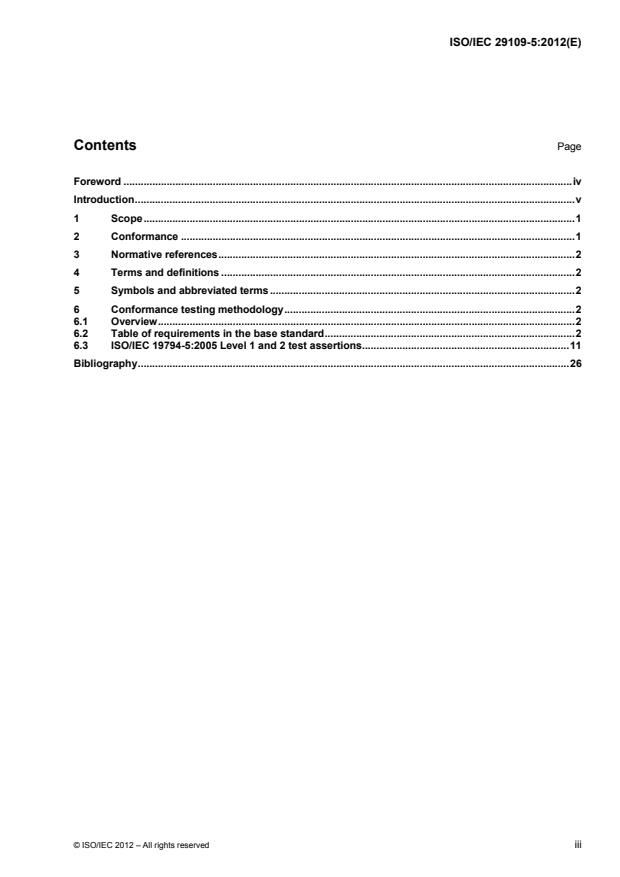
Contents Page
Foreword . iv
Introduction . v
1 Scope . 1
2 Conformance . 1
3 Normative references . 2
4 Terms and definitions . 2
5 Symbols and abbreviated terms . 2
6 Conformance testing methodology . 2
6.1 Overview . 2
6.2 Table of requirements in the base standard . 2
6.3 ISO/IEC 19794-5:2005 Level 1 and 2 test assertions . 11
Bibliography . 26
© ISO/IEC 2012 – All rights reserved iii
Foreword
ISO (the International Organization for Standardization) and IEC (the International Electrotechnical
Commission) form the specialized system for worldwide standardization. National bodies that are members of
ISO or IEC participate in the development of International Standards through technical committees
established by the respective organization to deal with particular fields of technical activity. ISO and IEC
technical committees collaborate in fields of mutual interest. Other international organizations, governmental
and non-governmental, in liaison with ISO and IEC, also take part in the work. In the field of information
technology, ISO and IEC have established a joint technical committee, ISO/IEC JTC 1.
International Standards are drafted in accordance with the rules given in the ISO/IEC Directives, Part 2.
The main task of the joint technical committee is to prepare International Standards. Draft International
Standards adopted by the joint technical committee are circulated to national bodies for voting. Publication as
an International Standard requires approval by at least 75 % of the national bodies casting a vote.
Attention is drawn to the possibility that some of the elements of this document may be the subject of patent
rights. ISO and IEC shall not be held responsible for identifying any or all such patent rights.
ISO/IEC 29109-5 was prepared by Joint Technical Committee ISO/IEC JTC 1, Information technology,
Subcommittee SC 37, Biometrics.
This second edition cancels and replaces the first edition (ISO/IEC 29109-5:2011), which has been technically
revised.
ISO/IEC 29109 consists of the following parts, under the general title Information technology — Conformance
testing methodology for biometric data interchange formats defined in ISO/IEC 19794:
Part 1: Generalized conformance testing methodology
Part 2: Finger minutiae data
Part 4: Finger image data
Part 5: Face image data
Part 6: Iris image data
Part 7: Signature/sign time series data
Part 8: Finger pattern skeletal data
Part 9: Vascular image data
Part 10: Hand geometry silhouette data
iv © ISO/IEC 2012 – All rights reserved
Introduction
ISO/IEC 19794-5:2005 specifies a data record interchange format for storing, recording, and transmitting one
or more face images within a Common Biometric Exchange Formats Framework (CBEFF) data structure.
Each image is accompanied by subject-specific and image-specific metadata contained in a header record.
This part of ISO/IEC 29109 establishes tests for checking the correctness of the binary record.
The objective of ISO/IEC 19794-5:2005 cannot be completely achieved until biometric products can be tested
to determine whether they conform to those specifications. Conforming implementations are a necessary
prerequisite for achieving interoperability among implementations; therefore there is a need for a standardized
conformance testing methodology, test assertions, and test procedures as applicable to specific modalities
addressed by each part of ISO/IEC 19794. The test assertions will cover as much as practical of the
ISO/IEC 19794 requirements (covering the most critical features), so that the conformity results produced by
the test suites will reflect the real degree of conformity of the implementations to ISO/IEC 19794 data
interchange format records. This is the motivation for the development of this conformance testing
methodology.
This part of ISO/IEC 29109 supports those applications that require use of face image data according to
ISO/IEC 19794-5:2005. It defines a testing methodology to assure conformance of a vendor’s application or
service to the base ISO/IEC 19794-5:2005 specification. Thus, this part of ISO/IEC 29109 is intended to:
establish elements of the conformance testing methodology framework that are specific to the face
image-based data record requirements of ISO/IEC 19794-5:2005 conformance testing;
define requirements and guidelines for specifying conformance test suites and related test methods for
measuring conformity of products and services to the face image-based data record requirements of
ISO/IEC 19794-5:2005; and
define test procedures to be followed before, during, and after conformance testing.
This part of ISO/IEC 29109 is applicable to the development and use of conformity test method specifications,
conformity test suites for ISO/IEC 19794-5:2005 records, and conformance testing programs for
ISO/IEC 19794-5:2005 conformant products. It is intended primarily for use by testing organizations, but may
be applied by developers and users of test method specifications and test method implementations.
© ISO/IEC 2012 – All rights reserved v
INTERNATIONAL STANDARD ISO/IEC 29109-5:2012(E)
Information technology — Conformance testing methodology
for biometric data interchange formats defined in
ISO/IEC 19794 —
Part 5:
Face image data
1 Scope
This part of ISO/IEC 29109 specifies elements of conformance testing methodology, test assertions, and test
procedures as applicable to two-dimensional face images defined in the ISO/IEC 19794-5:2005 biometric data
interchange format standard for face image data.
This part of ISO/IEC 29109 establishes
・ test assertions of the structure of the face image data format as specified in ISO/IEC 19794-5:2005 (Type
A Level 1 as defined in ISO/IEC 29109-1:2009),
test assertions of internal consistency by checking the types of values that may be contained within each
field (Type A Level 2 as defined in ISO/IEC 29109-1:2007),
tests of semantic assertions (Type A Level 3 as defined in ISO/IEC 29109-1:2009).
This part of ISO/IEC 29109 does not establish
tests of conformance of 3D face records defined in ISO/IEC 19794-5:2005/Amd.2:2009,
tests of conformance of CBEFF structures required by ISO/IEC 19794-5:2005,
tests of consistency with the input biometric data record (Level 3),
tests of conformance of the image data to the quality-related specifications of ISO/IEC 19794-5:2005,
tests of conformance of the image data blocks to the respective JPEG or JPEG 2000 standards,
tests of other characteristics of biometric products or other types of testing of biometric products
(e.g. acceptance, performance, robustness, security).
2 Conformance
Biometric data interchange format conformance tests conform to this part of ISO/IEC 29109 if they satisfy all
of the normative requirements related to Clause 6. Specifically, they shall use the test methodology specified
in Clauses 6, 7 and 8 of ISO/IEC 29109-1, and all Level 1 and Level 2 tests shall use the assertions defined in
Table 2 of Clause 6 of this part of ISO/IEC 29109.
© ISO/IEC 2012 – All rights reserved 1
Implementations of ISO/IEC 19794-5:2005 tested according to the methodology specified shall be able to
claim conformance only to those biometric data record requirements specified in ISO/IEC 19794-5:2005 that
are tested by the test methods established by this methodology.
Implementations of ISO/IEC 19794-5:2005 do not necessarily need to conform to all possible aspects of
ISO/IEC 19794-5:2005, but only to those ISO/IEC 19794-5:2005 requirements that are claimed to be
supported by the implementation in an Implementation Conformance Statement, filled out in accordance with
Clause 8 of ISO/IEC 29109-1 and Table 1 of Clause 6 in this part of ISO/IEC 29109.
3 Normative references
The following referenced documents are indispensable for the application of this document. For dated
references, only the edition cited applies. For undated references, the latest edition of the referenced
document (including any amendments) applies.
ISO/IEC 19794-5:2005, Information technology — Biometric data interchange formats — Part 5: Face image
data
ISO/IEC 29109-1:2009, Information technology — Conformance testing methodology for biometric data
interchange formats defined in ISO/IEC 19794 — Part 1: Generalized conformance testing methodology
4 Terms and definitions
For the purposes of this document, the terms and definitions given in ISO/IEC 29109-1 apply.
5 Symbols and abbreviated terms
For the purposes of this document, the symbols and abbreviated terms given in ISO/IEC 29109-1 apply.
6 Conformance testing methodology
6.1 Overview
The testing methodology specified in Clauses 6, 7 and 8 of ISO/IEC 29109-1 shall apply. The content of the
tables below is based on the conformance testing methodology outlined in ISO/IEC 29109-1 and shall only be
used in the context of that testing methodology.
6.2 Table of requirements in the base standard
The normative requirements of ISO/IEC 19794-5:2005 are listed in Table 1. The supplier of the IUT can
explain which optional components of the standard are supported and the testing laboratory can note the
results of the test.
Under subformat applicability the columns labelled B, F and T indicate the Basic, Full Frontal and Token
Frontal image types.
2 © ISO/IEC 2012 – All rights reserved
Table 1 — Requirements of the Base Standard (ISO/IEC 19794-5:2005)
Requi- Ref. in Requirement Summary Level Status Subformat IUT Supported Test
rement Base Applicability Support Range Result
ID Std
B F T
R-1 5.2.1 Within the record format and all well-defined data blocks therein, 1 M Y Y Y
all multi-byte quantities are [implied shall] stored in Big-Endian
format. That is, the more significant bytes of any multi-byte
quantity are stored at lower addresses in memory than less
significant bytes. For example, the value 1025 (2 to the 10th
power plus one) would be stored as first byte= 00000100 and
second byte=00000001.
R-2 5.2.2 Numeric Values 3C O-3 Y Y Y
All numeric values are fixed-length unsigned integer quantities,
unless otherwise specified.
R-3 5.4.1 Format Identifier 1 M Y Y Y
The (4 byte) Format Identifier shall consist of three ASCII
characters “FAC” followed by a zero byte as a NULL string
terminator to identify the record format as the face record format.
R-4 5.4.2 Version Number 1 M Y Y Y
The (4 byte) Version Number block shall consist of three ASCII
numerals followed by a zero byte as a NULL string terminator.
The first and second character will represent the major version
number and the third character will represent the minor revision
number.
The version number of this specification shall be 0x30313000;
“010” – Version 1 revision 0.
R-5 Table 2 57 ≤ Length of Record ≤ 2 - 1 1 M Y Y Y
R-6 5.4.3 Length of Record 2 M Y Y Y
The (4 byte) Record Length Block shall be the combined length in
bytes for the record. This is the entire length of the record
including the Facial Record Header and Facial Record Data.
R-7 Table 2 1 ≤ Number of Facial Images ≤ 65 535 1 M Y Y Y
R-8 5.4.4 Number of Facial Images 2 M Y Y Y
The (2 byte) Number of Facial Images block shall be the number
of facial images included in the record.
R-9 5.5 The Facial Information block 2 M-2 Y Y Y
The (20 byte) Facial Information block is intended to describe
discrete properties of the individual discernable from the image,
one is included for each facial image included in the record. The
structure of this block is shown in [ISO/IEC 19794-5:2005] Figure
2.
Zero or more Facial Feature blocks, one Image Information block,
and one Image Data block follow this block.
R-10 5.5.1 Facial Record Data Length 2 M Y Y Y
The (4 byte) Facial Record Data Length field denotes the sum of
the lengths of the Facial Information block, the Feature Point
block(s), the Image Information block, and the Image Data block.
The minimum value of the Facial Record Data Length is 32 bytes
plus the size of the Image Data block (in bytes).
R-11 5.5.2 Number of Feature Points 2 M Y Y Y
The (2 byte) Number of Feature Points block shall be the number
of Feature Point blocks that follow the Facial Information block.
The Feature Point block is defined in [ISO/IEC 19794-5:2005]
Clause 5.6.
R-12 5.5.3 Gender 1 M Y Y Y
The (1 byte) Gender block shall be specified in accordance with
[ISO/IEC 19794-5:2005] Table 3.
R-13 5.5.4 Eye Colour 1 M Y Y Y
The (1 byte) Eye Colour field shall represent the colour of irises of
the eyes according to [ISO/IEC 19794-5:2005] Table 4. If the eyes
are different colours, then right eye colour is to be encoded.
R-14 5.5.5 Hair Colour 1 M Y Y Y
The (1 byte) Hair Colour field shall represent the colour of the hair
according to the [ISO/IEC 19794-5:2005] Table 5.
© ISO/IEC 2012 – All rights reserved 3
Requi- Ref. in Requirement Summary Level Status Subformat IUT Supported Test
rement Base Applicability Support Range Result
ID Std
B F T
R-15 5.5.6 Property Mask 2 M Y Y Y
The (3 byte) Property Mask is a bit mask of 3 bytes and each bit of
the mask position listed in [ISO/IEC 19794-5:2005] Table 6 shall
be set to 1 if the corresponding property is present, and set to 0 if
absent. The mask position starts from 0 at the lowest bit. The
lowest bit set to 0 shall indicate that properties are not specified
(and all bits shall be zero); the lowest bit set to 1 shall indicate that
all listed properties have been considered and that a zero value of
any property bit indicates an absence of that property.
Note that a Blink flag set to “1” will indicate non-compliance with
the Frontal, Full Frontal, and Token image types.
R-16 5.5.7 Expression 1 M Y Y Y
The (2 byte) Expression field shall represent the expression of the
face according to [ISO/IEC 19794-5:2005] Table 7.
R-17 5.5.8 Pose Angle 3C O-1 Y Y Y
The (3 multi byte) Pose Angle field (B , B , B ) shall represent the
Y P R
estimate or measure pose of the subject in the image. Each byte
in the field respectively represents pose angles of yaw, pitch and
roll in that order. The pose angle is given by Tait-Bryan angles.
• Yaw angle: Rotation about the vertical (y) axis.
• Pitch angle: Rotation about the horizontal side-to-side (x)
horizontal axis.
• Roll angle: Rotation about the horizontal back to front (z) axis.
The angles are defined relative to the frontal view of the subject,
which has angles (0,0,0) as shown in [ISO/IEC 19794-5:2005]
Figure 4. The examples are shown in [ISO/IEC 19794-5:2005]
Figure 5.
As order of the successive rotation around the different axes does
matter, the encoded rotation angle shall correspond to an order of
execution starting from the frontal view. This order shall be given
by Roll (about the front axis), then Pitch (about the horizontal axis)
and finally Yaw (about the vertical axis). The (first executed) Roll
transformation will therefore always be in the image (x,y) plane.
From the point of view of executing a transformation from the
observed view to a frontal view, the transformation order will
therefore be Yaw, Pitch, and then Roll. Note however that the
encoded angle is from the frontal view to the observed view.
R-18 5.5.8.1 Pose Angle – Yaw 1 M Y Y Y
The yaw angle Y is the rotation in degrees about the y-axis
(vertical axis) shown in [ISO/IEC 19794-5:2005] Figure 4. Frontal
faces have a yaw angle of 0 degrees. Positive angles represent
faces looking to their left (a counter-clockwise rotation around the
y-axis).
The encoding B of the yaw angle Y shall be in degrees as a byte
Y
(1 byte) with values from –180 to 180.
If 180 ≥ Y ≥ 0 and Y is even, then B = Y/2+1
Y
If 180 ≥ Y > 0 and Y is odd, then B = (Y+1)/2
Y
If -180 ≤ Y < 0 and Y is even, then B = 181+Y/2.
Y
If -180 ≤ Y < 0 and Y is odd, then By = 181+(Y-1)/2
The maximum value of B is 180. If the yaw angle is not specified,
Y
the value of B shall be 0.
Y
R-19 5.5.8.2 Pose Angle – Pitch 1 M Y Y Y
The pitch angle is the rotation in degrees about the x-axis
(horizontal axis) shown in [ISO/IEC 19794-5:2005] Figure 4.
Frontal faces have a pitch angle of 0 degrees. Positive angles
represent faces looking down (a counterclockwise rotation around
the x-axis).
The encoding B of the yaw angle P shall be in degrees as a byte
P
(1 byte) with values from –180 to 180.
If 180 ≥ P ≥ 0 and P is even, then B = P/2+1
P
If 180 ≥ P > 0 and P is odd, then B = (P+1)/2
P
If -180 ≤ P < 0 and P is even, then B = 181+P/2.
P
If -180 ≤ P < 0 and P is odd, then B = 181+(P-1)/2
P
The maximum value of B is 180. If the pitch angle is not specified,
P
the value of B shall be 0.
P
4 © ISO/IEC 2012 – All rights reserved
Requi- Ref. in Requirement Summary Level Status Subformat IUT Supported Test
rement Base Applicability Support Range Result
ID Std
B F T
R-20 5.5.8.3 Pose Angle – Roll 1 M Y Y Y
The roll angle is the rotation in degrees about the z-axis (the
horizontal axis from front to back) shown in [ISO/IEC 19794-
5:2005] Figure 4. Frontal faces have a roll angle of 0 degrees.
Positive angles represent faces tilted toward their right shoulder
(counter-clockwise rotation around the z-axis).
The encoding B of the yaw angle R shall be in degrees as a byte
R
(1 byte) with values from –180 to 180.
If 180 ≥ R ≥ 0 and R is even, then B = R/2+1
R
If 180 ≥ R > 0 and R is odd, then B = (R+1)/2
R
If -180 ≤ R < 0 and R is even, then B = 181+R/2.
R
If -180 ≤ R < 0 and R is odd, then B = 181+(R-1)/2
R
The maximum value of B is 180. If the roll angle is not specified,
R
the value of B shall be 0.
R
R-21 5.5.9 Pose Angle Uncertainty 1 M Y Y Y
The (3 multi-byte) Pose Angle Uncertainty (U , U , U ) represents
Y P R
the expected degree of accuracy of the pose angle yaw, pitch, and
roll. Each byte in the field respectively represents the uncertainty
of yaw, pitch and roll in that order. The uncertainty is allowed to
represent experimental uncertainty specified by each vendor.
The encoding of Pose Angle Uncertainty is given by bytes (U , U ,
Y P
U ) where each byte U in the field (k=Y,P,R) represents 1 degree
R K
of uncertainty with minimum and maximum values of 1 and 181
where U =(uncertainty+1). The more uncertain, the value of the
K
uncertainty U shall become larger. If the uncertainty is not
K
specified, then the values of U , U and U shall be set to zero (0).
Y P R
R-22 5.6 The Feature Point Block 1 M Y Y Y
The optional (8 byte) Feature Point block specifies the type, code
and position of a Feature Point in the facial image. The number of
Feature Point blocks shall be specified in the Number of Feature
Points field of the Facial Information Block. The structure of this
block is shown in [ISO/IEC 19794-5:2005] Table 8.
R-23 5.6.1 Feature Point Type 1 M Y Y Y
The (1 byte) Feature Point Type field represents the type of the
Feature Point stored in the Feature Point block. This field shall be
set to 0x01 to denote that the position of the Feature Point is
represented by the coordinate of the image. All other field values
are reserved for future definition of Feature Point types.
R-24 5.6.2 Feature Point Code 1 M Y Y Y
The (1 byte) Feature Point Code field shall specify the Feature
Point that is stored in the Feature Point block. The codes of the
Feature Points in [ISO/IEC 19794-5:2005] clause 5.6.3, taken from
the MPEG4 standard and defined as MPEG4 Feature Points, or
the additional eye and nostril Feature Points in [ISO/IEC 19794-
5:2005] clause 5.6.4 shall be stored in this block.
Each Feature Point code is represented by a notation A.B using a
major (A) and a minor (B) value. The encoding of the Feature
Point code is given by the (1 byte) value of A*16 + B.
R-25 5.6.3 MPEG4 Feature Points 3C O-1 Y Y Y
[ISO/IEC 19794-5:2005] Figure 6 denotes the Feature Point codes
associated with Feature Points as given by Annex C of
ISO/IEC 14496-2
R-26 5.6.4 Eye and nostril centre Feature Points 3C O-1 Y Y Y
The eye centre Feature Points 12.1 (left) and 12.2 (right) are
defined to be the horizontal and vertical midpoints of the eye
corners (3.7, 3.11) and (3.8, 3.12) respectively. The left nostril
centre Feature Point 12.3 is defined to be the midpoint of the nose
Feature Points (9.1, 9.15) in the horizontal direction and (9.3,9.15)
in the vertical direction. Similarly, the right nostril centre Feature
Point 12.4 is defined to be the midpoint of the nose Feature Points
(9.2, 9.15) in the horizontal direction and (9.3,9.15) in the vertical
direction. Both the eye centre and nostril centre Feature Points are
shown in [ISO/IEC 19794-5:2005] Figure 7 and values given in
[ISO/IEC 19794-5:2005] Table 9.
© ISO/IEC 2012 – All rights reserved 5
Requi- Ref. in Requirement Summary Level Status Subformat IUT Supported Test
rement Base Applicability Support Range Result
ID Std
B F T
R-27 5.7 The Image Information Block 2 M-2 Y Y Y
The (16 byte) Image Information block is intended to describe
digital properties of the facial image, one is included for each
facial image included in the record. The structure of this block is
shown in [ISO/IEC 19794-5:2005] Figure 2. One Image Data block
shall follow this block.
R-28 5.7.1 Face Image Type 1 M Y Y Y
The Face Image Type field shall represent the type of the facial
image stored in the Image Data Block according to
[ISO/IEC 19794-5:2005] Table 10. Note that all Frontal Image
Types are either Full Frontal or Token Frontal. Therefore a
separate Frontal Value is not required.
The Basic Face Image Type is defined in [ISO/IEC 19794-5:2005]
clause 6. The Frontal, Frontal/Full and Frontal/Token Face Image
Types are defined in [ISO/IEC 19794-5:2005] clauses 7, 8, and 9
respectively. Face Image Types use the notion of inheritance. For
example, the Frontal Face Image Type inherits all of the
requirements of the Basic Face Image Type - the Frontal Face
Image type obeys all normative requirements of the Basic Face
Image Type. The inheritance structure of currently defined image
types is shown in [ISO/IEC 19794-5:2005] Figure 8.
R-29 5.7.2 Image Data Type 2 M Y Y Y
The (1 byte) Image Data Type field denotes the encoding type of
the Image Data block. Either JPEG (ISO/IEC 10918-1 and ITU-T
Rec. T.81) or JPEG2000 (ISO/IEC 15444-1) shall be specified.
Note that a “Unspecified” Value cannot be encoded.
R-30 5.7.3 Width 2 M Y Y Y
The (2 byte) Width field shall specify the number of pixels in the
horizontal direction.
R-31 5.7.4 Height 2 M Y Y Y
The (2 byte) Height field shall specify the number of pixels in the
vertical direction.
R-32 5.7.5 Image Colour Space 2 M Y Y Y
The (1 byte) Image Colour Space field indicates the colour space
used in the encoded Image Data block according to the values in
[ISO/IEC 19794-5:2005] Table 12. The values of 128-255 are
vendor specific. Application developers may obtain the values for
these codes from the vendor.
R-33 5.7.6 Source Type 1 M Y Y Y
The (1 byte) Source Type field denotes the classification of the
source of the captured image and is given in [ISO/IEC 19794-
5:2005] Table 13.
R-34 5.7.7 Device Type 1 M Y Y Y
The (2 byte) Device Type field denotes the vendor specific capture
device type ID. A value of all zeros will be acceptable and will
indicate that the capture device type ID is unspecified. Application
developers may obtain the values for these codes from the
vendor.
R-35 5.7.8 Quality 1 M Y Y Y
The (2 byte) Quality field shall be reserved for future definition to
represent a quality of the facial image. This field shall be set to the
value 0 indicating “unspecified”.
R-36 5.8.1 Data structure 2 M Y Y Y
The (variable byte) Image Data block shall be the image data
encoded by either the JPEG or JPEG2000 standards.
Basic Face Image Type
R-37 6.2 Image data encoding requirements for the Basic Face Image Type2 M Y Y Y
One of two possible encodings is to be used for all image types
(Basic)
1) The JPEG Sequential baseline (ISO/IEC 10918-1) mode of
operation and encoded in the JFIF file format (the JPEG file
format)
2) The JPEG-2000 Part-1 Code Stream Format (ISO/IEC 15444-
1) and encoded in the JP2 file format (the JPEG2000 file format).
6 © ISO/IEC 2012 – All rights reserved
Requi- Ref. in Requirement Summary Level Status Subformat IUT Supported Test
rement Base Applicability Support Range Result
ID Std
B F T
R-38 6.4.1 Facial Header [for the Basic Face Image Type] 1 M Y Y Y
The Format Identifier, Version Number, Length of Record, and
Number of Faces fields shall be specified.
R-39 6.4.2 Facial Information [for the Basic Face Image Type] 1 M Y Y Y
The Block Length and Number of Feature Points fields shall be
specified.
R-40 6.4.3 Image Information [for the Basic Face Image Type] 1 M Y Y Y
The Face Image Type field shall be specified with value 0x00.
R-41 6.4.3 The Image Data Type, Width, and Height fields shall be specified. 1 M Y Y Y
The Frontal Face Image Type
R-42 7.2.2 Pose 3C O-1 N Y Y
Thus, the full-face frontal pose shall be used. Rotation of the head
shall be less than ±5° from frontal in pitch and yaw (see 5.5.8).
Pose variations that lead to an in-plane rotation of the head can be
more easily compensated by automated face recognition systems.
Therefore, the rotation of the head shall be less than ±8° from
frontal in roll (see 5.5.8). [ISO/IEC 19794-5:2005] Figure Cor.1.1
shows an example of ±8° rotation in roll.
The best practice recommendation as outlined in A.2.2 is that the
rotation of the head should be less than ±5° from frontal in roll.
This constraint refers to the pose of the subject associated with
the face image format data for all applications that call for this
format to be used.
[NOTE: This text is from ISO/IEC 19794-5:2005/Cor.2 Published
2008-07-01]
R-43 7.2.4 Assistance in positioning the face 3C O-1 N Y Y
In no cases will any other face be captured in the Frontal image.
See informative annex A.2 for best practices on this topic.
R-44 7.2.5 Shoulders 3C O-1 N Y Y
Shoulders shall be “square on” to the camera. “Portrait style”
photographs where the subject is looking over one shoulder are
not acceptable.
R-45 7.2.7 Subject and scene lighting 3C O-1 N Y Y
Lighting shall be equally distributed on the face.
R-46 7.2.7 There shall be no significant direction of the light from the point of 3C O-1 N Y Y
view of the photographer, as further described in [ISO/IEC 19794-
5:2005] clauses 7.2.8 and 7.2.9
R-47 7.2.8 Shadows over the face 3C O-1 N Y Y
The region of the face, from the crown (as defined in section 4.6)
to the base of the chin, and from ear-to-ear, shall be clearly visible
and free of shadows.
R-48 7.2.8 Special care shall be taken in cases when veils, scarves or 3C O-1 N Y Y
headdresses cannot be removed for religious reasons to ensure
these coverings do not obscure any facial features and do not
generate shadow. In all other cases head coverings shall be
absent .
R-49 7.2.9 Shadows in eye-sockets 3C O-1 N Y Y
There shall be no dark shadows in the eye-sockets due to the
brow.
R-50 7.2.9 The iris and pupil of the eyes shall be clearly visible. 3C O-1 N Y Y
R-51 7.2.10 Hot Spots 3C O-1 N Y Y
Care shall be taken to avoid "hot spots" (bright areas of light
shining on the face). These artefacts are typically caused when
one, high intensity, focused light source is used for illumination.
R-52 7.2.10 Instead, diffused lighting, multiple balanced sources or other 3C O-1 N Y Y
lighting methods shall be used.
A single bare “point” light source is not acceptable for imaging.
Instead, the illumination should be accomplished using other
methods that meet requirements specified in this [ISO/IEC 19794-
5:2005] clause.
© ISO/IEC 2012 – All rights reserved 7
Requi- Ref. in Requirement Summary Level Status Subformat IUT Supported Test
rement Base Applicability Support Range Result
ID Std
B F T
R-53 7.2.11 Eye Glasses 3C O-1 N Y Y
If the person normally wears glasses then they should wear
glasses when their photograph is taken. Glasses shall be clear
glass and transparent so the eye pupils and irises are clearly
visible.
Permanently tinted glasses or sunglasses are acceptable only for
R-54 7.2.11 3C O-1 N Y Y
medical reasons (and shall otherwise be removed). In cases
where tinted glasses or sunglasses are worn, the specification of
dark glasses in the header structure is recommended.
Care shall be taken that the glasses frames do not obscure the
R-55 7.2.11 3C O-1 N Y Y
eyes.
R-56 7.2.11 There shall be no lighting artefacts or flash reflections on glasses. 3C O-1 N Y Y
This can typically be achieved by increasing the angle between
the lighting, subject and camera to 45º (degrees) or more.
R-57 7.2.12 Eye Patches 3C O-1 N Y Y
The wearing of eye patches is allowed only for medical reasons.
In these cases, the specification of the patch, in the header
structure is recommended.
R-58 7.3.2 No Over or Under Exposure 3C O-1 N Y Y
For each patch of skin on the person’s face, the gradations in
textures shall be clearly visible. In this sense, there will be no
saturation (over or under exposure) on the face.
R-59 7.3.3 Focus and Depth of Field 3C O-1 N Y Y
The subject’s captured image shall always be in focus from nose
to ears and chin to crown.
R-60 7.3.3 All images will have sufficient depth of focus to maintain greater 3C O-1 N Y Y
than two millimetre resolution on the subject’s facial features at
time of capture.
R-61 7.3.4 Unnatural Color 3C O-1 N Y Y
Unnaturally coloured lighting, yellow, red, etc. is not allowed. Care
shall be taken to correct the "white balance" of image capture
devices.
R-62 7.3.4 The lighting shall produce a face image with natural looking flesh 3C O-1 N Y Y
tones when viewed in typical examination environments.
R-63 7.3.4 “Red-eye” is not acceptable. 3C O-1 N Y Y
R-64 7.3.5 Color or Grayscale Enhancement 3C O-1 N Y Y
A process that overexposes or under-develops a colour or
greyscale image for purposes of beauty enhancement or artistic
pleasure is not allowed. The full spectrum shall be represented on
the face image where appropriate. Teeth and whites of eyes shall
be clearly light or white (when appropriate) and dark hair or
features (when appropriate) shall be clearly dark.
R-65 7.3.6 Radial Distortion of the Camera Lens 3C O-1 N Y Y
The fish eye (ref. 4.11) that is associated with unusually large
noses in the image is not allowed.
R-66 7.4.1.1 Pixel aspect ratio 3C O-1 N Y Y
Digital cameras and scanners used to capture facial images shall
produce images with a pixel aspect ratio of 1:1. That is, the
number of pixels per inch in the vertical dimension shall equal the
number of pixels per inch in the horizontal direction.
R-67 7.4.1.2 Origin at Upper Left 3C O-1 N Y Y
The origin of coordinates shall be at the upper left given by
coordinate (0,0) with positive entries from left to right (first
dimension) and top to bottom (second dimension).
R-68 7.4.2.3 Colour space 2 O-1 N Y Y
Frontal images shall be represented as one of the following
a) The 24-bit RGB colour space where for every pixel, eight (8)
bits will be used to represent each of the Red, Green, and Blue
components.
b) An 8-bit monochrome colour space where for every pixel, (8)
bits will be used to represent the luminance component.
c) The YUV422 colour space where twice as many bits are
dedicated to luminance as to each of the two colour components.
YUV422 images typically contain two 8-bit Y samples along with
one 8-bit sample of each of U and V in every four bytes.
8 © ISO/IEC 2012 – All rights reserved
Requi- Ref. in Requirement Summary Level Status Subformat IUT Supported Test
rement Base Applicability Support Range Result
ID Std
B F T
R-69 7.4.3 Video interlacing 3C O-1 N Y Y
Interlaced video frames are not allowed for the Frontal Image
Type. All interlacing must be absent (not simply removed, but
absent).
R-70 7.5.2 Image Information [for the Frontal Image Type] 1 M N Y Y
Frontal Images are either Full Frontal or Token Frontal images
and the Face Image Type field shall be set accordingly (ref. 8.5.2,
9.3.2).
The Full Frontal Image Type
R-71 8.3.1 Introduction 3C O-1 N Y Y
In addition to the requirements of 8.3.2 to 8.3.6, the face from chin
to crown as defined in 8.3.5 and with the full width as defined in
8.3.4 shall be visible in the image.
[NOTE: This text is from ISO/IEC 19794-5:2005/Cor.2 Published
2008-07-01]
R-72 8.3.2 Horizontally centred face 3C O-1 N Y N
The approximate horizontal midpoints of the mouth and of the
bridge of the nose define the imaginary line AA (usually the
symmetry axis of the face). Furthermore, the imaginary line BB is
defined as the line through the centre of the left eye and the centre
of the right eye. The intersection of AA and BB defines the point M
as the centre of the face. The x-coordinate Mx of M shall be
between 45 % and 55 % of the image width.
[NOTE: This text is from ISO/IEC 19794-5:2005/Cor.2 Published
2008-07-01]
R-73 8.3.3 Vertical position of the face 3C O-1 N Y N
The y-coordinate M of M shall be between 30 % and 50 % of the
y
image height.
[NOTE: This text is from ISO/IEC 19794-5:2005/Cor.2 Published
2008-07-01]
N Y N
R-74 8.3.3 A single exception is allowed for children under the age of 11 3C O-1
years, in which case the higher limit shall be modified to 60 % (i.e.
the centre point of the head is allowed to be lower in the image for
children under the age of 11). Note that the origin O of the
coordinate system is in the upper left corner of the image.
[NOTE: This text is from ISO/IEC 19794-5:2005/Cor.2 Published
2008-07-01]
R-75 8.3.4 Width of head 3C O-1 N Y N
The width of a head is defined as the distance between the two
imaginary lines parallel to the line AA; each imaginary line is
drawn between the upper and lower lobes of each ear and shall
be positioned where the external ear connects to the head. The
head width is shown as length CC in [ISO/IEC 19794-5:2005]
Figure 9.
[NOTE: This text is from ISO/IEC 19794-5:2005/Cor.2 Published
2008-07-01]
R-76 8.3.4 To ensure that the entire face is visible in the image, the head 3C O-1 N Y N
width (CC) shall be between 50 % and 75 % of the image width
(A).
[NOTE: This text is from ISO/IEC 19794-5:2005/Cor.2 Published
2008-07-01]
R-77 8.3.5 Length of head 3C O-1 N Y N
The length of a head is defined as the distance between the base
of the chin and the crown measured on the imaginary line AA. This
is shown as length DD in [ISO/IEC 19794-5:2005] Figure 9. The
crown is defined as the top of the head ignoring any hair.
In order to assure that the entire face is visible in the image, the
minimum image height shall be specified by requiring that the
crown-to-chin portion (DD) of the full frontal image pose shall be
between 60 % and 90 % of the vertical length of the image (B).
[NOTE: This text is from ISO/IEC 19794-5:2005/Cor.2 Published
2008-07-01]
R-78 8.3.5 A single exception is allowed for children under the age of 11 3C O-1 N Y N
years, in which case the lower limit shall be modified to 50 %.
© ISO/IEC 2012 – All rights reserved 9
Requi- Ref. in Requirement Summary Level Status Subformat IUT Supported Test
rement Base Applicability Support Range Result
ID Std
B F T
R-79 8.4.1 Resolution [Digital requirements for the Full Frontal Face Image 3C O-1 N Y N
Type]
For an image for optimal human examination and permanent
storage, the resolution of the full images shall be at least 180
pixels of resolution for the width of the head, or roughly 90 pixels
from eye centre to eye centre. See informative annex section
A.3.1.1 for best practices on this topic.
R-80 8.5.2 Image Information 1 M N Y N
The Face Image Type field shall be specified with value 0х01.
[NOTE: This text is from ISO/IEC 19794-5:2005/Cor.1 Published
2008-07-01]
The Token Face Image Type
R-81 9.2.2 Eye positions 3C O-1 N N Y
To create a Token Face image, the eye socket centres, or simply
eye positions, defined as Feature Points 12.1 and 12.2, shall be
determined. For the determination of eye positions, it is possible:
1 - to use computer inspection
2 - to use human visual inspection
3 - to use computer and human visual inspection.
R-82 9.2.3 Token image geometric format 2 M N N Y
A Token image is a colour or greyscale image with image
dimensions and eye position coordinates given by
[ISO/IEC 19794-5:2005] Table 16. Note that [ISO/IEC 19794-
5:2005] clause 5.2.3 specifies conversion of values to integer.
Image Height W/0,75 where W is the Image Width.
R-83 9.2.3 Y coordinate of Eyes 0,6 * W 3C O-1 N N Y
[NOTE: This text is from ISO/IEC 19794-5:2005 Table 16 column
1.]
R-84 9.2.3 X coordinate of First (right) Eye 0,375 * W 3C O-1 N N Y
[NOTE: This text is from ISO/IEC 19794-5:2005 Table 16 column
1.]
R-85 9.2.3 X coordinate of Second (left) Eye = (0,625 * W) - 1 3C O-1 N N Y
[NOTE: This text corrects typographical error in ISO/IEC 19794-
5:2005 Table 16 column 1.]
R-86 9.2.3 Width from eye to eye (inclusive) 0,25 *W 3C O-1 N N Y
[NOTE: This text is from ISO/IEC 19794-5:2005 Table 16 column
1.]
R-87 9.2.4 Minimum Width Token Image 2 M N N Y
The minimum required image width is 240 pixels.
R-88 9.2.4 The distance from eye to eye (inclusive) in this case is therefore 3C O-1 N N Y
[at least] 60 pixels. This example is shown in [ISO/IEC 19794-
5:2005] Figure 10.
R-89 9.2.4 Coordinates are relative to the top left corner of the image (0,0) 3C O-1 N N Y
and all measurements are in units of pixels.
R-90 9.2.5 Padding 3C O-1 N N Y
The normative practice shall be to fill any undefined set of pixels
with any colour. See informative annex A.4.3 for best practices on
this matter.
R-91 9.3.2 Image Information 1 M N N Y
The Face Image Type field in the Image Information structure
shall be specified with value 0x02.
NOTE 1 Level 3C conformance test assertions are not specified. In all cases, the reason for this is that no method has
been defined to test the conformance of the IUT or BDIR for this mandatory requirement of the base standard. For the
purposes of this part of ISO/IEC 29109, the requirements are optional ("O") until an appropriate test method is established.
The 3C label indicates that conformance testing of this Level 3 conformance requirement is beyond the scope of the
present version of the conformance testing standard containing the table. However, most of the requirements could be
tested by means of suitable image processing operations. For example, there is a large academic literature on methods
for pose estimation (see [5] for a review).
10 © ISO/IEC 2012 – All rights reserved
NOTE 2 These Level 2 requirements appear in clauses which define the block structure of a conformant
ISO/IEC 19794-5:2005 record. The requirements do not appear in Tables 2, 3, 4 and 5 below because other conformance
test assertions cover these requirements.
NOTE 3 This is not a Level 1 requirement because testing requires more information than is contained in the field. It
could be addressed on a case-by-case basis by the requirements / assertions pertaining to those fields.
6.3 ISO/IEC 19794-5:2005 Level 1 and 2 test assertions
A subsystem that claims to produce face image records that conformant to the Level 1 and Level 2
requirements of the ISO/IEC 19794-5:2005 Face Image Format for Data Interchange shall be assessed by
execution of all of the specific test assertions listed in Table 2. The test notes which follow Table 2 are
normative.
If the Subformat is blank for a given assertion, the assertion shall apply to all Subformats (Basic, Full Frontal
and Token Frontal).
A subsystem that claims to produce face image records that conformant to the Level 1 and Level 2
requirements of the Basic Face Image Type of ISO/IEC 19794-5:2005 Face Image Format for Data
Interchange shall be assessed by execution of all of the specific test assertions listed in Table 3. The test
notes which follow Table 3 are normative.
A subsystem that claims to produce face image records that conformant to the Level 1 and Level 2
requirements of the Full Frontal Face Image Type of ISO/IEC 19794-5:2005 Face Image Format for Data
Interchange shall be assessed by execution of all of the specific test assertions listed in Table 4. The test
notes which follow Table 4 are normative.
A subsystem that claims to produce face image records that conformant to the Level 1 and Level 2
requirements of the Token Face Image Type of ISO/IEC 19794-5:2005 Face Image Format for Data
Interchange shall be assessed by execution of all of the specific test assertions listed in Table 5. The test
notes which follow Table 5 are normative.
...
Questions, Comments and Discussion
Ask us and Technical Secretary will try to provide an answer. You can facilitate discussion about the standard in here.
Loading comments...