

ISO 11893:2011
(Main)Space systems — Programme management — Project organization
General Information
- Abstract
ISO 11893:2011 defines the project organization principles and requirements needed to provide satisfactory and coherent management of space projects. The general requirements for project organization are given in ISO 14300-1. It addresses the following, in particular: responsibility and authority of the actors (all actors, customer, supplier), interrelations between the actors (meetings, action monitoring, reporting, assessments and audits), information technologies, and project organization documentation. The requirements specified herein apply to and affect the supplier and customer at all levels. ISO 11893:2011 is applicable to the customer-supplier relationship for space products to the extent agreed by both parties. It is intended to be used as a basis when establishing and negotiating customer program/project management requirements and to guide the supplier's responses. When viewed in a specific project context, the requirements defined in this International Standard should be tailored to match the specific requirements of a particular profile and circumstances of a project.
- Status
- Published
- Publication Date
- 12-Apr-2011
- Technical Committee
- ISO/TC 20/SC 14 - Space systems and operations
- Drafting Committee
- ISO/TC 20/SC 14/WG 5 - Space System Program Management and Quality
- Current Stage
- 9093 - International Standard confirmed
- Start Date
- 07-Dec-2021
- Completion Date
- 29-Aug-2026


Overview
ISO 11893:2011 - "Space systems - Programme management - Project organization" defines principles and requirements for establishing coherent project organizations in space programmes. It complements ISO 14300-1 by specifying how responsibilities, authority, interrelations, information technologies and project documentation should be structured across customer–supplier chains. The standard applies to all levels of suppliers and customers and is intended as a negotiation and implementation basis for programme/project management requirements in space projects. Requirements are to be tailored to the specific project profile and circumstances.
Key topics and requirements
- Project organization principles: Establish a clear, coherent organizational structure that includes required disciplines, reporting lines and interfaces across internal and external stakeholders.
- Responsibilities and authority: Define and allocate roles, responsibilities and authority unambiguously for all actors (customer, supplier, consultants). Identify the individual responsible for setting up the project organization.
- Customer and supplier obligations:
- Customer: define project characteristics, requirements and constraints; verify supplier compliance; assume supplier responsibilities when providing products to lower-tier actors.
- Supplier: set up project management organization, allocate adequate resources, monitor lower-tier suppliers, implement approved management plans, identify key personnel and roles.
- Key project functions: Project management, contracts, project control, configuration management, documentation management, information systems, procurement, AIV (assembly, integration and verification), product assurance and safety, engineering.
- Interrelations and communication: Formal meeting practices (agendas, minutes, action lists), action-monitoring systems with unique IDs, status and close-out tracking, reporting schedules, and contractual change control for meeting outcomes that affect contracts.
- Information technologies: Ensure data compatibility and use IT as the primary medium for information exchange.
- Project organization documentation: Produce implementation documents and a project directory (minimum: key personnel) to maintain coherence and traceability.
Applications and practical value
- Use ISO 11893:2011 when establishing or negotiating customer–supplier project management requirements for satellites, launch systems, payloads and space subsystems.
- Ideal for program managers, project managers, systems engineers, procurement leads, quality and product assurance teams, and prime contractors to:
- Define governance, reporting and audit interfaces
- Structure supplier chains and subcontractor oversight
- Implement action-monitoring and meeting governance
- Ensure data interoperability across project IT systems
- Helps reduce contractual ambiguity, improve stakeholder communications, and support successful delivery of complex space projects.
Related standards
- ISO 14300-1 (Structuring of a programme) - general organizational principles for space programmes
- ISO 14300-2 (Product assurance) - product assurance considerations
- ISO 9000 - quality management fundamentals and vocabulary
Keywords: ISO 11893:2011, space systems, project organization, programme management, customer–supplier, action monitoring, project documentation, information technologies.
Get Certified
Connect with accredited certification bodies for this standard

BUREAU VERITAS Certification Germany
Bureau Veritas certification in Germany.

Element Materials Technology
Materials testing and product certification.

AQMS Ltd.
AQMS provides ISO certification to SMEs across the UK.
Sponsored listings
Frequently Asked Questions
ISO 11893:2011 is a standard published by the International Organization for Standardization (ISO). Its full title is "Space systems — Programme management — Project organization". This standard covers: ISO 11893:2011 defines the project organization principles and requirements needed to provide satisfactory and coherent management of space projects. The general requirements for project organization are given in ISO 14300-1. It addresses the following, in particular: responsibility and authority of the actors (all actors, customer, supplier), interrelations between the actors (meetings, action monitoring, reporting, assessments and audits), information technologies, and project organization documentation. The requirements specified herein apply to and affect the supplier and customer at all levels. ISO 11893:2011 is applicable to the customer-supplier relationship for space products to the extent agreed by both parties. It is intended to be used as a basis when establishing and negotiating customer program/project management requirements and to guide the supplier's responses. When viewed in a specific project context, the requirements defined in this International Standard should be tailored to match the specific requirements of a particular profile and circumstances of a project.
ISO 11893:2011 defines the project organization principles and requirements needed to provide satisfactory and coherent management of space projects. The general requirements for project organization are given in ISO 14300-1. It addresses the following, in particular: responsibility and authority of the actors (all actors, customer, supplier), interrelations between the actors (meetings, action monitoring, reporting, assessments and audits), information technologies, and project organization documentation. The requirements specified herein apply to and affect the supplier and customer at all levels. ISO 11893:2011 is applicable to the customer-supplier relationship for space products to the extent agreed by both parties. It is intended to be used as a basis when establishing and negotiating customer program/project management requirements and to guide the supplier's responses. When viewed in a specific project context, the requirements defined in this International Standard should be tailored to match the specific requirements of a particular profile and circumstances of a project.
ISO 11893:2011 is classified under the following ICS (International Classification for Standards) categories: 49.140 - Space systems and operations. The ICS classification helps identify the subject area and facilitates finding related standards.
ISO 11893:2011 is available in PDF format for immediate download after purchase. The document can be added to your cart and obtained through the secure checkout process. Digital delivery ensures instant access to the complete standard document.
Standards Content (Sample)
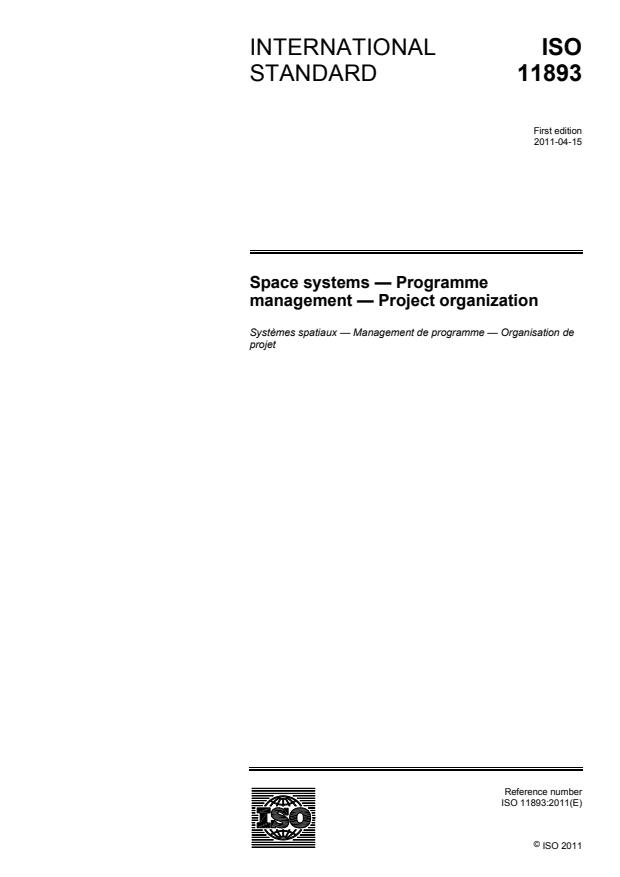
INTERNATIONAL ISO
STANDARD 11893
First edition
2011-04-15
Space systems — Programme
management — Project organization
Systèmes spatiaux — Management de programme — Organisation de
projet
Reference number
©
ISO 2011
© ISO 2011
All rights reserved. Unless otherwise specified, no part of this publication may be reproduced or utilized in any form or by any means,
electronic or mechanical, including photocopying and microfilm, without permission in writing from either ISO at the address below or
ISO's member body in the country of the requester.
ISO copyright office
Case postale 56 CH-1211 Geneva 20
Tel. + 41 22 749 01 11
Fax + 41 22 749 09 47
E-mail copyright@iso.org
Web www.iso.org
Published in Switzerland
ii © ISO 2011 – All rights reserved
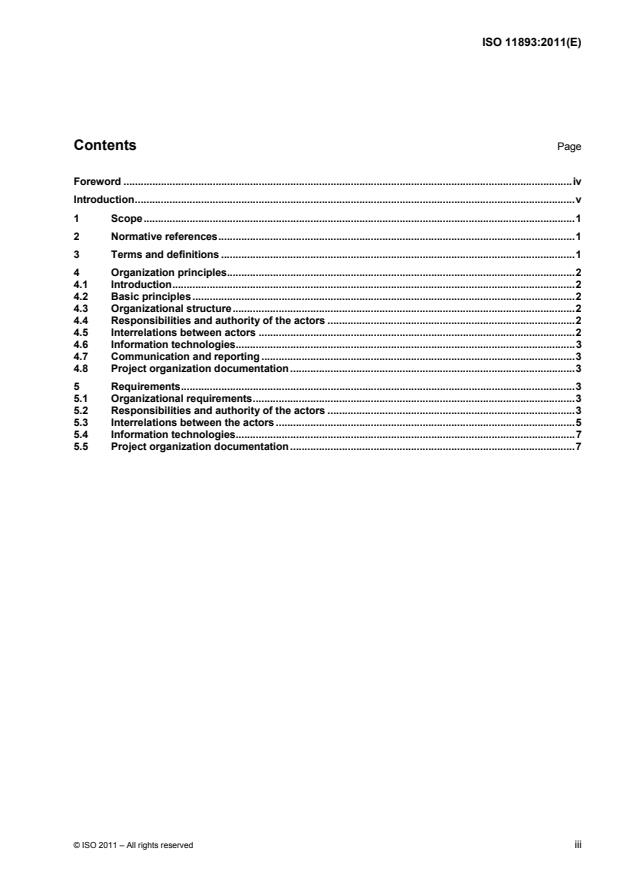
Contents Page
Foreword . iv
Introduction . v
1 Scope . 1
2 Normative references . 1
3 Terms and definitions . 1
4 Organization principles. 2
4.1 Introduction . 2
4.2 Basic principles . 2
4.3 Organizational structure . 2
4.4 Responsibilities and authority of the actors . 2
4.5 Interrelations between actors . 2
4.6 Information technologies . 3
4.7 Communication and reporting . 3
4.8 Project organization documentation . 3
5 Requirements . 3
5.1 Organizational requirements . 3
5.2 Responsibilities and authority of the actors . 3
5.3 Interrelations between the actors . 5
5.4 Information technologies . 7
5.5 Project organization documentation . 7
Foreword
ISO (the International Organization for Standardization) is a worldwide federation of national standards bodies
(ISO member bodies). The work of preparing International Standards is normally carried out through ISO
technical committees. Each member body interested in a subject for which a technical committee has been
established has the right to be represented on that committee. International organizations, governmental and
non-governmental, in liaison with ISO, also take part in the work. ISO collaborates closely with the
International Electrotechnical Commission (IEC) on all matters of electrotechnical standardization.
International Standards are drafted in accordance with the rules given in the ISO/IEC Directives, Part 2.
The main task of technical committees is to prepare International Standards. Draft International Standards
adopted by the technical committees are circulated to the member bodies for voting. Publication as an
International Standard requires approval by at least 75 % of the member bodies casting a vote.
Attention is drawn to the possibility that some of the elements of this document may be the subject of patent
rights. ISO shall not be held responsible for identifying any or all such patent rights.
ISO 11893 was prepared by Technical Committee ISO/TC 20, Aircraft and space vehicles, Subcommittee
SC 14, Space systems and operations.
iv © ISO 2011 – All rights reserved
Introduction
A coherent organization is a prerequisite for the successful execution of a project. The activities of organizing
a project consist of setting up the project's internal organization and the external interfaces. This is done by
defining the responsibilities and authority of the participants, and their interrelations, taking into account
information technologies and subsequently documenting the project organization.
This International Standard is intended to be applied for project organization in space programmes and
applications.
The formulation of this International Standard takes into account the existing ISO 9000 family of documents
and ISO 14300-1 and ISO 14300-2.
ISO 11893 defines specific requirements for the project organization for space projects.
INTERNATIONAL STANDARD ISO 11893:2011(E)
Space systems — Programme management — Project
organization
1 Scope
This International Standard defines the project organization principles and requirements needed to provide
satisfactory and coherent management of space projects.
The general requirements for project organization are given in ISO 14300-1.
This International Standard addresses the following, in particular:
a) responsibility and authority of the actors (all actors, customer, supplier),
b) interrelations between the actors (meetings, action monitoring, reporting, assessments and audits),
c) information technologies, and
d) project organization documentation.
The requirements specified herein apply to and affect the supplier and customer at all levels.
This International Standard is applicable to the customer-supplier relationship for space products to the extent
agreed by both parties. It is intended to be used as a basis when establishing and negotiating customer
program/project management requirements and to guide the supplier's responses. When viewed in a specific
project context, the requirements defined in this International Standard should be tailored to match the specific
requirements of a particular profile and circumstances of a project.
2 Normative references
The following referenced documents are indispensable for the application of this document. For dated
references, only the edition cited applies. For undated references, the latest edition of the referenced
document (including any amendments) applies.
ISO 9000:2005, Quality management systems — Fundamentals and vocabulary
ISO 14300-1, Space systems — Programme management — Part 1: Structuring of a programme
ISO 14300-2, Space systems — Programme management — Part 2: Product assurance
3 Terms and definitions
For the purposes of this document, the terms and definitions given in ISO 9000:2005 apply.
4 Organization principles
4.1 Introduction
The establishment of a well structured and coherent organizational structure for implementing a project at all
levels in the customer/supplier chain is a key factor for ensuring an effective and efficient management
approach. At each level in the customer/supplier chain, a project organization can be built as an independant
project team containing all necessary disciplines within the team structure or, more often, can be built around
a core project team containing key project functions with other necessary functions being provided from
outside the project team as external support. Irrespective of the organizational approach followed for a project,
the elements summarized below are relevant at all levels in the customer/supplier chain.
4.2 Basic principles
A coherent organization is a prerequisite for the successful execution of a space project.
ISO 14300-1 defines the organizational principles (organization at customer and industrial levels for
programme/project management) and specifies the organizational requirements concerning information
circuits, internal and external to the programme/project and its environment.
The activities of organizing a project consist of setting up the project internal organization and the external
interfaces. This is done by defining the responsibilities and authority of the participants, and their interrelations,
taking into account information technologies and subsequently documenting the project organization.
4.3 Organizational structure
It is essential that the project's organizational structure is arranged to include all disciplines essential to
implement the project with well-defined functions as well as clear reporting lines, interrelationships and
interfaces. All project actors below the top level customer and above the lowest level supplier(s) have the
roles of suppliers and customers, and their organizational structures are constructed to accommodate both
roles.
The organizational structure provides a clear and unambiguous definition and allocation of individual roles and
responsibility together with the necessary authority to implement these within the internal project set-up as
well as towards project external interfaces.
4.4 Responsibilities and authority of the actors
For the successful execution of a space project, a clear and unambiguous definition and allocation of
individual roles, with their associated responsibilities and authority, is essential.
The project organization defines these roles with respect to the internal project set-up as well as to interfaces
to the project's external environment (both internal and external to the organization).
Certain roles are relevant to all actors, some to customers (at all levels) only and some to suppliers (at all
levels) only.
4.5 Interrelations between actors
The complex nature of space projects leads to the vital need for effective communication between actors. This
communication takes the form of direct contact (meetings) and other means. Communications have varying
levels of formalism associated with them, ranging from informal information exchanges to contractually binding
commitments.
Communication serves initially to provide clarity about the project's goals and objectives. Subsequently,
communication supports the work towards achieving these objectives.
2 © ISO 2011 – All rights reserved
The use of formalized action monitoring systems has become established as good practice.
Regular reporting is a uniform means of exchanging information concerning the progress of the project.
Monitoring and control activities give the customer the ability to verify the supplied information (e.g. reports.
This can be done by subsequent assessments and audits.
4.6 Information technologies
Information technology is the primary means for the exchange of information. It is therefore important that data
compatibility is ensured.
4.7 Communication and reporting
Effective means of communication are essential tools for ensuring clear and efficient interaction between all
project actors, as well as
...