

ISO 11670:2003
(Main)Lasers and laser-related equipment — Test methods for laser beam parameters — Beam positional stability
General Information
- Abstract
ISO 11670:2003 specifies methods for determining laser beam positional as well as angular stability. The test methods given in ISO 11670:2003 are intended to be used for the testing and characterization of lasers.
- Status
- Published
- Publication Date
- 16-Apr-2003
- Technical Committee
- ISO/TC 172/SC 9 - Laser and electro-optical systems
- Current Stage
- 9092 - International Standard to be revised
- Start Date
- 27-Sep-2023
- Completion Date
- 29-Aug-2026
Buy Documents
ISO 11670:2003 - Lasers and laser-related equipment — Test methods for laser beam parameters — Beam positional stability Released:4/17/2003


ISO 11670:2003 - Lasers et équipements associés aux lasers — Méthodes d'essai des parametres du faisceau laser — Stabilité de visée du faisceau Released:4/17/2003
Overview
ISO 11670:2003 - "Lasers and laser-related equipment - Test methods for laser beam parameters - Beam positional stability" specifies standardized methods to measure and characterize the positional and angular stability of laser beams. The standard defines terminology, coordinate systems, measurement principles and procedures, and data evaluation metrics used to quantify beam pointing and wander over short, medium and long time scales.
Key topics and technical requirements
- Scope and definitions: Precise definitions for beam positional movement, beam positional stability (defined as four times the standard deviation of centroid movement at a plane), beam angular stability (twice the standard deviation of measured angular movement), relative stability metrics and the beam stability parameter product S.
- Coordinate systems: Clear description of the laboratory system and the beam-axis system (average propagation direction), plus azimuth angle and coordinate transformation procedures to align measured data to the beam-axis frame.
- Measurement principles:
- Positional stability: centroid movement measured in the image plane with a position-sensitive detector; evaluation via standard deviation over the chosen time interval.
- Angular stability: centroid movement measured in the focal plane of a focusing element; converted to angular variation.
- Time-scale categories: short-term (1 s), medium-term (1 min), long-term (1 h) stability definitions for consistent reporting.
- Test arrangement & equipment: requirements for coaxial alignment of laser and measurement optics, control of environment (thermal equilibration, avoid air turbulence), detection systems, beam-forming optics, and calibration procedures.
- Practical measurement guidance: avoids clipping or diffraction that would add >1% error; rule-of-thumb test for apertures (an aperture that reduces signal by 5% should be < 0.8× the optical component aperture).
- Evaluation and reporting: procedures to compute directional components (x,y), identify dominant movement direction, report stability metrics and relevant test conditions.
- Normative references and annexes: references ISO 11145, ISO 11146 and IEC 61040; informative annexes cover propagation of absolute beam stability and decoupling of short- and long-term fluctuations.
Applications and typical users
ISO 11670:2003 is used by:
- Laser manufacturers for product characterization and quality control.
- Test and calibration laboratories validating pointing stability and specifications.
- Optical system designers and integrators assessing beam delivery and alignment stability.
- Industrial and medical system developers where precise beam pointing is critical (e.g., material processing, medical ablation, metrology, free-space optical links).
- Safety officers and regulatory compliance teams documenting performance over specified time scales.
Practical uses include benchmarking laser pointing performance, diagnosing beam-wander sources, validating stabilization systems, and providing traceable, repeatable test reports.
Related standards
- ISO 11145: Vocabulary and symbols for lasers
- ISO 11146: Test methods for beam widths, divergence and beam propagation factor
- IEC 61040: Power and energy measuring detectors for laser radiation
Keywords: ISO 11670:2003, beam positional stability, beam angular stability, laser beam parameters, laser testing, position-sensitive detector, centroid measurement, pointing stability, laser characterization.
Relations
- Effective Date
- 25-Aug-2026
- Effective Date
- 25-Aug-2026
- Effective Date
- 12-Feb-2026
- Consolidates
ISO 31-6:1992 - Quantities and units — Part 6: Light and related electromagnetic radiations - Effective Date
- 06-Jun-2022
- Effective Date
- 15-Apr-2008
Buy Documents
ISO 11670:2003 - Lasers and laser-related equipment — Test methods for laser beam parameters — Beam positional stability Released:4/17/2003
ISO 11670:2003 - Lasers et équipements associés aux lasers — Méthodes d'essai des parametres du faisceau laser — Stabilité de visée du faisceau Released:4/17/2003
Frequently Asked Questions
ISO 11670:2003 is a standard published by the International Organization for Standardization (ISO). Its full title is "Lasers and laser-related equipment — Test methods for laser beam parameters — Beam positional stability". This standard covers: ISO 11670:2003 specifies methods for determining laser beam positional as well as angular stability. The test methods given in ISO 11670:2003 are intended to be used for the testing and characterization of lasers.
ISO 11670:2003 specifies methods for determining laser beam positional as well as angular stability. The test methods given in ISO 11670:2003 are intended to be used for the testing and characterization of lasers.
ISO 11670:2003 is classified under the following ICS (International Classification for Standards) categories: 31.260 - Optoelectronics. Laser equipment. The ICS classification helps identify the subject area and facilitates finding related standards.
ISO 11670:2003 has the following relationships with other standards: It is inter standard links to EN ISO 11252:2008, EN ISO 11252:2013, EN ISO 11670:2003, ISO 31-6:1992, ISO 11670:1999. Understanding these relationships helps ensure you are using the most current and applicable version of the standard.
ISO 11670:2003 is available in PDF format for immediate download after purchase. The document can be added to your cart and obtained through the secure checkout process. Digital delivery ensures instant access to the complete standard document.
Standards Content (Sample)
INTERNATIONAL ISO
STANDARD 11670
Second edition
2003-04-01
Lasers and laser-related equipment —
Test methods for laser beam
parameters — Beam positional stability
Lasers et équipements associés aux lasers — Méthodes d'essai des
paramètres du faisceau laser — Stabilité de visée du faisceau
Reference number
©
ISO 2003
PDF disclaimer
This PDF file may contain embedded typefaces. In accordance with Adobe's licensing policy, this file may be printed or viewed but shall
not be edited unless the typefaces which are embedded are licensed to and installed on the computer performing the editing. In
downloading this file, parties accept therein the responsibility of not infringing Adobe's licensing policy. The ISO Central Secretariat
accepts no liability in this area.
Adobe is a trademark of Adobe Systems Incorporated.
Details of the software products used to create this PDF file can be found in the General Info relative to the file; the PDF-creation
parameters were optimized for printing. Every care has been taken to ensure that the file is suitable for use by ISO member bodies. In the
unlikely event that a problem relating to it is found, please inform the Central Secretariat at the address given below.
All rights reserved. Unless otherwise specified, no part of this publication may be reproduced or utilized in any form or by any means,
electronic or mechanical, including photocopying and microfilm, without permission in writing from either ISO at the address below or
ISO's member body in the country of the requester.
ISO copyright office
Case postale 56 CH-1211 Geneva 20
Tel. + 41 22 749 01 11
Fax + 41 22 749 09 47
E-mail copyright@iso.org
Web www.iso.org
Published in Switzerland
©
ii ISO 2003 – All rights reserved
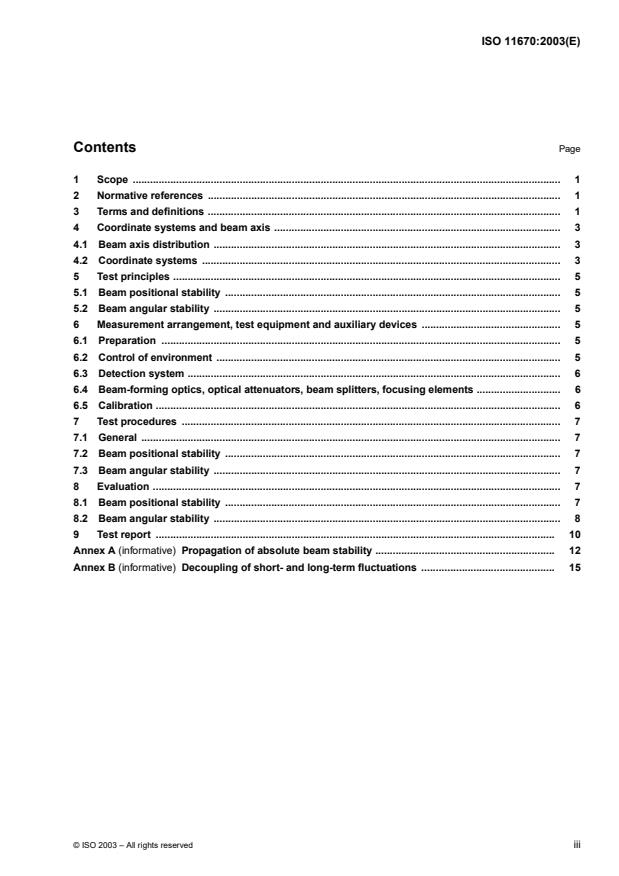
Contents Page
1 Scope . 1
2 Normative references . 1
3 Terms and definitions . 1
4 Coordinate systems and beam axis . 3
4.1 Beam axis distribution . 3
4.2 Coordinate systems . 3
5 Test principles . 5
5.1 Beam positional stability . 5
5.2 Beam angular stability . 5
6 Measurement arrangement, test equipment and auxiliary devices . 5
6.1 Preparation . 5
6.2 Control of environment . 5
6.3 Detection system . 6
6.4 Beam-forming optics, optical attenuators, beam splitters, focusing elements . 6
6.5 Calibration . 6
7 Test procedures . 7
7.1 General . 7
7.2 Beam positional stability . 7
7.3 Beam angular stability . 7
8 Evaluation . 7
8.1 Beam positional stability . 7
8.2 Beam angular stability . 8
9 Test report . 10
Annex A (informative) Propagation of absolute beam stability . 12
Annex B (informative) Decoupling of short- and long-term fluctuations . 15
©
ISO 2003 – All rights reserved iii
Foreword
ISO (the International Organization for Standardization) is a worldwide federation of national standards bodies
(ISO member bodies). The work of preparing International Standards is normally carried out through ISO
technical committees. Each member body interested in a subject for which a technical committee has been
established has the right to be represented on that committee. International organizations, governmental and
non-governmental, in liaison with ISO, also take part in the work. ISO collaborates closely with the International
Electrotechnical Commission (IEC) on all matters of electrotechnical standardization.
International Standards are drafted in accordance with the rules given in the ISO/IEC Directives, Part 2.
The main task of technical committees is to prepare International Standards. Draft International Standards
adopted by the technical committees are circulated to the member bodies for voting. Publication as an
International Standard requires approval by at least 75 % of the member bodies casting a vote.
Attention is drawn to the possibility that some of the elements of this document may be the subject of patent
rights. ISO shall not be held responsible for identifying any or all such patent rights.
ISO 11670 was prepared by Technical Committee ISO/TC 172, Optics and optical instruments, Subcommittee
SC 9, Electro-optical systems.
This second edition cancels and replaces the first edition (ISO 11670:1999), Clauses 3 and 9 of which have
been technically revised. Annexes A and B have been added.
©
iv ISO 2003 – All rights reserved
Introduction
The centre of a laser beam is defined as the centroid or first-order spatial moment of the power density
distribution. The current propagation axis of a beam is then the straight line connecting two centroids measured
at two different planes simultaneously in a uniform, homogeneous medium. Beam axis instability may be
characterized by transverse displacements and angular movements that are either monotonic, periodic or
stochastic in time.
The movement of a laser beam may be randomly distributed and uniform in amplitude in all directions. In
general, the beam may move a greater amount in one direction. If one direction predominates, the procedures
specified in this International Standard can be used to identify that dominant direction (the beam x-axis) and its
azimuthal location relative to the axes of the laboratory system.
This International Standard provides general principles for the measurement of these quantities. In addition,
definitions of terminology and symbols to be used in referring to beam position are provided.
©
ISO 2003 – All rights reserved v
.
vi
INTERNATIONAL STANDARD ISO 11670:2003(E)
Lasers and laser-related equipment — Test methods for laser
beam parameters — Beam positional stability
1Scope
This International Standard specifies methods for determining laser beam positional as well as angular stability.
The test methods given in this International Standard are intended to be used for the testing and
characterization of lasers.
2 Normative references
The following referenced documents are indispensable for the application of this document. For dated
references, only the edition cited applies. For undated references, the latest edition of the referenced document
(including any amendments) applies.
ISO 11145:2001, Optics and optical instruments — Lasers and laser-related equipment — Vocabulary and
symbols
ISO 11146:1999, Lasers and laser-related equipment — Test methods for laser beam parameters — Beam
widths, divergence angle and beam propagation factor
IEC 61040:1990, Power and energy measuring detectors, instruments and equipment for laser radiation
3 Terms and definitions
For the purposes of this document, the terms and definitions given in IEC 61040, ISO 11145 and ISO 11146
and the following apply.
3.1
angular movement
α , α
x y
angular movement of the laser beam in the xz- and y-z planes, respectively
NOTE These quantities are defined in the beam axis system xy, ,z. If the ratio of the quantity in the x direction to that in the
y direction does not exceed 1,15:1, the quantity is regarded as rotationally symmetric and only one number may be given.
The symbol α without index is used in that case.
3.2
beam angular stability
δα , δα
x y
twice the standard deviation of the measured angular movement
NOTE These quantities are defined in the beam axis system xy, ,z. If the ratio of the quantity in the x direction to that in the
y direction does not exceed 1,15:1, the quantity is regarded as rotationally symmetric and only one number may be given.
The symbol δα without index is used in that case.
3.3
pivot
point of intersection of all momentary beam axes with the z-axis
NOTE The measurement of the pivot is not a subject of this International Standard, because it does not necessarily exist.
©
ISO 2003 – All rights reserved 1
3.4
transverse displacement
a , a
x y
distance of transverse displacement of the laser beam in the xy- and -directions, respectively
NOTE 1 These quantities are defined in the beam axis system xy, ,z. If the ratio of the quantity in the x direction to that in
the y direction does not exceed 1,15:1, the quantity is regarded as rotationally symmetric and only one number may be
given. The symbol a without index is used in that case.
NOTE 2 The measurement of the transverse displacement is not a subject of this International Standard.
3.5
beam positional movement
�
positional movement of the centroid of the laser beam in the plane z
�
NOTE The positional movement at plane z results from the superposition of transverse displacement and/or angular
movement of the laser beam.
3.6
beam positional stability
� �
∆ (z ), ∆ (z )
x y
�
four times the standard deviation of the measured beam positional movement at plane z
NOTE These quantities are defined in the beam axis system xy, ,z. If the ratio of the quantity in the x direction to that in the
y direction does not exceed 1,15:1, the quantity is regarded as rotationally symmetric and only one number may be given.
�
The symbol ∆(z ) without index is used in that case.
3.7
relative beam angular stability
δα , ,δα δα
rel,x rel,y rel,
beam angular stability divided by the divergence angle
�
� �
1 2 2
NOTE For elliptical beams, an effective divergence angle θ = θ +θ should be used, since the principal axes
eff x y
of the beam positional stability in general will not coincide with the principal axes of the laser beam propagation.
3.8
relative beam positional stability
� � �
∆ (z ), , ∆ (z ) ∆ (z )
rel,x rel,y rel,
� �
beam positional stability at plane z divided by the beam diameter at plane z
�
� �
1 2 2
NOTE For elliptical beams, an effective beam diameter d = d +d should be used, since the principal axes of
eff
x y
the beam positional stability in general will not coincide with the principal axes of the laser beam propagation.
3.9
beam stability parameter product
S, ,S S
x y
The product of the minimum beam positional stability along the propagation and the beam angular stability
NOTE In a way similar to the beam diameter, the beam positional stability, as defined in sub-clause 3.6, obeys a hyperbolic
propagation law. Thus, the propagation of the absolute beam stability can be completely characterized by three parameters:
the position z of the minimum value of the beam positional stability, the minimum value of the beam positional stability ∆
0 0
and the beam angular stability αz. The position of the minimum value of the beam positional stability in general does not
coincide with the waist position of the laser beam. See Annex A for further details.
3.10
beam positional change from cold start
difference in beam position from the position noted immediately upon turning on a turned-off, ambient-
temperature-equilibrated laser and the position noted after that laser has operated for longer than the warm-up
time
©
2 ISO 2003 – All rights reserved
3.11
short-term stability
stability within a time interval of 1s
3.12
medium-term stability
stability within a time interval of 1 min
3.13
long-term stability
stability within a time interval of 1h
4 Coordinate systems and beam axis
4.1 Beam axis distribution
The distribution of the beam axes (as defined in ISO 11145) is obtained from a significant number (n� 1 000)
of measurements of the beam axis direction.
The movement of the beam axis can be described by means of the standard deviation of this beam axis
distribution. This standard deviation can vary in different directions. This means that the amplitude of the beam
movement can be greater in one dominant direction than in another, and that the distribution of beam axis
movements is not necessarily radially symmetric.
4.2 Coordinate systems
4.2.1 General
All coordinate systems are defined as right-handed.
Key
1 average direction of the beam propagation axes
2 beam axis (for one measurement)
3 two times the standard deviation of the beam axis distribution
� � �
Figure 1 — Coordinate systems x ,y ,z and xy, ,z
©
ISO 2003 – All rights reserved 3
4.2.2 Laboratory system
� � � �
The x , y and z axes define the orthogonal space directions in the laboratory system. The origin of the z -axis
� �
is in a reference (x -y )-plane defined by the laser manufacturer (e.g. the front of the laser enclosure), so that
◦ �
the beam propagates approximately (less than 10 deviation) along the z -axis.
4.2.3 Beam axis system
A second orthogonal coordinate system, the beam axis system, is defined in the following way:
— the z-axis is the average direction of the beam propagation axis (first-order spatial moment of the beam axis
distribution), which shall be determined after the laser has reached a steady state;
— the x-axis is the direction of maximum amplitude of movement of the asymmetric beam axis distribution in
the far-field;
NOTE The asymmetric beam axis distribution is not to be confused with the asymmetric beam power distribution function.
— the origin of the beam axis system coincides with the origin of the laboratory system.
4.2.4 Azimuth angle
The azimuth angle, ψx, is the angle by which the beam -axis is rotated with respect to the laboratory system
�
x -axis.
4.2.5 Transformation of coordinates
� � �
The transformation of the nx measured coordinates of the laboratory system ( ,y ,z ) into the beam axis
system (xy, ,z) shall be performed using the following equations for the translational and rotational
transformations (see Figure 1, where subscript M indicates the coordinates in the measuring plane):
� �
a) First step (calculation of x and y )
M M
�
�
x
i
i
�
x = (1)
M
n
�
�
y
i
i
�
y = (2)
M
n
1 n
where i =to .
b) Second step (translation):
� �
x� = x −x (3)
M
� �
y�= y −y (4)
M
c) Third step (rotation around the z axis):
� � � �� �
x cosψ sinψ x�
= (5)
y −sinψ cosψ y�
where
� �
2s
�x�y
ψ = arctan (6)
2 2
2 s −s
�x �y
�
� �
(x −x )
M
i
i
s = (7)
�x
n− 1
©
4 ISO 2003 – All rights reserved
�
� �
(y −y )
i M
i
s = (8)
�y
n− 1
�
� � � �
(x −x )(y −y )
i M i M
i
s = (9)
xy�
n− 1
where i = 1to n.
5 Test principles
5.1 Beam positional stability
The beam positional stability is measured directly or in the image plane of an imaging element. The movement
of the centroid of the beam is determined using a position-sensitive detector. The position of the centroid of the
beam (as measured by the first-order spatial moment of the power density distribution function in the xy, ,z
� � �
system) indicates the instantaneous position of the beam axis in the laboratory x ,y ,z system. The beam
positional stability can be calculated from the standard deviation of the variation of the centroid position over the
appropriate short, medium or long time scale.
5.2 Beam angular stability
The beam angular stability is measured in the focal plane of a focusing element. The movement of the centroid
of the beam is determined using a position-sensitive detector. The position of the centroid of the beam (as
measured by the first-order spatial moment of the power density distribution function in the xy, ,z system)
� � �
indicates the instantaneous direction of the beam axis in the laboratory x ,y ,z system. The beam angular
stability is calculated from the standard deviation of the variation of the centroid position over the appropriate
short, medium or long time scale.
6 Measurement arrangement, test equipment and auxiliary devices
6.1 Preparation
The laser beam and the optical axis of the measuring sys
...
NORME ISO
INTERNATIONALE 11670
Deuxième édition
2003-04-01
Lasers et équipements associés aux
lasers — Méthodes d'essai des
paramètres du faisceau laser — Stabilité
de visée du faisceau
Lasers and laser-related equipment — Test methods for laser beam
parameters — Beam positional stability
Numéro de référence
©
ISO 2003
PDF — Exonération de responsabilité
Le présent fichier PDF peut contenir des polices de caractères intégrées. Conformément aux conditions de licence d'Adobe, ce fichier
peut être imprimé ou visualisé, mais ne doit pas être modifié à moins que l'ordinateur employé à cet effet ne bénéficie d'une licence
autorisant l'utilisation de ces polices et que celles-ci y soient installées. Lors du téléchargement de ce fichier, les parties concernées
acceptent de fait la responsabilité de ne pas enfreindre les conditions de licence d'Adobe. Le Secrétariat central de l'ISO décline toute
responsabilité en la matière.
Adobe est une marque déposée d'Adobe Systems Incorporated.
Les détails relatifs aux produits logiciels utilisés pour la création du présent fichier PDF sont disponibles dans la rubrique General Info du
fichier; les paramètres de création PDF ont été optimisés pour l'impression. Toutes les mesures ont été prises pour garantir l'exploitation
de ce fichier par les comités membres de l'ISO. Dans le cas peu probable où surviendrait un problème d'utilisation, veuillez en informer
le Secrétariat central à l'adresse donnée ci-dessous.
Droits de reproduction réservés. Sauf prescription différente, aucune partie de cette publication ne peut être reproduite ni utilisée sous
quelque forme que ce soit et par aucun procédé, électronique ou mécanique, y compris la photocopie et les microfilms, sans l'accord écrit
de l'ISO à l'adresse ci-après ou du comité membre de l'ISO dans le pays du demandeur.
ISO copyright office
Case postale 56 CH-1211 Geneva 20
Tel. + 41 22 749 01 11
Fax + 41 22 749 09 47
E-mail copyright@iso.org
Web www.iso.org
Publié en Suisse
©
ii ISO 2003 – Tous droits réservés
Sommaire Page
1 Domaine d'application . 1
2Références normatives . 1
3 Termes et définitions . 1
4 Système de coordonnées et axes du faisceau . 3
4.1 Distribution des axes du faisceau . 3
4.2 Systèmes de coordonnées . 3
5 Principes d'essai . 5
5.1 Stabilité de visée du faisceau . 5
5.2 Stabilité angulaire du faisceau . 6
6 Dispositifs de mesure, matériel d'essai et dispositifs auxiliaires . 6
6.1 Préparation . 6
6.2 Contrôle de l'environnement . 6
6.3 Système de détection . 6
6.4 Optique de mise en forme du faisceau, atténuateurs optiques, séparateurs de faisceau, éléments
de focalisation . 7
6.5 Étalonnage . 7
7 Modes opératoires d'essai . 7
7.1 Généralités . 7
7.2 Stabilité de visée du faisceau . 8
7.3 Stabilité angulaire du faisceau . 8
8 Évaluation . 8
8.1 Stabilité de visée du faisceau . 8
8.2 Stabilité angulaire du faisceau . 9
9 Rapport d'essai . 11
Annexe A (informative) Propagation de stabilité de faisceau absolue . 13
Annexe B (informative) Découplage des fluctuations à court et à long terme . 16
©
ISO 2003 – Tous droits réservés iii
Avant-propos
L'ISO (Organisation internationale de normalisation) est une fédération mondiale d'organismes nationaux de
normalisation (comités membres de l'ISO). L'élaboration des Normes internationales est en général confiée
aux comités techniques de l'ISO. Chaque comité membre intéressé par une étude a le droit de faire partie du
comité technique créé à cet effet. Les organisations internationales, gouvernementales et non
gouvernementales, en liaison avec l'ISO participent également aux travaux. L'ISO collabore étroitement avec la
Commission électrotechnique internationale (CEI) en ce qui concerne la normalisation électrotechnique.
Les Normes internationales sont rédigées conformément aux règles données dans les Directives ISO/CEI,
Partie 2.
La tâche principale des comités techniques est d'élaborer les Normes internationales. Les projets de Normes
internationales adoptés par les comités techniques sont soumis aux comités membres pour vote. Leur
publication comme Normes internationales requiert l'approbation de 75 % au moins des comités membres
votants.
L'attention est appelée sur le fait que certains des éléments du présent document peuvent faire l'objet de droits
de propriété intellectuelle ou de droits analogues. L'ISO ne saurait être tenue pour responsable de ne pas avoir
identifié de tels droits de propriété et averti de leur existence.
L'ISO 11670 a été élaborée par le comité technique ISO/TC 172, Optique et instruments d'optique, sous-comité
SC 9, Systèmes électro-optiques.
Cette deuxième édition annule et remplace la première édition (ISO 11670:1999), dont les Articles 3 et 9 ont fait
l’objet d’une révision technique. Les Annexes A et B ont été ajoutées.
©
iv ISO 2003 – Tous droits réservés
Introduction
Le centre d'un faisceau laser est défini comme le centre ou le moment spatial d'ordre 1 de la distribution de la
densité de puissance. L'axe réel de propagation d'un faisceau est donc la droite qui relie deux centres mesurés
simultanément dans deux plans différents, dans un milieu uniforme et homogène. L'instabilité de l'axe du
faisceau peut être caractérisée par des déplacements transversaux et des mouvements angulaires qui sont soit
monotones, soit périodiques, soit stochastiques dans le temps.
Le mouvement d'un faisceau laser peut être distribué de manière aléatoire et son amplitude peut être uniforme
dans toutes les directions. Généralement, le faisceau peut effectuer un mouvement plus important dans une
direction. Si une direction est prédominante, les modes opératoires spécifiés dans la présente Norme
internationale peuvent être utilisés afin d'identifier cette direction dominante (l'axe des x du faisceau) et sa
position azimutale relative aux axes du système de référence (système lié au laboratoire).
La présente Norme internationale fournit des principes généraux de mesure de ces grandeurs. En outre, les
définitions des termes et les symboles à utiliser en référence à la position du faisceau sont fournis.
©
ISO 2003 – Tous droits réservés v
.
vi
NORME INTERNATIONALE ISO 11670:2003(F)
Lasers et équipements associés aux lasers — Méthodes d'essai
des paramètres du faisceau laser — Stabilité de visée du
faisceau
1 Domaine d'application
La présente Norme internationale spécifie des méthodes pour la détermination de la stabilité de visée ainsi que
de la stabilité angulaire d'un faisceau laser. Les méthodes d'essai données dans la présente Norme
internationale sont destinées à être utilisées pour les essais et la détermination des caractéristiques des lasers.
2Références normatives
Les documents de référence suivants sont indispensables pour l'application du présent document. Pour les
références datées, seule l'édition citée s'applique. Pour les références non datées, la dernière édition du
document de référence s'applique (y compris les éventuels amendements).
ISO 11145:2001, Optique et instruments d'optique — Lasers et équipements associés aux lasers —
Vocabulaire et symboles
ISO 11146:1999, Lasers et équipements associés aux lasers — Méthodes d'essai des paramètres des
faisceaux laser — Largeurs du faisceau, angle de divergence et facteur de propagation du faisceau
CEI 61040:1990, Détecteurs, instruments et matériels de mesurage de puissance et d'énergie des
rayonnements laser
3 Termes et définitions
Pour les besoins du présent document, les termes et définitions donnés dans la CEI 61040, l’ISO 11145 et
l’ISO 11146, ainsi que les suivants s'appliquent.
3.1
mouvement angulaire
α , α
x y
mouvement angulaire du faisceau laser dans les plans xz- et y-z, respectivement
NOTE Ces grandeurs sont définies dans le système lié aux axes du faisceau (xy, ,z). Si le rapport de la grandeur dans la
direction xyà celle dans la direction n'excède pas 1,15:1, la grandeur est considérée comme symétrique par rotation et un
seul nombre peut être donné. Le symbole α sans indice est alors utilisé dans ce cas.
3.2
stabilité angulaire du faisceau
δα , δα
x y
deux fois l'écart-type du mouvement angulaire mesuré
NOTE Ces grandeurs sont définies dans le système lié aux axes du faisceau (xy, ,z). Si le rapport de la grandeur dans la
direction xyà celle dans la direction n'excède pas 1,15:1, la grandeur est considérée comme symétrique par rotation et un
seul nombre peut être donné. Le symbole δα sans indice est alors utilisé dans ce cas.
©
ISO 2003 – Tous droits réservés 1
3.3
pivot
point d'intersection de tous les axes momentanés du faisceau avec l'axe des z
NOTE La mesure du pivot n'est pas traitée dans la présente Norme internationale, parce que celui-ci n'existe pas
nécessairement.
3.4
déplacement transversal
a , a
x y
distance de déplacement transversal du faisceau laser dans la direction des xy et des , respectivement
xyz
NOTE 1 Ces grandeurs sont définies dans le système lié aux axes du faisceau ( , , ). Si le rapport de la grandeur dans
la direction xy à celle dans la direction n'excède pas 1,15:1, la grandeur est considérée comme symétrique par rotation et
a
un seul nombre peut être donné. Le symbole sans indice est alors utilisé dans ce cas.
NOTE 2 La mesure du déplacement transversal n'est pas traitée dans la présente Norme internationale.
3.5
mouvement de visée du faisceau
�
mouvement de visée du centre du faisceau laser dans le plan z
�
NOTE Le mouvement de visée dans le plan z résulte de la superposition du déplacement transversal et/ou du mouvement
angulaire du faisceau laser.
3.6
stabilité de visée du faisceau
� �
∆ (z ), ∆ (z )
x y
�
quatre fois l'écart-type du mouvement de visée du faisceau mesuré dans le plan z
NOTE Ces grandeurs sont définies dans le système lié aux axes du faisceau (xy, ,z). Si le rapport de la grandeur dans la
direction xyà celle dans la direction n'excède pas 1,15:1, la grandeur est considérée comme symétrique par rotation et un
�
seul nombre peut être donné. Le symbole ∆(z ) sans indice est alors utilisé dans ce cas.
3.7
stabilité angulaire relative du faisceau
δα , ,δα δα
rel,x rel,y rel
stabilité angulaire du faisceau, divisée par l'angle de divergence
�
� �
1 2 2
θ = θ +θ
NOTE Pour les faisceaux elliptiques, il est recommandé d'utiliser un angle de divergence effectif ,
eff x y
puisqu'en général les axes principaux de stabilité de visée du faisceau ne coïncideront pas avec les axes principaux de
propagation du faisceau laser.
3.8
stabilité de visée relative du faisceau
� � �
∆ (z ), , ∆ (z ) ∆ (z )
rel,x rel,y rel
� �
stabilité de visée du faisceau dans le plan z , divisée par le diamètre du faisceau dans le plan z
�
� �
1 2 2
NOTE Pour les faisceaux elliptiques, il est recommandé d'utiliser un diamètre du faisceau effectif d = d +d ,
eff x y
puisqu'en général les axes principaux de stabilité de visée du faisceau ne coïncideront pas avec les axes principaux de
propagation du faisceau laser.
©
2 ISO 2003 – Tous droits réservés
3.9
produit de paramètre de stabilité du faisceau
S, ,S S
x y
produit de la stabilité minimale de visée du faisceau le long de la propagation et de la stabilité angulaire du
faisceau
NOTE De la même manière que pour le diamètre du faisceau, la stabilité de visée du faisceau, telle que définie en 3.6, suit
une loi de propagation hyperbolique. Ainsi, la propagation de la stabilité de faisceau absolue peut être totalement
caractérisée par trois paramètres: la position z de la valeur minimale de la stabilité de visée du faisceau, la valeur minimale
de la stabilité de visée du faisceau, ∆ , et la stabilité angulaire du faisceau αz. La position de la valeur minimale de la
0 0
stabilité de visée du faisceau ne coïncide pas en général avec la position du col du faisceau laser. Voir l'Annexe A pour plus
de détails.
3.10
changement de visée du faisceau au démarrage à froid
différence de position du faisceau entre la position relevée immédiatement après le branchement d'un laser à
l'arrêt, en équilibre avec la température ambiante, et la position relevée après que le laser ait fonctionné au-delà
du temps de préchauffage
3.11
stabilité à court terme
stabilité à l'intérieur d'un intervalle de temps de 1s
3.12
stabilité à moyen terme
stabilité à l'intérieur d'un intervalle de temps de 1 min
3.13
stabilité à long terme
stabilité à l'intérieur d'un intervalle de temps de 1h
4Système de coordonnées et axes du faisceau
4.1 Distribution des axes du faisceau
La distribution des axes du faisceau (comme définie dans l'ISO 11145) est obtenue à partir d'un nombre
significatif (n� 1 000) de mesures de la direction de l'axe du faisceau.
Le mouvement de l'axe du faisceau peut être décrit au moyen de l'écart-type de cette distribution des axes du
faisceau. Cet écart-type peut varier dans des directions différentes. Ceci signifie que l'amplitude du mouvement
du faisceau peut être plus grande dans une direction dominante que dans une autre, et que la distribution des
mouvements de l'axe du faisceau n'est pas nécessairement de symétrie radiale.
4.2 Systèmes de coordonnées
4.2.1 Généralités
Tous les systèmes de coordonnées sont définis par la règle de la main droite.
4.2.2 Système de référence (système lié au laboratoire)
� � �
Les axes des x , y et z définissent les directions spatiales orthogonales dans le système de référence.
� � �
L'origine de l'axe des z est définie, dans un plan (x -y ) de référence, par le fabricant du laser (par exemple le
panneau avant de l'enceinte du laser), de sorte que le faisceau se propage de manière approximative (déviation
◦ �
de moins de 10 ) le long de l'axe des z .
©
ISO 2003 – Tous droits réservés 3
Légende
1 direction moyenne des axes de propagation du faisceau
2 axes du faisceau (pour une mesure)
3 deux fois l'écart-type de la distribution des axes du faisceau
� � �
Figure 1 — Systèmes de coordonnées (x , y , z ) et (xy, ,z)
4.2.3 Système lié aux axes du faisceau
Un second système de coordonnées orthogonales, le système lié aux axes du faisceau, est défini de la manière
suivante:
— l'axe des z représente la direction moyenne de l'axe de propagation du faisceau (moment spatial d'ordre 1
de la distribution des axes du faisceau), qui doit être déterminée lorsque le laser a atteint un état d'équilibre;
— l'axe des x représente la direction de l'amplitude maximale du mouvement de la distribution asymétrique
des axes du faisceau en champ lointain;
NOTE Ne pas confondre la distribution asymétrique des axes du faisceau avec la fonction de distribution asymétrique de
la puissance du faisceau.
— l'origine du système lié aux axes du faisceau coïncide avec l'origine du système de référence.
4.2.4 Angle azimutal
L'angle azimutal, ψx, est l'angle repérant la rotation de l'axe des du faisceau effectuée par rapport à l'axe des
�
x du système de référence.
4.2.5 Transformation des coordonnées
� � �
La transformation des nx coordonnées mesurées du système de référence ( ,y ,z ) vers le système lié aux
axes du faisceau (xy, ,z) doit être effectuée au moyen des équations suivantes pour les transformations de
translation et de rotation (voir la Figure 1, dans laquelle l'indice M est utilisé pour indiquer les coordonnées dans
le plan de mesure):
©
4 ISO 2003 – Tous droits réservés
� �
a) Première étape (calcul de x et y ):
M M
�
�
x
i
i
�
x = (1)
M
n
�
�
y
i
i
�
y = (2)
M
n
où i = 1 à . n
b) Deuxième étape (translation):
� �
x� = x −x (3)
M
� �
� −y (4)
y = y
M
c) Troisième étape (rotation autour de l'axe des z):
� � � �� �
x cosψ sinψ x�
= (5)
y −sinψ cosψ y�
où
� �
2s
�x�y
ψ = arctan (6)
2 2
2 s −s
�x �y
�
� �
(x −x )
i M
i
s = (7)
�x
n− 1
�
� �
(y −y )
i M
i
s = (8)
�y
n− 1
�
� � � �
(x −x )(y −y )
i M i M
i
s = (9)
xy�
n− 1
où i = 1 à .n
5 Principes d'essai
5.1 Stabilité de visée du faisceau
La stabilité de visée du faisceau est mesurée directement ou dans le plan image d'un élément imageur. Le
mouvement du centre du faisceau est déterminé grâce à un détecteur de position. La position du centre du
faisceau [déterminée par le moment spatial d'ordre 1 de la fonction de distribution de la densité de puissance
dans le système (xy, ,z)] indique la position instantanée de l'axe du faisceau dans le système de référence
� � �
(x ,y , z ). La stabilité de visée du faisceau peut être calculée à partir de l'écart-type de la variation de la
position du centre sur l'échelle appropriée à court, moyen ou long terme.
©
ISO 2003 – Tous droits réservés 5
5.2 Stabilité angulaire du faisceau
La stabilité angulaire du faisceau est mesurée dans le plan focal d'un élément de focalisation. Le mouvement
du centre du faisceau est déterminé grâce à un détecteur de position. La position du centre du faisceau
[déterminée par le moment spatial d'ordre 1 de la fonction de distribution de la densité de puissance dans le
� � �
système (xy, ,z)] indique la direction instantanée de l'axe du faisceau dans le système de référence ( x , y , z ).
La stabilité angulaire du faisceau peut être calculée à partir de l'écart-type de la variation de la position du
centre sur l'échelle appropriée à court, moyen ou long terme.
6 Dispositifs de mesure, matériel d'essai et dispositifs auxiliaires
6.1 Préparation
Le faisceau laser et l'axe optique du système de mesure doivent être coaxiaux.
Le champ visuel du système optique doit être tel qu'il accepte toute la section du faisceau laser
...