

ISO 9022-6:2015
(Main)Optics and photonics — Environmental test methods — Part 6: Dust
General Information
- Abstract
ISO 9022-6:2015 specifies the methods relating to the environmental tests of optical instruments including additional assemblies from other fields (e.g. mechanical, chemical, and electronic devices), under equivalent conditions, for their ability to resist the influence of blowing dust. The purpose of testing is to investigate to what extent the optical, climatic, mechanical, chemical, and electrical (including electrostatic) performance characteristics of the specimen are affected by blowing dust, especially with a view to malfunctions of moving parts (such as sliding surfaces, bearings, contacts, operating controls, gears) or unacceptable wear of surfaces. This test is not intended to determine the wear resistance to coarse dust.
- Status
- Published
- Publication Date
- 25-Feb-2015
- Technical Committee
- ISO/TC 172/SC 1 - Fundamental standards
- Drafting Committee
- ISO/TC 172/SC 1/WG 3 - Environmental test methods
- Current Stage
- 9093 - International Standard confirmed
- Start Date
- 24-Oct-2025
- Completion Date
- 29-Aug-2026
Buy Documents
ISO 9022-6:2015 - Optics and photonics -- Environmental test methods
REDLINE ISO 9022-6:2015 - Optics and photonics -- Environmental test methods
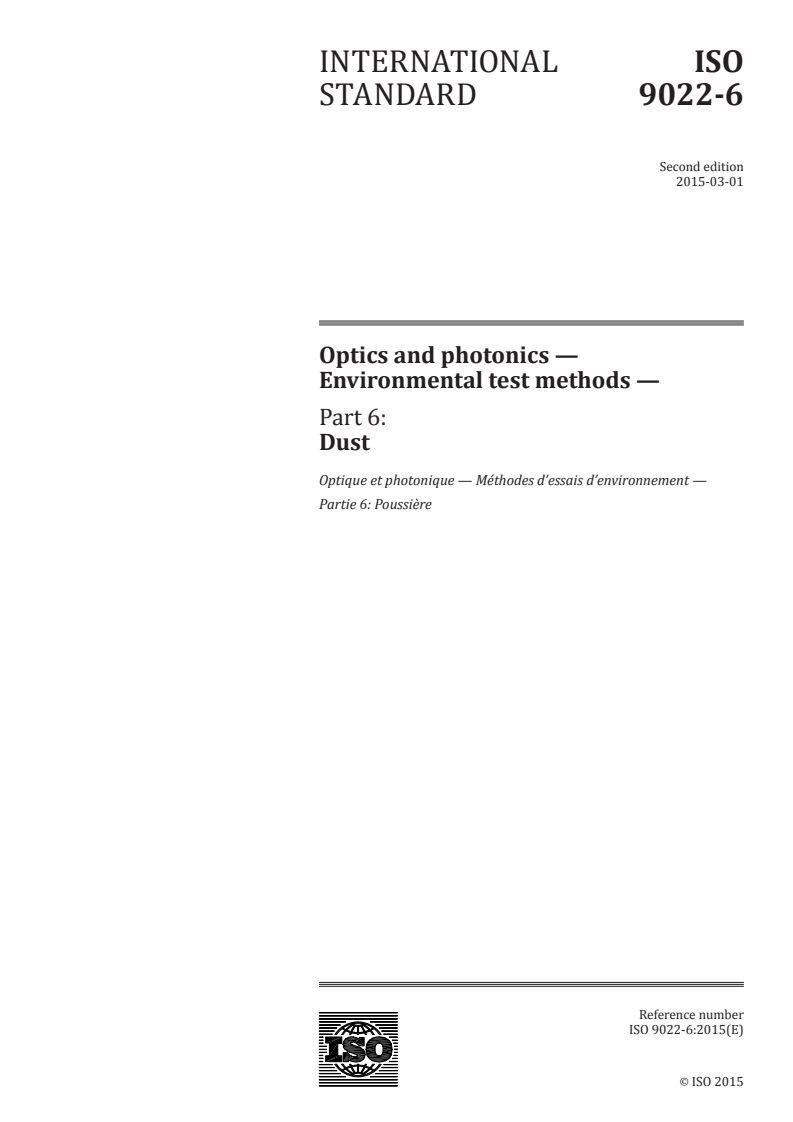
ISO 9022-6:2015 - Optics and photonics — Environmental test methods — Part 6: Dust/26/2015
REDLINE ISO 9022-6:2015 - Optics and photonics — Environmental test methods — Part 6: Dust/26/2015
Overview
ISO 9022-6:2015 - Optics and photonics - Environmental test methods - Part 6: Dust - defines laboratory methods to evaluate the resistance of optical instruments (and instruments containing optical components) to blowing dust. The standard simulates dust exposure to determine how optical, climatic, mechanical, chemical and electrical (including electrostatic) performance is affected, with particular attention to malfunctions of moving parts and unacceptable surface wear. It is not intended to measure wear resistance to coarse dust.
Key topics and technical requirements
- Conditioning method 52 (Blowing dust): The prescribed test sequence, degrees of severity and states of operation to simulate dust exposure.
- Dust composition: Mineral dust with sharp-edged particles, at least 97% silicon dioxide (SiO2) by mass.
- Particle size distribution: Fine dust fractions with specified ranges (examples from the standard):
- 75% < 0.045 mm (<45 µm)
- 15% 0.045–0.071 mm (45–71 µm)
- 8% 0.071–0.1 mm (71–100 µm)
- 2% 0.1–0.14 mm (100–140 µm)
- Test chamber and specimen placement: Chamber must be large enough so the specimen occupies no more than 50% of cross-sectional area (normal to airflow) and 50% of useful volume. Specimens are positioned near the chamber center with vulnerable surfaces facing the airflow; multiple specimens arranged at right angles and ≥100 mm apart.
- Environmental parameters: Typical severity levels specify ranges for temperature (e.g., 18–28 °C; optional higher temperature steps), relative humidity (<25 %), air velocity (1–10 m/s depending on step), sand/dust concentration (typically 5–15 g/m3), and exposure times (commonly 6 h or 16 h depending on sequence).
- Procedures and recovery: Preconditioning requires specimens to be clean and dry unless otherwise specified. After exposure, dust removal is by shaking, wiping, or brushing only - no air-blast or vacuum cleaning.
- Environmental test coding: Tests are identified using ISO 9022-1 conventions (example: Environmental test ISO 9022-52-01-2 for conditioning method 52, severity 01, state 2).
Practical applications
- Qualification and validation of optical instruments and assemblies for use in dusty environments (field optics, sensors, camera systems, rangefinders).
- Design verification to detect susceptibility of moving parts (bearings, gears, sliders), control surfaces, electrical contacts and electrostatic-sensitive elements.
- Acceptance testing and comparative evaluation for product development, procurement, and quality assurance.
Who should use this standard
- Optical and photonics manufacturers
- Environmental test laboratories
- Design and reliability engineers
- Procurement and compliance teams evaluating durability in dusty conditions
Related standards
- ISO 9022-1 (Definitions, extent of testing) - referenced for test coding and general procedure.
- ISO 565 (Test sieves) - referenced for particle-size analysis.
- Other parts of the ISO 9022 series for combined or complementary environmental tests.
Keywords: ISO 9022-6:2015, dust testing, optics and photonics, blowing dust, environmental test methods, dust resistance, conditioning method 52, optical instrument durability.
Relations
- Consolidated By
ISO 13679:2019 - Petroleum and natural gas industries — Procedures for testing casing and tubing connections - Effective Date
- 06-Jun-2022
- Effective Date
- 30-Aug-2014
Buy Documents
ISO 9022-6:2015 - Optics and photonics -- Environmental test methods
REDLINE ISO 9022-6:2015 - Optics and photonics -- Environmental test methods
ISO 9022-6:2015 - Optics and photonics — Environmental test methods — Part 6: Dust/26/2015
REDLINE ISO 9022-6:2015 - Optics and photonics — Environmental test methods — Part 6: Dust/26/2015
Frequently Asked Questions
ISO 9022-6:2015 is a standard published by the International Organization for Standardization (ISO). Its full title is "Optics and photonics — Environmental test methods — Part 6: Dust". This standard covers: ISO 9022-6:2015 specifies the methods relating to the environmental tests of optical instruments including additional assemblies from other fields (e.g. mechanical, chemical, and electronic devices), under equivalent conditions, for their ability to resist the influence of blowing dust. The purpose of testing is to investigate to what extent the optical, climatic, mechanical, chemical, and electrical (including electrostatic) performance characteristics of the specimen are affected by blowing dust, especially with a view to malfunctions of moving parts (such as sliding surfaces, bearings, contacts, operating controls, gears) or unacceptable wear of surfaces. This test is not intended to determine the wear resistance to coarse dust.
ISO 9022-6:2015 specifies the methods relating to the environmental tests of optical instruments including additional assemblies from other fields (e.g. mechanical, chemical, and electronic devices), under equivalent conditions, for their ability to resist the influence of blowing dust. The purpose of testing is to investigate to what extent the optical, climatic, mechanical, chemical, and electrical (including electrostatic) performance characteristics of the specimen are affected by blowing dust, especially with a view to malfunctions of moving parts (such as sliding surfaces, bearings, contacts, operating controls, gears) or unacceptable wear of surfaces. This test is not intended to determine the wear resistance to coarse dust.
ISO 9022-6:2015 is classified under the following ICS (International Classification for Standards) categories: 37.020 - Optical equipment. The ICS classification helps identify the subject area and facilitates finding related standards.
ISO 9022-6:2015 has the following relationships with other standards: It is inter standard links to ISO 13679:2019, ISO 9022-6:1994. Understanding these relationships helps ensure you are using the most current and applicable version of the standard.
ISO 9022-6:2015 is available in PDF format for immediate download after purchase. The document can be added to your cart and obtained through the secure checkout process. Digital delivery ensures instant access to the complete standard document.
Standards Content (Sample)
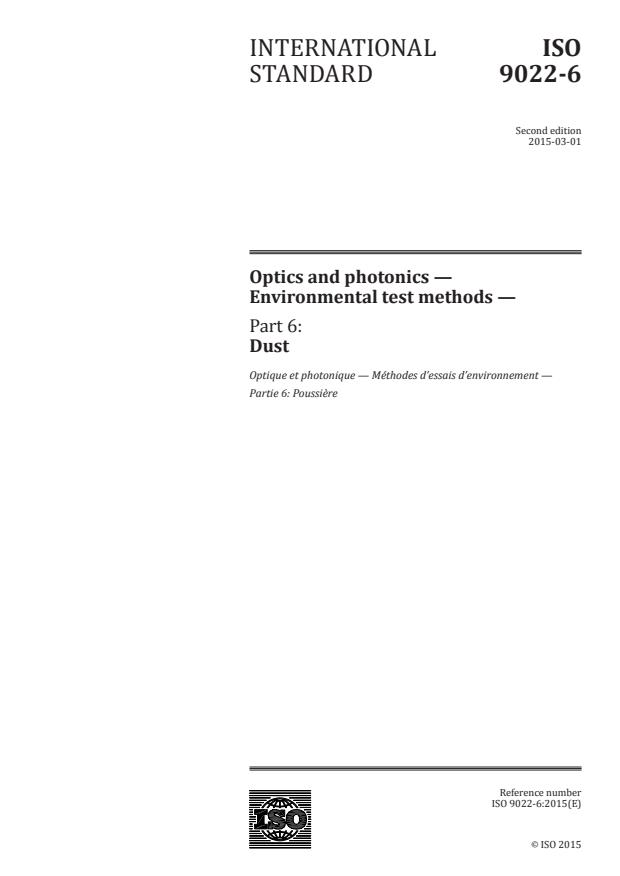
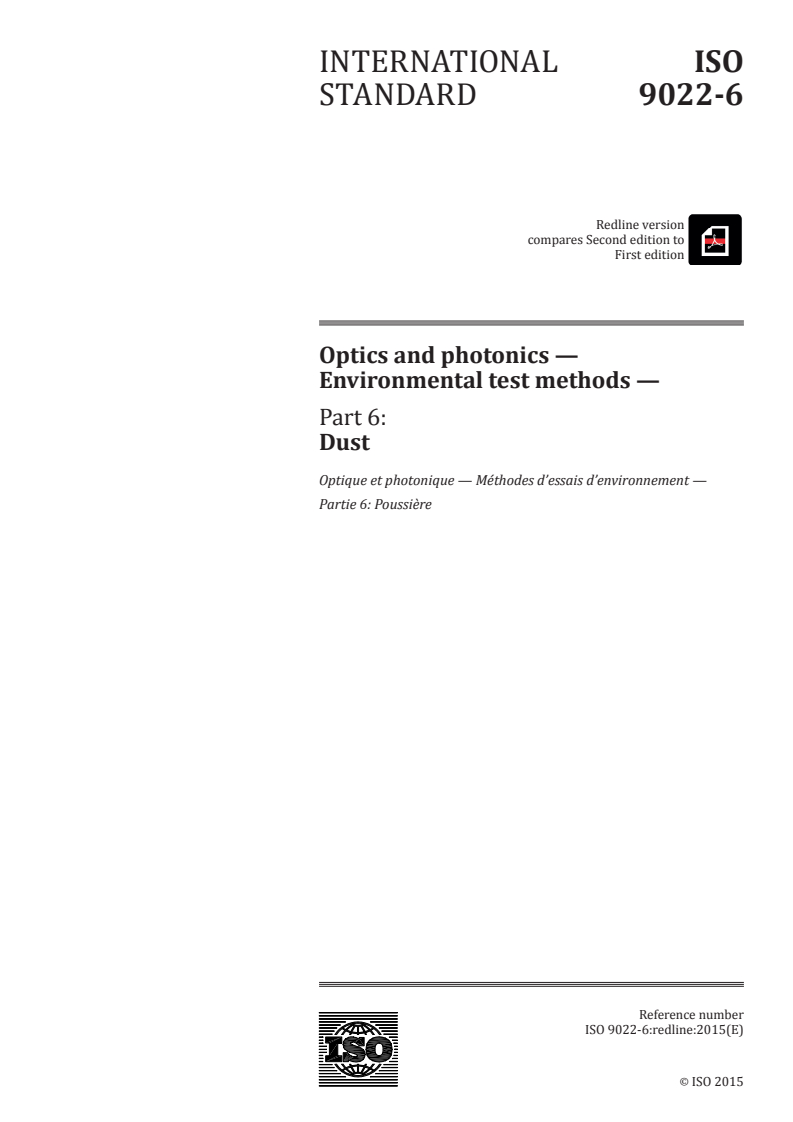
INTERNATIONAL ISO
STANDARD 9022-6
Second edition
2015-03-01
Optics and photonics —
Environmental test methods —
Part 6:
Dust
Optique et photonique — Méthodes d’essais d’environnement —
Partie 6: Poussière
Reference number
©
ISO 2015
© ISO 2015
All rights reserved. Unless otherwise specified, no part of this publication may be reproduced or utilized otherwise in any form
or by any means, electronic or mechanical, including photocopying, or posting on the internet or an intranet, without prior
written permission. Permission can be requested from either ISO at the address below or ISO’s member body in the country of
the requester.
ISO copyright office
Case postale 56 • CH-1211 Geneva 20
Tel. + 41 22 749 01 11
Fax + 41 22 749 09 47
E-mail copyright@iso.org
Web www.iso.org
Published in Switzerland
ii © ISO 2015 – All rights reserved
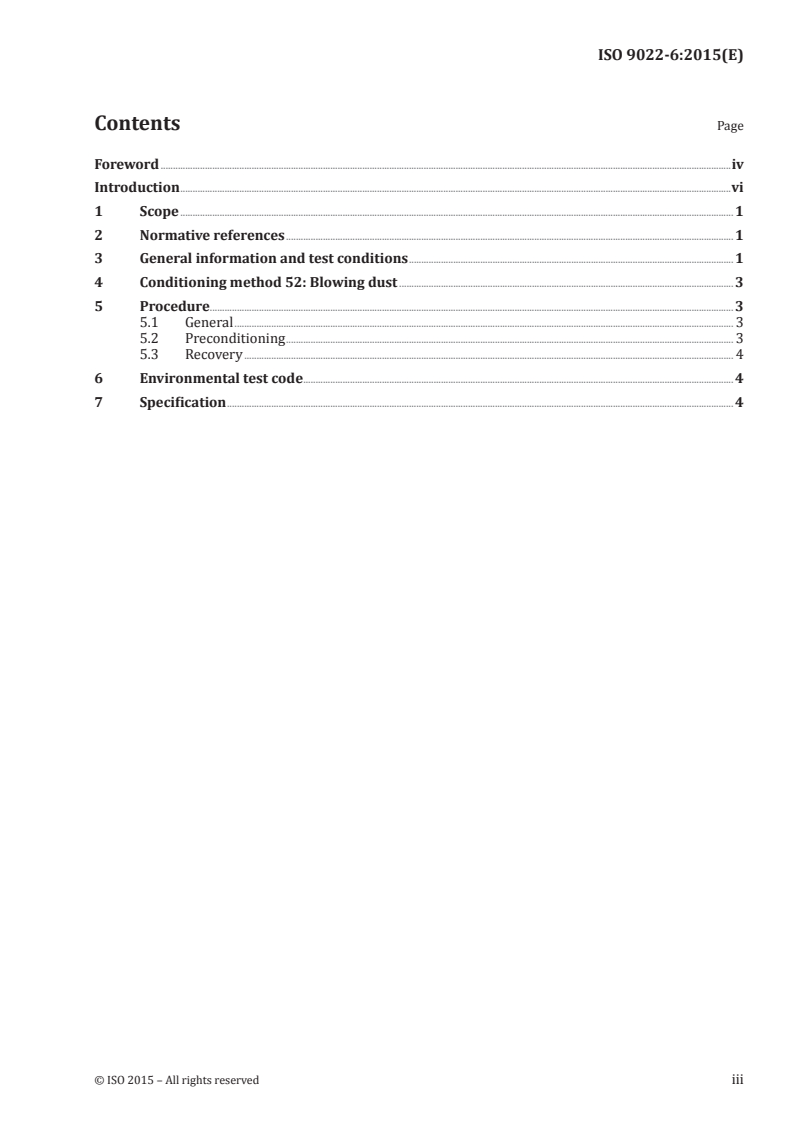
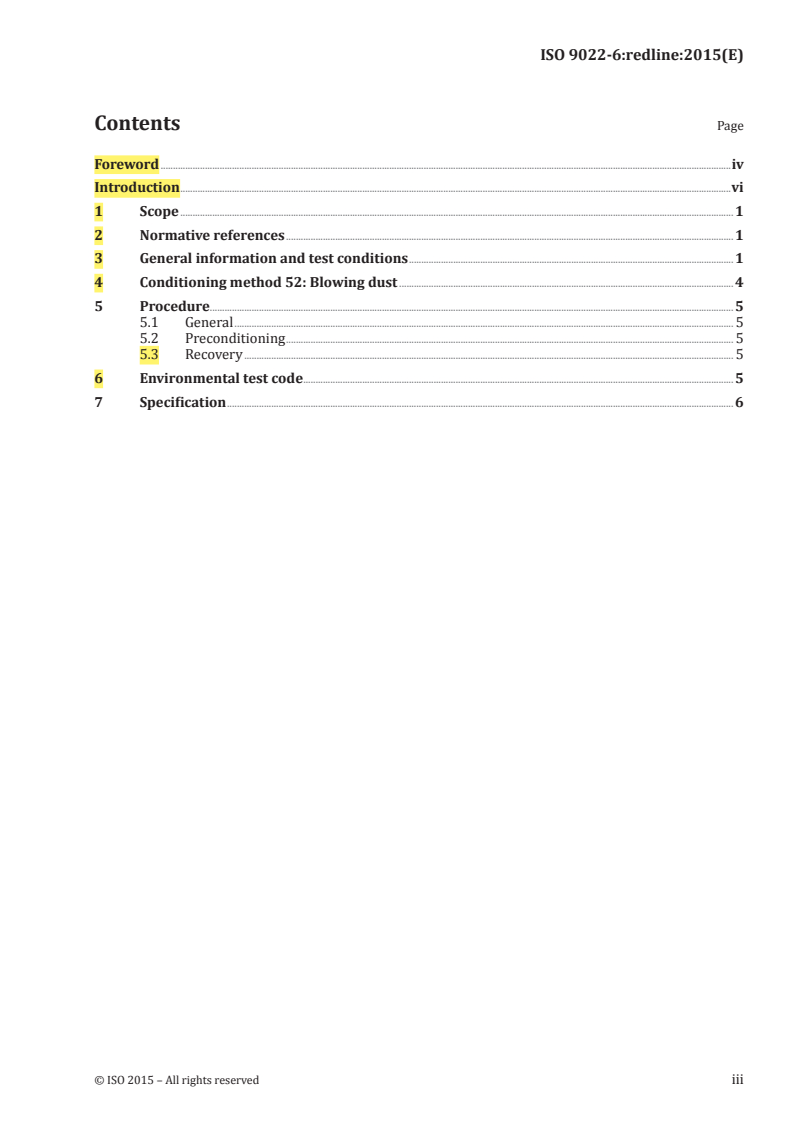
Contents Page
Foreword .iv
Introduction .vi
1 Scope . 1
2 Normative references . 1
3 General information and test conditions . 1
4 Conditioning method 52: Blowing dust . 3
5 Procedure. 3
5.1 General . 3
5.2 Preconditioning . 3
5.3 Recovery . 4
6 Environmental test code . 4
7 Specification . 4
Foreword
ISO (the International Organization for Standardization) is a worldwide federation of national standards
bodies (ISO member bodies). The work of preparing International Standards is normally carried out
through ISO technical committees. Each member body interested in a subject for which a technical
committee has been established has the right to be represented on that committee. International
organizations, governmental and non-governmental, in liaison with ISO, also take part in the work.
ISO collaborates closely with the International Electrotechnical Commission (IEC) on all matters of
electrotechnical standardization.
The procedures used to develop this document and those intended for its further maintenance are
described in the ISO/IEC Directives, Part 1. In particular the different approval criteria needed for the
different types of ISO documents should be noted. This document was drafted in accordance with the
editorial rules of the ISO/IEC Directives, Part 2 (see www.iso.org/directives).
Attention is drawn to the possibility that some of the elements of this document may be the subject of
patent rights. ISO shall not be held responsible for identifying any or all such patent rights. Details of any
patent rights identified during the development of the document will be in the Introduction and/or on
the ISO list of patent declarations received (see www.iso.org/patents).
Any trade name used in this document is information given for the convenience of users and does not
constitute an endorsement.
For an explanation on the meaning of ISO specific terms and expressions related to conformity
assessment, as well as information about ISO’s adherence to the WTO principles in the Technical Barriers
to Trade (TBT) see the following URL: Foreword - Supplementary information
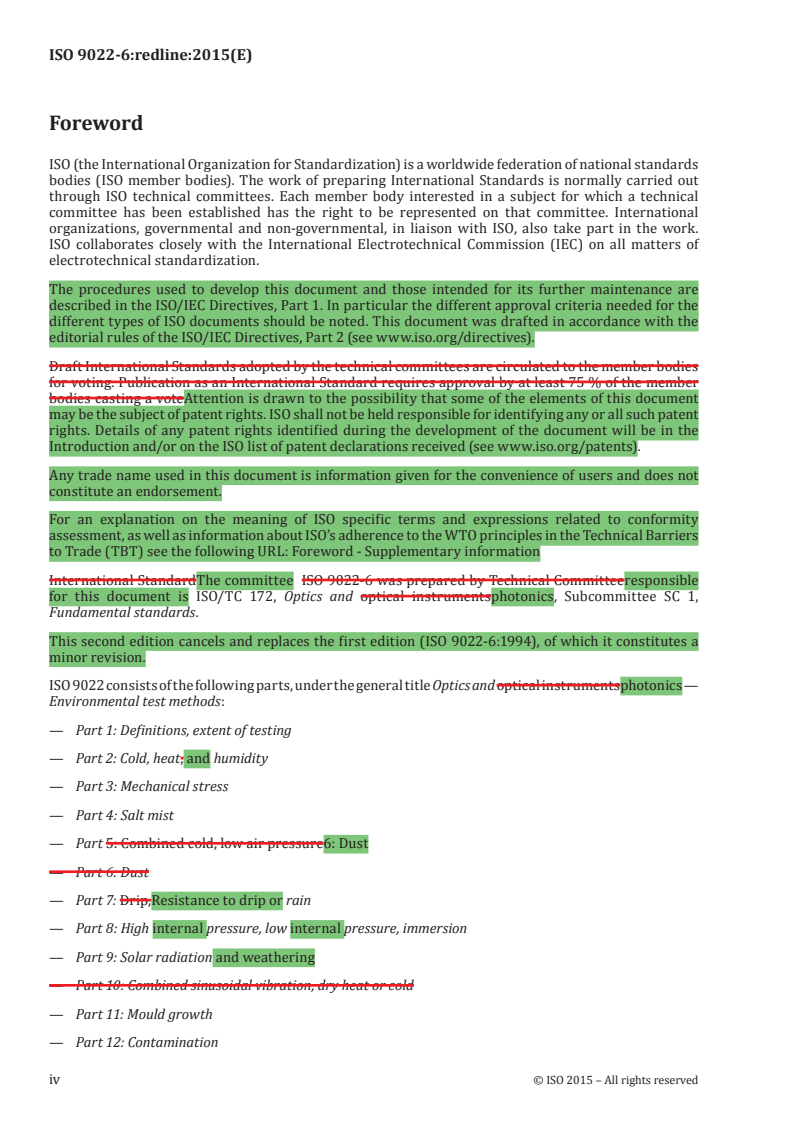
The committee responsible for this document is ISO/TC 172, Optics and photonics, Subcommittee SC 1,
Fundamental standards.
This second edition cancels and replaces the first edition (ISO 9022-6:1994), of which it constitutes a
minor revision.
ISO 9022 consists of the following parts, under the general title Optics and photonics — Environmental
test methods:
— Part 1: Definitions, extent of testing
— Part 2: Cold, heat and humidity
— Part 3: Mechanical stress
— Part 4: Salt mist
— Part 6: Dust
— Part 7: Resistance to drip or rain
— Part 8: High internal pressure, low internal pressure, immersion
— Part 9: Solar radiation and weathering
— Part 11: Mould growth
— Part 12: Contamination
— Part 14: Dew, hoarfrost, ice
— Part 17: Combined contamination, solar radiation
— Part 20: Humid atmosphere containing sulfur dioxide or hydrogen sulfide
iv © ISO 2015 – All rights reserved
— Part 22: Combined cold, dry heat or temperature change with bump or random vibration
— Part 23: Low pressure combined with cold, ambient temperature and dry and damp heat
Introduction
Optical instruments are affected during their use by a number of different environmental parameters
which they are required to resist without significant reduction in performance and to remain within
defined specifications.
The type and severity of these parameters depend on the conditions of use of the instrument (for
example, in the laboratory or workshop) and on its geographical location. The environmental effects
on optical instrument performance in the tropics and subtropics are totally different from those found
when they are used in arctic regions. Individual parameters cause a variety of different and overlapping
effects on instrument performance.
The manufacturer attempts to ensure, and the user naturally expects, that instruments will resist the
likely rigours of their environment throughout their life. This expectation can be assessed by exposure
of the instrument to a range of simulated environmental parameters under controlled laboratory
conditions. The severity of these conditions is often increased to obtain meaningful results in a relatively
short period of time.
In order to allow assessment and
...
INTERNATIONAL ISO
STANDARD 9022-6
Redline version
compares Second edition to
First edition
Optics and photonics —
Environmental test methods —
Part 6:
Dust
Optique et photonique — Méthodes d’essais d’environnement —
Partie 6: Poussière
Reference number
ISO 9022-6:redline:2015(E)
©
ISO 2015
ISO 9022-6:redline:2015(E)
IMPORTANT — PLEASE NOTE
This is a mark-up copy and uses the following colour coding:
Text example 1 — indicates added text (in green)
Text example 2 — indicates removed text (in red)
— indicates added graphic figure
— indicates removed graphic figure
1.x . — Heading numbers containg modifications are highlighted in yellow in
the Table of Contents
DISCLAIMER
This Redline version provides you with a quick and easy way to compare the main changes
between this edition of the standard and its previous edition. It doesn’t capture all single
changes such as punctuation but highlights the modifications providing customers with
the most valuable information. Therefore it is important to note that this Redline version is
not the official ISO standard and that the users must consult with the clean version of the
standard, which is the official standard, for implementation purposes.
© ISO 2015
All rights reserved. Unless otherwise specified, no part of this publication may be reproduced or utilized otherwise in any form
or by any means, electronic or mechanical, including photocopying, or posting on the internet or an intranet, without prior
written permission. Permission can be requested from either ISO at the address below or ISO’s member body in the country of
the requester.
ISO copyright office
Case postale 56 • CH-1211 Geneva 20
Tel. + 41 22 749 01 11
Fax + 41 22 749 09 47
E-mail copyright@iso.org
Web www.iso.org
Published in Switzerland
ii © ISO 2015 – All rights reserved
ISO 9022-6:redline:2015(E)
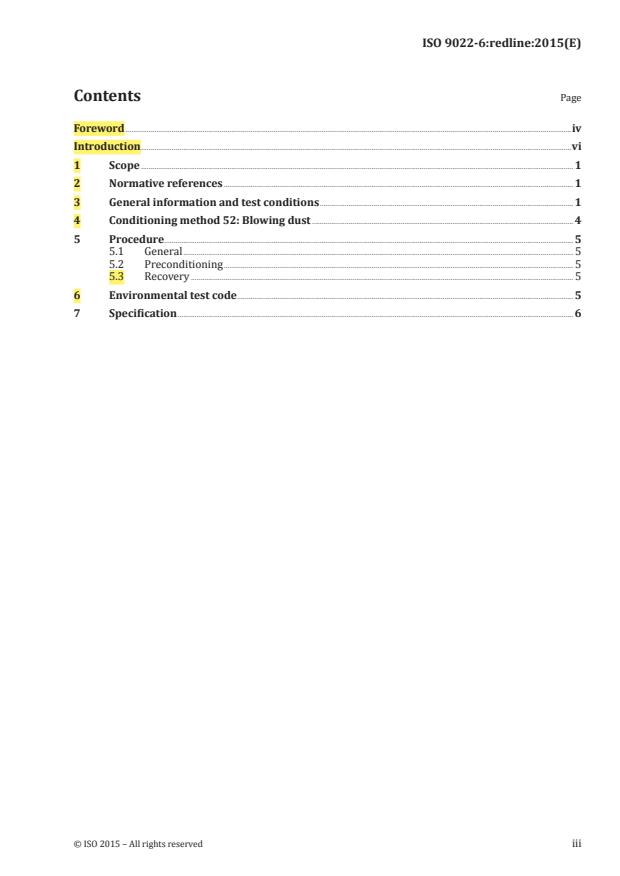
Contents Page
Foreword .iv
Introduction .vi
1 Scope . 1
2 Normative references . 1
3 General information and test conditions . 1
4 Conditioning method 52: Blowing dust . 4
5 Procedure. 5
5.1 General . 5
5.2 Preconditioning . 5
5.3 Recovery . 5
6 Environmental test code . 5
7 Specification . 6
ISO 9022-6:redline:2015(E)
Foreword
ISO (the International Organization for Standardization) is a worldwide federation of national standards
bodies (ISO member bodies). The work of preparing International Standards is normally carried out
through ISO technical committees. Each member body interested in a subject for which a technical
committee has been established has the right to be represented on that committee. International
organizations, governmental and non-governmental, in liaison with ISO, also take part in the work.
ISO collaborates closely with the International Electrotechnical Commission (IEC) on all matters of
electrotechnical standardization.
The procedures used to develop this document and those intended for its further maintenance are
described in the ISO/IEC Directives, Part 1. In particular the different approval criteria needed for the
different types of ISO documents should be noted. This document was drafted in accordance with the
editorial rules of the ISO/IEC Directives, Part 2 (see www.iso.org/directives).
Draft International Standards adopted by the technical committees are circulated to the member bodies
for voting. Publication as an International Standard requires approval by at least 75 % of the member
bodies casting a voteAttention is drawn to the possibility that some of the elements of this document
may be the subject of patent rights. ISO shall not be held responsible for identifying any or all such patent
rights. Details of any patent rights identified during the development of the document will be in the
Introduction and/or on the ISO list of patent declarations received (see www.iso.org/patents).
Any trade name used in this document is information given for the convenience of users and does not
constitute an endorsement.
For an explanation on the meaning of ISO specific terms and expressions related to conformity
assessment, as well as information about ISO’s adherence to the WTO principles in the Technical Barriers
to Trade (TBT) see the following URL: Foreword - Supplementary information
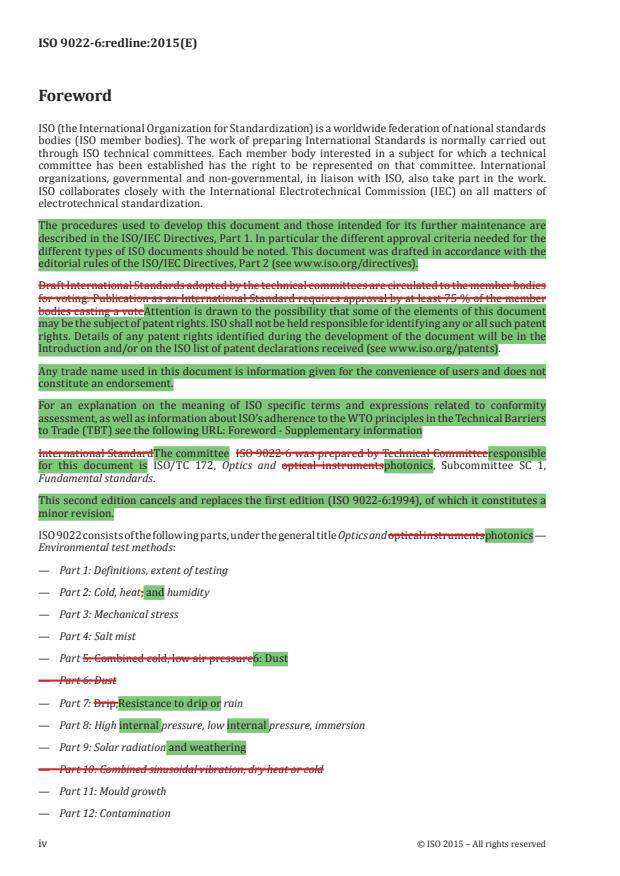
International StandardThe committee ISO 9022-6 was prepared by Technical Committeeresponsible
for this document is ISO/TC 172, Optics and optical instrumentsphotonics, Subcommittee SC 1,
Fundamental standards.
This second edition cancels and replaces the first edition (ISO 9022-6:1994), of which it constitutes a
minor revision.
ISO 9022 consists of the following parts, under the general title Optics and optical instrumentsphotonics —
Environmental test methods:
— Part 1: Definitions, extent of testing
— Part 2: Cold, heat, and humidity
— Part 3: Mechanical stress
— Part 4: Salt mist
— Part 5: Combined cold, low air pressure6: Dust
— Part 6: Dust
— Part 7: Drip,Resistance to drip or rain
— Part 8: High internal pressure, low internal pressure, immersion
— Part 9: Solar radiation and weathering
— Part 10: Combined sinusoidal vibration, dry heat or cold
— Part 11: Mould growth
— Part 12: Contamination
iv © ISO 2015 – All rights reserved
ISO 9022-6:redline:2015(E)
— Part 13: Combined shock, bump or free fall, dry heat or cold
— Part 14: Dew, hoarfrost, ice
— Part 15: Combined random vibration wide band: reproducibility medium, in dry heat or cold
— Part 16: Combined bounce or steady-state acceleration, in dry heat or cold
— Part 17: Combined contamination, solar radiation
— Part 18: Combined damp heat and low internal pressure20: Humid atmosphere containing sulfur
dioxide or hydrogen sulfide
— Part 19: Temperature cycles combined with sinusoidal22: Combined cold, dry heat or temperature
change with bump or random vibration
— Part 20: Humid atmosphere containing sulfur dioxide or hydrogen sulfide23: Low pressure combined
with cold, ambient temperature and dry and damp heat
ISO 9022-6:redline:2015(E)
Introduction
Optical instruments are affected during their use by a number of different environmental parameters
which they are required to resist without significant reduction in performance and to remain within
defined specifications.
The type and severity of these parameters depend on the conditions of use of the instrument (for example,
in the laboratory or workshop) and on its geographical location. The environmental effects on optical
instrument performance in the tropics and subtropics are totally different from those found when they
are used in the arctic regions. Individual parameters cause a variety of different and overlapping effects
on instrument performance.
The manufacturer attempts to ensure, and the user naturally expects, that instruments will resist the
likely rigours of their environment throughout their life. This expectation can be assessed by exposure
of the instrument to a range of simulated environmental parameters under controlled laboratory
conditions. The severity of these conditions is often increased to obtain meaningful results in a relatively
short period of time.
In order to allow assessment and comparison of the response of optical instruments to appropriate
environmental conditions, ISO 9022 contains details of a number of laboratory tests which reliably
simulate a variety of different environments. The tests are based largely on IEC standards, modified
where necessary to take into account features s
...
INTERNATIONAL ISO
STANDARD 9022-6
Second edition
2015-03-01
Optics and photonics —
Environmental test methods —
Part 6:
Dust
Optique et photonique — Méthodes d’essais d’environnement —
Partie 6: Poussière
Reference number
©
ISO 2015
© ISO 2015
All rights reserved. Unless otherwise specified, no part of this publication may be reproduced or utilized otherwise in any form
or by any means, electronic or mechanical, including photocopying, or posting on the internet or an intranet, without prior
written permission. Permission can be requested from either ISO at the address below or ISO’s member body in the country of
the requester.
ISO copyright office
Case postale 56 • CH-1211 Geneva 20
Tel. + 41 22 749 01 11
Fax + 41 22 749 09 47
E-mail copyright@iso.org
Web www.iso.org
Published in Switzerland
ii © ISO 2015 – All rights reserved
Contents Page
Foreword .iv
Introduction .vi
1 Scope . 1
2 Normative references . 1
3 General information and test conditions . 1
4 Conditioning method 52: Blowing dust . 3
5 Procedure. 3
5.1 General . 3
5.2 Preconditioning . 3
5.3 Recovery . 4
6 Environmental test code . 4
7 Specification . 4
Foreword
ISO (the International Organization for Standardization) is a worldwide federation of national standards
bodies (ISO member bodies). The work of preparing International Standards is normally carried out
through ISO technical committees. Each member body interested in a subject for which a technical
committee has been established has the right to be represented on that committee. International
organizations, governmental and non-governmental, in liaison with ISO, also take part in the work.
ISO collaborates closely with the International Electrotechnical Commission (IEC) on all matters of
electrotechnical standardization.
The procedures used to develop this document and those intended for its further maintenance are
described in the ISO/IEC Directives, Part 1. In particular the different approval criteria needed for the
different types of ISO documents should be noted. This document was drafted in accordance with the
editorial rules of the ISO/IEC Directives, Part 2 (see www.iso.org/directives).
Attention is drawn to the possibility that some of the elements of this document may be the subject of
patent rights. ISO shall not be held responsible for identifying any or all such patent rights. Details of any
patent rights identified during the development of the document will be in the Introduction and/or on
the ISO list of patent declarations received (see www.iso.org/patents).
Any trade name used in this document is information given for the convenience of users and does not
constitute an endorsement.
For an explanation on the meaning of ISO specific terms and expressions related to conformity
assessment, as well as information about ISO’s adherence to the WTO principles in the Technical Barriers
to Trade (TBT) see the following URL: Foreword - Supplementary information
The committee responsible for this document is ISO/TC 172, Optics and photonics, Subcommittee SC 1,
Fundamental standards.
This second edition cancels and replaces the first edition (ISO 9022-6:1994), of which it constitutes a
minor revision.
ISO 9022 consists of the following parts, under the general title Optics and photonics — Environmental
test methods:
— Part 1: Definitions, extent of testing
— Part 2: Cold, heat and humidity
— Part 3: Mechanical stress
— Part 4: Salt mist
— Part 6: Dust
— Part 7: Resistance to drip or rain
— Part 8: High internal pressure, low internal pressure, immersion
— Part 9: Solar radiation and weathering
— Part 11: Mould growth
— Part 12: Contamination
— Part 14: Dew, hoarfrost, ice
— Part 17: Combined contamination, solar radiation
— Part 20: Humid atmosphere containing sulfur dioxide or hydrogen sulfide
iv © ISO 2015 – All rights reserved
— Part 22: Combined cold, dry heat or temperature change with bump or random vibration
— Part 23: Low pressure combined with cold, ambient temperature and dry and damp heat
Introduction
Optical instruments are affected during their use by a number of different environmental parameters
which they are required to resist without significant reduction in performance and to remain within
defined specifications.
The type and severity of these parameters depend on the conditions of use of the instrument (for
example, in the laboratory or workshop) and on its geographical location. The environmental effects
on optical instrument performance in the tropics and subtropics are totally different from those found
when they are used in arctic regions. Individual parameters cause a variety of different and overlapping
effects on instrument performance.
The manufacturer attempts to ensure, and the user naturally expects, that instruments will resist the
likely rigours of their environment throughout their life. This expectation can be assessed by exposure
of the instrument to a range of simulated environmental parameters under controlled laboratory
conditions. The severity of these conditions is often increased to obtain meaningful results in a relatively
short period of time.
In order to allow assessment and
...
INTERNATIONAL ISO
STANDARD 9022-6
Redline version
compares Second edition to
First edition
Optics and photonics —
Environmental test methods —
Part 6:
Dust
Optique et photonique — Méthodes d’essais d’environnement —
Partie 6: Poussière
Reference number
ISO 9022-6:redline:2015(E)
©
ISO 2015
ISO 9022-6:redline:2015(E)
IMPORTANT — PLEASE NOTE
This is a mark-up copy and uses the following colour coding:
Text example 1 — indicates added text (in green)
Text example 2 — indicates removed text (in red)
— indicates added graphic figure
— indicates removed graphic figure
1.x . — Heading numbers containg modifications are highlighted in yellow in
the Table of Contents
DISCLAIMER
This Redline version provides you with a quick and easy way to compare the main changes
between this edition of the standard and its previous edition. It doesn’t capture all single
changes such as punctuation but highlights the modifications providing customers with
the most valuable information. Therefore it is important to note that this Redline version is
not the official ISO standard and that the users must consult with the clean version of the
standard, which is the official standard, for implementation purposes.
© ISO 2015
All rights reserved. Unless otherwise specified, no part of this publication may be reproduced or utilized otherwise in any form
or by any means, electronic or mechanical, including photocopying, or posting on the internet or an intranet, without prior
written permission. Permission can be requested from either ISO at the address below or ISO’s member body in the country of
the requester.
ISO copyright office
Case postale 56 • CH-1211 Geneva 20
Tel. + 41 22 749 01 11
Fax + 41 22 749 09 47
E-mail copyright@iso.org
Web www.iso.org
Published in Switzerland
ii © ISO 2015 – All rights reserved
ISO 9022-6:redline:2015(E)
Contents Page
Foreword .iv
Introduction .vi
1 Scope . 1
2 Normative references . 1
3 General information and test conditions . 1
4 Conditioning method 52: Blowing dust . 4
5 Procedure. 5
5.1 General . 5
5.2 Preconditioning . 5
5.3 Recovery . 5
6 Environmental test code . 5
7 Specification . 6
ISO 9022-6:redline:2015(E)
Foreword
ISO (the International Organization for Standardization) is a worldwide federation of national standards
bodies (ISO member bodies). The work of preparing International Standards is normally carried out
through ISO technical committees. Each member body interested in a subject for which a technical
committee has been established has the right to be represented on that committee. International
organizations, governmental and non-governmental, in liaison with ISO, also take part in the work.
ISO collaborates closely with the International Electrotechnical Commission (IEC) on all matters of
electrotechnical standardization.
The procedures used to develop this document and those intended for its further maintenance are
described in the ISO/IEC Directives, Part 1. In particular the different approval criteria needed for the
different types of ISO documents should be noted. This document was drafted in accordance with the
editorial rules of the ISO/IEC Directives, Part 2 (see www.iso.org/directives).
Draft International Standards adopted by the technical committees are circulated to the member bodies
for voting. Publication as an International Standard requires approval by at least 75 % of the member
bodies casting a voteAttention is drawn to the possibility that some of the elements of this document
may be the subject of patent rights. ISO shall not be held responsible for identifying any or all such patent
rights. Details of any patent rights identified during the development of the document will be in the
Introduction and/or on the ISO list of patent declarations received (see www.iso.org/patents).
Any trade name used in this document is information given for the convenience of users and does not
constitute an endorsement.
For an explanation on the meaning of ISO specific terms and expressions related to conformity
assessment, as well as information about ISO’s adherence to the WTO principles in the Technical Barriers
to Trade (TBT) see the following URL: Foreword - Supplementary information
International StandardThe committee ISO 9022-6 was prepared by Technical Committeeresponsible
for this document is ISO/TC 172, Optics and optical instrumentsphotonics, Subcommittee SC 1,
Fundamental standards.
This second edition cancels and replaces the first edition (ISO 9022-6:1994), of which it constitutes a
minor revision.
ISO 9022 consists of the following parts, under the general title Optics and optical instrumentsphotonics —
Environmental test methods:
— Part 1: Definitions, extent of testing
— Part 2: Cold, heat, and humidity
— Part 3: Mechanical stress
— Part 4: Salt mist
— Part 5: Combined cold, low air pressure6: Dust
— Part 6: Dust
— Part 7: Drip,Resistance to drip or rain
— Part 8: High internal pressure, low internal pressure, immersion
— Part 9: Solar radiation and weathering
— Part 10: Combined sinusoidal vibration, dry heat or cold
— Part 11: Mould growth
— Part 12: Contamination
iv © ISO 2015 – All rights reserved
ISO 9022-6:redline:2015(E)
— Part 13: Combined shock, bump or free fall, dry heat or cold
— Part 14: Dew, hoarfrost, ice
— Part 15: Combined random vibration wide band: reproducibility medium, in dry heat or cold
— Part 16: Combined bounce or steady-state acceleration, in dry heat or cold
— Part 17: Combined contamination, solar radiation
— Part 18: Combined damp heat and low internal pressure20: Humid atmosphere containing sulfur
dioxide or hydrogen sulfide
— Part 19: Temperature cycles combined with sinusoidal22: Combined cold, dry heat or temperature
change with bump or random vibration
— Part 20: Humid atmosphere containing sulfur dioxide or hydrogen sulfide23: Low pressure combined
with cold, ambient temperature and dry and damp heat
ISO 9022-6:redline:2015(E)
Introduction
Optical instruments are affected during their use by a number of different environmental parameters
which they are required to resist without significant reduction in performance and to remain within
defined specifications.
The type and severity of these parameters depend on the conditions of use of the instrument (for example,
in the laboratory or workshop) and on its geographical location. The environmental effects on optical
instrument performance in the tropics and subtropics are totally different from those found when they
are used in the arctic regions. Individual parameters cause a variety of different and overlapping effects
on instrument performance.
The manufacturer attempts to ensure, and the user naturally expects, that instruments will resist the
likely rigours of their environment throughout their life. This expectation can be assessed by exposure
of the instrument to a range of simulated environmental parameters under controlled laboratory
conditions. The severity of these conditions is often increased to obtain meaningful results in a relatively
short period of time.
In order to allow assessment and comparison of the response of optical instruments to appropriate
environmental conditions, ISO 9022 contains details of a number of laboratory tests which reliably
simulate a variety of different environments. The tests are based largely on IEC standards, modified
where necessary to take into account features s
...