


ISO/IEC 14496-3:2001/Cor 2:2004
(Corrigendum)Information technology — Coding of audio-visual objects — Part 3: Audio — Technical Corrigendum 2
Information technology — Coding of audio-visual objects — Part 3: Audio — Technical Corrigendum 2
Technologies de l'information — Codage des objets audiovisuels — Partie 3: Codage audio — Rectificatif technique 2
General Information
- Status
- Withdrawn
- Publication Date
- 17-Jun-2004
- Withdrawal Date
- 17-Jun-2004
- Current Stage
- 9599 - Withdrawal of International Standard
- Start Date
- 14-Mar-2006
- Completion Date
- 12-Feb-2026
Relations
- Effective Date
- 06-Jun-2022
- Revised
ISO/IEC 14496-3:2005 - Information technology — Coding of audio-visual objects — Part 3: Audio - Effective Date
- 15-Apr-2008

Get Certified
Connect with accredited certification bodies for this standard

BSI Group
BSI (British Standards Institution) is the business standards company that helps organizations make excellence a habit.

NYCE
Mexican standards and certification body.
Sponsored listings
Frequently Asked Questions
ISO/IEC 14496-3:2001/Cor 2:2004 is a standard published by the International Organization for Standardization (ISO). Its full title is "Information technology — Coding of audio-visual objects — Part 3: Audio — Technical Corrigendum 2". This standard covers: Information technology — Coding of audio-visual objects — Part 3: Audio — Technical Corrigendum 2
Information technology — Coding of audio-visual objects — Part 3: Audio — Technical Corrigendum 2
ISO/IEC 14496-3:2001/Cor 2:2004 is classified under the following ICS (International Classification for Standards) categories: 35.040 - Information coding; 35.040.40 - Coding of audio, video, multimedia and hypermedia information. The ICS classification helps identify the subject area and facilitates finding related standards.
ISO/IEC 14496-3:2001/Cor 2:2004 has the following relationships with other standards: It is inter standard links to ISO 11592-1:2016, ISO/IEC 14496-3:2005. Understanding these relationships helps ensure you are using the most current and applicable version of the standard.
ISO/IEC 14496-3:2001/Cor 2:2004 is available in PDF format for immediate download after purchase. The document can be added to your cart and obtained through the secure checkout process. Digital delivery ensures instant access to the complete standard document.
Standards Content (Sample)
INTERNATIONAL STANDARD ISO/IEC 14496-3:2001
TECHNICAL CORRIGENDUM 2
Published 2004-06-15
INTERNATIONAL ORGANIZATION FOR STANDARDIZATION • МЕЖДУНАРОДНАЯ ОРГАНИЗАЦИЯ ПО СТАНДАРТИЗАЦИИ • ORGANISATION INTERNATIONALE DE NORMALISATION
INTERNATIONAL ELECTROTECHNICAL COMMISSION • МЕЖДУНАРОДНАЯ ЭЛЕКТРОТЕХНИЧЕСКАЯ КОМИССИЯ • COMMISSION ÉLECTROTECHNIQUE INTERNATIONALE
Information technology — Coding of audio-visual objects —
Part 3:
Audio
TECHNICAL CORRIGENDUM 2
Technologies de l'information — Codage des objets audiovisuels —
Partie 3: Codage audio
RECTIFICATIF TECHNIQUE 2
Technical Corrigendum 2 to ISO/IEC 14496-3:2001 was prepared by Joint Technical Committee
ISO/IEC JTC 1, Information technology, Subcommittee SC 29, Coding of audio, picture, multimedia and
hypermedia information.
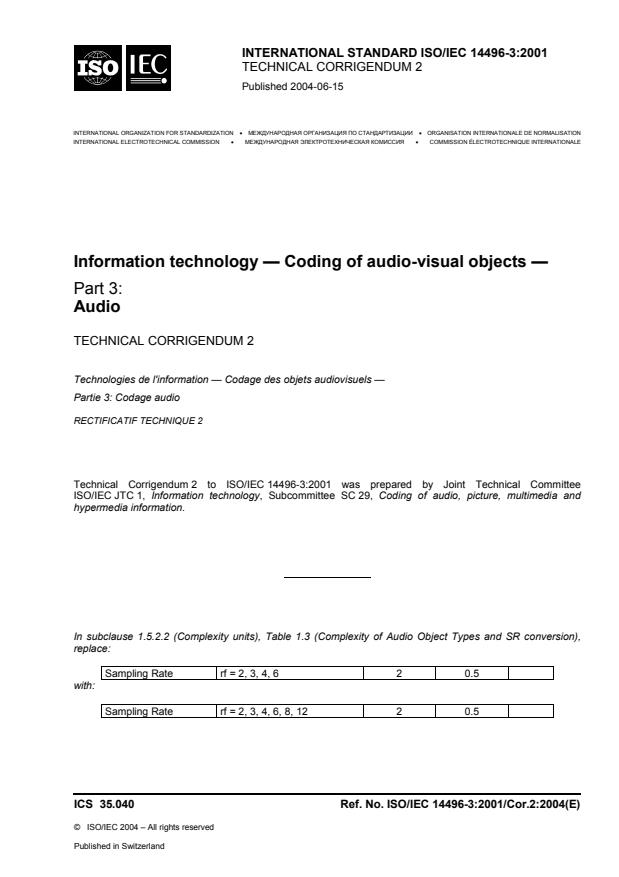
In subclause 1.5.2.2 (Complexity units), Table 1.3 (Complexity of Audio Object Types and SR conversion),
replace:
Sampling Rate rf = 2, 3, 4, 6 2 0.5
with:
Sampling Rate rf = 2, 3, 4, 6, 8, 12 2 0.5
ICS 35.040 Ref. No. ISO/IEC 14496-3:2001/Cor.2:2004(E)
© ISO/IEC 2004 – All rights reserved
Published in Switzerland
ISO/IEC 14496-3:2001/Cor.2:2004(E)
Replace subclause 1.7 (MPEG-4 Audio transport stream) with:
1.7 MPEG-4 Audio transport stream
1.7.1 Overview
This subclause defines a mechanism to transport ISO/IEC 14496-3 (MPEG-4 Audio) streams without using
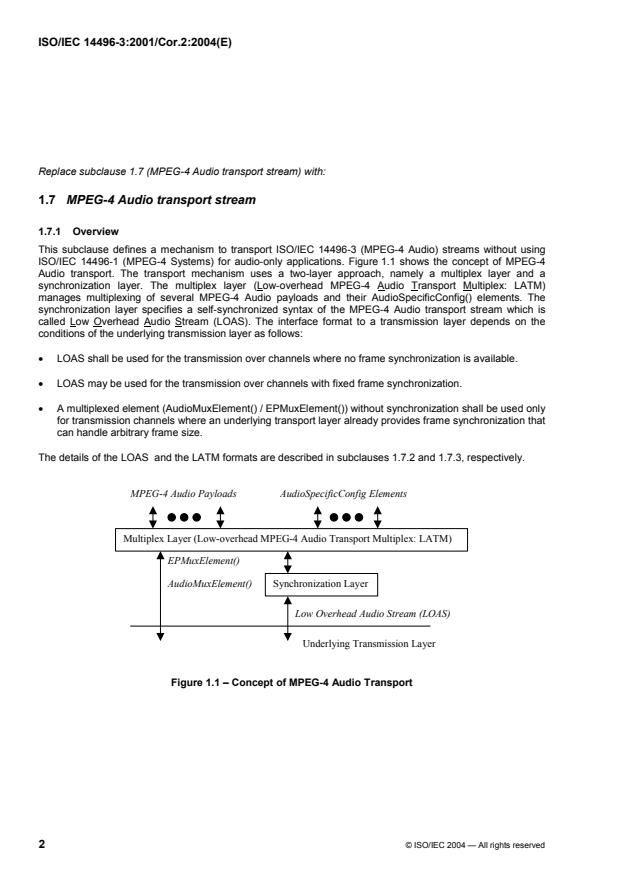
ISO/IEC 14496-1 (MPEG-4 Systems) for audio-only applications. Figure 1.1 shows the concept of MPEG-4
Audio transport. The transport mechanism uses a two-layer approach, namely a multiplex layer and a
synchronization layer. The multiplex layer (Low-overhead MPEG-4 Audio Transport Multiplex: LATM)
manages multiplexing of several MPEG-4 Audio payloads and their AudioSpecificConfig() elements. The
synchronization layer specifies a self-synchronized syntax of the MPEG-4 Audio transport stream which is
called Low Overhead Audio Stream (LOAS). The interface format to a transmission layer depends on the
conditions of the underlying transmission layer as follows:
• LOAS shall be used for the transmission over channels where no frame synchronization is available.
• LOAS may be used for the transmission over channels with fixed frame synchronization.
• A multiplexed element (AudioMuxElement() / EPMuxElement()) without synchronization shall be used only
for transmission channels where an underlying transport layer already provides frame synchronization that
can handle arbitrary frame size.
The details of the LOAS and the LATM formats are described in subclauses 1.7.2 and 1.7.3, respectively.
MPEG-4 Audio Payloads AudioSpecificConfig Elements
Multiplex Layer (Low-overhead MPEG-4 Audio Transport Multiplex: LATM)
EPMuxElement()
AudioMuxElement() Synchronization Layer
Low Overhead Audio Stream (LOAS)
Underlying Transmission Layer
Figure 1.1 – Concept of MPEG-4 Audio Transport
2 © ISO/IEC 2004 — All rights reserved
ISO/IEC 14496-3:2001/Cor.2:2004(E)
The mechanism defined in this subclause should not be used for transmission of TTSI objects (12), Main
Synthetic objects (13), Wavetable Synthesis objects (14), General MIDI objects (15) and Algorithmic
Synthesis and Audio FX objects (16). It should further not be used for transmission of any object in
conjunction with (epConfig==1). For those objects, other multiplex and transport mechanisms might be used,
e.g. those defined in MPEG-4 Systems.
1.7.2 Synchronization Layer
The synchronization layer provides the multiplexed element with a self-synchronized mechanism to generate
LOAS. The LOAS has three different types of format, namely AudioSyncStream(), EPAudioSyncStream() and
AudioPointerStream(). The choice for one of the three formats is dependent on the underlying transmission
layer.
• AudioSyncStream()
AudioSyncStream() consists of a syncword, the multiplexed element with byte alignment, and its length
information. The maximum byte-distance between two syncwords is 8192 bytes. This self-synchronized
stream shall be used for the case that the underlying transmission layer comes without any frame
synchronization.
• EPAudioSyncStream()
For error prone channels, an alternative version to AudioSyncStream() is provided. This format has the same
basic functionality as the previously described AudioSyncStream(). However, it additionally provides a longer
syncword and a frame counter to detect lost frames. The length information and the frame counter are
additionally protected by a FEC code.
• AudioPointerStream()
AudioPointerStream() shall be used for applications using an underlying transmission layer with fixed frame
synchronization, where transmission framing cannot be synchronized with the variable length multiplexed
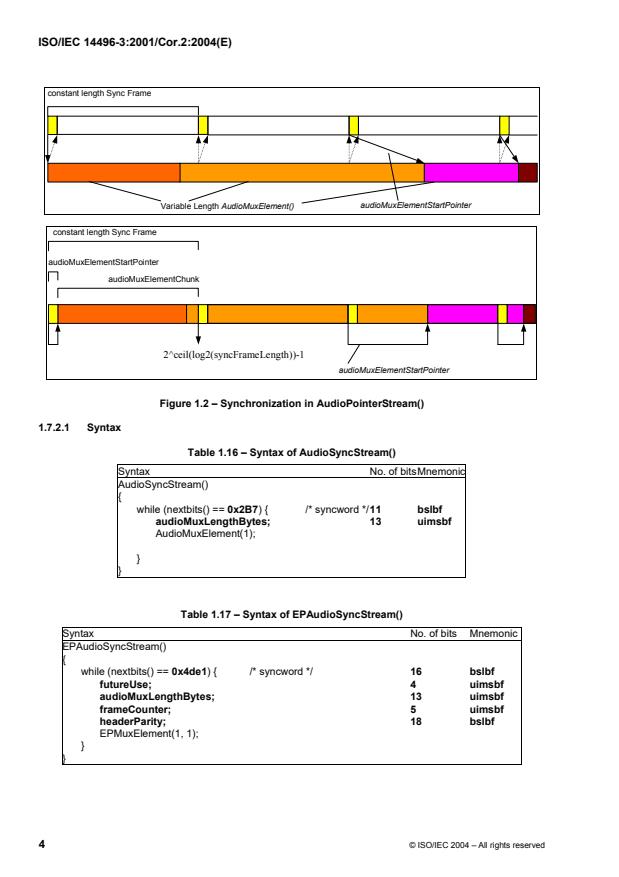
element. Figure 1.2 shows synchronization in AudioPointerStream(). This format utilizes a pointer indicating
the start of the next multiplex element in order to synchronize the variable length payload with the constant
transmission frame.
© ISO/IEC 2004 – All rights reserved 3
ISO/IEC 14496-3:2001/Cor.2:2004(E)
constant length Sync Frame
audioMuxElementStartPointer
Variable Length AudioMuxElement()
constant length Sync Frame
audioMuxElementStartPointer
audioMuxElementChunk
2^ceil(log2(syncFrameLength))-1
audioMuxElementStartPointer
Figure 1.2 – Synchronization in AudioPointerStream()
1.7.2.1 Syntax
Table 1.16 – Syntax of AudioSyncStream()
Syntax No. of bits Mnemonic
AudioSyncStream()
{
while (nextbits() == 0x2B7) { /* syncword */ 11 bslbf
audioMuxLengthBytes; 13 uimsbf
AudioMuxElement(1);
}
}
Table 1.17 – Syntax of EPAudioSyncStream()
Syntax No. of bits Mnemonic
EPAudioSyncStream()
{
while (nextbits() == 0x4de1) { /* syncword */ 16 bslbf
futureUse; 4 uimsbf
audioMuxLengthBytes; 13 uimsbf
frameCounter; 5 uimsbf
headerParity; 18 bslbf
EPMuxElement(1, 1);
}
}
4 © ISO/IEC 2004 – All rights reserved
ISO/IEC 14496-3:2001/Cor.2:2004(E)
Table 1.18 – Syntax of AudioPointerStream()
Syntax No. of bits Mnemonic
AudioPointerStream (syncFrameLength )
{
while ( ! EndOfStream ) {
AudioPointerStreamFrame ( syncFrameLength );
}
}
Table 1.18a – Syntax of AudioPointerStreamFrame()
Syntax No. of bits Mnemonic
AudioPointerStreamFrame( length )
{
audioMuxElementStartPointer; ceil(log2(length)) uimsbf
audioMuxElementChunk; length – ceil(log2(length)) bslbf
}
1.7.2.2 Semantics
1.7.2.2.1 AudioSyncStream()
audioMuxLengthBytes A 13-bit data element indicating the byte length of the subsequent
AudioMuxElement() with byte alignment (AudioSyncStream) or the
subsequent EPMuxElement() (EPAudioSyncStream).
AudioMuxElement() A multiplexed element as specified in subclause 1.7.3.2.2.
1.7.2.2.2 EPAudioSyncStream()
futureUse A 4-bit data element for future use, which shall be set to ‘0000’.
audioMuxLengthBytes see subclause 1.7.2.2.1.
frameCounter A 5-bit data element indicating a sequential number which is used to detect
lost frames. The number is continuously incremented for each multiplexed
element as a modulo counter.
headerParity A 18-bit data element which contains a BCH (36,18) code shortened from
BCH (63,45) code for the elements audioMuxLengthBytes and
frameCounter. The generator polynomial is
18 17 16 15 9 7 6 3 2
x +x +x +x +x +x +x +x +x +x+1. The value is calculated with this
generator polynomial as described in subclause 1.8.4.3.
EPMuxElement() An error resilient multiplexed element as specified in subclause 1.7.3.2.1.
1.7.2.2.3 AudioPointerStream()
AudioPointerStreamFrame() A sync frame of fixed length provided by an underlying transmission layer.
audioMuxElementStartPointer A data element indicating the starting point of the first AudioMuxElement()
within the current AudioPointerStreamFrame(). The number of bits required
for this data element is calculated as ceil(log2(syncFrameLength)). The
transmission frame length has to be provided from the underlying
transmission layer. The maximum possible value of this data element is
reserved to signal that there is no start of an AudioMuxElement() in this sync
frame.
© ISO/IEC 2004 – All rights reserved 5
ISO/IEC 14496-3:2001/Cor.2:2004(E)
audioMuxElementChunk A part of a concatenation of subsequent AudioMuxElement()’s (see
Figure 1.2).
1.7.3 Multiplex Layer
The LATM layer multiplexes several MPEG-4 Audio payloads and AudioSpecificConfig() syntax elements into
one multiplexed element. The multiplexed element format is selected between AudioMuxElement() and
EPMuxElement() depending on whether error resilience is required in the multiplexed element itself, or not.
EPMuxElement() is an error resilient version of AudioMuxElement() and may be used for error prone channels.
The multiplexed elements can be directly conveyed on transmission layers with frame synchronization. In this
case, the first bit of the multiplexed element shall be located at the first bit of a transmission payload in the
underlying transmission layer. If the transmission payload allows only byte-aligned payload, padding bits for
byte alignment shall follow the multiplexed element. The number of the padding bits should be less than 8.
These padding bits should be removed when the multiplexed element is de-multiplexed into the MPEG-4
Audio payloads. Then, the MPEG-4 Audio payloads are forwarded to the corresponding MPEG-4 Audio
decoder tool.
Usage of LATM in case of scalable configurations with CELP core and AAC enhancement layer(s):
• Instances of the AudioMuxElement() are transmitted in equidistant manner.
• The represented timeframe of one AudioMuxElement() is similar to a multiple of a super-frame
timeframe.
• The relative number of bits for a certain layer within any AudioMuxElement() compared to the total
number of bits within this AudioMuxElement() is equal to the relative bitrate of that layer compared to
the bitrate of all layers.
• In case of coreFrameOffset = 0 and latmBufferFullness = 0, all core coder frames and all AAC frames
of a certain super-frame are stored within the same instance of AudioMuxElement().
• In case of coreFrameOffset > 0, several or all core coder frames are stored within previous instances
of AudioMuxElement().
• Any core layer related configuration information refers to the core frames transmitted within the
current instance of the AudioMuxElement(), independent of the value of coreFrameOffset.
• A specified latmBufferFullness is related to the first AAC frame of the first super-frame stored within
the current AudioMuxElement().
• The value of latmBufferFullness can be used to determine the location of the first bit of the first
AAC frame of the current layer of the first super-frame stored within the current AudioMuxElement()
by means of a backpointer:
• backPointer = −meanFrameLength + latmBufferFullness + currentFrameLength
The backpointer value specifies the location as a negative offset from the current AudioMuxElement(),
i. e. it points backwards to the beginning of an AAC frame located in already received data. Any data
not belonging to the payload of the current AAC layer is not taken into account. If (latmBufferFullness
== ‘0’), then the AAC frame starts after the current AudioMuxElement().
Note that the possible LATM configurations are restricted due to limited signalling capabilities of certain data
elements as follows:
• Number of layers: 8 (numLayer has 3 bit)
• Number of streams: 16 (streamIndx has 4 bit)
• Number of chunks: 16 (numChunk has 4 bit)
6 © ISO/IEC 2004 – All rights reserved
ISO/IEC 14496-3:2001/Cor.2:2004(E)
1.7.3.1 Syntax
Table 1.19 – Syntax of EPMuxElement()
Syntax No. of bits Mnemonic
EPMuxElement(epDataPresent, muxConfigPresent)
{
if (epDataPresent) {
epUsePreviousMuxConfig; 1 bslbf
epUsePreviousMuxConfigParity; 2 bslbf
if (!epUsePreviousMuxConfig) {
epSpecificConfigLength; 10 bslbf
epSpecificConfigLengthParity; 11 bslbf
ErrorProtectionSpecificConfig();
ErrorProtectionSpecificConfigParity();
}
ByteAlign();
EPAudioMuxElement(muxConfigPresent);
}
else {
AudioMuxElement(muxConfigPresent);
}
}
Table 1.20 – Syntax of AudioMuxElement()
Syntax No. of bits Mnemonic
AudioMuxElement(muxConfigPresent)
{
if (muxConfigPresent) {
useSameStreamMux; 1 bslbf
if (!useSameStreamMux)
StreamMuxConfig();
}
if (audioMuxVersionA == 0) {
for (i = 0; i <= numSubFrames; i++) {
PayloadLengthInfo();
PayloadMux();
}
if (otherDataPresent) {
for(i = 0; i < otherDataLenBits; I++) {
otherDataBit; 1 bslbf
}
}
}
else {
/* tbd */
}
ByteAlign();
}
© ISO/IEC 2004 – All rights reserved 7
ISO/IEC 14496-3:2001/Cor.2:2004(E)
Table 1.21 – Syntax of StreamMuxConfig()
Syntax No. of bitsMnemonic
StreamMuxConfig()
{
audioMuxVersion; 1 bslbf
if (audioMuxVersion == 1) {
audioMuxVersionA; 1 bslbf
else {
audioMuxVersionA = 0;
}
if (audioMuxVersionA == 0) {
if (audioMuxVersion == 1 ) {
taraBufferFullness = LatmGetValue();
}
streamCnt = 0;
allStreamsSameTimeFraming; 1 uimsbf
numSubFrames; 6 uimsbf
numProgram; 4 uimsbf
for (prog = 0; prog <= numProgram; prog++) {
numLayer; 3 uimsbf
for (lay = 0; lay <= numLayer; lay++) {
progSIndx[streamCnt] = prog; laySIndx[streamCnt] = lay;
streamID [ prog][ lay] = streamCnt++;
if (prog == 0 && lay == 0) {
useSameConfig = 0;
} else {
useSameConfig; 1 uimsbf
}
if (! useSameConfig)
if ( audioMuxVersion == 1 ) {
ascLen = LatmGetValue();
}
ascLen -= AudioSpecificConfig(); Note 1
fillBits; ascLen bslbf
}
frameLengthType[streamID[prog][ lay]]; 3 uimsbf
if (frameLengthType[streamID[prog][lay] == 0) {
latmBufferFullness[streamID[prog][ lay]]; 8 uimsbf
if (! allStreamsSameTimeFraming) {
if ((AudioObjectType[lay] == 6 ||
AudioObjectType[lay] == 20) &&
(AudioObjectType[lay-1] == 8 ||
AudioObjectType[lay-1] == 24)) {
coreFrameOffset; 6 uimsbf
}
}
} else if (frameLengthType[streamID[prog][ lay]] == 1) {
frameLength[streamID[prog][lay]]; 9 uimsbf
} else if ( frameLengthType[streamID[prog][ lay]] == 4
frameLengthType[streamID[prog][ lay]] == 5
frameLengthType[streamID[prog][ lay]] == 3 ) {
CELPframeLengthTableIndex[streamID[prog][lay]]; 6 uimsbf
} else if ( frameLengthType[streamID[prog][ lay]] == 6
frameLengthType[streamID[prog][ lay]] == 7 ) {
HVXCframeLengthTableIndex[streamID[prog][ lay]]; 1 uimsbf
}
}
}
8 © ISO/IEC 2004 – All rights reserved
ISO/IEC 14496-3:2001/Cor.2:2004(E)
otherDataPresent; 1 uimsbf
if (otherDataPresent) {
if ( audioMuxVersion == 1 ) {
otherDataLenBits = LatmGetValue();
}
else {
otherDataLenBits = 0; /* helper variable 32bit */
do {
otherDataLenBits *= 2^8;
otherDataLenEsc; 1 uimsbf
otherDataLenTmp; 8 uimsbf
otherDataLenBits += otherDataLenTmp;
} while (otherDataLenEsc);
}
}
crcCheckPresent; 1 uimsbf
if (crcCheckPresent) crcCheckSum; 8 uimsbf
}
else {
/* tbd */
}
}
Note 1: AudioSpecificConfig() returns the number of bits read.
Table 1.COR2-1 – Syntax of LatmGetValue()
Syntax No. of bits Mnemonic
LatmGetValue()
bytesForValue; 2 uimsbf
value = 0; /* helper variable 32bit */
for ( i = 0; i <= bytesForValue; i++ ) {
value *= 2^8;
valueTmp; 8 uimsbf
value += valueTmp;
}
return value;
}
Table 1.22 – Syntax of PayloadLengthInfo()
Syntax No. of bits Mnemonic
PayloadLengthInfo()
{
if (allStreamsSameTimeFraming) {
for (prog = 0; prog <= numProgram; prog++) {
for (lay = 0; lay <= numLayer; lay++) {
if (frameLengthType[streamID[prog][ lay]] == 0) {
MuxSlotLengthBytes[streamID[prog][ lay]] = 0;
do { /* always one complete access unit */
tmp; 8 uimsbf
MuxSlotLengthBytes[streamID[prog][ lay]] += tmp;
} while(tmp == 255);
} else {
if ( frameLengthType[streamID[prog][ lay]] == 5 ||
frameLengthType[streamID[prog][ lay]] == 7 ||
© ISO/IEC 2004 – All rights reserved 9
ISO/IEC 14496-3:2001/Cor.2:2004(E)
frameLengthType[streamID[prog][ lay]] == 3 ) {
MuxSlotLengthCoded[streamID[prog][ lay]]; 2 uimsbf
}
}
}
}
} else {
numChunk; 4 uimsbf
for (chunkCnt = 0; chunkCnt <= numChunk; chunkCnt++) {
streamIndx; 4 uimsbf
prog = progCIndx[chunkCnt] = progSIndx[streamIndx];
lay = layCIndx[chunkCnt] = laySIndx [streamIndx];
if (frameLengthType[streamID[prog][lay]] == 0) {
MuxSlotLengthBytes[streamID[prog][ lay]] = 0;
do { /* not necessarily a complete access unit */
tmp; 8 uimsbf
MuxSlotLengthBytes[streamID[prog][lay]] += tmp;
} while (tmp == 255);
AuEndFlag[streamID[prog][lay]]; 1 bslbf
} else {
if (frameLengthType[streamID[prog][lay]] == 5 ||
frameLengthType[streamID[prog][lay]] == 7 ||
frameLengthType[streamID[prog][lay]] == 3) {
MuxSlotLengthCoded[streamID[prog][lay]]; 2 uimsbf
}
}
}
}
}
Table 1.23 – Syntax of PayloadMux()
Syntax No. of bits Mnemonic
PayloadMux()
{
if (allStreamsSameTimeFraming) {
for (prog = 0; prog <= numProgram; prog++) {
for (lay = 0; lay <= numLayer; lay++) {
payload [streamID[prog][ lay]];
}
}
} else {
for (chunkCnt = 0; chunkCnt <= numChunk; chunkCnt++) {
prog = progCIndx[chunkCnt];
lay = layCIndx [chunkCnt];
payload [streamID[prog][ lay]];
}
}
}
10 © ISO/IEC 2004 – All rights reserved
ISO/IEC 14496-3:2001/Cor.2:2004(E)
1.7.3.2 Semantics
1.7.3.2.1 EPMuxElement()
For parsing of EPMuxElement(), an epDataPresent flag shall be additionally set at the underlying layer. If
epDataPresent is set to 1, this indicates EPMuxElement() has error resiliency. If not, the format of
EPMuxElement() is identical to AudioMuxElement(). The default for both flags is 1.
epDataPresent Description
0 EPMuxElement() is identical to AudioMuxElement()
1 EPMuxElement() has error resiliency
epUsePreviousMuxConfig A flag indicating whether the configuration for the MPEG-4 Audio EP tool in
the previous frame is applied in the current frame.
epUsePreviousMuxConfig Description
0 The configuration for the MPEG-4 Audio EP tool
is present.
1 The configuration for the MPEG-4 Audio EP tool
is not present. The previous configuration
should be applied.
epUsePreviousMuxConfigParity A 2-bits element which contains the parity for epUsePreviousMuxConfig.
Each bit is a repetition of epUsePreviousMuxConfig. Majority decides.
epSpecificConfigLength A 10-bit data element to indicate the size of ErrorProtectionSpecificConfig()
epSpecificConfigLengthParity An 11-bit data element for epHeaderLength, calculated as described in
subclause 1.8.4.3 with “1) Basic set of FEC codes”.
Note: This means shortened Golay(23,12) is used
ErrorProtectionSpecificConfig() A data function covering configuration information for the EP tool which is
applied to AudioMuxElement() as defined in subclause 1.8.2.1.
ErrorProtectionSpecificConfigParity() A data function covering the parity bits for
ErrorProtectionSpecificConfig(), calculated as described in
subclause 1.8.4.3, Table 1.45.
EPAudioMuxElement() A data function covering error resilient multiplexed element that is generated
by applying the EP tool to AudioMuxElement() as specified by
ErrorProtectionSpecificConfig(). Therefore data elements in
AudioMuxElement() are subdivided into different categories depending on
their error sensitivity and collected in instances of these categories. Following
sensitivity categories are defined:
elements error sensitivity category
useSameStreamMux + StreamMuxConfig() 0
PayloadLengthInfo() 1
PayloadMux() 2
otherDataBits 3
Note 1: There might be more than one instance of error sensitivity category 1
and 2 depending on the value of the variable numSubFrames defined in
StreamMuxConfig(). Figure 1.3 shows an example for the order of the
instances assuming numSubFrames is one (1).
© ISO/IEC 2004 – All rights reserved 11
ISO/IEC 14496-3:2001/Cor.2:2004(E)
Note 2: EPAudioMuxElement() has to be byte aligned, therefore bit_stuffing
in ErrorProtectionSpecificConfig() should be always on.
0 1a 2a 1b 2b 3
Figure 1.3 – Instance order in EPAudioMuxElement()
1.7.3.2.2 AudioMuxElement()
In order to parse an AudioMuxElement(), a muxConfigPresent flag shall be set at the underlying layer. If
muxConfigPresent is set to 1, this indicates multiplexing configuration (StreamMuxConfig()) is multiplexed into
AudioMuxElement(), i.e. in-band transmission. If not, StreamMuxConfig() should be conveyed through out-
band means, such as session announcement/description/control protocols.
muxConfigPresent Description
0 out-band transmission of StreamMuxConfig()
1 in-band transmission of StreamMuxConfig()
useSameStreamMux A flag indicating whether the multiplexing configuration in the previous frame
is applied in the current frame.
useSameStreamMux Description
0 The multiplexing configuration is present.
1 The multiplexing configuration is not present. The
previous configuration should be applied.
otherDataBit A 1-bit data element indicating the other data information.
1.7.3.2.3 StreamMuxConfig()
AudioSpecificConfig() is specified in subclause 1.6.2.1. In this case it constitutes a standalone element in itself
(i.e. it does not extend the class BaseDescriptor as in the case of subclause 1.6).
audioMuxVersion A data element to signal the used multiplex syntax.
Note: In addition to (audioMuxVersion == 0), (audioMuxVersion == 1)
supports the transmission of a taraBufferFullness and the transmission of the
lengths of individual AudioSpecificConfig() data functions.
audioMuxVersionA A data element to signal the bitstream syntax version. Possible values: 0
(default), 1 (reserved for future extensions).
taraBufferFullness A helper variable indicating the state of the bit reservoir in the course of
encoding the LATM status information. It is transmitted as the number of
available bits in the tara bit reservoir divided by 32 and truncated to an integer
value. The maximum value that can be signaled using any setting of
bytesForValue signals that the particular program and layer is of variable rate.
This might be the value of hexadecimal FF (bytesForValue == 0), FFFF
(bytesForValue == 1), FFFFFF (bytesForValue == 2) or FFFFFFFF
(bytesForValue == 3). In these cases, buffer fullness is not applicable. The
state of the bit reservoir is derived according to what is stated in subpart 4,
subclause 4.5.3.2 (Bit reservoir). The LATM status information considered by
the taraBufferFullness comprises any data of the AudioMuxElement() except
of PayloadMux().
12 © ISO/IEC 2004 – All rights reserved
ISO/IEC 14496-3:2001/Cor.2:2004(E)
allStreamsSameTimeFraming A data element indicating whether all payloads, which are multiplexed in
PayloadMux(), share a common time base.
numSubFrames A data element indicating how many PayloadMux() frames are multiplexed
(numSubFrames+1). If more than one PayloadMux() frame is multiplexed, all
PayloadMux() share a common StreamMuxConfig().The minimum value is 0
indicating 1 subframe.
numProgram A data element indicating how many programs are multiplexed
(numProgram+1). The minimum value is 0 indicating 1 program.
numLayer A data element indicating how many scalable layers are multiplexed
(numLayer+1). The minimum value is 0 indicating 1 layer.
useSameConfig A data element indicating whether AudioSpecificConfig() for the payload in the
previous layer or program is applied for the payload in the current layer or
program.
useSameConfig Description
0 AudioSpecificConfig() is present.
1 AudioSpecificConfig() is not present.
AudioSpecificConfig() in the previous layer or
program should be applied.
ascLen[prog][lay] A helper variable indicating the length in bits of the subsequent
AudioSpecificConfig() data function including possible fill bits.
fillBits Fill bits.
frameLengthType A data element indicating the frame length type of the payload. For CELP and
HVXC objects, the frame length (bits/frame) is stored in tables and only the
indices to point out the frame length of the current payload is transmitted
instead of sending the frame length value directly.
frameLengthType Description
0 Payload with variable frame length. The payload length
in bytes is directly specified with 8-bit codes in
PayloadLengthInfo().
1 Payload with fixed frame length. The payload length in
bits is specified with frameLength in StreamMuxConfig().
2 Reserved
3 Payload for a CELP object with one of 2 kinds of frame
length. The payload length is specified by two table-
indices, namely CELPframeLengthTableIndex and
MuxSlotLengthCoded.
4 Payload for a CELP or ER_CELP object with fixed frame
length. CELPframeLengthTableIndex specifies the
payload length.
5 Payload for an ER_CELP object with one of 4 kinds of
frame length. The payload length is specified by two
table-indices, namely CELPframeLengthTableIndex and
MuxSlotLengthCoded.
6 Payload for a HVXC or ER_HVXC object with fixed
frame length. HVXCframeLengthTableIndex specifies
the payload length.
7 Payload for an HVXC or ER_HVXC object with one of 4
kinds of frame length. The payload length is specified by
two table-indices, namely HVXCframeLengthTableIndex
and MuxSlotLengthCoded.
© ISO/IEC 2004 – All rights reserved 13
ISO/IEC 14496-3:2001/Cor.2:2004(E)
latmBufferFullness[streamID[prog][lay]] data element indicating the state of the bit reservoir in the course
of encoding the first access unit of a particular program and layer in an
AudioMuxElement(). It is transmitted as the number of available bits in the bit
reservoir divided by the NCC divided by 32 and truncated to an integer value.
A value of hexadecimal FF signals that the particular program and layer is of
variable rate. In this case, buffer fullness is not applicable. The state of the bit
reservoir is derived according to what is stated in subpart 4, subclause 4.5.3.2
(Bit reservoir).
In the case of (audioMuxVersion == 0), bits spend for data other than any
payload (e.g. multiplex status information or other data) are considered in the
first occuring latmBufferFullness in an AudioMuxElement(). For AAC, the
limitations given by the minimum decoder input buffer apply (see subpart 4,
subclause 4.5.3.1). In the case of (allStreamsSameTimeFraming==1), and if
only one program and one layer is present, this leads to an LATM
configuration similar to ADTS.
In the case of (audioMUxVersion == 1), bits spend for data other than any
payload are considered by taraBufferFullness.
coreFrameOffset identifies the first CELP frame of the current super-frame. It is defined only in
case of scalable configurations with CELP core and AAC enhancement
layer(s) and transmitted with the first AAC enhancement layer. The value 0
identifies the first CELP frame following StreamMuxConfig() as the first CELP
frame of the current super-frame. A value > 0 signals the number of CELP
frames that the first CELP frame of the current super-frame is transmitted
earlier in the bitstream.
frameLength A data element indicating the frame length of the payload with
frameLengthType of 1. The payload length in bits is specified as 8 *
(frameLength + 20).
CELPframeLengthTableIndex A data element indicating one of two indices for pointing out the frame length
for a CELP or ER_CELP object. (Table 1.25 and Table 1.26)
HVXCframeLengthTableIndex A data element indicating one of two indices for pointing out the frame length
for a HVXC or ER_HVXC object. (Table 1.24)
otherDataPresent A flag indicating the presence of the other data than audio payloads.
otherDataPresent Description
0 The other data than audio payload otherData is not
multiplexed.
1 The other data than audio payload otherData is
multiplexed.
otherDataLenBits A helper variable indicating the length in bits of the other data.
crcCheckPresent A data element indicating the presence of CRC check bits for the
StreamMuxConfig() data functions.
crcCheckPresent Description
0 CRC check bits are not present.
1 CRC check bits are present.
crcCheckSum A data element indicating the CRC check bits.
14 © ISO/IEC 2004 – All rights reserved
ISO/IEC 14496-3:2001/Cor.2:2004(E)
1.7.3.2.4 LatmGetValue()
bytesForValue A data element indicating the number of occurencies of the data element
valueTmp.
valueTmp A data element used to calculate the helper variable value.
value A helper variable representing a value returned by the data function
LatmGetValue().
1.7.3.2.5 PayloadLengthInfo()
tmp A data element indicating the payload length of the payload with
frameLengthType of 0. The value 255 is used as an escape value and
indicates that at least one more tmp value is following. The overall length of
the transmitted payload is calculated by summing up the partial values.
MuxSlotLengthCoded A data element indicating one of two indices for pointing out the payload
length for CELP, HVXC, ER_CELP, and ER_HVXC objects.
numChunk A data element indicating the number of payload chunks (numChunk+1).
Each chunk may belong to an access unit with a different time base; only
used if allStreamsSameTimeFraming is set to zero. The minimum value is 0
indicating 1 chunk.
streamIndx A data element indicating the stream. Used if payloads are splitted into
chunks.
chunkCnt Helper variable to count number of chunks.
progSIndx,laySIndx Helper variables to identify program and layer number from streamIndx.
progCIndx,layCIndx Helper variables to identify program and layer number from chunkCnt.
AuEndFlag A flag indicating whether the payload is the last fragment, in the case that an
access unit is transmitted in pieces.
AuEndFlag Description
0 The fragmented piece is not the last one.
1 The fragmented piece is the last one.
1.7.3.2.6 PayloadMux()
payload The actual audio payload by means of either an access unit
(allStreamsSameTimeFraming == 1) or a part of a concatenation of
subsequent access units (allStreamsSameTimeFraming == 0).
1.7.3.3 Tables
Table 1.24 – Frame length of HVXC [bits]
MuxSlotLengthCoded
frameLengthType[] HVXCframeLengthTableIndex[] 00 01 10 11
6 0 40
6 1 80
7 0 40 28 2 0
7 1 80 40 25 3
© ISO/IEC 2004 – All rights reserved 15
ISO/IEC 14496-3:2001/Cor.2:2004(E)
Table 1.25 – Frame Length of CELP Layer 0 [bits]
Fixed-Rate 1-of-4 Rates (Silence 1-of-2 Rates (FRC)
frameLengthType[] Compression) frameLengthType[]=3
=4 frameLengthType[]=5
MuxSlotLengthCoded MuxSlotLengthCoded
CELPframeLenghTable 00 01 10 11 00 01
Index
0 154 156 23 8 2 156 134
1 170 172 23 8 2 172 150
2 186 188 23 8 2 188 166
3 147 149 23 8 2 149 127
4 156 158 23 8 2 158 136
5 165 167 23 8 2 167 145
6 114 116 23 8 2 116 94
7 120 122 23 8 2 122 100
8 126 128 23 8 2 128 106
9 132 134 23 8 2 134 112
10 138 140 23 8 2 140 118
11 142 144 23 8 2 144 122
12 146 148 23 8 2 148 126
13 154 156 23 8 2 156 134
14 166 168 23 8 2 168 146
15 174 176 23 8 2 176 154
16 182 184 23 8 2 184 162
17 190 192 23 8 2 192 170
18 198 200 23 8 2 200 178
19 206 208 23 8 2 208 186
20 210 212 23 8 2 212 190
21 214 216 23 8 2 216 194
22 110 112 23 8 2 112 90
23 114 116 23 8 2 116 94
24 118 120 23 8 2 120 98
25 120 122 23 8 2 122 100
26 122 124 23 8 2 124 102
27 186 188 23 8 2 188 166
28 218 220 40 8 2 220 174
29 230 232 40 8 2 232 186
30 242 244 40 8 2 244 198
31 254 256 40 8 2 256 210
32 266 268 40 8 2 268 222
33 278 280 40 8 2 280 234
34 286 288 40 8 2 288 242
35 294 296 40 8 2 296 250
36 318 320 40 8 2 320 276
37 342 344 40 8 2 344 298
38 358 360 40 8 2 360 314
39 374 376 40 8 2 376 330
40 390 392 40 8 2 392 346
41 406 408 40 8 2 408 362
42 422 424 40 8 2 424 378
43 136 138 40 8 2 138 92
44 142 144 40 8 2 144 98
45 148 150 40 8 2 150 104
46 154 156 40 8 2 156 110
47 160 162 40 8 2 162 116
48 166 168 40 8 2 168 122
49 170 172 40 8 2 172 126
50 174 176 40 8 2 176 130
51 186 188 40 8 2 188 142
16 © ISO/IEC 2004 – All rights reserved
ISO/IEC 14496-3:2001/Cor.2:2004(E)
52 198 200 40 8 2 200 154
53 206 208 40 8 2 208 162
54 214 216 40 8 2 216 170
55 222 224 40 8 2 224 178
56 230 232 40 8 2 232 186
57 238 240 40 8 2 240 194
58 216 218 40 8 2 218 172
59 160 162 40 8 2 162 116
60 280 282 40 8 2 282 238
61 338 340 40 8 2 340 296
62-63 reserved
Table 1.26 – Frame Length of CELP Layer 1-5 [bits]
Fixed-Rate 1-of-4 Rates (Silence
frameLengthType Compression)
[]=4 frameLengthType[]=5
MuxSlotLengthCoded
CELPframeLenghTableIndex 00 01 10 11
0 80 80 0 0 0
1 60 60 0 0 0
2 40 40 0 0 0
3 20 20 0 0 0
4 368 368 21 0 0
5 416 416 21 0 0
6 464 464 21 0 0
7 496 496 21 0 0
8 284 284 21 0 0
9 320 320 21 0 0
10 356 356 21 0 0
11 380 380 21 0 0
12 200 200 21 0 0
13 224 224 21 0 0
14 248 248 21 0 0
15 264 264 21 0 0
16 116 116 21 0 0
17 128 128 21 0 0
18 140 140 21 0 0
19 148 148 21 0 0
20-63 reserved
In subclause 1.A.3.2.1 (Definitions:Bitstream elements for ADTS) replace:
channel_configuration: Indicates the channel configuration used. If channel_configuration is greater than 0,
the channel configuration is given by Table 6.3, see subclause 6.3.4. If channel_configuration equals 0, the
channel configuration is not specified in the header and must be given by a program_config_element following
as first bitstream element in the first raw_data_block after the header, or by the implicit configuration (see
subpart 4) or must be known in the application.
with:
channel_configuration: Indicates the channel configuration used. In the case of (channel_configuration > 0),
the channel configuration is given in Table 1.11. In the case of (channel_configuration == 0), the channel
configuration is not specified in the header, but as follows:
MPEG-2/4 ADTS: A single program_config_element() following as first syntactic element in the first
raw_data_block() after the header specifies the channel configuration. Note that the
© ISO/IEC 2004 – All rights reserved 17
ISO/IEC 14496-3:2001/Cor.2:2004(E)
program_config_element() might not be present in each frame. An MPEG-4 ADTS decoder should not
generate any output until it received a program_config_element(), while an MPEG-2 ADTS decoder may
assume an implicit channel configuration.
MPEG-2 ADTS: Beside the usage of a program_config_element(), the channel configuration may be assumed
to be given implicitly (see ISO/IEC13818-7) or may be known in the application.
In subclause 1.A.3.2.2 (Description) remove:
The ADTS only supports a raw_data_stream() with only one program. The program may have up to 7
channels plus an independently switched coupling channel.
Replace the content of subclause 1.C (Patent statements) with:
The International Organization for Standardization and the International Electrotechnical Commission (IEC)
draw attention to the fact that it is claimed that compliance with this part of ISO/IEC 14496 may involve the
use of patents.
ISO and IEC take no position concerning the evidence, validity and scope of these patent rights.
The holders of these patent rights have assured the ISO and IEC that they are willing to negotiate licences
under reasonable and non-discriminatory terms and conditions with applicants throughout the world. In this
respect, the statements of the holders of these patents right are registered with ISO and IEC. Information may
be obtained from the companies listed in the Table below.
Attention is drawn to the possibility that some of the elements of this part of ISO/IEC 14496 may be the
subject of patent rights other than those identified in this annex. ISO and IEC shall not be held responsible for
identifying any or all such patent rights.
Alcatel
AT&T
BBC
Bosch
British Telecommunications
Canon
CCETT
Coding Technologies
Columbia Innovation Enterprise
Columbia University
Creative
CSELT
DemoGraFX
DirecTV
Dolby
EPFL
ETRI
France Telecom
Fraunhofer
Fujitsu
GC Technology Corporation
Hitachi
Hyundai
IBM
Institut fuer Rundfunktechnik
18 © ISO/IEC 2004 – All rights reserved
ISO/IEC 14496-3:2001/Cor.2:2004(E)
JVC
KPN
Matsushita Electric Industrial Co., Ltd.
Microsoft
Mitsubishi
NEC
NHK
Nokia
NTT
NTT Mobile Communication Networks
OKI
Philips
Rockwell
Samsung
Sarnoff
Scientific Atlanta
Sharp
Siemens
Sony
Telenor
Thomson
In subclause 3.B.5.3 (Encoding process) replace:
frame_size−−k 1
acf[]k=⋅sw[]n sw[n+ k],0≤ k≤ lpc_ order
∑
n=0
with:
window_size-k-1
_
acf [ ] k = sw[ n ]⋅ sw[ n + k ],0 ≤ k ≤ lpc_ order
∑
n = 0
In 4.4.2.7 (Subsidary payloads), Table 4.49 (Syntax of ltp_data()) replace:
if(window_sequence==EIGHT_SHORT_SEQUENCE) {
for (w=0; w
1uimsbf
ltp_short_used[w]
if (ltp_short_used [w]) {
1uimsbf
ltp_short_lag_present[w]
if (ltp_short_lag_present[w]) {
4uimsbf
ltp_short_lag[w]
}
}
}
} else {
for ( sfb=0; sfb< min(max_sfb,
MAX_LTP_LONG_SFB; sfb++ ) {
ltp_long_used[sfb] 1 uimsbf
}
}
with:
© ISO/IEC 2004 – All rights reserved 19
ISO/IEC 14496-3:2001/Cor.2:2004(E)
if(window_sequence!=EIGHT_SHORT_SEQUENCE) {
for ( sfb=0; sfb< min(max_sfb,
MAX_LTP_LONG_SFB; sfb++ ) {
ltp_long_used[sfb] 1 uimsbf
}
}
In subclause 4.5.1.1 (GASpecificConfig()), remove:
However, there is one exception to this rule, which is described in subclause 4.6.14.1 for Table 4.112.
In subclause 4.5.1.1 (GASpecificConfig()), replace:
DependsOnCoreCoder Set to 1 if a coder at a different sampling rate is used as a core coder in a scalable
bitstream.
CoreCoderDelay The delay in samples that has to be applied to the up-sampled core decoder output, before
the MDCT calculation. To save memory it is also possible to delay the bitstream by the appropriate number of
core frames instead. In that case it could be necessary to decode a core frame more than once.
with:
dependsOnCoreCoder Signals that a core coder has been used in an underlying base layer of a scalable
AAC configuration.
coreCoderDelay The delay in samples that has to be applied to the up-sampled (if necessary) core decoder
output, before the MDCT calculation.
In subclause 4.5.1 (Decoding of the GA specific configuration), replace:
An MPEG-4 Audio decoder is only required to follow the Program Config Element in GASpecificConfig(). The
decoder shall ignore any Program Config Elements that may occur in raw data blocks. PCEs transmitted in
raw data blocks cannot be used to convey decoder configuration information.
4.5.1.2 Program Config Element (PCE)
with:
4.5.1.2 program_config_element() (PCE)
A program_config_element() may occur outside the AAC payload e. g. as part of the GASpecificConfig() or
the adif_header(), but also inside the AAC payload as syntactic element in a raw_data_block().
Note that the channel configuration given in a program_config_element() inside the AAC payload is evaluated
only, if no channel configuration is given outside the AAC payload. In the context of ISO/IEC 14496-3 this is
only the case for MPEG-4 ADTS with channel_configation==0.
In any case only one program may be configured at a certain time.
In subclause 4.5.1.2 (Program Config Element), replace:
4.5.1.2.1 Implicit and defined channel configurations
20 © ISO/IEC 2004 – All rights reserved
ISO/IEC 14496-3:2001/Cor.2:2004(E)
The AAC audio syntax provides two ways to convey the mapping of channels within a set of syntactic
elements to physical locations of speakers. The first way is a default mapping based on the specific set of
syntactic elements received and the order in which they are received. The most common mappings are further
defined in subpart 1, Table 1.11. If MPEG-4 Audio is used together with the MPEG-4 Systems audio
compositor only these mappings shall be used. If a mapping shown in subpart 1, Table 1.11 is not used, the
following methods describe the default determination of channel mapping:
1) Any number of SCEs may appear (as long as permitted by other constraints, for example profile, level). If
this number of SCEs is odd, then the first SCE represents the front center channel, and the other SCEs
represent L/R pairs of channels, proceeding from center front outwards and back to center rear.
If the number of SCEs is even, then the SCEs are assigned as pairs as center-front L/R, in pairs proceeding
out and back from center front toward center back.
2) Any number of CPEs or PAIRS of SCEs may appear. Each CPE or pair of SCEs represents one L/R pair,
proceeding from where the first sets of SCEs left off, pairwise until reaching either center back pair.
3) Any number of SCEs may appear. If this number is even, allocating pairs of SCEs Left/Right, from 2), back
to center back. If this number is odd, allocated as L/R pairs, except for the final SCE, which is assigned to
center back.
4) Any number of LFEs may appear. No speaker mapping is defined in case of multiple LFEs.
In case of this default (or implicit) mapping the number and order of SCEs, CPEs and LFEs and the resulting
configuration may not change within the bitstream without sending a program_config_element, i.e. an implicit
reconfiguration is not allowed.
Other audio syntactic elements that do not imply additional output speakers, such as coupling
channel_element(), may follow the listed set of syntactic elements. Obviously non-audio syntactic elements
may be received in addition and in any order relative to the listed syntactic elements.
If reliable mapping of channel set to speaker geometry is a concern, then it is recommended that an implicit
mapping from subpart 1, Table 1.11, or a Program Config Element be used.
For more complicated configurations a Program Config Element (PCE) is defined. The same restrictions
apply with respect to the PCE as defined in ISO/IEC 13818-7. However, an MPEG-4 decoder is only required
to parse PCEs in raw_data_blocks(), without interpreting them. Only the PCE provided within
GASpecificConfig() describes the decoder configuration for the elementary stream under consideration. This
implies that only one program can be configured at a certain time.
with:
4.5.1.2.1 Channel configuration
The AAC audio syntax provides three ways to convey the mapping of channels within a set of syntactic
elements to physical locations of speakers. However in in the context of ISO/IEC 14496-3only two of them are
permitted. However, in the context of ISO/IEC 14496-3 only two of them are permitted.
4.5.1.2.1.1 Explicit channel mapping using default channel settings
The most common mappings are defined in subpart 1, Table 1.11. If MPEG-4 Audio is used together with the
MPEG-4 Systems audio compositor only these mappings shall be used.
4.5.1.2.1.2 Explicit channel mapping using a program_config_element()
© ISO/IEC 2004 – All rights reserved 21
ISO/IEC 14496-3:2001/Cor.2:2004(E)
Any possible channel configuration can be specified using a program_config_element(). The same
specifications and restrictions as defined
...
Questions, Comments and Discussion
Ask us and Technical Secretary will try to provide an answer. You can facilitate discussion about the standard in here.
Loading comments...