

ISO/IEC 30134-8:2022
(Main)Information technology — Data centres key performance indicators — Part 8: Carbon usage effectiveness (CUE)
General Information
- Abstract
This document specifies carbon usage effectiveness (CUE) as a key performance indicator (KPI) for quantifying the CO2 emissions of a data centre during the use phase of the data centre life cycle. CUE is a simple method for reporting the CO2 intensity of the data centre operating. By reporting CO2 emissions, it is possible to present the data centre's contribution to climate change (enhanced greenhouse effect). This document: a) defines the CUE of a data centre; b) introduces CUE measurement categories; c) describes the relationship of this KPI to a data centre’s infrastructure, information technology equipment and information technology operations; d) defines the measurement, the calculation and the reporting of the parameter; and e) provides information on the correct interpretation of the CUE.
- Status
- Published
- Publication Date
- 23-Mar-2022
- Technical Committee
- ISO/IEC JTC 1/SC 39 - Sustainability, IT and data centres
- Drafting Committee
- ISO/IEC JTC 1/SC 39/WG 1 - Resource Efficient Data Centres
- Current Stage
- 6060 - International Standard published
- Start Date
- 24-Mar-2022
- Due Date
- 14-May-2022
- Completion Date
- 24-Mar-2022



Overview
ISO/IEC 30134-8:2022 defines Carbon Usage Effectiveness (CUE) - a key performance indicator (KPI) for quantifying a data centre’s operational CO2 emissions during the use phase of its life cycle. CUE provides a straightforward way to report the CO2 intensity of data centre operations by relating total annual CO2 emissions to the energy consumed by IT equipment. The standard helps data centre practitioners communicate emissions, compare sites, and prioritize carbon-reduction measures without prescribing performance limits.
Key topics and requirements
- Definition of CUE: CUE is the ratio of annual data-centre-related CO2 emissions to annual IT equipment energy demand (both expressed consistently).
- Scope and boundaries: Focuses on the use phase; defines the data centre boundary for energy and emissions measurement (grid electricity, on-site generation, supporting infrastructure).
- Measurement categories: Distinguishes emissions from external grid electricity, internal generation (e.g., diesel), refrigerant leakage, and emergency power testing. Emission factors and conversion rules are specified to convert energy use into CO2 (CO2-e) terms.
- Calculation and measurement: Specifies measurement periods, frequency and the data sources required (energy metering at boundaries, equipment-level energy for IT load).
- Reporting requirements: Standardized constructs for public reporting, recommended trend-tracking data, and examples for communicating CUE values.
- CUE derivatives: Supports variants such as interim CUE (iCUE), partial CUE (pCUE) and design CUE (dCUE) to cover incomplete or design-phase assessments.
- Interpretation guidance: Explains how to interpret CUE in relation to infrastructure, IT equipment and operations; clarifies that the standard does not set targets or aggregate CUE into composite KPIs.
Practical applications and users
- Data centre operators and facility managers: To measure, benchmark and reduce operational CO2 intensity across sites or portfolios.
- Design and construction teams: Use design CUE (dCUE) to evaluate site choices, on-site generation and cooling strategies during planning.
- Sustainability/ESG teams and auditors: For transparent carbon reporting and alignment with organizational climate goals.
- Colocation providers and customers: To compare supplier carbon performance and influence procurement or migration decisions.
- Policy makers and consultants: To assess sector emissions and inform incentives or regulations.
Related standards
- ISO/IEC 30134-1 (Overview and general KPI requirements)
- ISO/IEC 30134 series (data centre KPIs)
- ISO 14067 (GHG global warming potential guidance)
- ISO 8601-1 (date/time representations for reporting)
Keywords: ISO/IEC 30134-8, CUE, Carbon Usage Effectiveness, data centre CO2, KPI, emissions reporting, data centre sustainability, IT energy consumption, carbon intensity.
Relations
- Effective Date
- 06-Mar-2023
Get Certified
Connect with accredited certification bodies for this standard

BSI Group
BSI (British Standards Institution) is the business standards company that helps organizations make excellence a habit.

NYCE
Mexican standards and certification body.
Sponsored listings
Frequently Asked Questions
ISO/IEC 30134-8:2022 is a standard published by the International Organization for Standardization (ISO). Its full title is "Information technology — Data centres key performance indicators — Part 8: Carbon usage effectiveness (CUE)". This standard covers: This document specifies carbon usage effectiveness (CUE) as a key performance indicator (KPI) for quantifying the CO2 emissions of a data centre during the use phase of the data centre life cycle. CUE is a simple method for reporting the CO2 intensity of the data centre operating. By reporting CO2 emissions, it is possible to present the data centre's contribution to climate change (enhanced greenhouse effect). This document: a) defines the CUE of a data centre; b) introduces CUE measurement categories; c) describes the relationship of this KPI to a data centre’s infrastructure, information technology equipment and information technology operations; d) defines the measurement, the calculation and the reporting of the parameter; and e) provides information on the correct interpretation of the CUE.
This document specifies carbon usage effectiveness (CUE) as a key performance indicator (KPI) for quantifying the CO2 emissions of a data centre during the use phase of the data centre life cycle. CUE is a simple method for reporting the CO2 intensity of the data centre operating. By reporting CO2 emissions, it is possible to present the data centre's contribution to climate change (enhanced greenhouse effect). This document: a) defines the CUE of a data centre; b) introduces CUE measurement categories; c) describes the relationship of this KPI to a data centre’s infrastructure, information technology equipment and information technology operations; d) defines the measurement, the calculation and the reporting of the parameter; and e) provides information on the correct interpretation of the CUE.
ISO/IEC 30134-8:2022 is classified under the following ICS (International Classification for Standards) categories: 35.020 - Information technology (IT) in general. The ICS classification helps identify the subject area and facilitates finding related standards.
ISO/IEC 30134-8:2022 has the following relationships with other standards: It is inter standard links to ISO 5821:2025. Understanding these relationships helps ensure you are using the most current and applicable version of the standard.
ISO/IEC 30134-8:2022 is available in PDF format for immediate download after purchase. The document can be added to your cart and obtained through the secure checkout process. Digital delivery ensures instant access to the complete standard document.
Standards Content (Sample)
INTERNATIONAL ISO/IEC
STANDARD 30134-8
First edition
2022-03
Information technology — Data
centres key performance indicators —
Part 8:
Carbon usage effectiveness (CUE)
Technologies de l'information — Indicateurs de performance clés des
centres de données —
Partie 8: Performance carbone (CUE)
Reference number
© ISO/IEC 2022
© ISO/IEC 2022
All rights reserved. Unless otherwise specified, or required in the context of its implementation, no part of this publication may
be reproduced or utilized otherwise in any form or by any means, electronic or mechanical, including photocopying, or posting on
the internet or an intranet, without prior written permission. Permission can be requested from either ISO at the address below
or ISO’s member body in the country of the requester.
ISO copyright office
CP 401 • Ch. de Blandonnet 8
CH-1214 Vernier, Geneva
Phone: +41 22 749 01 11
Email: copyright@iso.org
Website: www.iso.org
Published in Switzerland
ii
© ISO/IEC 2022 – All rights reserved
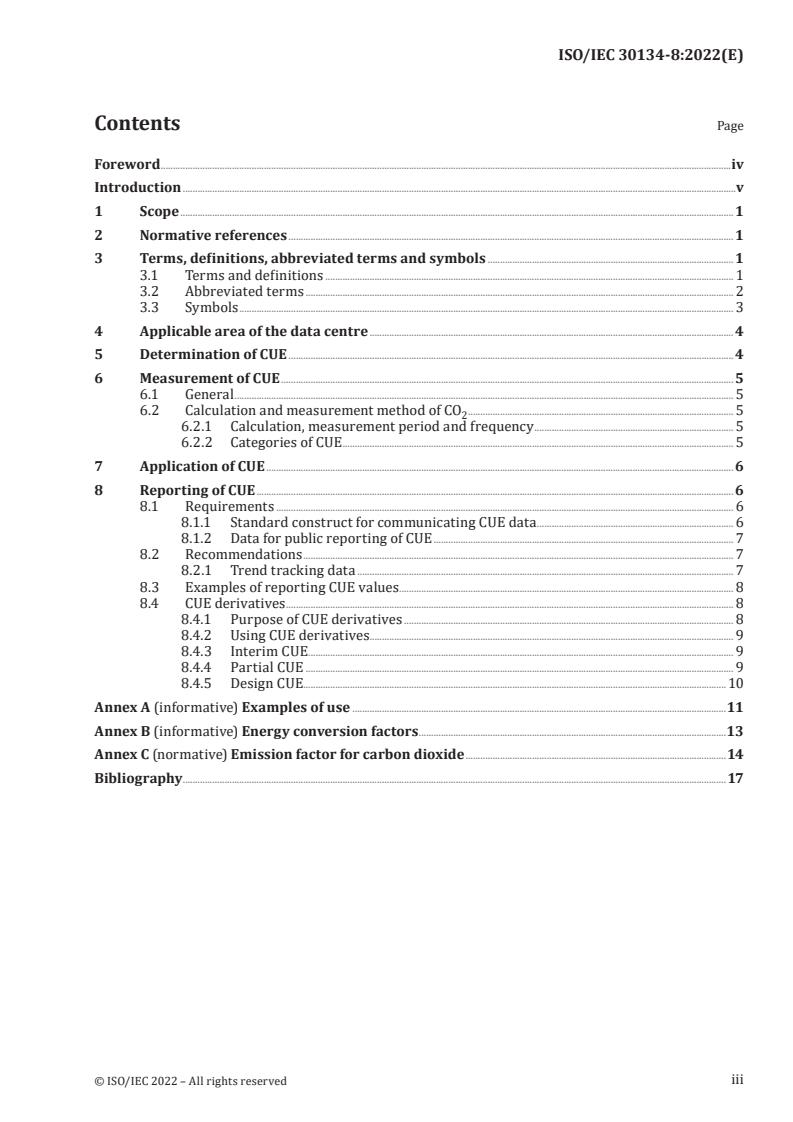
Contents Page
Foreword .iv
Introduction .v
1 Scope . 1
2 Normative references . 1
3 Terms, definitions, abbreviated terms and symbols . 1
3.1 Terms and definitions . 1
3.2 Abbreviated terms . 2
3.3 Symbols . 3
4 Applicable area of the data centre . 4
5 Determination of CUE .4
6 Measurement of CUE . 5
6.1 General . 5
6.2 Calculation and measurement method of CO . 5
6.2.1 Calculation, measurement period and frequency . 5
6.2.2 Categories of CUE . 5
7 Application of CUE . 6
8 Reporting of CUE . 6
8.1 Requirements . 6
8.1.1 Standard construct for communicating CUE data . 6
8.1.2 Data for public reporting of CUE . 7
8.2 Recommendations . 7
8.2.1 Trend tracking data . 7
8.3 Examples of reporting CUE values . 8
8.4 CUE derivatives . 8
8.4.1 Purpose of CUE derivatives . 8
8.4.2 Using CUE derivatives . 9
8.4.3 Interim CUE . 9
8.4.4 Partial CUE . 9
8.4.5 Design CUE. 10
Annex A (informative) Examples of use .11
Annex B (informative) Energy conversion factors .13
Annex C (normative) Emission factor for carbon dioxide .14
Bibliography .17
iii
© ISO/IEC 2022 – All rights reserved
Foreword
ISO (the International Organization for Standardization) and IEC (the International Electrotechnical
Commission) form the specialized system for worldwide standardization. National bodies that are
members of ISO or IEC participate in the development of International Standards through technical
committees established by the respective organization to deal with particular fields of technical
activity. ISO and IEC technical committees collaborate in fields of mutual interest. Other international
organizations, governmental and non-governmental, in liaison with ISO and IEC, also take part in the
work.
The procedures used to develop this document and those intended for its further maintenance
are described in the ISO/IEC Directives, Part 1. In particular, the different approval criteria
needed for the different types of document should be noted. This document was drafted in
accordance with the editorial rules of the ISO/IEC Directives, Part 2 (see www.iso.org/directives or
www.iec.ch/members_experts/refdocs).
Attention is drawn to the possibility that some of the elements of this document may be the subject
of patent rights. ISO and IEC shall not be held responsible for identifying any or all such patent
rights. Details of any patent rights identified during the development of the document will be in the
Introduction and/or on the ISO list of patent declarations received (see www.iso.org/patents) or the IEC
list of patent declarations received (see https://patents.iec.ch).
Any trade name used in this document is information given for the convenience of users and does not
constitute an endorsement.
For an explanation of the voluntary nature of standards, the meaning of ISO specific terms and
expressions related to conformity assessment, as well as information about ISO's adherence to
the World Trade Organization (WTO) principles in the Technical Barriers to Trade (TBT) see
www.iso.org/iso/foreword.html. In the IEC, see www.iec.ch/understanding-standards.
This document was prepared by Joint Technical Committee ISO/IEC JTC 1, Information technology,
Subcommittee SC 39, Sustainability, IT and data centres.
A list of all parts in the ISO/IEC 30134 series can be found on the ISO and IEC websites.
Any feedback or questions on this document should be directed to the user’s national standards
body. A complete listing of these bodies can be found at www.iso.org/members.html and
www.iec.ch/national-committees.
iv
© ISO/IEC 2022 – All rights reserved
Introduction
The global economy is today reliant on information and communication technologies and the associated
generation, transmission, dissemination, computation and storage of digital data. All markets have
experienced exponential growth in that data, for social, educational and business sectors and while the
internet backbone carries the traffic, there are a wide variety of data centres at nodes and hubs within
both private enterprise and shared/collocation facilities.
The historical data generation growth rate exceeds the capacity growth rate of information and
communications technology hardware. In addition, with many governments having “digital agendas” to
provide both citizens and businesses with ever-faster broadband access, the very increase in network
speed and capacity will, by itself, generate ever more usage (Jevons Paradox). Data generation and
the consequential increase in data processing and storage are directly linked to increasing power
consumption.
With this background, data centre growth, and power consumption in particular, is an inevitable
consequence; this growth will demand increasing power consumption despite the most stringent
energy efficiency strategies. This makes the need for key performance indicators (KPIs) that cover
the effective use of resources (including but not limited to energy and water) and the reduction of CO
emissions essential.
Within the ISO/IEC 30134 series, the term “resource usage effectiveness” is generally used for KPIs in
preference to “resource usage efficiency”, which is restricted to situations where the input and output
parameters used to define the KPI have the same units.
Carbon usage effectiveness (CUE) is intended to enable data centre practitioners to quickly calculate
the sustainability of their data centres, compare the results and determine if any energy efficiency and/
or sustainability improvements need to be made. The impact of operational carbon usage is emerging
as being extremely important in the design, location and operation of current and future data centres.
In order to determine the overall resource efficiency of a data centre, a holistic suite of metrics
is required. This document is one of a series of International Standards for such KPIs and has been
produced in accordance with ISO/IEC 30134-1, which defines common requirements for a holistic suite
of KPIs for data centre resource efficiency. This document does not specify limits or targets for the KPI
and does not describe or imply, unless specifically stated, any form of aggregation of this KPI into a
combination with other KPIs for data centre resource efficiency. This document presents specific rules
on CUE’s use, along with its theoretical and mathematical development. This document concludes with
several examples of site concepts that could employ the CUE metric.
v
© ISO/IEC 2022 – All rights reserved
INTERNATIONAL STANDARD ISO/IEC 30134-8:2022(E)
Information technology — Data centres key performance
indicators —
Part 8:
Carbon usage effectiveness (CUE)
1 Scope
This document specifies carbon usage effectiveness (CUE) as a key performance indicator (KPI) for
quantifying the CO emissions of a data centre during the use phase of the data centre life cycle.
CUE is a simple method for reporting the CO intensity of the data centre operating. By reporting
CO emissions, it is possible to present the data centre's contribution to climate change (enhanced
greenhouse effect).
This document:
a) defines the CUE of a data centre;
b) introduces CUE measurement categories;
c) describes the relationship of this KPI to a data centre’s infrastructure, information technology
equipment and information technology operations;
d) defines the measurement, the calculation and the reporting of the parameter; and
e) provides information on the correct interpretation of the CUE.
2 Normative references
The following documents are referred to in the text in such a way that some or all of their content
constitutes requirements of this document. For dated references, only the edition cited applies. For
undated references, the latest edition of the referenced document (including any amendments) applies.
ISO/IEC 30134-1, Information technology — Data centres — Key performance indicators — Part 1:
Overview and general requirements
ISO 8601-1, Date and time — Representations for information interchange — Part 1: Basic rules
3 Terms, definitions, abbreviated terms and symbols
3.1 Terms and definitions
For the purposes of this document, the following terms and definitions apply.
ISO and IEC maintain terminology databases for use in standardization at the following addresses:
— ISO Online browsing platform: available at https:// www .iso .org/ obp
— IEC Electropedia: available at https:// www .electropedia .org/
© ISO/IEC 2022 – All rights reserved
3.1.1
carbon usage effectiveness
CUE
ratio of the data centre annual CO emissions and IT equipment energy demand
3.1.2
total data centre energy consumption
total annual energy consumption for all energy types serving the data centre at its boundary
Note 1 to entry: The total data centre energy is measured in kWh; the energy is measured with energy metering
devices at the boundary of the data centre or at points of generation within the boundary.
Note 2 to entry: This includes energy derived from sources such as natural gas, hydrogen, bioethanol and district
utilities (e.g. chilled water, condenser water).
Note 3 to entry: Total annual energy includes supporting infrastructure.
[SOURCE: ISO/IEC 30134-2:2016, 3.1.7, modified.]
3.1.3
IT equipment energy consumption
energy consumed by equipment that is used to manage, process, store or route data within the compute
space
Note 1 to entry: The IT equipment energy consumption is measured in kWh; examples for IT equipment are
servers, storage equipment, and telecommunications equipment.
[SOURCE: ISO/IEC 30134-2:2016, 3.1.1, modified.]
3.1.4
global warming potential
radiative impact of a given greenhouse gas relative to that of carbon dioxide
3.1.5
greenhouse gases
GHG
gaseous constituent of the atmosphere that absorbs and emits radiation at specific wavelengths within
the spectrum of infrared radiation emitted by the earth's surface, the atmosphere and clouds
Note 1 to entry: Within the context of this document, seven GHGs are considered: carbon dioxide (CO ), methane
(CH ), nitrous oxide (N O), hydrofluorocarbons (HFCs), perfluorocarbons (PFCs), sulphur hexafluoride (SF ) and
4 2 6
nitrogen trifluoride (NF ).
Note 2 to entry: A list of greenhouse gases with their recognized global warming potentials is provided in
ISO 14067.
3.1.6
carbon dioxide equivalent
global warming potential of a greenhouse gas expressed in terms of the global warming potential of
one unit of carbon dioxide
3.1.7
emission factor for carbon dioxide
specific carbon dioxide emission stemming from the data centre’s energy use and facility operations
Note 1 to entry: The term “facility operations” covers CO emissions caused, for example, by refrigerants or diesel
generators.
3.2 Abbreviated terms
For the purposes of this document, the abbreviated terms in ISO/IEC 30134-1 and the following apply.
© ISO/IEC 2022 – All rights reserved
CO carbon dioxide
CO e carbon dioxide equivalent
CUE carbon usage effectiveness
DC data centre
DC CO Data-centre-related carbon dioxide emissions
dCUE design carbon usage effectiveness
EFC emission factor for carbon dioxide
ex external
GHG greenhouse gases
GWP global warming potential
iCUE interim carbon usage effectiveness
iPUE interim power usage effectiveness
int internal
pCUE partial carbon usage effectiveness
PUE power usage effectiveness
3.3 Symbols
For the purposes of this document, the following symbols apply.
C CO emissions of the data centre in kg
DC 2
C CO emissions of the data centre for testing emergency power supply engines
DC,ee 2
C data centre CO emissions for electricity from the grid
DC,ex,el 2
C data centre CO emissions for on-site generation (e.g. testing diesel engines)
DC,int,el 2
C data centre CO emissions for refrigerant (leakage)
DC,rf 2
C CO emissions of a subsystem in kg
S 2
c filling capacity of refrigerant
rf
E total data centre energy consumption (annual) in kWh
DC
E IT equipment energy consumption (annual) in kWh
IT
E acquired electrical energy from outside the data centre boundaries
ex,el
E acquired electrical energy and all additional energy supply from outside the data centre
ex,el,ad
boundaries
E electrical energy produced inside the data centre boundaries
int,el
E electrical energy and all additional energy supply produced inside the data centre boundaries
int,el,ad
© ISO/IEC 2022 – All rights reserved
f EFC in kg CO e/kWh
e 2
f EFC of external energy demand in kg CO e/kWh
e,ex 2
f EFC of external electrical energy demand
e,ex,el
f EFC of internal energy demand in kg CO e/kWh
e,int 2
f EFC of internal electrical energy demand
e,int,el
f EFC of refrigerant
e,int,rf
P annual average data centre power in kW
DC
r annual leakage rate
L,a
r monthly leakage rate
L,m
t runtime for diesel engines
D
t runtime for gas engines
G
η carbon usage effectiveness
U,C
η partial carbon usage effectiveness
U,C,p
η power usage effectiveness
U,P
η interim power usage effectiveness
U,P,i
4 Applicable area of the data centre
CUE as specified in this document:
— is associated with the data centre infrastructure and IT equipment within its boundaries only;
— describes the CUE relative to facilities with given environmental conditions, IT load characteristics,
availability requirements, maintenance and security requirements;
— measures the relationship between the total data centre CO emissions and the IT equipment energy
consumed.
CUE does not:
— account for the efficiency of other resources such as human resources, space or water;
— provide a data centre productivity metric;
— provide a standalone, comprehensive efficiency metric.
5 Determination of CUE
CUE provides a way to determine the carbon emissions associated with data centres. CUE has an ideal
value of 0,0, indicating that no carbon use is associated with the data centre’s operations. CUE has no
theoretical upper boundary.
CUE is defined using Formula (1):
C
DC
η = (1)
U,C
E
IT
© ISO/IEC 2022 – All rights reserved
NOTE 1 The values for C differ regarding to the CUE category (see 6.2.2).
DC
NOTE 2 The accuracy of measuring IT energy for CUE is not necessarily the same as the accuracy of measuring
IT energy for PUE (e.g. CUE category 1 can be reported with an accuracy of measuring IT energy referring to PUE
category 2).
CUE may be applied in mixed-use buildings when measurement of the CO emisions caused by the data
centre and that for other functions is possible.
6 Measurement of CUE
6.1 General
All KPIs of the ISO/IEC 30134 series are defined within the same boundaries.
6.2 Calculation and measurement method of CO
6.2.1 Calculation, measurement period and frequency
The minimum calculation and measurement period requires twelve months of cumulative DC CO
values. Annualized data used to calculate CUE shall be documented. The annual DC CO values
collected or calculated shall cover the same time period. It is not necessary to define the frequency of
measurement and calculation or assessments for the annual CUE determination, as the annual DC CO
value is a continuous integration of DC CO emitted in that timeframe. The required EFC values shall be
determined in accordance with Annex C.
NOTE 1 The measurement or assessment frequency can be necessary for subsystem improvements (refer to
partial PUE), but is not required for CUE disclosures.
NOTE 2 Direct measurements for CO can sometimes be taken (e.g. for diesel engines). However, calculations
are also sometimes made by measurements of energy, refrigerant losses, etc. and their EFC.
6.2.2 Categories of CUE
6.2.2.1 Introduction
CUE categories 1 to 3 are defined, as shown in Table 1, to provide a defined route that refines the extent
of the carbon emission sources considered.
Table 1 — CUE categories
Source Category 1 (CUE ) Category 2 (CUE ) Category 3 (CUE )
1 2 3
basic intermediate advanced
Considered emission External and internal DC External and internal DC Reserved for future use.
source electricity. electricity, all additional
DC energy supply and all
additional DC emission
sources.
Considered GHG CO CO equivalents. Reserved for future use.
2 2
Annex A provides examples for the calculation of the CUE categories.
6.2.2.2 CUE category 1: CO emissions from electricity only
For category 1, the CO emissions of all internal and external power supplies are considered, taking into
account electricity only. In the event that different energy sources are used, Annex B provides examples
© ISO/IEC 2022 – All rights reserved
for energy conversion factors. For instance, internal power supply can come from diesel engines
whereas external power supply can come from acquired electricity from the grid.
The CUE of category 1 only covers CO as one of the GHGs.
For category 1, CUE can be calculated using Formula (2):
Ef× + Ef×
C () ()
ex,ele,ex,el int,el e,int,el
DC
η == (2)
U,C,1
E E
IT IT
6.2.2.3 CUE category 2: CO emissions from all energy
The CUE of category 2 covers both CO and CO e for all external and internal power supplies, for all
2 2
additional energy supplies and for all additional CO e-related emission sources.
For example, CO e are considered for external electricity from the grid, additional data centre energy
from internal combined heat and power stations based on natural gas, refrigerant losses or static
transfer switches isolation gases.
For category 2 CUE can be calculated by Formula (3).
EE × ff + ×
...