


ISO 13605:2018
(Main)Solid mineral fuels - Major and minor elements in coal ash and coke ash - Wavelength dispersive x-ray fluorescence spectrometric method
Solid mineral fuels - Major and minor elements in coal ash and coke ash - Wavelength dispersive x-ray fluorescence spectrometric method
This document sets out a wavelength dispersive X-ray fluorescence (XRF) procedure for the determination of silicon, aluminium, iron, calcium, magnesium, sodium, potassium, titanium, manganese, phosphorus and sulfur.
Combustibles minéraux solides — Éléments en minorité et en majorité dans les cendres de houille et de coke — Méthode spectrométrique par fluorescence aux rayons X à une longueur d'onde dispersive
General Information
- Status
- Published
- Publication Date
- 18-Oct-2018
- Technical Committee
- ISO/TC 27/SC 5 - Methods of analysis
- Drafting Committee
- ISO/TC 27/SC 5 - Methods of analysis
- Current Stage
- 9093 - International Standard confirmed
- Start Date
- 19-Mar-2025
- Completion Date
- 13-Dec-2025
Relations
- Effective Date
- 18-Jun-2016
Overview
ISO 13605:2018 specifies a wavelength-dispersive X‑ray fluorescence (WDXRF) spectrometric method for the determination of major and minor elements in coal ash, coke ash and boiler ash. The method determines Si, Al, Fe, Ca, Mg, Na, K, Ti, Mn, P and S (reported as oxides where applicable) by preparing fused borate glass discs and measuring element intensities with a WDXRF spectrometer. The procedure is designed to eliminate particle-size effects and to give reliable quantitative results across specified concentration ranges.
Key topics and technical requirements
- Analytes and ranges: Method covers SiO2, Al2O3, Fe2O3, CaO, MgO, Na2O, K2O, TiO2, Mn3O4, P2O5, SO3 with application ranges given in the standard (e.g., SiO2: 5–100 %, Fe2O3: 0.1–25 %, Mn3O4: 0.005–5 %).
- Principle: Fusion of sample with a borate flux to make a homogeneous glass disc (casting or press‑quenching) to minimize matrix/particle effects before WDXRF measurement.
- Calibration and corrections: Use of pure chemicals and/or certified reference materials for calibration; matrix corrections for inter‑element effects; instrumental drift and dead‑time corrections are specified.
- Sample preparation: Ashing per ISO 1171 and sample sizing per ISO 13909‑4/6 or ISO 18283. Boiler ash grinding/drying instructions and disc storage/desiccation procedures are included.
- Apparatus and consumables: Non‑wetting platinum alloy crucibles, non‑wetting moulds (platinum, aluminium or graphite for press‑quench), borate fluxes (lithium tetraborate/ metaborate, lanthanum oxide blends), desiccator, suitable WDXRF spectrometer with vacuum path meeting precision requirements (~0.1 % / 10 counts).
- Quality control: Prepare and analyse a reference material at the start and end of each batch (maximum 25 samples); guidance on fused‑disc quality and crucible cleaning procedures.
- Safety: Standard contains a safety warning - users must establish appropriate lab safety and health practices.
Applications
- Routine quantitative analysis of coal ash and coke ash for combustion, power generation and coke‑making quality control.
- Environmental laboratories monitoring ash composition for disposal or reutilization decisions.
- Industrial R&D and material characterization where reliable major/minor element data in ash matrices are required.
- Regulatory compliance testing and feedstock evaluation for boilers and furnaces.
Who should use this standard
- Analytical and process laboratories in power plants, coke works and coal testing facilities.
- Quality assurance teams in coal and coke producers.
- Environmental and materials testing laboratories using WDXRF for ash characterization.
- Instrument manufacturers and method developers validating calibrations or adding analytes.
Related standards
- ISO 1171 - Determination of ash
- ISO 1213‑2 - Vocabulary: sampling, testing and analysis terms
- ISO 13909‑4 / ISO 13909‑6 - Mechanical sampling and test sample preparation
- ISO 18283 - Manual sampling
Keywords: ISO 13605, WDXRF, wavelength dispersive X‑ray fluorescence, coal ash analysis, coke ash, fused glass disc, borate flux, major and minor elements, ash chemistry, calibration, matrix correction.
Frequently Asked Questions
ISO 13605:2018 is a standard published by the International Organization for Standardization (ISO). Its full title is "Solid mineral fuels - Major and minor elements in coal ash and coke ash - Wavelength dispersive x-ray fluorescence spectrometric method". This standard covers: This document sets out a wavelength dispersive X-ray fluorescence (XRF) procedure for the determination of silicon, aluminium, iron, calcium, magnesium, sodium, potassium, titanium, manganese, phosphorus and sulfur.
This document sets out a wavelength dispersive X-ray fluorescence (XRF) procedure for the determination of silicon, aluminium, iron, calcium, magnesium, sodium, potassium, titanium, manganese, phosphorus and sulfur.
ISO 13605:2018 is classified under the following ICS (International Classification for Standards) categories: 73.040 - Coals; 75.160.10 - Solid fuels. The ICS classification helps identify the subject area and facilitates finding related standards.
ISO 13605:2018 has the following relationships with other standards: It is inter standard links to ISO/TS 13605:2012. Understanding these relationships helps ensure you are using the most current and applicable version of the standard.
ISO 13605:2018 is available in PDF format for immediate download after purchase. The document can be added to your cart and obtained through the secure checkout process. Digital delivery ensures instant access to the complete standard document.
Standards Content (Sample)
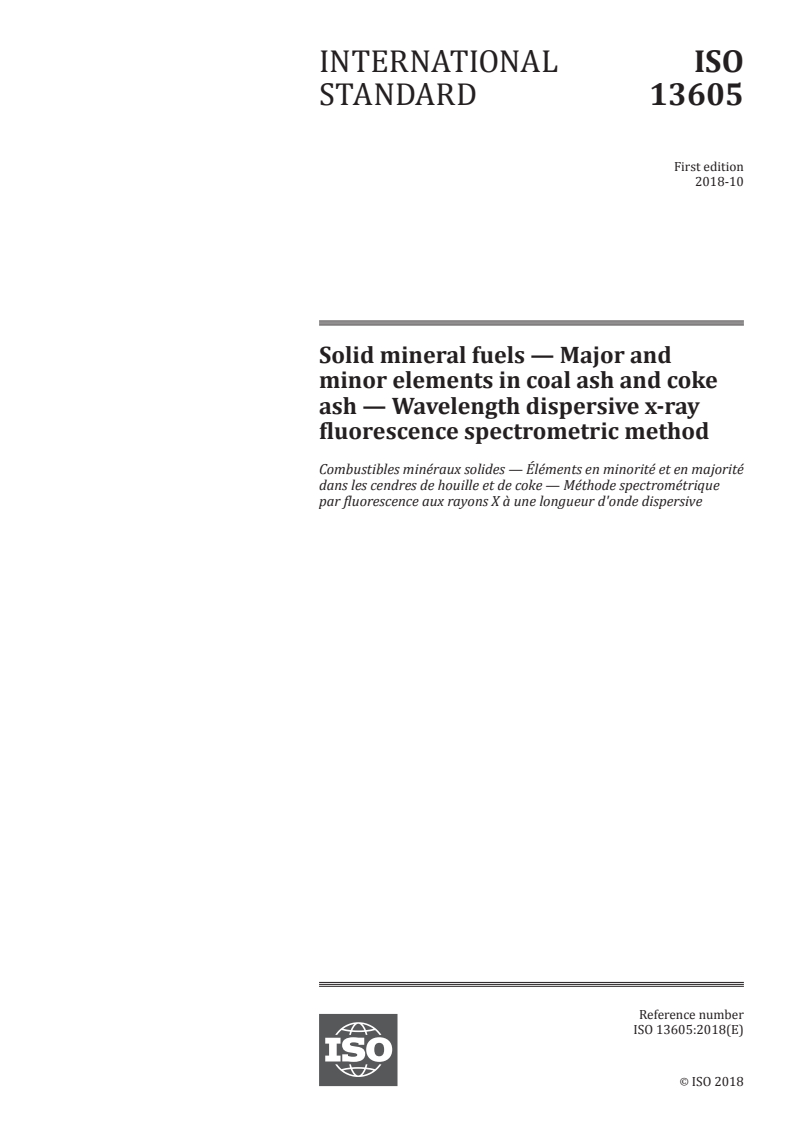
INTERNATIONAL ISO
STANDARD 13605
First edition
2018-10
Solid mineral fuels — Major and
minor elements in coal ash and coke
ash — Wavelength dispersive x-ray
fluorescence spectrometric method
Combustibles minéraux solides — Éléments en minorité et en majorité
dans les cendres de houille et de coke — Méthode spectrométrique
par fluorescence aux rayons X à une longueur d'onde dispersive
Reference number
©
ISO 2018
© ISO 2018
All rights reserved. Unless otherwise specified, or required in the context of its implementation, no part of this publication may
be reproduced or utilized otherwise in any form or by any means, electronic or mechanical, including photocopying, or posting
on the internet or an intranet, without prior written permission. Permission can be requested from either ISO at the address
below or ISO’s member body in the country of the requester.
ISO copyright office
CP 401 • Ch. de Blandonnet 8
CH-1214 Vernier, Geneva
Phone: +41 22 749 01 11
Fax: +41 22 749 09 47
Email: copyright@iso.org
Website: www.iso.org
Published in Switzerland
ii © ISO 2018 – All rights reserved
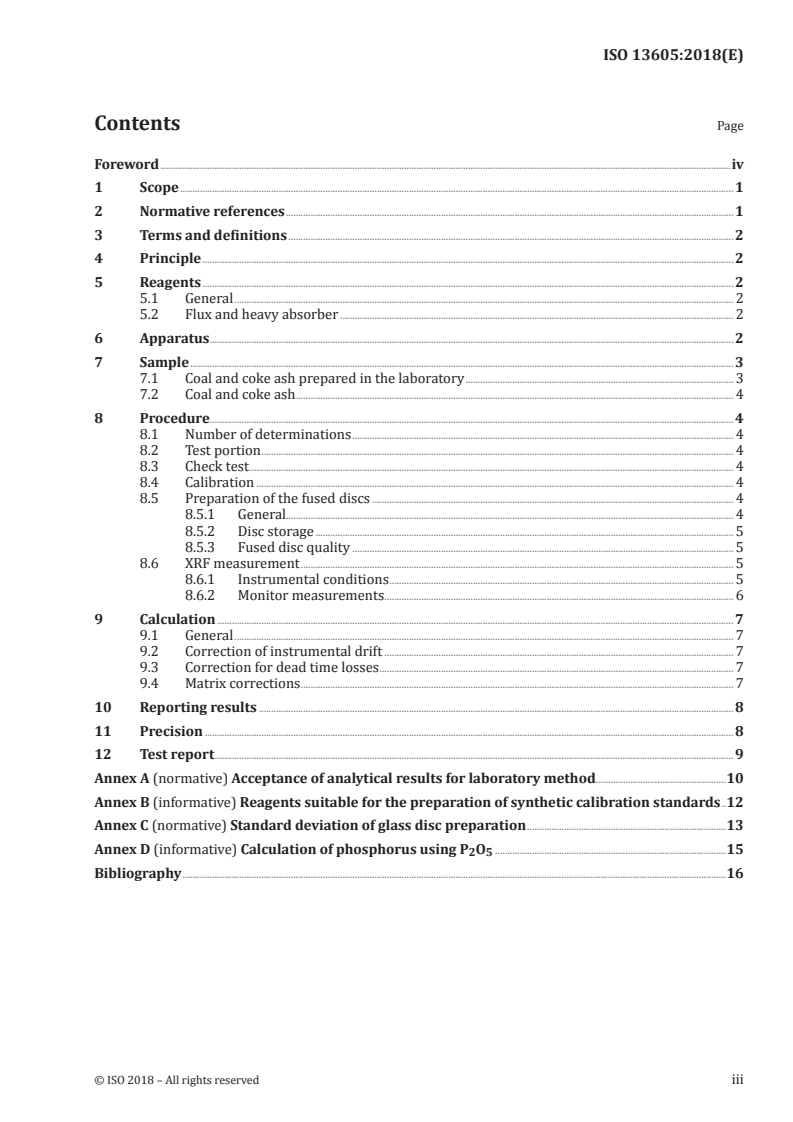
Contents Page
Foreword .iv
1 Scope . 1
2 Normative references . 1
3 Terms and definitions . 2
4 Principle . 2
5 Reagents . 2
5.1 General . 2
5.2 Flux and heavy absorber . 2
6 Apparatus . 2
7 Sample . 3
7.1 Coal and coke ash prepared in the laboratory . 3
7.2 Coal and coke ash . 4
8 Procedure. 4
8.1 Number of determinations . 4
8.2 Test portion . 4
8.3 Check test . 4
8.4 Calibration . 4
8.5 Preparation of the fused discs . 4
8.5.1 General. 4
8.5.2 Disc storage . 5
8.5.3 Fused disc quality . 5
8.6 XRF measurement . 5
8.6.1 Instrumental conditions . 5
8.6.2 Monitor measurements . . 6
9 Calculation . 7
9.1 General . 7
9.2 Correction of instrumental drift . 7
9.3 Correction for dead time losses . 7
9.4 Matrix corrections . 7
10 Reporting results . 8
11 Precision . 8
12 Test report . 9
Annex A (normative) Acceptance of analytical results for laboratory method .10
Annex B (informative) Reagents suitable for the preparation of synthetic calibration standards .12
Annex C (normative) Standard deviation of glass disc preparation .13
Annex D (informative) Calculation of phosphorus using P O .15
2 5
Bibliography .16
Foreword
ISO (the International Organization for Standardization) is a worldwide federation of national standards
bodies (ISO member bodies). The work of preparing International Standards is normally carried out
through ISO technical committees. Each member body interested in a subject for which a technical
committee has been established has the right to be represented on that committee. International
organizations, governmental and non-governmental, in liaison with ISO, also take part in the work.
ISO collaborates closely with the International Electrotechnical Commission (IEC) on all matters of
electrotechnical standardization.
The procedures used to develop this document and those intended for its further maintenance are
described in the ISO/IEC Directives, Part 1. In particular, the different approval criteria needed for the
different types of ISO documents should be noted. This document was drafted in accordance with the
editorial rules of the ISO/IEC Directives, Part 2 (see www .iso .org/directives).
Attention is drawn to the possibility that some of the elements of this document may be the subject of
patent rights. ISO shall not be held responsible for identifying any or all such patent rights. Details of
any patent rights identified during the development of the document will be in the Introduction and/or
on the ISO list of patent declarations received (see www .iso .org/patents).
Any trade name used in this document is information given for the convenience of users and does not
constitute an endorsement.
For an explanation of the voluntary nature of standards, the meaning of ISO specific terms and
expressions related to conformity assessment, as well as information about ISO's adherence to the
World Trade Organization (WTO) principles in the Technical Barriers to Trade (TBT) see www .iso
.org/iso/foreword .html.
This document was prepared by Technical Committee ISO/TC 27, Solid mineral fuels, Subcommittee
SC 5, Methods of analysis.
This first edition of ISO 13605 cancels and replaces ISO/TS 13605:2012, which has been technically
revised.
Any feedback or questions on this document should be directed to the user’s national standards body. A
complete listing of these bodies can be found at www .iso .org/members .html.
iv © ISO 2018 – All rights reserved
INTERNATIONAL STANDARD ISO 13605:2018(E)
Solid mineral fuels — Major and minor elements in
coal ash and coke ash — Wavelength dispersive x-ray
fluorescence spectrometric method
WARNING — Use of this document can involve hazardous materials, operations and equipment.
This document does not purport to address all of the safety problems associated with its use.
It is the responsibility of the user of this document to establish appropriate safety and health
practices and determine the applicability of regulatory limitations prior to use.
1 Scope
This document sets out a wavelength dispersive X-ray fluorescence (XRF) procedure for the
determination of silicon, aluminium, iron, calcium, magnesium, sodium, potassium, titanium,
manganese, phosphorus and sulfur.
The method is applicable to coal ashes, coke ashes and boiler ashes having components within the
concentration ranges specified in Table 1.
Table 1 — Ranges of application of the method
Concentration range
Oxide
%
SiO 5 to 100
Al O 5 to 80
2 3
Fe O 0,1 to 25
2 3
CaO 0,05 to 25
MgO 0,05 to 25
Na O 0,05 to 5
K O 0,05 to 5
TiO 0,05 to 5
Mn O 0,005 to 5
3 4
a
P O 0,01 to 5
2 5
SO 0,05 to 10
NOTE 1 Additional analytes can be included in the method, provided that appropriate validation using reference materials
is carried out.
NOTE 2 The precision statistics can be determined using suitable reference materials.
NOTE 3 The method described in this document has been tested for the following additional analytes: BaO (0,01 % to 1 %);
SrO (0,01 % to 1 %) and ZnO (0,005 % to 1 %).
a
For information relating to phosphorus calculations, refer to Annex D.
2 Normative references
The following documents are referred to in the text in such a way that some or all of their content
constitutes requirements of this document. For dated references, only the edition cited applies. For
undated references, the latest edition of the referenced document (including any amendments) applies.
ISO 1171, Solid mineral fuels — Determination of ash
ISO 1213-2, Solid mineral fuels — Vocabulary — Part 2: Terms relating to sampling, testing and analysis
ISO 13909-4, Hard coal and coke — Mechanical sampling — Part 4: Coal — Preparation of test samples
ISO 13909-6, Hard coal and coke — Mechanical sampling — Part 6: Coke — Preparation of test samples
ISO 18283, Hard coal and coke — Manual sampling
3 Terms and definitions
For the purposes of this document, the terms and definitions given in ISO 1213-2 apply.
ISO and IEC maintain terminological databases for use in standardization at the following addresses:
— ISO Online browsing platform: available at https: //www .iso .org/obp
— IEC Electropedia: available at http: //www .electropedia .org/
4 Principle
The specimen on which X-ray fluorescence measurements are made is prepared by incorporating
the test portion of the sample, via fusion, into a borate glass disc using a casting or press-quenching
procedure. By using such a specimen, particle size effects are eliminated.
Calibration is carried out using pure chemicals and/or reference standards, and by making matrix
corrections for inter-element effects.
It is expected that laboratories using this document have experience in analysing coal ashes of certain
compositions and that they employ calibrations that cover these compositions.
5 Reagents
5.1 General
Unless otherwise specified, all reagents shall be of analytical grade and only distilled water or water of
equivalent purity shall be used.
5.2 Flux and heavy absorber
Borate fluxes of differing compositions have been found suitable for preparing glass discs from coal/coke
ash samples. These fluxes are based on mixtures of one or more of the following: lithium tetraborate,
lithium metaborate and lanthanum oxide. Flux may be purchased commercially or prepared by fusion
of a mixture of individual reagents.
NOTE The levels of contamination in the flux should be checked. Because levels of contamination may vary
from batch to batch, the same batch of flux should be used for all specimens (synthetic standards, external
standards and unknowns). When using a fresh batch of flux, reference material specimens should be prepared to
determine whether adjustments to the calibration are required.
6 Apparatus
All apparatus shall be constructed from materials that are thermally stable and chemically inert under
the conditions of the procedure.
2 © ISO 2018 – All rights reserved
6.1 Crucible, made from a non-wetting platinum alloy.
The crucible shall have sufficient capacity to hold the flux and sample required for fusion. Normally,
15 ml crucibles are adequate for discs of 32 mm in diameter, and 25 ml crucibles for discs of 40 mm in
diameter.
NOTE Either platinum/gold or platinum/gold/rhodium alloys are suitable.
Because the crucible and lid (if used) are to be used for fusion work, the normal precautions associated
with the care of hot platinum ware should be observed. It is necessary, therefore, to have suitable tongs
and a surface on which to rest the crucible. The hot crucible can be rested on a refractory surface,
which shall be kept very clean.
Although the crucible is fabricated from an alloy that is not wetted by the glass, for the greatest
precision, the crucible should be cleaned between each fusion. The use of citric acid (mass concentration
of 20 %), dilute hydrochloric acid (volume fraction of 10 % to 50 %) or dilute chlorine-free nitric acid
(volume fraction of 10 %) have proven to be suitable for crucible cleaning. The use of an ultrasonic bath
will accelerate this process. An alternative method of cleaning is to fuse several grams of flux in the
crucible, moving the melt around so as to clean the entire inner surface. The molten flux is poured from
the crucible. If a droplet adheres to the crucible, this can easily be flaked off when the crucible is cold.
6.2 Mould, made from non-wetting material. For example, platinum alloy is commonly used for casting
discs, and aluminium or graphite is suitable for press quenching.
In the casting technique, the bottom of the disc is the analytical surface. The mould should therefore
be flat and sufficiently thick that it is not easily deformed. Casting moulds should be checked regularly
for flatness and should be polished regularly, to ensure that the disc releases from the mould. Platens
for press-quenching are constructed so that the depth gradually increases from the perimeter to the
centre. The analytical surface for press-quenched discs is the surface which contacts the plunger head.
Care should be taken not to choose the platen side for intensity measurements.
6.3 Crucible tongs, platinum-tipped or stainless steel or titanium.
NOTE Stainless steel or titanium tongs are a suitable alternative to platinum-tipped tongs.
6.4 Desiccator, containing freshly regenerated, self-indicating silica gel.
6.5 Sample holders, used for specimen presentation.
6.6 X-ray fluorescence spectrometer, any conventional wavelength dispersive (sequential,
simultaneous, or combination simultaneous/sequential) vacuum path X-ray fluorescence spectrometer
may be used, provided that it conforms to precision requirements at the 0,1 % (10 counts) precision level.
7 Sample
7.1 Coal and coke ash prepared in the laboratory
The coal or coke sample shall be the analysis sample, prepared to a nominal top size of 212 µm. Sample
preparation shall be in accordance with ISO 13909-4 for coal samples or ISO 13909-6 for coke samples
or ISO 18283.
The sample shall then be ashed using the procedure specified in ISO 1171.
7.2 Coal and coke ash
Laboratory-prepared ashes for XRF analysis should be received at the laboratory, freshly prepared If
not freshly prepared coal or coke ash, reheat at 815 °C for 15 min and cool in a desiccator immediately
prior to weighing for analysis.
Boiler ash received at the laboratory should be ground to a nominal top size of 63 µm and dried at
105 °C for 1 h, then stored in a desiccator over freshly regenerated, self-indicating silica gel.
8 Procedure
8.1 Number of determinations
Discs shall be prepared and analysed as single determinations and a reference material shall be
prepared and analysed at the beginning and end of each batch of samples containing a maximum of
25 samples.
8.2 Test portion
The mass of the test portion shall be appropriate for the mould size and sample flux ratio chosen.
NOTE 1 Typically, sample-to-flux ratios are in the range 1:5 to 1:10.
NOTE 2 Typical total mass (sample plus flux) is 4 g for a 32 mm diameter and 7,5 g for a 40 mm diameter mould.
8.3 Check test
At least one reference material of similar composition to the samples being analysed shall be included
with each batch of test samples and shall be analysed in parallel with, and under the same conditions
as, the test samples. The results for the batch of samples shall be rejected if the results for the reference
material fail to meet the acceptance criteria detailed in Annex A.
8.4 Calibration
Calibration shall be effected using either reference materials, synthetic standards or mixtures of
reference materials and synthetic standards. Reference materials shall be pre-treated in accordance
with the instructions contained on
...
Questions, Comments and Discussion
Ask us and Technical Secretary will try to provide an answer. You can facilitate discussion about the standard in here.
Loading comments...