

ISO 18541-6:2018
(Main)Road vehicles — Standardized access to automotive repair and maintenance information (RMI) — Part 6: L-Category vehicle specific RMI use cases and requirements
General Information
- Abstract
ISO 18541-6:2018 contains all elements (definitions, use cases, technical requirements, functional user interfaces requirements and conformance test cases) applicable for the standardized access to repair and maintenance information for two-wheeled and three-wheeled vehicles and quadricycles (L-category vehicles) The development of this document has been based on ISO 18541‑1, ISO 18541‑2, ISO 18541‑3 and ISO 18541‑4. This document constitutes an adaptation of standardized access to RMI prescriptions for passenger cars to L-category vehicles keeping the objectives and principles of the mandate M/421 from the European commission. ISO 18541-6:2018 references the usage of a Digital Annex of standardized search terms for RMI. The provision of such a Digital Annex will follow the process described in ISO 18542. CEN will nominate a Registration Authority according to ISO 18542 for the creation and maintenance of an appropriate Digital Annex.
- Status
- Published
- Publication Date
- 30-Jan-2018
- Technical Committee
- ISO/TC 22/SC 31 - Data communication
- Drafting Committee
- ISO/TC 22/SC 31 - Data communication
- Current Stage
- 9093 - International Standard confirmed
- Start Date
- 02-Jul-2025
- Completion Date
- 29-Aug-2026
Buy Documents


ISO 18541-6:2018 - Road vehicles -- Standardized access to automotive repair and maintenance information (RMI)
ISO 18541-6:2018 - Road vehicles — Standardized access to automotive repair and maintenance information (RMI) — Part 6: L-Category vehicle specific RMI use cases and requirements/4/2018


ISO 18541-6:2018 - Véhicules routiers -- Normalisation de l'acces aux informations relatives a la réparation et a la maintenance pour l'automobile (RMI)
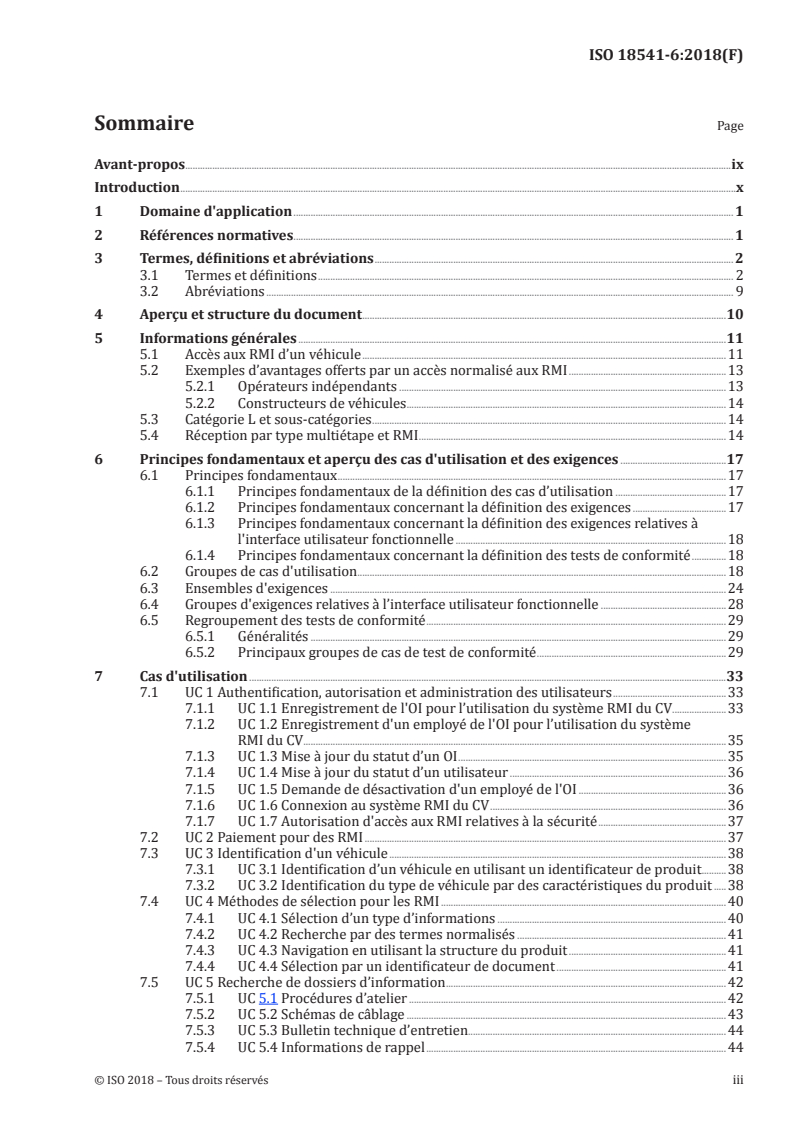
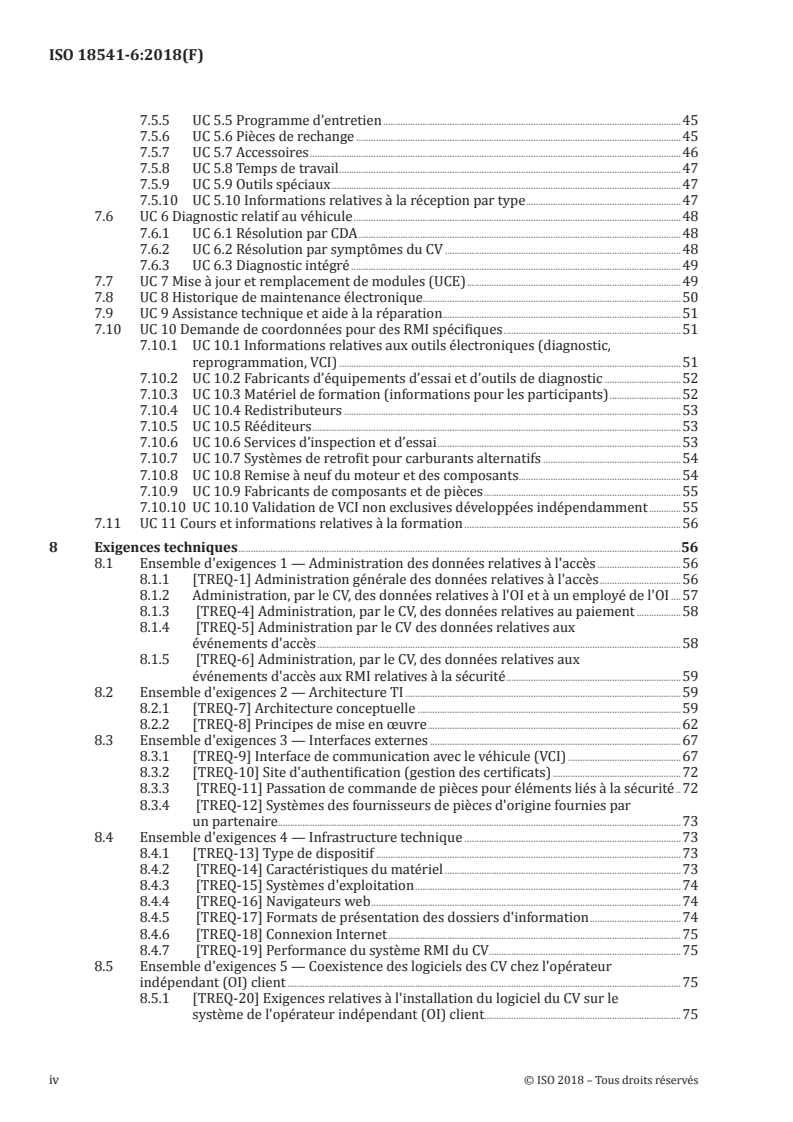
ISO 18541-6:2018 - Véhicules routiers — Normalisation de l'accès aux informations relatives à la réparation et à la maintenance pour l'automobile (RMI) — Partie 6: Exigences et cas d'usage RMI spécifiques aux véhicules de catégorie L/31/2018
Overview
ISO 18541-6:2018 - "Road vehicles - Standardized access to automotive repair and maintenance information (RMI) - Part 6" defines use cases and requirements for standardized access to repair and maintenance information specifically for L‑Category vehicles (two‑wheeled and three‑wheeled vehicles and quadricycles). It adapts the ISO 18541 passenger‑car prescriptions for L‑Category vehicles while preserving the objectives of the European mandate M/421. The document includes definitions, use cases, technical requirements, functional user‑interface (UI) requirements and conformance test cases, and references a Digital Annex of standardized search terms (ISO 18542).
Key topics and technical requirements
- Scope & structure: Complements ISO 18541‑1 through ISO 18541‑4 by applying standardized RMI access to L‑Category vehicles.
- Use cases (UC): Covers authentication/authorization, payment for RMI, vehicle identification, search/navigation (standardized terms, product structure), retrieval of information packages (workshop procedures, wiring diagrams, maintenance schedules, spare parts), diagnostics and DTC resolution, ECU/module updates, electronic maintenance history, and training/support contacts.
- Technical requirement clusters (TREQ):
- Access‑related data administration (IO registration, payment and access event logging)
- IT architecture and implementation principles
- External interfaces (vehicle communication interfaces, certificate/trust centre, parts ordering)
- Technical infrastructure (device types, OS, browsers, presentation formats, performance)
- Co‑existence of manufacturer (VM) software on independent operator (IO) clients
- Operations and availability, support and conformance testing
- Functional UI requirements: Standardized navigation pathways from use cases to vehicle‑manufacturer (VM) specific RMI locations to ensure consistent user experience for workshops and tools.
- Conformance testing: Test cases and clusters to verify interoperability, data access, security and functional behavior.
Applications and users
Who benefits:
- Independent operators and workshops seeking standardized RMI access for L‑Category vehicle repair, maintenance and diagnostics
- Vehicle manufacturers (VMs) implementing RMI portals and secure access controls
- Aftermarket tool and diagnostic tool vendors needing standardized interfaces and VCI integration
- Parts suppliers, training providers and service aggregators using standardized search terms and data packages
- Regulators and registration authorities (CEN/ISO 18542) responsible for Digital Annex creation and maintenance
Practical benefits:
- Faster fault diagnosis and repair through standardized searching (Digital Annex)
- Secure, auditable access to safety‑critical RMI and parts ordering
- Improved interoperability between workshop systems, diagnostic tools and VM systems
Related standards
- ISO 18541 series (Parts 1–4) - foundational RMI architecture and concepts
- ISO 18542 - process for the Digital Annex of standardized search terms
- Mandate M/421 (European Commission) - policy objective driving standardized RMI access
Keywords: ISO 18541-6:2018, RMI, L-Category vehicles, repair and maintenance information, standardized access, Digital Annex, ISO 18542, vehicle diagnostics.
Relations
- Effective Date
- 12-Feb-2026
- Consolidated By
ISO 717-2:2020 - Acoustics — Rating of sound insulation in buildings and of building elements — Part 2: Impact sound insulation - Effective Date
- 06-Jun-2022
Buy Documents
ISO 18541-6:2018 - Road vehicles -- Standardized access to automotive repair and maintenance information (RMI)
ISO 18541-6:2018 - Road vehicles — Standardized access to automotive repair and maintenance information (RMI) — Part 6: L-Category vehicle specific RMI use cases and requirements/4/2018
ISO 18541-6:2018 - Véhicules routiers -- Normalisation de l'acces aux informations relatives a la réparation et a la maintenance pour l'automobile (RMI)
ISO 18541-6:2018 - Véhicules routiers — Normalisation de l'accès aux informations relatives à la réparation et à la maintenance pour l'automobile (RMI) — Partie 6: Exigences et cas d'usage RMI spécifiques aux véhicules de catégorie L/31/2018
Get Certified
Connect with accredited certification bodies for this standard

TÜV Rheinland
TÜV Rheinland is a leading international provider of technical services.

TÜV SÜD
TÜV SÜD is a trusted partner of choice for safety, security and sustainability solutions.

DEKRA Certification Inc.
DEKRA US certification services.
Sponsored listings
Frequently Asked Questions
ISO 18541-6:2018 is a standard published by the International Organization for Standardization (ISO). Its full title is "Road vehicles — Standardized access to automotive repair and maintenance information (RMI) — Part 6: L-Category vehicle specific RMI use cases and requirements". This standard covers: ISO 18541-6:2018 contains all elements (definitions, use cases, technical requirements, functional user interfaces requirements and conformance test cases) applicable for the standardized access to repair and maintenance information for two-wheeled and three-wheeled vehicles and quadricycles (L-category vehicles) The development of this document has been based on ISO 18541‑1, ISO 18541‑2, ISO 18541‑3 and ISO 18541‑4. This document constitutes an adaptation of standardized access to RMI prescriptions for passenger cars to L-category vehicles keeping the objectives and principles of the mandate M/421 from the European commission. ISO 18541-6:2018 references the usage of a Digital Annex of standardized search terms for RMI. The provision of such a Digital Annex will follow the process described in ISO 18542. CEN will nominate a Registration Authority according to ISO 18542 for the creation and maintenance of an appropriate Digital Annex.
ISO 18541-6:2018 contains all elements (definitions, use cases, technical requirements, functional user interfaces requirements and conformance test cases) applicable for the standardized access to repair and maintenance information for two-wheeled and three-wheeled vehicles and quadricycles (L-category vehicles) The development of this document has been based on ISO 18541‑1, ISO 18541‑2, ISO 18541‑3 and ISO 18541‑4. This document constitutes an adaptation of standardized access to RMI prescriptions for passenger cars to L-category vehicles keeping the objectives and principles of the mandate M/421 from the European commission. ISO 18541-6:2018 references the usage of a Digital Annex of standardized search terms for RMI. The provision of such a Digital Annex will follow the process described in ISO 18542. CEN will nominate a Registration Authority according to ISO 18542 for the creation and maintenance of an appropriate Digital Annex.
ISO 18541-6:2018 is classified under the following ICS (International Classification for Standards) categories: 43.040.15 - Car informatics. On board computer systems; 43.180 - Diagnostic, maintenance and test equipment. The ICS classification helps identify the subject area and facilitates finding related standards.
ISO 18541-6:2018 has the following relationships with other standards: It is inter standard links to EN ISO 18541-6:2018, ISO 717-2:2020. Understanding these relationships helps ensure you are using the most current and applicable version of the standard.
ISO 18541-6:2018 is available in PDF format for immediate download after purchase. The document can be added to your cart and obtained through the secure checkout process. Digital delivery ensures instant access to the complete standard document.
Standards Content (Sample)
INTERNATIONAL ISO
STANDARD 18541-6
First edition
2018-02
Corrected version
2018-05
Road vehicles — Standardized access
to automotive repair and maintenance
information (RMI) —
Part 6:
L-Category vehicle specific RMI use
cases and requirements
Véhicules routiers — Normalisation de l'accès aux informations
relatives à la réparation et à la maintenance pour l'automobile
(RMI) —
Partie 6: Exigences et cas d'usage RMI spécifiques aux véhicules de
catégorie L
Reference number
©
ISO 2018
© ISO 2018
All rights reserved. Unless otherwise specified, or required in the context of its implementation, no part of this publication may
be reproduced or utilized otherwise in any form or by any means, electronic or mechanical, including photocopying, or posting
on the internet or an intranet, without prior written permission. Permission can be requested from either ISO at the address
below or ISO’s member body in the country of the requester.
ISO copyright office
CP 401 • Ch. de Blandonnet 8
CH-1214 Vernier, Geneva
Phone: +41 22 749 01 11
Fax: +41 22 749 09 47
Email: copyright@iso.org
Website: www.iso.org
Published in Switzerland
ii © ISO 2018 – All rights reserved
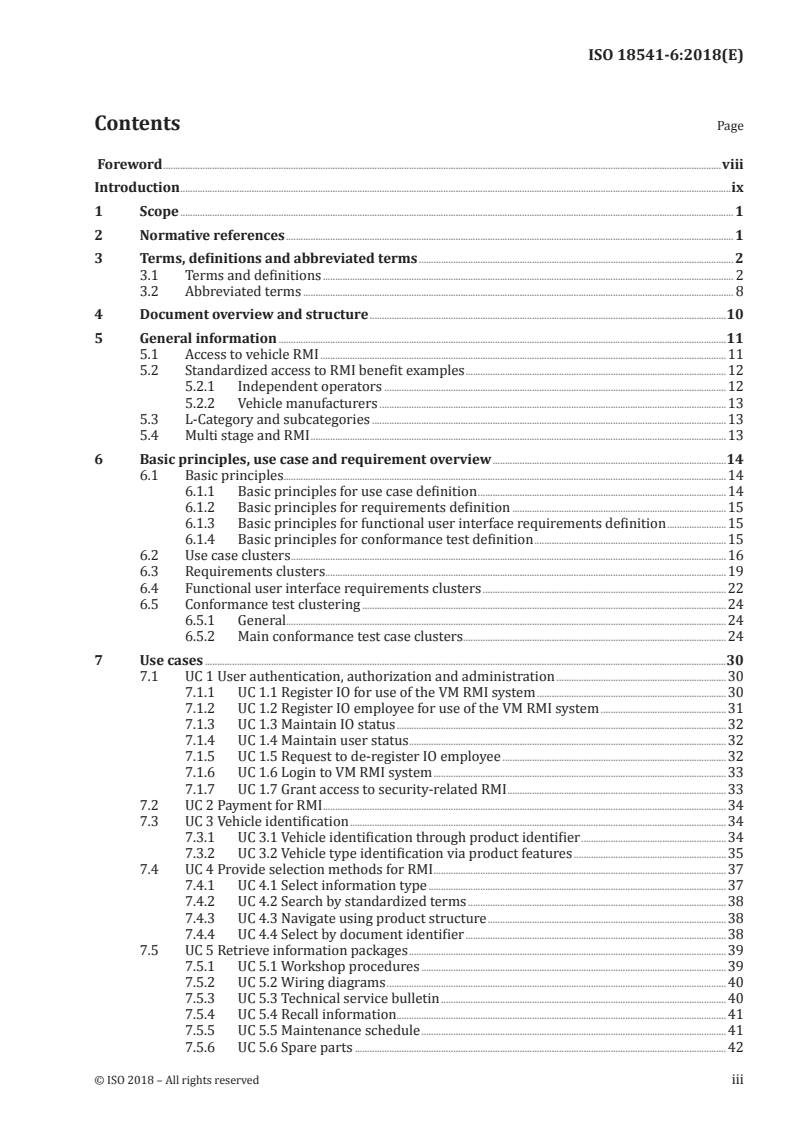
Contents Page
Foreword .viii
Introduction .ix
1 Scope . 1
2 Normative references . 1
3 Terms, definitions and abbreviated terms . 2
3.1 Terms and definitions . 2
3.2 Abbreviated terms . 8
4 Document overview and structure .10
5 General information .11
5.1 Access to vehicle RMI .11
5.2 Standardized access to RMI benefit examples .12
5.2.1 Independent operators .12
5.2.2 Vehicle manufacturers .13
5.3 L-Category and subcategories .13
5.4 Multi stage and RMI .13
6 Basic principles, use case and requirement overview .14
6.1 Basic principles.14
6.1.1 Basic principles for use case definition .14
6.1.2 Basic principles for requirements definition .15
6.1.3 Basic principles for functional user interface requirements definition .15
6.1.4 Basic principles for conformance test definition .15
6.2 Use case clusters .16
6.3 Requirements clusters .19
6.4 Functional user interface requirements clusters .22
6.5 Conformance test clustering .24
6.5.1 General.24
6.5.2 Main conformance test case clusters.24
7 Use cases .30
7.1 UC 1 User authentication, authorization and administration .30
7.1.1 UC 1.1 Register IO for use of the VM RMI system .30
7.1.2 UC 1.2 Register IO employee for use of the VM RMI system .31
7.1.3 UC 1.3 Maintain IO status .32
7.1.4 UC 1.4 Maintain user status .32
7.1.5 UC 1.5 Request to de-register IO employee .32
7.1.6 UC 1.6 Login to VM RMI system .33
7.1.7 UC 1.7 Grant access to security-related RMI .33
7.2 UC 2 Payment for RMI .34
7.3 UC 3 Vehicle identification .34
7.3.1 UC 3.1 Vehicle identification through product identifier .34
7.3.2 UC 3.2 Vehicle type identification via product features .35
7.4 UC 4 Provide selection methods for RMI .37
7.4.1 UC 4.1 Select information type .37
7.4.2 UC 4.2 Search by standardized terms .38
7.4.3 UC 4.3 Navigate using product structure .38
7.4.4 UC 4.4 Select by document identifier .38
7.5 UC 5 Retrieve information packages .39
7.5.1 UC 5.1 Workshop procedures .39
7.5.2 UC 5.2 Wiring diagrams .40
7.5.3 UC 5.3 Technical service bulletin .40
7.5.4 UC 5.4 Recall information .41
7.5.5 UC 5.5 Maintenance schedule .41
7.5.6 UC 5.6 Spare parts .42
7.5.7 UC 5.7 Accessories .42
7.5.8 UC 5.8 Labour times .43
7.5.9 UC 5.9 Special tools .44
7.5.10 UC 5.10 Type-approval related information .44
7.6 UC 6 Vehicle diagnostics .44
7.6.1 UC 6.1 DTC resolution .44
7.6.2 UC 6.2 VM symptom resolution .45
7.6.3 UC 6.3 Integrated diagnostics .45
7.7 UC 7 Updating and replacing modules (ECUs) .46
7.8 UC 8 Electronic Maintenance history .47
7.9 UC 9 Repair assistance technical support .47
7.10 UC 10 Request contact for specific RMI .47
7.10.1 UC 10.1 Electronic tool information (Diagnostic, Reprogramming, VCI) .47
7.10.2 UC 10.2 Test equipment and diagnostic tool manufacturers.48
7.10.3 UC 10.3 Training material (delegate information) .48
7.10.4 UC 10.4 Redistributors .49
7.10.5 UC 10.5 Republishers .49
7.10.6 UC 10.6 Inspection and testing services .50
7.10.7 UC 10.7 Alternative fuels retrofit systems .50
7.10.8 UC 10.8 Engine and components remanufacturing .50
7.10.9 UC 10.9 Component and parts manufacturers .51
7.10.10 UC 10.10 Validation of independently developed non-proprietary VCIs .51
7.11 UC 11 Courses and training information .52
8 Technical requirements .53
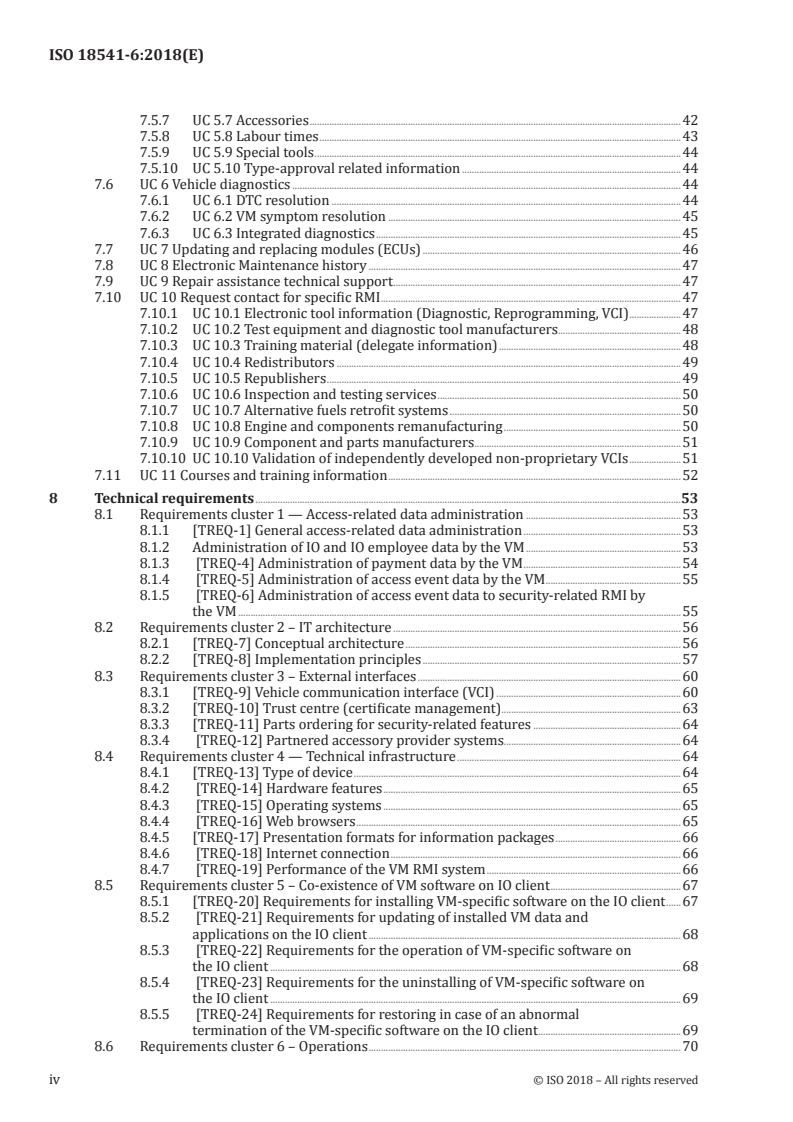
8.1 Requirements cluster 1 — Access-related data administration .53
8.1.1 [TREQ-1] General access-related data administration .53
8.1.2 Administration of IO and IO employee data by the VM .53
8.1.3 [TREQ-4] Administration of payment data by the VM .54
8.1.4 [TREQ-5] Administration of access event data by the VM .55
8.1.5 [TREQ-6] Administration of access event data to security-related RMI by
the VM .55
8.2 Requirements cluster 2 – IT architecture .56
8.2.1 [TREQ-7] Conceptual architecture .56
8.2.2 [TREQ-8] Implementation principles .57
8.3 Requirements cluster 3 – External interfaces .60
8.3.1 [TREQ-9] Vehicle communication interface (VCI) .60
8.3.2 [TREQ-10] Trust centre (certificate management).63
8.3.3 [TREQ-11] Parts ordering for security-related features .64
8.3.4 [TREQ-12] Partnered accessory provider systems.64
8.4 Requirements cluster 4 — Technical infrastructure .64
8.4.1 [TREQ-13] Type of device .64
8.4.2 [TREQ-14] Hardware features .65
8.4.3 [TREQ-15] Operating systems .65
8.4.4 [TREQ-16] Web browsers .65
8.4.5 [TREQ-17] Presentation formats for information packages .66
8.4.6 [TREQ-18] Internet connection .66
8.4.7 [TREQ-19] Performance of the VM RMI system .66
8.5 Requirements cluster 5 – Co-existence of VM software on IO client .67
8.5.1 [TREQ-20] Requirements for installing VM-specific software on the IO client .67
8.5.2 [TREQ-21] Requirements for updating of installed VM data and
applications on the IO client .68
8.5.3 [TREQ-22] Requirements for the operation of VM-specific software on
the IO client .68
8.5.4 [TREQ-23] Requirements for the uninstalling of VM-specific software on
the IO client .69
8.5.5 [TREQ-24] Requirements for restoring in case of an abnormal
termination of the VM-specific software on the IO client .69
8.6 Requirements cluster 6 – Operations .70
iv © ISO 2018 – All rights reserved
8.6.1 [TREQ-25] VM RMI system availability time .70
8.6.2 [TREQ-26] Support for the usage of the VM RMI system .70
8.6.3 [TREQ-27] Operation of the IO PC .71
8.7 [TREQ-28] Requirements cluster 7 – Functional user interface .71
9 Functional user interface requirements .72
9.1 General description .72
9.1.1 Navigational pathway from standardized use cases to VM-specific
navigation position .72
9.1.2 VM RMI system standardised navigation .73
9.2 Requirements cluster 8 — Standardized access mode .75
9.2.1 [FREQ-1] RMI access mode . .75
9.2.2 [FREQ-2] Registration and login support .76
9.3 Requirements cluster 9 — Use cases map .76
9.3.1 [FREQ-3] VM RMI system implemented use cases map .76
9.3.2 [FREQ-4] Download area .78
9.4 Requirements cluster 10 – Navigational pathway .78
9.4.1 [FREQ-5] Navigational pathway .78
10 Conformance test cases .79
10.1 Conformance test case — General structure . .79
10.1.1 Overview .79
10.1.2 Test case reference number and title [RMI-CT_.] [title] .79
10.1.3 Test purpose .79
10.1.4 Configuration .79
10.1.5 Preamble (setup state) .79
10.1.6 Test execution .79
10.1.7 Postamble.80
10.1.8 Result criteria .80
10.2 CT cluster 1 – Access-related data administration .80
10.2.1 [RMI-CT_TREQ-13, 14, 15, 16, 18, Annex B] Test client configuration .80
10.2.2 [RMI-CT_TREQ-17] Test presentation formats for information packages .81
10.3 CT cluster 2 — Test client’s external interfaces .82
10.3.1 [RMI-CT_TREQ-9] Test vehicle communication interface (VCI) .82
10.3.2 [RMI-CT_TREQ-11] Test parts ordering for security-related features .83
10.3.3 [RMI-CT_TREQ-12] Test partnered accessory provider systems .83
10.4 CT cluster 3 — Test user authentication, authorization and administration .84
10.4.1 [RMI-CT_UC1.1] Test to register IO for use of the VM RMI system .84
10.4.2 [RMI-CT_UC1.2_A] Test to register IO employee for use of the VM RMI
system — Scenario A .85
10.4.3 [RMI-CT_UC1.2_B] Test to register IO employee for use of the VM RMI
system — Scenario B .86
10.4.4 [RMI-CT_UC1.3] Test to maintain IO status .87
10.4.5 [RMI-CT_UC1.4] Test to maintain user status .88
10.4.6 [RMI-CT_UC1.5] Test to de-register an IO employee .89
10.4.7 [RMI-CT_UC1.6] Test login to VM RMI system .90
10.4.8 [RMI-CT_UC1.7] Test for granting access to security-related RMI .91
10.5 CT cluster 4 — Test functional user interface implementation .92
10.5.1 [RMI-CT_FREQ-1] Test for RMI access mode .92
10.5.2 [RMI-CT_FREQ-2] Test for registration and login support .92
10.5.3 [RMI-CT_FREQ-3] Test for implemented use cases map .93
10.5.4 [RMI-CT_FREQ-4] Test for download area .94
10.5.5 [RMI-CT_FREQ-5] Test for navigational pathway .95
10.6 CT cluster 5 — Test payment for RMI .96
10.6.1 [RMI-CT_UC2] Test payment for RMI .96
10.7 CT cluster 6 — Test for vehicle identification .97
10.7.1 [RMI-CT_UC3.1] Test vehicle identification through product identifier .97
10.7.2 [RMI-CT_UC3.2] Test vehicle identification via product features .98
10.8 CT cluster 7 — Test selection methods for RMI .99
10.8.1 [RMI-CT_UC4.1] Test selection of information type .99
10.8.2 [RMI-CT_UC4.2] Test search by standardized terms .100
10.8.3 [RMI-CT_UC4.3] Test navigation using product structure .101
10.8.4 [RMI-CT_UC4.4] Test selection by document identifier .102
10.9 CT cluster 8 — Test retrieval of information packages .103
10.9.1 [RMI-CT_UC5.1.1] Test retrieval of general workshop procedures .103
10.9.2 [RMI-CT_UC5.1.2] Test retrieval of body repair procedures .103
10.9.3 [RMI-CT_UC5.1.3] Test retrieval of temporary repair procedures .104
10.9.4 [RMI-CT_UC5.1.4] Test retrieval of preparation for PTI .105
10.9.5 [RMI-CT_UC5.2] Test retrieval of wiring diagrams .106
10.9.6 [RMI-CT_UC5.3] Test retrieval of technical service bulletin .107
10.9.7 [RMI-CT_UC5.4] Test retrieval of recall information .108
10.9.8 [RMI-CT_UC5.5] Test retrieval of maintenance schedule .109
10.9.9 [RMI-CT_UC5.6.1] Test retrieval of spare parts (identification) .110
10.9.10 [RMI-CT_UC5.6.2] Test retrieval of spare parts (access) .111
10.9.11 [RMI-CT_UC5.7.1] Test retrieval of accessory information factory fitted
(included in general RMI) .111
10.9.12 [RMI-CT_UC5.7.2] Test retrieval of accessory information partnered with
a VM part number .112
10.9.13 [RMI-CT_UC5.7.3] Test retrieval of fitting information for accessories with
no VM part number .113
10.9.14 [RMI-CT_UC5.8] Test retrieval of labour times .114
10.9.15 [RMI-CT_UC5.9] Test retrieval of special tool information .115
10.9.16 [RMI-CT_UC5.10] Test retrieval of type approval information .116
10.10 CT cluster 9 — Test vehicle diagnostics .117
10.10.1 [RMI-CT_UC6.1] Test DTC resolution .117
10.10.2 [RMI-CT_UC6.2] Test VM symptom resolution .117
10.10.3 [RMI-CT_UC6.3] Test integrated diagnostics .118
10.11 CT cluster 10 — Test updating and replacing of modules (ECUs) .119
10.11.1 [RMI-CT_UC7] Test updating and replacing modules information .119
10.12 CT cluster 11 — Test electronic maintenance history .120
10.12.1 [RMI-CT_UC8] Test electronic maintenance history .120
10.13 CT cluster 12 — Test repair assistance, technical support .121
10.13.1 [RMI-CT_UC9] Test repair assistance technical support .121
10.14 CT cluster 13 — Test request for contact information .122
10.14.1 [RMI-CT_UC10.1] Test for retrieval of electronic tool information
(Diagnostic, Reprogramming, VCI) .122
10.14.2 [RMI-CT_UC10.2] Test for retrieval of test equipment and diagnostic tool
manufacturers information .123
10.14.3 [RMI-CT_UC10.3] Test for retrieval of training material (delegate
information).124
10.14.4 [RMI-CT_UC10.4] Test for retrieval of redistributor contact information .125
10.14.5 [RMI-CT_UC10.5] Test for retrieval of republisher information .125
10.14.6 [RMI-CT_UC10.6] Test for retrieval of inspection and testing services
information .126
10.14.7 [RMI-CT_UC10.7] Test for retrieval of alternative fuels retrofit system
information .127
10.14.8 [RMI-CT_UC10.8] Test for retrieval of engine and components
remanufacturing information .128
10.14.9 [RMI-CT_UC10.9] Test for retrieval of component and parts manufacturer
information .129
10.14.10 .
[RMI-CT_UC10.10] Test for retrieval of validation of independently
developed non-proprietary VCI information.130
10.15 CT cluster 14 — Test courses and training information .131
10.15.1 [RMI-CT_UC11] Test for courses and training information .131
10.16 CT cluster 15 — Test data administration requirements .132
10.16.1 [RMI-CT_TREQ-1] Test general access-related data administration .132
vi © ISO 2018 – All rights reserved
10.16.2 [RMI-CT_TREQ-2] Test administration of IO data by the VM .132
10.16.3 [RMI-CT_TREQ-3] Test administration of IO employee data by the VM .133
10.16.4 [RMI-CT_TREQ-4] Test administration of payment data by VM .134
10.16.5 [RMI-CT_TREQ-5] Test administration of access event data by VM .134
10.16.6 [RMI-CT_TREQ-6] Test administration of access event data to security-
related RMI by VM .135
10.17 CT cluster 16 — Test VM software installation on the IO client .135
10.17.1 [RMI-CT_TREQ-20] Test for requirements for installing VM-specific
software on the IO client .135
10.17.2 [RMI-CT_TREQ-21] Test for requirements for updating of installed VM
data and applications on the IO client .136
10.17.3 [RMI-CT_TREQ-22] Test for requirements for the operation of VM-specific
software on the IO client .137
10.17.4 [RMI-CT_TREQ-23] Test for requirements for the uninstalling of VM-
specific software on the IO client.138
10.17.5 [RMI-CT_TREQ-24] Test for requirements for restoring in case of an
abnormal termination of the VM specific software on the IO client .139
10.18 CT cluster 17 — Test VM RMI operations .140
10.18.1 [RMI-CT_TREQ-25] Test for VM RMI system availability time .140
10.18.2 [RMI-CT_TREQ-26] Test for support for the usage of the VM RMI system .140
10.19 CT cluster 18 — Test trust centre (certificate management) .141
10.19.1 [RMI-CT_TREQ-10] Test for trust centre (certificate management) .141
Annex A (normative) Adopted elements from ISO 18541-1, ISO 18541-2, ISO 18541-3 and
ISO 18541-4 .143
Annex B (informative) PC specification .154
Bibliography .155
Foreword
ISO (the International Organization for Standardization) is a worldwide federation of national standards
bodies (ISO member bodies). The work of preparing International Standards is normally carried out
through ISO technical committees. Each member body interested in a subject for which a technical
committee has been established has the right to be represented on that committee. International
organizations, governmental and non-governmental, in liaison with ISO, also take part in the work.
ISO collaborates closely with the International Electrotechnical Commission (IEC) on all matters of
electrotechnical standardization.
The procedures used to develop this document and those intended for its further maintenance are
described in the ISO/IEC Directives, Part 1. In particular the different approval criteria needed for the
different types of ISO documents should be noted. This document was drafted in accordance with the
editorial rules of the ISO/IEC Directives, Part 2 (see www .iso .org/directives).
Attention is drawn to the possibility that some of the elements of this document may be the subject of
patent rights. ISO shall not be held responsible for identifying any or all such patent rights. Details of
any patent rights identified during the development of the document will be in the Introduction and/or
on the ISO list of patent declarations received (see www .iso .org/patents).
Any trade name used in this document is information given for the convenience of users and does not
constitute an endorsement.
For an explanation on the voluntary nature of standards, the meaning of ISO specific terms and
expressions related to conformity assessment, as well as information about ISO’s adherence to the
World Trade Organization (WTO) principles in the Technical Barriers to Trade (TBT) see the following
URL: www .iso .org/iso/foreword .html.
This document was prepared by the European Committee for Standardization (CEN) Technical
Committee CEN/TC 301, Road vehicles in collaboration with ISO/TC 22, Road vehicles, Subcommittee
SC 31, Data communication, in accordance with the Agreement on technical cooperation between ISO
and CEN (Vienna Agreement).
A list of parts in the ISO 18541 series can be found on the ISO website.
This corrected version of ISO 18541-6:2018 incorporates the following corrections:
— Figure 9 has been replaced with the correct figure.
viii © ISO 2018 – All rights reserved
Introduction
This document includes the requirements to be fulfilled by Repair and Maintenance Information (RMI)
systems as applied by Reference [ ].
This mandate relates to the EC type-approval system for vehicles falling into the scopes of Reference [ ],
7 8
Reference [ ] and Reference [ ] and, in particular, to requirements for access to vehicle repair and
maintenance information by independent operators.
The purpose of Reference [ ] is to develop a standard or set of standards which specify the requirements
to provide “standardized access to repair and maintenance information (RMI)” for independent
operators.
This document covers the access to repair and maintenance information for L-category vehicles (two-
wheel or three-wheel vehicles and quadricycles) based on Reference [ ] and related delegated and
implementing acts.
The information included in this document derives from the legislative requirements on European
level in the field of repair and maintenance information and related security requirements and can be
referenced by legislation in other countries.
INTERNATIONAL STANDARD ISO 18541-6:2018(E)
Road vehicles — Standardized access to automotive repair
and maintenance information (RMI) —
Part 6:
L-Category vehicle specific RMI use cases and
requirements
1 Scope
This document contains all elements (definitions, use cases, technical requirements, functional
user interfaces requirements and conformance test cases) applicable for the standardized access to
repair and maintenance information for two-wheeled and three-wheeled vehicles and quadricycles
(L-category vehicles)
The development of this document has been based on ISO 18541-1, ISO 18541-2, ISO 18541-3 and
ISO 18541-4. This document constitutes an adaptation of standardized access to RMI prescriptions for
passenger cars to L-category vehicles keeping the objectives and principles of the mandate M/421 from
the European commission.
This document references the usage of a Digital Annex of standardized search terms for RMI. The
provision of such a Digital Annex will follow the process described in ISO 18542.
CEN will nominate a Registration Authority according to ISO 18542 for the creation and maintenance of
an appropriate Digital Annex.
2 Normative references
The following documents are referred to in the text in such a way that some or all of their content
constitutes requirements of this document. For dated references, only the edition cited applies. For
undated references, the latest edition of the referenced document (including any amendments) applies.
ISO 18541-1:2014, Road vehicles — Standardized access to automotive repair and maintenance information
(RMI) — Part 1: General information and use case definition
ISO 18541-2:2014, Road vehicles — Standardized access to automotive repair and maintenance information
(RMI) — Part 2: Technical requirements
ISO 18541-3:2014, Road vehicles — Standardized access to automotive repair and maintenance information
(RMI) — Part 3: Functional user interface requirements
ISO 18541-4:2015, Road vehicles — Standardized access to automotive repair and maintenance information
(RMI) — Part 4: Conformance test
ISO 22900-2, Road vehicles — Modular vehicle communication interface (MVCI) — Part 2: Diagnostic
protocol data unit application programming interface (D-PDU API)
1)
SAE J2534-1 , Recommended Practice for Pass-Thru Vehicle Programming
1)
SAE J2534-2 , Optional Pass-Thru Features
1) http: //store .sae .org/
3 Terms, definitions and abbreviated terms
3.1 Terms and definitions
For the purposes of this document, the following terms and definitions apply.
ISO and IEC maintain terminological databases for use in standardization at the following addresses:
— IEC Electropedia: available at http: //www .electropedia .org/
— ISO Online browsing platform: available at http: //www .iso .org/obp
3.1.1
access levels
one of the levels of access to RMI
Note 1 to entry: Two access levels are defined by this document: an access to RMI relevant to security and another
one to RMI not relevant to security.
EXAMPLE One can consider an access to RMI relevant to security and another one to RMI not relevant to
security. They represent two different access levels.
3.1.2
accessories
supplementary features and components selected by a vehicle owner to enhance safety, performance,
comfort, etc. and whose fitting does not imp
...
INTERNATIONAL ISO
STANDARD 18541-6
First edition
2018-02
Corrected version
2018-05
Road vehicles — Standardized access
to automotive repair and maintenance
information (RMI) —
Part 6:
L-Category vehicle specific RMI use
cases and requirements
Véhicules routiers — Normalisation de l'accès aux informations
relatives à la réparation et à la maintenance pour l'automobile
(RMI) —
Partie 6: Exigences et cas d'usage RMI spécifiques aux véhicules de
catégorie L
Reference number
©
ISO 2018
© ISO 2018
All rights reserved. Unless otherwise specified, or required in the context of its implementation, no part of this publication may
be reproduced or utilized otherwise in any form or by any means, electronic or mechanical, including photocopying, or posting
on the internet or an intranet, without prior written permission. Permission can be requested from either ISO at the address
below or ISO’s member body in the country of the requester.
ISO copyright office
CP 401 • Ch. de Blandonnet 8
CH-1214 Vernier, Geneva
Phone: +41 22 749 01 11
Fax: +41 22 749 09 47
Email: copyright@iso.org
Website: www.iso.org
Published in Switzerland
ii © ISO 2018 – All rights reserved
Contents Page
Foreword .viii
Introduction .ix
1 Scope . 1
2 Normative references . 1
3 Terms, definitions and abbreviated terms . 2
3.1 Terms and definitions . 2
3.2 Abbreviated terms . 8
4 Document overview and structure .10
5 General information .11
5.1 Access to vehicle RMI .11
5.2 Standardized access to RMI benefit examples .12
5.2.1 Independent operators .12
5.2.2 Vehicle manufacturers .13
5.3 L-Category and subcategories .13
5.4 Multi stage and RMI .13
6 Basic principles, use case and requirement overview .14
6.1 Basic principles.14
6.1.1 Basic principles for use case definition .14
6.1.2 Basic principles for requirements definition .15
6.1.3 Basic principles for functional user interface requirements definition .15
6.1.4 Basic principles for conformance test definition .15
6.2 Use case clusters .16
6.3 Requirements clusters .19
6.4 Functional user interface requirements clusters .22
6.5 Conformance test clustering .24
6.5.1 General.24
6.5.2 Main conformance test case clusters.24
7 Use cases .30
7.1 UC 1 User authentication, authorization and administration .30
7.1.1 UC 1.1 Register IO for use of the VM RMI system .30
7.1.2 UC 1.2 Register IO employee for use of the VM RMI system .31
7.1.3 UC 1.3 Maintain IO status .32
7.1.4 UC 1.4 Maintain user status .32
7.1.5 UC 1.5 Request to de-register IO employee .32
7.1.6 UC 1.6 Login to VM RMI system .33
7.1.7 UC 1.7 Grant access to security-related RMI .33
7.2 UC 2 Payment for RMI .34
7.3 UC 3 Vehicle identification .34
7.3.1 UC 3.1 Vehicle identification through product identifier .34
7.3.2 UC 3.2 Vehicle type identification via product features .35
7.4 UC 4 Provide selection methods for RMI .37
7.4.1 UC 4.1 Select information type .37
7.4.2 UC 4.2 Search by standardized terms .38
7.4.3 UC 4.3 Navigate using product structure .38
7.4.4 UC 4.4 Select by document identifier .38
7.5 UC 5 Retrieve information packages .39
7.5.1 UC 5.1 Workshop procedures .39
7.5.2 UC 5.2 Wiring diagrams .40
7.5.3 UC 5.3 Technical service bulletin .40
7.5.4 UC 5.4 Recall information .41
7.5.5 UC 5.5 Maintenance schedule .41
7.5.6 UC 5.6 Spare parts .42
7.5.7 UC 5.7 Accessories .42
7.5.8 UC 5.8 Labour times .43
7.5.9 UC 5.9 Special tools .44
7.5.10 UC 5.10 Type-approval related information .44
7.6 UC 6 Vehicle diagnostics .44
7.6.1 UC 6.1 DTC resolution .44
7.6.2 UC 6.2 VM symptom resolution .45
7.6.3 UC 6.3 Integrated diagnostics .45
7.7 UC 7 Updating and replacing modules (ECUs) .46
7.8 UC 8 Electronic Maintenance history .47
7.9 UC 9 Repair assistance technical support .47
7.10 UC 10 Request contact for specific RMI .47
7.10.1 UC 10.1 Electronic tool information (Diagnostic, Reprogramming, VCI) .47
7.10.2 UC 10.2 Test equipment and diagnostic tool manufacturers.48
7.10.3 UC 10.3 Training material (delegate information) .48
7.10.4 UC 10.4 Redistributors .49
7.10.5 UC 10.5 Republishers .49
7.10.6 UC 10.6 Inspection and testing services .50
7.10.7 UC 10.7 Alternative fuels retrofit systems .50
7.10.8 UC 10.8 Engine and components remanufacturing .50
7.10.9 UC 10.9 Component and parts manufacturers .51
7.10.10 UC 10.10 Validation of independently developed non-proprietary VCIs .51
7.11 UC 11 Courses and training information .52
8 Technical requirements .53
8.1 Requirements cluster 1 — Access-related data administration .53
8.1.1 [TREQ-1] General access-related data administration .53
8.1.2 Administration of IO and IO employee data by the VM .53
8.1.3 [TREQ-4] Administration of payment data by the VM .54
8.1.4 [TREQ-5] Administration of access event data by the VM .55
8.1.5 [TREQ-6] Administration of access event data to security-related RMI by
the VM .55
8.2 Requirements cluster 2 – IT architecture .56
8.2.1 [TREQ-7] Conceptual architecture .56
8.2.2 [TREQ-8] Implementation principles .57
8.3 Requirements cluster 3 – External interfaces .60
8.3.1 [TREQ-9] Vehicle communication interface (VCI) .60
8.3.2 [TREQ-10] Trust centre (certificate management).63
8.3.3 [TREQ-11] Parts ordering for security-related features .64
8.3.4 [TREQ-12] Partnered accessory provider systems.64
8.4 Requirements cluster 4 — Technical infrastructure .64
8.4.1 [TREQ-13] Type of device .64
8.4.2 [TREQ-14] Hardware features .65
8.4.3 [TREQ-15] Operating systems .65
8.4.4 [TREQ-16] Web browsers .65
8.4.5 [TREQ-17] Presentation formats for information packages .66
8.4.6 [TREQ-18] Internet connection .66
8.4.7 [TREQ-19] Performance of the VM RMI system .66
8.5 Requirements cluster 5 – Co-existence of VM software on IO client .67
8.5.1 [TREQ-20] Requirements for installing VM-specific software on the IO client .67
8.5.2 [TREQ-21] Requirements for updating of installed VM data and
applications on the IO client .68
8.5.3 [TREQ-22] Requirements for the operation of VM-specific software on
the IO client .68
8.5.4 [TREQ-23] Requirements for the uninstalling of VM-specific software on
the IO client .69
8.5.5 [TREQ-24] Requirements for restoring in case of an abnormal
termination of the VM-specific software on the IO client .69
8.6 Requirements cluster 6 – Operations .70
iv © ISO 2018 – All rights reserved
8.6.1 [TREQ-25] VM RMI system availability time .70
8.6.2 [TREQ-26] Support for the usage of the VM RMI system .70
8.6.3 [TREQ-27] Operation of the IO PC .71
8.7 [TREQ-28] Requirements cluster 7 – Functional user interface .71
9 Functional user interface requirements .72
9.1 General description .72
9.1.1 Navigational pathway from standardized use cases to VM-specific
navigation position .72
9.1.2 VM RMI system standardised navigation .73
9.2 Requirements cluster 8 — Standardized access mode .75
9.2.1 [FREQ-1] RMI access mode . .75
9.2.2 [FREQ-2] Registration and login support .76
9.3 Requirements cluster 9 — Use cases map .76
9.3.1 [FREQ-3] VM RMI system implemented use cases map .76
9.3.2 [FREQ-4] Download area .78
9.4 Requirements cluster 10 – Navigational pathway .78
9.4.1 [FREQ-5] Navigational pathway .78
10 Conformance test cases .79
10.1 Conformance test case — General structure . .79
10.1.1 Overview .79
10.1.2 Test case reference number and title [RMI-CT_.] [title] .79
10.1.3 Test purpose .79
10.1.4 Configuration .79
10.1.5 Preamble (setup state) .79
10.1.6 Test execution .79
10.1.7 Postamble.80
10.1.8 Result criteria .80
10.2 CT cluster 1 – Access-related data administration .80
10.2.1 [RMI-CT_TREQ-13, 14, 15, 16, 18, Annex B] Test client configuration .80
10.2.2 [RMI-CT_TREQ-17] Test presentation formats for information packages .81
10.3 CT cluster 2 — Test client’s external interfaces .82
10.3.1 [RMI-CT_TREQ-9] Test vehicle communication interface (VCI) .82
10.3.2 [RMI-CT_TREQ-11] Test parts ordering for security-related features .83
10.3.3 [RMI-CT_TREQ-12] Test partnered accessory provider systems .83
10.4 CT cluster 3 — Test user authentication, authorization and administration .84
10.4.1 [RMI-CT_UC1.1] Test to register IO for use of the VM RMI system .84
10.4.2 [RMI-CT_UC1.2_A] Test to register IO employee for use of the VM RMI
system — Scenario A .85
10.4.3 [RMI-CT_UC1.2_B] Test to register IO employee for use of the VM RMI
system — Scenario B .86
10.4.4 [RMI-CT_UC1.3] Test to maintain IO status .87
10.4.5 [RMI-CT_UC1.4] Test to maintain user status .88
10.4.6 [RMI-CT_UC1.5] Test to de-register an IO employee .89
10.4.7 [RMI-CT_UC1.6] Test login to VM RMI system .90
10.4.8 [RMI-CT_UC1.7] Test for granting access to security-related RMI .91
10.5 CT cluster 4 — Test functional user interface implementation .92
10.5.1 [RMI-CT_FREQ-1] Test for RMI access mode .92
10.5.2 [RMI-CT_FREQ-2] Test for registration and login support .92
10.5.3 [RMI-CT_FREQ-3] Test for implemented use cases map .93
10.5.4 [RMI-CT_FREQ-4] Test for download area .94
10.5.5 [RMI-CT_FREQ-5] Test for navigational pathway .95
10.6 CT cluster 5 — Test payment for RMI .96
10.6.1 [RMI-CT_UC2] Test payment for RMI .96
10.7 CT cluster 6 — Test for vehicle identification .97
10.7.1 [RMI-CT_UC3.1] Test vehicle identification through product identifier .97
10.7.2 [RMI-CT_UC3.2] Test vehicle identification via product features .98
10.8 CT cluster 7 — Test selection methods for RMI .99
10.8.1 [RMI-CT_UC4.1] Test selection of information type .99
10.8.2 [RMI-CT_UC4.2] Test search by standardized terms .100
10.8.3 [RMI-CT_UC4.3] Test navigation using product structure .101
10.8.4 [RMI-CT_UC4.4] Test selection by document identifier .102
10.9 CT cluster 8 — Test retrieval of information packages .103
10.9.1 [RMI-CT_UC5.1.1] Test retrieval of general workshop procedures .103
10.9.2 [RMI-CT_UC5.1.2] Test retrieval of body repair procedures .103
10.9.3 [RMI-CT_UC5.1.3] Test retrieval of temporary repair procedures .104
10.9.4 [RMI-CT_UC5.1.4] Test retrieval of preparation for PTI .105
10.9.5 [RMI-CT_UC5.2] Test retrieval of wiring diagrams .106
10.9.6 [RMI-CT_UC5.3] Test retrieval of technical service bulletin .107
10.9.7 [RMI-CT_UC5.4] Test retrieval of recall information .108
10.9.8 [RMI-CT_UC5.5] Test retrieval of maintenance schedule .109
10.9.9 [RMI-CT_UC5.6.1] Test retrieval of spare parts (identification) .110
10.9.10 [RMI-CT_UC5.6.2] Test retrieval of spare parts (access) .111
10.9.11 [RMI-CT_UC5.7.1] Test retrieval of accessory information factory fitted
(included in general RMI) .111
10.9.12 [RMI-CT_UC5.7.2] Test retrieval of accessory information partnered with
a VM part number .112
10.9.13 [RMI-CT_UC5.7.3] Test retrieval of fitting information for accessories with
no VM part number .113
10.9.14 [RMI-CT_UC5.8] Test retrieval of labour times .114
10.9.15 [RMI-CT_UC5.9] Test retrieval of special tool information .115
10.9.16 [RMI-CT_UC5.10] Test retrieval of type approval information .116
10.10 CT cluster 9 — Test vehicle diagnostics .117
10.10.1 [RMI-CT_UC6.1] Test DTC resolution .117
10.10.2 [RMI-CT_UC6.2] Test VM symptom resolution .117
10.10.3 [RMI-CT_UC6.3] Test integrated diagnostics .118
10.11 CT cluster 10 — Test updating and replacing of modules (ECUs) .119
10.11.1 [RMI-CT_UC7] Test updating and replacing modules information .119
10.12 CT cluster 11 — Test electronic maintenance history .120
10.12.1 [RMI-CT_UC8] Test electronic maintenance history .120
10.13 CT cluster 12 — Test repair assistance, technical support .121
10.13.1 [RMI-CT_UC9] Test repair assistance technical support .121
10.14 CT cluster 13 — Test request for contact information .122
10.14.1 [RMI-CT_UC10.1] Test for retrieval of electronic tool information
(Diagnostic, Reprogramming, VCI) .122
10.14.2 [RMI-CT_UC10.2] Test for retrieval of test equipment and diagnostic tool
manufacturers information .123
10.14.3 [RMI-CT_UC10.3] Test for retrieval of training material (delegate
information).124
10.14.4 [RMI-CT_UC10.4] Test for retrieval of redistributor contact information .125
10.14.5 [RMI-CT_UC10.5] Test for retrieval of republisher information .125
10.14.6 [RMI-CT_UC10.6] Test for retrieval of inspection and testing services
information .126
10.14.7 [RMI-CT_UC10.7] Test for retrieval of alternative fuels retrofit system
information .127
10.14.8 [RMI-CT_UC10.8] Test for retrieval of engine and components
remanufacturing information .128
10.14.9 [RMI-CT_UC10.9] Test for retrieval of component and parts manufacturer
information .129
10.14.10 .
[RMI-CT_UC10.10] Test for retrieval of validation of independently
developed non-proprietary VCI information.130
10.15 CT cluster 14 — Test courses and training information .131
10.15.1 [RMI-CT_UC11] Test for courses and training information .131
10.16 CT cluster 15 — Test data administration requirements .132
10.16.1 [RMI-CT_TREQ-1] Test general access-related data administration .132
vi © ISO 2018 – All rights reserved
10.16.2 [RMI-CT_TREQ-2] Test administration of IO data by the VM .132
10.16.3 [RMI-CT_TREQ-3] Test administration of IO employee data by the VM .133
10.16.4 [RMI-CT_TREQ-4] Test administration of payment data by VM .134
10.16.5 [RMI-CT_TREQ-5] Test administration of access event data by VM .134
10.16.6 [RMI-CT_TREQ-6] Test administration of access event data to security-
related RMI by VM .135
10.17 CT cluster 16 — Test VM software installation on the IO client .135
10.17.1 [RMI-CT_TREQ-20] Test for requirements for installing VM-specific
software on the IO client .135
10.17.2 [RMI-CT_TREQ-21] Test for requirements for updating of installed VM
data and applications on the IO client .136
10.17.3 [RMI-CT_TREQ-22] Test for requirements for the operation of VM-specific
software on the IO client .137
10.17.4 [RMI-CT_TREQ-23] Test for requirements for the uninstalling of VM-
specific software on the IO client.138
10.17.5 [RMI-CT_TREQ-24] Test for requirements for restoring in case of an
abnormal termination of the VM specific software on the IO client .139
10.18 CT cluster 17 — Test VM RMI operations .140
10.18.1 [RMI-CT_TREQ-25] Test for VM RMI system availability time .140
10.18.2 [RMI-CT_TREQ-26] Test for support for the usage of the VM RMI system .140
10.19 CT cluster 18 — Test trust centre (certificate management) .141
10.19.1 [RMI-CT_TREQ-10] Test for trust centre (certificate management) .141
Annex A (normative) Adopted elements from ISO 18541-1, ISO 18541-2, ISO 18541-3 and
ISO 18541-4 .143
Annex B (informative) PC specification .154
Bibliography .155
Foreword
ISO (the International Organization for Standardization) is a worldwide federation of national standards
bodies (ISO member bodies). The work of preparing International Standards is normally carried out
through ISO technical committees. Each member body interested in a subject for which a technical
committee has been established has the right to be represented on that committee. International
organizations, governmental and non-governmental, in liaison with ISO, also take part in the work.
ISO collaborates closely with the International Electrotechnical Commission (IEC) on all matters of
electrotechnical standardization.
The procedures used to develop this document and those intended for its further maintenance are
described in the ISO/IEC Directives, Part 1. In particular the different approval criteria needed for the
different types of ISO documents should be noted. This document was drafted in accordance with the
editorial rules of the ISO/IEC Directives, Part 2 (see www .iso .org/directives).
Attention is drawn to the possibility that some of the elements of this document may be the subject of
patent rights. ISO shall not be held responsible for identifying any or all such patent rights. Details of
any patent rights identified during the development of the document will be in the Introduction and/or
on the ISO list of patent declarations received (see www .iso .org/patents).
Any trade name used in this document is information given for the convenience of users and does not
constitute an endorsement.
For an explanation on the voluntary nature of standards, the meaning of ISO specific terms and
expressions related to conformity assessment, as well as information about ISO’s adherence to the
World Trade Organization (WTO) principles in the Technical Barriers to Trade (TBT) see the following
URL: www .iso .org/iso/foreword .html.
This document was prepared by the European Committee for Standardization (CEN) Technical
Committee CEN/TC 301, Road vehicles in collaboration with ISO/TC 22, Road vehicles, Subcommittee
SC 31, Data communication, in accordance with the Agreement on technical cooperation between ISO
and CEN (Vienna Agreement).
A list of parts in the ISO 18541 series can be found on the ISO website.
This corrected version of ISO 18541-6:2018 incorporates the following corrections:
— Figure 9 has been replaced with the correct figure.
viii © ISO 2018 – All rights reserved
Introduction
This document includes the requirements to be fulfilled by Repair and Maintenance Information (RMI)
systems as applied by Reference [ ].
This mandate relates to the EC type-approval system for vehicles falling into the scopes of Reference [ ],
7 8
Reference [ ] and Reference [ ] and, in particular, to requirements for access to vehicle repair and
maintenance information by independent operators.
The purpose of Reference [ ] is to develop a standard or set of standards which specify the requirements
to provide “standardized access to repair and maintenance information (RMI)” for independent
operators.
This document covers the access to repair and maintenance information for L-category vehicles (two-
wheel or three-wheel vehicles and quadricycles) based on Reference [ ] and related delegated and
implementing acts.
The information included in this document derives from the legislative requirements on European
level in the field of repair and maintenance information and related security requirements and can be
referenced by legislation in other countries.
INTERNATIONAL STANDARD ISO 18541-6:2018(E)
Road vehicles — Standardized access to automotive repair
and maintenance information (RMI) —
Part 6:
L-Category vehicle specific RMI use cases and
requirements
1 Scope
This document contains all elements (definitions, use cases, technical requirements, functional
user interfaces requirements and conformance test cases) applicable for the standardized access to
repair and maintenance information for two-wheeled and three-wheeled vehicles and quadricycles
(L-category vehicles)
The development of this document has been based on ISO 18541-1, ISO 18541-2, ISO 18541-3 and
ISO 18541-4. This document constitutes an adaptation of standardized access to RMI prescriptions for
passenger cars to L-category vehicles keeping the objectives and principles of the mandate M/421 from
the European commission.
This document references the usage of a Digital Annex of standardized search terms for RMI. The
provision of such a Digital Annex will follow the process described in ISO 18542.
CEN will nominate a Registration Authority according to ISO 18542 for the creation and maintenance of
an appropriate Digital Annex.
2 Normative references
The following documents are referred to in the text in such a way that some or all of their content
constitutes requirements of this document. For dated references, only the edition cited applies. For
undated references, the latest edition of the referenced document (including any amendments) applies.
ISO 18541-1:2014, Road vehicles — Standardized access to automotive repair and maintenance information
(RMI) — Part 1: General information and use case definition
ISO 18541-2:2014, Road vehicles — Standardized access to automotive repair and maintenance information
(RMI) — Part 2: Technical requirements
ISO 18541-3:2014, Road vehicles — Standardized access to automotive repair and maintenance information
(RMI) — Part 3: Functional user interface requirements
ISO 18541-4:2015, Road vehicles — Standardized access to automotive repair and maintenance information
(RMI) — Part 4: Conformance test
ISO 22900-2, Road vehicles — Modular vehicle communication interface (MVCI) — Part 2: Diagnostic
protocol data unit application programming interface (D-PDU API)
1)
SAE J2534-1 , Recommended Practice for Pass-Thru Vehicle Programming
1)
SAE J2534-2 , Optional Pass-Thru Features
1) http: //store .sae .org/
3 Terms, definitions and abbreviated terms
3.1 Terms and definitions
For the purposes of this document, the following terms and definitions apply.
ISO and IEC maintain terminological databases for use in standardization at the following addresses:
— IEC Electropedia: available at http: //www .electropedia .org/
— ISO Online browsing platform: available at http: //www .iso .org/obp
3.1.1
access levels
one of the levels of access to RMI
Note 1 to entry: Two access levels are defined by this document: an access to RMI relevant to security and another
one to RMI not relevant to security.
EXAMPLE One can consider an access to RMI relevant to security and another one to RMI not relevant to
security. They represent two different access levels.
3.1.2
accessories
supplementary features and components selected by a vehicle owner to enhance safety, performance,
comfort, etc. and whose fitting does not imp
...
NORME ISO
INTERNATIONALE 18541-6
Première édition
2018-02
Véhicules routiers — Normalisation
de l'accès aux informations relatives à
la réparation et à la maintenance pour
l'automobile (RMI) —
Partie 6:
Exigences et cas d'usage RMI
spécifiques aux véhicules de
catégorie L
Road vehicles — Standardized access to automotive repair and
maintenance information (RMI) —
Part 6: L-Category vehicle specific RMI use cases and requirements
Numéro de référence
©
ISO 2018
DOCUMENT PROTÉGÉ PAR COPYRIGHT
© ISO 2018
Tous droits réservés. Sauf prescription différente ou nécessité dans le contexte de sa mise en oeuvre, aucune partie de cette
publication ne peut être reproduite ni utilisée sous quelque forme que ce soit et par aucun procédé, électronique ou mécanique,
y compris la photocopie, ou la diffusion sur l’internet ou sur un intranet, sans autorisation écrite préalable. Une autorisation peut
être demandée à l’ISO à l’adresse ci-après ou au comité membre de l’ISO dans le pays du demandeur.
ISO copyright office
CP 401 • Ch. de Blandonnet 8
CH-1214 Vernier, Geneva, Switzerland
Tel. +41 22 749 01 11
Fax +41 22 749 09 47
copyright@iso.org
www.iso.org
Publié en Suisse
ii © ISO 2018 – Tous droits réservés
Sommaire Page
Avant-propos .ix
Introduction .x
1 Domaine d'application . 1
2 Références normatives . 1
3 Termes, définitions et abréviations . 2
3.1 Termes et définitions . 2
3.2 Abréviations . 9
4 Aperçu et structure du document .10
5 Informations générales .11
5.1 Accès aux RMI d’un véhicule .11
5.2 Exemples d’avantages offerts par un accès normalisé aux RMI .13
5.2.1 Opérateurs indépendants .13
5.2.2 Constructeurs de véhicules .14
5.3 Catégorie L et sous-catégories .14
5.4 Réception par type multiétape et RMI .14
6 Principes fondamentaux et aperçu des cas d'utilisation et des exigences .17
6.1 Principes fondamentaux .17
6.1.1 Principes fondamentaux de la définition des cas d’utilisation .17
6.1.2 Principes fondamentaux concernant la définition des exigences .17
6.1.3 Principes fondamentaux concernant la définition des exigences relatives à
l'interface utilisateur fonctionnelle .18
6.1.4 Principes fondamentaux concernant la définition des tests de conformité .18
6.2 Groupes de cas d'utilisation .18
6.3 Ensembles d'exigences .24
6.4 Groupes d'exigences relatives à l’interface utilisateur fonctionnelle .28
6.5 Regroupement des tests de conformité .29
6.5.1 Généralités .29
6.5.2 Principaux groupes de cas de test de conformité .29
7 Cas d'utilisation .33
7.1 UC 1 Authentification, autorisation et administration des utilisateurs .33
7.1.1 UC 1.1 Enregistrement de l'OI pour l’utilisation du système RMI du CV.33
7.1.2 UC 1.2 Enregistrement d'un employé de l'OI pour l’utilisation du système
RMI du CV.35
7.1.3 UC 1.3 Mise à jour du statut d’un OI .35
7.1.4 UC 1.4 Mise à jour du statut d’un utilisateur .36
7.1.5 UC 1.5 Demande de désactivation d'un employé de l'OI .36
7.1.6 UC 1.6 Connexion au système RMI du CV .36
7.1.7 UC 1.7 Autorisation d'accès aux RMI relatives à la sécurité .37
7.2 UC 2 Paiement pour des RMI .37
7.3 UC 3 Identification d'un véhicule .38
7.3.1 UC 3.1 Identification d’un véhicule en utilisant un identificateur de produit .38
7.3.2 UC 3.2 Identification du type de véhicule par des caractéristiques du produit .38
7.4 UC 4 Méthodes de sélection pour les RMI .40
7.4.1 UC 4.1 Sélection d’un type d’informations .40
7.4.2 UC 4.2 Recherche par des termes normalisés .41
7.4.3 UC 4.3 Navigation en utilisant la structure du produit .41
7.4.4 UC 4.4 Sélection par un identificateur de document .41
7.5 UC 5 Recherche de dossiers d’information .42
7.5.1 UC 5.1 Procédures d’atelier .42
7.5.2 UC 5.2 Schémas de câblage .43
7.5.3 UC 5.3 Bulletin technique d’entretien.44
7.5.4 UC 5.4 Informations de rappel .44
7.5.5 UC 5.5 Programme d’entretien .45
7.5.6 UC 5.6 Pièces de rechange .45
7.5.7 UC 5.7 Accessoires .46
7.5.8 UC 5.8 Temps de travail .47
7.5.9 UC 5.9 Outils spéciaux .47
7.5.10 UC 5.10 Informations relatives à la réception par type .47
7.6 UC 6 Diagnostic relatif au véhicule .48
7.6.1 UC 6.1 Résolution par CDA .48
7.6.2 UC 6.2 Résolution par symptômes du CV .48
7.6.3 UC 6.3 Diagnostic intégré .49
7.7 UC 7 Mise à jour et remplacement de modules (UCE) .49
7.8 UC 8 Historique de maintenance électronique.50
7.9 UC 9 Assistance technique et aide à la réparation.51
7.10 UC 10 Demande de coordonnées pour des RMI spécifiques .51
7.10.1 UC 10.1 Informations relatives aux outils électroniques (diagnostic,
reprogrammation, VCI) .51
7.10.2 UC 10.2 Fabricants d’équipements d’essai et d’outils de diagnostic .52
7.10.3 UC 10.3 Matériel de formation (informations pour les participants) .52
7.10.4 UC 10.4 Redistributeurs .53
7.10.5 UC 10.5 Rééditeurs .53
7.10.6 UC 10.6 Services d’inspection et d’essai .53
7.10.7 UC 10.7 Systèmes de retrofit pour carburants alternatifs .54
7.10.8 UC 10.8 Remise à neuf du moteur et des composants .54
7.10.9 UC 10.9 Fabricants de composants et de pièces .55
7.10.10 UC 10.10 Validation de VCI non exclusives développées indépendamment .55
7.11 UC 11 Cours et informations relatives à la formation .56
8 Exigences techniques .56
8.1 Ensemble d'exigences 1 — Administration des données relatives à l'accès .56
8.1.1 [TREQ-1] Administration générale des données relatives à l'accès .56
8.1.2 Administration, par le CV, des données relatives à l'OI et à un employé de l'OI .57
8.1.3 [TREQ-4] Administration, par le CV, des données relatives au paiement .58
8.1.4 [TREQ-5] Administration par le CV des données relatives aux
événements d'accès .58
8.1.5 [TREQ-6] Administration, par le CV, des données relatives aux
événements d'accès aux RMI relatives à la sécurité .59
8.2 Ensemble d'exigences 2 — Architecture TI .59
8.2.1 [TREQ-7] Architecture conceptuelle .59
8.2.2 [TREQ-8] Principes de mise en œuvre .62
8.3 Ensemble d'exigences 3 — Interfaces externes .67
8.3.1 [TREQ-9] Interface de communication avec le véhicule (VCI) .67
8.3.2 [TREQ-10] Site d'authentification (gestion des certificats) .72
8.3.3 [TREQ-11] Passation de commande de pièces pour éléments liés à la sécurité .72
8.3.4 [TREQ-12] Systèmes des fournisseurs de pièces d'origine fournies par
un partenaire.73
8.4 Ensemble d'exigences 4 — Infrastructure technique .73
8.4.1 [TREQ-13] Type de dispositif .73
8.4.2 [TREQ-14] Caractéristiques du matériel .73
8.4.3 [TREQ-15] Systèmes d'exploitation .74
8.4.4 [TREQ-16] Navigateurs web .74
8.4.5 [TREQ-17] Formats de présentation des dossiers d'information .74
8.4.6 [TREQ-18] Connexion Internet .75
8.4.7 [TREQ-19] Performance du système RMI du CV .75
8.5 Ensemble d'exigences 5 — Coexistence des logiciels des CV chez l'opérateur
indépendant (OI) client .75
8.5.1 [TREQ-20] Exigences relatives à l'installation du logiciel du CV sur le
système de l'opérateur indépendant (OI) client.75
iv © ISO 2018 – Tous droits réservés
8.5.2 [TREQ-21] Exigences relatives à la mise à jour de données et
d'applications du CV installées sur le système de l'opérateur indépendant
(OI) client .76
8.5.3 [TREQ-22] Exigences relatives au fonctionnement du logiciel du CV sur le
système de l'opérateur indépendant (OI) client.77
8.5.4 [TREQ-23] Exigences relatives à la désinstallation du logiciel du CV
installé sur le système de l'opérateur indépendant (OI) client .78
8.5.5 [TREQ-24] Exigences relatives au rétablissement en cas de fin
d'exécution anormale du logiciel du CV sur le système de l'opérateur
indépendant (OI) client .78
8.6 Ensemble d'exigences 6 — Opérations .78
8.6.1 [TREQ-25] Temps de disponibilité du système RMI du CV .78
8.6.2 [TREQ-26] Assistance pour l'usage du système RMI du CV .79
8.6.3 [TREQ-27] Fonctionnement de l'ordinateur de l'opérateur indépendant (OI) .79
8.7 [TREQ-28] Ensemble d'exigences 7 — Interface utilisateur fonctionnelle .80
9 Exigences relatives à l'interface utilisateur fonctionnelle .80
9.1 Description générale .80
9.1.1 Parcours de navigation depuis des cas d'utilisation normalisés jusqu'au
point de navigation propre au CV .80
9.1.2 Navigation normalisée dans le système RMI du CV .81
9.2 Ensemble d'exigences 8 — Mode d'accès normalisé .84
9.2.1 [FREQ-1] Mode d'accès aux RMI .84
9.2.2 [FREQ-2] Aide à l'enregistrement et à la connexion .84
9.3 Ensemble d'exigences 9 — Cartographie des cas d'utilisation .84
9.3.1 [FREQ-3] Cartographie des cas d'utilisation implémentés dans le système
RMI du CV.84
9.3.2 [FREQ-4] Zone de téléchargement .88
9.4 Ensemble d'exigences 10 — Parcours de navigation .88
9.4.1 [FREQ-5] Parcours de navigation .88
10 Cas de test de conformité .89
10.1 Cas de test de conformité — Structure générale .89
10.1.1 Aperçu .89
10.1.2 Numéro de référence et titre du cas de test [RMI-CT_.] [titre] .89
10.1.3 Objectif du test .89
10.1.4 Configuration .89
10.1.5 Préambule (état de configuration) .90
10.1.6 Exécution du test .90
10.1.7 Opérations finales .90
10.1.8 Critères de résultat .90
10.2 Groupe de CT 1 — Administration des données relatives à l'accès .90
10.2.1 [RMI-CT_TREQ-13, 14, 15, 16, 18, Annexe B] Test de configuration du client .90
10.2.2 [RMI-CT_TREQ-17] Test relatif aux formats de présentation des
dossiers d'information . .91
10.3 Groupe de CT 2 — Test des interfaces externes du client . .92
10.3.1 [RMI-CT_TREQ-9] Test de l'interface de communication avec le véhicule (VCI) .92
10.3.2 [RMI-CT_TREQ-11] Test de passation de commande de pièces pour
éléments liés à la sécurité .93
10.3.3 [RMI-CT_TREQ-12] Test des systèmes des fournisseurs de pièces
d'origine fournies par un partenaire .94
10.4 Groupe de CT 3 — Test d'authentification, d'autorisation et d'administration
des utilisateurs .95
10.4.1 [RMI-CT_UC1.1] Test d'enregistrement de l'OI pour l’utilisation du
système RMI du CV .95
10.4.2 [RMI-CT_UC1.2_A] Test d'enregistrement d'un employé de l'OI pour
l’usage du système RMI du CV — Scénario A .96
10.4.3 [RMI-CT_UC1.2_B] Test d'enregistrement d'un employé de l'OI pour
l’usage du système RMI du CV — Scénario B .97
10.4.4 [RMI-CT_UC1.3] Test de mise à jour du statut d'un OI .98
10.4.5 [RMI-CT_UC1.4] Test de mise à jour du statut d'un utilisateur .99
10.4.6 [RMI-CT_UC1.5] Test de désactivation d'un employé de l'OI .100
10.4.7 [RMI-CT_UC1.6] Test de connexion au système RMI du CV .101
10.4.8 [RMI-CT_UC1.7] Test d'accès aux RMI relatives à la sécurité .102
10.5 Groupe de CT 4 — Test d'implémentation de l'interface utilisateur fonctionnelle .103
10.5.1 [RMI-CT_FREQ-1] Test du mode d'accès aux RMI .103
10.5.2 [RMI-CT_FREQ-2] Test de l'aide à l’enregistrement et à la connexion .104
10.5.3 [RMI-CT_FREQ-3] Test relatif à la cartographie des cas
d'utilisation implémentés .104
10.5.4 [RMI-CT_FREQ-4] Test relatif à la zone de téléchargement .105
10.5.5 [RMI-CT_FREQ-5] Test du parcours de navigation .106
10.6 Groupe de CT 5 — Test de paiement pour des RMI .107
10.6.1 [RMI-CT_UC2] Test de paiement pour des RMI .107
10.7 Groupe de CT 6 — Test d'identification du véhicule .108
10.7.1 [RMI-CT_UC3.1] Test d'identification d'un véhicule en utilisant
l'identificateur de produit .108
10.7.2 [RMI-CT_UC3.2] Test d'identification du véhicule par des caractéristiques
du produit .109
10.8 Groupe de CT 7 — Test des méthodes de sélection des RMI.110
10.8.1 [RMI-CT_UC4.1] Test de sélection du type d'informations.110
10.8.2 [RMI-CT_UC4.2] Test de recherche par des termes normalisés .111
10.8.3 [RMI-CT_UC4.3] Test de navigation en utilisant la structure du produit .112
10.8.4 [RMI-CT_UC4.4] Test de sélection par un identificateur de document .113
10.9 Groupe de CT 8 — Test d'extraction de dossiers d'information .114
10.9.1 [RMI-CT_UC5.1.1] Test d'extraction de procédures générales d'atelier .114
10.9.2 [RMI-CT_UC5.1.2] Test d'extraction de procédures de réparation de
la carrosserie .115
10.9.3 [RMI-CT_UC5.1.3] Test d'extraction de procédures de réparation provisoire .115
10.9.4 [RMI-CT_UC5.1.4] Test d'extraction de préparation en vue d'un CTP .116
10.9.5 [RMI-CT_UC5.2] Test d'extraction de schémas de câblage .117
10.9.6 [RMI-CT_UC5.3] Test d'extraction d'un bulletin technique d’entretien .118
10.9.7 [RMI-CT_UC5.4] Test d'extraction d'informations de rappel.119
10.9.8 [RMI-CT_UC5.5] Test d'extraction d'un programme d'entretien .120
10.9.9 [RMI-CT_UC5.6.1] Test d'extraction de pièces de rechange (identification) .121
10.9.10 [RMI-CT_UC5.6.1] Test d'extraction de pièces de rechange (accès) .122
10.9.11 [RMI-CT_UC5.7.1] Test d'extraction d'informations relatives aux
accessoires montés en usine (incluses dans les RMI générales) .123
10.9.12 [RMI-CT_UC5.7.2] Test d'extraction d'informations relatives aux
accessoires fournis par un partenaire et auxquels le CV a attribué un
numéro de pièce .124
10.9.13 [RMI-CT_UC5.7.3] Test d'extraction d'informations relatives au montage
d’accessoires sans numéro de pièce attribué par le CV.125
10.9.14 [RMI-CT_UC5.8] Test d'extraction du temps de travail .126
10.9.15 [RMI-CT_UC5.9] Test d'extraction d'informations relatives à un outil spécial .126
10.9.16 [RMI-CT_UC5.10] Test d'extraction d'informations relatives à la réception
par type .127
10.10 Groupe de CT 9 — Test de diagnostic relatif au véhicule .128
10.10.1 [RMI-CT_UC6.1] Test de résolution par CDA.128
10.10.2 [RMI-CT_UC6.2] Test de résolution par symptômes du CV .129
10.10.3 [RMI-CT_UC6.3] Test de diagnostic intégré .130
10.11 Groupe de CT 10 — Test de mise à jour et de remplacement de modules (UCE) .131
10.11.1 [RMI-CT_UC7] Test relatif aux informations de mise à jour et de
remplacement de modules .131
10.12 Groupe de CT 11 — Test de l'historique de maintenance électronique .132
10.12.1 [RMI-CT_UC8] Test de l'historique de maintenance électronique .132
10.13 Groupe de CT 12 — Test de l'assistance technique et de l'aide à la réparation .133
10.13.1 [RMI-CT_UC9] Test de l'assistance technique et de l'aide à la réparation .133
vi © ISO 2018 – Tous droits réservés
10.14 Groupe de CT 13 — Test de demande de coordonnées .134
10.14.1 [RMI-CT_UC10.1] Test d'extraction d'informations relatives aux outils
électroniques (diagnostic, reprogrammation, VCI) .134
10.14.2 [RMI-CT_UC10.2] Test d'extraction d'informations sur les fabricants
d'équipements d'essai et d'outils de diagnostic .135
10.14.3 [RMI-CT_UC10.3] Test d'extraction de matériel de formation
(informations pour les participants) .136
10.14.4 [RMI-CT_UC10.4] Test d'extraction des coordonnées d'un redistributeur .137
10.14.5 [RMI-CT_UC10.5] Test d'extraction d'informations relatives à un rééditeur .137
10.14.6 [RMI-CT_UC10.6] Test d'extraction d'informations sur les services
d’inspection et d’essai .138
10.14.7 [RMI-CT_UC10.7] Test d'extraction d'informations sur les systèmes de
retrofit pour carburants alternatifs .139
10.14.8 [RMI-CT_UC10.8] Test d'extraction d'informations sur la remise à neuf du
moteur et des composants .140
10.14.9 [RMI-CT_UC10.9] Test d'extraction d'informations pour les fabricants de
composants et de pièces.141
10.14.10 .
[RMI-CT_UC10.10] Test d'extraction d'informations pour la validation de
VCI non exclusives développées indépendamment .142
10.15 Groupe de CT 14 — Test des cours et informations relatives à la formation .143
10.15.1 [RMI-CT_UC11] Test des cours et informations relatives à la formation .143
10.16 Groupe de CT 15 — Test relatif aux exigences d'administration des données.144
10.16.1 [RMI-CT_TREQ-1] Test d'administration générale des données relatives
à l'accès .144
10.16.2 [RMI-CT_TREQ-2] Test d'administration, par le VM, des données relatives
à l'OI .145
10.16.3 [RMI-CT_TREQ-3] Test d'administration, par le VM, des données relatives
à un employé de l'OI .145
10.16.4 [RMI-CT_TREQ-4] Test d'administration, par le VM, des données relatives
au paiement .146
10.16.5 [RMI-CT_TREQ-5] Test d'administration, par le VM, des données relatives
aux événements d'accès .146
10.16.6 [RMI-CT_TREQ-6] Test d'administration, par le VM, des données relatives
aux événements d'accès aux RMI relatives à la sécurité.147
10.17 Groupe de CT 16 — Test d'installation du logiciel du CV sur le système de
l'opérateur indépendant (OI) client .148
10.17.1 [RMI-CT_TREQ-20] Test concernant les exigences relatives à l'installation
du logiciel du CV sur le système de l'opérateur indépendant (OI) client .148
10.17.2 [RMI-CT_TREQ-21] Test concernant les exigences relatives à la mise
à jour de données et d'applications du CV installées sur le système de
l'opérateur indépendant (OI) client .149
10.17.3 [RMI-CT_TREQ-22] Test concernant les exigences relatives au
fonctionnement du logiciel du CV sur le système de l'opérateur
indépendant (OI) client .150
10.17.4 [RMI-CT_TREQ-23] Test concernant les exigences relatives à la
désinstallation du logiciel du CV installé sur le système de l'opérateur
indépendant (OI) client .151
10.17.5 [RMI-CT_TREQ-24] Test concernant les exigences relatives au
rétablissement en cas de fin d'exécution anormale du logiciel du CV sur le
système de l'opérateur indépendant (OI) client.152
10.18 Groupe de CT 17 — Test des opérations RMI du CV .153
10.18.1 [RMI-CT_TREQ-25] Test concernant le temps de disponibilité du système
RMI du CV.153
10.18.2 [RMI-CT_TREQ-26] Test concernant l'assistance pour l'usage du système
RMI du CV.153
10.19 Groupe de CT 18 — Test du site d'authentification (gestion des certificats) .154
10.19.1 [RMI-CT_TREQ-10] Test concernant le site d’authentification (gestion
des certificats) . .154
Annexe A (normative) Éléments issus de l'ISO 18541-1, l'ISO 18541-2, l'ISO 18541-3 et
l'ISO 18541-4 .156
Annexe B (informative) Spécifications relatives à l'ordinateur .169
Bibliographie .170
viii © ISO 2018 – Tous droits réservés
Avant-propos
L'ISO (Organisation internationale de normalisation) est une fédération mondiale d'organismes
nationaux de normalisation (comités membres de l'ISO). L'élaboration des Normes internationales est
en général confiée aux comités techniques de l'ISO. Chaque comité membre intéressé par une étude
a le droit de faire partie du comité technique créé à cet effet. Les organisations internationales,
gouvernementales et non gouvernementales, en liaison avec l'ISO participent également aux travaux.
L'ISO collabore étroitement avec la Commission électrotechnique internationale (IEC) en ce qui
concerne la normalisation électrotechnique.
Les procédures utilisées pour élaborer le présent document et celles destinées à sa mise à jour sont
décrites dans les Directives ISO/IEC, Partie 1. Il convient, en particulier de prendre note des différents
critères d'approbation requis pour les différents types de documents ISO. Le présent document a été
rédigé conformément aux règles de rédaction données dans les Directives ISO/IEC, Partie 2 (voir www
.iso .org/ directives).
L'attention est appelée sur le fait que certains des éléments du présent document peuvent faire l'objet de
droits de propriété intellectuelle ou de droits analogues. L'ISO ne saurait être tenue pour responsable
de ne pas avoir identifié de tels droits de propriété et averti de leur existence. Les détails concernant
les références aux droits de propriété intellectuelle ou autres droits analogues identifiés lors de
l'élaboration du document sont indiqués dans l'Introduction et/ou dans la liste des déclarations de
brevets reçues par l'ISO (voir www .iso .org/ brevets).
Les appellations commerciales éventuellement mentionnées dans le présent document sont données
pour information, par souci de commodité, à l’intention des utilisateurs et ne sauraient constituer un
engagement.
Pour une explication de la nature volontaire des normes, la signification des termes et expressions
spécifiques de l'ISO liés à l'évaluation de la conformité, ou pour toute information au sujet de l'adhésion
de l'ISO aux principes de l’Organisation mondiale du commerce (OMC) concernant les obstacles
techniques au commerce (OTC), voir le lien suivant: www .iso .org/ iso/ fr/ avant -propos .html
Le présent document a été élaboré par le comité technique CEN/TC 301, Véhicules routiers, du Comité
européen de normalisation (CEN) en collaboration avec le comité technique ISO/TC 22, Véhicules routiers,
sous-comité SC 31, Communication de données conformément à l’Accord de coopération technique entre
l’ISO et le CEN (Accord de Vienne).
Une liste de toutes les parties de la série ISO 18541 se trouve sur le site Web de l’ISO.
Introduction
Le présent document contient les exigences auxquelles doivent se conformer les systèmes d'Information
sur la Réparation et la Maintenance (RMI) en application de la Référence [ ].
Ce mandat porte sur le système de réception CE des véhicules relevant des domaines d'application de
9 7 8
la Référence [ ], Référence [ ] et Référence [ ] et, en particulier, sur les exigences concernant l'accès
aux informations relatives à la réparation et à la maintenance des véhicules par des opérateurs
indépendants.
La Référence [ ] a pour objet l'élaboration d'une norme ou d'une série de normes spécifiant les exigences
pour fournir à des opérateurs indépendants un «accès normalisé aux informations sur la réparation et
la maintenance (RMI)».
Le présent document traite de l'accès aux informations sur la réparation et la maintenance des véhicules
de catégorie L (véhicules à deux ou trois roues et quadricycles), fondé la Référence [ ], et sur les actes
délégués et les actes d'exécution associés.
Les informations contenues dans ce document découlent des exigences législatives au niveau européen
dans le domaine des informations relatives à la réparation et à la maintenance et des spécifications de
sécurité associées, et peuvent être citées en référence par la législation dans d’autres pays.
x © ISO 2018 – Tous droits réservés
NORME INTERNATIONALE ISO 18541-6:2018(F)
Véhicules routiers — Normalisation de l'accès aux
informations relatives à la réparation et à la maintenance
pour l'automobile (RMI) —
Partie 6:
Exigences et cas d'usage RMI spécifiques aux véhicules de
catégorie L
1 Domaine d'application
Le présent document contient tous les éléments (définitions, cas d'utilisation, exigences techniques,
exigences fonctionnelles relatives aux interfaces utilisateur et cas de test de conformité) applicables à
l'accès normalisé aux informations relatives à la réparation et à la maintenance des véhicules à deux ou
trois roues et des quadricycles (véhicules de catégorie L).
Le présent document a été developpé en se fondant sur l’ISO 18541-1, ISO 18541-2, ISO 18541-3 et
ISO 18541-4. Le présent document constitue une adaptation des spécifications relatives à l'accès
normalisé aux RMI des voitures particulières aux véhicules de catégorie L, dans le respect des objectifs
et des principes du mandat M/421 de la Commission européenne.
Le présent document a fait référence à l'utilisation d'une annexe numérique de termes de recherche
normalisés relatifs aux RMI.
La fourniture d’une telle annexe numérique va respecter le processus décrit dans l’ISO 18542. Le C
...
NORME ISO
INTERNATIONALE 18541-6
Première édition
2018-02
Véhicules routiers — Normalisation
de l'accès aux informations relatives à
la réparation et à la maintenance pour
l'automobile (RMI) —
Partie 6:
Exigences et cas d'usage RMI
spécifiques aux véhicules de
catégorie L
Road vehicles — Standardized access to automotive repair and
maintenance information (RMI) —
Part 6: L-Category vehicle specific RMI use cases and requirements
Numéro de référence
©
ISO 2018
DOCUMENT PROTÉGÉ PAR COPYRIGHT
© ISO 2018
Tous droits réservés. Sauf prescription différente ou nécessité dans le contexte de sa mise en oeuvre, aucune partie de cette
publication ne peut être reproduite ni utilisée sous quelque forme que ce soit et par aucun procédé, électronique ou mécanique,
y compris la photocopie, ou la diffusion sur l’internet ou sur un intranet, sans autorisation écrite préalable. Une autorisation peut
être demandée à l’ISO à l’adresse ci-après ou au comité membre de l’ISO dans le pays du demandeur.
ISO copyright office
CP 401 • Ch. de Blandonnet 8
CH-1214 Vernier, Geneva, Switzerland
Tel. +41 22 749 01 11
Fax +41 22 749 09 47
copyright@iso.org
www.iso.org
Publié en Suisse
ii © ISO 2018 – Tous droits réservés
Sommaire Page
Avant-propos .ix
Introduction .x
1 Domaine d'application . 1
2 Références normatives . 1
3 Termes, définitions et abréviations . 2
3.1 Termes et définitions . 2
3.2 Abréviations . 9
4 Aperçu et structure du document .10
5 Informations générales .11
5.1 Accès aux RMI d’un véhicule .11
5.2 Exemples d’avantages offerts par un accès normalisé aux RMI .13
5.2.1 Opérateurs indépendants .13
5.2.2 Constructeurs de véhicules .14
5.3 Catégorie L et sous-catégories .14
5.4 Réception par type multiétape et RMI .14
6 Principes fondamentaux et aperçu des cas d'utilisation et des exigences .17
6.1 Principes fondamentaux .17
6.1.1 Principes fondamentaux de la définition des cas d’utilisation .17
6.1.2 Principes fondamentaux concernant la définition des exigences .17
6.1.3 Principes fondamentaux concernant la définition des exigences relatives à
l'interface utilisateur fonctionnelle .18
6.1.4 Principes fondamentaux concernant la définition des tests de conformité .18
6.2 Groupes de cas d'utilisation .18
6.3 Ensembles d'exigences .24
6.4 Groupes d'exigences relatives à l’interface utilisateur fonctionnelle .28
6.5 Regroupement des tests de conformité .29
6.5.1 Généralités .29
6.5.2 Principaux groupes de cas de test de conformité .29
7 Cas d'utilisation .33
7.1 UC 1 Authentification, autorisation et administration des utilisateurs .33
7.1.1 UC 1.1 Enregistrement de l'OI pour l’utilisation du système RMI du CV.33
7.1.2 UC 1.2 Enregistrement d'un employé de l'OI pour l’utilisation du système
RMI du CV.35
7.1.3 UC 1.3 Mise à jour du statut d’un OI .35
7.1.4 UC 1.4 Mise à jour du statut d’un utilisateur .36
7.1.5 UC 1.5 Demande de désactivation d'un employé de l'OI .36
7.1.6 UC 1.6 Connexion au système RMI du CV .36
7.1.7 UC 1.7 Autorisation d'accès aux RMI relatives à la sécurité .37
7.2 UC 2 Paiement pour des RMI .37
7.3 UC 3 Identification d'un véhicule .38
7.3.1 UC 3.1 Identification d’un véhicule en utilisant un identificateur de produit .38
7.3.2 UC 3.2 Identification du type de véhicule par des caractéristiques du produit .38
7.4 UC 4 Méthodes de sélection pour les RMI .40
7.4.1 UC 4.1 Sélection d’un type d’informations .40
7.4.2 UC 4.2 Recherche par des termes normalisés .41
7.4.3 UC 4.3 Navigation en utilisant la structure du produit .41
7.4.4 UC 4.4 Sélection par un identificateur de document .41
7.5 UC 5 Recherche de dossiers d’information .42
7.5.1 UC 5.1 Procédures d’atelier .42
7.5.2 UC 5.2 Schémas de câblage .43
7.5.3 UC 5.3 Bulletin technique d’entretien.44
7.5.4 UC 5.4 Informations de rappel .44
7.5.5 UC 5.5 Programme d’entretien .45
7.5.6 UC 5.6 Pièces de rechange .45
7.5.7 UC 5.7 Accessoires .46
7.5.8 UC 5.8 Temps de travail .47
7.5.9 UC 5.9 Outils spéciaux .47
7.5.10 UC 5.10 Informations relatives à la réception par type .47
7.6 UC 6 Diagnostic relatif au véhicule .48
7.6.1 UC 6.1 Résolution par CDA .48
7.6.2 UC 6.2 Résolution par symptômes du CV .48
7.6.3 UC 6.3 Diagnostic intégré .49
7.7 UC 7 Mise à jour et remplacement de modules (UCE) .49
7.8 UC 8 Historique de maintenance électronique.50
7.9 UC 9 Assistance technique et aide à la réparation.51
7.10 UC 10 Demande de coordonnées pour des RMI spécifiques .51
7.10.1 UC 10.1 Informations relatives aux outils électroniques (diagnostic,
reprogrammation, VCI) .51
7.10.2 UC 10.2 Fabricants d’équipements d’essai et d’outils de diagnostic .52
7.10.3 UC 10.3 Matériel de formation (informations pour les participants) .52
7.10.4 UC 10.4 Redistributeurs .53
7.10.5 UC 10.5 Rééditeurs .53
7.10.6 UC 10.6 Services d’inspection et d’essai .53
7.10.7 UC 10.7 Systèmes de retrofit pour carburants alternatifs .54
7.10.8 UC 10.8 Remise à neuf du moteur et des composants .54
7.10.9 UC 10.9 Fabricants de composants et de pièces .55
7.10.10 UC 10.10 Validation de VCI non exclusives développées indépendamment .55
7.11 UC 11 Cours et informations relatives à la formation .56
8 Exigences techniques .56
8.1 Ensemble d'exigences 1 — Administration des données relatives à l'accès .56
8.1.1 [TREQ-1] Administration générale des données relatives à l'accès .56
8.1.2 Administration, par le CV, des données relatives à l'OI et à un employé de l'OI .57
8.1.3 [TREQ-4] Administration, par le CV, des données relatives au paiement .58
8.1.4 [TREQ-5] Administration par le CV des données relatives aux
événements d'accès .58
8.1.5 [TREQ-6] Administration, par le CV, des données relatives aux
événements d'accès aux RMI relatives à la sécurité .59
8.2 Ensemble d'exigences 2 — Architecture TI .59
8.2.1 [TREQ-7] Architecture conceptuelle .59
8.2.2 [TREQ-8] Principes de mise en œuvre .62
8.3 Ensemble d'exigences 3 — Interfaces externes .67
8.3.1 [TREQ-9] Interface de communication avec le véhicule (VCI) .67
8.3.2 [TREQ-10] Site d'authentification (gestion des certificats) .72
8.3.3 [TREQ-11] Passation de commande de pièces pour éléments liés à la sécurité .72
8.3.4 [TREQ-12] Systèmes des fournisseurs de pièces d'origine fournies par
un partenaire.73
8.4 Ensemble d'exigences 4 — Infrastructure technique .73
8.4.1 [TREQ-13] Type de dispositif .73
8.4.2 [TREQ-14] Caractéristiques du matériel .73
8.4.3 [TREQ-15] Systèmes d'exploitation .74
8.4.4 [TREQ-16] Navigateurs web .74
8.4.5 [TREQ-17] Formats de présentation des dossiers d'information .74
8.4.6 [TREQ-18] Connexion Internet .75
8.4.7 [TREQ-19] Performance du système RMI du CV .75
8.5 Ensemble d'exigences 5 — Coexistence des logiciels des CV chez l'opérateur
indépendant (OI) client .75
8.5.1 [TREQ-20] Exigences relatives à l'installation du logiciel du CV sur le
système de l'opérateur indépendant (OI) client.75
iv © ISO 2018 – Tous droits réservés
8.5.2 [TREQ-21] Exigences relatives à la mise à jour de données et
d'applications du CV installées sur le système de l'opérateur indépendant
(OI) client .76
8.5.3 [TREQ-22] Exigences relatives au fonctionnement du logiciel du CV sur le
système de l'opérateur indépendant (OI) client.77
8.5.4 [TREQ-23] Exigences relatives à la désinstallation du logiciel du CV
installé sur le système de l'opérateur indépendant (OI) client .78
8.5.5 [TREQ-24] Exigences relatives au rétablissement en cas de fin
d'exécution anormale du logiciel du CV sur le système de l'opérateur
indépendant (OI) client .78
8.6 Ensemble d'exigences 6 — Opérations .78
8.6.1 [TREQ-25] Temps de disponibilité du système RMI du CV .78
8.6.2 [TREQ-26] Assistance pour l'usage du système RMI du CV .79
8.6.3 [TREQ-27] Fonctionnement de l'ordinateur de l'opérateur indépendant (OI) .79
8.7 [TREQ-28] Ensemble d'exigences 7 — Interface utilisateur fonctionnelle .80
9 Exigences relatives à l'interface utilisateur fonctionnelle .80
9.1 Description générale .80
9.1.1 Parcours de navigation depuis des cas d'utilisation normalisés jusqu'au
point de navigation propre au CV .80
9.1.2 Navigation normalisée dans le système RMI du CV .81
9.2 Ensemble d'exigences 8 — Mode d'accès normalisé .84
9.2.1 [FREQ-1] Mode d'accès aux RMI .84
9.2.2 [FREQ-2] Aide à l'enregistrement et à la connexion .84
9.3 Ensemble d'exigences 9 — Cartographie des cas d'utilisation .84
9.3.1 [FREQ-3] Cartographie des cas d'utilisation implémentés dans le système
RMI du CV.84
9.3.2 [FREQ-4] Zone de téléchargement .88
9.4 Ensemble d'exigences 10 — Parcours de navigation .88
9.4.1 [FREQ-5] Parcours de navigation .88
10 Cas de test de conformité .89
10.1 Cas de test de conformité — Structure générale .89
10.1.1 Aperçu .89
10.1.2 Numéro de référence et titre du cas de test [RMI-CT_.] [titre] .89
10.1.3 Objectif du test .89
10.1.4 Configuration .89
10.1.5 Préambule (état de configuration) .90
10.1.6 Exécution du test .90
10.1.7 Opérations finales .90
10.1.8 Critères de résultat .90
10.2 Groupe de CT 1 — Administration des données relatives à l'accès .90
10.2.1 [RMI-CT_TREQ-13, 14, 15, 16, 18, Annexe B] Test de configuration du client .90
10.2.2 [RMI-CT_TREQ-17] Test relatif aux formats de présentation des
dossiers d'information . .91
10.3 Groupe de CT 2 — Test des interfaces externes du client . .92
10.3.1 [RMI-CT_TREQ-9] Test de l'interface de communication avec le véhicule (VCI) .92
10.3.2 [RMI-CT_TREQ-11] Test de passation de commande de pièces pour
éléments liés à la sécurité .93
10.3.3 [RMI-CT_TREQ-12] Test des systèmes des fournisseurs de pièces
d'origine fournies par un partenaire .94
10.4 Groupe de CT 3 — Test d'authentification, d'autorisation et d'administration
des utilisateurs .95
10.4.1 [RMI-CT_UC1.1] Test d'enregistrement de l'OI pour l’utilisation du
système RMI du CV .95
10.4.2 [RMI-CT_UC1.2_A] Test d'enregistrement d'un employé de l'OI pour
l’usage du système RMI du CV — Scénario A .96
10.4.3 [RMI-CT_UC1.2_B] Test d'enregistrement d'un employé de l'OI pour
l’usage du système RMI du CV — Scénario B .97
10.4.4 [RMI-CT_UC1.3] Test de mise à jour du statut d'un OI .98
10.4.5 [RMI-CT_UC1.4] Test de mise à jour du statut d'un utilisateur .99
10.4.6 [RMI-CT_UC1.5] Test de désactivation d'un employé de l'OI .100
10.4.7 [RMI-CT_UC1.6] Test de connexion au système RMI du CV .101
10.4.8 [RMI-CT_UC1.7] Test d'accès aux RMI relatives à la sécurité .102
10.5 Groupe de CT 4 — Test d'implémentation de l'interface utilisateur fonctionnelle .103
10.5.1 [RMI-CT_FREQ-1] Test du mode d'accès aux RMI .103
10.5.2 [RMI-CT_FREQ-2] Test de l'aide à l’enregistrement et à la connexion .104
10.5.3 [RMI-CT_FREQ-3] Test relatif à la cartographie des cas
d'utilisation implémentés .104
10.5.4 [RMI-CT_FREQ-4] Test relatif à la zone de téléchargement .105
10.5.5 [RMI-CT_FREQ-5] Test du parcours de navigation .106
10.6 Groupe de CT 5 — Test de paiement pour des RMI .107
10.6.1 [RMI-CT_UC2] Test de paiement pour des RMI .107
10.7 Groupe de CT 6 — Test d'identification du véhicule .108
10.7.1 [RMI-CT_UC3.1] Test d'identification d'un véhicule en utilisant
l'identificateur de produit .108
10.7.2 [RMI-CT_UC3.2] Test d'identification du véhicule par des caractéristiques
du produit .109
10.8 Groupe de CT 7 — Test des méthodes de sélection des RMI.110
10.8.1 [RMI-CT_UC4.1] Test de sélection du type d'informations.110
10.8.2 [RMI-CT_UC4.2] Test de recherche par des termes normalisés .111
10.8.3 [RMI-CT_UC4.3] Test de navigation en utilisant la structure du produit .112
10.8.4 [RMI-CT_UC4.4] Test de sélection par un identificateur de document .113
10.9 Groupe de CT 8 — Test d'extraction de dossiers d'information .114
10.9.1 [RMI-CT_UC5.1.1] Test d'extraction de procédures générales d'atelier .114
10.9.2 [RMI-CT_UC5.1.2] Test d'extraction de procédures de réparation de
la carrosserie .115
10.9.3 [RMI-CT_UC5.1.3] Test d'extraction de procédures de réparation provisoire .115
10.9.4 [RMI-CT_UC5.1.4] Test d'extraction de préparation en vue d'un CTP .116
10.9.5 [RMI-CT_UC5.2] Test d'extraction de schémas de câblage .117
10.9.6 [RMI-CT_UC5.3] Test d'extraction d'un bulletin technique d’entretien .118
10.9.7 [RMI-CT_UC5.4] Test d'extraction d'informations de rappel.119
10.9.8 [RMI-CT_UC5.5] Test d'extraction d'un programme d'entretien .120
10.9.9 [RMI-CT_UC5.6.1] Test d'extraction de pièces de rechange (identification) .121
10.9.10 [RMI-CT_UC5.6.1] Test d'extraction de pièces de rechange (accès) .122
10.9.11 [RMI-CT_UC5.7.1] Test d'extraction d'informations relatives aux
accessoires montés en usine (incluses dans les RMI générales) .123
10.9.12 [RMI-CT_UC5.7.2] Test d'extraction d'informations relatives aux
accessoires fournis par un partenaire et auxquels le CV a attribué un
numéro de pièce .124
10.9.13 [RMI-CT_UC5.7.3] Test d'extraction d'informations relatives au montage
d’accessoires sans numéro de pièce attribué par le CV.125
10.9.14 [RMI-CT_UC5.8] Test d'extraction du temps de travail .126
10.9.15 [RMI-CT_UC5.9] Test d'extraction d'informations relatives à un outil spécial .126
10.9.16 [RMI-CT_UC5.10] Test d'extraction d'informations relatives à la réception
par type .127
10.10 Groupe de CT 9 — Test de diagnostic relatif au véhicule .128
10.10.1 [RMI-CT_UC6.1] Test de résolution par CDA.128
10.10.2 [RMI-CT_UC6.2] Test de résolution par symptômes du CV .129
10.10.3 [RMI-CT_UC6.3] Test de diagnostic intégré .130
10.11 Groupe de CT 10 — Test de mise à jour et de remplacement de modules (UCE) .131
10.11.1 [RMI-CT_UC7] Test relatif aux informations de mise à jour et de
remplacement de modules .131
10.12 Groupe de CT 11 — Test de l'historique de maintenance électronique .132
10.12.1 [RMI-CT_UC8] Test de l'historique de maintenance électronique .132
10.13 Groupe de CT 12 — Test de l'assistance technique et de l'aide à la réparation .133
10.13.1 [RMI-CT_UC9] Test de l'assistance technique et de l'aide à la réparation .133
vi © ISO 2018 – Tous droits réservés
10.14 Groupe de CT 13 — Test de demande de coordonnées .134
10.14.1 [RMI-CT_UC10.1] Test d'extraction d'informations relatives aux outils
électroniques (diagnostic, reprogrammation, VCI) .134
10.14.2 [RMI-CT_UC10.2] Test d'extraction d'informations sur les fabricants
d'équipements d'essai et d'outils de diagnostic .135
10.14.3 [RMI-CT_UC10.3] Test d'extraction de matériel de formation
(informations pour les participants) .136
10.14.4 [RMI-CT_UC10.4] Test d'extraction des coordonnées d'un redistributeur .137
10.14.5 [RMI-CT_UC10.5] Test d'extraction d'informations relatives à un rééditeur .137
10.14.6 [RMI-CT_UC10.6] Test d'extraction d'informations sur les services
d’inspection et d’essai .138
10.14.7 [RMI-CT_UC10.7] Test d'extraction d'informations sur les systèmes de
retrofit pour carburants alternatifs .139
10.14.8 [RMI-CT_UC10.8] Test d'extraction d'informations sur la remise à neuf du
moteur et des composants .140
10.14.9 [RMI-CT_UC10.9] Test d'extraction d'informations pour les fabricants de
composants et de pièces.141
10.14.10 .
[RMI-CT_UC10.10] Test d'extraction d'informations pour la validation de
VCI non exclusives développées indépendamment .142
10.15 Groupe de CT 14 — Test des cours et informations relatives à la formation .143
10.15.1 [RMI-CT_UC11] Test des cours et informations relatives à la formation .143
10.16 Groupe de CT 15 — Test relatif aux exigences d'administration des données.144
10.16.1 [RMI-CT_TREQ-1] Test d'administration générale des données relatives
à l'accès .144
10.16.2 [RMI-CT_TREQ-2] Test d'administration, par le VM, des données relatives
à l'OI .145
10.16.3 [RMI-CT_TREQ-3] Test d'administration, par le VM, des données relatives
à un employé de l'OI .145
10.16.4 [RMI-CT_TREQ-4] Test d'administration, par le VM, des données relatives
au paiement .146
10.16.5 [RMI-CT_TREQ-5] Test d'administration, par le VM, des données relatives
aux événements d'accès .146
10.16.6 [RMI-CT_TREQ-6] Test d'administration, par le VM, des données relatives
aux événements d'accès aux RMI relatives à la sécurité.147
10.17 Groupe de CT 16 — Test d'installation du logiciel du CV sur le système de
l'opérateur indépendant (OI) client .148
10.17.1 [RMI-CT_TREQ-20] Test concernant les exigences relatives à l'installation
du logiciel du CV sur le système de l'opérateur indépendant (OI) client .148
10.17.2 [RMI-CT_TREQ-21] Test concernant les exigences relatives à la mise
à jour de données et d'applications du CV installées sur le système de
l'opérateur indépendant (OI) client .149
10.17.3 [RMI-CT_TREQ-22] Test concernant les exigences relatives au
fonctionnement du logiciel du CV sur le système de l'opérateur
indépendant (OI) client .150
10.17.4 [RMI-CT_TREQ-23] Test concernant les exigences relatives à la
désinstallation du logiciel du CV installé sur le système de l'opérateur
indépendant (OI) client .151
10.17.5 [RMI-CT_TREQ-24] Test concernant les exigences relatives au
rétablissement en cas de fin d'exécution anormale du logiciel du CV sur le
système de l'opérateur indépendant (OI) client.152
10.18 Groupe de CT 17 — Test des opérations RMI du CV .153
10.18.1 [RMI-CT_TREQ-25] Test concernant le temps de disponibilité du système
RMI du CV.153
10.18.2 [RMI-CT_TREQ-26] Test concernant l'assistance pour l'usage du système
RMI du CV.153
10.19 Groupe de CT 18 — Test du site d'authentification (gestion des certificats) .154
10.19.1 [RMI-CT_TREQ-10] Test concernant le site d’authentification (gestion
des certificats) . .154
Annexe A (normative) Éléments issus de l'ISO 18541-1, l'ISO 18541-2, l'ISO 18541-3 et
l'ISO 18541-4 .156
Annexe B (informative) Spécifications relatives à l'ordinateur .169
Bibliographie .170
viii © ISO 2018 – Tous droits réservés
Avant-propos
L'ISO (Organisation internationale de normalisation) est une fédération mondiale d'organismes
nationaux de normalisation (comités membres de l'ISO). L'élaboration des Normes internationales est
en général confiée aux comités techniques de l'ISO. Chaque comité membre intéressé par une étude
a le droit de faire partie du comité technique créé à cet effet. Les organisations internationales,
gouvernementales et non gouvernementales, en liaison avec l'ISO participent également aux travaux.
L'ISO collabore étroitement avec la Commission électrotechnique internationale (IEC) en ce qui
concerne la normalisation électrotechnique.
Les procédures utilisées pour élaborer le présent document et celles destinées à sa mise à jour sont
décrites dans les Directives ISO/IEC, Partie 1. Il convient, en particulier de prendre note des différents
critères d'approbation requis pour les différents types de documents ISO. Le présent document a été
rédigé conformément aux règles de rédaction données dans les Directives ISO/IEC, Partie 2 (voir www
.iso .org/ directives).
L'attention est appelée sur le fait que certains des éléments du présent document peuvent faire l'objet de
droits de propriété intellectuelle ou de droits analogues. L'ISO ne saurait être tenue pour responsable
de ne pas avoir identifié de tels droits de propriété et averti de leur existence. Les détails concernant
les références aux droits de propriété intellectuelle ou autres droits analogues identifiés lors de
l'élaboration du document sont indiqués dans l'Introduction et/ou dans la liste des déclarations de
brevets reçues par l'ISO (voir www .iso .org/ brevets).
Les appellations commerciales éventuellement mentionnées dans le présent document sont données
pour information, par souci de commodité, à l’intention des utilisateurs et ne sauraient constituer un
engagement.
Pour une explication de la nature volontaire des normes, la signification des termes et expressions
spécifiques de l'ISO liés à l'évaluation de la conformité, ou pour toute information au sujet de l'adhésion
de l'ISO aux principes de l’Organisation mondiale du commerce (OMC) concernant les obstacles
techniques au commerce (OTC), voir le lien suivant: www .iso .org/ iso/ fr/ avant -propos .html
Le présent document a été élaboré par le comité technique CEN/TC 301, Véhicules routiers, du Comité
européen de normalisation (CEN) en collaboration avec le comité technique ISO/TC 22, Véhicules routiers,
sous-comité SC 31, Communication de données conformément à l’Accord de coopération technique entre
l’ISO et le CEN (Accord de Vienne).
Une liste de toutes les parties de la série ISO 18541 se trouve sur le site Web de l’ISO.
Introduction
Le présent document contient les exigences auxquelles doivent se conformer les systèmes d'Information
sur la Réparation et la Maintenance (RMI) en application de la Référence [ ].
Ce mandat porte sur le système de réception CE des véhicules relevant des domaines d'application de
9 7 8
la Référence [ ], Référence [ ] et Référence [ ] et, en particulier, sur les exigences concernant l'accès
aux informations relatives à la réparation et à la maintenance des véhicules par des opérateurs
indépendants.
La Référence [ ] a pour objet l'élaboration d'une norme ou d'une série de normes spécifiant les exigences
pour fournir à des opérateurs indépendants un «accès normalisé aux informations sur la réparation et
la maintenance (RMI)».
Le présent document traite de l'accès aux informations sur la réparation et la maintenance des véhicules
de catégorie L (véhicules à deux ou trois roues et quadricycles), fondé la Référence [ ], et sur les actes
délégués et les actes d'exécution associés.
Les informations contenues dans ce document découlent des exigences législatives au niveau européen
dans le domaine des informations relatives à la réparation et à la maintenance et des spécifications de
sécurité associées, et peuvent être citées en référence par la législation dans d’autres pays.
x © ISO 2018 – Tous droits réservés
NORME INTERNATIONALE ISO 18541-6:2018(F)
Véhicules routiers — Normalisation de l'accès aux
informations relatives à la réparation et à la maintenance
pour l'automobile (RMI) —
Partie 6:
Exigences et cas d'usage RMI spécifiques aux véhicules de
catégorie L
1 Domaine d'application
Le présent document contient tous les éléments (définitions, cas d'utilisation, exigences techniques,
exigences fonctionnelles relatives aux interfaces utilisateur et cas de test de conformité) applicables à
l'accès normalisé aux informations relatives à la réparation et à la maintenance des véhicules à deux ou
trois roues et des quadricycles (véhicules de catégorie L).
Le présent document a été developpé en se fondant sur l’ISO 18541-1, ISO 18541-2, ISO 18541-3 et
ISO 18541-4. Le présent document constitue une adaptation des spécifications relatives à l'accès
normalisé aux RMI des voitures particulières aux véhicules de catégorie L, dans le respect des objectifs
et des principes du mandat M/421 de la Commission européenne.
Le présent document a fait référence à l'utilisation d'une annexe numérique de termes de recherche
normalisés relatifs aux RMI.
La fourniture d’une telle annexe numérique va respecter le processus décrit dans l’ISO 18542. Le C
...