

ISO 17094:2014
(Main)Fine ceramics (advanced ceramics, advanced technical ceramics) — Test method for antibacterial activity of semiconducting photocatalytic materials under indoor lighting environment
General Information
- Abstract
ISO 17094:2014 presents a test method for determining the antibacterial activity of materials that contain an indoor-light-active photocatalytic material or have indoor-light-active photocatalytic films on the surface by measuring the survival of bacteria after illumination with indoor light. It is intended for use with different kinds of indoor-light-active photocatalytic materials used in construction materials in flat sheet, board or plate shape that are the basic forms of materials for various applications. It does not include powder, granular, or porous indoor-light-active photocatalytic materials, nor is it applicable to cloth or textiles. It is applicable to indoor-light-active photocatalytic materials produced for antibacterial application. Other types of performance of indoor-light-active photocatalytic materials, i.e. decomposition of water contaminants, self-cleaning, antifogging, and air purification, cannot be determined by this method.
- Status
- Published
- Publication Date
- 06-May-2014
- Technical Committee
- ISO/TC 206 - Fine ceramics
- Drafting Committee
- ISO/TC 206/WG 9 - Photocatalysis
- Current Stage
- 9092 - International Standard to be revised
- Start Date
- 03-Jun-2025
- Completion Date
- 29-Aug-2026
Buy Documents


ISO 17094:2014 - Fine ceramics (advanced ceramics, advanced technical ceramics) — Test method for antibacterial activity of semiconducting photocatalytic materials under indoor lighting environment Released:5/7/2014
Overview
ISO 17094:2014 specifies a standardized laboratory test method to determine antibacterial activity of semiconducting, indoor-light-active photocatalytic materials (fine/advanced ceramics) when illuminated under typical indoor lighting. The standard targets flat sheet, board or plate shaped construction materials and surface films that incorporate or are coated with photocatalysts active under artificial indoor light. It measures bacterial survival after controlled illumination to quantify antibacterial performance. Powders, granular/porous materials, textiles and other non‑flat forms are excluded.
Key technical topics and requirements
- Scope and exclusions: Applicable only to flat sheet/plate/board materials and films containing indoor‑light‑active photocatalysts; excludes powder, granular, porous forms and textiles.
- Test principle: Bacterial suspension is applied to the specimen, covered with an adhesive film and moisture‑preserving glass, exposed to indoor lighting, then recovered and enumerated to determine viable bacteria counts.
- Microorganisms: Representative strains specified (examples in the standard include Staphylococcus aureus - WDCM 00195 - and Escherichia coli - WDCM 00196). Use of registered culture collections is required.
- Materials and media: Specifications for culture media and washout solutions (e.g., nutrient agar, nutrient broth dilutions, SCDLP, physiological saline) and storage/sterilization practices.
- Apparatus & lighting: Requirement for controlled indoor light sources, UV sharp cut‑off filters, illuminance meters and fixtures suitable to reproduce indoor lighting conditions; test set‑up uses an adhesive film and moisture preservation glass.
- Measurement and calculation: Enumeration by viable count methods and calculation of antibacterial activity value (difference between treated and untreated specimen counts), including values with and without illumination.
- Safety and competence: Handling of microorganisms requires trained personnel and appropriate containment.
Practical applications and who uses this standard
- Manufacturers of advanced ceramic and construction surface products that incorporate indoor‑active photocatalytic coatings - to validate antibacterial claims.
- Independent testing laboratories and quality assurance teams - for performance verification, product development and batch control.
- Researchers developing visible‑light photocatalysts and surface antimicrobial technologies - to compare materials under standardized indoor conditions.
- Specifiers, building material certifiers and procurement teams - to assess and compare antibacterial performance of candidate materials for indoor environments (e.g., healthcare, public buildings, HVAC surfaces).
Related standards
- ISO 27447 - test method for photocatalytic antibacterial activity (general method).
- ISO/DIS 14605 - visible light source specifications for testing photocatalytic materials.
- ISO 80000‑1 - quantities and units (SI).
Keywords: ISO 17094:2014, fine ceramics, antibacterial activity, semiconducting photocatalytic materials, indoor lighting, test method, indoor‑light‑active photocatalyst.
Buy Documents
ISO 17094:2014 - Fine ceramics (advanced ceramics, advanced technical ceramics) — Test method for antibacterial activity of semiconducting photocatalytic materials under indoor lighting environment Released:5/7/2014
Frequently Asked Questions
ISO 17094:2014 is a standard published by the International Organization for Standardization (ISO). Its full title is "Fine ceramics (advanced ceramics, advanced technical ceramics) — Test method for antibacterial activity of semiconducting photocatalytic materials under indoor lighting environment". This standard covers: ISO 17094:2014 presents a test method for determining the antibacterial activity of materials that contain an indoor-light-active photocatalytic material or have indoor-light-active photocatalytic films on the surface by measuring the survival of bacteria after illumination with indoor light. It is intended for use with different kinds of indoor-light-active photocatalytic materials used in construction materials in flat sheet, board or plate shape that are the basic forms of materials for various applications. It does not include powder, granular, or porous indoor-light-active photocatalytic materials, nor is it applicable to cloth or textiles. It is applicable to indoor-light-active photocatalytic materials produced for antibacterial application. Other types of performance of indoor-light-active photocatalytic materials, i.e. decomposition of water contaminants, self-cleaning, antifogging, and air purification, cannot be determined by this method.
ISO 17094:2014 presents a test method for determining the antibacterial activity of materials that contain an indoor-light-active photocatalytic material or have indoor-light-active photocatalytic films on the surface by measuring the survival of bacteria after illumination with indoor light. It is intended for use with different kinds of indoor-light-active photocatalytic materials used in construction materials in flat sheet, board or plate shape that are the basic forms of materials for various applications. It does not include powder, granular, or porous indoor-light-active photocatalytic materials, nor is it applicable to cloth or textiles. It is applicable to indoor-light-active photocatalytic materials produced for antibacterial application. Other types of performance of indoor-light-active photocatalytic materials, i.e. decomposition of water contaminants, self-cleaning, antifogging, and air purification, cannot be determined by this method.
ISO 17094:2014 is classified under the following ICS (International Classification for Standards) categories: 81.060.30 - Advanced ceramics. The ICS classification helps identify the subject area and facilitates finding related standards.
ISO 17094:2014 is available in PDF format for immediate download after purchase. The document can be added to your cart and obtained through the secure checkout process. Digital delivery ensures instant access to the complete standard document.
Standards Content (Sample)
INTERNATIONAL ISO
STANDARD 17094
First edition
2014-05-01
Fine ceramics (advanced ceramics,
advanced technical ceramics) — Test
method for antibacterial activity
of semiconducting photocatalytic
materials under indoor lighting
environment
Céramiques techniques — Méthode d’essai de l’activité
antibactérienne des matériaux photocatalytiques semiconducteurs
dans un environnement d’éclairage intérieur
Reference number
©
ISO 2014
© ISO 2014
All rights reserved. Unless otherwise specified, no part of this publication may be reproduced or utilized otherwise in any form
or by any means, electronic or mechanical, including photocopying, or posting on the internet or an intranet, without prior
written permission. Permission can be requested from either ISO at the address below or ISO’s member body in the country of
the requester.
ISO copyright office
Case postale 56 • CH-1211 Geneva 20
Tel. + 41 22 749 01 11
Fax + 41 22 749 09 47
E-mail copyright@iso.org
Web www.iso.org
Published in Switzerland
ii © ISO 2014 – All rights reserved
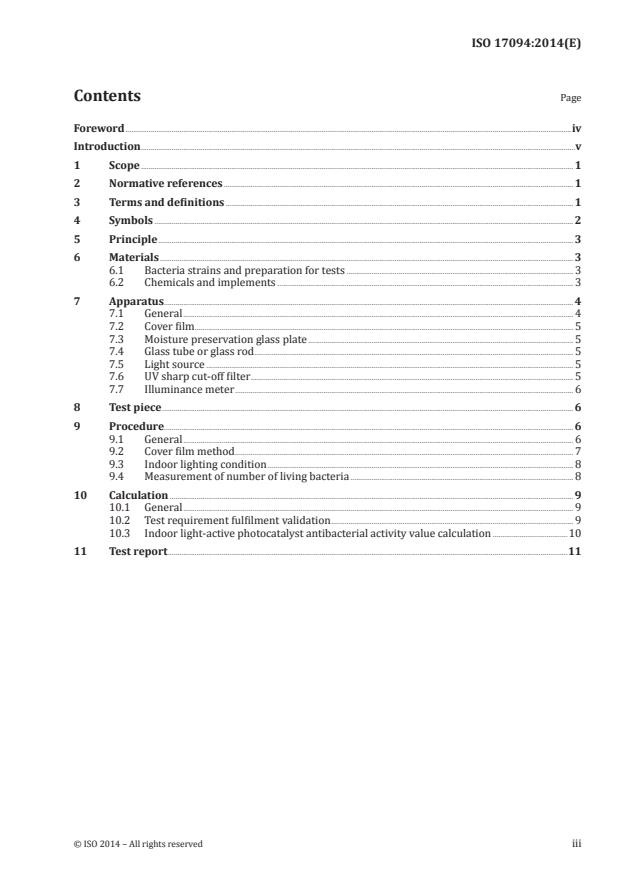
Contents Page
Foreword .iv
Introduction .v
1 Scope . 1
2 Normative references . 1
3 Terms and definitions . 1
4 Symbols . 2
5 Principle . 3
6 Materials . 3
6.1 Bacteria strains and preparation for tests . 3
6.2 Chemicals and implements . 3
7 Apparatus . 4
7.1 General . 4
7.2 Cover film . 5
7.3 Moisture preservation glass plate . 5
7.4 Glass tube or glass rod . 5
7.5 Light source . 5
7.6 UV sharp cut-off filter . 5
7.7 Illuminance meter . 6
8 Test piece . 6
9 Procedure. 6
9.1 General . 6
9.2 Cover film method . 7
9.3 Indoor lighting condition . 8
9.4 Measurement of number of living bacteria . 8
10 Calculation . 9
10.1 General . 9
10.2 Test requirement fulfilment validation . 9
10.3 Indoor light-active photocatalyst antibacterial activity value calculation .10
11 Test report .11
Foreword
ISO (the International Organization for Standardization) is a worldwide federation of national standards
bodies (ISO member bodies). The work of preparing International Standards is normally carried out
through ISO technical committees. Each member body interested in a subject for which a technical
committee has been established has the right to be represented on that committee. International
organizations, governmental and non-governmental, in liaison with ISO, also take part in the work.
ISO collaborates closely with the International Electrotechnical Commission (IEC) on all matters of
electrotechnical standardization.
The procedures used to develop this document and those intended for its further maintenance are
described in the ISO/IEC Directives, Part 1. In particular the different approval criteria needed for the
different types of ISO documents should be noted. This document was drafted in accordance with the
editorial rules of the ISO/IEC Directives, Part 2 (see www.iso.org/directives).
Attention is drawn to the possibility that some of the elements of this document may be the subject of
patent rights. ISO shall not be held responsible for identifying any or all such patent rights. Details of
any patent rights identified during the development of the document will be in the Introduction and/or
on the ISO list of patent declarations received (see www.iso.org/patents).
Any trade name used in this document is information given for the convenience of users and does not
constitute an endorsement.
For an explanation on the meaning of ISO specific terms and expressions related to conformity
assessment, as well as information about ISO’s adherence to the WTO principles in the Technical Barriers
to Trade (TBT) see the following URL: Foreword - Supplementary information
The committee responsible for this document is ISO/TC 206, Fine ceramics.
iv © ISO 2014 – All rights reserved
Introduction
A test method for cloths or textiles is not included in this International Standard because of a lack of
indoor-light-active photocatalytic cloths or textiles. When indoor-light-active photocatalytic cloths
or textiles have been developed, a suitable test method will be proposed with the remediated glass
adhesion method given in ISO 27447.
INTERNATIONAL STANDARD ISO 17094:2014(E)
Fine ceramics (advanced ceramics, advanced technical
ceramics) — Test method for antibacterial activity of
semiconducting photocatalytic materials under indoor
lighting environment
WARNING — Handling and manipulation of microorganisms that are potentially hazardous
requires a high degree of technical competence. Only personnel trained in microbiological
techniques should carry out tests.
1 Scope
This International Standard presents a test method for determining the antibacterial activity of materials
that contain an indoor-light-active photocatalytic material or have indoor-light-active photocatalytic
films on the surface by measuring the survival of bacteria after illumination with indoor light.
It is intended for use with different kinds of indoor-light-active photocatalytic materials used in
construction materials in flat sheet, board or plate shape that are the basic forms of materials for
various applications. It does not include powder, granular, or porous indoor-light-active photocatalytic
materials, nor is it applicable to cloths or textiles.
It is applicable to indoor-light-active photocatalytic materials produced for antibacterial application.
Other types of performance of indoor-light-active photocatalytic materials, i.e. decomposition of water
contaminants, self-cleaning, antifogging, and air purification, cannot be determined by this method.
2 Normative references
The following documents, in whole or in part, are normatively referenced in this document and are
indispensable for its application. For dated references, only the edition cited applies. For undated
references, the latest edition of the referenced document (including any amendments) applies.
ISO 27447, Fine ceramics (advanced ceramics, advanced technical ceramics) — Test method for antibacterial
activity of semiconducting photocatalytic materials
ISO 14605, Fine ceramics (advanced ceramics, advanced technical ceramics) — Light source for testing
semiconducting photocatalytic materials used under indoor lighting environment
3 Terms and definitions
For the purposes of this document, the following terms and definitions apply.
3.1
photocatalyst
substance that performs one or more functions based on oxidization and reduction reactions under
photoirradiation, including decomposition and removal of air and water contaminants, deodorization,
and antibacterial, antifungal, self-cleaning, and antifogging actions
3.2
indoor-light-active photocatalyst
photocatalyst that functions under illumination with artificial light used for general lighting purposes
3.3
indoor lighting environment
illumination with artificial light source(s) used for general lighting purposes and excluding sunlight
3.4
indoor-light-active photocatalytic material
material in which or on which the indoor-light-active photocatalyst is added by coating, impregnation,
mixing, etc
3.5
antibacterial
condition inhibiting the growth of bacteria on the surface of flat surface materials
3.6
indoor-light-active photocatalyst antibacterial activity value
numerical difference between the logarithmic values of the total number of viable bacteria on the indoor-
light-active photocatalytic treated material and non-treated material after indoor light illumination
Note 1 to entry: This value includes the decrease of number of bacteria without indoor light illumination.
3.7
indoor-light-active photocatalyst antibacterial activity value with indoor light illumination
numerical difference between the logarithmic values of the total number of viable bacteria on the indoor-
light-active photocatalytic treated material after indoor light illumination and the same material kept
in the dark
4 Symbols
A average number of viable bacteria on non-treated test pieces, just after inoculation
B average number of viable bacteria on non-treated test pieces, after being kept in a dark
D
place
B average number of viable bacteria on non-treated test pieces, after indoor light illumina-
L
tion of intensity L
C average number of viable bacteria on indoor-light-active photocatalytic treated test
D
pieces, after being kept in dark place
C average number of viable bacteria on indoor-light-active photocatalytic treated test
L
pieces, after indoor light illumination of intensity L
D dilution factor
F
L illuminance of indoor light
L maximum logarithmic value of viable bacteria
max
L average logarithmic value of viable bacteria for three test pieces
mean
L minimum logarithmic value of viable bacteria
min
N number of viable bacteria
P bacteria concentration
R indoor-light-active photocatalyst antibacterial activity value, after illumination at a con-
L
stant intensity (L) on an indoor-light-active photocatalytic material
ΔR indoor-light-active photocatalyst antibacterial activity value with indoor light illumina-
tion
2 © ISO 2014 – All rights reserved
V volume of soybean-casein digest broth with lecithin and polysorbate 80 medium for
washout
Z average number of colonies in two Petri dishes
5 Principle
The method is used to obtain the antibacterial activity of indoor-light-active photocatalytic materials by
contact of a test piece with bacteria, under indoor lighting condition. The film cover method is available
for flat sheet, board, or plate-shaped materials.
The test piece is laid in a Petri dish and the bacterial suspension is dripped onto the test piece. Then
the cover film is placed on the suspension and the moisture conservation glass is placed on top of the
Petri dish. The Petri dish containing the test piece is exposed to light. After exposure, the test bacteria
are washed out of the test piece and the cover film. This washout suspension is measured by the viable
bacterial count method.
6 Materials
6.1 Bacteria strains and preparation for tests
6.1.1 Bacteria strains
The bacteria strains to be used in the test shall be the same as or equivalent to those described in Table 1
and supplied by an entity that is registered under the World Federation for Culture Collections or the
Japan Society for Culture Collections.
Table 1 — Bacteria strains to be used in test
Bacteria species WDCM code
Staphylococcus aureus WDCM 00195
Escherichia coli WDCM 00196
NOTE Refer to WDCM (World Data Centre for Microorganisms) and its website: http://
www.wdcm.org/.
NOTE If necessary, additional tests with other bacteria can be allowed.
6.1.2 Bacteria preparation
Aseptic manipulations using microorganisms should be performed in an adequate safety cabinet.
Inoculate each strain into slant culture medium (nutrient agar medium), incubate for 16 h to 24 h at
37 °C ± 1 °C, and then store in a refrigerator at 5 °C to 10 °C. Repeat subcultures within one month by
replicating this process. The maximum number of subcultures from the original strain transferred by
culture collection is 10. A slant culture shall not be stored for more than one month.
NOTE 1 In the case of bacteria stored in deep freezer, the maximum number of subcultures from original strain
transferred by culture collection is 10.
NOTE 2 If activity of used bacteria is maintained, agar plates can be used.
6.2 Chemicals and implements
6.2.1 General
Commercial media of same components described below can be used.
Volume of prepared media should be adjusted in accordance with the number of test pieces.
6.2.2 1/500 nutrient broth (1/500 NB)
For 100 ml of purified water, take 0,3 g meat extract, 1,0 g peptone, and 0,5 g sodium chloride, put them
into a flask and dissolve them thoroughly. When the contents are thoroughly dissolved, use a solutio
...