

ISO 2507-3:1995
(Main)Thermoplastics pipes and fittings — Vicat softening temperature — Part 3: Test conditions for acrylonitrile/butadiene/styrene (ABS) and acrylonitrile/styrene/acrylic ester (ASA) pipes and fittings
General Information
- Abstract
Specifies the particular test conditions for determining the Vicat softening temperature of ABS and ASA pipes and fittings (the general test method is given in ISO 2507-1). Also gives, for information, the corresponding basic specifications.
- Status
- Withdrawn
- Publication Date
- 01-Feb-1995
- Current Stage
- 9599 - Withdrawal of International Standard
- Start Date
- 26-Jan-2026
- Completion Date
- 29-Aug-2026
Buy Documents
ISO 2507-3:1995 - Thermoplastics pipes and fittings -- Vicat softening temperature
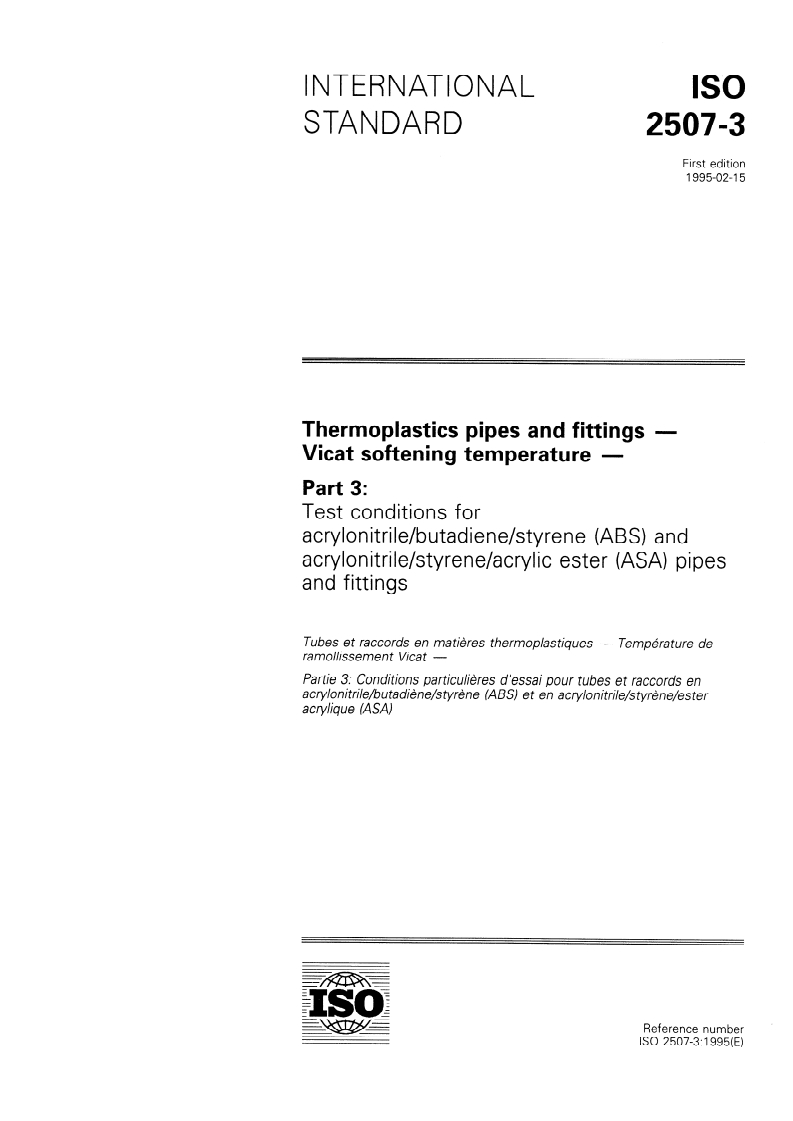
ISO 2507-3:1995 - Thermoplastics pipes and fittings — Vicat softening temperature — Part 3: Test conditions for acrylonitrile/butadiene/styrene (ABS) and acrylonitrile/styrene/acrylic ester (ASA) pipes and fittings/2/1995
ISO 2507-3:1995 - Tubes et raccords en matieres thermoplastiques -- Température de ramollissement Vicat
ISO 2507-3:1995 - Tubes et raccords en matieres thermoplastiques -- Température de ramollissement Vicat
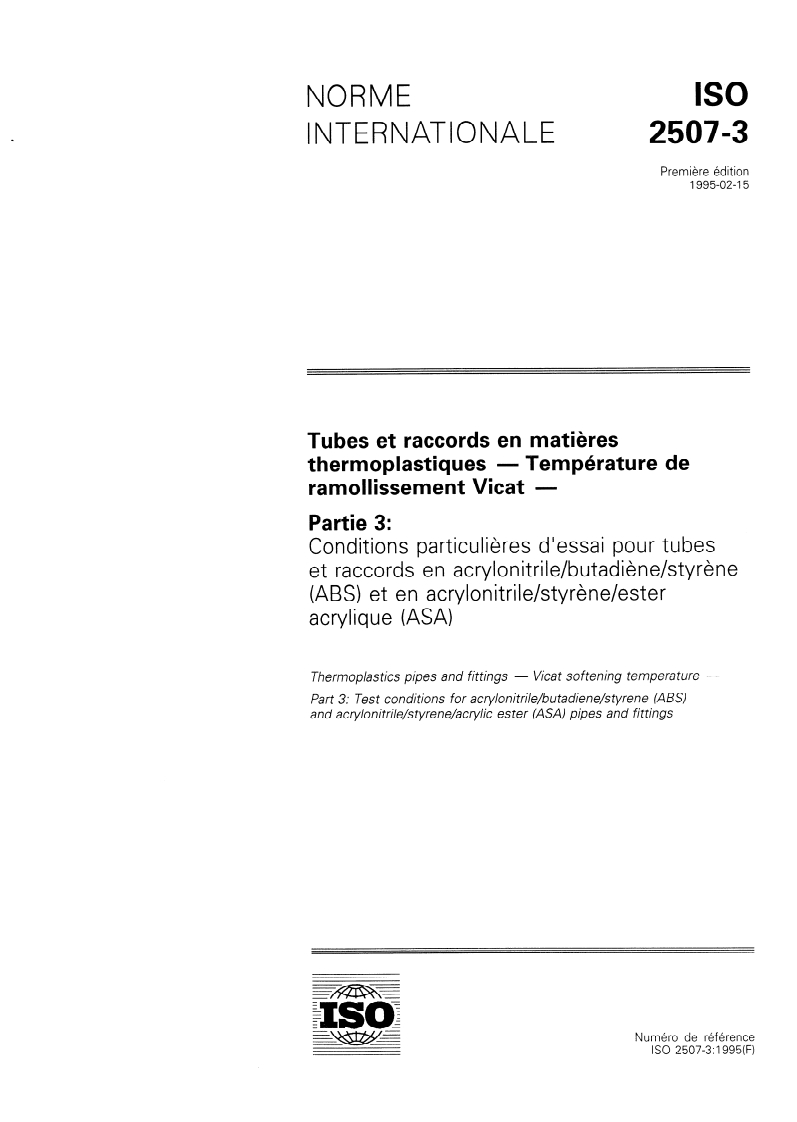
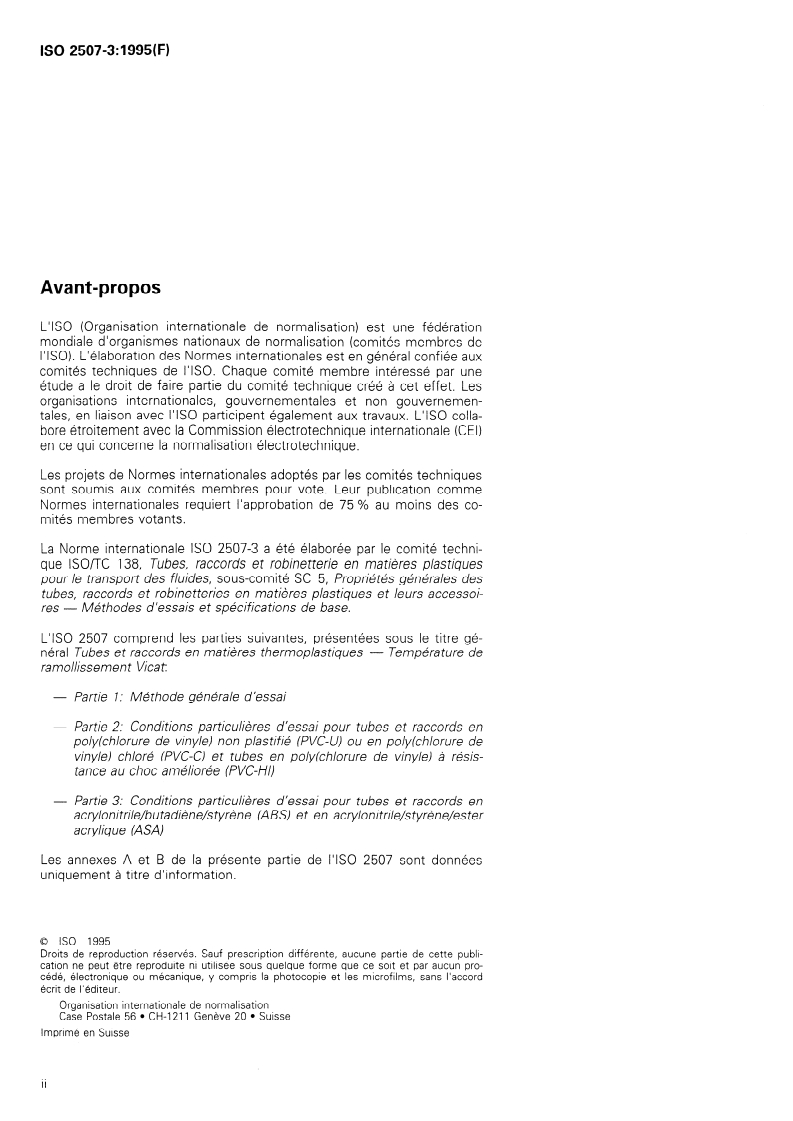
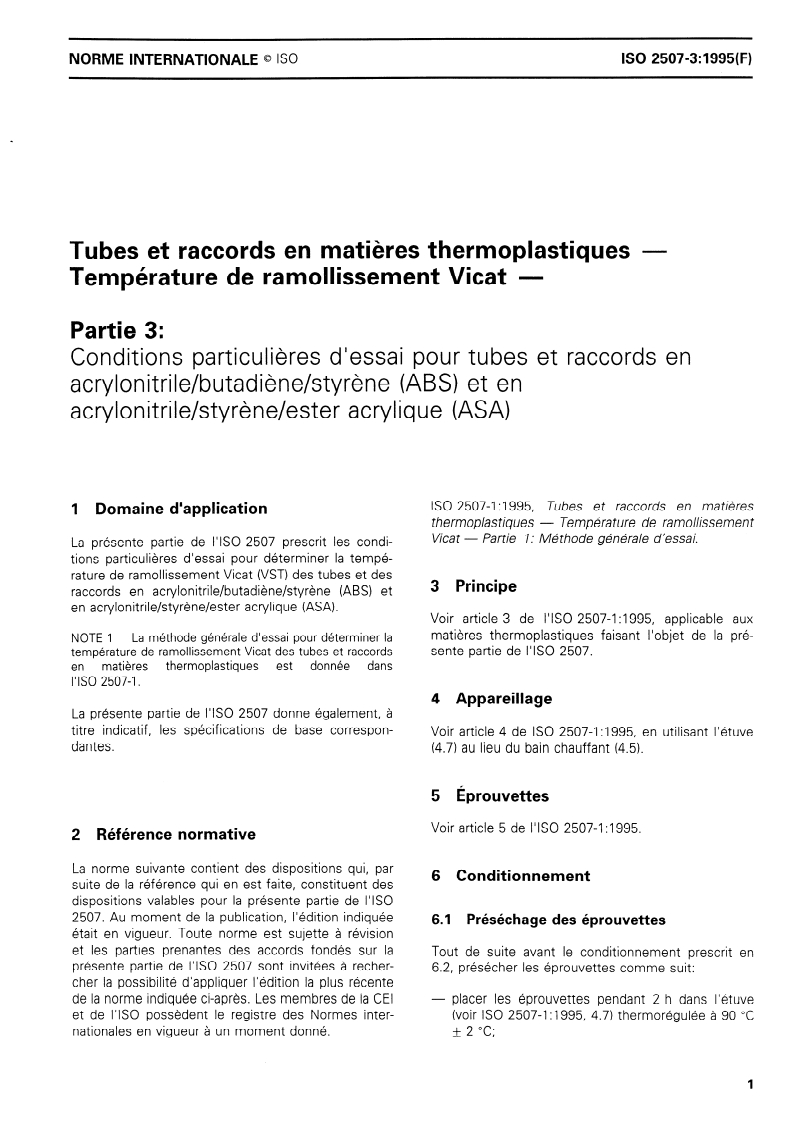
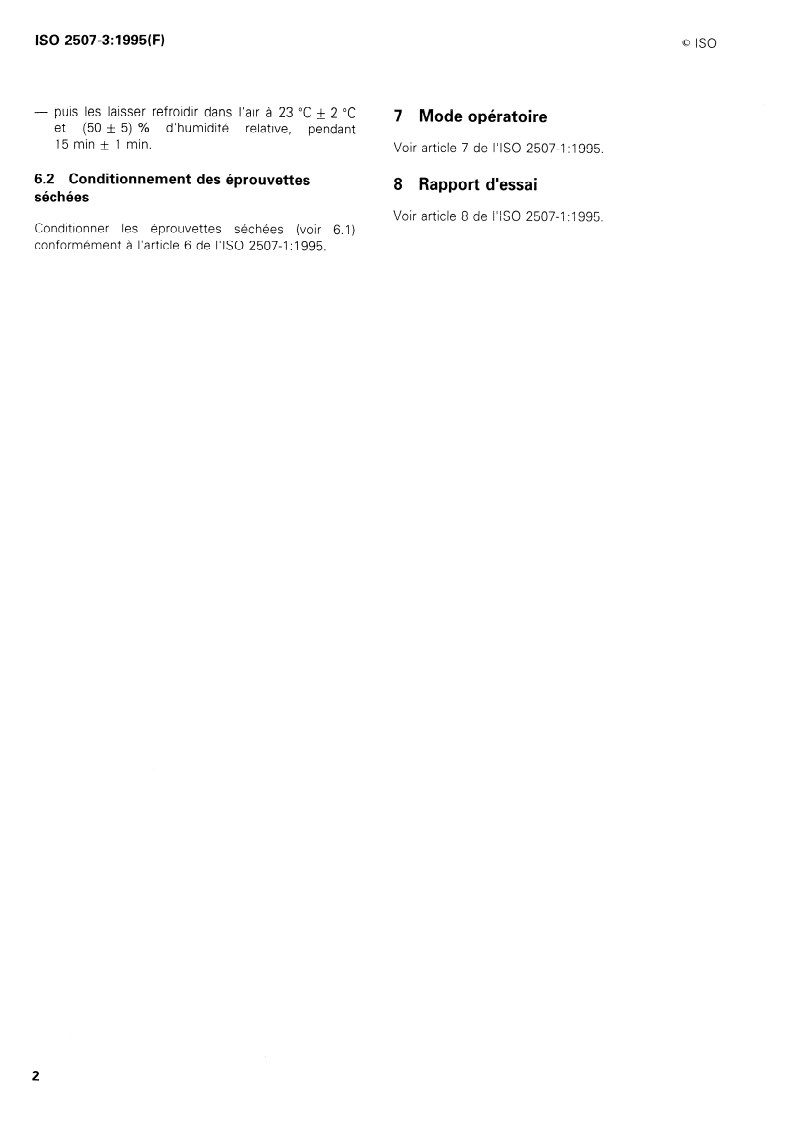
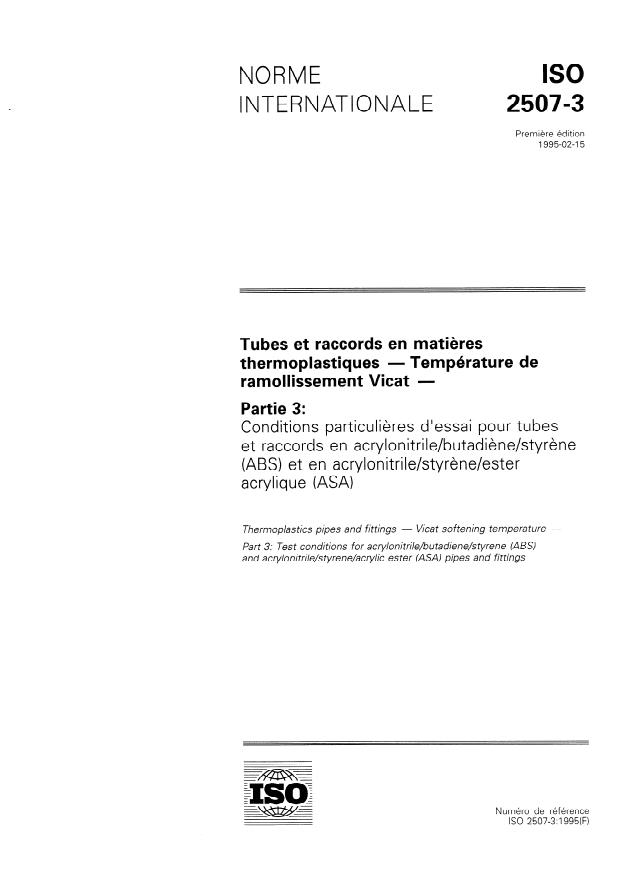
ISO 2507-3:1995 - Tubes et raccords en matières thermoplastiques — Température de ramollissement Vicat — Partie 3: Conditions particulières d'essai pour tubes et raccords en acrylonitrile/butadiène/styrène (ABS) et en acrylonitrile/styrène/ester acrylique (ASA)/2/1995
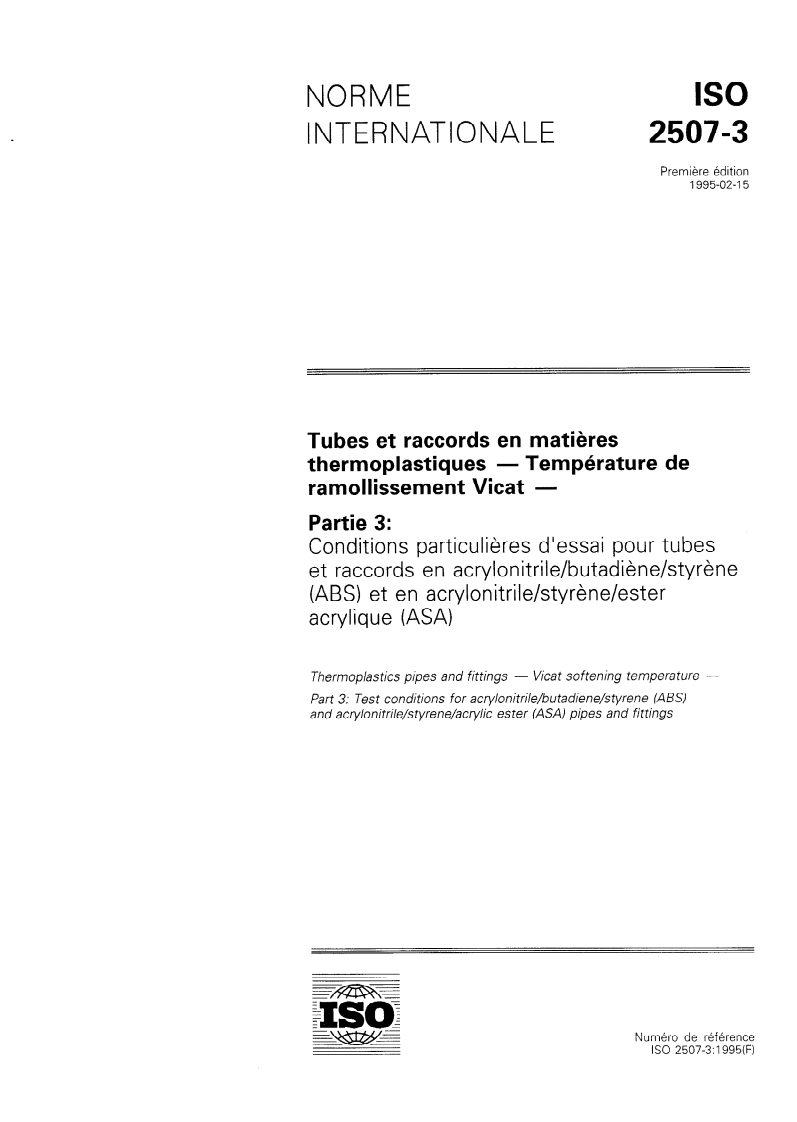
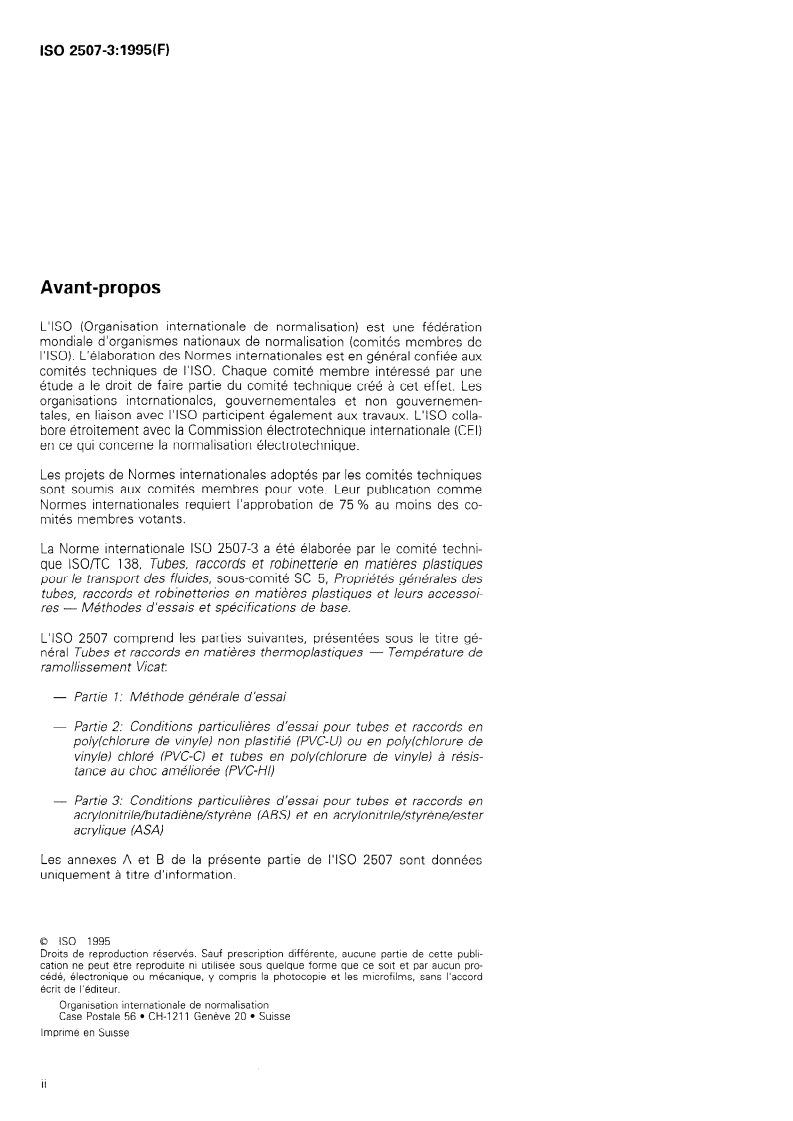
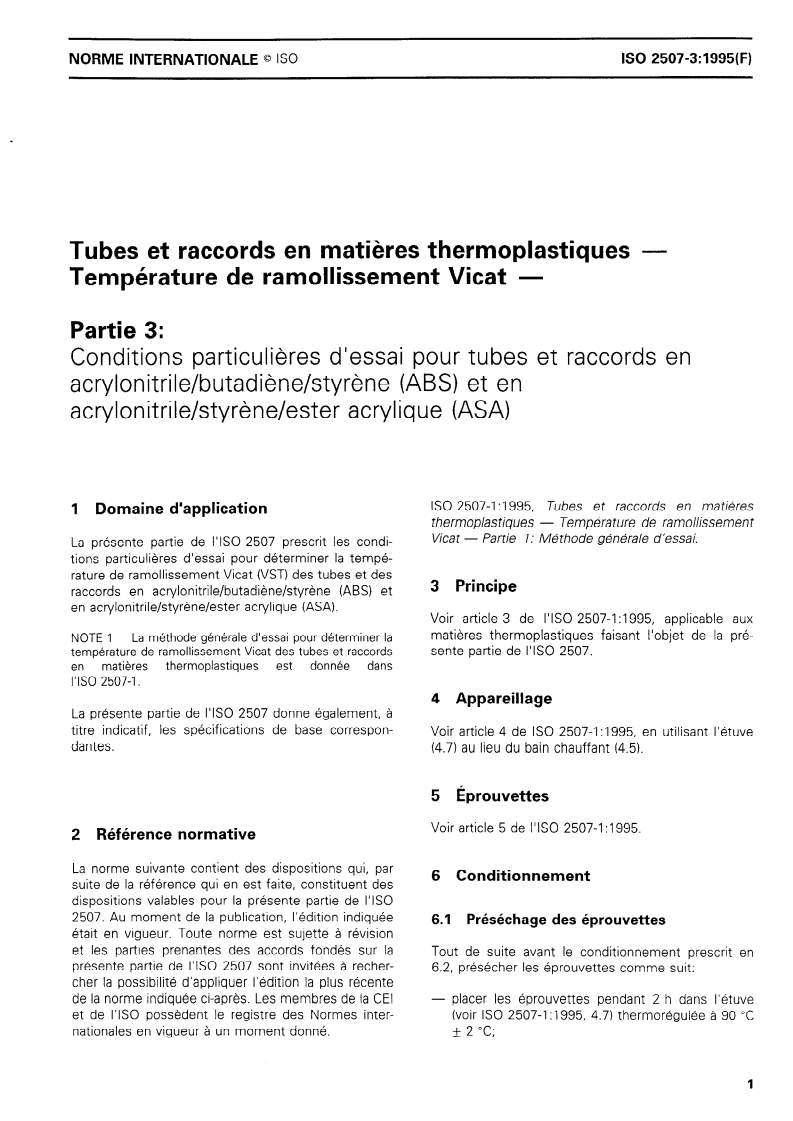
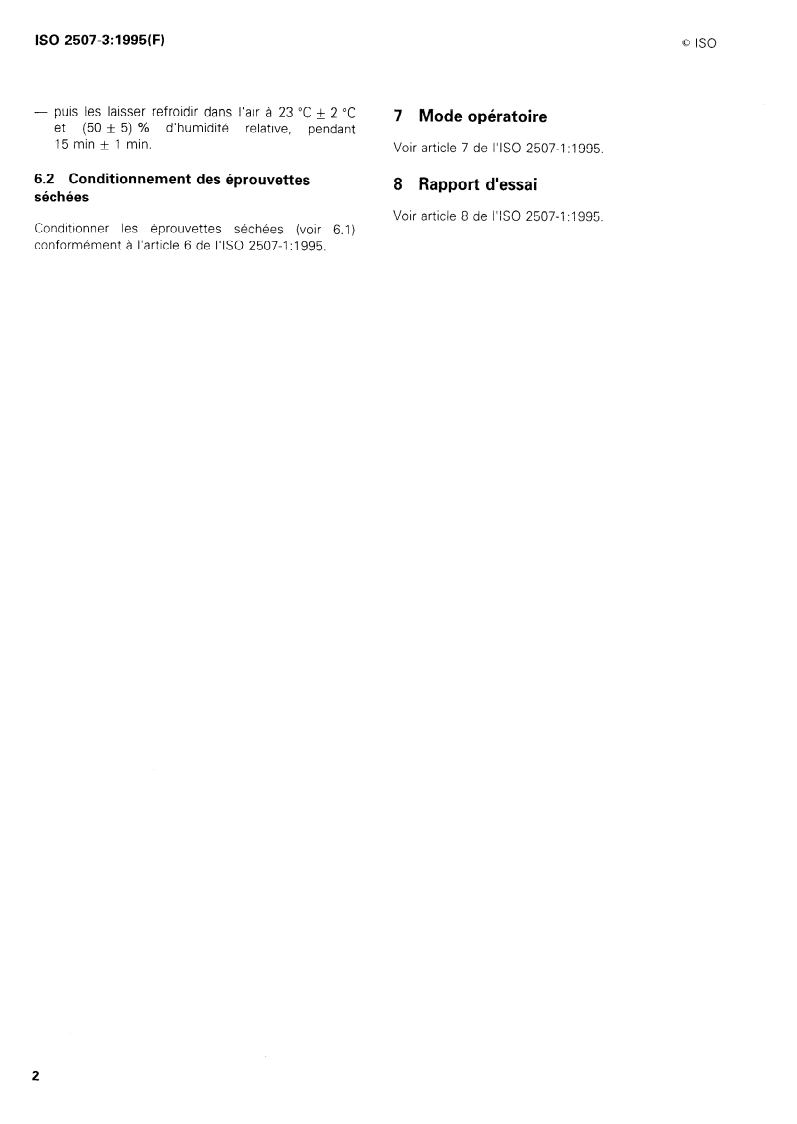
ISO 2507-3:1995 - Tubes et raccords en matières thermoplastiques — Température de ramollissement Vicat — Partie 3: Conditions particulières d'essai pour tubes et raccords en acrylonitrile/butadiène/styrène (ABS) et en acrylonitrile/styrène/ester acrylique (ASA)/2/1995
Overview
ISO 2507-3:1995 defines the specific test conditions for determining the Vicat softening temperature (VST) of thermoplastic pipes and fittings made from ABS (acrylonitrile/butadiene/styrene) and ASA (acrylonitrile/styrene/acrylic ester). It supplements the general Vicat test method given in ISO 2507-1 and includes informative basic specifications for both ABS and ASA materials.
Key topics and technical requirements
- Scope: Applies to ABS and ASA pipes and fittings for VST determination under the ISO 2507 series.
- Reference method: Uses the general Vicat softening temperature method from ISO 2507-1; Part 3 prescribes material- and product-specific adjustments.
- Apparatus: Specifies using a temperature-controlled oven (see clause referencing oven 4.7) in place of a heating bath for the conditioning step.
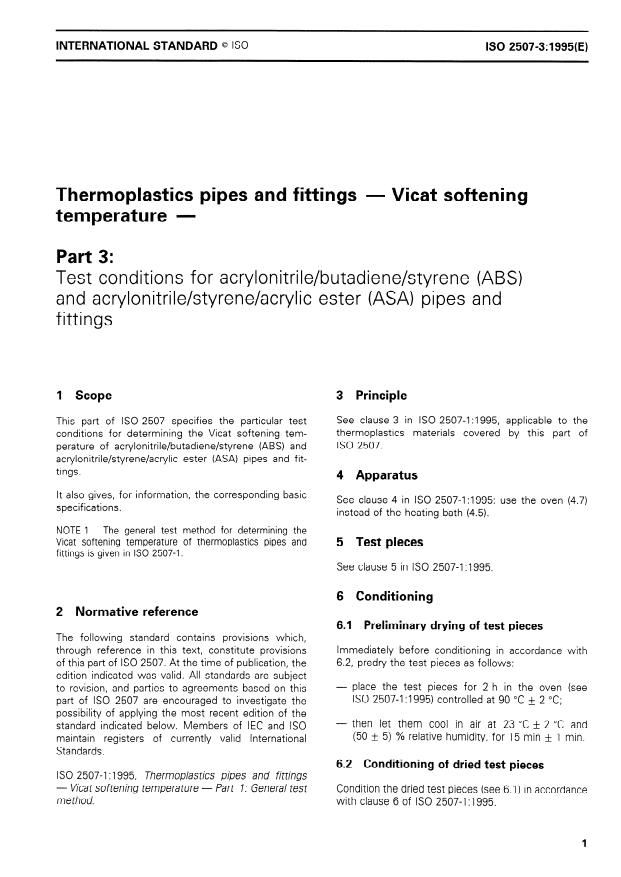
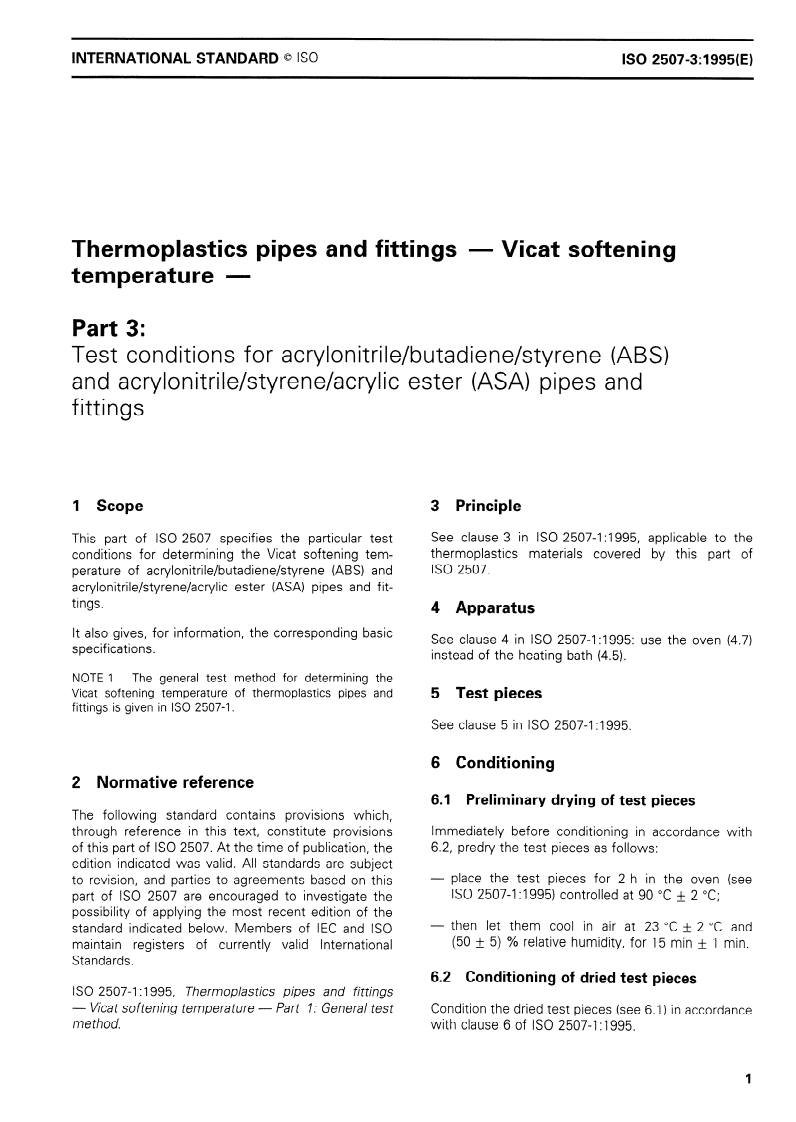
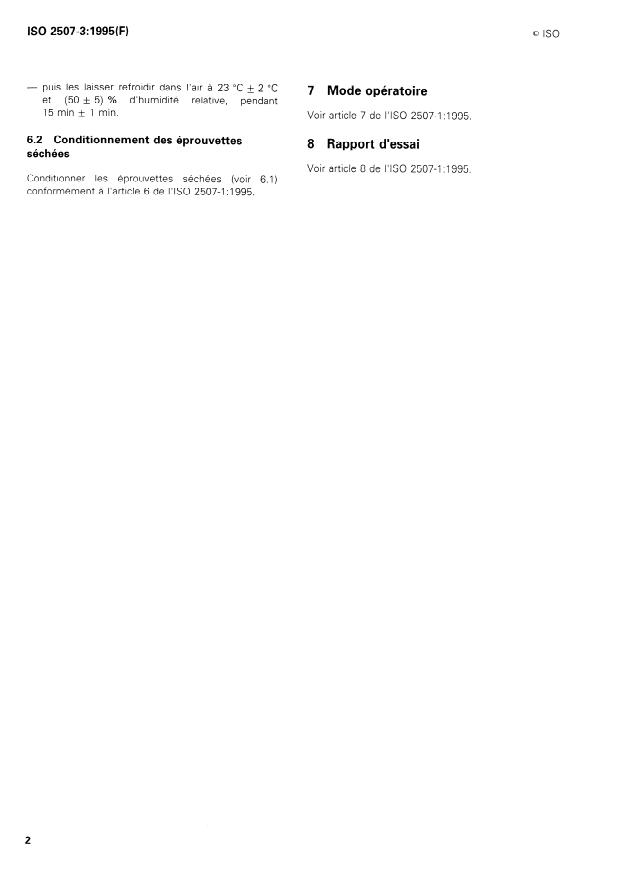
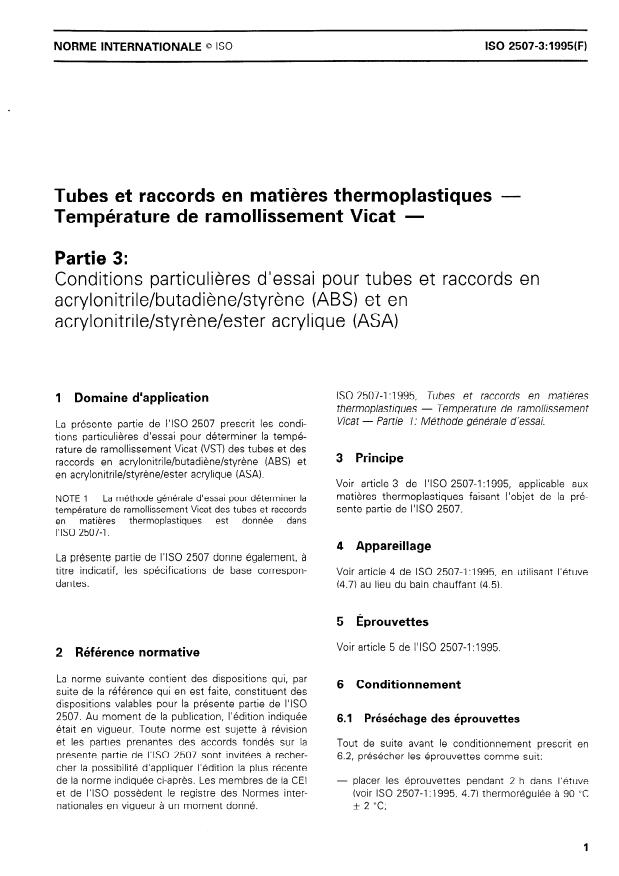
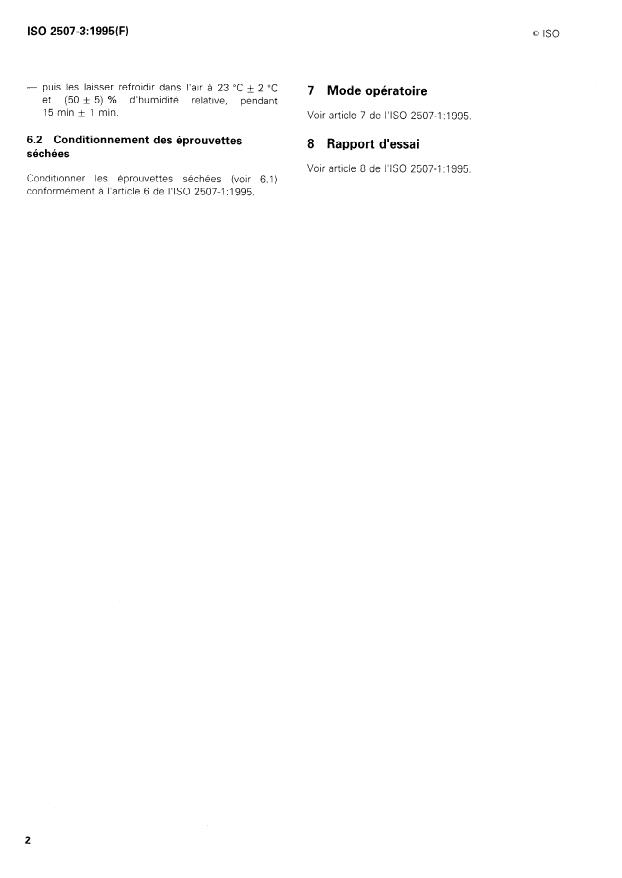
- Specimen pre-drying: Pre-dry test specimens immediately before conditioning by placing them in a thermostatted oven at 90 °C ± 2 °C for 2 hours, then cool in air at 23 °C ± 2 °C and (50 ± 5) % RH for 15 min ± 1 min.
- Conditioning: After pre-drying, condition specimens in accordance with the conditioning procedure of ISO 2507-1 (article 6).
- Reporting: Test report content follows ISO 2507-1 (article 8) requirements.
- Informative specifications: Annex A (ABS) and Annex B (ASA) give basic VST specification guidance - both indicate a minimum VST of 90 °C under the prescribed test conditions (product standards may set stricter values where required).
Applications and who uses this standard
- Manufacturers of ABS and ASA plastic pipes and fittings use ISO 2507-3 to verify thermal performance and to support product specifications.
- Quality control and testing laboratories apply the specified pre-drying, conditioning and test apparatus requirements to produce repeatable VST results.
- Product standards writers, procurement teams and regulatory bodies reference the standard when defining acceptance criteria or compliance for piping systems exposed to elevated temperatures.
- Useful for stakeholders assessing material selection, performance under heat, or comparing thermoplastic pipe materials (ABS/ASA) for building services, drainage, or industrial piping.
Related standards
- ISO 2507-1 - General method for Vicat softening temperature testing (primary reference).
- ISO 2507-2 - Part 2: test conditions for PVC pipes and fittings (related within the ISO 2507 series).
- Developed by ISO/TC 138 (plastics piping systems) - relevant for wider thermoplastics pipe testing and specifications.
Keywords: ISO 2507-3, Vicat softening temperature, VST, ABS pipes, ASA fittings, thermoplastics pipes test, plastic pipe testing, material specification.
Relations
- Effective Date
- 17-Feb-2024
Buy Documents
ISO 2507-3:1995 - Thermoplastics pipes and fittings -- Vicat softening temperature
ISO 2507-3:1995 - Thermoplastics pipes and fittings — Vicat softening temperature — Part 3: Test conditions for acrylonitrile/butadiene/styrene (ABS) and acrylonitrile/styrene/acrylic ester (ASA) pipes and fittings/2/1995
ISO 2507-3:1995 - Tubes et raccords en matieres thermoplastiques -- Température de ramollissement Vicat
ISO 2507-3:1995 - Tubes et raccords en matieres thermoplastiques -- Température de ramollissement Vicat
ISO 2507-3:1995 - Tubes et raccords en matières thermoplastiques — Température de ramollissement Vicat — Partie 3: Conditions particulières d'essai pour tubes et raccords en acrylonitrile/butadiène/styrène (ABS) et en acrylonitrile/styrène/ester acrylique (ASA)/2/1995
ISO 2507-3:1995 - Tubes et raccords en matières thermoplastiques — Température de ramollissement Vicat — Partie 3: Conditions particulières d'essai pour tubes et raccords en acrylonitrile/butadiène/styrène (ABS) et en acrylonitrile/styrène/ester acrylique (ASA)/2/1995
Get Certified
Connect with accredited certification bodies for this standard

Institut za varilstvo d.o.o. (Welding Institute)
Slovenia's leading welding institute since 1952. ISO 3834, EN 1090, pressure equipment certification, NDT personnel, welder qualification. Only IIW Au
Sponsored listings
Frequently Asked Questions
ISO 2507-3:1995 is a standard published by the International Organization for Standardization (ISO). Its full title is "Thermoplastics pipes and fittings — Vicat softening temperature — Part 3: Test conditions for acrylonitrile/butadiene/styrene (ABS) and acrylonitrile/styrene/acrylic ester (ASA) pipes and fittings". This standard covers: Specifies the particular test conditions for determining the Vicat softening temperature of ABS and ASA pipes and fittings (the general test method is given in ISO 2507-1). Also gives, for information, the corresponding basic specifications.
Specifies the particular test conditions for determining the Vicat softening temperature of ABS and ASA pipes and fittings (the general test method is given in ISO 2507-1). Also gives, for information, the corresponding basic specifications.
ISO 2507-3:1995 is classified under the following ICS (International Classification for Standards) categories: 23.040.20 - Plastics pipes; 23.040.45 - Plastics fittings. The ICS classification helps identify the subject area and facilitates finding related standards.
ISO 2507-3:1995 has the following relationships with other standards: It is inter standard links to ISO 2507:2026. Understanding these relationships helps ensure you are using the most current and applicable version of the standard.
ISO 2507-3:1995 is available in PDF format for immediate download after purchase. The document can be added to your cart and obtained through the secure checkout process. Digital delivery ensures instant access to the complete standard document.
Standards Content (Sample)
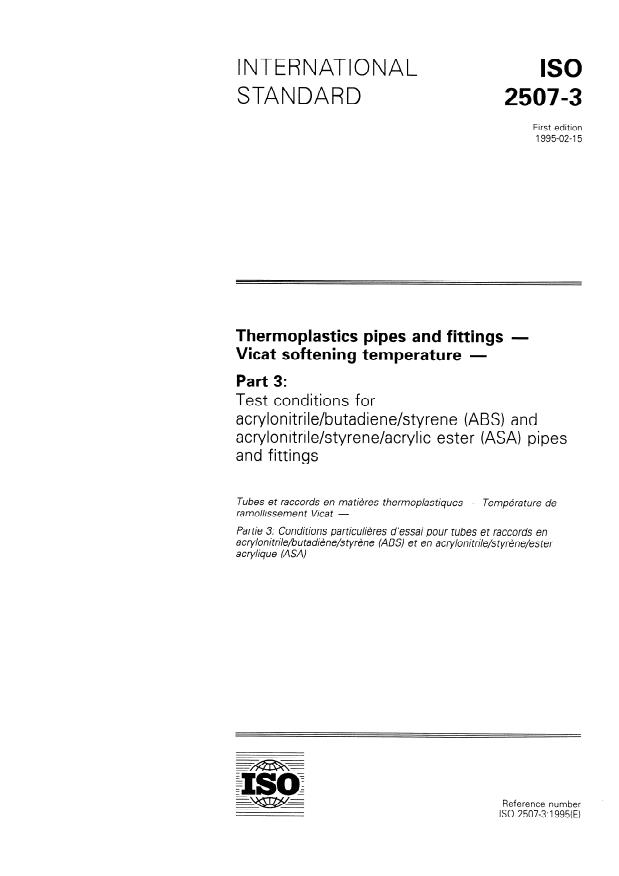
INTERNATIONAL
ISO
STANDARD
2507-3
First edition
1995-02-15
Thermoplastics pipes and fittings -
Vicat softening temperature -
Part 3:
Test conditions for
acrylonitrile/butadiene/styrene (ABS) and
acrylonitrile/styrene/acrylic ester (ASA) pipes
and fittings
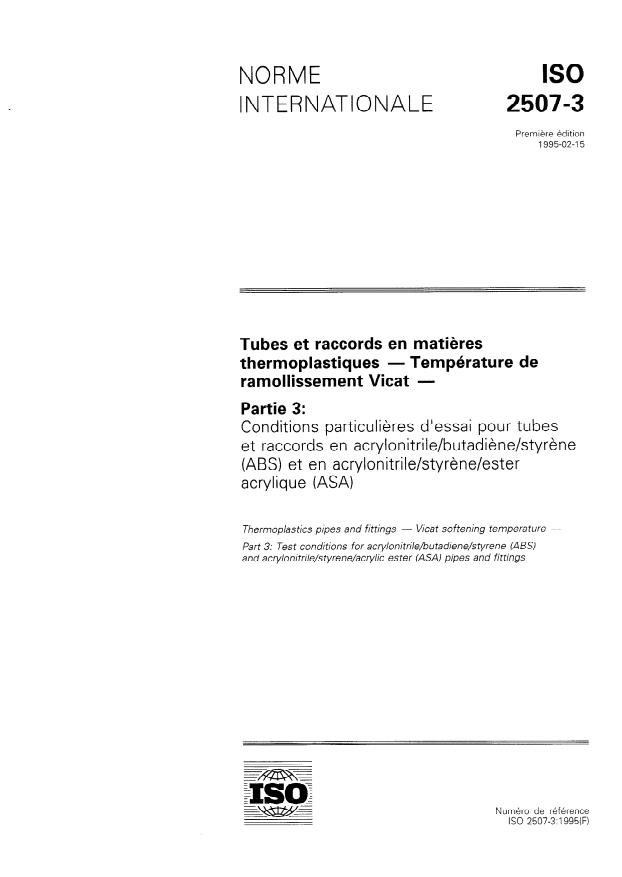
Tubes et raccords en ma tieres thermoplastiques -
Tempera ture de
ramollissemen t Vita t
Partie 3: Conditions particulieres d ’essai pour tubes et raccords en
acrylonitrile/butadi&ne/styrkne (ABS) et en acrylonitrile/styr&ne/ester
acrylique (ASA)
Reference number
ISO 2507-3: 1995(E)
Foreword
ISO (the International Organization for Standardization) is a worldwide
federation of national Standards bodies (ISO member bodies). The work
of preparing International Standards is normally carried out through ISO
technical committees. Esch member body interested in a subject for
which a technical committee has been established has the right to be
represented on that committee. International organizations, governmental
and non-governmental, in liaison with ISO, also take part in the work. ISO
collaborates closely with the International Electrotechnical Commission
(IEC) on all matters of electrotechnical standardization.
Draft International Standards adopted by the technical committees are
circulated to the member bodies for voting. Publication as an International
Standard requires approval by at least 75 % of the member bodies casting
a vote.
International Standard ISO 2507-3 was prepared by Technical Committee
lSO/TC 138, Plastics pipes, fittings and valves for the transport of fluids,
Subcommittee SC 5, General properties of pipes, fittings and valves of
plastic materials and their accessories - Test methods and basic specifi-
ca tions.
ISO 2507 consists of the following Parts, under the general title Thermo-
plastics pipes and fittings - Vita t softening tempera ture:
- Part 7: General fest method
- Part 2: Test conditions for unplasticized poly(vinyl chloride) (PVC-U)
or chlorinated poly(vin yl chloride) (PVC-C) pipes and fittings and for
high impact resistance poly(vinyl chloride) (PVC-Hl) pipes
- Part 3: Test conditions for acrylonitrile/butadiene/styrene (ABS) and
acrylonitrile/styrene/acrylic ester (ASA) pipes and fittings
Annexes A and B of this part of ISO 2507 are for information only.
0 ISO 1995
All rights reserved. Unless otherwise specified, no part of this publication may be reproduced
or utilized in any form or by any means, electronie or mechanical, including photocopying and
microfilm, without Permission in writing from the publisher.
International Organization for Standardization
Case Postale 56 l CH-l 211 Geneve 20 l Switzerland
Printed in Switzerland
ii
INTERNATIONAL STANDARD 0 ISO ISO 2507-3: 1995(E)
Thermoplastics pipes and fittings - Vicat softening
temperature -
Part 3:
Test conditions for acrylonitrile/butadiene/styrene (ABS)
and acrylonitrile/styrene/acrylic ester (ASA) pipes and
fittings
3 Principle
1 Scope
See clause 3 in ISO 2507-1:1995, applicable to the
This part of ISO 2507 specifies the particular test
thermoplastics materials covered by this part of
conditions for determining the Vicat softening tem-
...
INTERNATIONAL
ISO
STANDARD
2507-3
First edition
1995-02-15
Thermoplastics pipes and fittings -
Vicat softening temperature -
Part 3:
Test conditions for
acrylonitrile/butadiene/styrene (ABS) and
acrylonitrile/styrene/acrylic ester (ASA) pipes
and fittings
Tubes et raccords en ma tieres thermoplastiques -
Tempera ture de
ramollissemen t Vita t
Partie 3: Conditions particulieres d ’essai pour tubes et raccords en
acrylonitrile/butadi&ne/styrkne (ABS) et en acrylonitrile/styr&ne/ester
acrylique (ASA)
Reference number
ISO 2507-3: 1995(E)
Foreword
ISO (the International Organization for Standardization) is a worldwide
federation of national Standards bodies (ISO member bodies). The work
of preparing International Standards is normally carried out through ISO
technical committees. Esch member body interested in a subject for
which a technical committee has been established has the right to be
represented on that committee. International organizations, governmental
and non-governmental, in liaison with ISO, also take part in the work. ISO
collaborates closely with the International Electrotechnical Commission
(IEC) on all matters of electrotechnical standardization.
Draft International Standards adopted by the technical committees are
circulated to the member bodies for voting. Publication as an International
Standard requires approval by at least 75 % of the member bodies casting
a vote.
International Standard ISO 2507-3 was prepared by Technical Committee
lSO/TC 138, Plastics pipes, fittings and valves for the transport of fluids,
Subcommittee SC 5, General properties of pipes, fittings and valves of
plastic materials and their accessories - Test methods and basic specifi-
ca tions.
ISO 2507 consists of the following Parts, under the general title Thermo-
plastics pipes and fittings - Vita t softening tempera ture:
- Part 7: General fest method
- Part 2: Test conditions for unplasticized poly(vinyl chloride) (PVC-U)
or chlorinated poly(vin yl chloride) (PVC-C) pipes and fittings and for
high impact resistance poly(vinyl chloride) (PVC-Hl) pipes
- Part 3: Test conditions for acrylonitrile/butadiene/styrene (ABS) and
acrylonitrile/styrene/acrylic ester (ASA) pipes and fittings
Annexes A and B of this part of ISO 2507 are for information only.
0 ISO 1995
All rights reserved. Unless otherwise specified, no part of this publication may be reproduced
or utilized in any form or by any means, electronie or mechanical, including photocopying and
microfilm, without Permission in writing from the publisher.
International Organization for Standardization
Case Postale 56 l CH-l 211 Geneve 20 l Switzerland
Printed in Switzerland
ii
INTERNATIONAL STANDARD 0 ISO ISO 2507-3: 1995(E)
Thermoplastics pipes and fittings - Vicat softening
temperature -
Part 3:
Test conditions for acrylonitrile/butadiene/styrene (ABS)
and acrylonitrile/styrene/acrylic ester (ASA) pipes and
fittings
3 Principle
1 Scope
See clause 3 in ISO 2507-1:1995, applicable to the
This part of ISO 2507 specifies the particular test
thermoplastics materials covered by this part of
conditions for determining the Vicat softening tem-
...
NORME
ISO
INTERNATIONALE 2507-3
Première édition
1995-02-I 5
Tubes et raccords en matières
thermoplastiques - Température de
ramollissement Vicat -
Partie 3:
Conditions particulières d’essai pour tubes
et raccords en acrylonitrile/butadiène/styrène
(ABS) et en acrylonitrile/styrène/ester
acrylique (ASA)
Thermoplas tics pipes and fittings - Vicat softening temperature -
Part 3: Test conditions for acryionitrile/butadiene/styrene (A BS)
and acrylonitrile/styrene/acryiic ester (ASA) pipes and fittings
Numéro de référence
ISO 2507-3: 1995(F)
ISO 2507-3: 1995(F)
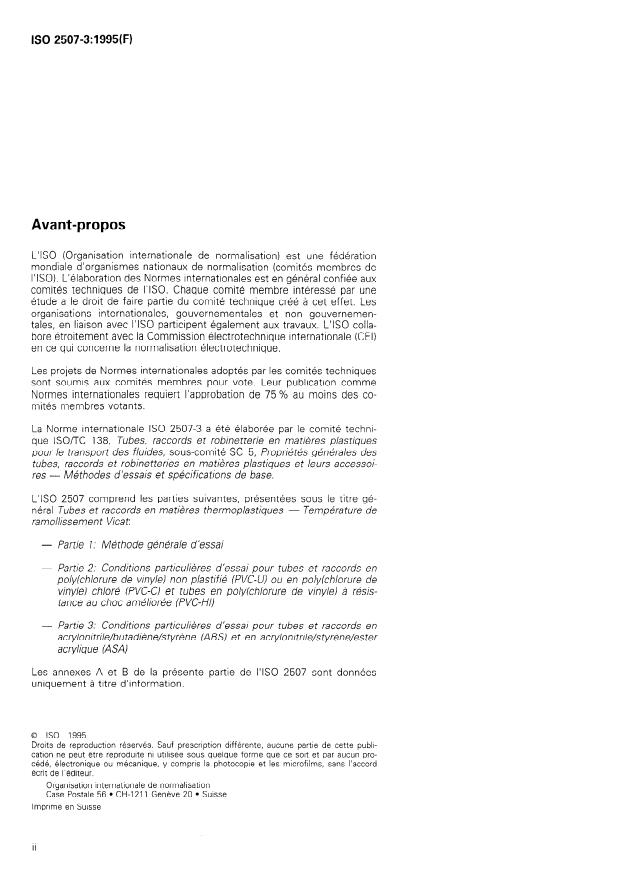
Avant-propos
L’ISO (Organisation internationale de normalisation) est une fédération
mondiale d’organismes nationaux de normalisation (comités membres de
I’ISO). L’élaboration des Normes internationales est en général confiée aux
comités techniques de I’ISO. Chaque comité membre intéressé par une
étude a le droit de faire partie du comité technique créé à cet effet. Les
organisations internationales, gouvernementales et non gouvernemen-
tales, en liaison avec I’ISO participent également aux travaux. L’ISO colla-
bore étroitement avec la Commission électrotechnique internationale (CEI)
en ce qui concerne la normalisation électrotechnique.
Les projets de Normes internationales adoptés par les comités techniques
sont soumis aux comités membres pour vote. Leur publication comme
Normes internationales requiert l’approbation de 75 % au moins des co-
mités membres votants.
La Norme internationale ISO 2507-3 a été élaborée par le comité techni-
que lSO/TC 138, Tubes, raccords et robinetterie en matières plastiques
pour le transport des fluides, sous-comité SC 5, Propriétés générales des
tubes, raccords et robinetteries en matières plastiques et leurs accessoi-
Méthodes d’essais et spécifications de base.
res -
LIS0 2507 comprend les parties suivantes, présentées sous le titre gé-
néral Tubes et raccords en matières thermoplastiques - Température de
ramollissement Vica t:
- Partie 7: Méthode générale d’essai
- Partie 2: Conditions particulières d’essai pour tubes et raccords en
poly(chlorure de vinyle) non plastifié (PVC-U) ou en poly(chlorure de
vinyle) chloré (PVC-C) et tubes en poly(chlorure de vinyle) à résis-
tance au choc améliorée (PVC-HI)
- Partie 3: Conditions particulières d’essai pour tubes et raccords en
acry/onitrile/butadiène/styrène (ABS) et en acrylonitrile/styrène/ester
acrylique (ASA)
Les annexes A et B de la présente partie de I’ISO 2507 sont données
uniquement à titre d’information.
0 ISO 1995
Droits de reproduction réservés. Sauf prescription différente, aucune partie de cette publi-
cation ne peut être reproduite ni utilisée sous quelque forme que ce soit et par aucun pro-
cédé, électronique ou mécanique, y compris la photocopie et les microfilms, sans l’accord
écrit de l’éditeur.
Organisation internationale de normalisation
Case Postale 56 l CH-l 211 Genève 20 l Suisse
Imprimé en Suisse
ISO 2507=3:1995(F)
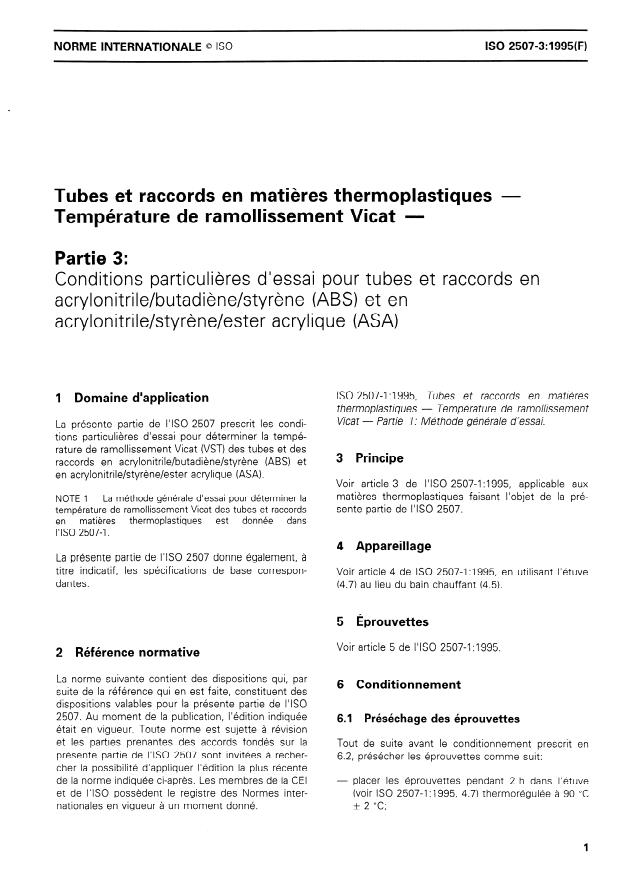
NORME INTERNATIONALE 0 ISO
Tubes et raccords en matières thermoplastiques -
Température de ramollissement Vicat -
Partie 3:
Conditions particulières d’essai pour tubes et raccords en
acrylonitrile/butadiène/styrène (ABS) et en
acrylonitrile/styrène/ester acrylique (ASA)
ISO 2507-I :1995, Tubes et raccords en matières
1 Domaine d’application
thermopiastiques - Température de ramoilissemen t
- Partie 7 : Méthode générale d’essai.
Vica t
La présente partie de I’ISO 2507 prescrit les condi-
tions particulières d’essai pour déterminer la tempé-
rature de ramollissement Vicat (VST) des tubes et des
3 Principe
raccords en acrylonitrile/butadiène/styrène (ABS) et
en acrylonitrile/styrène/e
...
NORME
ISO
INTERNATIONALE 2507-3
Première édition
1995-02-I 5
Tubes et raccords en matières
thermoplastiques - Température de
ramollissement Vicat -
Partie 3:
Conditions particulières d’essai pour tubes
et raccords en acrylonitrile/butadiène/styrène
(ABS) et en acrylonitrile/styrène/ester
acrylique (ASA)
Thermoplas tics pipes and fittings - Vicat softening temperature -
Part 3: Test conditions for acryionitrile/butadiene/styrene (A BS)
and acrylonitrile/styrene/acryiic ester (ASA) pipes and fittings
Numéro de référence
ISO 2507-3: 1995(F)
ISO 2507-3: 1995(F)
Avant-propos
L’ISO (Organisation internationale de normalisation) est une fédération
mondiale d’organismes nationaux de normalisation (comités membres de
I’ISO). L’élaboration des Normes internationales est en général confiée aux
comités techniques de I’ISO. Chaque comité membre intéressé par une
étude a le droit de faire partie du comité technique créé à cet effet. Les
organisations internationales, gouvernementales et non gouvernemen-
tales, en liaison avec I’ISO participent également aux travaux. L’ISO colla-
bore étroitement avec la Commission électrotechnique internationale (CEI)
en ce qui concerne la normalisation électrotechnique.
Les projets de Normes internationales adoptés par les comités techniques
sont soumis aux comités membres pour vote. Leur publication comme
Normes internationales requiert l’approbation de 75 % au moins des co-
mités membres votants.
La Norme internationale ISO 2507-3 a été élaborée par le comité techni-
que lSO/TC 138, Tubes, raccords et robinetterie en matières plastiques
pour le transport des fluides, sous-comité SC 5, Propriétés générales des
tubes, raccords et robinetteries en matières plastiques et leurs accessoi-
Méthodes d’essais et spécifications de base.
res -
LIS0 2507 comprend les parties suivantes, présentées sous le titre gé-
néral Tubes et raccords en matières thermoplastiques - Température de
ramollissement Vica t:
- Partie 7: Méthode générale d’essai
- Partie 2: Conditions particulières d’essai pour tubes et raccords en
poly(chlorure de vinyle) non plastifié (PVC-U) ou en poly(chlorure de
vinyle) chloré (PVC-C) et tubes en poly(chlorure de vinyle) à résis-
tance au choc améliorée (PVC-HI)
- Partie 3: Conditions particulières d’essai pour tubes et raccords en
acry/onitrile/butadiène/styrène (ABS) et en acrylonitrile/styrène/ester
acrylique (ASA)
Les annexes A et B de la présente partie de I’ISO 2507 sont données
uniquement à titre d’information.
0 ISO 1995
Droits de reproduction réservés. Sauf prescription différente, aucune partie de cette publi-
cation ne peut être reproduite ni utilisée sous quelque forme que ce soit et par aucun pro-
cédé, électronique ou mécanique, y compris la photocopie et les microfilms, sans l’accord
écrit de l’éditeur.
Organisation internationale de normalisation
Case Postale 56 l CH-l 211 Genève 20 l Suisse
Imprimé en Suisse
ISO 2507=3:1995(F)
NORME INTERNATIONALE 0 ISO
Tubes et raccords en matières thermoplastiques -
Température de ramollissement Vicat -
Partie 3:
Conditions particulières d’essai pour tubes et raccords en
acrylonitrile/butadiène/styrène (ABS) et en
acrylonitrile/styrène/ester acrylique (ASA)
ISO 2507-I :1995, Tubes et raccords en matières
1 Domaine d’application
thermopiastiques - Température de ramoilissemen t
- Partie 7 : Méthode générale d’essai.
Vica t
La présente partie de I’ISO 2507 prescrit les condi-
tions particulières d’essai pour déterminer la tempé-
rature de ramollissement Vicat (VST) des tubes et des
3 Principe
raccords en acrylonitrile/butadiène/styrène (ABS) et
en acrylonitrile/styrène/e
...
NORME
ISO
INTERNATIONALE 2507-3
Première édition
1995-02-I 5
Tubes et raccords en matières
thermoplastiques - Température de
ramollissement Vicat -
Partie 3:
Conditions particulières d’essai pour tubes
et raccords en acrylonitrile/butadiène/styrène
(ABS) et en acrylonitrile/styrène/ester
acrylique (ASA)
Thermoplas tics pipes and fittings - Vicat softening temperature -
Part 3: Test conditions for acryionitrile/butadiene/styrene (A BS)
and acrylonitrile/styrene/acryiic ester (ASA) pipes and fittings
Numéro de référence
ISO 2507-3: 1995(F)
ISO 2507-3: 1995(F)
Avant-propos
L’ISO (Organisation internationale de normalisation) est une fédération
mondiale d’organismes nationaux de normalisation (comités membres de
I’ISO). L’élaboration des Normes internationales est en général confiée aux
comités techniques de I’ISO. Chaque comité membre intéressé par une
étude a le droit de faire partie du comité technique créé à cet effet. Les
organisations internationales, gouvernementales et non gouvernemen-
tales, en liaison avec I’ISO participent également aux travaux. L’ISO colla-
bore étroitement avec la Commission électrotechnique internationale (CEI)
en ce qui concerne la normalisation électrotechnique.
Les projets de Normes internationales adoptés par les comités techniques
sont soumis aux comités membres pour vote. Leur publication comme
Normes internationales requiert l’approbation de 75 % au moins des co-
mités membres votants.
La Norme internationale ISO 2507-3 a été élaborée par le comité techni-
que lSO/TC 138, Tubes, raccords et robinetterie en matières plastiques
pour le transport des fluides, sous-comité SC 5, Propriétés générales des
tubes, raccords et robinetteries en matières plastiques et leurs accessoi-
Méthodes d’essais et spécifications de base.
res -
LIS0 2507 comprend les parties suivantes, présentées sous le titre gé-
néral Tubes et raccords en matières thermoplastiques - Température de
ramollissement Vica t:
- Partie 7: Méthode générale d’essai
- Partie 2: Conditions particulières d’essai pour tubes et raccords en
poly(chlorure de vinyle) non plastifié (PVC-U) ou en poly(chlorure de
vinyle) chloré (PVC-C) et tubes en poly(chlorure de vinyle) à résis-
tance au choc améliorée (PVC-HI)
- Partie 3: Conditions particulières d’essai pour tubes et raccords en
acry/onitrile/butadiène/styrène (ABS) et en acrylonitrile/styrène/ester
acrylique (ASA)
Les annexes A et B de la présente partie de I’ISO 2507 sont données
uniquement à titre d’information.
0 ISO 1995
Droits de reproduction réservés. Sauf prescription différente, aucune partie de cette publi-
cation ne peut être reproduite ni utilisée sous quelque forme que ce soit et par aucun pro-
cédé, électronique ou mécanique, y compris la photocopie et les microfilms, sans l’accord
écrit de l’éditeur.
Organisation internationale de normalisation
Case Postale 56 l CH-l 211 Genève 20 l Suisse
Imprimé en Suisse
ISO 2507=3:1995(F)
NORME INTERNATIONALE 0 ISO
Tubes et raccords en matières thermoplastiques -
Température de ramollissement Vicat -
Partie 3:
Conditions particulières d’essai pour tubes et raccords en
acrylonitrile/butadiène/styrène (ABS) et en
acrylonitrile/styrène/ester acrylique (ASA)
ISO 2507-I :1995, Tubes et raccords en matières
1 Domaine d’application
thermopiastiques - Température de ramoilissemen t
- Partie 7 : Méthode générale d’essai.
Vica t
La présente partie de I’ISO 2507 prescrit les condi-
tions particulières d’essai pour déterminer la tempé-
rature de ramollissement Vicat (VST) des tubes et des
3 Principe
raccords en acrylonitrile/butadiène/styrène (ABS) et
en acrylonitrile/styrène/e
...
NORME
ISO
INTERNATIONALE 2507-3
Première édition
1995-02-I 5
Tubes et raccords en matières
thermoplastiques - Température de
ramollissement Vicat -
Partie 3:
Conditions particulières d’essai pour tubes
et raccords en acrylonitrile/butadiène/styrène
(ABS) et en acrylonitrile/styrène/ester
acrylique (ASA)
Thermoplas tics pipes and fittings - Vicat softening temperature -
Part 3: Test conditions for acryionitrile/butadiene/styrene (A BS)
and acrylonitrile/styrene/acryiic ester (ASA) pipes and fittings
Numéro de référence
ISO 2507-3: 1995(F)
ISO 2507-3: 1995(F)
Avant-propos
L’ISO (Organisation internationale de normalisation) est une fédération
mondiale d’organismes nationaux de normalisation (comités membres de
I’ISO). L’élaboration des Normes internationales est en général confiée aux
comités techniques de I’ISO. Chaque comité membre intéressé par une
étude a le droit de faire partie du comité technique créé à cet effet. Les
organisations internationales, gouvernementales et non gouvernemen-
tales, en liaison avec I’ISO participent également aux travaux. L’ISO colla-
bore étroitement avec la Commission électrotechnique internationale (CEI)
en ce qui concerne la normalisation électrotechnique.
Les projets de Normes internationales adoptés par les comités techniques
sont soumis aux comités membres pour vote. Leur publication comme
Normes internationales requiert l’approbation de 75 % au moins des co-
mités membres votants.
La Norme internationale ISO 2507-3 a été élaborée par le comité techni-
que lSO/TC 138, Tubes, raccords et robinetterie en matières plastiques
pour le transport des fluides, sous-comité SC 5, Propriétés générales des
tubes, raccords et robinetteries en matières plastiques et leurs accessoi-
Méthodes d’essais et spécifications de base.
res -
LIS0 2507 comprend les parties suivantes, présentées sous le titre gé-
néral Tubes et raccords en matières thermoplastiques - Température de
ramollissement Vica t:
- Partie 7: Méthode générale d’essai
- Partie 2: Conditions particulières d’essai pour tubes et raccords en
poly(chlorure de vinyle) non plastifié (PVC-U) ou en poly(chlorure de
vinyle) chloré (PVC-C) et tubes en poly(chlorure de vinyle) à résis-
tance au choc améliorée (PVC-HI)
- Partie 3: Conditions particulières d’essai pour tubes et raccords en
acry/onitrile/butadiène/styrène (ABS) et en acrylonitrile/styrène/ester
acrylique (ASA)
Les annexes A et B de la présente partie de I’ISO 2507 sont données
uniquement à titre d’information.
0 ISO 1995
Droits de reproduction réservés. Sauf prescription différente, aucune partie de cette publi-
cation ne peut être reproduite ni utilisée sous quelque forme que ce soit et par aucun pro-
cédé, électronique ou mécanique, y compris la photocopie et les microfilms, sans l’accord
écrit de l’éditeur.
Organisation internationale de normalisation
Case Postale 56 l CH-l 211 Genève 20 l Suisse
Imprimé en Suisse
ISO 2507=3:1995(F)
NORME INTERNATIONALE 0 ISO
Tubes et raccords en matières thermoplastiques -
Température de ramollissement Vicat -
Partie 3:
Conditions particulières d’essai pour tubes et raccords en
acrylonitrile/butadiène/styrène (ABS) et en
acrylonitrile/styrène/ester acrylique (ASA)
ISO 2507-I :1995, Tubes et raccords en matières
1 Domaine d’application
thermopiastiques - Température de ramoilissemen t
- Partie 7 : Méthode générale d’essai.
Vica t
La présente partie de I’ISO 2507 prescrit les condi-
tions particulières d’essai pour déterminer la tempé-
rature de ramollissement Vicat (VST) des tubes et des
3 Principe
raccords en acrylonitrile/butadiène/styrène (ABS) et
en acrylonitrile/styrène/e
...