


ISO 10303-201:1994
(Main)Industrial automation systems and integration — Product data representation and exchange — Part 201: Application protocol: Explicit draughting
Industrial automation systems and integration — Product data representation and exchange — Part 201: Application protocol: Explicit draughting
La présente partie de l'ISO 10303 spécifie l'utilisation des ressources intégrées nécessaires au domaine d'application et aux prescriptions d'information relatives au dessin technique explicite. NOTE : Le modèle d'application d'activité décrit à l'annexe F fournit une représentation graphique des procédés et des flux d'information qui constituent la base de définition du domaine d'application de la présente partie de l'ISO 10303. La présente partie de l'ISO 10303 s'applique à l'échange entre organismes des informations sur les dessins et des données de définition de produits, qui peuvent être interprétées par système informatique. Les éléments suivants font partie du domaine d'application de la présente partie de l'ISO 10303 : la représentation des dessins susceptibles d'être échangés, notamment dans le cadre des applications d'ingénierie mécanique, architecturale et de construction ; la représentation de la taille réelle d'un produit symbolisé par un dessin pour permettre l'utilisation d'applications nécessitant une véritable équivalence géométrique ; EXEMPLE 2 : La représentation de la forme d'un produit est nécessaire pour supporter non seulement l'équivalence visuelle des dessins échangés mais également lorsque le système de réception requiert une véritable équivalence géométrique. Ces utilisations comprennent 1786les calculs des distances ou des surfaces ainsi que la génération de trajectoires d'outils de commande numérique. la représentation d'un dessin qui symbolise une phase du processus de conception ; la représentation des révisions individuelles de dessins ; la représentation du modèle bi-dimensionnel de forme de dessin technique symbolisant la forme du produit et les transformations utilisées pour générer les vues de dessins ; la visualisation des données de définition de produits non formées symbolisées par une annotation bi-dimensionnelle sur un dessin
Systèmes d'automatisation industrielle et intégration — Représentation et échange de données de produits — Partie 201: Protocole d'application: Dessin technique explicite
General Information
- Status
- Withdrawn
- Publication Date
- 21-Dec-1994
- Withdrawal Date
- 21-Dec-1994
- Technical Committee
- ISO/TC 184/SC 4 - Industrial data
- Drafting Committee
- ISO/TC 184/SC 4 - Industrial data
- Current Stage
- 9599 - Withdrawal of International Standard
- Start Date
- 08-Dec-2014
- Completion Date
- 12-Feb-2026
Relations
- Effective Date
- 06-Jun-2022
- Effective Date
- 08-Jun-2013

Get Certified
Connect with accredited certification bodies for this standard

National Aerospace and Defense Contractors Accreditation Program (NADCAP)
Global cooperative program for special process quality in aerospace.
CARES (UK Certification Authority for Reinforcing Steels)
UK certification for reinforcing steels and construction.
DVS-ZERT GmbH
German welding certification society.
Sponsored listings
Frequently Asked Questions
ISO 10303-201:1994 is a standard published by the International Organization for Standardization (ISO). Its full title is "Industrial automation systems and integration — Product data representation and exchange — Part 201: Application protocol: Explicit draughting". This standard covers: La présente partie de l'ISO 10303 spécifie l'utilisation des ressources intégrées nécessaires au domaine d'application et aux prescriptions d'information relatives au dessin technique explicite. NOTE : Le modèle d'application d'activité décrit à l'annexe F fournit une représentation graphique des procédés et des flux d'information qui constituent la base de définition du domaine d'application de la présente partie de l'ISO 10303. La présente partie de l'ISO 10303 s'applique à l'échange entre organismes des informations sur les dessins et des données de définition de produits, qui peuvent être interprétées par système informatique. Les éléments suivants font partie du domaine d'application de la présente partie de l'ISO 10303 : la représentation des dessins susceptibles d'être échangés, notamment dans le cadre des applications d'ingénierie mécanique, architecturale et de construction ; la représentation de la taille réelle d'un produit symbolisé par un dessin pour permettre l'utilisation d'applications nécessitant une véritable équivalence géométrique ; EXEMPLE 2 : La représentation de la forme d'un produit est nécessaire pour supporter non seulement l'équivalence visuelle des dessins échangés mais également lorsque le système de réception requiert une véritable équivalence géométrique. Ces utilisations comprennent 1786les calculs des distances ou des surfaces ainsi que la génération de trajectoires d'outils de commande numérique. la représentation d'un dessin qui symbolise une phase du processus de conception ; la représentation des révisions individuelles de dessins ; la représentation du modèle bi-dimensionnel de forme de dessin technique symbolisant la forme du produit et les transformations utilisées pour générer les vues de dessins ; la visualisation des données de définition de produits non formées symbolisées par une annotation bi-dimensionnelle sur un dessin
La présente partie de l'ISO 10303 spécifie l'utilisation des ressources intégrées nécessaires au domaine d'application et aux prescriptions d'information relatives au dessin technique explicite. NOTE : Le modèle d'application d'activité décrit à l'annexe F fournit une représentation graphique des procédés et des flux d'information qui constituent la base de définition du domaine d'application de la présente partie de l'ISO 10303. La présente partie de l'ISO 10303 s'applique à l'échange entre organismes des informations sur les dessins et des données de définition de produits, qui peuvent être interprétées par système informatique. Les éléments suivants font partie du domaine d'application de la présente partie de l'ISO 10303 : la représentation des dessins susceptibles d'être échangés, notamment dans le cadre des applications d'ingénierie mécanique, architecturale et de construction ; la représentation de la taille réelle d'un produit symbolisé par un dessin pour permettre l'utilisation d'applications nécessitant une véritable équivalence géométrique ; EXEMPLE 2 : La représentation de la forme d'un produit est nécessaire pour supporter non seulement l'équivalence visuelle des dessins échangés mais également lorsque le système de réception requiert une véritable équivalence géométrique. Ces utilisations comprennent 1786les calculs des distances ou des surfaces ainsi que la génération de trajectoires d'outils de commande numérique. la représentation d'un dessin qui symbolise une phase du processus de conception ; la représentation des révisions individuelles de dessins ; la représentation du modèle bi-dimensionnel de forme de dessin technique symbolisant la forme du produit et les transformations utilisées pour générer les vues de dessins ; la visualisation des données de définition de produits non formées symbolisées par une annotation bi-dimensionnelle sur un dessin
ISO 10303-201:1994 is classified under the following ICS (International Classification for Standards) categories: 25.040.40 - Industrial process measurement and control. The ICS classification helps identify the subject area and facilitates finding related standards.
ISO 10303-201:1994 has the following relationships with other standards: It is inter standard links to ISO 105-E12:1989/Amd 1:2002, ISO 10303-242:2014. Understanding these relationships helps ensure you are using the most current and applicable version of the standard.
ISO 10303-201:1994 is available in PDF format for immediate download after purchase. The document can be added to your cart and obtained through the secure checkout process. Digital delivery ensures instant access to the complete standard document.
Standards Content (Sample)
INTERNATIONAL
ISO
STANDARD
10303-201
First edition
1994-12-15
Industrial automation Systems and
integration - Product data representation
and exchange -
Part 201:
Application protocol: Explicit draughting
Sys tkmes d ’automa tisa tion industrielle et in t6gra tion - Reprbsen ta tion
et behange de donnees de produits -
Partie 20 7: Protocole d ’applica tion: Dessin technique explicite
Reference number
ISO 10303~zol:MM(E)
Paee
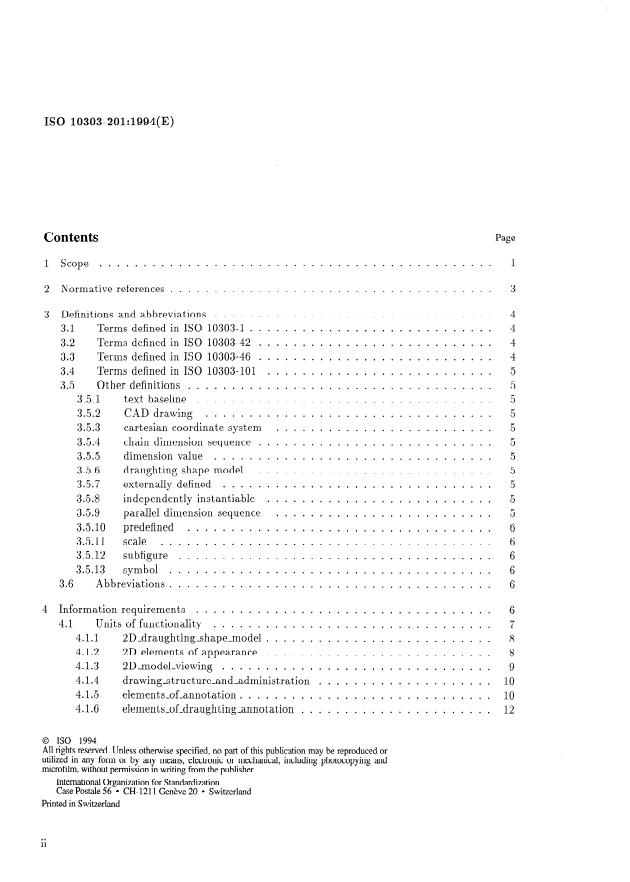
Contents ”
1 Scope . . . . . . . . . . . . . . . . . . . . . . . . . . . . . . . . . . . . . . . . . . . . .
2 Normative references . . . . . . . . . . . . . . . . . . . . . . . . . . . . . . . . . . . . .
3 Definitions and abbreviations . . . . . . . . . . . . . . . . . . . . . . . . . . . . . . . .
31 . Terms defined in ISO 10303-1 . . . . . . . . . . . . . . . . . . . . . . . . . . . .
32 . Terms defined in ISO 10303-42 . . . . . . . . . . . . . . . . . . . . . . . . . . .
. Terms defined in ISO 10303-46 . . . . . . . . . . . . . . . . . . . . . . . . . . .
34 . Terms defined in ISO 10303-101 . . . . . . . . . . . . . . . . . . . . . . . . . .
. Other definitions . . . . . . . . . . . . . . . . . . . . . . . . . . . . . . . . . . .
3.5.1 text baseline . . . . . . . . . . . . . . . . . . . . . . . . . . . . . . . . . .
................................. 5
3.5.2 CAD drawing
......................... 5
3.5.3 cartesian coordinate System
........................... 5
3.5.4 chain dimension sequence
dimension value . 5
3.5.5
draughting shape model .
3.5.6
externally defined . . . . . . . . . . . . . . . . . . . . . . . . . . . . . . . 5
3.5.7
independently instantiable . . . . . . . . . . . . . . . . . . . . . . . . . . 5
3.5.8
3.5.9 parallel dimension sequence . . . . . . . . . . . . . e . . . . . . . . . . .
3.5.10 predefined . . . . . . . . . . . . . . . . . . . . . . . . . . . . . . . . . . .
3.5.11 scale . . . . . . . . . . . . . . . . . . . . . . . . . . . . . . . . . . . . . . 6
3.5.12 subfigure . . . . . . . . . . . . . . . . . . . . . . . . . . . . . . . . . . . .
3.5.13 Symbol . . . . . . . . . . . . . . . . . . . . . . . . . . . . . . . . . . . . .
36 . Abbreviations . . . . . . . . . . . . . . . . . . . . . . . . . . . . e . . . . . . . . 6
4 Information requirements .
. Units of functionality . 7
4.1.1 2D-draughtingshape-model . 8
4.1.2 2D-elements-of-appearance .
4.1.3 2DmodeLviewing . . . . . . . . . . . . . . . . . . . . . . . . . . . . . . . 9
4.1.4 drawingstructure-and-administration . . . . . . . . . . . . . . . . . . . . 10
4.1.5 elements-of-annotation .
4.1.6 elements-of-draughting-annot ation .
0 ISO 1994
All rights reserved. Unless otherwise specified, no part of this publication may be reproduced or
utilized in any form or by any means, electronie or mechanical, including photocopying and
microfilm, without permission in writing from the publisher.
International Organization for Standardization
Case Postale 56 l CH-121 1 Geneve 20 l Switzerland
Printed in Switzerland
ii
c ISO
grouping .
4.1.7
................................
4.1.8 product-relation
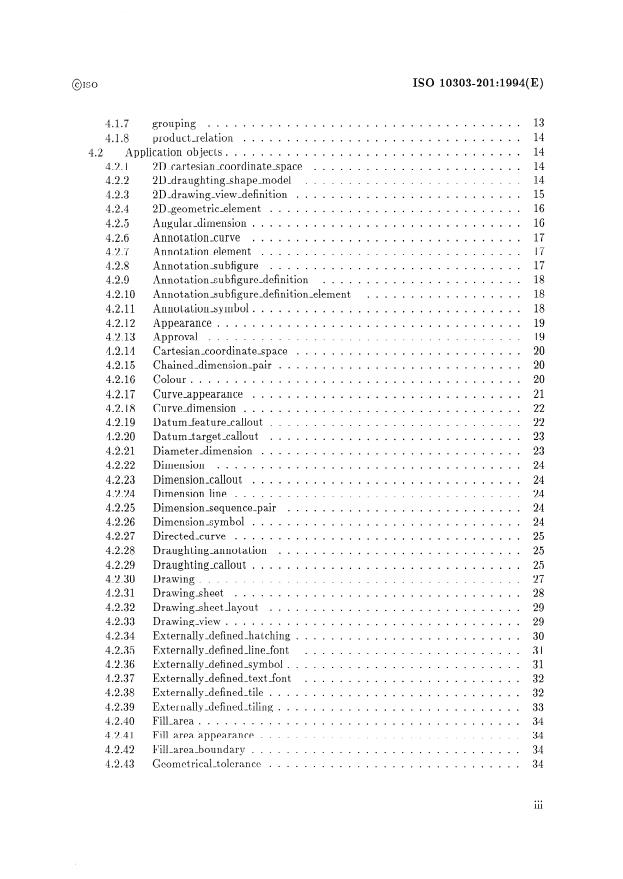
Application objects. .
42 .
........................
4.2.1 2Dcartesiancoordinatespace
‘ED-draughtingshape-model .
4.2.2
..........................
2D-drawing-view-definition
4.2.3
2D-geometrie-element .
4.2.4
Angular-dimension .
4.2.5
...............................
4.2.6 Annotation-curve
Annotationelement .
4.2.7
.............................
Annotationsubfigure
4.2.8
Annotationsubfigure-definition .
4.2.9
.................. 18
4.2.10 Annotationsubfigure-definitionelement
...............................
4.2.11 Annotationsymbol
Appearance .
4.2.12
....................................
4.2.13 Approval
Cartesian-coordinate-space .
4.2.14
............................
4.2.15 Chained-dimension-pair
Colour .
4.2.16
Curve-appearance .
4.2.17
................................
4.2.18 Curve-dimension
Datumfeature-callout .
4.2.19
.............................
4.2.20 Datum-target-callout
..............................
4.2.21 Diameter-dimension
4.2.22 Dimension .
...............................
4.2.23 Dimensioncallout
Dimensionline .
4.2.24
4.2.25 Dimension-sequence-pair .
Dimensionsymbol .
4.2.26
4.2.27 Directed-curve .
............................
4.2.28 Draughting-annotation
4.2.29 Draughting-callout .
4.2.30 Drawing .
Drawingsheet .
4.2.31
4.2.32 Drawingsheetlayout .
Drawing-view .
4.2.33
.......................... 30
4.2.34 Externally-defined-hatching
.........................
4.2.35 Externally-definedline-font
Externally-defined-Symbol .
4.2.36
......................... 32
4.2.37 Externally-defined-text font
Externally-defined-tile .
4.2.38
............................ 33
4.2.39 Externally-defined-tiling
.....................................
4.2.40 Fill-area
Fill-areaitppearance .
4.2.41
...............................
4.2.42 Fill-area-boundary
?
Geomctrical-tolerante .
4.2.43
. . .
c ISO
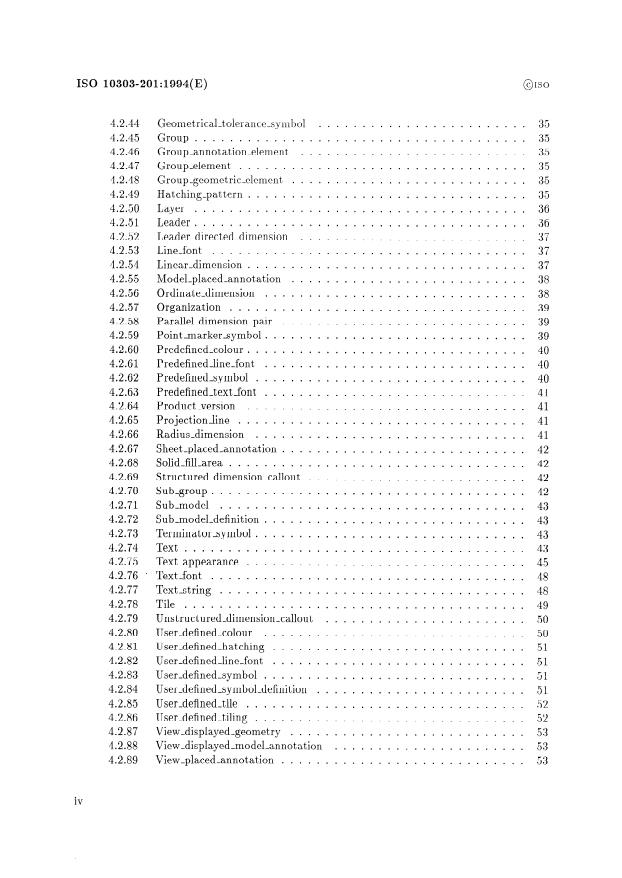
ISO 10303=201:1994(E) 0
4.2.44 Geometrical-tolerance-Symbol .
4.2.45 Group .
Gro-up-annot ation-element’ .
4.2.46
4.2.47 Group-element .
Group-geometrie-element .
4.2.48
4.2.49 Hatching-Pattern .
...................................... 36
4.2.50 Layer
4.2.51 Leader .
4.2.52 Leader-directed-dimension .
4.2.53 Line-font .
4.2.54 Lineardimension .
4.2.55 Model-placed-annotation .
4.2.56 Ordinate-dimension .
Organization 39
4.2.57 .
4.2.58 Parallel-dimension-pair .
4.2.59 Pointmarkersymbol .
Predefined-colour .
4.2.60
4.2.61 Predefinedline-font .
4.2.62 Predefined-Symbol .
4.2.63 Predefined-textfont .
Product:Version
4.2.64 .
4.2.65 Projectionline .
4.2.66 Radius-dimension .
Sheet-placed-annotation .
4.2.67
4.2.68 Solid-fill-area .
4.2.69 Structured-dimension-callout .
4.2.70 Sub-group .
4.2.71 Sub-model .
4.2.72 Submodel-definition .
4.2.73 Terminatorsymbol .
Text . 43
4.2.74
4.2.75 Text-appearance .
Textfont
4.2.76 .
4.2.77 Textstring
...................................
4.2.78 Tile .
4.2.79 Unstructured-dimension-callout .
4.2.80 User-defined-colour .
4.2.81 User-defined-hatching .
4.2.82 User-defined-line-font .
4.2.83 User-defined-Symbol .
User-defined-symbol-definition .
4.2.84
4.2.85 User-defined-tile .
User-defined-tiling 52
4.2.86 .
4.2.87 View-displayed-geometry . 53
4.2.88 View-displayed-model-annotation .
4.2.89 View-placed-annotation .
ISO 10303~201:1994(E)
c ISO
Visibility . . . . . . . . . . . . . . . . . . . . . . . . . . . . . . . . . . . . 53
4.2.90
. Application assertions . . . . . . . . . . . . . . . . . . . . . . . . . . . . . . . . 53
LD-draughtingshapemodel to 2D_geometric-element .
4.3.1
........ 54
4.3.2 2D-draughtingshape-model to Cartesian-coordinate-space
2D-draughtingshapemodel to Model-placed-annotation .
4.3.3
2D-draughtingshape-model to Sub-model .
4.3.4
.......... 54
4.3.5 2D-drawing-view-definition to View-displayed-geometry
..... 54
2D-drawing-view-definition to View-displayed-model-annotation
4.3.6
........................ 54
4.3.7 2D-geometrie-element to Layer
Angular-dimension to Dimension-line . 55
4.3.8
Angular-dimension to Projectionline .
4.3.9
................... 55
4.3.10 Annotation-curve to Curve-appearance
.......... 55
4.3.11 Annotationsubfigure to Annotation-subfigure-definition
..... 55
4.3.12 Annotationsubfigure-definition to 2D-cartesian-coordinate-space
Annotationsubfigure-definition to Annotation-subfigure-definition-element 55
4.3.13
.... 56
4.3.14 Annotationsubfigure-definitionelement to Draughting-annotation
..............
4.3.15 Annotationsubfigure-definitionelement to Layer
............ 56
4.3.16 Annotationsubfigure-definitionelement to Visibility
......................... 56
4.3.17 Annotationsymbol to Colour
4.3.18 Approval to Organkation .
......................... 56
4.3.19 Curve-appearance to Colour
........................
4.3.20 Curve-appearance to Line-font
4.3.21 Curve-dimension to Dimension-line .
...................... 57
4.3.22 Curve-dimension to Projectionline
4.3.23 Diameter-dimension to Dimensionline .
.................... 57
4.3.24 Diameter-dimension to Projectionline
....................... 57
4.3.25 Dimension to Dimension-callout
................... 57
4.3.26 Dimension to Dimension-sequence-pair
Dimensionline to Annotationsymbol .
4.3.27
4.3.28 Draughting-callout to Annotation-curve .
.................. 58
4.3.29 Draughting-callout to AnnotationSymbol
Draughting-callout to Directed-curve .
4.3.30
.......................... 58
4.3.31 Draughting-callout to Text
Drawing to Approval .
4.3.32
4.3.33 Drawing to Drawingsheet .
...........................
4.3.34 Drawing to Organkation
Drawing to Product-Version .
4.3.35
.............. 59
4.3.36 Drawing-sheet to 2D-cartesian-coordinate-space
Dra,wing-sheet to Approval .
4.3.37
Drawing-sheet to Drawing-view .
4.3.38
........................ 59
4.3.39 Drawingsheet to Organkation
Drawing-sheet to Sheet-placed-annotation .
4.3.40
............... 60
4.3.41 Drawing-view to 2D-cartesian-coordinate-space
Drawing-view to 2D-drawing-view-definition .
4.3.42
.................. 60
4.3.43 Drawing-view to View-placed-annotation
Fill-area to Fill-area-appearance .
4.3.44
V
4.3.45 Fill-area to Fill-area-boundary . . . . . . . . . . . . . . . . . . . . . . . . 60
................... 60
4.3.46 Fill-area-boundary to Annotation-curve
Group to Group-element . 60
4.3.47
4.3.48 Groupannotation-element to Draughting-annotation .
Group-geometrie-element to 2D-geometrie-element . 61
4.3.49
Hatching-Pattern to Curve-appearance . . 61
4.3.50
................ ............... 61
4.3.51 Layer to Visibility
4.3.52 Leader to Annotationsymbol . . 61
...... ............... 61
4.3.53 Leader-directed-dimension to Leader
4.3.54 Linear-dimension to Dimensionline . . 61
............... 62
4.3.55 Linear-dimension to Projectionline .
Model-placed-annotation to Layer . 62
4.3.56
............... 62
4.3.57 Model-placed-annotation to Visibility . . . . .
Ordinate-dimension to Projectionline . . . . . . 62
4.3.58
Product -Version to 2D-draughtingshape-model . 62
4.3.59
.
Product -Version to Organkation . . . . . . . . . 62
4.3.60
4.3.61 Radius-dimension to Dimensjonline . . 62
............... 63
4.3.62 Radius-dimension to Projectionline .
Sheet-placed-annotation to Layer . . 63
4.3.63
4.3.64 Sheet-placed-annotation to Visibility . . 63
Solid-fill-area to Colour . . 63
4.3.65
Structured-dimension-callout to Annotationsyr rbol . 63
4.3.66
...............
4.3.67 Structured-dimensioncallout to Textstring . . 63
Structured-dimension-callout to Draughting-cal out . 63
4.3.68
4.3.69 Sub-group to Group . . 64
Sub-model to Sub-model-definition . . 64
4.3.70
4.3.71 Text to Text-appearance . . 64
................ ...............
4.3.72 Text to Text-string 64
4.3.73 Text-appearance to Colour . . 64
Text -appearance to Text -font . .
4.3.74 64
4.3.75 Textstring to Text-appearance . . 64
4.3.76 Tile to Colour . . 65
Unstructured-dimension-callout to Draughting-callout . 65
4.3.77
4.3.78 User-defined-hatching to Hatching-Pattern . 65
User-defined-Symbol to User-defined-symbol-definition . 65
4.3.79
4.3.80 User-defined-symbol-definition to 2D-cartesian-coordinatespace . 65
4.3.81 User-defined-symbol-definition to Annotationelement .
4.3.82 User-defined-tile to User-defined-symbol-definition . 65
4.3.83 User-defined-tiling to Tile .
View-displaved-geometry to 2D-geometrie-element 66
4.3.84
4.3.85 View-displayed-geometry to Curve-appearance .
4.3.86 View-displayed-geometry to Visibility .
4.3.87 View-displayed-model-arm.otation to Appearance . 66
View-displayed-model-annotation to Model-placed-annotation 66
4.3.88 .
44.3.89 View-placed-annotation to La$ver . 6i’
4.3.90 View-placed-annotation to Visibilit,v . 67
.
c ISO
................................
5 Applica,tion interpreted model
51 Mapping table .
L.
‘
AIM EXPRESS short listing .
52 .
......................
5.2.1 explicit -draughting type definitions
..........................
5.2.2 explicit-draughting entities
explicit -draughting rule definitions .
5.2.3
...................
5.2.4 explicit -draughting function definitions
..................................
6 Conformance requirements
Annexes
AIM EXPRESS expanded listing .
A
B AIM short names .
Implementation method specific requirements .
C
.......... 324
D Protocol Implementation Conformance Statement (PICS) proforma
Information Object registration .
E
El . Document identification .
Schema identification .
E2 .
F Application activity model .
.............
Fl . Application activity model definitions and abbreviations
F.l.l 2D draughting shape model .
annotate drawing sheet
F.1.2 .
F.1.3 annotated drawing sheet .
F.1.4 annotated drawing view .
FA.5 approved drawing sheet .
F.1.6 CAD System*. .
changerequests*
F.1.7 .
F.1.8 configure 2D draughting shape model .
F.1.9 configure drawing .
; 327
F.l.10 configure drawing sheet . .
F.l.ll configure drawing view .
create drawing view
F.1.12 .
F.1.13 create model view .
......................
F.1.14 document drawing sheet approval
FA.15 document product .
F.1.16 draughting Standards* .
FL17 draughtsman* .
FA.18 drawing requirements* .
drawing sheet
FA.19 .
F.1.20 existing CAD drawing .
F.1.21 existing drawing sheet .
F.1.22 existing drawing view .
vii
c ISO
ISO 10303~201:1994(E)
................................... 328
F.1.23 model view
....................... 328
non-shape product information*
F.1.24
...................... 328
organization/project requirements*
F.1.25
.............................
FA.26 position drawing views
.............................. 328
F.l.27 product information
...................... 328
F.1.28 refined 2D draughting shape model
............................. 329
F.1.29 revised CAD drawing
..................... 329
F.l.30 select drawing sheet layout and size
......................... 329
F.1.31 sheet approval requirements*
..................... 329
F.1.32 sheet layout and size requirements*
..............................
F.1.33 sheet layout syrnbol
.............................. 329
F.1.34 sheet requirements”
................................
F.l.35 sheet with layout
................................ 329
sheet with views
F.1.36
.............................. 329
F.1.37 sheet without views
...............................
F.1.38 Symbols and fonts
........................... 329
F.1.39 unapproved drawing sheet
..........................
F.1.40 view location requirements*
............................... 329
F.1.41 view requirements*
........................ 330
F2 . Application activity model diagrams
G Application reference model . . . . . . . . . . . . . . . . . . . . . . . . . . . . . . . . 335
H AIM EXPRESS-G . . . . . . . . . . . . . . . . . . . . . . . . . . . . . . . . . . . . . 354
AIM EXPRESS listing . . . . . . . . . . . . . . . . . . . . . . . . . . . . . . . . . . . 407
J
K Bibliography . . . . . . . . . . . . . . . . . . . . . . . . . . . . . . . . . . . . . . . . 408
Index . . . . . . . . . . . . . . . . . . . . . . . . . . . . . . . . . . . . . . . . . . . . . . . 409
Figures
1 Data planning model . . . . . . . . . . . . . . . . . . . . . . . . . . . . . o . . . . . . xvi
2 Example of elements-of-annotation UoF . . . . . a . . . . . . . . . . . . . . . . . . .
3 Example of elements-of-draughting-annotation UoF . . . . . . . . . . . . . . . . . . 12
4 Angular and radius dimensions . . . . . . . . . . . . . . . . . . . . . . . . . . . . . .
. . . . . . . . . . . . . . . . . . . . . . . . . . . . . . . . 21
5 Chain dimension sequence
6 Curve dimension . . . . . . . . . . . . . . . . . . . . o . . . . . . . . . . . . . . e . . 22
7 Diameter dimension . . . . . . . . . . . . . . . . . . . . . . . . . . . . . . . . . . = . 23
8 Draughting callouts . . . . . I . . . u . o e u e e s . . e . D . . . . o . * . . . il 0 ,. 0 26
. . l . . . . . . . . e . . . . . . . . . e o . . m . . . o . e 37
9 Leader directed dimension
10 Ordinate dimension . . . . . . . . . . . . . D . . . . . * . . . c . . * . e I . . 0 e . 0 38
. . .
Vlll
ca1s0
v
............................... 40
11 Parallel dimension sequence
............................... 42
Structured dimension callout
Text characteristics . . . . . . . . . . . . . . . . . . . . . . . . . . . . . . . . . . . . 44
Mirror angle . . . . . . . . . . . . . . . . . . . . . . . . . . . . . . . . . . . . . . . . 46
Text appearance and rotation of text . . . . . . e . . . . . . . . . . . . . . . . . . . . 47
........................ 167
Illustration of predefined curve font lists
.............................. 177
17 Predefined dimension Symbols
........................ 181
18 Predefined geometrical tolerante Symbols
.............................
19 Predefined Point marker Symbols
20 Predefined terminator Symbols . . . . . . . e . . . . . . . . . . . . . . . . . . . . . . 186
Fl . IDEFO basic notation . . . . . . . . . . . . . . . . . . . . . . . . . . . . . . . . . . . 326
.................................. 331
F2 . A-O: document product
................................... 332
. AO: document product
F3
................................ 333
F4 . Al: configure drawing view
................................ 334
F5 . A2: configure drawing sheet
Gl . ARM diagram 1 of 15 . . . . . . . . . . . . . . . . . . . . . . . . . . . . . . . . . . . 336
G2 . ARM diagram 2 of 15 . . . . . . . . . . . . . . . . . . . . . . . . . . . . . . . . . . . 337
ARM diagram 3 of 15 . . . . . . . . . . . . . . . . . . . . . . . . . . . . . . . . . . . 338
G3 .
G4 . ARM diagram 4 of 15 . . . . . . . . . . . . . . . . . . . . . . . . . . . . . . . . . . . 339
G5 . ARM diagram 5 of 15 . . . . . . . . . . . . . . . . . . . . . . . . . . . . . . . . . . . 340
G6 . ARM diagram 6 of 15 . . . . . . . . . . . . . . . . . . . . . . . . . . . . . . . . . . . 341
G7 . ARM diagram 7 of 15 . . . . . . . . . . . . . . . . . . . . . . . . . . . . . . . . . . . 342
G8 . ARM diagram 8 of 15 . . . . . . . . . . . . . . . . . . . . . . . . . . . . . . . . . . . 343
G9 . ARM diagram 9 of 15 . . . . . . . . . . . . . . . . . . . . . . . . . . . . . . . . . . . 344
.................................. 345
G.lOARM diagram 10of 15.
.................................. 346
G.llARM diagram llof 15.
.................................. 347
G.12ARM diagram 12 of 15.
.................................. 348
G.13ARM diagram 130f 15.
.................................. 349
G.14ARMdiagram14of15.
G.15ARM diagram 150f 15. . 350
I-Kl. AIM EXPRESS-G diagram 1 of 52 . . . . . . . . . . . . . . . . . . . . . . . . . . . . 355
II.2 AIM EXPRESS-G diagram 2 of 52 . . . . . . . . . . . . . . . . . . . . . . . . . . . . 356
1x
c ISO
H.3 AIM EXPRESS-G diagram 3 of 52 . 357
H.4 AIM EXPRESS-G diagram 4 of 52 . 358
H.5 AIM EXPRESS-G diagram 5 of 52 . . . . . . . . . . . . . . . . . . . . . . . . . . . . 359
H.6 AIM EXPRESS-G diagram 6 of 52 .
H.7 AIM EXPRESS-G diagram 7 of 52 .
H.8 AIM EXPRESS-G diagram 8 of 52 . . . . . . . . . . . . . . . . . . . . . . . . . . . . 362
H.9 AIM EXPRESS-G diagram 9 of 52 . 363
H.10 AIM EXPRESS-G diagram 10 of 52 . 364
H.ll AIM EXPRESS-G diagram 11 of 52 .
H.12 AIM EXPRESS-G diagram 12 of 52 .
H.13 AIM EXPRESS-G diagram 13 of 52 .
H.14 AIM EXPRESS-G diagram 14 of 52 .
H.15 AIM EXPRESS-G diagram 15 of 52 . . . . . . . . . . . . . . . . . . . . . . . . . . . 369
H.16 AIM EXPRESS-G diagram 16 of 52 . , . 370
..........
H.17 AIM EXPRESS-G diagram 17 of 52 . * . e 371
H.18 AIM EXPRESS-G diagram 18 of 52 .
H.19 AIM EXPRESS-G diagram 19 of 52 . e . 373
H.20 AIM EXPRESS-G diagram 20 of 52 . 374
.............
H.21 AIM EXPRESS-G diagram 21 of 52 . o 0 375
H.22 AIM EXPRESS-G diagram 22 of 52 .
H.23 AIM EXPRESS-G diagram 23 of 52 . 377
e . 378
H.24 AIM EXPRESS-G diagram 24 of 52 .
H.25 AIM EXPRESS-G diagram 25 of 52 . 379
H.26 AIM EXPRESS-G diagram 26 of 52 .
H.27 AIM EXPRESS-G diagram. 27 of 52 .
I-I.28 AIM EXPRESS-G diagram 28 of 52 .
............ e .............. 383
H.29 AIM EXPRESS-G diagram 29 of 52
...... m .................... 384
H.30 AIM EXPRESS-G diagram 30 of 52
. e . o q v B . c . D D o . c . e 385
H.31 AIM EXPRESS-G diagram 31 of 52 a
IE-I.32 AIM EXPRESS-G diagram 32 of 52 . e . 386
Ir.33 AIM EXPRESS-G diagram 33 of 52 . e . , . 387
H.34 AIM EXPRESS-G diagram 34 of 52 . e . 388
X
ISO 10303=201:1994(E)
c ISO
H.35 AIM EXPRESS-G diagram 35 of 52 . 389
...........................
H.36 AIM EXPR.ESS-G diagram 36 of 52 390
H.37 AIM EX.PRESS-G diagram 37 of 52 .
I-T.38 AIM EXPRESS-G diagram 38 of 52 .
H . 39 . AIM EXPRESS-G diagram 39 of 52 . 393
H.40 AIM EXPRESS-G dia)gram 40 of 52 . 394
H.41 AIM EXPRESS-G diagram 41 of 52 . 395
H.42 AIM EXPRESS-G diagram 42 of 52 . 396
H.43 AIM EXPRESS-G diagram 43 of 52 .
H.44 AIM EXPRESS-G diagram 44 of 52 . 398
H.45 AIM EXPRESS-G diagram 45 of 52 .
H.46 AIM EXPRESS-G diagram 46 of 52 . 400
H.47 AIM EXPRESS-G diagram 47 of 52 . 401
H.48 AIM EXPRESS-G diagram 48 of 52 . 402
H.49 AIM EXPRESS-G diagram 49 of 52 . 403
H.50 AIM EXPRESS-G diagram 50 of 52 . 404
H.51 AIM EXPRESS-G diagram 51 of 52 . . . . . . . . . . . . . . . . . . . . . . . . . . . 405
H.52 AIM EXPRESS-G diagram 52 of 52 . . . . . . . . . . . . . . . . . . . . . . . . . . . 406
Tables
10 RGB colours for pre-defined colours . . . . . . . . . . . . . . . . . . . . . . . . . . . 166
11 Line Segment and space lengths for pre-defined curve fonts . 167
B.l AIM short names . 314
G.l Cross reference table for ARM diagrams . 351
c ISO
ISO 1030%201:1994(E)
Foreword
is a worldwide federation of national
The International Organization for Standardization (ISO)
Standards bodies (ISO member bodies). The work sf preparing International Standards is nor-
Esch member body interested in a subject
mally carried out through ISO technical committees.
for which a technical committee has been established has the right to be represented on that
committee. International organizations, governmental and non-governmental, in liaison with
ISO, also take part in the work. ISO collaborates closely with the International Electrotechnical
Commission (IEC) on all matters of electrotechnical standardization.
Draft International Standards adopted by technical comrnittees are circulated to the member
bodies for voting. Publication as an International Standard requires approval by at least 75%
of the member bodies casting a vote.
International Standard ISO 10303-201 was prepared by Technical Committee ISO/TC 184,
Industrial automation Systems and integration, Subcommittee SC4, Industrial data und global
manufacturing programming languages.
ISO 10303 consists of the following Parts under the general title Industrial automation Systems
and ilntegration - Product data representation and exchange:
Part 1, Overview and fundamental principles;
- Part 11, Description methods: The EXPRESS language reference manual;
Part 21, Implementation methods: Clear text encoding of the exchange structure;
Part 22, Implementation methods: Standard data access interface specification;
- Part 31, Conformance testing methodology and framework: General concepts;
- Part 32, Conformance testing methodology and framework: Requirements on testing
laboratories and client s;
-
Part 41, Integrated generic resources: Fundamentals of product description and support;
- Part 42, Integrated generic resources: Geometrie a,nd topological representation;
Part 43, Integrated generic resources: Representation structures;
- Part 44, Integrated generic resources: Product structure configuration;
-
Part 45, Integrated generic resources: Materials;
- Part 46, Integrated generic resources: Visual presentation;
- Part 47, Integrated generic resources: Shape Variation tolerantes;
xii
ISO 10303=201:1994(E)
c ISO
- Part 49, Integrated generic resources: Process structure and properties;
- Part 101, Integrated application resources: Draughting;
- Part 104, Integrated application resources: Finite element analysis;
- Part 105, Integrated application resources: Kinematics;
- Part 201, Application protocol: Explicit draughting;
- Part 202, Application protocol: Associative draughting;
- Part 203, Application protocol: Configuration controlled design;
- Part 207, Application protocol: Sheet metal die planning and design;
- Part 210, Application protocol: Printed circuit assembly product design data;
- Part 213, Application protocol: Numerital control process Plans for machined Parts.
The structure of this International Standard is described in ISO 10303-1. The numbering of the
Parts of this International Standard reflects its structure:
- Part 11 specifies the description methods;
- Parts 21 and 22 specify the implementation methods;
- Parts 31 and 32 specify the conformance testing methodology and framework;
- Parts 41 to 49 specify the integrated generic resources;
- Parts 101 to 105 specify the integrated application resources;
- Parts 201 to 213 specify the application protocols.
Should further Parts be published, they will follow the Same numbering Pattern.
Annexes A, B, C, D and E form an integral part of this part of ISO 10303. Annexes F, G, H, J
and K arc for information only.
Diskette
I.Jsers should note that this part of ISO 10303 comprises a diskette:
- the short names of entities given in annex B are also included on the diskette;
- the EXPRESS listings (annex A) are provided on the diskette only;
a method to enable users to report errors in the documentation is given. Full details are
provided in the file.
. . .
Xlll
ISO 10303~201:1994(E) @ISO
Introduction
ISO 10303 is an International Standard for the computer-interpretable representation and ex-
Change of product data. The objective is to provide a neutral mechanism capable of describing
product data throughout the life cycle of a product independent from any particular System.
The nature of this description makes it suitable not only for neutral file exchange, but also as a
basis for implementing and sharing product databases and archiving.
This International Standard is organized as a series of Parts, each published separately. The
description methods, integrated resources,
Parts of ISO 10303 fall into one of the following series:
application protocols, abstract test suites, implementation methods, and conformance testing.
The series are described in ISO 103034 This part of ISO 10303 is a member of the application
protocols series.
This part of ISO 10303 specifies an application protocol (AP) for the exchange of technical
CAD drawings consisting of two-dimensional geometry and two-dimensional annotation. This
part satisfies the need for the exchange of such drawings within and between organizations,
especially those operating in the mechanical engineering and architectural, engineering, and
construction industrial sectors.
The exchange of such drawings enables the communication of product data during all stages of
the lifecycle of a product for any product type. This product data, in the form of a CAD drawing,
may be interpreted by People according to accepted international, national, or organization
draughting Standards. The use of CAD drawings for the purposes of the communication of
product data is common practice in many industries. This product data may also be interpreted
by appropriate CAx Systems for use in applications other than draughting.
The nominal shape of a product is represented by geometry defined in two dimensions. Such
representations may be the result of the application of a projection transformation on a three-
dimensional shape representation; such three-dimensional shape representations, and the pro-
jection transformations that may be applied to produce a two-dimensional representation, lie
outside the scope of this part of ISO 10303.
This application protocol makes use of two fundamental concepts which relate to the creation,
revision, storage, and use of drawings produced using CAD Systems.
A CAD drawing is a digital representation of a drawing and may include the following, in
addition to lines and text presented on the face of the drawing:
representations of the shape(s) of the product(s) depicted by the drawing;
-
information used in administering drawings for purposes of configuraltion control, aludit
trails, etc.
The use of the shape representation present in the CAD drawing depends on the interpretation
of a draughtsman or engineer viewing the drawing. For this reason the concept of a dra)ughting
shape model is included. A draughting shape model is a representation of the sha,pe of a product
xiv
ISO 10303=201:1994(E)
c ISO
whose interpretation is determined through visual inspection of the drawings that depict the
product.
EXAMPLE 1 - An architectural drawing may contain both isometric and perspective views of a
building. The use of the two-dimensional representations depicted in these views depends on the
knowledge, in the mind of a designer, that the lengths of lines may be measured or calculated in the
isometric view but not in the perspective view.
This draughting shape model is also a nominal shape model; no information regarding tolerantes
is included in the draughting shape model.
Figure 1 contains the data planning model that provides a high-level description of the gen-
eral structure of this application protocol, as well as the relationships between the basic data
component s.
The data planning model illustrates th.at a product may be described by a draughting shape
model. The draughting shape model is a two-dimensional model generated by a CAD System.
This CAD model is composed of geometry which represents the shape of the product and may
also include annotation. The product is documented by a drawing.
The drawing is composed of drawing sheets that contain annotation and drawing views. The
drawing views are two-dimensional views of the draughting shape model that may include ad-
ditional annotation. Therefore, the drawing is a presentation of the draughting shape model.
Annotation, in the form of text and symbology, provides additional product data that is needed
to fully define the product or interpret the drawing. The scope of this application protocol
constrains the dimensionality of all data found within it to be two-dimensional only.
This application protocol defines the context, scope, and information requirements for exchange
of geometrically explicit two-dimensional technical CAD drawings with explicit annotation and
specifies the integrated resources necessary to satisfy these requirements.
Application protocols provide the basis for developing implernentations of ISO 10303 and ab-
stract test suites for the conformance testing of AP implernentations.
Clause 1 defines the scope of the application protocol and summarizes the functionality and
data covered by the AP. An application activity model that is the basis for the definition of
the scope is provided in annex F. The information requirements of the application are specified
in clause 4 using terminology appropriate to the application. A graphical representation of the
information requirements, referred to as the application reference model, is given in annex G.
Resource constructs are interpreted to meet the information requirements. This interpretation
produces the application interpreted model (AIM). Th’ 1s interpretation, given in 5.1, Shows
the correspondence between the information requirements and the AIM. The short listing of
the AIM specifies the interface to the integrated resources and is given in 5.2. Note that the
definitions and EXPRESS provided in the integrated resources for constructs used in the AIM
may include select list items and subtypes which are not imported into the AIM. The expanded
listing given in annex A contains the complete EXPRESS for the AIM without annotation. A
graphical representation of the AIM is given in annex H. Additional requirements for specific
c ISO
ISO 1030%201:1994(E)
imDlementation methods are given in annex C.
documents w
DRAWING
one or many
.
Zero, one, or many
is described by
one or many
consists of
,
2D
depicts b
DRAWING
DRAUGHTING
one
SHEET
SHAPE MODEL
many
contains Zero, one, or
i
\
DRAWING ,
VIEW
Zero, one, or many
is composed of
t
contains
1,
Zero, one, or many
2D contains
contains L, ANNOTATION - Zero, one, or many
+
Zero, one, or many
Figure 1 - Data planning model
xvi
ISO 10303=201:1994(E)
INTERNATIONAL STANDARD @ISO
Industrial automation Systems and integration -
Product data representation and exchange -
Part 201 :
Application protocol: Explicit draughting
1 Scope
This part of ISO 10303 specifies the use of the integrated resources necessary for the scope and
information requirement s for explicit draughting.
NOTE - The application activity model in annex F provides a graphical representation of the
processes and information flows which are the basis for the definition of the scope of this part of
ISO 10303.
This part of ISO 10303 is applicable to the inter-Organkation exchange of computer-interpretable
drawing information and product definition data.
The following are within the scope of this part of ISO 10303:
-
the representation of drawings for the purpose of exchange, especially for mechanical
engineering, architectural engineering, and construction applications;
-
the representation of the real size of a product depicted in a drawing to enable use by
applications where true geometric equivalence is required;
EXAMPLE 2 - The representation of the shape of the product is required to support not only
visual equivalence of exchanged drawings but also where true geometric equivalence is required by
the receiving System. Such uses include the calculations of distances or areas and the generation
of numerical control tool paths.
-
the representation of a drawing that depicts any Phase of the design;
-
t he represent ation of individual drawing revisions;
-
the representation of the two-dimensional draughting shape model depicting the product
shape and the transformations used for the generation of the drawing views;
-
the presentation of non-shape product definition data depicted in a drawing by two-
dimensional annot ation;
-
the hierarchical structure of drawings? drawing sheets, and views of the draughting shape
c ISO
ISO 10303~201:1994(E)
model;
mechanisms for the grouping of the elements depicted on a drawing;
-
the administrative data used for the purpose of drawing management;
-
the administrative data identifying the product Versions being documented by the draw-
mg.
The following are outside the scope of this part of ISO 10303:
-
the representation of the shape of a product using three-dimensional geometry;
-
the representation of the shape of a product that is not depicted in a drawing;
-
the representation of drawings that are not related to a product;
-
the exchange of drawing history;
-
the definition of annotation in three-dimensional coordinate Systems;
- the presentation of dimensions and annotation tha,t are associated to viewed geometry
and annotation;
-
a computer-interpretable bi11 of material structure except as conveyed by annotation on
t he drawing;
stritt enforcement of draughting Standards;
- drawings containing non-displayable at tribute data other than that required as admin-
strative data;
EXAMPLE 3 - Non-displayable attribute data could be density, mass, or moment of inertia.
-
the automatic generation of drawings including views, dimensions, and annotation.
-
the exchange of data used exclusively for the creation of Paper or or hardcopy Versions
of the drawing.
EXAMPLE 4 - Printer or Plotter data could be pen designations, plot scale, or plot color spec-
ifications.
ISO 10303=201:1994(E)
c ISO
2 Normative references
The following Standards contain provisions which, through reference in this text, constitute
provisions of this part of ISO 10303. At the time of publication, the editions indicated were
valid. All Standards are subject to revision, and Parties to agreements based on this part of
ISO IO303 alre encouraged to investigate the possibility of applying the most recent editions of
the Standards indicated below. Members of IEC and ISO maintain registers of currently valid
International Standards.
ISO 3098-1:1974, Tech.nical drawings - Lettering - Part 1: Currently used characters.
ISO/IEC 8824-l:-r), Information technology - Open Systems Interconnection - Abstract Syntax
Notation One (ASN.1) - Part 1: Specification of Basic Notation.
ISO 10303-1:1994, Industrial automation Systems and integration - Product data representation
and exchange - Parti: Overview and fundamental principles.
ISO 10303~11:1994, Industrial automation Systems and integration - Product data representa- .
tion and exchange - Part 11: Description methods: The EXPRESS language reference manual.
ISO 10303-21:1994, Industrial automation Systems and integration - Product data representa-
tion and exchange - Part 21: Implementation methods: Clear text encoding of the exchange
structure.
ISO 10303-31:1994, Industrial automation Systems and integration - Product data representa-
tio
...
Questions, Comments and Discussion
Ask us and Technical Secretary will try to provide an answer. You can facilitate discussion about the standard in here.
Loading comments...