


ISO 9319:2024
(Main)Traditional Chinese medicine — Poria cocos sclerotium
Traditional Chinese medicine — Poria cocos sclerotium
This document specifies the quality, safety requirements and test methods for Poria cocos sclerotium that is derived from the fungus Poria cocos (Schw.) Wolf. It is applicable to Poria cocos sclerotium sold and used as natural medicines in international trade, including Chinese materia medica (whole medicinal materials) and decoction pieces.
Médecine traditionnelle chinoise — Poria cocos sclerotium
General Information
- Status
- Published
- Publication Date
- 08-Feb-2024
- Technical Committee
- ISO/TC 249 - Traditional Chinese medicine
- Drafting Committee
- ISO/TC 249 - Traditional Chinese medicine
- Current Stage
- 6060 - International Standard published
- Start Date
- 09-Feb-2024
- Due Date
- 24-Nov-2024
- Completion Date
- 09-Feb-2024
Overview - ISO 9319:2024 (Poria cocos sclerotium)
ISO 9319:2024 is an international standard for Traditional Chinese Medicine - Poria cocos sclerotium. It specifies quality and safety requirements, sampling and test methods for the dried sclerotium of the fungus Poria cocos (Schw.) Wolf used as natural medicines, including Chinese materia medica (whole medicinal materials) and decoction pieces. The standard supports consistent product quality in international trade and helps address issues such as adulteration and variable processing or storage.
Key topics and technical requirements
The standard covers identification, quality limits and laboratory methods, including:
- Descriptions and trade forms: whole poria, cubic poria, sliced poria and powdered poria with macroscopic and morphological characteristics.
- Identification methods: macroscopic and microscopic examination (powder morphology, hyphae characteristics) and thin‑layer chromatography (TLC) matching with reference solutions.
- Chemical reactions: specified chemical colour reaction (e.g., iodinated potassium iodide produces a deep red colour on sample).
- Quantitative quality limits:
- Moisture: not more than 15.0% mass fraction.
- Total ash: not more than 2.0% mass fraction.
- Extractives: determination of ethanol‑soluble and water‑soluble extractives to assess extractable constituents.
- Marker compound: determination of marker compound(s) such as pachymic acid (method included).
- Safety testing: limits and test methods for heavy metals, pesticide residues and sulfur dioxide.
- Sampling, test reporting, packaging, storage and labelling: requirements to ensure integrity during trade and use.
- Informative annexes include TLC identification, pachymic acid determination and examples of national/regional values.
Applications - who uses ISO 9319 and why
ISO 9319 is practical for stakeholders across the supply chain:
- Manufacturers and processors of Poria cocos sclerotium - to standardize production, processing and product specifications.
- Quality control and analytical laboratories - to adopt validated test methods (microscopy, TLC, moisture, ash, pachymic acid, heavy metals, pesticide and SO2 testing).
- Exporters/importers and traders - to demonstrate compliance with an internationally recognized specification for raw material and decoction pieces.
- Regulators and pharmacopoeia authors - to harmonize national requirements and reduce trade barriers.
- Practitioners of Traditional Chinese Medicine - to ensure clinical safety and consistent therapeutic quality of materia medica.
Related standards
ISO 9319 references and aligns with other ISO TCM standards, including:
- ISO 18664 (heavy metals determination)
- ISO/TS 21310 (microscopic examination)
- ISO 21371 (labelling requirements)
- ISO 22217 (storage requirements)
- ISO 22258 (pesticide residues by GC)
- ISO 22590 (sulfur dioxide determination)
- ISO 23723 (general requirements for herbal raw materials)
Adoption of ISO 9319 improves supply-chain transparency, lab comparability and regulatory acceptance for Poria cocos sclerotium in global markets.
Get Certified
Connect with accredited certification bodies for this standard

BSI Group
BSI (British Standards Institution) is the business standards company that helps organizations make excellence a habit.

TÜV Rheinland
TÜV Rheinland is a leading international provider of technical services.

TÜV SÜD
TÜV SÜD is a trusted partner of choice for safety, security and sustainability solutions.
Sponsored listings
Frequently Asked Questions
ISO 9319:2024 is a standard published by the International Organization for Standardization (ISO). Its full title is "Traditional Chinese medicine — Poria cocos sclerotium". This standard covers: This document specifies the quality, safety requirements and test methods for Poria cocos sclerotium that is derived from the fungus Poria cocos (Schw.) Wolf. It is applicable to Poria cocos sclerotium sold and used as natural medicines in international trade, including Chinese materia medica (whole medicinal materials) and decoction pieces.
This document specifies the quality, safety requirements and test methods for Poria cocos sclerotium that is derived from the fungus Poria cocos (Schw.) Wolf. It is applicable to Poria cocos sclerotium sold and used as natural medicines in international trade, including Chinese materia medica (whole medicinal materials) and decoction pieces.
ISO 9319:2024 is classified under the following ICS (International Classification for Standards) categories: 11.120.10 - Medicaments. The ICS classification helps identify the subject area and facilitates finding related standards.
ISO 9319:2024 is available in PDF format for immediate download after purchase. The document can be added to your cart and obtained through the secure checkout process. Digital delivery ensures instant access to the complete standard document.
Standards Content (Sample)
International
Standard
ISO 9319
First edition
Traditional Chinese medicine —
2024-02
Poria cocos sclerotium
Médecine traditionnelle chinoise — Poria cocos sclerotium
Reference number
© ISO 2024
All rights reserved. Unless otherwise specified, or required in the context of its implementation, no part of this publication may
be reproduced or utilized otherwise in any form or by any means, electronic or mechanical, including photocopying, or posting on
the internet or an intranet, without prior written permission. Permission can be requested from either ISO at the address below
or ISO’s member body in the country of the requester.
ISO copyright office
CP 401 • Ch. de Blandonnet 8
CH-1214 Vernier, Geneva
Phone: +41 22 749 01 11
Email: copyright@iso.org
Website: www.iso.org
Published in Switzerland
ii
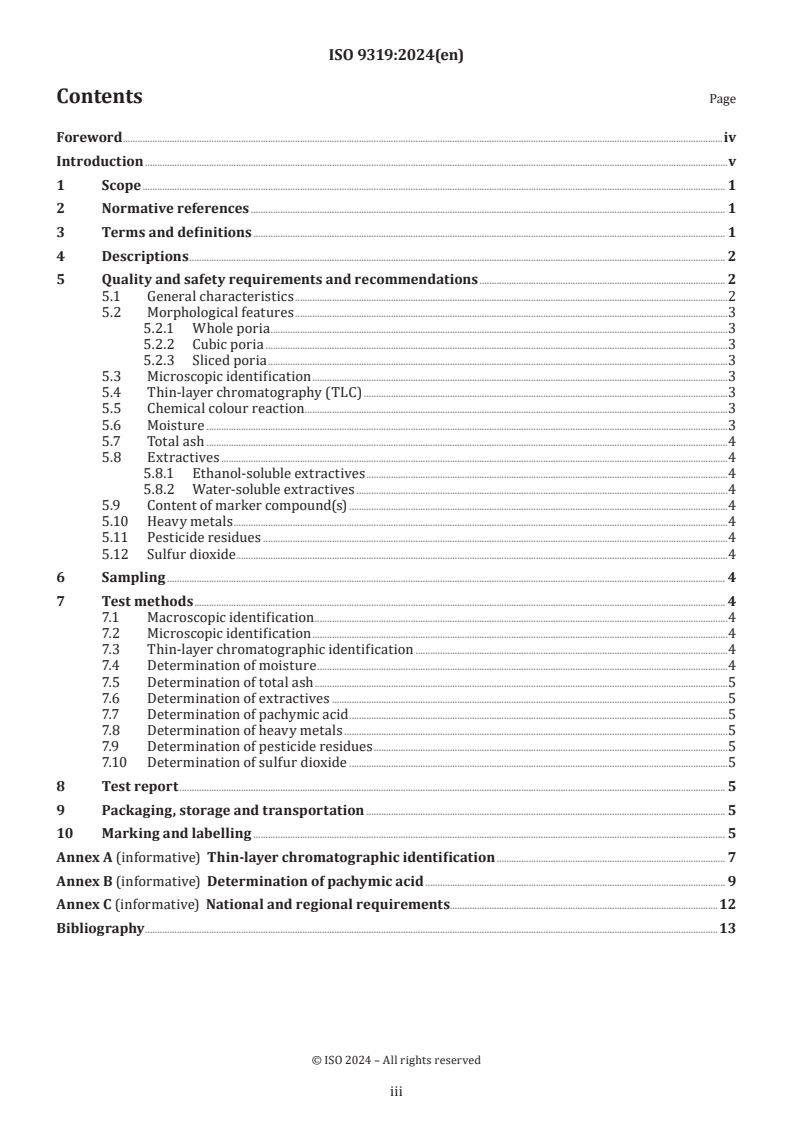
Contents Page
Foreword .iv
Introduction .v
1 Scope . 1
2 Normative references . 1
3 Terms and definitions . 1
4 Descriptions . 2
5 Quality and safety requirements and recommendations . 2
5.1 General characteristics .2
5.2 Morphological features .3
5.2.1 Whole poria .3
5.2.2 Cubic poria .3
5.2.3 Sliced poria .3
5.3 Microscopic identification .3
5.4 Thin-layer chromatography (TLC) .3
5.5 Chemical colour reaction .3
5.6 Moisture .3
5.7 Total ash .4
5.8 Extractives .4
5.8.1 Ethanol-soluble extractives .4
5.8.2 Water-soluble extractives .4
5.9 Content of marker compound(s) .4
5.10 Heavy metals .4
5.11 Pesticide residues .4
5.12 Sulfur dioxide . .4
6 Sampling . 4
7 Test methods . 4
7.1 Macroscopic identification .4
7.2 Microscopic identification .4
7.3 Thin-layer chromatographic identification .4
7.4 Determination of moisture .4
7.5 Determination of total ash .5
7.6 Determination of extractives .5
7.7 Determination of pachymic acid .5
7.8 Determination of heavy metals .5
7.9 Determination of pesticide residues .5
7.10 Determination of sulfur dioxide .5
8 Test report . 5
9 Packaging, storage and transportation . 5
10 Marking and labelling . 5
Annex A (informative) Thin-layer chromatographic identification . 7
Annex B (informative) Determination of pachymic acid . 9
Annex C (informative) National and regional requirements.12
Bibliography .13
iii
Foreword
ISO (the International Organization for Standardization) is a worldwide federation of national standards
bodies (ISO member bodies). The work of preparing International Standards is normally carried out through
ISO technical committees. Each member body interested in a subject for which a technical committee
has been established has the right to be represented on that committee. International organizations,
governmental and non-governmental, in liaison with ISO, also take part in the work. ISO collaborates closely
with the International Electrotechnical Commission (IEC) on all matters of electrotechnical standardization.
The procedures used to develop this document and those intended for its further maintenance are described
in the ISO/IEC Directives, Part 1. In particular, the different approval criteria needed for the different types
of ISO document should be noted. This document was drafted in accordance with the editorial rules of the
ISO/IEC Directives, Part 2 (see www.iso.org/directives).
ISO draws attention to the possibility that the implementation of this document may involve the use of (a)
patent(s). ISO takes no position concerning the evidence, validity or applicability of any claimed patent
rights in respect thereof. As of the date of publication of this document, ISO had not received notice of (a)
patent(s) which may be required to implement this document. However, implementers are cautioned that
this may not represent the latest information, which may be obtained from the patent database available at
www.iso.org/patents. ISO shall not be held responsible for identifying any or all such patent rights.
Any trade name used in this document is information given for the convenience of users and does not
constitute an endorsement.
For an explanation of the voluntary nature of standards, the meaning of ISO specific terms and expressions
related to conformity assessment, as well as information about ISO's adherence to the World Trade
Organization (WTO) principles in the Technical Barriers to Trade (TBT), see www.iso.org/iso/foreword.html.
This document was prepared by Technical Committee ISO/TC 249, Traditional Chinese medicine.
Any feedback or questions on this document should be directed to the user’s national standards body. A
complete listing of these bodies can be found at www.iso.org/members.html.
iv
Introduction
Poria cocos sclerotium is the dried sclerotium of the fungus Poria cocos (Schw.) Wolf (Polyporaceae). It is a
medicinal herb which has been widely used as functional food and crude drug to promote urination to drain
dampness, fortify the spleen and calm the heart in Asian countries for thousands of years.
The products of Poria cocos sclerotium are sold all over the world. There are at least 23 countries and
regions using Poria cocos sclerotium and its products. Major users include China, Japan, the Republic of
Korea, Viet Nam, Malaysia and Singapore. Factors including producing areas, processing, packaging and
storage conditions affect the quality of Poria cocos sclerotium. The quality of Poria cocos in the market can
be unstable.
[1]
Poria cocos sclerotium is recorded in the Pharmacopoeia of the People's Republic of China , the European
[5] [2] [4]
Pharmacopoeia , the Japanese Pharmacopoeia and the Korean Pharmacopoeia . However, the
requirements and test methods of Poria cocos in these national and regional standards are varied and can
cause barriers to international trade. In addition, due to its great demand in the global market, trade in
Poria cocos sclerotium can be complicated by adulteration and substitution issues. The establishment of
an International Standard for Poria cocos sclerotium is therefore necessary to ensure quality consistency,
support clinical safety and effectiveness and promote international trade.
As national implementation can differ, national standards bodies are invited to modify the values given in
5.6 and 5.7 in their national standards. Examples of national and regional values are given in Annex C.
v
International Standard ISO 9319:2024(en)
Traditional Chinese medicine — Poria cocos sclerotium
1 Scope
This document specifies the quality, safety requirements and test methods for Poria cocos sclerotium that is
derived from the fungus Poria cocos (Schw.) Wolf.
It is applicable to Poria cocos sclerotium sold and used as natural medicines in international trade, including
Chinese materia medica (whole medicinal materials) and decoction pieces.
2 Normative references
The following documents are referred to in the text in such a way that some or all of their content constitutes
requirements of this document. For dated references, only the edition cited applies. For undated references,
the latest edition of the referenced document (including any amendments) applies.
ISO 18664, Traditional Chinese Medicine — Determination of heavy metals in herbal medicines used in
Traditional Chinese Medicine
ISO/TS 21310, Traditional Chinese medicine — Microscopic examination of medicinal herbs
ISO 21371, Traditional Chinese medicine — Labelling requirements of products intended for oral or topical use
ISO 22217, Traditional Chinese medicine —Storage requirements for raw materials and decoction pieces
ISO 22258, Traditional Chinese medicine — Det
...
Questions, Comments and Discussion
Ask us and Technical Secretary will try to provide an answer. You can facilitate discussion about the standard in here.
Loading comments...