


ISO/TS 13131:2014
(Main)Health informatics — Telehealth services — Quality planning guidelines
Health informatics — Telehealth services — Quality planning guidelines
ISO/TS 13131:2014 provides advice and recommendations on how to develop quality objectives and guidelines for telehealth services that use information and communications technologies (ICTs) to deliver healthcare over both long and short distances by using a risk management process. The following key requirements are considered when developing quality objectives and guidelines for telehealth services: management of telehealth quality processes by the healthcare organization; management of financial resources to support telehealth services; processes relating to people such as workforce planning, healthcare planning, and responsibilities; provision of infrastructure and facilities resources for telehealth services; management of information and technology resources used in telehealth services.
Informatique de santé — Services de télésanté — Lignes directrices pour la planification de la qualité
General Information
- Status
- Withdrawn
- Publication Date
- 10-Dec-2014
- Withdrawal Date
- 10-Dec-2014
- Technical Committee
- ISO/TC 215 - Health informatics
- Drafting Committee
- ISO/TC 215/WG 2 - Systems and Device Interoperability
- Current Stage
- 9599 - Withdrawal of International Standard
- Start Date
- 28-May-2021
- Completion Date
- 12-Feb-2026
Relations
- Effective Date
- 09-Jun-2018


Get Certified
Connect with accredited certification bodies for this standard

BSI Group
BSI (British Standards Institution) is the business standards company that helps organizations make excellence a habit.

NYCE
Mexican standards and certification body.
Sponsored listings
Frequently Asked Questions
ISO/TS 13131:2014 is a technical specification published by the International Organization for Standardization (ISO). Its full title is "Health informatics — Telehealth services — Quality planning guidelines". This standard covers: ISO/TS 13131:2014 provides advice and recommendations on how to develop quality objectives and guidelines for telehealth services that use information and communications technologies (ICTs) to deliver healthcare over both long and short distances by using a risk management process. The following key requirements are considered when developing quality objectives and guidelines for telehealth services: management of telehealth quality processes by the healthcare organization; management of financial resources to support telehealth services; processes relating to people such as workforce planning, healthcare planning, and responsibilities; provision of infrastructure and facilities resources for telehealth services; management of information and technology resources used in telehealth services.
ISO/TS 13131:2014 provides advice and recommendations on how to develop quality objectives and guidelines for telehealth services that use information and communications technologies (ICTs) to deliver healthcare over both long and short distances by using a risk management process. The following key requirements are considered when developing quality objectives and guidelines for telehealth services: management of telehealth quality processes by the healthcare organization; management of financial resources to support telehealth services; processes relating to people such as workforce planning, healthcare planning, and responsibilities; provision of infrastructure and facilities resources for telehealth services; management of information and technology resources used in telehealth services.
ISO/TS 13131:2014 is classified under the following ICS (International Classification for Standards) categories: 35.240.80 - IT applications in health care technology. The ICS classification helps identify the subject area and facilitates finding related standards.
ISO/TS 13131:2014 has the following relationships with other standards: It is inter standard links to ISO 13131:2021. Understanding these relationships helps ensure you are using the most current and applicable version of the standard.
ISO/TS 13131:2014 is available in PDF format for immediate download after purchase. The document can be added to your cart and obtained through the secure checkout process. Digital delivery ensures instant access to the complete standard document.
Standards Content (Sample)
TECHNICAL ISO/TS
SPECIFICATION 13131
First edition
2014-12-15
Health informatics — Telehealth
services — Quality planning
guidelines
Informatique de santé — Services de télésanté — Lignes directrices
pour la planification de la qualité
Reference number
©
ISO 2014
© ISO 2014
All rights reserved. Unless otherwise specified, no part of this publication may be reproduced or utilized otherwise in any form
or by any means, electronic or mechanical, including photocopying, or posting on the internet or an intranet, without prior
written permission. Permission can be requested from either ISO at the address below or ISO’s member body in the country of
the requester.
ISO copyright office
Case postale 56 • CH-1211 Geneva 20
Tel. + 41 22 749 01 11
Fax + 41 22 749 09 47
E-mail copyright@iso.org
Web www.iso.org
Published in Switzerland
ii © ISO 2014 – All rights reserved
Contents Page
Foreword .v
Introduction .vi
1 Scope . 1
2 Normative references . 1
3 Terms and definitions . 1
3.1 Quality characteristics . 1
3.2 Actors . 3
3.3 Care . 5
3.4 Quality . 7
3.5 Risk . 8
3.6 Telehealth . 9
4 Conformance .10
5 Quality and risk management .10
5.1 Telehealth risk, safety and quality assessment .10
5.2 Telehealth quality characteristics .10
5.3 Management of quality characteristics .11
5.4 Establishing the context for telehealth services .12
5.5 Risk assessment — Identification .12
5.6 Risk assessment — Analysis .12
5.7 Risk assessment — Evaluation .12
5.8 Risk treatment and quality .13
6 Quality management of telehealth services .13
6.1 Quality characteristics .13
6.2 Services description .13
6.3 Processes description .14
6.4 Quality planning .14
6.5 Risk assessment .14
6.6 Risk treatment .15
6.7 Service improvement .15
6.8 Safety improvement .15
7 Financial management .15
7.1 Quality characteristics .15
7.2 Sustainability .16
7.3 Healthcare funds .16
8 Service planning .16
8.1 Quality characteristics .16
8.2 Service design .17
8.3 Service levels .17
8.4 Duration of care .17
9 Workforce planning.17
9.1 Quality characteristics .17
9.2 Workforce skills and training .18
9.3 Consultation with workforce .18
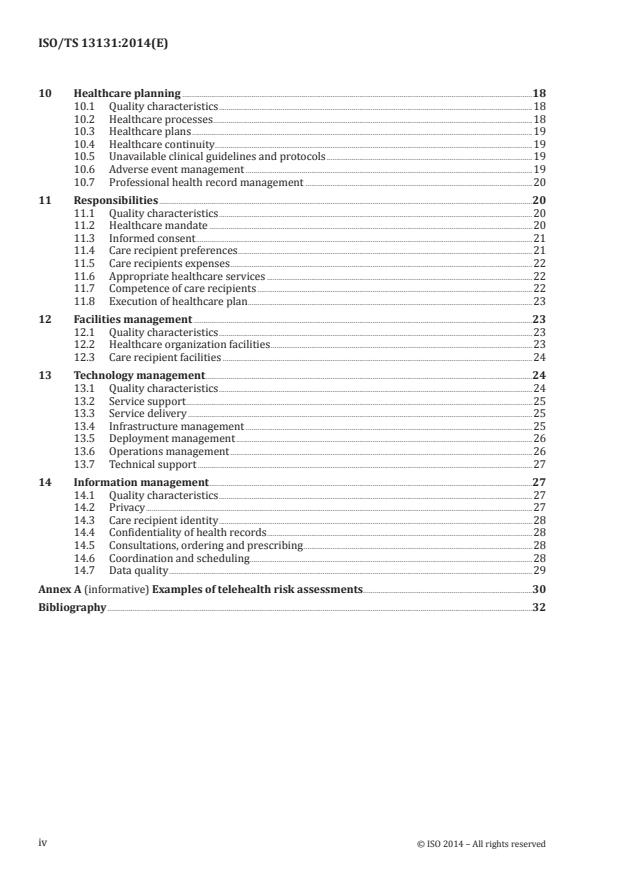
10 Healthcare planning .18
10.1 Quality characteristics .18
10.2 Healthcare processes .18
10.3 Healthcare plans .19
10.4 Healthcare continuity .19
10.5 Unavailable clinical guidelines and protocols .19
10.6 Adverse event management .19
10.7 Professional health record management .20
11 Responsibilities .20
11.1 Quality characteristics .20
11.2 Healthcare mandate .20
11.3 Informed consent .21
11.4 Care recipient preferences .21
11.5 Care recipients expenses .22
11.6 Appropriate healthcare services .22
11.7 Competence of care recipients .22
11.8 Execution of healthcare plan .23
12 Facilities management .23
12.1 Quality characteristics .23
12.2 Healthcare organization facilities .23
12.3 Care recipient facilities .24
13 Technology management .24
13.1 Quality characteristics .24
13.2 Service support .25
13.3 Service delivery .25
13.4 Infrastructure management .25
13.5 Deployment management .26
13.6 Operations management .26
13.7 Technical support .27
14 Information management .27
14.1 Quality characteristics .27
14.2 Privacy .27
14.3 Care recipient identity .28
14.4 Confidentiality of health records .28
14.5 Consultations, ordering and prescribing .28
14.6 Coordination and scheduling .28
14.7 Data quality .29
Annex A (informative) Examples of telehealth risk assessments .30
Bibliography .32
iv © ISO 2014 – All rights reserved
Foreword
ISO (the International Organization for Standardization) is a worldwide federation of national standards
bodies (ISO member bodies). The work of preparing International Standards is normally carried out
through ISO technical committees. Each member body interested in a subject for which a technical
committee has been established has the right to be represented on that committee. International
organizations, governmental and non-governmental, in liaison with ISO, also take part in the work.
ISO collaborates closely with the International Electrotechnical Commission (IEC) on all matters of
electrotechnical standardization.
The procedures used to develop this document and those intended for its further maintenance are
described in the ISO/IEC Directives, Part 1. In particular the different approval criteria needed for the
different types of ISO documents should be noted. This document was drafted in accordance with the
editorial rules of the ISO/IEC Directives, Part 2 (see www.iso.org/directives).
Attention is drawn to the possibility that some of the elements of this document may be the subject of
patent rights. ISO shall not be held responsible for identifying any or all such patent rights. Details of
any patent rights identified during the development of the document will be in the Introduction and/or
on the ISO list of patent declarations received (see www.iso.org/patents).
Any trade name used in this document is information given for the convenience of users and does not
constitute an endorsement.
For an explanation on the meaning of ISO specific terms and expressions related to conformity
assessment, as well as information about ISO’s adherence to the WTO principles in the Technical Barriers
to Trade (TBT) see the following URL: Foreword - Supplementary information
The committee responsible for this document is ISO/TC 215, Health Informatics.
Introduction
Aging populations are driving the demand for healthcare in many countries. Extended life expectancy
will bring increased health issues for many people. Health systems are seeking to lower the demand for
hospital beds by shortening the periods of hospitalization and providing more health care outside of the
acute sector. The acute sector can also be geographically concentrated in capital cities which increases
the potential demand for health services in primary care, community care settings, and preventative
health care. Despite such measures, the demand for healthcare professionals and resources is likely to
increase across all these care settings.
The use of information and communication technologies (ICT) is growing within the healthcare sector.
The applications for ICT include devices and equipment that have embedded software. Originally, ICT
was mainly used only within larger healthcare organizations, but has now spread throughout the
healthcare sector. Applications and devices that use many types of information and communication
technologies, including embedded software are now widely available for use in hospital clinics and the
homes of patients or clients.
Healthcare organizations and healthcare supporting organizations can provide or support healthcare
services using information and communications technologies (ICTs) to deliver health services and
transmit health information over both long and short distances. The use of ICT in this way is known as
telehealth or telemedicine services.
Although the use of ICT applications to deliver health care in community settings, in patient’s homes,
and connect healthcare professionals is seen as advantageous, there are additional risks to the quality
of health care services when delivered at a distance using ICT. This Technical Specification provides
guidelines on the development of quality plans to manage these risks. These guidelines are intended for
use by healthcare organizations and healthcare supporting organizations.
A quality plan identifies the desired quality characteristics, related quality objectives, and quality
procedures. This Technical Specification provides examples of generally applicable quality plans
applicable to telehealth services.
vi © ISO 2014 – All rights reserved
TECHNICAL SPECIFICATION ISO/TS 13131:2014(E)
Health informatics — Telehealth services — Quality
planning guidelines
1 Scope
A growing number of initiatives in various countries around the world, most of them small-scale, are
described as telehealth or telemedicine or m-health projects. It is not yet clear when the term telehealth
or telemedicine should be used to describe such initiatives, because these terms can be described and
interpreted in different ways in the absence of a unifying concept.
Telehealth is the use of information and communications technologies to deliver healthcare and transmit
health information over both long and short distances. Telehealth is a form of care provision that extends
the reach of care, reduces the need for care recipient or client travel and mobility, supports choice in
healthcare service delivery, preventative care, individual self-care, and may also increase the efficiency
of care. Currently telemedicine is seen as a providing a subset of a broader suite of telehealth services.
Telehealth also includes ICT applications that support a wider set of activities including educational and
administrative use.
This Technical Specification provides advice and recommendations on how to develop quality objectives
and guidelines for telehealth services that that use information and communications technologies
(ICTs) to deliver healthcare over both long and short distances by using a risk management process.
The following key requirements are considered when developing quality objectives and guidelines for
telehealth services:
— management of telehealth quality processes by the healthcare organization;
— management of financial resources to support telehealth services;
— processes relating to people such as workforce planning, healthcare planning, and responsibilities;
— provision of infrastructure and facilities resources for telehealth services;
— management of information and technology resources used in telehealth services.
2 Normative references
The following documents, in whole or in part, are normatively referenced in this document and are
indispensable for its application. For dated references, only the edition cited applies. For undated
references, the latest edition of the referenced document (including any amendments) applies.
ISO 31000:2009, Risk management — Principles and guidelines
3 Terms and definitions
For the purposes of this document, the following terms and definitions apply.
3.1 Quality characteristics
3.1.1
accessibility
usability of a product, service, environment, or facility by people within the widest range of capabilities
EXAMPLE Accessibility of healthcare for recipients.
[SOURCE: Based on ISO 9241-20]
3.1.2
accountability
responsibility of an organization for its decisions and activities, and state of being answerable to its
governing bodies, legal authorities, and, more broadly, its other stakeholders regarding these decisions
and activities
EXAMPLE Accountability for healthcare activities delivered by a healthcare organization.
[SOURCE: ISO 26000, 2.1, modified]
3.1.3
appropriateness
extent to which healthcare activities enable care recipients to achieve specified objectives
EXAMPLE Appropriateness of a healthcare activity for care recipients and healthcare organizations.
[SOURCE: ISO/IEC 25010, modified]
3.1.4
competency
ability to apply knowledge and skills to achieve intended results
EXAMPLE Competency to participate in healthcare activities of care recipients or healthcare professionals.
[SOURCE: ISO/IEC 17021:2011, 3.7]
3.1.5
confidentiality
extent to which information is not made available or disclosed to unauthorized entities
Note 1 to entry: In this context, entities include individuals, processes, and healthcare actors.
EXAMPLE Confidentiality of information to maintain the privacy of the care recipient in society or social life.
[SOURCE: ISO/IEC 27000:2014, modified]
3.1.6
continuity
component of patient care quality consisting of the degree to which the care needed by a patient is
coordinated among practitioners and across organizations and time
EXAMPLE Continuity of healthcare especially when several healthcare professionals or organizations share
the delivery of services to a single care recipient.
[SOURCE: ISO/TR 18307:2001]
3.1.7
dependability
collective term used to describe the availability performance and its influencing factors, reliability
performance, maintainability performance, and maintenance support performance
EXAMPLE Dependability of healthcare for care recipients and healthcare organizations.
[SOURCE: ISO 9000:2005, 3.5.3]
3.1.8
effectiveness
extent to which planned activities are realized and planned results achieved
EXAMPLE Effectiveness of healthcare activities in improving the quality of life and health outcomes of care
recipients and their informal caregivers.
[SOURCE: ISO 9000:2005, 3.2.14]
2 © ISO 2014 – All rights reserved
3.1.9
efficiency
relationship between the results achieved and how well the resources have been used
EXAMPLE Efficiency of healthcare activities in improving the quality of life and health outcomes of care
recipients and healthcare providers.
[SOURCE: ISO/IEC 27000:2014, 2.14]
3.1.10
inclusivity
intention or policy of including people who might otherwise be excluded or marginalized, such as the
handicapped, learning-disabled, or racial and sexual minorities
EXAMPLE Inclusivity of the care recipient in society or social life.
Note 1 to entry: Refer to ISO 26000 for further discussion of this concept.
[SOURCE: The Oxford Pocket Dictionary of Current English, 2009]
3.1.11
safety
freedom from unacceptable risk or harm
EXAMPLE Safety measures that maintain the health of care recipients and healthcare professionals.
[SOURCE: ISO/IEC Guide 51:1999, modified]
3.1.12
transparency
openness about decisions and activities that affect the care recipient, and willingness to communicate
these in a clear, accurate, timely, honest, and complete manner
EXAMPLE Transparency of healthcare activities.
[SOURCE: ISO 26000:2010, 2.1.24, modified]
3.1.13
usability
extent to which a product can be used by specified users to achieve specified goals with effectiveness,
efficiency, and satisfaction in a specified context of use
EXAMPLE Usability of the systems providing healthcare for care recipients and healthcare professionals.
[SOURCE: ISO 9241:2011]
3.2 Actors
3.2.1
care recipient
person seeking to receive, receiving, or having received healthcare
Note 1 to entry: Based on ISO 13940:—, 5.2.1 definition of subject of care
3.2.2
client
person seeking to receive, receiving, or having received healthcare
EXAMPLE A client may have a contract or agreement for the provision of healthcare using telehealth. If the
subject of care is not capable of engaging in an agreement, a subject of care proxy or a legally authorized proxy
may act on behalf of the client.
[SOURCE: Based on ISO 13940:—, 5.2.1]
3.2.3
healthcare actor
organization or person participating in healthcare
Note 1 to entry: An individual person may be regarded as a legal entity in some situations depending on the
service being delivered and the relevant national legislation.
[SOURCE: Based on ISO 13940:—, 5.2]
3.2.4
healthcare organization
organization whose healthcare personnel participate in the direct provision of healthcare
EXAMPLE A care team, a group practice, a hospital department, a self employed healthcare professional.
[SOURCE: ISO 13940:—, 5.2.2.1]
3.2.5
healthcare professional
healthcare personnel having a healthcare professional entitlement in a given jurisdiction
[SOURCE: ISO 13940:—, 5.2.3.2]
3.2.6
healthcare supporting organization
healthcare third party having organizational role
EXAMPLE Public health organization; organization that focus on wellness, fitness, and/or prevention, a
homecare service organization, a health insurance fund, the operator of a telehealth service.
[SOURCE: ISO 13940:—, 5.2.4.2]
3.2.7
healthcare third party
healthcare actor other than a healthcare organization, professional, or the subject of care
EXAMPLE Spouse, neighbour, family members, and friends.
Note 1 to entry: This Technical Specification may use the following term as a synonym: informal caregiver.
[SOURCE: ISO 13940:—, 5.2.3, modified]
3.2.8
informal care giver
healthcare third party having person role
EXAMPLE A relative (family member), a neighbour.
[SOURCE: ISO 13940:—, 5.2.3.1, modified]
3.2.9
organization
group of people and facilities with an arrangement of responsibilities, authorities, and relationships
[SOURCE: ISO 9000:2005, 3.3.1]
3.2.10
person
human being regarded as an individual
Note 1 to entry: An individual person is not intended to also be regarded as a legal entity for legislative purposes.
[SOURCE: The Oxford Pocket Dictionary of Current English, 2009]
4 © ISO 2014 – All rights reserved
3.2.11
subject of care
person seeking to receive, receiving, or having received healthcare
Note 1 to entry: This Technical Specification may use the following terms as synonyms: subject of healthcare,
patient, client, care recipient
Note 2 to entry: In applying this Technical Specification, it is possible that the subject of care may be considered
to be a group of people.
[SOURCE: ISO 13940:—, 5.2.1, modified]
3.2.12
subject of care proxy
person having the right to take decisions on behalf of the subject of care
[SOURCE: ISO 13940:—, 5.2.3.3, modified]
3.3 Care
3.3.1
adverse event
unintended event that may negatively influence a healthcare process
[SOURCE: ISO 13940:—, 8.2.4]
3.3.2
authorization by law
provision in legislation that in certain circumstances may overrule the need for informed consent
[SOURCE: ISO 13940:—, 11.2.7]
3.3.3
clinical guidelines
set of systematically developed statements to assist the decisions made by healthcare actors about
healthcare activities to be performed with regard to specified health issues
[SOURCE: ISO 13940:—, 9.2.4]
3.3.4
consent competence
capability of the subject of care and/or the subject of care proxy to give informed consent or dissent
[SOURCE: ISO 13940:—, 11.2.5.1]
3.3.5
guideline
systematically developed requirements to assist decisions
Note 1 to entry: Guidelines should be structured and contain requirements that can be verified through the
provision of objective evidence.
[SOURCE: ISO 9000:2005, 3.8.4, modified]
3.3.6
health record
data repository regarding the health and healthcare of a subject of care
[SOURCE: ISO 13940:—, 12.2]
3.3.7
healthcare
care activities, services, or supplies related to the health of an individual
[SOURCE: ISO 13940:—, 3.1.1]
3.3.8
healthcare activity
activity performed for a subject of care with the intention of directly or indirectly improving or
maintaining the health state of the subject of care
Note 1 to entry: See ISO 13940:—, 6.2.1.1.2 for a detailed definition of health state.
[SOURCE: ISO 13940:—, 7.2]
3.3.9
healthcare funds
funds provided for healthcare delivery
[SOURCE: ISO 13940:—, 5.2.4]
3.3.10
healthcare mandate
mandate (commission) based on a commitment and either an informed consent or an authorization
by law, defining the rights and obligations of one healthcare actor with regard to their involvement in
healthcare processes performed for a specific subject of care
[SOURCE: ISO 13940:—, 11.2]
3.3.11
healthcare needs assessment
healthcare assessment during which a healthcare professional considers a subject of care’s health need
and determines the needed healthcare activities
[SOURCE: ISO 13940:—, 7.2.4.4.1]
3.3.12
healthcare plan
dynamic, personalized plan including identified needed healthcare activities, health objectives, and
healthcare goals, relating to one or more specified health issues in a healthcare process
[SOURCE: ISO 13940:—, 9.2]
3.3.13
healthcare process
set of interrelated or interacting healthcare activities which transform inputs into outputs
[SOURCE: ISO 13940:—, 8.2]
3.3.14
healthcare service
service that is the result of a healthcare process
[SOURCE: ISO 13940:—, 8.2.5]
3.3.15
informed consent
permission to perform healthcare activities, voluntarily given by a subject of care having consent
competence or by a subject of care proxy, after having been informed about the purpose and the possible
results of the healthcare activities
[SOURCE: ISO 13940:—, 11.2.5.1]
6 © ISO 2014 – All rights reserved
3.3.16
procedure
specified way to carry out an activity or process
[SOURCE: ISO 9000:2005, 3.4.5]
3.3.17
process
set of interrelated or interacting activities which transform inputs into outputs
[SOURCE: ISO 9000:2005]
3.3.18
professional health record
health record held under the responsibility of one healthcare organization and maintained by one or
several healthcare professionals
[SOURCE: Based on ISO 13940:—, 12.2.1]
3.3.19
protocols
customized guidelines
[SOURCE: ISO 13940:—, 9.4.2.1]
3.4 Quality
3.4.1
quality
degree to which a set of inherent characteristics of a product, fulfils requirements
[SOURCE: ISO 9000:2005, 3.1.1]
3.4.2
quality characteristic
inherent characteristic of a product, process, or system related to a requirement
Note 1 to entry: Refer to ISO 9001:2005 for definitions of subsidiary terms.
[SOURCE: ISO 9000:2005, 3.5.2]
3.4.3
quality management
coordinated activities to direct and control an organization with regard to quality
[SOURCE: ISO 9000:2005, 3.2.8]
3.4.4
quality management system
management system to direct and control an organization with regard to quality
[SOURCE: ISO 9000:2005, 3.2.10]
3.4.5
quality manual
document specifying the quality management system of an organization
[SOURCE: ISO 9000:2005, 3.7.4]
3.4.6
quality objective
something sought, or aimed for, related to quality
[SOURCE: ISO 9000:2005, 3.2.5]
3.4.7
quality plan
document specifying which procedures and associated resources shall be applied by whom and when to
a specific project, product process or contract
Note 1 to entry: Quality plans should be structured and contain requirements that can be verified using procedures
that provide objective evidence.
[SOURCE: ISO 9000:2005, 3.8.4, modified]
3.4.8
quality procedure
specified way to carry out an activity or process to manage quality
[SOURCE: ISO 9000:2005, 3.4.5, modified]
3.4.9
requirement
need or expectation that is stated, generally implied or obligatory
[SOURCE: ISO 9000:2005, 3.1.2]
3.5 Risk
3.5.1
residual risk
risk remaining after risk treatment
[SOURCE: ISO 31000:2009, 2.27]
3.5.2
risk
effect of uncertainty on objectives
[SOURCE: ISO 31000:2009, 2.1]
3.5.3
risk analysis
process to comprehend the nature of risk and to determine the level of risk
[SOURCE: ISO 31000:2009, 2.21]
3.5.4
risk assessment
overall process of risk identification, risk analysis, and risk evaluation
[SOURCE: ISO 31000:2009, 2.14]
3.5.5
risk criteria
terms of reference against which the significance of a risk is evaluated
[SOURCE: ISO 31000:2009, 2.22]
8 © ISO 2014 – All rights reserved
3.5.6
risk evaluation
process of comparing the results of risk analysis with risk criteria to determine whether the risk and/or
its magnitude is acceptable or tolerable
[SOURCE: ISO 31000:2009, 2.24]
3.5.7
risk identification
process of finding, recognizing, and describing risks
[SOURCE: ISO 31000:2009, 2.15]
3.5.8
risk management
coordinated activities to direct and control an organization with regard to risk
[SOURCE: ISO 31000:2009, 2.2]
3.5.9
risk management process
systematic application of management policies, procedures, and practices to the activities of
communicating, consulting, establishing the context, and identifying, analyzing, evaluating, treating,
monitoring, and reviewing risk
[SOURCE: ISO 31000:2009, 2.8]
3.5.10
risk treatment
process to modify risk
[SOURCE: ISO 31000:2009, 2.25]
3.6 Telehealth
3.6.1
ICT
information and communication technology, sometimes also referred to as information technology
3.6.2
telehealth
information and communications technologies to deliver healthcare and transmit health information
over both long and short distances
EXAMPLE Telehealth may use information and communications technologies to transmit video, voice, data,
images, and other forms of information.
Note 1 to entry: Telehealth may be used to bridge short or long distances. It is also possible that differences in time
are bridged, using asynchronous communications.
Note 2 to entry: It is possible that prior to, or following transmission, data or information is processed in order to
enhance the telehealth service.
3.6.3
telehealth service
healthcare activity undertaken using telehealth
EXAMPLE It is possible that the subject of care is not directly involved in a telehealth service, e.g. in the case
of teledermatology where one physician consults another physician who is at a distant location.
Note 1 to entry: Telehealth services may support treatment, preventive (educational) and curative aspects of
healthcare, the performance of administrative functions.
Note 2 to entry: A healthcare organization or healthcare supporting organization may use telehealth to provide
or support healthcare.
4 Conformance
This Technical Specification provides guidance and recommendations and is not intended to be used for
certification, regulatory, or contractual purposes.
The design and implementation of risk management, safety, and quality management frameworks
specific to telehealth should take into account the varying needs of a specific organization, its particular
objectives, context, structure, operations, processes, functions, projects, products, services, or assets
and specific practices employed. This Technical Specification provides generic quality objectives and
guidelines for telehealth services that can be adapted as required for application across very different
organizations and services.
This Technical Specification should be used to supplement existing international and national standards
and guidelines for safety, quality, and risk management in the health sector. In particular, the use of other
standards, when applicable in telehealth settings is encouraged including ISO 13485 and IEC/ISO 80001.
In addition to the below-mentioned standards, general legislation, quality and safety practices that may
be applicable in certain countries, whether or not specific to the domain of healthcare should be taken
into account when implementing quality objectives and guidelines.
5 Quality and risk management
5.1 Telehealth risk, safety and quality assessment
Many healthcare organizations have put in place quality management systems to actively manage patient
safety and healthcare quality. These systems draw upon the quality management principles and
processes described in ISO 9000, ISO 9001 and ISO 9004. This Technical Specification recommends
the application of ISO 9000, ISO 9001 and ISO 9004 processes in telehealth services. In particular, this
Technical Specification adopts the recommendation in ISO 9004 to use ISO 31000 to help organizations
identify, assess and manage risks when developing appropriate quality objectives for telehealth services.
Organizational objectives, strategies, scope and parameters of the services provided by an organization
shall be established in accordance with ISO 31000. The risks that may then prevent the achievement
of organizational objectives can be identified by analysing factors external to and internal to the
organization.
ISO 31000 guidelines require these risks to be analysed, prioritized, and risk treatments established. In
a quality management system, these risk treatments can then become the basis for quality objectives
that are used to control the identified risks.
ISO 9004 recommends that an organization should identify the internal and external resources that are
needed for the achievement of the organization’s objectives in the short and long term. This Technical
Specification supports the use of this recommendation when deriving generic quality objectives
and guidelines for telehealth services. The objectives and guidelines in this Technical Specification
support quality and financial management, service planning, workforce planning, healthcare planning,
healthcare organization responsibilities, facilities, technology, and information management to deliver
healthcare and transmit health information. This Technical Specification does not provide advice for the
full implementation of ISO 9004 in a telehealth context.
5.2 Telehealth quality characteristics
Telehealth can support a broad range of healthcare activities that are not restricted to only to
recipients receiving health treatments. In general, telehealth services aim to support healthcare
quality characteristics that improve the quality of life and quality of care for care recipients. The
quality characteristics considered by this Technical Specification include: accessibility, accountability,
10 © ISO 2014 – All rights reserved
appropriateness, competency, confidentiality, continuity, dependability, effectiveness, efficiency,
inclusivity, safety, transparency, and usability.
In general, the quality characteristics desirable for health services delivery without the use of telehealth
should also apply in situations where telehealth is used. Some quality characteristics can become more
important to consider when telehealth is used for delivering health services.
5.3 Management of quality characteristics
An organization should have a quality management system in place to define and monitor the required
quality characteristics of telehealth services.
The processes that impact quality and financial management, service planning, workforce planning,
healthcare planning, healthcare organization responsibilities, facilities, technology, and information
management should be analysed for identifiable risks that may impact a range of quality characteristics
such as accessibility, accountability, appropriateness, competency, confidentiality, continuity,
dependability, effectiveness, efficiency, inclusivity, safety, transparency, and usability.
Usually only a small number of these characteristics will be relevant to the development of an individual
quality guideline.
The process to derive quality objectives and guidelines for the organization, people, facili
...
Questions, Comments and Discussion
Ask us and Technical Secretary will try to provide an answer. You can facilitate discussion about the standard in here.
Loading comments...