

ISO 19642-3:2019
(Main)Road vehicles — Automotive cables — Part 3: Dimensions and requirements for 30 V a.c. or 60 V d.c. single core copper conductor cables
General Information
- Abstract
This document specifies the dimensions and requirements for single-core cables intended for general purpose vehicle applications where the nominal system voltage is less than or equal to 30 V a.c. or less than or equal to 60 V d.c.. It also applies to individual cores in multi-core cables. This document specifies requirements for copper conductor cables. This edition is a successor standard to ISO 6722-1, ISO 6722-2, and ISO 14572.
- Status
- Published
- Publication Date
- 29-Jan-2019
- Technical Committee
- ISO/TC 22/SC 32 - Electrical and electronic components and general system aspects
- Drafting Committee
- ISO/TC 22/SC 32/WG 4 - Automotive electrical cables
- Current Stage
- 9092 - International Standard to be revised
- Start Date
- 23-Jul-2025
- Completion Date
- 29-Aug-2026
Buy Documents


ISO 19642-3:2019 - Road vehicles -- Automotive cables
ISO 19642-3:2019 - Road vehicles — Automotive cables — Part 3: Dimensions and requirements for 30 V a.c. or 60 V d.c. single core copper conductor cables/30/2019
Overview
ISO 19642-3:2019 - Road vehicles - Automotive cables - Part 3: Dimensions and requirements for 30 V a.c. or 60 V d.c. single core copper conductor cables - defines physical and performance requirements for single‑core copper automotive cables used in vehicle electrical systems with nominal voltages ≤ 30 V a.c. or ≤ 60 V d.c.. The standard covers both standalone single‑core cables and individual cores within multi‑core assemblies, specifying conductor materials, dimensional limits, insulation classes and the required test regime.
Key topics and technical requirements
- Voltage and scope: Intended for general‑purpose vehicle wiring up to 30 V a.c. / 60 V d.c. and for copper conductors only.
- Conductor materials: Plain or coated copper strands per recognized specifications (e.g., ASTM B1, B3, B33, B298, B355, EN 13602). Material and elongation requirements are agreed between supplier and customer where applicable.
- Conductor dimensions and CSA: Cross‑sectional area (CSA), conductor diameter and strand configurations are standardized or referenced; finished cable must meet CSA and resistance requirements.
- Insulation types: Three insulation wall classes - thick wall, thin wall, and ultra‑thin wall - with minimum thicknesses defined per conductor size.
- Temperature classes: All temperature classes from ISO 19642‑1 apply; high temperature applications may use silver or nickel‑coated conductors.
- Testing framework: Test methods are specified in ISO 19642‑2 and include dimensional, electrical (conductor resistance, withstand voltage, volume resistivity), mechanical (strip force, abrasion, breaking force, cyclic bending), and environmental tests (heat ageing, thermal overload, cold impact, humidity cycling, chemical resistance, ozone, flame propagation).
- Supplier/customer agreements: Where alloys or non‑standard stranding are used, resistance or stranding requirements must be mutually agreed and documented.
Applications
- Design, manufacture and qualification of vehicle wiring harnesses, single‑core power and signal cables for passenger cars, commercial vehicles, and off‑highway equipment where system voltages do not exceed the specified limits.
- Procurement specifications and supplier quality control for automotive cable manufacturers, harness assemblers and OEM electrical engineers.
- Compliance testing and product comparison during new cable development or supplier assessment.
Who should use this standard
- Automotive OEMs, Tier‑1 wiring harness suppliers, cable manufacturers, electrical design engineers, and test laboratories involved in vehicle wiring design, specification and qualification.
Related standards
- ISO 19642‑1 (vocabulary and design guidelines)
- ISO 19642‑2 (test methods)
- Legacy references: ISO 6722 series, ISO 14572
- Material standards: ASTM B1, B3, B33, B298, B355; EN 13602
Keywords: ISO 19642-3:2019, automotive cables, single core copper conductor cables, 30 V a.c., 60 V d.c., vehicle wiring, insulation thickness, conductor CSA, cable testing.
Buy Documents
ISO 19642-3:2019 - Road vehicles -- Automotive cables
ISO 19642-3:2019 - Road vehicles — Automotive cables — Part 3: Dimensions and requirements for 30 V a.c. or 60 V d.c. single core copper conductor cables/30/2019
Get Certified
Connect with accredited certification bodies for this standard

TÜV Rheinland
TÜV Rheinland is a leading international provider of technical services.

TÜV SÜD
TÜV SÜD is a trusted partner of choice for safety, security and sustainability solutions.

DEKRA Certification Inc.
DEKRA US certification services.
Sponsored listings
Frequently Asked Questions
ISO 19642-3:2019 is a standard published by the International Organization for Standardization (ISO). Its full title is "Road vehicles — Automotive cables — Part 3: Dimensions and requirements for 30 V a.c. or 60 V d.c. single core copper conductor cables". This standard covers: This document specifies the dimensions and requirements for single-core cables intended for general purpose vehicle applications where the nominal system voltage is less than or equal to 30 V a.c. or less than or equal to 60 V d.c.. It also applies to individual cores in multi-core cables. This document specifies requirements for copper conductor cables. This edition is a successor standard to ISO 6722-1, ISO 6722-2, and ISO 14572.
This document specifies the dimensions and requirements for single-core cables intended for general purpose vehicle applications where the nominal system voltage is less than or equal to 30 V a.c. or less than or equal to 60 V d.c.. It also applies to individual cores in multi-core cables. This document specifies requirements for copper conductor cables. This edition is a successor standard to ISO 6722-1, ISO 6722-2, and ISO 14572.
ISO 19642-3:2019 is classified under the following ICS (International Classification for Standards) categories: 43.040.10 - Electrical and electronic equipment. The ICS classification helps identify the subject area and facilitates finding related standards.
ISO 19642-3:2019 is available in PDF format for immediate download after purchase. The document can be added to your cart and obtained through the secure checkout process. Digital delivery ensures instant access to the complete standard document.
Standards Content (Sample)
INTERNATIONAL ISO
STANDARD 19642-3
First edition
2019-01
Road vehicles — Automotive cables —
Part 3:
Dimensions and requirements for 30
V a.c. or 60 V d.c. single core copper
conductor cables
Véhicules routiers — Cables automobiles —
Partie 3: Dimensions et exigences des câbles en cuivre mono
conducteurs de 30 V a.c. ou 60 V c.c.
Reference number
©
ISO 2019
© ISO 2019
All rights reserved. Unless otherwise specified, or required in the context of its implementation, no part of this publication may
be reproduced or utilized otherwise in any form or by any means, electronic or mechanical, including photocopying, or posting
on the internet or an intranet, without prior written permission. Permission can be requested from either ISO at the address
below or ISO’s member body in the country of the requester.
ISO copyright office
CP 401 • Ch. de Blandonnet 8
CH-1214 Vernier, Geneva
Phone: +41 22 749 01 11
Fax: +41 22 749 09 47
Email: copyright@iso.org
Website: www.iso.org
Published in Switzerland
ii © ISO 2019 – All rights reserved
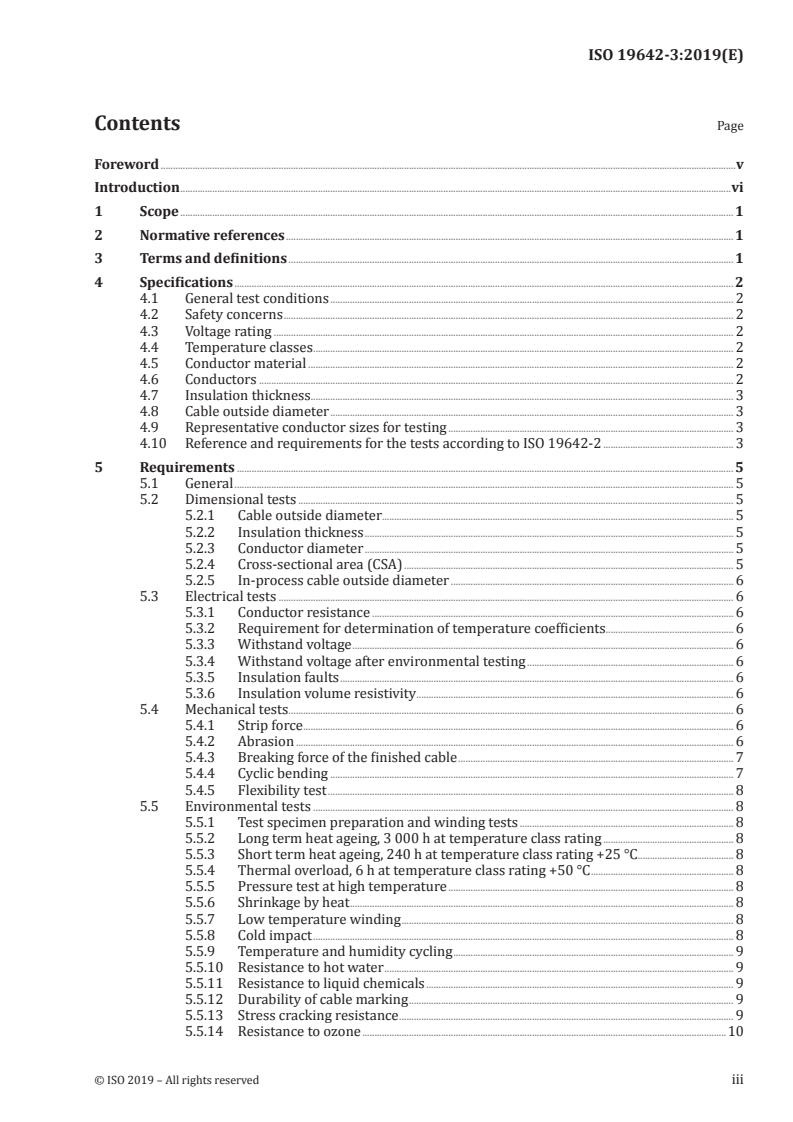
Contents Page
Foreword .v
Introduction .vi
1 Scope . 1
2 Normative references . 1
3 Terms and definitions . 1
4 Specifications . 2
4.1 General test conditions . 2
4.2 Safety concerns . 2
4.3 Voltage rating . 2
4.4 Temperature classes . 2
4.5 Conductor material . 2
4.6 Conductors . 2
4.7 Insulation thickness. 3
4.8 Cable outside diameter . 3
4.9 Representative conductor sizes for testing . 3
4.10 Reference and requirements for the tests according to ISO 19642-2 . 3
5 Requirements . 5
5.1 General . 5
5.2 Dimensional tests . 5
5.2.1 Cable outside diameter. 5
5.2.2 Insulation thickness . 5
5.2.3 Conductor diameter . 5
5.2.4 Cross-sectional area (CSA) . 5
5.2.5 In-process cable outside diameter . 6
5.3 Electrical tests . 6
5.3.1 Conductor resistance . 6
5.3.2 Requirement for determination of temperature coefficients . 6
5.3.3 Withstand voltage . 6
5.3.4 Withstand voltage after environmental testing . 6
5.3.5 Insulation faults . 6
5.3.6 Insulation volume resistivity . 6
5.4 Mechanical tests . 6
5.4.1 Strip force . 6
5.4.2 Abrasion . 6
5.4.3 Breaking force of the finished cable . 7
5.4.4 Cyclic bending . 7
5.4.5 Flexibility test . 8
5.5 Environmental tests . 8
5.5.1 Test specimen preparation and winding tests . 8
5.5.2 Long term heat ageing, 3 000 h at temperature class rating . 8
5.5.3 Short term heat ageing, 240 h at temperature class rating +25 °C. 8
5.5.4 Thermal overload, 6 h at temperature class rating +50 °C . 8
5.5.5 Pressure test at high temperature . 8
5.5.6 Shrinkage by heat . 8
5.5.7 Low temperature winding . 8
5.5.8 Cold impact . 8
5.5.9 Temperature and humidity cycling . 9
5.5.10 Resistance to hot water . 9
5.5.11 Resistance to liquid chemicals . 9
5.5.12 Durability of cable marking . 9
5.5.13 Stress cracking resistance . 9
5.5.14 Resistance to ozone .10
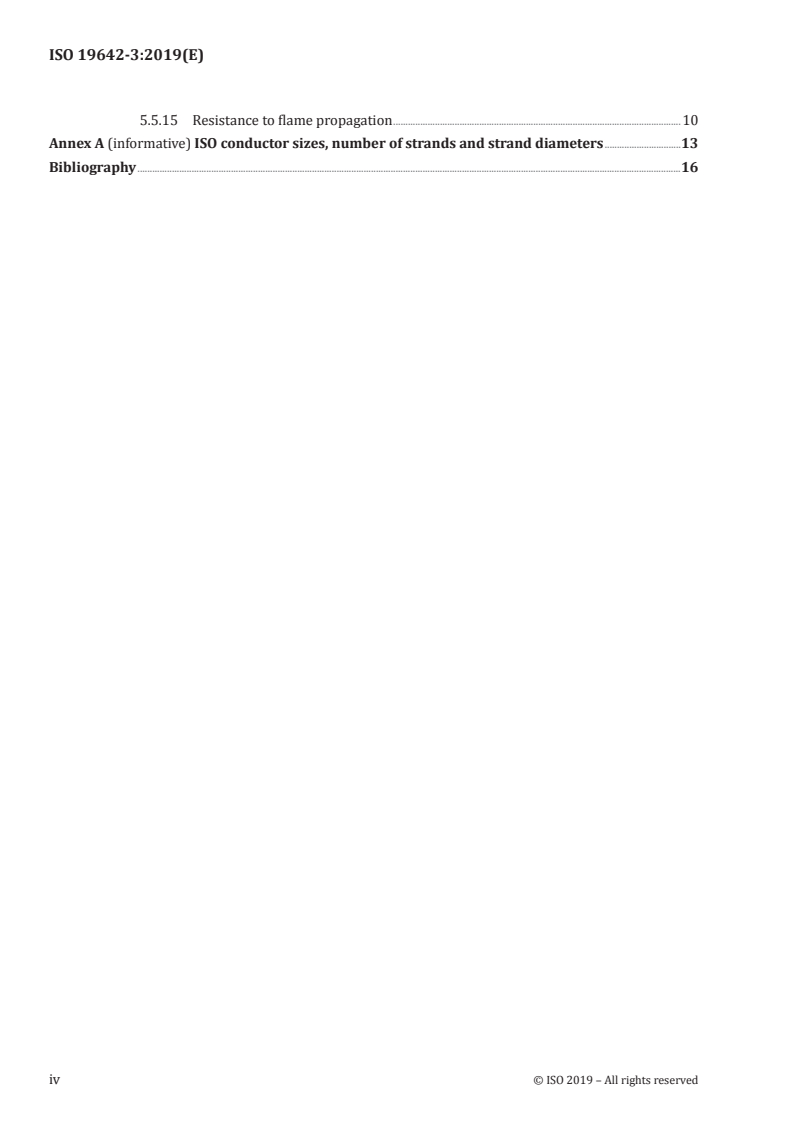
5.5.15 Resistance to flame propagation .10
Annex A (informative) ISO conductor sizes, number of strands and strand diameters .13
Bibliography .16
iv © ISO 2019 – All rights reserved
Foreword
ISO (the International Organization for Standardization) is a worldwide federation of national standards
bodies (ISO member bodies). The work of preparing International Standards is normally carried out
through ISO technical committees. Each member body interested in a subject for which a technical
committee has been established has the right to be represented on that committee. International
organizations, governmental and non-governmental, in liaison with ISO, also take part in the work.
ISO collaborates closely with the International Electrotechnical Commission (IEC) on all matters of
electrotechnical standardization.
The procedures used to develop this document and those intended for its further maintenance are
described in the ISO/IEC Directives, Part 1. In particular, the different approval criteria needed for the
different types of ISO documents should be noted. This document was drafted in accordance with the
editorial rules of the ISO/IEC Directives, Part 2 (see www .iso .org/directives).
Attention is drawn to the possibility that some of the elements of this document may be the subject of
patent rights. ISO shall not be held responsible for identifying any or all such patent rights. Details of
any patent rights identified during the development of the document will be in the Introduction and/or
on the ISO list of patent declarations received (see www .iso .org/patents).
Any trade name used in this document is information given for the convenience of users and does not
constitute an endorsement.
For an explanation of the voluntary nature of standards, the meaning of ISO specific terms and
expressions related to conformity assessment, as well as information about ISO's adherence to the
World Trade Organization (WTO) principles in the Technical Barriers to Trade (TBT), see www .iso
.org/iso/foreword .html.
This document was prepared by Technical Committee ISO/TC 22, Road vehicles, Subcommittee SC 32,
Electrical and electronic components and general system aspects.
A list of all parts in the ISO 19642 series can be found on the ISO website.
Any feedback or questions on this document should be directed to the user’s national standards body. A
complete listing of these bodies can be found at www .iso .org/members .html.
Introduction
This document was prepared following a joint resolution to improve the general structure of the ISO
Automotive Electric Cable standards. This new structure adds more clarity and, by defining a new
standard family, opens up the standard for future amendments.
Many other standards currently refer to ISO 6722-1, ISO 6722-2 and ISO 14572. So these standards
will stay valid at least until the next scheduled systematic review and will be replaced later on by the
ISO 19642 series.
For new Automotive Cable Projects customers and suppliers are advised on using the ISO 19642 series.
vi © ISO 2019 – All rights reserved
INTERNATIONAL STANDARD ISO 19642-3:2019(E)
Road vehicles — Automotive cables —
Part 3:
Dimensions and requirements for 30 V a.c. or 60 V d.c.
single core copper conductor cables
WARNING — The use of this document can involve hazardous materials, operations and
equipment. This document does not purport to address all of the safety concerns, if any, associated
with its use. It is the responsibility of the user of this document to establish appropriate safety
practices and determine the applicability of regulatory limitations prior to use.
1 Scope
This document specifies the dimensions and requirements for single-core cables intended for general
purpose vehicle applications where the nominal system voltage is less than or equal to 30 V a.c. or less
than or equal to 60 V d.c. It also applies to individual cores in multi-core cables.
This document specifies requirements for copper conductor cables.
2 Normative references
The following documents are referred to in the text in such a way that some or all of their content
constitutes requirements of this document. For dated references, only the edition cited applies. For
undated references, the latest edition of the referenced document (including any amendments) applies.
ISO 19642-1, Road vehicles — Automotive cables — Vocabulary and design guidelines
ISO 19642-2, Road vehicles — Automotive cables — Test methods
EN 13602, Copper and copper alloys — Drawn, round copper wire for the manufacture of electrical
conductors
ASTM B1, Standard Specification for Hard-Drawn Copper Wire
ASTM B3, Standard Specification for Soft or Annealed Copper Wire
ASTM B33, Standard Specification for Tinned Soft or Annealed Copper Wire for Electrical Purposes
ASTM B298, Standard Specification for Silver-Coated Soft or Annealed Copper Wire
ASTM B355, Standard Specification for Nickel-Coated Soft or Annealed Copper Wire
3 Terms and definitions
For the purposes of this document, the terms and definitions given in ISO 19642-1 apply.
ISO and IEC maintain terminological databases for use in standardization at the following addresses:
— ISO Online browsing platform: available at https: //www .iso .org/obp
— IEC Electropedia: available at http: //www .electropedia .org/
4 Specifications
4.1 General test conditions
The test conditions of ISO 19642-2 shall apply.
The cables shall be tested as specified in Table 2.
If suppliers and customers agree on modifications or changes to the methods and requirements, all the
changes and modifications shall be clearly documented.
4.2 Safety concerns
The precautions as described in the WARNING at the beginning of this document shall be followed.
4.3 Voltage rating
The cable described in this document is limited to 30 V a.c. and 60 V d.c. maximum.
4.4 Temperature classes
All temperature classes in ISO 19642-1 are suitable for copper conductor cables.
4.5 Conductor material
The conductors shall consist of plain or coated copper strands as shown in Table 1.
ISO conductor sizes greater than or equal to 0,5 mm shall consist of soft annealed copper or annealed
compressed wires.
ISO conductor sizes less than 0,5 mm shall consist of soft annealed copper, soft annealed compressed
copper, hard un-annealed copper or a copper alloy.
The specifications for the conductors shall be completed by material specifications. Elongation
requirements shall be established by agreement between the customer and the supplier.
The finished cable shall meet the resistance and cross-sectional area (CSA) requirements of Table 6 for
all conductors except alloys. When an alloy is used, the resistance requirement shall be established by
agreement between the customer and the supplier.
NOTE Examples for strands are shown in Annex A.
Table 1 — Conductor specifications
Description Specification number
Hard-drawn copper wire ASTM B1
Soft or annealed copper wire ASTM B3 or EN 13602
Tinned soft or annealed copper wire ASTM B33 or EN 13602
Silver-coated soft or annealed copper wire ASTM B298
Nickel-coated soft or annealed copper ASTM B355
wire
NOTE Silver and Nickel coated conductors are intended for use with high “temperature class
ratings”.
4.6 Conductors
The conductors in the finished cable shall meet the CSA and resistance requirements of Table 6.
2 © ISO 2019 – All rights reserved
The maximum diameter of the conductors is standardized and presented in Table 7.
The configuration of the stranded conductor is not standardized.
NOTE 1 Existing stranding configurations for copper conductors are presented in Table A.1.
NOTE 2 Preferred stranding configurations for copper conductors are presented in Table A.2.
Other stranding configurations may be used for copper conductors provided they meet the above
requirements and are agreed between the customer and the supplier.
4.7 Insulation thickness
The following three different insulation thicknesses are allowed in this document:
1. thick wall insulation;
2. thin wall insulation;
3. ultra-thin wall insulation.
The minimum wall thickness requirements for the different ISO conductor sizes are standardized and
specified in Table 7.
The nominal wall thickness is derived from the minimum wall thickness in Table 7 by the following
formulae:
w =×12,/50w or w = w ,8
nomnminmom in
where
w is the minimum wall thickness;
min
w is the nominal wall thickness.
nom
4.8 Cable outside diameter
The cable outside diameter for each ISO conductor size and insulation thickness is standardized and
specified in Table 7.
4.9 Representative conductor sizes for testing
When a test is required, all combinations of conductor size, insulation thickness and insulation
formulation shall meet the specified requirements.
However, if testing of representative conductor sizes is permitted by agreement between the customer
and the supplier, compliance for a cable family may be demonstrated by testing examples of large and
small conductor sizes only.
4.10 Reference and requirements for the tests according to ISO 19642-2
Table 2 provides a list of all relevant tests in ISO 19642-2:2019 for single core cables.
Table 2 — Tests
c
Mandatory If required
Initial Initial
Test description
In
b b
certifica- Periodic certifica- Periodic
a
p
...
INTERNATIONAL ISO
STANDARD 19642-3
First edition
2019-01
Road vehicles — Automotive cables —
Part 3:
Dimensions and requirements for 30
V a.c. or 60 V d.c. single core copper
conductor cables
Véhicules routiers — Cables automobiles —
Partie 3: Dimensions et exigences des câbles en cuivre mono
conducteurs de 30 V a.c. ou 60 V c.c.
Reference number
©
ISO 2019
© ISO 2019
All rights reserved. Unless otherwise specified, or required in the context of its implementation, no part of this publication may
be reproduced or utilized otherwise in any form or by any means, electronic or mechanical, including photocopying, or posting
on the internet or an intranet, without prior written permission. Permission can be requested from either ISO at the address
below or ISO’s member body in the country of the requester.
ISO copyright office
CP 401 • Ch. de Blandonnet 8
CH-1214 Vernier, Geneva
Phone: +41 22 749 01 11
Fax: +41 22 749 09 47
Email: copyright@iso.org
Website: www.iso.org
Published in Switzerland
ii © ISO 2019 – All rights reserved
Contents Page
Foreword .v
Introduction .vi
1 Scope . 1
2 Normative references . 1
3 Terms and definitions . 1
4 Specifications . 2
4.1 General test conditions . 2
4.2 Safety concerns . 2
4.3 Voltage rating . 2
4.4 Temperature classes . 2
4.5 Conductor material . 2
4.6 Conductors . 2
4.7 Insulation thickness. 3
4.8 Cable outside diameter . 3
4.9 Representative conductor sizes for testing . 3
4.10 Reference and requirements for the tests according to ISO 19642-2 . 3
5 Requirements . 5
5.1 General . 5
5.2 Dimensional tests . 5
5.2.1 Cable outside diameter. 5
5.2.2 Insulation thickness . 5
5.2.3 Conductor diameter . 5
5.2.4 Cross-sectional area (CSA) . 5
5.2.5 In-process cable outside diameter . 6
5.3 Electrical tests . 6
5.3.1 Conductor resistance . 6
5.3.2 Requirement for determination of temperature coefficients . 6
5.3.3 Withstand voltage . 6
5.3.4 Withstand voltage after environmental testing . 6
5.3.5 Insulation faults . 6
5.3.6 Insulation volume resistivity . 6
5.4 Mechanical tests . 6
5.4.1 Strip force . 6
5.4.2 Abrasion . 6
5.4.3 Breaking force of the finished cable . 7
5.4.4 Cyclic bending . 7
5.4.5 Flexibility test . 8
5.5 Environmental tests . 8
5.5.1 Test specimen preparation and winding tests . 8
5.5.2 Long term heat ageing, 3 000 h at temperature class rating . 8
5.5.3 Short term heat ageing, 240 h at temperature class rating +25 °C. 8
5.5.4 Thermal overload, 6 h at temperature class rating +50 °C . 8
5.5.5 Pressure test at high temperature . 8
5.5.6 Shrinkage by heat . 8
5.5.7 Low temperature winding . 8
5.5.8 Cold impact . 8
5.5.9 Temperature and humidity cycling . 9
5.5.10 Resistance to hot water . 9
5.5.11 Resistance to liquid chemicals . 9
5.5.12 Durability of cable marking . 9
5.5.13 Stress cracking resistance . 9
5.5.14 Resistance to ozone .10
5.5.15 Resistance to flame propagation .10
Annex A (informative) ISO conductor sizes, number of strands and strand diameters .13
Bibliography .16
iv © ISO 2019 – All rights reserved
Foreword
ISO (the International Organization for Standardization) is a worldwide federation of national standards
bodies (ISO member bodies). The work of preparing International Standards is normally carried out
through ISO technical committees. Each member body interested in a subject for which a technical
committee has been established has the right to be represented on that committee. International
organizations, governmental and non-governmental, in liaison with ISO, also take part in the work.
ISO collaborates closely with the International Electrotechnical Commission (IEC) on all matters of
electrotechnical standardization.
The procedures used to develop this document and those intended for its further maintenance are
described in the ISO/IEC Directives, Part 1. In particular, the different approval criteria needed for the
different types of ISO documents should be noted. This document was drafted in accordance with the
editorial rules of the ISO/IEC Directives, Part 2 (see www .iso .org/directives).
Attention is drawn to the possibility that some of the elements of this document may be the subject of
patent rights. ISO shall not be held responsible for identifying any or all such patent rights. Details of
any patent rights identified during the development of the document will be in the Introduction and/or
on the ISO list of patent declarations received (see www .iso .org/patents).
Any trade name used in this document is information given for the convenience of users and does not
constitute an endorsement.
For an explanation of the voluntary nature of standards, the meaning of ISO specific terms and
expressions related to conformity assessment, as well as information about ISO's adherence to the
World Trade Organization (WTO) principles in the Technical Barriers to Trade (TBT), see www .iso
.org/iso/foreword .html.
This document was prepared by Technical Committee ISO/TC 22, Road vehicles, Subcommittee SC 32,
Electrical and electronic components and general system aspects.
A list of all parts in the ISO 19642 series can be found on the ISO website.
Any feedback or questions on this document should be directed to the user’s national standards body. A
complete listing of these bodies can be found at www .iso .org/members .html.
Introduction
This document was prepared following a joint resolution to improve the general structure of the ISO
Automotive Electric Cable standards. This new structure adds more clarity and, by defining a new
standard family, opens up the standard for future amendments.
Many other standards currently refer to ISO 6722-1, ISO 6722-2 and ISO 14572. So these standards
will stay valid at least until the next scheduled systematic review and will be replaced later on by the
ISO 19642 series.
For new Automotive Cable Projects customers and suppliers are advised on using the ISO 19642 series.
vi © ISO 2019 – All rights reserved
INTERNATIONAL STANDARD ISO 19642-3:2019(E)
Road vehicles — Automotive cables —
Part 3:
Dimensions and requirements for 30 V a.c. or 60 V d.c.
single core copper conductor cables
WARNING — The use of this document can involve hazardous materials, operations and
equipment. This document does not purport to address all of the safety concerns, if any, associated
with its use. It is the responsibility of the user of this document to establish appropriate safety
practices and determine the applicability of regulatory limitations prior to use.
1 Scope
This document specifies the dimensions and requirements for single-core cables intended for general
purpose vehicle applications where the nominal system voltage is less than or equal to 30 V a.c. or less
than or equal to 60 V d.c. It also applies to individual cores in multi-core cables.
This document specifies requirements for copper conductor cables.
2 Normative references
The following documents are referred to in the text in such a way that some or all of their content
constitutes requirements of this document. For dated references, only the edition cited applies. For
undated references, the latest edition of the referenced document (including any amendments) applies.
ISO 19642-1, Road vehicles — Automotive cables — Vocabulary and design guidelines
ISO 19642-2, Road vehicles — Automotive cables — Test methods
EN 13602, Copper and copper alloys — Drawn, round copper wire for the manufacture of electrical
conductors
ASTM B1, Standard Specification for Hard-Drawn Copper Wire
ASTM B3, Standard Specification for Soft or Annealed Copper Wire
ASTM B33, Standard Specification for Tinned Soft or Annealed Copper Wire for Electrical Purposes
ASTM B298, Standard Specification for Silver-Coated Soft or Annealed Copper Wire
ASTM B355, Standard Specification for Nickel-Coated Soft or Annealed Copper Wire
3 Terms and definitions
For the purposes of this document, the terms and definitions given in ISO 19642-1 apply.
ISO and IEC maintain terminological databases for use in standardization at the following addresses:
— ISO Online browsing platform: available at https: //www .iso .org/obp
— IEC Electropedia: available at http: //www .electropedia .org/
4 Specifications
4.1 General test conditions
The test conditions of ISO 19642-2 shall apply.
The cables shall be tested as specified in Table 2.
If suppliers and customers agree on modifications or changes to the methods and requirements, all the
changes and modifications shall be clearly documented.
4.2 Safety concerns
The precautions as described in the WARNING at the beginning of this document shall be followed.
4.3 Voltage rating
The cable described in this document is limited to 30 V a.c. and 60 V d.c. maximum.
4.4 Temperature classes
All temperature classes in ISO 19642-1 are suitable for copper conductor cables.
4.5 Conductor material
The conductors shall consist of plain or coated copper strands as shown in Table 1.
ISO conductor sizes greater than or equal to 0,5 mm shall consist of soft annealed copper or annealed
compressed wires.
ISO conductor sizes less than 0,5 mm shall consist of soft annealed copper, soft annealed compressed
copper, hard un-annealed copper or a copper alloy.
The specifications for the conductors shall be completed by material specifications. Elongation
requirements shall be established by agreement between the customer and the supplier.
The finished cable shall meet the resistance and cross-sectional area (CSA) requirements of Table 6 for
all conductors except alloys. When an alloy is used, the resistance requirement shall be established by
agreement between the customer and the supplier.
NOTE Examples for strands are shown in Annex A.
Table 1 — Conductor specifications
Description Specification number
Hard-drawn copper wire ASTM B1
Soft or annealed copper wire ASTM B3 or EN 13602
Tinned soft or annealed copper wire ASTM B33 or EN 13602
Silver-coated soft or annealed copper wire ASTM B298
Nickel-coated soft or annealed copper ASTM B355
wire
NOTE Silver and Nickel coated conductors are intended for use with high “temperature class
ratings”.
4.6 Conductors
The conductors in the finished cable shall meet the CSA and resistance requirements of Table 6.
2 © ISO 2019 – All rights reserved
The maximum diameter of the conductors is standardized and presented in Table 7.
The configuration of the stranded conductor is not standardized.
NOTE 1 Existing stranding configurations for copper conductors are presented in Table A.1.
NOTE 2 Preferred stranding configurations for copper conductors are presented in Table A.2.
Other stranding configurations may be used for copper conductors provided they meet the above
requirements and are agreed between the customer and the supplier.
4.7 Insulation thickness
The following three different insulation thicknesses are allowed in this document:
1. thick wall insulation;
2. thin wall insulation;
3. ultra-thin wall insulation.
The minimum wall thickness requirements for the different ISO conductor sizes are standardized and
specified in Table 7.
The nominal wall thickness is derived from the minimum wall thickness in Table 7 by the following
formulae:
w =×12,/50w or w = w ,8
nomnminmom in
where
w is the minimum wall thickness;
min
w is the nominal wall thickness.
nom
4.8 Cable outside diameter
The cable outside diameter for each ISO conductor size and insulation thickness is standardized and
specified in Table 7.
4.9 Representative conductor sizes for testing
When a test is required, all combinations of conductor size, insulation thickness and insulation
formulation shall meet the specified requirements.
However, if testing of representative conductor sizes is permitted by agreement between the customer
and the supplier, compliance for a cable family may be demonstrated by testing examples of large and
small conductor sizes only.
4.10 Reference and requirements for the tests according to ISO 19642-2
Table 2 provides a list of all relevant tests in ISO 19642-2:2019 for single core cables.
Table 2 — Tests
c
Mandatory If required
Initial Initial
Test description
In
b b
certifica- Periodic certifica- Periodic
a
p
...