

ISO 16329:2003
(Main)Ships and marine technology — Heading control systems for high-speed craft
General Information
- Abstract
ISO 16329:2003 specifies the structure, performance, inspection and testing of heading control systems to be installed on board crafts operating under the following conditions: speed exceeding 30 kn and up to 70 kn; maximum rate of turn 20°/s; the normal range of operation between 70°N and 70°S should, as required by chapter 13 of the HSC Code, comply with the minimum performance requirements specified in these standards. ISO 16329:2003 applies to the heading control systems which enable a craft to keep a preset heading with minimum operation of the craft's steering gear, within limits related to the craft's manoeuvrability in conjunction with their sources of heading information.
- Status
- Published
- Publication Date
- 14-Apr-2003
- Technical Committee
- ISO/TC 8/SC 6 - Navigation and ship operations
- Drafting Committee
- ISO/TC 8/SC 6/WG 1 - Gyro compasses
- Current Stage
- 9092 - International Standard to be revised
- Start Date
- 29-Sep-2023
- Completion Date
- 29-Aug-2026


Overview
ISO 16329:2003 - Ships and marine technology - Heading control systems for high-speed craft - defines structure, performance, inspection and testing requirements for heading control (automatic steering) systems installed on high-speed craft. It applies to craft operating at speeds exceeding 30 kn and up to 70 kn, with a maximum rate of turn of 20°/s, and normal operation between 70°N and 70°S per chapter 13 of the HSC Code. The standard ensures heading control systems can maintain a preset heading with minimum steering gear operation, accounting for craft manoeuvrability and heading information sources.
Key topics and technical requirements
- Scope & applicability
- High-speed craft (30–70 kn); conventional arrangements assumed unless justified otherwise.
- Performance & functionality
- Ability to adapt to different steering characteristics across speed, weather and loading conditions.
- Connection to a gyro-compass where provided, otherwise electronically to a magnetic compass.
- Manufacturer must provide qualitative descriptions of heading-control errors under high speed, accelerations and sea state.
- Minimum constituents
- Heading-signal processor (with indicator), preset-heading control, adjustment controls, automatic-steering device, change-over device, alarms/signalling, steering-mode and heading-source indicators.
- Change-over and control
- Change-over between automatic and manual steering must be possible at any rudder position and activated by one manual control within 3 seconds.
- When switching to automatic, the system shall take over the actual heading as the preset heading.
- Manual override and suitable change-over location and indicators required.
- Operational controls
- Easy-to-identify and usable adjustment and operational controls; non-essential controls should not be readily accessible.
- Safety, EMC & environmental
- Equipment shall meet environmental requirements of IEC 60945 for weather-protected categories.
- Type testing includes magnetic-compass safe-distance, EMC/environmental tests, control characteristic tests (e.g., 200° turn, heading stability, overshoot).
- Documentation & fall-back
- Marking, information to users and fall-back arrangements are specified.
Applications and who uses it
- Shipbuilders and naval architects specifying steering systems for high-speed ferries, patrol boats and passenger craft.
- Marine automation and autopilot manufacturers designing heading control systems compliant with HSC Code requirements.
- System integrators connecting gyro-compasses or transmitting magnetic compasses to autopilots.
- Classification societies, flag-state regulators and ship operators verifying performance, testing and certification.
Related standards
- ISO 16328 - Gyro-compasses for high-speed craft
- ISO 694 - Positioning of magnetic compasses in ships
- IEC 60945 - Maritime navigation equipment - general requirements and tests
- IMO resolutions referenced: A.694(17), A.822(19), MSC.64(67) (A.342(IX) amendments)
Keywords: ISO 16329:2003, heading control systems, high-speed craft, automatic steering, gyro-compass, magnetic compass, HSC Code, IEC 60945, heading stability, rudder control.
Relations
- Consolidated By
ISO 27509:2012 - Petroleum and natural gas industries — Compact flanged connections with IX seal ring - Effective Date
- 06-Jun-2022
Get Certified
Connect with accredited certification bodies for this standard

DNV
DNV is an independent assurance and risk management provider.

Lloyd's Register
Lloyd's Register is a global professional services organisation specialising in engineering and technology.

FSC International
Forest Stewardship Council certification.
Sponsored listings
Frequently Asked Questions
ISO 16329:2003 is a standard published by the International Organization for Standardization (ISO). Its full title is "Ships and marine technology — Heading control systems for high-speed craft". This standard covers: ISO 16329:2003 specifies the structure, performance, inspection and testing of heading control systems to be installed on board crafts operating under the following conditions: speed exceeding 30 kn and up to 70 kn; maximum rate of turn 20°/s; the normal range of operation between 70°N and 70°S should, as required by chapter 13 of the HSC Code, comply with the minimum performance requirements specified in these standards. ISO 16329:2003 applies to the heading control systems which enable a craft to keep a preset heading with minimum operation of the craft's steering gear, within limits related to the craft's manoeuvrability in conjunction with their sources of heading information.
ISO 16329:2003 specifies the structure, performance, inspection and testing of heading control systems to be installed on board crafts operating under the following conditions: speed exceeding 30 kn and up to 70 kn; maximum rate of turn 20°/s; the normal range of operation between 70°N and 70°S should, as required by chapter 13 of the HSC Code, comply with the minimum performance requirements specified in these standards. ISO 16329:2003 applies to the heading control systems which enable a craft to keep a preset heading with minimum operation of the craft's steering gear, within limits related to the craft's manoeuvrability in conjunction with their sources of heading information.
ISO 16329:2003 is classified under the following ICS (International Classification for Standards) categories: 47.020.70 - Navigation and control equipment. The ICS classification helps identify the subject area and facilitates finding related standards.
ISO 16329:2003 has the following relationships with other standards: It is inter standard links to ISO 27509:2012. Understanding these relationships helps ensure you are using the most current and applicable version of the standard.
ISO 16329:2003 is available in PDF format for immediate download after purchase. The document can be added to your cart and obtained through the secure checkout process. Digital delivery ensures instant access to the complete standard document.
Standards Content (Sample)
INTERNATIONAL ISO
STANDARD 16329
First edition
2003-04-15
Ships and marine technology — Heading
control systems for high-speed craft
Navires et technologie maritime — Systèmes de pilotage automatique
pour les navires à grande vitesse
Reference number
©
ISO 2003
PDF disclaimer
This PDF file may contain embedded typefaces. In accordance with Adobe's licensing policy, this file may be printed or viewed but
shall not be edited unless the typefaces which are embedded are licensed to and installed on the computer performing the editing. In
downloading this file, parties accept therein the responsibility of not infringing Adobe's licensing policy. The ISO Central Secretariat
accepts no liability in this area.
Adobe is a trademark of Adobe Systems Incorporated.
Details of the software products used to create this PDF file can be found in the General Info relative to the file; the PDF-creation
parameters were optimized for printing. Every care has been taken to ensure that the file is suitable for use by ISO member bodies. In
the unlikely event that a problem relating to it is found, please inform the Central Secretariat at the address given below.
© ISO 2003
All rights reserved. Unless otherwise specified, no part of this publication may be reproduced or utilized in any form or by any means,
electronic or mechanical, including photocopying and microfilm, without permission in writing from either ISO at the address below or
ISO's member body in the country of the requester.
ISO copyright office
Case postale 56 • CH-1211 Geneva 20
Tel. + 41 22 749 01 11
Fax + 41 22 749 09 47
E-mail copyright@iso.org
Web www.iso.org
Published in Switzerland
ii © ISO 2003 — All rights reserved
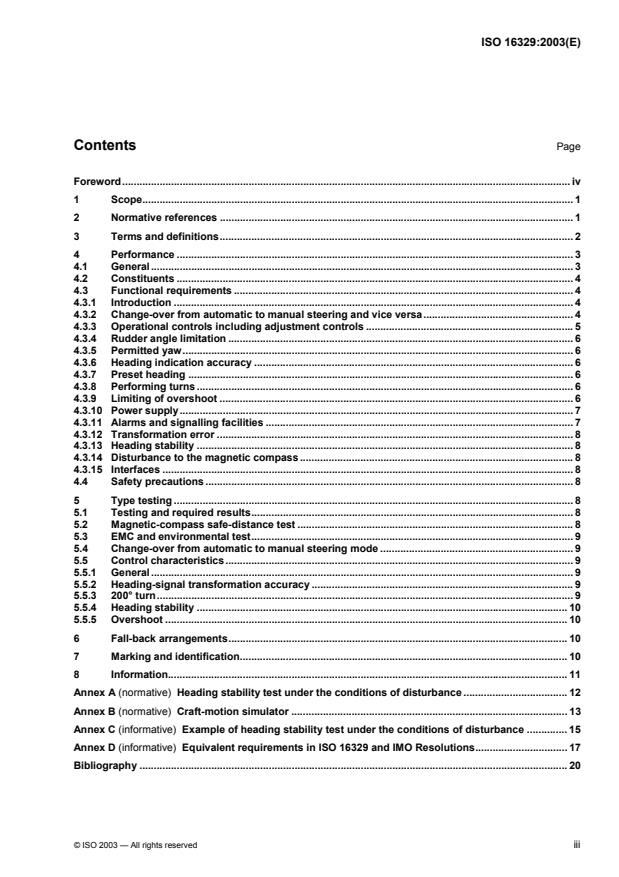
Contents Page
Foreword. iv
1 Scope. 1
2 Normative references. 1
3 Terms and definitions. 2
4 Performance. 3
4.1 General. 3
4.2 Constituents. 4
4.3 Functional requirements. 4
4.3.1 Introduction. 4
4.3.2 Change-over from automatic to manual steering and vice versa. 4
4.3.3 Operational controls including adjustment controls .5
4.3.4 Rudder angle limitation . 6
4.3.5 Permitted yaw. 6
4.3.6 Heading indication accuracy . 6
4.3.7 Preset heading. 6
4.3.8 Performing turns. 6
4.3.9 Limiting of overshoot . 6
4.3.10 Power supply. 7
4.3.11 Alarms and signalling facilities . 7
4.3.12 Transformation error. 8
4.3.13 Heading stability. 8
4.3.14 Disturbance to the magnetic compass . 8
4.3.15 Interfaces. 8
4.4 Safety precautions. 8
5 Type testing. 8
5.1 Testing and required results. 8
5.2 Magnetic-compass safe-distance test . 8
5.3 EMC and environmental test. 9
5.4 Change-over from automatic to manual steering mode . 9
5.5 Control characteristics. 9
5.5.1 General. 9
5.5.2 Heading-signal transformation accuracy . 9
5.5.3 200° turn. 9
5.5.4 Heading stability. 10
5.5.5 Overshoot. 10
6 Fall-back arrangements. 10
7 Marking and identification. 10
8 Information. 11
Annex A (normative) Heading stability test under the conditions of disturbance . 12
Annex B (normative) Craft-motion simulator . 13
Annex C (informative) Example of heading stability test under the conditions of disturbance . 15
Annex D (informative) Equivalent requirements in ISO 16329 and IMO Resolutions. 17
Bibliography . 20
Foreword
ISO (the International Organization for Standardization) is a worldwide federation of national standards bodies
(ISO member bodies). The work of preparing International Standards is normally carried out through ISO
technical committees. Each member body interested in a subject for which a technical committee has been
established has the right to be represented on that committee. International organizations, governmental and
non-governmental, in liaison with ISO, also take part in the work. ISO collaborates closely with the
International Electrotechnical Commission (IEC) on all matters of electrotechnical standardization.
International Standards are drafted in accordance with the rules given in the ISO/IEC Directives, Part 2.
The main task of technical committees is to prepare International Standards. Draft International Standards
adopted by the technical committees are circulated to the member bodies for voting. Publication as an
International Standard requires approval by at least 75 % of the member bodies casting a vote.
Attention is drawn to the possibility that some of the elements of this document may be the subject of patent
rights. ISO shall not be held responsible for identifying any or all such patent rights.
ISO 16329 was prepared by Technical Committee ISO/TC 8, Ships and marine technology, Subcommittee
SC 6, Navigation.
iv © ISO 2003 — All rights reserved
INTERNATIONAL STANDARD ISO 16329:2003(E)
Ships and marine technology — Heading control systems for
high-speed craft
1 Scope
This International Standard specifies the structure, performance, inspection and testing of heading control
systems to be installed on board craft operating under the following conditions:
a) speed exceeding 30 kn and up to 70 kn;
b) maximum rate of turn 20°/s;
c) normal range of operation between 70°N and 70°S should, as required by chapter 13 of the HSC Code,
comply with the minimum performance requirements specified in these standards.
This International Standard applies to the heading control systems which enable a craft to keep a preset
heading with minimum operation of the craft's steering gear, within limits related to the craft's manoeuvrability
in conjunction with their sources of heading information.
This International Standard assumes the use of a conventional arrangement. Where other arrangements are
provided, the requirements of this standard should apply insofar as they are applicable, and appropriate
justification provided where deviation from the requirements is necessary.
The heading control systems should, within a speed range of up to 30 knots, comply with resolution A.342(IX),
and within a speed range of 30 knots to 70 knots should comply with the requirements of this resolution.
NOTE 1 All requirements that are extracted from the recommendations of IMO Resolutions [Resolution A.822(19) on
performance standards for automatic steering aids for high-speed craft, A.694(17) and A.342(IX)] are printed in italics.
NOTE 2 The heading control system was previously called “automatic steering aids (automatic pilot)”.
NOTE 3 Resolution A.342(IX) represents Resolution A.342(IX) as amended by MSC.64(67), Annex 3.
2 Normative references
The following referenced documents are indispensable for the application of this document. For dated
references, only the edition cited applies. For undated references, the latest edition of the referenced
document (including any amendments) applies.
ISO 694, Ships and marine technology — Positioning of magnetic compasses in ships
ISO 16328, Ships and marine technology — Gyro-compasses for high-speed craft
IEC 60945, Maritime navigation and radiocommunication equipment and systems — General requirements —
Methods of testing and required test results
IEC 61162 (all parts), Maritime navigation and radiocommunication equipment and systems — Digital
interfaces
IMO Resolution A.694(17), General requirements for shipborne radio equipment forming part of the global
maritime distress and safety system (GMDSS) and for electronic navigational aids
IMO Resolution A.822(19), Performance standards for automatic steering aids (automatic pilots) for high-
speed craft
IMO Resolution MSC.64(67), Annex 3:1997, Amendment to resolution A.342(IX), Performance standards for
heading control systems
3 Terms and definitions
For the purposes of this document, the following terms and definitions apply.
3.1
heading
horizontal direction in which a craft actually points or heads at any instant, expressed in degrees from a
reference direction, usually from 000° at the reference direction clockwise through 360°, where 360° becomes
identical with 000°
3.2
preset heading
horizontal direction in which a craft is steered or intended to be steered, expressed as the angular direction
with respect to north (true/magnetic), from 000° clockwise through 360°, where 360° becomes identical with
000°
3.3
manual steering
method of controlling the steering gear manually
EXAMPLE Using a steering wheel.
3.4
automatic steering
method of controlling the steering gear automatically to enable a craft to keep, or change to, a preset heading
by processing the heading information obtained from a heading source, such as a gyro-compass or
transmitting magnetic compass, etc.
3.5
change-over device
device for changing-over from automatic to manual steering and vice versa
3.6
automatic-steering device
device which controls automatic steering
3.7
proportional rudder adjustment
adjustment of a component of the total rudder command in proportion to an instantaneous value of the
difference between the preset heading and actual heading
3.8
derivative rudder adjustment
counter rudder adjustment
adjustment of a component of the total rudder command which acts to control the rate of turn of the craft
2 © ISO 2003 — All rights reserved
3.9
integral rudder adjustment
adjustment of a component of the total rudder command which is in proportion to the integral value of the
heading deviation
3.10
weather adjustment
adjustment which minimizes unnecessary steering motion against yawing caused by waves, swells and wind
3.11
adjustment control
device which changes the characteristics of an automatic steering device, including proportional rudder
adjustment, derivative rudder adjustment, integral rudder adjustment and weather adjustment
3.12
operational device
switch, key, knob, etc. which is used for operating a heading control system
3.13
heading-signal processor
unit which processes the heading signal generated by a gyro-compass, magnetic compass, etc., and adapts it
before its use by the heading control system
3.14
override function
intentional fast change-over from automatic to temporary manual control
3.15
conning position
place on the bridge with a commanding view providing the necessary information and equipment for the
conning officer to carry out his functions
3.16
turn-rate control
method of controlling the rudder of a vessel to perform turns with a preset rate of turn
3.17
turning radius control
method of controlling the rate of turn of a vessel to perform turns with a preset turning radius
4 Performance
4.1 General
4.1.1 The heading control system shall be capable of adapting manually or automatically to different
steering characteristics of the craft under various speed, weather and loading conditions, and provide reliable
operation under prevailing environment and normal operational conditions.
4.1.2 The heading control system shall be connected to the gyro-compass if a gyro-compass is provided.
Otherwise it shall be electronically connected to the magnetic compass.
4.1.3 A qualitative description of the effects of the heading control system errors due to high speed,
accelerations, heading changes, sea state, etc., and a qualitative description of corresponding errors in other
navigation system, shall be provided to the user. This information shall be provided by the manufacturer.
4.1.4 Heading control systems shall conform to the environmental requirements of IEC 60945 for equipment
categories protected from the weather.
4.2 Constituents
A heading control system shall be composed, as a minimum, of the following components (see Figure 1):
a) heading-signal processor (including an indicator of the heading);
b) operational control for preset heading;
c) operational controls for adjustments;
d) automatic steering devices;
e) change-over device (with steering-mode indicator) which is not required to be an integrated part of the
heading control system;
f) alarm signalling facilities compliant with the requirements of this International Standard;
g) indicators for steering mode and heading source in use.
4.3 Functional requirements
4.3.1 Introduction
The following requirements shall be fulfilled.
4.3.2 Change-over from automatic to manual steering and vice versa
4.3.2.1 Change-over from automatic to manual steering and vice-versa shall be possible at any position
of the rudder and shall be activated by one manual control within 3 seconds.
4.3.2.2 Change-over from automatic to manual steering shall be possible under any conditions, including
any failure in the heading control system.
4.3.2.3 When changing-over from manual to automatic steering, the heading control system (automatic
pilot) shall take over the actual heading as the preset heading.
4.3.2.4 Change-over from manual steering with override function to automatic steering shall not be
possible without an intended action of the craft’s personnel.
4.3.2.5 Change-over devices shall be located close to each other in the immediate vicinity of the position
at which the equipment is normally operated.
4.3.2.6 Adequate indication shall be provided to show which method of steering is in operation at a
particular moment. This indicator shall be fitted near the change-over devices.
4.3.2.7 The installation shall include manual steering with an override function.
4 © ISO 2003 — All rights reserved
a
The portion enclosed by the thick line shows the constituent devices of a heading control system which are specified
in this International Standard.
b
The change-over device is not required to be an integrated part of the heading control systems.
c
Alarm indicating devices may be external units.
Figure 1 — Typical block diagram for heading control systems
4.3.3 Operational controls including adjustment controls
4.3.3.1 All operational controls shall permit normal adjustments to be easily performed and shall be easy
to identify from the position at which the equipment is normally operated. Controls not required for normal
operation shall not be readily accessible.
4.3.3.2 The heading control system shall be provided with automatic and manually operated controls for
operational use to adjust the system to the craft’s steering performance to take account of the effects of
changing weather. The heading control systems may be provided with automatic or manually operated
controls for operational use to adjust the system to the craft’s steering performance to take account of
changing speed and loading conditions.
4.3.3.3 Adequate illumination shall be provided in the equipment or in the craft to enable identification of
controls and facilitate reading of indicators at all times. Means shall be provided for dimming the output of any
equipment light source which is capable of interfering with navigation.
4.3.3.4 The heading control system shall be designed in such a way as to ensure altering the preset
heading to starboard by turning the heading setting control clockwise or tilting it to the right-hand side. Turning
the control counterclockwise or tilting it to the left shall effect a similar alteration to port. Normal alterations of
heading shall be possible by one adjustment only of the preset heading control. Requirements shall be made
by means of the design and the construction of the preset heading control to preclude unintended alteration of
heading.
4.3.3.5 When changing heading, the clockwise (right-hand side) or counterclockwise (left-hand side)
direction of preset heading adjustment shall determine the craft’s turning direction.
4.3.3.6 Where remote control stations are provided, facilities for the delegation of control to the remote
station and unconditional return of control shall be incorporated in the master station.
4.3.3.7 Except for the preset heading setting control, the actuation of any other control shall not
significantly affect the heading of the craft.
4.3.3.8 Additional controls at remote positions shall comply with the provisions of this standard.
4.3.4 Rudder angle limitation
Means shall be incorporated in the equipment to enable adjustable rudder angle limitation in
...